“Love is patient…”: Ten songs based on 1 Corinthians 13

This Sunday’s lectionary reading from the Epistles is 1 Corinthians 13:1–13, the famous “love” passage. Here are ten songs that set that text or are based on it. And there are many more besides!

1. “1 Corinthians 13:1–8,” chanted in Romanian by Maria Coman, 2023:

2. “Love Will Never Fail” by Leslie Jordan, Orlando Palmer, Isaac Wardell, and Paul Zach of The Porter’s Gate, from Neighbor Songs, 2019:

For a cover by the Good Shepherd Collective, featuring Jayne Sugg and Son of Cloud (Jonathan Seale) (his is one of my favorite male singing voices), see here. They add as an outro the refrain of Martin Smith’s “I Could Sing of Your Love Forever.”

3. “Tell Him” by Lauryn Hill, 1998, performed by Esperanza Spalding, 2009:

The neo-soul/R&B album The Miseducation of Lauryn Hill (1998), Hill’s solo debut, is one of the most widely acclaimed albums of the nineties. At an evening of jazz and spoken word hosted at the White House on May 19, 2009, by then president Barack Obama, upright bass player, singer, and composer Esperanza Spalding performed her gorgeous arrangement of Hill’s “Tell Him.” The object pronoun “him” used throughout has been interpreted by listening publics as either a romantic partner or God, and the ambiguity is probably intentional. As for me, I hear the song as religious, especially given the line “the love that was shown when our lives were spared,” which I take to be a reference to Christ’s saving sacrifice. [HT]

4. “1 Corinthians 13:8–11” (excerpt) from Uganda, 2021:

This video was uploaded by Bwire Isaac, the founder of Alpha Worship Connection, a registered nonprofit that trains and equips worship leaders in Uganda. It was filmed at one of his Discipleship Training Weeks, and features a pastor named Muwanguzi playing the adungu (bow harp). I believe the language is Luganda. [HT]

5. “Love (1 Corinthians 13)” by Joni Mitchell, from Wild Things Run Fast, 1982:

The song also appears, re-recorded and in new arrangement, on Mitchell’s Travelogue (2002). Hear her speak about how the apostle Paul’s words inspired her in this two-minute video.

(Related post: “The Greatest of These,” a poem by Tania Runyan)

6. “Faith, Hope and Love” by Joanna Forbes L’Estrange, performed by London Voices, dir. Ben Parry, from Heaven to Earth, 2024:

7. “El Amor (1 Corintios 13)” by Michelle Matius, 2023:

Matius is a Christian singer-songwriter and recording artist from the Dominican Republic. Like all her songs, this one is in Spanish.

8. “Live for Love” by Eric Lige, 2022:

9. “The Gift of Love” by Hal Hopson, 1972, performed by Koiné on Gesanbuch, 2008:

The music of this one is adapted from a traditional English folk tune.

10. “Kanoo” (Love) by Elfi Bohl, aka Mariyama Suso, from Suukuu Kutoo / A New Song, 1999:

Bohl’s “Kanoo” is an original setting of 1 Corinthians 13:4–7 in the Mandinka language of West Africa, which she sings to a kora self-accompaniment. She wrote and recorded it while living in The Gambia. To learn more about Bohl and her kora songs, see my previous blog post from December.
Advent, Day 1: Rend the Heavens!

O that you would tear open the heavens and come down!

—Isaiah 64:1a

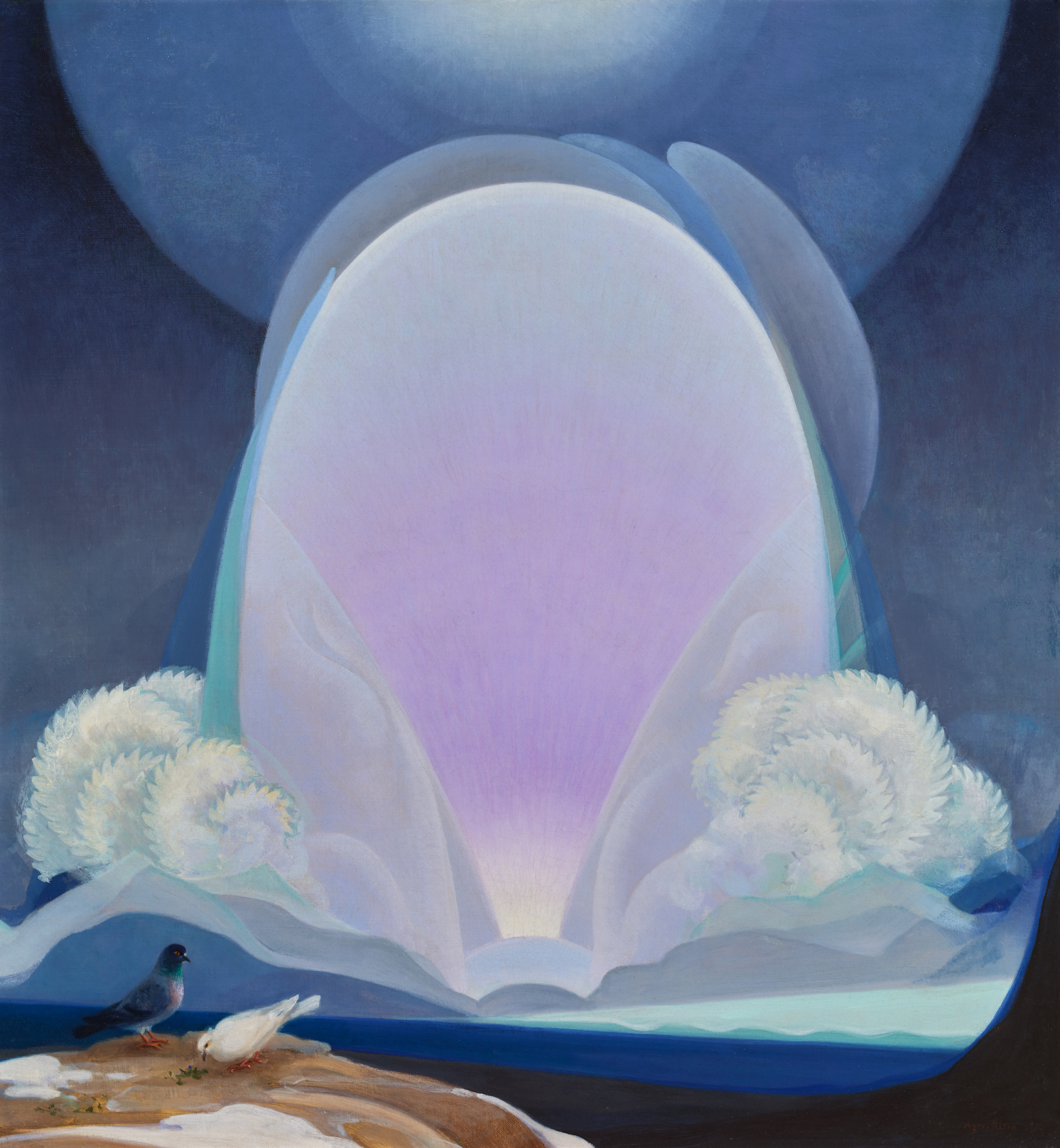
LOOK: Winter by Agnes Pelton

Pelton, Agnes_Winter
Agnes Pelton (American, 1881–1961), Winter, 1933. Oil on canvas, 30 × 28 in. Crocker Art Museum, Sacramento, California.

Agnes Pelton was part of the Transcendental Painting Group, an artists’ collective founded in the American Southwest in 1938 on the principles of creating a pure abstract painting style imbued with spiritual intent. Clayton Schuster, writing for Hyperallergic, describes one of Pelton’s metaphysical landscapes:

Pelton’s Winter (1933) depicts a pigeon and dove on a cliff in the foreground, with a great blooming cloud in the distance. The arched lavender cloud against the dark sky seems to suggest the narrow path toward a new beginning, as a pale glow at the top of the painting symbolizes hidden truths. Within the cloud are delicate lines hinting at two hills. The cloud seems to glow where the hills nearly meet and delineate the valley. It is as if Pelton has excavated a road from the cloud and revealed the path to paradise.

Pelton shows us a new way opening. The sky has been rent, and light breaks in. To either side of the central bulbous form are tooth-edged wheels in motion. At the bottom left, the snow is melting at the emerging warmth, revealing tiny green shoots on the ground. The two doves perhaps signify a coming peace.

Full of mystical yearning, this painting shouts “Advent!” to me. It evokes in my mind not only the Isaianic exclamation cited above—the basis for today’s featured song (below)—but several other Advent scriptures as well, such as Isaiah 40:3–5 (pave a straight path for God through the desert; every hill, every valley . . .), Psalm 98:8–9 (“let the hills sing together for joy at the presence of the Lord, for he is coming . . .”), and Revelation 1:7 (“Look! He is coming with the clouds”; cf. Matthew 24:30: “they will see ‘the Son of Man coming on the clouds of heaven’ with power and great glory”).

Pelton was not a Christian—she rejected organized religion—but her artworks are so wonderfully expansive in the associations and interpretations they invite.

For more on the artist, see the wonderful book Agnes Pelton: Desert Transcendentalist, a catalog of a recent major retrospective of her work organized by the Phoenix Art Museum.

LISTEN: “O Savior, Rend the Heavens Wide” (original title: “O Heiland, reiß die Himmel auf”) | Original German words by Friedrich Spee, 1622; translated into English by Martin L. Seltz, 1965, ©1969 Concordia Publishing House | Tune: O HEILAND, REISS DIE HIMMEL AUF, from Gesangbuch, Augsburg, 1666 | Performed by Koiné on Anno Domini, 2009 [sheet music]

O Savior, rend the heavens wide;
Come down, come down with mighty stride;
Unlock the gates, the doors break down;
Unbar the way to heaven’s crown.

O Morning Star, O radiant Dawn,
When will we sing your morning song?
Come, Son of God! Without your light
We grope in dread and gloom of night.

Sin’s dreadful doom upon us lies;
Grim death looms fierce before our eyes.
O come, lead us with mighty hand
From exile to our promised land.

There shall we all our praises bring
And sing to you, our Savior King;
There shall we laud you and adore
Forever and forevermore.

The German hymn text “O Heiland, reiß die Himmel auf” (O Savior, Rend the Heavens Wide) is by Friedrich Spee (1591–1635), a German Jesuit priest, professor, and poet best known for opposing the European witch trials and the use of torture. Written during the Thirty Years’ War, it was first published in Würzburg in 1622 in the collection Das Allerschönste Kind in der Welt (The Most Beautiful Child in the World).

Four-plus decades later, in 1666, a Dorian-mode melody was published anonymously with the text in the Rheinfelsisches Deutsches Katholisches Gesangbuch (German Catholic Hymnal). Then in 1863, Johannes Brahms arranged that melody as a motet for unaccompanied mixed choir (op. 74, no. 2):

The hymn entered English-speaking churches in the twentieth century when Martin L. Seltz (1909–1967) translated it.

The original chorale tune is still in use, but I’ve also heard some churches using the 2003 retune by Nathan Partain. Here’s a live recording of that version from Trinity Church Seattle, sung by Partain, back when he was the church’s music director (it was called Green Lake Presbyterian Church at the time):

The hymn also appears, with updated arrangement, on Partain’s 2019 album The Beauty to Come. The chord charts, lead sheets, and string scores for this album and two others can be downloaded for free from Partain’s website.


This post is part of a daily Advent series from December 2 to 24, 2023 (with Christmas to follow through January 6, 2024). View all the posts here, and the accompanying Spotify playlist here.

Christmas, Day 6

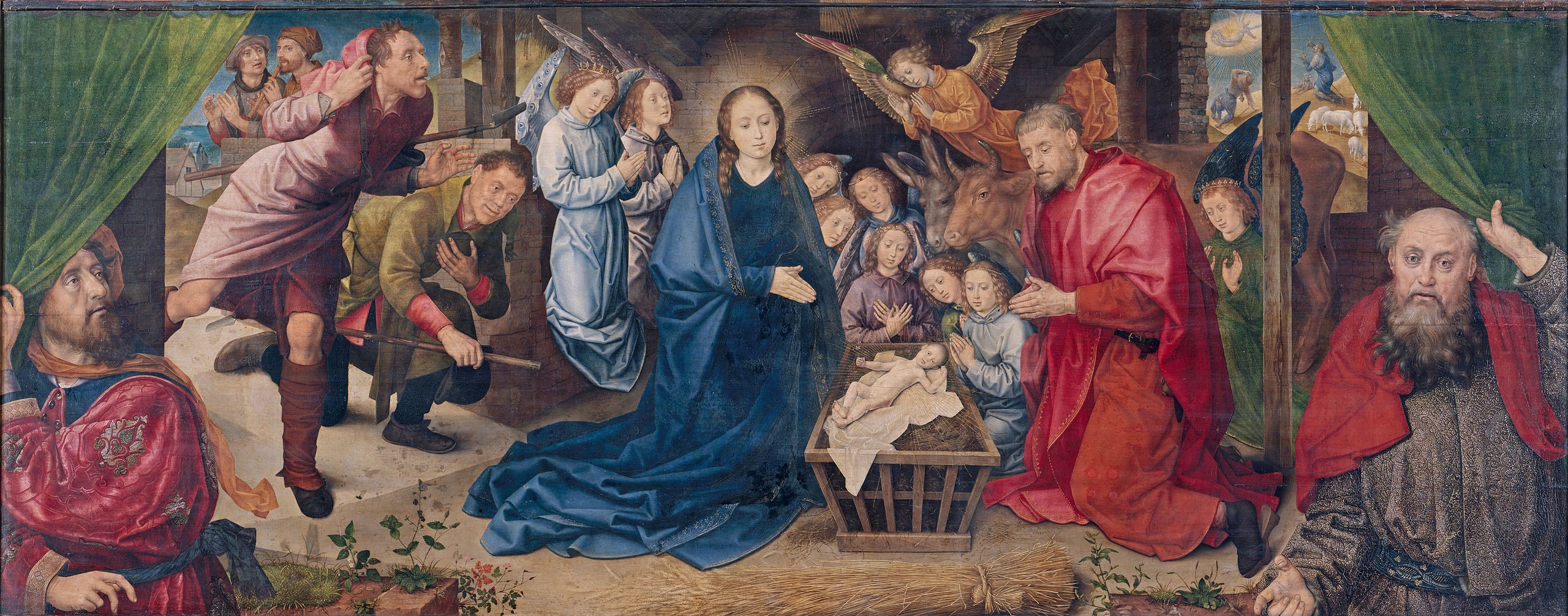
LOOK: Adoration of the Shepherds by Hugo van der Goes

van der Goes, Hugo_Adoration of the Shepherds
Hugo van der Goes (Flemish, ca. 1440–1482), Adoration of the Shepherds, ca. 1480. Oil on oak wood, 99.9 × 248.6 cm. Gemäldegalerie, Berlin.

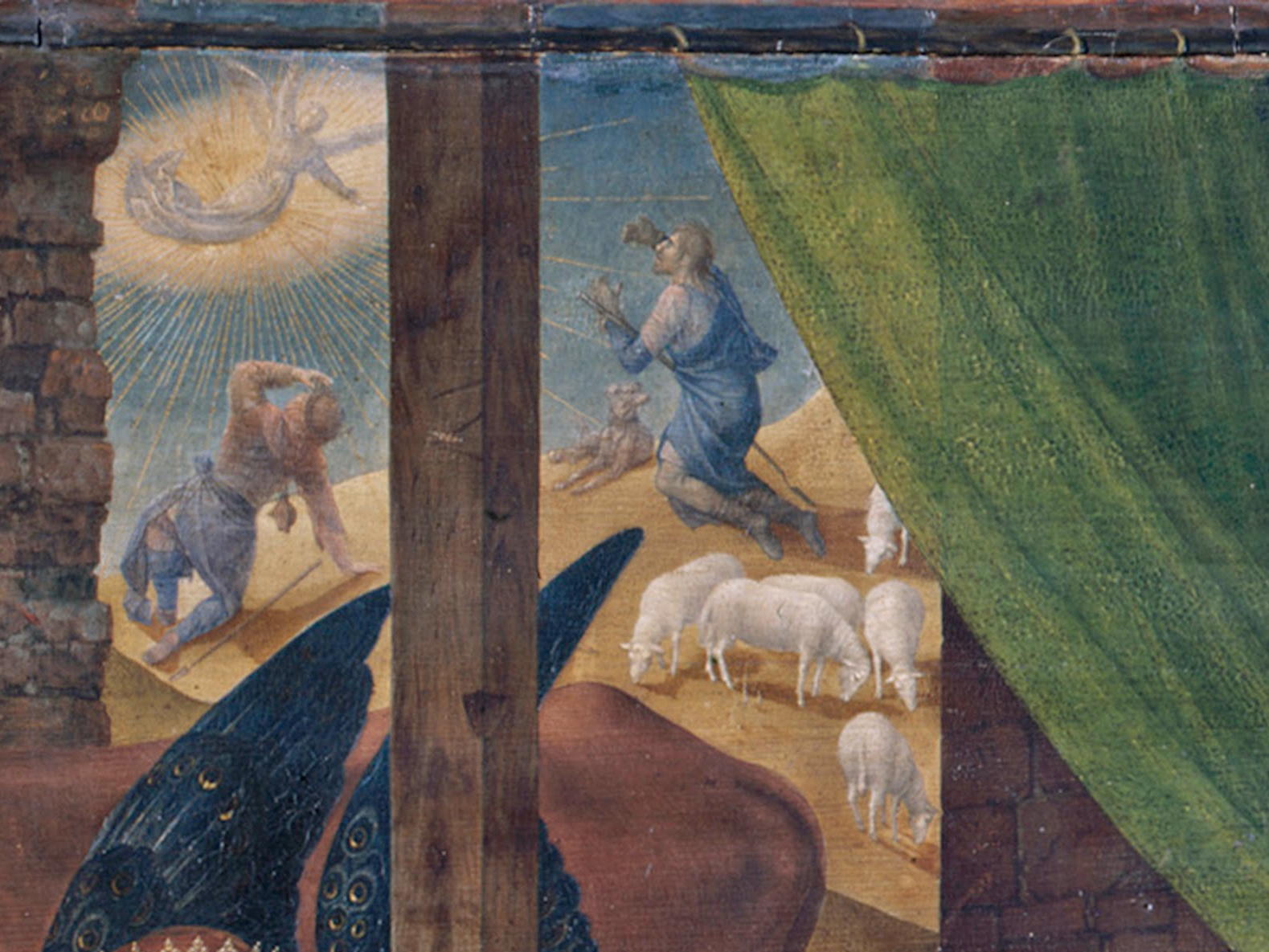
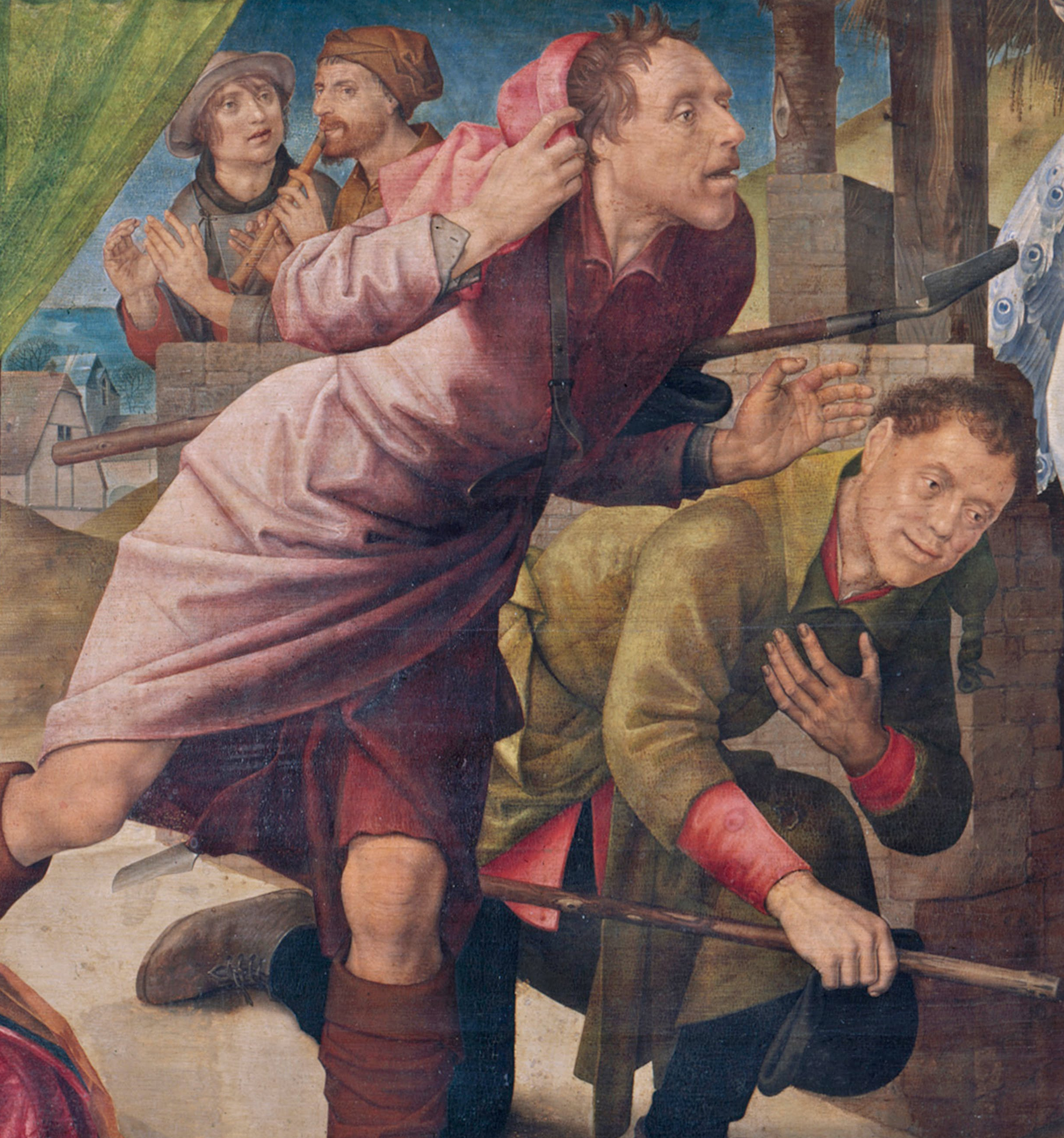
After the angel of the Lord announced the birth of the Messiah to a band of shepherds, “they went with haste” to the place where he lay (Luke 2:16). The Flemish artist Hugo van der Goes shows the shepherds’ hurried arrival at the manger. One of them gallops through the door panting, having run from the scene in the upper right corner, and another removes his hat and kneels. Two more stand behind them just outside the shed—one playing a recorder, the other in midclap.

van der Goes, Hugo_Adoration of the Shepherds (detail, Annunciation)
van der Goes, Hugo_Adoration of the Shepherds (detail, shepherds)

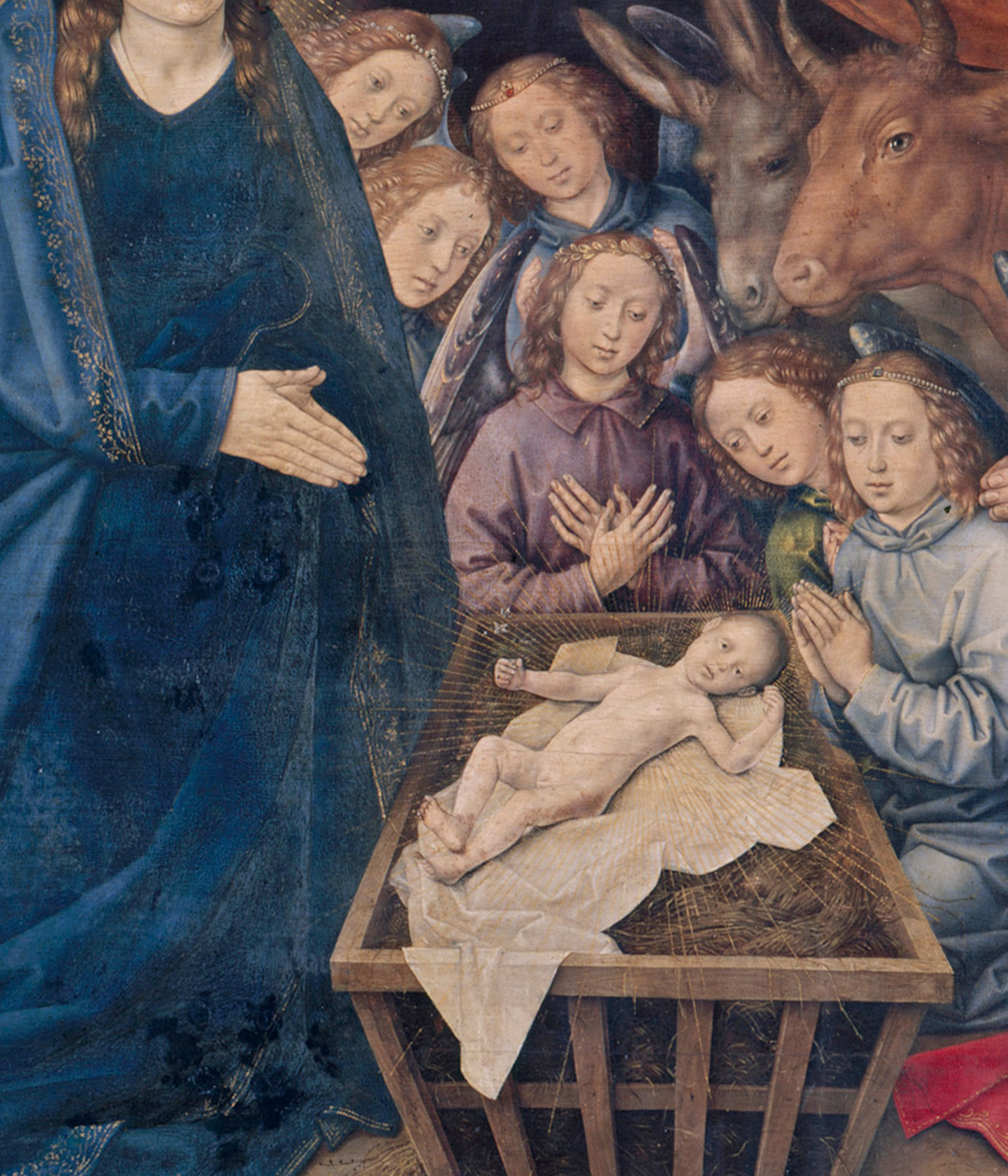
In the center of the composition, the Christ child squirms in his makeshift bed, surrounded by his parents, an ox and ass, and a coterie of angels. At the foot of the manger is a sheaf of wheat, an allusion to Jesus as “the living bread that came down from heaven” (John 6:51) and, by extension, to the Eucharist. This painting, after all, was originally made, most likely, to hang over an altar.

van der Goes, Hugo_Adoration of the Shepherds (detail, Jesus)

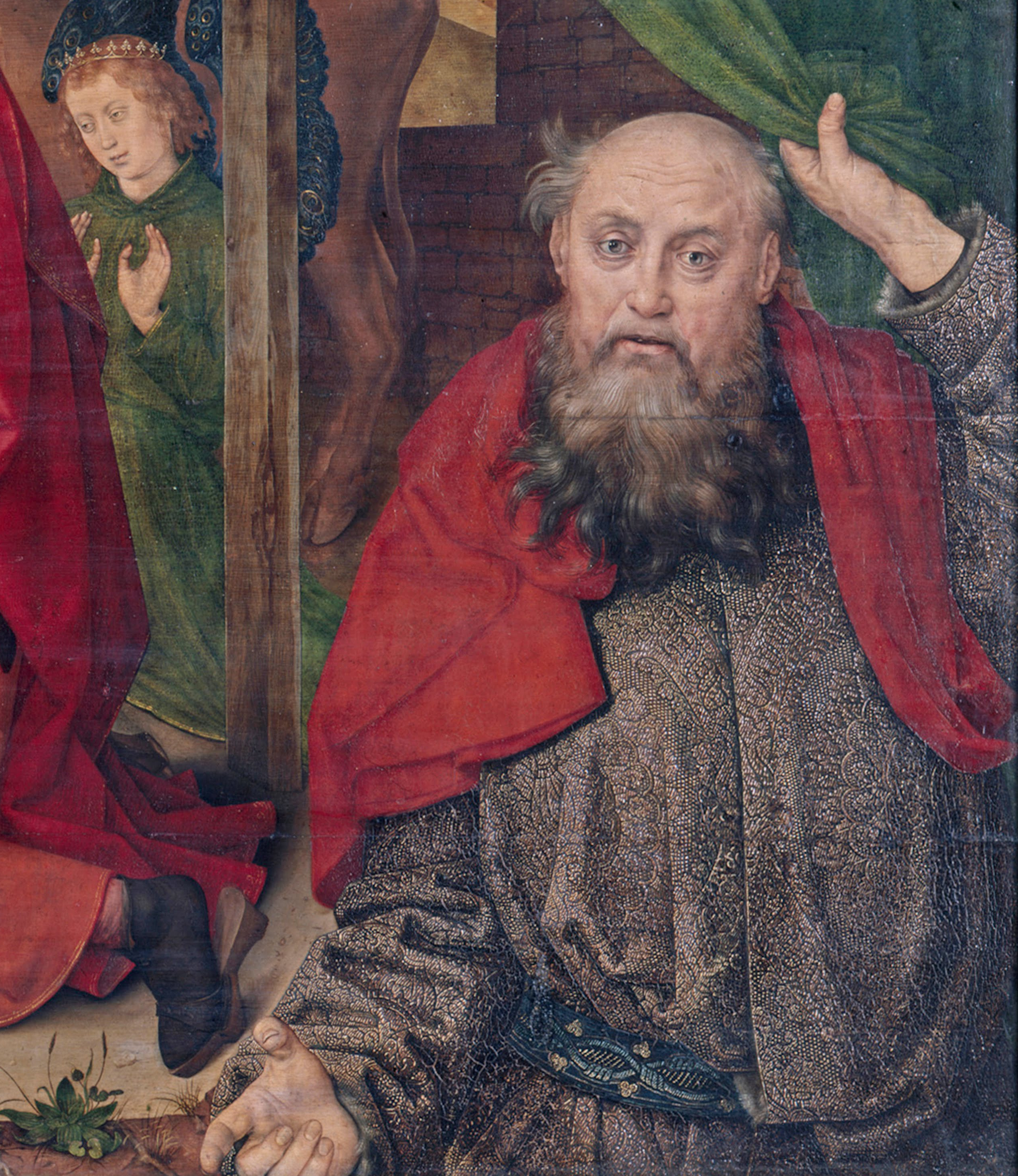
In the foreground two men draw open a set of curtains, revealing God made flesh. An actual wooden rod is attached to the panel and painted with rings, enhancing the illusion. Most scholars agree that the men represent Isaiah (left) and Jeremiah (right), Old Testament prophets who foretold Christ (see, e.g., Isa. 7:14; Jer. 23:5–6)—though John Moffitt suggests they are the apostles Mark and Paul, two New Testament personages who specifically associate themselves with a veil as a sign of divine manifestation. Either way, these figures act as intermediaries between the viewer and the depicted narrative, inviting us, like the shepherds, to bear witness to the wondrous mystery of the Incarnation and to respond in adoration.

van der Goes, Hugo_Adoration of the Shepherds (detail, Jeremiah)

This Adoration, sometimes referred to as van der Goes’s Berlin Nativity, is not the artist’s most famous painting on the subject. That would be the central panel of the Portinari Altarpiece, painted a few years earlier.

LISTEN: “Where Shepherds Lately Knelt” | Words by Jaroslav J. Vadja, 1987, © Concordia Publishing House | Music by Carl F. Schalk, 1987, © GIA Publications, Inc. | Performed by Koiné on Emmanuel Lux, 2012

Where shepherds lately knelt and kept the angel’s word,
I come in half-belief, a pilgrim strangely stirred;
but there is room and welcome there for me,
but there is room and welcome there for me.

In that unlikely place I find him as they said:
sweet newborn babe, how frail! and in a manger bed,
a still small voice to cry one day for me,
a still small voice to cry one day for me.

How should I not have known Isaiah would be there,
his prophecies fulfilled? With pounding heart I stare:
a child, a son, the Prince of Peace for me,
a child, a son, the Prince of Peace for me.

Can I, will I forget how Love was born, and burned
its way into my heart, unasked, unforced, unearned,
to die, to live, and not alone for me,
to die, to live, and not alone for me?