
Five Films about Finding Community

There are many great movies that spotlight the positive role of family, friendship, and community, showing how humans are built for interdependence. For this article of recommendations, I’ve chosen a narrower subset of that theme: movies about a character or characters who don’t have community at the beginning, or who aren’t receptive to it, but who find it throughout the course of the story. That may sound cliché, but I promise, all five selections are nonsappy and bring something new to the table.

What movie(s) would you add to the list? Also, what other thematic film lists would you like to see on this website?
About a Boy
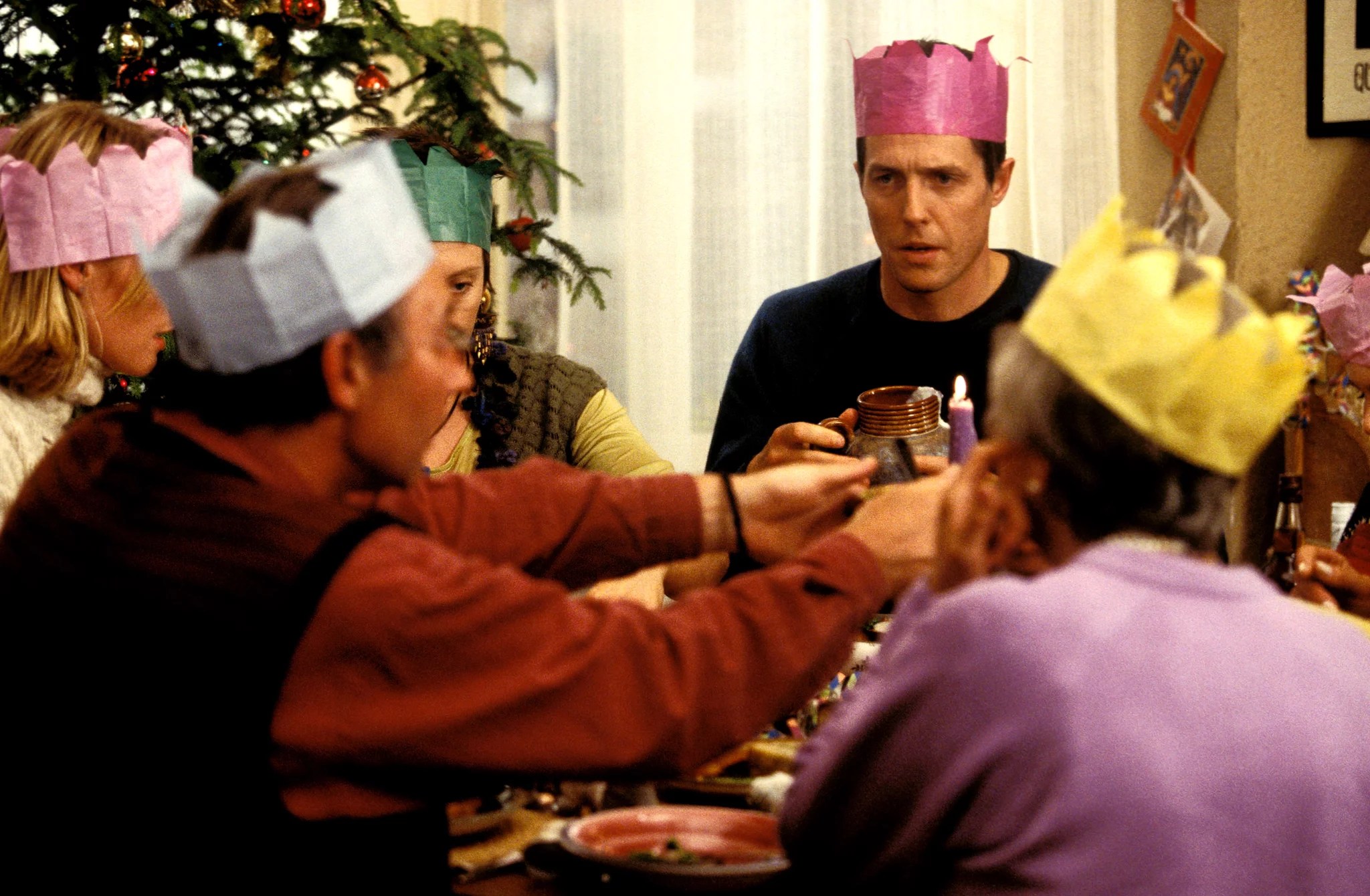
Will (Hugh Grant) sits through an uncomfortable Christmas dinner at Fiona’s house (the main course: nutloaf), having been invited by her son, Marcus, in this scene from About a Boy.

1. About a Boy (2002), dir. Chris Weitz and Paul Weitz. In general, my favorite type of movie is one that makes me both laugh and cry. About a Boy hits that spot. Based on a novel of the same name by Nick Hornby, it stars Hugh Grant as Will, a thirty-something single man who lives a carefree life in a swanky apartment—with no responsibilities, no commitments—subsisting off the royalties of a hit song his late father wrote many years ago. He prides himself in this unattached, “island living.”

Sleazeball that he is, he joins a Single Parents Alone Together group for access to vulnerable single women, despite his not having kids. It’s through that group that he meets a nerdy twelve-year-old named Marcus (Nicholas Hoult), whose mom, Fiona (Toni Collette), has depression. Marcus strategizes to make Will a part of their life so that they have a bigger support network as his mom navigates her mental illness. (“Two people isn’t enough; you need a backup,” he reasons.) Will is resistant at first. He doesn’t want the complexity or inconvenience that come with relationships. But Marcus’s persistence wears him down, and as he warms up to Marcus’s friendship and later Fiona’s, he learns to care for people and things other than just himself. His autonomy breaks down the more he allows his behaviors and decisions to be influenced by those around him whom he’s grown fond of and invested in, and he eventually realizes that, as the poet John Donne famously wrote, “no man is an island.”

(Not currently streaming for free through any subscription services but can be rented digitally. If you’re a local friend, you can borrow my Blu-ray copy—or come over and watch it with me!)

2. Lars and the Real Girl (2007), dir. Craig Gillespie. Twenty-seven-year-old Lars Lindstrom (Ryan Gosling) lives in a small Wisconsin town in his brother Gus (Paul Schneider) and sister-in-law Karen’s (Emily Mortimer) garage. Conversation and physical contact make him anxious, so he generally keeps to himself. But then one day a sex doll named Bianca arrives at his house, and he develops a chaste relationship with her. He gives her a backstory—she’s a half-Brazilian, half-Danish missionary with nurse’s training who was orphaned as a baby—and starts introducing her around town as his girlfriend.
Lars and the Real Girl (doctor's office)
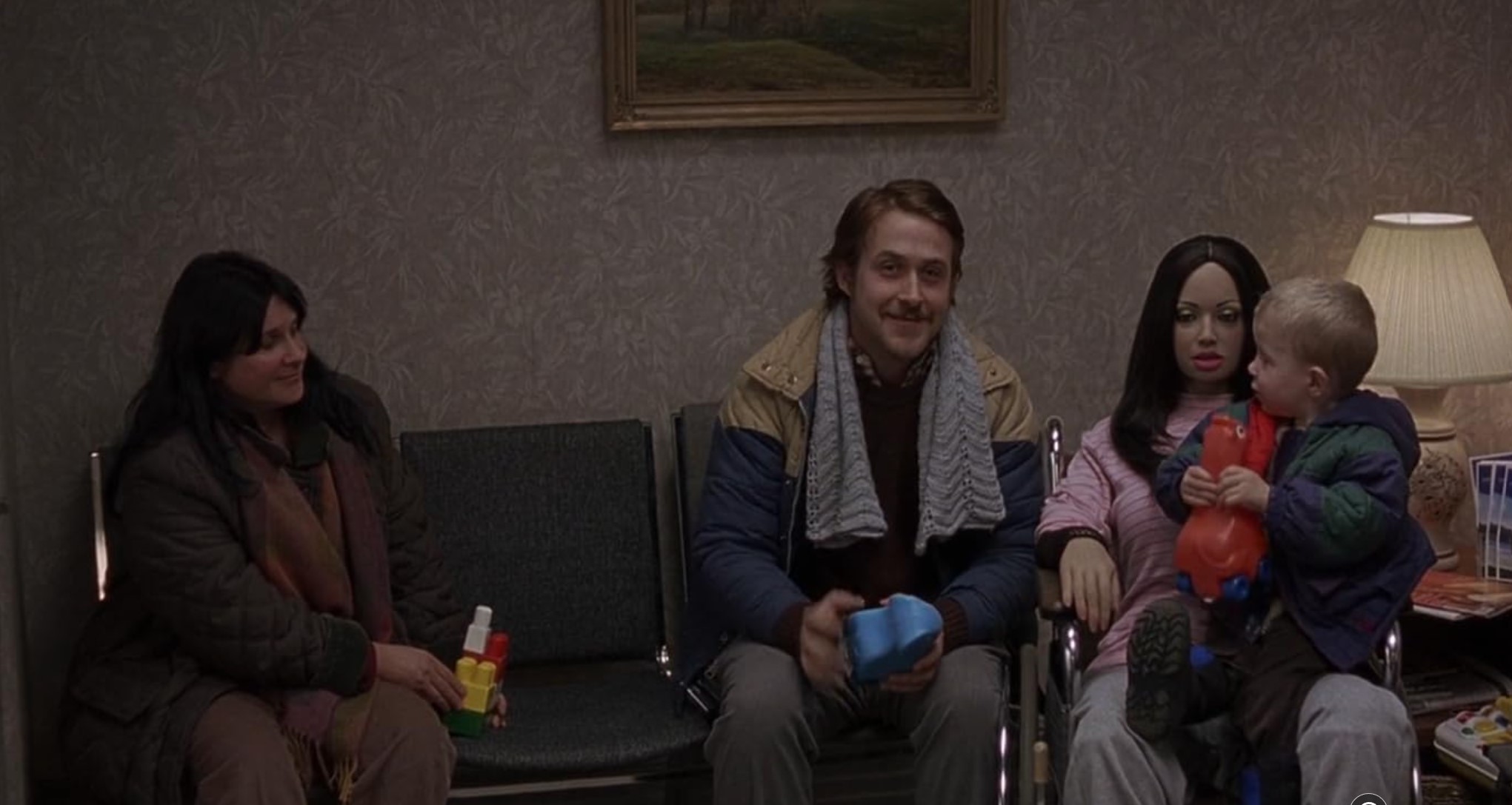
Bianca, at right, waits for her doctor’s appointment in Lars and the Real Girl. (“She loves kids,” Lars says.)

The beauty of this film is in how Lars’s family, his church (one of the rare positive portrayals of Christianity in contemporary cinema), his coworkers, and local retailers all compassionately care for Lars as he experiences this delusion, not judging or teasing—although there is some initial resistance—but instead welcoming Bianca into the community, as his psychiatrist advised. Bianca attends worship, gets her hair done at the salon, volunteers at the hospital, leads story time at the elementary school, even gets elected to the school board! Karen bathes and dresses her; a work colleague dances with her at a party; her new friends drive her to a girls’ night out. As the people in Lars’s life embrace Bianca, Lars becomes more open to human interaction, more sociable, until he no longer needs the delusion. Waiting in the wings is Margo (Kelli Garner), the “real girl” of the title, who works in Lars’s office and sings in the church choir—and who has a crush on him. The love and support of his community as he works through psychological issues is what enables him to eventually pursue healthy relationships with real-life people.

Streaming on Tubi (no account necessary).

3. Shoplifters (2018), dir. Kore-eda Hirokazu. My favorite film by one of my favorite writer-directors, Shoplifters is a preeminent onscreen example of “found family.” It follows a band of outsiders living together in a small house on the outskirts of Tokyo. Each of them has suffered some form of abuse or neglect, having been cast off by their biological families or spouses. None of them are blood-related, and yet they’ve formed bonds of love and loyalty. They support each other emotionally and financially: Hatsue (Kirin Kiki), aka “Grandma,” contributes funds allegedly from her deceased husband’s pension; Nobuyo (Sakura Andô) works for an industrial laundry service, while her husband, Osamu (Lily Franky), works as a day laborer; Aki (Mayu Matsuoka) works at a sex parlor; and the boy Shoto (Jyo Kairi) engages in petty theft.

Shoplifters
Nobuyo, Aki, Lin, Shota, and Osamu take a day off from their workaday lives to spend time together at the beach in the found-family film Shoplifters—Kore-eda’s best, in my opinion.

The conflict is introduced when the family finds a little girl named Yuri/Juri (Miyu Sasaki), dirty and hungry, left alone on a front porch, and they decide to take her. They rename her Lin, and she becomes part of their family. But now they are guilty of kidnapping. The film explores themes of belonging and of being unwanted versus wanted—that is, chosen. It also asks, What is a mother or a father? What is a sibling? Kore-eda deftly folds together the delicate layers of the various relationships, most movingly (to me) Grandma and Aki’s, and Shoto’s with his new younger sister, Lin.

Sakura Andô is outstanding as Noboyu—the best performance of any of the films on this list, and of 2018. She delivers a zinger during the interrogation scene, and the nuances of her voice and body language throughout bear so much of the film’s complexity and meaning.

Streaming on Hulu.

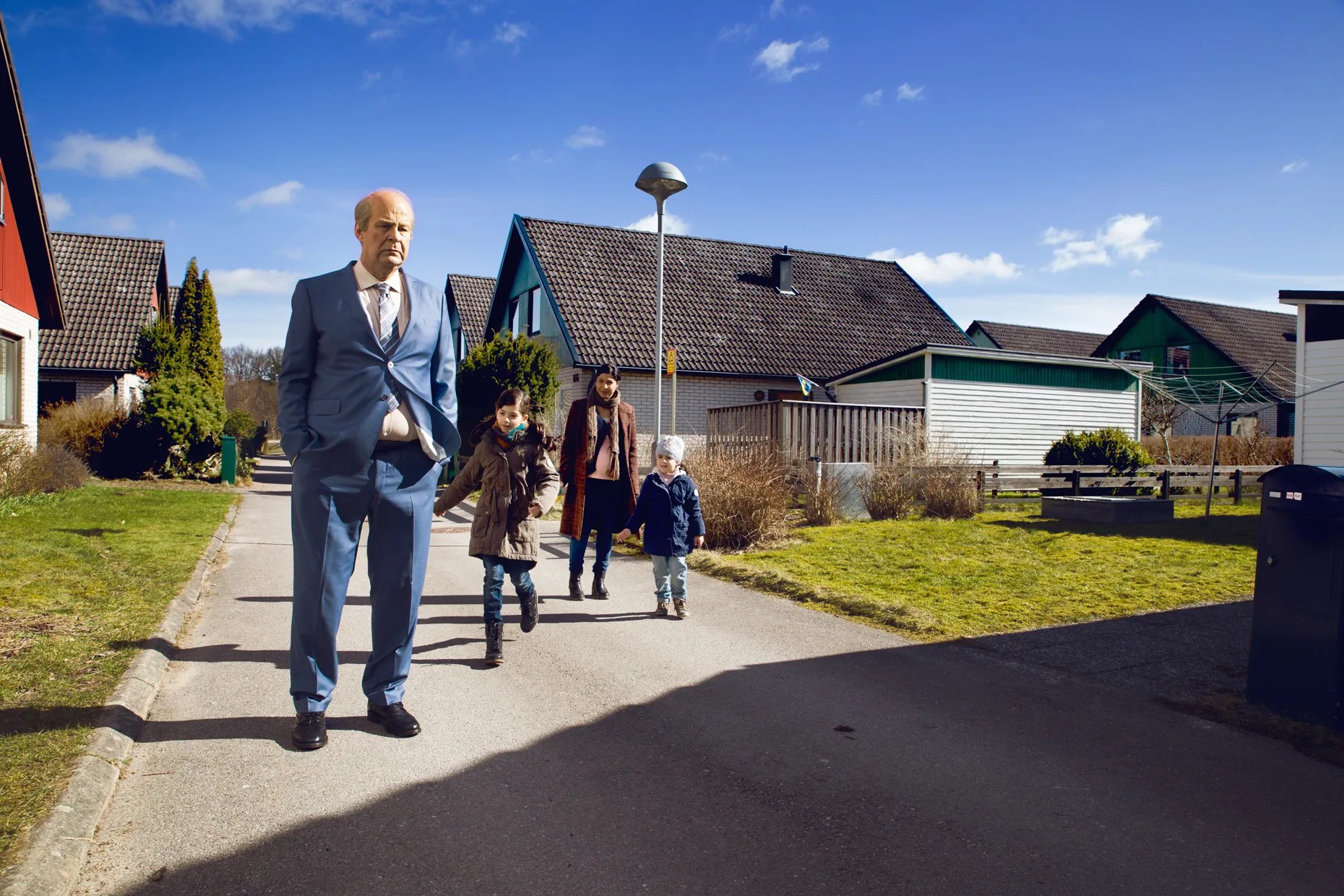
4. A Man Called Ove (2015), dir. Hannes Holm. Based on the best-selling Swedish novel En man som heter Ove by Fredrik Backman, this movie centers on Ove (pronounced “oo-vah”) (Rolf Lassgård), a grumpy old widower and retiree obsessed with enforcing block association rules no one cares about and still mourning the death of his wife. When a lively young couple and their two kids move in next door, the commotion interrupts Ove’s suicide attempt. He is called on to help out with increasing frequency—lend his ladder, watch the girls, teach the wife, Parvaneh (Bahar Pars), to drive—which outwardly annoys him but, he subconsciously realizes, gives him purpose and opportunities for meaningful human connection. He gradually learns also to receive acts of care and outreach, like a chicken and rice dinner, and to interact with others in modes other than just criticism and judgment.
A Man Called Ove
In A Man Called Ove, the titular character becomes disgruntled when a boisterous family moves in next door, but they ultimately draw him out of his suicidal ideation and help him let go of his bitterness over the hand he’s been dealt in life.

Through flashbacks, we learn about Ove’s childhood and his romance and married life with Sonja (Ida Engvoll) and begin to better understand the bitterness he holds. It’s beautiful to see that bitterness fade, even if it doesn’t entirely go away, as he begins to let his guard down and open himself to small joys.

The film was remade in English in 2022 as A Man Called Otto, set in Pittsburgh and starring Tom Hanks, but the original Swedish adaptation is the better of the two.

Streaming on Amazon.

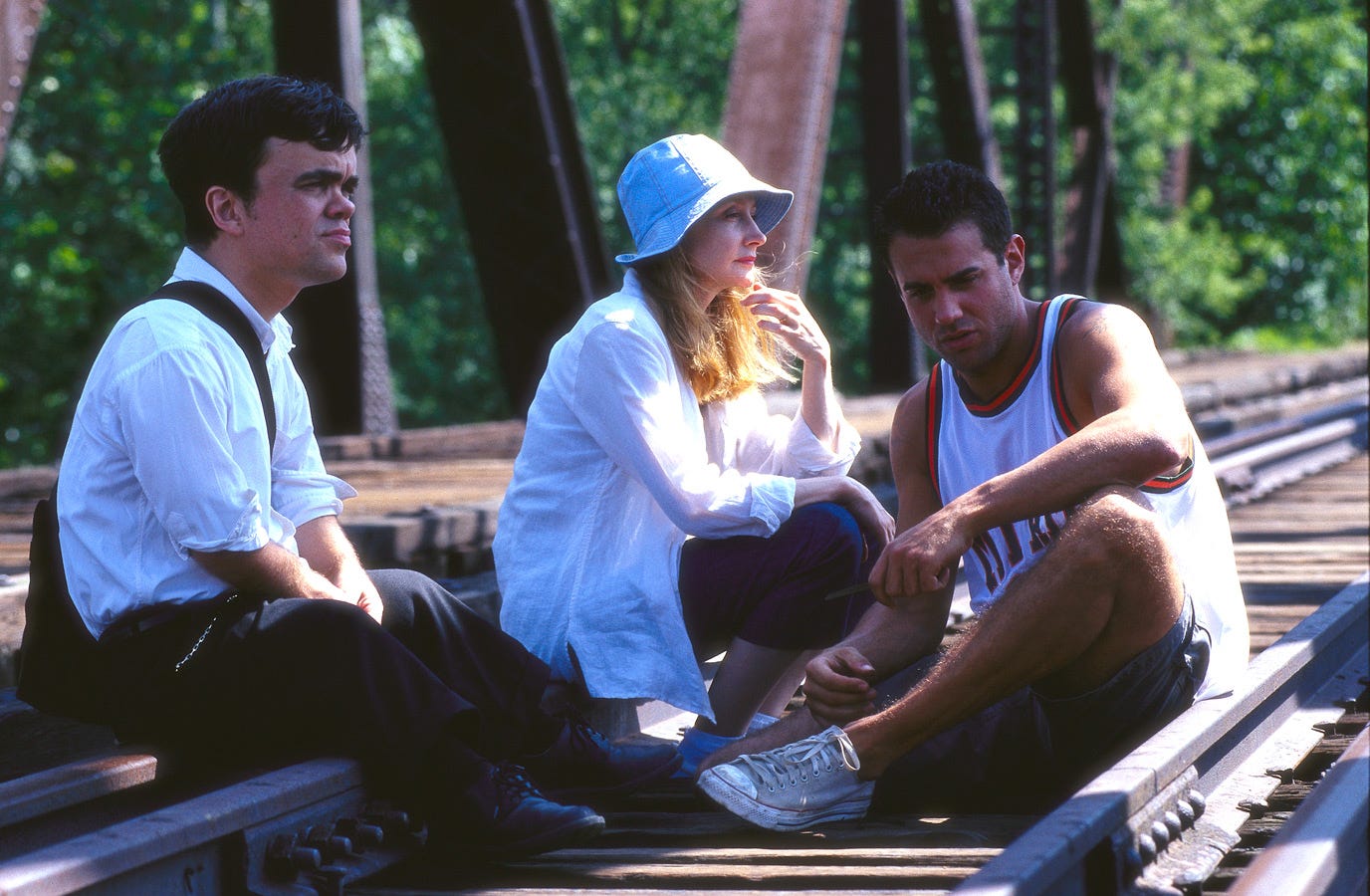
5. The Station Agent (2003), dir. Tom McCarthy. When his only friend dies, Fin (Peter Dinklage), a train enthusiast, inherits an abandoned train depot in rural New Jersey, which he moves into, intent on living in solitude. But situated just outside his new digs is a chatty hot dog vendor, Joe (Bobby Cannavale)—in town indefinitely from Manhattan to care for his sick father—whose stand is frequented by Olivia (Patricia Clarkson), a discombobulated woman who, we later find out, is grieving the death of her son and the fraying of her marriage. Fin gradually surrenders to the uninvited companionship. He also befriends a local elementary school girl who plays alone and likes trains, and a librarian with an abusive boyfriend.
The Station Agent
In The Station Agent, Fin’s deliberate life of solitude is interrupted by Olivia and Joe, who adopt his hobby of train watching not so much for their interest in trains as for their desire for companionship.

Fin had chosen a solitary life to protect himself from the taunts he receives because of his dwarfism. But he finds that vulnerability—putting yourself out there—is ultimately the better way to live, even though it means greater unpredictability and susceptibility to hurt. He forges a community from an unlikely bunch, people with whom he learns to enjoy comfortable silences and talk both small and large. The movie is punctuated by long walks along railroad rights-of-way and ends with a meal around a table.

Streaming on Amazon.
Favorite Films of 2023, Part 1

Past Lives

I’ve seen over seventy films from 2023 (and there are still more I want to see!), and these are my top ten. My top eleven through twenty will be released this weekend in a separate post. Many are international, and what year to classify them as can be hazy; I go by the date on which the film was released in the US, which is when I have access to it.

If the film is streaming for free with a subscription service, I’ve noted that at the bottom of the entry. Otherwise, most are available for digital rental (Google Play is my preferred vendor), and a few are still in theaters. You might also see if your local library has any on DVD, as that’s how I watched several of these.

Please be aware that the following films have either PG-13 or R ratings, for various reasons. I don’t have a personal policy of “no x” or “no y” in the movies I watch, but if you do, please consult the MPAA rating descriptors or a more detailed content advisory before deciding whether to view the film.

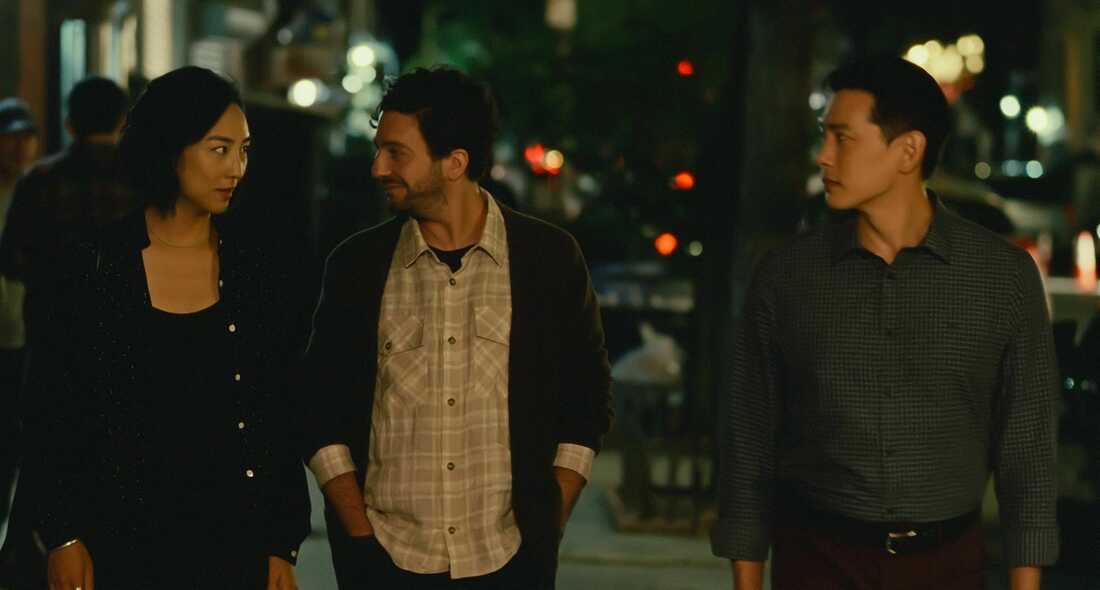
1. Past Lives, dir. Celine Song. Kind, gentle, and empathetic, this semiautobiographical indie drama by debut director Celine Song follows Na Young, or Nora (Greta Lee), over the course of twenty-four years, from her young adolescence in South Korea to her emigration to Canada and then the US. Act 1 introduces us to Nora’s childhood sweetheart, Hae Sung (Teo Yoo), whom she reconnects with virtually twelve years later in act 2, shortly before meeting and befriending a white American man named Arthur (John Magaro) at a writers’ retreat. After another twelve years of not interacting, Nora and Hae Sung find each other again in act 3 at age thirty-six, when the single Hae Sung visits Nora, who’s now married to Arthur, in New York.

What I love about this film is how it subverts all the tropes associated with the romantic triangle. The characters aren’t possessive, conniving, or competitive. There are no heroes or villains here. The film is about bonds of love and culture, and especially about what trust, support, constancy, maturity, and love look like in a marriage. In an interview on the DVD special features, Song says Past Lives is at its core a love story between Nora and Arthur. It’s also a story of navigating a bicultural identity—living between two worlds, mourning the piece of oneself that’s lost with the adoption of a new home country, and integrating elements of one’s “past life” into one’s new life, continuing to be shaped by both.

The opening scene and closing scene are perfect. Song’s skill as a storyteller, honed over her years as a successful playwright, really shines through in her screenplay.

2. The Zone of Interest, dir. Jonathan Glazer. This chilling Holocaust drama centers on a Nazi family living their dream life in the literal backyard of the Auschwitz concentration and death camp. Rudolf Höss (Christian Friedel)—who is an actual historical figure—is the commandant of the camp; having risen through the ranks, he seeks to provide his wife, Hedwig (Sandra Hüller), and their five children a comfortable and idyllic life. It’s a risky choice to tell this story from a German perspective, but Glazer and the two lead actors more than succeed. We never actually set foot inside the camp; most of the scenes happen within the confines of the villa or at the nearby river where the family goes on outings. Nor do we directly see any of the horrors; we see merely hints, like smoke rising from a crematorium chimney in the background. But even more, we hear these intimations: a train pulling into the station, a tussle, a chase, a barking dog, a gunshot, screaming. All of this happens just over the wall, while Hedwig tends to her flower garden or her son plays with toys in his bedroom. (Props to the sound designer, Johnnie Burn.)

What is so disturbing about the film is the banality of evil that it reveals. Rudolf isn’t the type of villain who sneers or snarls or has violent outbursts. He brings his kids kayaking and reads them bedtime stories; he sips coffee with his wife. He could be us. “I wanted to show that these were crimes committed by Mr. and Mrs. Smith at No. 26,” Glazer said. Sanitization is one of the themes explored—lots of scrubbing.

3. Four Daughters, dir. Kaouther Ben Hania. Blending documentary and fiction, this film tells the true story of a Tunisian Muslim mother—Olfa Hamrouni—and her four daughters, the elder two of whom became radicalized by ISIS as teenagers and ran away to Libya to engage in jihad. In 2016 Kaouther Ben Hania saw media segments of Olfa calling out local authorities for their indifference and inaction and knew she wanted to make a film about the disappearance, to understand how a tragedy like this can happen in a family. She originally wanted to do a straight documentary but soon realized it would be more powerful, and more feasible, to have Olfa and her younger daughters, Eya and Tayssir Chikhaoui (born in 2003 and 2005), reenact their memories onscreen. Because daughters Ghofrane and Rahma Chikhaoui are still absent, actors Ichrak Matar and Nour Karoui were hired to portray them, and actor Hind Sabri stepped into the mother role for the scenes that took too high an emotional toll on Olfa.

This method of storytelling better reveals the story’s complex layers, as the three women are both inside and outside the scenes. They’re telling the past, but they’re also questioning it. They’re reflecting on their motivations as they discuss their memories with each other and Ben Hania—many of them traumatic, but others warm or simply ordinary, as when they talk about their first periods! Olfa, the mother, is a particularly complex character, as she is fiercely protective of her daughters but also perpetuates on them some of the patriarchal oppression that she herself suffered. The film is about motherhood, sisterhood, zealotry, rebellion, and violence, and it has left a searing impression on me.

4. Anatomy of a Fall, dir. Justine Triet. In this courtroom drama set in the French Alps, Sandra (Sandra Hüller) is suspected of her husband Samuel’s (Samuel Theis) murder. As the police investigate and the prosecution launches its interrogations, they uncover details about Sandra and Samuel’s conflicted relationship, and the couple’s visually impaired eleven-year-old son, Daniel (Milo Machado Graner), is forced to testify. Hüller’s performance is riveting—she gets my vote for Best Actress of the Year.

5. Saint Omer, dir. Alice Diop. Another French courtroom drama, this one based on the real-life story of Fabienne Kabou. Laurence Coly (Guslagie Malanda), a Senegalese immigrant to France, is on trial in Saint-Omer for the murder of her fifteen-month-old daughter, Lili, an action she blames on sorcery. Intrigued by the case as potential source material for the novel she’s working on, Rama (Kayije Kagame), pregnant, travels from Paris to attend the trial. But when Laurence’s motives prove inscrutable and mental illness is put on the table, Rama begins to worry about her own ability to mother. The testimony dredges up emotions for Rama surrounding her troubled relationship with her mother—also a Senegalese immigrant, who appears, from the flashback sequences, to suffer from depression—and sharpens her sense of cultural alienation. Rama is an analogue for the filmmaker, Alice Diop, who, as a documentarian and expectant mother at the time, attended the Kabou trial, and it forced her to face her own difficult truths.

Streaming on Hulu.

6. Dream Scenario, dir. Kristoffer Borgli. Paul Matthews (Nicolas Cage) is an evolutionary biologist teaching at a small-town college and living a quiet life with his wife and two daughters, when out of nowhere, he starts appearing in the dreams of strangers around the world and becomes instantly famous. An absurd comedy with elements of horror, Dream Scenario satirizes the fickle nature of celebrity in today’s internet age, in which even the most unremarkable people can become an overnight sensation, and the adoration of fans can turn to hatred at the drop of a hat. I was laughing out loud a lot at this one—and cringing too!

7. Fremont, dir. Babak Jalali. Donya (Anaita Wali Zada) is a young Afghan immigrant working at a fortune cookie factory in the Bay Area of California. Formerly a translator for the US Army in Afghanistan, she is ostracized by many of her fellow Afghans as a traitor, and she struggles with loneliness. But the film has an uplifting tone; it’s about survival, hope, and connection. The first full-length feature by the Iranian British filmmaker Babak Jalali, it is in English, Dari, and Cantonese.

Streaming on MUBI.

8. Monster, dir. Kore-eda Hirokazu. When her eleven-year-old son, Minato (Soya Kurokawa), starts behaving strangely and she hears that a teacher hit him, Saori (Sakura Ando) demands answers from the school. The story is told in three parts, each from a different narrative perspective: first the mom’s, then the teacher’s, then the boy’s. The truth gradually emerges with each shift, and a stormy finale brings things to a close.

9. Plan 75, dir. Chie Hayakawa. In a near future, the Japanese government launches a voluntary but coercive program encouraging the nation’s elderly citizens to terminate their lives in order to nobly reduce the burden on society. Having been forced to retire from her job as a hotel maid after one of her coworker peers slips in a hotel shower, Michi (Chieko Baishô) is considering signing up. The film focuses on her but also develops side stories for two Plan 75 employees: a Filipino migrant whose daughter back home needs an operation, and a man whose estranged uncle becomes a client.

10. Killers of the Flower Moon, dir. Martin Scorsese. Based on the best-selling nonfiction book by David Grann about the serial murder of members of Osage Nation in the 1920s, Scorsese’s Killers of the Flower Moon depicts the criminal ugliness of white greed and laments a grave historical injustice. When the Osage discover oil on the reservation they’ve been displaced to in Oklahoma, they become very wealthy, and white men from the outside move in to try to steal that wealth. The white crime boss and master of deception William Hale (Robert De Niro)—the movie uses all the real names—has ingratiated himself with the Osage over decades and has secretly been carrying out a plan to gain control of Osage headrights by killing off inheritors.

The movie focuses on Hale’s nephew Ernest Burkhart (Leonardo DiCaprio), a simpleton whom Hale compels to marry the young Osage woman Mollie Kyle (Lily Gladstone) and further manipulates to manipulate others. The movie suggests that the love been Ernest and Mollie is genuine but complicated, and I didn’t quite grasp what bound them together (was it just physical attraction?) or how much either of them knew about what was going on (was Ernest really that naive? did Mollie never suspect him or his uncle of foul play earlier on?). But I was engrossed for the full three-and-a-half-hour runtime, all the way to the gutsy final scene of the radio play and the beautiful, defiant coda.

Streaming on Apple TV+.

Read part 2.

Favorite Films of 2022, Part 1

Since 2020, I have been publishing an annual list of my top twenty films of the year, with trailers and microreviews. (See my lists for 2020 and 2021.) I love the collaborative nature of filmmaking, the coming together of so many talents—writing, acting, directing, shooting, editing, set design, costume design, etc.—to tell a story through moving images. Movies are actually my favorite mode of storytelling. It’s a shame that in some circles they’re denigrated as inferior to novels, less worthy of our time. That’s absolutely not true!

Moviegoing can be transformative. Like other art forms, movies reflect back to us the many aspects of the human (and in the case of my #5, animal!) experience, and can demand something of us.

Here are the first ten of my twenty recommendations for films to see that were released in the United States (though several were made internationally) in 2022, ranked in order of preference. Please be aware that many of these have R ratings and that you can consult content advisories if that concerns you.

1. Everything Everywhere All at Once, dir. Daniels (Daniel Kwan and Daniel Scheinert). Bighearted and bizarre, this comedy sci-fi action adventure is about a first-generation Chinese American woman, Evelyn (Michelle Yeoh), who’s trying to hold it all together as her laundromat business is failing and her relationships are fraying, especially with her twenty-something daughter, Joy (Stephanie Hsu), whom she just doesn’t “get.” Then one day, out of nowhere, Evelyn is enlisted by a version of her husband, Waymond (Ke Huy Quan), to stop the evil Jobu Tupaki, a version of Joy, from destroying the multiverse. As Evelyn travels to alternate universes, she’s able to access skills and emotions her alt-selves possess and bring them back with her to help her fight.

Absurdity ensues. In one universe, Evelyn has hotdogs for fingers, and so becomes adept at using her feet; in one she’s a rock overlooking a canyon; in another, a teppanyaki chef whose colleague is controlled by a raccoon under his hat; in yet another, she’s a martial arts–trained movie star who never left China. She “verse jumps” from one to the other seeking to save her daughter from the vortex of despair into which she’s trying to suck everyone and everything, and all the while Joy is trying to find a version of her mother whom she can connect with, who can understand the emptiness in her.

The directors said the film is about a family trying to find each other through the chaos. At its core, it’s a family drama—one that explodes across the multiverse. It’s also about choosing kindness and joy (symbolized by a googly eye) and moving toward one another in empathy. It’s much louder and more outrageous than all my other picks, and I could have done without the scatological humor, but I found myself enthralled by the wild, disorienting ride that lands at a really tender place. Michelle Yeoh proves her versatility as an actor, and Jamie Lee Curtis, who plays IRS inspector Deirdre Beaubeirdra, is hilarious.

Streaming on Showtime.

2. The Banshees of Inisherin, dir. Martin McDonagh. Set in 1923 during the Irish Civil War on a fictional island off Ireland’s west coast, this dark comedy begins when Colm (Brendan Gleeson) tells his lifelong bestie, Pádraic (Colin Farrell), that he no longer wants to be friends. Colm is a fiddler and composer who wants to establish a legacy, a musical output that will live on—a goal that Pádraic is impeding by distracting him with daily hours of dull conversation, he says—whereas Pádraic says he merely wants to be known for “being nice.” Baffled by his friend’s abrupt severing of their relationship, Pádraic repeatedly pursues understanding and restoration, escalating the tension toward acts of violence. Male friendship and loneliness, melancholy, and mortality are key themes in this artful buddy-breakup movie that had me laughing out loud as well as tearing up.

Streaming on HBO Max.

3. Guillermo del Toro’s Pinocchio, dir. Guillermo del Toro and Mark Gustafson. Light overcomes the darkness in this stop-motion animated musical adaptation of the classic Italian children’s novel from 1883. It was written and codirected by Guillermo del Toro, a master of magical realism, and has been in development since 2008. When his young son dies, the carpenter Geppetto (David Bradley) carves a boy puppet, Pinocchio (Gregory Mann), to fill the hole left by this profound loss. In an act of compassion, the Wood Sprite (Tilda Swinton) brings Pinocchio to life and commissions Sebastian J. Cricket (Ewan MacGregor), an itinerant writer, to look out for him. Curious and unruly, Pinocchio ends up trapped in a circus by an abusive showman. He and his father spend much of the film trying to reunite, to be family to each other.  

These story points will sound familiar to most, but del Toro cleverly adapts them and adds new ones, setting the story in a Tuscan village during the rise of Mussolini in the 1930s, with one of the main villains being a Fascist podestà who’s trying to recruit Pinocchio into the army. It turns out it is the villagers who blindly subscribe to Il Duce’s propaganda who are the puppets, whereas Pinocchio, with his irrepressibility, is decidedly unpuppetlike. Thus the film explores contexts in which disobedience can be a virtue. Del Toro also places more emphasis on Geppetto’s growth than Pinocchio’s, making the story about Geppetto becoming a real father—learning to accept Pinocchio with all his quirks and difference, not making his love contingent on Pinocchio fulfilling his image of the perfect son—rather than Pinocchio becoming a real boy.

The artistry of this film is dazzling! I was blown away by the production design by Guy Davis and Curt Enderle (they designed the locations and characters and established the whole visual style), especially the evocation of interwar Italian life and culture, with the centrality of the church. I’m also dazzled by the puppets—shout-out to Georgina Haynes, the director of character fabrication—because remember, with stop-motion animation, all the characters are handmade, physical creations existing in three-dimensional space, not computer-made or drawn on a page; all but the “wooden” Pinocchio (made from 3D-printed hard plastic) consist of a manipulable silicone skin sitting over a mechanized system.

Streaming on Netflix.

4. Aftersun, dir. Charlotte Wells. Eleven-year-old Sophie (Frankie Corio) is on vacation with her single dad, Calum (Paul Mescal), in Turkey. He doesn’t have a lot of money, but he’s trying to create a memorable holiday for her. And despite its mundanity, it is memorable—the frame story is adult Sophie replaying its moments on tape and in her mind. Aftersun is a very personal project for first-time writer-director Charlotte Wells, who draws on her own history and relationship with her father; she says she wants people to be able to feel the warmth of these memories, even though they’re tinged with sadness. Though it’s never spelled out, it appears that Calum suffers from depression, and we gradually see more and more of his pain. The lack of exposition enables us to make our own inferences about it and about the ending. The “Under Pressure” dance sequence, which intercuts a frantic, stroboscopic nightclub scene where adult Sophie searches the floor for Calum with one of young Sophie and Calum dancing lovingly outside the hotel, safe in each other’s arms, is a contender for scene of the year—a metaphoric conveyance of mental health decline, of holding on and letting go.

5. EO, dir. Jerzy Skolimowski. Who would have thought a donkey’s inner life could be so captivating to watch onscreen? His memories, his imagination, his hopes, his fears, the affection he feels and longs for, his joys and sorrows. EO follows the life journey of the titular donkey as he passes from owner to owner, some of them kind, others cruel. He starts out at a circus in Poland, where he’s tenderly cared for by the young performer Magda (Sandra Drzymalska). But he’s seized by animal rights activists and ends up at a horse sanctuary, and from there he moves to a petting farm for children with disabilities. He escapes, looking for Magda, and spends a harrowing night alone in the forest. Chancing upon a soccer game the next day, he becomes a mascot for a time, a figure of great adulation but also vitriol by the opposing team. His next job is as a beast of burden at a fur farm, where he’s made to carry fox pelts, and then he’s acquired by an Italian priest.

There’s very little dialogue in the film, and there are no voiceovers to convey EO’s thoughts or emotions, which we infer by context. The cinematography, from close-up shots of EO’s dark, expressive eyes to wide shots of varied landscapes, is gorgeous—visual poetry. EO is an indictment of human violence and a call to empathy for animals. Dare I say I liked it better than the Bresson classic (Au hasard Balthazar) that inspired it? Unlike its predecessor, it stays entirely focused on the donkey’s perspective, with humans relegated to the periphery.

6. Hit the Road, dir. Panah Panahi. A road-trip dramedy from Iran, this debut feature by Panah Panahi follows a family of four as they drive across the Iranian countryside under the pretext of a wedding. Dad (Mohammad Hassan Madjooni), who wears a leg cast, sits in the back with the young, ball-of-fire son (Rayan Sarlak) and sick dog, while Mom (Pantea Panahiha) and the quiet older son (Amin Simiar) take turns at the wheel, sometimes evincing their worry. There’s something clandestine about this journey, and over the course of the film we learn more but not much. But even with the imminent separation hanging like a cloud, there’s a lightness and a sweetness that’s so endearing as we watch the characters bicker and goof around and connect with one another. Films that can hold together the weighty and the comical, like this one, tend to be the ones I enjoy most.

Streaming on Showtime.

7. TÁR, dir. Todd Field. Set in the classical music world, this drama explores the corrupting nature of power through the (fictional) character of Lydia Tár (Cate Blanchett), an award-winning conductor, composer, educator, and author. It’s an intense and brilliant performance of a complex character who is amazing at her craft but who also uses her status to manipulate others, including the young female cellist who has just joined her orchestra, the prestigious Berlin Philharmonic. The tension rachets up as they prepare to perform Mahler’s Fifth Symphony and rumors about Lydia’s connection to the death of one of her former protégés threaten to undo her.

8. Broker, dir. Kore-eda Hirokazu. Found families is a key theme in the oeuvre of the Japanese director Kore-eda Hirokazu, whose Shoplifters (2019) is one of my all-time favorite films. His latest, Broker, is set in South Korea. Seeking to place her newborn son, Woo-sung, in the care of a family better equipped to raise him, the young single mom So-young (Ji-eun Lee) leaves him outside a church, where he is intercepted by Sang-hyeon (Song Kang-ho) and Dong-soo (Dong-won Gang), who attempt to sell him on the adoption black market. The next day she returns with doubts and demands to be included in the process of finding a home for Woo-sung. So she follows the two brokers in responding to the calls of prospective buyers, and along the way they pick up a stowaway from an orphanage, the ebullient Hae-jin (Seung-soo Im), the character that really brought it all together for me.

As they drive from city to city, the five travelers bond with one another, each of them carrying their own forms of rejection trauma and seeking love and belonging. The last night they spend together . . . wow! Kore-eda is a deft handler of sentiment, never maudlin but rather inserting understated emotional moments in all the right places (another example: the flower on the wet car window scene). He tackles heavy subject matter and complex social issues with heart, always keeping his characters at the center and allowing for reprieves of warmth and brightness. He avoids simplistic endings but also unnecessarily bleak ones, taking a vantage point of hope.

9. The Fabelmans, dir. Steven Spielberg. This coming-of-age drama is a fictionalized telling of Steven Spielberg’s upbringing in a midcentury Jewish American household and, since seeing his first movie in a theater at age six, his developing passion for cinema. Spielberg’s stand-in is Sammy Fabelman (Gabriel LaBelle). In many ways The Fabelmans is Spielberg’s love letter to his artistic and free-spirited mother, named Mitzi in the movie and played by Michelle Williams, who from the get-go fully supports Sammy’s dream to become a filmmaker, unlike his much more practical father, Burt (Paul Dano), a computer engineer, who doesn’t initially see filmmaking as a worthy pursuit.

I wondered if The Fabelmans was going to be a self-indulgent homage to Spielberg’s successful career, full of Easter eggs to his other films, but it wasn’t that at all. The story stands on its own apart from its basis in the particularities of Spielberg’s life. It’s about vocation and family and the power of films to help us see the truth. That it’s also a semiautobiographical portrait of a director whose films I grew up on (E.T., Jaws, Jurassic Park) and continue to admire is an added bonus!

10. Nanny, dir. Nikyatu Jusu. Marked by menace and mystery, this psychological horror-drama centers on Aisha (Anna Diop), a Senegalese immigrant to New York City hired by an affluent couple to care for their daughter. Aisha is haunted by the absence of her six-year-old son, whom she left under the care of a cousin in Senegal so that she could earn money to bring him to the US. But that goal becomes difficult when her employers start withholding her wages. As she navigates the oppressive situation she finds herself in, she is visited by figures from West African folklore: Mami Wata (a mermaid-like water spirit) and Anansi (a trickster spider). They seem like malevolent forces, but her boyfriend’s grandmother encourages her to reframe her thinking and to ask what the spirits want not from her but for her. Could they be haunting her to help guide her toward a new and better life?

The film deals with class, race, exploitation, resistance, survival, motherhood, and guilt—all parts of Aisha’s immigrant experience. Despite the too-quick resolution that follows, the scene at the end of Aisha being reborn out of chaos is visually and emotionally compelling. I appreciate how writer-director Nikyatu Jusu, born in the US to Sierra Leonean parents, uses supernatural horror tropes in unique and subversive ways.

Streaming on Amazon Prime.

Read part 2.