
VISUAL COMMENTARY: “Repentance (Transforming Tears)” by Clemena Antonova: One of the three works that art historian Clemena Antonova curated for the Visual Commentary on Scripture exhibition on Peter’s denial of Christ (Matt. 26:69–75; Mark 14:66–72; Luke 22:54–62; John 18:15–18, 25–27) is the installation Lágrimas de São Pedro (Tears of Saint Peter) by contemporary Brazilian artist Vinícius Silva de Almeida. The artist used hundreds of light bulbs, filled with water and suspended on near-invisible nylon threads, to create an environment in which visitors move between “tears” falling like raindrops from above. In the Christian tradition, Peter is regarded as a paradigm of penitence, as scripture says he “wept bitterly” when he realized his sin, and soon after he was restored to Christ. As Antonova interprets, Tears of Saint Peter invites folks to reflect on the interconnection of sorrow and healing in Peter’s story and in their own.

+++
SONGS:
>> “Peter” by Montell Fish: Montell Fish (the stage name of Montell Frazier) is a singer-songwriter from Pittsburgh whose music combines elements of lo-fi and classic R&B. In his song “Peter” from the album Camp Lukewarm (2020), he compares himself, in confessional mode, to the titular apostle, who denied Christ three times. “Sometimes I feel like Peter / Denied you and I cannot deny that I did / Can I rest my head on your shoulders again?” In the bridge, Christ answers in the affirmative: Yes, come rest.
>> “O How He Loves You and Me / Your Love Divine”: The first song in this medley was written by CCM (contemporary Christian music) pioneer Kurt Kaiser in 1975; the second, by the legendary gospel artist Richard Smallwood. Recorded live at Jericho City of Praise in Landover, Maryland, it’s performed here by Smallwood (at piano) and his vocal and instrumental ensemble Vision, featuring soloist Vanessa Williams. The recording appears as two separate tracks on Persuaded: Live in D.C. (2001).
Here are the lyrics to the second song, starting at 3:06:
Refrain:
Lord, you know the pain, pain we bear
And Lord, you know the toils, toils and cares
Send your direction
Send your protection
Send your compassion
And your love divineVerse:
Help us love those who would do us wrong
Send your cleansing power from above
Unite our hearts as one
Make us vessels for the flow-through of your love[Refrain]
Vamp:
Your love divine
Your love divine
+++
BOOK CHAPTER: “Maundy Thursday—The Mission,” chap. 16 from Films for All Seasons by Abby Olcese: Abby Olcese is a writer on film, faith, and popular culture, living in Kansas City. Last year her book Films for All Seasons: Experiencing the Church Year at the Movies was published by InterVarsity Press, spotlighting twenty-six films as lenses through which to reflect on the great themes of the church calendar. I was preparing to write something on The Mission, the 1986 film directed by Roland Joffé, for Lent this year when I encountered this book, and because Olcese covers the movie so well, I secured permission from IVP to provide a free PDF download of the chapter to Art & Theology readers. Olcese situates The Mission as a film that’s especially appropriate for Maundy Thursday, a day when the church reflects on the call to servant-love and commemorates, among other things, Jesus’s arrest in the garden of Gethsemane, during which he and his disciples “face the forces of human empire, a dramatic moment of conflict ending in what, for the moment, feels like defeat.”
The Mission addresses themes of Christian ministry, the kingdom of God, repentance, forgiveness, love, respect, and the nonviolent ethic of Christ. Based on actual events, it follows an eighteenth-century Spanish Jesuit priest, Father Gabriel (Jeremy Irons), as he establishes a mission among the Guaraní people in the borderlands of present-day Argentina, Paraguay, and Brazil and seeks to protect the Guaraní from the encroachment of Spanish and Portuguese enslavers. He is later joined by the penitent Rodrigo Mendoza (Robert De Niro), a recent convert and former slave dealer and mercenary soldier. But the two clash over how best and most faithfully to protect the people they live among and serve.
PDF excerpt from Films for All Seasons by Abby Olcese. Copyright © 2024 by Abigail Olcese. Used by permission of InterVarsity Press. www.ivpress.com
+++
ORATORIO: Water Passion After St. Matthew by Tan Dun: Commissioned for the 250th anniversary of Bach’s death in 2000, this eclectic, Asian-influenced Passion oratorio by the Chinese American composer Tan Dun follows Jesus from his baptism to his resurrection. As the title suggests, water plays an important role in the work. When performed, seventeen large transparent water bowls, dramatically lit from below, form a cross on the stage and are used by percussionists throughout the piece’s ninety-minute duration, creating various timbres. (“The three percussionists make water drip, flow, burble, crash and hiss. They lift handfuls of water, then fling it back down. They stir it, strike it with pairs of plastic cups, float soup bowls upside down in it and play them,” Justin Davidson described in his review of the world premiere.) For Tan, water is “a symbol of baptism, renewal, re-creation, and resurrection.”

In addition to the water percussion, the work calls for an SATB chorus that doubles on stones and tingsha (Tibetan finger cymbals); soprano and bass soloists who double on the xun (Chinese ocarina, or globular vessel flute) and who are required to do some Mongolian overtone singing; one violin; one cello; and one sampler player (Yamaha A-3000).
Water Passion premiered in Stuttgart, Germany, on September 8, 2000, conducted by Tan—you can listen to the full live recording on Spotify—and it has since been performed a handful of other times across the globe. I recommend the following hour-long video from Symphony Tacoma in Washington, which features excerpts from their March 30, 2016, performance augmented by interviews with some of the key players:
+++
ARTWORK: The Judas Window by Laurence Whistler: In 1940, St Nicholas Moreton in Dorset was hit by a German bomb, destroying much of the church building, including its nineteenth-century stained glass windows. After rebuilding, the church commissioned the renowned glass engraver Laurence Whistler in 1955 to make twelve new windows, replacing the ruined ones, a project he worked on for the next three decades; they depict butterflies, birds, rabbits, wildflowers, candles, stars and planets, and local scenes. (See a few photos at The Dorset Rambler or Chris Belsten’s Flickr album.) In 1987 he offered to donate a thirteenth window on the theme of forgiveness, featuring the death of Judas, which would be visible, by design, from the outside only (the proposed space was blocked on the inside by a memorial tablet). The idea was entertained but, after consultation between the rector, parish council, and local diocese, was ultimately rejected due to its controversial nature—too many felt that it just wasn’t a fitting subject for a church window. Eager to pursue his vision, Whistler made the window anyway and loaned it to the county museum in Dorchester but insisted that if the church ever changed its mind, it should be given to them.
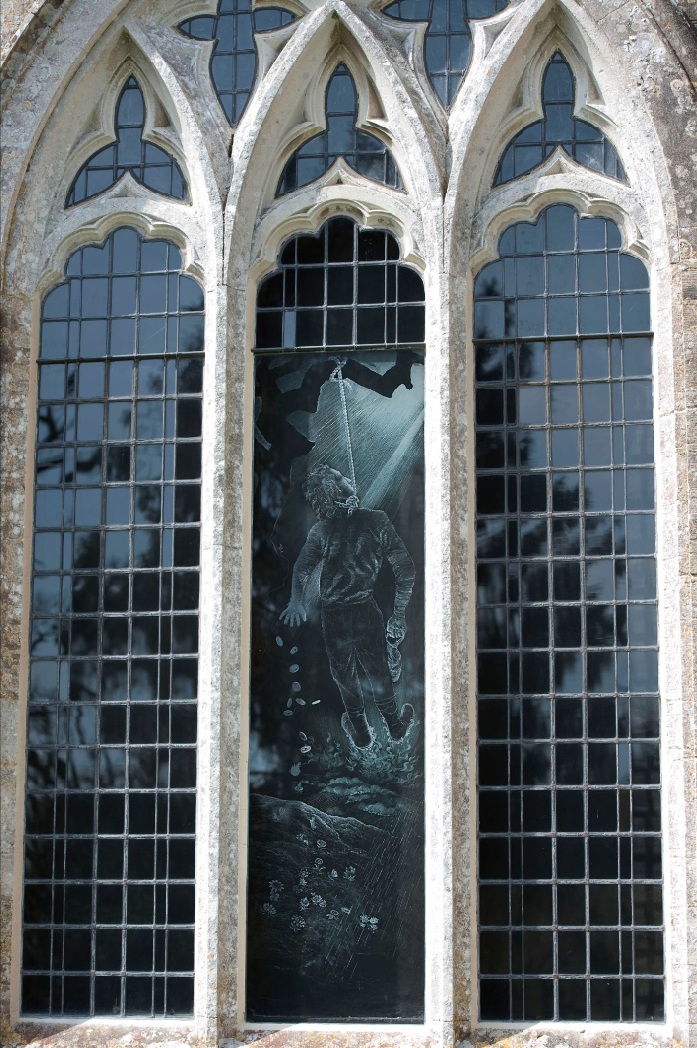
In 2012, Rev. Jacqueline Birdseye, the new rector, encouraged the parish to revisit the issue, and this time around, there was unanimous approval to install the window, startling though it is. Again, it’s a blind window—behind it is black wooden boarding—which was the artist’s intent, as he wanted Judas to be a “shadowy” figure (so he couldn’t be front-lit and backlit) and on the outside, near the graveyard. But, unlike traditional portrayals of Judas’s suicide, which are bleak and punishing, Whistler’s portrayal is one of subtle hope, redemption, and new life. The uniting theme of the twelve interior windows is “light,” and here a bright shaft falls from the heavens on Judas’s upturned face. Hanging from his noose, he relinquishes the thirty coins for which he sold his Savior, and when they hit the ground they transform into flowers; the “field of blood” (Acts 1:18–19) becomes a spring meadow.
Scripture tells us that after realizing his enormous error, Judas “repented” (Matt. 27:3 KJV), “was filled with remorse” (NLT), and returned the blood money. Though Christians have historically counted Judas as eternally damned, other Christians have suggested the possibility of forgiveness beyond the grave for the traitorous disciple who was desperately grieved by his sin. “There’s a wideness in God’s mercy.” “A broken and contrite heart, O God, you will not despise” (Ps. 51:17).





 Art & Theology