Roundup: Liturgical video installation; Mynheer profile; SYTYCD; natural-world mystic poetry; lament song

“Mark Dean Projects Stations of the Cross Videos on Henry Moore Altar,” exhibition review and artist interview by Jonathan Evens: On April 15–16 St. Stephen Walbrook in London hosted an all-night Easter Eve vigil that featured a fourteen-video installation by artist-priest Mark Dean. Inspired by the Stations of the Cross, these videos were projected, in sequence and interspersed with readings and periods of silence, onto the church’s round stone altar by the famous modern artist Henry Moore (Dean wanted his work to be presented as an offering). The vigil culminated with a dance performance by Lizzi Kew Ross & Co and a dawn Eucharist. Evens writes,

Mark Dean’s videos are not literal depictions of the Stations of the Cross, the journey Jesus walked on the day of his crucifixion. Instead, Dean appropriated a few frames of iconic film footage together with extracts of popular music and then slowed down, reversed, looped or otherwise altered these so that the images he selected were amplified through their repetition. As an example, in the first Stations of the Cross video, a clip of Julie Andrews as the novice Maria from the opening scenes of The Sound of Music was layered over an extract, from the Alfred Hitchcock film Psycho, of a car arriving at Bates Motel where Marion Crane would be murdered by Norman Bates. The blue of the sky and the innocence suggested by Maria’s religious vocation was in contrast with the footage from Psycho, which was indicative of the violent death to which Jesus was condemned. [Read more of the review, plus an interview with the artist, here.]
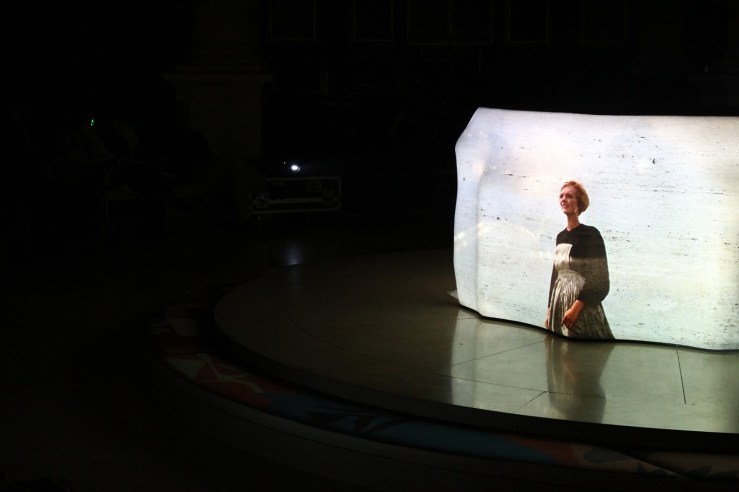
Stations of the Cross by Mark Dean
Mark Dean, “I. The Royal Road,” from Stations of the Cross cycle. Video projected on Henry Moore altar at St. Stephen Walbrook, London, April 15–16, 2017. Photo: Jonathan Evens
Stations of the Cross by Mark Dean
Mark Dean, “VIII. Daughters of Jerusalem,” from Stations of the Cross cycle. Video projected on Henry Moore altar at St. Stephen Walbrook, London, April 15–16, 2017. Photo: Jonathan Evens
Stations of the Cross by Mark Dean
Mark Dean, “IX. In Freundschaft,” from Stations of the Cross cycle. Video projected on Henry Moore altar at St. Stephen Walbrook, London, April 15–16, 2017. Photo: Jonathan Evens

Sounds like an exemplary integration of art and liturgy! You can read the catalog essay and watch the videos on Dean’s website, tailbiter.com. See also the interview with curator Lucy Newman Cleeve published in Elephant magazine.

+++

“Featured Artist: Nicholas Mynheer” by Victoria Emily Jones: This month I wrote a profile on British artist Nicholas Mynheer for Transpositions, the official blog of the Institute for Theology, Imagination, and the Arts at the University of St. Andrews in Scotland. (There’s a glitch with their publishing tool that is preventing all the artworks from displaying, but all the ones I discuss in the article can be found at www.mynheer-art.co.uk.) A painter, sculptor, and glass designer, Nick works almost exclusively on religious subjects, in a style that blends influences from medieval, primitive, and expressionist art. I met him in 2013 and got to see his studio and his work in situ in various Oxford churches. His love of God and place was obvious from my spending just one afternoon with him. Other articles I’ve written are on Nick’s Wilcote Altarpiece, Islip Screen, and 1991 Crucifixion painting (which I own).

Harvest by Nicholas Mynheer
Nicholas Mynheer (British, 1958–), Harvest, 2010. Oil on canvas, 70 × 70 cm.
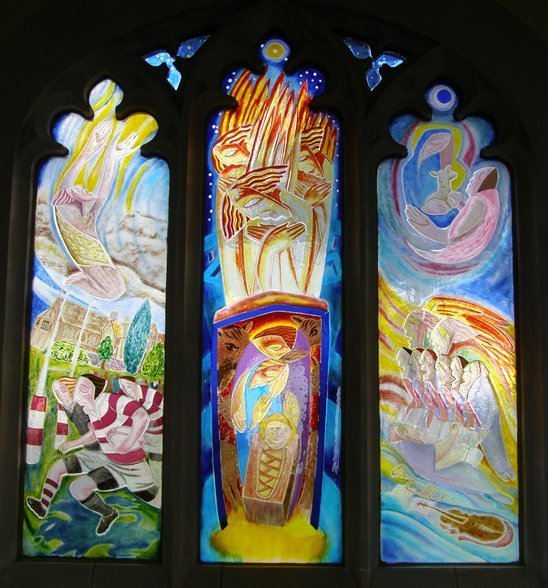
Michaelmas Term Window by Nicholas Mynheer
Nicholas Mynheer (British, 1958–), Michaelmas Term Window, 2012. Fused glass. Abingdon School Chapel, Oxfordshire, England.
Corpus of Christ by Nicholas Mynheer
Nicholas Mynheer (British, 1958–), Corpus of Christ, 2010. English limestone, 85 cm tall.

+++

Season 14 of So You Think You Can Dance premiered last Monday (the only TV show I never miss!). Watching dancers draws me into a deeper awe of God, as I see all the creative potentialities of the human body he designed. Here are my two favorite auditions from episode 1. The first is husband-wife duo Kristina Androsenko and Vasily Anokhin performing ballroom. The second is a modern dance number performed by Russian twins Anastasiia and Viktoriia; they gave no comment on the dance’s motivation or meaning, but it’s clear that it represents trauma of some kind.

+++

“Why we need Mary Oliver’s poems” by Debra Dean Murphy: “Oliver is a mystic of the natural world, not a theologian of the church. . . . Her theological orientation is not that of orthodox Christianity. Nevertheless, Christians have much to gain from reading Oliver . . .” Her poems are “occasions for transfiguring the imagination and a summons to wonder and delight”; they remind us “of what it means to attend to what is before us in any given moment,” teach us to adopt “a posture of receptivity that Christians sometimes speak of as part of our vocation—the calling to live more fully into our humanity as persons bearing the imago dei, to mirror the divine dance of mutual presence, mutual receptivity, mutual love.” Some of my favorite Oliver poems are “Praying,” “I Wake Close to Morning,” “Messenger,” “The Summer Day,” and “How the Grass and the Flowers Came to Exist, a God-Tale.”

+++

NEW SONG: “Weep with Me” by Rend Collective: Written last month in response to the Manchester Arena bombing, “Weep with Me” is a contemporary lament psalm in which the speaker asks God to do what the title says: weep with him. To feel his pain and respond. It’s introduced and performed acoustically by band member Chris Llewellyn in the video below.

On the video’s YouTube page, Rend Collective writes,

Can worship and suffering co-exist? Can pain and praise inhabit the same space? Can we sing that God is good when life is not? When there are more questions than answers? The Bible says a resounding yes: these songs are called laments and they make up a massive portion of the Psalms.

We felt it was fitting to let you hear this lament we’ve written today as we prepare to play tonight in Manchester. We can’t make the pain go away. We refuse to provide cheap, shallow answers. But hopefully this song can give us some vocabulary to bring our raw, open wounds before the wounded healer, who weeps with us in our distress. We pray that we can begin to raise a costly, honest and broken hallelujah. That is what it means to worship in Spirit and in Truth.
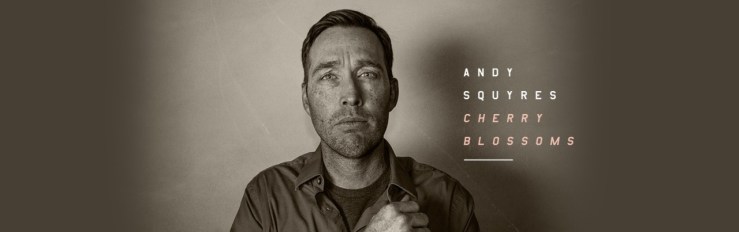
Of pain and praise: Cherry Blossoms by Andy Squyres (album review)

andy-squyres

In a recent interview, Bono issued a call to Christians for more authentic songwriting, for the “brutal honesty” before God that characterizes the book of Psalms. We need more realism in art and in life, he said; we need to be “porous.”

Andy Squyres delivers all this in his 2015 album Cherry Blossoms, which chronicles his journey through pain and loss after his friend was murdered by a home intruder. Tragedy destabilizes; it prompts questions regarding the nature of God and the viability of faith in the face of reality. But it also throws into high relief God’s promises—to love, to strengthen, to walk with, to bring through. Not immediately, but with time.

A necessary step to regaining stability after receiving a blow like the death of a loved one is to spend time sitting in the darkness of the why, and that’s exactly what many of the tracks on Cherry Blossoms allow us to do: grieve, question, wrestle hard for a blessing until daybreak.

My favorite song is “What Nobody Should Know”:

While all the others focus on personal pain, this one shows what it looks like to suffer in community. (The murder victim was a fellow church member.) Here’s an excerpt:

We were in a church but we were shouting
Mourning our loss but not our doubting
Wondering why love is allowing
All of us to hit the floor
Down here is one of the strangest places
Nothing but hearts and dirty faces
Maybe this is where amazing grace is
God knows we need some more

Squyres’s lyrics are very evocative, sensory.

In “The Pestle and the Mortar,” he writes that his sweet illusions were crushed like spice pods—turned to dust—by the pestle of affliction. The implication is that suffering, by virtue of its pounding, releases in us an aroma and preps us to be used in delicious ways.

In “Labor in Vain,” he references John Henry, the steel driver of African American folklore, and considers the field as a metaphor for life, in that we often have to cut through hard ground. It’s laborious work, and it requires perseverance. But the yield is grain and grapes—that is, fuller communion with the body and blood of Christ (his people, his suffering).

Cherry Blossoms gives voice to other frustrations as well, like economic injustice. In “The Hawk and the Crow,” Squyres grapples with feelings of hatred toward the inconsiderate wealthy whose lack of care oppresses. I’m really intrigued by the line “mercy is the burden of the poor.” When I asked Squyres if he could unpack it a little for me, this is what he said:

It is the idea that those who are marginalized (the poor, the rejected, the outcast, etc.) are the most likely to be recipients of injustice and therefore have the most opportunity to forgive the oppressor, to heap mercy upon the one who has probably done great harm. Jesus doesn’t let the poor off the hook just because they’re poor. We have to show mercy too.

“Only love can give what vengeance cannot cure.”

There’s only one song on the album that’s not autobiographical, and that’s “Don’t Forget About Me When I’m Gone.” Squyres said he approached it as an exercise in songwriting and empathy: he wanted to tap into that feeling of separation we sometimes feel from our loved ones.

The album concludes with the titular “Cherry Blossoms,” a redemption song full of springtime imagery. Previously “bur[ied] . . . in a blanket of evening snow,” Squyres is now thawed out, warmed by a reassurance of God’s love. Here he is singing the song with his daughter Savannah McAffrey:

Stating his resolve to not give in to the forces of frustration and death, Squyres clings to hope and issues forth praise that is anything but cheap—it cost him blood and bone. It’s not that he’s arrived spiritually; rather, he has cycled through a season of life with God and has landed at a gracious new beginning. “Orientation-disorientation-reorientation” is how Walter Brueggemann schematizes this constant flow along which God’s children are always in transit.

Both bitter and sweet, Cherry Blossoms is for those whose equilibrium has ever been disrupted by a life event—and more than that, it’s for the church at large, because we are in desperate need of a language of suffering. Such a language is part of our heritage—i.e., the Psalms—and Squyres helps us reclaim it, letting us walk, and sing, with him through his own valley. Squyres shows that pain and praise are companions in the life of faith (the one need not be suppressed), and that Love is always there to be our breakthrough.

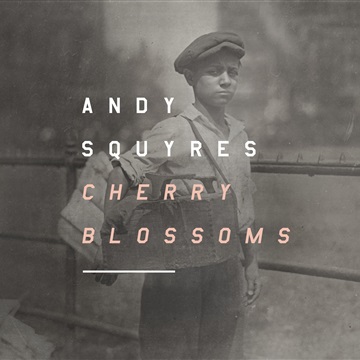
cherry-blossoms-album-cover

I really admire Squyres’s artistic sensibility, not only in regard to lyrics and composition but also extending to things like disc packaging. The album cover photo is striking. I asked him about its origin, and he had this to say about it:

I had seen a photo at an art exhibit at the Mint Museum in Charlotte of some kids in the 1930s standing on a street corner in Harlem. They were smoking cigarettes and looked like they had already seen their fair share of life and most of them were probably only young teenagers. When I saw that photo I just knew I wanted it for my album cover. We couldn’t get permission to use that one but we found the shoeshine boy. I love him because he looks world-weary yet determined. He’s probably got dreams, but he’s probably just gonna have to figure out a way to survive. That is the story of most of us.

He brings this sensibility to his job as worship pastor at Queen City Church in Charlotte, North Carolina, along with his life experience and heart of faith.

In a blog post dated October 15, 2012, Squyres wrote,

The season of your existence between the day you are born and the day you die is the only moment in the entire span of eternity from which you can love God in the midst of trouble, from the altar of pain. When you are finally out of the realm of time, loving God will be altogether glorious but equally obvious. You won’t be asking “why” this trouble. You won’t be reaching with hands of faith anymore. Faith will pass and you will be in the ecstasy of His presence. That’s why you must see this life, any affliction, any sorrow, any struggle as the most incredible gift that it is; this is your chance to love God from this place and in this moment. It will never again be. Every tear will be wiped away. So if now, you have a tear, then give it to God with all the imperfect love in your heart.

Cherry Blossoms is Squyres’s tear-offering—to God and to the church.


Cherry Blossoms is available for free download from NoiseTrade (in exchange for your e-mail address). You can purchase the physical disc here.

Here’s a bonus song, not part of the album but of the same spirit: “Why, Oh Why”: