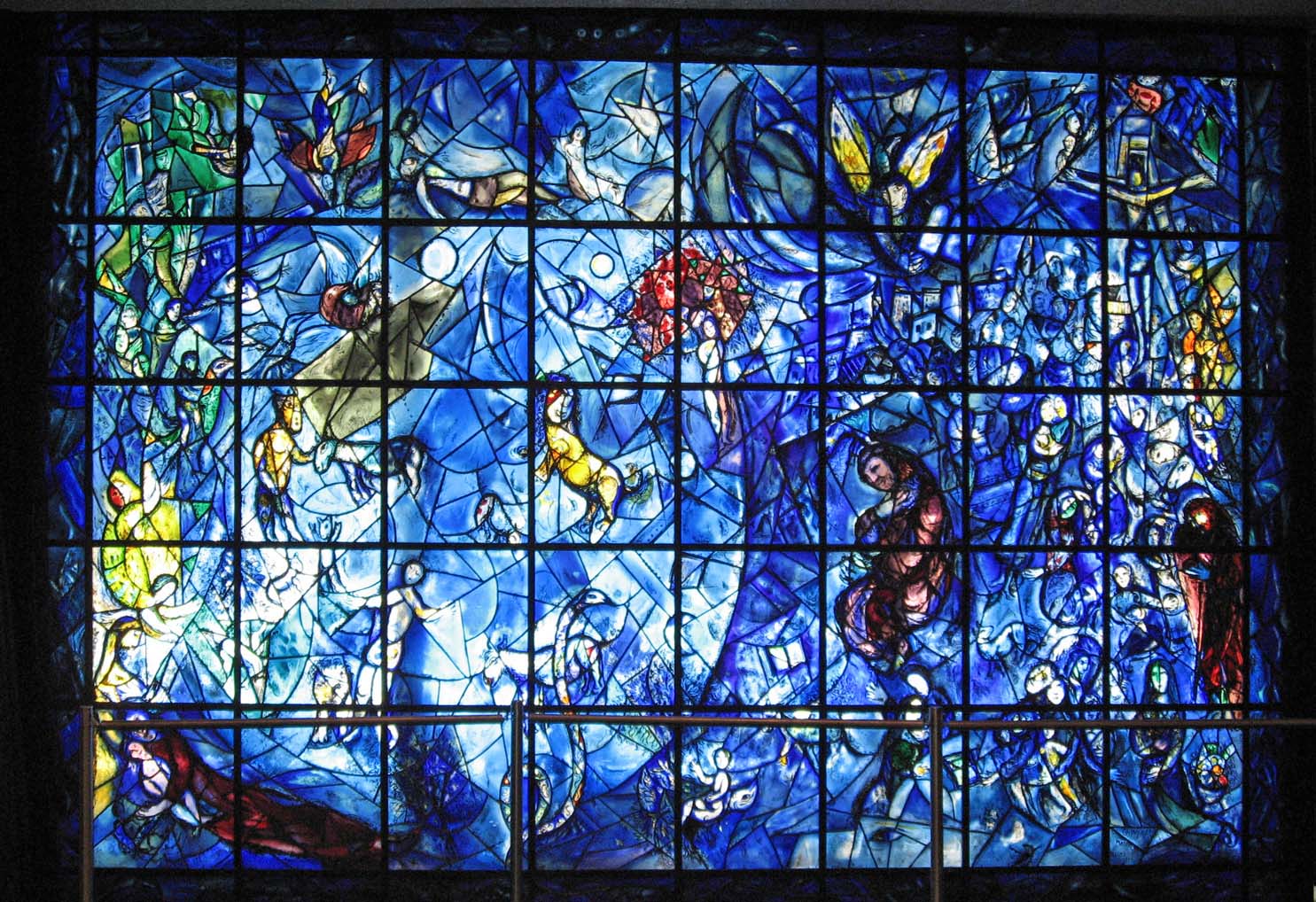
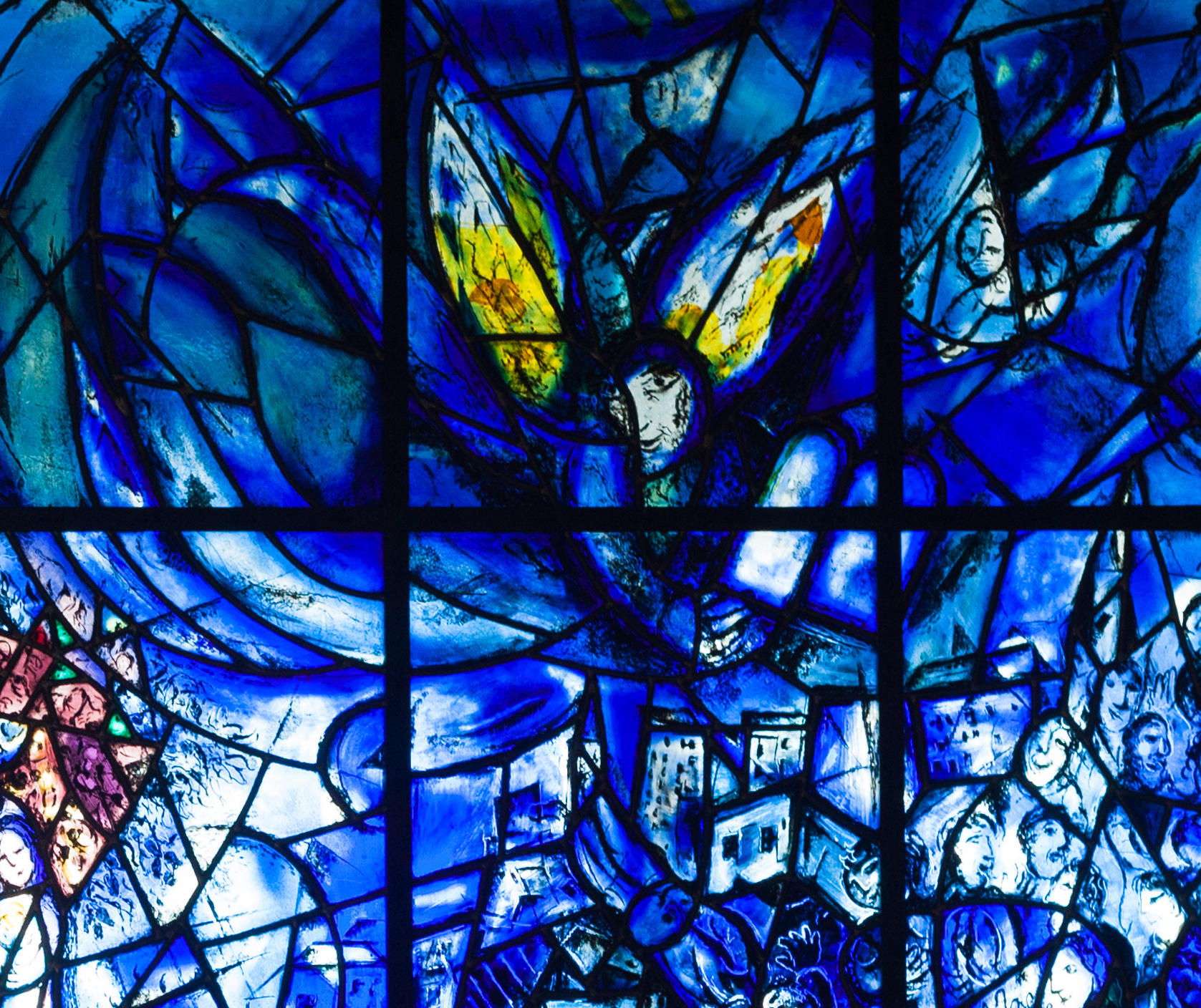
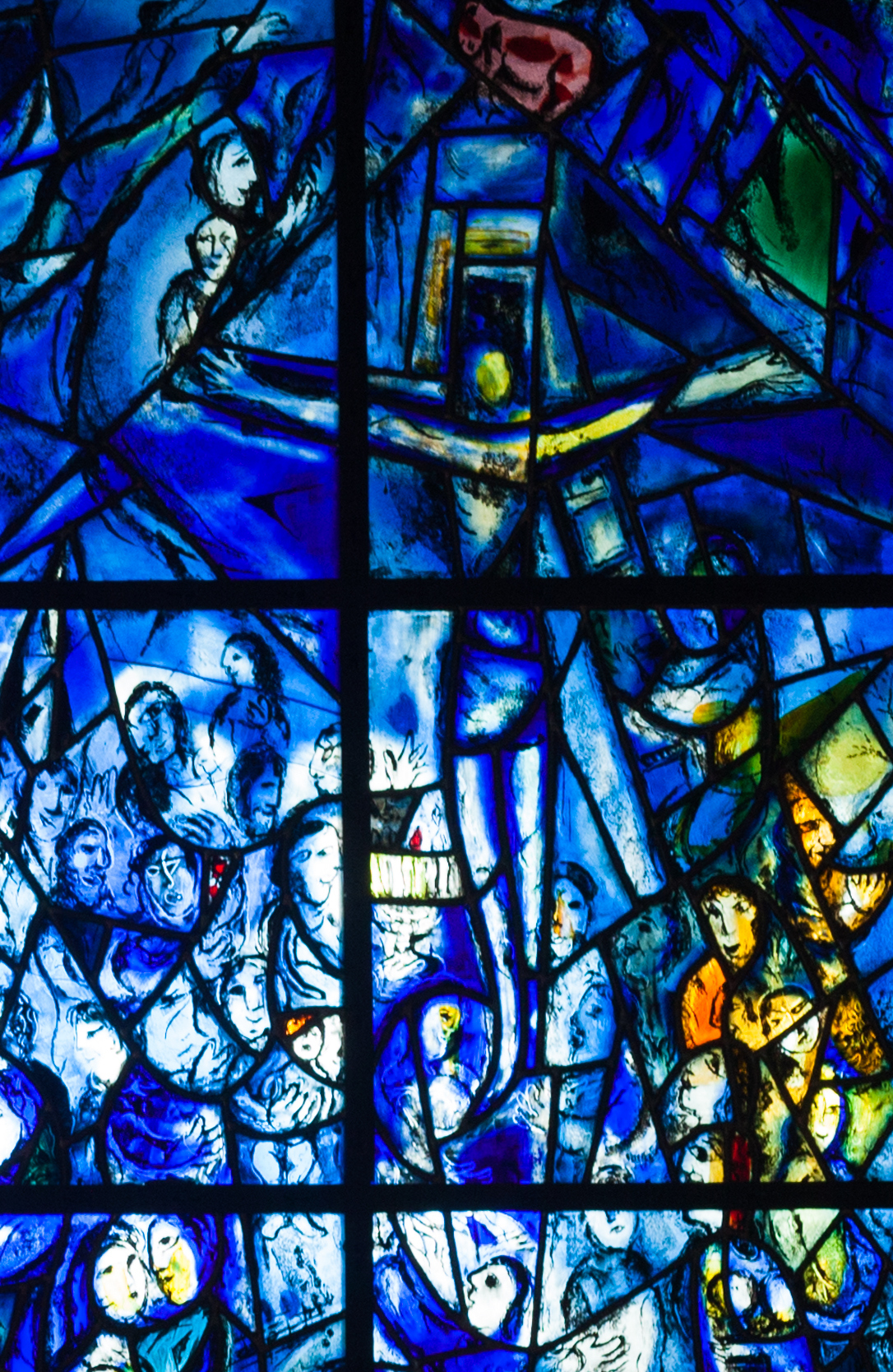
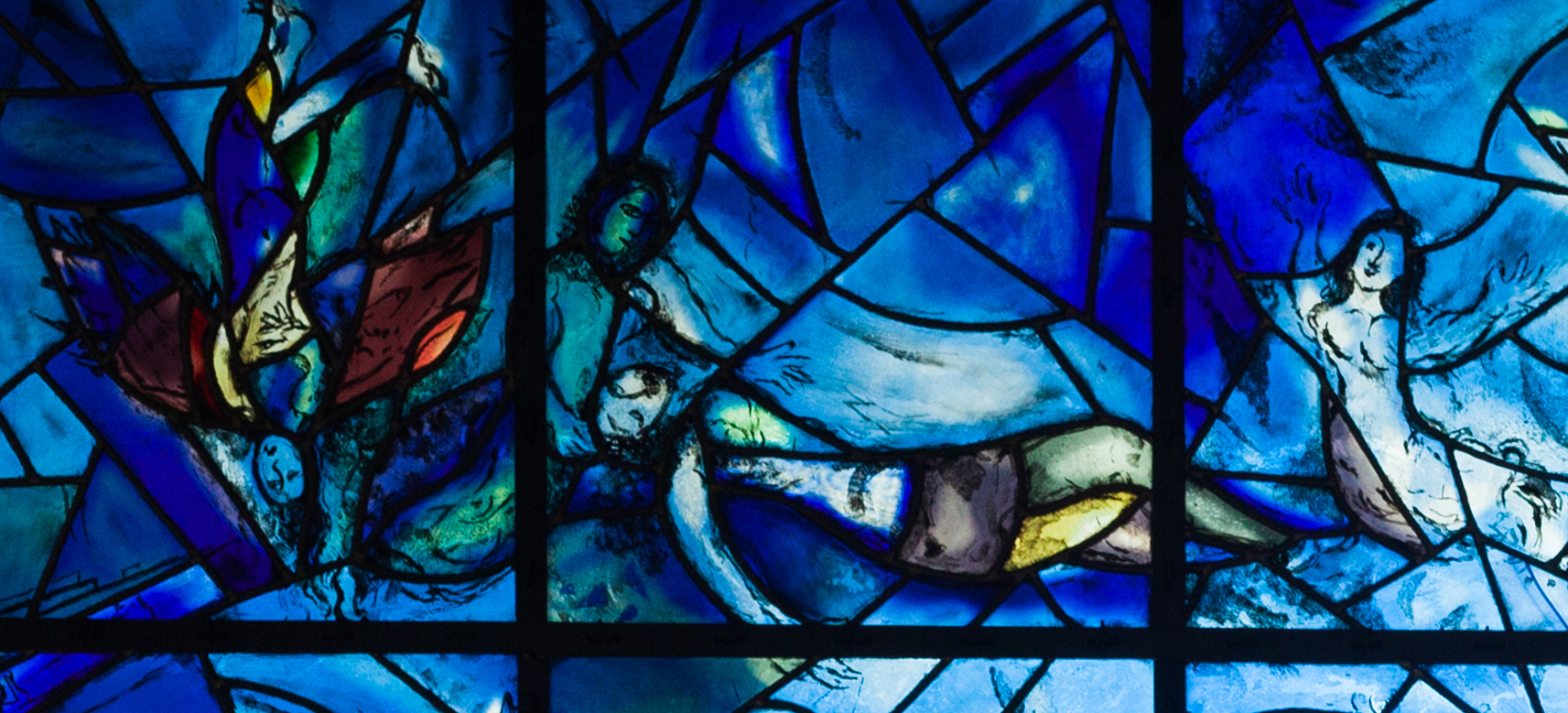
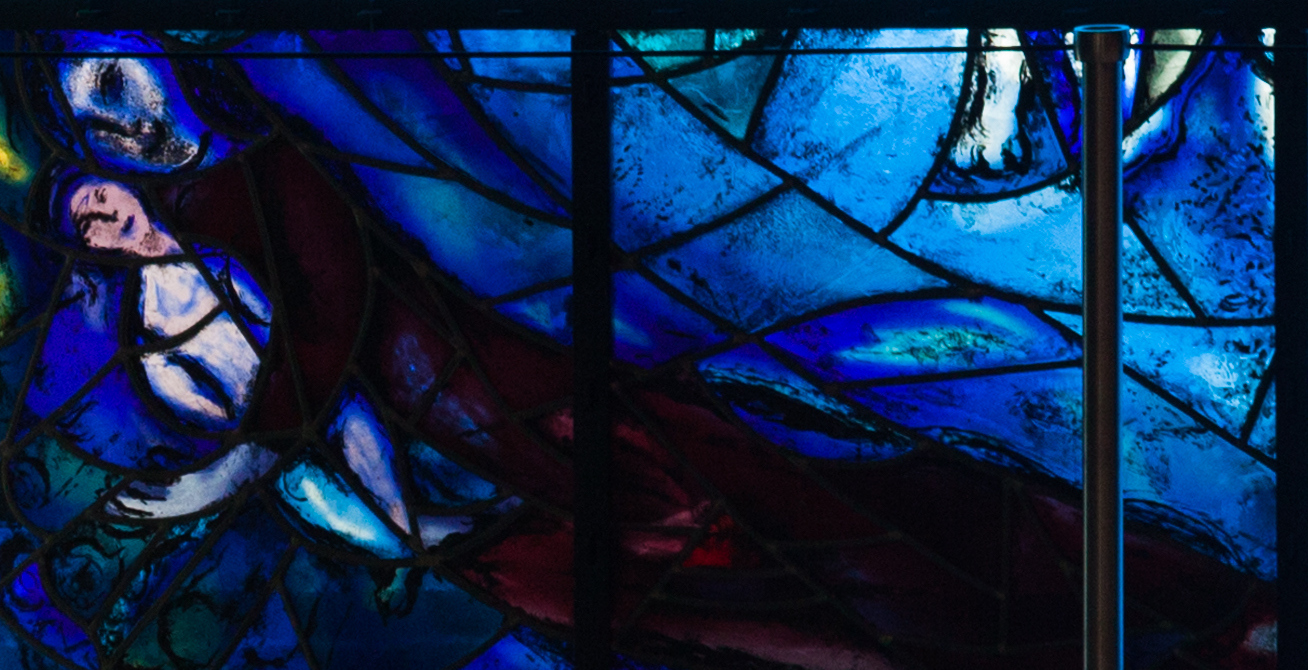
Marc Chagall (Russian/French, 1887–1985), Peace Window, 1964. Stained glass, 12 × 15 ft. Public lobby, General Assembly Building, United Nations Headquarters, New York. Manufactured by Brigitte Simon and Charles Marq.
This stained glass window by Marc Chagall was commissioned as a memorial for the Swedish diplomat Dag Hammarskjöld (1905–1961), who served as the second secretary-general of the United Nations, and for the fifteen other UN staff and peacekeepers who died with him when their plane crashed on the way to a peace negotiation for the Congo Crisis in Northern Rhodesia. The artist’s handwritten dedication reads, “A tous ceux qui ont servi les buts et principes de la Charte des Nations Unies et pour lesquels Dag Hammarskjöld a donné sa vie” (To all who served the purposes and principles of the United Nations Charter, for which Dag Hammarskjöld gave his life).
Chagall’s design was executed by master glassmakers Brigitte Simon and Charles Marq of Atelier Simon-Marq.
Chagall was born in 1887 into a Hasidic Jewish family in Vitebsk, Russia (now Belarus). He moved to Paris in 1910 to develop his art, becoming a French citizen in 1937. When Nazis took over the country, threatening Chagall’s safety, he was successfully extricated to the United States with the help of Alfred Barr, director of the Museum of Modern Art in New York. He returned to France for good in 1948. His impressive body of work, marked by a spiritual vivacity, includes—in addition to stained glass—paintings, drawings, book illustrations, stage sets, ceramics, and tapestries.
His 1964 Peace Window in New York City—not to be confused with his similar but much larger Peace Window of 1974 in the Chapel of the Cordeliers in Sarrebourg, France—is full of biblical allusions.
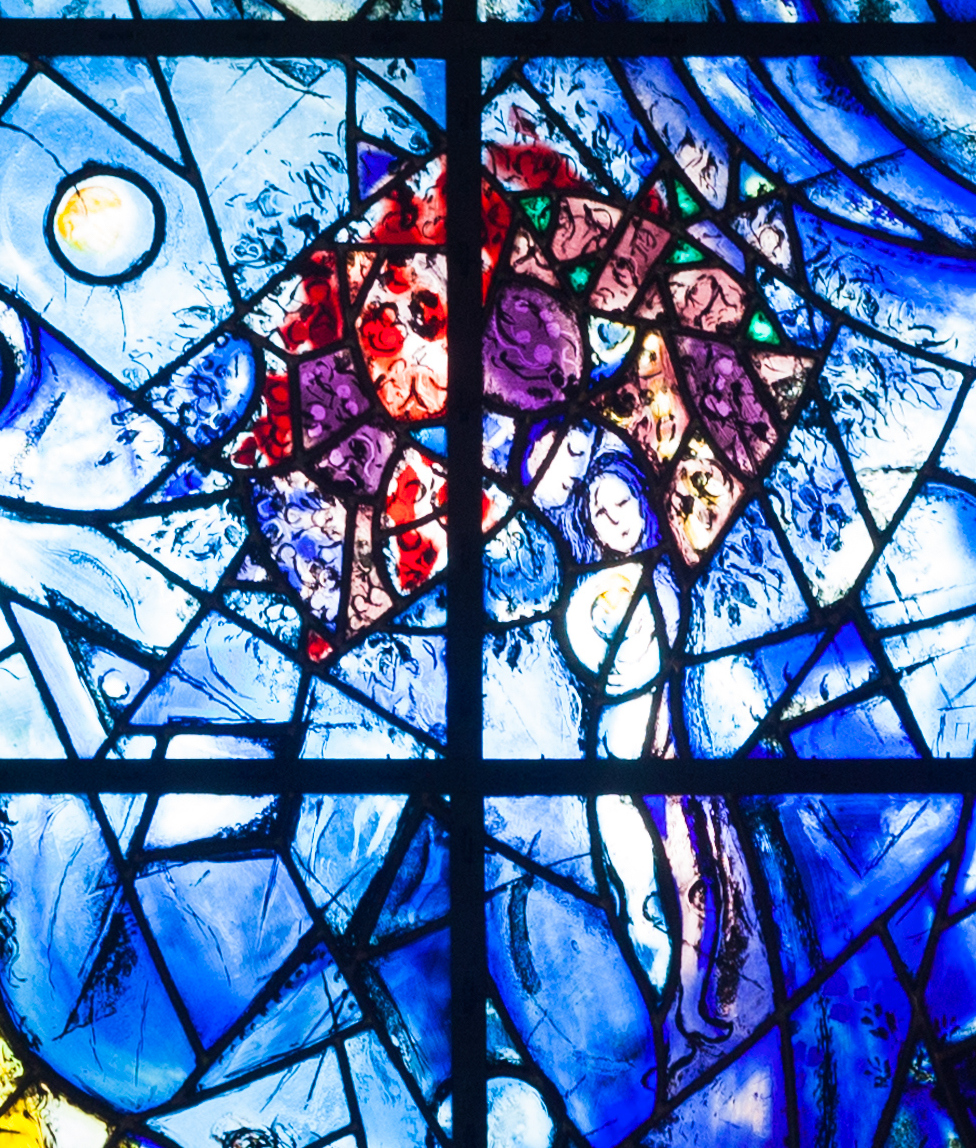
My eyes are drawn first to the red and purple bouquet in the center, under which stands an amorous couple. Who are they? What do they represent? I can think of several possibilities:
1. Adam and Eve. In the sketch Chagall made for the window, the woman is very clearly naked, though she’s less obviously so in the final window. That Eve, pre-fall, is traditionally portrayed unclothed, and that Chagall’s later Peace Window unequivocally portrays Adam and Eve within a red tree, lends credence to the interpretation of these figures as our primordial foreparents, in which case the flowering mass would stand for the tree of life in the garden of Eden (Gen. 2:9).
2. The Annunciation—the angel Gabriel coming to Mary to announce that she had been chosen to birth and mother God’s Son. The male head is bodiless, emerging from the crimson bloom (suggesting, perhaps, a supernatural entity), and there’s a yellow glow at the woman’s breast, perhaps signifying the conception of Christ. What’s more, the woman appears to be cradling something—her pregnant belly?
3. God and the human soul, or Christ and his church. One traditional Jewish interpretation of the poetic book of scripture known as the Song of Solomon is that it celebrates the love between humanity and the Divine. Medieval Christians, similarly, spoke of the book as an allegory of the future marriage of Christ and the church, his bride, drawing too on the New Testament book of Revelation, which culminates in a mystical union, a picture of cosmic harmony, heaven and earth inseparably joined.
4. The kiss of Justice and Peace. Psalm 85:8–11, a common Advent text, speaks of the divine attributes that coalesce to accomplish salvation (in the Christian reading, in the Incarnation):
Let me hear what God the LORD will speak, for he will speak peace to his people, to his faithful, to those who turn to him in their hearts. Surely his salvation is at hand for those who fear him, that his glory may dwell in our land.
Steadfast love and faithfulness will meet; righteousness and peace will kiss each other [emphasis mine]. Faithfulness will spring up from the ground, and righteousness will look down from the sky.
5. The kiss of Joy. Beethoven’s Ninth Symphony was a favorite of Dag Hammarskjöld’s, and its performance, at least the “Ode to Joy” chorus in its final movement, is a United Nations Day concert tradition. Hammarskjöld described the work as “a jubilant assertion of life,” championing universal peace and brotherhood. One of the lines from Friedrich Schiller’s text that Beethoven set exclaims that “Joy . . . kiss[es] . . . the whole world!”
I suspect some or all of these ideas were at play when Chagall designed the window. Or even just romantic love in general (with other types of love portrayed elsewhere in the composition), as he often painted himself and his wife Bella kissing or embracing.
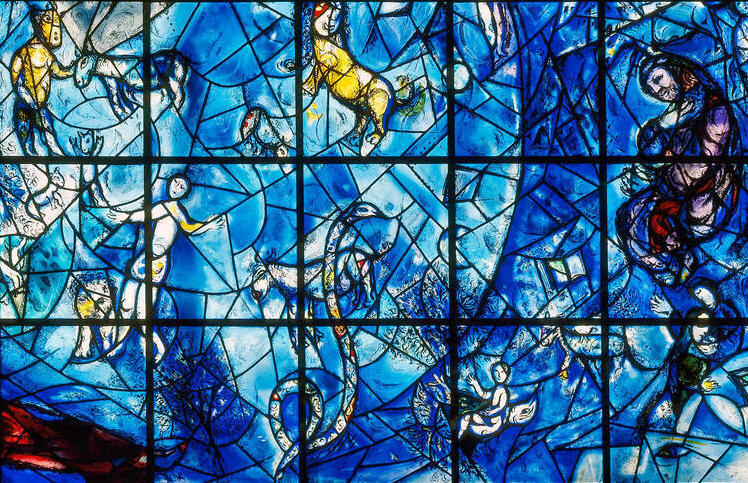
After this tableau, my eyes go to the large male figure cloaked in purple just right of center. I take him to be the prophet Isaiah, beholding a vision of wild animals and children cavorting together in harmony (see Isaiah 11). A boy, for example, reaches his hand out toward a viper and is not harmed.
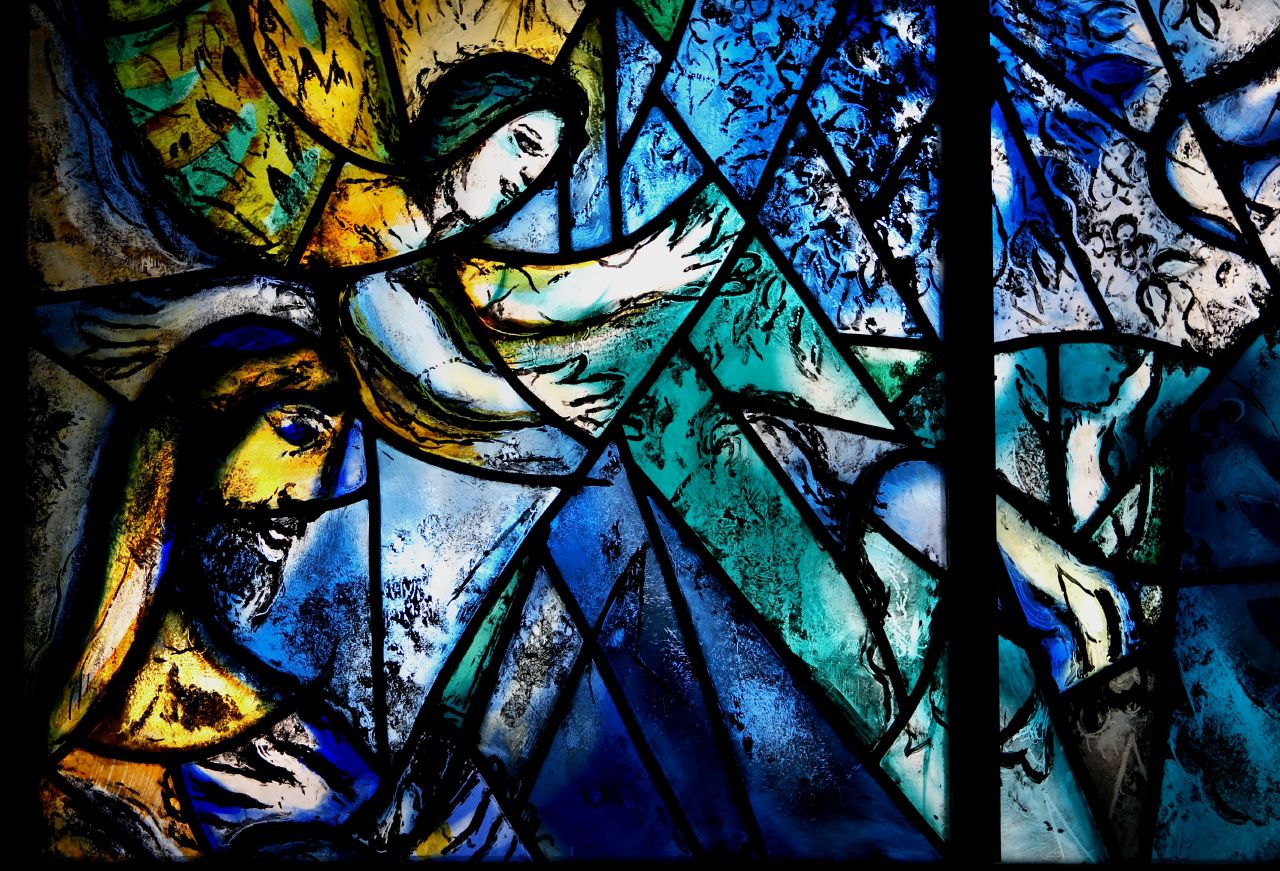
But it’s also possible that’s meant to be Isaiah at the bottom left of the window, his face illumined by the beauty spread out before him, which an angel gestures to, guiding the prophet’s imagination:
On the top right, another angel delivers the Ten Commandments to the people of God.
Next to this communication of God’s word is the death of God’s Word in the flesh, Jesus Christ, around whom the crowds have gathered. A man ascends a ladder propped against the cross, the ladder being a multivalent symbol harking back to Jacob’s dream at Bethel and evoking notions of descent and ascent.
Vignettes below include a couple embracing with an infant in hand, a woman being fed at a table (the Eucharist?), a family reading a book (probably the Bible), a woman making music, and another bearing flowers.
At the top left is a lamentation scene that evokes those of Christ deposed from the cross. A man in a loincloth lies dead or wounded on the ground, his head cradled by a loved one, while at his feet another mourner throws her arms up in grief. This is the cost of human violence.
By contrast, in the bottom left corner, a mother cradles her child, evoking scenes of the nativity of Christ—of Mary with her newborn son.
All these characters—human, animal, and divine—are sprawled across a warm azure background, playing out love, suffering, death, peace, joy, and reconciliation.
LISTEN: “Oracles” by Steve Bell, on Keening for the Dawn (2012)
O ancient seer, your vision told Of desert highways streaming home To the mountain of the Lord Where nations sound a righteous song forevermore
And on that mountain men will forge From cruel implements of war The tools to till and garden soil The rose will bloom and faces shine with gladdening oil
And it will surely come to pass Justice will reign on earth at last The wolf will lie down with the lamb No beast destroy, no serpent strike the child’s hand
And God himself will choose the sign A frightened woman in her time Will bear a son and name him well God with us! O come, O come, Emmanuel!
This a continuation of yesterday’s article.In part 1 I shared three room highlights from my visit to Kolumba museum in Cologne, Germany, run by the city’s Catholic archdiocese; in this final part I will do the same for KMSKA in Antwerp, Belgium, whose Old Masters galleries received a “contemporary injection” in an exhibition that wrapped this week.All photos are my own.
[Content warning: This article contains female nudity: a controversial Renaissance painting of the Virgin Mary, and three photographs of women who have just given birth.]
KMSKA, Antwerp
The Royal Museum of Fine Arts Antwerp, or KMSKA for short, is a world-famous museum whose collection spans seven centuries, from the Flemish Primitives to the Expressionists.
When I was there last month, the featured exhibition was Collected with Vision: Private Collections in Dialogue with the Old Masters, which ran from April 4 to October 12, 2025. Organized in conjunction with Geukens & De Vil Projects, it interwove postwar and contemporary works by internationally renowned artists from Belgian private collections with the existing museum collection, “expanding the transhistorical approach already in place. The exhibition offers a reflection on the history of art collecting and asks probing questions about social issues such as gender, power and identity. The role of museums and collectors is the focal point. Do the interventions create a harmonious dialogue with 700 years of art history, or do they give rise to challenging contrasts?” Featured artists included Cindy Sherman, Olafur Eliasson, David Claerbout, Francis Alys, Christian Boltanksi, Tracey Emin, Marlene Dumas, Luc Tuymans, and Louise Bourgeois.
The galleries of the exhibition were organized by theme: Holy, Impotence, Horizon, Image, Entertainment, Profusion, Lessons for Life, Fame, The Salon, Heroes, Evil, The Madonna, Suffering, Redemption, Prayer, Heavens, and Power.
I’ll spotlight what I consider the most successful and intriguing pairings.
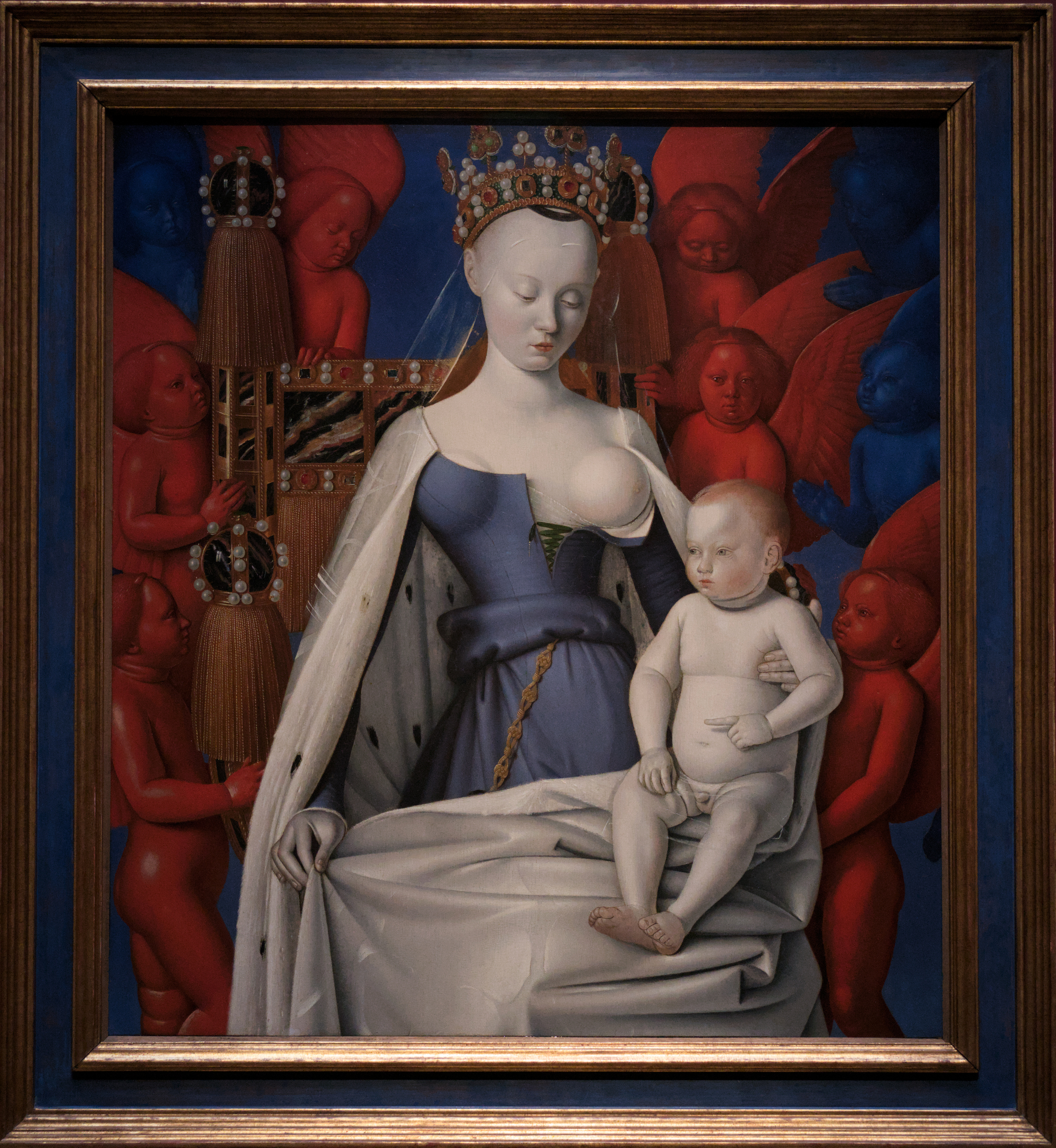
First, the “Madonna” room, anchored by the famous Madonna Surrounded by Seraphim and Cherubim by the late medieval French court painter Jean Fouquet. It’s the right wing of a diptych that originally hung above an altar at the Collegiate Church of Notre-Dame in Melun.
Jean Fouquet (French, 1410/30–1477/81), Madonna Surrounded by Seraphim and Cherubim, ca. 1450. Oil on panel, 92 × 83.5 cm. Koninklijk Museum voor Schone Kunsten Antwerpen (KMSKA, Royal Museum of Fine Arts Antwerp).
The painting is historically significant—I first encountered it in a college art history course. Commissioned by Etienne Chevalier, treasurer to King Charles VII of France, it portrays the Virgin Mary as the Queen of Heaven, baring her breast ostensibly to nourish the Christ child with her milk. She was probably modeled after Agnès Sorel, the king’s recently deceased mistress and mother of three of his daughters, considered the ideal of feminine beauty at that time in western Europe: pale-skinned, with a high forehead, and fashionable in her ermine cloak.
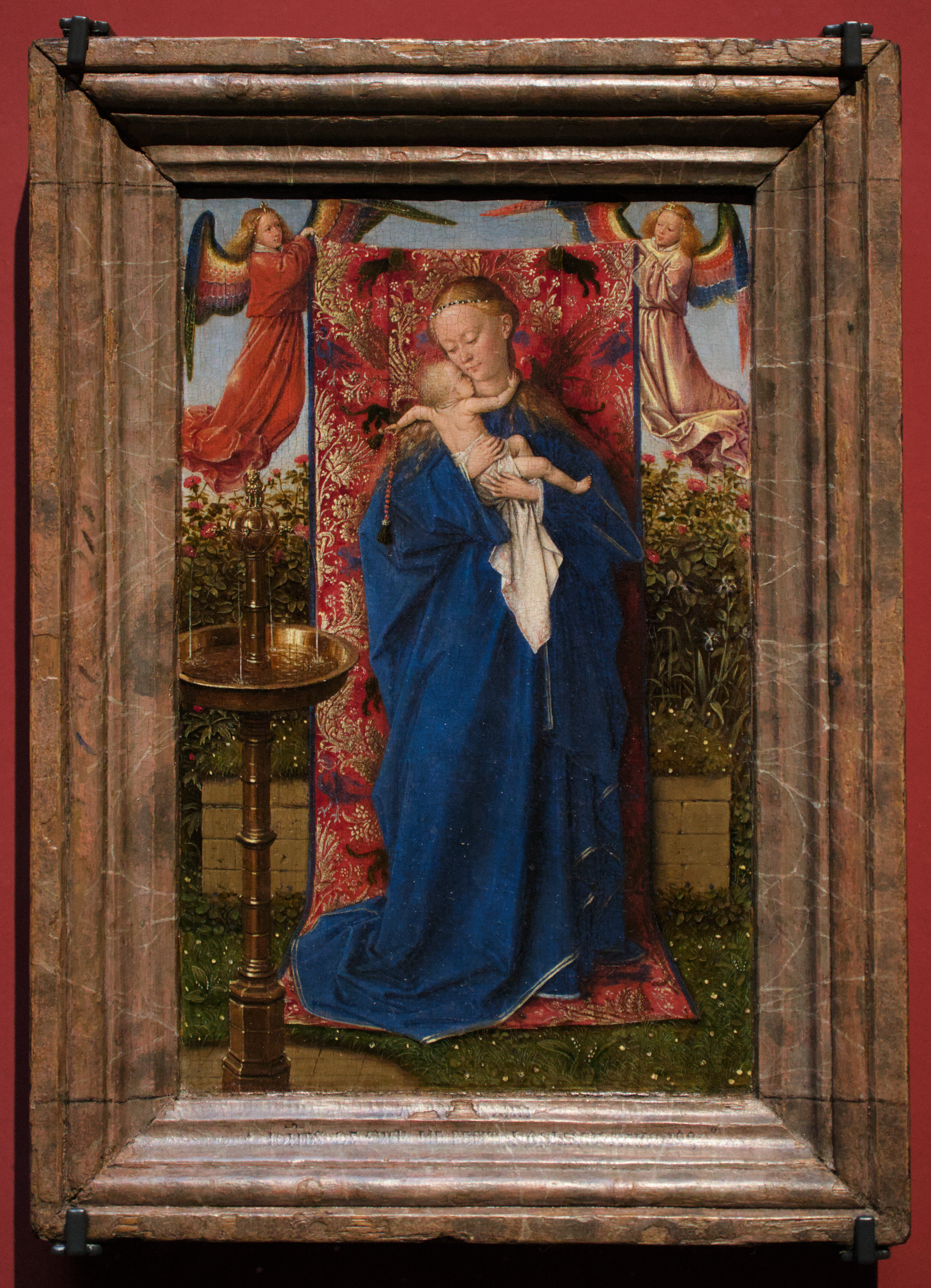
Though I can appreciate the technical excellence of this painting and the intense reds and blues of the angels, I don’t really like it. Mary seems cold, not very maternal. There’s also an eroticization of her body—not because her breast is exposed, which was common in Marian art, but because it seems to be on display for the viewer; her son’s not interested in feeding—that’s wholly inappropriate for the subject. Why you’d want to memorialize your boss’s sex partner in such a way is beyond me. I’m no prude, but I much prefer Jan van Eyck’s Madonna at the Fountain, on display in the same room:
Jan van Eyck (Flemish, 1390/99–1441), Madonna at the Fountain, 1439. Oil on panel, 19 × 12 cm. Koninklijk Museum voor Schone Kunsten Antwerpen (KMSKA, Royal Museum of Fine Arts Antwerp).
This small painting originally hung not in a church but in someone’s house. Though there’s still an air of formality, it has all the tenderness and connection that the other one lacks. Mother and son embrace in a garden of roses, irises, and lilies of the valley, he reaching round her neck and holding a string of prayer beads, she gazing adoringly at him. They stand beside a fountain, recalling Jesus’s discussion in John 4 about the “living water” he gives to those who thirst. The original wood frame bears the artist’s motto: “As well as I can.”
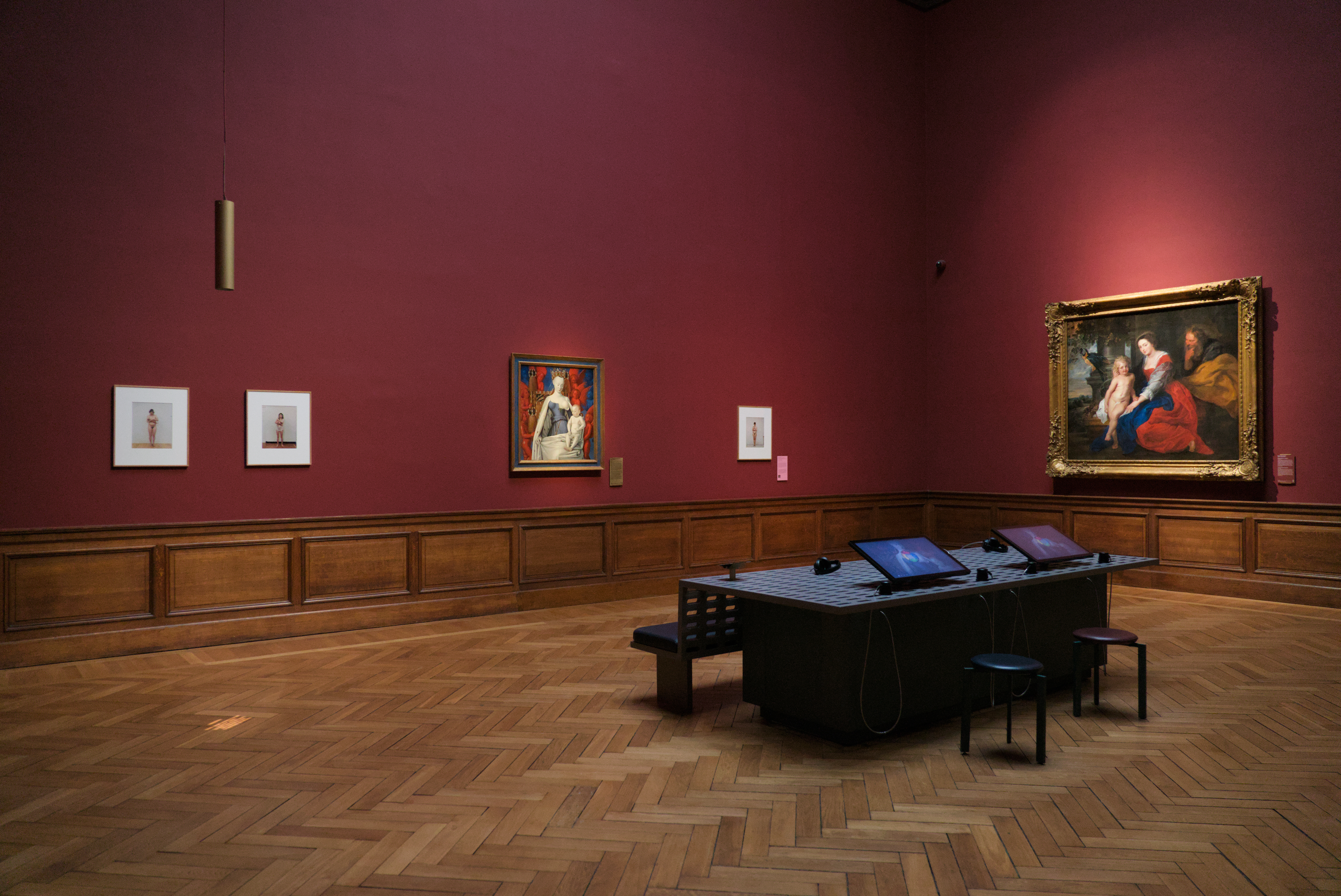
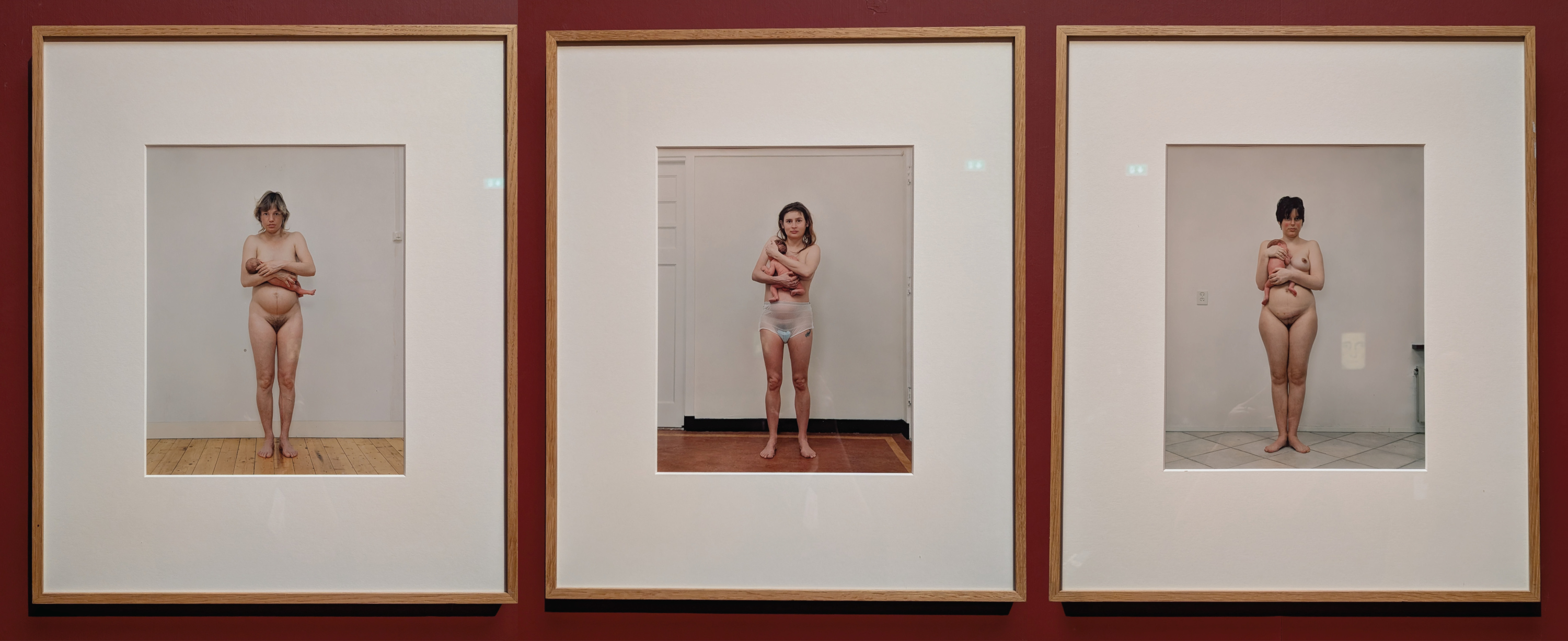
The deeply engrained portrait of motherhood embodied by the Virgin Mary is juxtaposed most potently with a series of three black-and-white portraits of new mothers by the Dutch photographer Rineke Dijkstra.
Gallery 2.17 (“The Madonna”) from the KMSKA exhibition Collected with Vision: Private Collections in Dialogue with the Old Masters
The accompanying text read:
Jean Fouquet portrays motherhood as something sacred. Mary as a symbol of purity and devotion is richly dressed in cool colours. Rineke Dijkstra homes in on the vulnerable reality. Her mothers are scantily clad and marked by childbirth. Both works are innovative: Fouquet may have painted his Mary for the first time from a real person, and in its day the painting was regarded as ‘modern’. Dijkstra shows motherhood in all its rawness, a taboo usually withheld from view.
Julie wears hospital pads and mesh underwear, which women often do for several weeks after giving birth to manage postpartum bleeding and urinary incontinence. As for Tecla, blood is running down her leg. And Saskia bears a scar from her cesarean section. A linea nigra (dark line) zips down the abdomen of all three, a temporary pigmentation increase caused by increased hormone levels. I love this triptych that shows motherhood’s glorious, messy, alterative impact on the body—the real physicality of the vocation of bearing children into the world.
I wish there were more imagery of Mary like this, as it would, I think, deepen the wonder of the Incarnation and enhance women’s ability to identify with Mary and thus further enliven her story.
Also in the Madonna gallery was a unique “light poetry” installation by Nick Mattan and Angelo Tijssens—one of seventeen spread throughout the second floor, collectively titled Licht dat naar ons tast (Light that reaches for us). KMSKA had commissioned this couple to bring to life the short verses the museum’s late writer-in-residence Bernard Dewulf had written in response to the galleries’ stated themes.
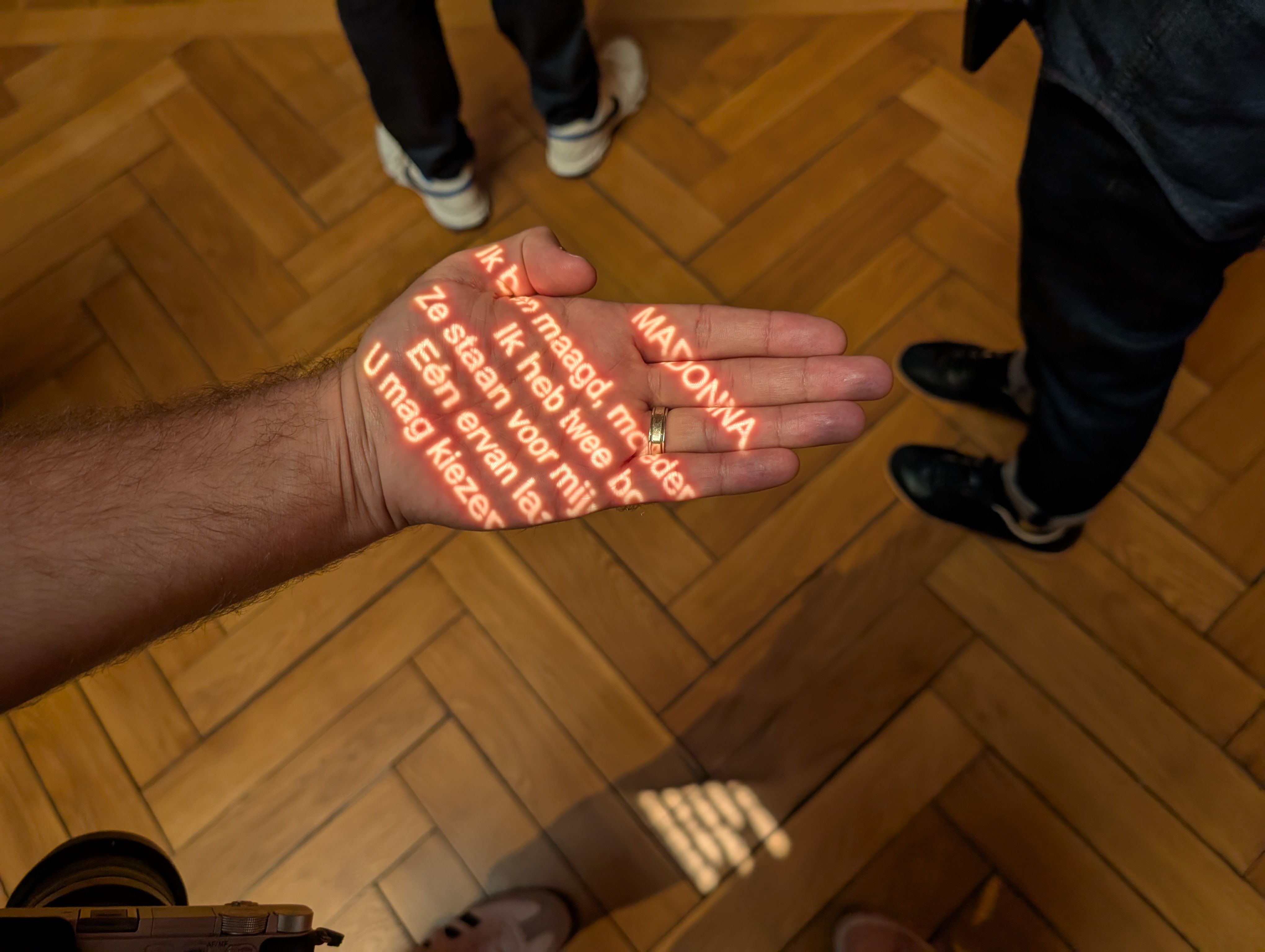
“Inspired by the museum’s many reading and praying figures, as well as James Ensor’s expressive hand sketches, [Mattan and Tijssens] sought a subtle way to make [Dewulf’s] words tangible,” the museum writes. Their solution was to project them onto the gallery floors from brass cylinders suspended from the ceiling. The words shine like faint specks of light, becoming legible only when a visitor holds their hands, a sweater, or something else up to the light.
Here my husband “holds” a poem written in the voice of Mary:
Nick Mattan (Belgian, 1987–) and Angelo Tijssens (Belgian, 1986–), Licht dat naar ons tast (Light that reaches for us), 2023, featuring seventeen poems by Bernard Dewulf. Commissioned by and permanently installed at the Koninklijk Museum voor Schone Kunsten Antwerpen (KMSKA, Royal Museum of Fine Arts Antwerp).
“Madonna” by Bernard Dewulf
Virgin, mother, wife – I have two breasts that stand for my three souls. I show you one of them, and whose it is is yours to choose.
Translated from the original Dutch by David Colmer
Kind of cheeky! Dewulf speaks of Mary’s three identities and lets us decide if the breast she bares in Fouquet’s painting represents her naked innocence, her nurturing impulse, or her desire to please her husband. (Traditionally in art, it has always stood for the second.)
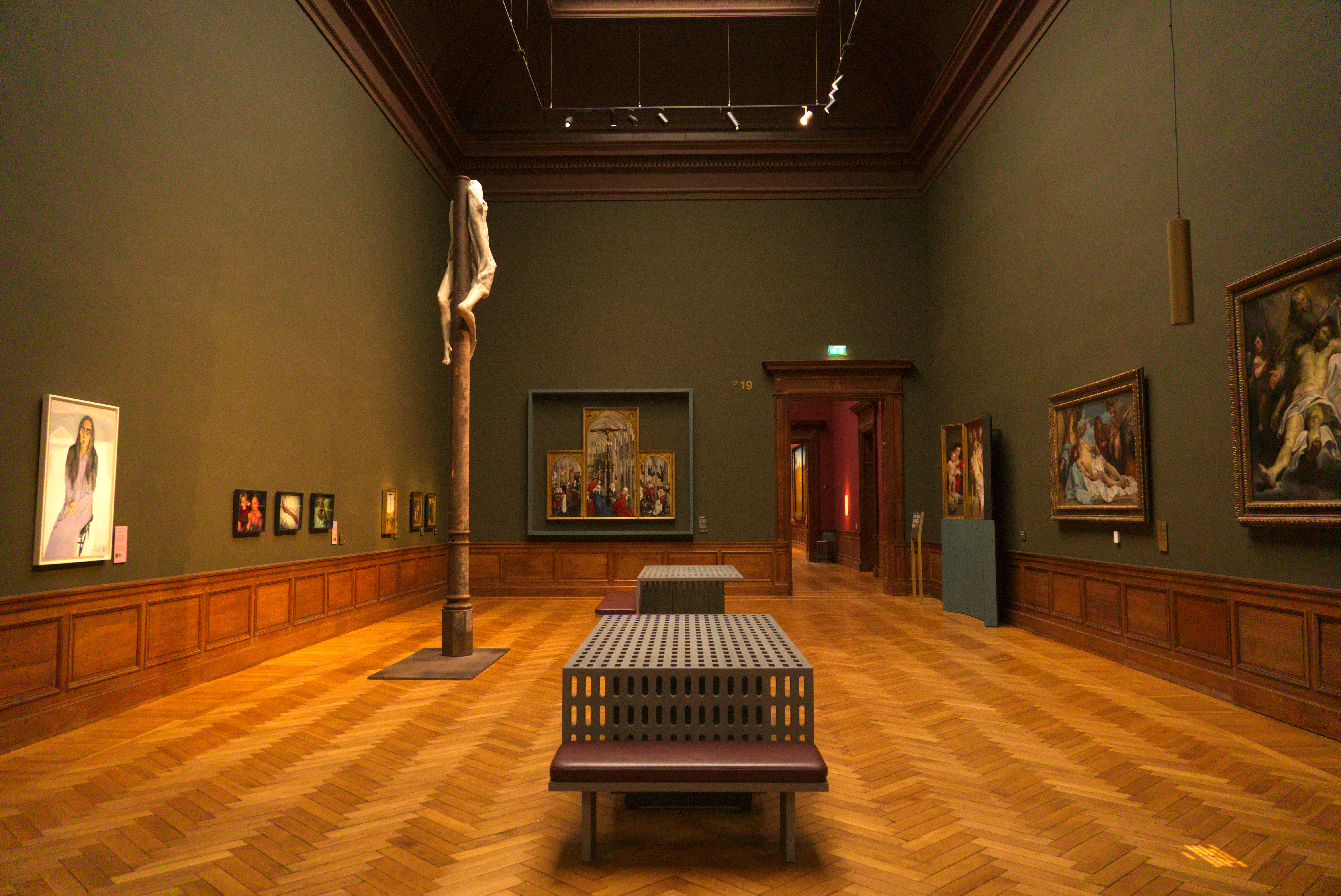
The next gallery I entered was themed “Suffering.”
Gallery 2.19 (“Suffering”) from the KMSKA exhibition Collected with Vision: Private Collections in Dialogue with the Old Masters
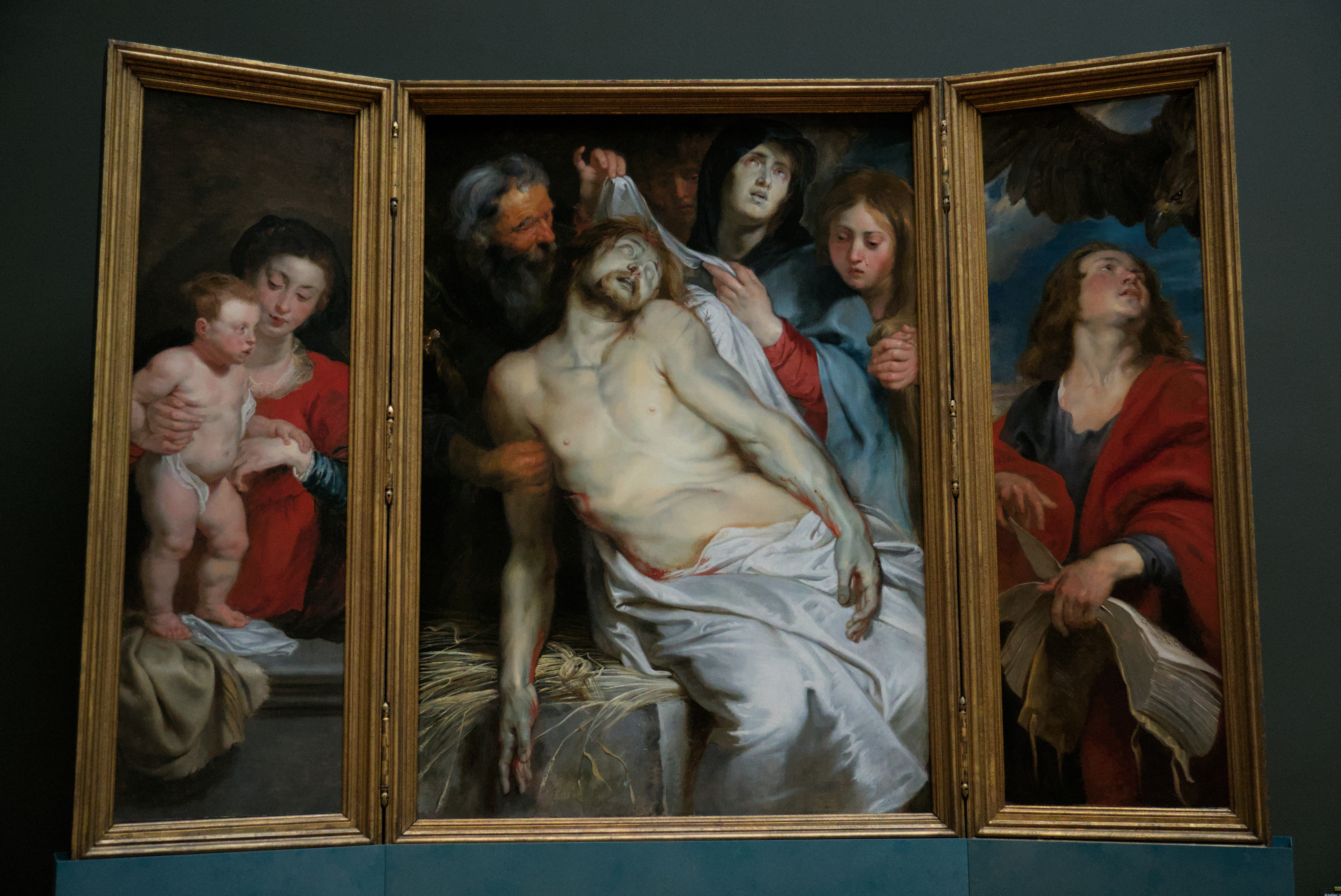
As one would expect, it’s inhabited by several Old Master paintings of Christ’s passion, most notably a triptych by the Flemish Baroque artist Peter Paul Rubens.
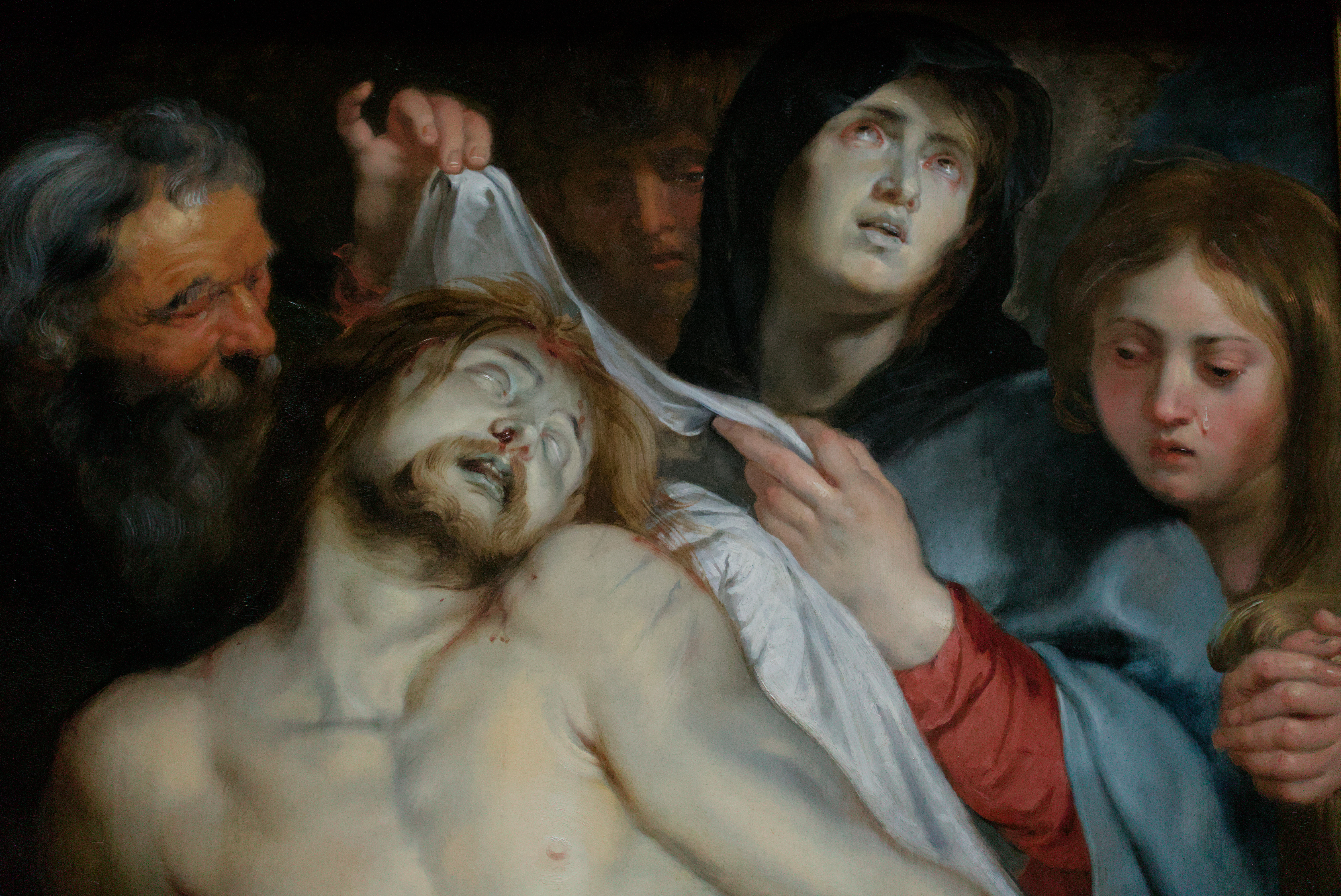
Peter Paul Rubens (Flemish, 1577–1640), Epitaph of Jan Michielsen and His Wife Maria Maes (aka Christ on the Straw, Madonna, and Saint John), 1618. Oil on panel, 138 × 178 cm. Koninklijk Museum voor Schone Kunsten Antwerpen (KMSKA, Royal Museum of Fine Arts Antwerp).
The central panel shows the dead Christ being laid out on a marble slab and wrapped in a shroud by Joseph of Arimathea, while his mother and Mary Magdalene (and the apostle John in the background) mourn him. The left wing shows Mary supporting the pudgy little baby Jesus as he takes some of his first steps, while the right wing shows John, whose symbol is the eagle, writing his Gospel that will place Jesus’s death in the context of the larger story of his life of ministry and his resurrection.
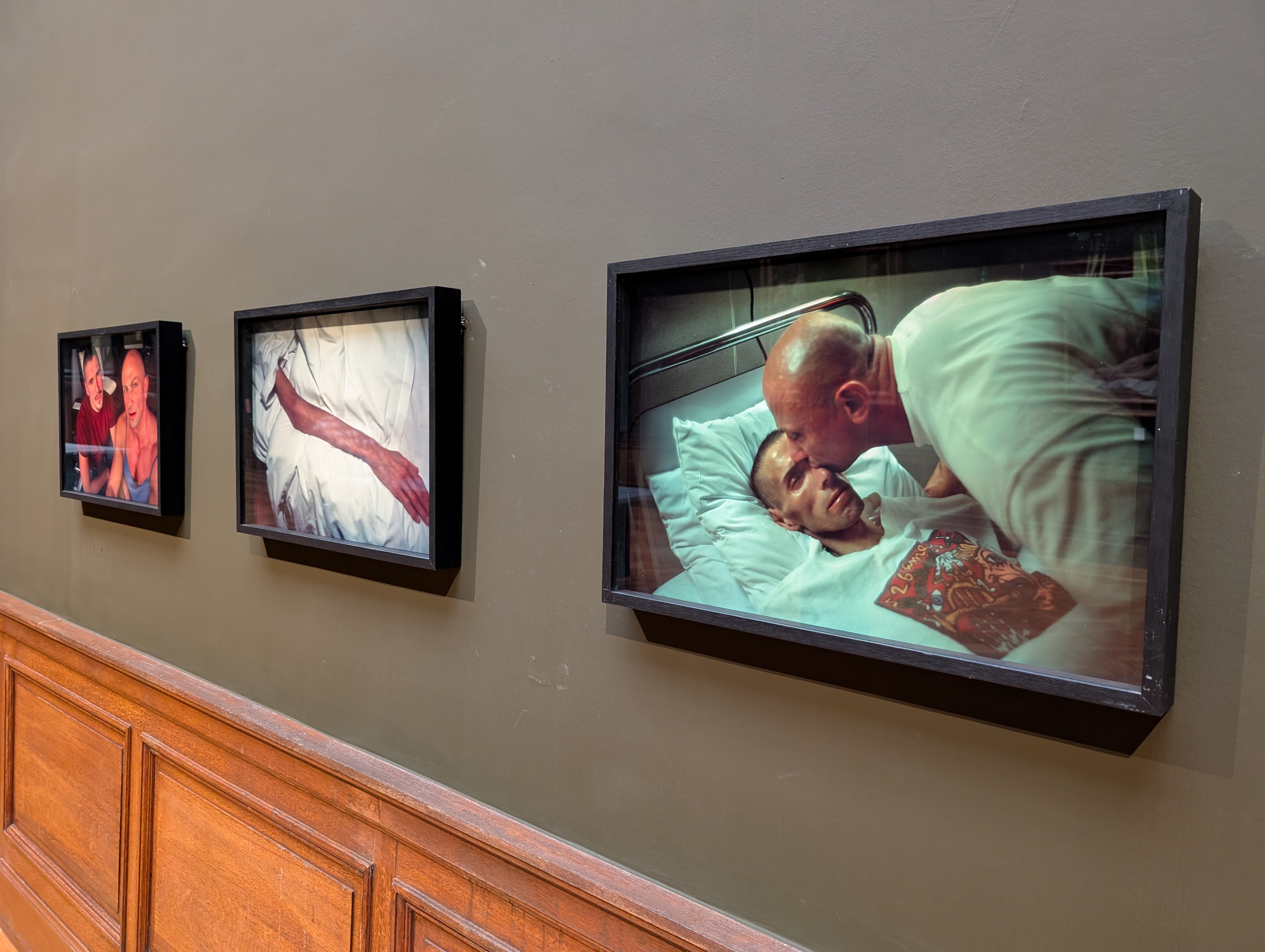
This painting, along with Anthony van Dyck’s Lamentation over the Dead Christ and The Holy Trinity by a follower of Rubens’s (which shows God the Father cradling the dead body of God the Son in an image type sometimes referred to as the Mystic Pietà), are juxtaposed with three photographs by Nan Goldin that show the impact of AIDS on her friend, the Parisian gallery owner Gilles Dusein, and his partner, the artist Gotscho.
Nan Goldin (American, 1953–), Gilles in Hospital, Gilles’ Arm, and Gotscho Kissing Gilles, 1993. C-prints. Private collection.
Dusein’s emaciated arm, resting weakly on a hospital sheet, recalls the limp arm of Christ in paintings of the Deposition and Entombment; and Gotscho’s kiss, the love and grief of Jesus’s mother and friends as they watched their loved one suffer and succumb to death.
By displaying these disparate artworks from vastly different contexts across from each other, we are encouraged to draw connections between the suffering of Christ and that of the LGBTQ+ community. While Christians in Rubens’s day would sit before images of Jesus in pain or sorrow or having died a torturous and untimely death, and deepen their empathy and love, so too might we do well to sit prayerfully, humbly, empathetically, with contemporary images of suffering, seeking to enter the stories they tell.
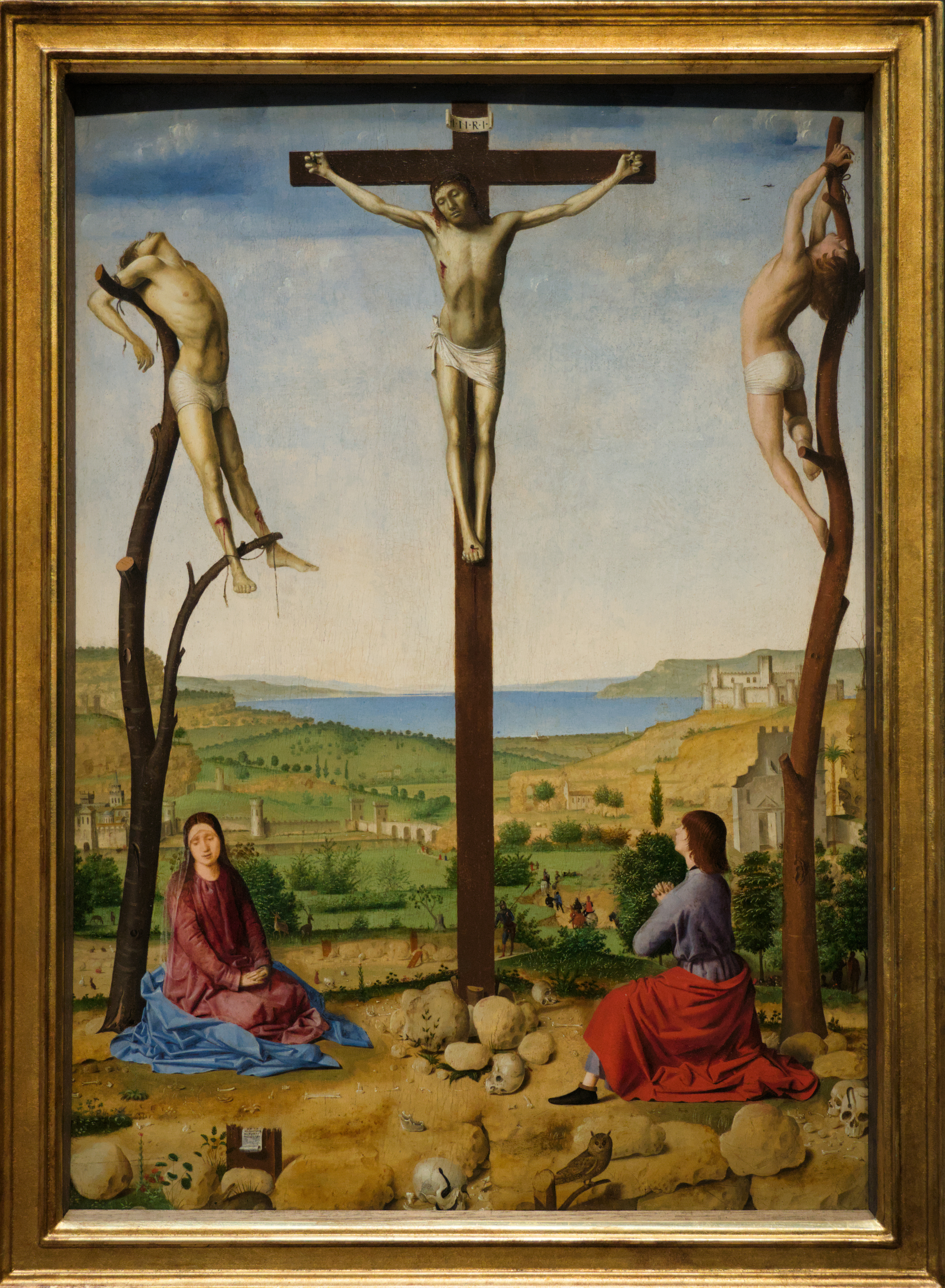
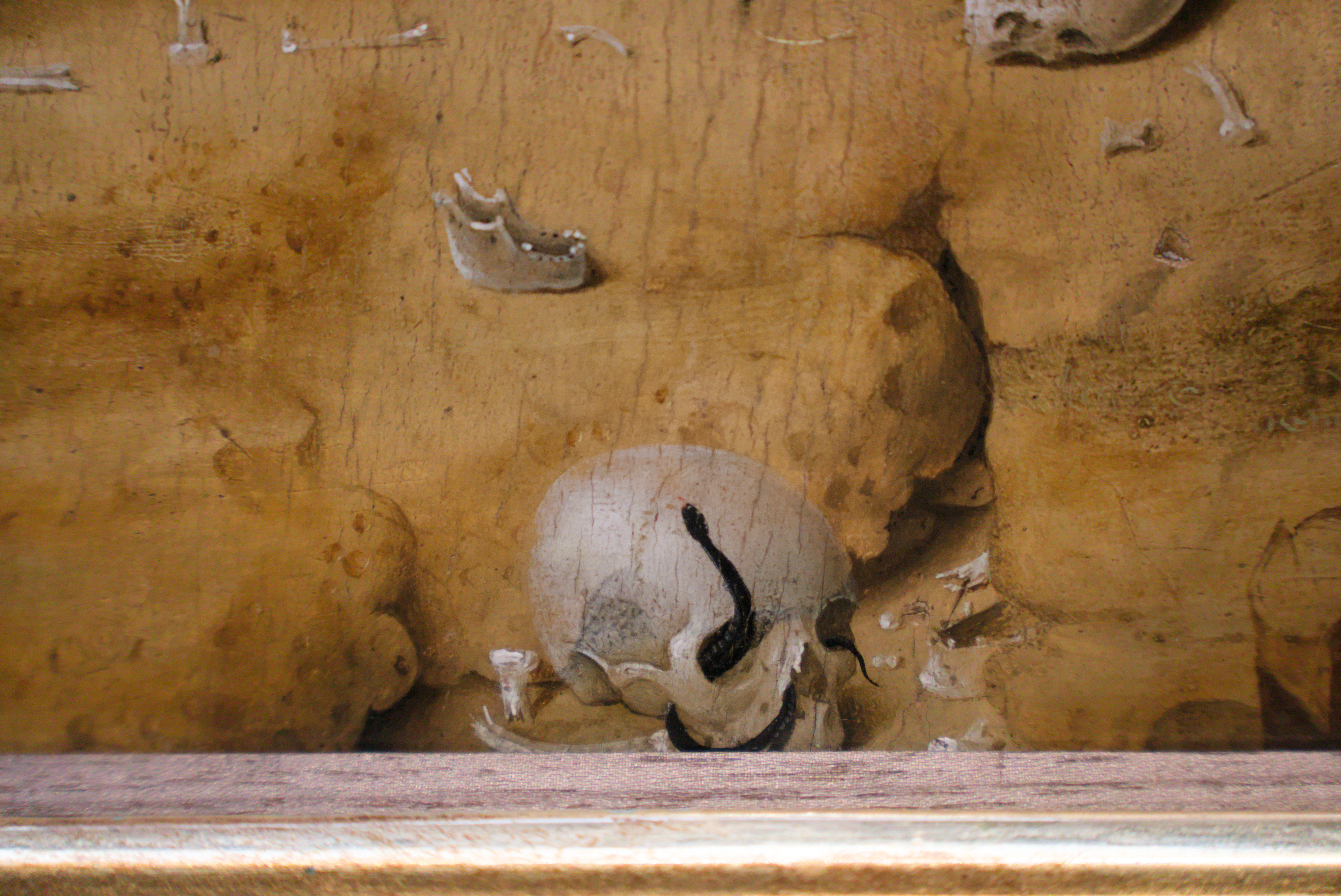
Antonello da Messina (Italian, 1430–1479), Calvary, 1475. Oil on panel, 52.5 × 42.5 cm. Koninklijk Museum voor Schone Kunsten Antwerpen (KMSKA, Royal Museum of Fine Arts Antwerp).
Compare these figures to contemporary Belgian artist Berlinde de Bruyckere’s Schmerzensmann (Man of Sorrows), on loan from the collection of David and Indré Roberts (see wide-view photo above). The piece consists of a wax and resin mold of a contorted human form, its skin stretched and broken, its legs wrapped around a tall rusty pole.
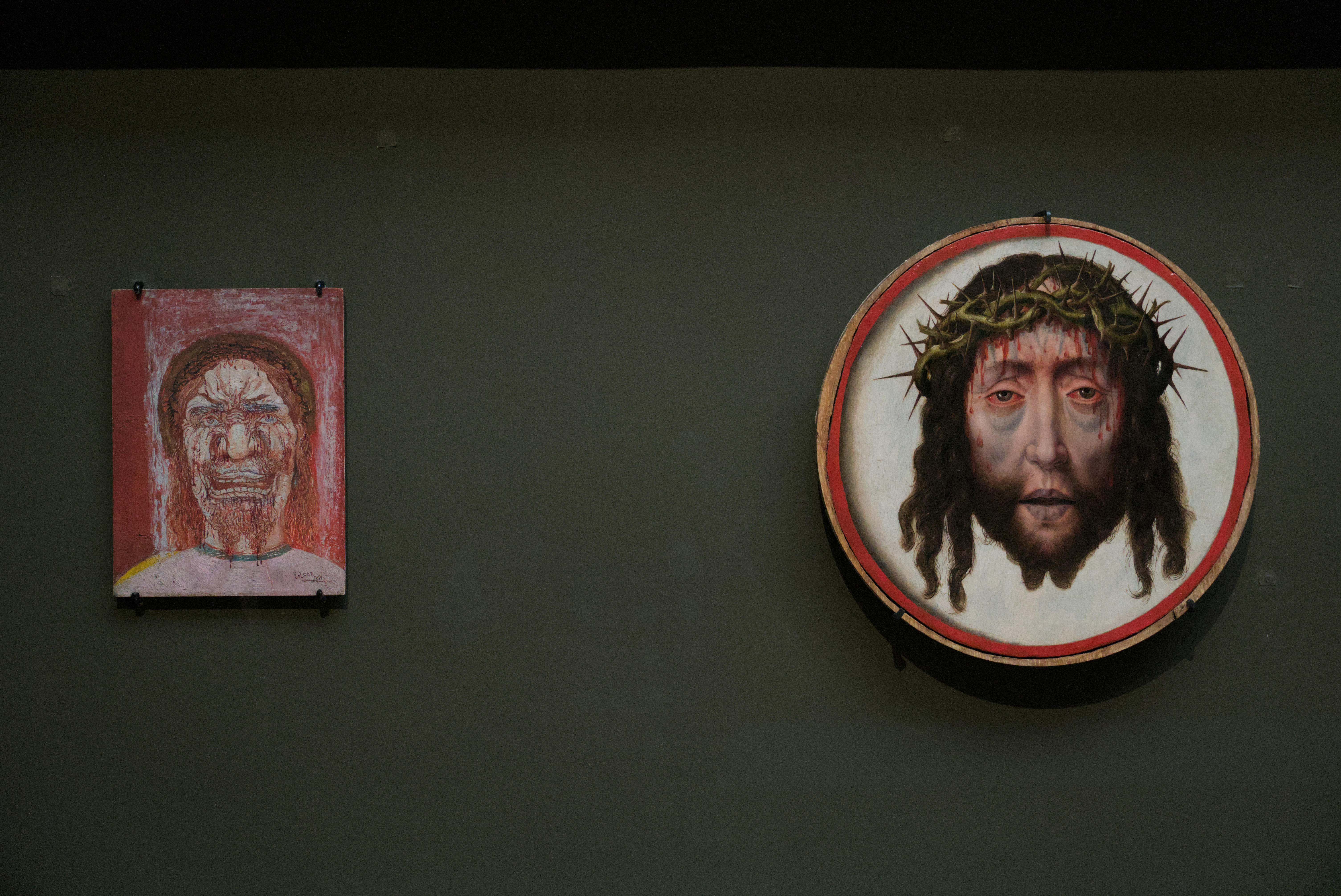
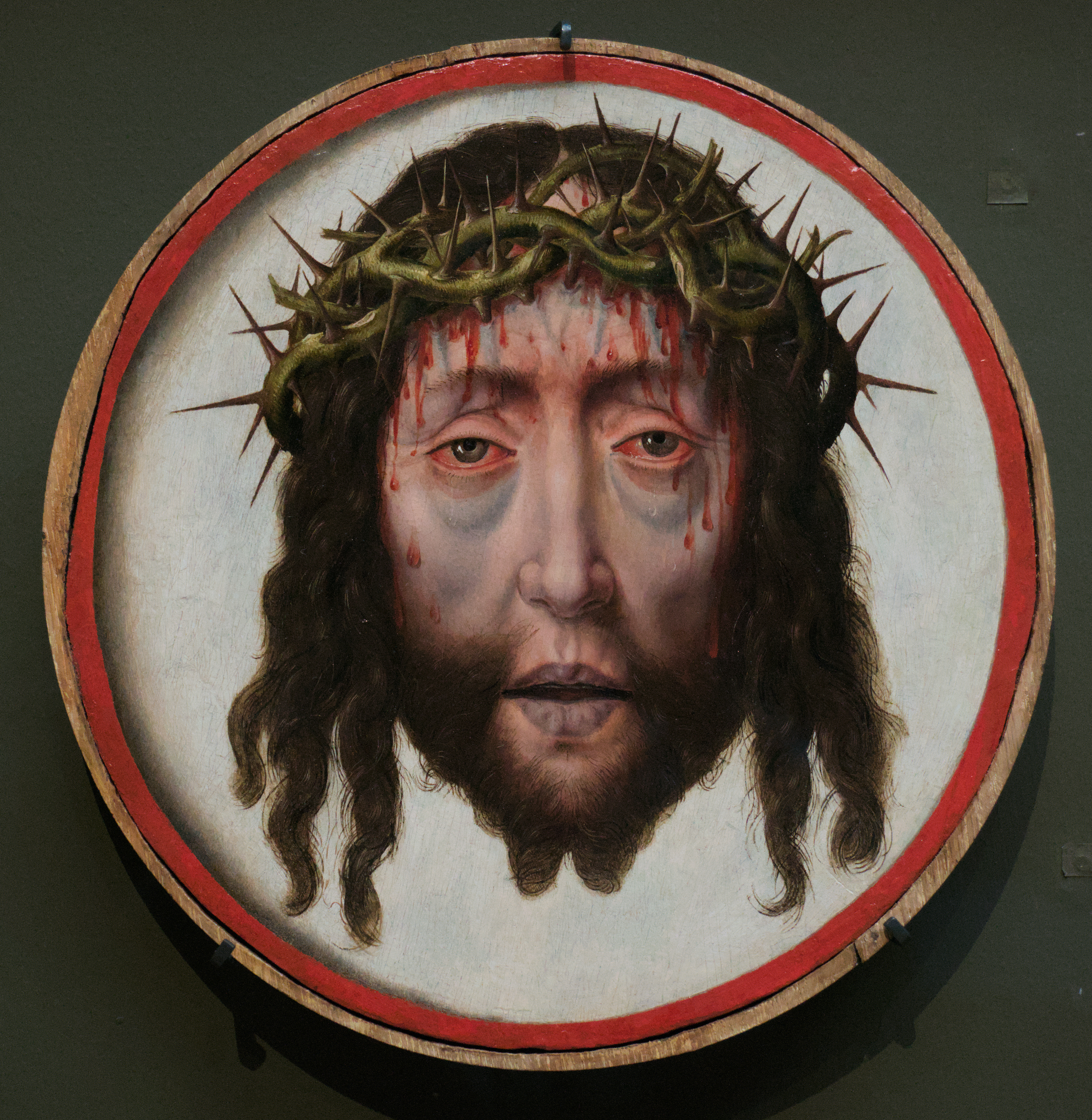
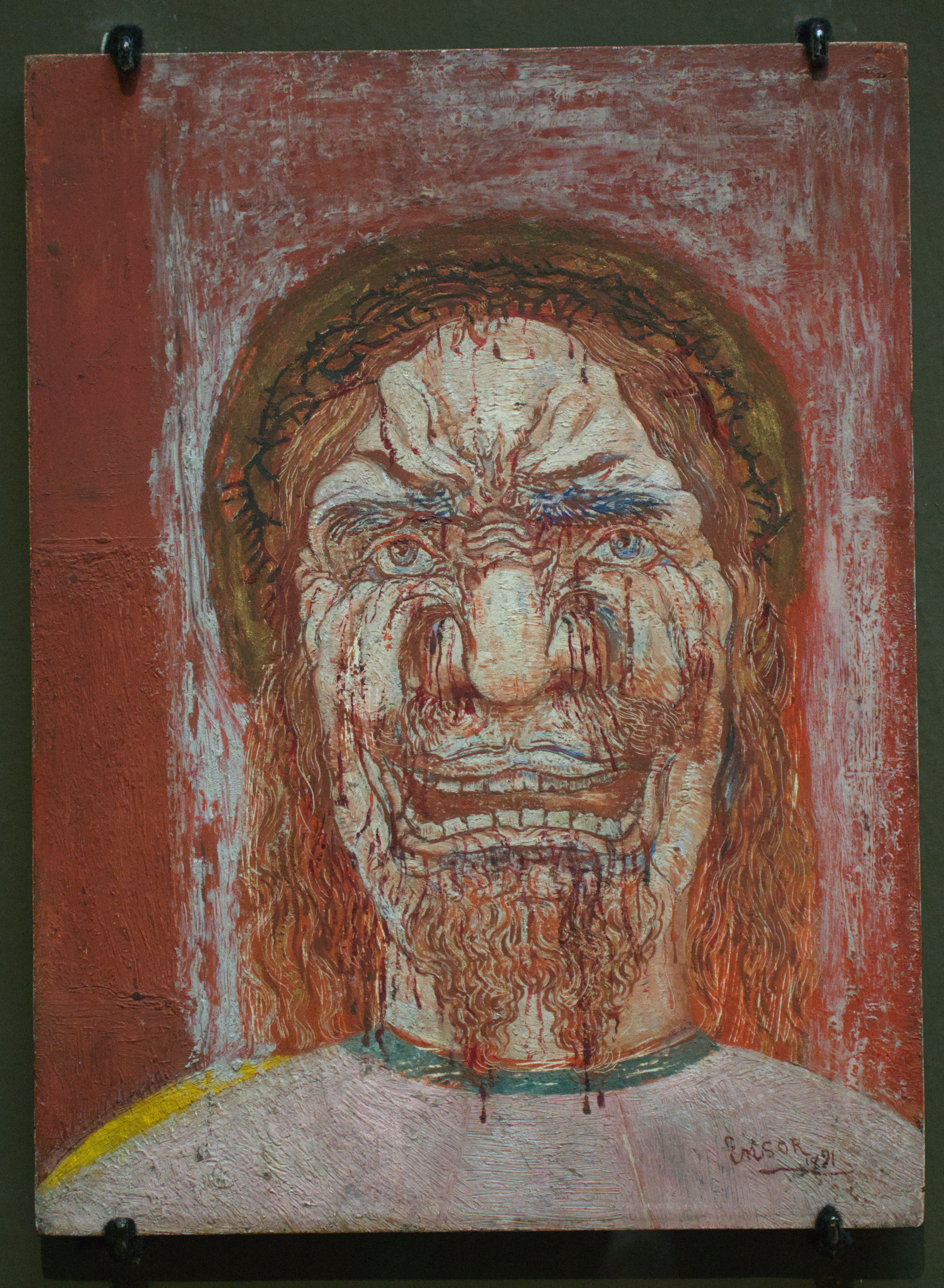
“Man of Sorrows” is also the title of an Early Netherlandish painting by Albrecht Bouts and a modern painting by James Ensor, which KMSKA displays side-by-side.
Albrecht Bouts (Flemish, 1451/55–1549), Man of Sorrows, 1500–1525. Oil on panel, diameter 29 cm. Koninklijk Museum voor Schone Kunsten Antwerpen (KMSKA, Royal Museum of Fine Arts Antwerp).
The earlier one is an incredibly moving image of pathos. Christ wears a thick, twisted, mock crown whose thorns dig holes into his forehead and draw blood. His eyes are red with tears and sunken in, and his lips are turning blue with the pallor of death. I find it quite beautiful, insofar as an image of suffering can be beautiful. (That’s a topic for another day.)
James Ensor (Belgian, 1860–1949), Man of Sorrows, 1891. Oil on panel, 20 × 15.5 cm. Koninklijk Museum voor Schone Kunsten Antwerpen (KMSKA, Royal Museum of Fine Arts Antwerp).
The Ensor painting, on the other hand, is decidedly not beautiful. In fact, I think it’s the ugliest image of Christ I’ve ever seen, with his crumpled face, scraggly hair, and bared teeth. There’s something very unsettling about his expression, and no wonder, as the curatorial text informs that Ensor drew inspiration from the masks of demon characters in Japanese theater. “His [Ensor’s] Jesus screams with rage about the injustice inflicted on him,” the label says. Is that what that expression is? To me he looks sinister. Like he’s growling at us. And I dislike his dinky crown that he wears like a headband; give me Bouts’s gnarly one instead.
I’m in favor of Christ images that show the rage he must have felt, but I don’t think Ensor is successful if that was his aim. To name a few modern artists who were: Guido Rocha (Tortured Christ, 1975) and David Mach (Die Harder, 2011), both of whom capture Jesus’s cry of dereliction on the cross.
The final themed gallery I’ll call out is “Heavens.”
Gallery 2.22 (“Heavens”) from the KMSKA exhibition Collected with Vision: Private Collections in Dialogue with the Old Masters
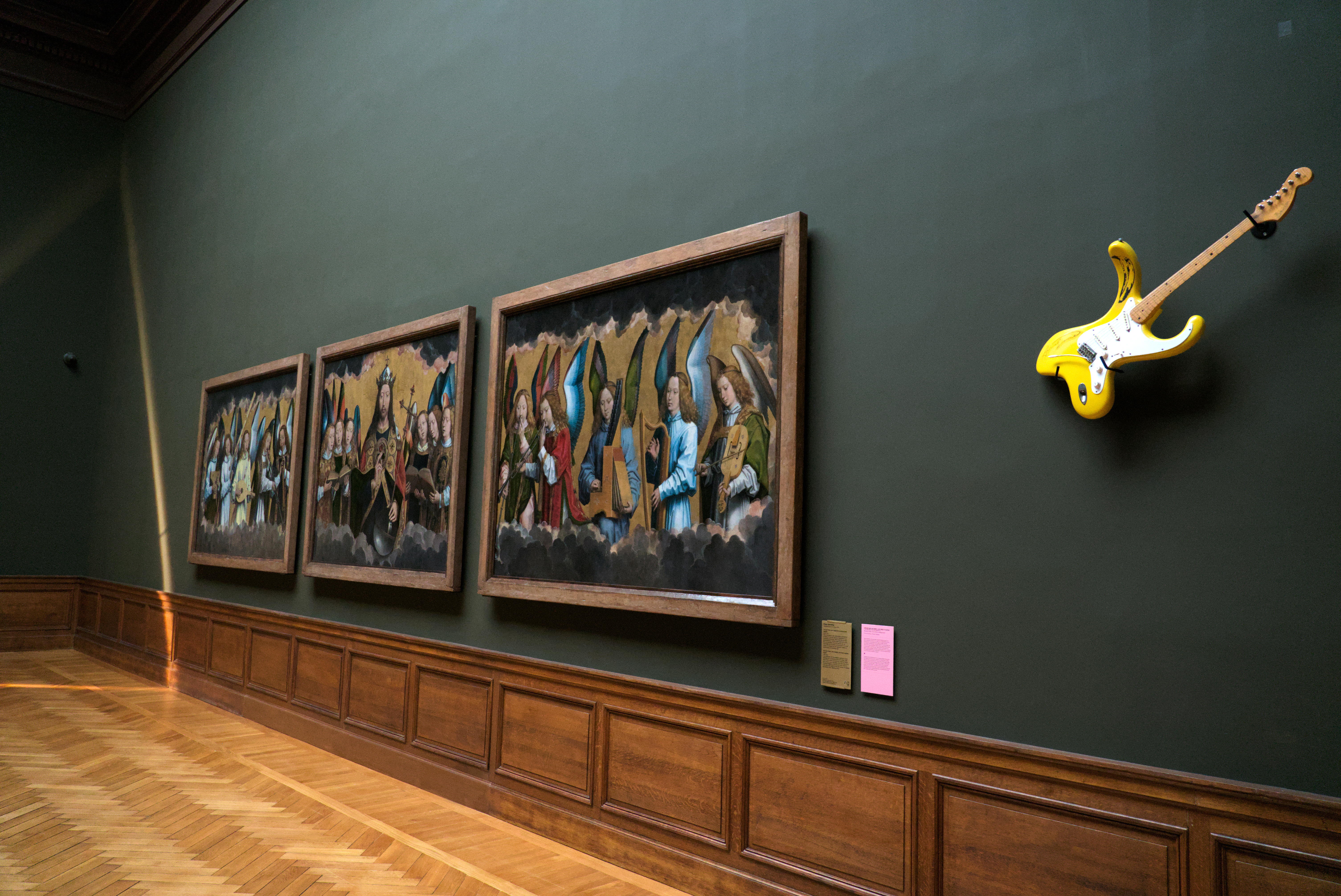
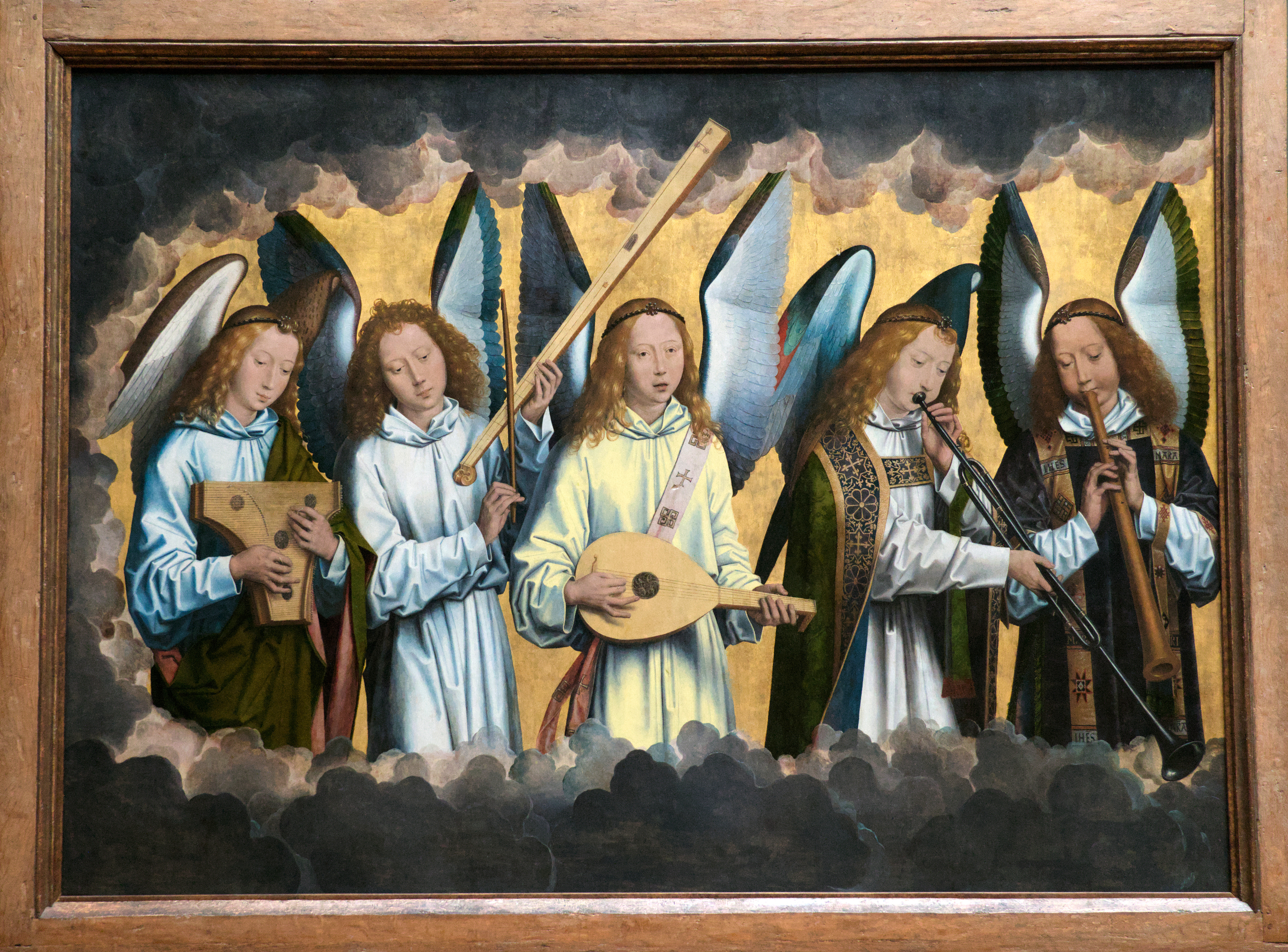
The dominant Old Master work is a set of three panels from the upper tier of a colossal altarpiece that Hans Memling painted for the church at the Benedictine Abbey of Santa Maria la Real in Najera in northern Spain. All the other panels are lost.
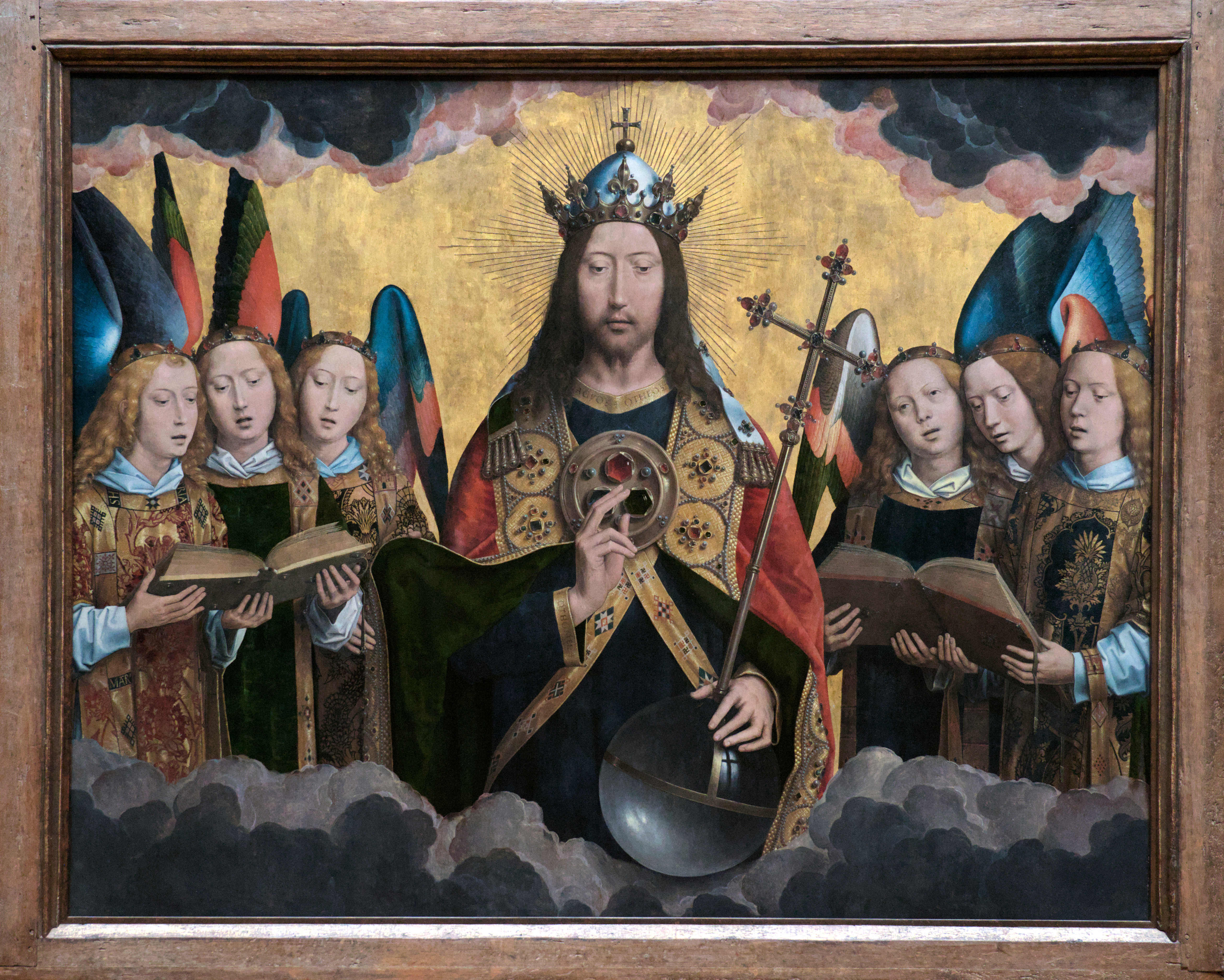
The museum titles the central panel God the Father with Singing Angels—but I think the figure is more properly God the Son, Jesus Christ, portrayed as Salvator Mundi (Savior of the World). In his left hand he holds a cross-surmounted crystal globe, signifying his dominion over the earth, and with the other hand he gestures blessing. He wears a tiara and a red cope decorated with gold-thread embroidery, pearls, and precious stones, and his collar bears the words Agyos Otheos (Holy God).
Hans Memling (German Flemish, ca. 1430–1494), God the Father with Singing Angels, 1483–94. Oil on panel, 164 × 212 cm. Koninklijk Museum voor Schone Kunsten Antwerpen (KMSKA, Royal Museum of Fine Arts Antwerp).
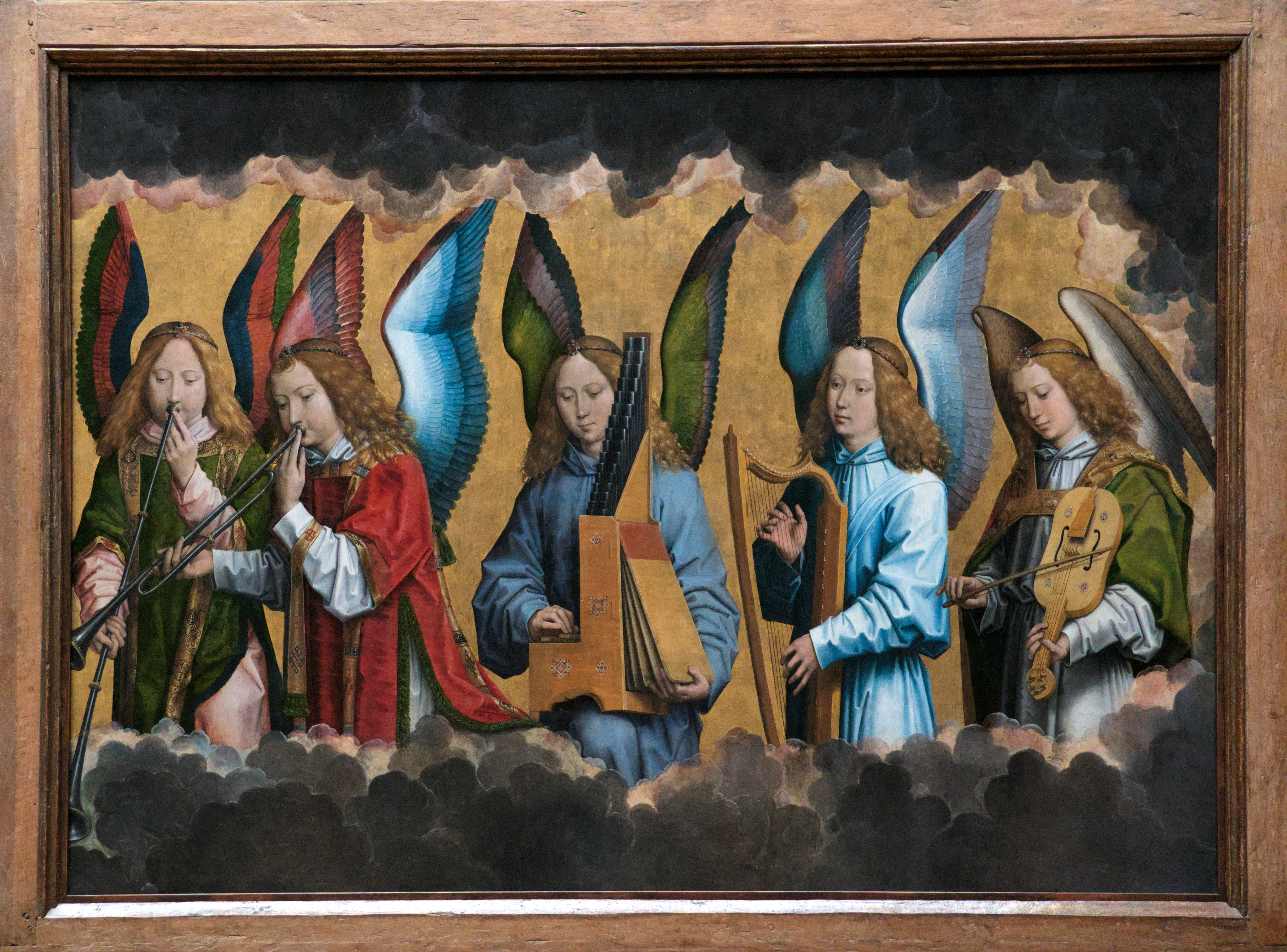
Surrounding him is a musical band of angels, singing his praises from songbooks and, in the flanking panels, playing a variety of wind and string instruments: (from left to right) a psaltery, a tromba marina, a lute, a trumpet, a shawm, a straight trumpet, a looped trumpet, a portative organ, a harp, and a fiddle.
Hans Memling (German Flemish, ca. 1430–1494), Music-Making Angels (left), 1483–94. Oil on panel, 165 × 230 cm. Koninklijk Museum voor Schone Kunsten Antwerpen (KMSKA, Royal Museum of Fine Arts Antwerp).Hans Memling (German Flemish, ca. 1430–1494), Music-Making Angels (right), 1483–94. Oil on panel, 165 × 230 cm. Koninklijk Museum voor Schone Kunsten Antwerpen (KMSKA, Royal Museum of Fine Arts Antwerp).
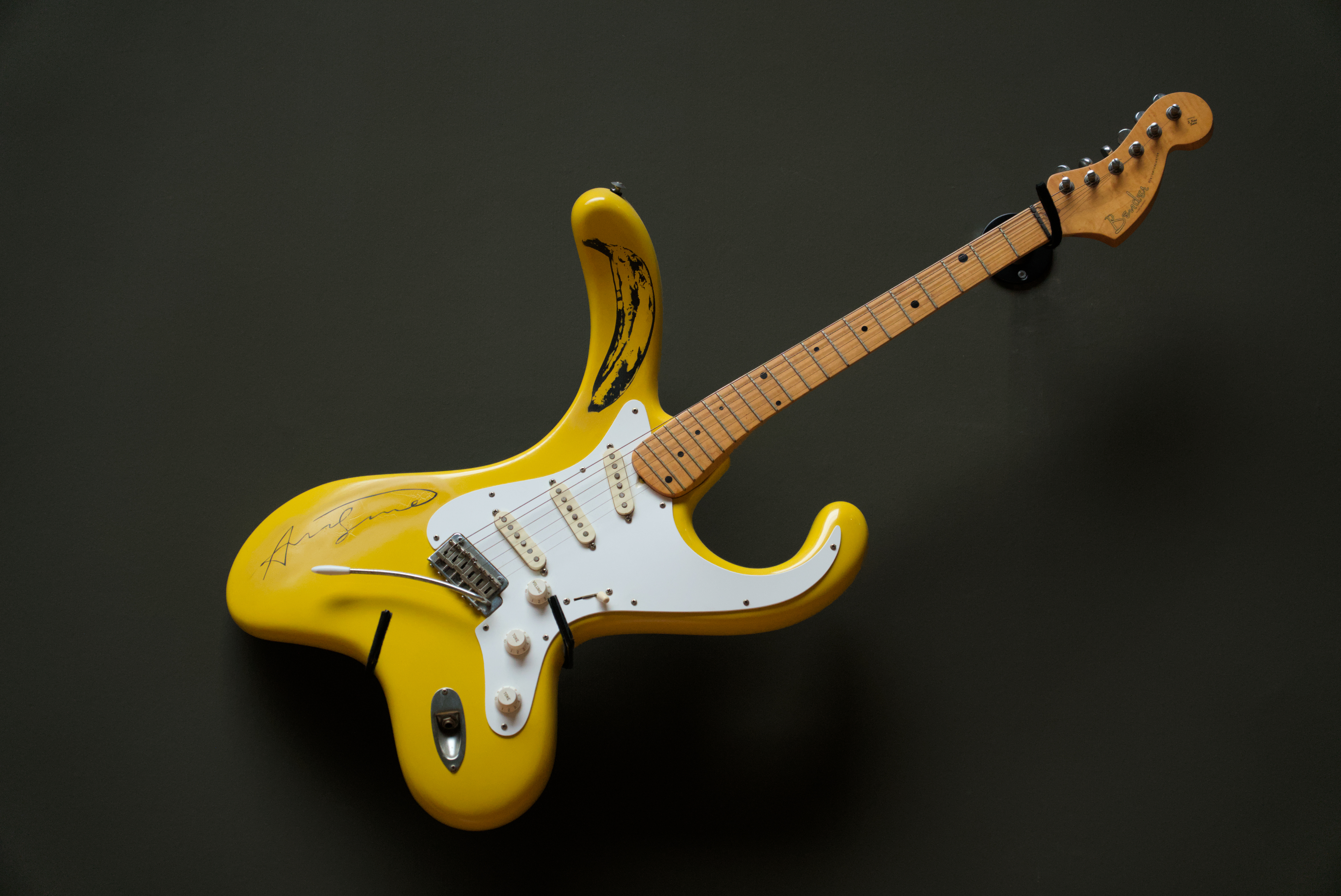
This ensemble probably evokes for you a particular sound—something like Tallis or Palestrina—soaring polyphonic vocals, a gentle yet majestic accompaniment. But instead, a different soundtrack played, audibly, in the room: songs from the 1967 debut album of the American rock band the Velvet Underground, several of which use religious language to describe the experience of doing drugs. “Heroin” opens like this:
I don’t know just where I’m going But I’m gonna try for the kingdom, if I can ’Cause it makes me feel like I’m a man When I put a spike into my vein
And I’ll tell you things aren’t quite the same When I’m rushing on my run And I feel just like Jesus’ son
This aural element was complemented, on the gallery wall, by the guitar of Lou Reed, the band’s lead singer and songwriter. It’s signed by Andy Warhol, who produced and championed the Velvet Underground & Nico album and made its banana cover art, replicated on the instrument.
Lou Reed’s “Banana Guitar,” from a private collection
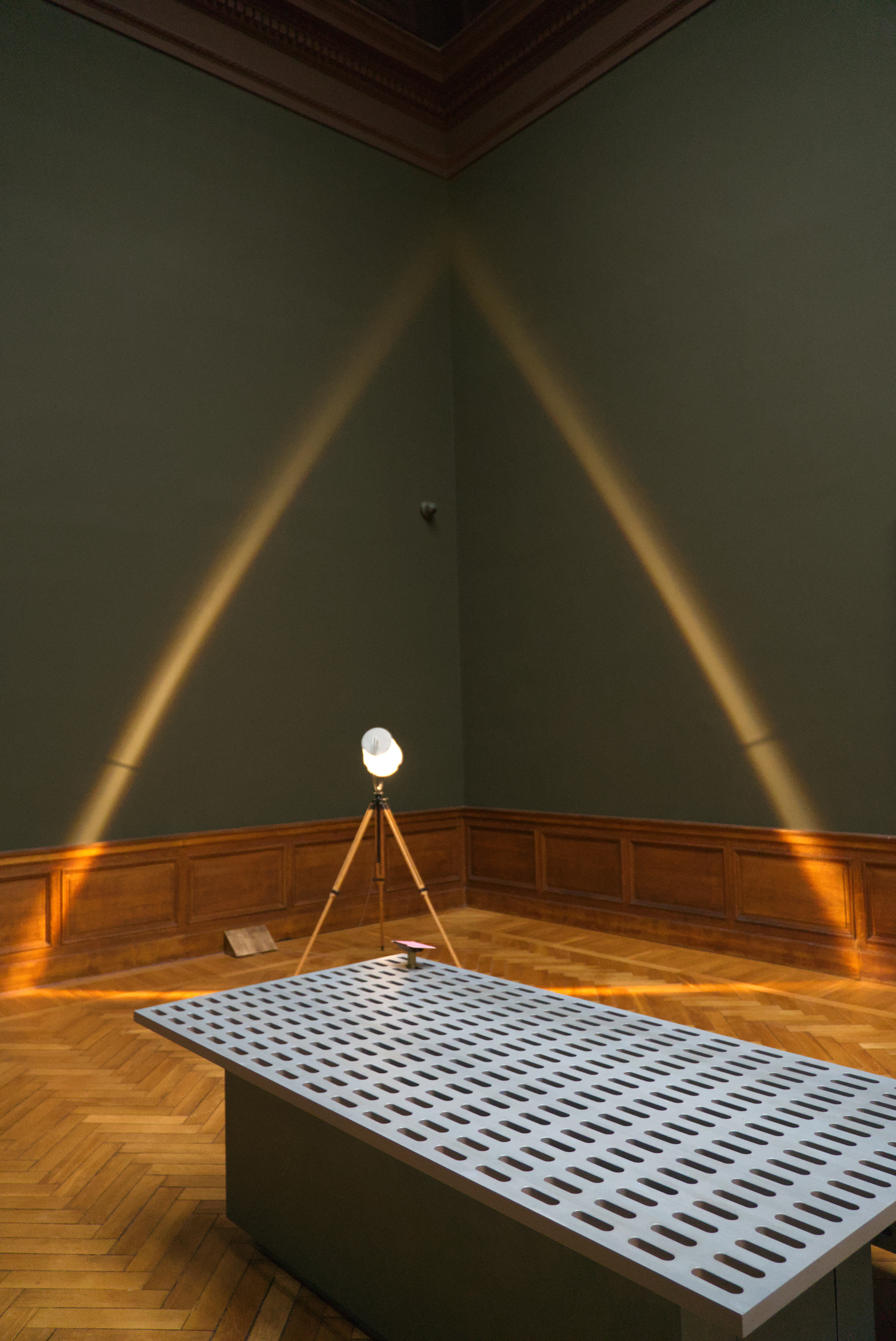
Adding to the mix, in the corner of the room was an installation by the Copenhagen-born and -based artist Olafur Eliasson, called Lighthouse Lamp. “Affixed to a tripod, a lamp situated within a Fresnel lens—a compact lens which was developed for lighthouses—emits a band of white light in 360 degrees,” the artist’s website explains. In this space, the beam takes on a triangular shape.
Olafur Eliasson (Icelandic Danish, 1967–), Lighthouse Lamp, 2004. Mixed media. Collection of Filiep and Mimi Libeert.
There was also an altarpiece of The Last Judgment and the Seven Acts of Mercy by Bernard van Orley, which references Jesus’s teaching in Matthew 25 about one’s entry into heaven being contingent on whether, in this life, you feed the hungry, give shelter to the homeless, visit the prisoner, and so on.
The “Heavens” gallery begs the question: How does one define “heaven”? Is it a physical place? A state of mind? An encounter? I think of related words like bliss, beatitude, communion, the sublime.
The celestial scene painted by Memling—and remember, it’s only partial, as the rest is missing—is beautifully rendered, but it also encapsulates what has become the popular cliché of heaven: angels on clouds, strumming harps, and a regal God swaying his scepter. Music-making, angelic beings, and the reign of God are all certainly a part of how the Bible describes heaven. But it’s also so much more. It’s a garden and a city. It’s healing and restoration. It’s the righting of wrongs. It’s all things made new. It’s jubilee. It’s a wedding—deep and lasting union between God and humanity. It’s an eternal interlocking of God’s space and ours (earth). It’s a global, transhistorical community of faith, gathered together around Christ their head, worshipping him in diverse languages, musical styles, dances, and other cultural expressions. It’s the culmination of the greatest story ever told.
Today, Memling’s vision of heaven probably fails to captivate most people, even Christians. So it’s an interesting experiment to compare it to how others conceive of the concept.
Eliasson’s Lighthouse Lamp wasn’t a commission on or explicit treatment of the theme, but the curator saw fit to place it beside Memling, because heaven is often conceived of as a light-filled space, and light can evoke the divine. For this reason, Memling painted his background gold. What’s more, the three-sidedness of Eliasson’s light beam may, for some, evoke the Trinity, the classical Christian doctrine of Father, Son, and Holy Ghost that Memling alludes to with the three precious stones on the fibula of Christ’s mantle.
Still, other folks experience what could be termed “heavenly” transcendence through the use of mind-altering substances, as did the members of the Velvet Underground, whose drug trips gave birth to their experimental music—which, in turn, has taken others to a transcendent place.
Whether in special exhibitions or displays of their permanent collections, I want to see more of this in museums: bringing old and new artworks into conversation with one another around universal themes, in the same room. (In some museums, the labels sometimes cross-reference works in other galleries, but that’s not the same.) Although there are benefits to the traditional approach of laying out art chronologically to give you discrete pictures of different historical eras and allow you to progress by time period, a thematic approach that compiles works from across time also has its benefits.
I’ve found cross-temporal art displays to be especially vitalizing, because instead of trying to tell history, they more naturally invite personal reflection and tend to be less academic in tone. Such an approach makes the art accessible to a larger number of people, especially those who don’t frequent museums. It helps us see the relevance of the Old Masters (or whatever the museum’s collection focus) for today—how the subjects they depicted often address topics or questions we still ask or wonder about or that reflect aspects of the common human experience, such as joy, suffering, family, death, betrayal, or festivity. Creating relationships between works made centuries apart, highlighting similarities and differences, can give us a broader perspective.
And for this museumgoer (pointing at myself) who is attracted to medieval and early Renaissance art and sometimes bypasses the contemporary galleries, the integrative approach is more engaging. Giving contemporary works a point of connection with the works I’m already inclined to like helps me enter into them more easily and fruitfully, and I’m more likely to spend time with them than if they were segregated.
New and old don’t have to be equally represented—Kolumba skews heavily contemporary, whereas KMSKA lets its strengths shine with the Old Masters, and yet the occasional unexpected intervention from years past or future always caused me to pause and be curious. Over the last several years I’ve been noticing other museums engaging in similar playful exchange—plopping a contemporary work into the medieval section, or vice versa, in a way that provides some kind of illumination.
This was my first and only visit to KMSKA, and as I understand, there’s not the same degree of intermixing of old and new year-round; this was a special exhibition that brought in contemporary works from outside, as the institution itself owns very few. But they did do something similar last year with the exhibition What’s the Story?, and the dangling light poems by Bernard Dewulf are a permanent fixture in the Old Masters galleries.
Have you been to a museum where works from different time periods were displayed side-by-side to create a discourse, and if so, did that choice enhance your engagement, insight, or appreciation? I’d love to hear what other museums are doing this!
This article took me some forty hours to write and to select and edit photos for. If you appreciate learning about my museum experiences and having access to high-resolution, downloadable art images, would you please consider adding to my “tip jar” (PayPal), or sponsoring a book from my Amazon wish list? Thank you!
As a caveat, I am a Protestant, and while I do have a profound respect and appreciation for icons, my theology of images, including my definition of sacred art, is not the same as the Orthodox Church’s—even though elements of it are influenced by the Orthodox position. All the same, I believe it’s important for Christians of all denominations to understand the significance of icons and what differentiates them from noniconic religious images. Those lines are being blurred a bit by the new schools of iconography coming out of western Ukraine and Poland, which honor tradition even as they push it forward into the contemporary era. Here are a few icon-related videos, articles, and weblinks that I’ve gathered over the past several months.
LECTURES:
>> “The Meaning of Icons” by Fr. Maximos Constas, November 13, 2019, Notre Dame Seminary: Father Maximos Constas, professor of patristics and Orthodox spirituality at Hellenic College Holy Cross Greek Orthodox School of Theology, explains the significance of icons in the Orthodox Church, with special attention to their aesthetic features and theological meaning, which is informed by the church’s Christology and cosmology. He answers such questions as, Why do the figures in icons look bored and unnatural? And, Doesn’t the Second Commandment forbid representations of Christ? He does not address icon veneration or details of the making process.
Constas spends the first fifteen minutes juxtaposing Eastern and Western approaches to religious images, discussing how the Renaissance values of humanism and naturalism came to prevail in the West. The Orthodox, he says, see this as the “secularization” or “carnalization” of sacred art—in its commitment to depicting observable realities, Western art from the Renaissance onward typically lacks overt signs of transcendence.
Constas also discusses the dogmatization of sacred images in the East. Icons are never simply works of art or pedagogical tools, he says. “They were understood to be visual artistic expressions of the church’s theology. And in the same way that church doctrines could not be changed, neither could the image in which the doctrines were embodied.”
Here are some notes I took on the talk, including some transcriptions:
An icon can be a panel painting, a fresco, a mosaic, a relief carving, an enameled plaque, a manuscript illumination, etc. “What ultimately defines an icon has nothing to do with artistic medium or style but rather depends on how the image is used and, most importantly, what it is believed to be. And every icon is a means of spiritual encounter and dialogue. It offers us the possibility of such an encounter because it shares in the holiness of the sacred figure whose likeness it bears.”
An icon is not a work of art but a work of witness that makes use of art.
“Icons are not simply portraits but manifestations of human persons in their new heavenly condition. They are images of the spiritual character of human beings reborn, as it were, in the womb of eternity.”
“The icon has the ability to evoke within me the memory of the forgotten depth of my own being. It enables me to see my true face. It orients me toward my destiny in God. And this vision, this remembrance, this knowledge fills me with unspeakable joy and profound consolation.”
We not only can but must make images of Christ; “to deny the icon is to deny the reality of the Incarnation.”
“All created things are intrinsically good, and all, therefore, have spirit-bearing potentialities. And to this essential goodness and beauty of the material world, the icon bears joyful witness. In the icon, we see matter restored to harmony and so fulfilling its true vocation, which is to reflect and transmit the divine glory. The icon, then, safeguards not only the authenticity of Christ’s physical body, but also the true value of creation in its unfallen state as created by God. Inherent in the very fact of the icon is an optimistic, affirmative vision of the material creation. As spirit-bearing matter, the icon has what we would call eschatological significance—it anticipates the final transfiguration of the cosmos at the last day, when the created world will be delivered from its present bondage to corruption, to quote St. Paul, and will enter into the glorious liberty of the children of God.”
Icons as:
windows, doors, thresholds into heaven (spiritual places of passage)
mirrors, a reflection of their living source
tracks or traces
32:40: Portrayal of figures in icons
Alteration of the natural symmetries and proportions of the body, including the features of the face (eyes and ears enlarged; nose elongated; mouth small and closed)
Full frontality—wholeness, completion, perfection; makes the icon dialogical and relational
Serene, controlled facial expression
No shadows cast; illumined from within
>> “Rajaton hengellinen kuva: Kärsimyksen ja ylösnousemuksen kuvat” (Boundless Spiritual Image: Images of Suffering and Resurrection) by Ari Luomajoki, March 26, 2021, Kuopio Cathedral, Kuopio, Finland: I don’t speak Finnish, but I share this seventy-minute video for the visuals (and of course for any Finnish speakers!) and to show how contemporary icons are spreading west. In August 2016 under the leadership of Pastor Ari Luomajoki, the Lutheran Monastic Community of Enonkoski in Ihamaniemi, Finland, organized its first international icon workshop (read more here, and follow @LutheranIcon on Facebook), which attracted iconographers from Poland and Ukraine, as well as a few domestic artists. It was reprised in 2017 (I mentioned this second workshop here). Icons that came out of these workshops have been exhibited several times in Finland, and have facilitated relationships that have led to new exhibitions—such as Kärsimyksen ja ylösnousemuksen kuvat (Images of Suffering and Resurrection) at Kuopio Cathedral, which ran March 26–April 11, 2021. Follow the boldface link to see a taping of the opening, which includes opening comments, a tour, and a lecture.
Danylo Movchan (Ukrainian, 1979–), Descent from the Cross, 2021. Watercolor on paper, 33 × 38 cm.Basia Mindewicz (Polish, 1978–), Lamentation, 2016. Acrylic on wood, 26 × 20 cm.
In the first sixteen minutes of the video, Pastor Olli Viitaniemi, one of the main organizers of the exhibition (with Pastor Salla Tyrväinen), shows screen captures from the website he built connected to the exhibition, https://sielunkuvat.net/. At around 16:24 he gives a tour of the exhibition around the church sanctuary.
At 32:48 Luomajoki—who is a Lutheran pastor in Kouvola, Finland, and has a master’s degree in art history—starts his half-hour lecture. He introduces Międzynarodowe Warsztaty Ikonopisów w Nowicy (International Iconography Workshop in Nowica) in Poland and Lviv National Academy of Arts and the Iconart gallery in Ukraine, two centers of contemporary Eastern iconography that inspired the icons project at the Enonkoski monastery in Finland. At 47:41 Luomajoki does side-by-side image comparisons to show similarities and differences across time. At 50:41 he discusses the use of images in early Lutheranism. He goes on to show some examples of religious art in Finland in the past century (including a really compelling Crucifixion painting by Helene Schjerfbeck and crucifix by Paavo Halonen!). He closes by spotlighting Hidden Life in Nazareth by Ivanka Demchuk and a Nativity by Arsen Bereza, participants in the workshop.
Luomajoki is a wonderful photographer of art. Follow him on Instagram @ari.luomajoki.
+++
INTERVIEW with contemporary iconographer Khrystyna Kvyk, by Kevin Antlitz: OK, Patheos blog posts are painful to read because of all the obtrusive ads, which is why I rarely link to them. But I’m making an exception for this one, where American Anglican pastor Kevin Antlitz interviews Ukrainian Greek Catholic iconographer Khrystyna Kvyk, who earned a master’s degree in sacral art in 2020. She discusses her process of painting icons, what makes an icon an icon, timelessness and transfiguration, the relationship between tradition and innovation, the idea of divine light as reflected in two of her icons, and more. I really love her work and was delighted to hear some of her own words about it.
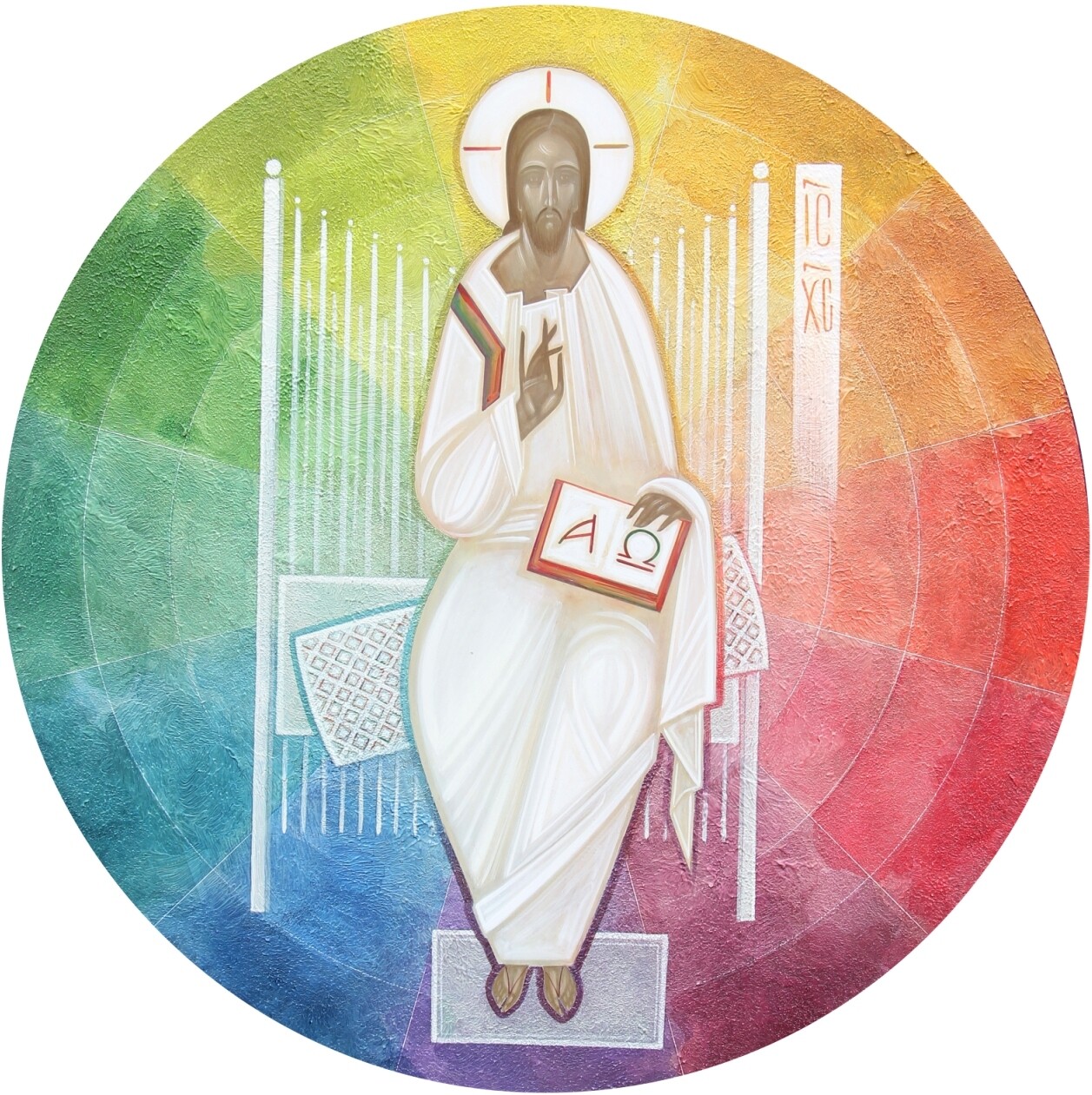
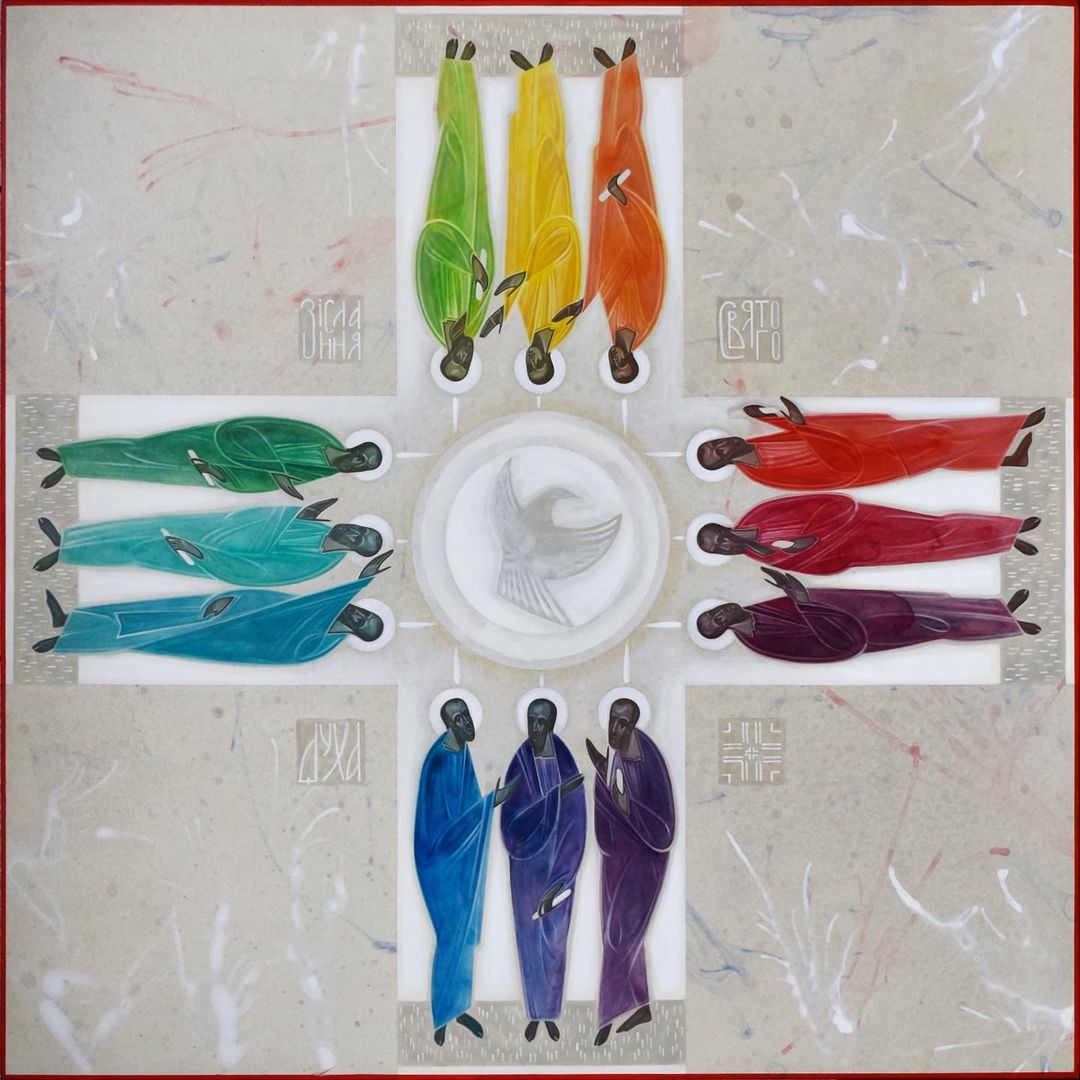
Khrystyna Kvyk (Ukrainian, 1994–), I Am the Light of the World, 2021. Acrylic on gessoed wood, diameter 35 cm.Khrystyna Kvyk (Ukrainian, 1994–), Pentecost, 2021. Acrylic on gessoed wood, 45 × 45 cm.
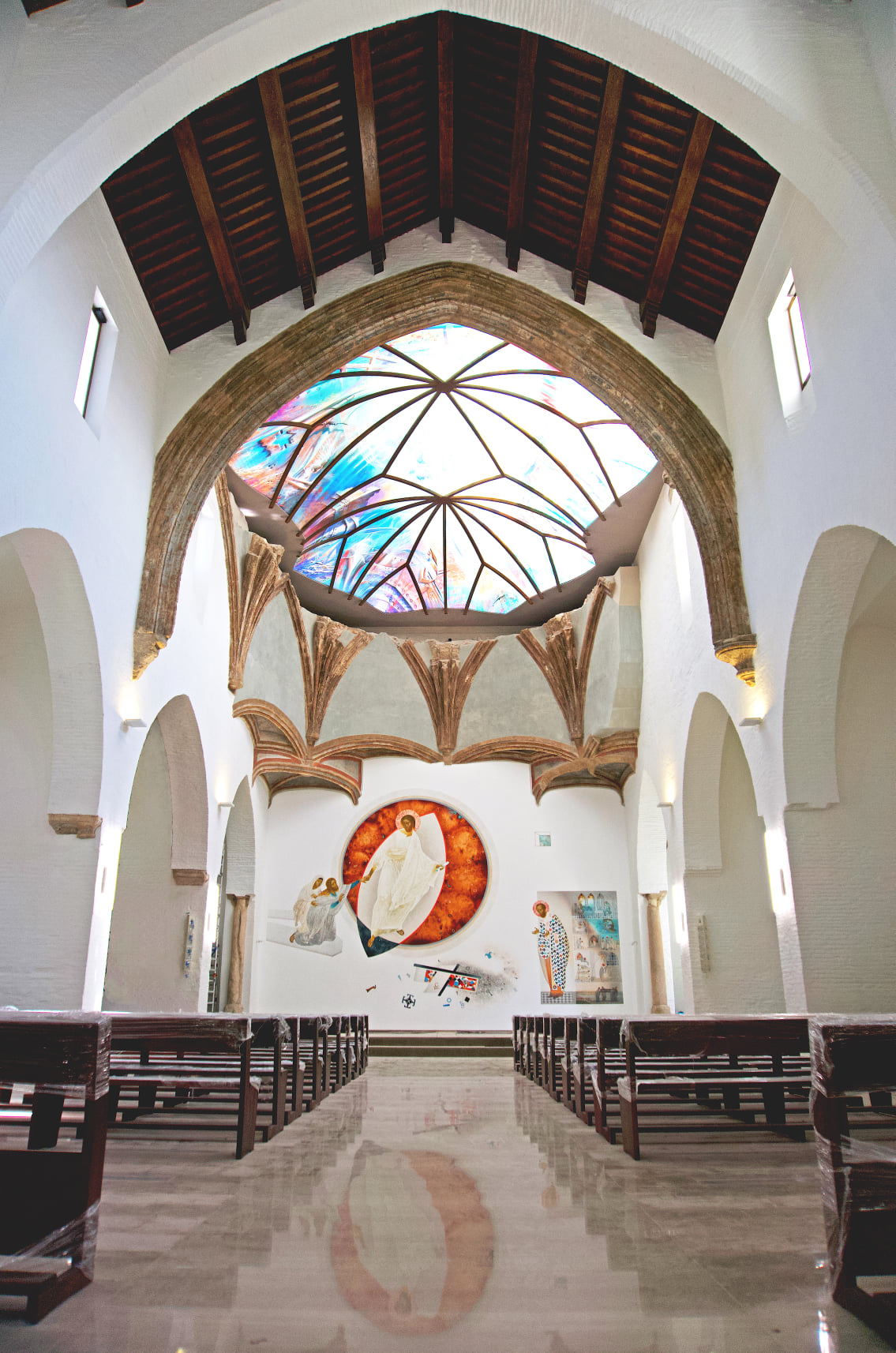
NEW CHURCH COMMISSION: Wall paintings at Iglesia de San Nicolás by Ivanka Demchuk and Arsen Bereza: Ukrainian artists Ivanka Demchuk and Arsen Bereza—a married couple!—have completed a monumental painting on the east wall of the Catholic church of Saint Nicholas in Granada. It was deeply influenced by Byzantine iconography, in which they’ve both been trained, but also contains some modern abstract and geometric elements.
The church building is from the sixteenth century and recently underwent extensive renovations, finally reopening to the public in April, which is when Demchuk and Bereza’s mural was unveiled. It portrays the Anastasis, the Eastern Orthodox image of Christ’s resurrection, which shows him breaking down the doors of hell to release its captives. In the video (which is in Ukrainian with Spanish subtitles), Demchuk describes how they painted two mandorlas behind him: the almond-shaped one symbolizing his divine light, and a round one symbolizing the cosmos.
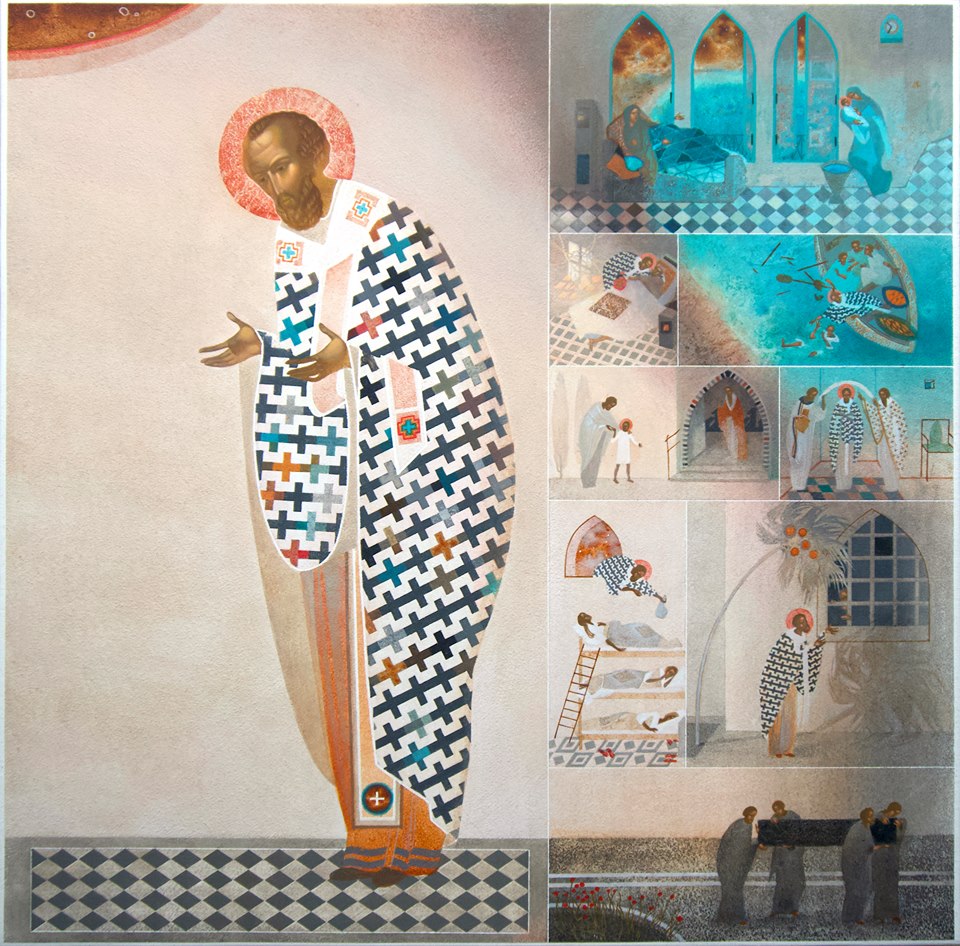
Appearing alongside this focal point is a portrait of the church’s namesake, Saint Nicholas, with eight scenes from his life—including my favorite, where he tosses three bags of gold through the window of an impoverished family’s home. (The legend of Santa Claus—Claus being a shortened form of “Nicholas”—evolved from this story of anonymous gift giving.)
Iglesia de San Nicolás, Granada, Spain, 2022, with east end mural by Ivanka Demchuk and Arsen BerezaIvanka Demchuk (Ukrainian, 1990–), Resurrection, 2018. Mixed media on wood. Design for the Church of St. Nicholas, Granada, Spain.Ivanka Demchuk (Ukrainian, 1990–), Saint Nicholas with Scenes from His Life, 2018. Mixed media on wood. Design for the Church of St. Nicholas, Granada, Spain.
BLOG POST: “The Meaning of Melchizedek in Icons” by David Coomler: Though he’s not religious, David Coomler is an expert on Christian icons and often consults on them. On his blog he unpacks the iconography of standard types but also more unusual ones, like You Are a Priest Forever After the Order of Melchizedek, inspired by Hebrews 7. This rare type is meant to show that Jesus is both the offering and the offerer. The variation pictured below shows, I think, three representations of Christ: as crucified seraph (still quite puzzling to me, but Coomler points out that the Greek of Isaiah 9:6 refers to the Messiah as the “Messenger of Great Counsel”), Holy Wisdom (aka Sophia), and high priest—hence the man in ecclesiastical garb in the back. Wild!
In September 2019 I visited Atlanta, Georgia, and one of the two art stops I made was the Clark Atlanta University Art Museum, whose purpose is “to collect, preserve, research, and exhibit fine art works that document the role of African Americans in American history and culture.” When I got there I was bummed to see that the museum was closed in preparation for three exhibitions that were to open that Sunday. But graciously, even though the signage and lighting hadn’t been installed and some of the objects were still being moved around, the curator allowed me in for a little glimpse.
I was stopped in my tracks by a mixed media sculpture in the gallery of recent acquisitions: Float by Alfred Conteh.
Alfred Conteh (American, 1975–), Float, 2014. Steel, epoxy dough, thermoadhesive plastic, atomized steel dust, atomized bronze dust, urethane plastic, steel chain, 93 × 46 × 35 in. Clark Atlanta University Art Museum, Atlanta, Georgia. Photo: Victoria Emily Jones.
It shows a Black female Christ figure rising up in a whirl of energy, her hat blown aloft. Wounds are visible on her hands and feet, but these are taken up into new, greening life. At the bottom is a broken chain, indicating that she has been set free. The piece expresses the exhilaration of emancipation, of being shackled no more.
I would classify Float as a resurrection image, which its staging reinforces. To its far left is a wooden crucifix by Dilmus Hall, followed by The Mourners by Frederick C. Flemister, from 1942. (Note that the two crucifix photos in this post are courtesy of the Souls Grown Deep Foundation, who donated the pieces to the museum.)
Dilmus Hall (American, 1896–1987), Untitled, n.d. Wood, wood putty, plastic beads, and paint, 12 × 9 in. Clark Atlanta University Art Museum, Atlanta, Georgia. Photo: Stephen Pitkin / Pitkin Studio.Frederick C. Flemister (American, 1916–1976), The Mourners, 1942. Oil on canvas, 39 3/4 × 31 1/4 in. Clark Atlanta University Art Museum, Atlanta, Georgia. Photo: Victoria Emily Jones.
Drawing on iconography of the Lamentation over the Dead Christ, Flemister’s The Mourners shows a mother holding the corpse of her grown son, who has just been deposed from a lynching tree. Behind her a woman in a pink dress throws up her arms in grief, and a preteen boy runs into his own mother’s arms for comfort. Like many artists before and after him, Flemister connects the killings of innocent Black men to the killing of Jesus—not because their deaths are salvific but because both they and Jesus were unjustly “crucified,” and because Black men bear God’s image, which the visual conflation reminds us of. As Jesus told his disciples, “Truly, I say to you, as you did it to one of the least of these my brothers, you did it to me” (Matt. 25:40).
Death and resurrection, suffering and hope, are the theme of this temporary exhibition. A second wooden crucifix, by Thornton Dial Jr., adorns the opposite wall. It’s titled I’ll Be Back, which, as the sculpture was made a few years after The Terminator came out, may be a playful reference to Arnold Schwarzenegger’s famous line, but it is first and foremost an affirmation that Jesus will return to earth, as promised, to fully set things right. (By the way, I wonder if Conteh, in making Float, was inspired by the hubcap component of another of Dial’s crucifixes . . .)
Thornton Dial Jr. (American, 1953–), I’ll Be Back, 1988. Wood, metal, barbed wire, string, fabric, industrial sealing compound, enamel, nails, 35 × 32 × 6 3/4 in. Clark Atlanta University Art Museum, Atlanta, Georgia. Photo: Stephen Pitkin / Pitkin Studio.
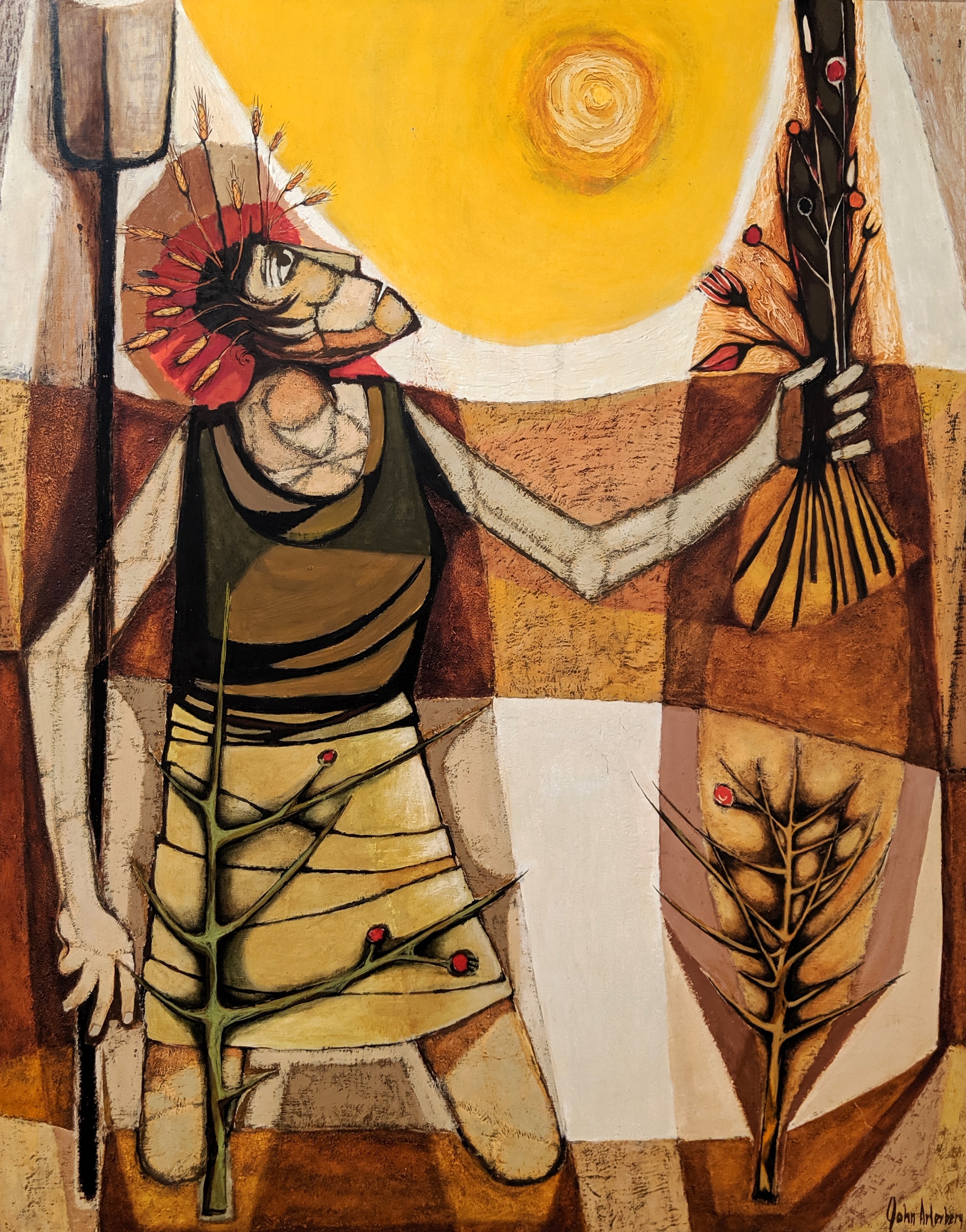
The last piece in the room is Ceres by John W. Arterbery. Ceres was the Roman goddess of agriculture, grain crops, and fertility, the equivalent of the Greek mother-goddess Demeter. In Arterbery’s painting she wears a crown of sprouting wheat stalks and holds a pitchfork in one hand and a leafless plant with buds and berries in the other. I think the flowers may be poppies, as Ceres is associated with those.
John W. Arterbery (American, 1928–1977), Ceres, 1963. Oil on Masonite, 60 × 47 1/2 in. Clark Atlanta University Art Museum, Atlanta, Georgia. Photo: Victoria Emily Jones.
It appears as though Arterbery is depicting the imminence of spring, when Ceres will be reunited with her daughter Proserpine (Persephone) and life will grow and flourish. It shows Ceres looking toward the sun in anticipation of such a time. Read in conjunction with the other pieces in the room, Ceres could be interpreted as an Advent image—a waiting for the final fulfillment of God’s good purposes for his creation, which includes a definitive end to suffering and oppression and a universal thriving.
The Clark Atlanta University Art Museum is typically open Tuesday through Friday from 11 a.m. to 4 p.m., as well as by appointment, but you may want to email ahead of time (cauArtMuseum@gmail.com) to confirm. It’s definitely worth a visit, though I can’t guarantee that the works featured here will be on display. If you wish to browse photos of pieces from the museum’s collection, see In the Eye of the Muses: Selections from the Clark Atlanta University Art Collection (2012).
All four canonical Gospel accounts of the retrieval of Jesus’s body from the cross and its entombment are very matter-of-fact. There is no mention of grieving. The focus is on the roles of Joseph of Arimathea and Nicodemus, though Matthew and Mark mention two Marys being present (Matt. 27:61; Mark 15:47), and Luke refers generically to “the women who had come with him from Galilee” (Luke 23:55). Mark and Luke also mention the women preparing and, after the Sabbath, returning with burial spices (Mark 16:1; Luke 23:56–24:1).
Leave it to the artists, poets, and composers to inject some emotion into these undeniably wrenching moments! Of carrying the corpse of a loved one, cleaning it, dressing it, and saying goodbye as it’s put into the earth. There is an enormous number of paintings, sculptures, music, and literary texts composed over the centuries to aid Christians in meditating on the dead Christ and vicariously lamenting with those present, especially the Virgin Mary.
After Mary and the others laid Jesus to rest on Friday, their mourning continued, I’m sure, into Saturday. They were utterly bereft.
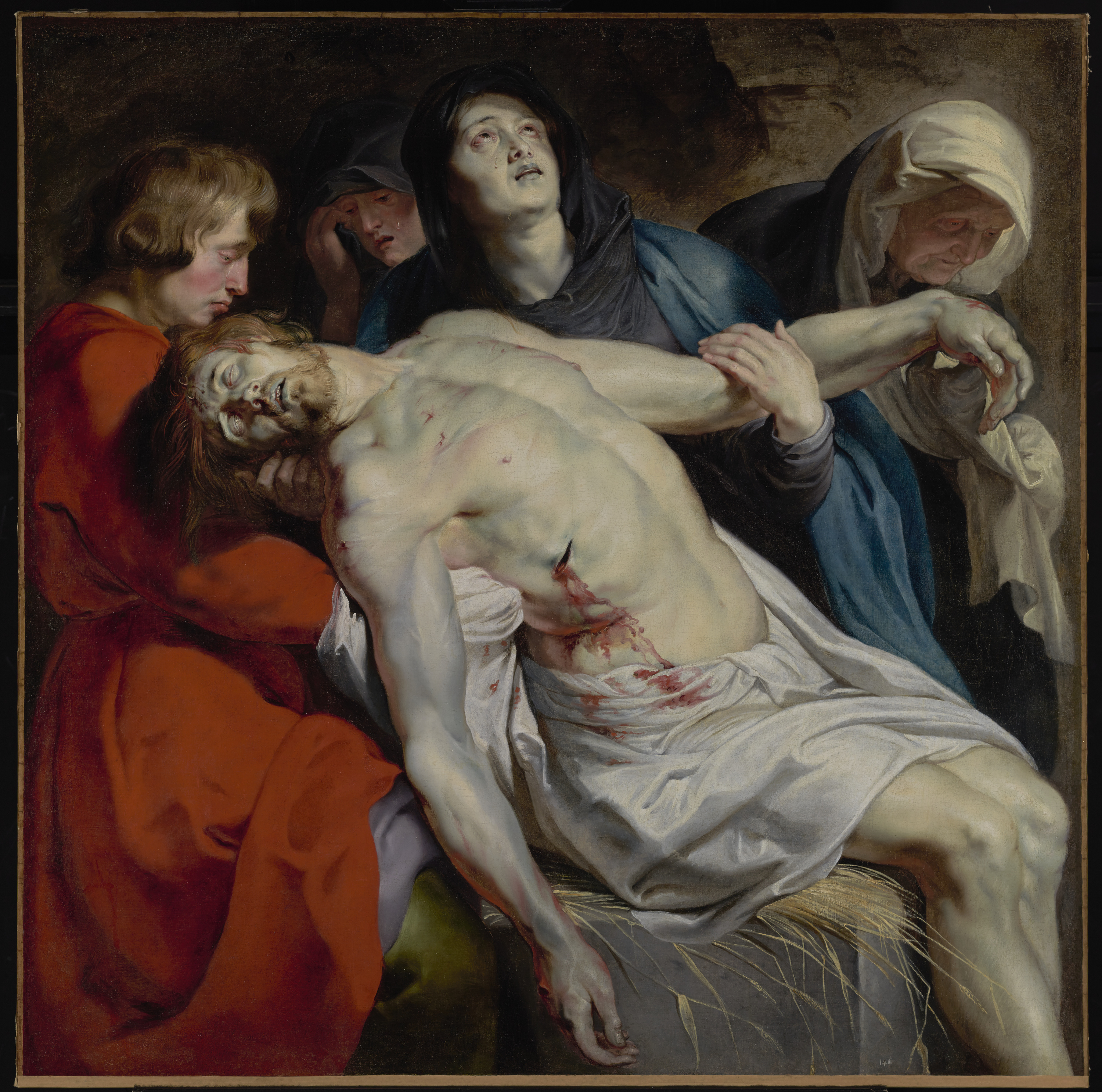
LOOK:Peter Paul Rubens (Flemish, 1577–1640), The Entombment, ca. 1612. Oil on canvas, 51 5/8 × 51 1/4 in. (131.1 × 130.2 cm). J. Paul Getty Museum, Los Angeles.
The Flemish Baroque artist Peter Paul Rubens painted scenes of the lamentation of Christ many times. I saw this one in person at the Getty a few years ago, and it really drew me in. It shows Saint John and the Virgin Mary supporting Jesus’s body as they lay him down onto a stone slab. Mary Magdalene weeps from behind, and another, older Mary, the mother of James the Younger and Joseph (Matt. 27:56; Mark 15:40), gingerly lifts his wounded hand, fixing her sorrow there.
Rubens does not shy away from the ugliness of death, showing Jesus’s eyes rolled back in his head, his lips blue, and blood caked in his hair and dried up around the gaping laceration in his side. His whole body is pale with death, his skin green-tinged, in contrast to John’s ruddy complexion; his mother wears the same deathly pallor. Her eyes are red and puffy, and she looks up to the heavens as if to question why, or to petition God for strength.
The wheat that Jesus lies on alludes to the straw he was bedded in as a newborn and to the bread of the Eucharist on the altar. Christ’s body is given as a holy offering for the sins of the world.
Áine Minogue is an award-winning Irish harpist, singer, arranger, and composer, now living in the Boston area. She plays and sings a mix of traditional tunes and original songs, most with Gaelic lyrics. “Song of Keening” wasn’t written explicitly for Holy Week, but it is a funeral lament that uses non-word utterances to express grief. Minogue writes,
In old Ireland, the practice of keening provided a physical and emotional release for those who grieved. Sometimes, keening was a direct emotional response to loss, practiced by both men and women, though particularly by women who had lost young children—a common occurrence in the past, when child mortality rates were significantly higher.
However, often a professional keener was hired by a family as a way of honoring the dead. These professional mourners were always women, and their keening was more stylized, taking the form of an improvisation based on particular structures and handed-down phrases. Though practiced in diverse cultures from Ireland to Greece, keening was generally frowned upon by church authorities, and treated with disdain by those who embraced the trappings of modernity. The practice now has virtually died out.
This piece is improvised in the old style, using old structures and vocables.
Professional mourners (moirologists) were used in ancient Israel too, at least by those wealthy enough to afford them. There’s no indication that any were present at the death of Jesus. In art history the chief mourners at Jesus’s crucifixion and burial are his mother, Mary; John, to whose care Mary was entrusted; Mary Magdalene; and Jesus’s other female followers.
There are hundreds of thousands of musical works, from a range of genres, inspired by Christ’s passion, especially his death on the cross, which, along with the resurrection, is the centerpiece of the Christian faith. I’ve curated just a sampling of these on Spotify, from across time periods and countries, to serve as an aural guide through the final week of Jesus’s life. The drama begins with Christ’s triumphal entry into Jerusalem on a donkey, where he’s hailed with hosannas, and then continues with a last supper shared with his disciples, an agonized prayer in Gethsemane followed by betrayal and arrest, then, all in one day, multiple trials (religious and civil), conviction by mob, a public execution, and burial. Many of the playlist selections are narrative in character, while some have a more theological bent. My hope is that these pieces aid you in observing this most holy of weeks, walking with Christ through the shadows, taking in how “he himself bore our sins in his body on the tree, that we might die to sin and live to righteousness. By his wounds [we] have been healed” (1 Pet. 2:24).
To add the playlist to your account, open the Art & Theology Holy Week Playlist link, then click on the More (…) icon and select “Save to Library.”
[Playlist cover art: Odilon Redon, Christ, ca. 1895, charcoal, chalk, pastel, and pencil on paper, Museum of Modern Art, New York]
The playlist is a mixture of classical and popular (indie-folk, gospel) music. In this post I want to provide a little context for some of the pieces, by which I mainly mean translations of all the non-English lyrics. Because of what you see here, you might get the wrong impression that the list is almost entirely classical; actually, it’s only about half.
The opening track, “Herr, unser Herrscher” (Lord, Our Ruler), is a unique arrangement of the opening chorus from Johann Sebastian Bach’s St. John Passion, a Good Friday oratorio in German.
Herr, unser Herrscher, dessen Ruhm
In allen Landen herrlich ist!
  Zeig uns durch deine Passion,
  Daß du, der wahre Gottessohn,
  Zu aller Zeit,
  Auch in der größten Niedrigkeit,
  Verherrlicht worden bist!
Lord, our ruler, whose fame
In every land is glorious!
  Show us, through your passion,
  That you, the true Son of God,
  Through all time,
  Even in the greatest humiliation,
  Have become transfigured! [source]
Unique, because the Baroque choir and orchestra are accompanied by an ensemble of Gabonese musicians who contribute their own rhythmic profile, along with solo percussionists Sami Ateba from Cameroon and Naná Vasconcelos from Brazil. The recording, rereleased on the compilation album Babel (2008), is originally from Lambarena: Bach to Africa (1995), a collaboration between French composer and producer Hughes de Courson and Gabonese composer and guitarist Pierre Akendengué, synthesizing two disparate sound worlds. (“Bombé / Ruht wohl, ruht wohl, ihr heiligen Gebeine” is another highlight from the album. For weeks I debated whether to include it on this playlist—adding it, taking it off, adding it back again—ultimately deciding to leave it off, the reason being that it overlays Bach’s choral rondo with music and invocations to the dead from a Bwiti religious ritual. Though sonically compelling and worth listening to, I felt that it might impede some Christians’ ability to engage this list in a devotional way; so I opted for a traditional Western classical recording instead.)
Other selections from Bach’s St. John Passion are:
>> “Christus, der uns selig macht”
Christus, der uns selig macht,
Kein Bös’ hat begangen,
Der ward für uns in der Nacht
Als ein Dieb gefangen,
Geführt für gottlose Leut
Und fälschlich verklaget,
Verlacht, verhöhnt und verspeit,
Wie denn die Schrift saget.
Christ, who makes us blessed,
committed no evil deed,
for us he was taken in the night
like a thief,
led before godless people
and falsely accused,
scorned, shamed, and spat upon,
as the scripture says. [source]
>> “Petrus, der nicht denkt zurück”
Petrus, der nicht denkt zurück,
Seinen Gott verneinet,
Der doch auf ein' ernsten Blick
Bitterlichen weinet.
Jesu, blicke mich auch an,
Wenn ich nicht will büßen;
Wenn ich Böses hab getan,
Rühre mein Gewissen!
Peter, who did not recollect,
denied his God,
who yet after a serious glance
wept bitterly.
Jesus, look upon me also,
when I will not repent;
when I have done evil,
stir my conscience! [source]
>> “O große Lieb”
O große Lieb, O Lieb ohn alle Maße,
Die dich gebracht auf diese Marterstraße!
Ich lebte mit der Welt in Lust und Freuden,
Und du mußt leiden.
O great love, O love beyond measure,
that brought you to this path of martyrdom!
I lived with the world in delight and joy,
and you had to suffer. [source]
>> “Ruht wohl, ihr heiligen Gebeine”
Ruht wohl, ihr heiligen Gebeine,
Die ich nun weiter nicht beweine,
Ruht wohl und bringt auch mich zur Ruh!
Das Grab, so euch bestimmet ist
Und ferner keine Not umschließt,
Macht mir den Himmel auf und schließt die Hölle zu.
Rest well, you blessed limbs;
now I will no longer mourn you.
Rest well and bring me also to peace!
The grave that is allotted to you
and encloses no further suffering
opens heaven for me and closes off hell. [source]
For Bach’s St. Matthew Passion—one of the most celebrated works of classical sacred music ever written, right up there with Handel’s Messiah—I’ve drawn from the abridged English version (rather than the original German), translated by the Rev. Dr. John Troutbeck and performed in 1962 by the New York Philharmonic and Collegiate Chorale under the direction of Leonard Bernstein. I chose just a few pieces from it, not wishing to replicate the whole thing; as you can see, I tend to favor chorales over arias.
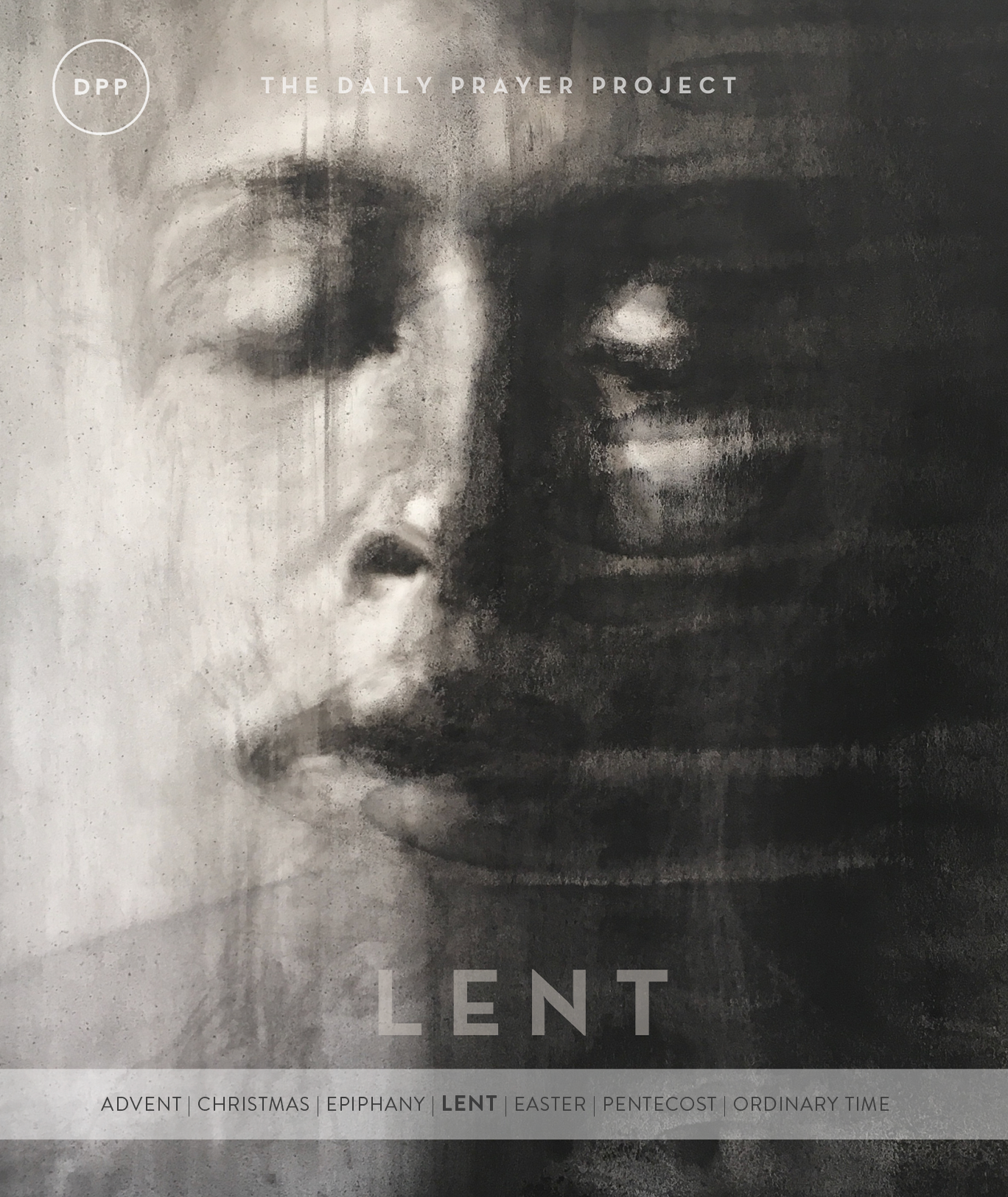
The Lent 2021 edition of the Daily Prayer Project prayerbook is now available, covering February 17–April 3. (I serve as curator.) The stunning cover image is Prayers of the People I by Meena Matocha, who works in charcoal, ashes, acrylic, and wax. You can purchase the booklet in either digital or physical format.
In the opening letter, Project Director Joel Littlepage writes, “Lent is a season that disturbs many people. Maybe that includes you. Among Protestant Christian communities that I have been a part of over the years, Lent can either be seen as a ‘graceless,’ ‘harsh,’ ‘legalistic’ part of the Christian year or, on the other hand, trivialized into a time to ‘pick something to give up,’ like a seasonal spiritual diet plan. Both these characterizations miss the mark.” He goes on to describe the bidirectionality of the Lenten journey: downward, as we are crucified with Christ, and upward, toward the victory of resurrection and new life. “It is a season to sense again the path of the Christian life.”
+++
NEW CHILDREN’S BOOK: Pippy the Piano and the Very Big Wave by Roger W. Lowther, illustrated by Sarah Dusek: My friend Roger Lowther [previously], director of Community Arts Tokyo and host of the Art Life Faith podcast, has written his first children’s book, which released in December. It’s inspired by the story of a church in Kamaishi, who after the 2011 tsunami found their beloved piano upside down and covered in mud and debris but, rather than discard it, decided to spend enormous amounts of time and money to restore it—a picture of God’s love for his precious creation, and the lengths he went to to demonstrate that love. Hollywood and Broadway actor Sean Davis reads the book in the video below. [Available on Amazon]
+++
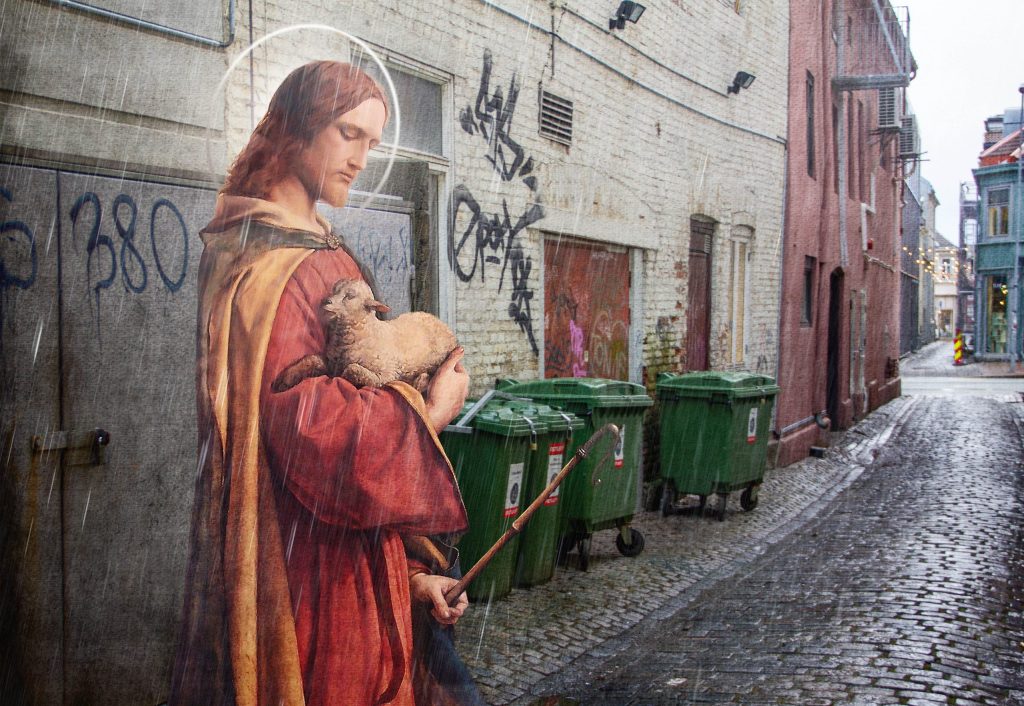
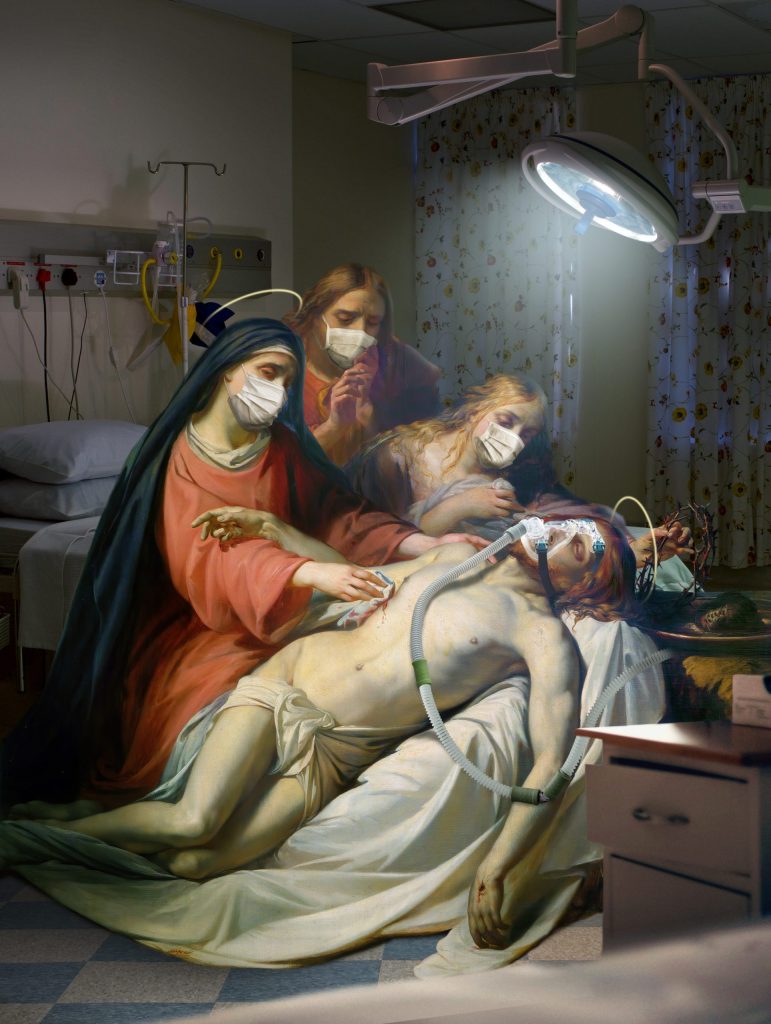
EXHIBITION: The Cobblestone Gospel by Trygve Skogrand, Vår Frue Kirke (Our Lady Church), Trondheim, Norway, July 2020–April 2021: “An exhibition of collages of historic low-church art merged with photographs of our own contemporary surroundings. The essence of the works is the meeting. Between painting and photography, the mystical and the mundane, and how the meeting makes both worlds renewed and re-visibled.” The original advertising says the exhibition is open Mondays through Saturdays from 12 to 3 p.m., but I’m not sure whether COVID has changed that; you can contact the church here.
Trygve Skogrand (Norwegian, 1967–), Found, 2020. Collage / pigment print on paper.Trygve Skogrand (Norwegian, 1967–), The Beloved, 2020. Collage / pigment print on paper.
When I was a child, I went to a Christmas party at our local church. At the end of the party, every child got a small bag of gifts to take home. In the bag: a pack of raisins, a small orange, some sweets – and a prayer card showing Jesus in paradise. Oh, how beautiful I thought the small prayer card was! Jesus and butterflies and a sunset and flowers AND a golden glittery border. A wonder of loveliness and holiness!
Move on twenty years. I was 30, had started working as an artist, and found the bible card again. I had changed, and the card too. Instead of seeing loveliness, I found the card rather sad. It looked to me as if Jesus was imprisoned in a dusty and suffocating make-believe paradise.
Then it struck me: What if I remove the paradise?
I have now been working with the merging of high and low historical Christian art with our contemporary surroundings for twenty years. For me, this process not only binds together what nowadays normally is shown as sundered but also re-actualizes the classical art and infuses the everyday, modern surroundings with holiness.
+++
MUSIC VIDEO: “Fear Thou Not” by Josh Garrels: This beautiful new setting of Isaiah 41:10 by Josh Garrels appears on Garrels’s 2020 album Peace to All Who Enter Here [previously]. “Fear thou not; for I am with thee: be not dismayed; for I am thy God: I will strengthen thee; yea, I will help thee; [and] I will uphold [you] with the right hand of my righteousness” (KJV).
+++
SHORT FILM: A Colorized Snowball Fight from 1896 Shows Not Much Has Changed in the Art of Winter Warfare: This is pure joy! “A short clip, originally captured by Louis Lumière in 1896, documents a rowdy snowball fight [bataille de boules de neige] on the streets of Lyon, France. Thanks to Saint-Petersburg, Russia-based Dmitriy Badin, who used a combination of the open-source software DeOldify and his own specially designed algorithms to upscale and colorize the historic footage, the video of the winter pastime is incredibly clear, revealing facial features and details on garments.”






 Art & Theology