
In 2010 Eugene Soh was enrolled in Nanyang Technological University’s School of Art, Design, and Media, on track to becoming a game programmer, when Campus magazine, aware of his photography hobby, asked him if he’d like to contribute a centerfold to an upcoming issue. He said yes but, after combing through his photos, realized he had nothing great to offer—he’d have to shoot something new, something epic. He chose to restage Leonardo da Vinci’s Last Supper at Maxwell Road Hawker Centre (a “hawker center,” or kopitiam, is what Singaporeans call their open-air food courts), using vendors as models for Christ and his disciples.
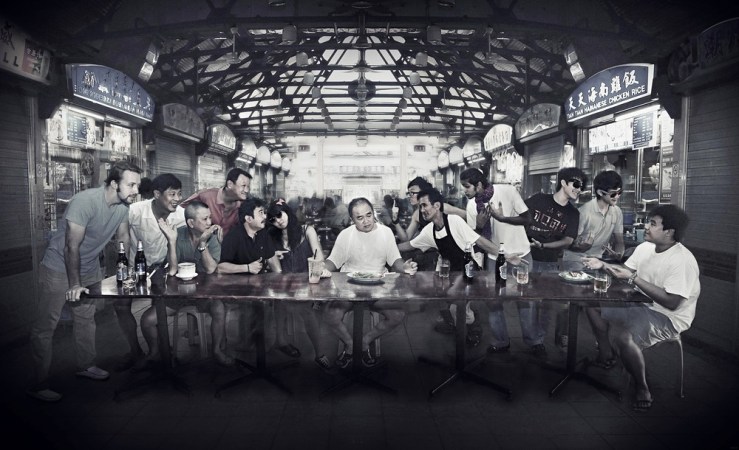
The photo was published but went without much notice until two years later in 2012, when it went viral online. Galleries started contacting him to do shows, not realizing that The Last Kopitiam was a one-off thing. Soh decided to finish out his concentration in interactive media, graduating in 2013, and then to pursue fine art photography as a career.
Encouraged by the interest in his Leonardo adaptation, Soh translated more Western art masterpieces into a contemporary Singaporean idiom, among them the Mona Lisa (renamed Moh Lee Sha), The School of Athens (Food for Thought), The Birth of Venus (Arrival of Venus), Saturn Devouring His Son (Saturn Devouring His Naan), A Sunday on La Grande Jatte (Sunday Afternoon on the Island of Singapore), Arrangement in Grey and Black No. 1 (Arrangement in Grey, Black and Yellow), and American Gothic (Singapore Gothic).
His Creation of Ah Dam, after Michelangelo’s famous Sistine Chapel ceiling fresco, shows a wet-market grocer transferring the spark of life to “Ah Dam” via carrot.

It is Soh’s process, as demonstrated in these photos, to shoot his human subjects separately and then stitch them together digitally to create a single composite image. The hawkers in The Last Kopitiam, for example, couldn’t all get away from their stalls at the same time, so this sort of cut-and-paste manipulation was born out of necessity. At first Soh was resistant to using Photoshop in this way, thinking of it as “cheating,” but he quickly became convinced of its legitimacy and artistic potential.
Earlier this year Soh developed a new series called The Second Coming, which reenvisions the life of Christ on Singaporean soil (much like David LaChapelle did, for America, in his 2003 series Jesus Is My Homeboy). Mounted as a solo show in February and March at Chan Hampe Galleries, The Second Coming draws on familiar devotional image types, like the Madonna and Child, the Crucifixion, and the Pietà, as well as invents some new ones, like Jesus answering his cell (Hold Up, Dad’s Calling) or helping one of his hosts prepare dinner (What’s Cooking, Jesus?).
In Happy Birthday & Merry Christmas, Jesus, Jesus blows out the candles on his cake. The mise-en-scène includes a foam crown, maracas, and an umbrella drink.

In contrast, the mood of The Last Christmas is gloom and doom. According to the artist, Jesus has just announced that he is going to destroy the world, putting a damper on the birthday festivities (though one attendee chooses to make light of the news). Staged like a Last Supper, this imagined scene takes place immediately preceding Armageddon. It’s everyone’s last Christmas. Continue reading “Jesus comes to Singapore: The New Testament imagery of Eugene Soh”


