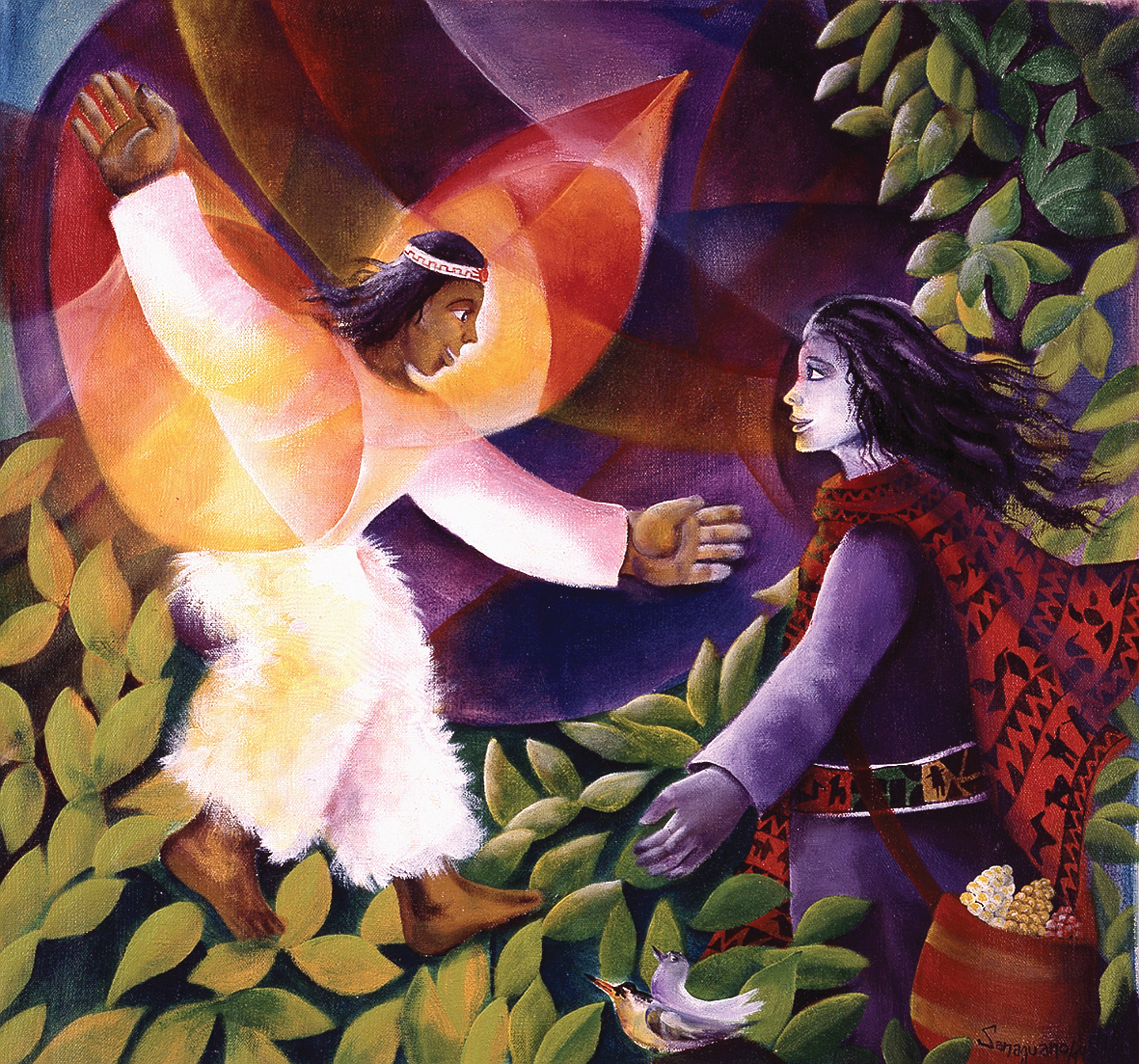
In this outdoor Andean Annunciation scene, the angel Gabriel arrives with a gust of wind before Mary, who has a satchel of freshly harvested corn slung over her shoulders. He wears llama or alpaca pants, part of the traditional male dress in the highlands of Ecuador. With his right hand he gestures toward the heavens, and with his left he gestures toward her, as if to say, “Heaven’s coming down to earth—God wants to be made human in you.”
He smiles. She smiles. Her face is illumined by beams of divine grace. She extends her arms to embrace her new vocation as Mother of God.
LISTEN: “Bendita seas, María” (Blessed Are You, Mary) by Ariel Glaser, on Tercer Milenio, 1997 | Performed by Jimena Muñoz with Brother Alex, 2020
En un silencio profundo tejías plegarias a un Dios que escuchaba tus simples palabras, pequeña María entregada a su amor. Y en una tarde tranquila rompiendo el silencio, las alas de un ángel, sonaban al tiempo que te saludaba de parte de Dios.
Estribillo 1: ¡Bendita seas, María, entre toda mujer! ¡Has encontrado gracia a los ojos de Dios! María, Madre suplicante, ayúdame también a escucharlo a Él.
Fue la palabra más dulce que tocó la tierra, la que te propuso cumplir la promesa de que nacería nuestro Salvador. «Hágase en mí como has dicho;» respondiste al ángel, y el Santo Espíritu descendió al instante. Te habías convertido en Madre de Dios.
Estribillo 2: Bendita seas María, hija del Padre, Esposa del Espíritu, Madre del Emanuel. María, Madre de Jesús, ayúdame, también a decir amén.
ENGLISH TRANSLATION (my own):
In profound silence you wove prayers to a God who heard your simple words, little Mary, surrendered as you were to his love. And on a quiet afternoon, breaking the silence, the wings of an angel sounded as he greeted you on behalf of God.
Refrain 1: Blessed are you, Mary, among all women! You have found favor in the eyes of God! Mary, supplicating mother, help me to listen to him too.
It was the sweetest word that touched the earth, the one that offered you the promise of the birth of our Savior. “Let it be done to me according to your word,” you replied to the angel, and the Holy Spirit descended instantly. You had become the Mother of God.
Refrain 2: Blessed are you, Mary, daughter of the Father, wife of the Spirit, mother of Emmanuel. Mary, mother of Jesus, help me also to say amen.
This song marvels at Mary’s unique calling while recognizing that we, too, are called to say yes and amen (“let it be”) to God’s will in our lives, which includes being filled with Christ.
The first two lines of the first refrain combine Elizabeth’s exclamation to Mary in Luke 1:42 (“Blessed are you among women!”) with Gabriel’s declaration in Luke 1:30 (“You have found favor with God”).
The epithets in the second refrain highlight Mary’s relationship to the three persons of the Trinity. She is a child of God the Father, as we all are. But she was also wed to God’s Spirit, experiencing a unique and nonsexual union that resulted in the conception of Jesus, the Son of God. Jesus received his flesh from Mary, and she mothered him from his birth to his death. The title Theotokos—God-bearer, or Mother of God—was formally affirmed for Mary at the Council of Ephesus in 431 and is held true by all three branches of Christianity.
The songwriter, Ariel Glaser, is from Argentina. He describes himself as “a catechist who sings,” teaching Catholic doctrines in schools and churches through traditional methods and song. He and his wife are members of the Convivencia con Dios (CcD), a charismatic Catholic movement made up of both laypeople and religious, both men and women, responding to Jesus’s call in John 17: “Father, may they all be one as you and I are one!” Follow Glaser on Facebook.
The singer, Jimena Muñoz, has been singing and playing guitar since age twelve. In addition to making gospel-centered music, she is also a professor of sacred sciences (a field in Catholic institutions that includes theology, canon law, philosophy, biblical studies, church history, and liturgy), and a pastoral coordinator for CEF (Centro Educativo Franciscano) La Rioja.
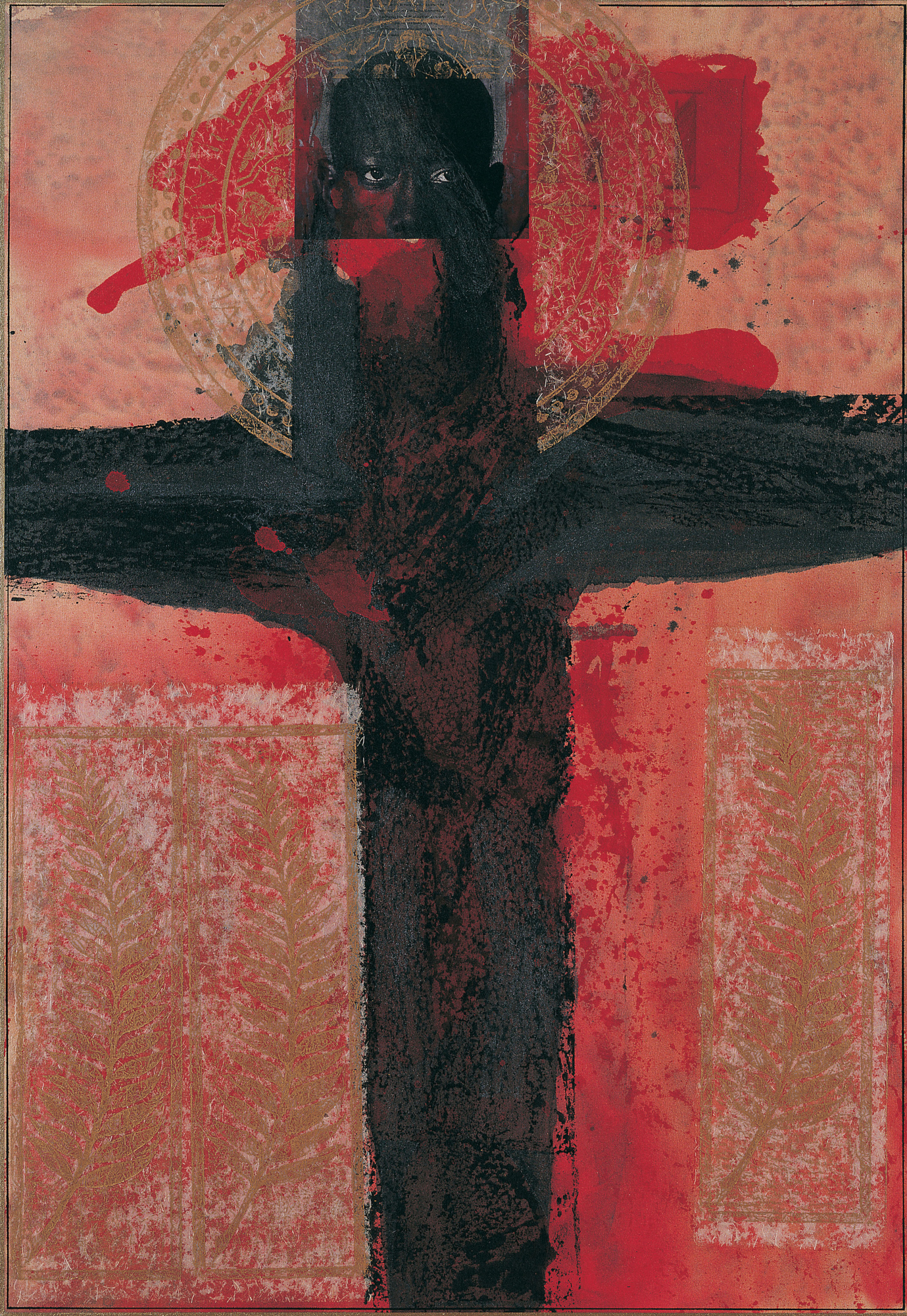
Last month when I was driving home to Maryland from Connecticut, I decided to stop for an hour or two at the Newark Museum of Art in New Jersey. I wanted to see a monumental Nativity painting in their collection by Joseph Stella. It didn’t end up being on display, but I did find many other compelling works. Chief among them was the acrollage painting Christ of the Christians by Nuyorican (New York Puerto Rican) artist Rodríguez Calero, a variation on the Crucifixion that portrays the violence of the cross in the abstract.
Rodríguez Calero (Puerto Rican, 1959–), Christ of the Christians, 1995. Acrollage on canvas, 52 × 36 in. Newark Museum of Art, Newark, New Jersey. All photos (except the two details that follow) courtesy of the artist.
Made with acrylic paint, rice paper, imaged paper, colored glazes, and gold leaf, the work is heavily layered. Its focal point is the direct gaze of a young Black man, his head framed by a shaded gray box and haloed in gold. His face is cut off just above the mouth. The Word is muted.
This figure fragment is at the top terminal of a rough-edged cruciform that is rendered in a harsh tar-black embedded with deep splotches of red. Body merges with cross—blood, wood, and flesh.
The whole background is covered in pinks and reds. The color pools and splatters and permeates, representing the pouring out of life.
Standing upright alongside the cross are three stenciled palm branches, alluding to Christ’s entry into Jerusalem just five days earlier. Palm branches were a symbol of triumph in ancient Judaism, hence their being waved to greet the Christ, the “Anointed One,” at the city gate. (Jesus’s followers anticipated a political victory over Rome, little knowing that God had other plans.) In Christian iconography palm branches are associated with martyrdom; in portraits and heavenscapes they are held by saints who met an early end because of their spiritual convictions, just like their Lord.
Their presence in this scene can be read on the one hand as an indictment of human fickleness (lauding Jesus as savior one day, crucifying him the next) and on the other as an assertion of triumph through the unlikely means of death on a cross.
The work can also be read through the lens of Black suffering and liberation. The late Christian theologian James Cone writes about such themes in The Cross and the Lynching Tree, a landmark book published in 2013, anticipating the Black Lives Matter movement. Cone explains how powerful a symbol the cross has historically been to Black American communities who face racial terror, violence, and oppression. They see in the Crucifixion, in addition to its spiritual implications, a demonstration of God’s solidarity with the oppressed, and hope on the other side. “I’m with you in your suffering,” says the God who hangs on a tree at the behest of a mob, “and death will not have the final word.”
Cone describes the thousands of lynchings of Black men, women, and children in the US as “recrucifixions”—the killing of sons and daughters of God. Two decades earlier, Jamaican American artist Renee Cox made the same connection in her photographic collage It Shall Be Named, just one in a line of artistic works to do so, going as far back as the Harlem Renaissance. Calero’s Christ of the Christians contributes to this tradition.
The gaze of the Christ in her piece is arresting. It confronts. It asserts the sacred humanity of its wearer, despite attempts to blot it out.
However, the artist tells me that for her, Christ of the Christians is about sacrifice, not violence, racial or otherwise. The man in the painting is the “people’s Messiah,” she says, “the anointed Savior to humankind who was sent to save all from the pain, darkness, and injustices that we see on a regular basis.” The cross is “willful humility, the culmination of prophecy, and the fulfillment of promises,” and the crown is heavenly reward. The trinity of branches represents hope.
One of the features that most struck me about this piece is its raised and varied textures, a hallmark all across the artist’s larger body of work. Calero coined the term “acrollage” to describe her mixed-media technique in which she uses an acrylic emulsifier to transfer collaged images (from found elements or her own photographs) onto painted canvas, adding further embellishments with gold leaf, stenciled patterns, and rice paper. This technique of layering materials, producing veils, suggests a theme of hiddenness and revelation.
Rodríguez Calero, or RoCa for short, was born in Arecibo, Puerto Rico, in 1959 and moved to Brooklyn when she was a year old. She returned to Puerto Rico after high school to study at the Escuela de Artes Plásticas at the Instituto de Cultura Puertorriqueña, under master artist Lorenzo Homar, who specialized in printmaking. Then she returned to New York for additional training in painting and collage under artist Leo Manso. She currently resides in New York and New Jersey.
Calero’s work merges Catholic iconography and hip-hop culture, drawing her personal community into the visual lexicon of the sacred. Raised Catholic, she was influenced from an early age by religious imagery at church and school. She brings this influence to bear in her artistic work while also integrating and reflecting the multiracial, multiethnic, urban environment she grew up in. “My inspiration really comes from just being in the neighborhood . . . the people walking the streets,” she says.
Alejandro Anreus, art historian and curator of the major 2015 exhibition Rodríguez Calero: Urban Martyrs and Latter-Day Santos at El Museo del Barrio in New York, describes the Nuyorican art aesthetic that was just getting off the ground while Calero studied at the Art Students League of New York from 1976 to 1982:
Starting before 1970—crystalizing possibly with the foundation of the Taller Boricua in New York City—and emerging and developing throughout the 1970s and into the 1980s, a specific aesthetic that can be defined as Nuyorican came into being. The aesthetic of New York Puerto Rican art was a diverse fusion of abstract expressionism and geometric abstraction, surrealism and social realism, as well as assemblage and constructions incorporating cultural and ethnic icons. The ethnic and cultural icons reflected several thematic preoccupations, which included Taino and Afro-Hispano imagery, depictions of barrio life, a popular, even populist Catholicism, and the belief that everyone, particularly the poor and marginalized of the neighborhoods, has dignity and inner worth regardless of social status. [exhibition catalog, p. 23]
The Christian doctrine of the imago Dei—that all human beings bear God’s image—is a central theme in Calero’s work. In His Image even adopts this theological language from the book of Genesis in its title, reminding us that God created each and every person with intrinsic and objective value, a reflection of his own divine self.
Rodríguez Calero (Puerto Rican, 1959–), In His Image, 1994. Acrollage on canvas, 36 × 24 in.
The piece shows a Black man dressed in a coat and beanie looking pensive and forlorn, his eyes downcast. Rectilinear pieces of teal-blue handmade paper form a cross behind him, and the outline of a manhole cover labeled “PUBLIC SERVICE” is superimposed over his face, doubling as a halo. In Christian art the halo signifies the light of Christ shining around and through a person, and Calero often adopts that device to underscore the sacred humanity of her subjects.
But the cross-hatching of this round form across the man’s face gives the impression of prison bars. Is he headed to prison, or is that destination merely what others, those with shallow or skewed vision, see when they look at him? Maybe he feels imprisoned by his circumstances. Or perhaps he is experiencing some kind of mental captivity. Whatever the nature of the confinement, those bars need to be broken. God wants every human being to be free and flourishing.
Rodríguez Calero (Puerto Rican, 1959–), El Hijo de Dios, 1995. Acrollage on canvas, 36 × 24 in.
The youth in El Hijo de Dios also shines forth God’s image. He looks straight out at the viewer from under his red Karl Kani sweatshirt hood, with a softness and a self-awareness that evoke empathy. A gilded pattern of crosses in diamonds cuts across the middle third of the acrollage, and a dot-rimmed semicircle, a halo fragment, seems to embrace the boy. The delicacy of this intervention over the thick, heavy folds of the cotton sportswear creates an intriguing mix.
To the boy’s right is a collaged face of a male in profile that looks like it could have been taken out of a Picasso painting. He could be an extension of the primary figure, his face set on a path. Or he could be someone who is at cross-purposes with him, as they are oriented at a ninety-degree angle from each other.
Translated “The Son of God,” the title of this acrollage could refer to Jesus Christ, who bears this title in a special sense, as the only begotten of God the Father. The man does seem to embody the vulnerability and determination that characterize Christ in his passion. Alternatively, it could refer to a child of God more generally, as the Spanish hijo is not necessarily male-specific. The particular and the universal are both at play here. We are all God’s children (Acts 17:28–29), equally and eternally beloved.
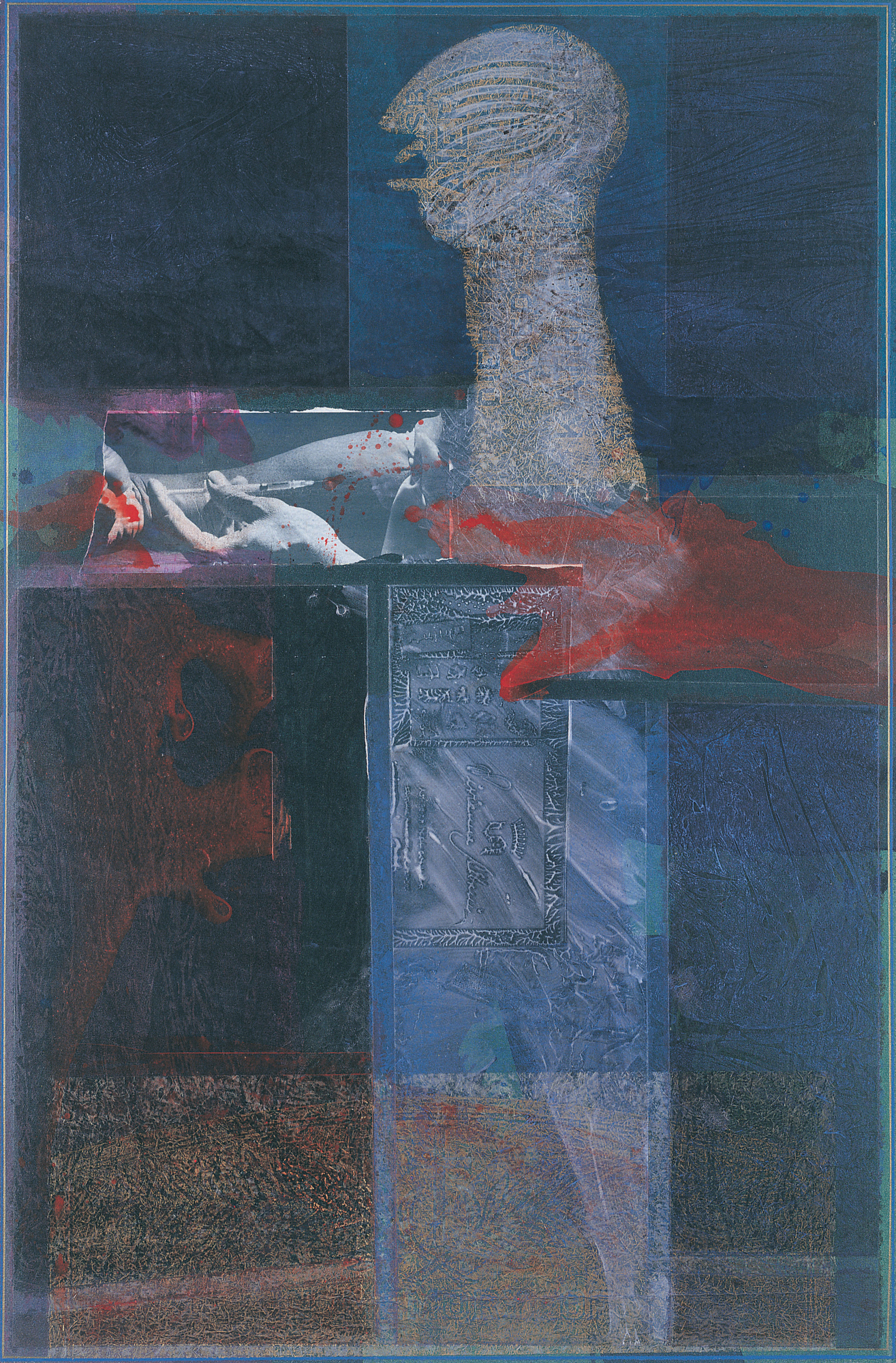
Rodríguez Calero (Puerto Rican, 1959–), Cruz de Loisaida, 1994. Acrollage on canvas, 64 × 42 in.
God’s love reaches especially into places of darkness, even though we don’t always feel it. In Cruz de Loisaida, our eyes are drawn to a monochrome found image of a hand injecting heroin into an arm. This fragment forms part of an abstracted cross, that archetypal symbol of deep suffering. The title, which translates to “Cross of Loisaida,” references a Lower East Side neighborhood with a strong Puerto Rican heritage. The piece laments the pain and anguish of drug addiction and, the artist says, the burdens forced on the Puerto Rican community by the government (“we are the sacrificial lambs”). Red pigment spills forth from the arm, evoking blood.
Rodríguez Calero (Puerto Rican, 1959–), Crowned with Thorns, 1999. Acrollage on canvas, 36 × 24 in.
Another acrollage that alludes to Christ’s passion is Crowned with Thorns, which is dominated by a large orange halo filled with linear and organic designs and cut out narrowly to reveal the face of a Black man. This headpiece is not obviously a crown of suffering; instead, it seems to convey an unironic air of royalty. It contains palm branches and irradiating gold lines that branch out like the veins of a leaf. And it smolders like fire. Could this be I AM speaking from the burning bush? The lush floral patterns, the Voice abloom?
By virtue of its historical associations, the title connects the man to Christ. With his hands he touches his Sacred Heart.
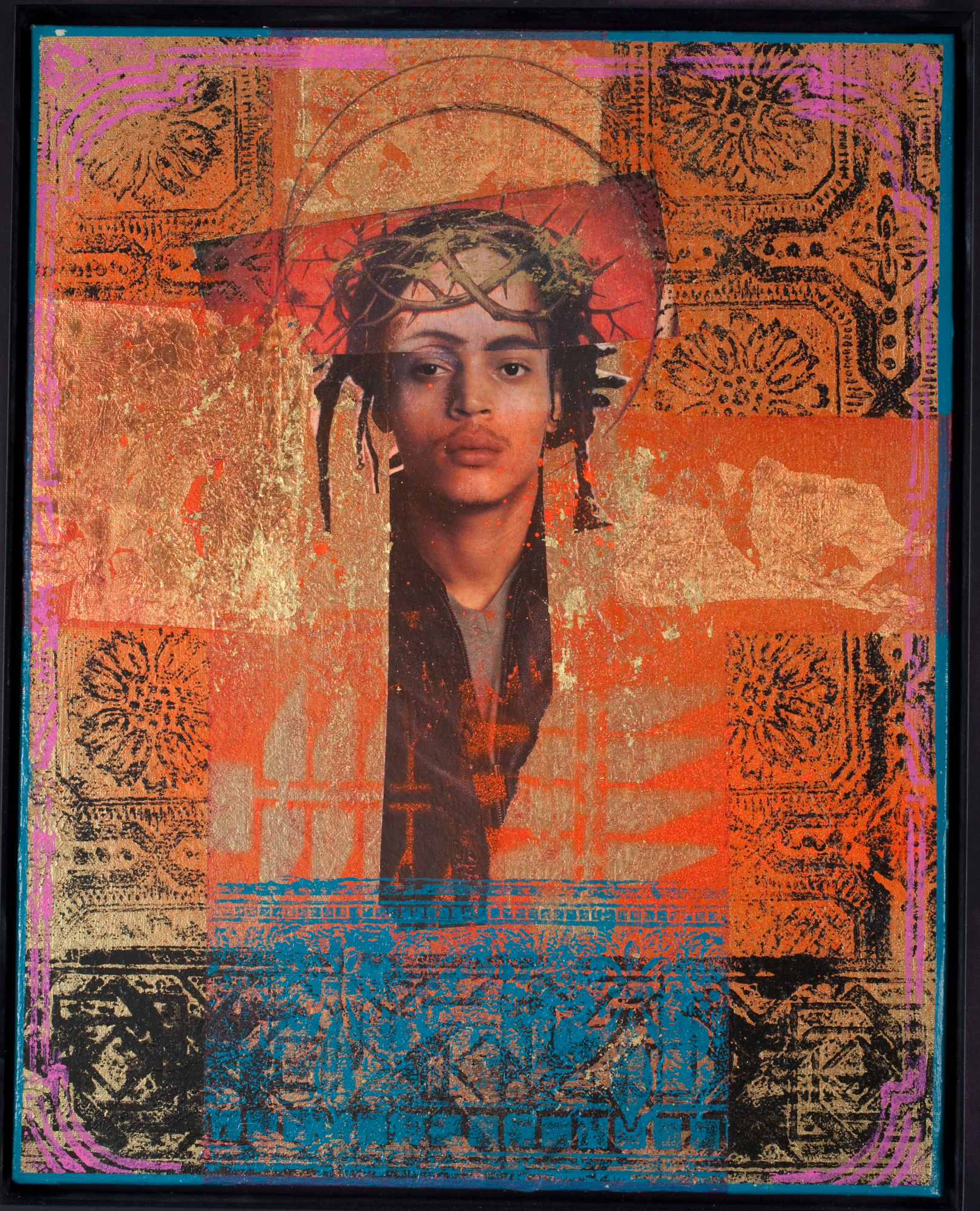
Rodríguez Calero (Puerto Rican, 1959–), The Chosen, 2000. Acrollage on canvas, 20 × 16 in.
One piece that appropriates unmistakable imagery of Christ is The Chosen: it contains a fragment of a Dutch Renaissance painting in the National Gallery of Christ crowned with thorns. Calero has cropped a detail of the gnarly crown piercing (a Caucasian) Christ’s forehead and collaged it with the face of a Latino man and the locs of a third (presumably a Black man). Her multiracial Jesus is nimbed twice over and emerges as if from a behind gold curtain, his brown eyes holding our gaze. He is surrounded by black-ink prints of flowers and crosses and flanked, as in Christ of the Christians, by golden palm branches. Droplets of red paint are splattered about his face and torso, one resting prominently on his upper right cheek like a tear.
Like Jesus, the Virgin Mary, his mother, is a major religious figure in Puerto Rican culture, and Calero references her in several of her artworks. Ángel y Maria depicts the moment of Annunciation, when the angel Gabriel comes to Mary to tell her that she has been chosen to bear God’s Son (Luke 1:26–38).
Rodríguez Calero (Puerto Rican, 1959–), Ángel y María, 2000. Acrollage on canvas, 52 × 36 in.
It’s a stunning image, bringing new life to a subject that has been painted hundreds of thousands of times over the course of history, starting with the ancient Roman catacombs. In Calero’s take, Mary is portrayed as a beautiful young woman of African descent who sits in profile, contemplating the gravity of what has just been asked of her. She holds a bouquet of flowers to her chest—perhaps she was in the midst of picking or arranging them when Gabriel arrived.
Gabriel stands in formality, cognizant of the weight of his message, patiently awaiting a response. His body is rendered in a wash of colors that blend into one another, producing an ethereal look.
Mary’s lips are parted, speaking her yes.
“The theme is love,” Calero told me. “The flowers are a representation of the blessing already inside.”
In the gospel story, this supernatural encounter results in a miraculous pregnancy, pictured in Calero’s La Madonna Negra (The Black Madonna). The image is of the Madonna del Parto (Our Lady of Parturition) type—that is, the pregnant Mary. We don’t often see Mary’s bare belly in all its pregnant glory, but here we are given a glimpse and reminded of the bodiliness of the Incarnation. We can even see the linea nigra extending across her belly button!
Rodríguez Calero (Puerto Rican, 1959–), La Madonna Negra, 2007. Acrollage on canvas, 54 × 24 in.
Calero’s Afro-Latina Madonna has two sets of arms. With one, she cradles her third-trimester baby bump and clenches the veil near her face, and the other she extends outward in a gesture of giving, offering the fruit of her womb for the life of the world (notice the printed impression of a fetus in her upper left hand). I love how these multiple gestures capture the conflicting instincts she must have felt—on the one hand, to keep the child to herself, to protect him from harm, and on the other, knowing her ministry is to support his, to share him with everyone. I see both Mary’s fear and her surrender in this image; her very human “What if I’m not ready for this?” and her “Welcome; come, receive.”
Rodríguez Calero (Puerto Rican, 1959–), Virgen María, 2000. Acrollage on canvas, 52 × 34 in. Collection of María Domínguéz-Morales and Juan M. Morales.
There’s also a hybridity in Virgen María, which shows a woman whose face is an amalgam of “every woman,” says the artist. Strong and confident, this Mary takes up space. Streaks of red paint cut across her torso like cords—but she spreads her arms, breaking what binds her. The bottom half of the canvas consists of blues and reds, Mary’s traditional colors, while the top half is gold, signifying the light of God.
“Mary, for me, has always been pictured as passive, and dressed in blue,” Calero told me. “Think about God in heaven, searching the world for the perfect woman to bear his Son. Now, in that state of mind, I thought Mary was chosen for her beauty, strength, compassion, intellect, and sexiness, and must represent all women, hence my Virgen María.”
Just as Calero often composites people of different races and ethnicities, she also occasionally mixes genders, as in Divine Prophet.
Rodríguez Calero (Puerto Rican, 1959–), Divine Prophet, 2012. Acrollage on canvas, 54 × 36 in.
This prophet’s face is made up of three collaged elements. A male with long hair and closely cropped facial hair forms the base, but the two eyes, underlined in blue shadow, are clearly a woman’s. And a mystical third eye is patched onto the forehead.
In Eastern spirituality, the third eye, also called the inner eye, provides perception beyond ordinary sight. The prophet, for example, sees visions of a reality that is presently invisible but that will one day be made manifest. The third eye symbolizes a state of enlightenment.
The prophet in this piece could be Jesus, or an Old Testament seer, or a prophet from another faith tradition. If the former, it’s interesting to consider how male and female are both contained in the Godhead, per Genesis 1:27. Although the second person of the Trinity incarnated as a male, there’s a long tradition of ascribing feminine attributes to Christ, from Clement to Ephrem to Anselm to Marguerite d’Oingt to Julian of Norwich. Christ is our Mother, they say, who labors to bring us to birth and feeds us at his breast. Moreover, the biblical book of Proverbs personifies Wisdom as a woman, and that woman is associated with Christ.
Centuries of European religious art and its mass-produced derivatives have harnessed the popular imagination to a narrow view of what the sacred looks like. Because of this conditioning through images, most people all over the world, not just in the West, conceive of Jesus, Mary, and the saints—those due honor—as white. Calero challenges that conception, not erasing whites but broadening the tent of sacred imagery to encompass people of color as well.
Most of her “saints” are not historical. They’re ordinary folks from New York’s barrios, or from other US cities—and from today. With their strong frontal poses, direct gazes, and haloes, they reflect the dignified, divine image–bearing status of those whom traditional Christian iconography has tended to exclude.
“Her saints—santos—are latter day and among us, her martyrs are our contemporaries,” says Alejandro Anreus. “They all live and struggle in an urban world filled with tension, even violence, as well as humor, yet open to epiphanies, where miracles can happen.” And, he continues, “her representations of Jesus Christ become all of us, as if reflecting the variety of humanity redeemed by Christ.”
(Regarding Anreus’s crucial last point: I articulated some of my thoughts on the matter a few years ago in this Instagram post.)
Black and brown bodies are beautiful and good, bearing the imprint of God their Creator. Rodríguez Calero helps us see and celebrate that. Bringing her cultural heritage to the fore, she cuts and combines, mixes and matches, contemplates, plays, and intuits, constructing affirming figure-based images of flesh and spirit that, while borrowing Christian visual tropes, are not tethered to Christianity but rather can live and move beyond an orthodox framework.
To learn more about Calero’s art training, her oeuvre, and collage as an art form, see the catalog for her retrospective (written in English and Spanish). You can also visit her website, www.rodriguezcalero.com.
Jesus said to them, “I am the bread of life. Whoever comes to me will never be hungry, and whoever believes in me will never be thirsty. . . . Your ancestors ate the manna in the wilderness, and they died. This is the bread that comes down from heaven, so that one may eat of it and not die. I am the living bread that came down from heaven. Whoever eats of this bread will live forever; and the bread that I will give for the life of the world is my flesh.”
—John 6:35, 49–51
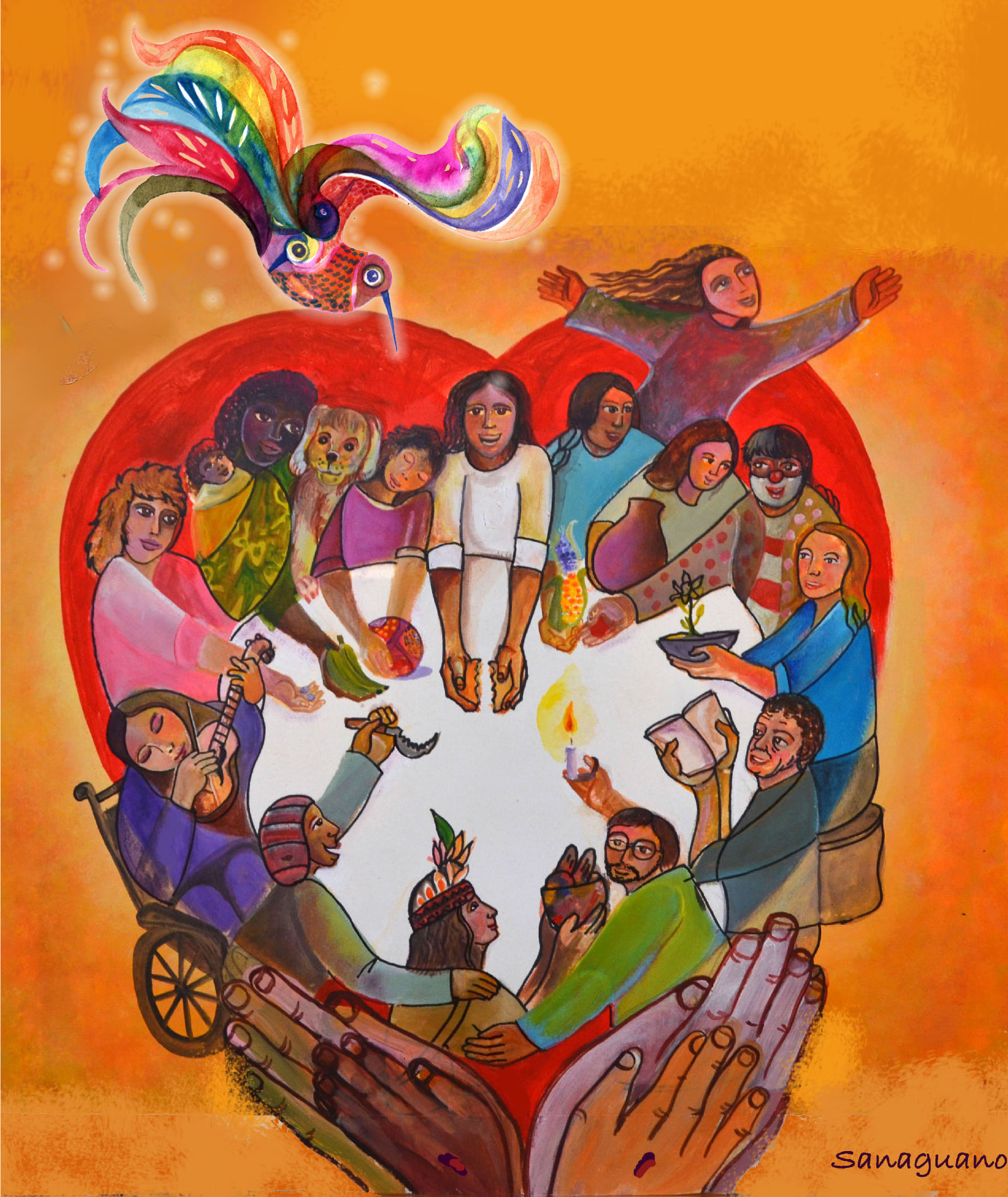
LOOK: Painting by Pablo Sanaguano
Painting by Pablo Sanaguano (Ecuadorian, 1964–), 2021
This song was written for the Porter’s Gate album Neighbor Songs, which released in 2019. Diana Gameros, a member of the collective, sings on the recording and plays guitar. Here she is a year later, singing the song with Minna Choi for a City Church San Francisco [previously] virtual worship service.
Jesus, bread of life Manna from heaven Broken for the world Offered up for every man
The feast of angels becomes food for the weary And hungry hearts are filled When you open up your hand When you open up your hand
O Lord, come fill us with your love This table laid for us There is more than enough Jesus, bread of life
Sister, take what you need Anything I own There is no famine here Jesus’ love will multiply
Brother, what’s mine is yours You are not alone There is no shortage here Jesus’ love satisfies Jesus’ love satisfies
O Lord, come fill us with your love This table laid for us There is more than enough Jesus, bread of life
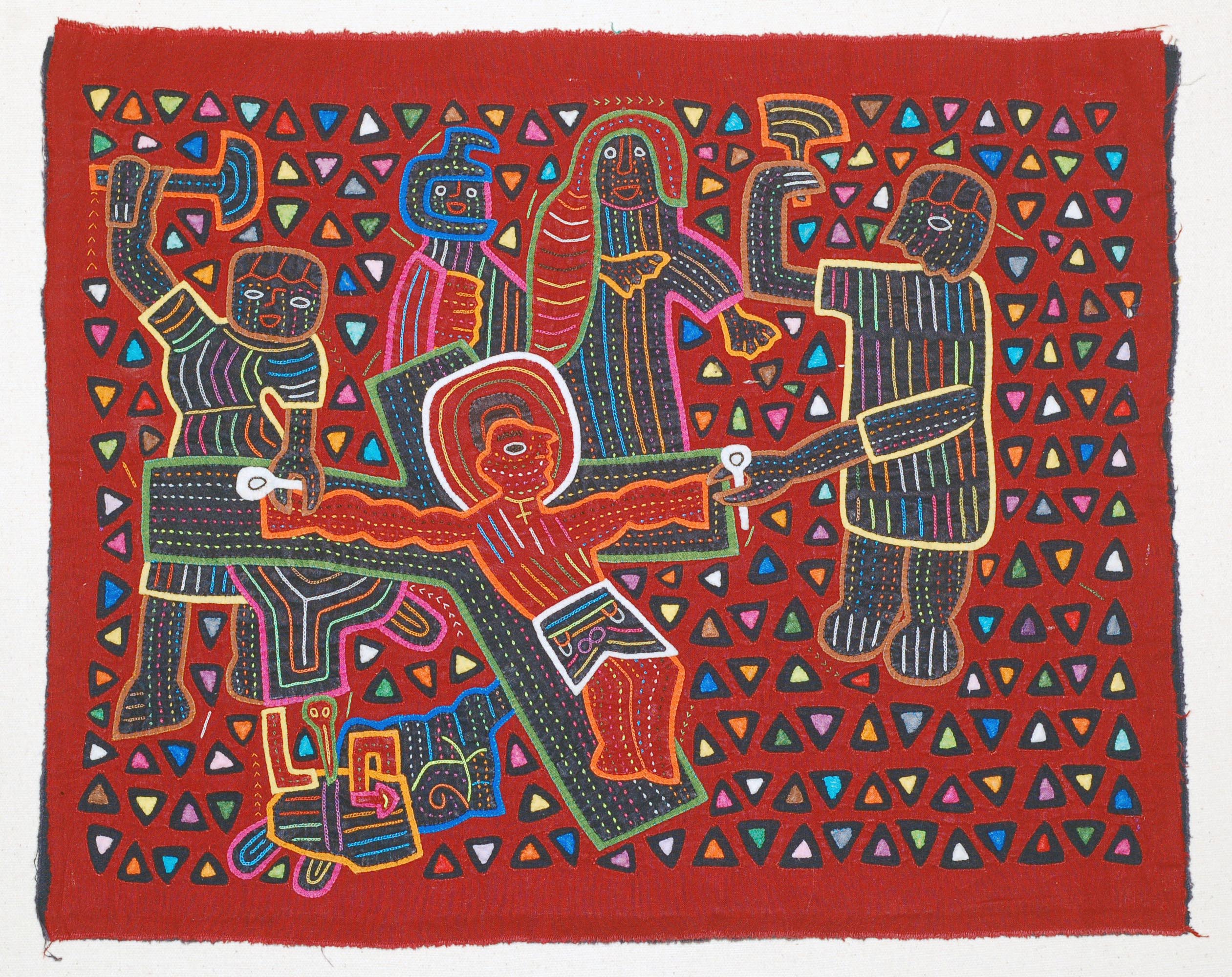
Christ Nailed to the Cross, mola (reverse appliqué panel) from the San Blas Islands, late 20th century. Bowden Collections.
The Kuna (also spelled Guna or Cuna) Indians live on the San Blas archipelago off the east coast of Panama, a cluster of some 378 islands in the Caribbean Sea. They are politically autonomous, and much of their traditional culture is intact.
Since the late nineteenth century, Kuna women have been making what are called molas, reverse appliqué panels made in pairs for the front and back of women’s blouses. As mola collector Jane Gruver describes, “several layers of cloth are stacked together and the design is made by cutting through the different layers of fabric to expose the desired color. Once the specific shape is achieved, the area is stitched around. Sometimes embroidery and applique are also used to add detail.” This colorful, wearable textile art is an integral part of Kuna culture.
The earliest molas featured geometric designs, which the Kunas translated from their customary body painting designs, but now a vast variety of representational subjects are common, including animals, plants, domestic scenes, political satire, dragons, mermaids, superheroes, spacecraft—and biblical stories!
The first Christian missionary to the San Blas Islands was Annie Coope, a single woman from the United States who arrived in the first decade of the 1900s and established a school on the island of Nirgana in 1913. A significant number of the Kuna embraced Christianity, such that there are now churches on thirty of the islands, as well as eighteen Kuna churches in and around Panama City, according to Wycliffe. A Kuna translation of the New Testament was published in 1995, at the behest of Kuna pastor Lino Smith Arango, and a Kuna Old Testament was completed in 2014.
The mola above shows two men hammering nails into Christ’s palms as two mourning figures—presumably John and Mary—stand behind. This piece is from the collection of Sandra and Bob Bowden in Chatham, Massachusetts, who are among today’s major collectors of modern biblical art. It is one of forty molas in the traveling exhibition Eden to Eternity: Molas from the San Blas Islands, available for rental for a nominal fee.
Fernando Botero (Colombian, 1932–), Cabeza de Cristo (Head of Christ), 1976. Oil on canvas, 185 × 179 cm. Museo de Antioquia, Medellín, Colombia.
Colombian painter and sculptor Fernando Botero is South America’s best-known artist. He is influenced by the Old Masters, which he studied in his twenties in Madrid, Paris, and Florence, and by the Mexican muralists. But his style—marked by plump, often childlike figures—is distinctively his own and has even been given the name “Boterismo.”
Throughout his career he has remained adamant that he does not paint “fat people” or “chubbies.” What he paints, he insists, is exaggerated volumes that highlight the body’s natural shape and the “sensuality of form.” In addition to religious subjects, he also paints Latin American street scenes, domestic life, nudes, and political portraits.
At age eighty-nine, Botero continues to be active as an artist, living and working between Paris, New York, and Tuscany.
LISTEN: “Legend (The Crown of Roses),” Op. 54, No. 5, by Pyotr Ilyich Tchaikovsky, 1883/89 | Based on a text by Richard Henry Stoddard, 1856 | Performed by the University of Pretoria Camerata, dir. Michael Barrett, on Written in the Stars, 2021
When Jesus Christ was yet a child He had a garden small and wild, Wherein he cherished roses fair, And wove them into garlands there.
Now once, as summer-time drew nigh, There came a troop of children by, And seeing roses on the tree, With shouts they plucked them merrily.
“Do you bind roses in your hair?” They cried, in scorn, to Jesus there. The Boy said humbly: “Take, I pray, All but the naked thorns away.”
Then of the thorns they made a crown, And with rough fingers pressed it down. Till on his forehead fair and young Red drops of blood like roses sprung.
In 1877 Tchaikovsky found a Russian poem by Aleksey Pleshcheyev published in a journal; it was a translation of the English-language poem “Roses and Thorns” (1856) by American poet Richard Henry Stoddard, an allegory of the Crucifixion. It’s about the boy Jesus who tends a rose garden and dreamily weaves together crowns from the branches’ yield. One day a bunch of rowdy children comes by and carelessly yanks the flowers off the bushes, scoffing at Jesus for being soft, a flower lover. In a spirit of gentleness, he tells them they may have the flowers, but to leave the thorns. Continuing their derision, the children bend the bare, thorny stems into a crown and press it into Jesus’s head. From his flesh then bloom “roses” of blood.
Tchaikovsky first set the Russian poem to music in 1883, arranging it for solo voice and piano and publishing it as part of his Sixteen Songs for Children, Opus 54. In 1884 he arranged it for solo voice and orchestra, and in 1889 for unaccompanied choir.
When English-language choirs sing the song, instead of using Stoddard’s original text, they typically use a 1913 adaptation by British poet Geoffrey Dearmer—which I believe is the superior version. See a side-by-side presentation of the song’s textual history.







 Art & Theology