
Marian roundup: Contemporized statuettes, Mary as an icon of literacy, and more

Since the Middle Ages, the Roman Catholic Church has celebrated May, a time of new growth, as “Mary’s month.” The calendrical placement of this celebration probably has to do in part with the fact that the ancient Greeks celebrated a festival to Artemis, the goddess of fecundity, in May; the ancient Romans, Flora, the goddess of flowers and spring. Because Mary, by the power of the Holy Spirit, conceived in her womb and brought to birth the life of the world, Jesus Christ, Christians see her as standing at the threshold of an eternal springtime.

[Related posts: “‘May is Mary’s month’: Hopkins poem meets Glasgow style”; “Bursting with God-News (Artful Devotion)”]

POLL QUESTION: Before moving on to the six roundup items below, if you are a regular reader of this blog or other media like it, would you please help me out by answering the following poll question? (I’m trying out this WordPress feature for the first time!) Over the years I’ve gathered a lot of compelling poems and artworks on the Annunciation, encompassing a variety of eras, styles, and perspectives, and I’d like to pursue the idea of turning one or the other, or both, into a book. Which kind of Annunciation-themed book would you be most inclined to buy? Keep in mind that a book with art would cost significantly more because it would be in full color and probably a larger hardcover. Also note that a book that combines art and poetry would obviously have fewer selections of each than a book dedicated fully to one or the other.

+++

UPCYCLED MARY STATUETTES: Soasig Chamaillard is a French artist who, since 2006, has been acquiring small, damaged statues of the Virgin Mary—either from garage sales or received donations—and restoring and transforming them, often with reference to children’s toy lines and media franchises, comic book heroes, or other pop-culture icons. Some are silly or irreverent; others, merely quirky. Here are two I like, which both modernize Mary, by her dress or her reading material. Click on the images to view detail photos of the final product, and see here and here for blog posts that document the transformation process.

Jeans Mary (before-after)
Before/After. Right: Soasig Chamaillard (French, 1976–), Jeans-Marie (Jeans Mary), 2015. Plaster, acrylic paint, resin, metal frame, height 48 cm.

Chamaillard, Soasig_New Bible (before-after)
Before/After. Right: Soasig Chamaillard (French, 1976–), Nouvelle Bible (New Bible), 2008. Plaster, acrylic paint, resin, digital print, height 40 cm.

The first shows Mary in high-waisted jeans and red Converse high-tops with rosettes on the tongues. The second one, a Madonna del Parto, shows her pregnant and reading the book J’élève mon enfant (Raising My Child) by Laurence Pernoud, picking up tips on being a new mom.

+++

ESSAY: “Mary: Evolution of a Bookworm” by Joel J. Miller: “It’s unlikely the historical Mary could read at all, but medieval Christians transformed her into an icon of literacy,” often showing her with a book in hand, whether as a child learning to read from her mother, Saint Anne; at the Annunciation, with the book of Isaiah, the Psalter, or a book of hours splayed open on her lap; or teaching her own child, Jesus, how to read. Drawing on the research of Laura Saetveit Miles, author of The Virgin Mary’s Book at the Annunciation: Reading, Interpretation, and Devotion in Medieval England [previously], Joel J. Miller discusses how images of Mary reading “rode a wave of rising female literacy and simultaneously encouraged its expansion.”

Annunciation (Brunswick Casket)
Ivory plate of the Annunciation from the Brunswick Casket, made in Metz, France, ca. 860–70. Herzog Anton Ulrich Museum, Braunschweig, Lower Saxony, Germany. This is the earliest known representation of the Virgin Mary with a book at the Annunciation.

Costa, Lorenzo_Annunciation
Lorenzo Costa (Italian, 1460–1535), Annunciation (Mary Reading), first third of 16th century. Oil on panel, 62 × 60.5 cm. Gemäldegalerie Alte Meister (Old Masters Picture Gallery), Dresden, Germany.

+++

CONVERSATION: “Sacra Conversazione” with Walter Hansen and Bruce Herman: In this written conversation from Image no. 62, artist Bruce Herman [previously] and patron Walter Hansen discuss the two large altarpieces Herman produced comprising six paintings on the life of the Virgin Mary: Miriam, Virgin Mother and Second Adam. The article is about the creative process and Herman’s collaboration with Hansen and with student apprentices in Orvieto, Italy, but it’s also about attempting to recover Mary’s image from a heap of the saccharine or overly exalted on the one hand, and ironic detachment on the other. Herman says,

I had vivid memories of Boston art critics and museum people back in the 1980s telling me that [religious] subject matter could only be approached ironically, but I had a persistent feeling that they were wrong. I’ve sensed for many years that the tradition of biblical imagery in art is far from exhausted—maybe simply stalled out due to loss of nerve or imagination. To me, much of the recent religious imagery we’ve inherited is fairly shallow. I know this might sound odd, given more than a thousand years of tradition, but I honestly believe that new insights are arrived at in every generation. Why can’t a contemporary artist paint the Virgin Mary without irony—and maybe even specifically attack the problematic nature of much Marian imagery? Why can’t a century of experimentation in painting yield something relevant to that tradition?

It’s an excellent conversation! You may have to subscribe to Image journal to access it, but it’s well worth it for all the wonderful content they put out quarterly and access to their archives.

Herman, Bruce_Miriam, Virgin Mother
Bruce Herman (American, 1953–), Miriam, Virgin Mother, 2007. Oil on wood with silver and gold leaf, 95 × 154 in. (241.3 × 391.2 cm).

Read more about the two altarpieces and view more photos at www.bruceherman.com/magnificat, and in the beautifully produced catalog magnificat, with a foreword by Hansen and essays by Rachel Hostetter Smith and John Skillen. The book also features four paintings from Herman’s related Woman series.

+++

ART VIDEOS:

What follows are my two favorite videos from the Visual Commentary on Scripture’s twelve-episode series “Unlocking Christian Art: The Virgin Mary,” in which theologian Ben Quash and art historian Jennifer Sliwka discuss religious artworks from museums in Berlin.

>> “Holy Kinship”: The subject of this video is a late medieval German limewood carving by Hans Thoman depicting Jesus’s extended family on his mother’s side. He and his mom, grandma, grandpa, step-grandpas, aunts, and cousins pose for this matriarchal family portrait that reflects a medieval legend (rejected by the Council of Trent) that Saint Anne was grandmother not just to Jesus but also, through two subsequent marriages, to five of the twelve apostles: James the Greater, Simon, Jude, James the Less, and John the Evangelist. Also included in this sculpture group are Elizabeth and Zechariah with their son, John the Baptist, and Emelia with her son Servatius of Tongeren, a fourth-century saint whom legends name a distant relative of Jesus. [view object record]

>> “Leave-Taking”: From the same period and general region as the above sculpture comes a painting by Bernhard Strigel (1460–1528) that shows Jesus taking leave of his mother just before his entry into Jerusalem the week of his death, a popular subject in northern Europe in the sixteenth century. The episode derives from a versified Marienleben (Life of Mary) from the early fourteenth century written by the Carthusian monk Philipp von Seitz, aka Bruder Philipp, from Middle Franconia. [view object record]

View more videos like this on the VCS YouTube channel.

+++

SONG: “Mary” by Patty Griffin: “Mary, you’re covered in roses, you’re covered in ashes, you’re covered in rain . . .” From the 1998 album Flaming Red by the country-folk artist Patty Griffin, the song “Mary” is a tribute to the woman who mothered Jesus and mothers us all. A compassionate presence who lives on in heaven at her son’s right hand, she feels the pain of other mothers who’ve lost their children. Griffin sings of Mary’s beautiful, big, humble, suffering, nurturing, pondering heart.

+++

POEM: “Christ’s Mother Reflects: His Childhood” by Micha Boyett: This is the last in a series of five Advent poems written from the perspective of Mary for John Knox Presbyterian Church in Seattle in 2010, the other four being on the subjects of the Annunciation, the boy who is snatched away by a dragon in Revelation 12, the Visitation, and the Nativity. Here, after Jesus’s death, Mary reflects back on his life—an early heartbreak of his, his contemplative nature, a question he once asked, his delight in scripture study, the hard choices he made, her own unfulfilled hope for normalcy on his behalf, the tearing of his flesh that mends us.
Roundup: “Soul Food Love,” call for Sufjan Stevens papers, and more

LECTURES:

Calvin University’s January Series is an annual fifteen-day series of lectures and conversations that “aims to cultivate deep thought and conversations about important issues of the day, to inspire cultural renewal and make us better global citizens in God’s world.” It brings in various scholars on various topics, but the two lectures I want to call out in particular are both about food!

Also note: upcoming events in the series include “Neurodivergent Storytelling” with Daniel Bowman Jr., a novelist and professor with autism; a live recording of the Poetry for All podcast featuring guest poet Marilyn Nelson; and “Tuning Our Minds, Ears, and Hearts to Sing God’s Grace: Reflections of a Conductor” with Pearl Shangkuan.

>> “Soul Food and the Collective Cultural Memory” by Caroline Randall Williams (available through Feb. 15): Caroline Randall Williams is a multigenre writer (of poems, YA fiction, essays, recipes), educator, activist, and home cook in Nashville whom Southern Living recognized as one of “50 People Changing the South” for her work around food justice. She’s the coauthor (with her mother, Alice Randall) of Soul Food Love: Healthy Recipes Inspired by One Hundred Years of Cooking in a Black Family and host of the TV show Hungry for Answers. I enjoyed this wonderful introduction to her work—though frustratingly, the sound cuts in and out several times. The introduction starts at 14:05, and the Q&A starts at 1:04:40. She opens with a reading of the delicious poem “When the Burning Begins” by Patricia Smith.

>> “Table Conversations: Building Community as We Eat” by Kendall Vanderslice: Kendall Vanderslice is a baker, writer, and the founder of the Edible Theology Project, an educational nonprofit connecting the Communion table to the kitchen table. She earned her master’s of theological studies from Duke Divinity School and master’s in gastronomy from Boston University. . . . Through her work in food studies and theology, Vanderslice explores the ways God uses the table to restore communities and creation. In her most recent book, By Bread Alone: A Baker’s Reflection on Hunger, Longing, and the Goodness of God, she discusses her faith journey, shares recipes, and dives into the role of bread in church history.” Introduction starts at 11:45; Q&A, at 50:33.

+++

CALLS FOR PAPERS:

>> For inclusion in the forthcoming book My Impossible Soul: The Metamodern Music of Sufjan Stevens: Dr. Tom Drayton and Greg Dember are compiling essays for a new book on Sujan Stevens, and they’re seeking contributing writers from across academic disciplines. “My Impossible Soul will be the first academic volume dedicated to the work of multi-instrumentalist singer-songwriter Sufjan Stevens. A staple of the indie/alternative music scene since 2000, Stevens’ work transcends genres – ranging from minimalist folk to maximalist electronica. His prolific discography blends “stories of his own life with ancient mythology and religious references” (McKinney 2015), interweaving themes of grief (Minton 2023), nostalgia, queer relationships (Postelli 2016; Glow 2021), Christianity, disease, problematic families, and the apocalypse with intricately produced compositions. . . . This volume aims to provide the first international and interdisciplinary analysis of the music, lyrics, performance process and cultural impact of Sufjan Stevens, through the framework of metamodernism . . .” Proposal deadline: March 1, 2024.

>> On Religion and Film: The International Conference on Religion and Film is held every two years, gathering leading scholars in the fields of religious studies and film; 2022’s was in Amsterdam, and this year’s (June 27–28, 2024) is in Hollywood! The Brehm Center at Fuller Seminary is soliciting papers for the conference. “We invite papers exploring Hollywood films from their origins in the 1890s through the silent film era as well as the Classic Hollywood studio film era from the 1930s through the end of the Hays Code (1968). How did religion influence the creative process, production, reception, and distribution of these films? How might the intersection of religion and film in this historic era inform our conversations about religion and film today? We are especially interested in contemporary films that deal with the future and the role of religion in the future. In addition, we seek papers exploring how advances in film technologies and our collective experience of film (in-theater technologies, VR, Streaming) will influence the future of filmmaking. Additionally, how might AI change storytelling and human creativity? How will those who work in Religion and Film Studies adapt/respond to these changes?” Abstracts are due by February 10, 2024.

+++

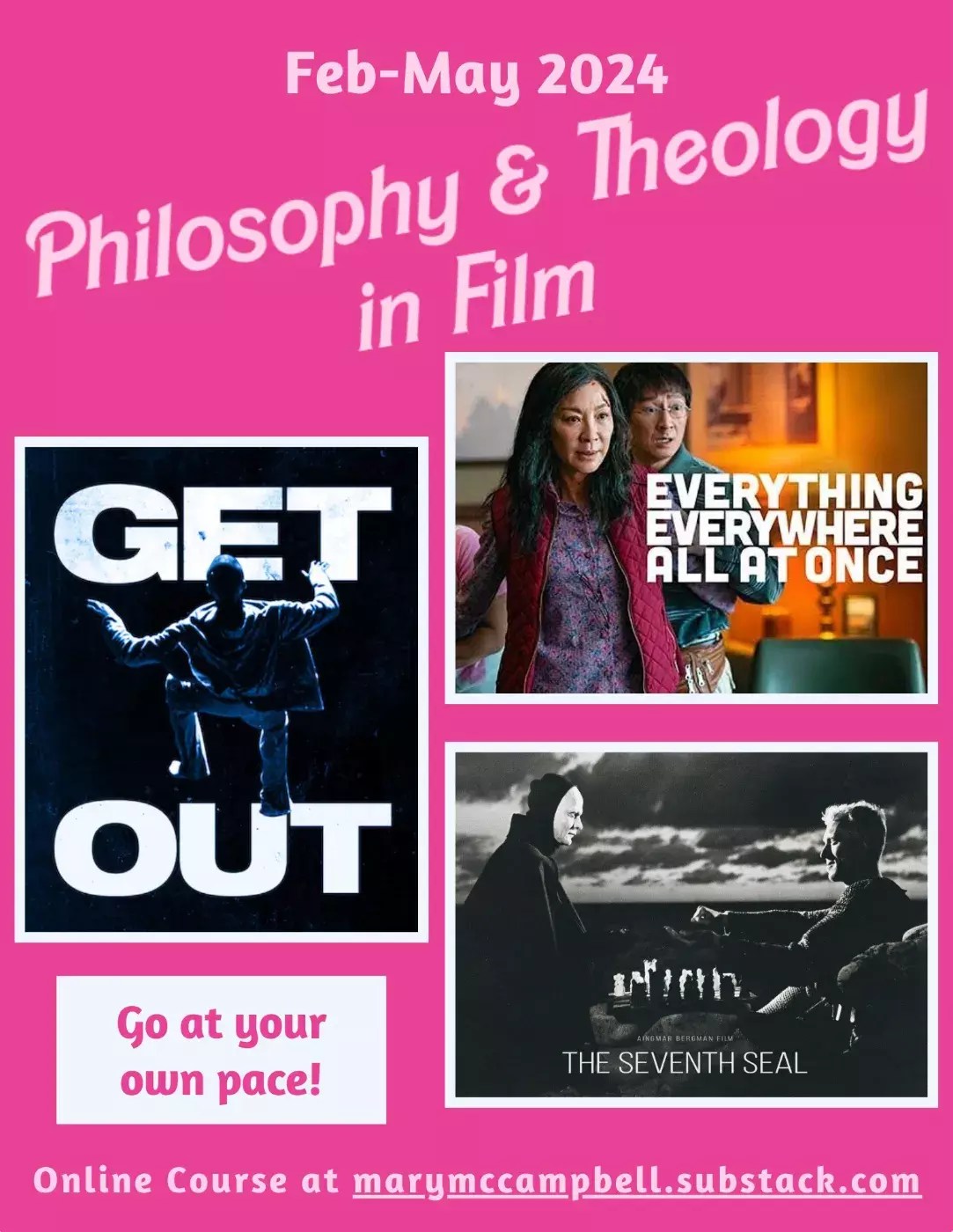
ONLINE COURSE: “Philosophy and Theology in Film” with Dr. Mary McCampbell, February–May 2024: Mary McCampbell [previously] is a writer and educator on film, literature, and popular culture whose Substack, The Empathetic Imagination, is one of my favorites! In December she and nine other professors lost their jobs at Lee University because the university’s humanities major has been suspended due to financial difficulties—and this despite her being tenured and having taught there for fourteen years.

So, she won’t be in a traditional classroom this spring, but the course she had prepared to teach undergraduates she is adapting for online and opening up to the public! It costs just $20 (a four-month paid subscription to The Empathetic Imagination), which is a real steal. Beginning near the end of February and running through May, the course will include:

  • An introductory video for each of ten films, including a lesson on the main philosophical influences and parallels (including intro lectures on Marx, Nietzsche, Freud, Sartre, Descartes, and more)
  • A live Zoom discussion of each film
  • A written Substack post of McCampbell’s analysis of each film, hopefully followed by a lively discussion in the comments section

I’ll be participating!

+++

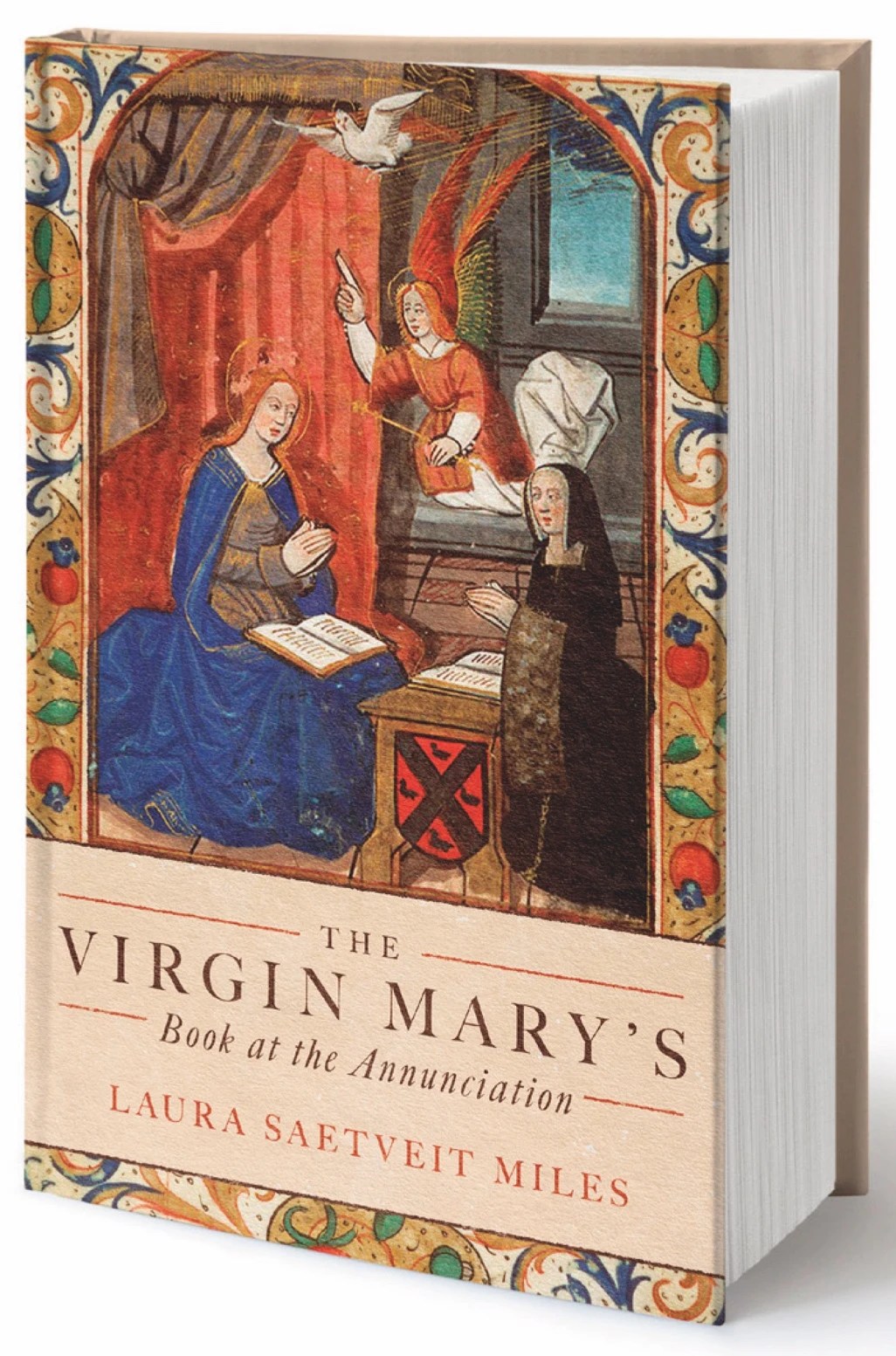
UPCOMING (ONLINE) LECTURE: “Reading alongside the Virgin Mary in Late Medieval Books of Hours Annunciation Scenes” by Laura Saetveit Miles, February 1, 2024: Professor Laura Saetveit Miles’s book The Virgin Mary’s Book at the Annunciation (Boydell & Brewer, 2020) has been one of my favorite reads of the last several years—so I was delighted to see she’ll be giving a free online talk on the topic next week! Organized by the Centre for Marian Studies at St Mary’s University in Twickenham, Miles’s lecture “will focus on two rare and fascinating versions of the standard Annunciation scene, as they are developed in both devotional literature and illuminations in Books of Hours. One type of representation captures the moment before Gabriel arrives; the other type depicts the reader herself as part of the scene. Some versions even combine these two. Where do these variations come from, and what do they mean? This neglected story of imitatio Mariae sheds new light on what Mary’s role in the Incarnation meant for medieval Christians across Europe.” (Update, 2/2: Here’s the recording.)