
Roundup: Advent video from Fuller Studio, making room for love, “Lord, Remind Me,” and more

VIDEO MEDITATION: “Yearning and Promise (Advent),” dir. Lauralee Farrer (2017): The first in the seven-part Liturgical Meditations series produced by Fuller Studio (a resource center affiliated with Fuller Theological Seminary), this four-minute video features Advent scripture readings by Fuller alum Paul Mpishi (MDiv, ’17) in his native Swahili, set to beautiful cinematography by Lindsey Sheets, Timothy Kay, and Jordan McMahon.

“Yearning and Promise” explores Advent and the expectant longing for the birth of Christ through cityscapes, wilderness, and water from Chicago and Malibu, with scriptures drawn from Isaiah 40 and Matthew 1. The audio for this video is in Swahili with subtitles in English, Spanish, Mandarin, and Korean—a poetic way to represent the primary tongues of our community. . . .

The liturgical calendar spans the life of Christ in a single year—from anticipation (Advent), to hope (Christmas), to transcendence (Epiphany), to lament (Lent), to redemption (Easter), to the birth of the church (Pentecost), and through long, numbered days (Ordinary Time) back to Advent. The liturgical meditation series to which this video belongs relies on nature to tell the story of God, accompanied by scriptures traditional to each season.

The other Liturgical Meditations are “Fear and Glory” (Christmastide), “Desire and Light” (Epiphany), “Hunger and Healing” (Lent), “Death and Resurrection” (Eastertide), “Fire and Wind” (Pentecost), and “Mystery and Love” (Ordinary Time). Full playlist here.

+++

SUBSTACK POST: “The Most Powerful Muscle in the World” by Stephanie Duncan Smith: Stephanie Duncan Smith, author of Even After Everything: The Spiritual Practice of Knowing the Risks and Loving Anyway, reflects here on the strong and capacious “womb-love” (Phyllis Trible’s term) of God, and on the physical transformation Mary underwent to make room for him in her own body. Advent, Smith writes, is about “stretch[ing] to make room for love.”

+++

ARTICLE: “The Birth of Eternity into Time: Contemplating the Incarnation with Piero della Francesca’s Madonna del Parto and Jorie Graham’s ‘San Sepolcro’” by Kathryn Stelmach Artuso, Mockingbird: This short article engages with a famous Italian Renaissance painting of the pregnant Mary (which the British writer Michèle Roberts calls “one of the most beautiful and powerful, sexy and numinous paintings of the Christian era”) and a modern ekphrastic poem about it.

Francesca, Piero della_Madonna del Parto
Piero della Francesca (Italian, ca. 1415–1492), Madonna del Parto, after 1457. Detached fresco, 100 × 80 in. (260 × 203 cm). Musei Civici Madonna del Parto, Monterchi, Italy.

+++

ZOOM GATHERING: Advent Art Salon, December 12, 5 p.m. ET: Image journal is hosting its fourth annual Advent Art Salon in two weeks, a free, hour-long virtual gathering featuring festive seasonal recipes, poetry readings, a musical performance, Advent reflections, and more. This year’s guests include poet Katie Hartsock, singer-songwriter Jon Guerra, composer Mike Capps, and writers Alex Ramirez (here’s his short story “Gabriel”), Meghan Murphy-Gill (author of The Sacred Life of Bread), and Jan Richardson.

+++

SONGS:

>> “Lord, Remind Me” by Jon and Valerie Guerra: From their album It’s Almost Christmas! Jon Guerra writes in the YouTube video description about how most days, hope feels naive; about the narratives in which we misplace our trust; about how Jesus, in his coming, tells a different narrative and brings our hope to fruition.

At Christmastime, Guerra writes,

Christians . . . celebrat[e] the arrival of a “shoot from Jesse’s stump.” It’s a transgressive celebration of fragility and vulnerability. We wanted a fully matured tree—God gave us a shoot coming from a stump. We wanted a strong leader—God gave us a vulnerable baby. We wanted a strength that dominates—God gave us a weakness that submits. We wanted victory—God gave us defeat, destitution, death.

How is this defying of our expectations hopeful? Well, theology at its atomic level says this: God is love. God doesn’t love as a decisive action, as though tomorrow the decision could be reversed. God is, always, love.

That love is not only towards humanity—it becomes humanity. It is not only compassionate towards the broken—it becomes the broken. It is unconditional love that becomes death—and in so doing, defeats it. It defies our expectations only to exceed to them.

So here’s to remembering hope in God’s unconditional love towards the desolate stumpiness of ourselves and the world this season—and to believing that this is not the end of the story. Lord, remind me.

>> “His Name Is Jesus” by Keiko Ying: Released this month on YouTube, this children’s Advent song by Keiko Ying celebrates Jesus as Emmanuel, “God with us.” Here is the lead sheet. The drawings and animation in the music video are by the songwriter’s thirteen-year-old daughter, Clara. [HT: Global Christian Worship]
Roundup: Controversial Eve painting, liturgy, protest, visualizing belief, and “Ya Hey”

“Mormon painting of a black Eve draws fire, but not for the reasons you might think” by Peggy Fletcher Stack, Salt Lake Tribune: Early this year a new painting of a seminude black Eve by Mormon artist J. Kirk Richards went on display at Writ & Vision gallery in Provo, Utah. While many Mormons have expressed how captivated and inspired they are by it (and I should note, black figures are extremely rare in Mormon art), a few have insisted it’s wrong for a white man to depict a nude black woman because it conjures up collective memories of sexual brutality and enslavement. The article features some interesting perspectives by black Mormon feminists. In addition to raising important questions surrounding racial histories and representation, the painting, I’ve noticed, also illustrates a distinctly Mormon view of the Fall, which differs from the orthodox Christian view—a fact Richards alludes to in his March 14 gallery talk. View the painting.

+++

“A Conversation about Creativity and the Liturgical Calendar,” panel discussion presented by Brehm Center and Fuller Studio: Moderator Edwin M. Willmington, composer-in-residence at Fuller Theological Seminary, talks with an all-star trio of creatives and liturgists comprising David Gungor of The Brilliance [00:50], on authenticity in songwriting and introducing liturgical practices to the evangelical church he attended; Todd E. Johnson [10:40], on the history, purpose, and major observances of the church calendar; and Lauralee Farrer [26:18], on discovering the Canonical Hours in a New Mexico desert and later developing them into characters for a film project. Questions: [34:02] How has liturgy shaped you? [36:20] Advice for artists on how to bring the church year to bear in their art? [37:11] Have you found that lament is generally embraced or resisted? [39:41] Advice for worship leaders?

+++

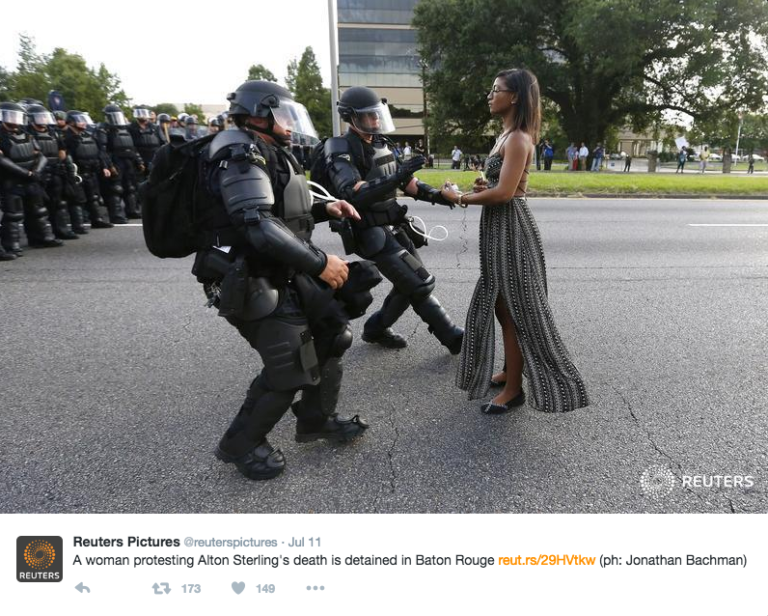
“An Art Historical Perspective on the Baton Rouge Protest Photo that Went Viral” by An Xiao Mina and Ray Drainville, Hyperallergic: During a July 10 protest following the fatal killing of Alton Sterling, Reuters photographer Jonathan Bachman captured the moment of twenty-eight-year-old Ieshia L. Evans’s arrest. As heavily armored policemen pressed in, the other protestors dropped back, but Ieshia stood assuredly in the middle of the three-lane highway, prepared to be bound. This article lauds the strength of this image of confrontation by citing compositionally and thematically similar paintings, including Briton Riviere’s Daniel in the Lion’s Den and Giotto’s The Arrest of Christ, and other works of art.

Ieshia Evans arrest photo

Ieshia considers herself a vessel of God, eager to be used by him to bring justice and peace. Here’s what she wrote on her Facebook wall the night of her release from jail:

Ieshia Evans statement

+++

“Things Unseen: Vision, Belief, and Experience in Illuminated Manuscripts”: Running through September 25 at the Getty Center in Los Angeles, this exhibition “explores the visual challenges artists faced as they sought to render miraculous encounters with the divine, grand visions of the end of time, the intricacies of belief, and the intimate communications of prayer.” It includes a September 15 talk, “How Do We Depict Religious Experiences?”—that is, how do we convey metaphysical essence in physical form? I appreciated the Getty’s blog post this week featuring a newly acquired choir book leaf that’s part of the exhibition. Curator Bryan C. Keene writes about the difficulties of identifying the illuminator and about discovering, through an examination of the back and a search on the Cantus database, that the illumination depicts the wiping of tears from saints’ eyes, not, as previously assumed, the healing of the blind.

Christ wiping the tears from the eyes of the saved
Initial A: Christ Wiping the Tears from the Eyes of the Saved, attributed to the Master of the Antiphonary of San Giovanni Fuorcivitas, ca. 1345–50. Tempera and gold leaf on parchment, 5 1/3 × 5 1/3 in. (13.5 × 13.5 cm). The J. Paul Getty Museum, Ms. 113, recto. Digital image courtesy of the Getty’s Open Content Program.

+++

“Ya Hey” song cover by The Brilliance: Written by Ezra Koenig of Vampire Weekend, “Ya Hey” is a modern-day psalm that expresses frustration with God’s seeming unresponsiveness—to being spurned and being sought, to brokenness and suffering, to sin and struggle. The title is a play on the word Yahweh, the Hebrew name for God. The chorus references the burning bush of Exodus 3: “Through the fire and through the flames / You won’t even say your name / Only ‘I am that I am.’” The Brilliance’s acoustic cover of “Ya Hey” was released last month as a music video on YouTube featuring four New York City ballet dancers. It abandons the shrill vocoder and heavy percussion of the original song in favor of a softer, purer sound. Read the lyrics and an analysis at Sound: Interrupted.