The following excerpt is from the fourteenth-century biblical drama The Last Judgement from the York cycle of mystery plays [previously], performed annually in York, England, on the feast of Corpus Christi until its suppression by Protestants in 1569. Based on Matthew 25, this final play in the cycle was produced by the city’s guild of mercers (dealers in textile fabrics) and so is sometimes referred to as the Mercers’ Play.
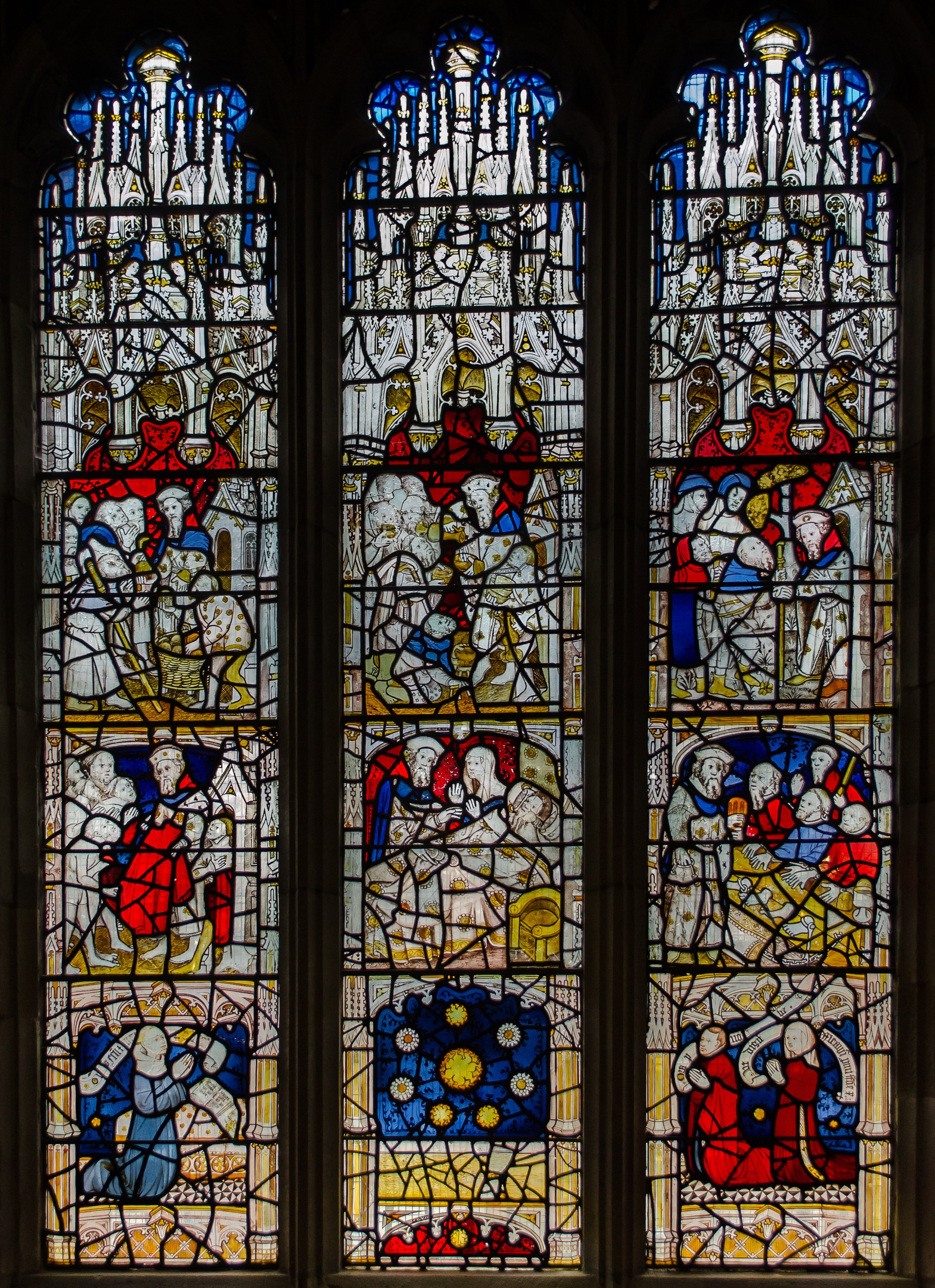
I’ve chosen to feature it at this time because almsgiving—that is, assisting those in need, especially through the giving of money or goods—is one of the three pillars of Lent, and according to Matthew 25:31–46, it’s the measure by which Christ eternally blesses or damns people. It’s what separates the sheep from the goats, those who truly know Christ from those who don’t. The list of six charitable deeds in this Gospel passage—feeding the hungry, giving drink to the thirsty, welcoming the stranger, clothing the naked, caring for the sick, visiting the imprisoned—are called, in church tradition, the corporal works of mercy. A seventh, burying the dead, was added based on the book of Tobit 1:17–19.
Corporal Acts of Mercy, 1410. Stained glass window, All Saints Church, North Street, York, England. Photo: Julian P. Guffogg.
I’ve sourced the Middle English text below from the Oxford World Classics volume York Mystery Plays: A Selection in Modern Spelling, edited by Richard Beadle and Pamela M. King. The glosses are Beadle and King’s.
JESUS: My blessed children on my right hand, Your doom this day ye thar not dread, [thar = need] For all your comfort is comand— [command = coming] Your life in liking shall ye lead. Come to the kingdom ay-lastand [ay-lastand = eternal] That you is dight for your good deed; [you is dight = is prepared for you] Full blithe may ye be where ye stand, For mickle in heaven shall be your meed. [mickle = great; meed = reward]
When I was hungry, ye me fed; To slake my thirst your heart was free; [free = willing] When I was clotheless, ye me clad, Ye would no sorrow upon me see. In hard press when I was stead, [When I was placed in difficult circumstances] Of my pains ye had pity; Full sick when I was brought in bed, [in = to] Kindly ye came to comfort me.
When I was will and weariest [will = distraught] Ye harbored me full heartfully; Full glad then were ye of your guest, And plained my poverty piteously. [plained = lamented] Belive ye brought me of the best [belive = quickly] And made my bed full easily, [easily = comfortably] Therefore in heaven shall be your rest, In joy and bliss to be me by.
1 GOOD SOUL: When had we, Lord that all has wrought, Meat and drink thee with to feed, Since we in earth had never nought But through the grace of thy Godhead?
2 GOOD SOUL: When was’t that we thee clothes brought, Or visited thee in any need, Or in thy sickness we thee sought? Lord, when did we thee this deed?
JESUS: My blessed children, I shall you say What time this deed was to me done: When any that need had, night or day, Asked you help and had it soon. Your free hearts said them never nay, Early ne late, midday ne noon, But as oft-sithes as they would pray, [pray = ask] Them thurt but bid, and have their boon. [They only needed to ask, and their request was granted]
For a modern performance of The Last Judgement by Handmade Performance in Toronto, see here. (The above passage is at 16:43ff.) They use a modern translation by Chester N. Scoville and Kimberley M. Yates.
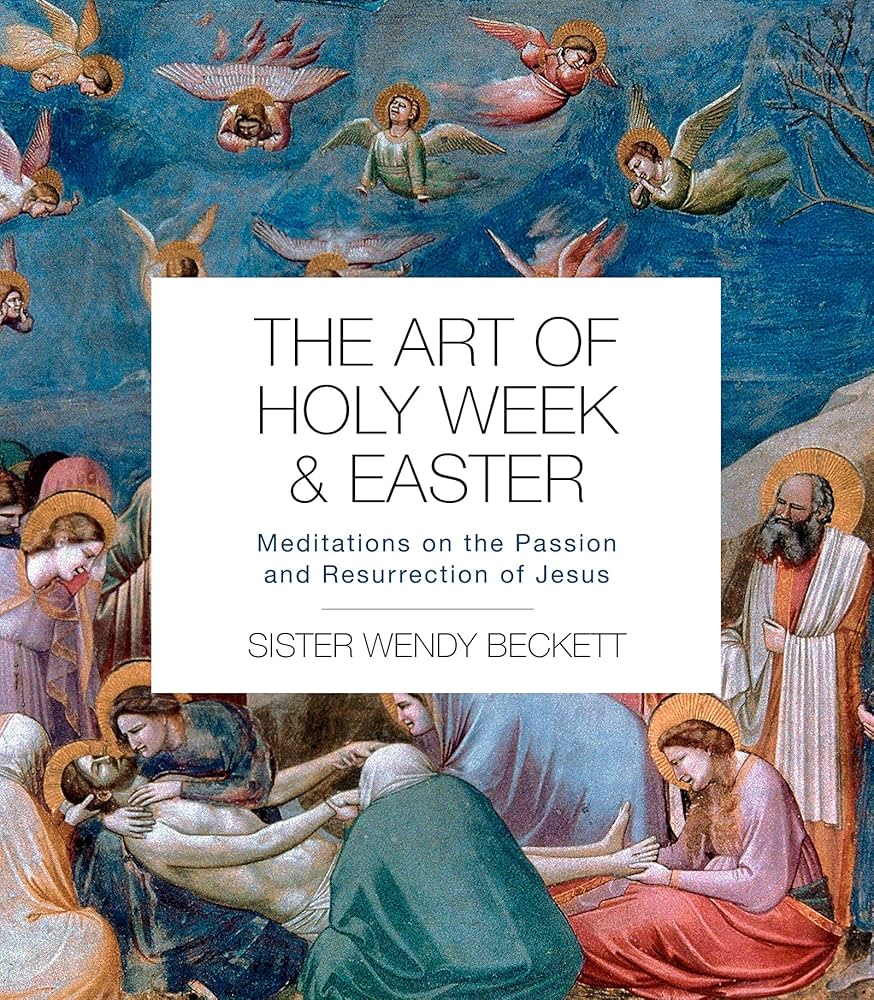
BOOK: The Art of Holy Week and Easter: Meditations on the Passion and Resurrection of Jesus by Sister Wendy Beckett (2021): Sister Wendy Beckett, a British Catholic nun and art enthusiast who died in 2018, is the one who first got me interested in art history. We watched clips from her BBC series Sister Wendy’s Story of Painting in my studio art class in high school, and I was so drawn to the way she looked at art and talked about it. Enthusiastic, warm, inquisitive, spiritually sensitive and theologically astute, and interested not just in the technical qualities of a work but also in its content—though I know I lack the same flair, my own voice and approach when it comes to art are indebted to hers.
So I was delighted to see that SPCK (and IVP in North America) has published two church calendar–based art devotionals by Sister Wendy: one for Lent, and one for Holy Week and Easter. I was disappointed with The Art of Lent: It has an admirable diversity of art selections, but Sister Wendy’s reflections are short and basic, and most don’t shine in the way I’ve come to expect from her; there were only two standouts for me. I also found it thematically confusing (for example, a section on “Confidence”?), unfocused, and redundant (especially in the “Silence” and “Contemplation” sections). I will grant that Lent is a more difficult season to structure for a project like this than Advent is, as I found the one year I published a daily Lent series; it can mean many things to many people.
Sister Wendy’s The Art of Holy Week and Easter, on the other hand, I did enjoy and recommend, even though I wish it had the same variety as the Lent book. (There’s only one modern/contemporary painting.) I care for only about half the featured artworks—two favorites are below—but even for the ones I was disinclined toward, her commentary helped me appreciate them.
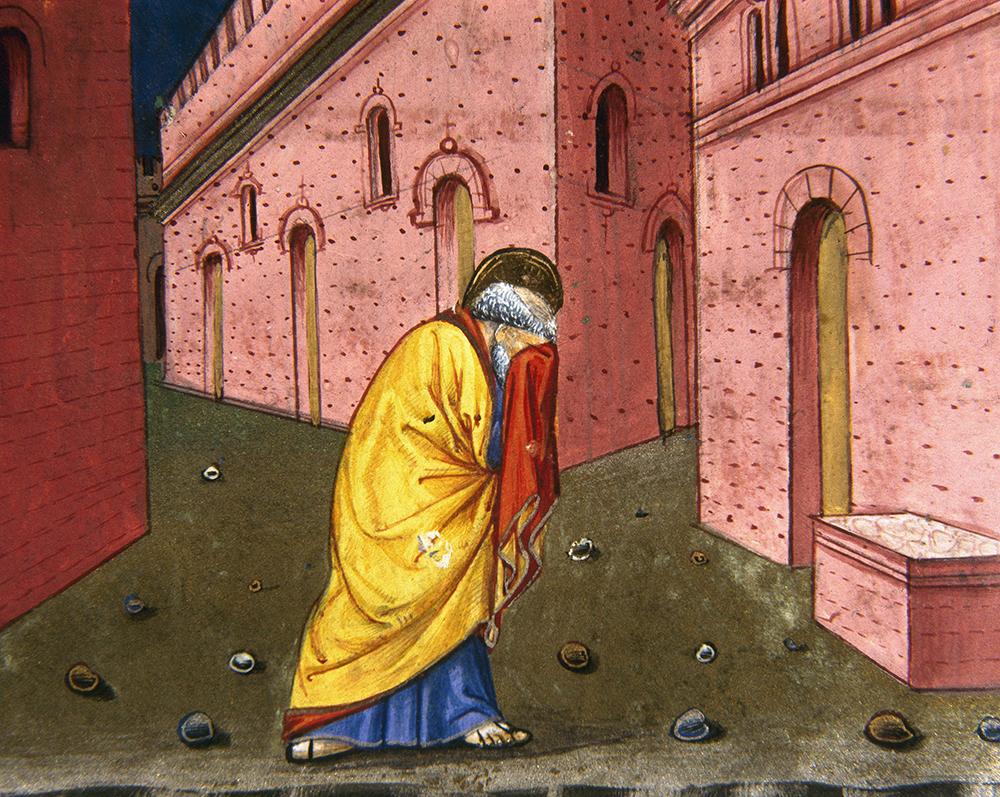
Cristoforo de Predis (Italian, 1440–1486), “Saint Peter realizing he has thrice betrayed Jesus,” from the Leggendario Sforza-Savoia, 1476. Codice Varia 124, Biblioteca Reale (Royal Library), Turin, Italy.
About a medieval manuscript illumination of Peter weeping by Cristoforo de Predis, Sister Wendy writes:
This magical little picture presents an unforgettable image of grief. It is that most painful kind of grief, lamenting of our own folly. Here we see Peter with his shamed face covered, stumbling blindly forward from one closed door to the next. There are ways out behind him, but Peter is too lost in misery to look for them. This claustrophobic despair, this helpless anguish, this incapacitating sense of shame: these are the result of a sudden overturn of our own self-image.
Peter had honestly seen himself as one who loved and followed Jesus, priding himself, moreover, on how true his loyalty was in comparison with that of others. ‘Even if all should betray you, I will never betray you’ – it was a boast, but he had meant it. Now he sees, piercingly, that he is fraudulent. He has been unmasked to himself, he has lost his self-worth.
The crucial question is: What next? Will he hide his face forever, destroyed by self-pity? Will he lose all heart, perhaps even kill himself, as Judas did? But while Judas felt only remorse, Peter feels contrition, a healing sorrow that will lead to repentance and a change of heart. Now that he knows his true weakness, he will cling to Jesus as never before. He will cling in desperate need and not in false strength, and will in the end become truly Peter, the ‘rock’, on which the Church, likewise dependent on Christ, will be built. (26)
El Greco (Greek Spanish, 1541–1614), Christ Crucified with Toledo in the Background, 1604–14. Oil on canvas, 111 × 69 cm. Fundación Banco Santander, Madrid.
About El Greco’s Christ Crucified, she mentions how “Jesus . . . dies looking upwards, his determination set upon his Father’s will and its consummation. . . . His body spirals upwards like a white flame, radiating out as he spreads his arms to share the light with the defeated shadows” (38).
+++
HYMNS:
>> “O Love, How Deep, How Broad, How High”: I’ve enjoyed learning a few new-to-me hymns from the YouTube channel of Josh Bales. Attributed to the fifteenth-century German Dutch Catholic mystic Thomas à Kempis, this hymn text was translated from Latin into English by Benjamin Webb in 1871. It appears in the Episcopal hymnal with the tune EISENACH by Bartholomäus Gesius, as adapted by Johann Hermann Schein in 1628, which is what Bales sings. It’s rare among hymns for emphasizing that our salvation was won not just by Christ’s death but also by his life—his faithful obedience to the Father.
>> “I Stand Amazed (How Marvelous)”: A favorite from my childhood, this 1905 gospel hymn by Charles H. Gabriel is performed here by the Imani Milele Choir, made up of orphaned and/or vulnerable children and youth from Uganda.
>> “Come Let Me Love”: I recently learned of this shape-note hymn from a book I’m reading by J. R. Watson. Written by the late great Isaac Watts, the text was first published in the 1706 edition of Watts’s Horæ lyricæ with the title “Christ’s Amazing Love and My Amazing Coldness.” I especially love verses 4 and 5, reproduced below. The tune in the following video, LAVY, is actually a new one (from 1993) that sounds old, by John Bayer Jr.
Infinite grace! Almighty charms! Stand in amaze, ye rolling skies! Jesus, the God with naked arms, Hangs on a cross of love and dies.
Did pity ever stoop so low, Dress’d in divinity and blood? Was ever rebel courted so, In groans of an expiring God?
+++
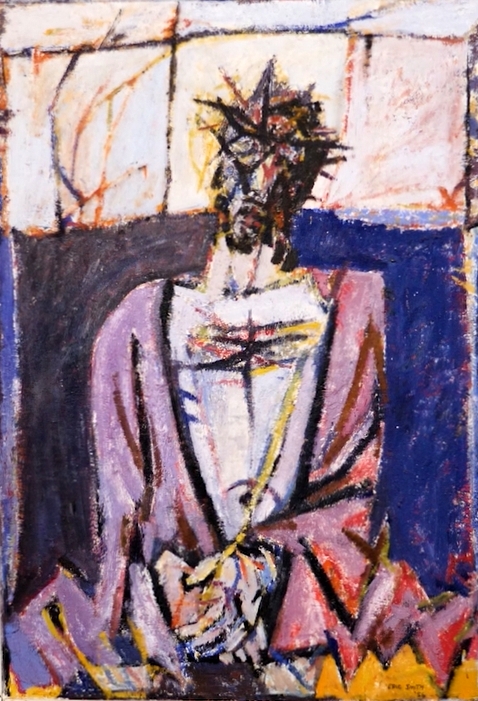
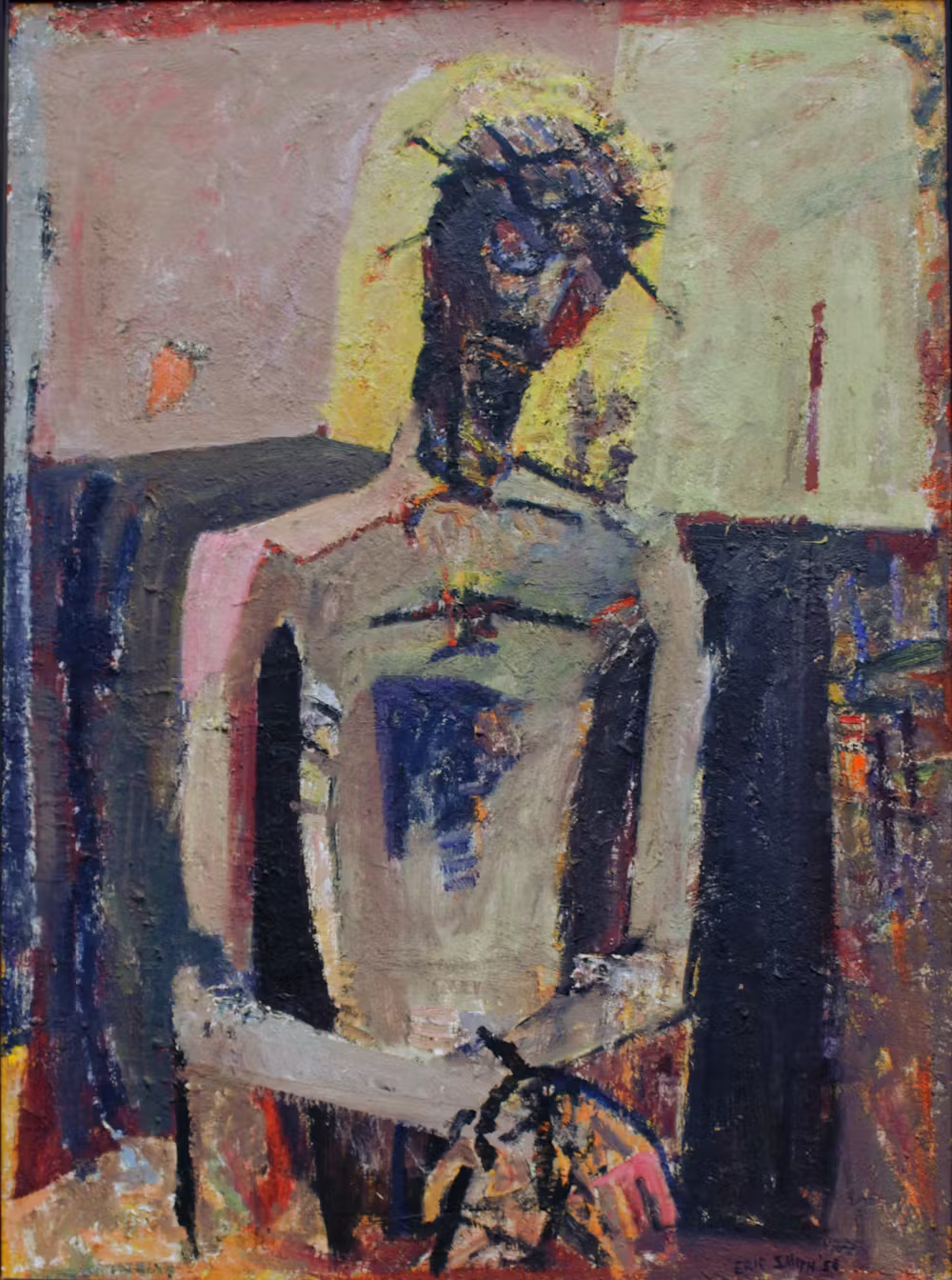
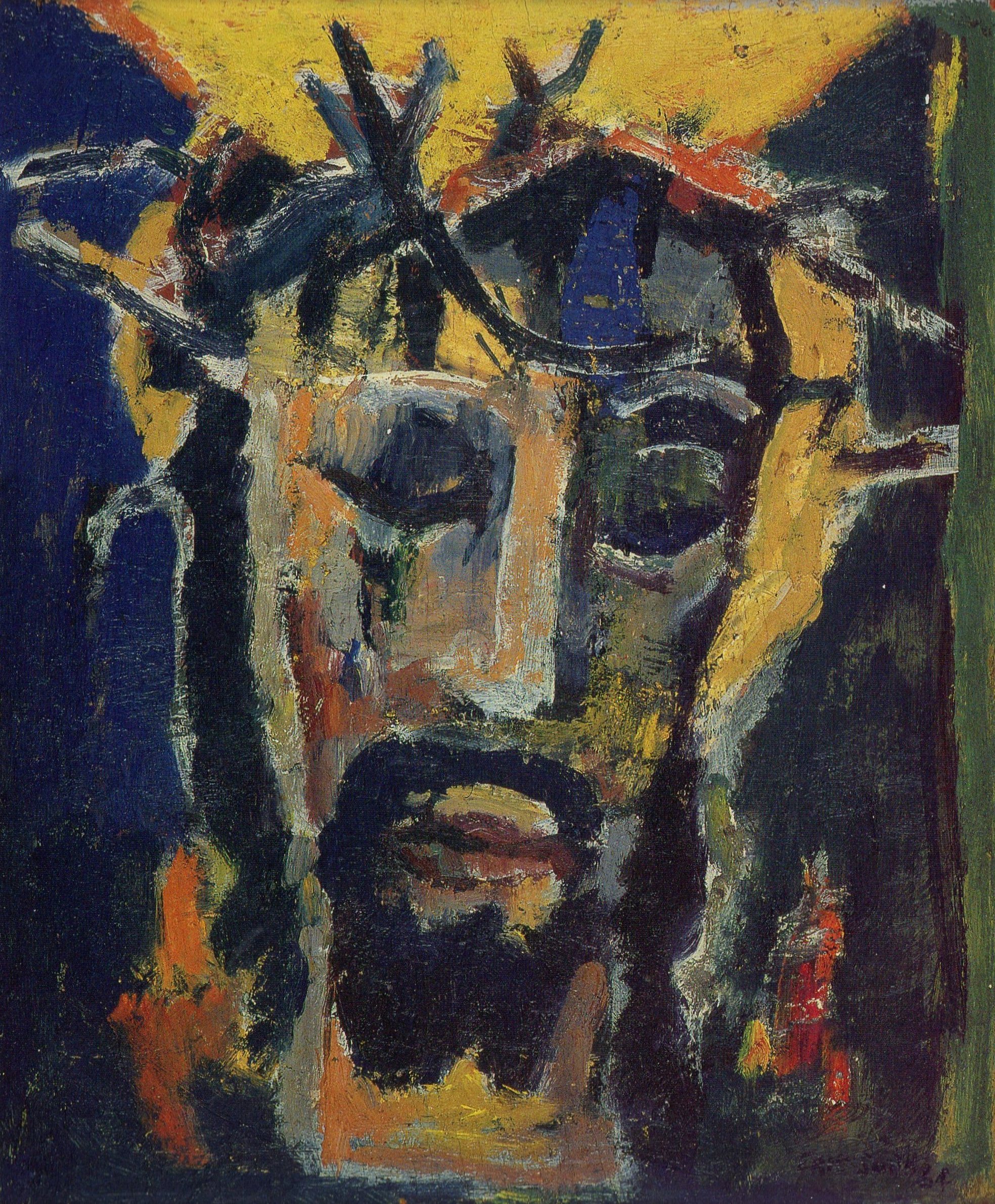
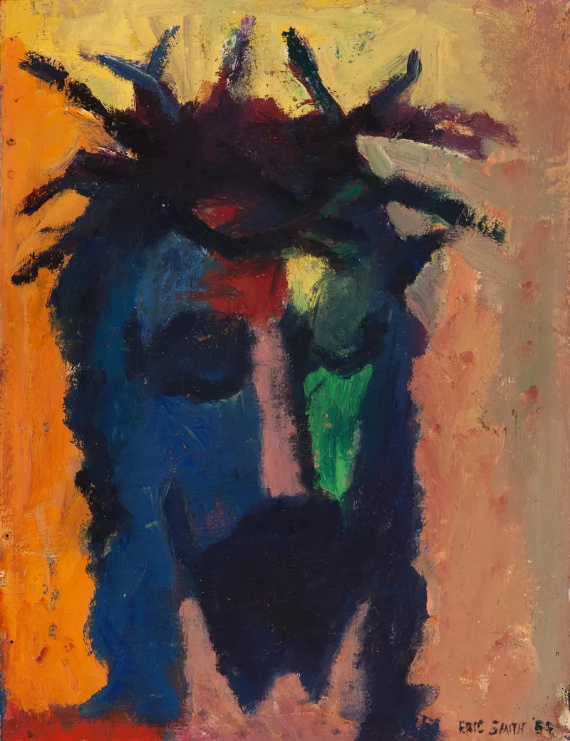
VIDEO:“Christ by Eric Smith”: This is the first video in the (Catholic) Archdiocese of Brisbane’s four-part Art Aficionados series from 2022. In it, Archbishop Emeritus Mark Coleridge, theology professor Maeve Heaney, and Rev. Dr. Tom Elich of Liturgy Brisbane discuss the semiabstract Ecce homo painting Christ by the modern Australian artist Eric Smith—its pathos, calm, and double irony. This Christ is crushed yet composed, Coleridge says. Smith won the prestigious Blake Prize for Religious Art six times, including, in 1956, for a painting similar to this one (see second image in slideshow below). I’d love to see more dioceses releasing videos like this!—close looking at art.
Eric Smith (Australian, 1919–2017), Christ, 1956. Oil on Masonite, 138 × 95 cm. Collection of Holy Spirit Seminary (Queensland Provincial Seminary), Banyo, Brisbane, Australia. Photo courtesy of Tom Elich.
Eric Smith (Australian, 1919–2017), The Scourged Christ, 1956. Oil on Masonite, 116 × 85 cm. Penrith Regional Gallery, Emu Plains, Australia.
Eric Smith (Australian, 1919–2017), Head of Christ, 1954. Oil on wood, 47 × 39.4 cm. Collection of Newman College, University of Melbourne, Australia.
Eric Smith (Australian, 1919–2017), Head of Christ, 1954. Oil on Masonite, 40.5 × 32.6 cm. Art Gallery of South Australia, Adelaide.
+++
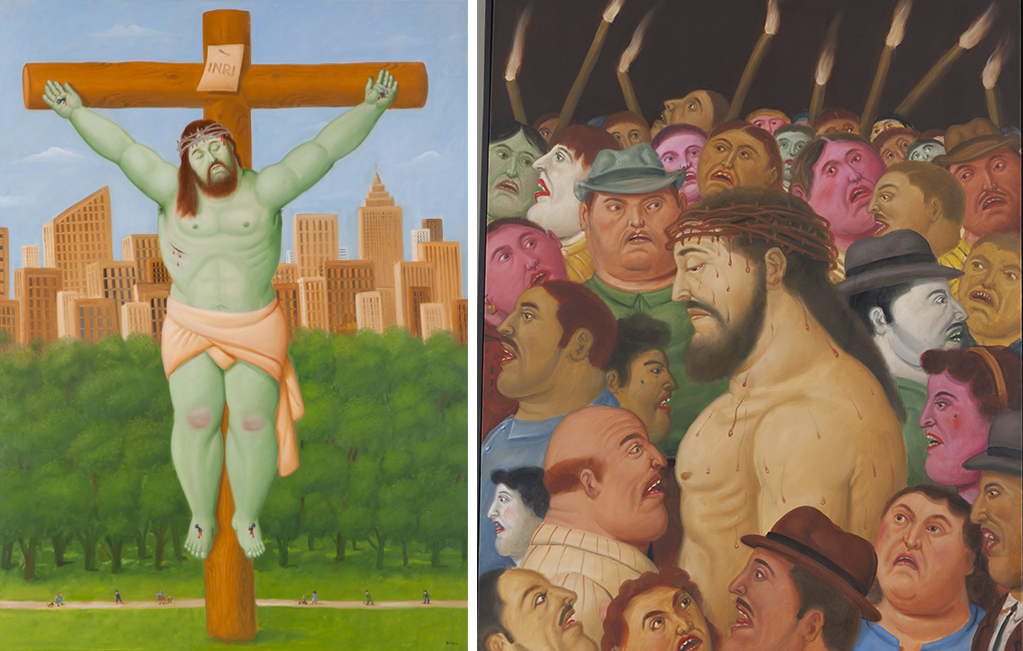
ART SERIES: Via Crucis: La pasión de Cristo (Way of the Cross: The Passion of Christ) by Fernando Botero: Executed in 2010–11, Via Crucis is a series of twenty-seven oil paintings and thirty-four mixed-media drawings by Colombia’s most famous artist, Fernando Botero (1932–2023) [previously]. Botero said he turned to the subject of Christ’s passion not because he’s religious, but out of admiration for the great works of art on the subject; he approached it with “a spirit of great respect,” aiming to portray God as a tortured man. The artist donated the series to the Museo de Antioquia in Medellín for his eightieth birthday. I can’t find a compilation of the whole series (the museum has digital records of the Boteros in its collection, but not all the images are showing up for me)—but you can view fourteen of the paintings in this article, and here’s a quick little Facebook reel.
Marlborough Gallery in New York offers a catalog of the series for $75, and Artika offers a much more expensive one (a gorgeous product, but $9,500!):
Here’s a news segment, in English, about the series’ exhibition at Lisbon’s Palacio de Ajuda in November 2012 (unfortunately, the video quality is low):
Fernando Botero (Colombian, 1932–2023), Crucifixión (Crucifixion), 2011, and Jesús y la multitud (Jesus and the Crowd), 2010. Oil on canvas. Museo de Antioquia, Medellín, Colombia.
+++
I have thematic playlists on Spotify for Lent and Holy Week—for the latter, don’t miss “From the Garden to the Tomb” by The Soil and The Seed Project, one of several recent additions.
But, by popular request, I also have a brand-new March 2026 playlist, a somewhat random assortment of songs I’ve been enjoying—some new releases, some not.
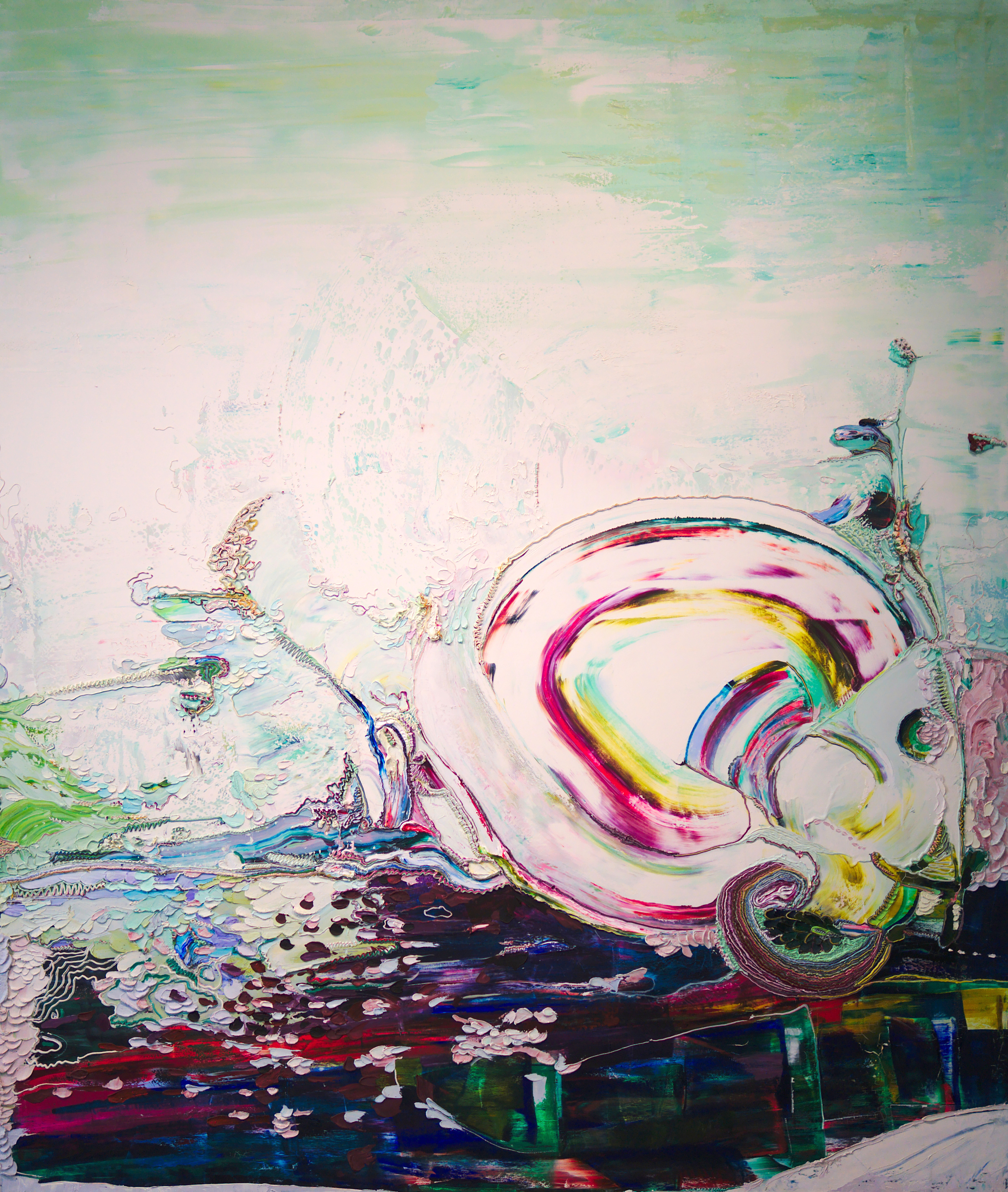
Julia Fernandez-Pol (Argentine, 1984–), Glacial Rain, 2008. Oil on canvas. Colorado Springs Fine Arts Center at Colorado College, Colorado Springs. Photo: Victoria Emily Jones.
Make me river, cold
with mountain, green
with quiver, silver in

the run and churn of
winter leaving, valley
waking, sheet moss

breathing. Make me
flash of mica, drift of
foam. O Lord of flux,

make these dry bones
flow, teach me to spill,
pool, glide, fall, tutor me

to long for depth, seek
downward paths, indwell
the low. Oh teach me

liturgy of keel, swirl,
flume, the breaking into
mist, the pull, the press,

the song. Oh form me
into blood of bedrock,
quest of glacier, dream

of sea, release me, set
me free to course, surge,
pour, sweep, issue, eddy,

shower, plummet, roll.
O Lord of flood, O Lord
of spray, unstill my soul.
Abigail Carroll is a poet whose work, as Walter Brueggemann called it, is “an unflinching witness to the reality and goodness of God.” She has authored the collections Cup My Days Like Water (Cascade, 2023), Habitation of Wonder (Cascade, 2018), and A Gathering of Larks: Letters to Saint Francis from a Modern-Day Pilgrim (Eerdmans, 2017), and her poems have also been published in anthologies and periodicals. She makes her home in Vermont, where she serves as associate pastor at Church at the Well. In addition to writing, she enjoys walking, photographing nature, and playing piano.
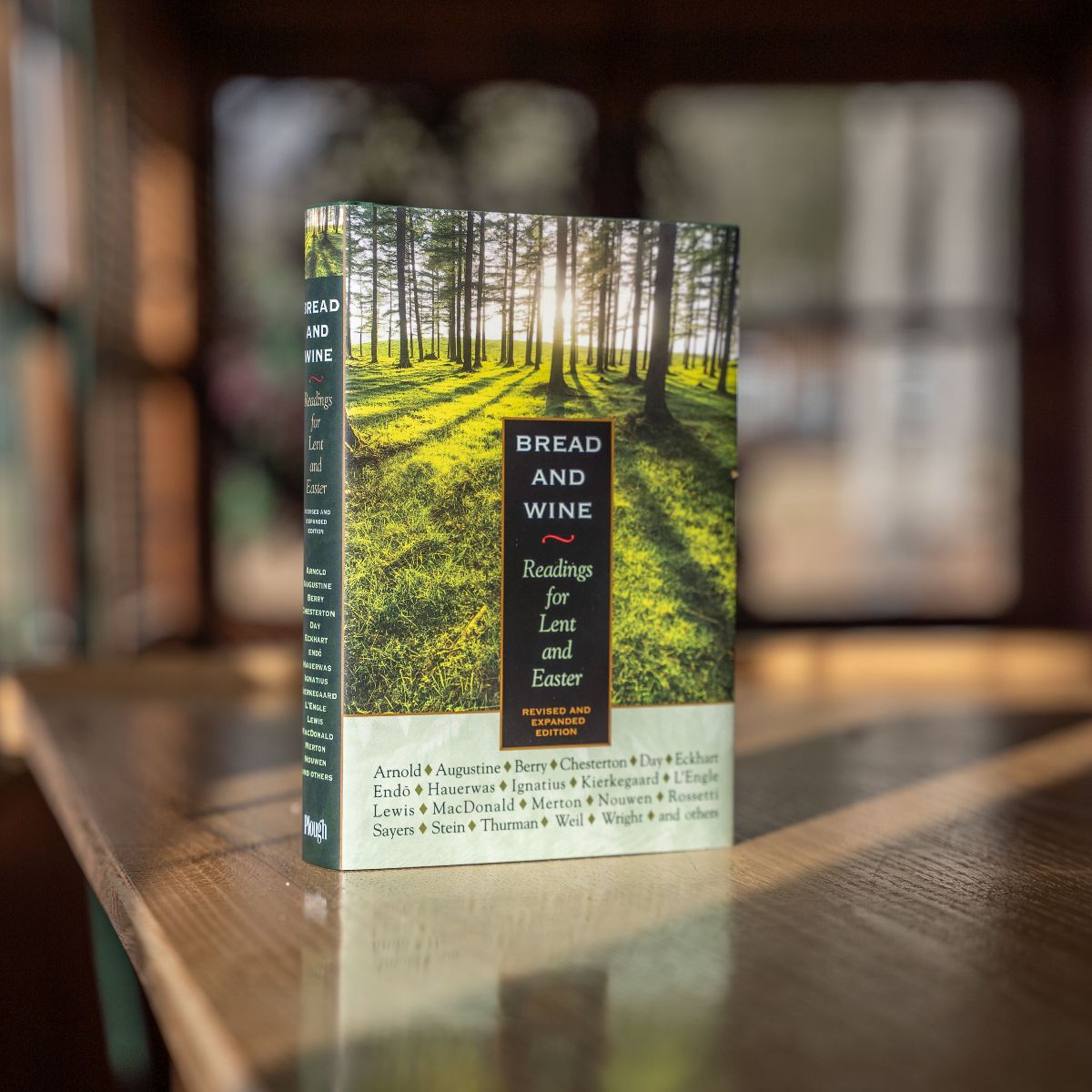
NEW BOOK: Bread and Wine: Readings for Lent and Easter, Second Edition: Plough is the publishing house of the Bruderhof, an international Anabaptist communal movement. This year they released a revised and expanded edition of their popular Lent and Easter devotional, increasing the original seventy-two entries to ninety-six to cover the full fifty days of Easter—although the last section is themed around Pentecost. The selections are all from previously published material, but what a treasure-house has been curated here from across denominations, countries, and eras, from early church fathers to medieval mystics to modern saints. Clement of Rome, Julian of Norwich, Kahlil Gibran, Watchman Nee, Gonzalo Báez Camargo, Thomas Merton, Simone Veil, Howard Thurman, Toyohiko Kagawa, Barbara Brown Taylor, Jürgen Moltmann, Tish Harrison Warren—these are some of the many voices included here that reflect on and expound the beautiful truths of the Lent and Easter seasons. Each reading is just a few pages long, so it’s easy to pick up with your morning coffee or just before bed.
Besides the expansion, other changes I’ve noticed in this edition are:
Thinner pages, which, despite the additional content, reduce the overall thickness of the book
The epigraph at the beginning of each reading was removed, as these were not the authors’.
Thirteen of the original readings were replaced, possibly due to permissions costs, but maybe also just to get in some fresh voices or content, and in one case, to remove an accused sex abuser.
A misattribution in the original to Mother Teresa was corrected to Joseph Langford, who founded the Missionaries of Charity Fathers with her.
There is a slight reordering of readings so that pertinent meditations appear during Holy Week.
I’ve provided a link to the Plough book page above, but you can also purchase through Amazon or your retailer of choice.
+++
SONGS:
I grew up in an independent Baptist church, ignorant of most of the historic prayers of the church at large. The first time I ever heard the phrase “Kyrie eleison” [previously] was on track 5 of the Christian recording artist Mark Schultz’s 2001 album Song Cinema, which is a cover of an eighties rock song by Mr. Mister. I was in middle school, and I had to look up what it meant. Derived from a prayer found in multiple places in the Psalms and the Gospels, “Kyrie eleison” (pronounced KEER-ee-ay eh-LAY-ee-sohn) is Greek for “Lord, have mercy,” and it’s traditionally followed by “Christe eleison”—Christ, have mercy. An inheritance from early Eastern Christian liturgies, it has been part of the Ordinary of the Catholic Mass since the fifth century, which means it’s recited or sung in every eucharistic service regardless of the liturgical season, and it’s used in many other Christian traditions as well. I’ve never been part of a church that sings the Kyrie, but I occasionally sing it in my personal devotions. It’s been set to music by hundreds of composers, for choirs, contemporary bands, and more. Here are two settings that I’ve recently come across and enjoy, followed by a song that entreats (God’s?) mercy on father, brother, church, country, and every living thing.
>> “Kyrie (Lord, Have Mercy)” by Robert Alan Rife: This song was written by Robert Alan Rife [previously], a minister with the Evangelical Covenant Church, serving in Edinburgh. It’s performed here by worship musicians at Great Road Church (formerly Highrock Covenant Church) in Acton, Massachusetts. The lead vocalist is Caelyn Jarrett Poetz; she’s accompanied on guitar by her dad, Travis Jarrett, the church’s music pastor, and Hannah Moulton provides backing vocals. Rife tells me you can purchase the sheet music here, and that other songs of his can be streamed on Spotify, Apple Music, etc.; he has not yet recorded this one, but it’s in the works.
>> “Kyrie” by Paul Smith: This peaceful, resonant setting of the Kyrie was composed by Paul Smith, cofounder of the Grammy-nominated British vocal ensemble VOCES8, who perform it here. The song appears on Smith’s 2025 album Revelations.
>> “Mercy Now” by Mary Gauthier: In this video from the 2010 Americana Music Festival in Nashville, folk singer-songwriter Mary Gauthier (last name pronounced go-SHAY) performs her most famous song, “Mercy Now,” originally released on her 2005 album of the same title. It doesn’t directly invoke God, but it feels like a prayer, asking for mercy (forgiveness, relief, compassion, lovingkindness) first for two family members—her father on his deathbed, and her drug-addicted brother—and then for the institutions of church and state, both in need of repair, and then for everyone: “We all could use a little mercy now / I know we don’t deserve it / But we need it anyhow,” and “only the hand of grace” can give it, can intervene to save us from our self-destructive ways. In response to the song’s being listed as “one of the saddest 40 country songs of all time” by Rolling Stone in 2014, Gauthier said, “It is not a sad song. It is about hope.”
+++
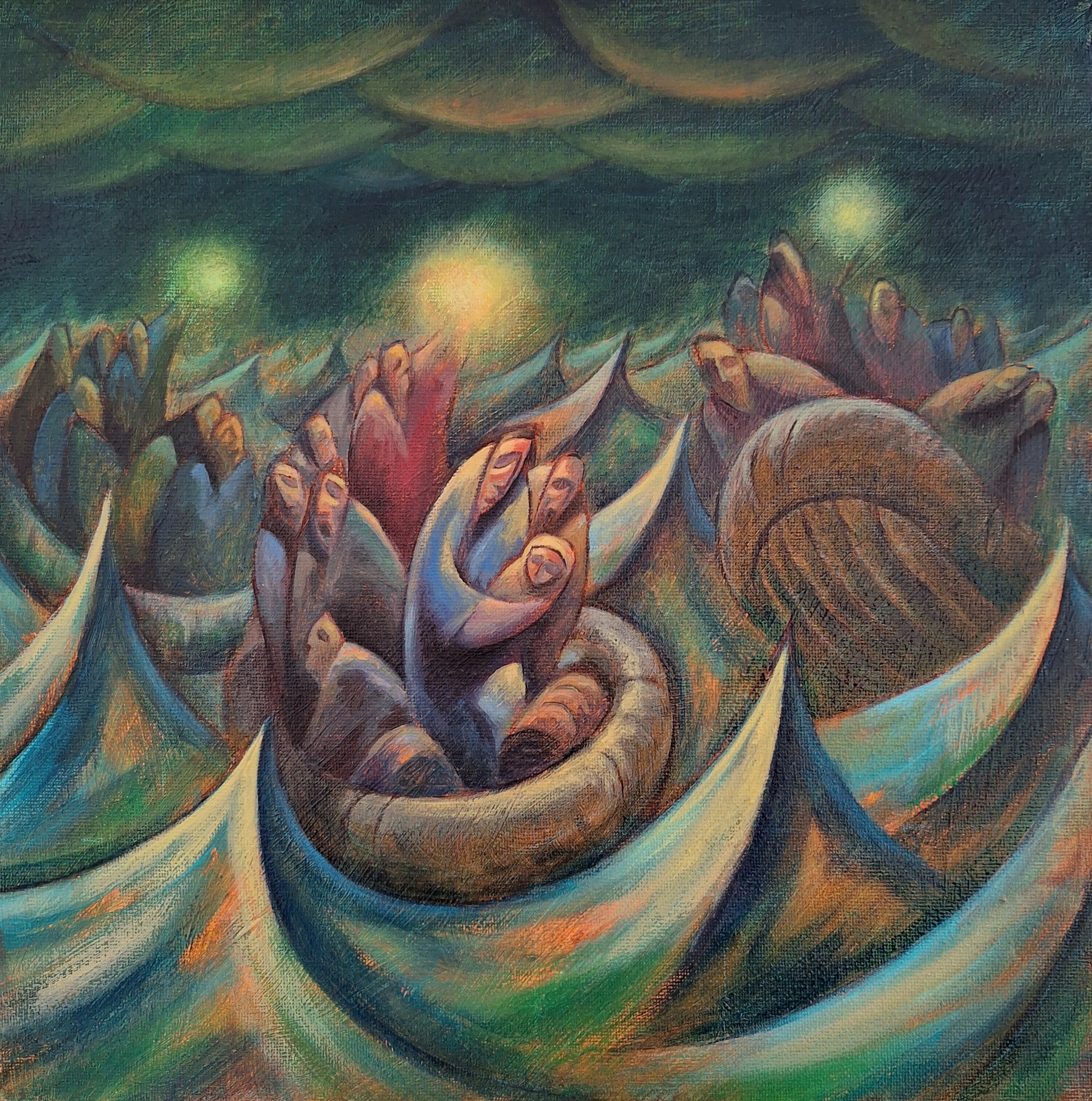
EXHIBITION: Sanctuary by Nicholas Mynheer, February 18–April 12, 2026, Portsmouth Cathedral, UK: One of my favorite artists, Nicholas Mynheer, has a show that opened on Ash Wednesday at Portsmouth Cathedral, aka the Cathedral of the Sea, and that will continue for the duration of Lent plus some. “The exhibition features paintings and sculptures that explore the experiences of refugees, both ancient and contemporary. The story of Jesus, Mary and Joseph fleeing to Egypt sits alongside the realities faced by people crossing the English Channel today. Mynheer’s work doesn’t offer easy answers – instead, it asks questions. What would we do if our home were no longer safe? How do we respond to those seeking refuge? What does it mean to hope for a better life when the risks are so great?”
Nicholas Mynheer (British, 1958–), The Holy Family Cross the English Channel, 2025. Oil on canvas, 30 × 30 cm.
As an artist, one of the themes that I’ve been drawn to repeatedly is that of the Holy Family on the Flight to Egypt. The fact that even Jesus, Mary and Joseph became refugees to escape the wrath of Herod reminds us that it could happen to any one of us.
Over the past years we have become increasingly aware of the plight of refugees; from Syria, Afghanistan, Ukraine, Somalia, along with daily reports of refugees attempting to cross the English Channel. Whether they flee from war, persecution, famine, political instability or for economic reasons, the risks are the same; all driven by hope, the hope of a better life.
I often wonder what I would do if I lived in a country ravaged by war? What would I do if I was persecuted for my faith, my colour or my culture? What would I do if scrolling on my phone, others’ lives seemed easier, happier, and all I had to do was get there?
It is my hope that these meditations in paint and stone might draw us in to question how we might respond if we, like Jesus, Mary and Joseph, were forced to seek refuge; to be refugees . . . to search for Sanctuary.
Starting February 25, Portsmouth Cathedral is offering a free four-week Lent course (classes are in person on Wednesday evenings) inspired by the exhibition. The first class will be a talk by Mynheer himself, and the other three will be led by clergy, exploring biblical themes of journey, rescue, and redemption through the art on display.
+++
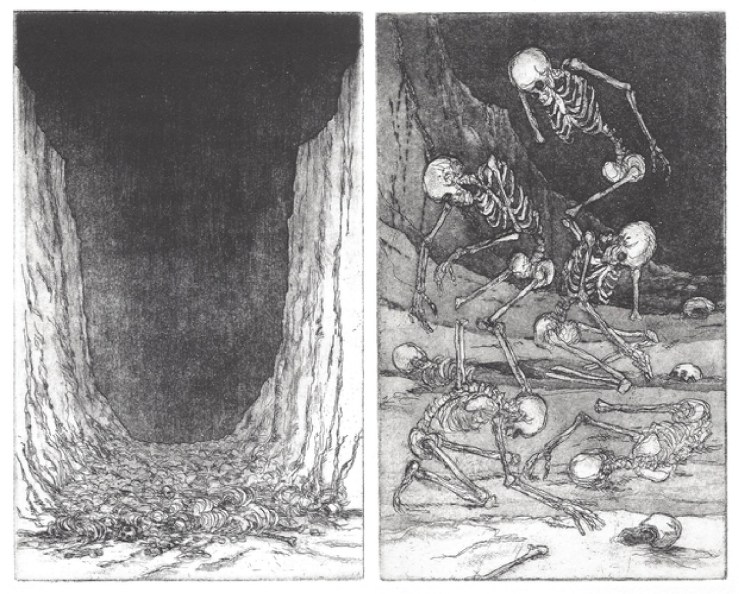
CALL FOR ART: The Valley of Dry Bones, Museum of the Bible, Washington, DC: “The Valley of Dry Bones art invitational seeks to inspire the creation of new artwork based on Ezekiel 37:1–14, the biblical vision in which God brings life, renewal, and restoration to a valley of dry bones. Museum of the Bible invites Christian and Jewish artists residing in the continental United States to create original pieces in a variety of media that show their personal and spiritual reflections on this powerful theme. The goal is to show how the Bible can shape modern art and give visitors a meaningful way to connect with biblical themes through creativity. Museum of the Bible will choose 15 artists through a national call and design a professional exhibition to showcase their art from May 7–November 7, 2027. The museum will also help promote the artists and their work through talks, social media, and special events. Each artist chosen will be paid a stipend of $3,000 to cover the costs of creation, travel, and shipping.” Entry deadline: April 24, 2026.
Margaret Adams Parker (American, 1948–), Ezekiel 37, from The Vigil Etchings, 2013–14. Etching with roulette and aquatint on Somerset velvet white paper, each 8 1/2 × 5 1/2 in. Edition of 15.
+++
SHORT FILM:Forevergreen(2025), dir. Nathan Engelhardt and Jeremy Spears: With the announcement of the 2025 Academy Award nominations last month, I learned that Forevergreen is one of five nominees for Best Animated Short Film! Written and directed by two Christians in the animation industry (employed by Disney but working independently here) and executed by a team of over a hundred, Forevergreen is a thirteen-minute gospel-oriented film in which “an orphaned bear cub finds a home with a fatherly evergreen tree, until his hunger for trash leads him to danger.” I found out about it last November through the music artists who wrote the soundtrack, Josh Garrels and Isaac Wardell, and am delighted to see it recognized in such a huge way. I really dig its unique animation style, which uses whittled wood figures. The movie is currently streaming for free on YouTube (see embed below), but if you want to see it on a big screen, check your local theater listings.
Lent starts next Wednesday, February 18, so I want to remind you about my Lent Playlist on Spotify. There are plenty of songs for contemplative listening throughout the season. I periodically add new entries to the bottom. Recent additions include a song by Amanda Held Opelt about being in the belly of a whale; “Living Water” by Sr. Miriam Therese Winter of the Medical Mission Sisters; Paul Zach’s cover of Johnny Cash’s “The Beast in Me”; and a setting of Matthew 4:17 by Seth Thomas Crissman of The Soil and The Seed Project, whose parallel verse, Mark 1:15, is commonly recited with the imposition of ashes on Ash Wednesday.
+++
VIDEO ART: Quarta-Feira de Cinzas / Epilogue(Ash Wednesday / Epilogue) by Rivane Neuenschwander with Cao Guimarães: When visiting the Museum of Modern Art in New York last month, I encountered a video work from Brazil that I found mesmerizing. The Perez Art Museum Miami describes it this way:
In Rivane Neuenschwander’s video Quarta-Feira de Cinzas / Epilogue (Ash Wednesday / Epilogue), made in collaboration with artist Cao Guimarães, ants become the protagonists of a captivating journey. Shot on Ash Wednesday, after the end of Brazilian Carnival, the video follows a colony of leafcutter ants as they traverse the rough terrain of a forest floor, transporting pieces of colored confetti to their underground nest. The video is set to a digitally composed soundtrack that blends ambient natural sounds with the sound of matchsticks dropping onto the floor. At the video’s end, we watch the ants descend into the darkness of their nest, intent, perhaps, on furnishing a celebration of their own.
Rivane Neuenschwander (Brazilian, 1967–) with Cao Guimarães (Brazilian, 1965–), Quarta-Feira de Cinzas / Epilogue (Ash Wednesday / Epilogue), 2006. High-definition video (color, sound), 5:44 min. Photo courtesy of Tanya Bonakdar Gallery, New York.
Originating in the Middle Ages, Carnival—from the Latin carve vale, meaning “flesh, farewell!” (flesh = meat)—is a period of merrymaking before the solemn restraints of Lent. It’s primarily a secular folk custom, celebrated by many with hedonistic parties involving excessive drinking. But Carnival need not be debauched, and some Christians celebrate it with social gatherings, games, parades, and/or food traditions. A Polish Catholic coworker of mine would always bring pączki (jelly donuts) to the office on Fat Tuesday (Mardi Gras in French), the day before Ash Wednesday. Some churches host a pancake supper on that evening, using up eggs, milk, and sugar, ingredients that were historically forbidden during Lent, along with bacon and sausage. At The Liturgical Home, Ashley Tumlin Wallace describes Fat Tuesday as a transition day moving God’s people out of Epiphanytide.
Neuenschwander and Guimarães’s Ash Wednesday / Epilogue is, first and foremost, fun and playful. We don’t tend to think of insects having parties! I wonder what the ants are doing with those vibrant little metallized discs. But the video also, for me, captures something of the tone of the first day of Lent—a quiet sweeping up after the previous day’s festivities, the humans of this place having left their revelries to go to church, where they enter a time of penitence.
+++
BLOG POST: “Ash Wednesday” by Libby John: I really appreciated these four guided journal prompts that Libby John, founder of the Vivid Artistry creative collective, gave last Lent:
What is something in my life I am seeking for God to renew and restore?
What rhythms in my life need to be interrupted and reoriented to God’s heart for me?
What are some ways I can surrender my schedule to help attune my senses to more of God’s presence?
Am I bringing my whole self to God or do I divide and keep parts of my life from him?
+++
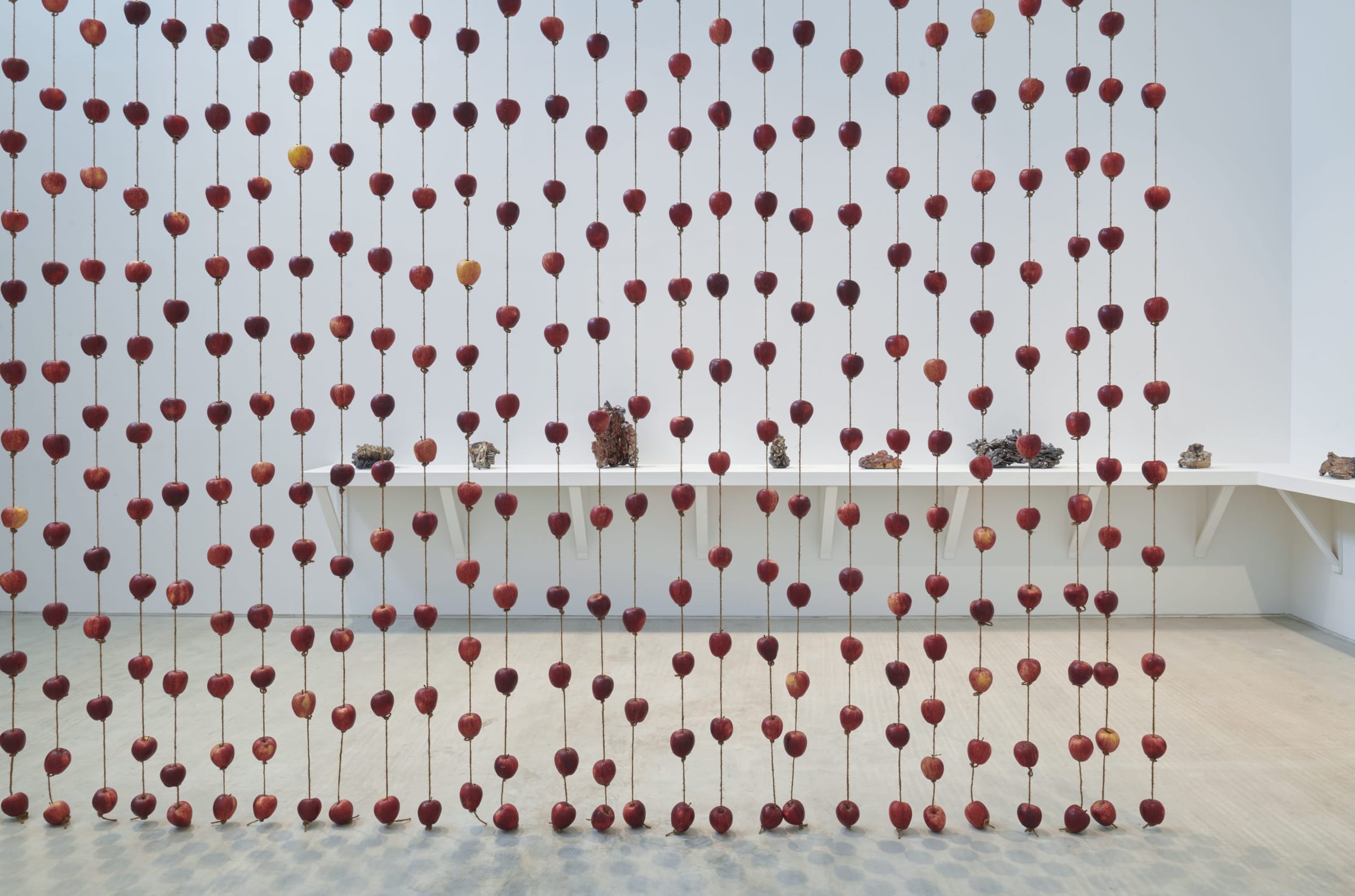
ARTICLE: “Anya Gallaccio’s Organic Mementos Mori” by Eliza Goodpasture, Hyperallergic: Rotting apples threaded with hanging twine, shriveling red daisies pressed between plexiglass, burning candles creating waxen landscapes on aluminum foil, a hundred-plus-year-old ash tree stricken with ash dieback disease—these were among the memento mori (reminders of death) installed at artist Anya Gallaccio’s exhibition preserve at Turner Contemporary in Margate, England, in fall 2024. “The potency of the transient works is so magnetic,” writes reviewer Eliza Goodpasture. “The Christian motif of dust to dust undergirds it all. . . . The artist reminds us that decay is full of energy—not just an ending, but part of an endless circle of life.”
Anya Gallaccio (Scottish, 1963–), Falling from grace, 2000. 2,700 Gala apples, hop twine. Installation view at Turner Contemporary, Margate, 2024. Photo: Jo Underhill, courtesy of the artist.
+++
SONGS:
>> “Turning” by Deanna Witkowski:Deanna Witkowski is a jazz composer and pianist living in Chicago. She wrote this choral piece for Lent, a season in which the liturgies call us to turn away from sin and toward God. That’s what repentance means: changing direction. The first verse is taken from Psalm 119:36–40. “Turn our hearts, O Lord, from selfish gain to your commandments . . .”
>> “Miraculous Salvation” by Tenielle Neda: This song by the Australian singer-songwriter Tenielle Neda praises God for the grace he lavishes on us and for his great love. Backing vocals are provided by Chris Cho.
+++
CAROL TEXT: “Revert, revert” by James Ryman, ca. 1492: Medievalist Eleanor Parker shares this Lenten carol text by the fifteenth-century Franciscan friar James Ryman, from Cambridge University Library MS Ee 1.12. The burden (repeated stanza) is “Revert, revert, revert, revert; / O sinful man, give me thine heart”—an echo of Isaiah 44:22, “Return to me, for I have redeemed you.” Written in Christ’s voice, it calls us to remember how he took on our flesh, was baptized, and was flogged and crucified for our sakes. I think the shield in stanza 3 refers to the cross; the Via Dolorosa was a battlefield on which Christ fought the devil, and paradoxically, the instrument of his execution was the means of victory.
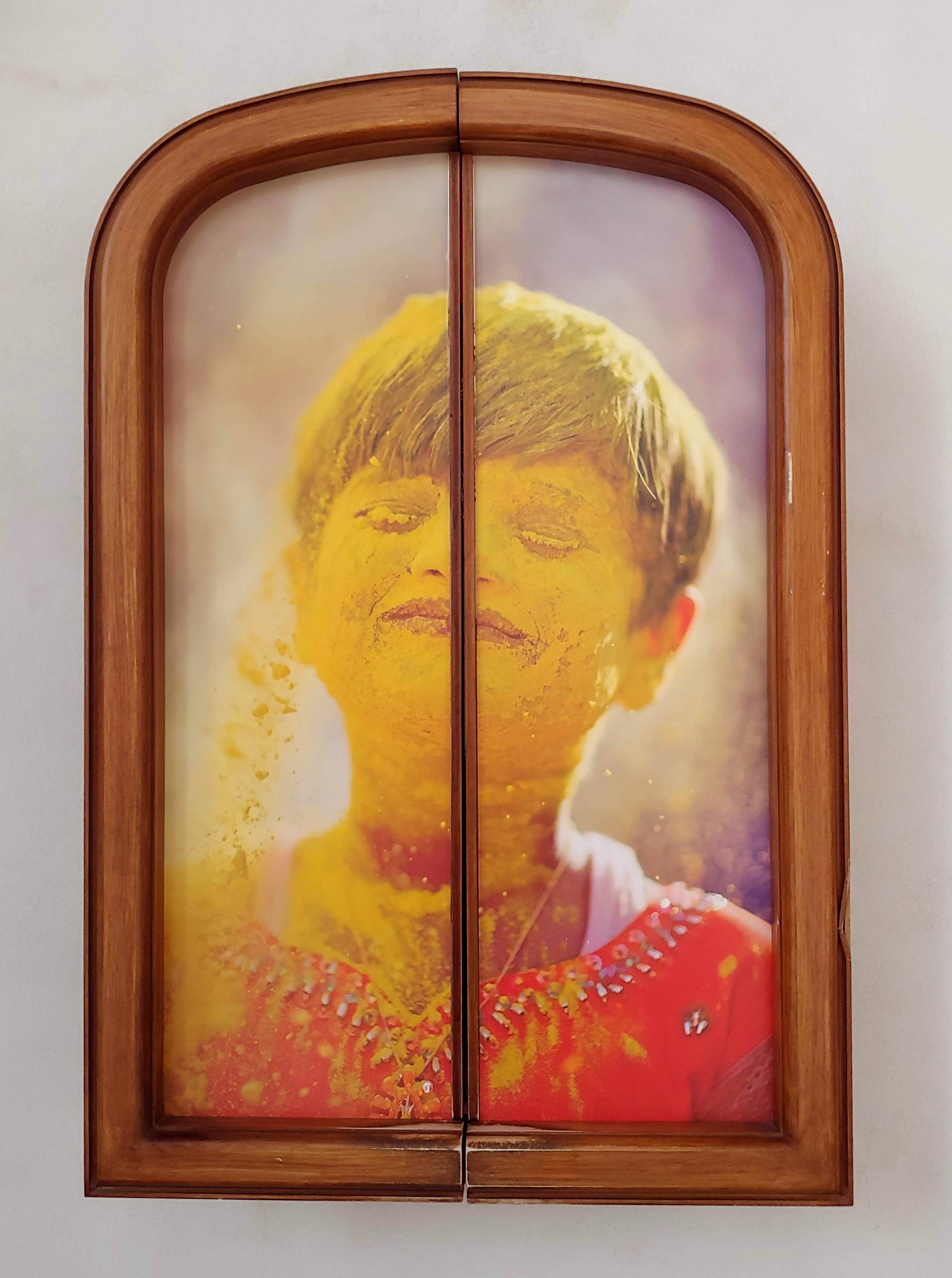
One of thirteen wall-mounted display panels (with opening doors) designed by Kossmanndejong for the ambulatory of the Church of St. Lawrence in Rotterdam, portraying the city’s diverse religious festivals. This one portrays Holi, a Hindu festival in March celebrating the victory of light over darkness and involving the throwing of colored powder and water. I took this photo when visiting during Lent 2019.
The following text has been floating around the internet for some time. It’s often attributed to the American motivational writer and Methodist lay leader William Arthur Ward (1921–1994), but it is not in his compilation of maxims, Fountains of Faith (Droke House, 1970), and it doesn’t sound like his other writings.
Fast from judging others; feast on the Christ within them. Fast from emphasis on difference; feast on the unity of life. Fast from apparent darkness; feast on the reality of light. Fast from thoughts of illness; feast on the healing power of God.
Fast from words that pollute; feast on phrases that purify. Fast from discontent; feast on gratitude. Fast from anger; feast on patience. Fast from pessimism; feast on optimism.
Fast from complaining; feast on appreciation. Fast from worry; feast on trust in God’s care. Fast from unrelenting pressure; feast on unceasing prayer. Fast from facts that depress; feast on verities that uplift.
Fast from lethargy; feast on enthusiasm. Fast from thoughts that weaken; feast on promises that inspire. Fast from shadows of sorrow; feast on the sunlight of serenity. Fast from problems that overwhelm; feast on prayer that undergirds.
Fast from bitterness; feast on forgiveness. Fast from self-concern; feast on compassion for others. Fast from personal anxiety; feast on eternal truth. Fast from discouragements; feast on hope.
It’s a stirring exhortation, and it always gets special traction during Lent, a penitential season in which many Christians practice the spiritual discipline of fasting (in the traditional sense of limiting food intake) and/or abstinence (refraining from eating a certain type of food). The language of “fasting” can be confusing, because traditionally, you’re to fast from good things for a set period of time, and then enjoy them all the more fully during a period of feasting; but people sometimes use the word “fast” to describe the act of giving up something that’s bad for them or that’s unholy and that, truth be told, would best be given up year-round. This text uses the latter meaning: reducing or abstaining from attitudes and behaviors that drag you or others down. It also acknowledges, as did the church fathers, that when you cut something unwholesome out of your life, it’s often wise to replace it with something wholesome.
Lent is an annual prompt for self-examination, a spiritual wellness check in which we’re invited to identify the ways we’ve veered off course from the way of Christ (or where we’re stumbling) and to let Christ’s grace draw us back (or help us surmount the obstacles). It’s a chance to tend to our disordered manners of being and develop healthy new habits as we seek to live more faithfully as people of God.
In February 2010, Msgr. Kerry Beaulieu adapted the above text for Our Lady Queen of Angels Catholic Church in Newport Beach, California, which he pastored from 2004 to 2018:
Fast from a gloomy outlook on life; Feast on what is bright and cheerful.
Fast from always being right; Feast on seeing another’s point of view.
Fast from always pointing out differences; Feast on what unites us all.
Fast from words that pollute; Feast on those that purify.
Fast from complaining; Feast on appreciation.
Fast from self-pity; Feast on goodness in others and self.
Fast from self-concern; Feast on going out to others.
Fast from overdoing; Feast on time for prayer.
Fast from worry; Feast on God’s love.
It was also adapted into the song “Fast from, Feast On” in 2014 by Latifah Alattas and Dave Wilton and is performed by Alattas (under the artist name Page CXVI) on the album Lent to Maundy Thursday.
Fast from the swelling darkness Feast on the power of his light Fast from discontentment Feast on the joy that he brings
Refrain: Sustainer, protector, the well of life My helper, my comfort, the bread of life Is you Is you
Fast from the fear that haunts us Feast on the power of his might Fast from the trap of judgment Feast on all that’s been redeemed [Refrain]
Bridge: From the sorrow’s shadow to perfect light From the darkness of our doubt to a cleansing white From the sorrow’s shadow to perfect light From the blindness of our sin to healing sight [Refrain]
I recommend choosing one or more of these fast-feast pairings to partake of during Lent. Or you could write your own aspirational list, tailored to the areas where you struggle and want to see growth. Rephrase it as a vow: “I will fast from . . . I will feast on . . .” If you are comfortable sharing for the edification of other readers, feel free to do so in the Comments section below.
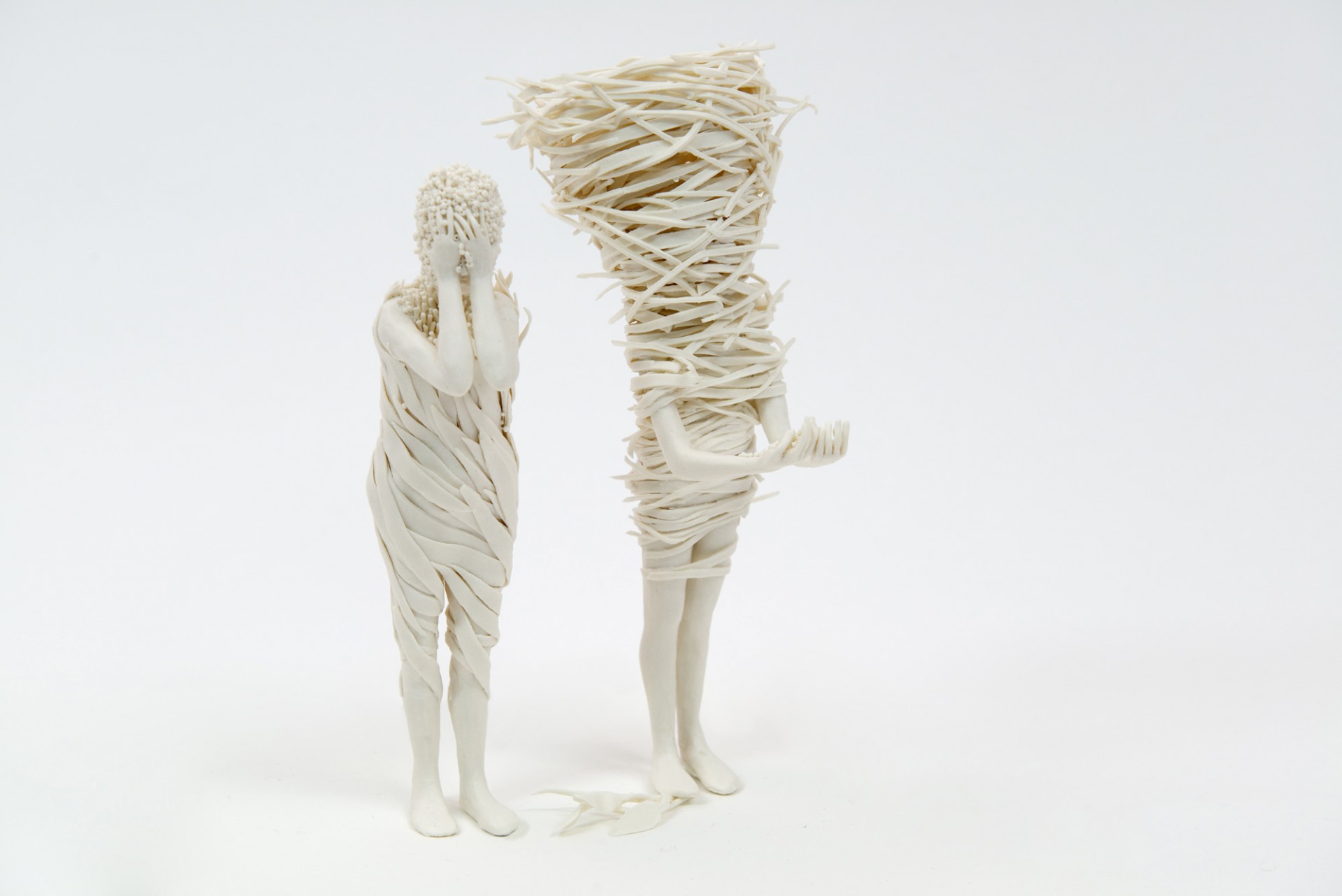
Claudia Fontes (Argentine, 1964–), sculptures from the Foreigners series, 2013–15. Flaxseed paper porcelain, height 25 cm. Photo: Bernard G. Mills.
Oh! how my mind
          Is gravel’d!
                    Not a thought
That I can find,
          But’s ravel’d
                    All to nought.
Short ends of threads,
          And narrow shreds
                    Of lists,
Knots, snarled ruffs,
          Loose broken tufts
                    Of twists,
Are my torn meditation’s ragged clothing;
Which, wound and woven, shape a suit for nothing.
One while I think, and then I am in pain
To think how to unthink that thought again.

How can my soul
          But famish
                    With this food?
Pleasure’s full bowl
          Tastes rammish,
                    Taints the blood:
Profit picks bones,
          And chews on stones
                    That choke.
Honor climbs hills;
          Fats not, but fills
                    With smoke.
And whilst my thoughts are greedy upon these,
They pass by pearls, and stoop to pick up peas.
Such wash and draff is fit for none but swine;
And such I am not, Lord, if I am thine.
          Clothe me anew, and feed me then afresh;
          Else my soul dies famish’d and starv’d with flesh.
I first encountered this poem in Before the Door of God: An Anthology of Devotional Poetry, edited by Jay Hopler and Kimberly Johnson. I had never heard of Christopher Harvey (1597–1663), an English clergyman and minor poet who was a contemporary of John Donne, George Herbert, Henry Vaughan, and Richard Crashaw, the so-called Metaphysical poets. Apparently out of a sense of humility, Harvey published his poetry anonymously during his lifetime. This poem is from a slim 1640 volume of his titled The Synagogue, or, The Shadow of The Temple, but his name didn’t start appearing on the title page until the nineteenth century. Read about the mysterious publication history of The Synagoguehere.
“Confusion” uses an unusual stanza form that befits the subject, with uneven line lengths that produce a raggedy appearance on the page. The rhyme scheme is abc abc dde ffe gghh, with an additional rhyming couplet at the end of the second stanza.
The speaker says his mind is all jumbled, unsettled. “Oh! how my mind is graveled!” he laments. “Not a thought that I can find, but’s raveled all to nought.” (“Graveled” is an archaic word meaning disarrayed, and “raveled” means entangled.) Launching into sartorial imagery, he compares his fragmented thoughts to old, partial, mismatched pieces of dress that fail to make up a coherent attire.
He doesn’t yet specify the nature of his thoughts, whether sinful (e.g., prideful, hateful, lustful) or simply trivial and unfocused on God or dominated by worry. Either way, he is suffering from intrusive and distracting thoughts that undo him.
In stanza 2 he shifts to the metaphor of food, and reveals that it is avarice he is struggling with—an insatiable need to acquire more and to be perceived as successful and important. In part to maintain an image, he indulges in the pleasures typical of rich men, which appear juicy and delicious, he says, but they actually taste quite rank (“rammish”) and make him sick. He cautions that wealth, social status, and human praise, if that’s what we feed on, not only fail to nourish (fatten) our souls; they can ultimately choke us or starve us to death.
Feasting on sensual gratification, expensive toys, and accolades instead of on Christ is like passing up pearls for peas, the speaker remarks. Such foods are the dregs, the refuse (“draff”), fit only for pigs, not for God’s children.
The closing couplet pulls together both stanzas, as the speaker asks God to clothe him in a whole new garment and to feed him afresh so that he is not “starved with flesh.” This final phrase, an oxymoron, suggests how the dishes served up by this world seem meaty but ultimately do not satisfy; when it comes to filling us, they’re as good as nothing, only leaving us empty.
Instead of being content to go about in tatters, eating slop, we must “clothe ourselves with the new self . . . in true righteousness and holiness” (Eph. 4:24) and feed on Jesus, “the bread of life . . . come down from heaven” (John 6:35, 33).
POEM: “Lost Sheep” by Margaret DeRitter: DeRitter writes about a lost Merino sheep in Australia who, because left unsheared for so long, was carrying over seventy-five pounds of wool on his back. He was found in 2021 and rescued by Edgar’s Mission Farm Sanctuary in Lancefield.
+++
SONGS:
>> “What Have We Become” by the Sweeplings:The Sweeplings are Cami Bradley and Whitney Dean, a singing-songwriting folk pop duo. From their album Rise and Fall (2015), “What Have We Become” laments how sin encroaches on our lives—we may welcome it in at first, but then it takes over, makes of our house a wasteland. This theme is embodied by a shadowy, thorny-veiled dancer in the music video.
>> “It Knows Me” by Avi Kaplan: Living outside Nashville, Tennessee, Avi Kaplan is best known for being the original vocal bass of the a cappella group Pentatonix, from 2011 to 2017. This song of self-probing is from his second solo EP, I’ll Get By (2020). It’s about the freedom that comes from reckoning with one’s inner darkness and accepting grace. The animation in the video is by Mertcan Mertbilek.
“It Knows Me” is an extremely personal song to me. I believe that everyone has a darker side of them, and that you can choose to play into that, or you can choose to not. This song is about that battle between those two forces, and having a little grace for yourself when you do falter on your path.
>> “Not the Devil Song” by Marcus & Marketo:Marcus & Marketo (Marcus Clingaman and Marketo Michel) are a worship music duo from South Bend, Indiana, fusing the styles of gospel, classical, country, and soul. “Not the Devil Song,” which they wrote in 2019, is about the power Christians are given to tell Satan to back off! When he dangles temptations in front of you, whispers lies in your ear, sows seeds of doubt or fear or hopelessness, you can confidently retort, “Devil, no, you gotta let go; Jesus died to save my soul.”
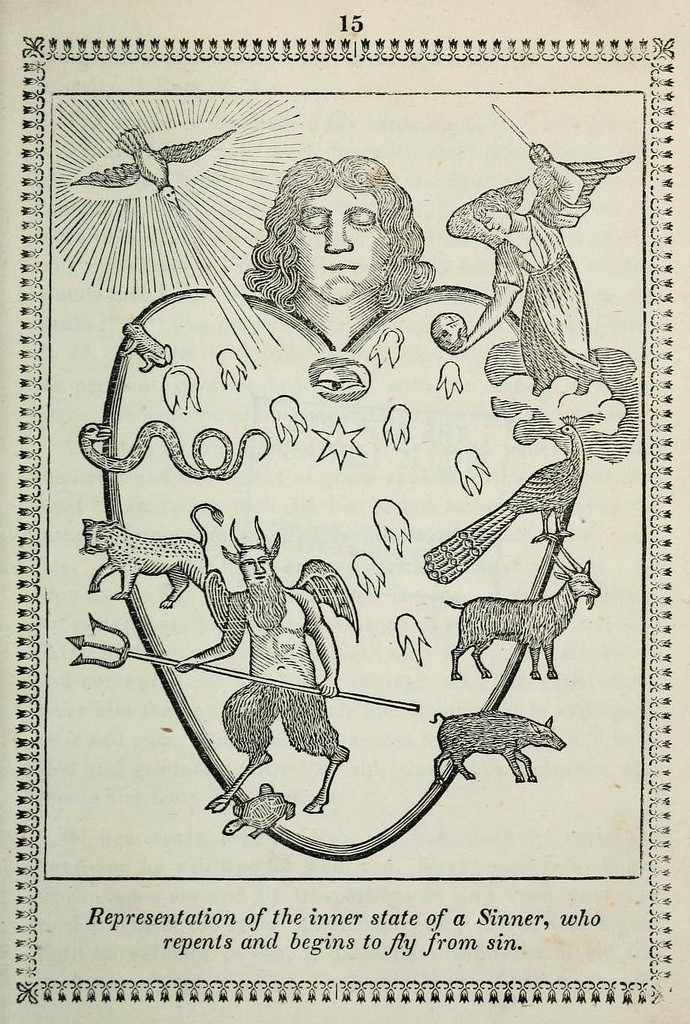
In his book The Forge of Vision (2015), visual studies scholar David Morgan contrasts this emblematic series with the related Cor Jesu amanti sacrum by Anton Wierix (which I wrote about here). Whereas the Wierix engravings from Antwerp are marked by sweetness, with the Christ child gently cleaning and setting up house in the human heart, the anonymous illustrations Gossner uses portray more of a psychomachia (battle for the soul), with armed angels seeking to oust Satan and his minions.
+++
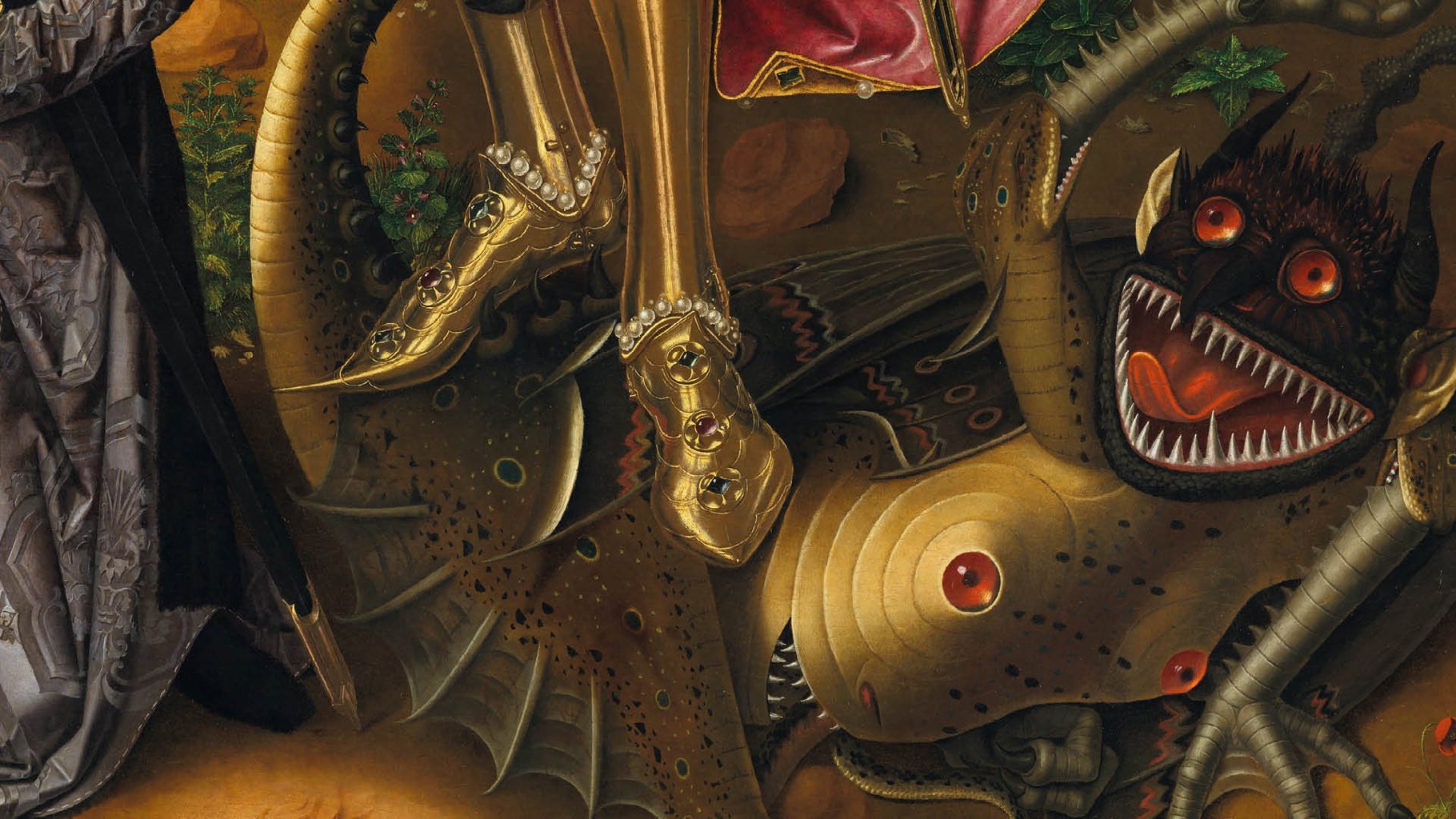
VIDEO: “How Bermejo paints good and evil in Saint Michael Triumphs over the Devil”: In this nine-minute video, Daniel Sobrino Ralston, associate curator for Spanish paintings at the National Gallery in London, examines a late Gothic painting in the museum’s collection by the Spanish artist Bartolomé Bermejo, showing the archangel Michael slaying Satan. Based on Revelation 12:7–9, this subject gave artists the chance to flex their imaginations in portraying evil incarnate and its vanquishment. Possessing an impressive capacity for fantastical invention, Bermejo gives the devil snakes for arms, eyes for nipples, bird claws, moth-like wings, a spiky tail, and a cactus growing out of its head!
Bartolomé Bermejo (Spanish, ca. 1440–after 1495), Saint Michael Triumphs over the Devil (detail), 1468. Oil and gold on wood, 179.7 × 81.9 cm. National Gallery, London.
If this visual subject interests you, I recommend the book Angels and Demons in Art by Rosa Giorgi, from the J. Paul Getty Museum’s Guide to Imagery series.
For all flesh is as grass, and all the glory of man as the flower of grass. The grass withereth, and the flower thereof falleth away: but the word of the Lord endureth for ever. And this is the word which by the gospel is preached unto you.
—1 Peter 1:24–25 (KJV) (cf. Isaiah 40:7–8)
Man is like a breath; his days are like a passing shadow.
—Psalm 144:4 (ESV)
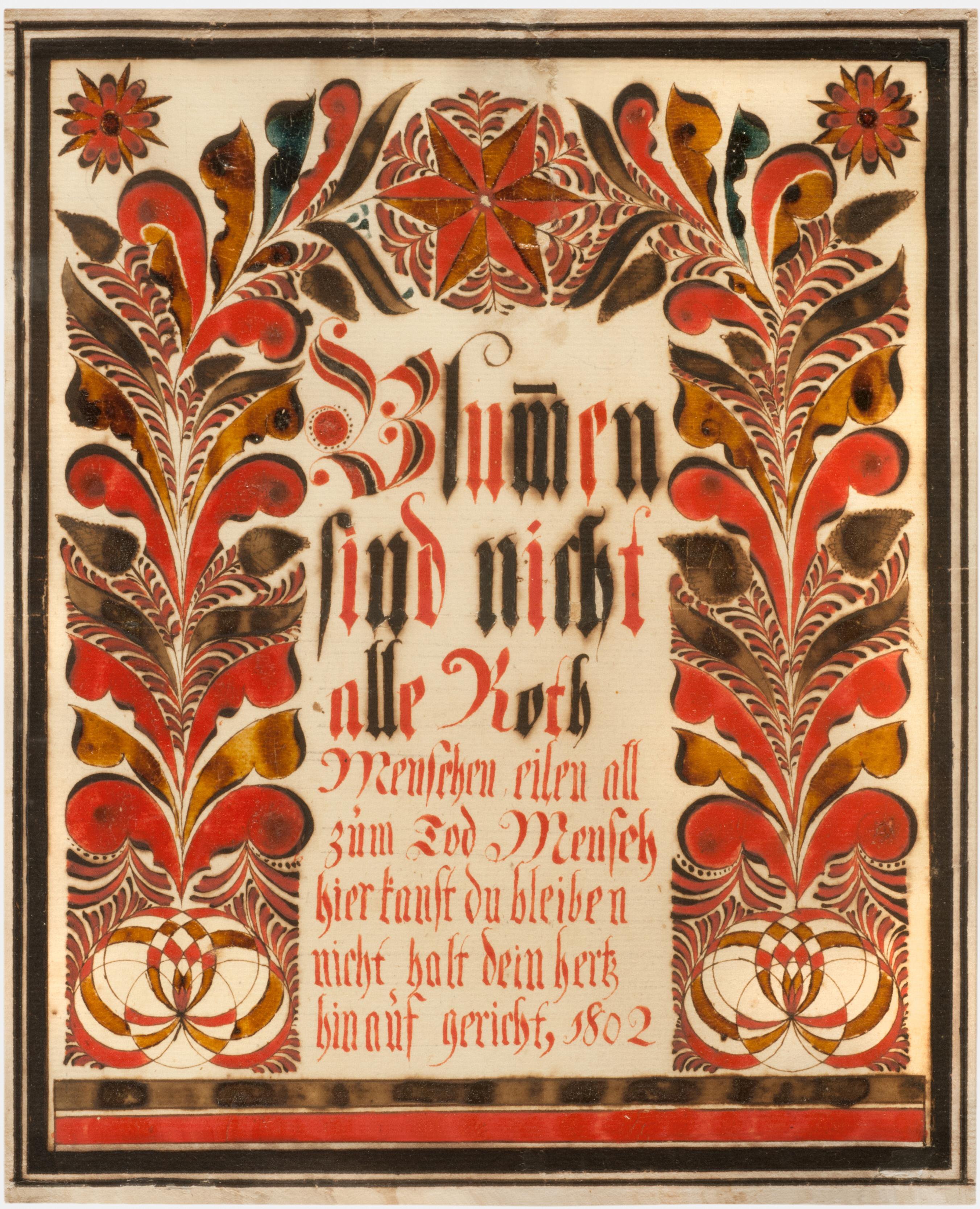
LOOK: Fraktur attributed to David Kriebel
Fraktur attributed to David Kriebel (1787–1848), Gwynedd Township, Montgomery County, Pennsylvania, 1802. Watercolor and ink on laid paper, 9 1/2 × 7 1/2 in. (24.1 × 19.1 cm). Philadelphia Museum of Art.
Referring to exuberantly decorated pages made by Pennsylvania Germans, fraktur is a type of folk art that flourished in the eighteenth and nineteenth centuries. Traditionally handwritten in ink and hand-painted with letter embellishments and design motifs like birds, hearts, and tulips, these works on paper often contain religious texts and/or commemorate important life events like births, deaths, and baptisms. They were made primarily by pastors and schoolmasters, who gifted them to parishioners or students. The recipients did not frame or hang them, but rather kept them in Bibles, drawers, or chests.
The German text of this fraktur translates to “Flowers are not all red. All men hasten toward death. Man cannot remain here, so direct your heart upward.” The piece features a foliate border and a color palette of reds and browns that captures both the bloom of youth and life’s inevitable withering. It was made by David Kriebel, a farmer from Gwynedd Township in Montgomery County, Pennsylvania, who would later move to nearby Worcester Township and become a minister in the Schwenkfelder Church, a small Christian denomination rooted in the Protestant Reformation teachings of Caspar Schwenkfeld von Ossig (1489–1561), which emphasize inner spirituality over outward form.
LISTEN: “As the Life of a Flower” by Laura E. Newell (words) and George H. Ramsey (music), 1904 | Performed by the Chuck Wagon Gang, 1953 [HT]
As the life of a flow’r, as a breath or a sigh So the years that we live as a dream hasten by True, today we are here, but tomorrow may see Just a grave in the vale and a mem’ry of me
Refrain: As the life of a flow’r, as a breath or a sigh So the years glide away, and alas, we must die
As the life of a flow’r, be our lives pure and sweet May we brighten the way for the friends that we greet And sweet incense arise from our hearts as we live Close to him who doth teach us to love and forgive [Refrain]
While we tarry below, let us trust and adore Him who leads us each day toward the radiant shore Where the sun never sets and the flow’rs never fade Where no sorrow or death may its borders invade [Refrain]
This early twentieth-century gospel hymn is performed here by D. P. Carter (tenor) and three of his nine children: Rose Carter Karnes (soprano), Anna Carter Gordon (alto), and Ernest (Jim) Carter (bass, guitar). The quartet formed in 1935 and started appearing on WBAP radio in the family’s hometown of Fort Worth, Texas, the following year, billing themselves as the Chuck Wagon Gang.
“As the Life of a Flower” draws on biblical passages that compare human life to a flower for its ephemerality (e.g., Job 14:2; Psalm 103:15–16; Isa. 40:6–8; 1 Pet. 1:24–25). But flowers are also fragrant, and the song makes that comparison too, echoing verses like 2 Corinthians 2:14–15, where Paul writes, “Thanks be to God, who . . . through us spreads in every place the fragrance that comes from knowing him. For we are the aroma of Christ to God among those who are being saved and among those who are perishing.”
Though we are fading, we are glorious creations of God with joyous and sweet-smelling potential. While we live on this earth, may we exude the beauty and aroma of Christ in all we say and do.
BibleProject is a nonprofit in Portland, Oregon, that offers free videos, podcasts, articles, and classes to help people experience the Bible in a way that is approachable and transformative.
The following two songs are from the music ministry of the Cathedral Church of the Advent in downtown Birmingham, Alabama. The ministry flourished under the leadership of Rev. Dr. Zac Hicks, who served as the church’s canon for worship and liturgy from 2016 to 2021. (He is now pastor of Church of the Cross, also in Birmingham.)
The music videos used to be available on YouTube, but it appears that the church has undergone some restructuring, and they have been removed. For now, though, they are still available through Facebook, and the audio releases are available through streaming services.
>> “Lord, Who Throughout These Forty Days”: This 1873 hymn by Claudia Frances Hernaman recounts the forty days Jesus spent in fasting and prayer in the Judean wilderness at the outset of his ministry and beseeches God to give us strength, like Jesus, to fight temptation, to die to self, and to live by his word and with a keen sense of his abiding presence. It’s set to an American folk tune from the Sacred Harp tradition, known as LAND OF REST, which has roots in the ballads of northern England and Scotland. The hymn is sung by Madison Craig (née Hablas), with Emma Lawton (née Dry) and Annie Lee on background vocals, Joey Seales on pump organ, Charley Rowe on cajon, and Zac Hicks on acoustic guitar.
>> “Spring Up, O Well”: This is an original song by Zac Hicks, sung by Jordan Brown. It draws especially on the narrative in John 4, where Jesus tells a Samaritan woman at a well, “Everyone who drinks of this water will be thirsty again, but those who drink of the water that I will give them will never be thirsty. The water that I will give will become in them a spring of water gushing up to eternal life” (vv. 13–14). The exclamation “Spring up, O well!” in the song’s refrain comes from Numbers 21:17, where the Israelites praise God for providing them water in the desert, and that musical phrase is adapted from the old children’s church song “I’ve Got a River of Life.”
+++
SHORT FILM: “Silences,” dir. Nathan Clarke: Shot in 2016 at Box Canyon near Laity Lodge in the Texas Hill Country, this contemplative short film features cellist Steuart Pincombe playing a short improvisation that interacts with the natural space. The impromptu music making was for him an exercise in prayer.
Three years earlier, also while on retreat at Laity Lodge, Pincombe’s wife shot him doing the same inside the newly constructed Threshold, an interactive, site-specific, permanent outdoor installation by Roger Feldman consisting of three curved walls:
The Threshold improvisation, Pincombe writes, “stemmed from a particular note (and its harmonic overtones) that naturally resonated in the space—the cello’s lowest strings were tuned to match this strongest resonation. Playing with the confusion of resonances (or pitches) was an important part of this short musical and spatial exploration—pitches are bent or adjusted in a way that create audible pulses in the sound and play on the conflicts of resonation within the space.”
+++
ESSAY: “Silence in an Age of Mass Media: John Cage and the Art of Living” by Dr. Jonathan A. Anderson, ARTS (Spring 2017): Many twentieth- and twenty-first-century artists have explored the necessities and possibilities for aesthetic stillness and silence, Anderson writes. In this essay he considers the composer John Cage (1912–1992), best known—and most excoriated—for his modernist piano composition 4′33″ (1952), in which the pianist sits at the bench for four minutes and thirty-three seconds, playing no notes. The point was to attune the audience to the ambient sounds of the concert hall (coughing, rustling, creaking, mechanical humming, outside traffic, etc.), testing the distinction between “music” and “noise.” Cage found the fundamental difference between the two to be not in the qualities of sound but in the attentiveness of the listener.
I was pleasantly surprised to learn from Anderson’s article that even after Cage left Christianity (in which he was raised) and turned to Zen Buddhism, he continued to link his love for the givenness of environmental sounds to Jesus’s admonition to “consider the lilies” (Luke 12:27). “Cage sought to quiet his own aesthetic ‘worry’ for musical meaning,” Anderson writes, “and to instead receive the given sounds of the world as richly meaningful in themselves.”
+++
VIDEO: Lenten Jazz Vespers, Duke University Chapel, March 23, 2023: This Jazz Vespers service combines the liturgical traditions of Vespers with the musical improvisation of jazz. Exploring the theme of hope, the service is presided over by Rev. Racquel C. N. Gill, minister for intercultural engagement at Duke University Chapel. Musical leadership is provided by the John Brown Little Big Band.
Here are the time stamps:
0:01: Song: “I Came to Tell You” by Trinity Inspirational Choir
5:40: Welcome and Prayer
8:33: Song: “Miracle (It’s Time for Your Miracle)” by Marvin Sapp
14:38: Poetry reading: “Dark Testament (8)” by Pauli Murray



 Art & Theology