Lent, Day 20

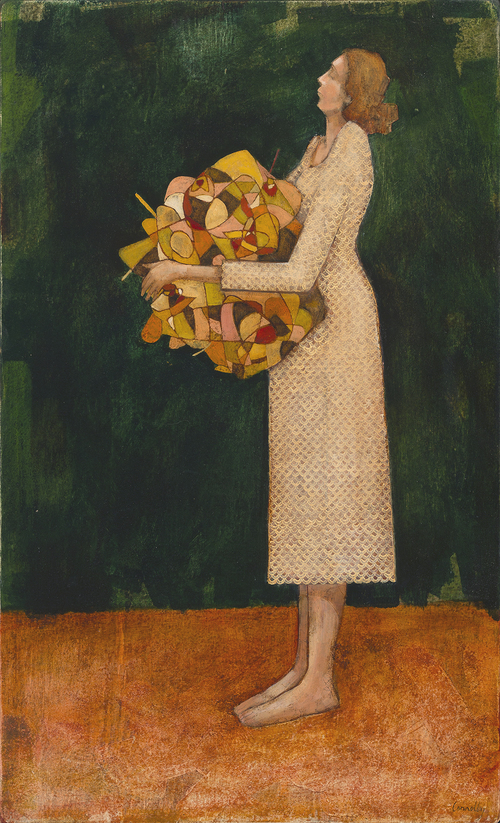
LOOK: Holding a Mystery by Caitlin Connolly
Connolly, Caitlin_Holding a Mystery
Caitlin Connolly (American, 1986–), Holding a Mystery, 2014. Oil on panel, 16 × 6 in.

Caitlin Connolly is an artist from Provo, Utah, whose paintings explore womanhood, sorrow, and faith. Her website, www.caitlinconnolly.com, contains an archive of original images dating back to 2013, many of which she sells as giclée prints from her online shop. She is featured in the first half of this episode of the BYUtv documentary series Artful.

The women in Connolly’s paintings are often shown holding something—the world, “holy things,” a book, a truth, a child, tears—or they might cup or cradle an absence that hurts. Here the figure carries a beautiful, tangled mass, a mystery, which is strangely both heavy and light. She doesn’t try to untangle it but simply hugs it close, resting.

LISTEN: “Lovely (Anselm of Canterbury)” by Nick Chambers, 2020 (to be released on an EP in 2022)

Lord my God, I don’t know how to start,
So I pray today that you would teach my heart
Where and how to find you, God, O where and how to search.
How can I know unless you show me first?

My God and my All, I’ve never seen you.
You created me, and you have made me new
And given me the good things in my hands and in my heart,
But still I don’t know who it is you are.

[Refrain] Let me seek you in all my desire,
Desire you in everything I seek.
Let it be by loving you I find you,
And when I finally find you, let it be lovely.

I come to you confessing gratefully.
It was in your image you created me
So that I may remember you and find the living course
On my way back to the loving source.

But that image is so worn and dim,
Darkened by the fault and by the smoke of sin,
That it can no longer do what you made it to do
Until it is refashioned and renewed.

[Refrain]

I’m not trying to ascend your heights;
My mind’s in no way capable of such a flight.
I do desire to know a little of your truth above
Which my heart already trusts and loves.

I seek to understand not so I can believe,
but I believe so I may understand.
And what is more, I do believe that unless I do believe,
I’ll never understand this mystery.

Originally from the Midwest, the Rev. Nick Chambers lives with his wife Katlyn and two sons in Atlanta, where he serves as the worship and formation pastor at Trinity Anglican Northside. His academic background is in philosophy and theology. “I love writing songs in, with, and for the church, and I’ve been doing it for years but only recently started seeking to share them beyond my local community,” he told me. He has contributed to two Porter’s Gate albums (Advent Songs and the forthcoming Climate Vigil Songs) and will be releasing his first solo EP later this year.

On Chambers’s YouTube channel you will find some of his original settings of psalms, prayers by Ephrem and Augustine and from the Book of Common Prayer, a poem by Pádraig Ó Tuama, and even a reworking of a Swedish hymn that he encountered through a few spoken lines from the Ingmar Bergman film Wild Strawberries!

“Lovely (Anselm of Canterbury)” is adapted from a prayer by the eleventh-century Burgundian-born monk, and later archbishop, named in the title. A doctor of the church, Anselm had a tremendous influence on the development of Christian theology and spirituality. The “combination of theological veracity and personal ardour is what most distinguishes Anselm’s writings from similar prayers, and makes him both traditional and revolutionary,” says Sister Benedicta Ward, a preeminent scholar and English translator of Anselm.

Anselm wrote the Proslogion (Lat. Proslogium, “Discourse”) in the 1070s while he was prior of the abbey of Notre Dame at Bec in Normandy. Chambers’s song is based on the passage that ends chapter 1:

Teach me to seek thee, and reveal thyself to me, when I seek thee, for I cannot seek thee, except thou teach me, nor find thee, except thou reveal thyself. Let me seek thee in longing, let me long for thee in seeking; let me find thee in love, and love thee in finding. Lord, I acknowledge and I thank thee that thou hast created me in this thine image, in order that I may be mindful of thee, may conceive of thee, and love thee; but that image has been so consumed and wasted away by vices, and obscured by the smoke of wrong‑doing, that it cannot achieve that for which it was made, except thou renew it, and create it anew. I do not endeavor, O Lord, to penetrate thy sublimity, for in no wise do I compare my understanding with that; but I long to understand in some degree thy truth, which my heart believes and loves. For I do not seek to understand that I may believe, but I believe in order to understand. For this also I believe—that unless I believed, I should not understand. (translated from the Latin by Sidney Norton Deane, 1903; emphasis mine)

In her 1973 translation of the Proslogion (pp. 243–44), Benedicta Ward sets this prayer in broken lines “in an attempt to convey the rhythm of Anselm’s complex rhymed prose, which is closer to our conception of poetry” and which aids a more meditative reading:

      Teach me to seek you,
   and as I seek you, show yourself to me,
   for I cannot seek you unless you show me how,
      and I will never find you
   unless you show yourself to me.
Let me seek you by desiring you,
   and desire you by seeking you;
   let me find you by loving you,
   and love you in finding you.

   I confess, Lord, with thanksgiving,
   that you have made me in your image,
so that I can remember you, think of you, and love you.
But that image is so worn and blotted out by faults,
   so darkened by the smoke of sin,
   that it cannot do that for which it was made,
   unless you renew and refashion it.
Lord, I am not trying to make my way to your height,
   for my understanding is in no way equal to that,
   but I do desire to understand a little of your truth
   which my heart already believes and loves.
I do not seek to understand so that I may believe,
   but I believe so that I may understand;
      and what is more,
I believe that unless I do believe I shall not understand.

I particularly love lines 8–9: “Let me find you by loving you, and love you in finding you.” Or, as Deane translates it, “Let me find thee in love and love thee in finding.” Chambers highlights these lines by making them, and the two that precede them, the refrain of his song: “Let me seek you in all my desire, / Desire you in everything I seek. / Let it be by loving you I find you, / And when I finally find you, let it be lovely.”

For Anselm, our desire for God must precede our understanding of God. We cannot know God except through love; those who pursue him without loving him will not find him. And it’s not as if our “finding” God ends the pursuit, as there is always more of God to discover. We catch small glimpses, and that’s invigorating. In this life we are never granted a full and complete vision of God but rather are always searching and often finding—and that search, undertaken with loving belief, is a delight.

Lent, Day 19

I am my beloved’s, and my beloved’s is mine . . .

—Song of Solomon 6:3a (cf. 2:16)

He brought me to the banqueting house, and his banner over me was love.

—Song of Solomon 2:4

I will extol thee, O LORD; for thou hast lifted me up . . .

—Psalm 30:1a

Blessed be the God and Father of our Lord Jesus Christ, who hath blessed us with all spiritual blessings in heavenly places in Christ . . .

—Ephesians 1:3

LOOK: Ethiopian Angels, Debre Birhan Selassie Church

Ethiopian church ceiling
Painted wood ceiling, early 19th century, Debre Birhan Selassie Church, Gondar, Ethiopia. Photo: A. Savin.

Debre Birhan Selassie (Trinity and Mountain of Light) Church in Gondar, the imperial capital of Ethiopia from 1636 to 1855, is famous for the colorful paintings that cover every inch of the interior walls and ceiling. The south wall concentrates on the Life of Christ, while the north wall depicts various saints. The focal point—on the east wall, in front of the holy of holies—is a Crucifixion scene and an icon of the Trinity. But the most celebrated visuals inside the church are the hundred-plus winged heads painted in rows between the wooden beams of the ceiling, representing the cherubim and God’s omnipresence.

The original church, which was round, was consecrated in 1693 by Emperor Iyasu I, but lightning destroyed it in 1707. The rectangular stone church that stands on the site now likely dates to the late eighteenth century, and it is the only one of the forty-four Orthodox Tewahedo churches in Gondar to survive the 1888 sack of the city by Mahdist soldiers from Sudan. (Locals say the marauders were miraculously rerouted by a swarm of bees.)

According to Ethiopia (Bradt Travel Guide) writer Philip Briggs, “The paintings are traditionally held to be the work of the 17th-century artist Haile Meskel, but it is more likely that several artists were involved and that the majority were painted during the rule of Egwala Seyon (1801–17), who is depicted prostrating himself before the Cross on one of the murals.”

Debre Birhan Selassie is still an active church, but priests also offer tours. Here’s some video footage of the inside (you’ll see it’s very dark, and flash photography is not allowed), and some drone footage of the exterior.

The church is part of a larger imperial compound, known as Fasil Ghebbi, that has been a UNESCO World Heritage Site since 1979 and that includes palaces, monasteries, and public and private buildings.

Angels (Debra Berhan Selassie Church)
Photo: Alan Davey

LISTEN: “His Banner Over Me Is Love” by B. C. Laurelton (pseudonym of Alfred B. Smith), 1965 | Performed by Christy Nockels on Be Held: Lullabies for the Beloved, 2017 | CCLI #28579

I am my Beloved’s and He is mine—
His banner over me is love.
I am my Beloved’s and He is mine—
His banner over me is love.
I am my Beloved’s and He is mine—
His banner over me is love,
His banner over me is love.

He brought me to His banqueting table—
His banner over me is love.
He brought me to His banqueting table—
His banner over me is love.
He brought me to His banqueting table—
His banner over me is love,
His banner over me is love.

He lifted me up to the heavenly places—
His banner over me is love.
He lifted me up to the heavenly places—
His banner over me is love.
He lifted me up to the heavenly places—
His banner over me is love,
His banner over me is love.

I sang a version of this song in children’s church regularly when I was little (with hand motions!) and have carried it with me all these years, a gentle assurance that I am divinely loved and protected. I’ve quoted the scriptures it’s drawn from above. Its refrain comes from Song of Solomon 2:4: “his banner over me was love.”

The Song of Solomon, aka the Canticle of Canticles, has traditionally been read, at least on one level, as an allegory of the love between God and the human soul—or, more specifically in the Christian tradition, Christ and his church.

From the root “to cover,” the Hebrew word for “banner” in this verse refers to a military standard. It is being used figuratively here to indicate that we enlist ourselves under Love’s banner, which goes forth in triumph and protects those under its billows. We belong to love, commit ourselves to love, overcome through love. The verse is perhaps an allusion to the names of generals being inscribed on the banners of their armies. God’s name is Love (1 John 4:8).

The image is at once vigorous and gentle. The NRSV translates the phrase as “his intention toward me was love.”

The song “His Banner Over Me Is Love” was written by Alfred B. Smith (1916–2001), an itinerant song leader, songwriter, and Christian music publisher. Smith compiled and published his first songbook, Singspiration One: Gospel Songs and Choruses, while he was a student at Wheaton College in 1941, to support the evangelistic meetings he was running with his roommate, Billy Graham (yes, that Billy Graham!). Two years later he founded Singspiration Publishing Company, which published several popular series of songbooks. In 1963 he sold Singspiration to Zondervan, but he ran other publishing ventures (i.e., Better Music Publications and Encore Publications) for the remainder of his ministerial career.

According to Music in the Air: The Golden Age of Gospel Radio by Mark Ward Sr., Smith composed “His Banner Over Me Is Love” in 1965 as an impromptu offertory while serving as a visiting song leader at First Baptist Church–Laurelton in Brick, New Jersey. Afterward he received requests from the congregation for the music. His original notation read “B. C. Laurelton” (for “Baptist Church Laurelton”) to designate where he wrote the song, and it was copied as such as people shared the music with others—so when the song was later published in 1972, Smith decided to adopt “B. C. Laurelton” as a pen name.

Singer-songwriter Christy Nockels [previously] sings “His Banner over Me” on an album of lullabies to a twinkling piano accompaniment.

May this truth—that God’s banner over you is love—soothe you and give you confidence.

Lent, Day 18

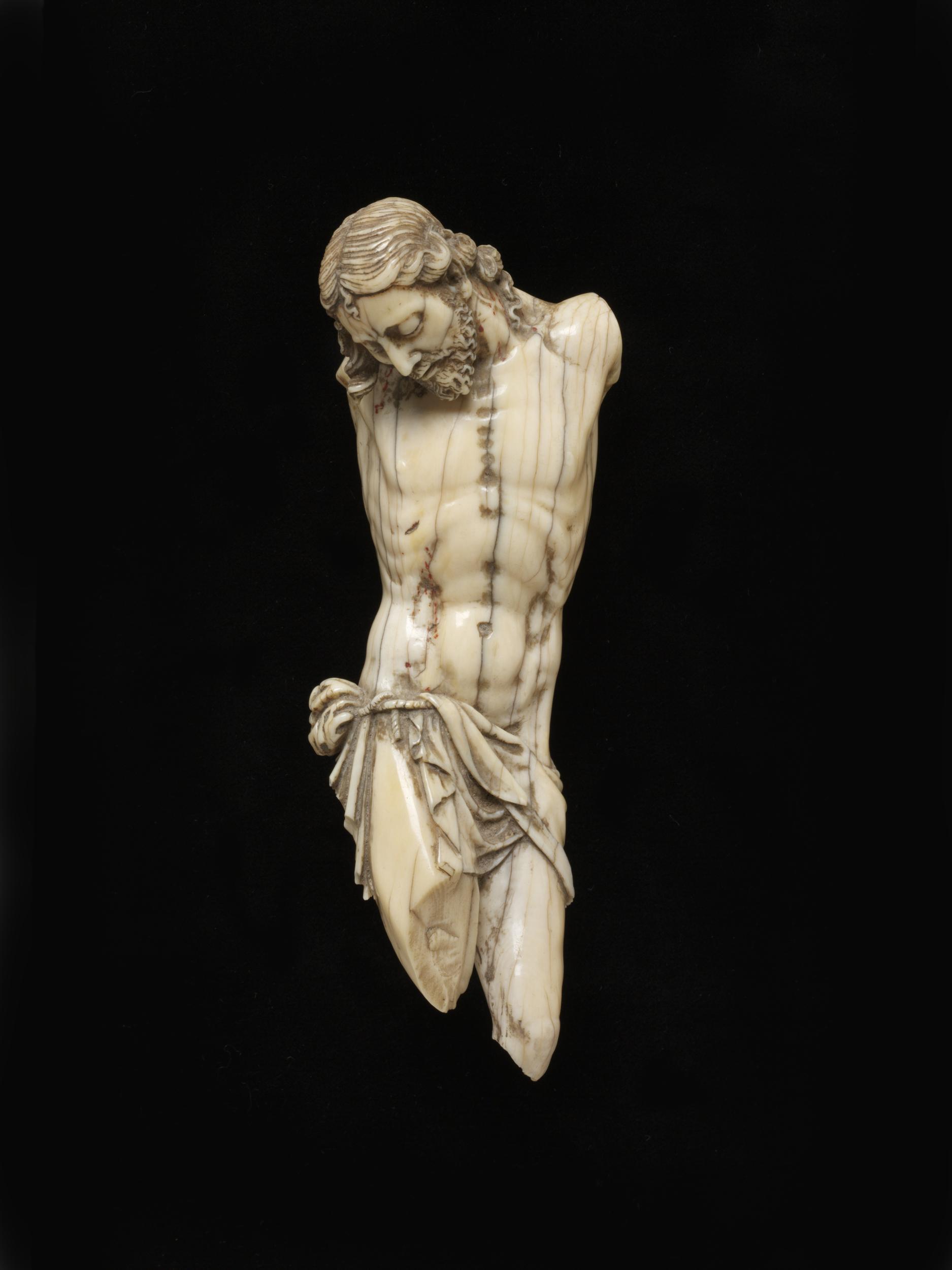
LOOK: Crucifix figure by Giovanni Antonio Gualterio

Gualterio, Giovanni Antonio_Crucifix figure
Giovanni Antonio Gualterio (Italian, active 1582–1600), Crucifix figure, ca. 1599. Ivory, h. 13.5 cm. Victoria and Albert Museum, London.

LISTEN: “Christ’s dying love; or, our pardon bought at a dear price” (aka “Condescension”) | Words by Isaac Watts, 1709 | Music: Appalachian shape-note tune, ca. 1800; published in The Southern Harmony, and Musical Companion (new edition, thoroughly revised and much enlarged), ed. William Walker, 1854 | Arranged and performed by Timothy Seaman on bamboo flute, 2021

How condescending and how kind
Was God’s eternal Son!
Our mis’ry reached his heav’nly mind,
And pity brought him down.

When justice, by our sins provoked,
Drew forth its dreadful sword,
He gave his soul up to the stroke
Without a murmuring word.

He sunk beneath our heavy woes,
To raise us to his throne;
There’s ne’er a gift his hand bestows
But cost his heart a groan.

This was compassion like our God,
That when the Savior knew
The price of pardon was his blood,
His pity ne’er withdrew.

Now though he reigns exalted high,
His love is still as great:
Well he remembers Calvary,
Nor should his saints forget.

Here we behold his bowels roll,
As kind as when he died;
And see the sorrows of his soul
Bleed through his wounded side.

Here we receive repeated seals
Of Jesus’ dying love;
Hard is the heart that never feels
One soft affection move.

Here let our hearts begin to melt
While we his death record,
And with our joy for pardoned guilt,
Mourn that we pierced the Lord.

Virginia musician Timothy Seaman plays a variety of instruments, including the hammered dulcimer, mountain dulcimer, various flutes and whistles, bowed and plucked psalteries, and guitar. He has recorded fifteen albums featuring his instrumental arrangements of traditional music (especially American mountain and Scots-Irish tunes), as well as original compositions, many of them inspired by local wildlife and nature and by the Christian faith. He has eight years’ worth of videos on his YouTube channel, a mix of tutorials and informal performances. For this time of year especially, I’d also commend to you another of his Appalachian folk hymn arrangements, “Behold the Lamb of God” on hammered dulcimer.

Of “Condescension,” he writes,

In 1986 I found this profound folk hymn in an old book, and I’ve loved to play and sing it ever since—but not till now have I recorded it. I’ve considered ensemble arrangements with intriguing chords and rhythms, etc., but I keep coming back to a cappella bamboo flute, or voice. Here it is in its instrumental form! The tune is anonymous, and the words are by the master hymn writer Isaac Watts.

Click here to access the lead sheet for “Condescension.” It was made by Seaman and is shared here with his permission.

For a vocal performance, see The Shapenote Album by The Tudor Choir, directed by Doug Fullington.

The mention of rolling bowels in the sixth stanza may sound strange to us today (sounds like a digestive issue!), but traditionally, the bowels were regarded as the seat of tender and sympathetic emotions—felt in the gut. Several of the biblical authors mention the moving of that organ in relation to yearning, anguish, compassion, or mercy (e.g., Gen. 43:30; Isa. 63:15; Jer. 4:19; 1 John 3:17). The KJV translation preserves the expression, still commonly used in the seventeenth century, with literalness, translating the Hebrew mēʿê and Greek splagchnon as either “bowels,” “belly,” or “inward parts.” Today we locate such emotions in the heart instead.

This stanza is actually my favorite in the hymn. There’s such a poetic quality to it! Watts is meditating on Christ exalted, who is not at all impassive in that high estate, but rather is still moved to compassion for humanity, every bit as much as when he hung on the cross. He still bears the wounds of crucifixion, and, in a figurative sense, those wounds still bleed for us.

Here we behold his bowels roll,
As kind as when he died;
And see the sorrows of his soul
Bleed through his wounded side.

Lent, Day 17

LOOK: Head of Christ by Fernando Botero

Botero, Fernando_Head of Christ
Fernando Botero (Colombian, 1932–), Cabeza de Cristo (Head of Christ), 1976. Oil on canvas, 185 × 179 cm. Museo de Antioquia, Medellín, Colombia.

Colombian painter and sculptor Fernando Botero is South America’s best-known artist. He is influenced by the Old Masters, which he studied in his twenties in Madrid, Paris, and Florence, and by the Mexican muralists. But his style—marked by plump, often childlike figures—is distinctively his own and has even been given the name “Boterismo.”

Throughout his career he has remained adamant that he does not paint “fat people” or “chubbies.” What he paints, he insists, is exaggerated volumes that highlight the body’s natural shape and the “sensuality of form.” In addition to religious subjects, he also paints Latin American street scenes, domestic life, nudes, and political portraits.

At age eighty-nine, Botero continues to be active as an artist, living and working between Paris, New York, and Tuscany.

LISTEN: “Legend (The Crown of Roses),” Op. 54, No. 5, by Pyotr Ilyich Tchaikovsky, 1883/89 | Based on a text by Richard Henry Stoddard, 1856 | Performed by the University of Pretoria Camerata, dir. Michael Barrett, on Written in the Stars, 2021

When Jesus Christ was yet a child
He had a garden small and wild,
Wherein he cherished roses fair,
And wove them into garlands there.

Now once, as summer-time drew nigh,
There came a troop of children by,
And seeing roses on the tree,
With shouts they plucked them merrily.

“Do you bind roses in your hair?”
They cried, in scorn, to Jesus there.
The Boy said humbly: “Take, I pray,
All but the naked thorns away.”

Then of the thorns they made a crown,
And with rough fingers pressed it down.
Till on his forehead fair and young
Red drops of blood like roses sprung.

In 1877 Tchaikovsky found a Russian poem by Aleksey Pleshcheyev published in a journal; it was a translation of the English-language poem “Roses and Thorns” (1856) by American poet Richard Henry Stoddard, an allegory of the Crucifixion. It’s about the boy Jesus who tends a rose garden and dreamily weaves together crowns from the branches’ yield. One day a bunch of rowdy children comes by and carelessly yanks the flowers off the bushes, scoffing at Jesus for being soft, a flower lover. In a spirit of gentleness, he tells them they may have the flowers, but to leave the thorns. Continuing their derision, the children bend the bare, thorny stems into a crown and press it into Jesus’s head. From his flesh then bloom “roses” of blood.

Tchaikovsky first set the Russian poem to music in 1883, arranging it for solo voice and piano and publishing it as part of his Sixteen Songs for Children, Opus 54. In 1884 he arranged it for solo voice and orchestra, and in 1889 for unaccompanied choir.

When English-language choirs sing the song, instead of using Stoddard’s original text, they typically use a 1913 adaptation by British poet Geoffrey Dearmer—which I believe is the superior version. See a side-by-side presentation of the song’s textual history.

Lent, Day 16

LOOK: Heavy Rain by Samuel Salcedo

Salcedo, Samuel_Heavy Rain
Samuel Salcedo (Spanish, 1975–), Heavy Rain, 2011. Polyester resin and aluminum powder, 185 × 180 × 260 cm. From the solo exhibition That’s Why I’m Light, Light like a Sunday Morning, October 16–November 11, 2014, Osnova Gallery, Moscow. Photo courtesy of the gallery.

LISTEN: “Water” by Gregory Porter, on Water (2010)

This is the title track of multi-Grammy-winning jazz vocalist and songwriter Gregory Porter’s debut album. The live performance posted below took place in November 2010 at Dizzy’s Club at Lincoln Center in New York City. It features Chip Crawford on piano, Alex Han on alto saxophone, and Yosuke Sato on alto saxophone.

Water pouring down the sidewalks
Cleaning widows clear to see
Washing gumdrops down side gutters
Rusting chains and cleansing me

Greening gardens, drowning ants
Changing rhythms, bruising plants
Graying vistas soulfully
And again it’s saving me

Ooooo
Ooooo
Wash me, wash me, wash me
Let me rest in you
Let me flow away to glory
Save me, save me, save me

[Related post: “Wash Me Clean (Artful Devotion)”]

Lent, Day 15

LOOK: Life of Christ by Tony Nwachukwu

Nwachukwu, Tony_Untitled
Carved and painted wood by Tony Nwachukwu (Nigerian, 1959–)

I retrieved this image years ago from https://anthonynwachukwu.com/, but the domain has since expired. Nwachukwu didn’t give a title or a date there, and I couldn’t find his contact information to ask. The scene on the far left appears to me to be a Nativity—Christ in the manger, his mother and father standing behind. Then there’s what I’m guessing is Jesus’s anointing with the Spirit at his baptism; hands outspread, he receives his commission. The wineglass and flatbread refer, of course, to the Last Supper, and to Jesus’s declaration that he is the bread of life and that he is initiating a new covenant in his blood. The overturned cup may be a reference to the cup of wrath poured out on Christ at his passion. The open palm with nail wound and adjacent blood-stained cross are shorthand for the Crucifixion. Next to that is the dark cavern of Christ’s tomb. But in the final segment the mouth of the tomb is open and bright, and Christ bursts forth in resurrection.

Tony Nwachukwu studied art at the University of Nigeria in Nsukka. Since 1987 he has lived in Owerri in Imo State, where he runs an art gallery. In addition to painting and carving, he also makes batiks (dyed cloth artworks) [previously] and liturgical vestments. In 2009 the German Catholic organization Misereor commissioned him to design that year’s Hungertuch, a liturgical veil hung in churches during Lent [previously], which was reproduced throughout Europe; his theme was climate change.

LISTEN: “Life of Jesus” by David Childers and Bill Noonan, on Serpents of Reformation (2014)

I been washed in the blood of the Holy Lamb
Washed in the blood of Jesus

Well, I’m gonna tell you about the life of Jesus
I’m gonna tell you about the life of Jesus
He lived a long time ago
He still lives today
He came down from his Father in heaven
To show us a better way

And I been washed in the blood of the Holy Lamb
Washed in the blood of Jesus
Washed in the blood of the Holy Lamb
Washed in the blood of Jesus

He was born in a lowly place
Smack-dab in the middle of the human race
He grew up to spread the word of God
Living and loving and sweating as a man
Working and hurting and all that you can
Living and dying, he knew that too

Washed in the blood of the Holy Lamb
Washed in the blood of Jesus

He went through the land
Preaching the gospel and the truth to man
Healing the sick and saving the lost
Driving the demons back to hell
Then he came to Jerusalem
Where trials and tribulations waited for him
He wound up nailed on Calvary’s tree

And that’s where I was washed in the blood of the Holy Lamb
Washed in the blood of Jesus
Washed in the blood of the Holy Lamb
Washed in the blood of Jesus

He was laid in the tomb
He descended into hell
He arose on the third day
To angel horns and heavenly bells
And when his disciples came looking for him
He was not to be found
Angels had rolled the stone away
And Jesus was heaven-bound

Now I am washed in the blood of the Holy Lamb
Washed in the blood of Jesus
Washed in the blood of the Holy Lamb
Washed in the blood of Jesus

This song is from a gospel album by North Carolina singer-songwriter, roots musician, and bandleader David Childers (b. 1952). (Read an album review here.) I learned about him through Bob Crawford, bassist for the Avett Brothers and a close friend and sometime collaborator of Childers’s.

“Life of Jesus” originated in the 1990s with Bill Noonan, one of Childers’s bandmates in the Gospel Playboys at the time. Noonan was just playing around, but Childers “took it seriously and wound up writing out some words and finding a song structure,” Childers told me. His son Robert Childers and Neal Harper produced the version of the song on Serpents of Reformation, released in 2014 on Ramseur Records. “The song . . . has continued to evolve with each performance,” Childers said in an email. “It usually gets the room moving and grooving, which might freak out some Baptists; but it makes me happy. I also think Jesus liked to see people happy, and maybe did not frown on dancing or demonstrable rejoicing.”

There are a handful of live performances of the song on YouTube, including this one from a house concert in Charlotte shortly after the album release:

In addition to writing and recording music, Childers practiced law for thirty-five years, serving as an attorney for those on social security and/or disability. Those two careers ran parallel for a while, but in 2016 Childers decided to quit the legal profession to focus on his music. He is also a poet and a painter.

Lent, Day 14

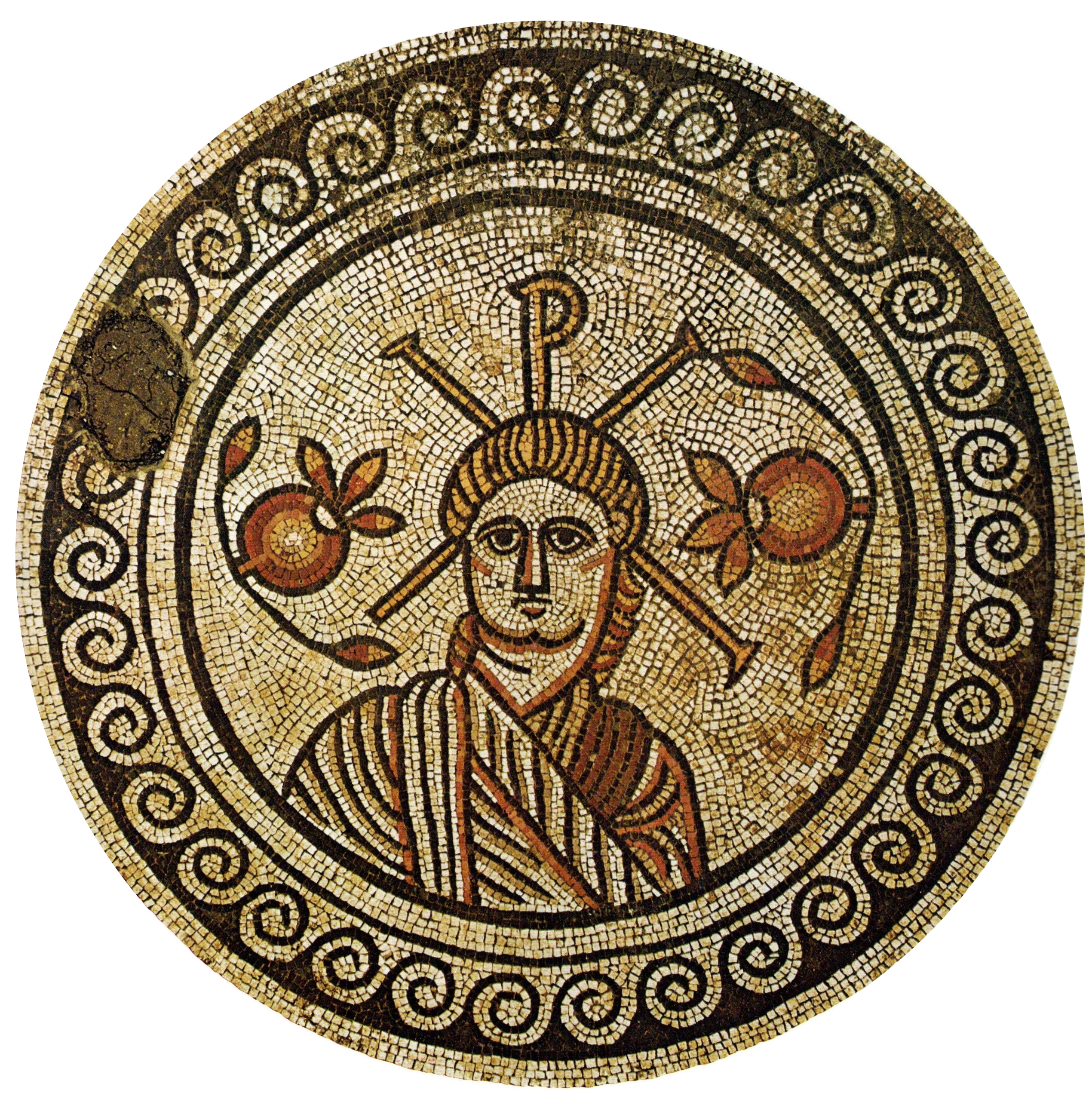
LOOK: Christ with Pomegranates (ancient Christian mosaic)

Christ with Pomegranates
Mosaic from Hinton St. Mary, Dorset, England, early 4th century, preserved at the British Museum, London.

One of the earliest surviving portraits of Christ is in the central roundel of a stone mosaic pavement excavated in the English village of Hinton St. Mary in Dorset, from what was either a Roman villa or a church. It’s part of a larger program of images that covered the floor, which you can see and read about in this Instagram post of mine, and on the British Museum website.

Clean-shaven and wearing a pallium, Christ is crowned with his personal monogram, the chi-rho—the first two letters of the Greek title ΧΡΙΣΤΟΣ, Christos. He is flanked by pomegranates, a symbol of life, fertility, and abundance. In Jewish tradition the pomegranate symbolizes righteousness because it is said to have 613 seeds, corresponding to the 613 mitzvot (commandments) in the Torah. The fruit was woven onto the hems of the robes of the Jewish high priests (Exod. 28:33–34) and is customarily eaten on Rosh Hashanah.

To these symbolic associations, I would add another: sweetness!

[Related post: “So Sweet (Artful Devotion)”]

LISTEN: “Iesu, dulcis memoria” | Words attributed to Bernard of Clairvaux, 12th century (but see notes on authorship) | Music: Medieval chant, harmonized | Performed by Tenth Avenue North, feat. Audrey Assad, on Cathedrals, 2014

On this track Assad sings the first and last stanzas of the traditional five—which are themselves extracted from a poem that was originally forty-two stanzas! The ending sounds abrupt because on the album it moves seamlessly into the next track, “Cathedrals.” For the full song (same tune but without the harmonies), see Angels and Saints at Ephesus by the Benedictines of Mary, Queen of Apostles.

Latin: 

Jesu, dulcis memoria
dans vera cordis gaudia:
sed super mel et omnia
ejus dulcis praesentia.

Nil canitur suavius,
nil auditur jucundius,
nil cogitatur dulcius,
quam Jesus Dei Filius.

Jesu, spes paenitentibus,
quam pius es petentibus!
quam bonus te quaerentibus!
sed quid invenientibus?

Nec lingua valet dicere,
nec littera exprimere:
expertus potest credere,
quid sit Jesum diligere.

Sis, Jesu, nostrum gaudium,
qui es futurus praemium:
sit nostra in te gloria,
per cuncta semper saecula.
Amen.
Literal (nonmetrical) English translation:

Jesus, sweet remembrance,
Granting the heart its true joys,
But above honey and all things
Is His sweet presence.

Nothing more pleasing can be sung,
Nothing gladder can be heard,
Nothing sweeter can be thought
Than Jesus, Son of God.

Jesus, hope of the penitent,
How merciful you are to those who ask,
How good to those who seek;
But O, what you are to those who find!

Tongue has no power to describe
Nor writings to express,
But only belief can know by experience
What it is to love Jesus.

Be our joy, O Jesus,
Who will be the prize we win.
May all our glory be in you, always
And through all ages.
Amen.

Trans. Mick Swithinbank and Jamie Reid Baxter

Does this sound vaguely familiar? Edward Caswall translated it into metrical English in 1849 as “Jesus, the Very Thought of Thee,” a staple of modern American hymnals:

Jesus, the very thought of Thee
With sweetness fills the breast!
Yet sweeter far Thy face to see
And in Thy Presence rest.

No voice can sing, no heart can frame,
Nor can the memory find,
A sweeter sound than Jesus’ Name,
The Savior of mankind.

O hope of every contrite heart!
O joy of all the meek!
To those who fall, how kind Thou art!
How good to those who seek!

But what to those who find? Ah! this
Nor tongue nor pen can show
The love of Jesus, what it is,
None but His loved ones know.

Jesus! our only hope be Thou,
As Thou our prize shalt be;
In Thee be all our glory now,
And through eternity.
Amen.

I commend to you the recording on A Hymn Revival, Volume 3 by The Lower Lights. The tune, from 1866, is by John B. Dykes.

Lent, Day 13

“Therefore I tell you, do not be anxious about your life, what you shall eat or what you shall drink, nor about your body, what you shall put on. Is not life more than food, and the body more than clothing? Look at the birds of the air: they neither sow nor reap nor gather into barns, and yet your heavenly Father feeds them. Are you not of more value than they? And which of you by being anxious can add one cubit to his span of life? And why are you anxious about clothing? Consider the lilies of the field, how they grow; they neither toil nor spin; yet I tell you, even Solomon in all his glory was not arrayed like one of these. But if God so clothes the grass of the field, which today is alive and tomorrow is thrown into the oven, will he not much more clothe you, O men of little faith? Therefore do not be anxious, saying, ‘What shall we eat?’ or ‘What shall we drink?’ or ‘What shall we wear?’ For the Gentiles seek all these things; and your heavenly Father knows that you need them all. But seek first his kingdom and his righteousness, and all these things shall be yours as well.”

—Matthew 6:25–33

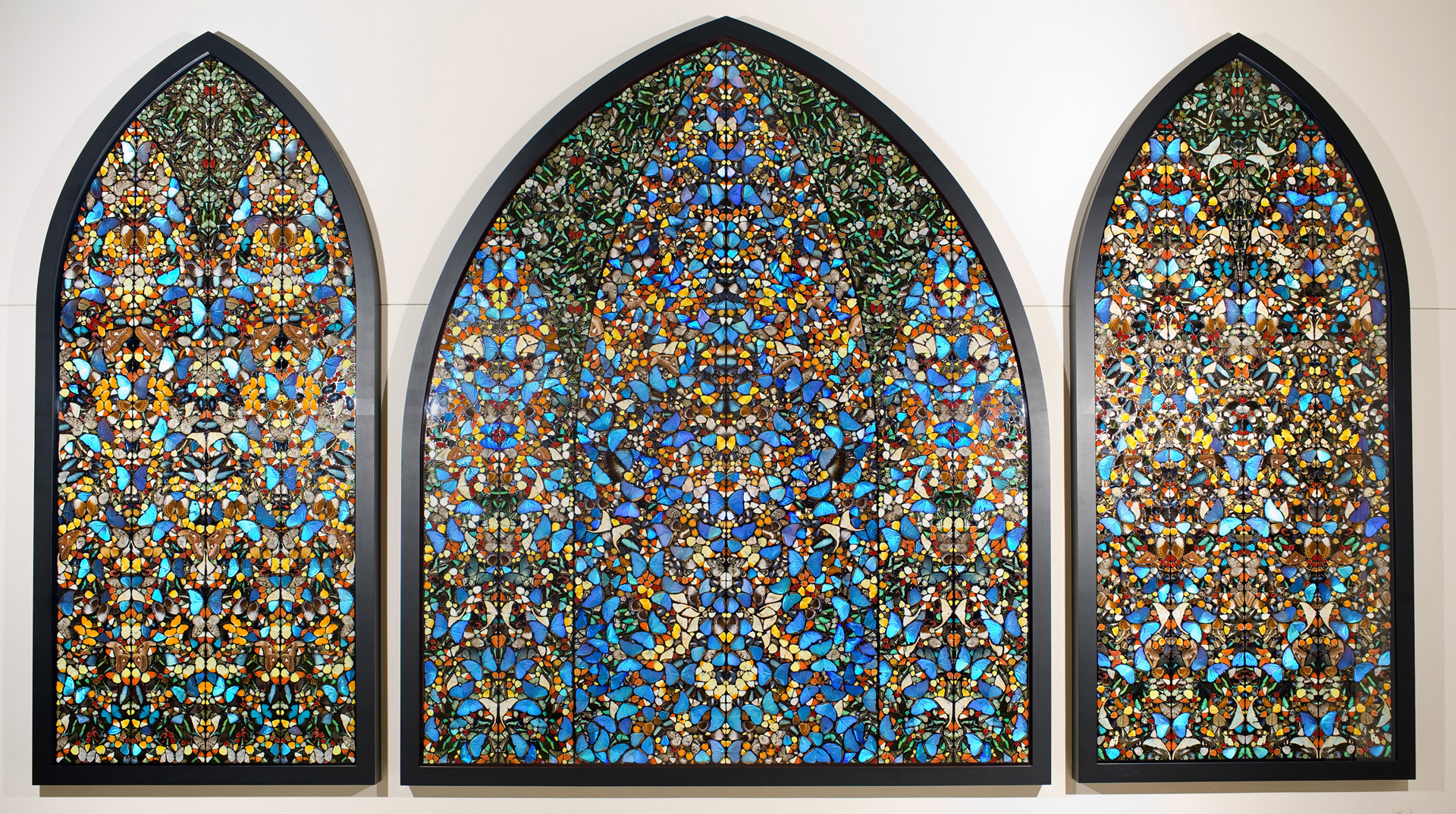
LOOK: The Kingdom of the Father by Damien Hirst

Hirst, Damien_The Kingdom of the Father
Damien Hirst (British, 1965–), The Kingdom of the Father, 2007. Butterflies and household gloss on three canvas panels, 115 7/8 × 190 in. (294.3 × 482.6 cm). Photo: Randy Boverman.

Hirst, Damien_The Kingdom of the Father (detail)
Detail. Photo: Yvette Wohn.

LISTEN: “Seek Ye First” by Emorja Roberson, on The Evening Musicale (2019), feat. the University of Notre Dame’s Voices of Faith Gospel Choir and friends

Seek ye first the kingdom
And watch God add to your life
Seek ye first the kingdom of God
And his righteousness, it shall be yours

No need to worry ’bout the lack in your life
The God I know, he will supply
Submit your request, make it known
Give it to God, leave it alone
But you must have faith and believe what he said
In his word, trust his word

When you pray, seek his face, trust his word—trust and obey
If it’s in his word, you can count on it, trust his word—trust and obey
When you seek him, believe—trust and obey
Trust him, then seek him, and you’ll find him—trust and obey

Seek ye first the kingdom of God
And his righteousness, it shall be yours

I was searching for a good rendition of “Seek Ye First” by Karen Lafferty, a pioneer of the Jesus Movement of the 1970s—but instead I came across this awesome gospel song inspired by the same scripture passage! It was written by Emorja Roberson—pianist, conductor, workshop coordinator, composer, arranger, and classical and gospel vocalist. He graduated with a master’s of sacred music in vocal performance from the University of Notre Dame in 2017 and is currently a student in the school’s doctor of musical arts in choral conducting program, with a focus on the African American repertoire. He is the director of the Voices of Faith Gospel Choir.

Roberson’s “Seek Ye First” is featured in the online project Songs of Notre Dame: A Lenten Offering 2020. The accompanying meditation reads,

In this season, we pause and examine the things that stand in the way of our relationship with God. Notre Dame’s Voices of Faith Gospel Choir reminds us that we must seek God first – before fame, riches, pleasure, or certainty. In order to anchor our lives in God and to direct our efforts towards the coming of the kingdom, we must trust in God’s providence. What might be taking priority in our lives over our relationship with God? How can we re-center this day, this week, and this Lenten season, by seeking God first?

Lent, Day 12

LOOK: Mr. & Mrs. Satan Fishing by Leroy Almon

Almon, Leroy_Mr. and Mrs. Satan Fishing
Leroy Almon (American, 1938–1997), Mr. & Mrs. Satan Fishing, 1991. Polychrome bas-relief wood carving, 22 1/2 × 24 in. Gordon Gallery, Nashville.

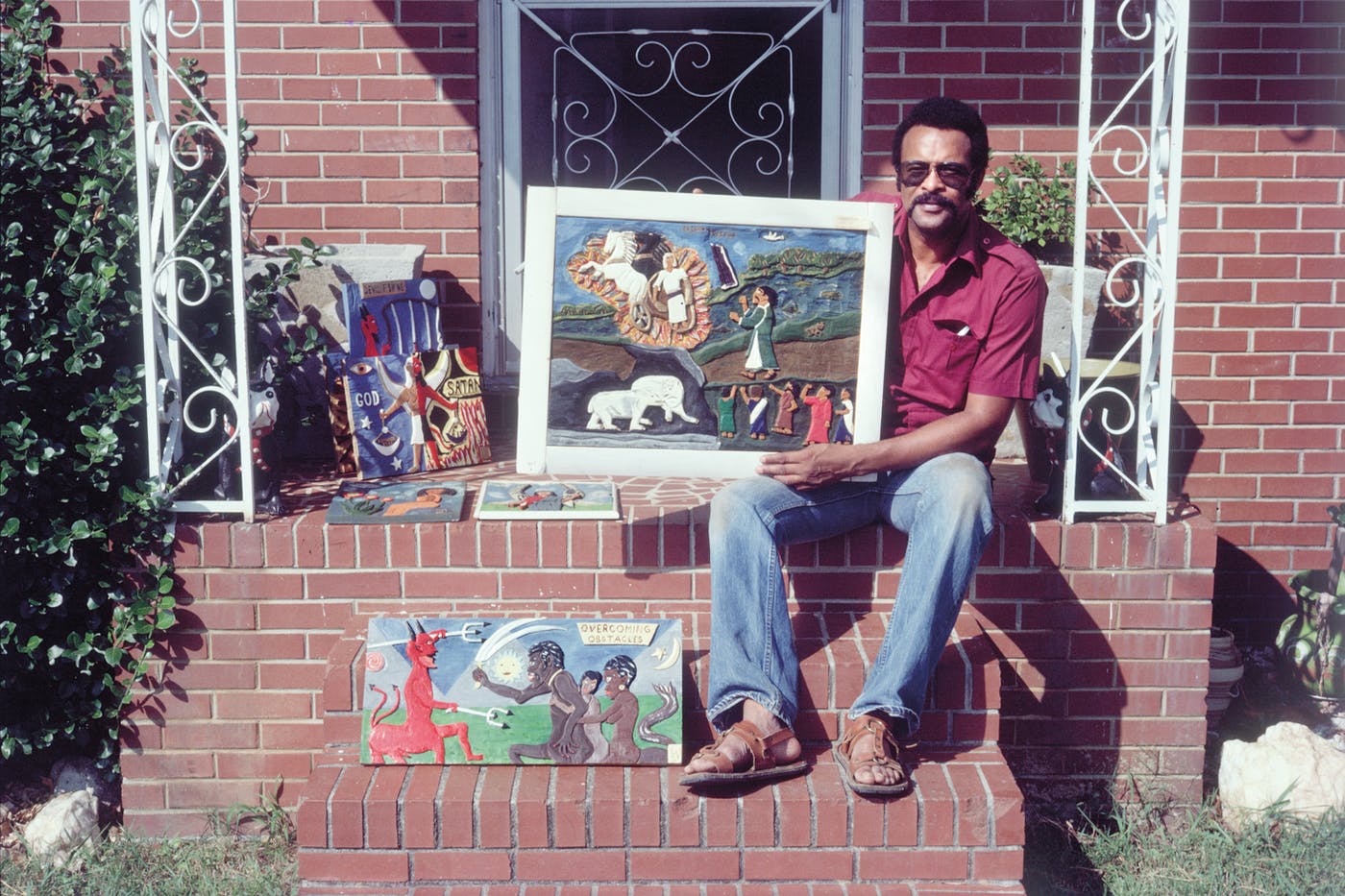
Leroy Almon (1938–1997) was born in Tallapoosa, Georgia, but grew up in Ohio. While working for Coca-Cola in Columbus, he met the self-taught woodcarver Elijah Pierce [previously] at Gay Tabernacle Baptist Church, where Pierce served as lay preacher, and in 1979 became apprenticed to him. Pierce taught Almon how to make low-relief carvings in wood using pocketknives and hand chisels, and then to paint them. Initially the two collaborated on pieces, until 1982, when Almon returned to Tallapoosa. There he restored his childhood home, converting the basement into an art studio. Like his mentor, he too combined the vocations of art making and evangelical preaching.

Almon is well known for his didactic carvings on the subjects of religion, politics, and African American history. The battle between good and evil is at the forefront of his art. Satan fishing for souls is a theme he developed and returned to many times in variation; see, for example, here, here, here, and here. Such carvings show a caricatured Satan (red, horned, spiky-tailed, and goateed) dangling various vices—gambling, promiscuity, sex, drugs, greed, hypocrisy, etc.—as bait before humans who appear ready to bite. Sometimes he’s joined by his wife, Mrs. Satan!

In the version at the Gordon Gallery in Nashville, cards, cash, a romantic couple (presumably unwed), alcohol, cigarettes, a bomb, hard drugs, and a church building are on the line. The latter symbolizes the false piety of many churchgoers and the corruption inside institutionalized Christianity.

In The New Encyclopedia of Southern Culture, Vol. 23: Folk Art, Jenifer P. Borum praises Almon’s ability to “mix fire-and-brimstone warnings about the world’s evils with a playful sense of humor”; she refers to the “comic moralism” of his work. My first reaction upon seeing Mr. & Mrs. Satan Fishing was to laugh out loud. But then I wondered whether the humor was intentional. Does the artist want us to chuckle? I haven’t been able to find any statements from Almon. The image likely represents very real temptations that afflicted his community and maybe, some of them, him personally. I suppose the humor could be self-conscious, but if so, it’s a dark humor—gravitas masked in levity. Almon knew that “like a roaring lion [our] adversary the devil prowls around, looking for someone to devour” (1 Pet. 5:8).

Leroy Almon
Leroy Almon on his front stoop in Tallapoosa, Georgia, 1987. Photo: Roger Manley.

LISTEN: “The Devil Ain’t Lazy” by Fred Rose; originally recorded by Bob Wills & His Texas Playboys, 1947 | Performed by Pokey LaFarge on Pokey LaFarge, 2013

The devil ain’t lazy (No siree)

He roams around with sticks and stones
Passing out his moans and groans
The devil ain’t no lazy bones
He works 24 hours a day

The devil ain’t lazy (No siree)

He likes to see us fight and fuss
Makes us mean enough to cuss
Then he blames it all on us
He works 24 hours a day

He travels like a lightning streak
And he strikes from town to town
Then he gets you when you’re weak
He’ll tear your playhouse down

The devil ain’t lazy (No siree)

He tells us he won’t hurt a fly
Then he makes us steal and lie
Keeps us sinning until we die
He works 24 hours a day

The devil ain’t lazy (No siree)

Gets his pitchfork out each night
Gives the folks an awful fright
I know he does it just for spite
He works 24 hours a day

The devil ain’t lazy (No siree)

Tells us how to find success
I know he’ll wind up in distress
I’ll tell ya why: the devil is an awful mess
He works 24 hours a day

He likes to see things scorch and burn
He don’t make no excuse
If he catches you, he’ll turn you
Every way but loose

The devil ain’t lazy (No siree)

So if you think you’re strong and brave
Smart enough to not behave
You got one foot in the grave
He works 24 hours a day
24 hours a day (Yes, he does!)
He works 24 hours a day

Lent, Day 11

“Enter through the narrow gate; for the gate is wide and the road is easy that leads to destruction, and there are many who take it. For the gate is narrow and the road is hard that leads to life, and there are few who find it.”

—Matthew 7:13–14

Then Jesus told his disciples, “If any want to become my followers, let them deny themselves and take up their cross and follow me. For those who want to save their life will lose it, and those who lose their life for my sake will find it. For what will it profit them if they gain the whole world but forfeit their life? Or what will they give in return for their life?”

—Matthew 16:24–26

These teachings of Jesus give me pause. How do we square them with Jesus’s saying that his yoke is light, and that in him the heavy laden find rest (Matt. 11:28–30)? Crosses are hefty! They weigh down. To follow Christ, do we trade one burden (sin) for another (self-denial)? And is there not a wideness and a freedom to Christ’s way? Narrowness implies constriction. His embrace is certainly wide. But his gate is narrow?

I’ve seen this passage abused by Christians who insist that their own narrow parameters of belief and practice (and I’m talking apart from the historical creeds) constitute the one true path; without accounting for differences of conscience, culture, or biblical interpretation, they label this view or that behavior a “slippery slope” that will lead to destruction.

I have thoughts on some of these questions, but they’re not fully formed. Feel free to share your thoughts in the Comment field.

Rather than ignoring Bible passages that I find confusing or uncomfortable, I prefer to wrestle with them. Below I’ll look at how two artists engage these texts, setting them within a larger framework: German painter Laurentius de Neter and hymn writer Isaac Watts. Both works are old-fashioned, and I don’t give my full endorsement to either one, but I believe they are worth visiting.

LOOK: The Broad and Narrow Road by Laurentius de Neter (aka Laurence Neter)

de Neter, Laurentius_The Wide and Narrow Road
Laurentius de Neter (German, 1600–1649), De brede en de smalle weg (The Broad and Narrow Road), ca. 1635. Oil on canvas, 59 × 78 cm. Museum Catharijneconvent, Utrecht, Netherlands.

The artist painted this image, popular among Protestants, during his three-year sojourn in the Netherlands from 1635 to 1638. I saw it when I was there in 2019, in one of the galleries of the Museum Catharijneconvent in Utrecht. There was a Dutch title given but no description. I spent a while looking at all the details.

In the center is a large tree—green and lush on the left, and dead and barren on the right. A man stands under it, being pulled in two directions.

de Neter, Laurentius_The Wide and Narrow Road-004

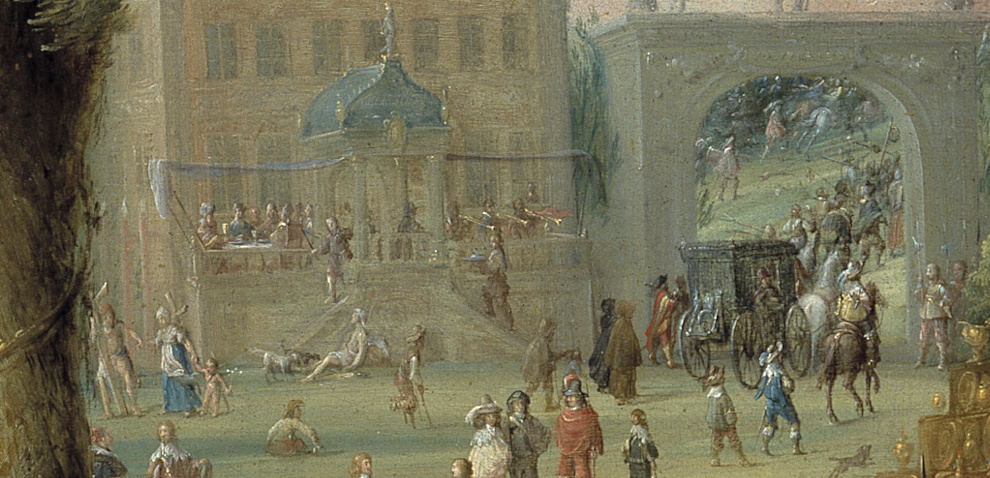
To our right is a skeleton with a bow and arrow, standing in the shadows and representing death, and a finely dressed woman holding an apple, representing temptation. She tries to persuade the man toward a life of earthly pleasures, signified by a pile of cards and dice, a theatrical mask, musical instruments and sheet music, bags of coins, fancy vases, and armor. On this “worldly” side a regent sits on a dais under a canopy before a literal wall of gold—her head ensconced in a glass globe! She is living in a bubble, consumed with self and power. Nearby a lutist and a harpist play at an extravagant outdoor banquet, while in the background a contemporary “Lazarus,” hungry and barely clothed, sits outside the host’s house as two dogs lick his sores.

de Neter, Laurentius_The Wide and Narrow Road-002

In the right background a crowd of people shuffle through a wide archway marked V[olu]pta[t]es, Latin for “pleasures.” (I’m not sure who the sculpted figures on top are supposed to represent.) They are heading toward destruction, as is clear from the blazing fire in the distance. This is one of the paths that is open to the indecisive man at the center.

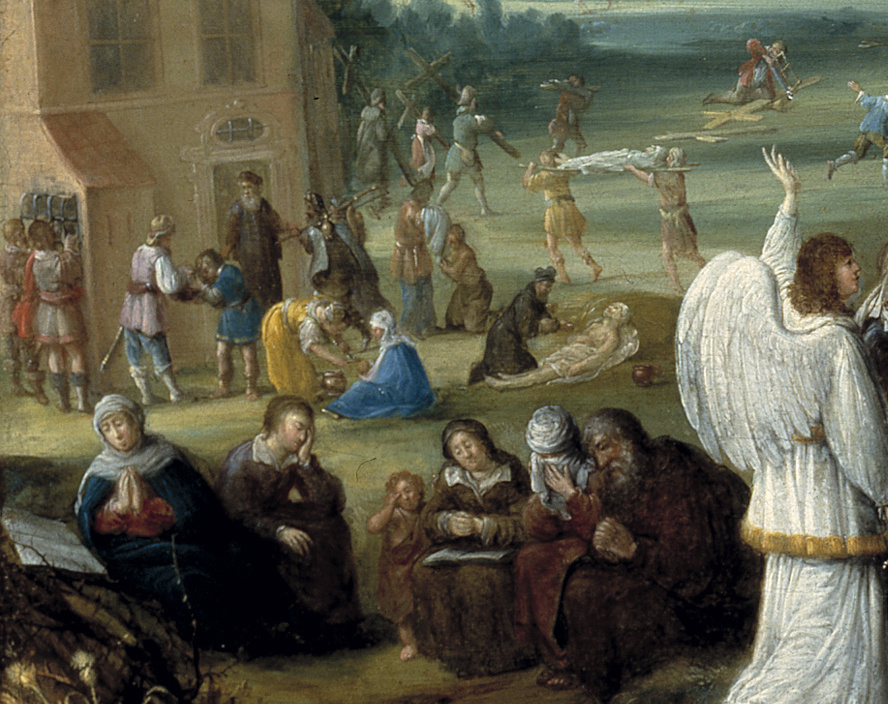
His other option, though, is the way of Christ. He is beckoned there by a simply dressed woman with an infant, representing Christian love, and by an angel who points to the Ten Commandments with his sword.

This “narrow way” is marked by humble prayer and service. At the left, those who have chosen this way enact the seven works of mercy, derived mainly from Matthew 25: feeding the hungry, giving drink to the thirsty, clothing the naked, sheltering the stranger, visiting the prisoner, caring for the sick, and burying the dead. They have taken up their cross, and they head for a narrow footpath that stretches over a body of water and winds up and around a mountain. Those who fall off the path are in danger of landing in the fiery pit at the base.

de Neter, Laurentius_The Wide and Narrow Road (detail)

Even though it’s a popular metaphor and has been for ages, I’m not so keen on envisioning the Christian life as an uphill climb. It’s meant to connote something of the struggle to press on as well as a sense of progression toward a goal—the mountaintop, which stands for heaven. But it seems this picture could falsely suggest that heaven is gained through self-exertion, through laborious effort, and that the journey of faith is one of continual progress or ascent, and that it looks the same for everyone. In reality, sometimes we start out high but regress. Sometimes we travel a different path for a while, but it meets back up with the main, bringing us to a point we couldn’t have gotten to any other way.

While I realize there are scriptures to support the view of faith as a feat of endurance (e.g., Phil. 3:12–14; 1 Cor. 9:24–27; Gal. 6:9), and I’m certainly not suggesting idleness, there are also numerous passages about relying on God’s strength rather than our own; on Christ’s merits, not our own.

I think that as long as we recognize the limitations of the mountain metaphor, bringing a more nuanced understanding to it, it’s fine to retain.

But another problematic idea that this painting could be read as insinuating is that all pleasures, such as good food, the theater, music, and games, ought to be repudiated as distractions at best, idolatries at worst. (No one on the narrow path is seen enjoying such things.) Enjoyment of the arts and of God’s good gifts is not sinful. However, if you come to live only for such pleasures, if you become so consumed with them that they cause you to ignore the needs of those around you and neglect your other Christian duties, then they can become destructive. One might discern this subtle distinction in de Neter’s portrayal of the bombastic displays of wealth and the diners’ apparent exclusion of the poor and disabled from their feast.  

I do appreciate that the artist’s characterization of the “narrow path” includes not just personal pieties but also a social aspect—faith worked out in the public square in material ways, in interactions with neighbors.

LISTEN: “Windham” (Roud 15045) | Words by Isaac Watts, 1707–9 | Music by Daniel Read, 1785 | Performed by the Watersons on Sound, Sound Your Instruments of Joy, 1977

Broad is the road that leads to death
And thousands walk together there
But wisdom shows a narrow path
With here and there a traveler

“Deny thyself and take thy cross”
Is the Redeemer’s great command
Nature must count it all but dross
If she would gain this heavenly land

The fearful soul that tires and faints
And walks the ways of God no more
Is but esteemed almost a saint
And makes his own destruction sure

Lord, let not all my hopes be vain
Create my heart entirely new
Which hypocrites could ne’er attain
Which false apostates never knew

Isaac Watts titled this hymn—quite unattractively!—“Few saved: or, The almost Christian, the Hypocrite, and Apostate.” The tune, which is in the Sacred Harp (aka shape-note) tradition, is by New England composer Daniel Read (1757–1836); it’s named WINDHAM, I’m assuming after the town of Windham, Connecticut, Read’s state of residence. The famous British folk group The Watersons recorded the hymn under that title in the seventies. The text and tune complement each other very well.

I will say, though: I don’t like the third stanza. There’s no grace or compassion in it, no sense of God’s faithfulness to carry his own, his strength applied to our weakness, or his calling back the wayward wanderers. It may be influenced at least in part by Revelation 21:7–8 (KJV): “He that overcometh shall inherit all things; and I will be his God, and he shall be my son. But the fearful [i.e., cowardly], and unbelieving, and the abominable, and murderers, and whoremongers, and sorcerers, and idolaters, and all liars, shall have their part in the lake which burneth with fire and brimstone: which is the second death.” But Watts’s image of tiredness and fainting suggests someone who has picked up their cross and has buckled under its weight, as opposed to someone who outright rejects Christ’s call to cross taking. So in that case, Watts may have more in mind the passages of scripture that mention a believer’s “falling away,” or apostatizing, from the faith (Heb. 3:12; 6:4–12; 10:26–39; Rom. 11:22; 1 Cor. 9:25–27; etc.). Only those who persevere to the end will be saved.

I’m not sure how the “hypocrite” of the title fits into all this.

I don’t wish to get bogged down here with Calvinist versus Arminian debates about whether salvation can be lost, as that would detract from the main point, which is following Christ, staying committed.

I would not program this hymn into a worship service—it’s stark and severe and lacks, as I said, a perspective of divine grace, even if it does honor certain isolated scripture passages—but I wanted to introduce it here nonetheless. Being by the father of English hymnody, it circulated quite widely; the website Hymnary identifies its appearance in 441 hymnals. And it directly ties in to my two selected scripture texts, which are stark and severe, and I know of few other songs that address them. Not all hymns have to have a feel-good quality. Sometimes hymn writers give us something with bite, and that can be OK, even necessary. This one is an admonishment to stay on the straight and narrow. If you’ve veered off course, now is the time to come back!