Next Wednesday, February 14, is the first day of Lent—a season of focused prayer and simple living. During this time I will continue publishing weekly “Artful Devotion” posts based on scripture readings from the Revised Common Lectionary, plus I have a few other posts planned. I’m especially excited about what I’ll be publishing this Sunday—the fruits of many months of labor; I hope you’ll check back!
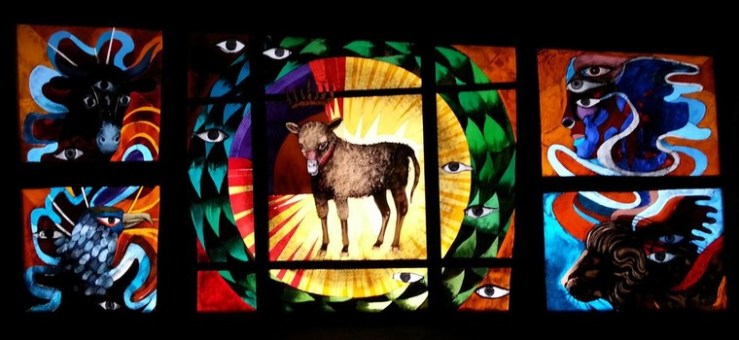
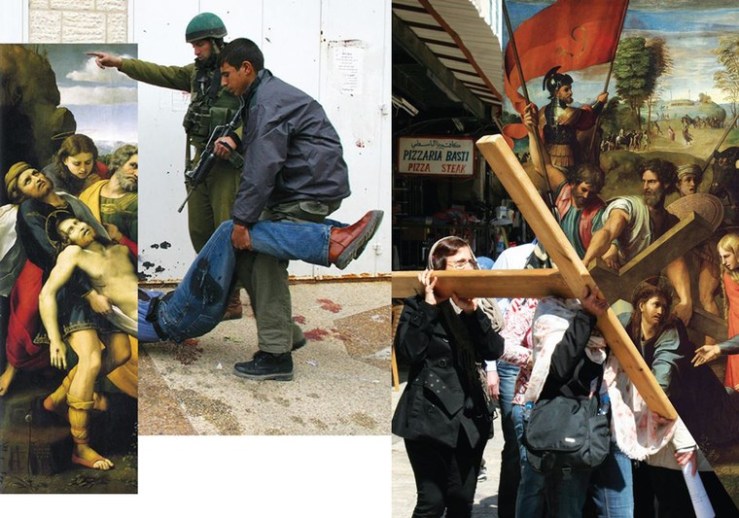
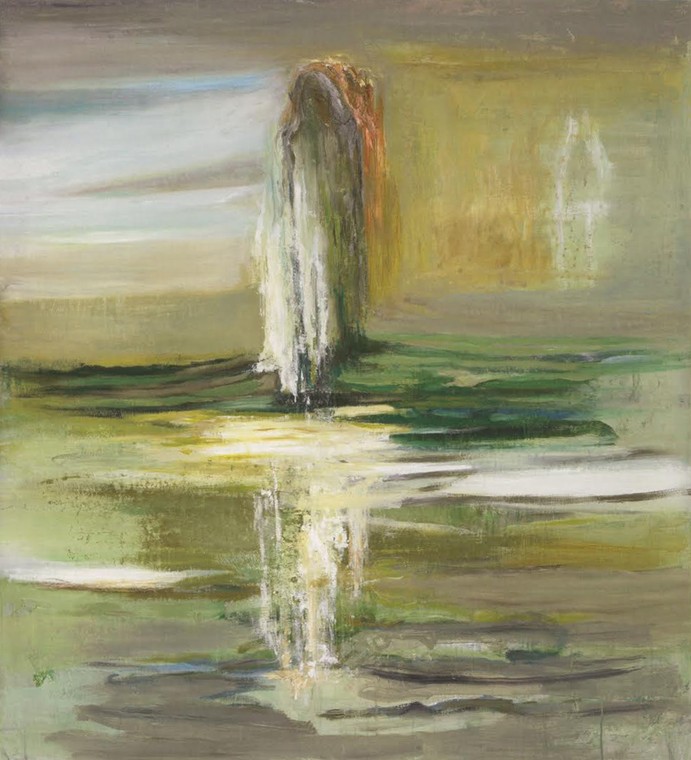
“The Lent Project V” by Biola University: From Ash Wednesday through the first week of Easter, Biola University’s Center for Christianity, Culture, and the Arts will be publishing daily “aesthetic meditations” on Christ’s life, death, and resurrection. The scripture texts, art images, music, and poetry are curated by a CCCA team, and staff are invited to contribute written reflections that respond to them. “The mood of Lent can be beautifully captured through the arts, which are often cathartic expressions of longing, suffering, loneliness, love, death and rebirth,” says university president Barry H. Corey. “Art is a great chronicler both of the drama of human history and the aches of the human heart.” Here are some artworks Biola has featured in previous years; click on each to experience the full devotion:
Michaël Borremans (Belgian, 1963–), The Bread, 2012. Oil on canvas, 29 × 23 cm.Arcabas (French, 1926–), Lamb of God. Stained glass, Notre-Dame des Neiges Church, Alpe d’Huez, France.The Deposition & Christ Falling on the Way to Calvary, 2014. Collage, from “The Presence of the Holy See” project at the Palestinian Museum. Photographs by Alexandra Boulat (French, 1962–2007); paintings by Raphael.Maja Lisa Engelhardt (Danish, 1956–), Jesus on the Shore. Altarpiece, Turup Church, Assens, Denmark.
Lenten Readings 2018 by Kevin Greene: For the seventh year in a row, Kevin Greene, a teaching elder at West End Presbyterian Church in Richmond, Virginia, is publishing short daily devotions, each one containing an art image and a piece of music. (Last year I learned of lots of new artists through him!) For the prayer component he has used various resources in the past—the Revised Common Lectionary, sermons on the cross of Christ across the centuries, Wesley’s Scripture Hymns, and excerpts from the early church fathers—but this year he will be using collects (pronounced COL-lects) from the Book of Common Prayer. Unfamiliar with the term? Click here to read how a collect works. Continue reading “Lent devotionals with arts component”→
Gulap K. Hajarathbai (Indian), Temptation, 20th century. Oil on canvas, 18 × 20 in. Source: Herbert E. Hoefer, Christian Art in India (Chennai, India: Gurukul Lutheran Theological College and Research Institute, 1982)
“Tempted”by Eugene H. Peterson
Mark 1:12–13
Still wet behind the ears, he’s Spirit-pushed
up Jordan’s banks into the wilderness.
Angels hover praying ’round his head.
Animals couch against his knees and ankles
intuiting a better master. The Man
in the middle—new Adam in old Eden—
is up against it, matched with the ancient
Adversary. For forty days and nights
he tests the baptismal blessing and proves to his dismay
the Man is made of sterner stuff than Adam:
the Man will choose to be the Son God made him.
Mark dedicates a spare two verses to this initiatory event in the life of Christ: the forty days of temptation he endured immediately following his baptism: “The Spirit immediately drove him out into the wilderness. And he was in the wilderness forty days, being tempted by Satan. And he was with the wild animals, and the angels were ministering to him” (Mark 1:12–13, ESV; cf. Matthew 4:1–11, Luke 4:1–13).
I’m intrigued by Mark’s use of the word driven (ekballō) to describe the manner in which the Spirit imparts motion to Christ. Whereas Matthew and Luke use the gentler led (anagō), Mark implies something more forceful: ejected, cast forth, hurled. In his idiomatic translation of the Bible, The Message, Eugene H. Peterson uses push: “At once, this same Spirit pushed Jesus out into the wild” (emphasis mine).
So the same Spirit who had just alighted on Jesus in the waters of the Jordan, presiding over God’s pronouncement that “You are my beloved Son; with you I am well pleased” (Mark 1:11), now pushes Jesus into the Judean desert, away from civilization. Why? So that in the quiet, he could get to better know himself and the Father, to better discern the task to which he had been called. This process necessarily involved doing battle with the prospects of other paths, other identities.
“Turn these stones into bread.” “Jump; let’s see if God saves you.” “Worship me; I’ll give you the kingdom of earth.”
Satan tries to draw Jesus from a messiahship of self-sacrifice to a messiahship of power. Performing miracles for his own benefit, to avoid any discomfort or pain in life; performing miracles for show, like a magician, to impress the masses; becoming an earthly king, with political control and dominion—these are all temptations Jesus would face again. Here he has the opportunity to confront them head-on in preparation for his imminent ministry to the Israelites. Over this period of forty days, Jesus solidifies his mission, rejecting the vision of himself and his life that Satan lays out for him. Instead of gratification, pride, and riches, Jesus chooses purity, humility, and poverty. Continue reading “Voices in the desert—whose blessing will we heed?”→
As you may have noticed, I’ve had to ease up lately on my self-imposed one-post-a-week rule to accommodate other projects. For February and March, I’ve been teaching an adult Sunday school course at my church called “Art and the Church: Seeing the Sacred in Global Christian Art”; I have a really great group of people exploring the topic with me, and I’ve enjoyed seeing which images they respond to most. I’ve also been invited by three separate entities to produce content on their platforms this spring: by a missions organization, to curate an online gallery of Passion art; by a divinity school, to write a post for its blog; and by a Christian ministry at Brown University, to deliver a talk to undergraduates. Moreover, I just returned from a trip to California, where I attended a Biola University–sponsored art symposium called “Art in a Postsecular Age”; I got to meet Matthew Milliner and Jonathan Anderson and hear from a panel of other distinguished speakers.
So, while I had every intention of getting this list out last week to coincide with the start of Lent, slide preparations, permissions e-mails, and travels have claimed my focus. I regret that all this revving up has come during a season dedicated to slowing down. Please forgive the slackness, but I’ve decided to practice the “holy pause” for the next forty days (through Easter Sunday). To fast from my obsession with productivity. I will still honor my obligation to those who have commissioned me for specific tasks, but I will be lightening up on the frequency of blog posts. In lieu of Lent-related Art & Theology content, I lift up the following supports for your journey.
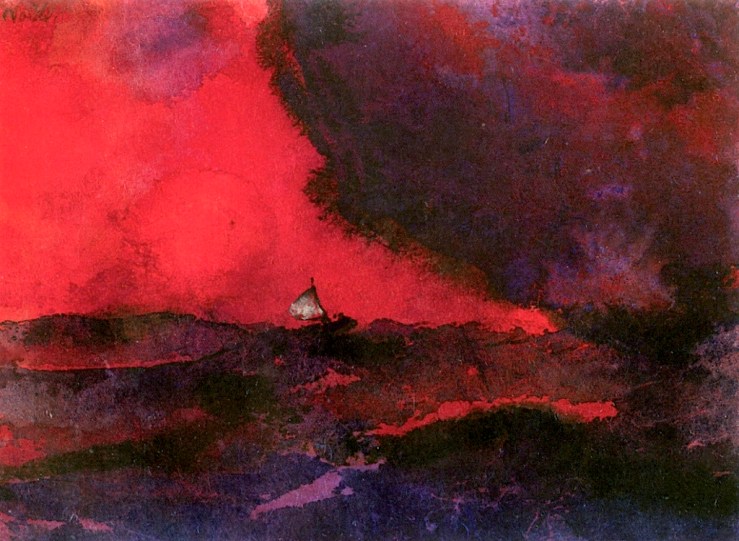
Online devotional with visual art and music: Each Lenten season since 2012, Kevin Greene, an associate pastor at West End Presbyterian Church in Richmond, Virginia, has published an online devotional that comprises for each day an art image, a short scripture reading, a prayer, and a music file. I absolutely love this model, with its spare style: because the entries are light on text, they invite silence, contemplation, seeing, listening. Greene’s image selection is stellar. He doesn’t go for the obvious choices but rather aims at something more atmospheric, more slant. Among the painted subjects, for example, you’ll find a stairway, a storm, a dancer, a reaper; day 1, Ash Wednesday, was a sailboat on troubled waters (pictured below). Fine-art viewing isn’t something that’s typically a part of Protestant devotional practice, so in response to questions he’s received, Greene has described how art operates on the imagination and the spirit. I’ve been greatly blessed moving through the first week of Lent with this companion, and I can’t wait to dive into the backlist entries later on. You can sign up via e-mail in the left sidebar, or simply bookmark the website and visit it each morning.
Emil Nolde (German, 1867–1956), Dark Red Sea, ca. 1938. Watercolor. Nolde Museum, Seebüll, Schleswig-Holstein, Germany.
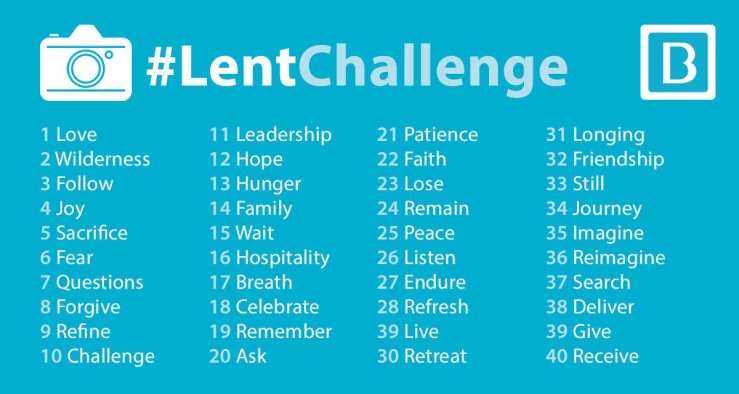
Lent Photo Challenge: The UK-based Bible Society invites people to take one photo per day throughout the season based on rotating themes (e.g., wilderness, hospitality, ask), then share them on social media using the hashtag #LentChallenge. Today is the sixth day of Lent (Sundays are excluded from the traditional forty-day count), and the assigned theme is “fear.”
Essays, short stories, poems, art: Founded in 1989, Image journal seeks “to demonstrate the continued vitality and diversity of contemporary art and literature that engage with the religious traditions of Western culture.” This Lent they’ve curated a selection of literary essays, short stories, poems, and art images from their back issues and their blog, Good Letters, that relate to the season, as well as to Easter. I especially enjoyed “Jeffrey Mongrain: An Iconography of Eloquence.” A few selections might be accessible only to subscribers (you can subscribe here; you won’t be disappointed!). Also available: the book God For Us: Rediscovering the Meaning of Lent and Easter, a full-color devotional with contributions by some of Image’s favorites. Lent is not about becoming lost in our brokenness, the description says, but about cleansing the palate so that we can taste life more fully.
Jeffrey Mongrain (American, 1956–), Blood Pool, 2006. Plexiglas, 47 × 88 in. Saint Peter’s Catholic Church, Columbia, South Carolina.
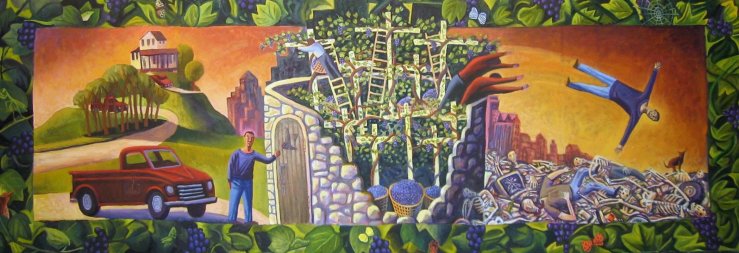
“Lent Is Here to Throw Us Off Again: Finding healing in repetition, community, and art” by W. David O. Taylor: An excellent introduction to Lent, addressing unselfing, dying a good death, opening up vacant space, and praying with the eyes. This Christianity Today article is adapted from the foreword Taylor wrote for artist James B. Janknegt’s new book, Lenten Meditations, which features forty of Janknegt’s paintings on the parables of Jesus, along with written reflections. Artists like Janknegt, Taylor writes, “fix before us an image of a world broken by our own doing, but not abandoned by God. They question our habits of sight. They arrest our attention. See this image. See it for the first time, again. See what has become hidden and distorted. See the neglected things. See the small but good things. It is in this way that artists can rescue us from what the poet Samuel Taylor Coleridge calls the ‘film of familiarity’ and the ‘lethargy of custom.’”
James B. Janknegt (American, 1953–), The Wicked Tenants, 2008. Oil on canvas, 24 × 72 in.
Stations of the Cross in Washington, DC: This Lent, Dr. Aaron Rosen and the Rev. Dr. Catriona Laing of the Church of the Epiphany have organized a combination pilgrimage and art exhibition, featuring works located throughout Washington, DC, in places both sacred and secular. Mostly contemporary, some newly commissioned, the works include George Segal’s Depression Bread Line, the Vietnam Women’s Memorial by Glenna Goodacre, Barnett Newman’s Stations cycle at the National Gallery of Art, a video installation at First Congregational United Church of Christ by Leni Diner Dothan, and more. Participants can follow the stations by downloading the app “Alight: Art and the Sacred,” which offers maps and audio commentary (my friend Peggy Parker is a contributor!). (If you don’t have a smartphone, you can view the maps and listen to the commentary through a browser by following the primary link above.) Also check out the accompanying devotional guide.
Lent by The Brilliance: This 2012 EP by The Brilliance, a duo comprising David Gungor and John Arndt, has seven tracks: “Dust We Are,”“Now and at the Hour of Our Death” (the rerelease on Brother removes the invocation to Mary), “Dayspring of Life,”“Does Your Heart Break?,” “Holy Communion,” “Violent Loving God,” and “Have You Forsaken Me?” Each one is a beautiful prayer, the words organized around a string quartet. Some take the shape of praise, others lament. God is supplicated for peace, mercy, light. The first track well captures the spirit of Lent: “Be still my soul and let it go, just let it go.” Click here to read a 2015 Hallels interview with The Brilliance, or here to listen to a podcast interview by David Santistevan.
The salty, twisted treats that we call pretzels have their origin, it is thought, in a seventh-century European monastery—according to lore, either in southern France, northern Italy, or Germany. Allegedly a monk invented them by shaping scraps of leftover bread dough to resemble arms crossed in prayer over the chest. (Think upside-down pretzel.)
During the Middle Ages the church’s fasting requirements for Lent were stricter than they are today, forbidding the intake of all nonaquatic animal by-products, including eggs, lard, milk, and butter. Because pretzels could be made with a simple recipe that avoided these banned ingredients, they soon became associated with the season.
Detail from The Battle between Carnival and Lent by Pieter Bruegel, 1559, showing the gaunt Lady Lent (a man cross-dressed as a nun) riding a cart bearing traditional Lenten fare: pretzels, waffles, and mussels. He holds, like a lance, a baker’s peel topped with two herring.
The pretzel’s Lenten link, not to mention its popularity as a year-round snack both inside and outside monastic communities, led artists to sometimes paint pretzels into Last Supper images.
The Last Supper, from a bishop’s benedictional made in Bavaria, Germany, ca. 1030–40. J. Paul Getty Museum, Los Angeles: MS Ludwig VII 1, fol. 38.
Who are you? Why do you not let me live
As I please? And how could your caress, so rough,
Be kinder than my smooth alternative?
Your steel-brush strokes are forcing me to slough,
Daily, my fleshy growths of appetite,
But still they come; I cannot have enough.
I would forever scratch my itches, light
At first, then harder at the thickened sore;
But you would give me radical delight,
Gouging my itches till I have no more.
“The Pleasure Principle” is published here with the permission of Southern Humanities Review, where the poem first appeared in Spring 1974.
+++
In this poem, sinful desires are characterized as skin sores whose itchiness is temporarily relieved when scratched—but the scratching also makes the sores become irritated and enlarged and even more vile-looking, and the itch comes back not too long after.
The speaker addresses God, first in a posture of defensiveness. God has presumably penetrated his conscience, illuminating his sin, and he responds with a string of accusatory questions to the effect of, “Who do you think you are, coming into my life, telling me what I can and can’t do? I am happy as I am, thank you very much.” Continue reading ““The Pleasure Principle” by Raymond Oliver”→
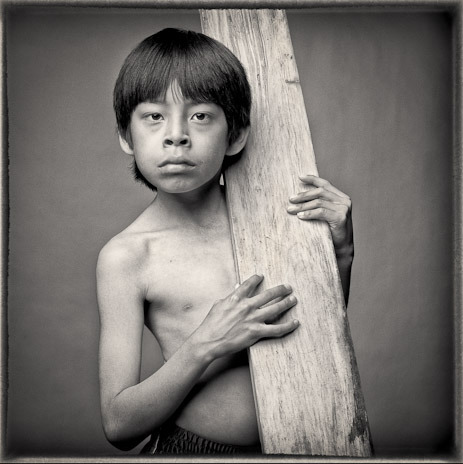
While working at a rehabilitation center for torture survivors in Chicago, Greg Halvorsen Schreck was struck by the profound physical and emotional traumas these individuals had experienced. He thought of Christ, who suffers in solidarity with those who suffer. And he thought that as a fine-art photographer, maybe he could tell the story of this via dolorosa (“way of sorrow”) they were traveling, by linking it to the medieval Christian devotional practice of the fourteen stations of the cross.
Greg Halvorsen Schreck (American, 1957–), Station 2: Jesus is given his cross, from the Via Dolorosa project, 2012. Photograph.
The stations of the cross originated in the thirteenth century as a way for Christians to enter more fully into Jesus’s last hours by praying visually, verbally, and bodily with fourteen images that highlight various points along his journey to the cross, from his trial to his entombment. Derived from the scriptural accounts (save for the legendary addition of Veronica’s veil, plus the embellishment of Christ’s three falls), the stations offered a stay-at-home alternative for Christians who couldn’t afford a pilgrimage to Jerusalem: instead of literally walking the road between Antonia fortress and Golgotha, they could walk it metaphorically, in their imaginations, with fourteen way stations to provide particular foci.
The models Schreck used in his Via Dolorosa cycle—which can be viewed in full here, and in the video below—are not themselves torture survivors. (That would have posed a safety risk.) But “the stories and the general ethos of those in our midst wounded by war, political upheaval, and unspoken violence shaped my approach,” he said.
It was important to him to portray a range of ethnicities—which is why his stations include people not only of European descent but of Latin American, Caribbean, Middle Eastern, East Asian, and African descent, including a few of mixed race. The falling Christ is portrayed by a Mexican American veteran of the Iraq War. Simone of Cyrene is portrayed by an Ethiopian woman. Mary Magdalene, with her jar of incense, is portrayed by a woman who is half-Syrian.
Schreck also included his two children, adopted from Guatemala, in the project. His daughter, Magdalena, is cast alongside three of her friends as a daughter of Jerusalem in station 8 (top left). His son, Teo, is featured in stations 2 and 13; in the latter, Schreck himself stands in for Joseph of Arimathea or Nicodemus, a reference to Michelangelo’s self-portrait in his Florence Deposition sculpture, Schreck says.
Songs for Lent is a collaborative album by musicians, songwriters, and producers from around the country, forming a collective based out of Brooklyn, New York. Released in 2013, it reflects on themes of temptation, suffering, sin, death, grace, and longing.
Except for two originals, all the hymn texts were written between the sixteenth through eighteenth centuries. Bruce Benedict, the chaplain of worship arts at Hope College in Holland, Michigan, curated them for this project, based on their theological richness and their fittingness for Lenten meditation. I applaud his selections, most of which have heretofore been little known and little sung in the church.
The one that’s most familiar is probably “Alas and Did My Savior Bleed”—this is the only song on the album whose traditional melody is retained. All the others feature brand-new musical settings by twelve different songwriters; in a few cases, two interpretations of the same text are included. Though I enjoyed every contribution, I especially like the ones by Jason Pipkin: “Remember, Lord, Our Mortal State” and “Away, My Unbelieving Fear,” which he performs with his wife, Kanene Donehey Pipkin.
The collective—they call themselves “New York Hymns”—is graciously providing Songs for Lent for free streaming and download on Bandcamp. (Donations are welcome.) Lead sheets and chord charts can be accessed at www.newyorkhymns.com.
Below is the track list. Because most of the lyrics on the album are excerpts from longer hymns, I’ve included a link to the full original lyrics for each one in a parenthetical note.
Tomorrow, Ash Wednesday, marks the first day of Lent, a season of concentrated prayer, repentance, and simple living during which the church as a collective prepares herself to experience the resurrection joy that is Easter. Most people associate it with fasting—from food or other distractions; this is not an end in and of itself but is for the purpose of cultivating a greater dependence on God and an openness to his will. As Wendy M. Wright writes in her book The Rising, “The forty days of Lent celebrate the dismembering, disequilibrium, and dying that are preludes to the creative transformation of Eastertide. It is a season of being changed and emptied so that new life might come to birth in us and resurrection be found in us as well” (17).
The designation of a forty-day season leading up to the feast of the resurrection is at least as old as the fourth century, as the bishops at the Council of Nicaea in 325 spoke of the quadragesima paschae (“forty days before Easter”). The calculation of days, however, is not that straightforward, and varies by denomination: Roman Catholics count from Ash Wednesday to Holy Thursday (44 days), whereas most Protestants count through Holy Saturday (46 days; excluding Sundays, which are non-fast days, makes 40), and the Orthodox Church uses a different calendar entirely.
Lent is like getting your yearly physical. It’s not that we aren’t to maintain our health throughout the year but that having an “appointment” forces us to come face-to-face with the state of our souls and to really hear the Doctor’s orders. We self-examine, and then we attend to those parts of ourselves that need improvement.
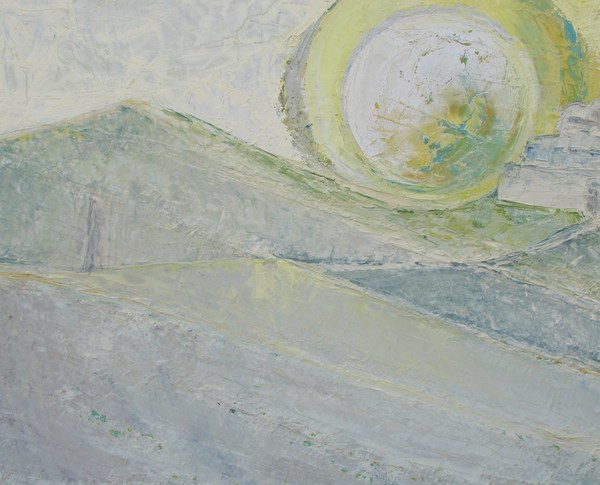
Macha Chmakoff (French, 1952–), Jésus au désert n°2 (Jesus in the Desert 2). Oil on canvas, 65 × 81 cm.
Even though Lent involves pointed reflection on human neediness and the confrontation of sin, it is not meant to be all dark and glum, nor characterized only by emptying. The word “Lent” actually means “springtime”; it’s a time of renewal, growth, filling. Inspired by Jesus’s retreat into the desert to overcome temptation and more fully inhabit his baptismal identity, we too retreat into a proverbial desert, saying no to one or more things so that we can say yes to something else. Continue reading “The season of Lent”→







 Art & Theology