Magnificat roundup: Visio divina with Mary Gardner, “For Ages Women Hoped and Prayed,” and more

QUOTES:

Mary’s response to this announcement [of Jesus’s forthcoming birth]—her Magnificat—is even more overtly revolutionary. Her song in Luke’s Gospel is not a lullaby; it is a manifesto. She declares that the mighty will be cast down from their thrones, the lowly lifted, the hungry filled with good things, and the rich sent away empty. This is the language of redistribution, the language of a world reordered by justice rather than domination. It is no surprise that tyrants have feared this text; throughout modern history, the Magnificat has been prohibited and/or discouraged in public worship in places like Guatemala, Argentina, and India because oppressed communities used it as a rallying cry for liberation. Mary’s theology is insurgent.

—Kat Armas, “The Politics of Birthing God,” Some Things Abuelita (Substack), December 2, 2025

What I love about Hannah and Mary is they step into God’s eternal streams of justice and of righteousness and of what it means to live as a faithful follower of Yahweh. They step into this expansive world of what God is going to do and has promised to do in the world, instead of the smaller space of their own need—which again, is OK and understandable. But they take us to places where, if we’re honest, most of our prayers don’t regularly go.

—Rev. Dr. Tracey Bianchi, “Waiting with Women (Advent Series Part 2): Hannah’s Story and the Gift of Peace (Shalom),” The Alabaster Jar (podcast), December 8, 2025

+++

VIDEO DEVOTION: “Beholding the Magnificat with Mary Gardner”: In this “Space for God” video devotion from Coracle, Rev. Mary Amendolia Gardner, an Anglican priest with a bachelor’s degree in art history and a master’s in Christian spirituality, guides us in lectio divina (sacred reading) with Luke 1:46–55 and visio divina (sacred seeing) with James Tissot’s Magnificat.
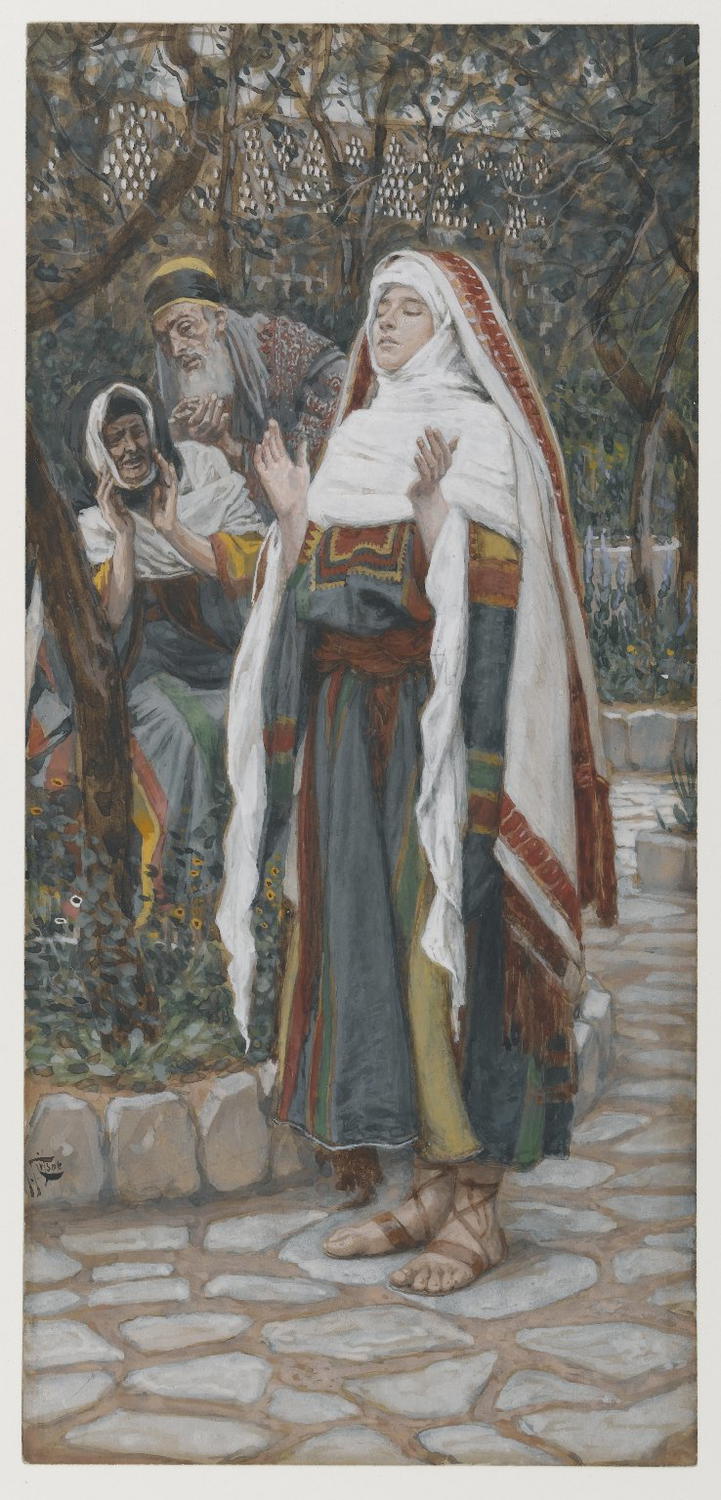
Tissot, James_The Magnificat
James Tissot (French, 1836–1902), The Magnificat, 1886–94. Opaque watercolor over graphite on gray wove paper, 9 15/16 × 4 5/8 in. (25.2 × 11.7 cm). Brooklyn Museum, New York.

I typically don’t care for Tissot’s biblical watercolors, because of their illustrative quality—they remind me of pictures from the Sunday school curriculum I followed as a child. But I do like this one, which shows Mary in a position of wisdom and authority, absorbed in prayer, preparing to preach and prophesy. Elizabeth and Zechariah stand in attentive awe on the sidelines, their eyes directed toward the divine child she carries in her body while they await her words. The priest’s tongue had been tied, but Mary’s has been loosed. The Cuban American theologian Kat Armas, in the post quoted above, calls Mary “the first theologian of the Gospel,” as she boldly proclaims the messianic deliverance God has set in motion.

+++

SONGS:

>> “For Ages Women Hoped and Prayed” by Jane Parker Huber: “We join the song that Mary sings, an earthly, heavenly theme.” Performed at Wheaton Bible Church in Illinois.

>> “Mary, Did You Know” with alternative lyrics by Jennifer Henry: The original lyrics of this Gaither Vocal Band song were written by Mark Lowry in 1985, and they were set to music by Buddy Greene in 1991; the song became a popular hit. However, some Christians take issue with the rhetorical device that implies Mary did not know her son was God, that he would deliver Israel, and that he would reign forever, when that’s precisely what Gabriel told her from the beginning and what she alludes to in her Magnificat. (Defenders say these questions are most likely voiced by people in Mary’s life who didn’t know all that God had conveyed to her; or that it’s legitimate to wonder whether Mary knew the specifics that would unfold, and to suppose that even if she knew theoretically who Jesus was, she may have struggled to grasp the full scope and significance of his messiahship.)

In 2017, the Canadian theologian and activist Jennifer Henry rewrote the lyrics to center on the Magnificat and its mobilizing influence on justice movements across the globe. That song is sung here by Eric Lige, who is accompanied by Vahagn Stepanyan on piano.

>> “Magnificat” by Simon de Voil, feat. Alexa Sunshine Rose: This adaptation of the Magnificat is by Simon de Voil, a sacred musician, “interspiritual minister,” and retreat leader originally from Scotland now living in Vermont. The imagery in the video is not what I would have expected: It’s footage of bears in the woods. Perhaps it alludes to how all of creation will be redeemed in “the world that is to come”? The bears here, though, seem at peace, so maybe it’s a picture of blessedness, or of creation’s praise alongside Mary’s.

+++

SERMON: Liberated to See by the God Who Sees” by Wes Vander Lugt, Trinity Forest Church, Concord, North Carolina, December 7, 2025: I’m always pleased when preachers, as part of their biblical exegesis, skillfully integrate art into their sermons—not as mere illustration or decoration but as itself interpreting scripture and/or doing theological work. In the sermon he gave for the Second Sunday of Advent this year, Rev. Dr. Wes Vander Lugt [previously], an ordained Presbyterian minister and director of the Leighton Ford Initiative in Theology, the Arts, and Gospel Witness at Gordon-Conwell Theological Seminary, preached on Luke 1:5–25, 39–45, about how God sees us and liberates us to see him and others. He discusses Rembrandt’s Visitation painting, especially the artist’s use of light and shadow—Mary and Elizabeth step out of the shadows, out of a place of feeling unseen, into the light of God’s grace, says Vander Lugt, where they are known and knowing.
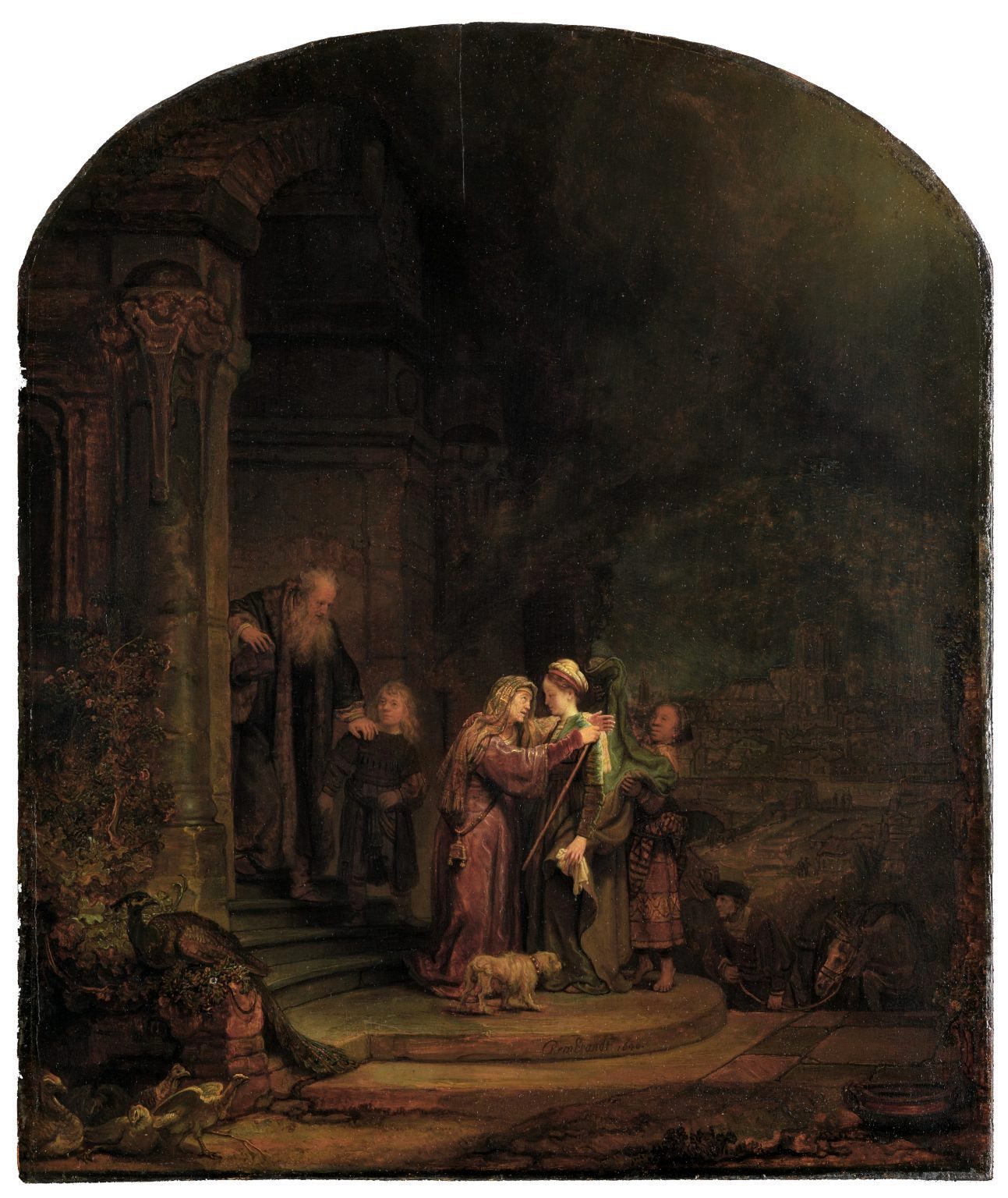
Rembrandt_Visitation
Rembrandt Harmensz van Rijn (Dutch, 1606–1669), The Visitation, 1640. Oil on cedar panel, 22 1/4 × 18 7/8 in. (56.5 × 47.9 cm). Detroit Institute of Arts, Michigan. [object record]

He also touches on, very briefly, James B. Janknegt’s 2008 Visitation, which shows how John the Baptist has been liberated to see Jesus, even as the two are still in utero. See 17:49–20:05.

+++

FROM THE ARCHIVE: The Magnificat is a topic I’ve covered on the blog several times over the past ten years. Here are some examples:

Juneteenth Playlist: Songs of Black joy, liberation, and faith

Juneteenth (June 19) is a federal holiday in the United States celebrating the liberation of enslaved African Americans in Texas in 1865. Abraham Lincoln had issued the Emancipation Proclamation on January 1, 1863, but it was not implemented in places still under Confederate control, and because Texas, being on the westernmost edge of the Confederacy, was farthest from the military action of the Civil War, Texans could conveniently continue to enslave, as there were no soldiers there to enforce the executive decree. But when Union troops, both white and Black, arrived in Galveston Bay on June 19, 1865, two months after the official end of the war, they saw to it by threat of force that the 250,000-plus enslaved Black people in the state were freed.

Also known as Emancipation Day or Jubilee Day (after the year of release mandated by ancient Israelite law), Juneteenth has been celebrated by African American communities in Texas ever since the first anniversary of the freeing event. Historically, the church has been at the center of these celebrations, as the formerly enslaved attributed their liberation to God, to whom they gave effusive thanks and praise. In the twentieth century, Juneteenth expanded into other states but still remained very niche, until 2021, when, after decades of lobbying by Black activists, President Joe Biden signed into law the Juneteenth National Independence Day Act, moving the holiday into the mainstream.

Juneteenth marks not only that one historic day but also, more broadly, freedom as an ongoing struggle. It’s not as if the illegalizing of chattel slavery, or even the passage of the Civil Rights Act of 1964, ended racial oppression or prejudices, which manifest today in, for example, the racial wealth gap, voter suppression, and disparities in policing. We have made important progress as a country, for sure, but there’s still a ways to go until everyone breathes free.

Bishop T. D. Jakes of The Potter’s House in Dallas says that Juneteenth must involve a reckoning with our nation’s sordid past and a commitment to identifying and rooting out whatever sordidness persists. “It’s vital we all must remember when liberty and justice is delayed or denied, it causes traumatic ripples throughout future generations. . . . As we collectively stop to acknowledge and learn from the delayed liberties of our nation’s ancestors, we must not allow those same systems to repeat injustices.”

In recognition of Juneteenth, I’ve compiled on Spotify 118 songs of Black joy, liberation, and faith. From Beyoncé to Duke Ellington, Adolphus Hailstork to Rhiannon Giddens, Mary Lou Williams to Richard Smallwood, these artists jubilate, extol, lament, protest, revel, testify, and hope.

I acknowledge the complications of me, a white person, offering this playlist. I have grappled with how to appropriately celebrate Juneteenth and how to balance its predominant tone of joy (am I allowed to feel joy?) with an honest accounting of past and present evils that mark the Black experience in America, especially slavery and its legacy. One basic piece of advice I’ve heard is to center Black voices. Listen to and lift up Black historians, Black theologians, Black novelists, Black songwriters, etc.  

The Art & Theology Juneteenth Playlist combines sacred and so-called secular music written and/or performed by Black artists and exhibiting a spirit of defiant joy. It emphasizes the beauty, power, creativity, and divine belovedness of Black people.

Honoring the religious roots of Juneteenth and the faithful ongoing witness of the Black church, I have incorporated many Christian songs, especially those that speak to the imago Dei and to God’s faithfulness, guidance, and deliverance. The Bible is full of divine deliverance tales: the Israelites from slavery in Egypt; Daniel from the lions’ den; the three Hebrew boys from the fiery furnace; Jonah from the belly of the whale; Paul and Silas from prison. “Didn’t my Lord deliver Daniel? Then why not every man?” sings one spiritual. Another, “Go Down, Moses,” confronts Pharaoh, a stand-in for white Southern enslavers, with the demand “Let my people go,” while yet another exults in the toppling of Pharaoh’s power—“Pharaoh’s army got drownded.” The spiritual “Satan, We’re Gonna Tear Your Kingdom Down” addresses the Enemy directly, expressing resolve to overthrow demonic systems and ideologies, such as white supremacy.

There are also plenty of feel-good vibes on the playlist, lighter songs like Lee Dorsey’s “Occapella,” Count Basie’s “Jumpin’ at the Woodside,” and Jon Batiste’s “Freedom” (with its stylish, smile-inducing music video that I can’t get enough of!):

There’s also the gospel song “This Joy” by Shirley Caesar, sung by the Resistance Revival Chorus:

Its first verse is: “This joy that I have—the world didn’t give it to me. . . . The world didn’t give it, and the world can’t take it away.” “This strength,” “this love,” and “this peace” follow in subsequent verses—otherworldly qualities given to us by God, as Caesar makes explicit in the original, and which no one can ever steal from us. No matter what harm people may do to us, we still possess these inner gifts, which help us face whatever comes.

Composed in the antebellum South, “No More Slavery Chains for Me” (aka “Many Thousands Gone” or “No More Auction Block”) holds together proclamation and grief. The speaker boldly asserts her freedom: “No more slavery chains,” “no more auction block,” “no more peck of corn,” “no more driver’s lash,” “no more mistress’ call,” “no more children stole from me.” It could be spoken by someone who is still enslaved but who refuses to tolerate that condition any longer, or it could be spoken by someone recently freed, rejoicing in what she has escaped. But the solemn refrain, “Many thousands gone,” remembers the multitudes whom slavery has killed. Here’s a performance by mezzo-soprano Shirley Verrett, an international opera star active from the late 1950s through 1990s:

Often words fail to capture the emotional intensity one might feel. “Triptych: Prayer / Protest / Peace” by Max Roach, from his 1960 avant-garde jazz album We Insist!: Freedom Now Suite, featuring Abbey Lincoln, consists almost entirely of wordless vocal expressions, screaming, and sighing, along with drumming by Roach. It’s mournful and alarming. The only words are at the beginning of part 3: “I need peace.” Cued up here (starting at 5:50) is Lincoln and Roach’s performance of the first two parts of “Triptych” for a Belgian TV station that aired January 10, 1964. (The earlier song in the video is “Tears for Johannesburg,” from the same suite.)

In the liner notes for We Insist!, Nat Hentoff writes that “Triptych” is a “final, uncontrollable unleashing of rage and anger that have been compressed in fear for so long that the only catharsis can be the extremely painful tearing out of all the accumulating fury.”

From the same era and genre is “They Say I Look Like God” from The Real Ambassadors, a jazz musical by Dave Brubeck and Iola Brubeck that never made it to the stage but that was recorded in the studio in 1961 and released a year later. Sung by Louis Armstrong, the song opens with these humorous lines, which Armstrong delivers with chilling earnestness:

They say I look like God
Could God be black? My God
If all are made in the image of Thee
Could Thou perchance a zebra be?

This is one-half of the first of four verses, all of which are interspersed with lines of scripture from Genesis 1 and 1 John 4 intoned, like a liturgical chant, by the trio Lambert, Hendricks & Ross, affirming the inherent goodness of Black folks, bearers of the divine breath. Verses 2 and 3 are addressed to God, pleading that he would show “that our creation was meant to be.” The final verse expresses longing for the day

When God tells man he’s really free
Really free
Really free
Really free

The creation narrative of Genesis 1 is also where Sho Baraka’s “Black as Heaven” opens—with beautiful Blackness, sacred humanity. Historically the color white has been used to symbolize goodness, purity, and heaven, but Baraka turns that symbol inside out and declares that he is “black as heaven.” If God created all humans in his image and many of those humans have black skin, then Blackness is a reflection of God. The Creator loves what he created, and we should too.

Heaven is full of Black saints and will continue to fill with such. The song lists many from across the fields of politics, music, history, education, theology and homiletics, agricultural science, and the culinary arts: Dr. Martin Luther King Jr., King Ezana of Aksum, King Lalibela of the Zagwe dynasty, Mahalia Jackson, Athanasius, Mary McLeod Bethune, George Washington Carver, David Walker, Edna Lewis, Carter G. Woodson, Bishop G. E. Patterson, Sister Rosetta Tharpe. These men and women are all “black as gold,” not in the sense that they are commodities or currencies, but rather are holy, luminous; and black as life-giving soil.

This is one of the songs commissioned for the 2022 documentary Juneteenth: Faith and Freedom [previously], and it includes a rap by Mag44 of Zambia. There’s so much richness in it, and I encourage you to follow along and sit with the lyrics, investigating any unfamiliar references and, depending on your background, humbly receiving the critiques or gladly receiving the affirmations.

In addition to hip-hop and jazz, the playlist is full of songs from the civil rights movement, such as “Woke Up This Morning with My Mind.” This old gospel song was recorded by Roosevelt and Uaroy Graves in 1936 and adapted in 1961 by the Rev. Robert Wesby, a Baptist minister from Aurora, Illinois. Wesby first sang it while spending time in jail in Hinds County, Mississippi, as a Freedom Rider, replacing the repeated word “Jesus” with one of Jesus’s key platform goals, “freedom”: “Woke up this morning with my mind stayed on freedom.”

This song became an important one in civil rights marches, and is led in the above recording by the famous activist Fannie Lou Hamer. For subsequent verses, she sings “Walkin’ and talkin’ with my mind . . . ,” “Singin’ and prayin’ with my mind . . . ,” “Ain’t no harm to keep your mind . . .” Stayed on freedom.

“Ain’t No Grave” is another traditional gospel song, first recorded by Bozie Sturdivant in 1942 and then by Sister Rosetta Tharpe in 1946–47. It’s about the general resurrection, when the saints will be called up out of their graves, but it’s also about indestructibility, the refusal to be or stay buried. I chose a more recent arrangement performed by jazz vocalist Tiffany Austin [previously], from her 2018 album Unbroken:

Hers starts off with the percussive sounds of a ring shout, a style borrowed from the Gullah Geeche of South Carolina’s Sea Bird Islands, and then goes on to incorporate scat singing. It’s full of enthusiastic energy!

One of the most powerful songs on the playlist is “Make It Home” by Tobe Nwigwe, written after the murder of George Floyd in May 2020. The song is “for the nappy heads in heaven, with a nappy-head Christ by they side”—for Blacks who have died.

It’s also a prayer and a blessing for Blacks who are living. “I pray you catch a wave that doesn’t subside. . . . May your streets be paved with gold. Hope my whole hood make it home.” He prays that his friends, family, and neighbors are able to make it safely back to their homes each night and are not killed in the streets. But “home” operates on other levels as well. To be at home with yourself, for example, is to feel whole, confident, secure in your body. Home also implies belonging. And of course “home” can also mean heaven, that place of ultimate freedom and rest. Are we creating the necessary conditions for freedom and rest here on earth as it is in heaven?

I learned about this song from Dr. Mary McCampbell (see the February 17, 2022, installment of her newsletter, The Empathetic Imagination), who teaches the music video in her humanities class at a Christian university.

Collectively, the songs on this playlist reflect the multifaceted spirit of Juneteenth, which encapsulates exultation, passion, power, praise, irrepressibility, resistance, sorrow, anger, and hope and trust. Like Juneteenth itself, the playlist is a looking back and a looking forward. We Americans are a people “on our way.” The work of emancipation is unfinished. These Black artists invite us to join the work.

I invite you, as a way of commemorating the holiday, to:

1. Choose one of the songs and pray from it.

2. Choose one of the artists and explore more of their oeuvre.

3. Choose one of the older songs and explore its origin and history, learning more about the context from which it arose and how it has been received over the decades. Listen to other renditions to see the different ways it’s been interpreted.

The image on the playlist cover is cropped from a photo I took a few years ago at Duke University Chapel of the linocut Ain’t No Grave by Steve A. Prince (2019), which shows a dancing winged figure emerging from the head of Carlotta Walls LaNier, the youngest of the Little Rock Nine, as she integrates the city’s high school in 1957. It is an embodiment of LaNier’s mighty spirit, and that of other Black “agents of God,” to use Prince’s term, who pursue freedom for themselves and others.

Juneteenth roundup: Documentary, playlists, Alvin Ailey’s Revelations

DOCUMENTARY: Juneteenth: Faith and Freedom, dir. Ya’Ke Smith: Released June 7 by Our Daily Bread Ministries, this film follows Where Ya From? podcast host Rasool Berry to Texas to talk with pastors, historians, activists, artists, and elected officials about the spiritual significance of America’s newest federal holiday, and to visit historic sites associated with it. You can watch the full seventy-five-minute film for free on YouTube. Here’s the trailer:

The interviewees, in order of appearance, are:

  • Dr. Michael W. Waters, pastor, Abundant Life African Methodist Episcopal Church
  • Sam Collins, president, Juneteenth Legacy Project
  • Lisa Fields, founder, Jude 3 Project
  • DJ Norman-Fox, historian, author of Juneteenth 101: Popular Myths and Forgotten Facts
  • Lawrence Thomas, Juneteenth organizer
  • Dr. Carey Latimore, history professor, Trinity University
  • Sharon Batiste Gillins, genealogist, Institute of Genealogy and Historical Research
  • Diane Henderson-Moore, member, Reedy Chapel AME
  • Deborah Blacklock-Sloan, historical researcher and genealogist, Rutherford B. H. Yates Museum
  • Jacqueline W. Bostic, chairman, Fourth Ward Redevelopment Authority
  • Jacqueline Bostic-McElroy, assistant district attorney, Fort Bend County
  • Rev. Art McElroy, senior pastor, Antioch Missionary Baptist Church
  • Opal Lee, civil rights activist and “grandmother of Juneteenth”
  • Lecrae, hip-hop artist

+++

SPOTIFY PLAYLISTS by Lara Downes (with commentary!):

>> Songs for Freedom: A Juneteenth Playlist (2021): Award-winning pianist and NPR radio host Lara Downes curated an excellent Spotify playlist for Juneteenth last year—a mix of jazz, classical, and soul. It is full of wonderful surprises, introducing me to the work of several African American composers, new and old, such as Wynton Marsalis’s The Democracy! Suite for jazz ensemble; a symphony by William Grant Still titled “Song of a New Race”; “Adoration” by Florence Price (originally written for organ but arranged here for violin and piano); “Fanfare on Amazing Grace” by Adolphus Hailstork; and “Startin’ Sumthin’” by Jeff Scott, a French hornist who performs “urban classical chamber music.”

There are also several well-known names—Billie Holiday, Mahalia Jackson, Aretha Franklin, Nina Simone, Duke Ellington, John Coltrane, Stevie Wonder—and more recent popular artists like Jon Batiste and Rhiannon Giddens. Batiste’s arrangement of “What a Wonderful World” is gorgeous, and the music video—wow (see below). It features a group of Black nuns having fun around London—picnicking on a park bench, traversing monkey bars, sharing the gospel with passersby, eating cotton candy, riding bumper cars. It captures the tone of the song perfectly.

From Downes’s list I also really like the blues song “I Knew I Could Fly” by Allison Russell and Leyla McCalla, excerpted in the following featurette. It’s from the album Songs of Our Native Daughters, which sheds light on African American women’s stories of struggle, resistance, and hope.

Be sure to read the NPR article that introduces the playlist. Downes calls out nine of the musical selections with blurbs that provide some background, and throughout there is a smattering of historical photographs of Black flourishing in and around Washington, DC, from 1904 onward, taken by the Black-owned Scurlock Studio.

YWCA camp for girls
YWCA camp for girls. Highland Beach, Maryland, 1930. This photo is from the Scurlock Studio Collection at the Smithsonian National Museum of American History.

>> Songs to Believe In: A Juneteenth Playlist (2022): As I was formatting this post I realized that Downes just published a brand-new playlist for Juneteenth 2022. I haven’t had time to listen yet, but it looks awesome. “I offer you a collection of music that insists on the promise of freedom, however long in coming,” she writes. “Music that counters the shrieking dissonance of conflict with the radiant warmth of its harmonies, that offers us comfort in our sorrow and sustenance in our struggle. Songs that ground us with the steadiness of their rhythms and embrace us in the lines of their melodies. Music that brings us hope and faith and even joy, urging us to stand and fight another day, reminding us that what we are celebrating on this holiday is our freedom to believe, even in the hardest of times.”

+++

YOUTUBE PLAYLIST: Juneteenth Playlist by Victoria Emily Jones. Nineteen songs of freedom and faith—gospel, pop, funk, R&B, and spirituals. I wanted to choose all live performances or music videos so that there’s a visual element to engage.

One of the songs is “Clap Praise” by Diane White-Clayton, performed by Selah Gospel Choir. It’s a setting of Psalm 47, which opens, “Clap your hands, all you peoples; shout to God with loud songs of joy!”

Dr. Diane White-Clayton is a composer, conductor, pianist, and lecturer in ethnomusicology specializing in Black sacred music. I love the exuberance and all the body percussion in this widely performed piece of hers. I learned about Selah Gospel Choir through Bridge Projects, an art gallery in Los Angeles where they recently performed. The choir was founded in 2007 “as a space for people who want to sing gospel music birthed by the spirit of the Black church and the ancestry of Black community but are either unable to find it in their home place of worship or do not identify with being in a church at all.”

+++

DANCE WORK: Revelations, choreographed by Alvin Ailey: This classic thirty-six-minute work choreographed by the pioneering Alvin Ailey premiered in New York in 1960 and since then has been performed continually around the globe. This particular performance at Lincoln Center premiered online on December 6, 2020, as part of Alvin Ailey American Dance Theater’s virtual season during the pandemic. “Using African American spirituals, song-sermons, gospel songs, and holy blues, Revelations fervently explores the places of deepest grief and holiest joy in the soul.” Ailey said it was born of the “blood memories” of his childhood in rural Texas and his affection for the Baptist church that nurtured him.

All the numbers are great, but my favorite is “Wade in the Water” (part of the “Take Me to the Water” sequence that begins at 9:41). Second favorite: “Fix Me” (5:22).

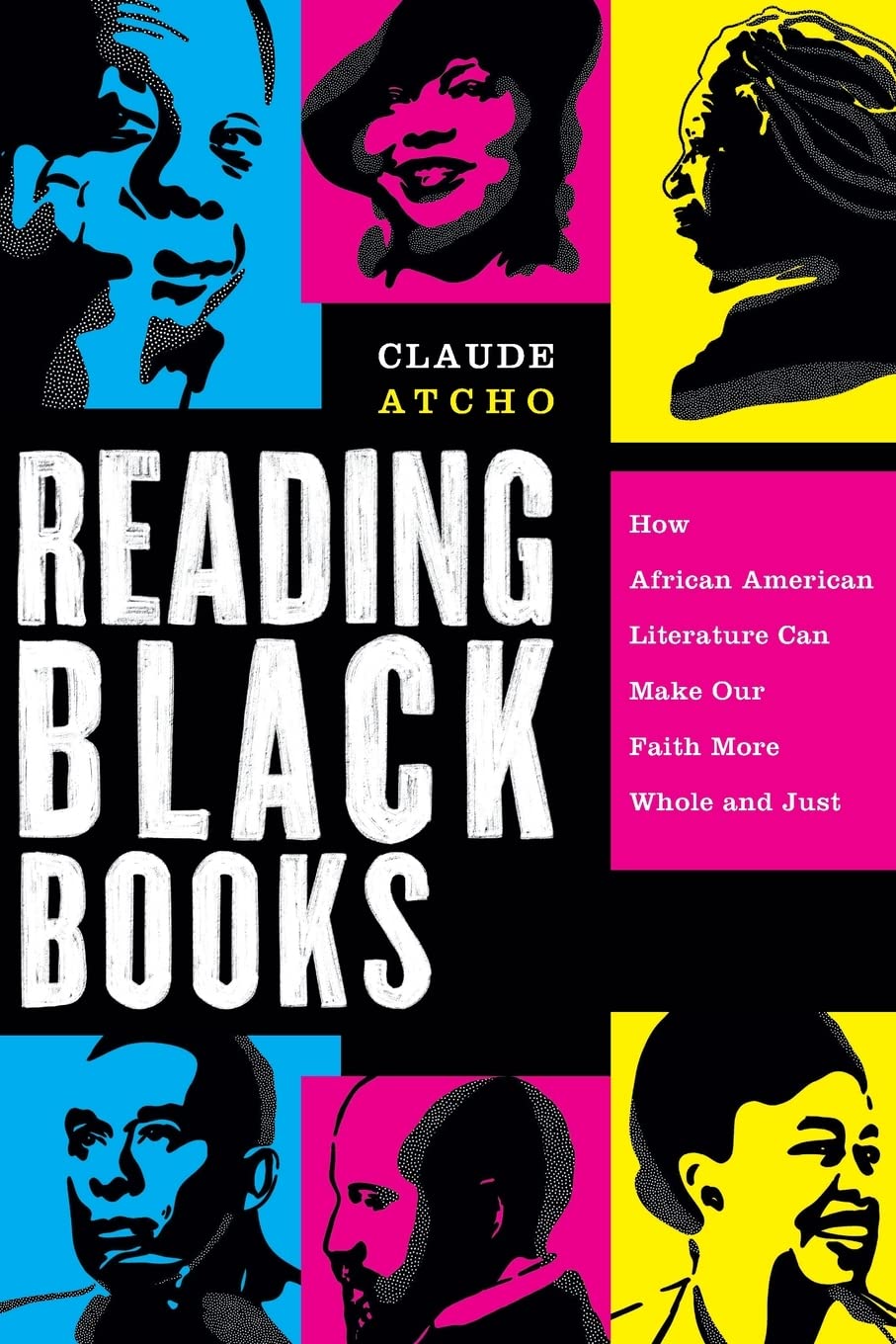
Book Review: Reading Black Books: How African American Literature Can Make Our Faith More Whole and Just by Claude Atcho

“One of the best ways to listen to Black voices is to attend to Black stories, specifically the enduring ones captured in classic African American literature,” writes pastor-theologian and former English professor Claude Atcho in the opening paragraph of Reading Black Books: How African American Literature Can Make Our Faith More Whole and Just.

Such great cover art and design by Octavia Ink!

Published last month by Brazos Press, the book consists of ten chapters, each one built around a theologically charged word or concept (such as “sin,” “image of God,” or “lament”) and a twentieth-century novel or poem(s) by a Black author that is then engaged through that lens. A potential danger with this approach is that the interpretations in either direction could be forced to fit into a box, but this turned out not to be the case at all. Reading Black Books is a two-way, mutually enriching exchange between theology and literature, one that is expansive rather than limiting and that takes each discipline seriously on its own terms.

Combining literary analysis and theological reflection, Atcho shows how “God’s truth addresses Black experience and how Black experience, as shown in the literature of our great writers, can prod readers from all backgrounds toward sharper theological thinking and more faithful living” (1). We are invited to inhabit the experiences of various characters and poetic voices and to be transformed as a result. As a middle-class white woman living in a Maryland suburb, I acknowledge that I move about the world with a very different set of experiences than those of people of color. With pastoral sensitivity but also directness, Atcho helps me enter into America’s racial narrative—and the narrative of the gospel!—from a different vantage point. This book is for Christians of any race who desire to be enlarged by story and to live more fully into the liberative arc of scripture.

Atcho provides enough context for each book—introducing us to characters, rehearsing relevant plot points, and highlighting specific scenes, often including quoted excerpts—that you don’t have to have read the work previously to benefit from his commentary. The book does contain spoilers, as all serious literary criticism almost inevitably will. But literature is way more than plot, and readers are encouraged to then engage with the primary texts in full on their own, equipped with frames for thinking about them and open to surprises.


I have attempted to come to this book about books as a guide who integrates my affections: my love for these stories, my love for what they say about Black experience in both trials and triumphs, and my love for Jesus and his kingdom.

Claude Atcho, p. 7

Chapter 1 examines the question “What does it mean to live as an image bearer when other image bearers try to limit your existence?” The protagonist of Ralph Ellison’s Invisible Man (not to be confused with H. G. Wells’s sci-fi novel The Invisible Man) is not physically invisible; rather, he is rendered invisible by others’ refusal to see him. Atcho discusses the need for white sight—our warped “inner eyes”—to be redeemed.

Chapter 2 explores how systemic sin exacerbates personal sin through the controversial character of Bigger Thomas in Richard Wright’s Native Son, a Black man from 1930s Chicago who kills two people (the first one accidentally). Is Bigger a victim or a perpetrator? The question is too simplistic. Bigger is both trapped by Sin and an agent of Sin, Atcho says. Atcho’s explication of Sin with a capital S and sin, little s, is sophisticated and illuminates for me broader discussions going on in contemporary culture. Sin is not just personally experienced and personally enacted; it is also a dominating force that’s been set loose in our world and that has become embedded in systems.

The focus of chapter 3 is James Baldwin’s semiautobiographical debut novel Go Tell It on the Mountain, “a critical generational portrait of the toxic Christian practice that emerges from belief in a loveless God” (40). Baldwin gestures toward true religion through negation—by presenting the character of Gabriel, the protagonist’s minister stepfather, as a promiscuous and abusive binge drinker with a lust for power.  

Chapter 4 visits “Christ Recrucified” and the nine-hundred-line “The Black Christ” (read the first stanza here) by Harlem Renaissance poet Countee Cullen, unpacking the picture they paint of a Jesus who suffers for, like, and with us. Published in the 1920s, both poems compare the crucified Christ to a lynched Black man.

In chapter 5 Zora Neale Hurston’s Moses, Man of the Mountain, a folkloric retelling of the book of Exodus, opens up a quest into the doctrine of salvation. Atcho discusses salvation from and to, which story and script forms us most (the old empire or the coming kingdom?), the significance of the promised land, and Christian social concern as a biblical imperative.

The deliverance of the exodus elides the false dichotomy of a truncated salvation. Hurston’s Moses points in the same direction—toward imagining a fully orbed salvation, as did our enslaved ancestors: revelation and liberation.

Is it our attention, then, to be fixed on the sin of slavery or our slavery to sin? Personal piety in the power of the Spirit or social change in Jesus’s name? Liberation or revelation? In the exodus, the Lord frees his people so that they might exist in freedom for him. It is liberation through revelation and atonement. God’s revelation (Exod. 9:4, 16, 29; 10:1–2; 11:7; 14:4), the necessity of atonement (13:13, 15), the urgency of liberation (2:23–25), and the subsequent call to holiness (31:13; Lev. 20:8) cannot be isolated. In the exodus, each motif exists in relation, forming the full melody of salvation. The song of salvation is not played in only one key. The contextual pressures of human experience can force us, understandably at times, to prize piety or liberation when truly salvation expands and contains both—and more. (84–85)

Nella Larsen’s Passing—which was adapted into an acclaimed film last year—is the subject of chapter 6, on racism. The novella delves into the psyches of two light-skinned Black women in 1920s Harlem, one of whom passes for white in all settings as a means of survival, and the other of whom does so only when convenient. Atcho talks about the need to combat colorism with affirmation (e.g., “Black is beautiful”), with denial, and through the flesh of Christ.

Chapter 7 spotlights Beloved, a gothic novel by Toni Morrison that combines the historical and the supernatural to tell the story of a devoted mother named Sethe who is seeking freedom from enslavement. At one point she escapes with her children, but when the authorities find them she kills her two-year-old daughter (who is unnamed in the novel and referred to as “Beloved,” the sole word on her tombstone) rather than relinquish her to a life of slavery. Sethe is ultimately able to get away to an Ohio farmhouse, which becomes haunted by Beloved’s ghost.

Atcho discusses the traumas of enslavement that continue to compound and haunt the body, mind, and soul even after one becomes “free”; the need for righteous rage; enfleshment and bodily liturgy; chattel slavery’s theft of the mother-child relationship; memory as a muscle that needs to be exercised transparently, communally, and redemptively; new creation and anticreation; and exorcism, rescue.

One of the most compelling characters in the novel is Sethe’s mother-in-law, Baby Suggs. A shepherdess of bodies and souls, she creates a new space in the woods near the farmhouse where she enacts weekly liturgies of healing. She directs her people, in Atcho’s words, “to move and be in the sacred humanity that they are and that has so viciously been attacked by those who enslaved and debased them” (117). A key passage in Beloved describes this communal gathering:

After situating herself on a huge flat-sided rock, Baby Suggs bowed her head and prayed silently. The company watched her from the trees. They knew she was ready when she put her stick down. Then she shouted, “Let the children come!” and they ran from the trees toward her.

“Let your mothers hear you laugh,” she told them, and the woods rang. The adults looked on and could not help smiling.

Then “Let the grown men come,” she shouted. They stepped out one by one from among the ringing trees.

“Let your wives and your children see you dance,” she told them, and groundlife shuddered under their feet.

Finally she called the women to her. “Cry,” she told them. “For the living and the dead. Just cry.” And without covering their eyes the women let loose.

It started that way: laughing children, dancing men, crying women and then it got mixed up. Women stopped crying and danced; men sat down and cried; children danced, women laughed, children cried until, exhausted and riven, all and each lay about the Clearing damp and gasping for breath. In the silence that followed, Baby Suggs, holy, offered up to them her great big heart. . . .

“Here,” she said, “in this here place, we flesh; flesh that weeps, laughs; flesh that dances on bare feet in grass. Love it. Love it hard. Yonder they do not love your flesh . . .”

Baby Suggs then goes on to list various parts of the body—eyes, skin, hands, mouth, neck, liver, heart—contrasting what “yonder” men do to those parts (gouge, flay, chop, beat, hang, expose and feed to hogs) with each part’s innate belovedness. Atcho’s comments on this passage—a passage that has stuck with me ever since I first read the novel some fifteen years ago—are among the best in the book.

Chapter 8 is on the theme of lament, and it considers that biblical practice in relation to the poem “A Litany of Atlanta” by W. E. B. Du Bois while also looking at the Psalms and the cross. “There is . . . power in lament that names injustice for what it is,” Atcho writes. “By naming it as such and placing it before God as counter to his moral will, lament teaches us to make no peace with injustice or oppression” (137). Bearing true witness against evil, the poem was written in response to the three-day reign of racial terror that white men unleashed on a Black community in Atlanta in September 1906, killing, maiming, and destroying homes and businesses. It opens, “O Silent God, Thou whose voice afar in mist and mystery hath left our ears an-hungered in these fearful days— / Hear us, good Lord!

Chapter 9 takes a look at another novel by Richard Wright, The Man Who Lived Underground, published for the first time last year, sixty-one years after the author’s death. (Publishers rejected it during Wright’s lifetime.) It follows Fred Daniels, a Black man who, after being picked up by police and relentlessly tortured, confesses to a double murder that he did not commit, then flees into the city’s sewer system. “The underground” confers on him a new knowledge of the world’s foundations of falsehood and injustice. At the end, he meets his demise.


To imagine a more just world, one must reckon with the world that is.

Claude Atcho, p. 145

Even though the novel promotes a worldview that is bleak and fatalistic, reading it can still be constructive, Atcho says; as Christians, we carry our hope to bleak texts. What would it look like to see this senseless world reconfigured into wholeness and justice? Atcho calls us to action, away from discrimination, violence, and power abuse and toward the pursuit of justice for all people on earth as it is in heaven.  

It’s fitting that the last chapter centers on hope, particularly as expressed through Margaret Walker’s poem “For My People.” Atcho describes the poem as “a living history, an ode, an exhortation, a lament, a prayer” that “embodies the fiery passion of a communal hope, a bond of persons and destiny” (160, 166). While the majority of the poem addresses Walker’s Black kin, at the end she expands “my people” to embrace all of humanity, “all the adams and eves.”

+++

Throughout Atcho’s book we see the legacies of racial oppression in America—how it manifests today. Though the most recent of the featured literary works is from 1989, they all speak into our current moment. I appreciate how Atcho defines terms that show up a lot in public discourse, such as liberation and justice, comparing cultural definitions with biblical ones. But he leads with story. While in the public square our tendency is often to arm ourselves with arguments to bolster our views and defend against attacks, story has a way of disarming us. Abstract concepts become incarnate in the lives of characters. Literature can teach us the discipline of listening and can develop our empathy and understanding. It may prompt us to assess our own prejudices or complicities and impel us to repentance and real change.

Reading Black Books demonstrates the power of great literature to form us spiritually, regardless of the faith commitments of its author. Atcho presumes no theological agenda on the part of the writers, but rather chooses to read these works theologically—which can unlock more nuanced interpretations or deepened meaning. Applying a theological framework, Atcho draws out themes from the works that cannot be addressed quite as well, I’d say, without theological language. He connects our collective human story to God’s story.

The back matter includes discussion questions for each chapter.

Though I had previously read and studied all four poems Atcho discusses, I’ve read only one of the seven novels—and this despite my having been an English major in college! This book makes me want to read more for sure. I’ve already stocked up my library accordingly. I’m grateful to Atcho for reactivating my interest in fiction and for extending it in the direction of these seminal African American novels.

You can buy Reading Black Books on Amazon (at the time of writing, Amazon is offering three for the price of two!), from Baker Publishing, or from your retailer of choice.

“My soul is alive with thoughts of God”: An adaptation of Mary’s Magnificat, by Rev. M Barclay

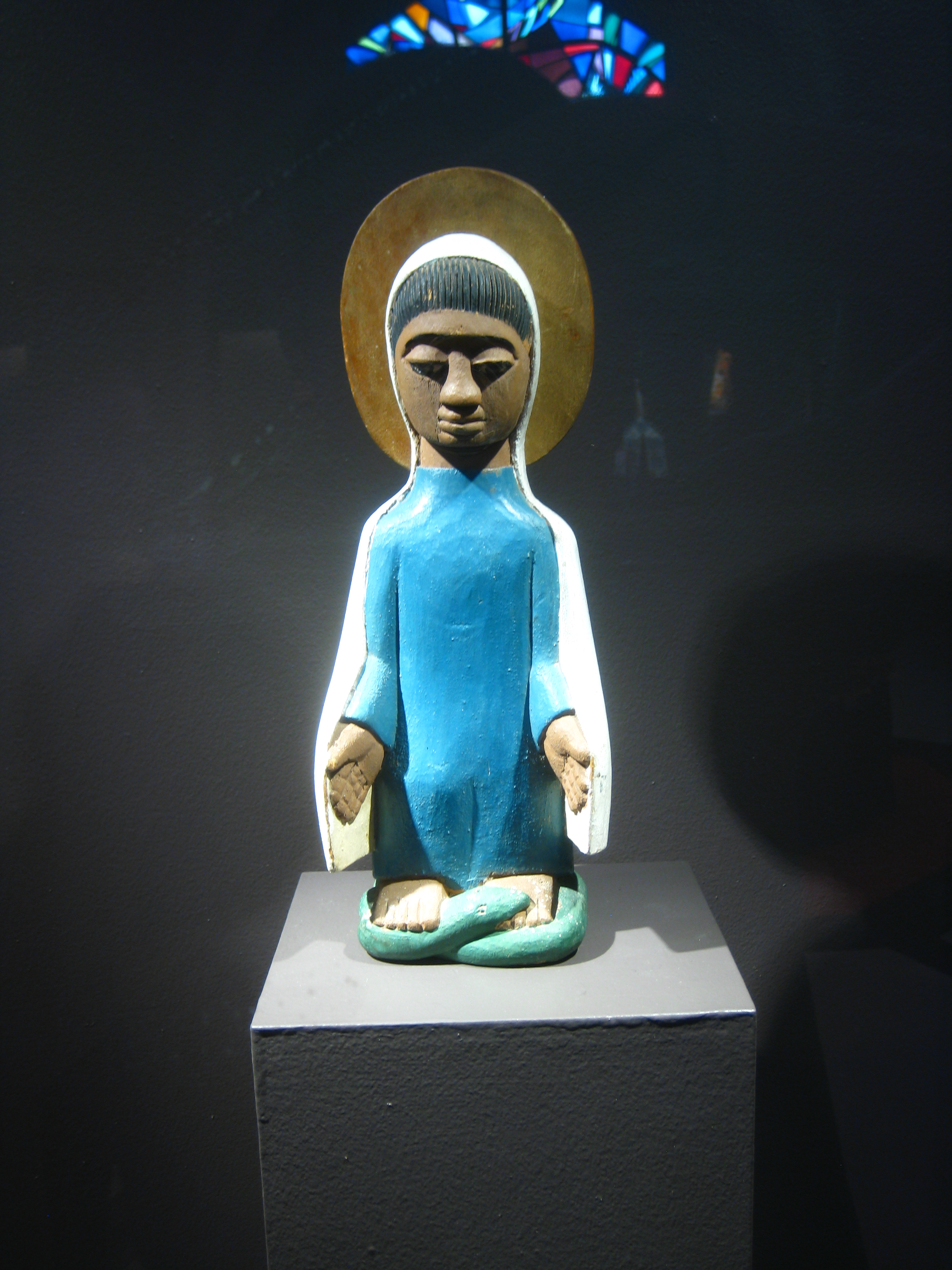
Bandele, George_Virgin Mary
George Bandele (Nigerian, 1910–1995), Virgin Mary, 1960s, wood and pigment. Collection of the SMA African Art Museum, Tenafly, New Jersey. Photo: Victoria Emily Jones.

With the feast of the Visitation coming up on May 31, I’ve been thinking about the song Mary sings in Luke 1:46–55 upon meeting up with her cousin Elizabeth in the hill country of Judea following their miraculous conceptions. It’s bold, exultant, and worshipful, oriented around the liberative power of God. As we continue to reel from the string of mass shootings in the US (Tuesday’s shooting at Robb Elementary School in Uvalde, Texas, was the 212th this year alone), I wonder how Mary’s song might speak to us in this moment—how we, too, might exclaim it with her same fervor and hope, truly believing that God is at work in the world, bringing about justice and healing, even though it is injustice and hurt that so often sound the loudest.

Here is a modern interpretation of the Magnificat by Rev. M Barclay, cofounder and director of enfleshed, an organization that creates prayers, liturgies, art, meditations, teachings, and other spiritual resources for collective liberation. Written in 2019, it captures the verve of Mary’s words while also drawing out shades of sorrow and adding a petitionary element. Barclay uses the gender-neutral pronoun “They” for the Triune God.

My soul is alive with thoughts of God.
What a wonder, Their liberating works.
Though the world has been harsh to me,
God has shown me kindness,
seen my worth,
and called me to courage.
Surely, those who come after me will call me blessed.
Even when my heart weighs heavy with grief,
still, so does hope abide with me.
Holy is the One who makes it so.
From generation to generation,
Love’s Mercy is freely handed out;
none are beyond the borders of
God’s transforming compassion.
The power of God is revealed
among those who labor for justice.
They humble the arrogant.
They turn unjust thrones into dust.
Their Wisdom is revealed in
the lives and truths of those on the margins.
God is a feast for the hungry.
God is the great redistributor of wealth and resources.
God is the ceasing of excessive and destructive production
that all the earth might rest.
Through exiles and enslavement,
famines and wars,
hurricanes and gun violence,
God is a companion in loss,
a deliverer from evil,
a lover whose touch restores.
This is the promise They made
to my ancestors,
to me,
to all the creatures and creations,
now and yet coming,
and in this promise,
I find my strength.
Come, Great Healer,
and be with us.

Album Review: Full Moon in June by Ears to the Ground Family

Ears to the Ground Family is a group of friends in their early thirties, making music together in and around their hometown of Harrisonburg, Virginia. Minimalist and totally acoustic, they sing songs of hope, sustaining faith, and resistance to oppression and empire. Their stylistic influences include the spirituals, soul, hip-hop, R&B, folk/Americana, chant, Taizé, and Anabaptist hymns, especially from the Mennonite tradition, to which they belong.

Ears to the Ground Family
The core members of Ears to the Ground Family are, from left to right, Jake Cochran, percussionist; Matt Dog, trumpeter; Nichole Barrows, lead vocalist; Hannah Win, vocalist; and Dimitris Campos, lead vocalist, classical guitarist, and multi-instrumentalist.

The band formed in 2010 and has “always preferred the outdated and peculiar model of the elusive traveling troubadour,” sharing their music in small settings, unplugged, locally or regionally. Its members first met during the Petrol-Free Jubilee, an annual two-week bicycle-powered music and art tour of the mid-Atlantic, which they went on to participate in as a group for seven years. Its purpose was “to promote peace, social justice, and a healthy planet.”

“We biked two hundred to three hundred miles with ten to twenty people on average, often several bands or musicians with us at a time, and our regular stops and show locations included a lot of farms, community centers, and Catholic Worker houses,” band member Nichole Barrows told me. “Just imagine twenty people rolling down Main Street in your city in the middle of a hot summer afternoon on their bikes, with drums and guitars in tow, ringing their bike bells and singing at the top of their voices! I mean, it was like summer camp on wheels; we brought the show with us!”

This small-scale approach and casual touring schedule, Barrows said, “enables us to root ourselves deeply within our home community and invest in the valuable work that inspires our music.” That valuable work includes church ministry, community organizing, farming, and outdoor education.

In June 2017 Ears to the Ground Family recorded eight original songs (written between 2007 and 2013) plus a traditional African American spiritual, but jobs, family, and other projects prevented them from being able to mix, master, and self-release until recently. Finally, on December 18, 2020, their debut album, Full Moon in June, came into the world, making their music available to a much wider audience for the first time.

“It’s funny,” Barrows said, “some people talk about ‘slow music’ (you know, slow food, etc.) to describe homegrown, independently released local music. But we’re so ‘slow’ that it takes us about ten years to release our first album!”

Infused with prophetic imagination, Full Moon in June denounces the forces of evil at work in the world on a grand scale—things like war, environmental exploitation, predatory lending practices, and the prison industrial complex—and casts a beautiful vision of all things new under Christ. Stop participating in that which is destructive, the album invites, and join instead with the creative work of the Spirit, which is love, joy, peace, patience, kindness, generosity, faithfulness, gentleness, and self-control (Gal. 5:22–23). These songs awaken my enthusiasm for the promised future of all that is and for our journey toward it, sowing seeds of Christ’s kingdom all along the way.

An exploration of “Almond Blossom”

My favorite song on Full Moon in June is the first one, “Almond Blossom” by Dimitris Campos, which uses the image of a tree to signal abundance and renewal. “There’s an almond blossoming in Jerusalem,” it opens. Almond blossoms are a harbinger of springtime, and in fact Israel’s almond trees are the first to bloom each year. The song’s second line, “The buds on a fig tree becoming tender again,” evoke the recurring comparison of God’s people to a fig tree in the Hebrew Bible (e.g., Hosea 9:10; Jer. 8:13; Jer. 24) as well as the story of Jesus cursing a fig tree for failing to bear fruit, a symbolic act of judgment against those who reject his ways. The image here, though, is of a withered fig tree becoming healthy and vibrant once again.

The lyrics go on to note how the trees and other parts of the natural world appear to worship God; the “mountains are clapping their hands” (cf. Psa. 98:8; Isa. 55:12), and the trees reach toward the heavens. Humanity, by contrast, turns in on itself, and rather than living into the flourishing it was created for, invents new means of destruction—bombs dropped from drones, for example, leaving orphans in their wake.

(Related posts: “Songs of Lament and Justice by The Porter’s Gate”; 1798 essay, “A Plan of a Peace-Office for the United States” by Benjamin Rush)

In the song, Campos recalls a visit to the National Air and Space Museum in Washington, DC, the horror of families posing happily for photos in front of bombers, fighter jets, missiles, military avionics, and other tools of combat, celebrating national might. Campos contrasts the heaviness of those metal death-traps with the light feeling of floating on the “river of life” (cf. Rev. 22:1), and their sterility with a fructifying olive vine, delicately tended (cf. Rom. 11:11–24).

Empires fall—Egypt, Rome; America one day will too, and another will rise in its place. “I proclaim that Jesus, he will decide / If it is that Rome is on I-95”—the highway that the US capital is located off of. Earthly kingdoms that put their trust in arsenals and that deal in death rather than life may be in for a divine toppling. The same goes for corrupt systems.

Jesus himself said as much. For example, in Mark 13:2, he says regarding the Jewish temple complex, “Do you see these great buildings? Not one stone will be left here upon another; all will be thrown down.” It’s because the religious establishment at the time had become oppressive and was rejecting Jesus as the Christ. They were trusting in all their rules and learned interpretations of scripture while failing to see the plain revelation of God right in front of them.  

The penultimate stanza of “Almond Blossom” is excerpted from “Canticle of the Turning” by Rory Cooney, a paraphrase of Mary’s Magnificat, which is one of the Bible’s most radical songs:

From the halls of the power to the fortress tower
Not a stone will be left upon a stone
Let the king beware, for your justice tears
Every tyrant from his throne

The song concludes with a reprise of the first two lines, circling back to the image of trees and their eschatological (end times) resonances. In Matthew 24:32–33, Jesus tells his disciples, “From the fig tree learn its lesson: as soon as its branch becomes tender and puts forth its leaves, you know that summer is near. So also, when you see all these things, you know that [the Son of Man] is near, at the very gates.”

“Almond Blossom” is a clever interweaving of biblical allusions, spanning Genesis to Revelation, that calls America to account for its warmongering while inviting her citizens into the beautiful, lasting, life-giving way of Christ.  

The following poem from the book of Isaiah, about the messianic age, was resounding in my mind as I listened to this song:

For you shall go out in joy
    and be led back in peace;
the mountains and the hills before you
    shall burst into song,
    and all the trees of the field shall clap their hands.
Instead of the thorn shall come up the cypress;
    instead of the brier shall come up the myrtle;
and it shall be to the Lord for a memorial,
    for an everlasting sign that shall not be cut off.

—Isaiah 55:12–13

Other songs

All but two of the songs on Full Moon in June were written (or cowritten) by Dimitris Campos. Half Greek and half Peruvian, he was raised in a Latino culture in the United States, which itself has mixed Spanish, Indigenous, and African influences. His musical compositions are informed by this background.

“Recession Don’t Bother Me,” subtitled “No te compliques la vida” (Don’t complicate your life), reflects on a mother’s words of advice regarding not staking your identity on material things, and not climbing over others to get ahead. It was released with this statement:

We are releasing this album in the midst of the historic COVID-19 pandemic. The virus has left record numbers of people without work and we realize that in this moment, working-class people are suffering. With that in mind, we want to note that our song “Recession Don’t Bother Me” (which was written during the Great Recession of 2007 and 2008) is not saying “the recession don’t affect me,” because as the current pandemic has shown us, the circumstances and effects of the current situation do indeed have profound consequences for us all. Nor is this song saying that we are insulated from the economic effects of recession because of our wealth or privilege—although we acknowledge that in this current context, many people have had it much harder than we have. What this song is saying is that our current destructive and dehumanizing economy must, one day, collapse. And that we hope to be among those who welcome and rejoice at an exodus from an Egypt to a promised land, even if it means a journey through the desert to get there. We are praying for providence for all those suffering during these deeply trying times.

In downtown Harrisonburg, amidst hip college-town cafés, sits the Rockingham County Jail, right across the street from the courthouse. At certain times of day, men in jumpsuits and chains are very visibly marched to and from these locations. Disgusted by this flagrancy and following the arrest of one of his undocumented friends, Campos wrote “Prison Cells.” It’s a condemnation of America’s for-profit prison system and retributive (as opposed to restorative) model of justice. How does our lust for punishment cohere with Jesus’s blessing on the merciful (Matt. 5:7) and the apostle Paul’s insistence that “love keeps no record of wrongs” (1 Cor. 13:5)? We teach our kids to forgive offenses and to let go of grudges, and yet our criminal law teaches the opposite. Lord, have mercy.

Fourth up on the album is a new interpretation of the spiritual “Sheep, Sheep, Don’t You Know the Road?” from the Georgia Sea Islands, popularized in the 1960s by folk singer and African American music preservationist Bessie Jones, who learned it from her formerly enslaved grandfather. Ears to the Ground Family has expressed the indebtedness of their work to “centuries of creative Black resistance against slavery and oppression,” of which this song is just one example. Its lyrics describe the road of faith as one of pain but also bridges, a road where “there’s no price tag” (cf. Isa. 55:1) and “the sword’s beat down” (cf. Isa. 2:3–4).

On this track the djembe and shekere are played by Jay Beck and Tevyn East, two of the lead organizers of the Carnival de Resistance. “A traveling carnival, village, and school for social change bridging the worlds of art, activism and faith,” this organization seeks to throw off sanitized pieties and “provide a raucous expression of grief and longing and hope for Creation.”

“Painter” is a parable that shows how indulging in sin cuts us off from ourselves and can inhibit us from showcasing God’s glory.

“Moneditas” (Coins), which Campos wrote with Ana Maria Febres, is a Spanish-language song about the emptiness of riches. It echoes Matthew 6:19–20: “Do not store up for yourselves treasures on earth, where moth and rust consume and where thieves break in and steal; but store up for yourselves treasures in heaven, where neither moth nor rust consumes and where thieves do not break in and steal.”

The whimsical “Time, Time, Time,” with its coffee-mug and glass-bottle percussion, seems to me to be a celebration of the unfolding of time just as it is. May we not wish for time to move any faster or slower, but instead appreciate the now and live with an openness to whatever’s next.

“Walnut Textures,” by Campos and Lightning Lucas, encourages a closer relationship with the natural world. It remarks with regret how we have such a strong desire to explore the far reaches of the universe, and yet many of us hardly know the beauty and wonders of our own planet, or even our immediate environs—or if we do, we don’t care enough to protect them. Instead of stewarding nature we squander and abuse it, building highways (dirty paved “rivers”) through forests and then packing cars onto them, increasing air pollution and contributing to global warming. This dominating stance over God’s creation is vanity, and God urges us toward a better way—one of friendship with creation, in which we recognize our mutual groaning for redemption (Rom. 8:22–23) and take up our responsibility as caretakers, which includes adopting sustainable environmental practices.

Spending time in nature is refreshing and even liberating, a chance to experience the givenness of life. Living in right relationship with her now is great practice for the age to come, when all will be reconciled.

The last song, “Shade of the Most High,” was written by Nichole Barrows amid her grief following the death of her mother. It was inspired by the promise in Psalm 91 that we will find rest in the “shadow” of the Almighty God. She says,

I found great comfort in this image of grief as a dark place where God can still find us and bring us rest, because although we feel that we don’t deserve the bad things that are happening to us, we can trust that we are still in his “shade.” And this gift of trust in God’s faithfulness helps us not to fear disease or darkness or even death. I sang these words over myself that year [of my mother’s decline] and I sing them over you now: “With a hope like this, we are fearless, and with a love like this, I will not despair.”

Loss is wrenching and often unexplainable, but it can also be an occasion “to find new life, to find new eyes,” and to lean all the more firmly on the One who bears our sorrows in love.

Already and not yet

When I was talking to Barrows, she expressed emphatically one of the great paradoxes in Christian teaching: “that the kingdom of God is not yet here and that we are together longing for Christ to come make all things new, and also that he is already here, now, on this earth, in this place.” She mentioned how Ears to the Ground Family wishes to affirm not just the spiritual elements of faith (which, I will add, are the central preoccupation of the vast majority of faith-based music) but the physical elements as well, “such as care for the earth and the peace witness and the works of mercy.” This commitment is certainly reflected on their album, which is centered on holistic liberation. I love how it so joyously embraces the broadness of the good news of Jesus Christ, which is not just for individual souls but also for bodies and communities and for the whole created world—presently as well as futurely!

Full Moon in June is available for digital download or as a CD in a cardboard sleeve with handprinted letters (produced by Campos’s vintage, treadle-powered letterpress) and stamped with handmade rubber stamp art. The latter option is a limited edition of 200.

An Affirmation of Faith

Painting by Jyoti Sahi
Painting by Jyoti Sahi, based on John 20:22

We believe in Jesus Christ,
our savior and liberator,
the expression of God’s redeeming
and restoring love,
the mark of humanness,
source of courage, power, and love,
God of God,
light of light,
ground of our humanity.

We believe that God resides in slums,
lives in broken homes and hearts,
suffers our loneliness, rejection, and powerlessness.

But through death and resurrection
God gives life, pride, and dignity,
provides the content of our vision,
offers the context of our struggle,
promises liberation
to the oppressor and the oppressed,
hope to those in despair.

We believe in the activity of the Holy Spirit
who revives our decaying soul,
resurrects our defeated spirits,
renews our hope of wholeness,
and reminds us of our responsibility
in ushering in God’s new order here and now.

This affirmation of faith originally appeared in the December 1986 issue of iGi, a publication of the Asian Women’s Resource Centre for Culture and Theology. Used by permission.

Jubilee (Artful Devotion)

Jubilee by Steve Prince
Steve A. Prince, Jubilee. Linocut, 36 × 24 in.
Click on image to purchase.

And he [Jesus] came to Nazareth, where he had been brought up. And as was his custom, he went to the synagogue on the Sabbath day, and he stood up to read. And the scroll of the prophet Isaiah was given to him. He unrolled the scroll and found the place where it was written,

The Spirit of the Lord is upon me,
because he has anointed me
to proclaim good news to the poor.
He has sent me to proclaim liberty to the captives
and recovering of sight to the blind,
to set at liberty those who are oppressed,
to proclaim the year of the Lord’s favor.

And he rolled up the scroll and gave it back to the attendant and sat down. And the eyes of all in the synagogue were fixed on him. And he began to say to them, “Today this Scripture has been fulfilled in your hearing.”

—Luke 4:16–21

+++

In this passage from Sunday’s Gospel lectionary reading, Jesus enters his hometown synagogue in Nazareth and gives what is essentially his inaugural address, having recently been installed to public office by God (at his baptism) and now informing the people of his intentions as their new leader. His agenda is taken straight from Isaiah 61:1–2, and boils down to this: FREEDOM. That is his rallying cry.

“The year of the Lord’s favor,” or “the acceptable year of the Lord,” in Luke 4:19 refers to the Jubilee legislation God gave Israel, mandating that every fiftieth year, slaves were to be set free, debts canceled, and land wealth redistributed (see Leviticus 25). This ushering in of economic justice was most definitely “good news to the poor.” In his reading from the Isaiah scroll and his statement that “Today this Scripture has been fulfilled,” Jesus was calling for the celebration of the Year of Jubilee. And as we know from what follows in the Gospels, this Jubilee would be far more expansive than the one prescribed in Levitical law. Release from bondage, forgiveness of debts, restoration of what had been lost—there is, of course, still a material significance to these provisions, but there’s also a spiritual significance, in that through Christ, we are liberated from sin and ultimately brought back to the Garden in which we originally dwelt.

In ancient Israel, the semicentennial Jubilee Year was announced by the blowing of a shofar (ram’s horn) on the Day of Atonement. The Hebrew word for jubilee, yovel, actually means “ram’s horn”; in the Septuagint, yovel is translated multiple times as apheseos semasia (“trumpet blast of liberty”). The Latin form, jubilaeus, is influenced by the Latin jubilare, “to shout for joy.”

+++

Typically I make one music selection for the week’s Artful Devotion, but I couldn’t decide between these two—so you’re getting a twofer! I’d encourage you also to revisit “Jubilee” by the McIntosh County Shouters (which pairs splendidly with the Steve Prince linocut), featured in a previous roundup.

JAZZ INSTRUMENTAL: “Jubilee Stomp” by Duke Ellington, 1928

This track was recorded at Okeh studios in New York City on January 19, 1928. It features Duke Ellington on piano, Bubber Miley and Louis Metcalf on trumpet, Joe Nanton on trombone, Barney Bigard on clarinet and tenor sax, Harry Carney on alto sax and baritone sax, Fred Guy on banjo, Otto Hardwick on alto sax and bass sax, Wellman Braud on string bass, and Sonny Greer on drums.

GOSPEL-ROCK: “The Year of Jubilee” | Words by Charles Wesley, 1750 | Music by Kirk Ward, 2010

Blow ye the trumpet, blow! The gladly solemn sound
Let all the nations know, to earth’s remotest bound:
Jesus, our great high priest, has full atonement made;
You weary spirits, rest; you mournful souls, be glad.

Freedom! The year of jubilee is come;
You ransomed sinners, return, return home.

Extol the Lamb of God, the sacrificial Lamb;
Redemption through his blood throughout the world proclaim:
You slaves of sin and hell, your liberty receive;
And safe in Jesus dwell, and blessed in Jesus live.

You who have sold for naught your heritage above,
Receive it back unbought, the gift of Jesus’ love:
The gospel trumpet hear, the news of heavenly grace;
And, saved from earth, appear before your Savior’s face.

Hymnic poetry doesn’t get much better than that of Charles Wesley, and “Blow ye the trumpet, blow!” is no exception. I discovered this text through Kirk Ward, who wrote new music for it—a tune that is, in my opinion, far superior to the ca. 1782 tune by Lewis Edson that’s used in the hymnals of the United Methodist Church, the Orthodox Presbyterian Church, and others. Ward’s gospel-rock version of the hymn, which includes the addition of a chorus, is a congregational favorite at my little church in Maryland.

Describing his stylistic influences and aspirations, Ward writes:

I was thinking that the song would work well in a more 1960s style, civil rights era gospel-rock. I was thinking Sharon Jones and the Dap-Kings or Aloe Blacc, but the over-driven guitar sounds and my white boy vocals push it more toward something like Neil Young. Maybe one day, I’ll record it with horns and soul-power guitar riffs to get the sound I heard in my head. Regardless of the groove, my main goal was to get everyone shouting “FREEDOM!” at the top of their range.

As with all the songs posted on the New City Fellowship Music website, congregations are encouraged to freely use “The Year of Jubilee” in worship; an MP3 demo, lead sheet, and lyrics are provided for that purpose. I’d love to hear some full-band performances of this song online—if any exist, please post them in the comment field below. If you’re interested in making a commercial recording, contact Kirk Ward for permission.

(Related post: “And the Walls Came a-Tumblin’ Down,” commentary on a Steve Prince linocut from my collection)


This post belongs to the weekly series Artful Devotion. If you can’t view the music player in your email or RSS reader, try opening the post in your browser.

To view all the Revised Common Lectionary scripture readings for the Third Sunday after Epiphany, cycle C, click here.