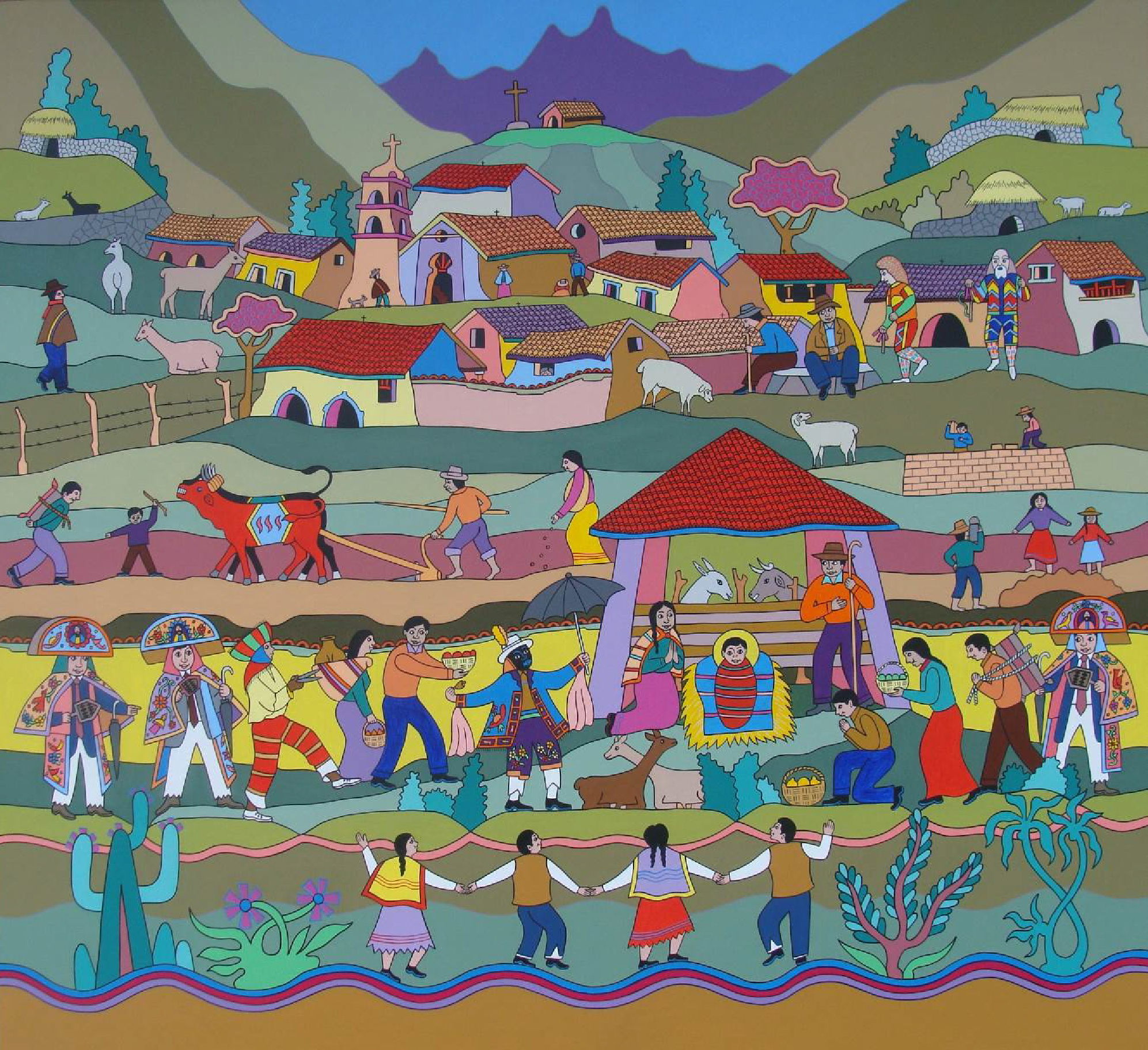
Josué Sánchez Cerrón (Peruvian, 1945–), Navidad en los Andes (Christmas in the Andes)
The Word, for our sake, became poverty clothed as the poor who live off the refuse heap.

The Word, for our sake, became agony in the shrunken breast of the woman grown old by the absence of her murdered husband.

The Word, for our sake, became a sob a thousand times stifled in the immovable mouth of the child who died from hunger.

The Word, for our sake, became rebellion before the lifeless body of Gaspar Sanchez Toma, “scientifically” murdered.

The Word, for our sake, became danger in the anguish of the mother who worries about her son growing into manhood.

The Word became an ever-present absence among the 70,000 families torn apart by death.

The Word, for our sake, became an inexorable accusation arising from the blazing craters which swallowed up their tortured bodies.

The word-knife cut us deeply in that place of shame: the painful reality of the poor.

The Word blew its spirit over the dried bones of the Mummified-Churches, guardians of silence.

The Word, that early-morning-bugle, awoke us from the lethargy which had robbed us of our Hope.

The Word became a path in the jungle, a decision on the farm, love in women, unity among workers,
and a Star for those few who can inspire dreams.

The Word became Light,
The Word became History,
The Word became Conflict,
The Word became Indomitable Spirit,
and sowed its seeds
upon the mountain,
near the river, and in the valley,

and those-of-good-will heard the angels sing.

Tired knees were strengthened,
trembling hands were stilled,
and the people who wandered in darkness
saw the light!

Then,

The Word became flesh in a nation-pregnant-with-freedom,
The Spirit strengthened the arms which forged Hope,
The Verb became flesh in the people who perceived a new day, and for our sake became life in Mary and Joseph who embrace Righteousness and bury the people’s ignominy.

The Word became the seed-of-justice
and we conceived peace.

The Word cried out to the world the truth about the struggle against the anti-man.

The Word made justice to rain
and peace came forth from the furrows in the land.

And we saw its glory in the eyes of the poor converted into true men and women.

Grace and Truth celebrated together
in the laughter of the children rescued by life.

And those-who-saw-the-star
opened up for us
the path we now follow.

Meanwhile,
Herod, slowly dying,
is eaten by worms.

The Word became judgment
and the anti-men ground their teeth.

The Word became forgiveness
and human hearts
learned to beat with love.

And the Word shall continue sowing futures
in the furrows of Hope.

And on the horizon,
the Word made light
invited us to relive a thousand dawns
toward the Kingdom that comes.

The Word will gather us round her table.
And they will come from the East and the West,
from the North and the South,
and dressed in incorruption
we-will-finally-be-happy.
Translated from the Spanish by Maria Elena Acevedo, René Calderón, Maria Elena Caracheo, Sister Caridad Inda, and Philip Wheaton in the bilingual Threatened with Resurrection / Amenazado de Resurreción: Prayers and Poems from an Exiled Guatemalan (The Brethren Press, 1982).
Julia Esquivel (1930–2019) was a Guatemalan poet, theologian, lay preacher, biblical studies teacher, social worker, and human rights activist. In 1953 she moved to Costa Rica to study at the Seminario Biblico Latinoamericano, returning to Guatemala to work at the Instituto Evangélico América Latina. After speaking out against the massacres, assassinations, torture, and forced disappearances being carried out by the Guatemalan military and police, she received death threats and survived two kidnapping attempts and thus went into forced exile in 1980, finding refuge in the monastic Communauté de Grandchamp in Switzerland. She studied at the Ecumenical Institute at Château de Bossey, run by the World Council of Churches. She returned to her home country in 1996 after the signing of the Peace Accords, helping document over two hundred thousand civilian deaths and disappearances for the Recovery of Historical Memory Project and working with women traumatized by violence. She is the author of several books, including the poetry collections Threatened with Resurrection (1982) and The Certainty of Spring (1993).
New Mount Pilgrim commemorates the Maafa, the Great Migration, and martyrs of urban violence and instills hope with trilogy of rose windows, which include an African Christ
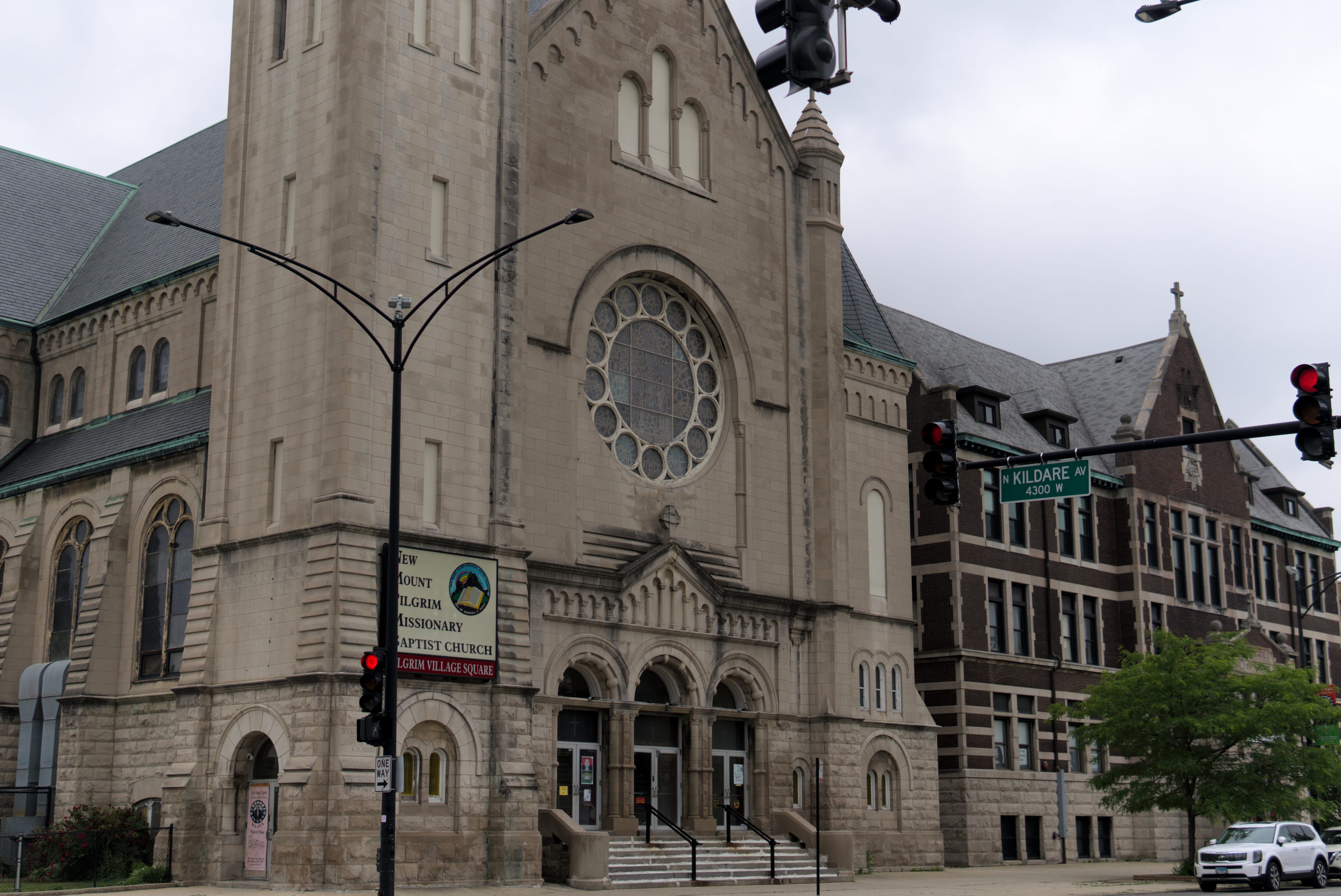
Designed by Charles L. Wallace and built in 1910–11, the French Romanesque–style church at 4301 West Washington Boulevard in Chicago’s West Garfield Park neighborhood was originally home to one of the largest Irish Catholic parishes in the city: St. Mel’s (named after Mél of Ardagh, a nephew of St. Patrick from the fifth century). They had the interior decorated with stained glass windows made by the studio of F. X. Zettler in Munich, portraying biblical figures and other saints—all as Caucasian, as was customary at the time and, frankly, still is. St. Mel’s, which merged with Holy Ghost Catholic Church in 1941 (whose parishioners were mainly of German descent), was a flourishing congregation. But in the late 1960s, white people began leaving the neighborhood as Black people moved in, and St. Mel’s membership waned until eventually the church closed its doors in 1988.
After the building had stood vacant for several years, in 1993, the Catholic Archdiocese of Chicago sold it to New Mount Pilgrim Missionary Baptist Church, a local Black congregation founded in 1950. The church leaders found that, due to lack of maintenance, the three large rose windows had structural issues that needed to be addressed. Rather than repairing the windows, they decided to replace them with new ones that better reflected the faith stories of their own parishioners—their history, heritage, and aspirations as a community. Rev. Dr. Marshall E. Hatch Sr., who had become the church’s pastor just a month after they moved into the new building and still serves in that role, developed the concepts for the windows with input from the congregation and started fundraising. All three were fabricated by Botti Studio of Architectural Arts in nearby Evanston, Illinois.
The Maafa Remembrance Window
The most striking and theologically profound of the three new windows, and the one I flew to Chicago to see last summer, is the Maafa Remembrance window on the wall to the left of the front altar. Because the church is oriented south rather than the traditional east, this is, directionally speaking, the East Rose Window; it purposefully faces the Atlantic Ocean. It was dedicated December 17, 2000, the church’s fiftieth anniversary year. It replaced an image of the Assumption of Mary (which you can view here); read more about the church building’s original windows on the website of art historian Rolf Achilles.
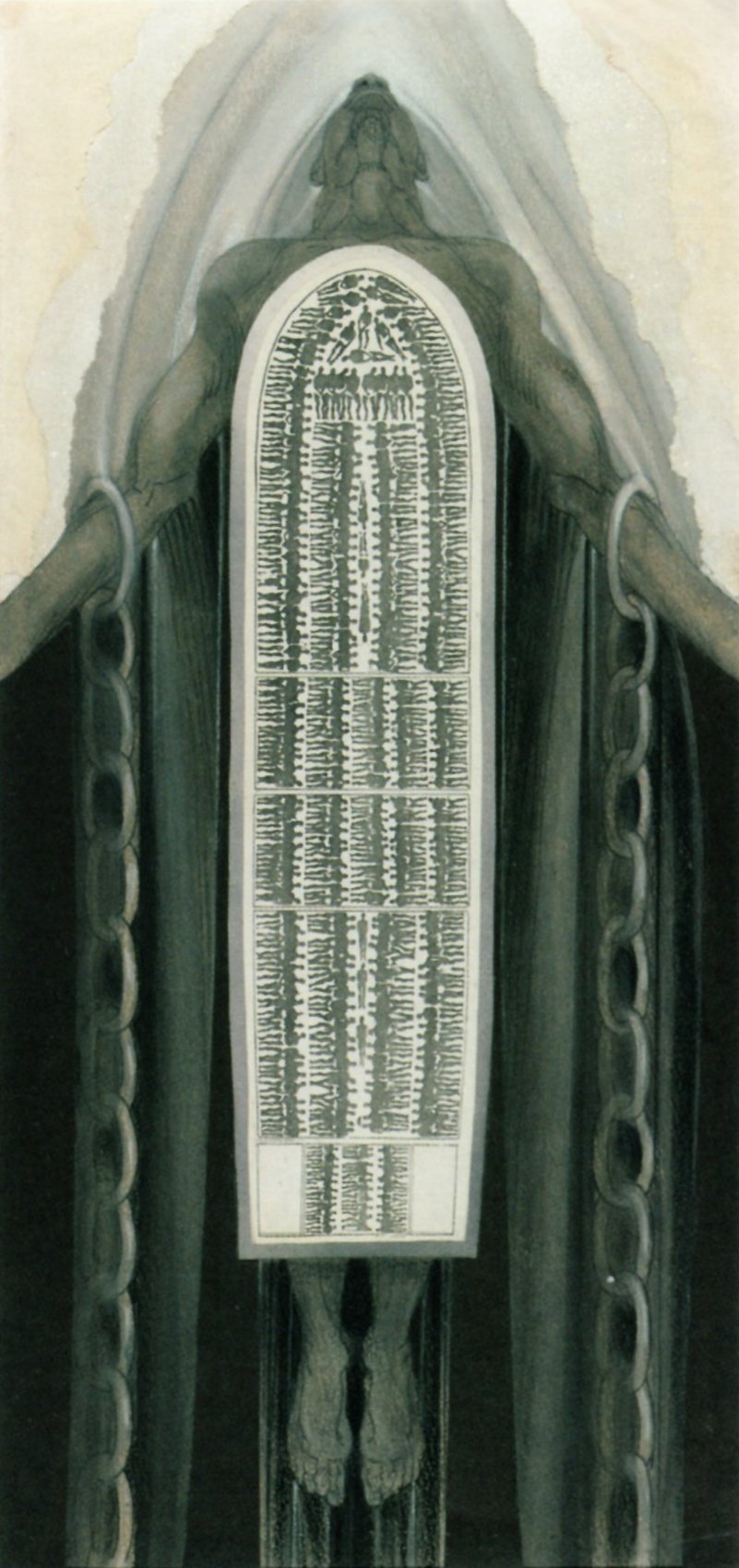
Maafa Remembrance, 2000, based on an illustration from The Middle Passage by Tom Feelings. Stained glass, diameter 25 feet. New Mount Pilgrim Missionary Baptist Church, West Garfield Park, Chicago. Photo: Victoria Emily Jones.Six of the twelve apostles are pictured in these stained glass windows inherited by New Mount Pilgrim from the building’s former owner, St. Mel’s Catholic Church. They appear beneath the newer Maafa Remembrance window, commissioned to counterbalance the preponderance of sacred white personages with sacred Black ones and to tell a narrative of liberation. Photo: Victoria Emily Jones.
Maafa (mah-AH-fah) is a Swahili word meaning “great disaster” or “great tragedy.” Since the late 1980s it has been used to refer to the transatlantic slave trade of the sixteenth through nineteenth centuries, during which an estimated 12.5 million African men, women, and children were kidnapped from their homes and forcibly brought to the Americas to work plantations without pay (by and large), building the wealth of their white enslavers. Some scholars prefer the term “African Holocaust” or “Black Holocaust” to describe this historic atrocity.
Based on an illustration by Tom Feelings from his extraordinary book The Middle Passage: White Ships / Black Cargo (Dial, 1995), the East Rose Window commemorates the Maafa through an evocation of the Middle Passage, the second leg of the triangular trade route. On this harrowing two- to three-month voyage across the Atlantic Ocean, which ships made many times over chattel slavery’s multicentury duration, at least two million enslaved Africans died of malnutrition, dehydration, disease, captor-inflicted violence, or suicide.
The closeness of the place, and the heat of the climate, added to the number in the ship, which was so crowded that each had scarcely room to turn himself, almost suffocated us. This produced copious perspirations, so that the air soon became unfit for respiration, from a variety of loathsome smells, and brought on a sickness among the slaves, of which many died, thus falling victims to the improvident avarice, as I may call it, of their purchasers. This wretched situation was again aggravated by the galling of the chains, now become insupportable; and the filth of the necessary tubs, into which the children often fell, and were almost suffocated. The shrieks of the women, and the groans of the dying, rendered the whole a scene of horror almost inconceivable.
In Feelings’s image, an African Christ figure stretches his chained arms out, as if on the cross. His body is constituted by the famous schematic representation of the crowded lower deck of the Brookes slave ship’s human cargo hold, first created in England in 1788 and widely disseminated throughout the nineteenth century. The perspective is such that we’re looking down on a body-as-slave-ship gliding through the waters—but it’s also a crucifixion. The Son of God carries the suffering of the sons and daughters of God, feeling it in his own body. He wears the slave ship like a giant wound that will forever mark him because it has marked his ecclesial body, the church.
The window functions, on one level, as a lament. Consider it in light of the following poem by Lucille Clifton, which draws out the cruel irony of the actual names some ostensibly Christian slave ship owners gave their vessels.
“slaveships” by Lucille Clifton
loaded like spoons into the belly of Jesus where we lay for weeks for months in the sweat and stink of our own breathing Jesus why do you not protect us chained to the heart of the Angel where the prayers we never tell and hot and red our bloody ankles Jesus Angel can these be men who vomit us out from ships called Jesus Angel Grace Of God onto a heathen country Jesus Angel ever again can this tongue speak can these bones walk Grace Of God can this sin live
The speaker of the poem, an enslaved African, addresses Jesus, questioning why he allows them to be so brutally treated—stolen from their homeland, marched to the coast in chains, claustrophobically packed in ship holds for maximum profitability, and spat out onto auction blocks in a barbarous country that appears to practice the devil’s ways more than God’s. How can God abide such sin? What kind of grace is it that transports them into oppression?
Christian Wiman brilliantly unpacks this poem, noting Clifton’s cunningly subtle tweak of a prophetic passage from Ezekiel that promises resurrection, both of individuals and of a nation. Underneath its acerbity, there’s a certain hopefulness to the poem—a hope that this sin will die, this suffering be transformed. In both Ezekiel’s vision of the valley of dry bones and Clifton’s poem, Wiman writes,
the Word comes streaming again through, and by means of, the word. In terms of the poem, Jesus (the man) is on board Jesus (the ship), but he is in the hold, just as, when the worship services took place above the captured slaves on the Gold Coast of Africa, God, if he was anywhere, was underneath it all, shackled and sweating and merged with human terror.
Emmanuel, God-with-us.
Clinging to this truth, the psalmist declares, “If I make my bed in hell, behold, thou [God] art there” (Psalm 139:8b). In his great compassion, God descends with us into the depths, and bears us up.
The Maafa Remembrance window plays with the themes of descent and ascent. As Emmanuel, Jesus was below deck, in the miserable belly of the thousands of slave ships that traversed the Atlantic, suffering with those chained inside. Christ’s arms are draped with chains, notes Marshall Hatch Jr., the pastor’s son and cofounder and executive director of the MAAFA Redemption Project (more on that below), “but he’s rising. And at some point those chains will break. That’s the hopefulness that shines through.”
Thus, the window commemorates both tragedy and triumph. It honors those who died on the Middle Passage and through the institution of slavery more broadly while also honoring those who persevered all the way to freedom. Hatch Jr. says this Christ is “carrying within himself the memories of those who lost their lives on the journey to America. But also he’s carrying the legacy of those who survived. And we are that living legacy,” descendants of the Middle Passage.
The border around the window’s central image calls parishioners to “REMEMBRANCE.” They must remember their history, the Great Catastrophe their ancestors endured, and, having faced the truth, commit to ending slavery’s legacy of racism in America’s civic, social, and religious spheres and in their own psyches.
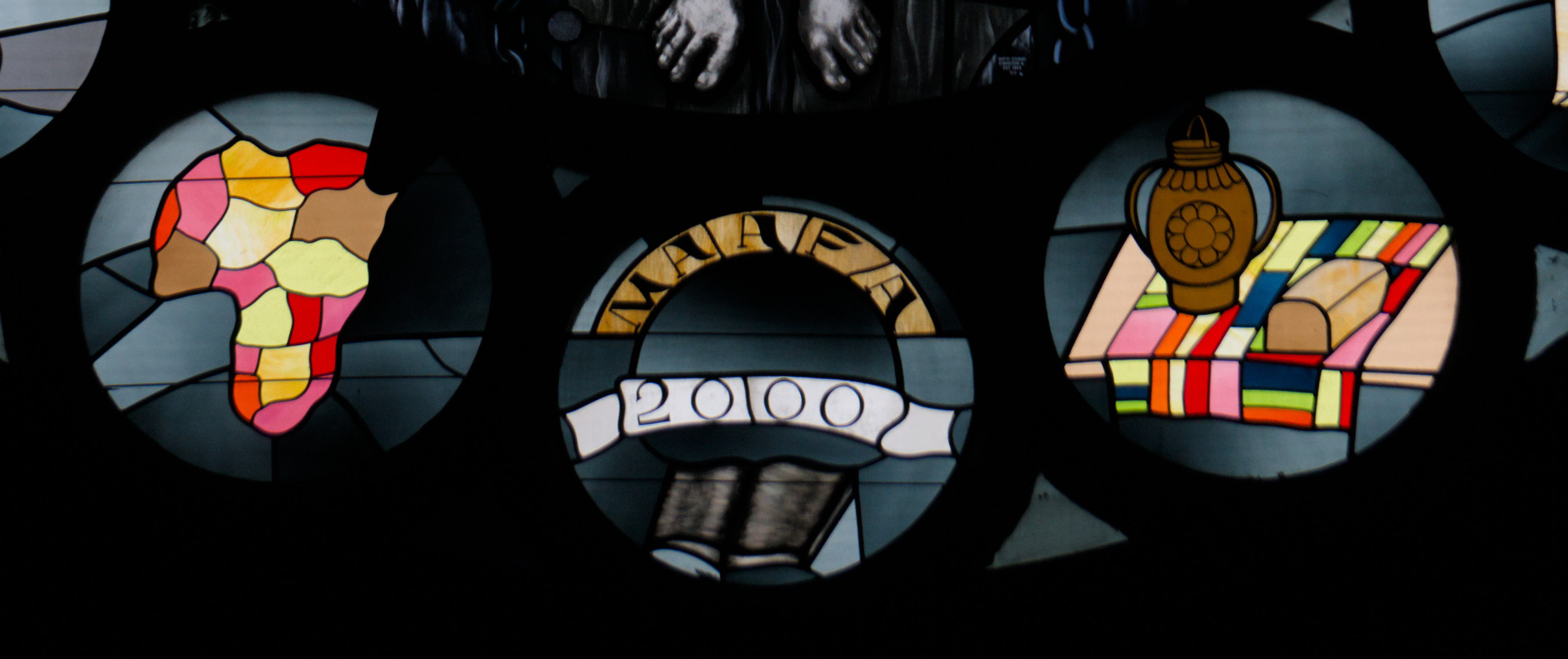
Two of the roundels in the bottom border show a map of Africa and a Communion table laid with kente cloth, a loaf of bread, and a flask of wine. The roundel between these two displays the open word of God, which guides Christians forward in our work of justice and reconciliation.
Art historian Cheryl Finley features New Mount Pilgrim’s Maafa Remembrance window in her book Committed to Memory: The Art of the Slave Ship Icon (Princeton University Press, 2022), which traces the origins of the Brookes schematic and its proliferation in mass culture and art. She identifies the window, twenty-five feet in diameter, as the largest example of the “slave ship icon” in the world and writes that, like the cross of Christ, the slave ship embodies both death and rebirth. It is “a site of death, of dying Africans, and of new life, of a people who would persevere in the face of slavery and unspeakable cruelty to become a free people who helped define the modern era” (6).
“The children will need to know that this symbol, this window, is a representation of not only the pain but also the possibilities of a great and mighty God,” Rev. Dr. Gregory Thomas told the Chicago Tribune in 2000. Thomas was a theology professor at Harvard Divinity School, where Hatch Sr. served a fellowship sabbatical semester in 1999 and first encountered Feelings’s Middle Passage book.
In the window, slavery is interpreted in light of the paradox of the cross. Theologian James H. Cone famously interpreted another, later icon of Black suffering—the lynching tree—in light of the same in his essential book The Cross and the Lynching Tree (Orbis, 2011). He opens the book by explaining why and how the cross has held such power for the Black church:
The cross is a paradoxical religious symbol because it inverts the world’s value system with the news that hope comes by way of defeat, that suffering and death do not have the last word, that the last shall be first and the first last.
That God could “make a way out of no way” in Jesus’ cross was truly absurd to the intellect, yet profoundly real in the soul of black folk. Enslaved blacks who first heard the gospel message seized on the power of the cross. Christ crucified manifested God’s loving and liberating presence in the contradictions of black life—that transcendent presence in the lives of black Christians that empowered them to believe that ultimately, in God’s eschatological future, they would not be defeated by the “troubles of this world,” no matter how great and painful their suffering. Believing this paradox, this absurd claim of faith, was only possible through God’s “amazing grace” and the gift of faith, grounded in humility and repentance. There was no place for the proud and the mighty, for people who think that God called them to rule over others. The cross was God’s critique of power—white power—with powerless love, snatching victory out of defeat. (2)
A powerful reclamation of Christian iconography, New Mount Pilgrim’s Maafa Remembrance window weds Black history and Christian theology to offer its predominantly African American congregation a communal symbol that honors what they’ve been through as a people and reminds them that they worship a risen Christ who breaks chains and brings life out of death.
The North Star / Great Migration Window
The East Rose Window covered in the previous section is narratively the first in the trilogy of newly commissioned windows, but the first of the three to be fabricated and installed, earlier in 2000, was the North Rose Window, called the North Star or Great Migration window. It commemorates those who traveled north on the Underground Railroad to escape slavery, and, a few generations later (from about 1910 to 1970), as part of a mass movement to escape Jim Crow oppression.
North Star / Great Migration, 2000. Stained glass, diameter 25 feet. New Mount Pilgrim Missionary Baptist Church, West Garfield Park, Chicago. Photo: Victoria Emily Jones.
The North Star window shows a Black family unit, the father, in purple robe, lifting his newborn up to the heavens in a gesture of gratitude and pride. The child is backlit by the North Star, a beacon to freedom. The scene recalls the famous naming ceremony in the 1977 Roots miniseries, based on the best-selling novel by Alex Haley, in which Omoro Kinte, a Mandinka man living in The Gambia, carries his firstborn son, Kunta Kinte, to the edge of the village, raises him into the starry night sky, and exclaims, “Behold, the only thing greater than yourself!” This declaration affirms the child’s inherent worth and directs him toward worship of his Creator God.
During New Mount Pilgrim’s baby dedication ceremonies, the pastor raises the child in like manner while the parents vow to bring up the child in the nurture and admonition of the Lord and the congregation vows to support them in this task. This physical gesture of lifting up signifies surrender to God and hope that the next generation will carry the flame of faith out into the city of Chicago and the wider world. Because the North Star window is situated across from the pulpit, over the choir loft and organ, it is in full view of the dedicants.
Baby dedication ceremony, New Mount Pilgrim Missionary Baptist Church. Photo courtesy of Partnering for Community Impact.View from the pulpit of New Mount Pilgrim, facing the North Star window and the main entrance to the church. Photo courtesy of the church.
The inscription below the family in the window reads, “Lift holy hands,” a phrase taken from 1 Timothy 2:8, and the roundels in the border spell out the name of the church. The three portraits at the bottom are of the church’s longest-serving pastors: (from right to left) Rev. J. H. Johnson, the church’s first elected pastor; Rev. James R. McCoy, who served from 1965 to 1993; and Rev. Dr. Marshall Hatch Sr., who has served since 1993. Hatch Sr.’s father and McCoy both participated in the Great Migration, having moved to Chicago from Aberdeen, Mississippi, and so did the majority of the church’s founding members.
The North Star window fills the space previously occupied by a window depicting Saint Cecilia, a Roman virgin martyr.
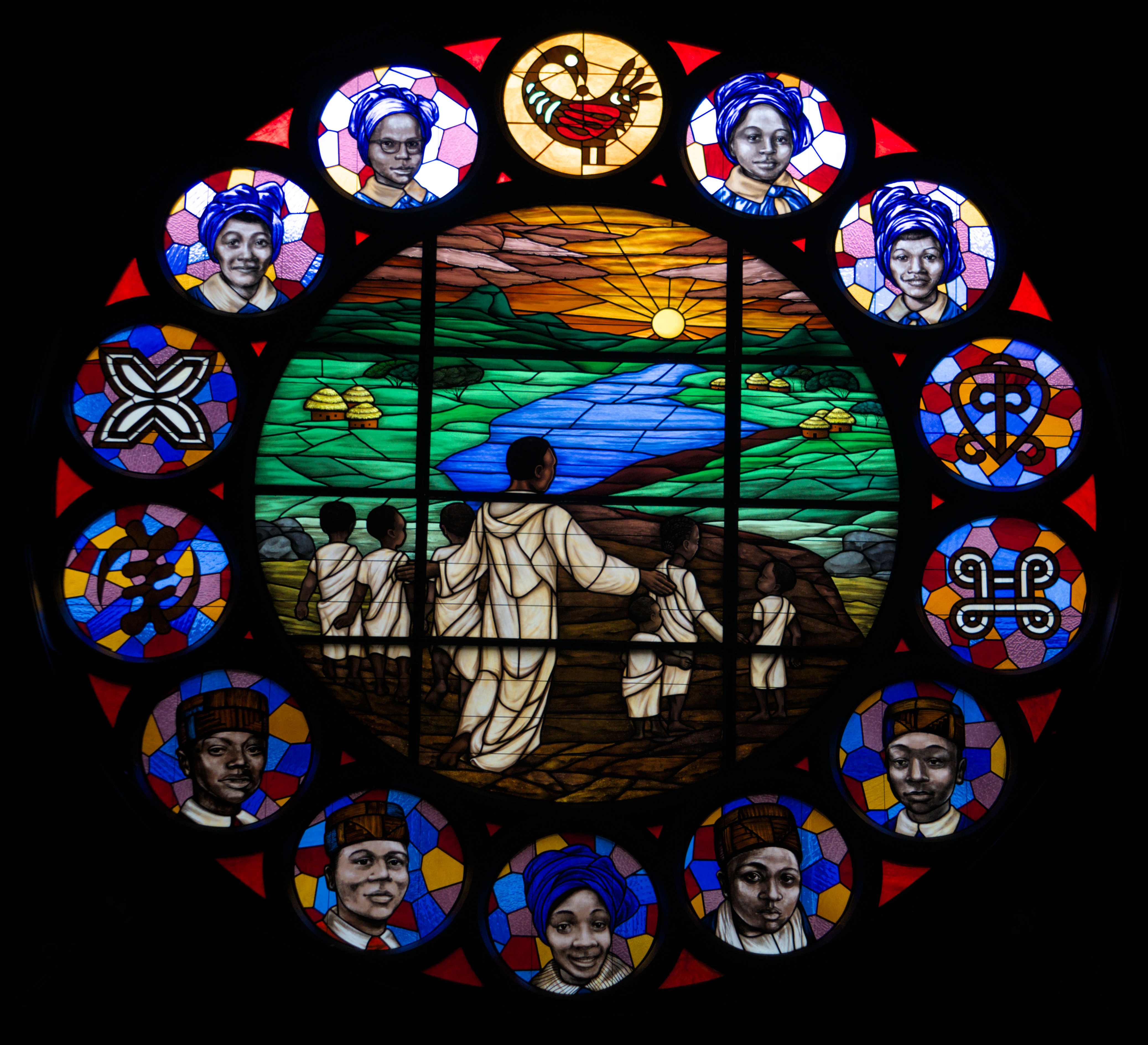
The Sankofa Peace Window
The West Rose Window, known as the Sankofa Peace window, was the final one to be installed, replacing the clear panes that were there for over two decades. (New Mount Pilgrim sold the original window depicting Mary and the Christ child blessing and accepting the rosary from a male and female saint, to raise funds for the new one.) The Sankofa Peace window was dedicated on February 24, 2019 (watch the service here and view photos here), the year that marked the four hundredth anniversary of race-based slavery in America.
Sankofa Peace, 2019. Stained glass, diameter 25 feet. New Mount Pilgrim Missionary Baptist Church, West Garfield Park, Chicago. Photo: Victoria Emily Jones.
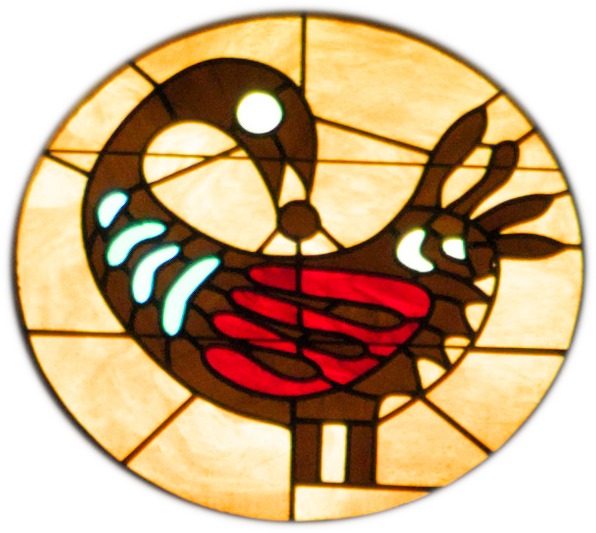
Sankofa is a Twi word from the Akan people of Ghana that means “go back and retrieve it,” a phrase that encourages learning from the past to inform the future. It comes from the proverb “Se wo were fi na wosan kofa a yenkyiri”—“It is not wrong to go back for that which you have forgotten,” to return to one’s roots to reclaim lost identity. The concept of Sankofa is traditionally symbolized by a mythical bird with its head turned backward while its feet face forward, carrying a precious egg in its mouth, which represents the knowledge of the past on which wisdom is based.
The Sankofa bird appears in the top center roundel of the window.
Hatch Jr., who preached at the window’s dedication service, discussed Sankofa as a spiritual discipline, highlighting how it can refer not only to returning to one’s cultural roots, but also to God, our Source. “Sankofa is the process of training my soul to reach back and remember the grace and the glory of God,” he says, which can fuel us for the forward journey. He quotes the famous gospel hymn that says, “My soul looks back in wonder how I got over.” We must regale one another with stories of where we’ve been and how far God has brought us, and remind ourselves and each other where we’re heading.
Besides the Sankofa bird, the other four adinkra symbols that New Mount Pilgrim chose to include in the window’s border are:
These are key guiding principles of the church, part of their missional purpose and identity. They seek liberation and peace for all, through the power of God, following the path of the Savior who is Love, who brings us back to who we most truly are.
One way the Sankofa Peace window looks backward while moving forward is through the memorialization of murdered Black American youth, from the civil-rights-era South and twenty-first-century Chicago. The portraits at the top depict the four girls who were killed by the Sixteenth Street Baptist Church bombing in Birmingham, Alabama, in 1963: Carole Robertson (age fourteen), Addie Mae Collins (fourteen), Denise McNair (fourteen), and Cynthia Wesley (eleven).
The five teens at the bottom, selected by members of New Mount Pilgrim’s youth leadership committee, were victims of Chicago violence from the previous decade or so. From left to right, they are:
Derrion Albert(1994–2009), age sixteen. On his way home from school, he got caught in the middle of a brawl between two rival factions of students and was beaten to death with a railroad tie. The crime was captured on cellphone video.
Laquan McDonald (1997–2014), age seventeen. He was shot sixteen times by a police officer while he was walking away.
Hadiya Pendleton (1997–2013), age fifteen. She was killed by a stray bullet while hanging out in a park with friends after her final honors exams.
Blair “Bizzy” Holt (1990–2007), age sixteen. He was fatally shot on a CTA bus while shielding his friend from gang gunfire.
Demetrius “Nunnie” Griffin Jr. (2000–2016), age fifteen. A lifelong member of New Mount Pilgrim, he was burned to death in a trash can in a West Side alley. His death was ruled a homicide, but his killer(s) have not been found. He had told his mother that a gang had been trying to recruit him.
All nine children are dressed in traditional African headwear.
Even as the window laments these unjust deaths, it also provides a vision of restoration. The central scene shows Jesus as the Good Shepherd, leading his children to green pastures and still waters lined with thatched-roof homes—an Edenic place of peace and rest. One might view this as the afterlife (Hatch Sr. told me the children are “going back to the Father’s estate”); but it could also be seen as a picture of Christ leading us into a future on this side of the parousia, where all God’s children are safe and thrive on earth as it is in heaven.
Hatch Sr. told me the window is about recovering a village mentality right in the heart of the city, embracing values like hospitality, family, mutual support, elder respect, and the protection and uplift of children. Whereas the North Star window visualizes the literal lifting up of a child, the Sankofa Peace window calls parishioners to do it metaphorically, through the building of strong community and advocacy for policies that prevent violence and tragedy.
The MAAFA Redemption Project
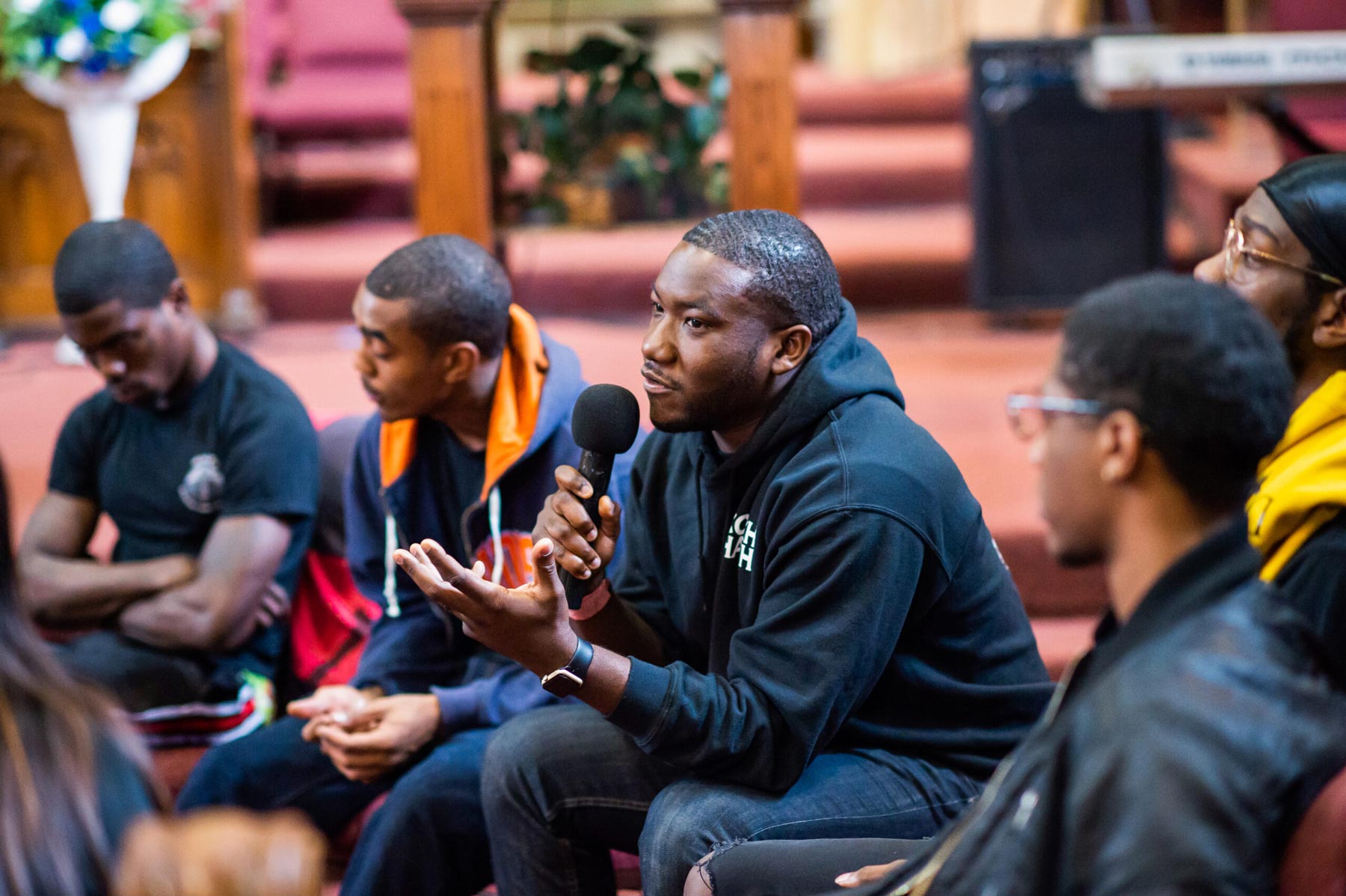
As a tangible outworking of the communal values expressed in its three rose windows, in 2017 New Mount Pilgrim established a workforce, social, and spiritual development program for young Black men in West Garfield Park, which is still running strong. (It graduated its seventh cohort last month!) Called the MAAFA Redemption Project, it is predicated on the belief that redemption and transformation must begin with the individual, and then that personal transformation can effect family and community transformation. The program emphasizes the importance of, as its website says, “remembering the past in order to create a more just and verdant present and future.”
Marshall Hatch Jr., director of the MAAFA Redemption Project (a ministry of New Mount Pilgrim MB Church), speaks with a group of participants about their experiences as young Black men living in West Garfield Park.
Using a dual direct-service and community-building approach, the program provides housing, job training, educational opportunities, psychotherapy, counseling, and wrapround social services to the young men who enroll. These supports are supplemented with programming that focuses on the arts, cultural identity development, spiritual enrichment, transformative travel, civic empowerment, and life coaching and mentoring.
The square-mile neighborhood of West Garfield Park has the highest rate of gun violence in Chicago and is one of the most crime-dense populations in the nation. The MAAFA Redemption Project seeks to recruit men between the ages of eighteen and thirty who are a part of this gun culture or at risk of becoming so, recognizing that young people are a neighborhood’s greatest resource for change. The project affirms the dignity and promise of the neighborhood’s Black and Brown youth and aims to instill hope in them, empowering them in activism against gun violence and the conditions that create it.
“The young people who come to us are tired of the subculture that only produces death, despair, and falling into the trap of the criminal justice system,” says Marshall Hatch Jr., the cofounder and executive director of the MAAFA Redemption Project. “They want something different for themselves and their loved ones.”
He continues, “We want to create the space for young men to see themselves differently, to reimagine themselves as men and leaders, pillars of this neighborhood. And so our goal is to embrace the truths that they give us of their experience but also challenge them to overcome, just as their ancestors overcame; to develop the inner resources to persevere and to challenge the system so that their sons, their daughters, don’t have to fight the same fights.”
The video storytelling unit NBC Left Field ran a wonderful segment in November 2018 that features the work of MAAFA Redemption Project:
I also recommend the feature-length documentary All These Sons (2021), directed by the Oscar-nominated Bing Liu and Joshua Altman (Minding the Gap) and streaming for free on Tubi, Amazon, and other services. MAAFA Redemption Project is one of the two Chicago antiviolence programs profiled, the other being the South Side’s Inner-City Muslim Action Network (IMAN) run by Billy Moore.
Most recently, MAAFA Redemption Project has partnered with other groups to build and share ownership of the Sankofa Wellness Village, a series of interconnected capital projects and social enterprises sited along the Madison and Pulaski corridor in West Garfield Park. Winner of the Chicago Prize awarded by the Pritzker Traubert Foundation, the village will be a sprawling, $50 million campus that will bring critical health, financial, and recreational resources back into the disinvested neighborhood, including a wellness center, a credit union, an art center, a business incubator and entrepreneurial support center, and pop-up fresh food markets.
The Sankofa Wellness Village breaks ground later this summer and is expected to open in late 2025.
Having identified the arts as an unmet need and desire of West Garfield Park residents, MAAFA Redemption Project has taken the reins on what will be called the MAAFA Center for Arts and Activism. They are working to restore the old St. Barnabas Episcopal Church to provide a space where residents can engage in intergenerational art making, relationship building, community organizing, political education, and civic empowerment.
Rendering of the future MAAFA Center for Arts and Activism in West Garfield Park, Chicago. Credit: Moody Nolan/Bureau Gemmel
“We’re part of a continuum of that liberation narrative of God,” Hatch Sr. says, referring to his church’s commitment to see their neighborhood flourish.
When in the nineties they inherited a grand church full of Eurocentric stained glass and other decoration from the Irish Catholic community that worshipped there previously, New Mount Pilgrim Missionary Baptist Church had some decisions to make. How would they honor the history of that sacred space while also making room for their own histories? What adjustments would have to be made to accommodate their different ecclesial and theological tradition? They made a few changes to the sanctuary, but they left most of it intact. The most significant change is the three new rose windows they commissioned to replace the old ones that were buckling. Once the first two were installed, Pastor Marshall Hatch Sr. told me, the space really started to feel like home.
Hatch Sr. spoke to me about “the power of art to reclaim an identity” for youth involved in or susceptible to gang violence. For sure, many local youth have been inspired by the Maafa Remembrance image in particular, which MAAFA Redemption Project uses as its logo, and thus it’s been widely visible throughout the neighborhood. And yet while the “under thirty” demographic is a particular focus of the church’s outreach efforts, the identity-forming power of art holds true for folks of any age. When a West Garfield Park resident enters the New Mount Pilgrim sanctuary for whatever reason—prayer, worship, respite, connection, religious education, compulsion from a family member—they can hopefully see themselves reflected in the imagery of the rose windows, and, in conjunction with the church’s music and preaching ministries, experience healing and revival.
Their culture, their history, their stories are sacralized in stained glass and integrated into the larger story of redemption God is telling.
Perhaps, from viewing the windows, they feel a deep identification with Christ in his crucifixion, or a sense of God’s presence with them in their suffering; perhaps they are dazzled by the dignity and endurance of their ancestors, or are compelled by the freedom Christ offers; perhaps that was one of their friends whose face shines down from the wall, or the niece or nephew of a friend, and they are turned toward somber remembrance of the lost life and moved to concrete action to reduce the city’s violence; perhaps they’re emboldened by the reminder that Christ goes with them as they seek transformation, as they bring to bear the gospel in this present age, in their own lives and the life of their community.
Visit the Church
Address: New Mount Pilgrim Missionary Baptist Church 4301 W. Washington Blvd. Chicago, IL 60624 (To see the windows in the sanctuary, I made a weekday appointment ahead of time with office manager Rochelle Sykes by calling the church at 773-287-5051. She let me in through the side door.)
The Middle Passage: White Ships / Black Cargo by Tom Feelings (Dial, 1995). This is an important work that every American should own a copy of. It consists of fifty-four powerful grayscale drawings that tell the story of the transatlantic slave trade’s Middle Passage. There’s no written narrative, but there is a brief introduction by the historian John Henrik Clarke. The book caught the attention of Marshall Hatch Sr. while he was a scholar-in-residence at Harvard Divinity School in 1999 and led him to reach out to Feelings for permission to have a stained glass window made based on one of the illustrations.
Committed to Memory: The Art of the Slave Ship Icon by Cheryl Finley (Princeton University Press, 2022). Thank you to Marshall Hatch Sr. for recommending this book to me. Finley, an art historian, explores how an eighteenth-century engraving of a slave ship became a cultural icon of Black resistance, identity, and remembrance, its radical potential rediscovered in the twentieth century by Black artists, activists, writers, filmmakers, and curators who have used it as a medium to reassert their common identity and memorialize their ancestors. It’s heavily illustrated and an insightful read, academic in tone but very accessible.
Painting the Gospel: Black Public Art and Religion in Chicagoby Kymberly N. Pinder (University of Illinois Press, 2016). This is where I first found out about the Maafa Remembrance window at New Mount Pilgrim. It’s one of sixty-some Black-affirming religious images from Chicago churches and their neighborhoods made between 1904 and 2015 that Pinder, an art historian, features, focusing on their intersection with the social, political, and theological climates of the times. Read my review here.
“Voices from Chicago’s Most Violent Neighborhood” by Andy Grimm, Chicago Sun-Times, 2023. The Sun-Times spent months last year talking to residents of West Garfield Park about why they’ve chosen to stay despite the rampant violence, and they’ve presented some of these stories in a well-designed, interactive web feature. One of the remarks that stands out to me is: “The most dangerous residents of the neighborhood are also the most endangered.”
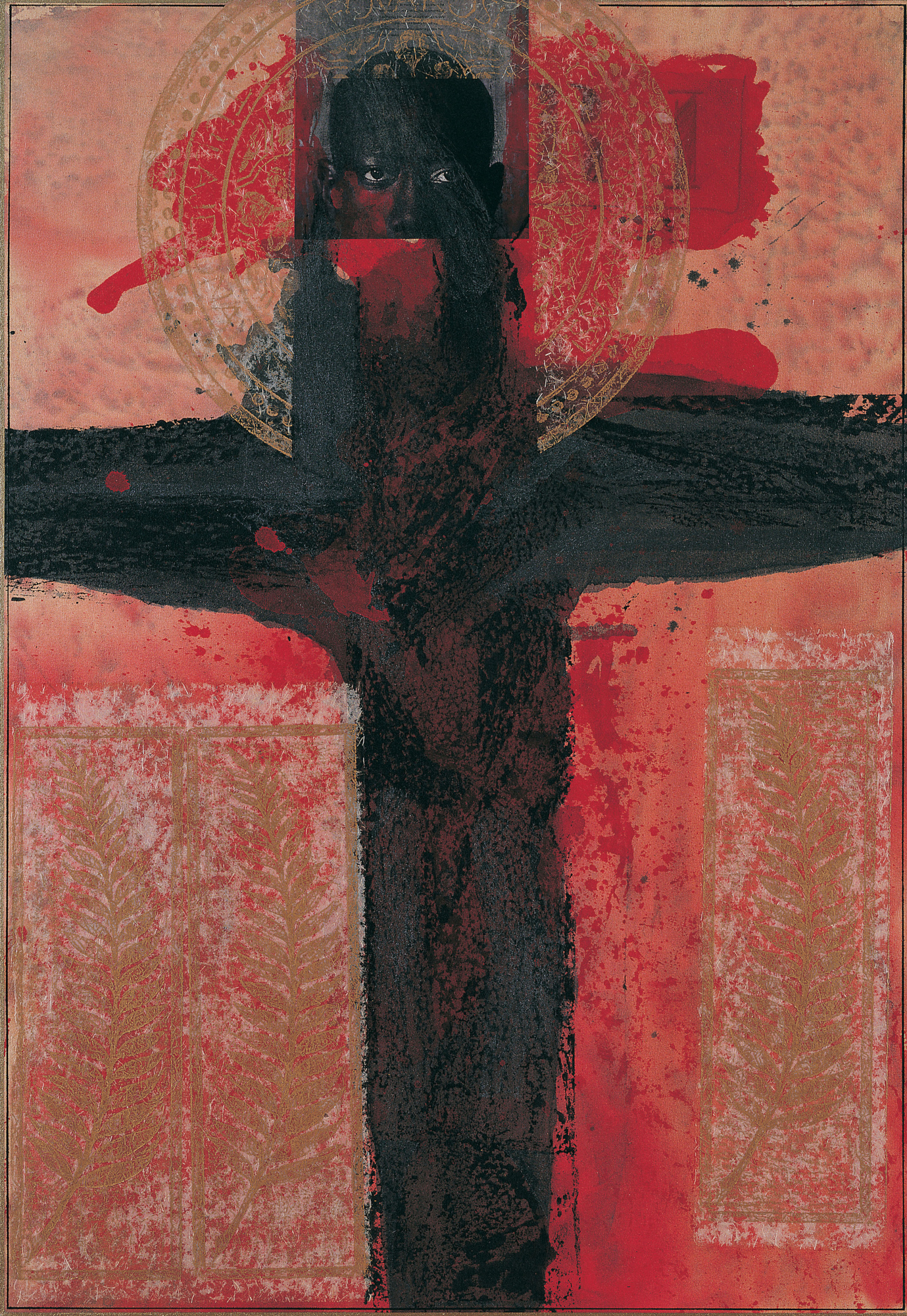
Last month when I was driving home to Maryland from Connecticut, I decided to stop for an hour or two at the Newark Museum of Art in New Jersey. I wanted to see a monumental Nativity painting in their collection by Joseph Stella. It didn’t end up being on display, but I did find many other compelling works. Chief among them was the acrollage painting Christ of the Christians by Nuyorican (New York Puerto Rican) artist Rodríguez Calero, a variation on the Crucifixion that portrays the violence of the cross in the abstract.
Rodríguez Calero (Puerto Rican, 1959–), Christ of the Christians, 1995. Acrollage on canvas, 52 × 36 in. Newark Museum of Art, Newark, New Jersey. All photos (except the two details that follow) courtesy of the artist.
Made with acrylic paint, rice paper, imaged paper, colored glazes, and gold leaf, the work is heavily layered. Its focal point is the direct gaze of a young Black man, his head framed by a shaded gray box and haloed in gold. His face is cut off just above the mouth. The Word is muted.
This figure fragment is at the top terminal of a rough-edged cruciform that is rendered in a harsh tar-black embedded with deep splotches of red. Body merges with cross—blood, wood, and flesh.
The whole background is covered in pinks and reds. The color pools and splatters and permeates, representing the pouring out of life.
Standing upright alongside the cross are three stenciled palm branches, alluding to Christ’s entry into Jerusalem just five days earlier. Palm branches were a symbol of triumph in ancient Judaism, hence their being waved to greet the Christ, the “Anointed One,” at the city gate. (Jesus’s followers anticipated a political victory over Rome, little knowing that God had other plans.) In Christian iconography palm branches are associated with martyrdom; in portraits and heavenscapes they are held by saints who met an early end because of their spiritual convictions, just like their Lord.
Their presence in this scene can be read on the one hand as an indictment of human fickleness (lauding Jesus as savior one day, crucifying him the next) and on the other as an assertion of triumph through the unlikely means of death on a cross.
The work can also be read through the lens of Black suffering and liberation. The late Christian theologian James Cone writes about such themes in The Cross and the Lynching Tree, a landmark book published in 2013, anticipating the Black Lives Matter movement. Cone explains how powerful a symbol the cross has historically been to Black American communities who face racial terror, violence, and oppression. They see in the Crucifixion, in addition to its spiritual implications, a demonstration of God’s solidarity with the oppressed, and hope on the other side. “I’m with you in your suffering,” says the God who hangs on a tree at the behest of a mob, “and death will not have the final word.”
Cone describes the thousands of lynchings of Black men, women, and children in the US as “recrucifixions”—the killing of sons and daughters of God. Two decades earlier, Jamaican American artist Renee Cox made the same connection in her photographic collage It Shall Be Named, just one in a line of artistic works to do so, going as far back as the Harlem Renaissance. Calero’s Christ of the Christians contributes to this tradition.
The gaze of the Christ in her piece is arresting. It confronts. It asserts the sacred humanity of its wearer, despite attempts to blot it out.
However, the artist tells me that for her, Christ of the Christians is about sacrifice, not violence, racial or otherwise. The man in the painting is the “people’s Messiah,” she says, “the anointed Savior to humankind who was sent to save all from the pain, darkness, and injustices that we see on a regular basis.” The cross is “willful humility, the culmination of prophecy, and the fulfillment of promises,” and the crown is heavenly reward. The trinity of branches represents hope.
One of the features that most struck me about this piece is its raised and varied textures, a hallmark all across the artist’s larger body of work. Calero coined the term “acrollage” to describe her mixed-media technique in which she uses an acrylic emulsifier to transfer collaged images (from found elements or her own photographs) onto painted canvas, adding further embellishments with gold leaf, stenciled patterns, and rice paper. This technique of layering materials, producing veils, suggests a theme of hiddenness and revelation.
Rodríguez Calero, or RoCa for short, was born in Arecibo, Puerto Rico, in 1959 and moved to Brooklyn when she was a year old. She returned to Puerto Rico after high school to study at the Escuela de Artes Plásticas at the Instituto de Cultura Puertorriqueña, under master artist Lorenzo Homar, who specialized in printmaking. Then she returned to New York for additional training in painting and collage under artist Leo Manso. She currently resides in New York and New Jersey.
Calero’s work merges Catholic iconography and hip-hop culture, drawing her personal community into the visual lexicon of the sacred. Raised Catholic, she was influenced from an early age by religious imagery at church and school. She brings this influence to bear in her artistic work while also integrating and reflecting the multiracial, multiethnic, urban environment she grew up in. “My inspiration really comes from just being in the neighborhood . . . the people walking the streets,” she says.
Alejandro Anreus, art historian and curator of the major 2015 exhibition Rodríguez Calero: Urban Martyrs and Latter-Day Santos at El Museo del Barrio in New York, describes the Nuyorican art aesthetic that was just getting off the ground while Calero studied at the Art Students League of New York from 1976 to 1982:
Starting before 1970—crystalizing possibly with the foundation of the Taller Boricua in New York City—and emerging and developing throughout the 1970s and into the 1980s, a specific aesthetic that can be defined as Nuyorican came into being. The aesthetic of New York Puerto Rican art was a diverse fusion of abstract expressionism and geometric abstraction, surrealism and social realism, as well as assemblage and constructions incorporating cultural and ethnic icons. The ethnic and cultural icons reflected several thematic preoccupations, which included Taino and Afro-Hispano imagery, depictions of barrio life, a popular, even populist Catholicism, and the belief that everyone, particularly the poor and marginalized of the neighborhoods, has dignity and inner worth regardless of social status. [exhibition catalog, p. 23]
The Christian doctrine of the imago Dei—that all human beings bear God’s image—is a central theme in Calero’s work. In His Image even adopts this theological language from the book of Genesis in its title, reminding us that God created each and every person with intrinsic and objective value, a reflection of his own divine self.
Rodríguez Calero (Puerto Rican, 1959–), In His Image, 1994. Acrollage on canvas, 36 × 24 in.
The piece shows a Black man dressed in a coat and beanie looking pensive and forlorn, his eyes downcast. Rectilinear pieces of teal-blue handmade paper form a cross behind him, and the outline of a manhole cover labeled “PUBLIC SERVICE” is superimposed over his face, doubling as a halo. In Christian art the halo signifies the light of Christ shining around and through a person, and Calero often adopts that device to underscore the sacred humanity of her subjects.
But the cross-hatching of this round form across the man’s face gives the impression of prison bars. Is he headed to prison, or is that destination merely what others, those with shallow or skewed vision, see when they look at him? Maybe he feels imprisoned by his circumstances. Or perhaps he is experiencing some kind of mental captivity. Whatever the nature of the confinement, those bars need to be broken. God wants every human being to be free and flourishing.
Rodríguez Calero (Puerto Rican, 1959–), El Hijo de Dios, 1995. Acrollage on canvas, 36 × 24 in.
The youth in El Hijo de Dios also shines forth God’s image. He looks straight out at the viewer from under his red Karl Kani sweatshirt hood, with a softness and a self-awareness that evoke empathy. A gilded pattern of crosses in diamonds cuts across the middle third of the acrollage, and a dot-rimmed semicircle, a halo fragment, seems to embrace the boy. The delicacy of this intervention over the thick, heavy folds of the cotton sportswear creates an intriguing mix.
To the boy’s right is a collaged face of a male in profile that looks like it could have been taken out of a Picasso painting. He could be an extension of the primary figure, his face set on a path. Or he could be someone who is at cross-purposes with him, as they are oriented at a ninety-degree angle from each other.
Translated “The Son of God,” the title of this acrollage could refer to Jesus Christ, who bears this title in a special sense, as the only begotten of God the Father. The man does seem to embody the vulnerability and determination that characterize Christ in his passion. Alternatively, it could refer to a child of God more generally, as the Spanish hijo is not necessarily male-specific. The particular and the universal are both at play here. We are all God’s children (Acts 17:28–29), equally and eternally beloved.
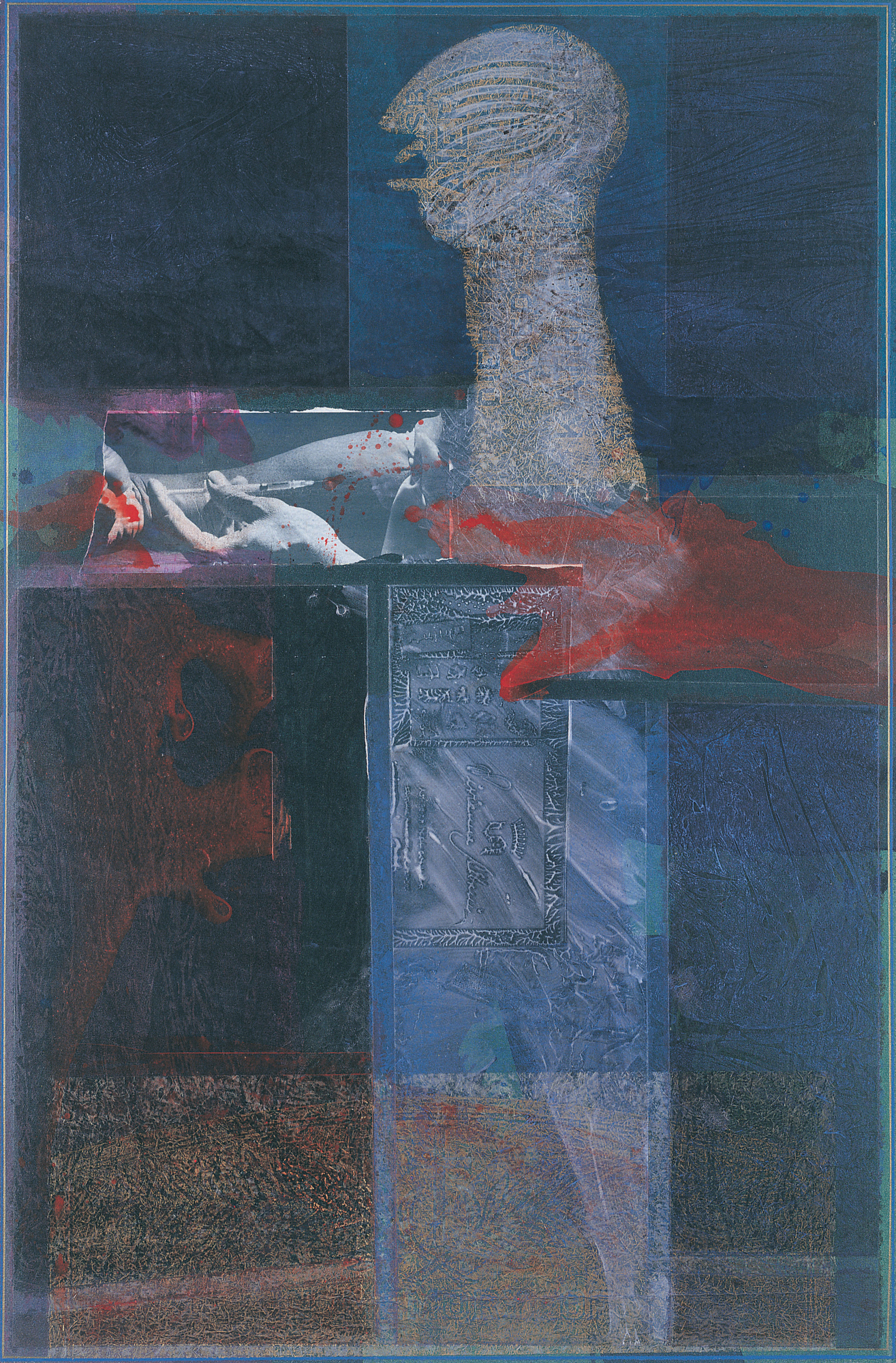
Rodríguez Calero (Puerto Rican, 1959–), Cruz de Loisaida, 1994. Acrollage on canvas, 64 × 42 in.
God’s love reaches especially into places of darkness, even though we don’t always feel it. In Cruz de Loisaida, our eyes are drawn to a monochrome found image of a hand injecting heroin into an arm. This fragment forms part of an abstracted cross, that archetypal symbol of deep suffering. The title, which translates to “Cross of Loisaida,” references a Lower East Side neighborhood with a strong Puerto Rican heritage. The piece laments the pain and anguish of drug addiction and, the artist says, the burdens forced on the Puerto Rican community by the government (“we are the sacrificial lambs”). Red pigment spills forth from the arm, evoking blood.
Rodríguez Calero (Puerto Rican, 1959–), Crowned with Thorns, 1999. Acrollage on canvas, 36 × 24 in.
Another acrollage that alludes to Christ’s passion is Crowned with Thorns, which is dominated by a large orange halo filled with linear and organic designs and cut out narrowly to reveal the face of a Black man. This headpiece is not obviously a crown of suffering; instead, it seems to convey an unironic air of royalty. It contains palm branches and irradiating gold lines that branch out like the veins of a leaf. And it smolders like fire. Could this be I AM speaking from the burning bush? The lush floral patterns, the Voice abloom?
By virtue of its historical associations, the title connects the man to Christ. With his hands he touches his Sacred Heart.
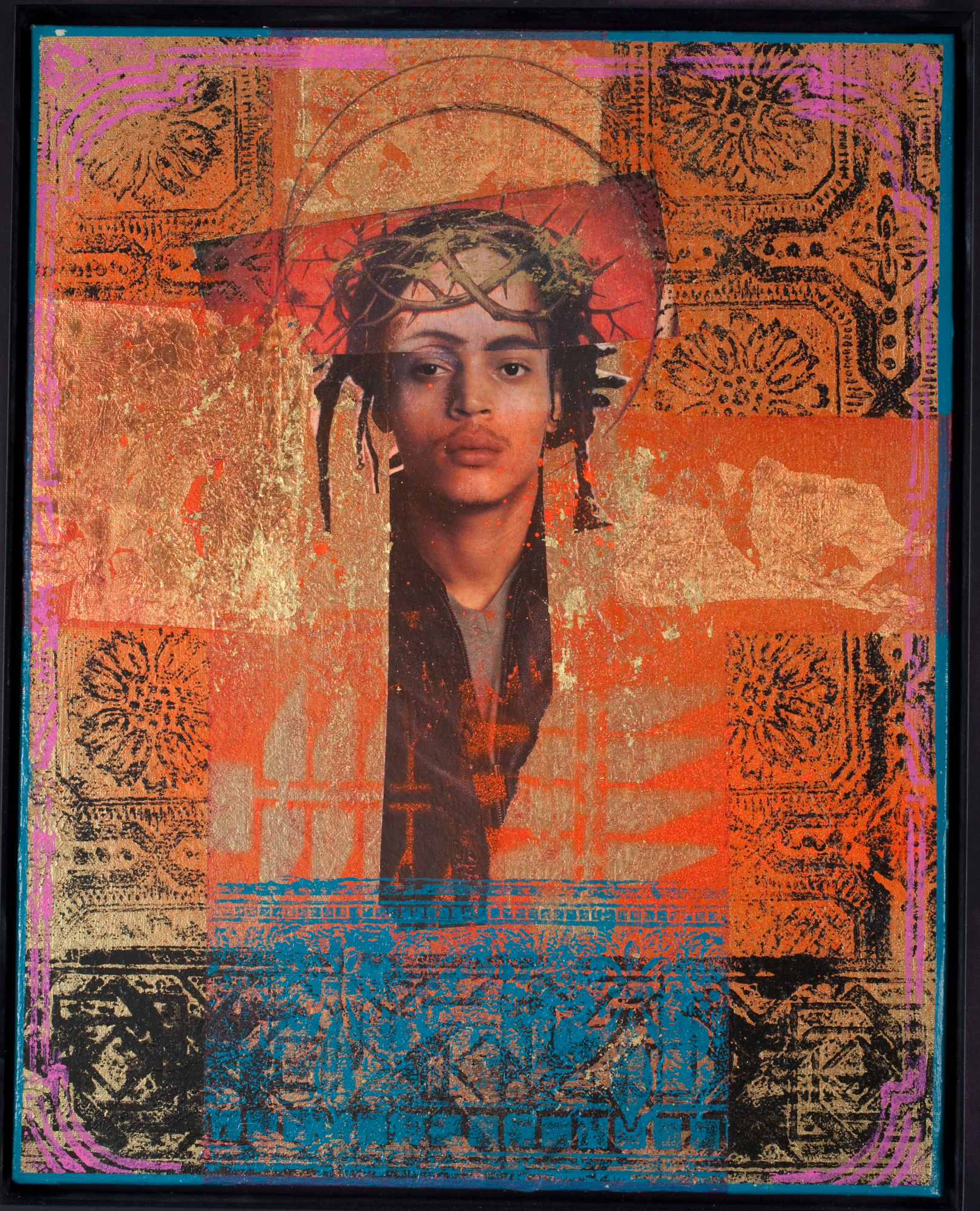
Rodríguez Calero (Puerto Rican, 1959–), The Chosen, 2000. Acrollage on canvas, 20 × 16 in.
One piece that appropriates unmistakable imagery of Christ is The Chosen: it contains a fragment of a Dutch Renaissance painting in the National Gallery of Christ crowned with thorns. Calero has cropped a detail of the gnarly crown piercing (a Caucasian) Christ’s forehead and collaged it with the face of a Latino man and the locs of a third (presumably a Black man). Her multiracial Jesus is nimbed twice over and emerges as if from a behind gold curtain, his brown eyes holding our gaze. He is surrounded by black-ink prints of flowers and crosses and flanked, as in Christ of the Christians, by golden palm branches. Droplets of red paint are splattered about his face and torso, one resting prominently on his upper right cheek like a tear.
Like Jesus, the Virgin Mary, his mother, is a major religious figure in Puerto Rican culture, and Calero references her in several of her artworks. Ángel y Maria depicts the moment of Annunciation, when the angel Gabriel comes to Mary to tell her that she has been chosen to bear God’s Son (Luke 1:26–38).
Rodríguez Calero (Puerto Rican, 1959–), Ángel y María, 2000. Acrollage on canvas, 52 × 36 in.
It’s a stunning image, bringing new life to a subject that has been painted hundreds of thousands of times over the course of history, starting with the ancient Roman catacombs. In Calero’s take, Mary is portrayed as a beautiful young woman of African descent who sits in profile, contemplating the gravity of what has just been asked of her. She holds a bouquet of flowers to her chest—perhaps she was in the midst of picking or arranging them when Gabriel arrived.
Gabriel stands in formality, cognizant of the weight of his message, patiently awaiting a response. His body is rendered in a wash of colors that blend into one another, producing an ethereal look.
Mary’s lips are parted, speaking her yes.
“The theme is love,” Calero told me. “The flowers are a representation of the blessing already inside.”
In the gospel story, this supernatural encounter results in a miraculous pregnancy, pictured in Calero’s La Madonna Negra (The Black Madonna). The image is of the Madonna del Parto (Our Lady of Parturition) type—that is, the pregnant Mary. We don’t often see Mary’s bare belly in all its pregnant glory, but here we are given a glimpse and reminded of the bodiliness of the Incarnation. We can even see the linea nigra extending across her belly button!
Rodríguez Calero (Puerto Rican, 1959–), La Madonna Negra, 2007. Acrollage on canvas, 54 × 24 in.
Calero’s Afro-Latina Madonna has two sets of arms. With one, she cradles her third-trimester baby bump and clenches the veil near her face, and the other she extends outward in a gesture of giving, offering the fruit of her womb for the life of the world (notice the printed impression of a fetus in her upper left hand). I love how these multiple gestures capture the conflicting instincts she must have felt—on the one hand, to keep the child to herself, to protect him from harm, and on the other, knowing her ministry is to support his, to share him with everyone. I see both Mary’s fear and her surrender in this image; her very human “What if I’m not ready for this?” and her “Welcome; come, receive.”
Rodríguez Calero (Puerto Rican, 1959–), Virgen María, 2000. Acrollage on canvas, 52 × 34 in. Collection of María Domínguéz-Morales and Juan M. Morales.
There’s also a hybridity in Virgen María, which shows a woman whose face is an amalgam of “every woman,” says the artist. Strong and confident, this Mary takes up space. Streaks of red paint cut across her torso like cords—but she spreads her arms, breaking what binds her. The bottom half of the canvas consists of blues and reds, Mary’s traditional colors, while the top half is gold, signifying the light of God.
“Mary, for me, has always been pictured as passive, and dressed in blue,” Calero told me. “Think about God in heaven, searching the world for the perfect woman to bear his Son. Now, in that state of mind, I thought Mary was chosen for her beauty, strength, compassion, intellect, and sexiness, and must represent all women, hence my Virgen María.”
Just as Calero often composites people of different races and ethnicities, she also occasionally mixes genders, as in Divine Prophet.
Rodríguez Calero (Puerto Rican, 1959–), Divine Prophet, 2012. Acrollage on canvas, 54 × 36 in.
This prophet’s face is made up of three collaged elements. A male with long hair and closely cropped facial hair forms the base, but the two eyes, underlined in blue shadow, are clearly a woman’s. And a mystical third eye is patched onto the forehead.
In Eastern spirituality, the third eye, also called the inner eye, provides perception beyond ordinary sight. The prophet, for example, sees visions of a reality that is presently invisible but that will one day be made manifest. The third eye symbolizes a state of enlightenment.
The prophet in this piece could be Jesus, or an Old Testament seer, or a prophet from another faith tradition. If the former, it’s interesting to consider how male and female are both contained in the Godhead, per Genesis 1:27. Although the second person of the Trinity incarnated as a male, there’s a long tradition of ascribing feminine attributes to Christ, from Clement to Ephrem to Anselm to Marguerite d’Oingt to Julian of Norwich. Christ is our Mother, they say, who labors to bring us to birth and feeds us at his breast. Moreover, the biblical book of Proverbs personifies Wisdom as a woman, and that woman is associated with Christ.
Centuries of European religious art and its mass-produced derivatives have harnessed the popular imagination to a narrow view of what the sacred looks like. Because of this conditioning through images, most people all over the world, not just in the West, conceive of Jesus, Mary, and the saints—those due honor—as white. Calero challenges that conception, not erasing whites but broadening the tent of sacred imagery to encompass people of color as well.
Most of her “saints” are not historical. They’re ordinary folks from New York’s barrios, or from other US cities—and from today. With their strong frontal poses, direct gazes, and haloes, they reflect the dignified, divine image–bearing status of those whom traditional Christian iconography has tended to exclude.
“Her saints—santos—are latter day and among us, her martyrs are our contemporaries,” says Alejandro Anreus. “They all live and struggle in an urban world filled with tension, even violence, as well as humor, yet open to epiphanies, where miracles can happen.” And, he continues, “her representations of Jesus Christ become all of us, as if reflecting the variety of humanity redeemed by Christ.”
(Regarding Anreus’s crucial last point: I articulated some of my thoughts on the matter a few years ago in this Instagram post.)
Black and brown bodies are beautiful and good, bearing the imprint of God their Creator. Rodríguez Calero helps us see and celebrate that. Bringing her cultural heritage to the fore, she cuts and combines, mixes and matches, contemplates, plays, and intuits, constructing affirming figure-based images of flesh and spirit that, while borrowing Christian visual tropes, are not tethered to Christianity but rather can live and move beyond an orthodox framework.
To learn more about Calero’s art training, her oeuvre, and collage as an art form, see the catalog for her retrospective (written in English and Spanish). You can also visit her website, www.rodriguezcalero.com.
Today’s roundup brings together a theologian (Anderson Jeremiah), an art historian (Elissa Yukiko Weichbrodt), and a musician (Eric Lige and friends) who I think complement one another really well!
SONGS:
Eric Lige [previously] is “a music-maker who promotes Jesus, Justice, Faith, and Community.” He is the worship director at Ethnos Community Church in San Diego and the co-executive producer of The Ethnos Project, which creates a platform for new and emerging global voices in musical worship to be heard worldwide. Especially since COVID hit in 2019, he has been assembling multinational teams of musicians to produce YouTube videos, many of which are livestreamed as part of Ethnos worship services. Here are three examples (view more on Lige’s YouTube channel):
>> “Ξεδιψασμένος (No Longer Thirsty)” by Kostas Nikolaou: A contemporary Christian worship song in Greek, about how Christ, the living water, quenches our thirst for love and purpose. The lead vocalist is Nefeli Papanagi—and wow, do I love her voice!
>> “Ua Mau (Hosanna)” by Moses W. Kaaneikawahaale Keale (aka Keale Ta Kaula): Reyn and Joy Nishii perform this nineteenth-century Hawaiian hymn by Keale “the Prophet,” who converted to Christianity after calling on God during a hunting accident and finding rescue. The first verse translates to “Perpetual is the righteousness / That comes from the Father above / Let us gather together / In his goodness and grace.”
>> “Love’s in Need of Love Today” by Stevie Wonder: Edward Chen and friends—from Canada, the United States, Armenia, Venezuela, and Mexico—perform the opening track from Stevie Wonder’s Grammy-winning album Songs in the Key of Life. “God gave me this gift, and this particular song was a message I was supposed to deliver,” Wonder has said. “The concept I had in mind was that for love to be effective, it has to be fed.” See the full list of credits in the description on the video page. Eric Lige is the one in the maroon shirt.
+++
LECTURES:
>> “Many Faces of Jesus: Christologies from the Margins” by the Revd. Canon Dr. Anderson H. M. Jeremiah, October 12, 2021: Anderson Jeremiah is a senior lecturer in the politics, philosophy, and religion department at Lancaster University in the UK, whose areas of expertise include Christian theology in Asia, postcolonial approaches to theology, Dalit studies, liberation theology, modern missionary movements, and inculturation and faith. Ordained in the Church of South India (part of the Anglican Communion), he was installed as Canon Theologian of Blackburn Cathedral in September 2021, making him the first Dalit to be appointed to that role in any English cathedral.
In this half-hour online talk given last fall for the Diocese of Manchester, Jeremiah discusses the Incarnation as a continuous event—Christ being born into human cultures—as expressed through a selection of visual artworks from Ghana, Bolivia, China, Japan, and India. These images subvert the predominant Western image of Christ and sometimes provide critique. New to me was the black marble crucifix from the Anglican chapel inside Cape Coast Castle, a former trading post (now a museum) where enslaved Africans were held before being loaded onto ships and sold in the Americas. I’m not sure who commissioned the sculpture or when it was placed at this site, but it definitely looks modern.
The Q&A that followed on the original Zoom event is not included in the video, but here’s one of Jeremiah’s comments from it that I transcribed: “Jesus is not foreign to my own experience; this Jesus is part and parcel of my own existential reality. It [the image] enables people who are seeking peace and emancipation; [they are] emboldened in that process of seeing themselves reflected in the image of Jesus. The normative image the church has been holding on to has not created that space.” When one attendee asked if images of white Jesus are always “wrong” or to be discouraged, Jeremiah replied that there’s nothing wrong with such an image in itself, but the problem is when it is imposed on the entire world as the only way of looking at Jesus. “When we hold up one image as normative, we lose the diverse ways God intends to manifest himself in diverse contexts,” he said. (I couldn’t agree more!)
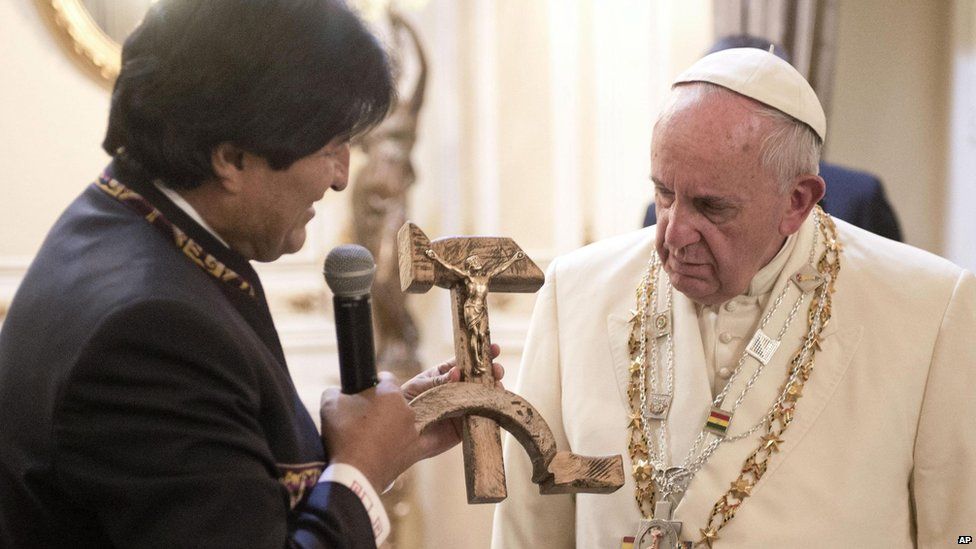
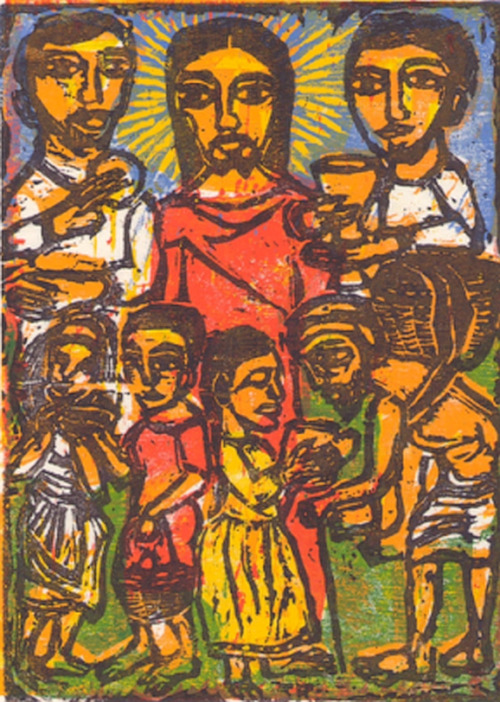
In July 2015 Bolivian president Evo Morales (who is Aymara) presented to Pope Francis a crucifix sculpted in the shape of a hammer and sickle. The crucifix is based on a design by Luís Espinal (1932–1980), a Jesuit priest assassinated in 1980 by right-wing militia. Bolivia’s communications minister, Marianela Paco, told Bolivian radio that “the sickle evokes the peasant, the hammer the carpenter, representing humble workers, God’s people.” Photo: AP.Solomon Raj (Indian, 1921–2019), The Lord Remembers the Hungry: Liberation from Hunger, 2006 (based on the 1988 original). Woodcut, from the series “Liberation in Luke’s Gospel.”
In this undergraduate lecture (starts at 4:06), Weichbrodt discusses how photography has been used to shape racial bias and even construct race, as well as gender, focusing on a famous 1957 photograph of school desegregation in Little Rock, Arkansas. She shows how this single photo is part of a larger web of meaning that contemporary news photos also play into. We’re always interpreting and categorizing images in relationship to things we’ve already seen, Weichbrodt says, creating a mental archive—for example, a file for “blackness,” a file for “womanhood.” And “as Christians called to recognize the dignity of God’s image in all people, we have to do actual work to acknowledge how our own archives may have hampered or distorted our love for our neighbors.” To look more faithfully, we need to look more; we need to build a broader archive.
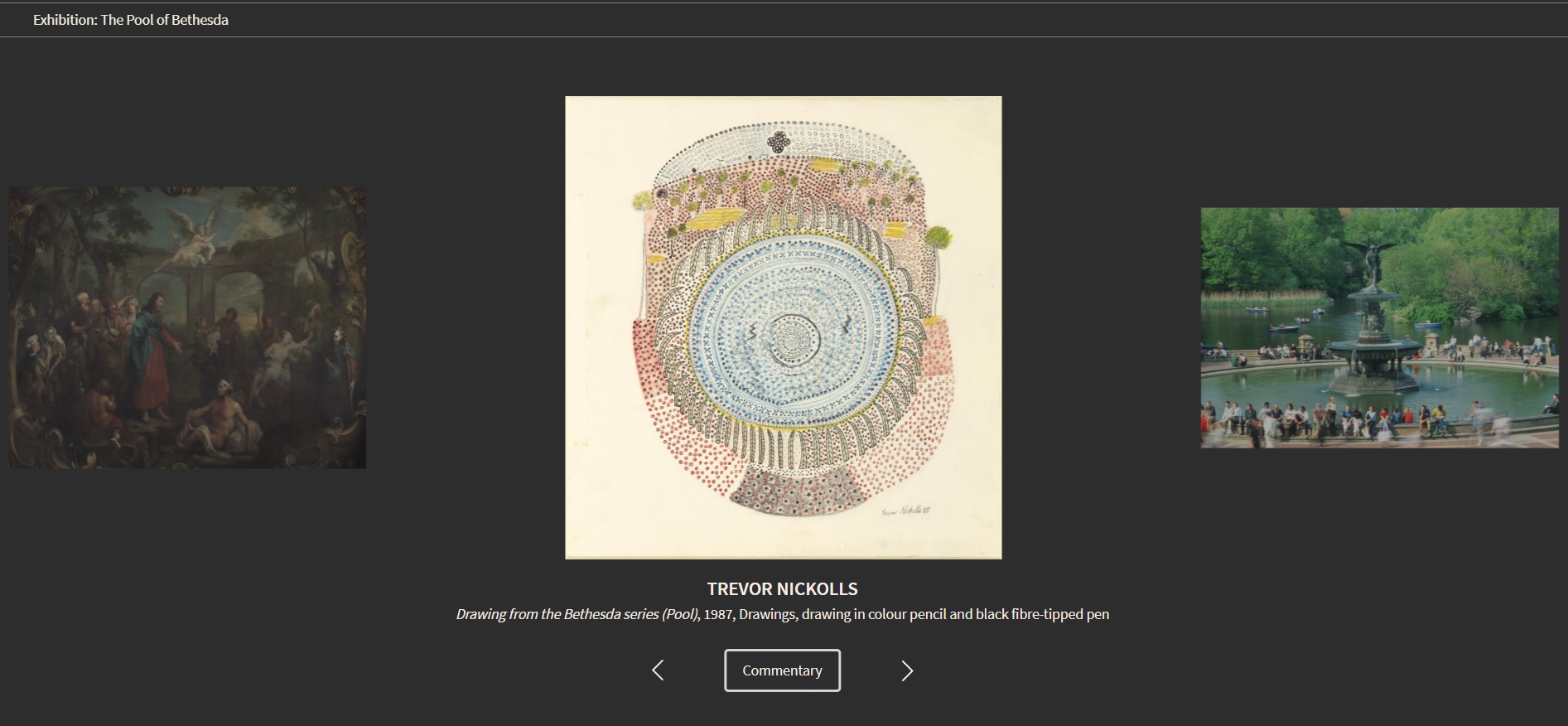
VISUAL COMMENTARIES: “The Pool of Bethesda” by Naomi Billingsley: In a recent contribution to the online Visual Commentary on Scripture [previously], Naomi Billingsley has compiled and written about three artworks based on John 5:1–18, a story in which Jesus heals a paralyzed man at a reservoir in Jerusalem. A source of hydration, cleansing, and tranquility, the pool of Bethesda, Billingsley says, is a symbol that transcends individual religious traditions.
She discusses William Hogarth’s painting of the subject for a hospital, showing sick patients receiving care; a “Dreamtime” drawing from Aboriginal Australian artist Trevor Nickolls’s Bethesda series, created during his recovery from a major car accident; and The Angel of the Waters fountain in Bethesda Terrace in Manhattan’s Central Park, designed by Emma Stebbins in 1842 to celebrate an aqueduct that brought clean water to New York City and improved public health (and which you may recognize as the site where John the Baptist baptizes disciples in the opening sequence of the movie Godspell).
+++
ARGENTINE TANGO HYMN: “Tenemos Esperanza” (We Have Hope): This hymn text was written in 1979 by Federico Pagura (1923–2016), a Methodist bishop and human rights champion from Argentina, and set to tango music by Homero Perera (1939–2019) of Uruguay. Argentinian pastor Federico “Fede” Apecena, who lives in Georgia in the US, recently introduced the song to his friend Josh Davis, who heads the multicultural worship ministry Proskuneo, and the two banged out this awesome video performance. “The song is a record of all that Jesus came to do and to be,” Apecena explains at the end of the video. [HT: Global Christian Worship]
+++
OBITUARY: Ernesto Cardenal (1925–2020), poet and priest who mixed religion and politics in his commitment to social justice in Nicaragua, dies at 95: A Catholic priest, poet, and political revolutionary from Nicaragua, Ernesto Cardenal was a controversial figure. He supported the Sandinista insurrection against the dictatorial Somoza regime in the seventies and, when the Sandinista government (which claimed to integrate Marxist and Christian ideals) came to power, served as its minister of culture from 1979 to 1987. He viewed this post as an extension of his priestly office and, refusing to quit it at Pope John Paul II’s behest, was forthwith suspended from the priesthood in 1984. (Pope Francis absolved him of canonical censure in February 2019, permitting him to administer the sacraments once again.)
Cardenal’s most enduring achievement was his 1966 founding of a religious community among the peasant farmers and fishermen of the Solentiname archipelago in Lake Nicaragua. He saw to the construction of a small wooden church, where he led collaborative Masses: instead of giving a homily on the week’s assigned Gospel reading, he opened up dialogues about it with his parishioners, relishing their insights. Transcripts of these conversations were published in four volumes as El Evangelio en Solentiname (The Gospel in Solentiname) between 1975 and 1977, with English translations appearing in 1976–82—a classic work of liberation theology.
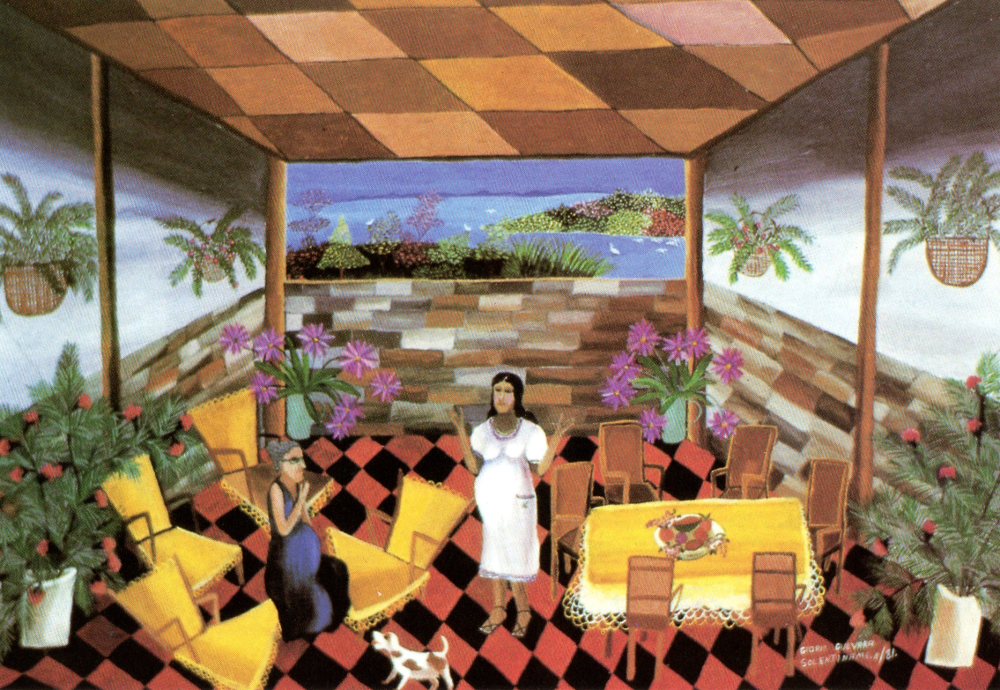
Besides cultivating the islanders’ interest in the Bible, Cardenal also took notice of their creative talents. He brought in artists to lead workshops, which led to the development of a primitivist art school that achieved international recognition for its paintings, many of them depicting Jesus’s birth, ministry, and passion taking place in Solentiname, in and around the familiar thatched-roof buildings, blue waters, and lush vegetation. In 1984 Orbis Books editors Philip and Sally Scharper combined several such images with a heavily abridged version of The Gospel in Solentiname and published it as The Gospel in Art by the Peasants of Solentiname, a slim, full-color hardcover that I highly recommend.
Gloria Guevara (Nicaraguan, 1954–), The Visitation, 1981 [source: The Gospel in Art by the Peasants of Solentiname]“It was the Gospel which radicalized us politically,” Cardenal said. “The peasants began to understand the core of the Gospel message: the announcement of the kingdom of God, that is, the establishment on this earth of a just society, without exploiters or exploited.” Afraid of the dangerous ideas taking root in Solentiname, Somoza’s National Guard razed the settlement to the ground in 1977, and Cardenal was forced to flee to Costa Rica. He gave his blessing to his community’s decision to join the Sandinistas, the people’s army, to attempt an overthrow of Somoza, a victory they achieved in 1979. The surviving peasants returned to Solentiname to rebuild, and their practice of art and faith continues to thrive to the present day.
Cardenal is also known as a poet. I’ve read only one volume of his poetry, in English translation: Apocalypse: And Other Poems (New Directions, 1977). I didn’t connect well with a lot of it, but it does have a few gems, like “Prayer for Marilyn Monroe,” “The Cosmos Is His Sanctuary (Psalm 150),” and “Behind the Monastery,” reprinted here in full:
Behind the monastery, down the road,
there is a cemetery of worn-out things
where lie smashed china, rusty metal,
cracked pipes and twisted bits of wire,
empty cigarette packs, sawdust,
corrugated iron, old plastic, tires beyond repair:
all waiting for the Resurrection, like ourselves.
(translated from the Spanish by Robert Pring-Mill)
+++
LECTURE: “On Beauty” by Natalie Carnes: “Beauty has been leveraged in ways that wound us, with legacies of misogyny, class hatred, and racial injustice,” says Dr. Natalie Carnes, associate professor of theology at Baylor University. “And yet I want to suggest that beauty tends those same wounds, and can be found in those same wounds, for beauty is a name for God.”
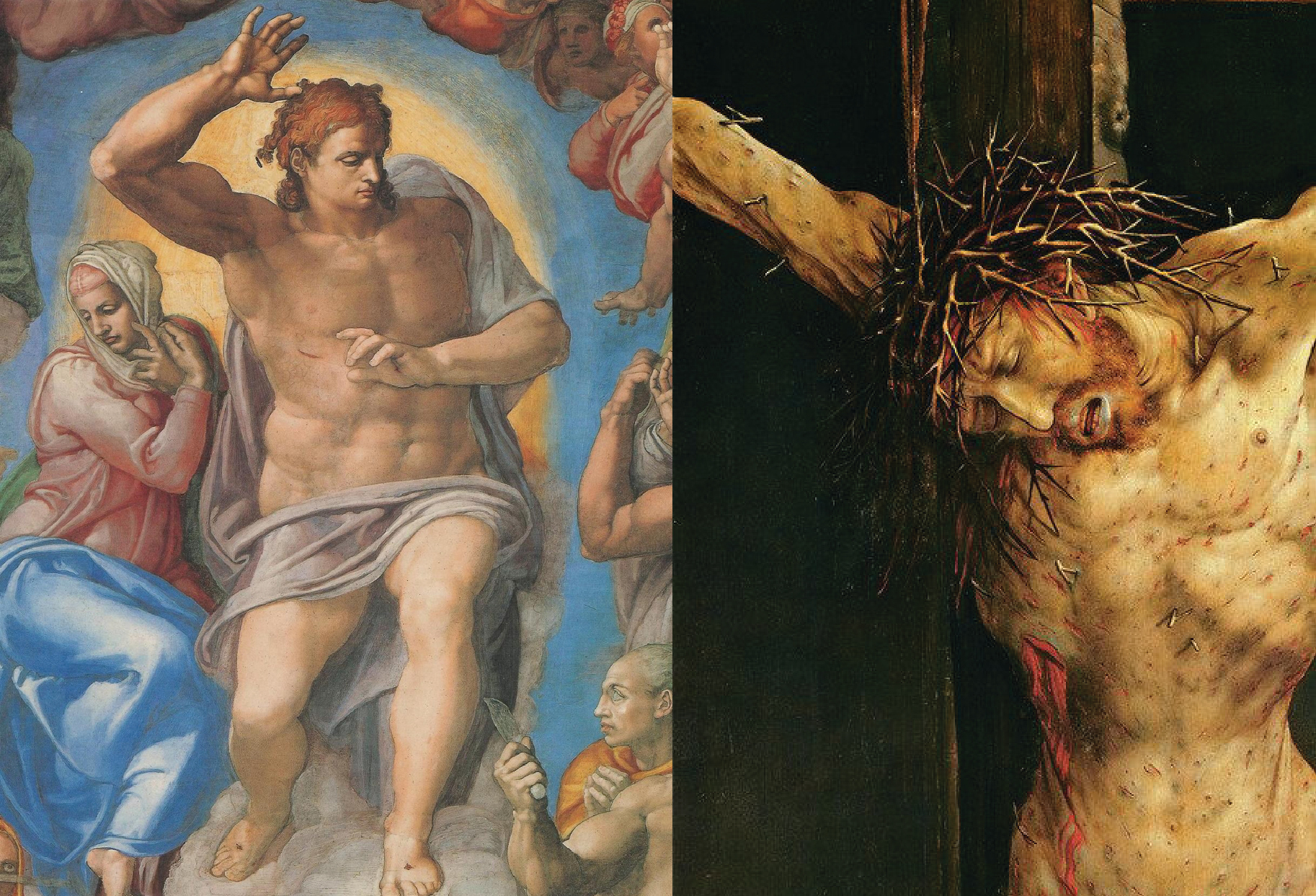
In this half-hour talk given November 1, 2017, at Dallas Theological Seminary as part of school’s Arts Week, Carnes examines the paradox, expressed in the church’s art and theology across history, that God is both beautiful and not beautiful. In his suffering, Carnes says—his entering the ravaged and scarred places of our humanity—God does not renounce his beauty but reveals it.
The divine presence in grotesque suffering is not a departure from the divine life but characteristic of it. And that movement into the grotesque is not antagonistic to beauty but the revelation of it. God’s faithfulness goes by way of intimacy with not-God, and beauty by way of the grotesque. The beauty that rejects suffering is false, and the one who follows the call of beauty faithfully will find herself in the scarred places of the world. Beauty, after all, is a name for God, and God does not abandon divinity in identifying with the suffering and afflicted but expresses through such identification the very marker of divine life.
This is not to say that suffering, affliction, or poverty is beautiful. Beauty is distinct from the mode of its arriving. Poverty and suffering can be important sites of beauty, even as they are not themselves beautiful, because they mediate the beauty of the God who is charity. . . .
PLAYLIST: “Spiritual Cosmonaut,” compiled by Latifah Alattas: Last month singer-songwriter and music producer Latifah Alattas [previously] curated a short Spotify playlist of “Spiritual songs that stir my soul. Melodies that tap into mystery. Sounds that open me up to the wonder and peace of God.” It’s great!
Alattas is the frontwoman of the band Page CXVI [previously], which has just returned from a six-year hiatus. I’m so moved by their recently released rendition of “Great Is Thy Faithfulness,” with piano, synthesizer, and pedal steel guitar. Alattas has made the song more communal, subbing out all first-person singular pronouns for first-person plural, even rewording whole lines, like the last two of the chorus, which become “Amidst the pain of this world you grieve with us—unfailing faithfulness, dwelling so near.” Or the final line of the final verse, which she changed from “Blessings all mine, with ten thousand beside!” to “Blessings for all, Christ within us resides.”
People who are attached to singing the song a certain way might object to such lyrical revisions, but I see them, along with the creative musical liberties she takes, as helping to bring out the themes that are already there. Alattas helped me to hear this classic hymn with new ears.
+++
FILM: The Two Popes (2019), dir. Fernando Meirelles: I recently watched this Oscar-nominated biographical drama and enjoyed it more than I thought I would! I wasn’t expecting the respect it gives to its subjects and to Christianity. Its title refers to the fact that, for the first time in six hundred years, the Roman Catholic Church has one reigning pope and one retired pope, the “pope emeritus.” (When Benedict announced his resignation in 2013, it shocked the world, as it’s expected that, if chosen, you serve in that role until death.)
The movie is primarily about the relationship between the traditionalist Pope Benedict XVI (born Joseph Ratzinger) and the progressive Pope Francis (born Jorge Bergoglio), which starts out antagonistically but buds into a friendship of sorts. It’s dialogue-heavy (it was adapted from a stage play), but in the most interesting way, as the two engage in “a series of philosophical and dogmatic discussions and disagreements about the nature of faith and forgiveness, and the direction of a church struggling to maintain relevance in the modern world” [source].
But it’s not just about the church’s struggle or the burdens of high office; it’s also about personal faith as a struggle—how to discern one’s calling in life, how to hear God’s voice and deal with his silence, and how to forgive oneself for one’s own tragic silences (in Benedict’s case, regarding the sex abuse perpetrated by clergy; in Francis’s, regarding the Dirty War in his home country of Argentina in the late seventies and early eighties, while he was serving as priest).
Francis’s backstory, of which I knew nothing beforehand, is told in flashbacks. (The fiancée is fictional, though the real Francis has admitted to having romantic crushes as a teenager and even as a seminarian.) The portrayal of both men, by Anthony Hopkins as Benedict and Jonathan Pryce as Francis, is very humanizing (not initially for Benedict, but his character gets there)—and not just because of the glimpse it provides into Francis’s life prior to the cloth, but also, in part, because of little nods it gives to their interests beyond the church, like Francis’s love of soccer and tango dancing, and Benedict’s piano playing and Fanta drinking. And because it shows their personal fallibility, their regret over past misdeeds.
It should be noted that the meeting of the two men at the papal summer residence of Castel Gandolfo prior to Benedict’s resignation is invented, as are many of their lengthy dialogues, which are nonetheless inspired by speeches, letters, and other writings of theirs, brought into conversation with one another by playwright and screenwriter Anthony McCarten.
Last month Sister Rosetta Tharpe (1915–1973), one of the few female guitar evangelists of the ’30s and ’40s and the first gospel superstar, was inducted into the Rock and Roll Hall of Fame. She was named an “Early Influence” for her electric sound and original guitar picking, which influenced the likes of Chuck Berry, Jerry Lee Lewis, Elvis, and Johnny Cash, among many others. (“Tharpe’s unique guitar style blended melody-driven urban blues with traditional folk arrangements and incorporated a pulsating swing sound that is one of the first clear precursors of rock and roll.”) Performing (controversially) both sacred and secular music, in churches and nightclubs, Tharpe collaborated with heavy-hitting artists of the time, including Duke Ellington, Cab Calloway, and the Dixie Hummingbirds, and she even hired a white group, the Jordanaires, to sing backup during one of her tours.
In 2011 BBC Four premiered Sister Rosetta Tharpe: The Godmother of Rock and Roll, a documentary written and directed by UK filmmaker Mick Csaky. Its US television premiere was in 2013, part of PBS’s American Masters series. Watch the trailer below, or watch the full documentary online.
Another April Rock and Roll Hall of Fame inductee, who’s more of a household name, is Nina Simone (1933–2003). One of her most famous songs (certainly her most sampled) is “Sinnerman,” a Negro spiritual inspired by Revelation 6:12–17:
When he opened the sixth seal, I looked, and behold, there was a great earthquake, and the sun became black as sackcloth, the full moon became like blood, and the stars of the sky fell to the earth as the fig tree sheds its winter fruit when shaken by a gale. The sky vanished like a scroll that is being rolled up, and every mountain and island was removed from its place. Then the kings of the earth and the great ones and the generals and the rich and the powerful, and everyone, slave and free, hid themselves in the caves and among the rocks of the mountains, calling to the mountains and rocks, “Fall on us and hide us from the face of him who is seated on the throne, and from the wrath of the Lamb, for the great day of their wrath has come, and who can stand?”
When Simone (then Eunice Waymon) was a young girl, her mother, a Methodist minister, had her play the song on the piano at revival and prayer meetings as a means of compelling sinners to the altar. (Before pursuing her career as a singer and recording artist, she wanted to be a classical concert pianist. She plays the piano on “Sinnerman” and many other tracks.) Because she recorded her version of “Sinnerman” at the height of her civil rights activism, in 1965, some have speculated that the song is a veiled condemnation of the sins of white America. Continue reading “Roundup: Rock Hall inductions; James Cone; lynching memorial; “Christ in Alabama””→

















 Art & Theology