Advent, Day 19: Thy Light Is a-Comin’

Arise, shine; for your light has come,
and the glory of the LORD has risen upon you.

—Isaiah 60:1

But for you who revere my name the sun of righteousness shall rise, with healing in its wings.

—Malachi 4:2a

LOOK: Christ as Sol Invictus, Early Christian mosaic

Christ as Sol
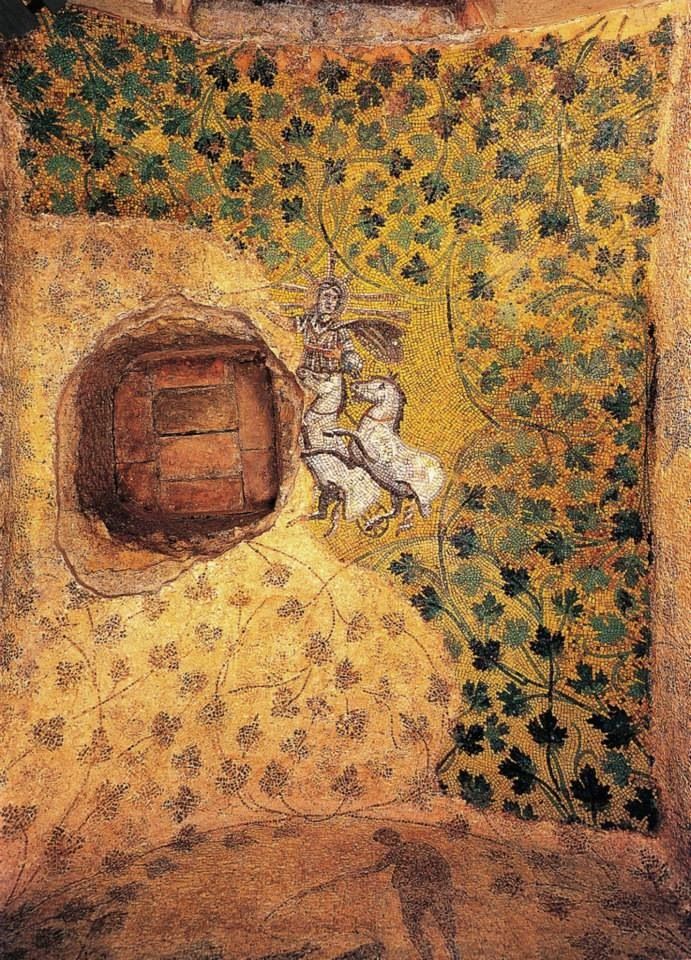
Christ as Sol Invictus, late 3rd or early 4th century. Mosaic from the Tomb of the Julii (Mausoleum “M”), Vatican Necropolis, under St. Peter’s Basilica, Rome. Photo: Tyler Bell.

This ceiling mosaic from an ancient Roman mausoleum built for one Julius Tarpeianus and his family contains an extraordinary depiction of Jesus Christ modeled after the sun-god Sol Invictus, who was sometimes identified with Helios, Apollo, or Mithras. It’s one of many surviving examples of how the early Christians appropriated pagan iconography for their own use, communicating the sacred stories and truths of the new faith—in this case, Jesus as the light of the world.

Buried beneath St. Peter’s Basilica in Vatican City, the mausoleum was first discovered in 1574 when a workman conducting floor alterations on the cathedral accidentally broke through. A larger hole was then drilled to gain access, which is why this mosaic on its vault is partially destroyed.

The mosaic shows a male figure wearing a radial crown and wheeling through the sky in a quadriga (four-horse chariot)—though just two of the horses survive. He holds an orb, symbolic of his dominion over the earth, and is dressed in a tunic and a windswept cloak. His other hand, missing due to the damage, may have been making a blessing gesture. He sends forth rays in all directions, lighting up the sky with a golden sheen. Grapevine tendrils unfurl all around him, symbolic of life and especially the life-giving Eucharist.

Most scholars identify the image as Christian and read the figure on the sun-wagon as Christ, though this is debated. Other images in the mausoleum are of a fisherman, a shepherd, and a man being swallowed by a sea-monster (e.g., Jonah)—all of which appear in both pagan and Christian funerary contexts in that era.
Christ as Sol (wide shot)

That December 25 was the birthday of Sol Invictus (and Mithras, a Persian sun-god whose cult gained popularity in Rome in the third century) likely factored into the church choosing that date for the annual celebration of Jesus’s birth. In his book Living the Christian Year: Time to Inhabit the Story of God, Bobby Gross, the vice president for graduate and faculty ministries for InterVarsity Christian Fellowship, writes,

Worship of the sun has a long history in ancient cultures. The Roman emperor Aurelian, who apparently wanted to unite the empire around a common religion, instituted the cult of Sol Invictus, the “Unconquered Sun,” in 274 and declared the day of the winter solstice, December 25, as the birthday and feast of the sun-god. [The official date of the winter solstice in the Roman Empire would change to December 21 when the Council of Nicaea adjusted the Julian calendar in 325.] The earliest evidence of Christians in Rome celebrating Christ’s nativity on December 25 appears later in 336. Many scholars conclude that the church purposefully countered the pagan festival by adopting its date for their celebration of the birth of “the sun of righteousness” (Mal. 4:2). This cultural appropriation became an implicit witness to the truly unconquerable light. (66–67)

Other scholars argue that December 25 was chosen because the Feast of the Annunciation—celebrating the miraculous conception of Christ in Mary’s womb—had already been fixed on March 25, the spring equinox, and if you count forward nine months (the average human gestation period), you land on December 25.

These two theories of the dating of Christmas are not mutually exclusive. Christ’s birth was and is celebrated in Rome as a festival of light, so it makes sense that Christians there would mark that birth on the date when the daylight hours first start to grow longer. (Just as it makes sense that his conception was placed in springtime, reflecting the flowering of new life.) Jesus came to us in the depths of our darkness, bringing light. The winter solstice is not an intrinsically pagan event—it’s a natural one, which religions of all kinds find meaning in, not to mention the practicality in ancient societies of marking time by the courses of the sun and the moon.

Many of the church fathers wrote about Jesus as light-bringer and as Light itself. In chapter 11 of his Protrepticus pros Hellenas (Exhortation to the Greeks), written around 200 CE, Clement of Alexandria glories in the light of Christ that extends over all of creation, banishing the darkness. The chapter is editorially titled “How great are the benefits conferred on humanity through the advent of Christ”:

Hail, O light! For in us, buried in darkness, shut up in the shadow of death, light has shone forth from heaven, purer than the sun, sweeter than life here below. That light is eternal life; and whatever partakes of it lives. But night fears the light, and hiding itself in terror, gives place to the day of the Lord. Sleepless light is now over all, and sunset has turned into dawn. This is the meaning of the new creation; for the Sun of Righteousness, who drives his chariot over all, pervades equally all humanity, like his Father, who makes his sun to rise on everyone, and distills on them the dew of the truth. (translated from the Greek by William Wilson, adapt.; emphasis mine)

In chapter 9 of the same work, Clement expounds on Ephesians 5:14, writing, “Awake, he says, you that sleep, and arise from the dead, and Christ shall give you light—Christ, the Sun of the Resurrection, he who was born before the morning star, and with his beams bestows life.”

Similarly, Ambrose of Milan refers to Christ as “the true sun” in his Latin hymn “Splendor paternae gloriae,” written in the second half of the fourth century:

O splendor of God’s glory bright,
O Thou that bringest light from light,
O Light of Light, light’s Living Spring,
O Day, all days illumining.

O Thou true Sun, on us Thy glance
let fall in royal radiance,
the Spirit’s sanctifying beam
upon our earthly senses stream.

. . . . . . . . . . . . . . . . . . . . . . . . . .

Morn in her rosy car is borne:
let Him come forth our Perfect Morn,
the Word in God the Father One,
the Father perfect in the Son. Amen.

Trans. Robert Bridges

Some Christians may feel uncomfortable with Christ’s being made to resemble a pagan deity in the Vatican Necropolis mosaic, or with the suggestion that the church saw fit to celebrate Christ’s birth on the same day Sol Invictus, the “Invincible Sun,” was said to be born. As for myself, I feel no such qualms. Just as the apostle Paul affirmatively quoted the pagan poets Epimenides and Aratus in his Areopagus sermon to reveal the truth of Christ (Acts 17:28), so too can we recognize connection points between our own faith tradition and others, which often reveal common yearnings we share—for example, for light that the darkness cannot overcome.

It’s then for us to articulate what makes Christ, who is such a light, distinct from those who came before and after. He is true God and true man, born miraculously of a virgin in first-century Judaea. He knows our sorrows intimately, because he was one of us—he made himself vulnerable. He taught people how to live as citizens of the kingdom of heaven. For that he was crucified, but he conquered death, rising from the grave and ascending to the right hand of the Father, where he lives and intercedes for us. He will come again to restore us to our true home. This, the story of Christ, is what C. S. Lewis called “a true myth.”

Suggestions for further reading:

  • Robin Jensen, Understanding Early Christian Art, 2nd ed. (London and New York: Routledge, 2023)
  • Kurt Weitzmann, ed., Age of Spirituality: Late Antique and Early Christian Art, Third to Seventh Century (New York: Metropolitan Museum of Art; Princeton, NJ: Princeton University Press, 1979) (available to read online for free)

LISTEN: “Rise, Shine, for Thy Light Is a-Comin,” African American spiritual

>> Performed by the Fisk Jubilee Singers, dir. Paul T. Kwami, feat. Briana Barbour, 2016:

>> Performed by the William Appling Singers on Shall We Gather, 2001:

Refrain:
Rise, shine, for thy light is a-comin’
My Lord says he’s comin’ by and by

This is the year of Jubilee
(My Lord says he’s comin’ by and by)
My Lord has set his people free
(My Lord says he’s comin’ by and by) [Refrain]

I intend to shout and never stop
(My Lord says he’s comin’ by and by)
Until I reach the mountaintop
(My Lord says he’s comin’ by and by) [Refrain]

Wet or dry, I intend to try
(My Lord says he’s comin’ by and by)
To serve the Lord until I die
(My Lord says he’s comin’ by and by) [Refrain]

This song originated in enslaved African American communities in the southern US in the first half of the nineteenth century. They composed spirituals as a way to hold on to hope amid the suffering inflicted on them by their enslavers.

The spirituals often hold double meanings, with words like “salvation,” “deliverance,” and “freedom” referring to God’s acts toward the soul and the body. So “freedom,” on the one hand, can mean freedom from sin and eternal death, but it can also mean freedom from physical bondage. “Light” could be the light of the world, Jesus, returning to consummate his kingdom on earth, and it could be the lantern of an Underground Railroad conductor, come to guide you up north to liberation.

The “year of Jubilee” in the first verse refers to the Jubilee law of ancient Israel, which dictates that every fifty years, the enslaved are to be set free (see Leviticus 25). “Wet” in the last verse may refer to how some enslaved people tried to escape by crossing rivers.

“Rise, Shine, for Thy Light Is a-Comin’” exhorts its hearers to take heart, for the sun of righteousness is on its way.

Advent, Day 13: A star shall rise out of Jacob

LOOK: Virgin and Child with a Prophet catacomb fresco

Mary breastfeeding (Catacomb of Priscilla)
Virgin and Child with a Prophet, 3rd century. Fresco in the Catacomb of Priscilla on the Via Saleria, Rome. Photo: Scala / Art Resource. [view wider shot]

Deep in the Catacomb of Priscilla in Rome, one of the early Christian underground burial places (named after the donor of the land), is an arched ceiling fresco of a woman breastfeeding her child under an apple tree. Beside her a man points up to a star that’s resting over their heads among the fruit.

Dating to the third century, this image is the earliest known depiction of the Virgin Mary, and one of the oldest of Christ. The identity of the third figure is less sure, but it’s most likely the Gentile prophet Balaam, who, in the power of God’s Spirit, prophesied to King Balak of Moab that “a star shall come out of Jacob, and a scepter shall rise out of Israel” (Num. 24:17).

Although this prophecy had a more immediate fulfillment in King David, it has also been interpreted in a messianic sense since as early as Justin Martyr (ca. 100–165), who wrote, “And that he [Christ] should arise like a star from the seed of Abraham, Moses showed beforehand when he said, ‘A star shall arise from Jacob, and a leader from Israel’” (Dialogue with Trypho, chap. 106).

Irenaeus (ca. 130–200) wrote that the star the magi followed to seek out the newborn Christ was the one prophesied by Balaam (Against Heresies, bk. 3, chap. 9.2), and Origen (ca. 185–254) maintained that Numbers 24:17 was the Hebrew Bible verse the magi found that instigated their journey (Against Celsus, bk. 1, chap. 60).

Priscilla Catacomb arch
Arched ceiling detail from Gallery 3 of the Catacomb of Priscilla, Rome. The central image, in stucco, portrays a shepherd and two sheep, while at the far right, oriented in a different direction, is a fresco of the Virgin and Child. The artworks are damaged by age.

Other suggestions put forward as to the identity of the pointing figure in this catacomb fresco have been a magus; the Hebrew prophet Isaiah, who declared that “a virgin shall conceive” (Isa. 7:14) and enjoined his people to “arise, shine; for thy light is come, and the glory of the Lord is risen upon thee” (Isa. 60:1); and, from Hans-Ruedi Weber, John the Baptist, who “came as a witness to testify to the light, so that all might believe. . . . The true light, which enlightens everyone, was coming into the world” (John 1:6–9).

To explore more of the Catacomb of Priscilla, see the following Smarthistory video by Beth Harris and Steven Zucker. Today’s featured image is introduced at 3:35:

LISTEN: “There Shall a Star from Jacob Come Forth” (original title: “Es wird ein Stern aus Jacob aufgeh’n”), from Christus, Op. 97 | Original German text compiled by Christian Charles Josias von Bunsen, 1846, from Numbers 24:17 and the hymn “Wie schön leuchtet der Morgenstern” by Philipp Nicolai, 1599; English translation of lines 4–10 by Catherine Winkworth, 1863 | Music by Felix Mendelssohn, 1846–47, based on Nicolai’s hymn tune | Performed by the St. Olaf Choir, the St. Olaf Cantorei, the St. Olaf Chapel Choir, the Manitou Singers, Viking Chorus, and the St. Olaf Orchestra, dir. Robert Scholz, on Love Divine, Illumine Our Darkness: Christmas at St. Olaf, 2002

There shall a star from Jacob rise up,
And a sceptre from Israel come forth,
To dash in pieces princes and nations.

How brightly beams the morning star!
With sudden radiance from afar,
With light and comfort glowing!
Thy word, Jesus, inly feeds us,
Rightly leads us,
Life bestowing.
Praise, oh praise such love o’erflowing.

The musical work “Es wird ein Stern aus Jacob aufgeh’n” (There Shall a Star from Jacob Come Forth) is from an unfinished oratorio by Felix Mendelssohn (1809–1847), which the composer’s brother Paul gave the name Christus and published posthumously as Opus 97. The first performance took place in 1852.

The first three lines are taken from Numbers 24:17, while the latter portion is from the Lutheran hymn “Wie schön leuchtet der Morgenstern” (How Brightly Beams the Morning Star) by Philipp Nicolai, written in 1597 and first published in 1599 with the title “Ein geistlich Brautlied der gläubigen Seelen von Jesu Christo ihrem himmlischen Bräutigam, gestellet über den 45. Psalm des Propheten David” (A spiritual wedding song of the faithful soul about Jesus Christ, her heavenly groom, made over the 45th psalm of the Prophet David). The tune it was published with was adapted by Nicolai, it appears, from an older tune found in the Strasbourg Psalter of 1538—which is further adapted here by Mendelssohn.

In Mendelssohn’s piece, the first two lines about an emerging luminary from the lineage of Jacob are lovely and lofty, repeated in different and overlapping voices over the course of a minute-plus. But then the third line cuts in with emphatic force: “To dash in pieces princes and nations.” Its violence is jarring, very far from the peaceful sentiments we’re used to associating with this time of year! Even as it adds drama and interest to the composition, its militant language is unsettling.

But it does honor the larger context of Balaam’s prophecy:

So he [Balaam] uttered his oracle, saying,

“The oracle of Balaam son of Beor,
    the oracle of the man whose eye is clear,
the oracle of one who hears the words of God
    and knows the knowledge of the Most High,
who sees the vision of the Almighty,
    who falls down but with eyes uncovered:
I see him but not now;
    I behold him but not near—
a star shall come out of Jacob,
    and a scepter shall rise out of Israel;
it shall crush the foreheads of Moab
    and the heads of all the Shethites [a Moabite tribe].
Edom will become a possession,
    Seir [an alternative name for Edom] a possession of its enemies,
    while Israel does valiantly.
One out of Jacob shall rule
    and destroy the survivors of Ir [‘City’].”

(Num. 24:15–19)

The mercenary prophet Balaam had been hired by Balak, king of Moab, to curse Israel. See, the Israelites had escaped slavery in Egypt some forty years prior and were looking for land to settle. Having been refused passage through, they had just conquered Amorite country, which used to belong to Moab, and Balak feared Moab would be next.

Despite being a non-Israelite, Balaam heard words from Yahweh, Israel’s God. Balak recognized Balaam as an authority, as did others, and thought he might be persuaded for a fee to issue a prophecy in Moab’s favor. But Balaam told him he would speak only the words of Yahweh.

The passage above is the fourth and final oracle Balaam pronounced on this mission to Moab. In it he says that Moab and Edom would be conquered—a prophecy that came to pass with King David (2 Sam. 8:2–12; cf. Ps. 60:8).

Christians, as we have seen, often extract verses from longer Old Testament passages, prophetic or otherwise, and read into them messianic significance—pointers to Jesus Christ. Even the New Testament authors, and Jesus himself, did this. Did the Old Testament authors intend such meanings? Probably not in most places, not to the extent that premodern Christian interpreters suggested. (That’s not to say Jesus didn’t fulfill biblical prophecies. Quite the contrary!)

But many Christian biblical scholars acknowledge what’s been called the sensus plenior, or “fuller sense,” of scripture—a term popularized by Raymond E. Brown in his book The Sensus Plenior of Sacred Scripture (1955). Sensus plenior, Brown writes, is “that additional, deeper meaning, intended by God but not clearly intended by the human author, which is seen to exist in the words of a biblical text (or group of texts, or even a whole book) when they are studied in the light of further revelation or development in the understanding of revelation.”

Some people consider this kind of reading to be distortive. But others, including myself, consider it creative. Rabbinical literature often does the same thing: finds meaning in and beyond a scripture passage’s strict historical context that the original authors likely did not intend but that open up the text in new ways. Sensus plenior says that studying a book of the Bible only in its historical and immediate textual context and for what it would have meant to its original audience is limiting, incomplete. Of course, the opposite approach, which does run rampant in many Christian communities, is also problematic: divesting scripture passages of their contexts, reflexively backfilling all the Old Testament with “Jesus” at the expense of understanding the texts on their own terms.

I think the application of “To dash in pieces princes and nations” (a paraphrase from Balaam’s prophecy) to Jesus’s birth is confusing, as Jesus was nonviolent, rejecting conquest. Perhaps you could say that Christ’s rule would (rhetorically) dash Herod’s kingdom to pieces, as it challenged the modus operandi of empire. There’s a new caesar in town, a new king on the throne, and his law of love, his gospel of peace, trumps the laws and proclamations of all earthly rulers.

The last six lines of Mendelssohn’s song return to the sweet, gentle tones of the song’s opening, exulting in the radiant glory of Christ, the Morning Star (Rev. 22:16), who shines forth from the pages of God’s word.


This post is part of a daily Advent series from December 2 to 24, 2023 (with Christmas to follow through January 6, 2024). View all the posts here, and the accompanying Spotify playlist here

Roundup: Epiphany Playlist, thread installation, and more

In the church calendar, the linked seasons of Advent, Christmas, and Epiphany are sometimes referred to as the “cycle of light.” “Since earliest times the Christian community has utilized light as a primary symbol to convey the meaning of the Christ-event,” writes Wendy M. Wright in The Vigil: Keeping Watch in the Season of Christ’s Coming. “The power of the symbol was not lost on most generations of believers who lived closer than we do to the truth that we are all ultimately dependent upon the light of the sun for warmth, vision, and life itself” (152). Light imagery permeates scripture and the writings of the church fathers.

The capstone of the cycle of light, celebrated each year on January 6, is Epiphany, which means “manifestation” or “appearance.” In the West, this feast commemorates the visit of the magi, to whom the divinity of Christ was revealed, and who brought back the light they received to their homelands, an early spreading of the gospel. Epiphany is exactly one month away, but I wanted to provide a few resources in advance. For those in the DC metro area: note that there are just two weeks left to see the Anne Lindberg exhibition!

+++

NEW PLAYLIST: Epiphany (Art & Theology): I put together a playlist of nearly a hundred Epiphany songs that celebrate Jesus as the light of the world and that mark the magi’s transformative encounter with him.

Besides the classic “We Three Kings,” it also includes a few versions of the ancient hymn “Phos Hilaron” (originally written in Koine Greek and translated into English as “Gladsome [or Gladdening] Light”), a Provençal carol popularized by Bizet, a shape-note hymn from Appalachia, aguinaldos from Puerto Rico, Arabic hymns from Syria and Lebanon, plainchant scripture settings, Renaissance motets, traditional and contemporary Black gospel songs, indie songs (including retuned hymns) from the past decade, and choral works from the UK, Jamaica, and Argentina. Some of the selections are quieter, more reflective, whereas others are very exuberant, like “Jesus Is the Light” by Hezekiah Walker and the Love Fellowship Crusade Choir:

And “Los Reyes Magos,” the fifth movement of Ariel Ramirez’s folk drama Navidad Nuestra (lyrics here); the song was written as a taquirari, a type of Bolivian folk song that has a syncopated rhythm and that is danced to, and features a charango (small guitar) and siku (Andean panpipe):

+++

ART COMMENTARIES: The VCS Advent Calendar 2023: Every Advent, the Visual Commentary on Scripture sends out a daily image from its online archives to its email list around a seasonal theme. This year’s theme is “light.” The images are keyed to particular scripture passages having to do with light and are accompanied by commentary from a range of contributors. So far the VCS has featured a Genesis 1–inspired Sistine Chapel fresco, John Piper and Patrick Reyntiens’s extraordinary Baptistery Window at Coventry Cathedral, a Trinitarian miniature from an English book of hours, a heliotropic landscape sculpture by David Wood, a light installation by Dan Flavin at a church in Milan, and Vincent van Gogh’s Starry Night.

Baptistery Window, Coventry
Baptistery Window, Coventry Cathedral. Designed by John Piper and made by Patrick Reyntiens, 1957–61. Stained glass, 85 × 56 ft.

+++

EXHIBITIONS:

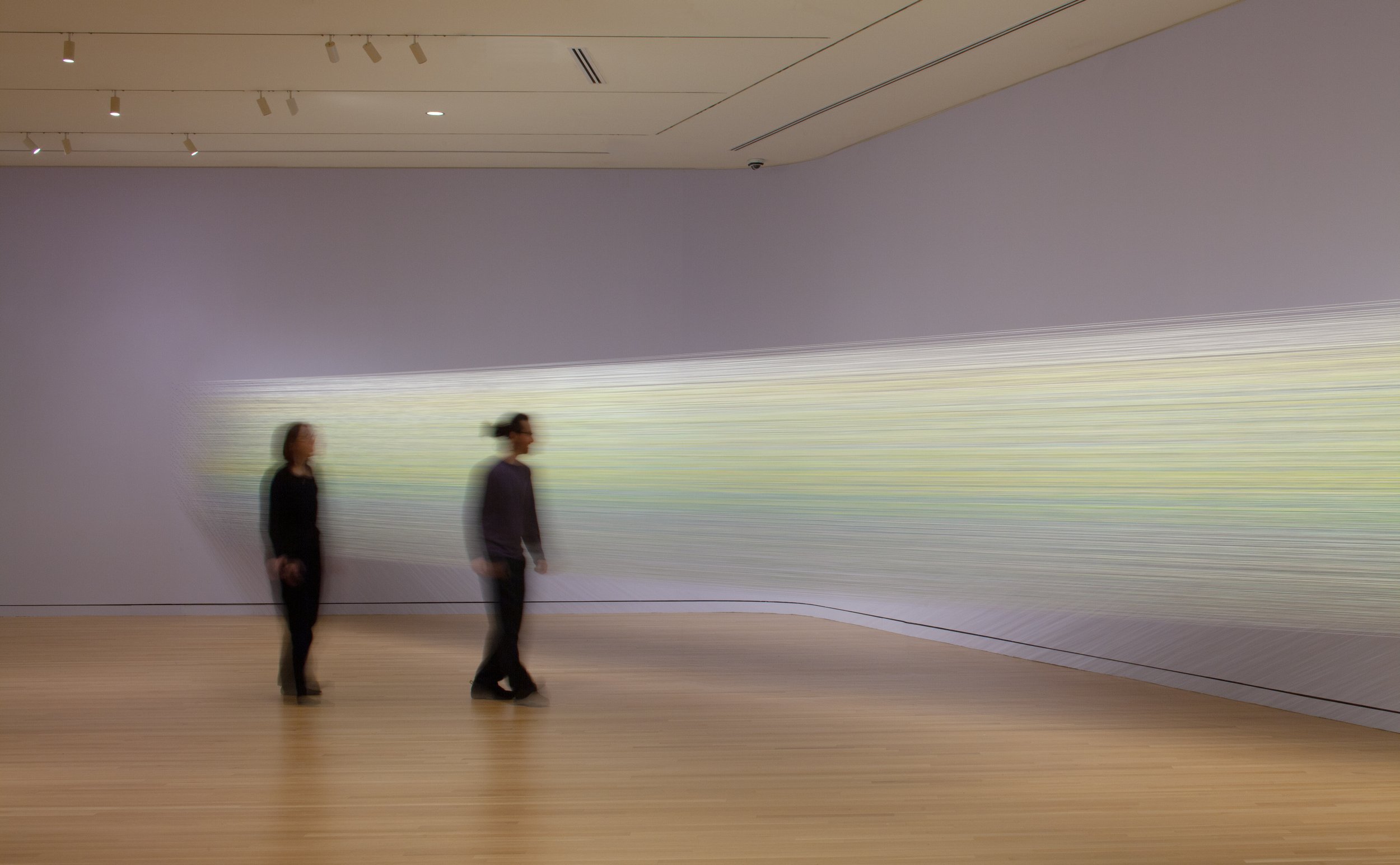
>> What color is divine light? by Anne Lindberg, January 5–December 22, 2023, Textile Museum at George Washington University, Washington, DC: I saw this installation last month, and it is striking! About four thousand strands of complementary yellow and blue cotton thread (and some white and green), stretching across the gallery against a backdrop of lavender-painted walls, evoking light. The artist describes the work as a drawing made of textile material in the air. It was inspired by a 1971 essay of the same title by the art historian Patrik Reuterswärd (see The Visible and Invisible in Art: Essays in the History of Art), and it opened adjacent to an exhibition of prayer carpets, titled Prayer and Transcendence.

Lindberg, Anne_What color is divine light
Anne Lindberg (American, 1962–), What color is divine light?, 2023. Cotton thread, staples, 5 × 55 × 14 ft. Solo exhibition at the Textile Museum, George Washington University, Washington, DC. Photo: Derek Porter.

In addition to the video above, you can view gorgeous photos of the installation on Lindberg’s website.

>> Bubble Universe: Physical Light, Bubbles of Light, Wobbling Light, and Environmental Light by teamLab, opens early February 2024, Borderless (museum), Azabudai Hills, Tokyo: teamLab is an international collective of “ultra-technologists” consisting of artists, programmers, engineers, CG animators, mathematicians, and architects who collaborate on immersive art projects. One of their upcoming installations is a room with hundreds of glowing spheres, each containing unique changing lights that interact with guests and the environment itself. [HT: My Modern Met]

Bubble Universe
teamLab, Bubble Universe, 2023 (work in progress). Interactive installation, Borderless, Azabudai Hills, Tokyo.

+++

NEW ALBUMS:

>> The Light by Sarah Sparks: A four-song EP by a Christian singer-songwriter from Hawaii. Here’s the first track:

>> Morning Star: Music for Epiphany Down the Ages by the Gesualdo Six: Released November 3, this wonderful album comprises twenty-one choral pieces for Epiphany—a mix of plainchant propers for Mass, hymns, Renaissance motets, and twenty-first-century works. One of the contemporary works is a setting by Owain Park of Psalm 43:3: “O send out thy light and thy truth, that they may lead me; let them bring me unto thy holy hill, and to thy dwelling”:

Christmas, Day 2

LOOK: Jesus, Light of the World by Wayne Forte

Forte, Wayne_Jesus, Light of the World
Wayne Forte (Filipino American, 1950–), Jesus, Light of the World, 2009. Oil and acrylic on canvas, 30 × 24 in.

LISTEN: “Jesus, Light of the World” | Words by Charles Wesley (stanzas), 1739, and George D. Elderkin (refrain), 1890 | Music by George D. Elderkin, 1890 | Performed by Isaac Cates and Ordained on Carol of the Bells, 2014 (soloists: Margaret Rainey and Kami Woodard)

Hark! the herald angels sing.
Jesus, the light of the world.
Glory to the newborn King,
Jesus, the light of the world.

We’ll walk in the light, beautiful light.
Come where the dewdrops of mercy shine bright.
Oh, shine all around us by day and by night.
Jesus, the light of the world.

Joyful, all you nations, rise.
Jesus, the light of the world.
Join the triumph of the skies.
Jesus, the light of the world.

Christ, by highest heav’n adored.
Jesus, the light of the world.
Christ, the everlasting Lord,
Jesus, the light of the world.

Hail the heav’n-born Prince of Peace.
Jesus, the light of the world.
Hail the Sun of righteousness!
Jesus, the light of the world.

In 1890 Chicago publisher George D. Elderkin adapted Charles Wesley’s beloved Christmas hymn text “Hark! the Herald Angels Sing,” using the first two lines of Wesley’s stanzas 1, 2, 3, and 5 and adding a refrain that’s based on a Fanny Crosby text from 1880. For the music, he wrote a gospel waltz. Although Elderkin was not African American, this hymn has become especially well loved in Black churches. Read a more detailed history of the hymn’s composition at the UMC Discipleship website.  

Isaac Cates’s 2014 arrangement and recording is my favorite. Cates is a gospel vocalist, arranger, and pianist who performs with his choir, Ordained.

Send Out Your Light (Artful Devotion)

Lighthouse in Westkapelle by Piet Mondrian
Piet Mondrian (Dutch, 1872–1944), Lighthouse in Westkapelle [in Orange], 1909. Oil on canvas, 39 × 29 cm. Galleria d’Arte Moderna, Milan.

O send out your light and your truth;
let them lead me;
let them bring me to your holy hill
and to your dwelling.

—Psalm 43:3

+++

SONG: “Let Your Light Shine on Me” | Traditional, performed by Blind Willie Johnson, 1929

+++

About the painting: Before he became a world-famous pioneer of geometric abstraction, Piet Mondrian (1872–1944) spent his early artistic career painting pastoral images of his native Netherlands in an impressionist style—churches, windmills, fields, rivers, sand dunes, and lighthouses. He made several paintings, using different color palettes, of the “tall lighthouse” of Westkapelle, which stands at the entrance to the village. The structure is actually a fifteenth-century Gothic church tower that was converted into a lighthouse in 1818 after the church burned down. It is still active, serving along with the “short lighthouse” to lead vessels coming in from the northern part of the North Sea. The loose pointillist technique Mondrian uses here enables him to fuse the lighthouse with the surrounding sky, producing a sense of vibration and ethereality.

About the singer: Blind Willie Johnson (1897–1945) was a gospel blues singer, slide guitarist, and evangelist from Texas about whom little is known. Besides the one-time payments he received from Columbia for his studio recordings of 1927–30, most of his income was earned by performing and preaching on the streets; appreciative passersby would drop coins into the tin cup tied to his Stella. Johnson is known for his unique style of singing: in a gravelly “false bass,” or growl, which he drops into in verse 2 of “Let Your Light Shine on Me.” His is the earliest known recording of this traditional gospel song.


This post belongs to the weekly series Artful Devotion. If you can’t view the music player in your email or RSS reader, try opening the post in your browser.

To view all the Revised Common Lectionary scripture readings for Proper 26, cycle A, click here.