
How did Jesus’s mother, Mary, come to find out that he had risen from the dead? Was she there when it happened, keeping vigil? Was she among the holy women at the tomb to whom the angel made the announcement, or did these women go to Mary to relay the news to her? Maybe an angel came to tell her personally? Or perhaps Jesus himself appeared to her, to tell and show, at the home where she was staying.
The Bible is silent as to Mary’s whereabouts between the time of Entombment and the events of Easter morning. Historically, there have been proponents of each of the above suppositions. But the one that has taken the strongest hold is the last one—that Jesus made direct personal contact with his mom after his resurrection, before appearing to anyone else. He wasn’t at the tomb when Mary Magdalene got there (unless, perhaps, he was lingering somewhere in the shadows). Where did he go in the early morning? Some scholars say he must have gone to console his mother.
The claim that Jesus appeared first to Mother Mary can be found as far back as Ambrose (340–397), who wrote in his De virginitate, “Therefore Mary saw the resurrection of the Lord: she saw it first and believed.”
Around 1300 the anonymous writer known as Pseudo-Bonaventure elaborated on this tradition in his highly influential Meditationes Vitae Christi (Meditations on the Life of Christ), providing a vivid and affecting narrative in which Mary, when the women depart for the tomb on Sunday morning, stays behind and prays for God to restore her son to her alive.
And with that, she so praying, sweet tears shedding, lo suddenly our Lord Jesus came and appeared to her, and in all white clothes, with a glad and lovely cheer, greeting her in these words: “Hail, holy mother.” And anon she turning said: “Art thou Jesus, my blessed son?” And therewith she kneeling down honored him; and he also kneeling beside her said: “My dear mother, I am. I have risen, and lo, I am with you.” And then both rising up kissed the other; and she with unspeakable joy clasped him, sadly, resting all upon him, and he gladly bare her up and sustained her. [as translated into Middle English by Nicholas Love in The Mirror of the Blessed Life of Jesus Christ, ca. 1400, with modernized spellings]
Pseudo-Bonaventure imagines a private, emotional reunion in a domestic interior. This episode was picked up by Ludolph of Saxony in his Vita Christi and by other writers, and it circulated throughout Europe. It made its way into the visual arts starting in the first half of the fourteenth century. The two most famous examples are the right wing of Rogier van der Weyden’s Miraflores Triptych and a woodcut from Albrecht Dürer’s Small Passion series.
But I want to take a look at this Italian Baroque bas-relief by the minor artist Giovanni Pietro Lasagna.
LOOK: Christ Appearing to His Mother by Giovanni Pietro Lasagna
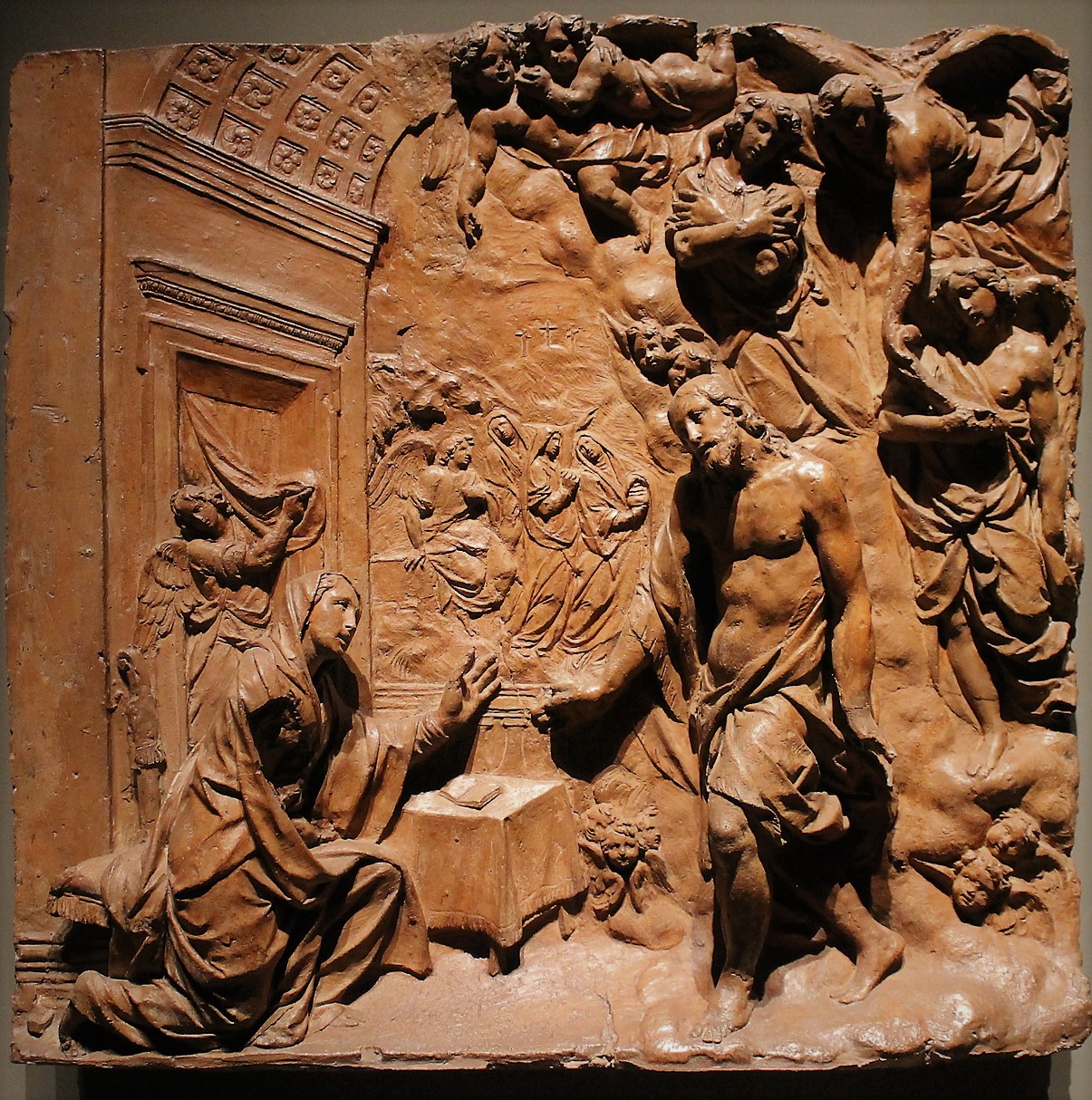
I found this artwork in the blog article “Iconography of the Resurrection – Christ Appears to His Mother” by Margaret Duffy, which provides a fascinating compilation of images. Duffy cites its location as unknown, and I’ve not been able to find reference to it anywhere else. It was probably made in Milan, where the artist was active. An email inquiry I sent last month to the city’s Museo del Duomo, which has similar terracottas from the same period in its collection, has garnered no reply. It’s possible the work was made as a design for a marble sculpture.
Carved in low relief in the background, an angel sits on the edge of an empty sarcophagus and tells the three women with their ointment jars that Jesus is not here but is risen. Three untenanted crosses are visible in the distance on Mount Calvary, a shadow of Friday’s events.
In the foreground, sculpted in high relief, we see Mary at her prayer desk. She is interrupted by the triumphant entry of her risen son, attended by angels. Their arms reach out to embrace each other as her grief turns to joy.
To reinforce the news of resurrection, an angel who stands behind Mary peeks out from behind a curtained doorway and points to the concurrent scene that’s unfolding in the garden of Jesus’s burial.
I’m not certain of the identity of the figures behind Jesus. But in looking into it, I did find that there’s a legend, likely originating in fourteenth- or fifteenth-century Spain, that when Jesus appeared to his mother after the resurrection, he presented to her the redeemed of the Old Testament, whom he had just freed from Hades.* So it’s possible that the beardless young man at the upper left with his arms crossed over his chest is Adam, and that the figure at the right with one breast bared is Eve. And I think the man at the top right corner who’s touching them both is an angel.
Note the iconographic similarity to scenes of the Annunciation—Gabriel’s announcement to the young Mary that she had been chosen by God to bear his Son. This “emphasizes the parallelism between the heralding of the Incarnation by the Archangel, and Christ’s own announcement, to his mother, of the fulfillment of that Incarnation, that is, the Resurrection.”**
* James D. Breckenridge, “‘Et Prima Vidit’: The Iconography of the Appearance of Christ to His Mother,” Art Bulletin 39, no. 1 (March 1957): 28. This excellent illustrated article traces the literary and visual history of the resurrected Christ appearing to his mother, in its several variations.
** Ibid., 26–27.
LISTEN: “Be Joyful, Mary” (Regina caeli, jubila) | Words: Latin, 17th century, based on the 12th-century “Regina caeli”; anonymous English translation from Psallite, 1901 | Music by Nicholas Andrew Barber, 2020
Be joyful, Mary, heav’nly queen
Gaude, Maria!
Your son who died was living seen
Alleluia!Laetare, O Maria
O MariaThe son you bore by heaven’s grace
Gaude, Maria!
Did all our guilt and sin efface
Alleluia!Laetare, O Maria
O MariaThe Lord has risen from the dead
Gaude, Maria!
He rose with might as he had said
Alleluia!Laetare, O Maria
O Maria
This song has its roots in a medieval liturgical text that is still used as an antiphon (short hymn) in the Roman Catholic Church throughout the Easter season. Gaude means “rejoice”; laetare, “be glad.”
The lyrics could be in the voice of the women who went early to the tomb and are returning with the great news, or it could be that we the faithful are imaginatively addressing Mary across time, inserting ourselves into that story of the first Easter morning.
 Art & Theology