BibleProject is a nonprofit in Portland, Oregon, that offers free videos, podcasts, articles, and classes to help people experience the Bible in a way that is approachable and transformative.
The following two songs are from the music ministry of the Cathedral Church of the Advent in downtown Birmingham, Alabama. The ministry flourished under the leadership of Rev. Dr. Zac Hicks, who served as the church’s canon for worship and liturgy from 2016 to 2021. (He is now pastor of Church of the Cross, also in Birmingham.)
The music videos used to be available on YouTube, but it appears that the church has undergone some restructuring, and they have been removed. For now, though, they are still available through Facebook, and the audio releases are available through streaming services.
>> “Lord, Who Throughout These Forty Days”: This 1873 hymn by Claudia Frances Hernaman recounts the forty days Jesus spent in fasting and prayer in the Judean wilderness at the outset of his ministry and beseeches God to give us strength, like Jesus, to fight temptation, to die to self, and to live by his word and with a keen sense of his abiding presence. It’s set to an American folk tune from the Sacred Harp tradition, known as LAND OF REST, which has roots in the ballads of northern England and Scotland. The hymn is sung by Madison Craig (née Hablas), with Emma Lawton (née Dry) and Annie Lee on background vocals, Joey Seales on pump organ, Charley Rowe on cajon, and Zac Hicks on acoustic guitar.
>> “Spring Up, O Well”: This is an original song by Zac Hicks, sung by Jordan Brown. It draws especially on the narrative in John 4, where Jesus tells a Samaritan woman at a well, “Everyone who drinks of this water will be thirsty again, but those who drink of the water that I will give them will never be thirsty. The water that I will give will become in them a spring of water gushing up to eternal life” (vv. 13–14). The exclamation “Spring up, O well!” in the song’s refrain comes from Numbers 21:17, where the Israelites praise God for providing them water in the desert, and that musical phrase is adapted from the old children’s church song “I’ve Got a River of Life.”
+++
SHORT FILM: “Silences,” dir. Nathan Clarke: Shot in 2016 at Box Canyon near Laity Lodge in the Texas Hill Country, this contemplative short film features cellist Steuart Pincombe playing a short improvisation that interacts with the natural space. The impromptu music making was for him an exercise in prayer.
Three years earlier, also while on retreat at Laity Lodge, Pincombe’s wife shot him doing the same inside the newly constructed Threshold, an interactive, site-specific, permanent outdoor installation by Roger Feldman consisting of three curved walls:
The Threshold improvisation, Pincombe writes, “stemmed from a particular note (and its harmonic overtones) that naturally resonated in the space—the cello’s lowest strings were tuned to match this strongest resonation. Playing with the confusion of resonances (or pitches) was an important part of this short musical and spatial exploration—pitches are bent or adjusted in a way that create audible pulses in the sound and play on the conflicts of resonation within the space.”
+++
ESSAY: “Silence in an Age of Mass Media: John Cage and the Art of Living” by Dr. Jonathan A. Anderson, ARTS (Spring 2017): Many twentieth- and twenty-first-century artists have explored the necessities and possibilities for aesthetic stillness and silence, Anderson writes. In this essay he considers the composer John Cage (1912–1992), best known—and most excoriated—for his modernist piano composition 4′33″ (1952), in which the pianist sits at the bench for four minutes and thirty-three seconds, playing no notes. The point was to attune the audience to the ambient sounds of the concert hall (coughing, rustling, creaking, mechanical humming, outside traffic, etc.), testing the distinction between “music” and “noise.” Cage found the fundamental difference between the two to be not in the qualities of sound but in the attentiveness of the listener.
I was pleasantly surprised to learn from Anderson’s article that even after Cage left Christianity (in which he was raised) and turned to Zen Buddhism, he continued to link his love for the givenness of environmental sounds to Jesus’s admonition to “consider the lilies” (Luke 12:27). “Cage sought to quiet his own aesthetic ‘worry’ for musical meaning,” Anderson writes, “and to instead receive the given sounds of the world as richly meaningful in themselves.”
+++
VIDEO: Lenten Jazz Vespers, Duke University Chapel, March 23, 2023: This Jazz Vespers service combines the liturgical traditions of Vespers with the musical improvisation of jazz. Exploring the theme of hope, the service is presided over by Rev. Racquel C. N. Gill, minister for intercultural engagement at Duke University Chapel. Musical leadership is provided by the John Brown Little Big Band.
Here are the time stamps:
0:01: Song: “I Came to Tell You” by Trinity Inspirational Choir
5:40: Welcome and Prayer
8:33: Song: “Miracle (It’s Time for Your Miracle)” by Marvin Sapp
14:38: Poetry reading: “Dark Testament (8)” by Pauli Murray
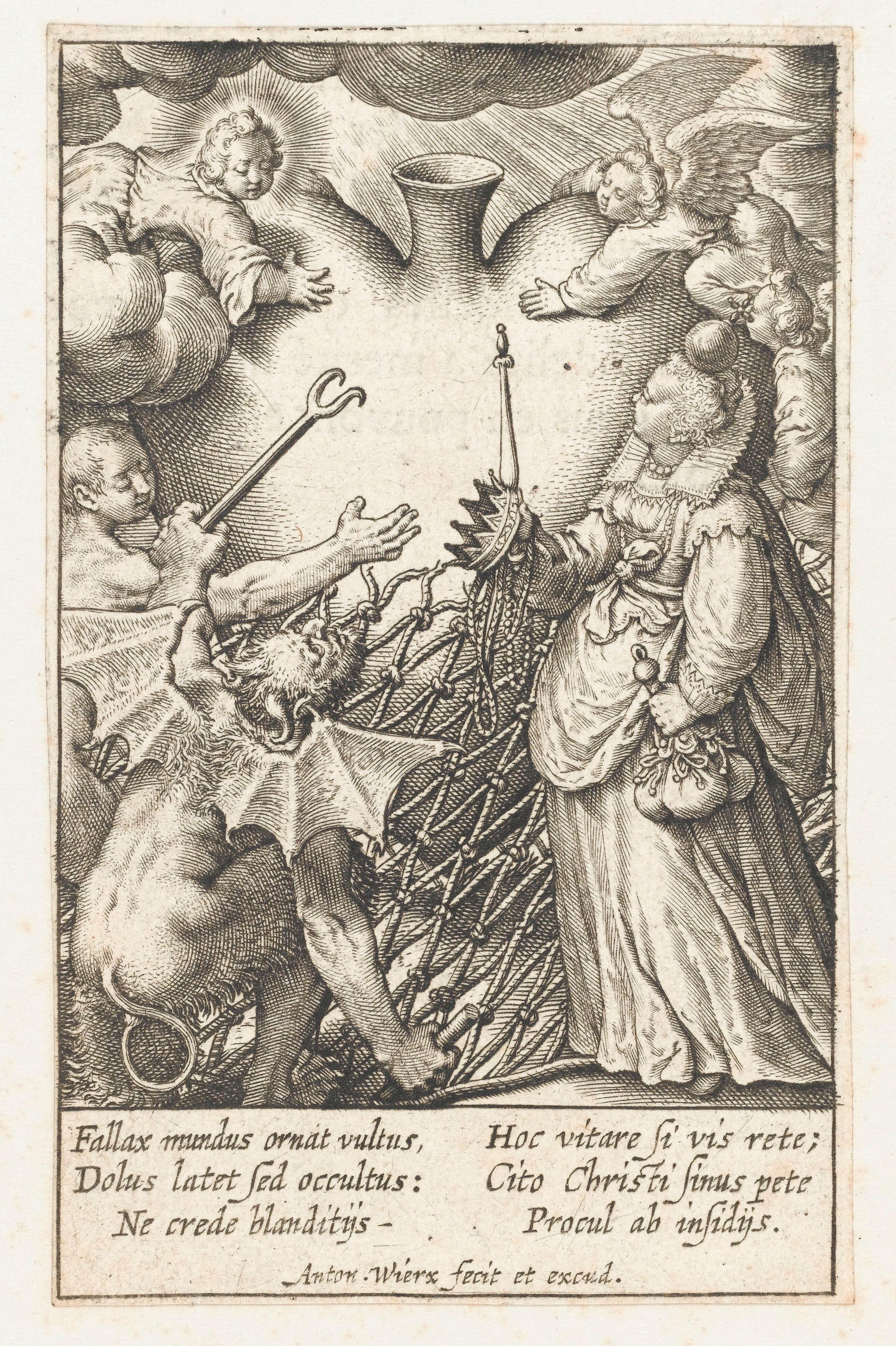
In Antwerp sometime around 1600, the Flemish printmaker Anton Wierix II (whose name is alternatively rendered as Antonie, Anthony, Antoine, or Antonius) engraved a series of seventeen* cardiomorphic emblems called the Cor Jesu amanti sacrum (The Heart Consecrated to the Loving Jesus), which portray the human heart as the dwelling-place, schoolroom, and throne of Christ. Commissioned by the Jesuit order, the series shows the Christ child cutting through the net that has ensnared the heart, knocking at the heart’s door, shining a light inside, sweeping out the monsters and vices, purging it with his blood, establishing his reign therein, teaching it, adorning it, making music in it, defending it from hostile invasion, piercing it with the arrows of love, and setting it aflame with desire.
These prints circulated as loose sheets and inside books, and various artists copied Wierix’s designs throughout the seventeenth century. The most famous book that uses the Cor Jesus images is Le coeur dévot, throsne royal de Iesus, Pacifique Salomon (The Devout Heart, Royal Throne of Jesus, Pacific Salomon) by Etienne Luzvic, SJ, originally written for a religious community, perhaps one devoted to the Sacred Heart. The book’s initial publication—in Paris in 1626—was without illustrations, but an enlarged edition was reissued in Douai and Antwerp the following year, containing twenty Cor Jesu engravings adapted by Martin Baes from Wierix’s originals, as well as additional meditations called “Incentives” by Fr. Etienne Binet, SJ.
Also in 1627, Le coeur dévot was translated into Latin, which became the basis for a number of vernacular translations throughout Europe, including an English version translated by Henry Hawkins in 1634, titled The Devout Hart, or Royal Throne of the Pacifical Salomon. This English edition includes a hymn by Hawkins for each emblem.
The odd-sounding subtitle of the book is a reference to King Solomon of the Old Testament, whom Luzvic apparently read a type of Christ in his majesty. “Pacifical” is an archaic word meaning conciliatory, peaceable.
Below I reproduce Wierix’s seventeen emblems, a loose-leaf edition held by the Wellcome Collection in London; you can click on the image to be taken to its object page.
Each engraving contains at the bottom a rhyming Latin verse in two stanzas of three lines each, interpreting the picture. The English translations provided below are sourced from the Wellcome Collection website, unless otherwise noted.
The engravings are not numbered, and their order was not fixed; they show up in variable sequences in different books. I’ve ordered them as they appear in Hawkins’s The Devout Hart. Scholars and editors have given them different descriptive titles over the years. I use Hawkins’s titles, only I’ve modernized the spellings. I’ve also provided a few quotes from Hawkins’s translation of Luzvic’s meditational texts that accompany the images in The Devout Hart, with page numbers provided in parentheses.
1. The world, the flesh, and the devil assail the heart, but Jesus saves it for himself
Anton Wierix II (Flemish, ca. 1555–1604), The world, the flesh, and the devil assail the heart, but Jesus saves it for himself, ca. 1600. Engraving, with etching, image 7.7 × 5.6 cm.
Fallax mundus ornat vultus, dolus latet sed occultus: ne crede blanditiis.
Hoc vitare si vis rete; cito Christi sinus pete procul ab insidiis.
(The deceptive world makes up its face, yet trickery lurks concealed. Do not trust in blandishments if you want to avoid this net! Quickly seek the breast of Christ, far from ambushes.)
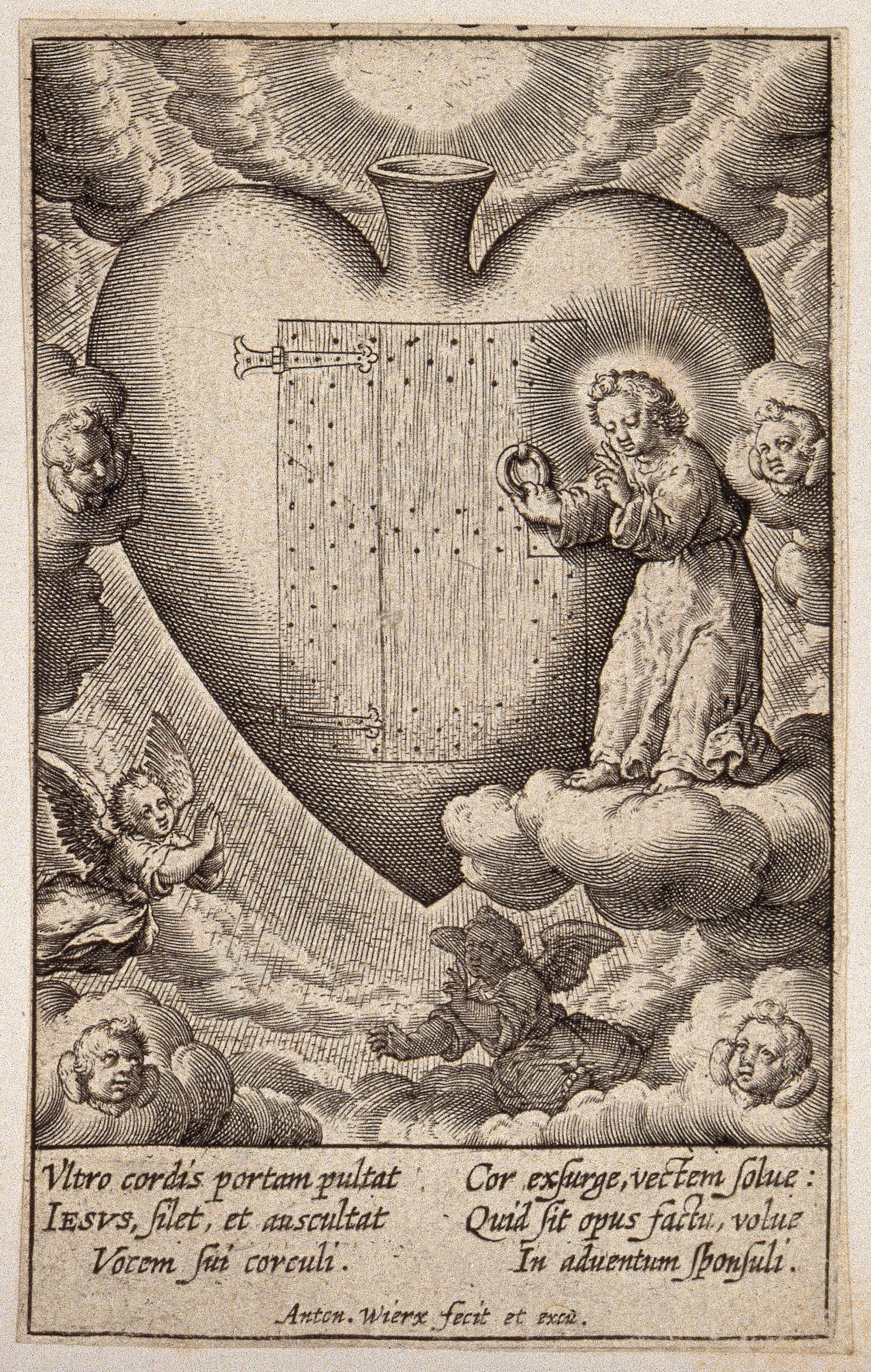
2. The most amorous Jesus knocks at the door of the heart
Anton Wierix II (Flemish, ca. 1555–1604), The most amorous Jesus knocks at the door of the heart, ca. 1600. Engraving, image 7.8 × 5.5 cm.
Ultro cordis portam pultat Iesus, silet et auscultate vocem sui corculi.
Cor exsurge, vectem solve: Quid sit opus factu, volve in adventum sponsuli.
(Outside the door of the heart Jesus knocks, is silent, and listens for the voice of his little heart. Heart, rise up! throw back the bolt! think what needs to be done at the arrival of the little betrothed one!)
This image is rooted in Revelation 3:20: “Behold, I stand at the door, and knock: if any man hear my voice, and open the door, I will come in to him . . .” (KJV).
If you cannot hear the knocking, Etienne Luzvic encourages you to consider,
Is it the noise perhaps of the guests thou hast admitted in already, which so tacked up, and stupefies thine ears, as thou canst not hear thy beloved’s voice? Oh guests, or haunting ghosts, I may call you, rather! Oh sinister affections! Oh inordinate appetites! What a tumult have you made here? (49)
He further exhorts:
Hasten, therefore, O fairest of all beauties; what? Sleepest thou yet? Shake off this sluggishness. Is there a mutiny at home, then quiet the tumults, command silence, bid the door be set open. And if thy spouse now wearied with thy demurs should chance to divert from thee, and go his ways, follow him at the heels with cries, and prayers, and tiring him outright, urge him hard, that he would deign to return again to his sanctuary. (50)
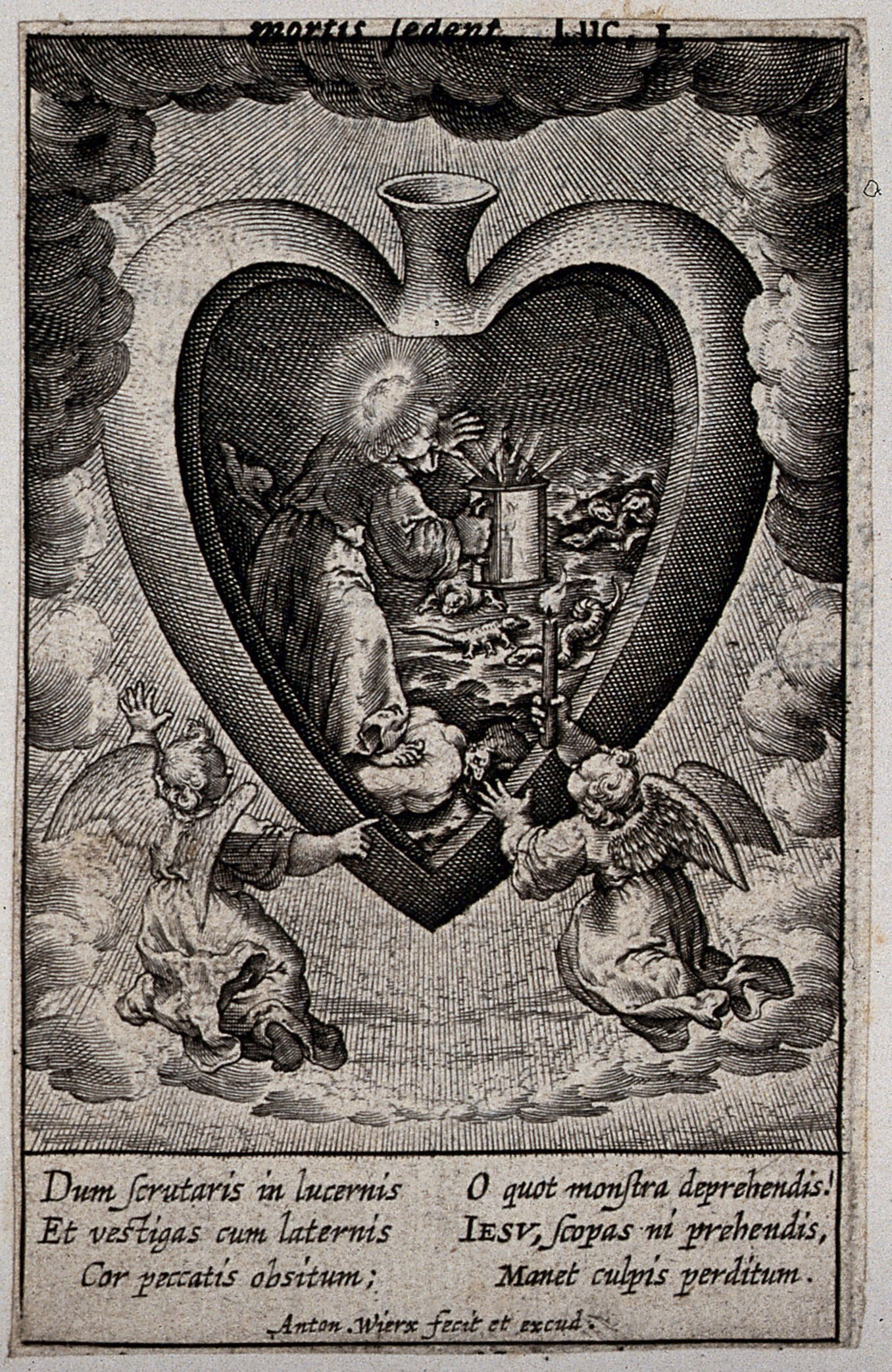
3. Jesus searcheth out the monsters lurking in the dark corners of the heart
Anton Wierix II (Flemish, ca. 1555–1604), Jesus searcheth out the monsters lurking in the dark corners of the heart, ca. 1600. Engraving, image 7.8 × 5.7 cm.
Dum scrutaris in lucernis et vestigas cum laternis cor peccatis obsitum;
o quot monstra deprehendis! Iesus, scopas ni prehendis, manet culpis perditum.
(While you search among the lights and track the heart besieged by sins, oh how many monsters do you find! Jesus, if you do not find a broom, [the heart] remains lost in wrongs.)
From Luzvic:
So long as Jesus is absent from my heart. Ah me! what monsters? what sordidies? what Gorgons? what wicked fiends? what hells are centered there?
When Jesus enters into the heart, and therein pours his light, good God? what foul, what horrible prodigies of vices the mind discovers there which the eyes had never yet detected? I say while Jesus puts forth his rays, what bestial manners? what perfidiousness? what blots of an ungrateful mind? what heinous crimes are represented in this detestable heart?
At these portents the very angels tremble. Yet go thou on, my most sweet Jesus: illuminate the darksome corners of the soul; cleanse this foul, infamous stable. Amid this Cimmerian darkness, with glimpse of thy light bewray [reveal] me to myself that . . . at length [I] may fly to thee, love nothing else but thee. Oh the only Darling of my soul! O only love of my heart, my little Jesus! (60–61)
Oh how I tremble at it, to see how many snakes there are! What spiders, what scorpions, and other such like plagues . . . (65)
Consider, then, how powerfully Jesus, as soon as admitted to enter into the heart, expels and banisheth all sins from the secretes nooks thereof. (68)
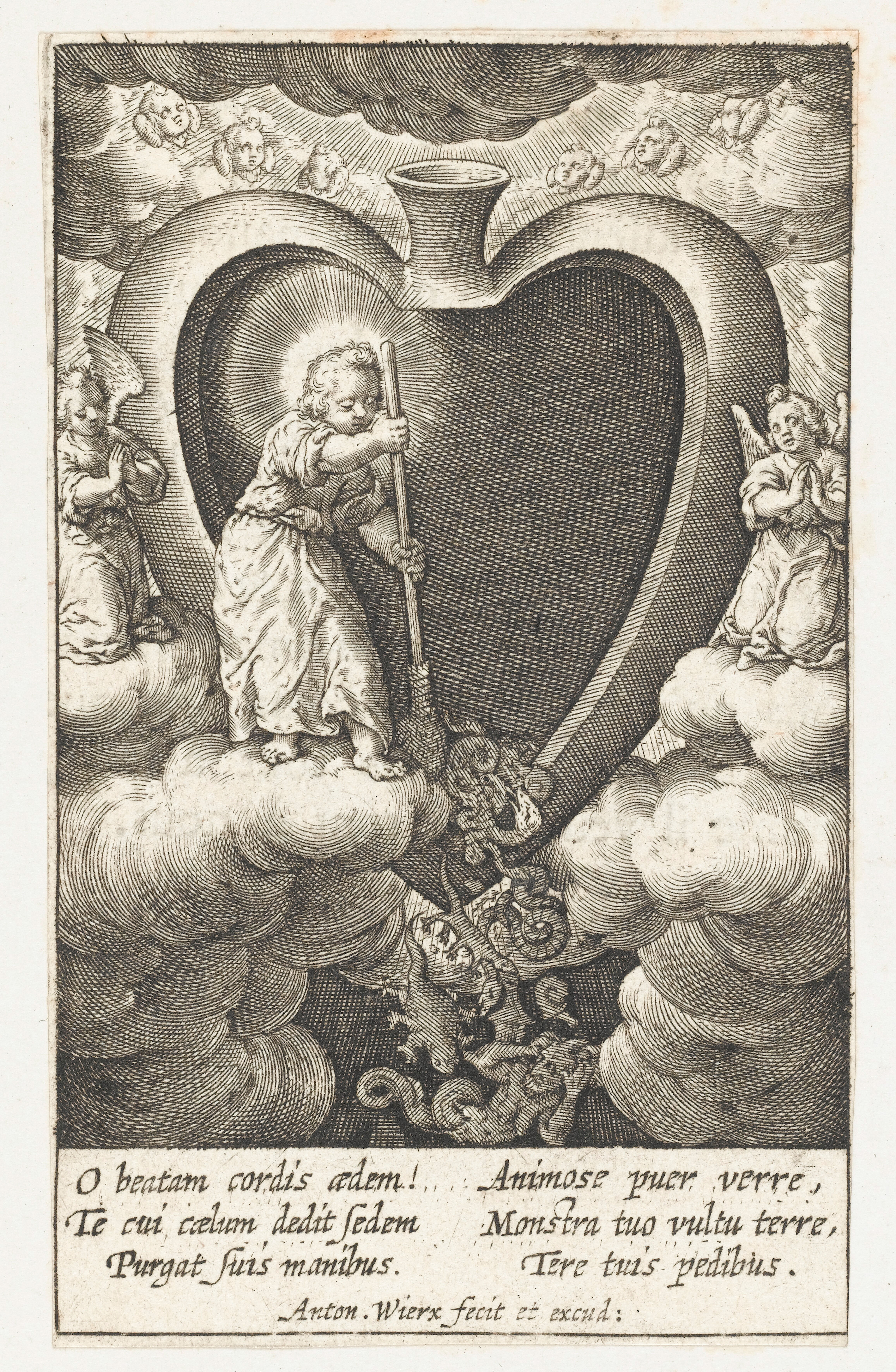
4. Jesus sweeps the dust of sins from the heart
Anton Wierix II (Flemish, ca. 1555–1604), Jesus sweeps the dust of sins from the heart, ca. 1600. Engraving, 7.8 × 5.6 cm.
O beatam cordis aedem! Te cui caelum dedit sedem purgat suis manibus.
Animose puer verre, monstra tuo vultu terre, tere tuis pedibus.
(O blessed temple of the heart! Let him to whom heaven has given his abode clean you with his own hands. Spirited boy, sweep away! Frighten the monsters with your look! Crush them under your feet!)
Once Jesus locates the toads, snakes, and other slimy creatures (symbols of sin) hiding in the heart’s cave, he sweeps them out. Luzvic welcomes this purging:
Go on, my little Jesus, and oh! expel, tread, crush under thy holy feet this poisonous virulence of serpents, which with their venom intoxicate and kill my soul. Destroy them quite, and so frame me a heart wholly according to thy heart. (73–74)
He asks Jesus that, once he banishes the monsters, he keep them out for good:
Thou, most Blessed Darling of my heart, fortify and prevent all the ways and passages of the enemy, and place strong guards at the entrance and gates thereof, lest happily they steal or rush in anywhere . . . (77)
But he also owns his own responsibility in keeping them out:
Oh what dullness of mind is this, what stupidity of heart, that we should so long suffer these monsters to rest and abide with us, as if they were some friends and familiars of ours! Oh truly admirable goodness of God! who hath attended and expected us so long to return to the duty and office of good men; and now at last most powerfully hath brought us into liberty, wherefore we will steadfastly purpose, and determine hereafter, to die rather than once to afford any place in our heart to sins. (82)
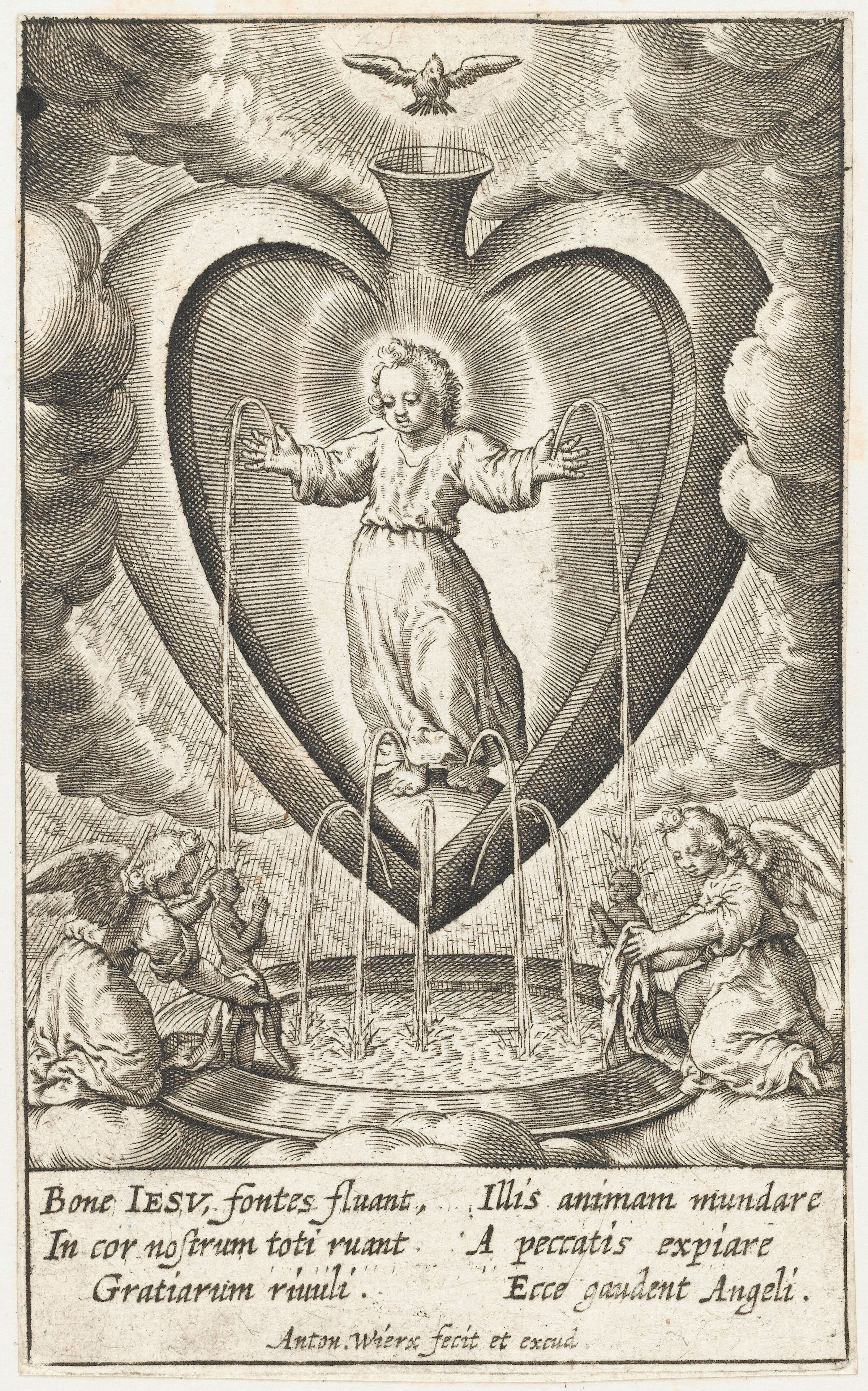
5. Jesus the Living Fountain in the heart
Anton Wierix II (Flemish, ca. 1555–1604), Jesus the Living Fountain in the heart, ca. 1600. Engraving, with etching, image 7.9 × 5.6 cm.
Bone Iesu fontes fluant, in cor nostrum toti ruant, gratiarum rivuli.
Illis animam mundare, a peccatis expiare, Ecce gaudent angeli.
(Good Jesus, into the heart let fountains flow, let all the streams of graces [flow]. With them to clean the soul and expiate [it] from sin, behold angels rejoice.)
In this image, blood flows out of the nail wounds in Christ’s hands and feet—a cleansing, refreshing fount.
Luzvic rhapsodizes,
If Jesus be absent, I am arid, dry, and without juice, so as neither I feel God, nor anything of God. Oh cruel aridity! O fatal drought!
If Jesus be present, he sheds divine dews of graces; he opens springs of incredible sweetness; the heart floats only and swims and sinks in these torrents of celestial delights. Oh grateful dews! O blessed springs! O ineffable delights!
Angelical hands laid hither those waters of life; sprinkle therewith my heart and soul, cleanse, and water them with endless springs of paradise. (85)
He asks God’s angels to “plunge this my dry and thirsty heart, drown it in the ocean of love” (91).
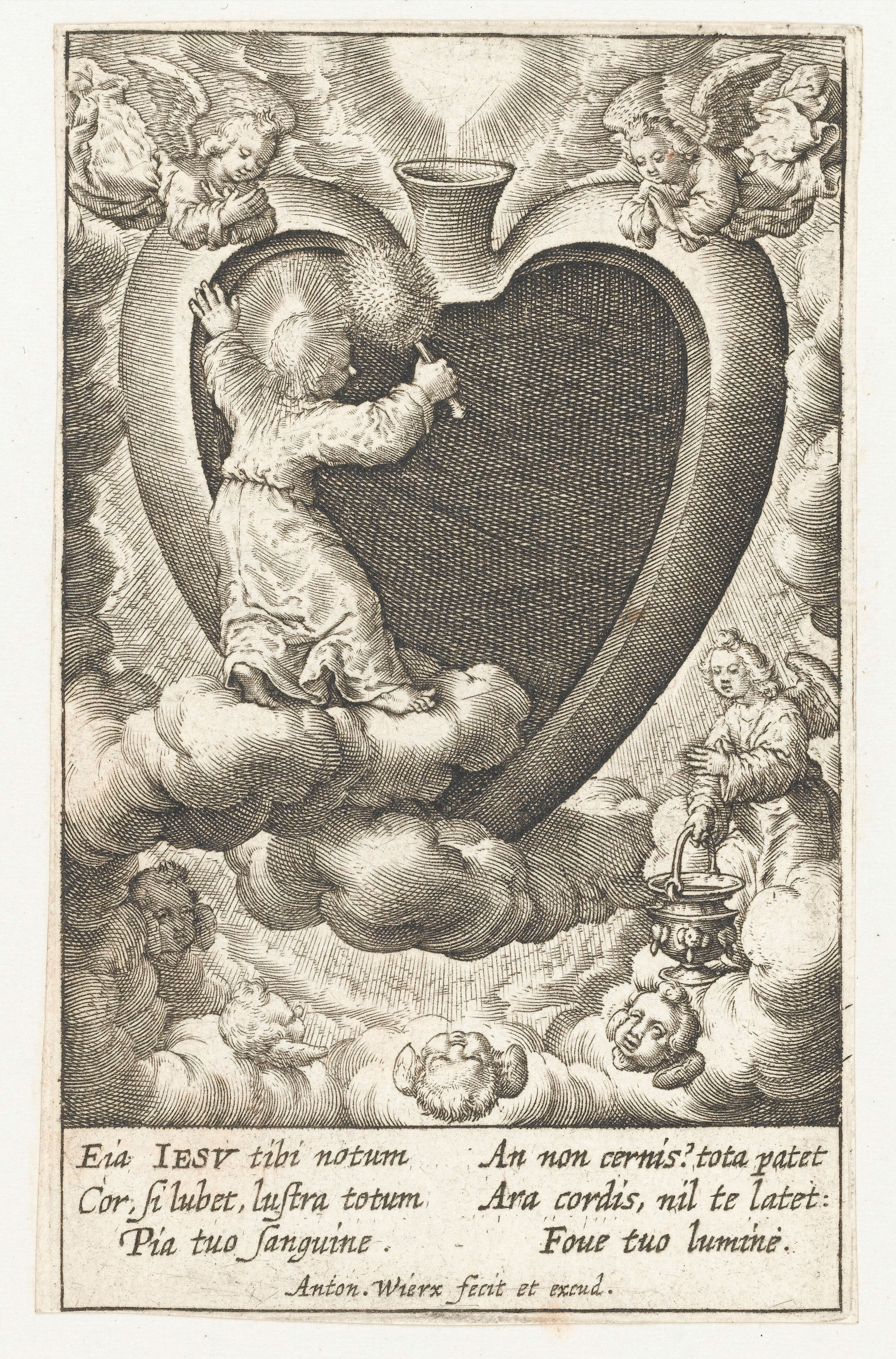
6. Jesus purgeth the heart with expiatory blood
Anton Wierix II (Flemish, ca. 1555–1604), Jesus purgeth the heart with expiatory blood, ca. 1600. Engraving, with etching, image 7.8 × 5.6 cm.
Eia Iesu tibi notum cor, si lubet, lustra totum, pia tuo sanguine.
An non cernis? tota patet ara cordis, nil te latet: Fove tuo lumine.
(Ahh, Jesus, the heart which you know, clean it all, if you like, purify it with your blood! Or do you not see? The whole altar of the heart lies open, nothing is hidden from you. Sustain it with your light.)
“Purge me with hyssop,” prays David the psalmist (Ps. 51:7). In this image Jesus uses an aspergillum to sprinkle his blood on the believer’s heart, much like Moses did with the blood of oxen (Exod. 24:1–8)—sprinkling it on the altar and on God’s covenant people—and like the Levitical priests did with the blood of bulls and goats before the mercy seat (Lev. 16).
Binet writes of the immediate effect: “Lo, the heart came presently to itself again, as soon as it felt but one little drop of thy divine love to be sprinkled on it” (98). I love that phrase: “the heart came presently to itself again.” Jesus reconciles us not only to God but also to ourselves, taking away our guilt so that we can live in the freedom we were always meant to have. He brings us home to our truest selves.
There’s power in the blood! Luzvic beseeches Jesus for just a few drops:
Take, therefore, O Jesus, love of my soul, from this infinite bath of thine some few little drops, at least, and sprinkle thy sanctuary therewith, I say—the ample field of my heart, whose sure possession thou hast taken to thyself long since. (99–100)
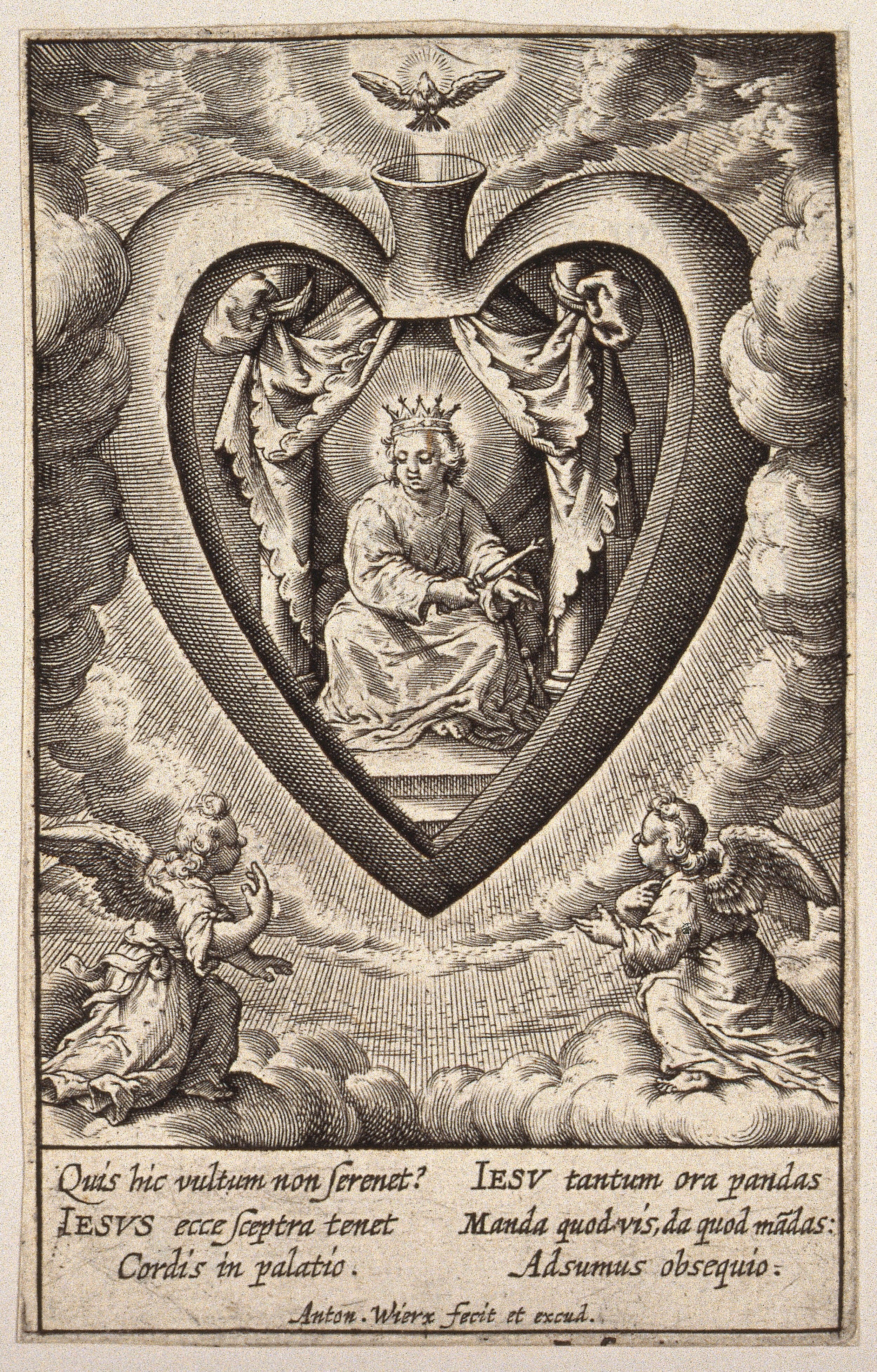
7. Jesus rules and reigns in the loving and devout heart
Anton Wierix II (Flemish, ca. 1555–1604), Jesus rules and reigns in the loving and devout heart, ca. 1600. Engraving, with etching, image 7.8 × 5.7 cm.
Quis hic vultum non serenet? Iesus ecce sceptra tenet cordis in palatio.
Iesu tantum ora pandas, manda quod vis, da quod mandas; adsumus obsequio.
(Who would not here have a serene expression? Behold, Jesus holds the scepter in the palace of the heart. Jesus, just open your mouth, order what you want, give what you order: we are present to obey.)
Here’s a beautiful prayer by Luzvic. Its last line is a quotation from Song of Solomon 6:3, a book that Christians have read, on one level, as an allegory of the love between Christ and the human soul:
The heart . . . is hungry and thirsty, nor lives contented with any owner, unless thou fix the seat of thy kingdom in its precincts. If thou beest present with, it desires no more; if absent, come in all created things at once and woo it never so much, there will yet be place enough for more. If thou gettest from thence, all felicity departs with thee: if thou abides, all beatitude comes suddenly thither. Reign, therefore, and eternally reign in my heart, O love of my heart. Quiet the motion of perturbations, nor ever suffer the unhappy heart to thrust the king out of his seat, then which cannot happen a greater disaster to it. Nor suffer, I say, O darling and delight of my heart, that one heart should be shared into many parts. For thou sufferest no rival. Oh suffer it not ever to be enticed with the allurements of worldly pleasure, which gate being once set open, I see how easily the enemy will rush in. Be thou to it a brazen, yea, a wall of fire, which may so roundly girt the tower, as that no passage may be found unto it. But that only the Holy Ghost may come down from heaven, whereto the heart lies open, and enter therein with a full gale, and occupy the whole heart, that so I may truly profess and glory, My beloved to me and I to him. (116–18)
8. Jesus teacheth the devout heart
Anton Wierix II (Flemish, ca. 1555–1604), Jesus teacheth the devout heart, ca. 1600. Engraving, with etching, image 7.7 × 5.5 cm.
Sunt auscultent qui Platoni, aut facundo Ciceroni, aut mundi stultitiae.
Tu ne verba vitae sperne: Audi patris aeviterne dicta sapientiae.
(Some listen to Plato or to eloquent Cicero, or to the stupidity of the world. [But] you, do not scorn the words of life! Listen to the Father’s sayings of everlasting wisdom!)
In this image Christ is portrayed as the heart’s instructor. He sits with an open book that reads, “Erunt omnes docibiles Dei” (All shall be the pupils of God).
Luzvic imagines one of the directives he gives:
Hear, my child (for so Jesus advises from the pulpit of the heart): Do thou give thyself to me. Let me be thy possession, thy nurse, thy food, for nothing can satiate thine appetite without me. My child, throw away those leeks and garlic of Egypt, turn thy face from the stinking waters of [vain] pleasure, and put thy mouth rather to my side, the wine-cellar of graces, whence at ease thou mayest draw and derive to thyself most sovereign and incomparable joys. (128–29)
9. Jesus paints the images of the last things in the table of the heart
Anton Wierix II (Flemish, ca. 1555–1604), Jesus paints the images of the last things in the table of the heart, ca. 1600. Engraving, with etching, image 7.8 × 5.7 cm.
Sume Iesu penicilla, corque totum conscribilla piis imaginibus:
sic nec Venus prophanabit, nec Voluptas inquinabit vanis phantasmatibus.
(Take, Jesus, your paintbrushes and daub over the whole heart with holy images. Thus neither shall Venus profane it nor shall pleasure pollute it with empty fantasies.)
The four last things, clockwise from bottom left inside the heart, are death, judgment, heaven, and hell. The image asks Jesus to make these future realities vivid in our minds so that we would live blamelessly until then.
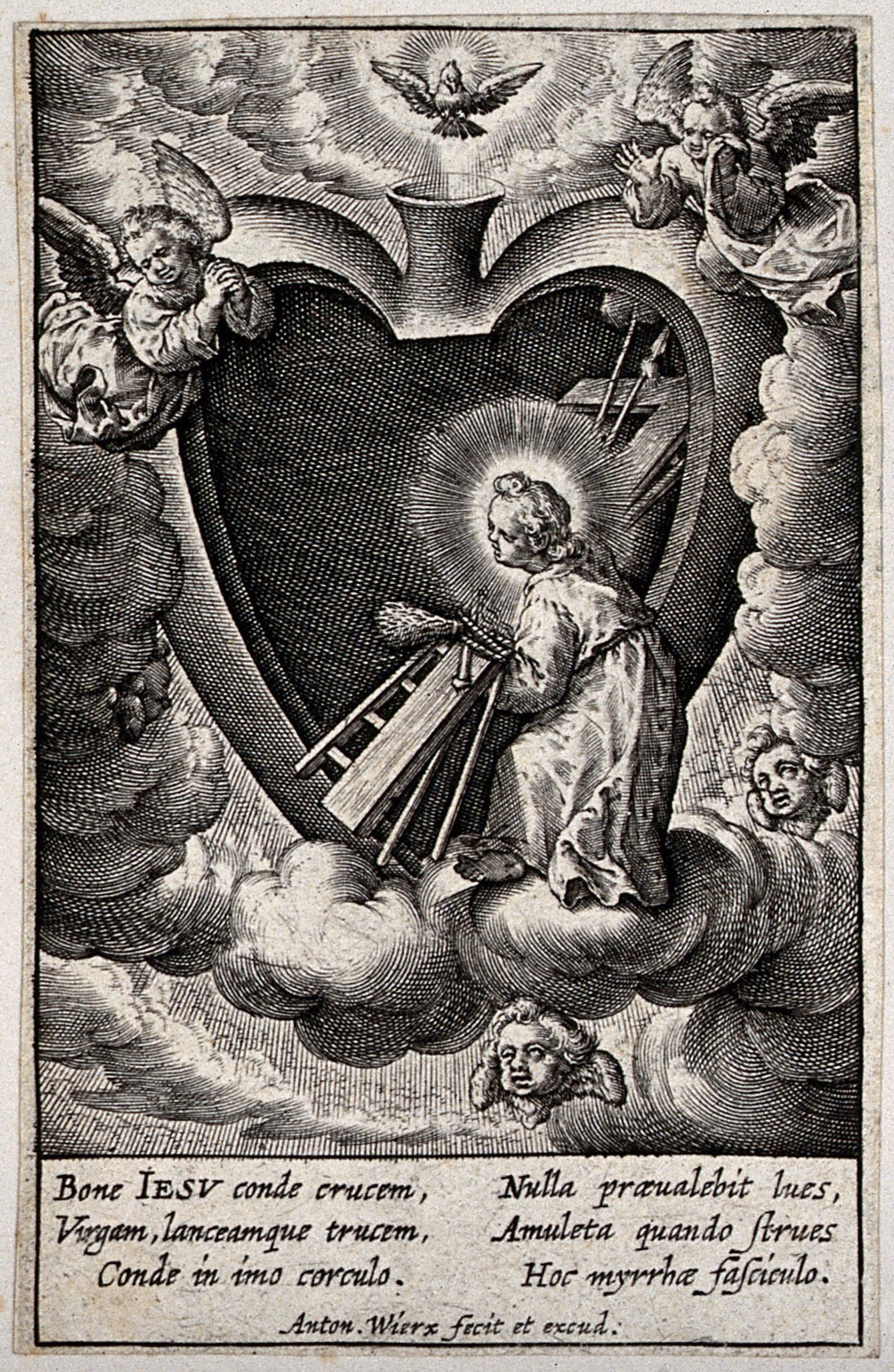
10. Jesus brings the cross into the heart, and easily imprints it in the lover
Anton Wierix II (Flemish, ca. 1555–1604), Jesus brings the cross into the heart, and easily imprints it in the lover, ca. 1600. Engraving, with etching, image 7.8 × 5.6 cm.
Bone Iesu conde crucem, virgam, Ianceamque trucem, conde in imo corculo.
Nulla praevalebit lues, amuleta quando strues hoc myrrhae fasciculo.
(Good Jesus, stow the cross, the lash, and the cruel lance, stow it at the bottom of the little heart. No sin shall prevail when you pile up this preservative on a gathering of myrrh.)
In this image, Christ deposits the instruments of his passion in the heart of the believer, where they serve as a reminder of the cross-shaped ethic we are to adopt—giving ourselves for others—as well as a call to gratitude for Christ’s sacrifice and a source of strength in times of suffering.
Go in, lovely cross; enter, lance, sponge, nails, scourge; bloody thorns, get you into the closet of the heart. Welcome still, but on this condition that Jesus bring you in himself; for myrrh with Jesus is admirable, and mere sweetness.
Thou sayest thou lovest Jesus; then needs must thou his cross, for if otherwise thou boast to love Jesus, thou deceivest thyself and others.
Most sweet child, what have you and I to do with this lumber here? Scarce art thou come into the world, but thou art oppressed with the weight of punishments. Oh plant thy seat in my heart! and then shall I challenge hell itself: for if Jesus and I hold together, what Hercules can stand against us both? (150–51)
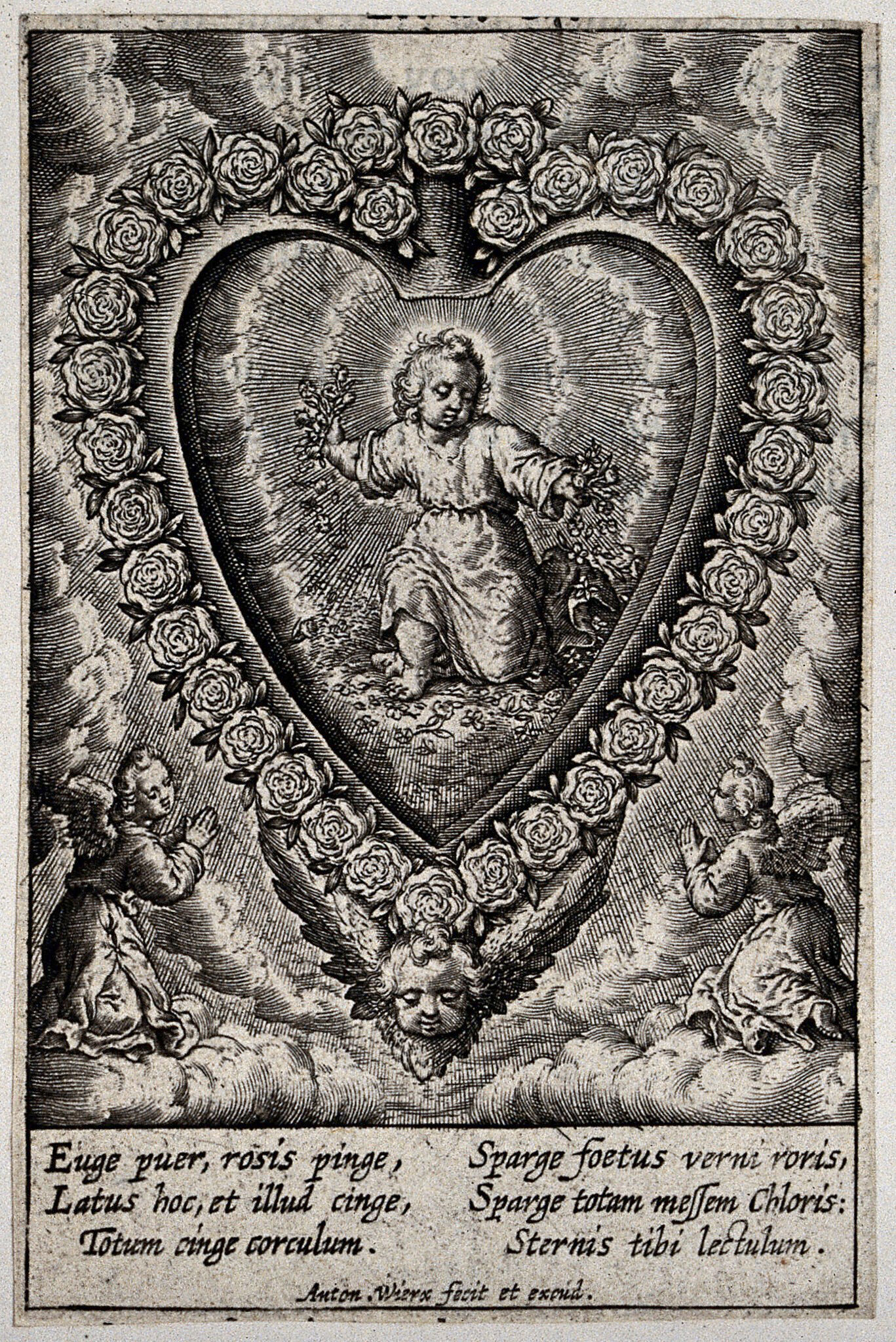
11. The heart consecrated to the love of Jesus is a flourishing garden
Anton Wierix II (Flemish, ca. 1555–1604), The heart consecrated to the love of Jesus is a flourishing garden, ca. 1600. Engraving, with etching, image 7.7 × 5.9 cm.
Euge puer, rosis pinge, latus hoc, et illud cinge, totum cinge corculum.
(Bravo, boy! paint this side and that and surround it with roses, surround the entire little heart! Spread the fruit of the spring dew, spread the entire harvest of the realm of flowers: you are [thus] laying a cot for yourself.)
(Alt translation by Walter S. Mellion: Bravo, lad! Embroider with roses now this side, now that, encompass them. Wreath the little heart, all of it. Strew it with the progeny of the springtime dew, with the whole harvest of Chloris: spread for yourself a [flowery] bed.)
Jesus bedecks the heart with roses in this image—makes it beautiful and fragrant. Again, this image evokes the Song of Solomon, with its scenes of lovers in the garden.
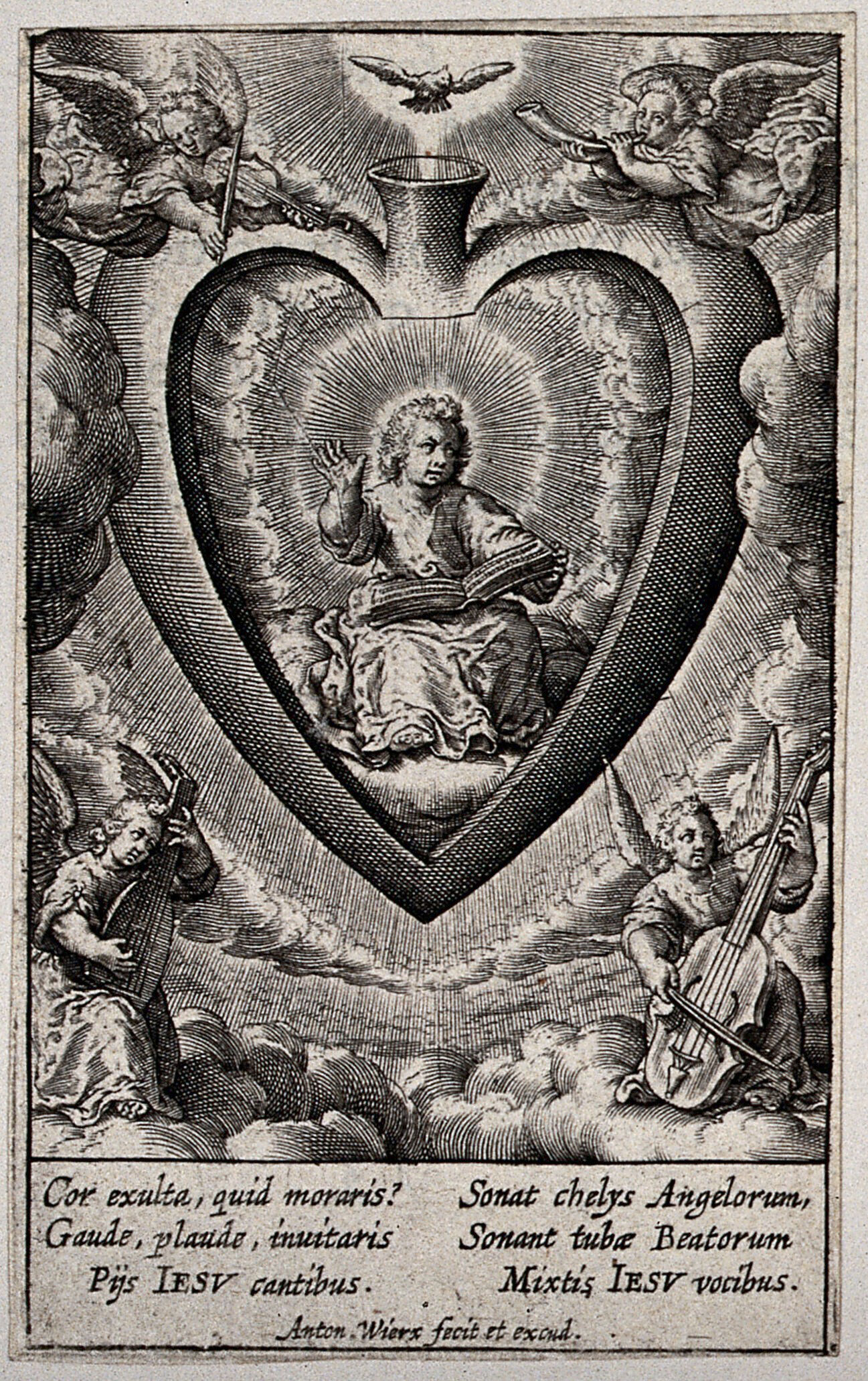
12. Jesus sings in the choir of the heart, to the angels playing on musical instruments
Anton Wierix II (Flemish, ca. 1555–1604), Jesus sings in the choir of the heart, to the angels playing on musical instruments, ca. 1600. Engraving, with etching, image 7.8 × 5.5 cm.
Cor exulta quid moraris? Gaude, plaude, invitaris piis Iesu cantibus.
Sonat chelys angelorum, sonant tubae beatorum mixtis Iesu vocibus.
(Heart, exult! Why do you hesitate? Rejoice! Applaud! Invite Jesus with sacred songs! The [name of] Jesus sounds forth in the lyre of angels, it sounds in the trumpets of the blessed mixed with voices [singing].)
Luzvic fancifully develops the image of Jesus as singer and choir conductor in the sanctum of our hearts, making sweet, melodious music:
I will chant the mercies of the Lord forever. For to this purpose Jesus, the prime Christ, records his ancient loves to the human heart, and now mixing with admirable skill flats with sharps, sharps with flats, the tenor with the bass, and running diversely divisions he touches with a sweet remembrance now with a moderate, now remiss, now slow, and now with a quick voice, the innumerable number of his benefits wherewith heretofore he hath wooed the heart . . . (176)
13. Jesus, the son of David, plays on the harp in the heart, while angels sing
Anton Wierix II (Flemish, ca. 1555–1604), Jesus, the son of David, plays on the harp in the heart, while angels sing, ca. 1600. Engraving, with etching, image 7.5 × 5.7 cm.
Pulsa chordas, sonet chelys, dum nos recreas de caelis Iesu cordis gaudium.
Dulce melos intonabunt, novum nobis excitabunt angeli tripudium.
(Strike the strings! Let the lyre sound forth! While from heaven you renew us, Jesus, joy of the heart. A sweet tune angels shall intone [and they] shall arouse a new dance within us.)
14. Jesus rests in the lover’s heart
Anton Wierix II (Flemish, ca. 1555–1604), Jesus rests in the lover’s heart, ca. 1600. Engraving, with etching, image 7.8 × 5.6 cm.
dum in corde lectum stravit, atque sponsus dormitavit, tuta ridet sponsula.
(In vain the north wind threatens, in vain the thunder runs wild, in vain the sea foams: while in the heart the betrothed has spread his bed and gone to sleep, the bride elect smiles in safety.)
What a moving image—the heart as a place of rest for Jesus. From the four corners the four winds blow, but Jesus is not perturbed, so why should we be? He still has the world in his hands (well, in his lap!).
The image is an allusion to the episode in all three Synoptic Gospels where a storm arises on the Sea of Galilee while Jesus and the disciples are in a boat; the disciples are frantic, and exasperated that Jesus is snoozing, but he tells them not to worry, and then he silences the wind and waves with a command: “Peace, be still!”
The image projects peace and stillness onto our troubled hearts.
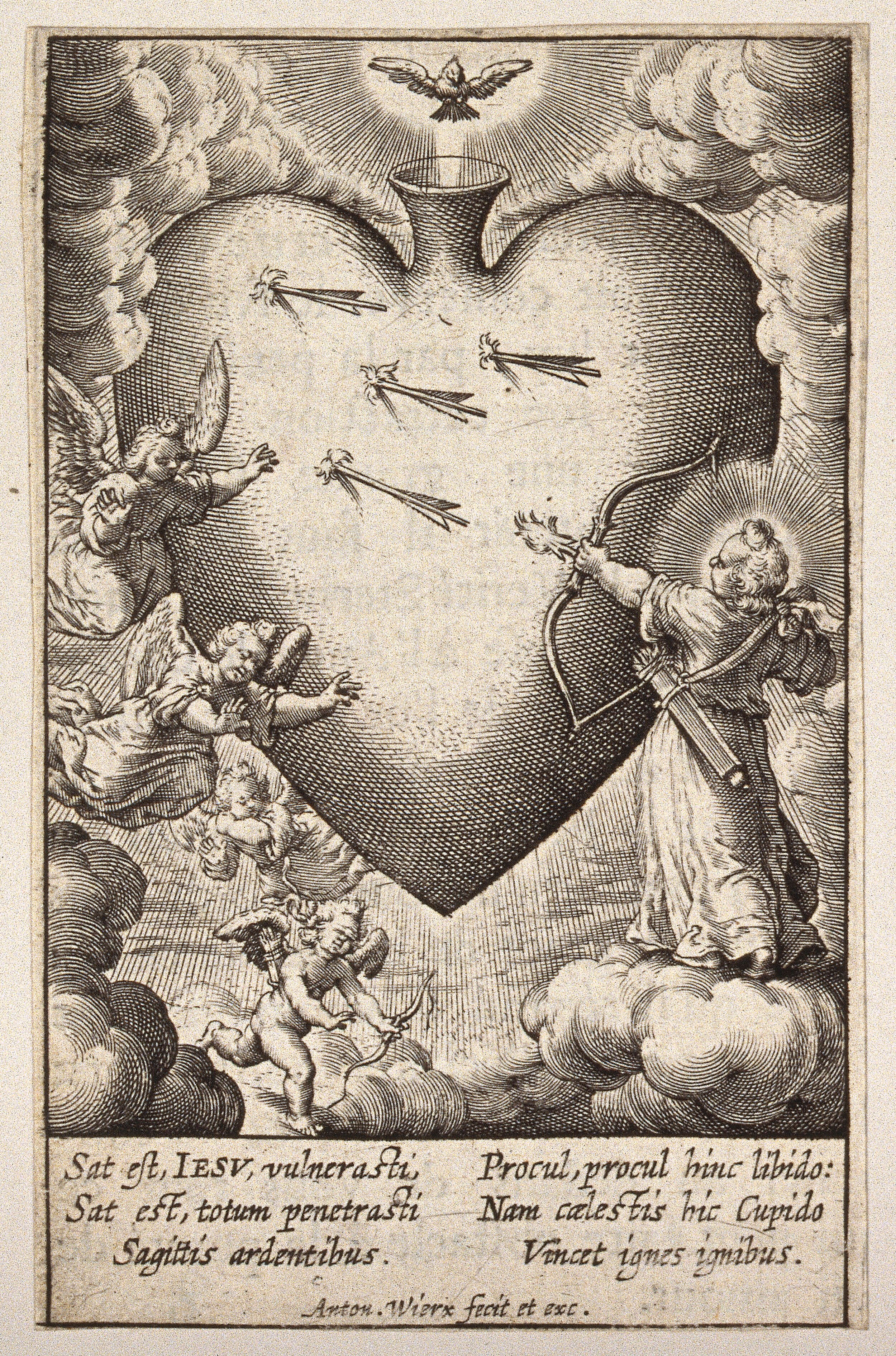
15. Jesus wounds and pierces the heart with the shafts of love
Anton Wierix II (Flemish, ca. 1555–1604), Jesus wounds and pierces the heart with the shafts of love, ca. 1600. Engraving, image 7.8 × 5.7 cm.
Sat est, Iesu, vulnerasti, sat est, totum penetrasti sagittis ardentibus.
Procul, procul hinc libido: nam caelestis hic Cupido vincet ignes ignibus.
(Enough, Jesus, enough! You have shot through the whole heart with flaming arrows. Lust, [be gone] far, far from here! For here is a heavenly Cupid who will conquer fire with fire.)
Luzvic quotes from chapter 2 of Augustine’s Confessions in this section: “Lord, thou hast pierced our hearts with thy charity.”
He elaborates with his own ecstatic words:
My good Archer, shoot, ah, shoot again! shoot through this heart of mine, with a million shafts, this refractory and rebellious heart, to thy divine love: slay and kill all love that is not thine, or is adversary to it. O sweet wounds! O dear to me! O arrows dipped and tipped with honey. . . .
The heart is never in so good a plight as when it is transfixed with a thousand points of sharpest love. (216)
16. The heart enflamed with the love of Jesus shines with light and flames
Anton Wierix II (Flemish, ca. 1555–1604), The heart enflamed with the love of Jesus shines with light and flames, ca. 1600. Engraving, with etching, image 7.8 × 5.7 cm.
En armatas flammis tendit Iesus manus, cor accendit hinc et illinc facibus.
Age, totum comburatur, in favillam redigatur cor amoris ignibus.
(Behold, Jesus holds out his hands armed with flames, and sets alight the heart with torches on this side and that. Come, let it all burn, let the heart be reduced to an ember by the fires of love.)
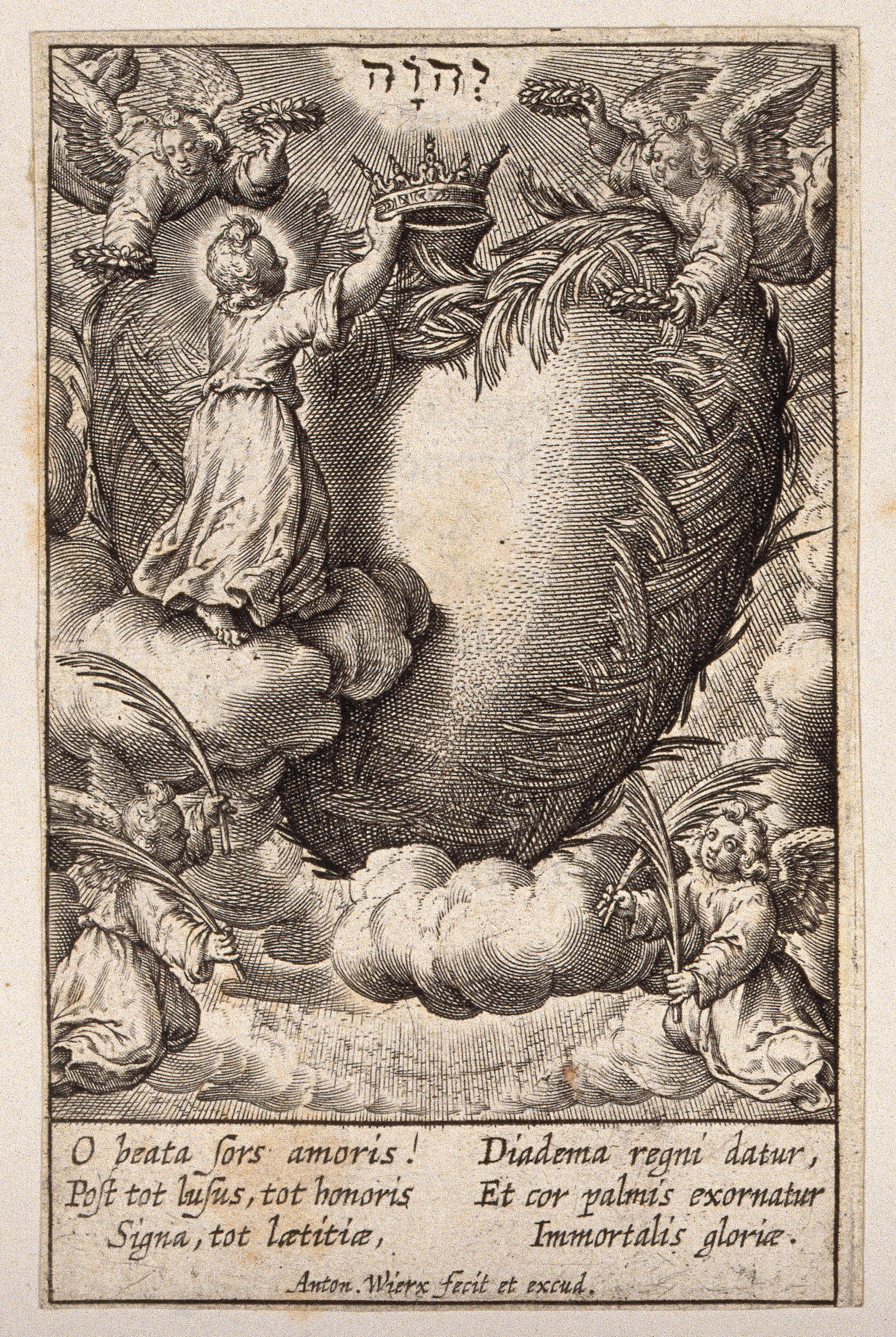
17. Jesus crowns his dear heart with palms and laurels
Anton Wierix II (Flemish, ca. 1555–1604), Jesus crowns his dear heart with palms and laurels, ca. 1600. Engraving, with etching, image 7.8 × 5.5 cm.
O beata sors amoris! Post tot lusus, tot honoris signa, tot laetitiae,
diadema regni datur, et cor palmis exornatur immortalis gloriae.
(O blessed fortune of love! After so many games, so many tokens of honor, so many of joy, the crown of the kingdom is bestowed, and the heart is adorned with the palms of immortal glory.)
* I am excluding the title page engraving from the count, which shows a flaming heart, inscribed with the words Cor Jesu amanti sacrum, held up by a Jesuit and a Franciscan friar; Jesus is not pictured, and there is no corresponding verse. And it appears that the Wellcome Collection does not own (or has not digitized) this print.
FURTHER READING
Daly, Peter M. The Emblem in Early Modern Europe: Contributions to the Theory of the Emblem. Surrey, UK: Ashgate, 2014.
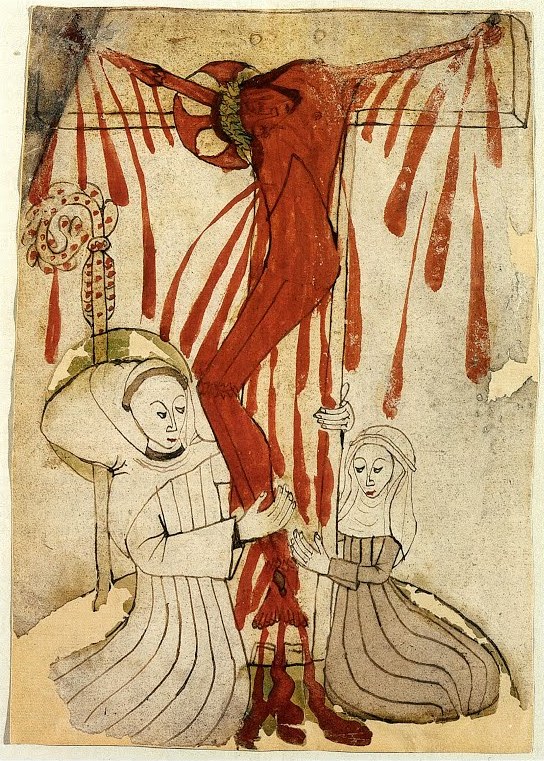
Vision of Saint Bernard (Blood Crucifix), by a nun from the Lower Rhine, 14th century. Ink and colored washes on paper, 25.5 × 18 cm. Museum Schnütgen, Cologne.
Jesu, no more! It is full tide;
From thy hands and from thy feet,
From thy head, and from thy side,
All the purple rivers meet.

What need thy fair head bear a part
In showers, as if thine eyes had none?
What need they help to drown thy heart,
That strives in torrents of its own?

Water’d by the showers they bring,
The thorns that thy blest brow encloses
(A cruel and a costly spring)
Conceive proud hopes of proving roses.

Thy restless feet now cannot go
For us and our eternal good,
As they were ever wont. What though?
They swim, alas! in their own flood.

Thy hand to give thou canst not lift,
Yet will thy hand still giving be.
It gives, but O, itself’s the gift,
It gives though bound, though bound ’tis free.

But, O thy side, thy deep-digg’d side,
That hath a double Nilus going:
Nor ever was the Pharian tide
Half so fruitful, half so flowing.

No hair so small, but pays his river
To this Red Sea of thy blood;
Their little channels can deliver
Something to the general flood.

But while I speak, whither are run
All the rivers named before?
I counted wrong: there is but one;
But O that one is one all o’er.

Rain-swol’n rivers may rise proud,
Bent all to drown and overflow;
But when indeed all’s overflow’d,
They themselves are drowned too.

This thy blood’s deluge (a dire chance,
Dear Lord, to thee) to us is found
A deluge of deliverance,
A deluge lest we should be drown’d.

Ne’er wast thou in a sense so sadly true,
The well of living waters, Lord, till now.
This poem was published in the second edition of Steps to the Temple: Sacred Poems, with Other Delights of the Muses (London, 1648) under the title “On the Bleeding Body of Our Crucified Lord”; an earlier version appeared in the book’s first edition in 1646 under the title “On the Bleeding Wounds of Our Crucified Lord.” I use the title by which it is most commonly known, “Upon the Bleeding Crucifix,” first assigned to it in Crashaw’s posthumously published collection Carmen Deo Nostro (Paris, 1652). I’ve modernized the spellings.
Richard Crashaw (1612–1649) was one of the major Metaphysical poets of seventeenth-century England, a movement marked by the use of elaborate figurative language, original conceits, paradoxes, and philosophical exploration. He was also a priest. Ordained in the Church of England in 1638, he was installed as curate of the Church of St Mary the Less in Cambridge, embracing the high-church reforms of Archbishop William Laud, for which he was persecuted. In 1643, during the English Civil War, Oliver Cromwell and his Puritan posse forced Crashaw into exile in France, where he converted to Roman Catholicism. Waiting for a papal retainer, he struggled with poverty and ill health. Pope Innocent X finally granted Crashaw a post at a seminary in Rome in 1647, and two years later he was given a cathedral benefice in Loreto, where he died of a fever at age thirty-six. He published two collections of poetry during his lifetime.
SPOTIFY PLAYLIST: July 2023 (Art & Theology): This month’s Spotify mix that I put together for you all includes a Shona worship song from Zimbabwe; “Adonai Is for Me,” a song in Hebrew by Shai Sol; a Black gospel rendition of the children’s classic “Jesus Loves Me”; a new setting of the Lord’s Prayer by Jon Guerra; a composition for clarinet and piano by Jessie Montgomery, written in April 2020 to try to make peace with the sadness brought about by the pandemic-prompted quarantine orders; a country-style setting of Psalm 121 by Julie Lee; and a benediction by Bob Dylan that I heard Leslie Odom Jr. sing in concert recently—its refrain, “May you stay forever young,” is not an anti-aging wish but rather a call to childlike faith, wonder, and curiosity in perpetuity.
The playlist also includes the following two songs.
>> “Come Go with Me”: A lesser-known African American spiritual performed by the Norwegian jazz singer-songwriter Kristin Asbjørnsen, from her excellent album Wayfaring Stranger: A Spiritual Songbook. She describes the spirituals as “existential expressions of life: songs of longing, mourning, struggling, loneliness, hopefulness and joyful travelling.” This particular one is about walking that pilgrim path to heaven, a path on which Satan lays stones to obstruct our progress but which Jesus, our “bosom friend,” clears away.
>> “Love, More Love”: A short Shaker hymn that opens with a common Shaker greeting: “More love!” “Our parents above” refers, I believe, to the elders of the faith who have passed on. The hymn uses horticultural imagery to describe the qualities of communal love—something planted and grown, becoming stronger and fuller and more beautiful as it is nurtured.
Love, more love A spirit of blessing I would be possessing For this is the call of our parents above
We will plant it and sow it And every day grow it And thus we will build up an arbor of love
The Shakers are a Christian sect founded in 1747, but because celibacy is one of their tenets (and thus they cannot rely on procreation for the community’s continuation), there are only two Shakers left: Sister June and Brother Arnold, who live in Dwellinghouse, Maine. But there has long been a historical interest in Shaker religious culture and aesthetics—which is why, for example, the Enfield Shaker Singers was formed, to preserve the hymnody.
+++
INTERVIEW + PHOTOS: “Photographer Shows the Raw, Unflinching Reality of Life on Skid Row”: For the past decade, anonymous street photographer Suitcase Joe has been spending time on Skid Row in downtown Los Angeles, a neighborhood inhabited by the largest unhoused community in America. He slowly developed trust and built relationships with the people in that community, learning more about their stories, and they granted him unprecedented access to their daily lives, allowing him to capture them on camera. Hear him talk about the experience, and about misconceptions people tend to have about those experiencing homelessness, in this interview, which also includes a sampling of photos. Even though the headline hawks “Raw!” and “Unflinching!,” I was more struck by how the photographs show experiences of joy and friendship.
POEM WITH COMMENTARY: “The Rungs” by Benjamin Gucciardi, commentary by Pádraig Ó Tuama: Each week on the Poetry Unbound podcast, Ó Tuama reads and reflects on a different contemporary poem. In this episode’s featured poem, “a social worker holds a group for teenagers at a school. They only half pay attention to him. Then something happens, and they pay attention to each other.” The poem is from Gucciardi’s latest collection, West Portal.
+++
ARTICLE: “Dool-Hoff: A Dutch Maze with New Jerusalem at its Centre (1705)”: The Public Domain Review is always uncovering unique, amusing prints and other artistic and literary curiosities from centuries past. Here they look at an early eighteenth-century religious maze published in Haarlem, Netherlands, whose pathways are filled with didactic verse, some leading to dead ends but others leading to heaven at the center.
Dool-hoff (maze), signed by the Dutch Catholic printer Claes Braau, 1705. Photo courtesy of the Rijksmuseum, Amsterdam.
+++
SONG: “Home Inside” by Valerie June, performed by the Good Shepherd Collective: This Valerie June cover is sung so gorgeously by Sowmya Somanath with Kate Gungor, Bea Gungor, Jayne Sugg, Liz Vice, and Diana Gameros, and John Arndt accompanies on piano. It premiered in Good Shepherd New York’s March 12 digital service. The song is a prayer for belonging more fully to ourselves, to God, and to this earth; its speaker asks that she might be sensitive to the divine breath in all living things, and be soothed and refreshed by that great stream of water that flows from God’s heart. (Reminds me a bit of Universal Jones’s“River”!)
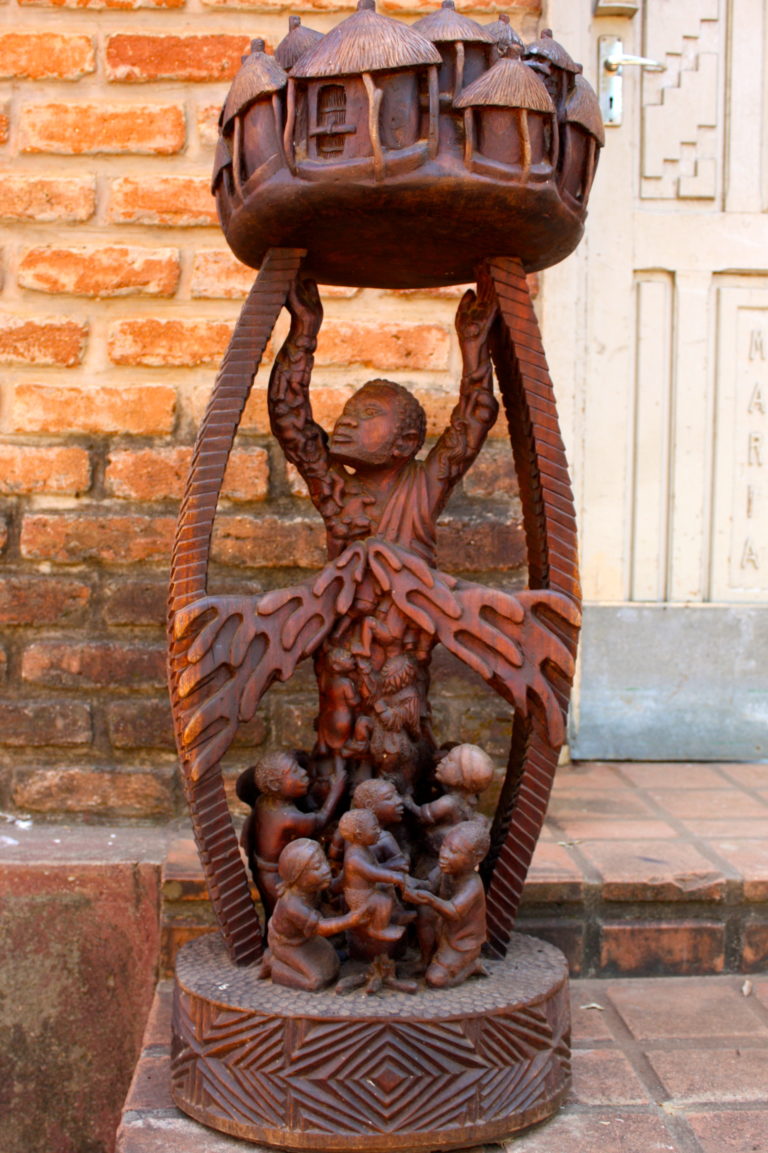
Thomas Mpira, Paschal Candlestand, 1990. Tangatanga wood, height 104 cm. Mua Parish Church, Mua, Malawi.
This large Paschal candlestand was made by Thomas Mpira, a master carver at the Kungoni Centre of Culture and Art in Mua, Malawi. Founded in 1976 by Father Claude Boucher Chisale, this center employed over 120 carvers at its height and is remarkable for how it synthesizes Christian faith and African culture. It is still active, with many locally produced artworks put on display at the center’s Chamare Museum. Others, like this one, are used in the liturgies at the Mua parish church in the diocese of Dedza, whose services are in Chichewa.
Traditionally, the Paschal candle is lit during the Easter Vigil on the night of Holy Saturday, representing the light of Christ’s resurrection expelling the darkness. It is raised and leads a procession, with the lighting blessing referencing
Christ, that Morning Star, who came back from the dead, and shed his peaceful light on all humanity, [God’s] Son, who lives and reigns for ever and ever.
The candle is then placed on the stand and remains lit at all worship services throughout the Easter season, and during baptisms and funerals at any time of the year.
The central figure of Mpira’s carving is the risen Christ, his body constituted of people who’ve been incorporated by his death and resurrection into the “celestial village” he holds aloft, the kingdom of God. From his Sacred Heart gushes a river of life that waters a Chewa village, where a newborn is being passed over a fire to welcome him into the community. (Some Chewa Christians have adapted this ritual such that the child is passed over a lit candle at baptism.) Powerful and regenerating, Christ’s Spirit pours out over the villagers and their daily lives.
The arched forms that support the top of the stand are stylized rainbows, symbolic of God’s promise.
LISTEN: “Vidi aquam”(Wolof: “Gis Na Deh”) by the Monks of Keur Moussa Abbey, from Keur Moussa: Sacred Chant and African Rhythms from Senegal (1997)
English translation:
I saw water flowing out of the temple, from its right side, alleluia: And all to whom this water came were saved, And they exclaim, “Alleluia, alleluia!”
Glory to the Father and to the Son and to the Holy Spirit: As it was in the beginning, now and forever.
I saw water flowing out of the temple, from its right side, alleluia: And all to whom this water came were saved, And they exclaim, “Alleluia, alleluia!”
“Vidi aquam” (“I saw the water”) is a joyful Easter chant for the asperges ritual at the beginning of Mass, in which the altar, the clergy, and the congregation are sprinkled with holy water. The Latin word “asperges” is taken from Psalm 51:3, “Asperges me hyssopo” (Thou shalt sprinkle me with hyssop), which is intoned during the rite for most of the year—except during Eastertide, when this text is replaced with one based on Ezekiel 47, in which the prophet sees a sanctifying flood issuing forth from the temple in Jerusalem:
Then he brought me back to the entrance of the temple; there water was flowing from below the entryway of the temple toward the east. . . . Wherever the river goes, every living creature that swarms will live . . . (vv. 1, 9)
This sensory ritual celebrates the cleansing power of Christ, from whose speared side, on the cross, gushed water and blood, a fount of life.
The monks of Keur Moussa Abbey in Senegal use a Wolof translation of the Vidi aquam, which they’ve set to music inspired by a diola melody from Casamance, southern Senegal. In this recording, they sing accompanied by two tom-toms.
O come away, Make no delay, Come while my heart is clean and steady! While faith and grace Adorn the place, Making dust and ashes ready!
No bliss here lent Is permanent, Such triumphs poor flesh cannot merit; Short sips and sights Endear delights: Who seeks for more, he would inherit.
Come then, True Bread, Quick’ning the dead, Whose eater shall not, cannot die! Come, antedate On me that state Which brings poor dust the victory.
Ay! victory, Which from Thine eye Breaks as the day doth from the East; When the spilt dew Like tears doth shew The sad world wept to be released.
Spring up, O wine, And springing shine With some glad message from His heart, Who did, when slain, These means ordain For me to have in Him a part.
Such a sure part In His blest heart, The Well where living waters spring, That with it fed, Poor dust, though dead, Shall rise again, and live, and sing.
O drink and bread, Which strikes Death dead, The food of man’s immortal being! Under veils here Thou art my cheer, Present and sure without my seeing.
How dost thou fly And search and pry Through all my parts, and, like a quick And knowing lamp, Hunt out each damp, Whose shadow makes me sad or sick!
O what high joys! The turtle’s voice And songs I hear! O quick’ning showers Of my Lord’s blood, You make rocks bud, And crown dry hills with wells and flowers!
For this true ease, This healing peace, For this taste of living glory, My soul and all Kneel down and fall, And sing His sad victorious story!
O thorny crown, More soft than down! O painful cross, my bed of rest! O spear, the key Opening the way! O Thy worst state, my only best!
Oh! all Thy griefs Are my reliefs, And all my sins Thy sorrows were! And what can I To this reply? What—O God!—but a silent tear?
Some toil and sow That wealth may flow, And dress this Earth for next year’s meat: But let me heed Why Thou didst bleed And what in the next world to eat.
Henry Vaughan (1621–1695) [previously] was a Welsh metaphysical poet, translator, and physician, known chiefly for his religious poetry in English. For info on his life and times, as well as his literary importance, see https://www.poetryfoundation.org/poets/henry-vaughan.
Vaughan’s “The Feast” was originally published in 1655 in the expanded edition of his celebrated collection Silex Scintillans (1650). (The book’s title is Latin for “The Fiery Flint,” referring to the stony hardness of man’s heart, from which divine steel strikes fire.) The poem consists of thirteen sestets (six-line stanzas), each following the syllable pattern 4-4-8-4-4-8, with a few cheats. More specifically: the first two lines of each stanza are in iambic dimeter, and the third is in iambic tetrameter, repeat. Which is simply the technical way of saying that the rhythm sounds like da-DUM, da-DUM—unstressed syllable, stressed syllable. The rhyme scheme is aabccb. I mention these details because it’s important to see the structure of a poem.
Now let’s walk through it piece by piece.
O come away, Make no delay, Come while my heart is clean and steady! While faith and grace Adorn the place, Making dust and ashes ready!
No bliss here lent Is permanent, Such triumphs poor flesh cannot merit; Short sips and sights Endear delights: Who seeks for more, he would inherit.
The speaker starts out by beseeching Christ’s return. He’s saying that he, who is mere dust, has put the affairs of his heart in order and is ready for the next life. He has come to realize that earthly pleasures are but “short sips,” quick delights, and he wants a long, slow drink, one that infinitely satisfies. Like the Samaritan woman at the well in John 4:13–14, to whom Jesus said, “Everyone who drinks of this [physical] water will be thirsty again, but whoever drinks of the water that I will give him will never be thirsty again. The water that I will give him will become in him a spring of water welling up to eternal life.”
Those who truly seek for more than what this world has to offer will find it.
Come then, True Bread, Quick’ning the dead, Whose eater shall not, cannot die! Come, antedate On me that state Which brings poor dust the victory.
“Come then, True Bread,” the speaker exclaims, addressing Christ in biblical metaphor. John 6 is a major reference point for Vaughan throughout this poem, which is where Jesus addresses the crowds whom he had just fed the day before with miraculously multiplied loaves and fishes:
“Do not work for the food that perishes, but for the food that endures to eternal life, which the Son of Man will give to you. For on him God the Father has set his seal.” Then they said to him, “What must we do, to be doing the works of God?” Jesus answered them, “This is the work of God, that you believe in him whom he has sent.” So they said to him, “Then what sign do you do, that we may see and believe you? What work do you perform? Our fathers ate the manna in the wilderness; as it is written, ‘He gave them bread from heaven to eat.’” Jesus then said to them, “Truly, truly, I say to you, it was not Moses who gave you the bread from heaven, but my Father gives you the true bread from heaven. For the bread of God is he who comes down from heaven and gives life to the world.” They said to him, “Sir, give us this bread always.”
Jesus said to them, “I am the bread of life; whoever comes to me shall not hunger, and whoever believes in me shall never thirst. . . .
“Your fathers ate the manna in the wilderness, and they died. This is the bread that comes down from heaven, so that one may eat of it and not die. I am the living bread that came down from heaven. If anyone eats of this bread, he will live forever. And the bread that I will give for the life of the world is my flesh.”
Jesus is the bread of life, whose flesh we eat at the Communion table, taking his self into our selves. Those who feed on Christ are strengthened in their union with him in both his crucifixion and resurrection. As the apostle Paul writes in 1 Corinthians 10:16, “The cup of blessing that we bless, is it not a participation in the blood of Christ? The bread that we break, is it not a participation in the body of Christ?”
“Come,” the poem’s speaker continues, “antedate / On me that state / Which brings poor dust the victory.” He, as one who has already lost battle after battle against sin, asks that Christ grant him the victory post-factum, rendering his past losses of no account. In other words: “Christ, have mercy.”
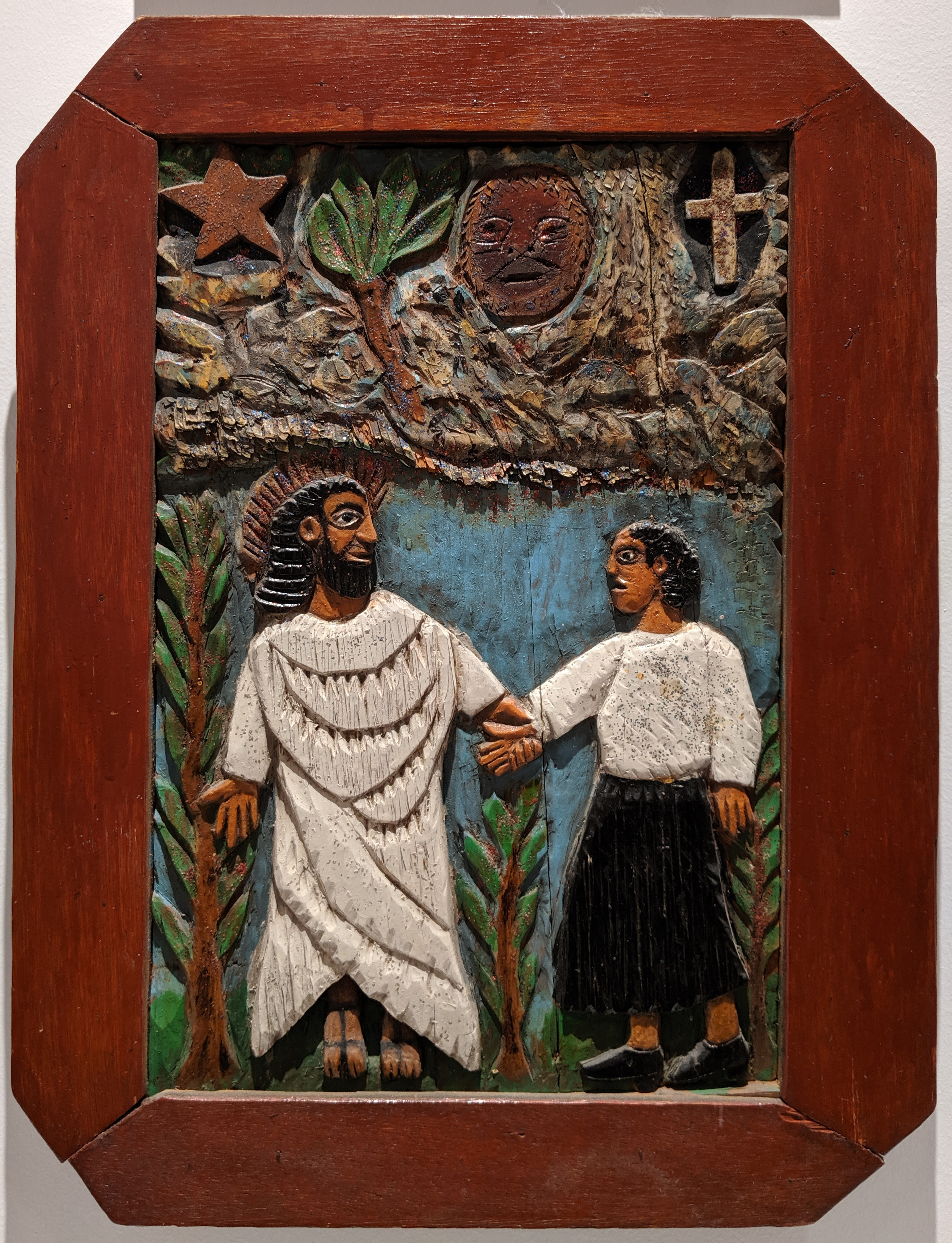
Elijah Pierce (American, 1892–1984), Christ and Lady, 1968. Wood, paint, and glitter, 21 1/2 × 16 1/2 × 1 1/4 in. High Museum of Art, Atlanta. Photo: Victoria Emily Jones.
A woman, a Samaritan, came to draw water. Jesus said, “Would you give me a drink of water?” (His disciples had gone to the village to buy food for lunch.)
The Samaritan woman, taken aback, asked, “How come you, a Jew, are asking me, a Samaritan woman, for a drink?” (Jews in those days wouldn’t be caught dead talking to Samaritans.)
Jesus answered, “If you knew the generosity of God and who I am, you would be asking me for a drink, and I would give you fresh, living water.”
The woman said, “Sir, you don’t even have a bucket to draw with, and this well is deep. So how are you going to get this ‘living water’? Are you a better man than our ancestor Jacob, who dug this well and drank from it, he and his sons and livestock, and passed it down to us?”
Jesus said, “Everyone who drinks this water will get thirsty again and again. Anyone who drinks the water I give will never thirst—not ever. The water I give will be an artesian spring within, gushing fountains of endless life.”
SONG: “Jesus Gave Me Water” by Lucie E. Campbell, 1946 | Performed by Sam Cooke and the Soul Stirrers, 1951
“One of the most regarded composers of African American religious song, Lucie E. Campbell [1885–1963] was a pioneering figure linking traditional hymnody to modern gospel composition and bridging gender and racial divides in the world of gospel music. Alongside such musical peers as Thomas A. Dorsey, Roberta Martin, and fellow Memphian Reverend W. Herbert Brewster, she helped forge the black gospel sound of the first half of the twentieth century and further belongs to a small coterie of composers who have set lasting standards for religious music in the black Baptist church.” (https://memphismusichalloffame.com/inductee/luciecampbell/)
Campbell’s song “Jesus Gave Me Water” was first recorded by Artis Kitchen in 1947. For a partial list of subsequent covers, see secondhandsongs.com. I like Sam Cooke’s version best, from 1951, when he was singing lead for the Soul Stirrers—no one can beat his honey-smooth vocals. You might know him, as I first did, as the singer of hits like “You Send Me,” “Chain Gang,” “Another Saturday Night,” “Twisting the Night Away,” “Cupid,” and “A Change Is Gonna Come.” (I have fond memories of listening to Oldies 100.7 FM in car rides with my dad growing up!) But like many famous soul singers, Cooke, a PK (preacher’s kid), got his start singing at church, at age six. His leadership of the popular black gospel group the Soul Stirrers from 1951 to 1956 propelled his career, and he crossed over into pop with great success.
A self-taught artist born in Baldwyn, Mississippi, Elijah Pierce began wood carving as a young child, using the pocketknife his father gave him. He knew he didn’t want to farm for a living like the rest of his family, so he left home as a teenager and eventually settled in Columbus, Ohio, where he ran a barbershop and led a church congregation. He described his wood carvings as sermons he used to teach people about the Bible. After encountering how Pierce used art to supplement his teaching, Leroy Almon (another celebrated folk artist, unknown at the time) apprenticed himself to Pierce.
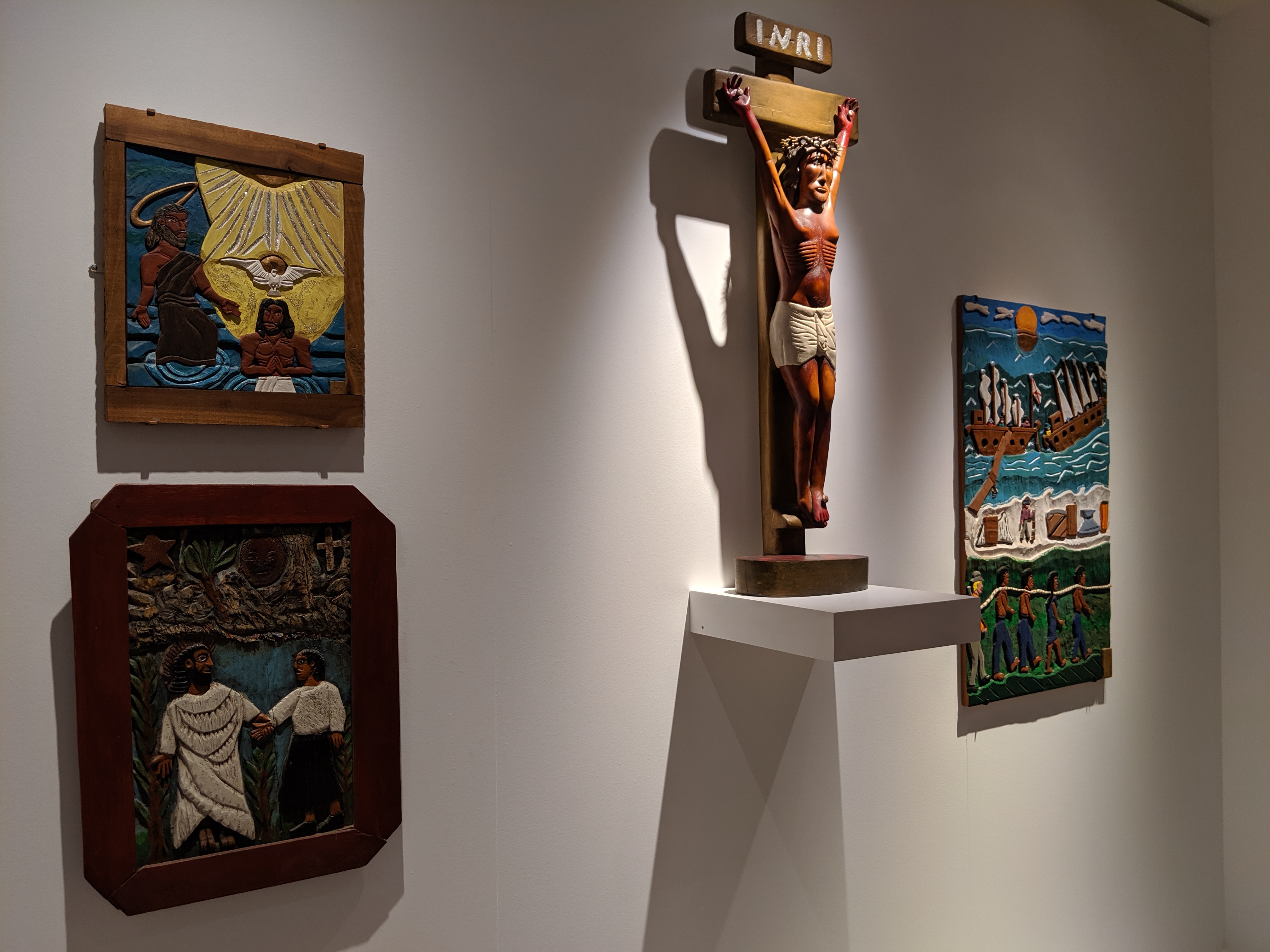
The High Museum of Art in Atlanta has a wonderful collection of folk art, including works by Pierce and his student Almon. Pictured below, from my visit last year, are: Leroy Almon, The Baptism of Jesus, 1983; Elijah Pierce, Christ and Lady, 1968; Ulysses Davis, Jesus on the Cross, 1946; and Leroy Almon, Slavery Time, 1990.
Though no well is visible in Christ and Lady and the title is generic, I see it as a depiction of the Samaritan woman from Sunday’s lectionary reading, and the description on the museum’s label also interprets it that way.
This post belongs to the weekly series Artful Devotion. If you can’t view the music player in your email or RSS reader, try opening the post in your browser.
To view all the Revised Common Lectionary scripture readings for the Third Sunday of Lent, cycle A, click here.
MaMuse is an acoustic folk duo from Chico, California, made up of Karisha Longaker and Sarah Nutting. Known for their soulful harmonies and light, bright lyrics, these women have said that they want their music to bring spiritual uplift and to connect people to the richness of life. Both Longaker and Nutting have backgrounds in music therapy and therefore view music as a healing art form. They also consider it an opportunity to bless others. Because of the intimacy it affords, they especially love performing house concerts.
Although they are not confessional Christians (they have a very all-embracing spirituality), they do cite gospel influences, which is evident in songs like “Hallelujah” and “On the Altar.” The former is the first track on their 2009 debut album All the Way and is one of the most beautiful songs I’ve heard in a while. Watch the music video below.
The song invokes a whole cluster of water imagery from the Bible. Jesus, for example, declared his Spirit to be the living water that quenches one’s deepest thirst (John 4:1–45, 7:37–39). Those who believe in him will receive within them “a spring of water welling up to eternal life”; “from [their] innermost being will flow rivers of living water.” The third verse of the song alludes to this gift:
There is a river In this heart of hearts With a knowingness Of my highest good
The Spirit not only nourishes and refreshes us but also prompts us to do what is right and good, coursing through our veins like a river of holy desire and spurting forth like a fountain for all to see. Continue reading “The soul-nourishing music of MaMuse”→








 Art & Theology