This Sunday’s lectionary reading from the Epistles is 1 Corinthians 13:1–13, the famous “love” passage. Here are ten songs that set that text or are based on it. And there are many more besides!
1. “1 Corinthians 13:1–8,” chanted in Romanian by Maria Coman, 2023:
For a cover by the Good Shepherd Collective, featuring Jayne Sugg and Son of Cloud (Jonathan Seale) (his is one of my favorite male singing voices), see here. They add as an outro the refrain of Martin Smith’s “I Could Sing of Your Love Forever.”
The neo-soul/R&B album The Miseducation of Lauryn Hill (1998), Hill’s solo debut, is one of the most widely acclaimed albums of the nineties. At an evening of jazz and spoken word hosted at the White House on May 19, 2009, by then president Barack Obama, upright bass player, singer, and composer Esperanza Spalding performed her gorgeous arrangement of Hill’s “Tell Him.” The object pronoun “him” used throughout has been interpreted by listening publics as either a romantic partner or God, and the ambiguity is probably intentional. As for me, I hear the song as religious, especially given the line “the love that was shown when our lives were spared,” which I take to be a reference to Christ’s saving sacrifice. [HT]
4. “1 Corinthians 13:8–11” (excerpt) from Uganda, 2021:
This video was uploaded by Bwire Isaac, the founder of Alpha Worship Connection, a registered nonprofit that trains and equips worship leaders in Uganda. It was filmed at one of his Discipleship Training Weeks, and features a pastor named Muwanguzi playing the adungu (bow harp). I believe the language is Luganda. [HT]
5. “Love (1 Corinthians 13)” by Joni Mitchell, from Wild Things Run Fast, 1982:
The song also appears, re-recorded and in new arrangement, on Mitchell’s Travelogue (2002). Hear her speak about how the apostle Paul’s words inspired her in this two-minute video.
9. “The Gift of Love” by Hal Hopson, 1972, performed by Koiné on Gesanbuch, 2008:
The music of this one is adapted from a traditional English folk tune.
10. “Kanoo” (Love) by Elfi Bohl, aka Mariyama Suso, from Suukuu Kutoo/ A New Song, 1999:
Bohl’s “Kanoo” is an original setting of 1 Corinthians 13:4–7 in the Mandinka language of West Africa, which she sings to a kora self-accompaniment. She wrote and recorded it while living in The Gambia. To learn more about Bohl and her kora songs, see my previous blog post from December.
Emily Dickinson (1830–1886) of Amherst, Massachusetts, is one of America’s most celebrated poets. There are hundreds of musical settings, from various genres, of her poems. Here are ten I really like.
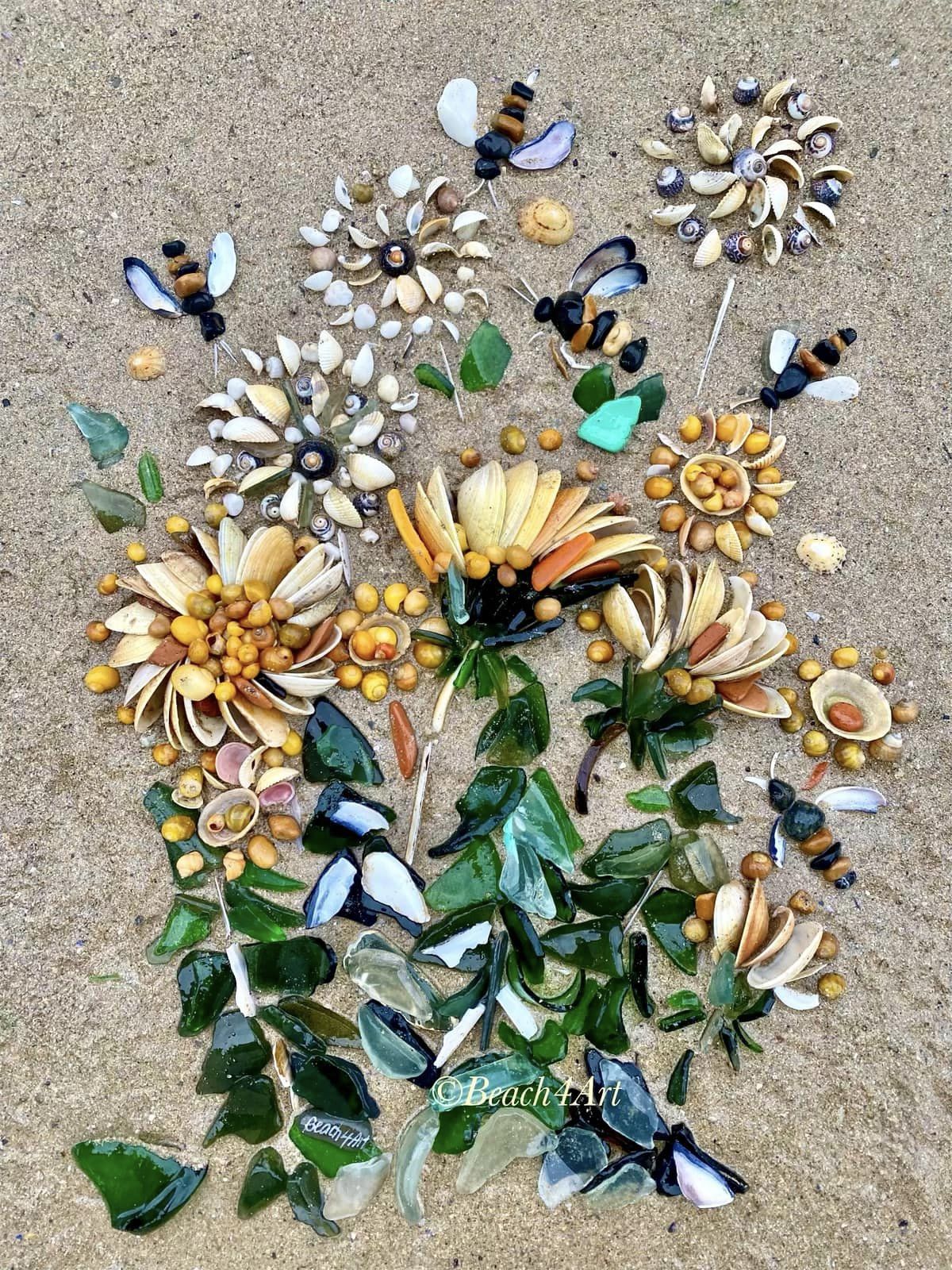
Created by Beach4Art, a family of four who assemble rocks and shells into images on the beaches of Devon, England
1. “I’m Nobody” by Emma Wallace: This is the first poem I ever read by Dickinson—in sixth grade. I was hooked, and I relished the assignment to memorize it and recite it to the class. The idea of being famous was apparently distasteful to Dickinson, and though she was a prolific writer of almost 1,800 poems, only ten were published during her lifetime, and those anonymously; some she sent in letters to friends, but most she kept private. She wrote this one in 1861, and it has contributed to her mystique. Singer-songwriter Emma Wallace turned it into a lovely, understated, minor-key waltz for The Thing with Feathers (2021), one of her several literary-themed albums.
I’m Nobody! Who are you? Are you – Nobody – too? Then there’s a pair of us! Don’t tell! they’d advertise* – you know!
How dreary – to be – Somebody! How public – like a Frog – To tell your name – the livelong June – To an admiring Bog!
* Dickinson often provided alternative words in the margins of her pages, which some editors have favored; “advertise” she marked as a possible substitute for “banish us.”
2.“I Shall Not Live in Vain” by Bard and Ceilidh (Mary Vanhoozer): Mary Vanhoozer’s debut album, Songs of Day and Night(2015), comprises original settings of classic poems by the likes of Emily Dickinson, Christina Rossetti, Henry Wadsworth Longfellow, and others. “Music has a unique ability to transform ordinary things into special things—the mundane into the extraordinary,” she writes. “This song cycle is all about exploring that further. Each song roughly represents an hour of the day. The CD begins at dawn and ends at dusk. As we travel through the day, we learn to perceive familiar objects and situations in a new light, infusing joy and a sense of mystery into the everyday experience.” For this track she is joined by her husband, Josh Rodriguez, on guitar. The text is a sort of purpose statement, committing to a life of love, kindness, and compassionate outreach.
If I can stop one Heart from breaking I shall not live in vain If I can ease one Life the Aching Or cool one Pain
Or help one fainting Robin Unto his Nest again I shall not live in vain.
3. “His Feet Are Shod with Gauze” by Emily Lau: The natural world, especially bees, was one of Dickinson’s favorite topics to write about. I think of her as a poet of summer. (Other great bee poems: “Bee! I’m expecting you!” and “Bees are Black, with Gilt Surcingles –.”) “His Feet are shod with Gauze –,” a panegyric, praises bees’ delicacy, might, and beauty. This musical setting is part of the suite Seven Dickinson Songs by composer and vocalist Emily Lau, which appears on her album Isle of Majesty (2019). Be sure to check out the other songs, including “I Can Wade Grief” and “I Never Saw a Moor,” in which Lau is joined by her chamber music ensemble, The Broken Consort.
His Feet are shod with Gauze – His Helmet, is of Gold, His Breast, a single Onyx With Chrysophras, inlaid –
His Labor is a Chant – His Idleness – a Tune – Oh, for a Bee’s experience Of Clovers, and of Noon!
4. “Some keep the Sabbath going to Church” by Michael McGuane: Dickinson was raised as a Congregationalist but never officially joined the church and by 1868 had stopped attending altogether. Her poems vary in tone toward Christianity, with some expressing devout sentiments and others irreverence. One thing that’s clear is that she often encountered God in nature. In this poem the fruit trees create a sanctuary for her and the birds serve as choir—an elevating, worshipful experience. Christians throughout history have spoken of how the “book of nature” complements the book of scripture, both revealing God’s truth. Here Dickinson acknowledges the same, emphasizing the goodness of creation, our enjoyment of which is sacred. On YouTube, the Americana musician Michael McGuane performs a guitar-picked, folk-rock tune he wrote for the poem.
Some keep the Sabbath going to Church – I keep it, staying at Home – With a Bobolink for a Chorister – And an Orchard, for a Dome –
Some keep the Sabbath in Surplice – I, just wear my Wings – And instead of tolling the Bell, for Church, Our little Sexton – sings.
God preaches, a noted Clergyman – And the sermon is never long, So instead of getting to Heaven, at last – I’m going, all along.
5. “Split the Lark” by Drum & Lace (Sofia degli Alessandri-Hultquist) and Ian Hultquist, feat. Ella Hunt: This pop music setting of “Split the Lark” was written by husband-and-wife composing duo Drum & Lace and Ian Hultquist for the Apple TV+ comedy-drama Dickinson (which I have mixed feelings about). It’s featured in season 2, episode 6, where it’s sung by Ella Hunt, the actress who plays Emily’s sister-in-law (and in the show, secret lover), Susan Huntington Gilbert Dickinson. Emily is attending an opera performance in Boston and imagines—in place of the soprano—Sue, singing her own words to her.
Split the Lark – and you’ll find the Music – Bulb after bulb, in Silver rolled – Scantily dealt to the Summer Morning Saved for your Ear, when Lutes be old –
Loose the Flood – you shall find it patent – Gush after Gush, reserved for you – Scarlet Experiment! Sceptic Thomas! Now, do you doubt that your Bird was true?
Containing echoes of William Wordsworth’s “We murder to dissect,” this poem derides empiricism as the sole method of arriving at truth. The addressee wants to better comprehend the lark’s song, to observe the internal apparatus that enables it to make such beautiful music. Go ahead, the speaker exasperatedly tells him: take up your scalpel and dissect the bird. You’ll unleash a flood of blood and guts (“bulb after bulb” could refer to globular anatomical structures—e.g., the aortic bulb, the jugular bulb—or organs, or to musical notes). But would such prying really bring you closer to knowing the lark? Your experiment will have only caused the song to stop. The poem references the apostle Thomas, who demanded physical proof of Christ’s resurrection (personally, I think he’s unfairly maligned for this; his probing does, in fact, lead him to a deeper level of knowledge).
Dickinson was very much a supporter of science, but she also recognized its limitations when it comes to explaining certain mysteries or trying to produce physical evidence of the invisible. On one level, this poem may describe Dickinson’s stance on poetry, which, once you start to pick it apart, can sometimes lose its magic. I’m all for poetic analysis, but there’s something to be said for simply letting the sounds and musicality of poetic verse wash over you without going at it with a scalpel.
6. “I Had No Time to Hate” by Gerda Blok-Wilson: Look what Dickinson can do with the cliché “Life is too short to be angry”! She had a dark wit, which you get a glimmer of here. The poem is structured in two stanzas, the first about hate, so we might expect the second to wax rhapsodic about the virtues of love. But instead we get a matter-of-fact admission that life is also too short to complete the work of love. However, because we must choose either hate or love, she chooses love—it’s for us to fill in why it’s the superior choice. I like the interplay of littleness and largeness, suggesting that even in small caring acts, there’s a substantiality and a sufficiency, no matter how imperfect our love may be. The following recording, from June 2021, is of the premiere performance of Gerda Blok-Wilson’s choral setting of “I had no time to Hate –” by the Vancouver Chamber Choir, directed by Kari Turunen.
I had no time to Hate – Because The Grave would hinder me – And Life was not so Ample I Could finish – Enmity –
Nor had I time to Love – But since Some Industry must be – The little Toil of Love – I thought Be large enough for Me –
7. “I felt a Funeral, in my Brain” by Andrew Bird, feat. Phoebe Bridgers: This is another Dickinson poem that made a strong impression on me when I read it in school—what a fabulous first line. Though some have interpreted the poem as Dickinson imagining her own funeral, I see the funeral as a metaphor—for, possibly, the loss of a cherished friendship, long-held belief, or hope or dream, any of which would take a heavy psychological toll, or for the temporary loss of sanity, a mental breakdown, due to some stressor. The mood is oppressive, and the speaker grows increasingly unraveled. The singer-songwriter, violinist, and whistler Andrew Bird set the poem to “a simple two-note melody,” he said, and, in collaboration with the Emily Dickinson Museum in Amherst, made a music video featuring Dickinson’s handwriting and footage of her lifelong home.
I felt a Funeral, in my Brain, And Mourners to and fro Kept treading – treading – till it seemed That Sense was breaking through –
And when they all were seated, A Service, like a Drum – Kept beating – beating – till I thought My mind was going numb –
And then I heard them lift a Box And creak across my Soul With those same Boots of Lead, again, Then Space – began to toll,
As all the Heavens were a Bell, And Being, but an Ear, And I, and Silence, some strange Race Wrecked, solitary, here –
And then a Plank in Reason, broke, And I dropped down, and down – And hit a World, at every plunge, And Finished knowing – then –
8. “Because I Could Not Stop for Death” by Susan McKeown: From the 2002 album Prophecy by Susan McKeown, a Grammy-winning musical artist from Ireland, this song takes as its lyrics one of Dickinson’s most famous poems, one that promotes a gentle, welcoming attitude toward death. It personifies Death as a kindly gentleman driving a carriage, transporting the speaker at a casual pace past the final traces of her mortal life and into eternity. (Note: Emma Wallace, from the first entry, also wrote a compelling setting!)
Because I could not stop for Death – He kindly stopped for me – The Carriage held but just Ourselves – And Immortality.
We slowly drove – He knew no haste And I had put away My labor and my leisure too, For His Civility –
We passed the School, where Children strove At Recess – in the Ring – We passed the Fields of Gazing Grain – We passed the Setting Sun –
Or rather – He passed Us – The Dews drew quivering and Chill – For only Gossamer, my Gown – My Tippet – only Tulle –
We paused before a House that seemed A Swelling of the Ground – The Roof was scarcely visible – The Cornice – in the Ground –
Since then – ’tis Centuries – and yet Feels shorter than the Day I first surmised the Horses’ Heads Were toward Eternity –
9. “Hope’s the Thing with Feathers” by Julie Lee: Another classic poem, this one about the warmth and persistence of hope. Julie Lee gives it an uplifting banjo tune.
“Hope” is the thing with feathers – That perches in the soul – And sings the tune without the words – And never stops – at all –
And sweetest – in the Gale – is heard – And sore must be the storm – That could abash the little Bird That kept so many warm –
I’ve heard it in the chillest land – And on the strangest Sea – Yet – never – in Extremity, It asked a crumb – of me.
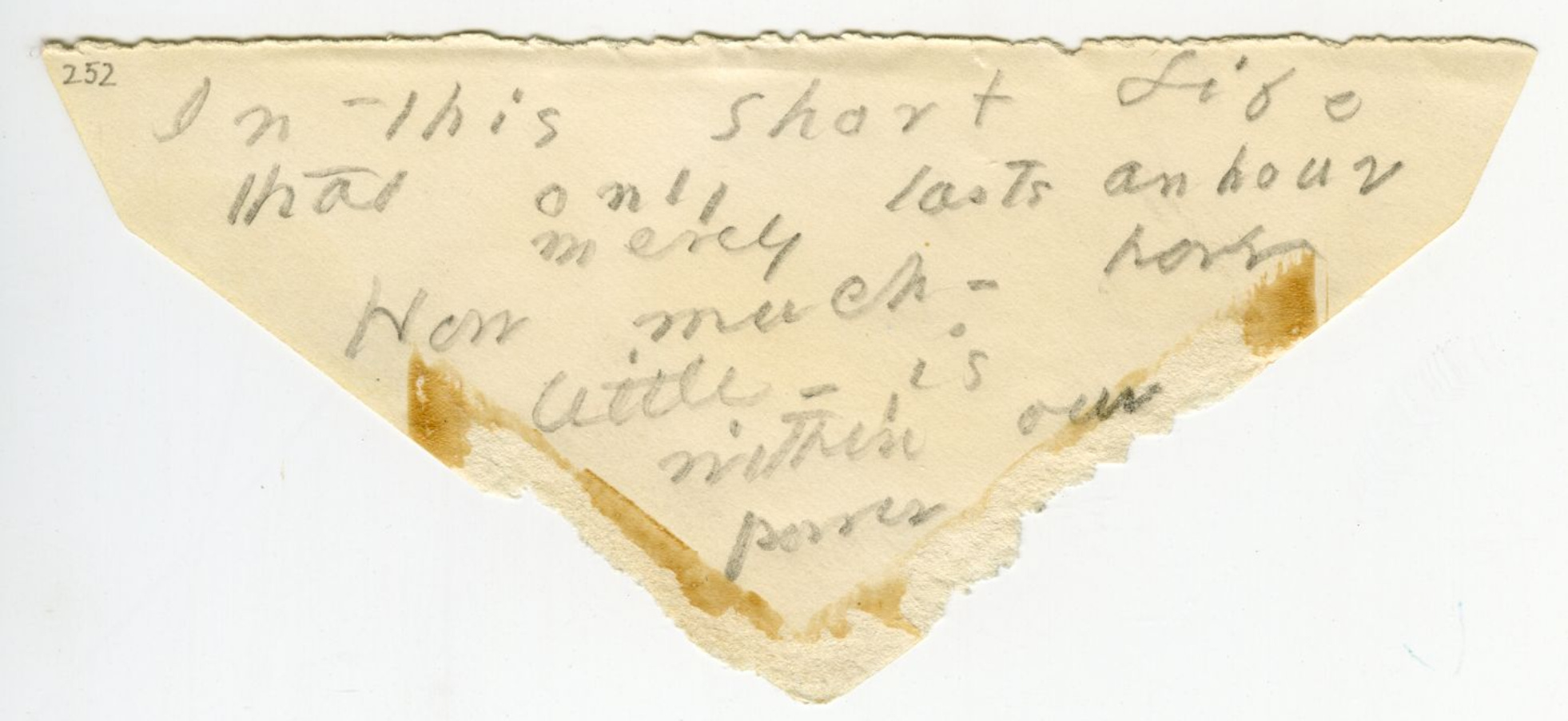
10. “In this short Life” by Scott Joiner: Dickinson wrote this compact poem of just two lines on an upcycled envelope flap, as she was wont to do, around 1873 and saved it. It expresses the paradox that we humans possess free will, a potent trait, and yet so many things are beyond our control. Composer Scott Joiner wrote a piece for voice and piano for this text, performed by Jessica Fishenfeld and Milena Gligić on the album Emily that released just this month (it features settings by Joiner of five poems by Dickinson and five by her near contemporary from across the pond, Emily Brontë). The tone is contemplative and resigned.
In this short Life that only lasts an hour How much – how little – is within our power
Envelope poem by Emily Dickinson, ca. 1873, from the Emily Dickinson Collection, Amherst College (Amherst Manuscript #252, Box 3, Folder 88)
SPOTIFY PLAYLIST: June 2024 (Art & Theology): Here are thirty selections of good, true, and beautiful music for your listening this month, spanning genres but leaning heavily into folk and gospel. The first song is written by my friend and Daily Prayer Project colleague Joel Littlepage!
+++
TV SERIES: Fargo, season 5: The latest season of the dark comedy anthology series Fargo, written by Noah Hawley and streaming on Hulu, has been my favorite so far, in part because of its subversive (i.e., redemptive) ending. (I also recommend seasons 1 and 2!) Set in the American Midwest, the series is inspired by the 1996 Coen brothers’ film of the same name but has all-new characters and plots, and each season is self-contained (though those who watch all the seasons will find Easter eggs). Viewer beware: the show contains graphic violence, and season 5 centers on domestic violence.
Debt is a major theme in Fargo’s season 5. In the first episode, two men invade main character Dorothy “Dot” Lyon’s (Juno Temple) home, having been sent by someone in her past who is collecting a debt, revealing her to be a hardcore survivalist. (We gradually learn more of her backstory, especially through a fantastic puppet sequence in episode 7.) Dot is married to the kindest man, Wayne (David Rysdahl), whose billionaire mother, Lorraine (Jennifer Jason Leigh), is the CEO of a debt collection agency. Both women eventually come to heads with Roy Tillman (Jon Hamm), an extreme alt-right Christian nationalist running for the office of police chief. One of his lackies is Ole Munch (pronounced “oo-lah moonk”) (Sam Spruell), a mysterious man from Wales via Scandinavia who we learn is a “sin-eater” wandering the earth without hunger, rest, or hope, taking on himself the sins of the powerful and privileged.
Injuries are inflicted back and forth in a seemingly unending cycle of violence and retaliation. How can the cycle be broken? When should a debt be forgiven? In its final twenty minutes, which at first feels like a coda but actually moves the story someplace new, Hawley explores the power of love and empathy, of baking and breaking bread together. The last shot (which is not the one pictured here; I don’t want to spoil it) is perfect.
Juno Temple as Dot in the finale of Fargo’s season 5, “Bisquik”
>> “Amazing Grace,” performed by Tori Kelly and Jon Batiste:Tori Kelly and Jon Batiste are both multiple-Grammy-winning artists who are unabashed Christians working in secular spaces. Here they perform a classic Christian hymn together on late-night television—unrehearsed!—with Kelly on vocals and Batiste on piano. The video was recorded live at Steinway Hall in New York City in August 2019 for The Late Show with Stephen Colbert. Kelly’s voice is gorgeous, and Batiste—my oh my, his talent blows me away. Listening to Kelly sing, he improvises a piano arrangement that follows and responds to her lead, weaving into and around those tones, providing ornamentation and support.
+++
ARTICLE: “12 Easy Ways to Improve Your Listening” by Blake Glosson: “True listening isn’t just hearing words but selflessly seeking understanding,” writes MDiv student Blake Glosson in this recent Gospel Coalition article. It’s not a fixed trait that you either have or you don’t, but rather a habit that can be formed with practice. He offers twelve tips for improving your listening so that those you converse with are heard and loved. These may seem obvious, but I found it helpful to have them listed all in one place, as I never really thought about listening in a systematic way. The “Ask engaging questions” and “Ask clarifying questions” is something I always appreciate when others do it for me and that I need to improve myself.
If I speak in tongues of justice or spirituality,
but do not have ashes,
I am a self-congratulating vigil,
a Sunday service inspired by itself.

If I have social media outreach,
a labyrinth in the church garden,
Bible study in the brewpub,
and if I have a capital campaign
to remove pews, put in church chairs,
and even add a coffee shop,
but do not have ashes, I am nothing.

If I give to church-wide offerings,
and go on mission trips so that I may boast,
but do not have ashes, I gain nothing.

Ashes are awkward; ashes are dirty;
ashes, like love,
are not envious, boastful, arrogant, or rude.
Ashes do not insist on a perfect Lent;
they do not even need to be in church
or be a gimmick getting folks to church;
they do not inventory wrongdoing,
especially the wrongdoing of others,
but rejoice in the precious now,
the very fragility of life.

Ashes bear love, believe in love,
hope in the possibility
of forgiveness for everyone,
endure even times of lovelessness.
Forgiveness never ends.

As for spiritual practices,
they will come to an end;
as for precious old hymns
and passionate praise songs,
they will grow quiet;
as for theology and faith formation,
believe me, it will shift and change again.

For churches are always reaching
for a part of things,
while those who flee church
reach for another part,
but when the full forgiveness comes,
it will look more like Valentine’s Day.

When I was a child, I said, “I love you,”
I cut out pink and red hearts,
I sent them to everyone, even the bullies,
but when I became an adult,
I decided to make it more complicated.

Now in our churches and lives
we have become too fond of mirrors,
but someday we will see each other
face to smudged face.
Now I love only in part;
then I will love fully,
even as I have been fully loved.

Today ashes, dust,
and a child’s pink paper art abide, these three;
but the greatest of these is the heart.
Fernando Peña Defilló (Dominican, 1928–2016), La ofrenda (The Offering), 1993. Oil and acrylic on canvas, 126 × 166 cm. Private collection. Source: Latin American Art in the Twentieth Century, ed. Edward J. Sullivan (Phaidon, 1996), p. 110.
May those whose hell it is To hate and hurt Be turned into lovers Bringing flowers.
—Shantideva, eighth century
These lines are from chapter 10, stanza 9, of the Bodhicharyavatara (Way of the Bodhisattva), a Mahayana Buddhist text by the eighth-century Indian monk Shantideva. I first encountered this religious classic, originally written in Sanskrit, while working at Shambhala Publications. The excerpt above was adapted by author David Richo from a translation by the Padmakara Translation Group. Here’s 10.9 in full, as translated by PTG:
May the hail of lava, fiery stones, and weapons Henceforth become a rain of blossom. May those whose hell it is to fight and wound Be turned to lovers offering their flowers. [source]
Other translations include those by Stephen Batchelor—
May the rains of lava, blazing stones, and weapons From now on become a rain of flowers, And may all battling with weapons From now on be a playful exchange of flowers. [source]
—and Fedor Stracke:
May the rain of leafs, embers, and weapons Become forthwith a rain of flowers. May those cutting each other with knives Forthwith throw flowers for fun. [source]
I am so struck by this short benediction that prays our hate be transformed into love, our hardness into softness, our cold, sterile weaponry into delicately petaled, fragrant blooms. Shantideva recognized that when we lash out in physical or verbal violence, we create a hell that’s all our own. We may intend to inflict suffering on another, but in doing so, we often wound ourselves—psychologically, spiritually. When we dehumanize others, we become less human.
Instead of hurling rocks, punches, bullets, or insults, what if we were to completely confound our enemies by offering them words or tokens of love? Love is the way of the bodhisattva, the “enlightened being.” It’s the way of Jesus—he who said, “Love your enemies; do good to those who hate you; bless those who curse you; pray for those who mistreat you” (Luke 6:27–28).
Loving people doesn’t mean we can’t be angry at them—but we cannot allow our anger to fester into bitterness and ill will or to explode in harmful outbursts. It should be a productive anger.
How might we use an ethic of love to direct our anger or somebody else’s toward a good end, to defuse a contentious situation? Not taking the easy way out by simply ignoring or retreating from a problem, but confronting our opponent in peaceful, creative, and potentially transformative ways?
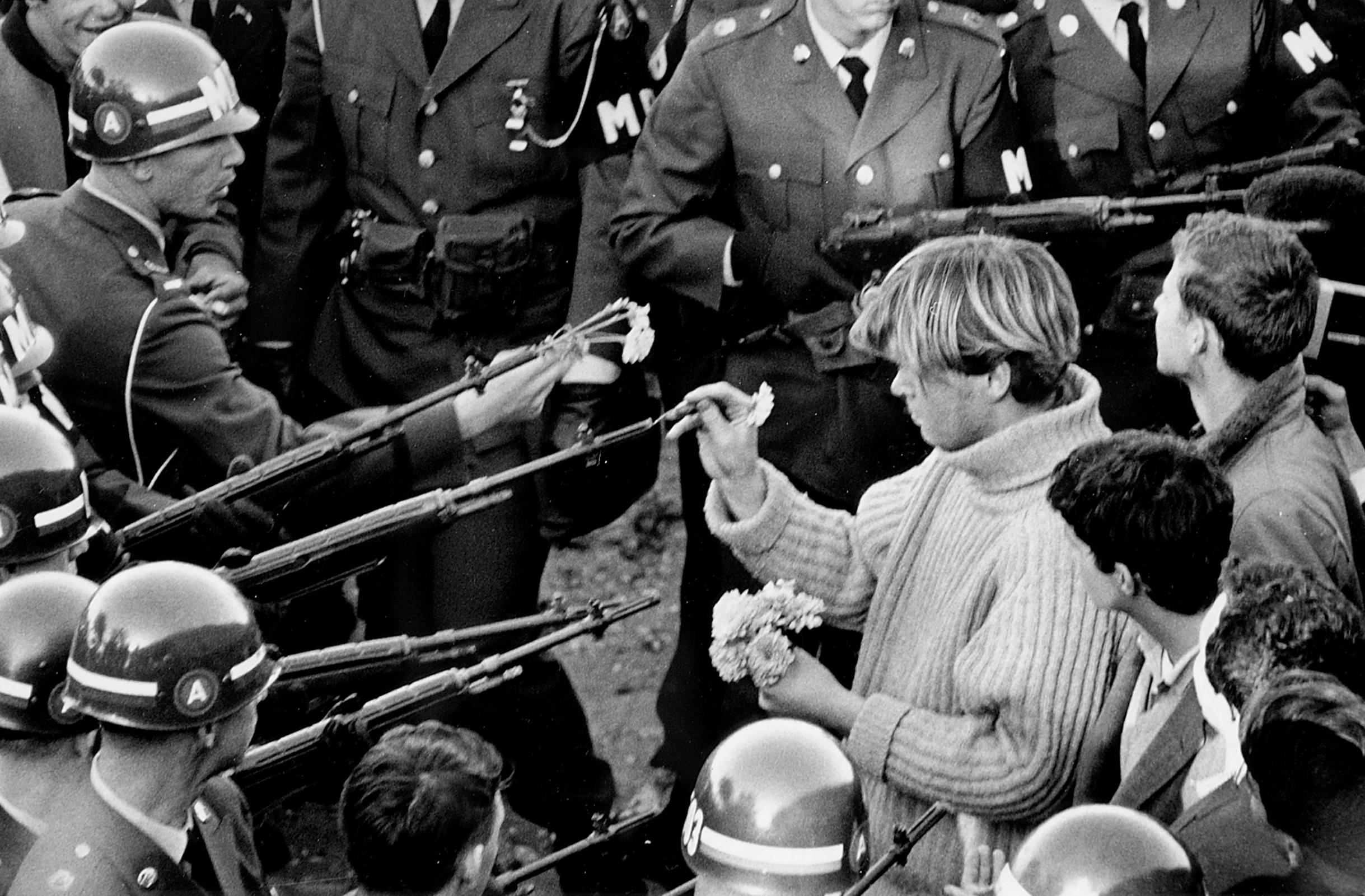
I’m reminded of the historic Pulitzer Prize–nominated photograph Flower Power, taken by Washington Star photojournalist Bernie Boston on October 21, 1967, when he was covering an antiwar march on the Pentagon. As the 503rd Military Police Battalion formed a semicircle around demonstrators to prevent them from climbing the Pentagon steps, Boston captured eighteen-year-old George Edgerly Harris III, aka Hibiscus, placing a carnation into the barrel of an M14 rifle held by one of the soldiers. What a powerful image!
Bernie Boston (American, 1933–2008), Flower Power, Arlington, Virginia, 1967
Two years earlier in his essay “How to Make a March/Spectacle,” Allen Ginsberg was the first to expound on the potency of flowers as a spectacle to simultaneously disarm opponents and influence thought. He said “masses of flowers” should be handed out on the front lines of protests to police, the press, and onlookers as a symbol of nonviolent advocacy. He also suggested candy bars and toys.
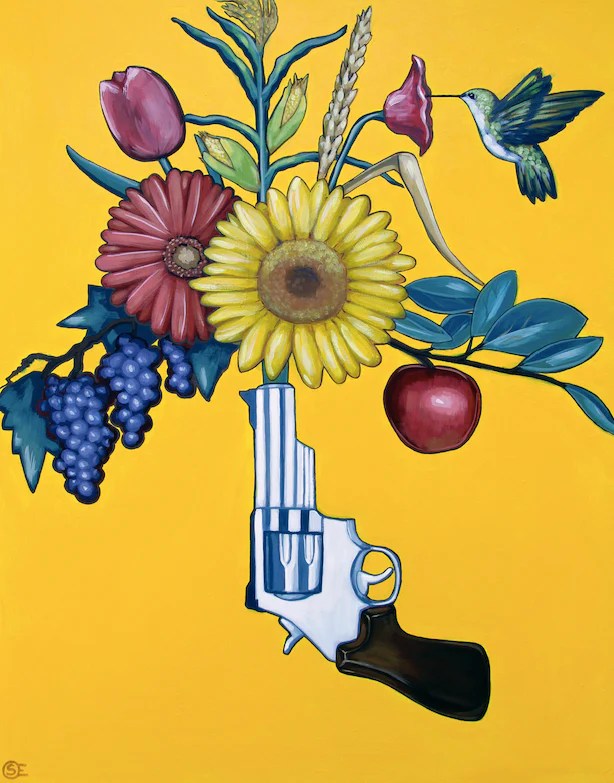
Artist Scott Erickson seems to have drawn on Boston’s Flower Power photograph in his visual interpretation of Isaiah 2:4, Swords into Plowshares, which shows a sprig of foliage growing out of the barrel of a pistol, oriented upward like a vase. Its deadly power mocked and reversed, the gun releases a benign projectile that attracts and nourishes rather than strikes fear.
The evocative Bible verse on which this painting is based prophesies a day when all the nations “shall beat their swords into plowshares, and their spears into pruning hooks”—a poetic way of describing the cessation of violence, as tools of destruction are transformed into gardening tools.
Christian activist Shane Claiborne has been instrumental in helping me see the immense beauty of Isaiah’s visions of the eschaton—he has worked with RAWtools to decommission firearms and literally forge them into shovels, spades, and other life-giving implements!—along with the holy foolishness of the gospel and all that implies. Before becoming a leader of the new monasticism movement, Claiborne went to circus school, and he has often put that training to use on the streets of Philadelphia where he lives. In his first book, The Irresistible Revolution: Living as an Ordinary Radical (2006), he writes,
Whenever there is a fight on our block, my first instinct is to run inside and grab our torches and begin juggling them, to upstage the drama of violent conflicts in our neighborhood. Perhaps the kids will lose interest in the noise of a good fight and move toward the other end of the block to watch the circus. I truly believe we can overwhelm the darkness of this world by shining something brighter and more beautiful. (285)
He has also written about Jesus’s “triumphal” entry into Jerusalem as a theatrical parody of power: he rode in on a dinky donkey instead of a warhorse, showing a much different alternative to the military might of empires. (“Imagine the president riding a unicycle in the Fourth of July parade”! Jesus for President, p. 122) And then on the cross, Jesus made a spectacle of human violence. In exchange for taunts and blows, he gave forgiveness, a metaphorical bouquet.
The UK-based street artist Banksy draws on the association of flowers with love and peace and their playful ability to disrupt violence in his mural Rage, Flower Thrower, which debuted on the West Bank wall in Israel-Palestine. Nathan Mladin, a researcher for Theos think tank, wrote about this artwork for the Visual Commentary on Scripture’s Logics of Reversals exhibition:
With a balaclava drawn over his face, the young protester is shown leaning back, as though braced to hurl a Molotov cocktail. But instead of a weapon, he wields a flower bouquet, the only coloured element in this otherwise monochrome work. We expect an act of aggression—all other elements of the mural suggest imminent violence—but instead we are offered a call to peace. . . . Theologically construed, the mural hints at the eschatological terminus of violence.
The absurd juxtaposition of flowers and violence is employed too by Lithuanian artist Severija Inčirauskaitė-Kriaunevičienė, who embroiders floral patterns onto antique soldiers’ helmets sourced from various countries, and Natalie Baxter of Lexington, Kentucky, whose Warm Gun series comprises over one hundred quilted stuffed guns, “droopy caricatures of assault weapons,” she says, “bringing ‘macho’ objects into a traditionally feminine sphere and questioning their potency.”
Severija Inčirauskaitė-Kriaunevičienė (Lituanian, 1977–), from the series Kill(ed) for Peace, 2016. Antique soldier’s helmet, cotton, cross-stitch embroidery, drilling, and industrial needle punching, 30 × 22 × 21 cm. Private collection, Latvia.Natalie Baxter (American, 1985–), Rose to the Occasion, from the Warm Gun series, 2016. Fabric and polyfill, 15 × 42 × 3 in.
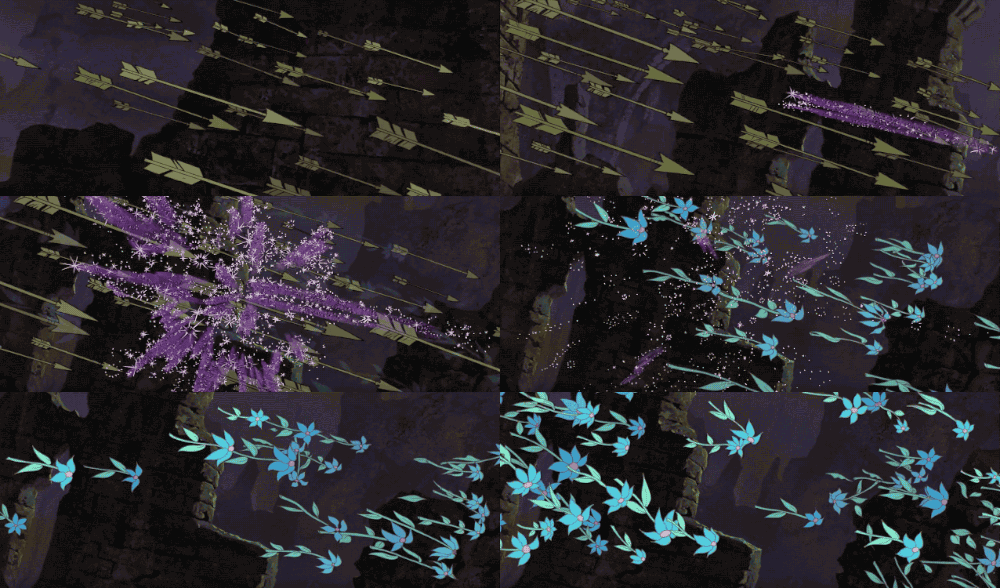
Another artistic example of overcoming brutality with gentleness can be found in the climactic battle sequence from Disney’s animated classic Sleeping Beauty (1959). As Prince Phillip escapes from Maleficent’s dungeon with the aid of the three good fairies, Maleficent’s goons shoot arrows at him—but Flora transforms them by magic into flowers, which fall innocuously about his booted feet. (The animation is by Dan McManus.)
Flora’s other enchantments include turning launched boulders into soap bubbles and a curtain of boiling water, tipped from a cauldron over a doorway, into a rainbow. Each of these deflective maneuvers involves the transformation of something threatening into something whimsical. While they do not ultimately deter the villain from her murderous rampage, and alas, Phillip conquers evil with a sword (albeit the Sword of Truth—there’s metaphor at play here), Flora’s few creative interventions at the outset of the battle assert an attractive counterethic that we would do well to embrace.
I need the dreams of Isaiah and the prayers of Shantideva, I need the ridiculous street theater of Hibiscus and Shane Claiborne and the activist blacksmithing of RAWtools, I need Banksy’s murals in zones of conflict and other subversive art, I need fairy tales from writers and animation studios, to help me relinquish my hate and imagine wholesome new ways of engaging my enemies. Most of all, I need Christ’s vibrant, upending gospel embedded more deeply in my heart, and the Holy Spirit—renewer, transformer—to melt the disdain and loathing I feel for certain figures in the current US political landscape and reshape it into loving regard.
While I do not have an urge to enact physical violence on anyone, I often seethe and think unkindly thoughts toward those I deem morally odious. Sometimes I pray they get what’s coming to them. But then I am convicted by that un-Christlike posture. I crave the eyes and mind of Christ, who sees everyone as redeemable and worthy of love, bearers of the divine image, and who moves toward them with open arms instead of clenched fists.
“May those whose hell it is to hate and hurt be turned into lovers bringing flowers.”
I pray this, sincerely, for others (I have a few particular names in mind), and also for myself.
          1 Cor 13

Embraces the woman whose child screams
on the floor of the cereal aisle.
Enters the friend’s new mansion,
lifts eyes to the skylights, gives thanks.
Yields the last word on the Facebook fight.
Looks the frowning barista in the eye.
Takes a breath and thanks God
there is even a zipper to get stuck.
Sends a gift to the wall-punching uncle.
Glances away from the handcuffed boys
on the side of the road and prays.
Smiles and listens to the grandmother complain
about her knees, rubs the knees,
ladles another bowl of soup.
Believes there is a reason that slumped man
in the alley was born. Trusts he’ll believe it.
Endures the quiet, thankless song of work.
Echoes long after the cymbals have died.
This poem is from Second Sky by Tania Runyan(Cascade/Wipf & Stock, 2013), a collection that “intertwines the life and writings of the Apostle Paul with the spiritual journey of a modern suburban woman confronting the broken world.”Used with permission.
Detail from a 14th-century Sienese panel painting, showing two enemies being reconciled by an archangel, embracing each other after having cast aside their weapons. Collection of the Museum of Fine Arts, Boston.
“You have heard that it was said to those of ancient times, ‘You shall not murder’; and ‘whoever murders shall be liable to judgment.’ But I say to you that if you are angry with a brother or sister, you will be liable to judgment; and if you insult a brother or sister, you will be liable to the council; and if you say, ‘You fool,’ you will be liable to the hell of fire. So when you are offering your gift at the altar, if you remember that your brother or sister has something against you, leave your gift there before the altar and go; first be reconciled to your brother or sister, and then come and offer your gift.”
I could listen to Seth Avett [previously] sing all day—and sometimes I do. (Lately I’ve been gorging on his cover of the Tom Waits song “Fish and Bird”!) His light, plaintive, silvery voice moves my soul in a way that producer Rick Rubin embodies in the 2018 HBO documentary May It Last: A Portrait of the Avett Brothers, as in the clip below. (He’s the long-bearded guy swaying around with his eyes closed.) “No Hard Feelings” is the crux of the film, and it made me cry when I first watched it. It’s an aspiration to live without bitterness, without malice, without enemies—an aspiration arrived at by contemplating one’s eventual death.
When my body won’t hold me anymore
And it finally lets me free
Will I be ready?
When my feet won’t walk another mile
And my lips give their last kiss goodbye
Will my hands be steady?
When I lay down my fears
My hopes and my doubts
The rings on my fingers
And the keys to my house
With no hard feelings
When the sun hangs low in the west
And the light in my chest
Won’t be kept held at bay any longer
When the jealousy fades away
And it’s ash and dust for cash and lust
And it’s just hallelujah
And love in thoughts and love in the words
Love in the songs they sing in the church
And no hard feelings
Lord knows they haven’t done
Much good for anyone
Kept me afraid and cold
With so much to have and hold
When my body won’t hold me anymore
And it finally lets me free
Where will I go?
Will the trade winds take me south
Through Georgia grain or tropical rain
Or snow from the heavens?
Will I join with the ocean blue
Or run into the Savior true
And shake hands laughing
And walk through the night
Straight to the light
Holding the love I’ve known in my life
And no hard feelings
Lord knows they haven’t done
Much good for anyone
Kept me afraid and cold
With so much to have and hold
Under the curving sky
I’m finally learning why
It matters for me and you
To say it and mean it too
For life and its loveliness
And all of its ugliness
Good as it’s been to me
I have no enemies
I have no enemies
I have no enemies
I have no enemies
Directed by Judd Apatow and Michael Bonfiglio and filmed over the course of two years, May It Last charts the rise of the North Carolina folk rock band the Avett Brothers (Scott Avett [previously], Seth Avett, Bob Crawford, Joe Kwon) and follows them in the present during the creation of their multi-Grammy-nominated album True Sadness. The nucleus of the film is the brotherhood of Scott and Seth—their growing up in the South, their creative collaborations, and their constant love, respect, and support for one another. Marriage, divorce, parenthood, and illness are also highlighted, as these inform the songs on True Sadness, of which Seth says, “There are moments of undeniable celebration and camaraderie, others of quiet and lonely exhalation.” (This could really describe the Avett Brothers’ whole catalog.)
The documentary is wonderful; you should see it. It’s streaming for free on HBO or can be rented from YouTube, Amazon Prime, or Vudu.
When God gave us this commandment, do you think the idea was that we would form a community in which we constantly antagonize each other, hate each other, abuse each other, wound each other—and then, at the last moment, refrain from murdering each other? Of course not. The spirit of “You shall not murder” is that your bearing toward your neighbors—both in your actions and in your dispositions, your hand and your heart—should never be enmity. Think of it this way: when you’re angry at your brother or sister, when you lash out with hateful words, isn’t that, too, in its own way a kind of violence, a lesser form of “murder”? Isn’t that, too, in its own way a violation of the commandment, an act of ruin against the healthy community the commandment is meant to help you create?
This post belongs to the weekly series Artful Devotion. If you can’t view the music player in your email or RSS reader, try opening the post in your browser.
To view all the Revised Common Lectionary scripture readings for the Sixth Sunday after Epiphany, cycle A, click here.
Andrey Yanev (Bulgarian, 1965–), Fraternal Forgiveness, n.d. Oil on canvas, 130 × 100 cm.
Put on then, as God’s chosen ones, holy and beloved, compassionate hearts, kindness, humility, meekness, and patience, bearing with one another and, if one has a complaint against another, forgiving each other; as the Lord has forgiven you, so you also must forgive. And above all these put on love, which binds everything together in perfect harmony.
—Colossians 3:12–14
+++
MUSIC: “The Way of Love” by Béla Fleck | Performed by Béla Fleck, V. M. Bhatt, and Jie-Bing Chen, on Tabula Rasā (2011)
Tabula Rasā is a Grammy-nominated collaborative album by three virtuoso instrumentalists: American banjoist Béla Fleck, mohan veena (Indian slide guitar) player Vishwa Mohan Bhatt, and erhu (two-string Chinese fiddle) player Jie-Bing Chen.
This post belongs to the weekly series Artful Devotion. If you can’t view the music player in your email or RSS reader, try opening the post in your browser.
To view all the Revised Common Lectionary scripture readings for the First Sunday after Christmas Day, cycle C, click here.








 Art & Theology