
“Love is patient…”: Ten songs based on 1 Corinthians 13

This Sunday’s lectionary reading from the Epistles is 1 Corinthians 13:1–13, the famous “love” passage. Here are ten songs that set that text or are based on it. And there are many more besides!

1. “1 Corinthians 13:1–8,” chanted in Romanian by Maria Coman, 2023:

2. “Love Will Never Fail” by Leslie Jordan, Orlando Palmer, Isaac Wardell, and Paul Zach of The Porter’s Gate, from Neighbor Songs, 2019:

For a cover by the Good Shepherd Collective, featuring Jayne Sugg and Son of Cloud (Jonathan Seale) (his is one of my favorite male singing voices), see here. They add as an outro the refrain of Martin Smith’s “I Could Sing of Your Love Forever.”

3. “Tell Him” by Lauryn Hill, 1998, performed by Esperanza Spalding, 2009:

The neo-soul/R&B album The Miseducation of Lauryn Hill (1998), Hill’s solo debut, is one of the most widely acclaimed albums of the nineties. At an evening of jazz and spoken word hosted at the White House on May 19, 2009, by then president Barack Obama, upright bass player, singer, and composer Esperanza Spalding performed her gorgeous arrangement of Hill’s “Tell Him.” The object pronoun “him” used throughout has been interpreted by listening publics as either a romantic partner or God, and the ambiguity is probably intentional. As for me, I hear the song as religious, especially given the line “the love that was shown when our lives were spared,” which I take to be a reference to Christ’s saving sacrifice. [HT]

4. “1 Corinthians 13:8–11” (excerpt) from Uganda, 2021:

This video was uploaded by Bwire Isaac, the founder of Alpha Worship Connection, a registered nonprofit that trains and equips worship leaders in Uganda. It was filmed at one of his Discipleship Training Weeks, and features a pastor named Muwanguzi playing the adungu (bow harp). I believe the language is Luganda. [HT]

5. “Love (1 Corinthians 13)” by Joni Mitchell, from Wild Things Run Fast, 1982:

The song also appears, re-recorded and in new arrangement, on Mitchell’s Travelogue (2002). Hear her speak about how the apostle Paul’s words inspired her in this two-minute video.

(Related post: “The Greatest of These,” a poem by Tania Runyan)

6. “Faith, Hope and Love” by Joanna Forbes L’Estrange, performed by London Voices, dir. Ben Parry, from Heaven to Earth, 2024:

7. “El Amor (1 Corintios 13)” by Michelle Matius, 2023:

Matius is a Christian singer-songwriter and recording artist from the Dominican Republic. Like all her songs, this one is in Spanish.

8. “Live for Love” by Eric Lige, 2022:

9. “The Gift of Love” by Hal Hopson, 1972, performed by Koiné on Gesanbuch, 2008:

The music of this one is adapted from a traditional English folk tune.

10. “Kanoo” (Love) by Elfi Bohl, aka Mariyama Suso, from Suukuu Kutoo / A New Song, 1999:

Bohl’s “Kanoo” is an original setting of 1 Corinthians 13:4–7 in the Mandinka language of West Africa, which she sings to a kora self-accompaniment. She wrote and recorded it while living in The Gambia. To learn more about Bohl and her kora songs, see my previous blog post from December.
“Improv on 1 Corinthians 13 for Ash Wednesday on Valentine’s Day” by Rev. Maren Tirabassi

If I speak in tongues of justice or spirituality,
but do not have ashes,
I am a self-congratulating vigil,
a Sunday service inspired by itself.

If I have social media outreach,
a labyrinth in the church garden,
Bible study in the brewpub,
and if I have a capital campaign
to remove pews, put in church chairs,
and even add a coffee shop,
but do not have ashes, I am nothing.

If I give to church-wide offerings,
and go on mission trips so that I may boast,
but do not have ashes, I gain nothing.

Ashes are awkward; ashes are dirty;
ashes, like love,
are not envious, boastful, arrogant, or rude.
Ashes do not insist on a perfect Lent;
they do not even need to be in church
or be a gimmick getting folks to church;
they do not inventory wrongdoing,
especially the wrongdoing of others,
but rejoice in the precious now,
the very fragility of life.

Ashes bear love, believe in love,
hope in the possibility
of forgiveness for everyone,
endure even times of lovelessness.
Forgiveness never ends.

As for spiritual practices,
they will come to an end;
as for precious old hymns
and passionate praise songs,
they will grow quiet;
as for theology and faith formation,
believe me, it will shift and change again.

For churches are always reaching
for a part of things,
while those who flee church
reach for another part,
but when the full forgiveness comes,
it will look more like Valentine’s Day.

When I was a child, I said, “I love you,”
I cut out pink and red hearts,
I sent them to everyone, even the bullies,
but when I became an adult,
I decided to make it more complicated.

Now in our churches and lives
we have become too fond of mirrors,
but someday we will see each other
face to smudged face.
Now I love only in part;
then I will love fully,
even as I have been fully loved.

Today ashes, dust,
and a child’s pink paper art abide, these three;
but the greatest of these is the heart.

Source: https://www.facebook.com/maren.tirabassi/posts/7212956592101295 [HT]

“The Greatest of These” by Tania Runyan

          1 Cor 13

Embraces the woman whose child screams
on the floor of the cereal aisle.
Enters the friend’s new mansion,
lifts eyes to the skylights, gives thanks.
Yields the last word on the Facebook fight.
Looks the frowning barista in the eye.
Takes a breath and thanks God
there is even a zipper to get stuck.
Sends a gift to the wall-punching uncle.
Glances away from the handcuffed boys
on the side of the road and prays.
Smiles and listens to the grandmother complain
about her knees, rubs the knees,
ladles another bowl of soup.
Believes there is a reason that slumped man
in the alley was born. Trusts he’ll believe it.
Endures the quiet, thankless song of work.
Echoes long after the cymbals have died.

This poem is from Second Sky by Tania Runyan (Cascade/Wipf & Stock, 2013), a collection that “intertwines the life and writings of the Apostle Paul with the spiritual journey of a modern suburban woman confronting the broken world.” Used with permission.

Bankrupt (Artful Devotion)

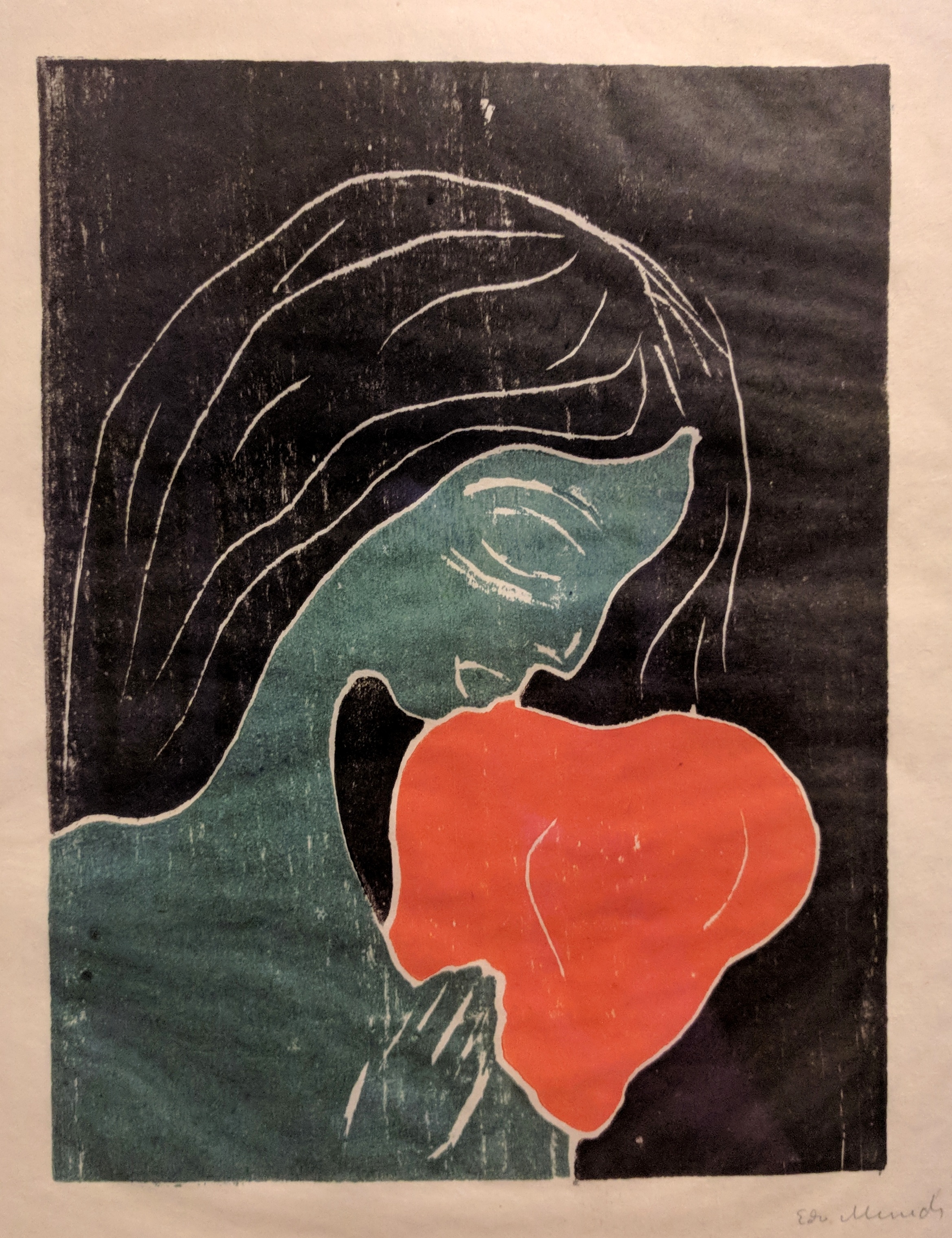
Girl with the Heart by Edvard Munch
Edvard Munch (Norwegian, 1863–1944), Girl with the Heart, 1899. Color woodcut, 40.4 × 33.9 cm (15 7/8 × 13 3/8 in.). National Gallery of Art, Washington, DC. Photo: Victoria Emily Jones.

If I speak in the tongues of men and of angels, but have not love, I am a noisy gong or a clanging cymbal. And if I have prophetic powers, and understand all mysteries and all knowledge, and if I have all faith, so as to remove mountains, but have not love, I am nothing. If I give away all I have, and if I deliver up my body to be burned, but have not love, I gain nothing.

—1 Corinthians 13:1–3

That’s the ESV. Here’s Eugene Peterson’s translation, from The Message:

If I speak with human eloquence and angelic ecstasy but don’t love, I’m nothing but the creaking of a rusty gate. If I speak God’s Word with power, revealing all his mysteries and making everything plain as day, and if I have faith that says to a mountain, “Jump,” and it jumps, but I don’t love, I’m nothing. If I give everything I own to the poor and even go to the stake to be burned as a martyr, but I don’t love, I’ve gotten nowhere. So, no matter what I say, what I believe, and what I do, I’m bankrupt without love.

+++

SONG: “The Gift of Love (Though I May Speak)” | Words: Hal H. Hopson, 1972 | Music: Traditional English folk melody (adapt.) | Performed by Becky Craig (vocals) and John Michniewicz (piano) | CCLI #67327

Though I may speak with bravest fire
And have the gift to all inspire
And have not love, my words are vain
As sounding brass and hopeless gain

Though I may give all I possess
And, striving so, my love profess
But not be giv’n by love within
The profit soon turns strangely thin

Come, Spirit, come, our hearts control
Our spirits long to be made whole
Let inward love guide every deed
By this we worship and are freed


This post belongs to the weekly series Artful Devotion. If you can’t view the music player in your email or RSS reader, try opening the post in your browser.

To view all the Revised Common Lectionary scripture readings for the Fourth Sunday after Epiphany, cycle C, click here.