Christmas, Day 10: Balulalow

LOOK: The Birth of Christ by Ulyana Tomkevych

Tomkevych, Ulyana_The Birth of Christ
Ulyana Tomkevych (Ukrainian, 1981–), The Birth of Christ, 2016. Egg tempera on gessoed wood, 11 1/2 × 12 in. Sacred Art Pilgrim Collection of John A. Kohan. Photo: Victoria Emily Jones, at East Meets West: Women Icon Makers of Western Ukraine, St. Christopher’s Episcopal Church, Chatham, Massachusetts, 2017.

Frosty yet warm, this icon by Ulyana Tomkevych of Ukraine is one of my favorite Nativity paintings. It shows Mary embracing her swaddled newborn, Jesus, amid a bleak midwinter. She reclines across a red blanket of flowers inspired by Ukrainian embroidery patterns, which hovers mystically above a line of barren trees, suggesting that Christ’s birth has ushered in a new springtime.

The wisps of white against the cool green-grays at the bottom suggest snowdrifts, whereas the faint rose tints at the top imply a suffusing warmth. The silver semicircle at the top, with its emanating beams, represents the mystery and presence of God breaking into the world.

Following Greek Orthodox tradition, Christ’s halo is inscribed with the Greek letters ώ Ό Ν (omega, omicron, nu), spelling “He who is” (see Exod. 3:14). Tomkevych is a member of the Ukrainian Greek Catholic Church, which is in communion with the Holy See but follows the Byzantine Rite.

LISTEN: “Balulalow” | Original German words by Martin Luther, 1535 (title: “Vom Himmel hoch da komm ich her”) | Translated into Scots by James, John, and Robert Wedderburn, 1567 | Music by Peter Warlock, from his Three Carols suite, 1923 | Performed by Sting on If on a Winter’s Night, 2009 [see full credits]

O my deare hert, young Jesu sweit,
Prepare thy creddil in my spreit
And I sall rock thee in my hert,
And never mair from thee depert.

But I sall praise thee evermore
With sangis sweit unto thy gloir.
The knees of my hert sall I bow,
And sing that richt Balulalow.

Literal English translation:

O my dear heart, young Jesus sweet,
Prepare thy cradle in my spirit
And I shall rock thee in my heart,
And nevermore from thee depart.

But I shall praise thee evermore
With songs sweet unto thy glory.
The knees of my heart shall I bow,
And sing that true Balulalow.

English translation, from the German, by Catherine Winkworth:

Ah! dearest Jesus, holy Child,
Make thee a bed, soft, undefiled
Within my heart, that it may be
A quiet chamber kept for Thee.

My heart for very joy doth leap;
My lips no more can silence keep.
I too must sing with joyful tongue
That sweetest ancient cradle song.

These two stanzas in Middle Scots are an extract from the longer “Ane Sang of the Birth of Christ,” also known by its first line, “I come from heuin to tell,” from the Ane Compendious Buik of Godly and Spirituall Sangis (1567). In this part of the hymn, the speaker asks Jesus to be at home in their heart and receive their sweet songs. Mary is the model for this reception, love, and adoration of the Christ child—she who cradled him, praised him, sang to him, and held him close.

The word balulalow is derived from the Scottish word for “lullaby.”

For all fifteen stanzas in Scots, see here, and for Catherine Winkworth’s full English translation, here. The hymn actually originated in German from the pen of Martin Luther, who titled it “Vom Himmel hoch da komm ich her” (From Heaven Above to Earth I Come). It spread to the Netherlands and the British Isles in the 1560s.

In his recording, the cross-genre English musician Sting uses neither the German folk tune that Luther paired with the text upon its first publication, nor the melody Luther composed for it in 1539. Instead Sting uses the 1923 setting written by the English composer Peter Warlock for his Three Carols suite.

In Sting’s rendition, which he arranged in collaboration with Robert Sadin, the female backing vocals evoke a wintry wind and a snare drum creates a forward momentum, while a cello supports Sting’s languid singing. The tone is tender and haunting.


This post is part of a daily Christmas series that goes through January 6. View all the posts here, and the accompanying Spotify playlist here.

Roundup: Nativity art from Asia, the Christ Hymn in Thai, and more

ARTICLES:

>> “How Asian Artists Picture Jesus’ Birth from 1240 to Today” by Victoria Emily Jones, December 18, 2023, Christianity Today: My first CT article was published this week! I was asked to curate and introduce a sampling of Nativity art from across Asia. By representing Jesus as Japanese, Indonesian, or what have you, these artists convey a sense of God’s immanence, his “with-us–ness,” for their own communities—and for everyone else, the universality of Christ’s birth.

Turun, I Wayan_In Bethlehem
I Wayan Turun (Indonesian, 1935–1986), In Bethlehem, 1958. Acrylic on canvas, 46 × 64 cm. Collection of Stichting Zendingserfgoed (Missionary Heritage Foundation), Zuidland, Netherlands.

>> “The Story of Christ in Chinese Art: Scholars at Peking University Make a Christmas Portfolio for LIFE,” Life, December 22, 1941, pp. 40–49: In doing research for my Christianity Today article, I found this old article from Life magazine that features eight Chinese watercolors on silk from the collection of Dr. William Bacon Pettus (1880–1959), an American educator and president of the California College of Chinese Studies in Peking (Beijing) in the 1920s and ’30s, which were being exhibited at New York’s American Bible Society at the time. With the ordination of six Chinese bishops by Pope Pius XI in 1926, the Chinese Catholic Church was transitioning from a mission church to an indigenous local church, and Chinese-style religious art—much of it coming out of the art department of the new Catholic University of Peking (Beiping Furen Daxue)—was part of that localization. Productivity seems to have continued at Furen during the Japanese occupation, as this article attests. Many of the students and faculty were recent converts to Christianity, though the article reports that non-Christians also enrolled and taught in the art program.

Lu Hongnian_Nativity
Lu Hongnian (Lu Hung-nien) ( 陸鴻年) (Chinese, 1914–1989), The Birth of Jesus, ca. 1941. Chinese watercolor on silk.

Here is one of the paintings by Lu Hongnian, who sometime after this article was published, in part through his having engaged the New Testament as inspiration for his paintings, became a Christian and took the name John. It shows the Holy Family in a mountainside cave, Mary gazing adoringly at her newborn son as Joseph brings more straw to cushion him. Beside them, an angel holds up a lantern for light, while two shepherd children approach from the entrance, eager to meet their Savior.

+++

SONGS:

>> “Philippians 2:511” by HARK Music: This song takes a traditional Thai melody, arranged by Tirasip Kraitirangul, and puts it to a Thai translation of the famous Christ Hymn from Philippians 2. It’s performed by the HARK Duriya Tasana Singers (feat. Somchairak Sriket and Damrongsak Monprasit) and Dancers, filmed on location at Chaloem Kanchanaphisek Park in Bangkok. The song is from HARK’s Thai Hymns Album (2014), which can be downloaded for free at https://harkpublications.com/?product=thai-hymns-album-2. The two-stringed bowed instrument you see at 3:21 is a saw u.

The Duriya Tasana (“Curators of the Arts”) ensemble was formed in 2012 under the commission of the Thai-Psalms Project, an endeavor to create Thai traditional and classical music settings for the psalms of the Bible. Many of the members are affiliated with the Bunditpatanasilpa Institute of Fine Arts in Bangkok. Thanks to my friend Janet, whose sister is preparing a move to Thailand, for alerting me to this group!

>> “Jesus You Come” by Tenielle Neda, performed with Jon Guerra: This song by the Australian singer-songwriter Tenielle Neda [previously], which she sings with Jon Guerra, makes a nice complement to the Thai song above. The performance is from “Songs for Hope: A TGC Advent Concert” on December 6, 2020.

+++

MIDDLE ENGLISH LULLABY: “As I lay upon a night”: Medievalist Eleanor Parker introduces a charming Christmas lullaby from fourteenth-century England, a dialogue between Mary and the Christ child, and provides a modern English translation of its thirty-seven stanzas. In the Middle Ages, says Rosemary Woolf, the subject matter of lullabies was often a prophecy of the baby’s future—presumably a romantic promise of great and happy achievements. But here it is the child who relates the future to his mother, thus providing the material for his own lullaby.

+++

ART VIDEO: “Third Sunday of Advent: Ethiopian Art: Gospel Book” by James Romaine: Every December, my friend James Romaine, an art historian who teaches at Lander University, publishes four videos on his Seeing Art History YouTube channel related to the themes of the season, part of his annual Art for Advent series. This year he’s chosen to focus on Ethiopian art, covering illuminations from two different manuscripts, a diptych icon, and a rock-hewn church.

In this video Romaine discusses the formal qualities of two paintings from a sixteenth-century Ethiopian Gospel-book, the identity of the figures, and the liturgical context of the book, including the use of the red veil that’s attached at the top, which, Romaine says, “both protects and sanctifies the icon,” creating a sense of anticipation for the Orthodox believer who, in faith, lifts the veil to see what is revealed.

Christmas, Day 6: Black-Haired Boy

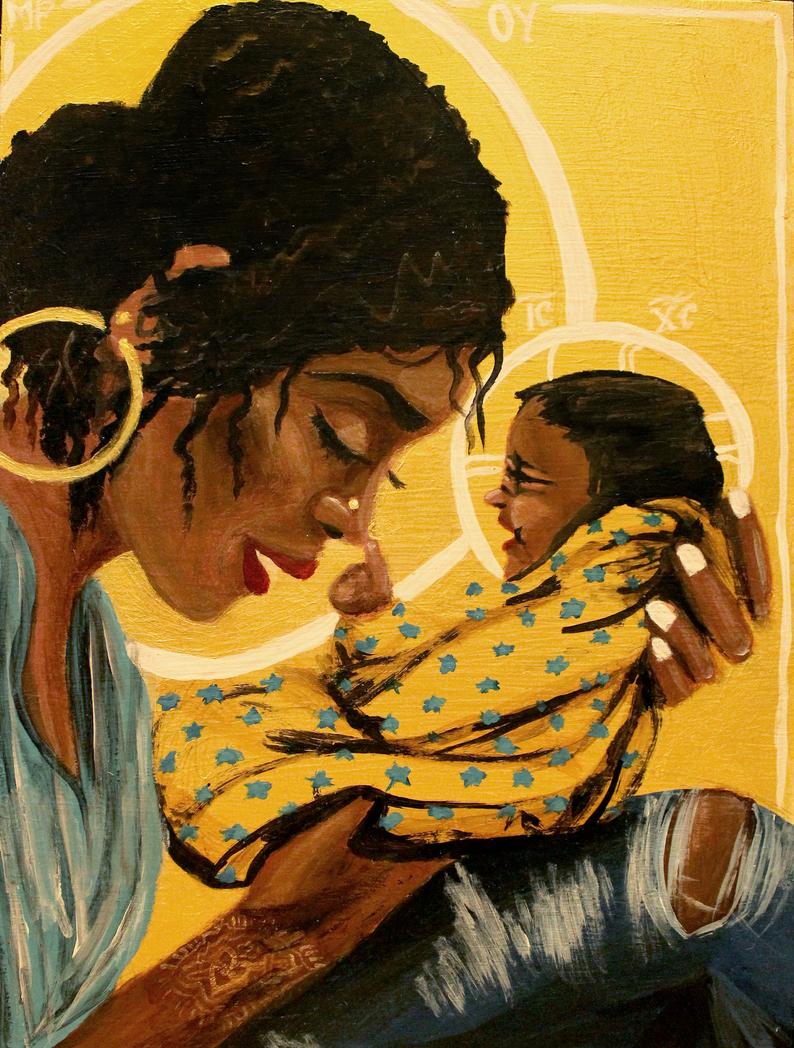
LOOK: Madonna and Child by Gracie Morbitzer

Morbitzer, Gracie_Madonna and Child
Gracie Morbitzer (American, 1997–), Madonna and Child, 2018. Acrylic on repurposed wood, 14 × 12 in. Private collection.

Gracie Morbitzer is a Catholic artist from Columbus, Ohio, who paints biblical and extrabiblical saints as modern, everyday people in a range of skin tones, forgoing the hieratic style of traditional icons in favor of a more relatable, this-worldly look that enables the individuals’ distinctive personalities to shine through. She uses discarded or thrifted pieces of wood as her substrate, welcoming cracks and imperfections as only further reiterating how the extraordinary shines through the ordinary.

In her Madonna and Child, Mary props up her newborn on her knees, basking in her new role as mother. She wears frayed jeans, a loose blouse, gold hoop earrings, and a nose stud. On her wrist is a henna tattoo of her Immaculate Heart—a burning, bloodied heart pierced with a sword and banded with roses, representing the intensity and purity of her love and the suffering that Simeon prophesies.

Jesus, wrapped in a starry blanket and donning a cruciform halo, playfully touches Mom’s nose, crinkling his face as he giggles with delight.

The yellow acrylic background recalls the gold leafing of icons, used to suggest the transfiguring light of God. Morbitzer also uses the traditional Greek abbreviations for the Mother of God (MP OY) and Jesus Christ (IC XC).

This image can be purchased as a 5 × 7-inch print at The Modern Saints Etsy shop.

LISTEN: “Mary’s Lullaby (Black Haired Boy)” | Words by Kate Bluett | Music by Paul Zach | Sung by Liz Vice on Advent Songs by The Porter’s Gate (2021)

Oh, black-haired boy, your eyes are dark
as midnight lit by shining stars
and bright as love that filled my heart
when first I looked at you.
Your skin is brown as pilgrim roads,
laid straight through fragrant olive woods,
as brown as mine, and I’m in awe
each time I look at you.

You made the ox and lamb, my love,
and shaped the wings of turtledoves.
You wrote the hidden secrets of
the world I’ll show to you.
Within my body you took form
and wailed aloud when you were born—
the moment that my heart was torn
with love I’ll show to you.

You wove these wonders through the earth;
you made them all and gave them worth,
and now you join them in your birth,
and I’ll give them to you.
I’ll show you skies filled up with stars
and teach you words for light and dark,
for all the wondrous things there are:
I’ll give them all to you.

I’ll hold you closely as I can
and watch you grow into a man.
As long as I can hold your hand,
I’ll walk the world with you.
And you’ll lead me to God’s own heart,
where all these wonders have their start.
But here within the stable dark,
I’ll be the world for you.

Since the Middle Ages, Christians have written lullabies in the voice of Mary, imagining her rocking her infant son to sleep, sharing with him her most tender feelings and wishes. This contemporary one by frequent songwriting collaborators Kate Bluett and Paul Zach—so poignantly sung by Liz Vice—is among my favorites.

In the first stanza Mary dotes poetically on Jesus’s features—his eyes dark and bright as star-studded midnight skies, his skin brown as the footpaths to Zion. In the remaining stanzas she marvels at how the Creator of the universe lies as a babe in her arms, and how she will get to experience its many wonders with him at her side, discover its secrets together. Jesus made the world in which she lives and moves and has her being, but now, while he is small, vulnerable, and dependent, she’ll be a whole world to him, as mothers are to their children.

Lent, Day 19

I am my beloved’s, and my beloved’s is mine . . .

—Song of Solomon 6:3a (cf. 2:16)

He brought me to the banqueting house, and his banner over me was love.

—Song of Solomon 2:4

I will extol thee, O LORD; for thou hast lifted me up . . .

—Psalm 30:1a

Blessed be the God and Father of our Lord Jesus Christ, who hath blessed us with all spiritual blessings in heavenly places in Christ . . .

—Ephesians 1:3

LOOK: Ethiopian Angels, Debre Birhan Selassie Church

Ethiopian church ceiling
Painted wood ceiling, early 19th century, Debre Birhan Selassie Church, Gondar, Ethiopia. Photo: A. Savin.

Debre Birhan Selassie (Trinity and Mountain of Light) Church in Gondar, the imperial capital of Ethiopia from 1636 to 1855, is famous for the colorful paintings that cover every inch of the interior walls and ceiling. The south wall concentrates on the Life of Christ, while the north wall depicts various saints. The focal point—on the east wall, in front of the holy of holies—is a Crucifixion scene and an icon of the Trinity. But the most celebrated visuals inside the church are the hundred-plus winged heads painted in rows between the wooden beams of the ceiling, representing the cherubim and God’s omnipresence.

The original church, which was round, was consecrated in 1693 by Emperor Iyasu I, but lightning destroyed it in 1707. The rectangular stone church that stands on the site now likely dates to the late eighteenth century, and it is the only one of the forty-four Orthodox Tewahedo churches in Gondar to survive the 1888 sack of the city by Mahdist soldiers from Sudan. (Locals say the marauders were miraculously rerouted by a swarm of bees.)

According to Ethiopia (Bradt Travel Guide) writer Philip Briggs, “The paintings are traditionally held to be the work of the 17th-century artist Haile Meskel, but it is more likely that several artists were involved and that the majority were painted during the rule of Egwala Seyon (1801–17), who is depicted prostrating himself before the Cross on one of the murals.”

Debre Birhan Selassie is still an active church, but priests also offer tours. Here’s some video footage of the inside (you’ll see it’s very dark, and flash photography is not allowed), and some drone footage of the exterior.

The church is part of a larger imperial compound, known as Fasil Ghebbi, that has been a UNESCO World Heritage Site since 1979 and that includes palaces, monasteries, and public and private buildings.

Angels (Debra Berhan Selassie Church)
Photo: Alan Davey

LISTEN: “His Banner Over Me Is Love” by B. C. Laurelton (pseudonym of Alfred B. Smith), 1965 | Performed by Christy Nockels on Be Held: Lullabies for the Beloved, 2017 | CCLI #28579

I am my Beloved’s and He is mine—
His banner over me is love.
I am my Beloved’s and He is mine—
His banner over me is love.
I am my Beloved’s and He is mine—
His banner over me is love,
His banner over me is love.

He brought me to His banqueting table—
His banner over me is love.
He brought me to His banqueting table—
His banner over me is love.
He brought me to His banqueting table—
His banner over me is love,
His banner over me is love.

He lifted me up to the heavenly places—
His banner over me is love.
He lifted me up to the heavenly places—
His banner over me is love.
He lifted me up to the heavenly places—
His banner over me is love,
His banner over me is love.

I sang a version of this song in children’s church regularly when I was little (with hand motions!) and have carried it with me all these years, a gentle assurance that I am divinely loved and protected. I’ve quoted the scriptures it’s drawn from above. Its refrain comes from Song of Solomon 2:4: “his banner over me was love.”

The Song of Solomon, aka the Canticle of Canticles, has traditionally been read, at least on one level, as an allegory of the love between God and the human soul—or, more specifically in the Christian tradition, Christ and his church.

From the root “to cover,” the Hebrew word for “banner” in this verse refers to a military standard. It is being used figuratively here to indicate that we enlist ourselves under Love’s banner, which goes forth in triumph and protects those under its billows. We belong to love, commit ourselves to love, overcome through love. The verse is perhaps an allusion to the names of generals being inscribed on the banners of their armies. God’s name is Love (1 John 4:8).

The image is at once vigorous and gentle. The NRSV translates the phrase as “his intention toward me was love.”

The song “His Banner Over Me Is Love” was written by Alfred B. Smith (1916–2001), an itinerant song leader, songwriter, and Christian music publisher. Smith compiled and published his first songbook, Singspiration One: Gospel Songs and Choruses, while he was a student at Wheaton College in 1941, to support the evangelistic meetings he was running with his roommate, Billy Graham (yes, that Billy Graham!). Two years later he founded Singspiration Publishing Company, which published several popular series of songbooks. In 1963 he sold Singspiration to Zondervan, but he ran other publishing ventures (i.e., Better Music Publications and Encore Publications) for the remainder of his ministerial career.

According to Music in the Air: The Golden Age of Gospel Radio by Mark Ward Sr., Smith composed “His Banner Over Me Is Love” in 1965 as an impromptu offertory while serving as a visiting song leader at First Baptist Church–Laurelton in Brick, New Jersey. Afterward he received requests from the congregation for the music. His original notation read “B. C. Laurelton” (for “Baptist Church Laurelton”) to designate where he wrote the song, and it was copied as such as people shared the music with others—so when the song was later published in 1972, Smith decided to adopt “B. C. Laurelton” as a pen name.

Singer-songwriter Christy Nockels [previously] sings “His Banner over Me” on an album of lullabies to a twinkling piano accompaniment.

May this truth—that God’s banner over you is love—soothe you and give you confidence.

Christmas, Day 10

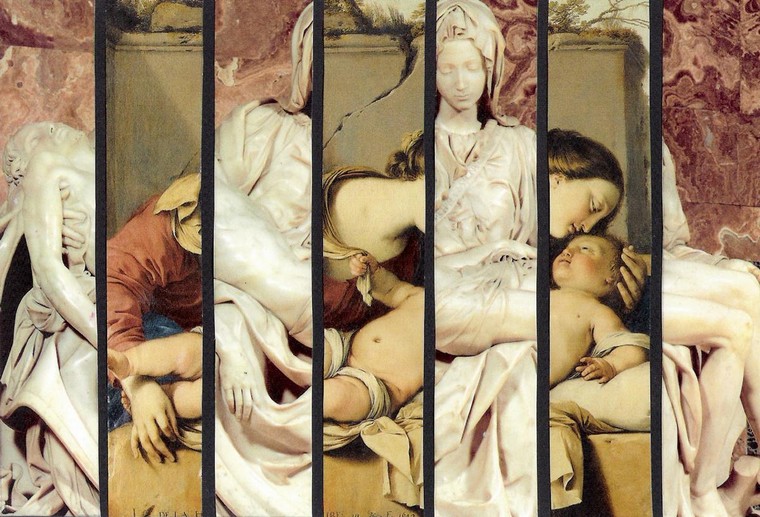
LOOK: The Passion of Mary by Katherine Kenny Bayly

Bayly, Katherine_The Passion of Mary
Katherine Kenny Bayly (American, 1945–), The Passion of Mary, before 2006. Collage on paper, 8 × 12 in.

This collage by Katherine Bayly is from the 2006 CIVA traveling exhibition Highly Favored: Contemporary Images of the Virgin Mary. In seven alternating vertical bands, it combines Michelangelo’s Pietà from St. Peter’s Basilica with a Virgin and Child painting by Laurent de La Hyre, showing Christ’s birth and death as two sides of the Incarnation coin. One can hear echoes of Simeon’s prophecy to Mary, that “a sword will pierce your own soul too” (Luke 2:35)—a veiled reference to the Crucifixion.

Since the Middle Ages artists have often embedded symbolic or other visual references to Christ’s passion in Nativity paintings—a goldfinch, a coral rosary, a bunch of grapes, a cave that recalls the tomb, swaddling bands that look like burial wrappings, a manger that looks like a sarcophagus or altar, or, more explicitly, angels holding the arma Christi (instruments of the passion). Sometimes artists would use a diptych format to juxtapose images of Mary holding Jesus as a vibrant young infant with her holding him as a pale adult corpse deposed from the cross, a pairing that strikes an emotional tenor, as there’s perhaps no deeper grief than a mother’s loss of a child. Bayly draws on this tradition in The Passion of Mary, foreshadowing a future sorrow and reminding us that Christ came to earth not only to live but also to die.

LISTEN: “Baby Boy” by Rhiannon Giddens, on Freedom Highway (2017)

Baby boy, baby boy, don’t you weep
You will be our savior
But until then, go to sleep

Young man, young man, I’ll watch over you
While you lead our people to the promised land
I will shelter you

Baby boy (Young man)
Don’t you weep (I will watch over you)
Baby boy (Young man)
Don’t you weep (I will watch over you)
You will be (You will be)
Our savior
But until then, go to sleep

Beloved, beloved, I will stand by you
When you leave this place to do what you must
I will always love you

Baby boy (Young man) (Beloved)
Don’t you weep (I will watch over you) (I will stand by you)
Baby boy (Young man) (Beloved)
Don’t you weep (I will watch over you) (I will stand by you)
You will be (You will be)
Our savior
But until then, go to sleep

Poignantly performed by Rhiannon Giddens [previously], Lalenja Harrington, and Leyla McCalla, “Baby Boy” is a lullaby written in the voice of a mother to her son, her salvation, whom she sings to sleep. She pledges to always watch over, shelter, and support him to the best of her ability.

The subject of the song could be Moses and the speaker his birth mother, Jochebed, as there’s mention of him leading his people to the promised land. This boy will grow up to shepherd a nation into its rest.

Or it could be Jesus, the New Moses, who liberated humanity at large, breaking their bondage to the powers of evil. Remembering the angel’s promise, Mary whispers her grand hopes to this cuddly little bundle she holds who will be their fulfillment, even as she shushes his cries.

Note, though, how there are three voices singing—a trio of women, a sisterhood united in their love of this child and their eager expectation of deliverance. Think of the women who, against all odds, ensured Moses’s protection as a young one and those who later walked alongside him in his difficult calling. Think, too, of all the women who supported Christ throughout his ministry, materially and spiritually, standing by him until the end, mourning his death, and spreading the news of his resurrection. One might imagine this song being sung by the three Marys, for example. They have a faint sense of the danger ahead and know the hero Jesus will become, but for now, they simply wish him sound slumber and sweet dreams. “Until then . . .”