Easter, Day 7: Hallelujah Day

LOOK: Voice of the Bell by Lumen Martin Winter
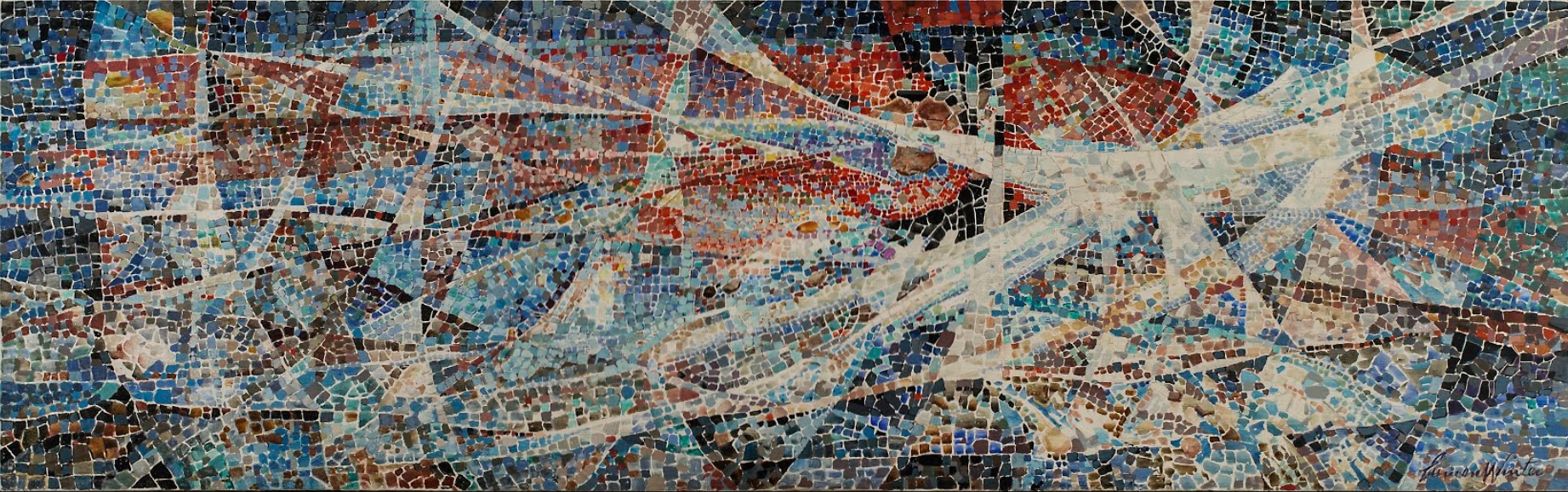
Winter, Lumen Martin_Voice of the Bell
Lumen Martin Winter (American, 1908–1982), Voice of the Bell, 1965. Oil on board, 18 × 52 in. Long Island Museum of American Art, History, and Carriages, Stony Brook, New York. This was a design for a mosaic mural for the entranceway of a school on Staten Island.

LISTEN: “Hallelujah Day” | Music by Abe Janowitz and Julius Grossman, 1955 | Performed by the Deep River Boys, accompanied by Sten Carlbergs kvartett, 1955

Ding-dong, ding-dong, ding-dong, ding-dong
Ding-dong, ding-dong, ding

Sing, sing the whole day long
Sing the hallelujah song
This is Hallelujah Day!

Sing, sing till early dawn
A great new chorus will be born
On this hallelujah holiday

Hallelujah, have a little lujah
Sound that magic melody
Everybody’s singing
You can feel it in the air
Celebrating, congregating
From the mountains to the sea
Everybody’s singing
Hallelujah everywhere

Hallelujah (3×)
What a joyous holiday
Hallelujah (3×)
This is Hallelujah Day!

Ding-dong, ding-dong, ding-dong, ding-dong
Ding-dong, ding-dong, ding
(Repeat)

Sing, sing the whole day long
Sing the hallelujah song
This is Hallelujah Day!

Sing, sing till early dawn
A great new chorus will be born
On this hallelujah holiday

Hallelujah (3×)
What a joyous holiday

Bells are ringing
(Ding-dong, ding)
We’re all singing
Hallelujah
This is Hallelujah Day!
Hallelujah Day!

This swing song was originally released in Norway in 1955 by the African American gospel group the Deep River Boys, which at the time consisted of Harry Douglass (baritone), Edward Ware (bass), Jimmy Lundy (first tenor), and Vernon Gardner (second tenor). They attained quite the popularity in Scandinavia and even recorded some songs in Swedish and Norwegian. Here they’re accompanied by an instrumental jazz quartet led by Sten Carlberg of Sweden.

The song makes me laugh with its silliness, particularly the bell imitations! But I dig it. “Hallelujah” is a Hebrew word meaning “God be praised!” (Hallelu = praise; Yah = Yahweh.) I found no statements from the artists involved about what occasion is being celebrated in the song, but it seems that it very well could be Easter. A day when church bells all around the world call believers—like every Sunday, but today with special vigor—to gather together in worship of their risen Savior.

Cadet Chapel of the United States Air Force Academy

All photos by Victoria Emily Jones or Eric James Jones, © ArtandTheology.org

Soaring 150 feet into the air against a Rocky Mountain backdrop, the United States Air Force Academy Cadet Chapel in Colorado Springs is a National Historic Landmark and one of Colorado’s most-visited manmade attractions. It was designed by Walter Netsch Jr. of Skidmore, Owings and Merrill, the architectural firm responsible for the planning and design of the entire academy, and is a recipient of the American Institute of Architects’ Twenty-Five-Year Award. Construction of the Cadet Chapel began in 1959 and was completed in 1962. It was dedicated in 1963.

United States Air Force Academy Cadet Chapel

The Cadet Chapel was designed to house three distinct worship spaces—Protestant, Catholic, and Jewish—on two levels, with a large “All-Faiths Room” on a third (bottom) level available to members of other faiths. In 2007 a Buddhist Chapel (the Vast Refuge Dharma Hall) was added, and more recently a Muslim prayer room, and outside there is a Falcon Circle for the Earth-Centered Spirituality community (pagans, Druids, Wiccans, etc.), dedicated in 2011. Because of the building’s sound-proofing and separate entrances, different services can be held simultaneously without interfering with one another.

I visited the Cadet Chapel last year shortly before it closed in September for a major renovation and restoration project needed to address water damage. It is scheduled to reopen again in fall 2023.

The most striking feature of the exterior is its seventeen spires, made to resemble jet fighter wings. I must admit: though it is an impressive structure, and I’m fully aware it is a military chapel, the evocation of warplanes for a worship space is a little unsettling. But the design choice does give the building great height—it points to the heavens as do the great medieval Gothic cathedrals of Europe, meant to turn the eye upward toward God.

United States Air Force Academy Cadet Chapel

The steel frame of the chapel comprises one hundred identical tetrahedrons, each weighing five tons and enclosed with aluminum panels. The surfaces of the outer panels are striated so that they reflect light differently throughout the day, depending on the sun’s position.

The chapel is situated on a terrace that overlooks part of the campus as well as beautiful mountain vistas.

View from USAFA Cadet Chapel

The front façade faces south—an atypical orientation for churches, which are traditionally built on a west–east axis, but a choice made, I’m assuming, to best utilize the sunlight for the interior decoration (see next section).

To reach the main entrance you have to ascend a wide granite stairway that leads up one story to an uncovered front porch. Walk inside, and you’re in the narthex (lobby) of the Protestant Chapel.

Protestant Chapel

The Protestant Chapel is by far the largest worship space within the Cadet Chapel, taking up the whole main floor—a choice made based on the religious demographics of enrolled cadets at the time of the building’s construction in the early sixties. (An article published shortly after the chapel’s dedication reported that 68% of cadets listed themselves as Protestant, 29% Catholic, and 2% Jewish, with a few listing other faiths or agnosticism.)

Though the exterior of the Cadet Chapel is, as I experienced it, somewhat cold, sterile, severe, the interior is incredibly warm and genial. Its vertical lift is spectacular. Stained glass strip windows provide ribbons of color between the tetrahedrons and progress from darker to lighter as they reach the altar, with some of the nearly 25,000 dalles (small, thick glass slabs) being deliberately chipped to produce jewel-like facets. The play of colored light across vault, floor, and pews was my favorite part of this space.

USAFA Cadet Chapel (Protestant Chapel)

Vault of USAFA Cadet Chapel (Protestant Chapel) Continue reading “Cadet Chapel of the United States Air Force Academy”