Advent is a season of waiting with deep longing and hope for that long-looked-for day when fear and pain will be no more because Christ will reign and set this world free. These songs tap into that.
>> “Redemption Draweth Nigh”by Gordon Jensen (1970), performed by Rumbi Lee (2018): The title and refrain of this contemporary hymn are drawn from Luke 21:28: “And when these things begin to come to pass, then look up, and lift up your heads; for your redemption draweth nigh” (KJV).
+++
STREET ART SERIES: Medicinal Flowers of Lebanon by Faith XLVII: In September 2021, South African artist Faith XLVII (Liberty Du) traveled to Beirut to paint curative flowers across the rubble of the Lebanese city in the wake of the August 4, 2020, port explosion that caused at least 218 deaths, 7,000 injuries, and $15 billion in property damage, as well as leaving an estimated 300,000 people homeless. Rosehips, horned poppies, chicory, African carline thistle—all these botanicals are used in remedies for common ailments. “Each flower urges us, in a sense, towards healing as they grow out of the concrete,” the artist said.
Faith XLVII (South African, 1979–), Glaucium flavum, from the Medicinal Flowers of Lebanon series, Beirut, Lebanon, 2021. Photo courtesy of the artist.
+++
NEW ALBUMS:
>> The Soil and The Seed Project, vol. 8: Advent-Christmas-Epiphany: For the Advent-Christmas-Epiphany triad of the church year comes this new album from The Soil and The Seed Project, a ministry of Virginia Mennonite Missions—and recently Lilly-Endowed! All their music is free—for download, and even as physical CDs while supplies last. Below are two of my favorite tracks, both written by new contributors to the project. The first verse of Philip Fisher Rhodes’s “Bethlehem One” is in the voice of the in utero Christ; the second, the shepherds; the third, the wise men. The song is sung by Ben Luna. And “Peace Prayer” by Susan Gascho-Cooke is a plea that God would hold his arms around “this tilting planet,” the world’s wounds, and all people.
Each TSATP album is part of a larger project that also includes “Little Liturgies” booklets perfect for families with small kids (but that can also be used by individuals and small groups). Each booklet includes litanies, prayers, reflection questions, suggested activities, and visual art—and again, they’re free! Request a digital or physical copy here.
>> Kindness Is Solid Stone, Violence Is a Heavy Loan to Pay by David Benjamin Blower: Released November 3 and available on Bandcamp only, this album features nine original songs by writer, poet, theologian, and podcaster David Benjamin Blower of Birmingham, UK. I appreciate the minimalist sound and the stark lyricism. My favorite track is probably “Meet Me Where I Sing and Stamp My Feet”:
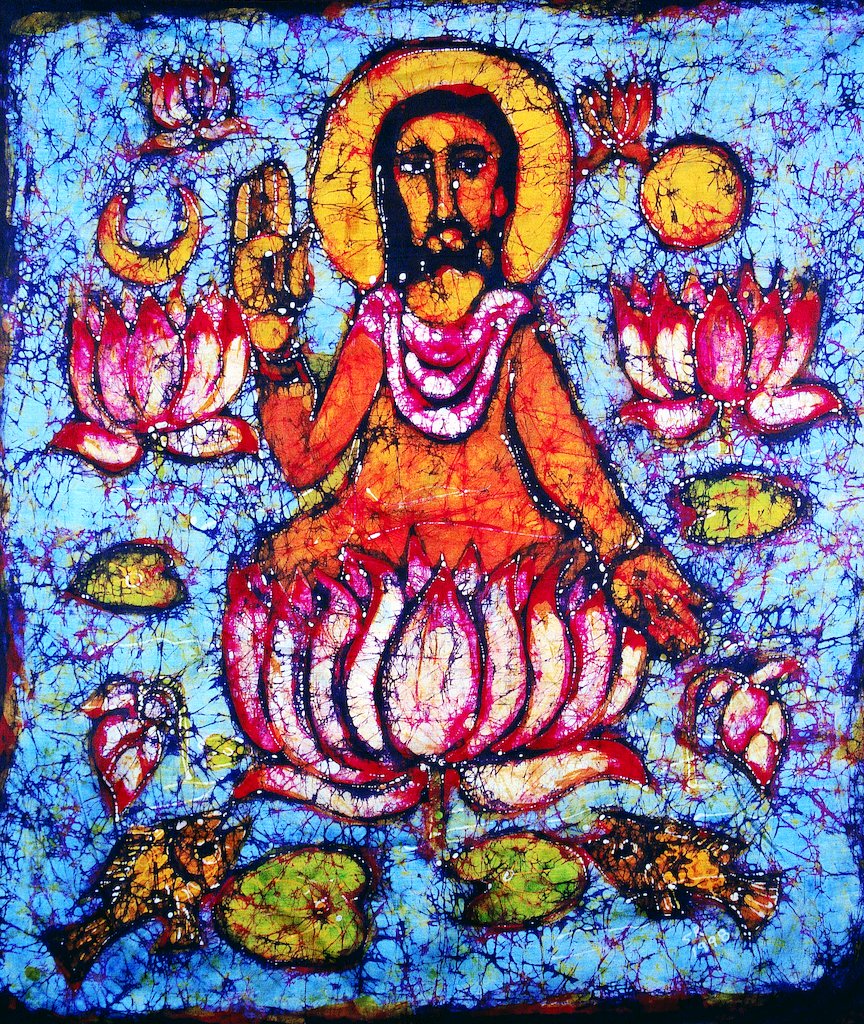
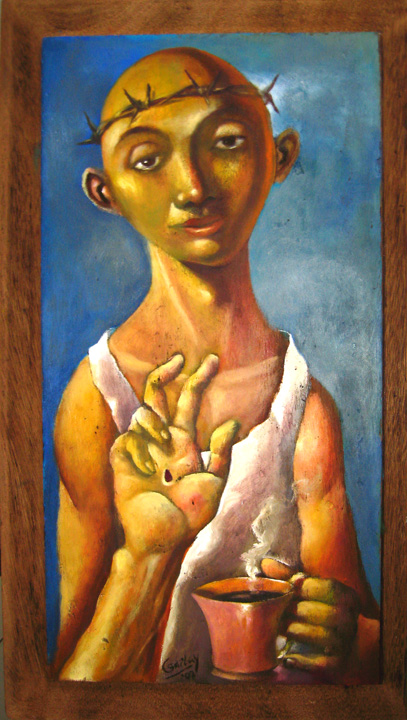
ARTICLE: “Searching for a Jesus Who Looks More Like Me” by Eric V. Copage: I was interviewed the other week for this New York Times piece on multiethnic images of Christ. I comment on paintings by Wisnu Sasongko (Indonesian), Greg Weatherby (Aboriginal Australian), Emmanuel Garibay (Filipino), and Solomon Raj (Indian), and helped select a few of the other images.
Solomon Raj (Indian, 1921–2019), Jesus on the Lotus Flower, 1998. Batik. Photo: Gudrun Löwner.
Emmanuel Garibay (Filipino, 1962–), Untitled, 2007. Oil on wood. Photo via the artist.
Of those Christians who even permit images of Jesus, some hold to a strict literalism and object to images that show him as anything other than a first-century Jew from Israel-Palestine—even though these same literalists would rightly insist that no image is literally Jesus. As I hope is clear from my website, I embrace a wide range of Christological imagery, which I feel reflects the universal presence and revelation of God. (“Christ is all, and in all,” as the apostle Paul wrote in Colossians 3:11; he continues to manifest spiritually, and through his ecclesial body, all over the world.) I’m not so proud to assume that my way of picturing Jesus is the most right or authoritative; I need others to help me see Jesus more fully, more truly. Like C. S. Lewis said, “My own eyes are not enough for me, I will see through those of others.” And historical realism is not the only, or even necessarily the best (depends on context), art style to show who Jesus is.
Even though the historical Jesus never wore a full-face moko (tattoo) like the Maori, as Sofia Minson paints him, nor did he sit on a lotus flower when he taught his disciples, nor did he appear to Peter, James, and John transfigured between two Yoruba deities, these images and others like them tell us something about Jesus. At a broad level, they proclaim the Incarnation—God in flesh, dwelling among us, as us, that is, fully human. The historical Jesus existed in a specific time and place, and had ethnic particularities, but his coming was not just for the Jews but for the Gentiles too, and not just for his day, for but all time. Through symbol and metaphor and materiality, artists make this truth real.
+++
UPDATED BLOG POSTS
Occasionally if I’ve covered an art topic in the past and then come across a new image that fits that topic perfectly, I will add it as an addendum to the original post. I’ve done that with two Eastertide posts.
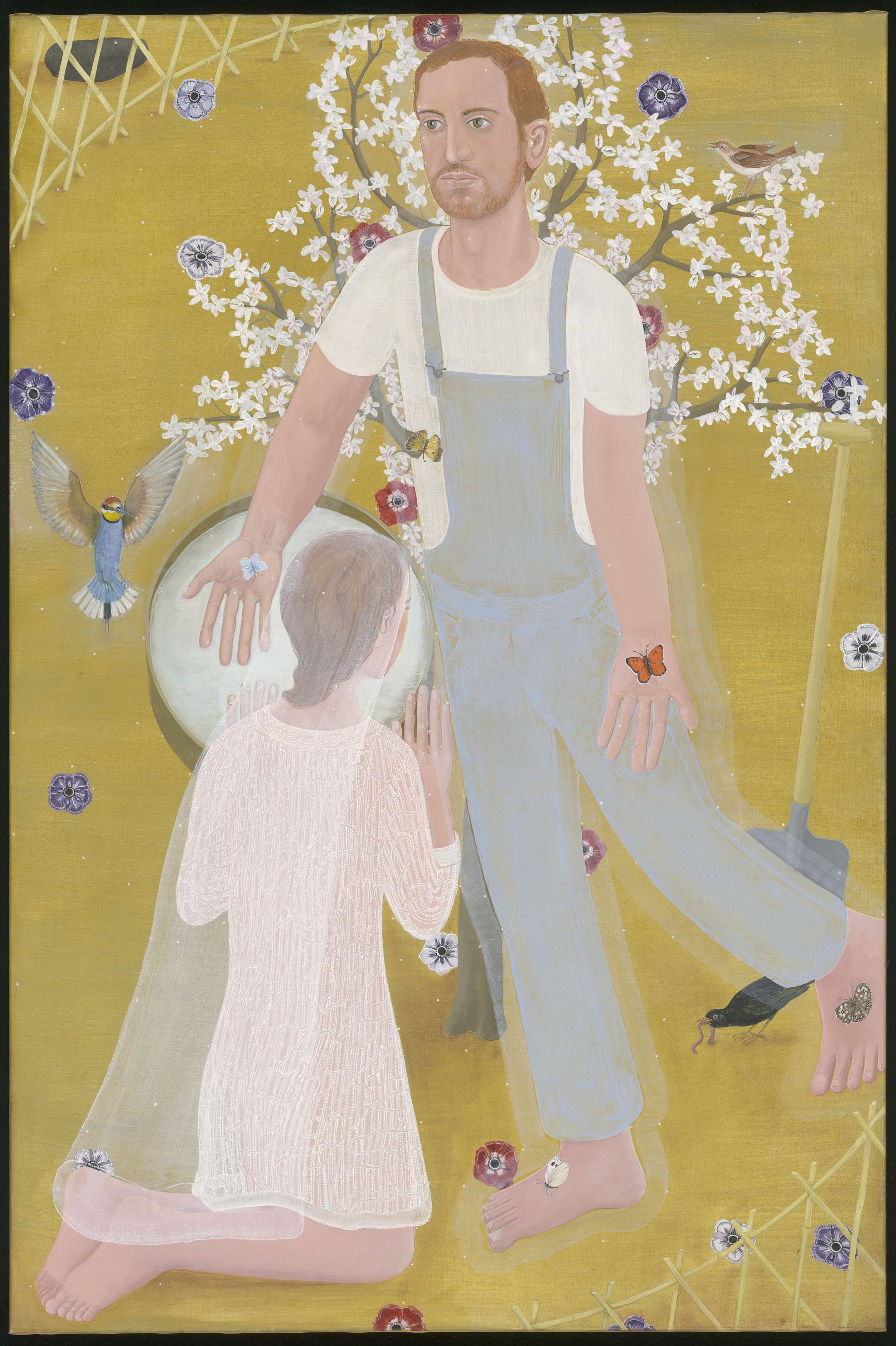
“‘She mistook him for the gardener’”: Humanity was born in a garden and reborn in a garden, as biblical scholars like N. T. Wright are keen to point out, with Easter morning marking the launch of new creation. In art history the resurrected Christ is sometimes amusingly shown carrying gardening tools when he encounters Mary Magdalene outside his tomb—to explain the case of mistaken identity that John records, perhaps, but more likely to establish a metaphor. Two of the paintings I’ve added to this post are by Janpeter Muilwijk, whose New Gardener from 2017 shows the freshly risen Christ in a white T-shirt and overalls, heading with open arms toward Mary, who is dressed like a bride to receive him. (Mary is modeled after the artist’s daughter Mattia, who died.) Butterflies alight on each of Jesus’s five wounds, marking them as sites of transformation, and the flowering branches of a tree crown him with spring glory.
Janpeter Muilwijk (Dutch, 1960–), New Gardener, 2017. Oil on canvas, 150 × 100 cm. Private collection, Netherlands.
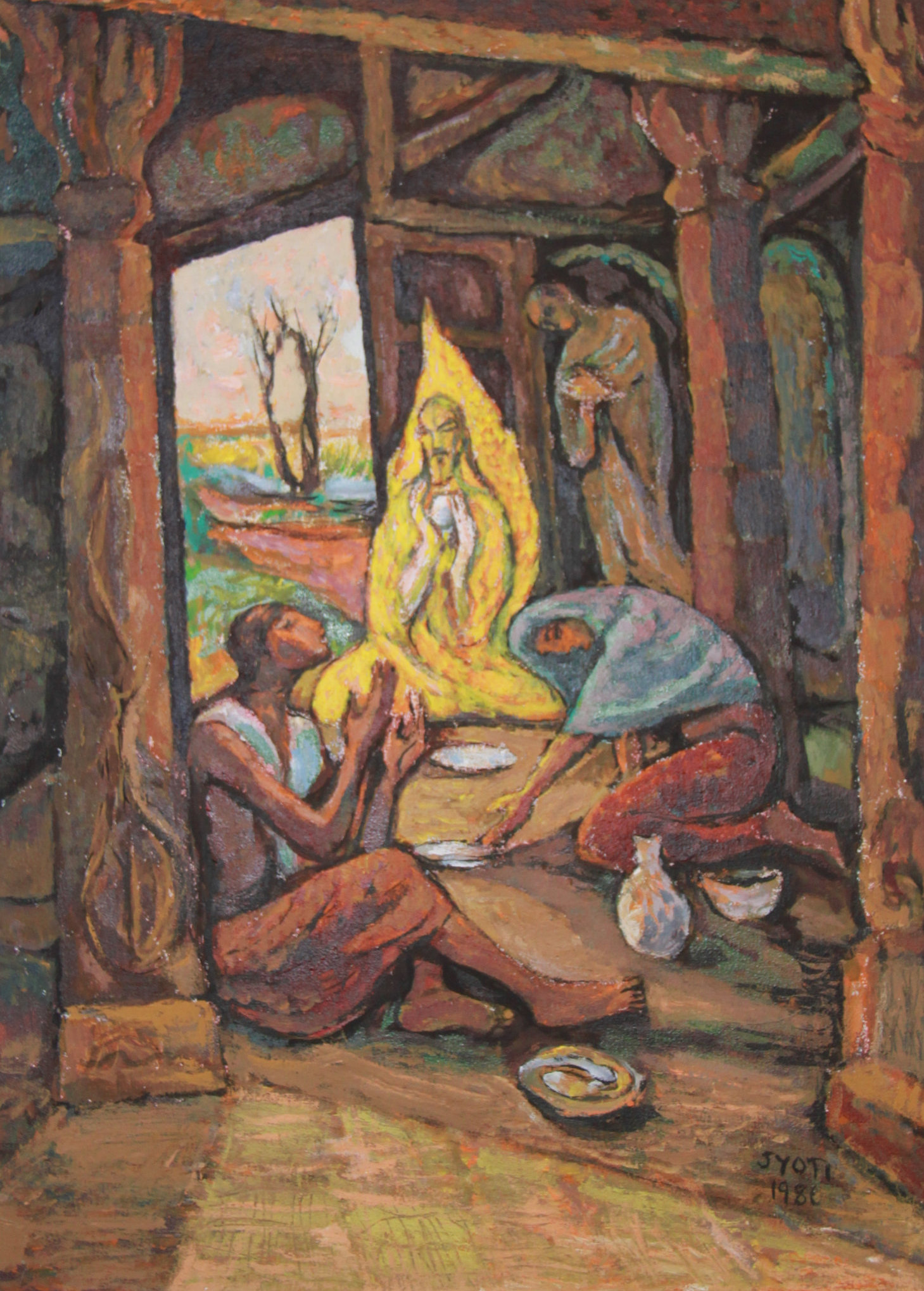
“The Unnamed Emmaus Disciple: Mary, wife of Cleopas?”: Written in 2017, this is one of Art & Theology’s most visited posts. In it I conjecture that the pilgrim who traveled with Cleopas from Jerusalem to Emmaus in the famous Easter story could have been a woman, perhaps Cleopas’s wife. Several artists have conjectured the same, and besides adding to this compilation three Emmaus paintings that the artist Maximino Cerezo Barredo sent me after the initial publication, I’ve also added one by Jyoti Sahi, which shows Jesus sitting with the two disciples—one male, one female—on the floor of a small roadside dwelling, breaking chapati (Indian flatbread) together. He is ablaze with glory, evoking his earlier revelations as I AM in the burning bush before Moses and to Peter, James, and John on Mount Tabor at the Transfiguration.
Jyoti Sahi (Indian, 1944–), The Supper at Emmaus, 1980. Mixed media on canvas. Photo courtesy of the artist.
+++
NEW SONGS
“A Bedtime Song for Anxious Children” by W. David O. Taylor and Paul Zach:David Taylor has written a new children’s song (set to music by Paul Zach), which he sings here with his daughter, Blythe. The lyrics are in the video description on YouTube.
“I’ve heard from so many parents recently that their children are struggling with anxiety, fear, frustration, sadness, anger, and restlessness,” Taylor writes, “and so I thought a little song reassuring them of God’s care at night, when they’re most vulnerable, might help their hearts. Our hope is that the melody might be simple enough for parents and children to be able to sing it when they go to bed.”
“See the Day” by Liz Vice: One of my favorite singers, Liz Vice, released a new single on April 10, called “See the Day.” Cowritten by her, Leslie Jordan, and Jonathan Day, it expresses hope for the coming day of the Lord, when justice will roll down like a mighty river, walls of division will crumble into dust, oppression will cease, and the whole world will be startled awake by love. “Precious Lord, come lead us on” to that reality.
+++
NEW ALBUM: Easter 1 by Mac Meador: Mac Meador, a singer-songwriter from Austin, Texas, released a new EP of six songs for Eastertide this April, a sort of flip side to the Lent 1 EP he released in February. I really enjoyed them both (and the same goes for his Summer of Psalms from 2018). The Easter album strikes just the right note for me right now—of a quiet hope and joy that’s not absent of pain. The songs celebrate Christ the risen king while also expressing longing for the age to come, when the kingdom will be established in full. Lean into that promise!
You can stream and purchase Meador’s music on Bandcamp. (Note: To help musicians affected by COVID-19, Bandcamp is waiving its cut of all sales made on its site on May 1.) You might also want to check out his YouTube channel, where he posts additional songs. For the past four weeks he has been releasing “Quarantine Hymn Sing” lyric videos for his church, Grace + Peace Austin, where he serves as minister of music. (He also sets Bible memory verses to music for kids!)
+++
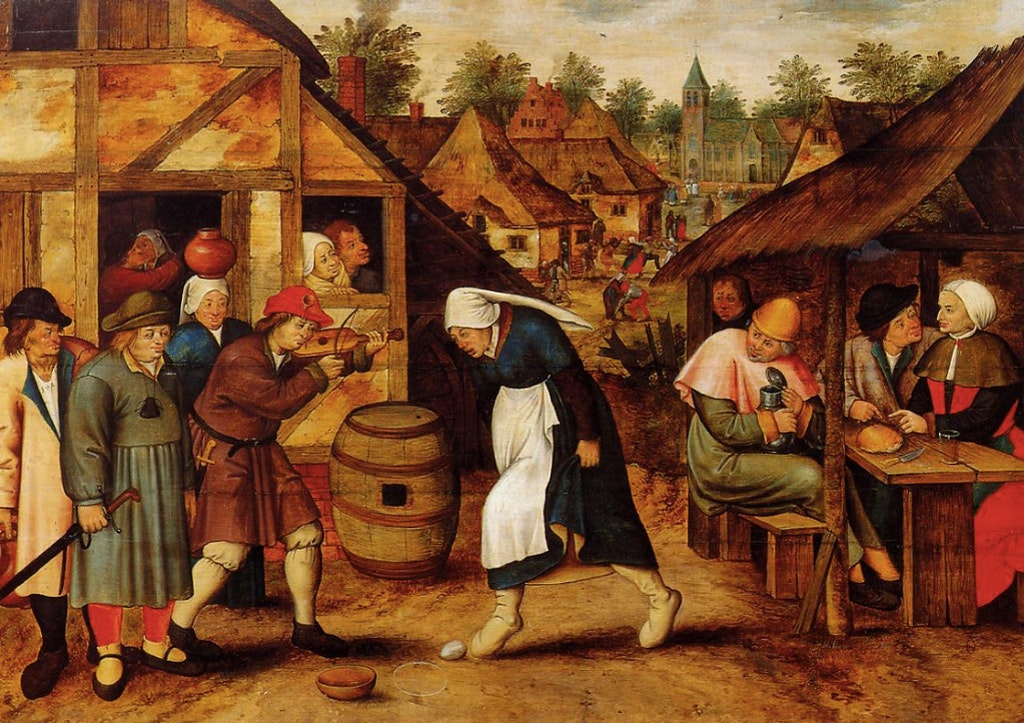
EGG DANCING: “The Egg Dance: From Peasant Village to Political Caricature”: The Public Domain Review has compiled an amusing gallery of historical paintings, drawings, and prints that show the egg dance, a traditional Easter game with several variations, most associated with western European peasantry of the sixteenth and seventeenth centuries.
Pieter Brueghel the Younger (Flemish, 1564/65–1637/38), The Egg Dance, ca. 1620. Oil on panel, 26 1/4 × 41 1/4 in. (66.7 × 104.8 cm).
+++
ART VIDEO:“500 Years of the Herrenberg Altarpiece”: I love seeing all the fun, creative resources being produced by art museums to help educate and engage the public in viewing art. Though I speak not a lick of German, this video from the Staatsgalerie Stuttgart about Jörg (Jerg) Ratgeb’s Herrenberg Altarpiece made me laugh and had me hooked for its full five minutes. (I came across it when I was prepping a Holy Week blog post that features a different painting attributed to the same artist.) Released last October for the five hundredth anniversary of the altarpiece, the video, directed by Valentin Hennig and Oleg Kauz, animates some of the birds from the painted panels and has them narrate as the camera zooms in on details (one of them quite jarring and unseemly!). They then fly through the museum hall and over the town some twenty miles southwest to the church where the piece originally stood.
To add autogenerated subtitles, click the “CC” (closed captioning) button on the bottom of the video player, then select your language using the gear icon.
Painted in 1519, this double-winged altarpiece was commissioned by the Brethren of the Common Life, a Catholic pietist community, for the high altar of the collegiate church of Herrenberg in Swabia. Closed, it shows the apostles about to set out on their mission to spread the word of God. The first open view (interior panels closed, exterior wings folded out) reveals scenes from the passion of Christ, each panel with a primary scene in the foreground and a secondary scene in the background: the Last Supper with the Agony in the Garden, the Flagellation and Crowning with Thorns with the Ecce Homo (presentation to the crowd), the Crucifixion with the Carrying of the Cross and the Entombment, and the Resurrection with the Noli me tangere (appearance to Mary Magdalene). Completely opened (its feast-day configuration), the altarpiece shows scenes from the infancy of Christ, with reference also to the life of the Virgin Mary. It used to have a central Marian statue and predella figures, but these were likely destroyed when the Protestant Reformation came to Württemberg in 1534.
The artist had already died by this time—he was executed (drawn and quartered) for treason in 1526 for his role as one of the leaders of the German Peasants’ Rebellion.


 Art & Theology