Christian comics: Encountering God in multipanel visual storytelling

I’ve been following the work of comics artist Madeleine Jubilee Saito for several years (you may recall me featuring her here and here), and I’m thrilled that her debut collection of comics, You Are a Sacred Place: Visual Poems for Living in Climate Crisis, has now hit shelves! It’s gorgeous, you all. To coincide with the book’s release date today, I asked if she’d be willing to write a guest post providing some background and insight on comics as an art form and how Christians, including herself, have used the form. Before sharing two of her own comics, she explores three earlier examples by others—an Italian Gothic devotional painting, a late nineteenth-century African American quilt, and (where my mind typically goes when I hear “Christian comics”) a popular series of evangelistic tracts—expanding my sense of what a comic can be.

—Victoria Jones


A guest post by Madeleine Jubilee Saito

Comics have always been an art form for ordinary people—the medium of children, the illiterate, and the learning-to-read. 

Since the 1960s, underground comix have been a scrappy, democratic, DIY art form: anyone with access to a black-and-white printer can make their own eight-page zine. And many Christians have found that humblest of publications, the self-published evangelistic tract, in that humblest of locations: the bathroom stall.

I am a Christian artist, and my medium is experimental comics. I define comics expansively as any visual artwork where meaning comes from the viewer reading discrete sections in sequence.
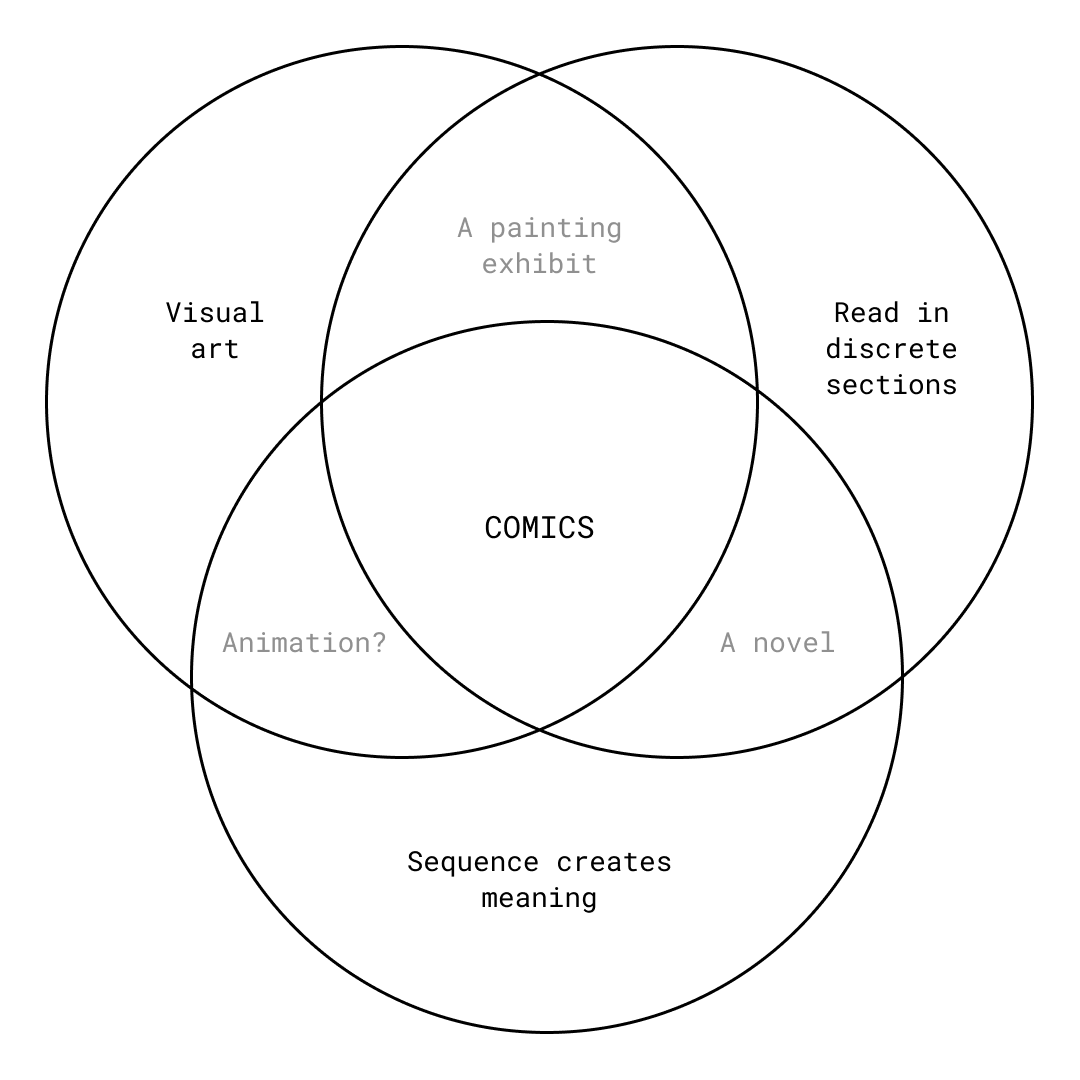
What is a comic?
Breaking down my definition of comics

To put it more simply, comics are pictures (and sometimes text) that you read across panels. 

Christian artists throughout time have been drawn to working in this medium. And because comics have always been a popular medium, often directed at those on the margins, reading Christian comics from the past can tell us something about how Christians of a particular time viewed ordinary people.

Three very different examples:

1. Pacino di Bonaguida, 14th century, Italy
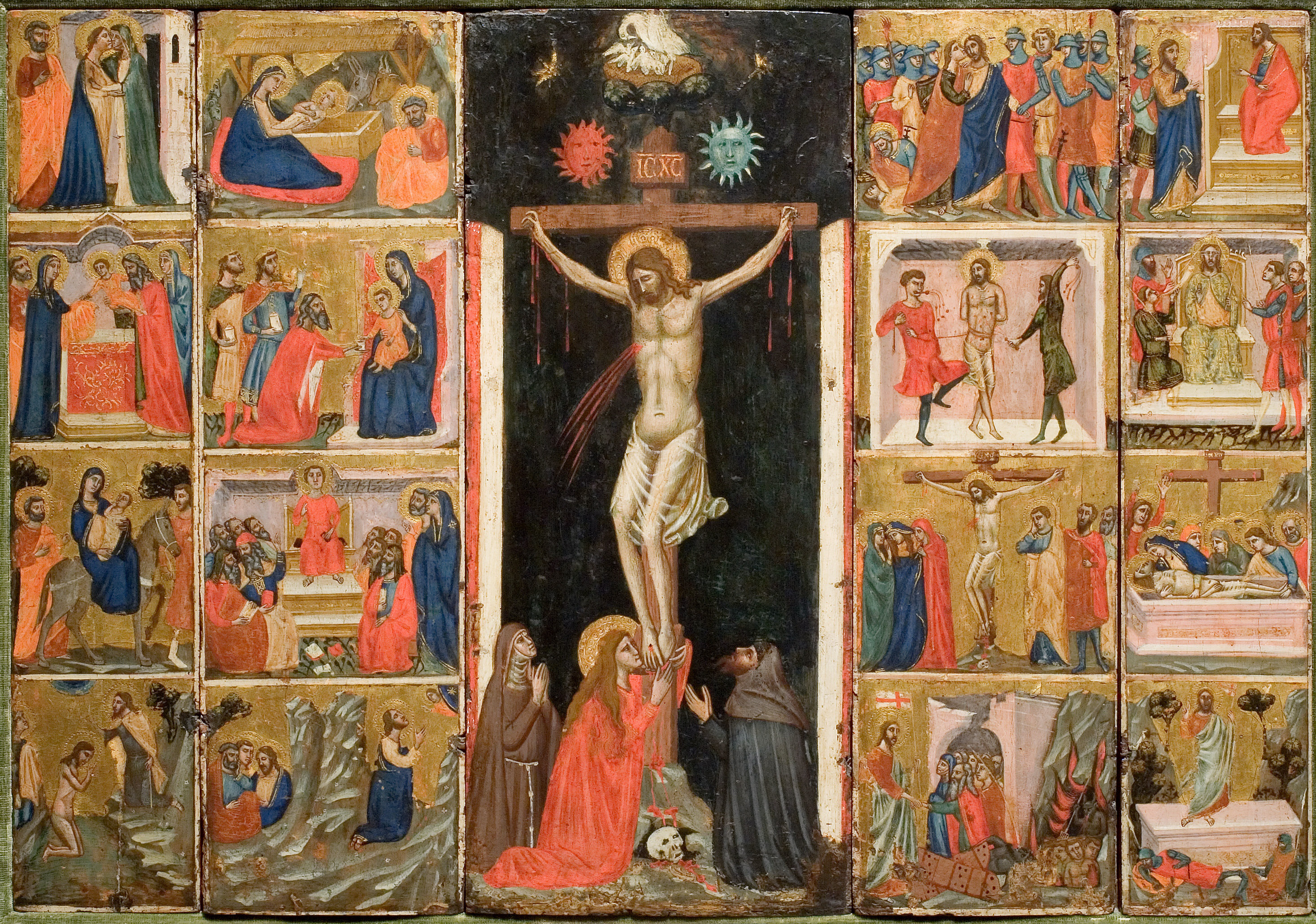
Pacino di Bonaguida_Tabernacle with Scenes from the Life of Christ
Pacino di Bonaguida (Italian, active 1302–ca. 1340), Tabernacle with Scenes from the Life of Christ, ca. 1325. Tempera and gold leaf on panel, 44.5 × 63.5 cm. University of Arizona Museum of Art, Tucson.

Pacino di Bonaguida is one example of an Italian artist making sacred comics alongside the rise of the Dominican and Franciscan mendicant orders in the thirteenth through fifteenth centuries. 

Panels showing sequential scenes from the life of Christ were a popular choice for altarpieces. (An example of artworks in this tradition is the Stations of the Cross—I made my own entry into that tradition a few years ago.)
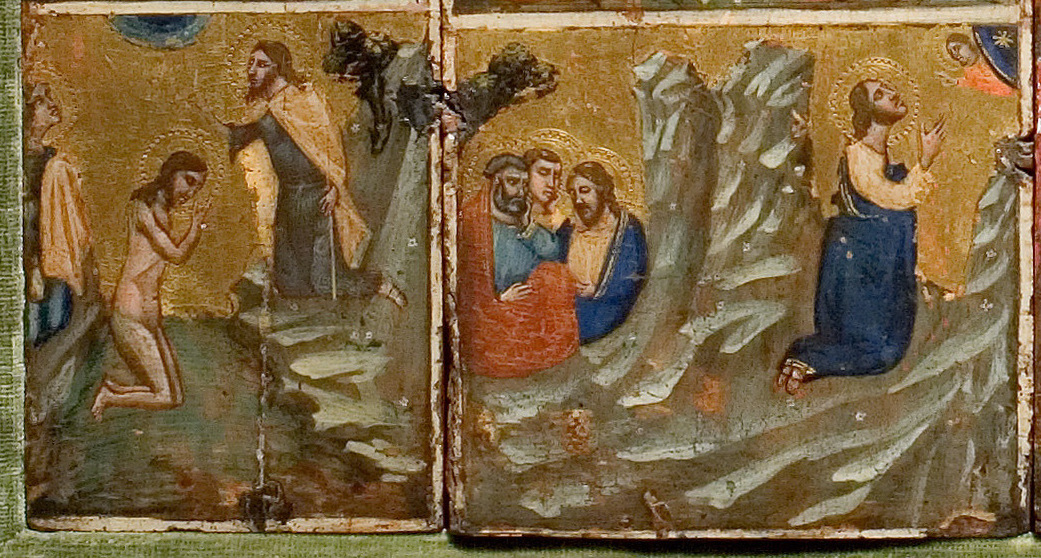
Pacino di Bonaguida, Tabernacle with Scenes from the Life of Christ, bottom left detail. Note the way that the rock forms echo between the two panels, creating rhythmic repetition between the Baptism of Christ and the Agony in the Garden.

In this period, Dominicans and Franciscans helped launch a movement in the church emphasizing preaching to and teaching common people and seeing oneself in the biblical story.

While we don’t have any writing from Pacino, we can look to the theological trends of the time to understand his comics. 

The Dominicans and Franciscans encouraged ordinary Christians, including the illiterate, to move sequentially, systematically, through the story of Christ. The anonymously authored manual The Garden of Prayer (1454) instructs:

Alone and solitary, excluding every external thought from your mind, start thinking of the beginning of the Passion, starting with how Jesus entered Jerusalem on the ass. Moving slowly from episode to episode, meditate on each one, dwelling on each single stage and step of the story. And if at any point you feel a sensation of piety, stop: do not pass on as long as that sweet and devout sentiment lasts.
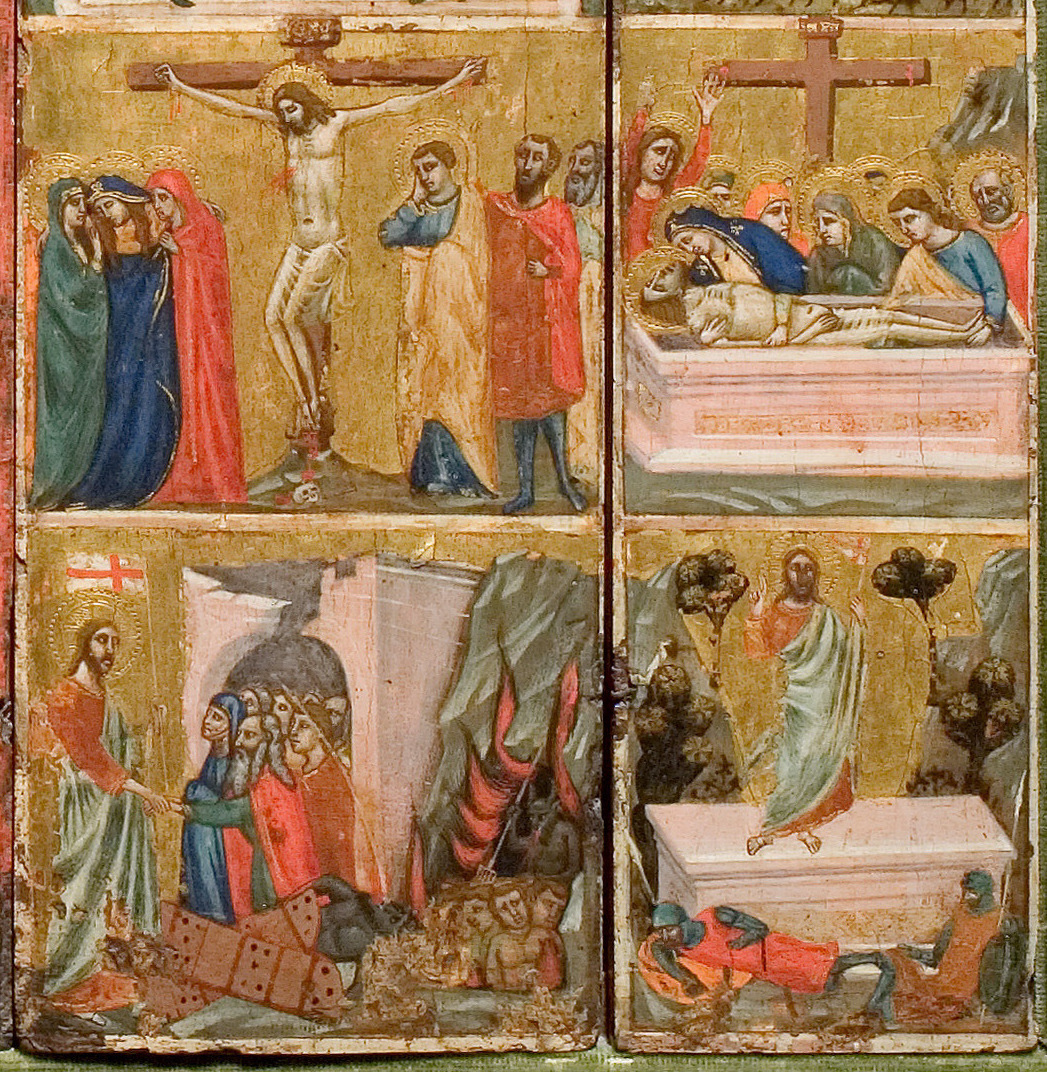
Pacino di Bonaguida_Tabernacle with Scenes from the Life of Christ
Pacino di Bonaguida, Tabernacle with Scenes from the Life of Christ, bottom right detail

We see this sequential movement reflected in the sacred comics of the time—sometimes in square panels, other times in more creative shapes.
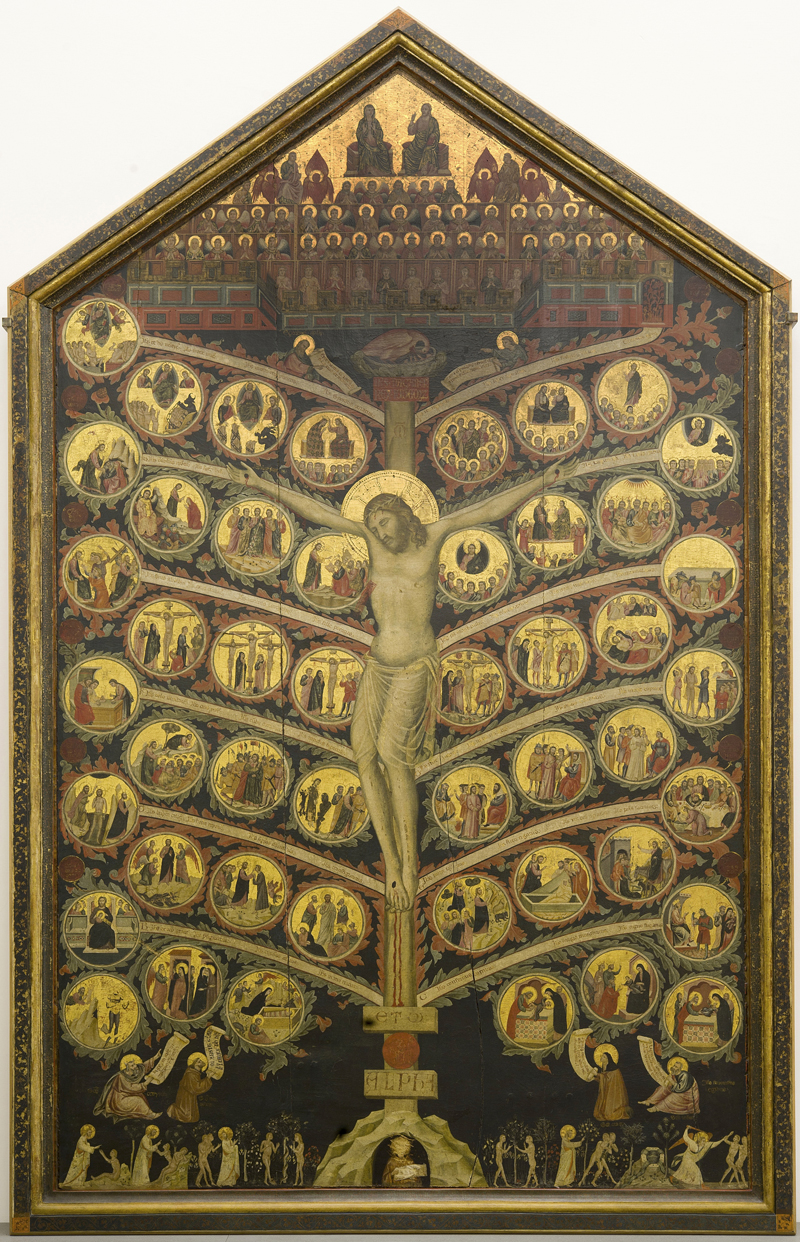
Pacino di Bonaguida_Tree of Life
Pacino di Bonaguida, The Tree of Life, 1320. Tempera and gold leaf on wood panel, 248 × 151 cm. Galleria dell’Accademia, Florence. Note the round panels extending from a central point.

Sermons from the time extolled the usefulness of images depicting scenes from the life of Christ as a way to expand access to the gospel narrative. In 1492, for example, the Dominican friar Michele da Carcano, citing a famous letter of Pope Gregory’s from around 600, preached that images were introduced in churches “first, on account of the ignorance of simple people, so that those who are not able to read the scriptures can yet learn by seeing the . . . faith in pictures.” 

These comics were intended to expand ordinary Christians’ access to the biblical story—making it more present and compelling, especially for those who couldn’t read. 

2. Harriet Powers, 19th century, American South
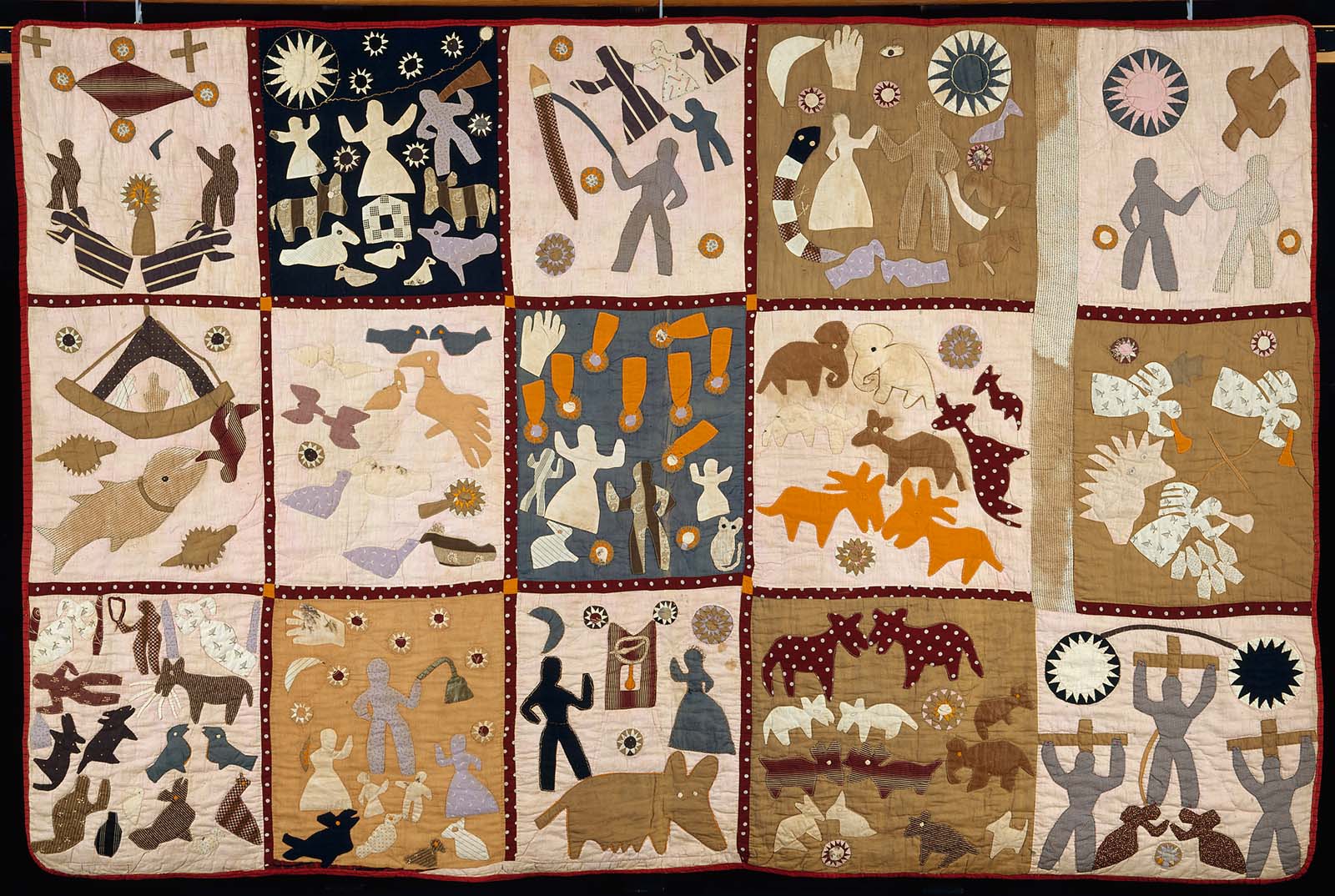
Powers, Harriet_Pictorial Quilt
Harriet Powers (American, 1837–1910), Pictorial Quilt, 1895–98. Cotton plain weave, pieced, appliqued, embroidered, and quilted, 175 × 266.7 cm. Museum of Fine Arts, Boston.

Harriet Powers was a Black American quilter and folk artist who was born into slavery in 1837 and lived near Athens, Georgia.

Like the Dominicans and Franciscans several centuries earlier, Powers saw her comics as a more-than-verbal way to preach the gospel. She described her work as “a sermon in patchwork,” saying she intended to “preach the gospel in patchwork, to show my Lord my humility” and to “show where sin originated, out of the beginning of things.”

Powers’s comics teach and exhort, just like a sermon. In her article “Quilting the Sermon: Homiletical Insights from Harriet Powers,” Dr. Donyelle McCray places Powers’s visual art in the tradition of African American preaching:

Rather than preaching a discursive message, [Powers] offers one that is “archaic,” or “predicated on the priority of something already there, something given.” Her symbols and textures facilitate a process of “crawling back” to a deeper level of consciousness or evoking knowledge that is already within but encumbered. . . .

Powers focuses on what her audience already knows by nurturing memory and offering faith-enlivening symbols that will embolden their Christian imagination.

Powers’s quilts weave historical scenes from the recent past with biblical scenes—visually and metaphorically linking the biblical story and her immediate reality.

In her Pictorial Quilt, five of the fifteen panels depict recent historical and climatological events. The remaining ten depict stories from scripture.
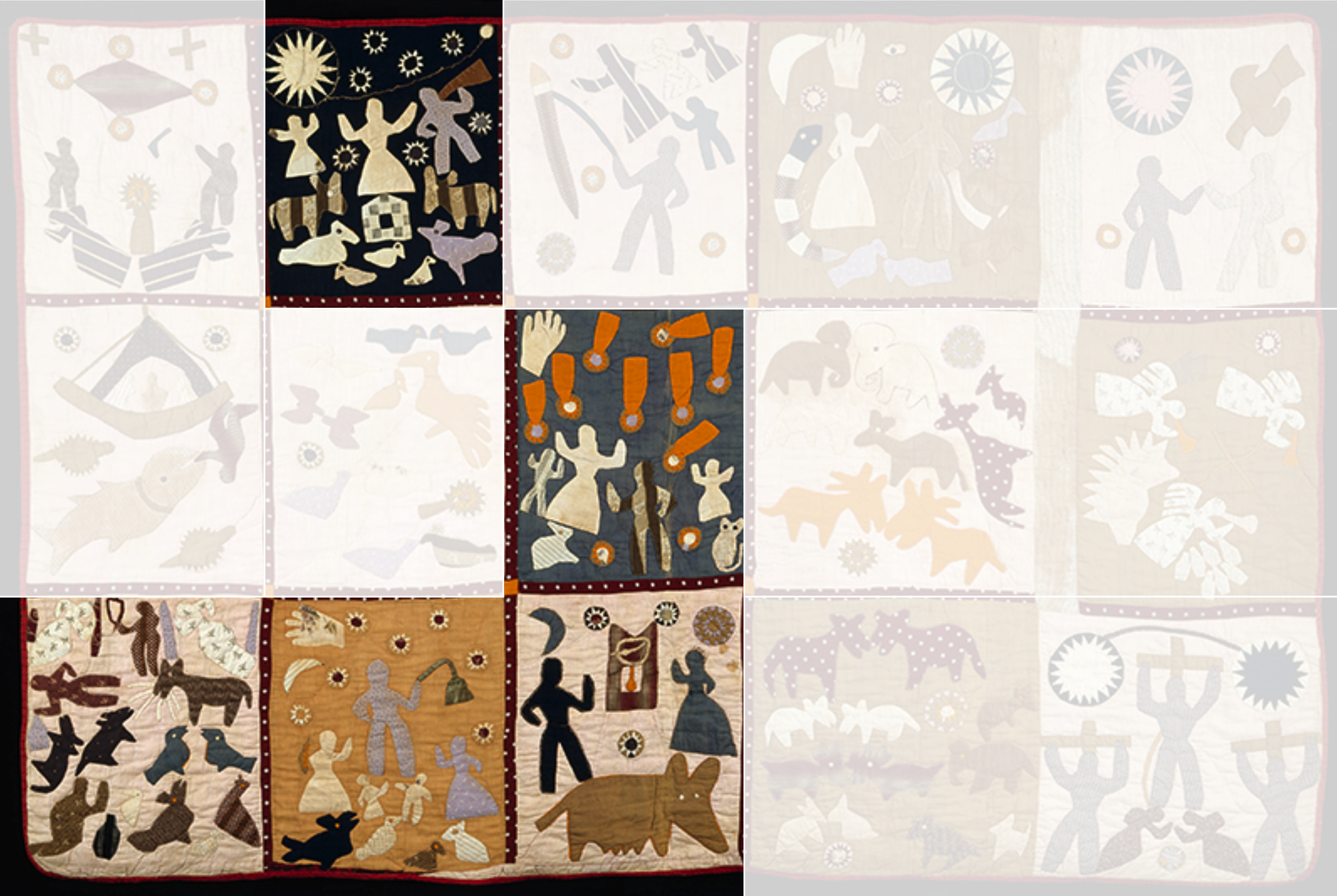
Harriet Powers, historical and climatological panels
Harriet Powers, Pictorial Quilt, edited by the author to highlight historical and climatological panels

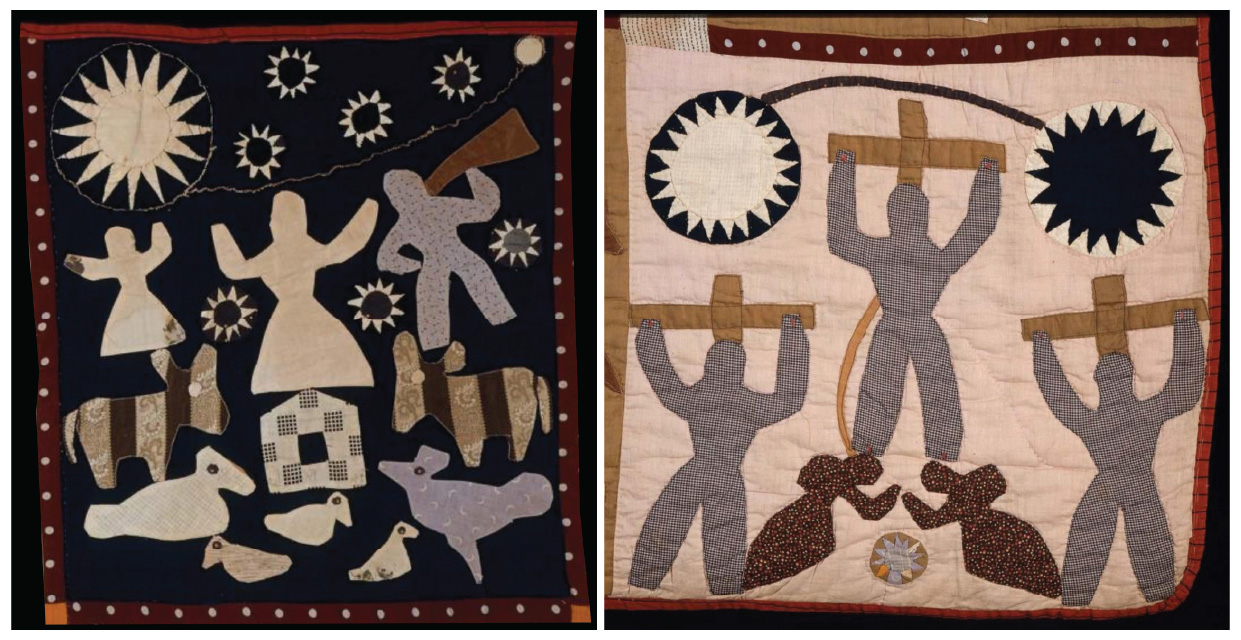
Panels from Pictorial Quilt by Harriet Powers

Left: “The dark day of May 19, 1780. The seven stars were seen 12 N. in the day. The cattle wall went to bed, chickens to roost and the trumpet was blown. The sun went off to a small spot and then to darkness.“

Right: “The crucifixion of Christ between the two thieves. The sun went into darkness. Mary and Martha weeping at his feet. The blood and water run from his right side.”

Note the way that the visual repetition of celestial bodies creates a link between the scene of recent history and Christ’s passion.

Powers’s comics, written from the margins (Powers was a formerly enslaved woman in Reconstruction-era Georgia) and for those on the margins, reflect a vision of a world where biblical stories and lived reality are not distant or separate, but already intertwined. 

God is already fully present on the margins. In “Quilting the Sermon,” McCray remarks:

A vibrant spirituality drives Powers’ preaching. She envisions God as a mighty sovereign who intervenes in earthly affairs and is known primarily through obedience to scripture and attentiveness to divine revelation. This revelation is not limited to scripture but continues to unfold in human history through climatological events, celestial occurrences, and everyday activities.

3. Jack Chick, 20th century, American West
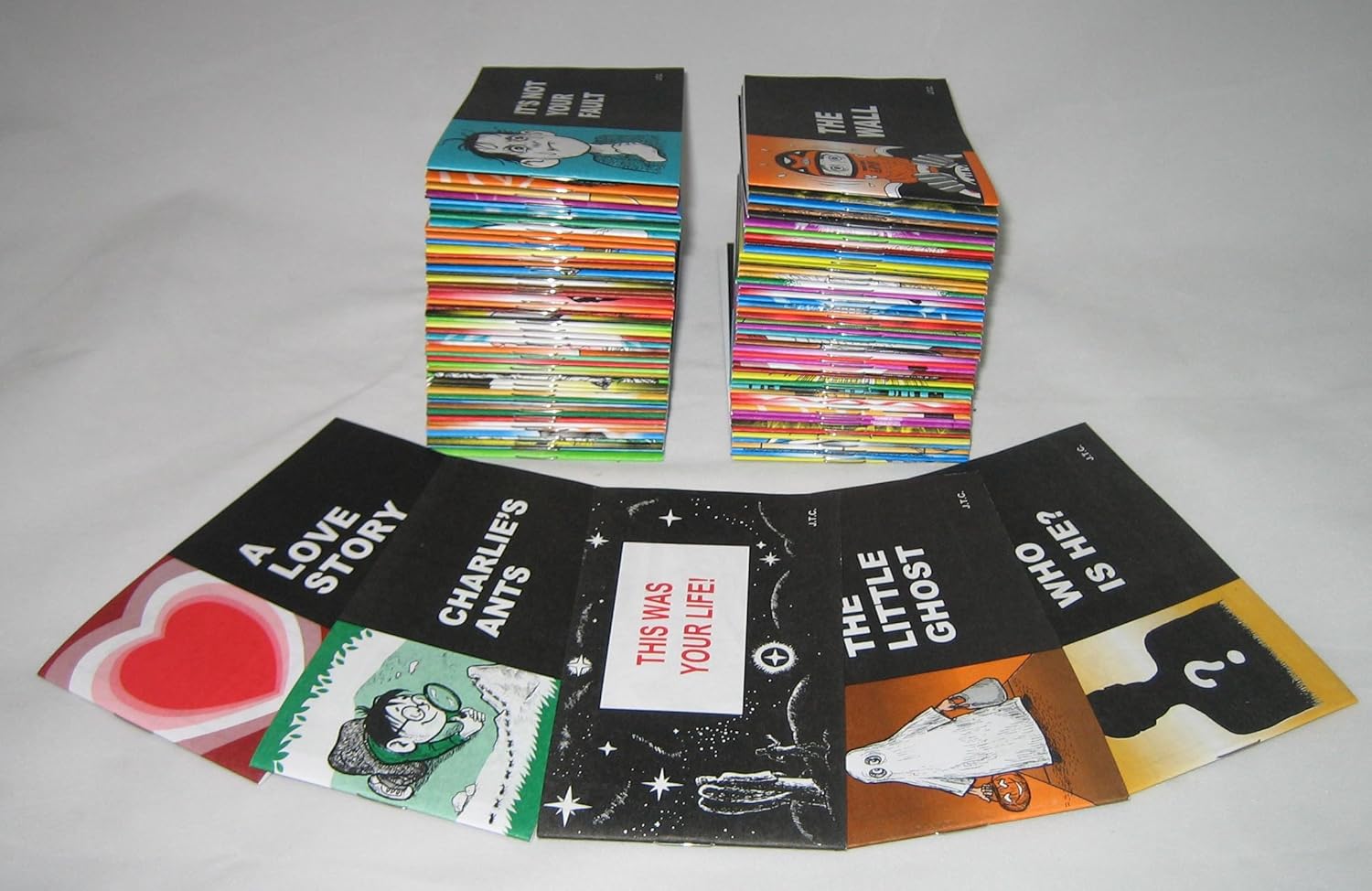
Chick tracts
Piles of Chick tracts from “Chick Tract Assortment” Amazon listing

Chick tracts are broadly viewed as hate literature because of their anti-Semitic and anti-Catholic content. And Jack Chick (and his collaborators) are likely among the best-selling cartoonists in human history, with one billion tracts sold (according to Chick.com’s numbers). 

While I don’t commend Chick’s work for distribution or personal meditation, I think that a critical reading of his comics reveals something interesting about a particular tradition of American Christianity—and how that tradition views the ordinary people who encounter Chick tracts in their mailboxes and workplaces and on public bathroom floors.
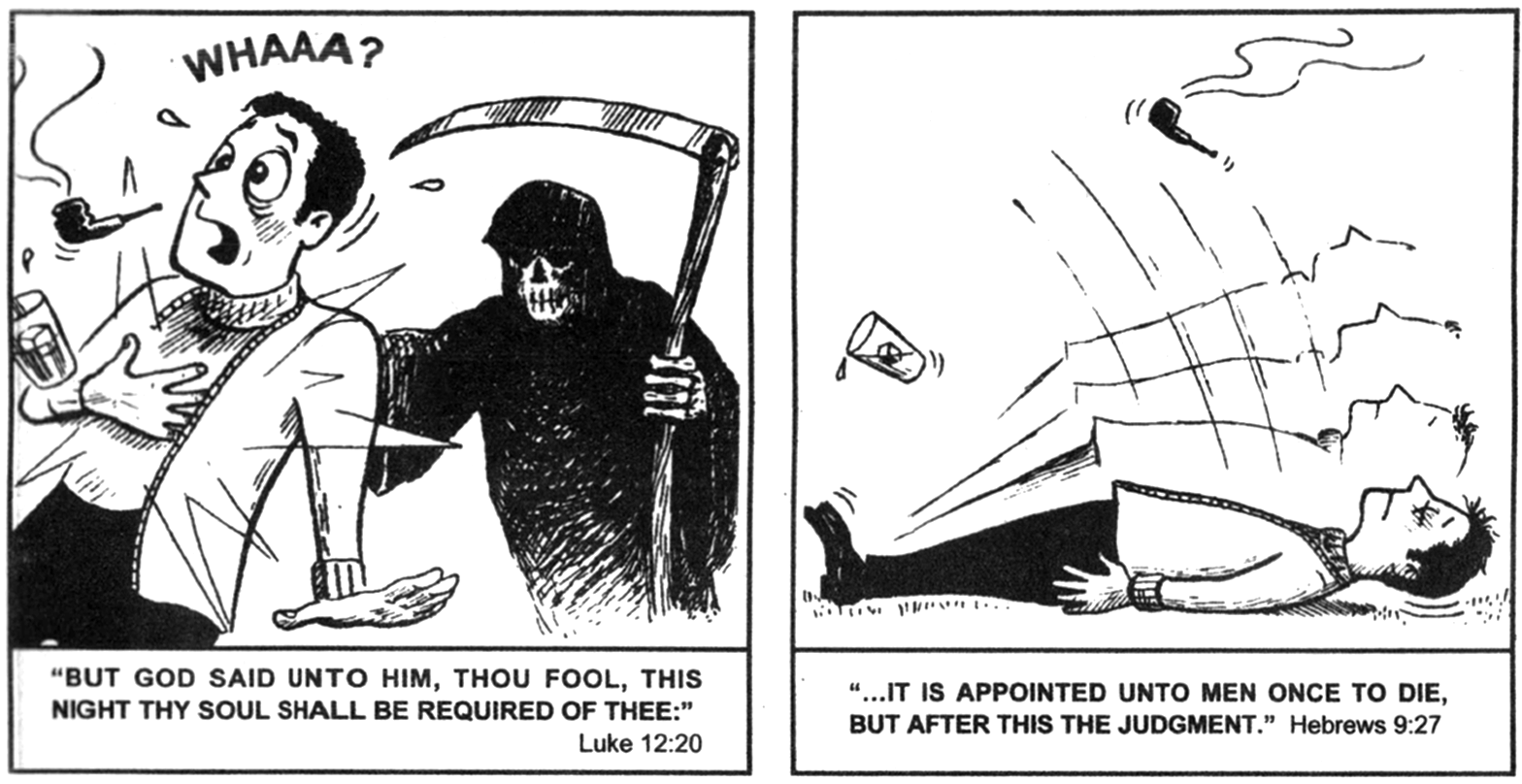
this was your life detail
Detail from This Was Your Life

Each tract is a little larger than a business card (3″ × 5″), and usually around twenty pages long. Most tracts have a consistent rhythm: a setup, a shocking encounter, and a dramatic conversion

If reading the Stations of the Cross feels like solemnly walking behind Christ as he makes his way through Jerusalem, Chick tracts feel like being pushed off a cliff.
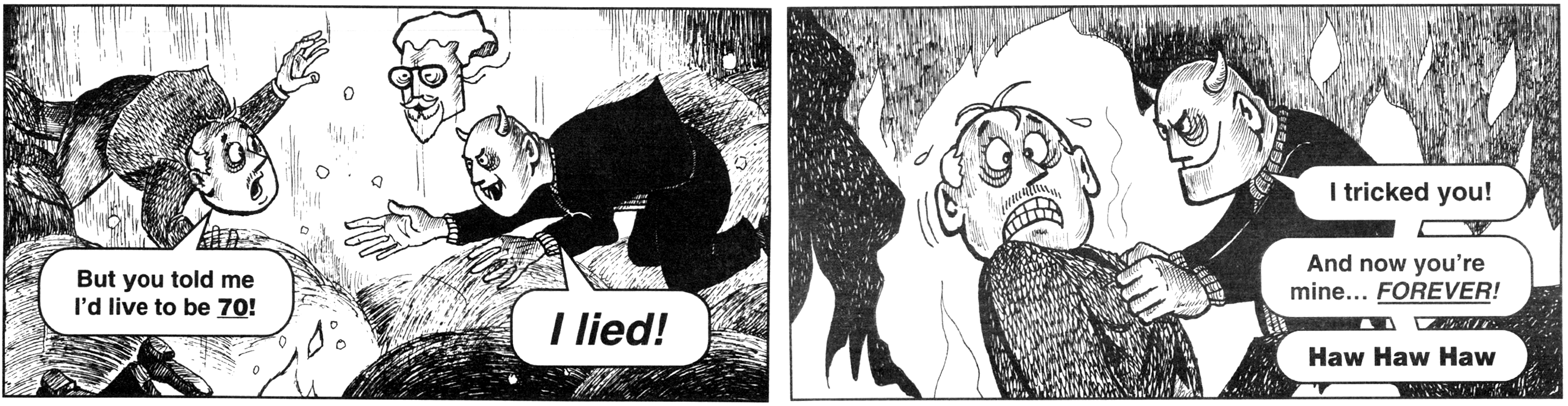
the-long-trip detail
Detail from The Long Trip

In Chick’s imagination, the reader’s encounter with Christ is flat, rote, and tightly choreographed: Chick gives his readers the words to say. The reader’s encounter with God is compressed and mass-produced—an industrial object, like the tracts themselves.
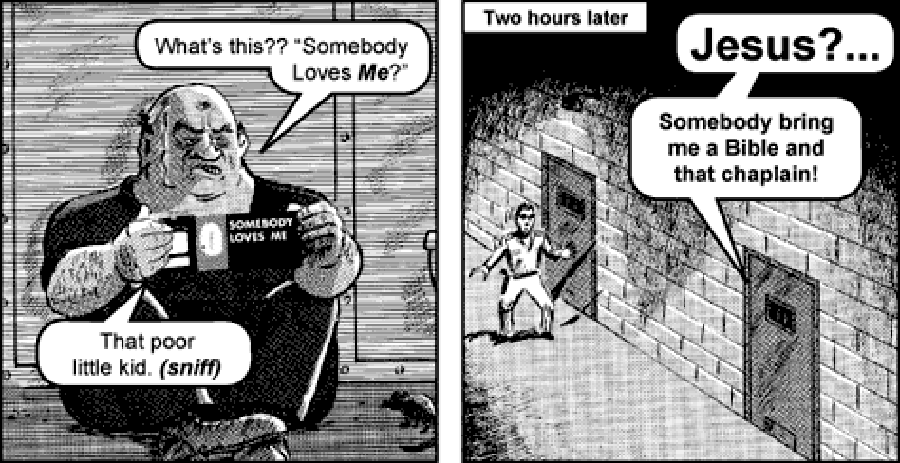
the-bull-detail
Detail from The Bull, in which the titular character has a conversion experience while reading a Chick tract


For all three artists—Pacino di Bonaguida, Harriet Powers, and Jack Chick—the form’s legibility, irresistibility, and overall accessibility made comics a compelling tool to facilitate their readers’ encounters with God. 


When I started making comics in high school, I was drawn to the medium for similar reasons: there is something irresistible and magical about the format. 

My first comics were influenced by the autobiographical cartoonists of the early 2000s, especially Kate Beaton and Marjane Satrapi. In recent years, I’ve begun working more experimentally, influenced by the tradition of Christian comics described above.
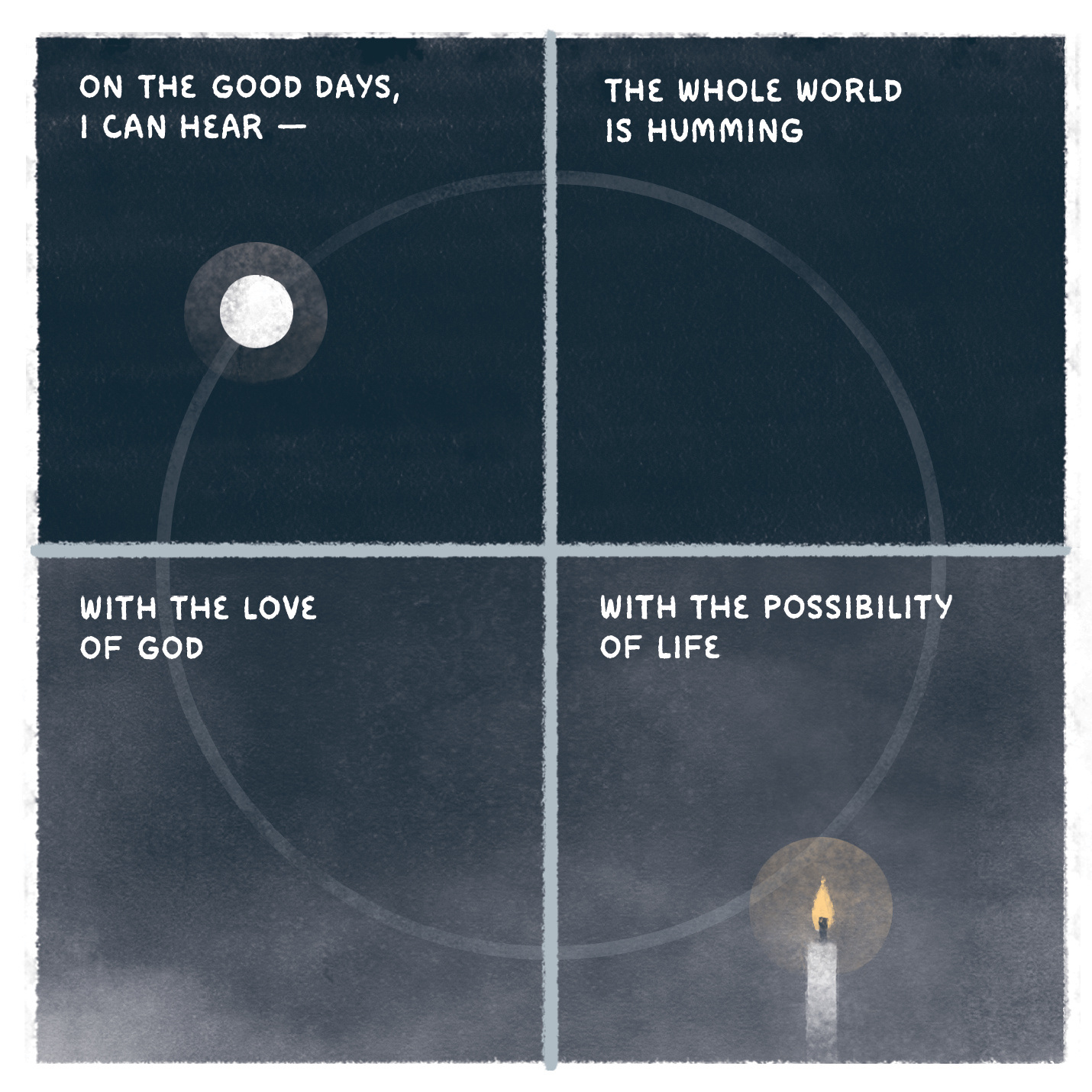
on-the-good-days
From You Are a Sacred Place © by Madeleine Jubilee Saito. Reprinted with permission of Andrews McMeel.

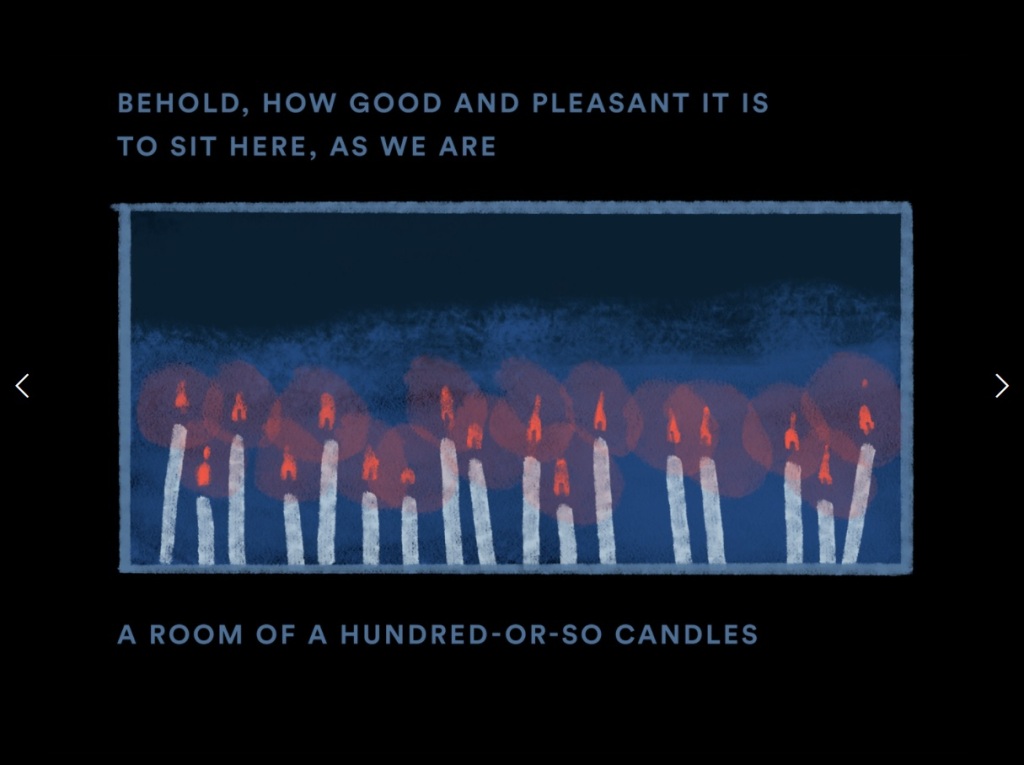
I’ve always loved the poetry and repetition of the Psalms and the Prophets. Comics, especially poetry comics, can have poetic resonances on multiple levels at once: in the text, in the imagery, and in the interplay between the text and imagery.
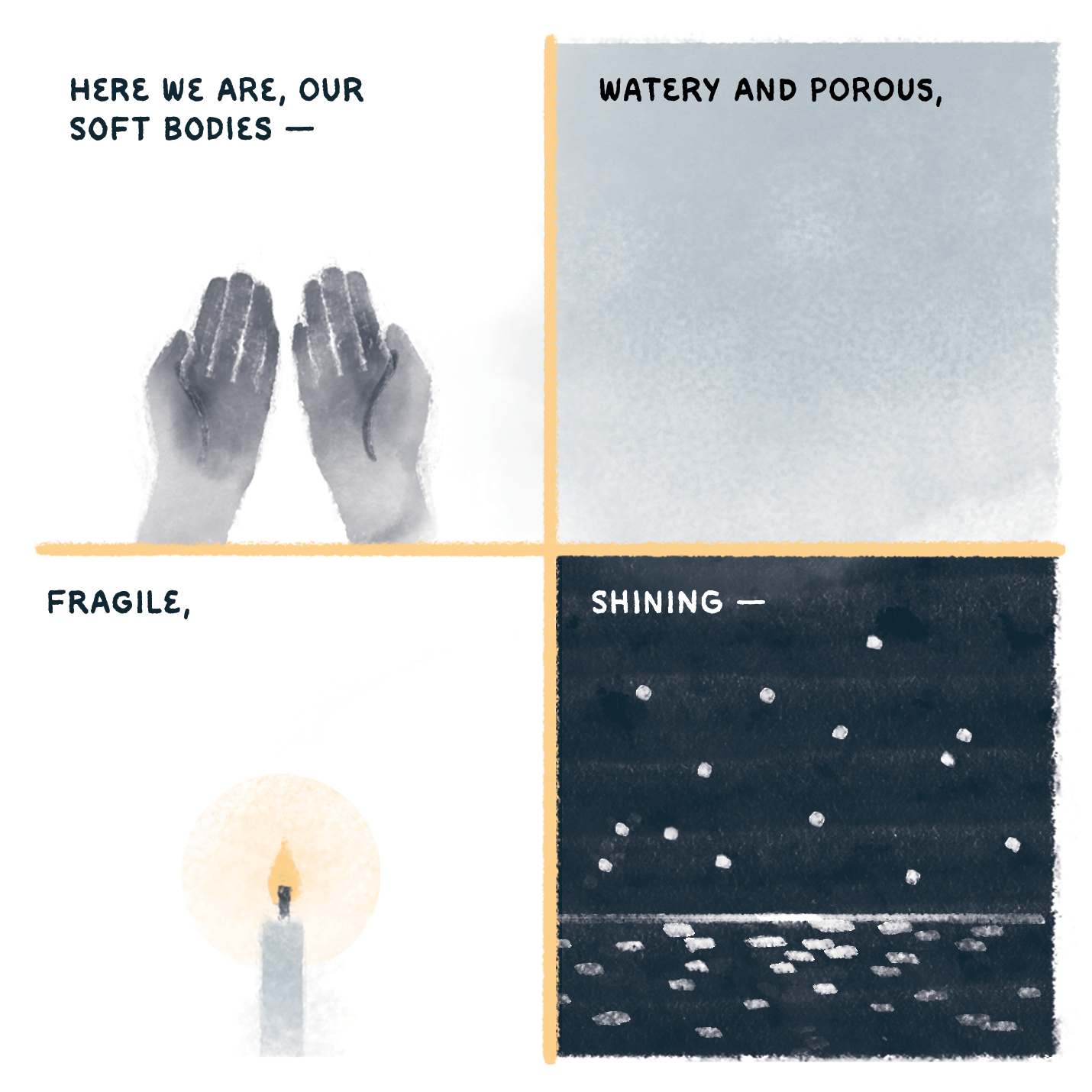
here-we-are
From You Are a Sacred Place © by Madeleine Jubilee Saito. Reprinted with permission of Andrews McMeel.

My first book, You Are a Sacred Place: Visual Poems for Living in Climate Crisis (out from Andrews McMeel March 25, 2025), is my attempt to bring the comics medium’s unique complexity into questions about the climate crisis, God’s justice, and how it feels to live in our moment in history. 

Madeleine Jubilee Saito (photo: Holly Stevens)

Madeleine Jubilee Saito is a cartoonist and artist from rural Illinois living in Seattle and the author of You Are a Sacred Place (Andrews McMeel, 2025). In 2022, she was an inaugural artist-in-residence at On Being. Her comics open each section of the best-selling anthology of women’s writing about climate, All We Can Save (One World, 2020), and her work was recognized in Best American Comics 2019. Follow her on Instagram @madeleine_jubilee_saito.
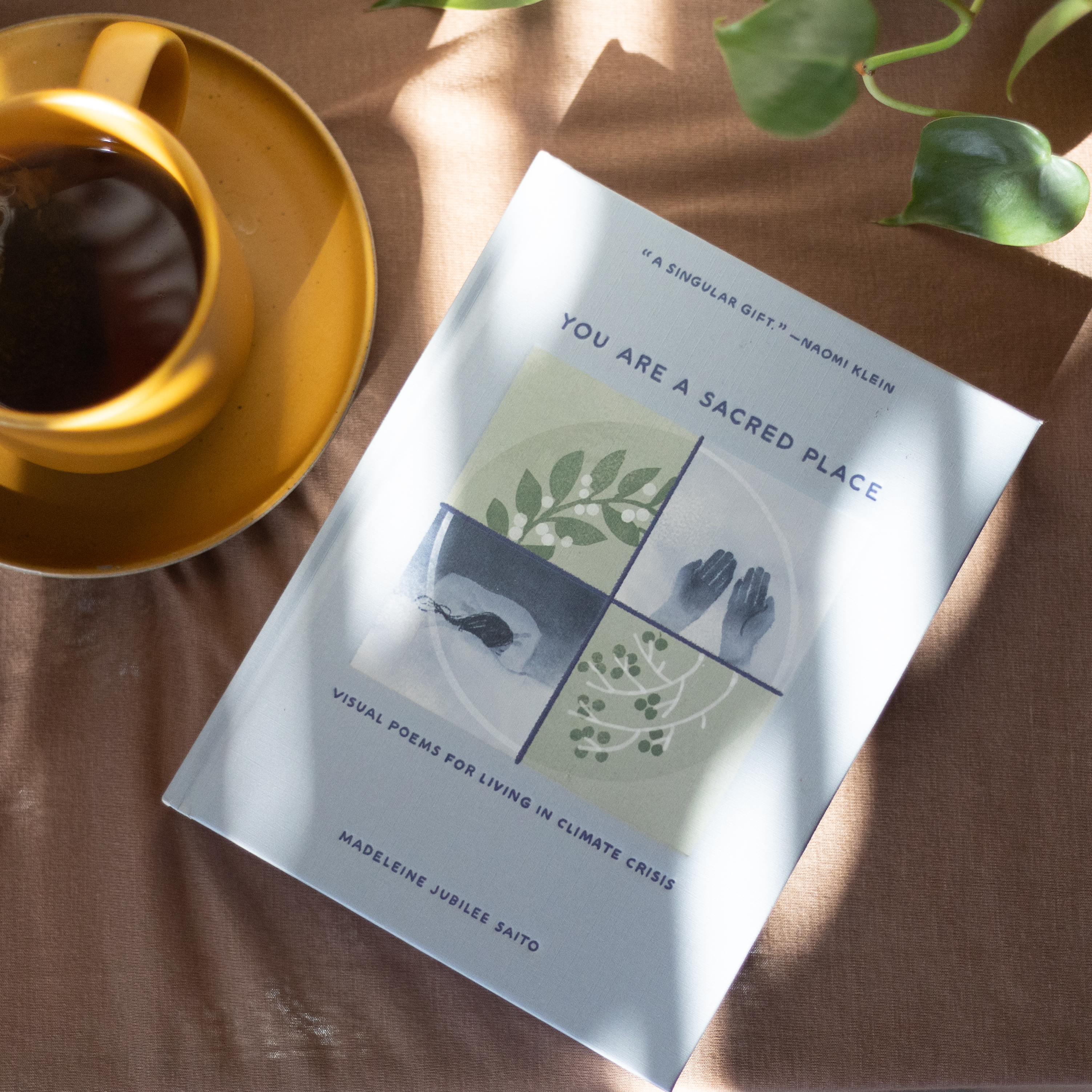
You Are a Sacred Place

[Purchase You Are a Sacred Place]

From the publisher: “In her debut collection of comics, artist and climate activist Madeleine Jubilee Saito offers a quietly radical message of hope. Framed as a letter in response to a loved one’s pain, this series of ethereal vignettes takes readers on a journey from seemingly inescapable isolation and despair, through grief and rage, toward the hope of community and connection. Drawing on the tradition of climate justice, Saito reminds readers that if we’re going to challenge fossil fuel capitalism, we must first imagine what lies beyond it: the beauty and joy of a healed world.”
Roundup: “Art and Religion Now” symposium, landscape of the body, and more

SYMPOSIUM: “Kunst en religie nu” (Art and Religion Now), October 20, 2023, 1:30–4:30 p.m., Museum Catharijneconvent, Utrecht, Netherlands: A week from Friday, attend a free afternoon of talks (in Dutch) on the topic of religion in modern and contemporary art. The speakers are Lieke Wijnia, who will present the results of her past two years of research on religious themes that crop up in modern and contemporary artworks in the Collectie Nederland (Netherlands Collection); Rozanne de Bruijne, on religion in art of the interwar period (1918–1940), the topic of a spring 2025 exhibition she’s curating; Wouter Prins from the Museum Krona, on the state of religious art in the post-Nietzsche era; and Joost de Wal on contemporary art in church spaces. Here’s the autotranslated description:

“The more modern the art, the smaller the presence of religion.” This frequently heard approach appears to be anything but justified. In fact, at the beginning of the twenty-first century, spirituality seems to be on the rise in the visual arts, resulting in a multitude of artistic interpretations. What does this say about the relationship between religion and art?

This symposium focuses on the multifaceted and sometimes unexpected presence of religion in visual art. For example, how does contemporary (religious) art relate to ongoing secularization on the one hand and to flourishing international religious communities on the other? What does the growing interest in spirituality mean for the arts? And what about the use of religious symbolism in visual art, both inside and outside the church? The speakers also shed light on how the wealth of (religious) stories and images can provide guidance in times of social uncertainty and uprooting.

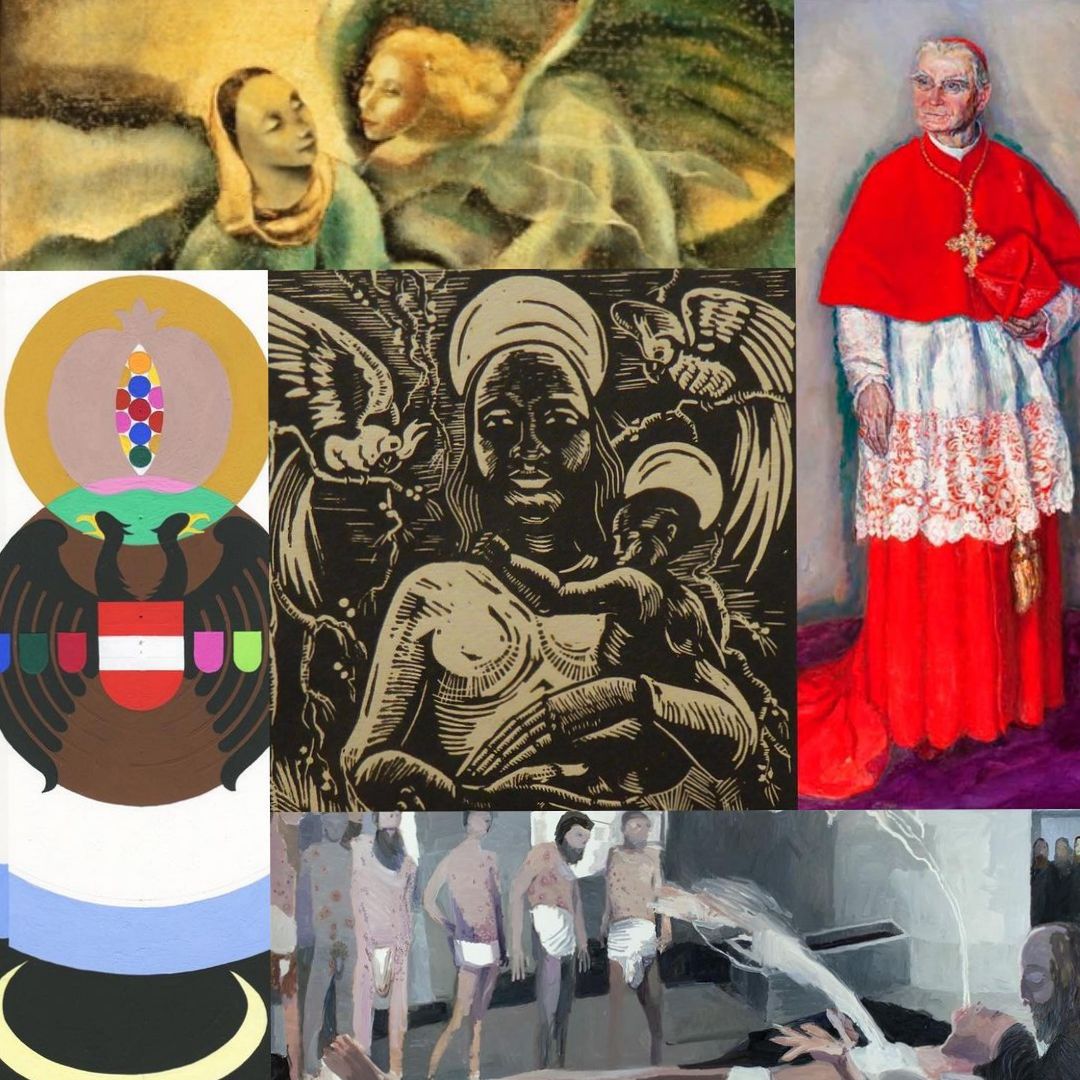
Clockwise from top left: Annunciation by Mariette Lydis (1931); Portrait of Cardinal W.M. van Rossum by Jan Sluijters (1927); The Exorcism of Mary Magdalene by Helen Verhoeven (2020); Path and Puddle, panel 4, by Kasper Bosmans (2022); Black Madonna by Genia van der Grinten-Lücker (1934)

+++

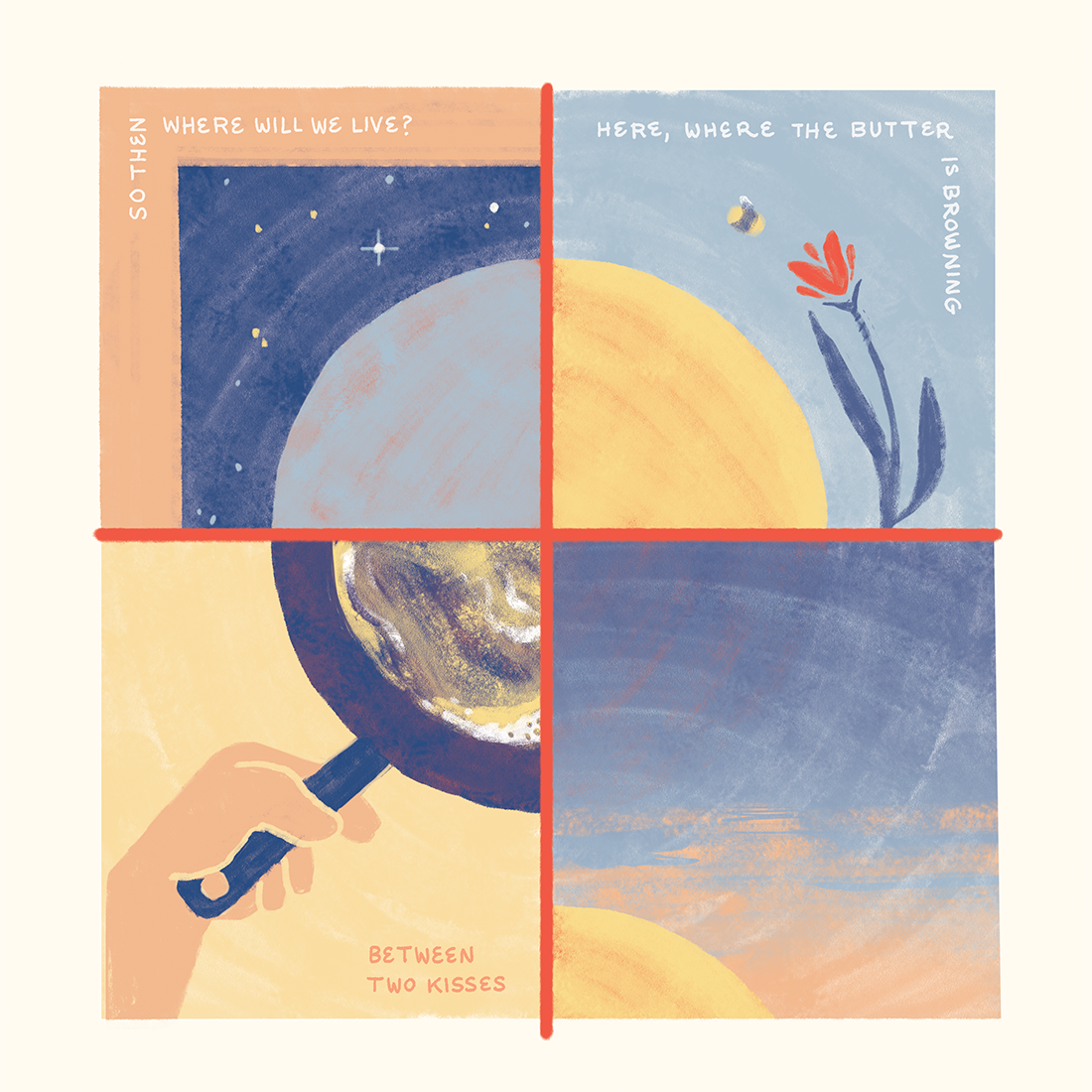
ONLINE WORKSHOP: “Deep Dive into Poetry Comics,” led by Madeleine Jubilee Saito, November 2, 9, 16, 30, 5–7 p.m. Pacific (8–10 p.m. Eastern): Madeleine Jubilee Saito [previously] is a cartoonist from Seattle who makes “poetry comics” about the environment and the sacred—and in four virtual sessions offered through Push/Pull, she’ll teach you how to make your own on topics of your choice!

Saito, Madeleine Jubilee_Love Poem
Madeleine Jubilee Saito, Love Poem, 2019

“In this online course, you’ll practice exercises to explore your own voice and interests in drawing and text, creating poetry comics in a variety of styles. You’ll learn about minicomics, how to do basic layout for printing, and how to print a quarter-page minicomic. We’ll end the course with a celebratory comics reading for friends and family on Zoom. Students need to either be comfortable drawing digitally (Procreate, Photoshop, etc.) or have access to a scanner. Students will be also need access to a printer or local print shop for the last phase of the course.”

If you don’t have time to commit to four classes, there’s a single one offered on October 27.

+++

NEW ALBUM: You Don’t Carry It Alone by Leila Way: Leila Way is a singer-songwriter from Austin, Texas, writing songs for the church. Her first full-length album, “You Don’t Carry It Alone is a collection of songs for hard times. Some of these are old hymns; some were written during a period of intense grief and loneliness, while others grew out of prayers for friends. The album was created to comfort those who mourn; to remind God’s people that He is always faithful, always present and at work, even when we can’t see what He’s up to.”

The album consists of four original songs, two original instrumentals, a cover of “Be Still, My Soul,” and new retunes of George Matheson’s “O Love That Wilt Not Let Me Go” (one of my favorite hymns) and James Montgomery’s “I cannot call affliction sweet.”

+++

CERAMIC BOWLS: Nurture Collection by Jane Boutwell: I met artist Jane Boutwell at a Christians in the Visual Arts (CIVA) conference in 2021 after she presented this body of work that really moved me—a collection of ceramic bowls that take as their three design elements anatomical features of the female breast: lymph nodes (gold, river-like), mammary glands (pink and blooming), and musculature. She started the Nurture Collection after having one of her milk ducts surgically removed in 2019 for a biopsy (it turned out not to be cancer), as a meditation on the strength and inner beauty of this part of the body that is so often objectified or shamed. She recommends the bowls as a gift for a woman in your life who has had a tender year with regard to her breasts—cancer, nursing, etc.—to honor her journey.

Boutwell, Jane_Mammary bowl
Bowl from the Nurture Collection by Jane Boutwell, 2020

I share these now because October is Breast Cancer Awareness Month. Below is an eight-minute video explanation by the artist, followed by a short “making of” montage:

There are five Nurture bowls currently for sale in Boutwell’s online shop: Joan, Tracy, Colleen, Rita, and Wendy. Each is named after a woman she knows with breast cancer.

+++

PODCAST EPISODES:

>> “Landscape of the Body with David Taylor,” Makers & Mystics, September 13, 2023: Constructing a cogent theology of the body, theologian W. David O. Taylor discusses why it’s important that we honor and understand our bodies, and why having a right relationship to our bodies is imperative to the quest of art. Christians have often feared, distrusted, or despised the body; sin has meant that we’ve become alienated from our own bodies and the bodies of others, that we harm our bodies and others’, and that we often flee from our bodies, dissimulate. But Jesus wants us to be at home in our bodies, Taylor says—in worship, and in day-to-day life. He talks about Jesus as an icon of care-filled touch and the implications of that.

>> “On Being in a Body,” On Being with Krista Tippett, September 21, 2023: At the 2023 Aspen Ideas Festival, Krista Tippett interviewed Kate Bowler, author of Everything Happens for a Reason (and Other Lies I’ve Loved), a reflection on how she moved through learning at age thirty-five that she had Stage IV colon cancer. “From the new reality in our time of living with cancer as a chronic illness, to the telling of truths to our young as we face precarity in our collective body, this conversation is full of the vividly-whole humanity that Kate Bowler singularly embodies.” I heard Kate in person at Duke University a few years ago talking on a panel about suffering. She’s full of wisdom, wit, and raw tenderness and so, so endearing, and even though I’ve heard her story many times, every conversation with her brings up something new.  

+++

DANCE PERFORMANCE: Chroma, Grace, Takademe, and Revelations, performed by Alvin Ailey American Dance Theater: I’ve shared a video of Alvin Ailey’s Revelations here before. Well, this rebroadcast from 2015 includes that, plus performances of three other works by the prestigious Alvin Ailey American Dance Theater. I especially enjoyed Chroma, with music by Joby Talbot and choreography by Wayne McGregor—it’s the first twenty-six minutes of the video.

Roundup: Steve Martin on banjo, poetry comic about the Resurrection, and more

BANJO DUET: “Foggy Morning Breaking” by Alison Brown and Steve Martin: Did you know the actor Steve Martin also has a music career? He’s been playing the banjo since he was a teenager, and he writes, records, and tours, both solo and as part of bluegrass bands. He’s even won three Grammys for his banjo music!

Fellow banjoist Alison Brown invited him to contribute to one of the tunes on her forthcoming album, On Banjo, which releases May 5. It’s called “Foggy Morning Breaking.” She wrote and plays the A section; he wrote and plays the B. The piece was released last month as a single, along with this music video.

+++

VIDEO: “Spring” by Jamie Scott: This time-lapse short film of flowers blooming is extraordinary! It’s by visual effects artist and time-lapse photographer Jamie Scott (IG @invisiblejam). The score is by Jim Perkins. [HT: Tamara Hill Murphy]

+++

EVENTS:

>> April 22: “The Ekstasis Café: An Evening of Poetry, Music, Testimony, and Gallery,” Goldberry Books, Concord, North Carolina: Ekstasis is a beautiful quarterly magazine “exhibit[ing] arts and letters that reflect the depths of Christian life.” Next Saturday they are hosting their first-ever public gathering! Their hope with it is to foster meaningful connections, conversation, deep aesthetic encounters, and inspiration.

>> April 28: Artists’ Talk and Reception for The Resurrection and the Life by Fish Coin Press Exhibition, Sojourn Arts Gallery, Louisville, Kentucky: Fish Coin Press (IG @fishcoin.press) is a Richmond, Virginia–based publisher of illustrated books, comics, and trading cards rooted in the story of scripture. They work with a range of artists and are doing really imaginative work.

Procopio, Stephen_Ascension
Stephen Procopio, Ascension, 2020. A full-color version of an illustration for Come See a Man (an illustrated Gospel of John) by Fish Coin Press.

From April 9 to May 28, the gallery at Sojourn Church Midtown in Louisville is exhibiting a selection of art from Fish Coin projects (open Sundays from 9 a.m. to 12:30 p.m., or by appointment); here are a few exhibition views. And two Friday evenings from today, Fish Coin Press creative director Jared Boggess and development lead Stephen Procopio, who are illustrators themselves, will be visiting the gallery to discuss “visual theology” and its role in the local church. There will be a Q&A and a sneak preview of upcoming publications.

+++

POEM: “Psalm” by Dorianne Laux: This poem sings the glories of “the hidden and small,” of the plants and creatures beneath our feet. Read more of Laux’s poems at https://www.doriannelaux.net/poems.

+++

LECTURE: “Resurrection and the Renewal of Creation” by N. T. Wright: In this 2018 lecture sponsored by Lanier Theological Library and Baylor University’s Truett Seminary, ancient historian and New Testament scholar N. T. Wright discusses the meaning of Jesus’s resurrection, a topic he explores thoroughly in the influential academic tome The Resurrection of the Son of God and its more accessible corollary, Surprised by Hope: Rethinking Heaven, the Resurrection, and the Mission of the Church. “Easter is the start of something; it isn’t the ending,” he says. With the resurrection of Christ, the new creation has been launched and put to work in the world. It’s not about securing our souls a place in some nonspatiotemporal heaven when we die but about heaven colonizing earth here and now. We humans, he says, are meant to stand at the place where heaven and earth interlock. We who have received life are to be ourselves life-bringers, to participate in God’s massive renewal project. We are resurrection people!

Wright addresses common Christian misconceptions about death, judgment, and the fate of this world, seeking to root out the corrupting influence of Platonism and other pagan Greek philosophies on Christian eschatology. (For example, the new creation won’t be a creatio ex nihilo, creation out of nothing; it will be a creatio ex vetere, a creation out of the old. The implications of that are huge.) He also affirms the absolute importance of belief in Jesus’s bodily resurrection—his rising is no mere metaphor!—and calls on Christians to recover a centralizing hope in the general resurrection (what he calls “life after life after death”; fully embodied life in the new heavens and the new earth that comes after the not-yet-fully-realized life experienced in the interim between one’s death and the future cosmic coming of Christ) rather than regarding what happens immediately after one’s death as the ultimate beatitude.

Wright always makes me excited about what God’s doing and excited to be a disciple of Jesus. What more could a preacher ask for?

The final half hour of the video is Q&A.

+++

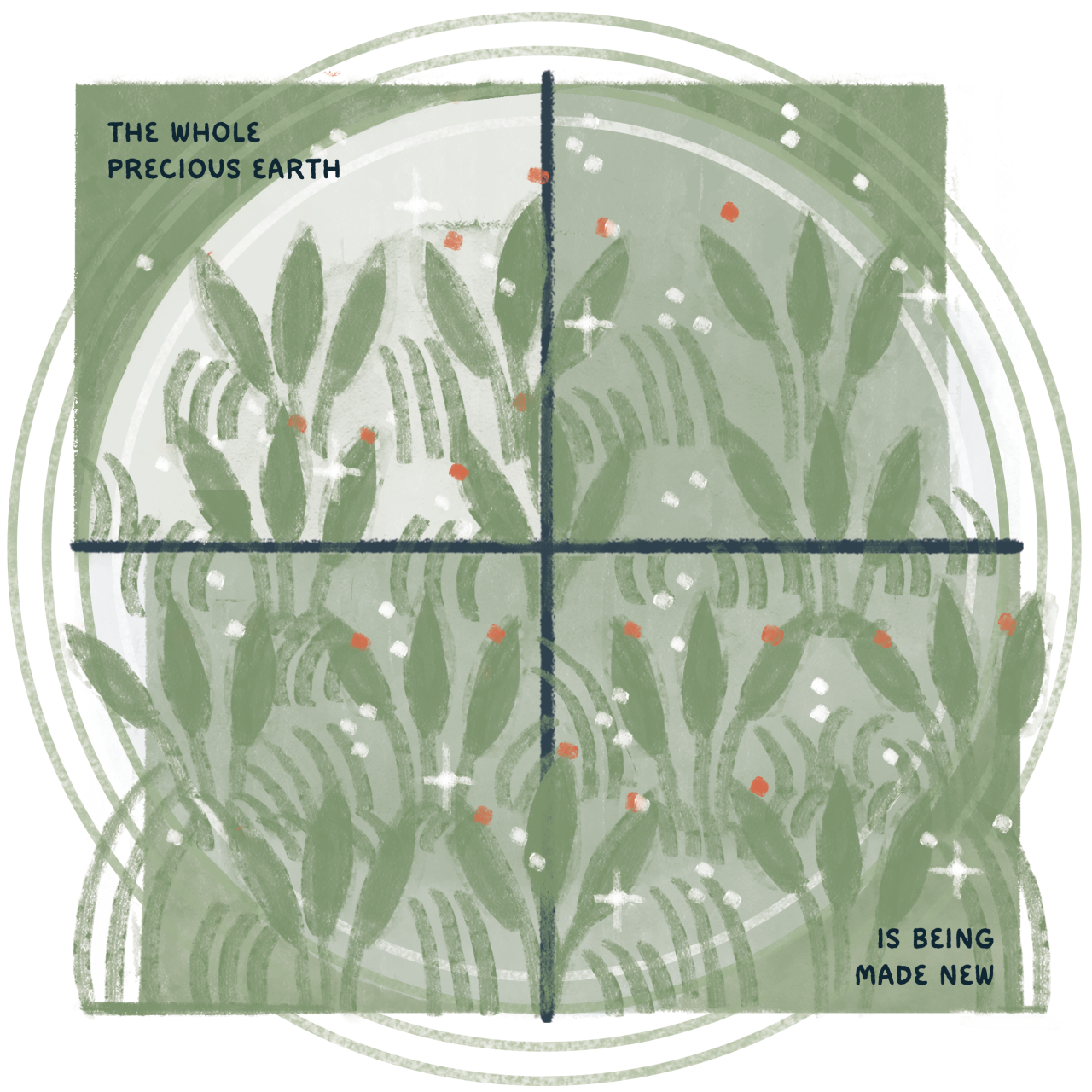
DIGITAL COMIC: 30 Days of Comics (2022) by Madeleine Jubilee Saito: Madeleine Jubilee Saito [previously] is a Seattle-based cartoonist who is interested, as she says on her website, in “friendship, formal experimentation, medieval sacred comics, the built environment, solidarity, climate justice, the psalms, the material world, and the sacred.” Last year she was one of five artists in the inaugural cohort of On Being Project’s Artist Residency; during that time she created “For living, in climate crisis.” Her work is poetic, spiritual, and earthy, and I love it.  

Saito, Madeleine Jubilee_Made New
Comic by Madeleine Jubilee Saito, 2022, the ninth of thirty from “30 Days of Comics.”

In November 2022 Saito made a one-page, four-panel comic (almost) every day for the duration of the month. The series is resurrection-themed and, she told me, inspired by one of my blog posts: the one about Fra Angelico’s Noli me tangere at San Marco, a painting in which Christ the Gardener sows his stigmata across the lawn, as art historian Georges Didi-Huberman so beautifully interprets in his monograph on the artist. Click on the image and scroll down (then, at the bottom, click “←older”) to view all twenty-seven comics from the series. Each can stand alone, but they also have a cumulative effect. It’s stunning! You can follow Saito on Instagram @madeleine_jubilee_saito.

Roundup: Black church–inspired art exhibition; new albums; visual Easter Vigil liturgy; and more

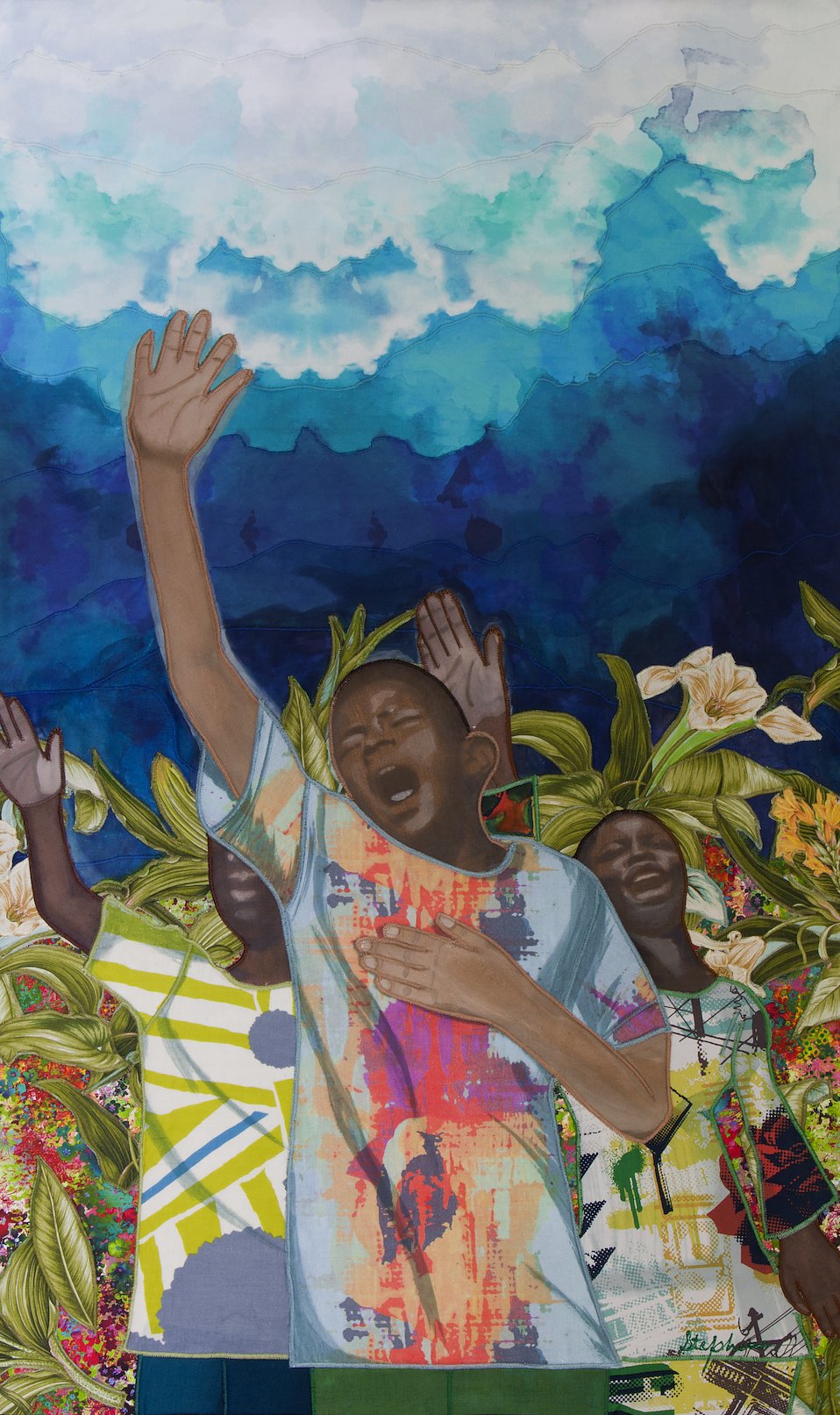
EXHIBITION: Otherwise/Revival, Bridge Projects, Los Angeles, April 9–June 26, 2021: Curated by Jasmine McNeal and Cara Megan Lewis, this group exhibition visualizes the impact of the historic Black church—specifically the Black Pentecostal movement—on contemporary artists. Included are several artists I’ve featured on the blog before—Lava Thomas [here], Kehinde Wiley [here], Clementine Hunter [here], Letitia and Sedrick Huckaby [here]—plus twenty-six others.

Phyllis Stephens (American, 1955–), High and Lifted Up, 2020. Cotton fabric, 57 × 33 in. Private collection. Courtesy of the artist and Richard Beavers Gallery, New York.

Davis, Kenturah_Namesake I
Kenturah Davis (American, 1984–), Namesake I, 2014. Incense ink on rice paper, applied with rubber stamp letters, 39 × 36 in. Courtesy of the artist and the Petrucci Family Foundation, New Jersey.

I regret that I won’t be able to see the exhibition in person, but there’s a wealth of relevant content available on the gallery’s website, including photos, artist bios and statements, and commentaries. I haven’t fully delved in yet, but some of the artist names are new to me, and I look forward to jumping over to their websites to learn more. There’s also a series of free events that have been scheduled. The premiere of the virtual music performance yes! lord by Ashton T. Crawley and a symposium on the Azusa Street Revival have already passed (both are archived online for on-demand viewing), but here are some upcoming opportunities you can reserve a spot for:

+++

ARTICLE: “5 Films About the Beauty of Resurrection” by Brett McCracken: “Resurrection’ tropes are so familiar in certain genres that they can numb us to the jarring beauty and bracing surprise of resurrection. But other films capture the magic and shock of resurrection by situating it within more mundane realities and contexts. Here are five of my favorite examples of this kind—movies that capture resurrection in all of its miraculous, unsettling, hope-giving glory.” One of his selections is Happy as Lazzaro, which I saw last year and enjoyed:

+++

NEW ALBUMS:

>> Hymns I by Lovkn: Steven Lufkin is a singer-songwriter from Phoenix, Arizona, recording under the name Lovkn. His latest EP, a collection of eight acoustic hymn covers, was released April 2. (Also, he’s currently raising funds to record an album of original songs, to be released later this year: kickstarter.com/projects/lovkn/new-album-2021.)

>> Prayers for the Time of Trial by Joel Clarkson: Released April 7, this EP comprises five original SATB choral compositions by Joel Clarkson, which he recorded with his sister Joy Clarkson. My favorite is the first, “Lighten Our Darkness,” a setting of the Book of Common Prayer’s Collect for Aid Against Perils: “Lighten our darkness, we beseech thee, O Lord; and by thy great mercy defend us from all perils and dangers of this night; for the love of thy only Son, our Savior, Jesus Christ. Amen.”

The other four are “Sub Tuum Praesidium” (Beneath Thy Protection), a third-century hymn to the Virgin Mary as Theotokos; “Hail King,” a poem by Joel’s other sister, Sarah Clarkson, that marvels at how rocky cliffs and sea waves and herring gulls sing God’s praises in their own way; “Ubi Caritas,” an ancient hymn centered on the theme of Christian charity; and the simple benediction “May the peace of the Lord be with you now and always.”

In addition to composing music, Joel is also a professional audiobook narrator and the author of Sensing God: Experiencing the Divine in Nature, Food, Music, and Beauty.

+++

ORTHODOX CHANT: Russian Kontakion of the Departed: At Prince Philip’s funeral service at St. George’s Chapel at Windsor Castle on April 17, a choir of four sang, among other pieces, the Russian Kontakion of the Departed, translated into English by William John Birkbeck and arranged by Sir Walter Parratt. “The Russian Kontakion of the Departed is an ancient Kiev chant with its origins in the Russian Orthodox liturgy. This moving chant expresses the sorrow of grief but reminds us of the Christian hope of everlasting life; in the face of sadness, we sing Hallelujahs.” [HT: Global Christian Worship]

Give rest, O Christ, to thy servant with thy saints:
where sorrow and pain are no more;
neither sighing but life everlasting.
Thou only art immortal, the creator and maker of man:
and we are mortal formed from the dust of the earth,
and unto earth shall we return:
for so thou didst ordain,
when thou created me saying:
Dust thou art und unto dust shalt thou return.
All we go down to the dust;
and weeping o’er the grave we make our song:
Alleluia, alleluia, alleluia.

+++

VISUAL LITURGY: “After Ezekiel” by Madeleine Jubilee Saito: Remember those flip books you probably encountered as a kid—the ones with a series of images that gradually change from one page to the next, giving the illusion of animation when viewed in quick succession? Well, this is a digital version of that. In 2019 cartoonist and illustrator Madeleine Jubilee Saito created an image sequence intended to be swiftly clicked through as part of the Easter Vigil at a church in Boston. It was inspired by the story of Ezekiel in the valley of dry bones (Ezek. 37). Very compelling!