Trinity Sunday Roundup

Today, June 4, is Trinity Sunday! Here’s a handful of art and music items on the topic.

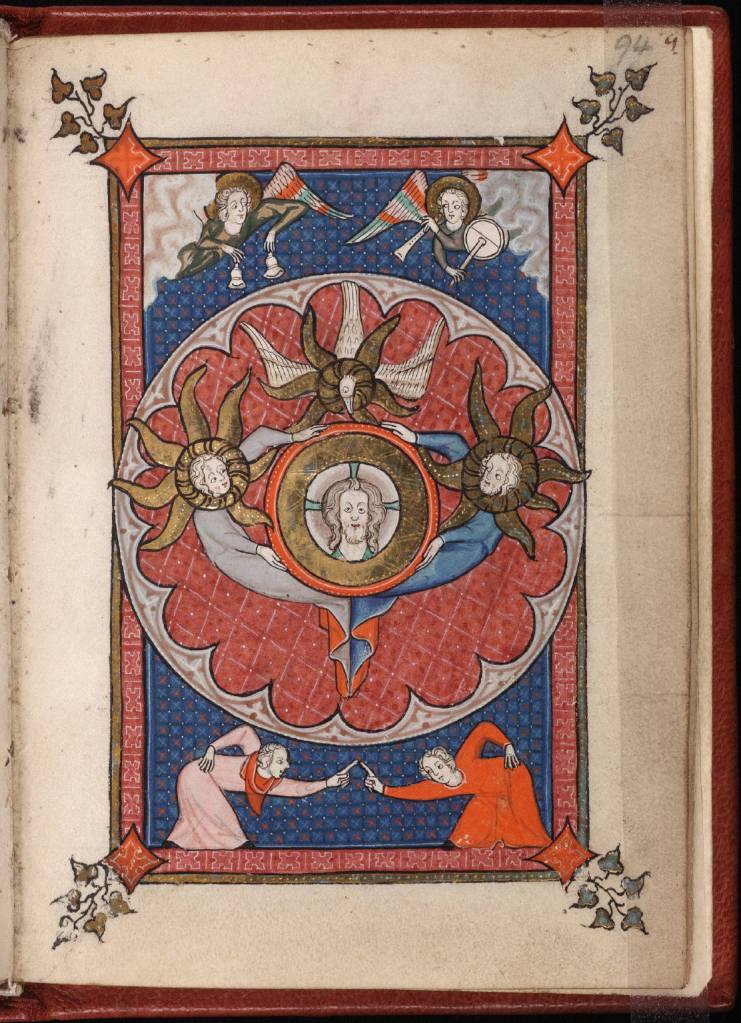
VISUAL MEDITATION: “The Wheeling Playfulness of the Trinity” by Victoria Emily Jones: The Rothschild Canticles [previously] from ca. 1300 Flanders contains some of the most inventive and delightful artistic renderings of the Trinity that I’ve ever seen. I key in on four of them in today’s visual meditation for ArtWay

Beinecke MS 404, fol. 94r

+++

MUSICAL COMMENTARY: “Theology in Sound and Motion: Perichoresis, for Brass Quintet” by Delvyn Case: Delvyn Case provides musical and theological commentary on his brass quintet composition “Perichoresis” (2006), inspired by the divine dance of the Trinity. “Its overall mood is joyous, an ecstatic whirling-about in which all three members become lost in the ecstasy of divine fellowship,” he writes. “At the exact moment of the dance when one member moves, the other fills in the spot left vacant.” “Perichoresis” premiered by Boston’s Triton Brass and appears on Case’s 2018 album Strange Energy. About this piece, Bible scholar and theologian Walter Brueggemann said, “I . . . have pondered ‘perichoresis’ for a long time. This is the finest exposition of that thick idea that I have encountered.”

+++

SONGS:

>> “Trinity Song” by Paul Zach: Performed in 2021 by Solomon Dorsey with Liz Vice and Madison Cunningham, this song by Paul Zach evolved into “God of Grace and Mystery” for The Porter’s Gate’s 2022 album Climate Vigil Songs. This earlier iteration has a Trinitarian focus that’s just lovely. “God of all eternity / Father, Spirit, and the Son / Ever-loving Three-in-One / O divine community / . . . / Calling us to join your dance . . .”

>> “One-Two-Three” by the Chosen Gospel Singers: This song was recorded in Los Angeles for Specialty Records and released as a single in 1952, with singers J. B. Randall (bass), E. J. Brumfield (tenor), George Butler (tenor), Fred Sims (tenor), and Oscar Cook (baritone). It opens with a repetition of the lines “One, two, three / One-in-Three and the Trinity.” The refrain is:

One for the Father
Two for the Son
Three for the Holy Ghost
All made of one

The song is largely eschatological. The first verse is about John the Revelator’s vision of the New Jerusalem descending, among other wonders; it ascribes a vision of the Trinity to John, even though that is not explicit as such in either John’s Gospel or the Apocalypse (but see “The Trinity in the Book of Revelation” by Edwin Reynolds). The second verse anticipates our singing and praising the Triune God in heaven, dressed in our brand-new robes. It also mentions David and Goliath, and I’m honestly not sure how that relates. But with gospel songs, floating lyrics are common, taken from one song and spliced into another, some more coherent than others in their new context.

+++

ESSAY: “The Hospitality of Abraham in the Work of Julia Stankova, Painter of Bulgarian Icons” by François Bœspflug: The first half of this peer-reviewed article introduces readers to the Bulgarian artist Julia Stankova, rehearsing her biography and examining her relationship to the icons tradition. The second half explores twelve of her paintings on the subject of the three angelic visitors to Abraham and Sarah in Genesis 18, whom the narrator suggests are a manifestation of God (“The LORD appeared to Abraham at the oaks of Mamre . . .”); because of the number of visitors, many Christians interpret this passage as revealing something of God’s triune nature, and for this reason traditional icons of the story are often titled The Trinity.

Stankova, Julia_The Hospitality of Abraham
Julia Stankova (Bulgarian, 1954–), The Hospitality of Abraham, 2004. Tempera on primed wooden panel and lacquer technique, 46 × 41 cm.

Since the publication of this article in 2019, Stankova has made at least three more paintings on the subject, all of which foreground Sarah and are titled Sarah’s Smile. She has just heard the angels announce that she will conceive a son in her old age.

+++

POEM: “After Rublev’s Trinity by Carrie Purcell Kahler: Published in Image no. 99 (Winter 2018), p. 21, this ekphrastic poem by Carrie Purcell Kahler interprets the famous fifteenth-century Trinity icon by Andrei Rublev. Sometimes referred to as “the hospitality of Abraham,” this biblical episode, as the iconographers interpret it, is really about the hospitality of God, who extends a hand to humanity, ever inviting us to sit at his table.

Rublev, Andrei_Trinity
Andrei Rublev (Russian, 1360–ca. 1430), The Trinity, ca. 1411. Tempera on wood, 141.5 × 114 cm. Tretyakov Gallery, Moscow.

A new choral setting of this poem by Garrett John Law is premiering today at Holy Trinity Episcopal Church in Covina, California, where Law serves as music director and organist. I believe it can be heard on the 10:30 a.m. PT worship service livestream on the church’s YouTube channel, but I’m not sure whether the performance will be archived online for later viewing. (Update, 6/12/23: Here it is! Sung by Holy Trinity’s seven-person choir.)

Making Music in Quarantine

Here’s a quick roundup of some of the music videos and songs I’ve really enjoyed that have come about as a result of the COVID-19 pandemic.

“He Will Carry You”: A song by Scott Wesley Brown performed by Zanbeni Prasad on lead vocals, with her husband Benny Prasad on guitar and her sister-in-law Aruni Prasad on backing vocals. [HT: Global Christian Worship]

+++

“The Sun Will Rise”: One of The Brilliance’s early songs, from their 2010 self-titled album—sung here by Madison Cunningham [previously], Matt Maher, Liz Vice, Jayne Sugg, Tyler Chester, and David Gungor, with multiple contributing instrumentalists (see full list on YouTube).

+++

“Maren” (Have Mercy on Us): The First Lady of Ethiopia, Zinash Tayachew, sings a new gospel song whose Amharic title, ማረን, transliterated “Maren,” means “Have mercy on us,” a plea addressed to God. “Do not abandon us during this time when the world is terrorized by bad news,” she sings. [HT: Global Christian Worship]

+++

Apocalyptic Lockdown Blues, a new EP by David Benjamin Blower: One of my favorite singer-songwriters, from Birmingham, England. “Apocalyptic Lockdown Blues is a small oral history of a global pandemic,” Blower writes. “This is folk, rootsy and ambient, with sacred longings, poetry and politics, sung out of windows and accompanied by birdsong.”

+++

“A Celtic Prayer”: Produced by Jonathan Estabrooks, this video features the choir of Fifth Avenue Presbyterian Church in New York City singing a traditional Celtic blessing set to music by Barry Peters. It begins, “May the Christ who walks on wounded feet walk with you on the road.”

+++

Virtual May Morning 2020: May Day, May 1, is a public holiday in England, and for the past five hundred-plus years it has been an Oxford tradition to kick off the celebration at dawn by having the Choir of Magdalen College sing unaccompanied in the Renaissance style from the top of the college’s bell tower. Typically a crowd of thousands gathers for May Morning along High Street and on Magdalen Bridge, but this year the event was canceled due to COVID-19. However, Magdalen College pulled off a virtual choir! The boy choristers and lay clerks recorded their parts from home, under the direction of Mark Williams, which were combined in a video that was released online at 6 a.m. local time. [HT: Joy Clarkson]

The choir sings “Hymnus Eucharisticus,” a seventeenth-century Trinitarian hymn, and “Now Is the Month of Maying,” an English ballett (a light, dancelike part song similar to a madrigal) from 1595, about lads and lasses frolicking in the grass. The prayer in the middle is led by the Rev. Dr. Andrew Bowyer, dean of divinity. The actual church bells did ring out the hour like usual, with a celebratory chime following the performance (the chimes in the video were prerecorded).

+++

“Doxology”: One of the things I miss most about communal (in-person) worship is singing the Doxology together with my church family each week. As part of his “Covers from an Empty House” series, Ben Rector has posted a contemplative rendition at the piano, which captures the sense of both mourning and hope that so characterizes this global moment. [HT: TGC Arts & Culture Newsletter]

+++

“I Know Who Holds Tomorrow”: This song was written by Ira Stanphill in 1950 following a painful divorce. It’s covered here by The Petersens, a family bluegrass group from Missouri.

+++

Scott Avett [previously] has been posting #emptylivingroomconcert videos on Instagram since the beginning of the year—just him and his guitar (or banjo) and a sixty-second time limit. Here are a few. (He’s the writer of all these songs, I’m assuming.)

Love That Holds On Tight (Artful Devotion)

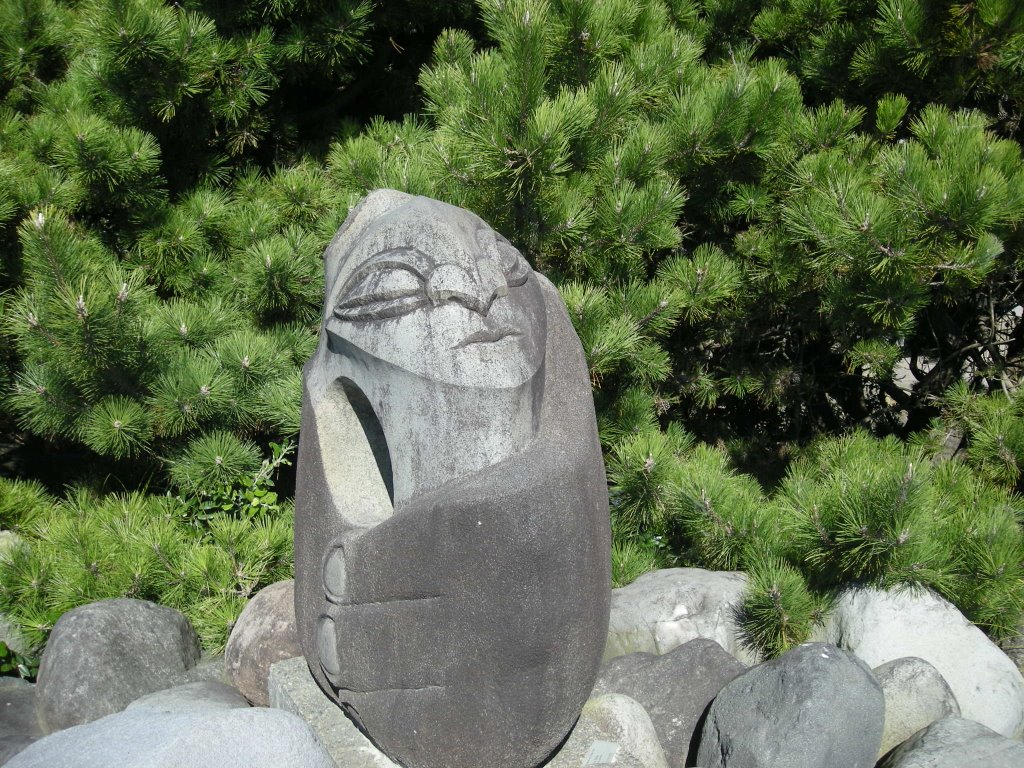
Fakaukau by Filipe Tohi
Filipe Tohi (Tongan, resident in New Zealand, 1959–), Fakaukau, 1996. Stone carving. Photo: Museum of New Zealand Te Papa Tongarewa, via Christ for All People, p. 87

I give them eternal life, and they will never perish, and no one will snatch them out of my hand. My Father, who has given them to me, is greater than all, and no one is able to snatch them out of the Father’s hand.

—John 10:28–29

+++

SONG: “O Love That Wilt Not Let Me Go” | Words by George Matheson, 1882 | Music by Albert L. Peace, 1884 | Performed by Madison Cunningham, on Monuments by Calvary Creative (2015)

+++

Fakaukau (“Thought”) is the title ascribed to this Tongan sculpture in the excellent book Christ for All People: Celebrating a World of Christian Art, published in 2001, which also places it in a private collection. However, photographs of a very similar—if not the same—sculpture by the same artist can be found online under the name Anchor Stone (see photos here and here), and it’s publicly accessible. Its shape is based on the anchor stone through which Tongan fishermen tie the rope of their boats. You can see the hand of God holding the fisher tenderly yet securely as the fisher rests in that grasp.

Anchor Stone by Filipe Tohi
Anchor Stone by Filipe Tohi, located along the Coastal Walkway in New Plymouth, Taranaki, North Island, New Zealand. Photo courtesy of New Plymouth District Council.

Anchor Stone is located along the New Plymouth Coastal Walkway, an eight-mile path that forms an expansive sea-edge promenade stretching from Pioneer Park at Port Taranaki all the way to the eastern side of Bell Block Beach in the Taranaki region of North Island, New Zealand. More precisely, the sculpture sits at the eastern end of a bridge that crosses the Huatoki Stream, near the Wind Wand. The walkway features several other sculptures by Filipe Tohi, as well as artworks by other Pacific Islanders.

Filipe Tohi was born in Nuku’alofa, Tonga, in 1959 and moved to Taranaki, New Zealand, in 1979, where he trained as a carver with a Maori cooperative. His early sculptures were mainly in stone and wood, but more recently he has achieved recognition for large contemporary sculptures in aluminum and steel that are inspired by lalava, traditional Tongan coconut sennit lashing (used to build roofs and canoes). Tohi studied and learned this ancient art form during a return visit to his homeland in 1987 and has been responsible for revitalizing and popularizing it. See more of his work at http://www.lalava.net/index.php/ct-menu-item-17#6.

Christianity took root in Tonga in the first half of the nineteenth century when the country’s king, George Tupou I, converted and the people followed suit. It has been Tonga’s main religion ever since.

+++

I first encountered the hymn “O Love That Wilt Not Let Me Go” a few years ago through a Calvary Collective album—I was extremely moved by Madison Cunningham’s understated arrangement and vocal performance, which captures so well the weary tone of the old text and tune. Cunningham adds a four-line chorus: “You will not let me go, so I will trust in thee. You won’t let go, so I will rest. You won’t let go, so I will trust in thee. O I will rest in thee.” Here is the full original text:

O Love that wilt not let me go,
I rest my weary soul in thee;
I give thee back the life I owe,
that in thine ocean depths its flow
may richer, fuller be.

O Light that follow’st all my way,
I yield my flick’ring torch to thee;
my heart restores its borrowed ray,
that in thy sunshine’s blaze its day
may brighter, fairer be.

O Joy that seekest me through pain,
I cannot close my heart to thee;
I trace the rainbow through the rain,
and feel the promise is not vain
that morn shall tearless be.

O Cross that liftest up my head,
I dare not ask to fly from thee;
I lay in dust life’s glory dead,
and from the ground there blossoms red,
life that shall endless be.

Upon hearing this, I immediately set about looking for a piano score—come to find that the hymn is in the hymnal I grew up with! And yet I don’t recall my congregation ever singing it.

In my estimation, “O Love” is one of the most sublime hymns ever written. It taps deeply into that feeling of “I’m tired, burnt out, spent,” meeting us there with gentle hope and joy. The first verse opens with a reminder of the tenacious hold God has on us and with a soul-invitation into the “ocean depths” of God’s being. What a contrast the hymn builds between our weakness and God’s strength. We flicker; God blazes. We bow our heads in exhaustion and lie down to die; God lifts us up and brings us into his full-flowering life. I know some churches have revived “O Love” using new tunes, but those, I feel, don’t hold a candle to Albert Peace’s original. The hymn often crops up in funeral programs and works beautifully in that context, but its relevance is by no means restricted to those at the end of life or those observing a recent passing.

For a brighter, more vigorous version of the hymn that utilizes the original tune, see Chelsea Moon’s Hymn Project, Volume 2, a collaboration with the Franz Brothers:

And here’s a great a cappella quartet arrangement by the Gaither Vocal Band:

Update, 10/19/20: Since I published this post, a video by 20schemes has been released, of Pete and Cara Bell from Hope Community Church Barlanark in Glasgow performing “O Love That Wilt Not Let Me Go” with the Peace tune I so admire. It’s a straightforward rendition with acoustic guitar, clear and beautiful singing, and lyrics onscreen, so if you’re looking to introduce the hymn to your church music team, this video would be a helpful start.


This post belongs to the weekly series Artful Devotion. If you can’t view the music player in your email or RSS reader, try opening the post in your browser.

To view all the Revised Common Lectionary scripture readings for the Fourth Sunday of Easter, cycle C, click here.