In these long, last days She has borne creation’s Crown; Heavy, sore, afraid, The weight of love is bearing down.
Refrain: We will wait. Even so, Come, Lord, come. We will wait. Even so, Come, Lord, come.
In these long, last days We must bear the weight of sin, Broken, torn, alone, Till you bring your peace to reign. [Refrain]
Bridge: Don’t forget us, Lord, Don’t forget us, Lord, While we wait. (×3) [Refrain ×2]
Sister Sinjin was founded in 2016 by three young moms wanting to record an Advent album: Elise Erikson Barrett, Elizabeth Duffy, and Kaitlyn Ferry. Barrett left the group to focus on her work in the nonprofit and philanthropic sectors, and Duffy and Ferry recorded two more albums. This September the duo announced a name change to A Bright Abyss to reflect the evolution of their vocational identities (they are both now psychotherapists) and music, a genre they call “psychoanalytic folk.”
The lyrics of “In These Long, Last Days,” one of seven original songs on Sister Sinjin’s debut album, were written by Barrett; the music and additional lyrics, by Ferry. The first stanza refers to Mary’s pregnancy with Jesus—her carrying that bundle of Word-made-flesh inside her, eagerly awaiting the birth.
As Mary waited for the Messiah’s first coming, feeling the signs of its nearness in her body, so we await his second, and with it the rebirth of heaven on earth. We do so bearing the weight not of presence but of absence. God is with us in the Spirit, in word and sacrament, and through Christ’s ecclesial body—but the incarnate Christ, the God-man, physically ascended back into the divine realm. “Come back!” we exclaim during Advent, yearning for the return he promised. “Don’t forget us.”
Until that day, we will wait. Even so, come, Lord, come.
Standing at the threshold of another Advent, we hear the invitation of Christ: ‘Come away to a deserted place and rest a while.’ And so we begin our season of growth and expectation—a time to secret ourselves with Mary, to join our hearts with hers, and to grow pregnant with God together. God invites us to a quiet place of reflection and bounty. This Advent, choose some time for silence. Make space within yourself to grow large with the abundance of God’s favor. Make this a time to fill your lungs deeply with God so that you can breathe Christ into the world.
Waiting does not diminish us, any more than waiting diminishes a pregnant mother. We are enlarged in the waiting. We, of course, don’t see what is enlarging us. But the longer we wait, the larger we become, and the more joyful our expectancy.
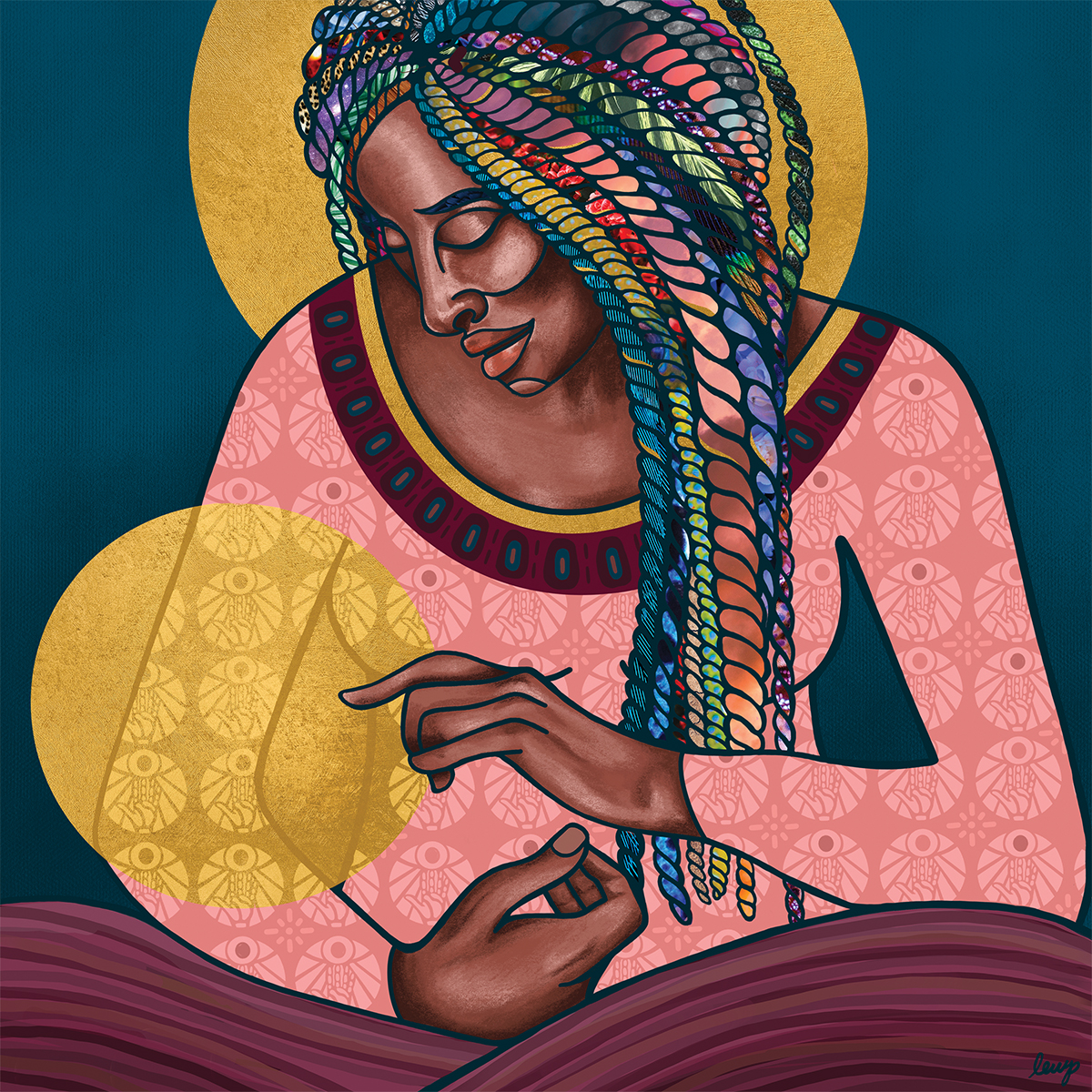
LOOK: Contours of Mary’s Dream by Lauren Wright Pittman
Lauren Wright Pittman (American, 1988–), Contours of Mary’s Dream, 2020. Digital painting with collage, 20 × 20 in. Used with permission.
Contours of Mary’s Dream by Rev. Lauren Wright Pittman of Knoxville, Tennessee, shows Mary, the mother of Jesus, bonding with her in utero son. She sits cross-legged and nimbed, tenderly caressing a hovering gold halo that represents the Holy One, the light of the world, taking shape inside her. Repeated in roundels, the design on her shirt is an upraised, open hand illuminated by sunrays, an allusion to the Magnificat, Mary’s praise song from Luke 1:46–55, which begins, “My soul magnifies the Lord!” A whole world of possibility opens up with God’s taking on flesh. Wright Pittman says,
I have this instinct to read the Magnificat alongside the first creation narrative in Genesis. I imagine Christ taking form in Mary’s womb much like I imagine all of creation emerging at the Creator’s voice. I collaged macrophotography of patterns, textures, and colors from creation—such as sunsets, bird’s feathers, fish scales, galaxies, leaves, planets, fur, water, etc.—and wove them into her hair. Jesus, the thread of creation, is being knit together in her womb. God’s dream for all creation is materializing as cells divide in her body; all the while she sings of a dream, still unrealized.
Creation–new creation, and Jesus the firstborn of both.
There’s wonder and excitement in the image, but there’s also a trace of loss, as the orb that Mary cradles could be seen as not only a potentiality that’s forming, a God-lit body coming to be, but also an absence, the vestigial essence of a boy wrenched from the protective arms of his mother. The artist said she was thinking of the painting Analogous Colors by Titus Kaphar that appeared on the cover of the June 15, 2020, issue of Time magazine, which reported on the nationwide protests in the US in the wake of George Floyd’s murder by a police officer. In Kaphar’s image, a grieving Black mother holds an empty silhouette of her infant close to her chest, alluding to the many African American women whose children’s lives have been taken by police and racist vigilantes.
“When I read the Magnificat, Kaphar’s image came into sharp relief,” Wright Pittman says. “How could I image Mary holding the contours of her dreams for the world, while also holding the contour of her loss? Mary’s son would be publicly murdered at the hands of the state. Mary’s song reverberates for all mothers who have had dreams for their children shattered by senseless violence.”
I originally wrote this description for the Advent 2022 edition of the Daily Prayer Project.
VIDEO MEDITATION: “Yearning and Promise (Advent),” dir. Lauralee Farrer (2017): The first in the seven-part Liturgical Meditations series produced by Fuller Studio (a resource center affiliated with Fuller Theological Seminary), this four-minute video features Advent scripture readings by Fuller alum Paul Mpishi (MDiv, ’17) in his native Swahili, set to beautiful cinematography by Lindsey Sheets, Timothy Kay, and Jordan McMahon.
“Yearning and Promise” explores Advent and the expectant longing for the birth of Christ through cityscapes, wilderness, and water from Chicago and Malibu, with scriptures drawn from Isaiah 40 and Matthew 1. The audio for this video is in Swahili with subtitles in English, Spanish, Mandarin, and Korean—a poetic way to represent the primary tongues of our community. . . .
The liturgical calendar spans the life of Christ in a single year—from anticipation (Advent), to hope (Christmas), to transcendence (Epiphany), to lament (Lent), to redemption (Easter), to the birth of the church (Pentecost), and through long, numbered days (Ordinary Time) back to Advent. The liturgical meditation series to which this video belongs relies on nature to tell the story of God, accompanied by scriptures traditional to each season.
Piero della Francesca (Italian, ca. 1415–1492), Madonna del Parto, after 1457. Detached fresco, 100 × 80 in. (260 × 203 cm). Musei Civici Madonna del Parto, Monterchi, Italy.
>> “Lord, Remind Me” by Jon and Valerie Guerra: From their album It’s Almost Christmas! Jon Guerra writes in the YouTube video description about how most days, hope feels naive; about the narratives in which we misplace our trust; about how Jesus, in his coming, tells a different narrative and brings our hope to fruition.
At Christmastime, Guerra writes,
Christians . . . celebrat[e] the arrival of a “shoot from Jesse’s stump.” It’s a transgressive celebration of fragility and vulnerability. We wanted a fully matured tree—God gave us a shoot coming from a stump. We wanted a strong leader—God gave us a vulnerable baby. We wanted a strength that dominates—God gave us a weakness that submits. We wanted victory—God gave us defeat, destitution, death.
How is this defying of our expectations hopeful? Well, theology at its atomic level says this: God is love. God doesn’t love as a decisive action, as though tomorrow the decision could be reversed. God is, always, love.
That love is not only towards humanity—it becomes humanity. It is not only compassionate towards the broken—it becomes the broken. It is unconditional love that becomes death—and in so doing, defeats it. It defies our expectations only to exceed to them.
So here’s to remembering hope in God’s unconditional love towards the desolate stumpiness of ourselves and the world this season—and to believing that this is not the end of the story. Lord, remind me.
>> “His Name Is Jesus” by Keiko Ying: Released this month on YouTube, this children’s Advent song by Keiko Ying celebrates Jesus as Emmanuel, “God with us.” Here is the lead sheet. The drawings and animation in the music video are by the songwriter’s thirteen-year-old daughter, Clara. [HT: Global Christian Worship]
Since the Middle Ages, the Roman Catholic Church has celebrated May, a time of new growth, as “Mary’s month.” The calendrical placement of this celebration probably has to do in part with the fact that the ancient Greeks celebrated a festival to Artemis, the goddess of fecundity, in May; the ancient Romans, Flora, the goddess of flowers and spring. Because Mary, by the power of the Holy Spirit, conceived in her womb and brought to birth the life of the world, Jesus Christ, Christians see her as standing at the threshold of an eternal springtime.
POLL QUESTION: Before moving on to the six roundup items below, if you are a regular reader of this blog or other media like it, would you please help me out by answering the following poll question? (I’m trying out this WordPress feature for the first time!) Over the years I’ve gathered a lot of compelling poems and artworks on the Annunciation, encompassing a variety of eras, styles, and perspectives, and I’d like to pursue the idea of turning one or the other, or both, into a book. Which kind of Annunciation-themed book would you be most inclined to buy? Keep in mind that a book with art would cost significantly more because it would be in full color and probably a larger hardcover. Also note that a book that combines art and poetry would obviously have fewer selections of each than a book dedicated fully to one or the other.
+++
UPCYCLED MARY STATUETTES:Soasig Chamaillard is a French artist who, since 2006, has been acquiring small, damaged statues of the Virgin Mary—either from garage sales or received donations—and restoring and transforming them, often with reference to children’s toy lines and media franchises, comic book heroes, or other pop-culture icons. Some are silly or irreverent; others, merely quirky. Here are two I like, which both modernize Mary, by her dress or her reading material. Click on the images to view detail photos of the final product, and see here and here for blog posts that document the transformation process.
Before/After. Right: Soasig Chamaillard (French, 1976–), Jeans-Marie (Jeans Mary), 2015. Plaster, acrylic paint, resin, metal frame, height 48 cm.Before/After. Right: Soasig Chamaillard (French, 1976–), Nouvelle Bible (New Bible), 2008. Plaster, acrylic paint, resin, digital print, height 40 cm.
The first shows Mary in high-waisted jeans and red Converse high-tops with rosettes on the tongues. The second one, a Madonna del Parto, shows her pregnant and reading the book J’élève mon enfant (Raising My Child) by Laurence Pernoud, picking up tips on being a new mom.
+++
ESSAY: “Mary: Evolution of a Bookworm” by Joel J. Miller: “It’s unlikely the historical Mary could read at all, but medieval Christians transformed her into an icon of literacy,” often showing her with a book in hand, whether as a child learning to read from her mother, Saint Anne; at the Annunciation, with the book of Isaiah, the Psalter, or a book of hours splayed open on her lap; or teaching her own child, Jesus, how to read. Drawing on the research of Laura Saetveit Miles, author of The Virgin Mary’s Book at the Annunciation: Reading, Interpretation, and Devotion in Medieval England [previously], Joel J. Miller discusses how images of Mary reading “rode a wave of rising female literacy and simultaneously encouraged its expansion.”
Ivory plate of the Annunciation from the Brunswick Casket, made in Metz, France, ca. 860–70. Herzog Anton Ulrich Museum, Braunschweig, Lower Saxony, Germany. This is the earliest known representation of the Virgin Mary with a book at the Annunciation.Lorenzo Costa (Italian, 1460–1535), Annunciation (Mary Reading), first third of 16th century. Oil on panel, 62 × 60.5 cm. Gemäldegalerie Alte Meister (Old Masters Picture Gallery), Dresden, Germany.
+++
CONVERSATION: “Sacra Conversazione” with Walter Hansen and Bruce Herman: In this written conversation from Image no. 62, artist Bruce Herman [previously] and patron Walter Hansen discuss the two large altarpieces Herman produced comprising six paintings on the life of the Virgin Mary: Miriam, Virgin Mother and Second Adam. The article is about the creative process and Herman’s collaboration with Hansen and with student apprentices in Orvieto, Italy, but it’s also about attempting to recover Mary’s image from a heap of the saccharine or overly exalted on the one hand, and ironic detachment on the other. Herman says,
I had vivid memories of Boston art critics and museum people back in the 1980s telling me that [religious] subject matter could only be approached ironically, but I had a persistent feeling that they were wrong. I’ve sensed for many years that the tradition of biblical imagery in art is far from exhausted—maybe simply stalled out due to loss of nerve or imagination. To me, much of the recent religious imagery we’ve inherited is fairly shallow. I know this might sound odd, given more than a thousand years of tradition, but I honestly believe that new insights are arrived at in every generation. Why can’t a contemporary artist paint the Virgin Mary without irony—and maybe even specifically attack the problematic nature of much Marian imagery? Why can’t a century of experimentation in painting yield something relevant to that tradition?
It’s an excellent conversation! You may have to subscribe to Image journal to access it, but it’s well worth it for all the wonderful content they put out quarterly and access to their archives.
Bruce Herman (American, 1953–), Miriam, Virgin Mother, 2007. Oil on wood with silver and gold leaf, 95 × 154 in. (241.3 × 391.2 cm).
Read more about the two altarpieces and view more photos at www.bruceherman.com/magnificat, and in the beautifully produced catalog magnificat, with a foreword by Hansen and essays by Rachel Hostetter Smith and John Skillen. The book also features four paintings from Herman’s related Woman series.
+++
ART VIDEOS:
What follows are my two favorite videos from the Visual Commentary on Scripture’s twelve-episode series “Unlocking Christian Art: The Virgin Mary,” in which theologian Ben Quash and art historian Jennifer Sliwka discuss religious artworks from museums in Berlin.
>> “Holy Kinship”: The subject of this video is a late medieval German limewood carving by Hans Thoman depicting Jesus’s extended family on his mother’s side. He and his mom, grandma, grandpa, step-grandpas, aunts, and cousins pose for this matriarchal family portrait that reflects a medieval legend (rejected by the Council of Trent) that Saint Anne was grandmother not just to Jesus but also, through two subsequent marriages, to five of the twelve apostles: James the Greater, Simon, Jude, James the Less, and John the Evangelist. Also included in this sculpture group are Elizabeth and Zechariah with their son, John the Baptist, and Emelia with her son Servatius of Tongeren, a fourth-century saint whom legends name a distant relative of Jesus. [view object record]
>> “Leave-Taking”: From the same period and general region as the above sculpture comes a painting by Bernhard Strigel (1460–1528) that shows Jesus taking leave of his mother just before his entry into Jerusalem the week of his death, a popular subject in northern Europe in the sixteenth century. The episode derives from a versified Marienleben (Life of Mary) from the early fourteenth century written by the Carthusian monk Philipp von Seitz, aka Bruder Philipp, from Middle Franconia. [view object record]
SONG: “Mary” by Patty Griffin: “Mary, you’re covered in roses, you’re covered in ashes, you’re covered in rain . . .” From the 1998 album Flaming Red by the country-folk artist Patty Griffin, the song “Mary” is a tribute to the woman who mothered Jesus and mothers us all. A compassionate presence who lives on in heaven at her son’s right hand, she feels the pain of other mothers who’ve lost their children. Griffin sings of Mary’s beautiful, big, humble, suffering, nurturing, pondering heart.
+++
POEM: “Christ’s Mother Reflects: His Childhood”by Micha Boyett: This is the last in a series of five Advent poems written from the perspective of Mary for John Knox Presbyterian Church in Seattle in 2010, the other four being on the subjects of the Annunciation, the boy who is snatched away by a dragon in Revelation 12, the Visitation, and the Nativity. Here, after Jesus’s death, Mary reflects back on his life—an early heartbreak of his, his contemplative nature, a question he once asked, his delight in scripture study, the hard choices he made, her own unfulfilled hope for normalcy on his behalf, the tearing of his flesh that mends us.
This book is the first time Hildegard’s writings appeared in English. In selecting, translating, and adapting the material for it, Uhlein worked from the German critical editions of De Operatione Dei (1965), Liber Vitae Meritorum (1972), and Hildegard’s letters (Briefweschel) (1965) and songs (Lieder) (1969), all published by Otto Müller Verlag in Salzburg.
For the original Latin of the above hymn and a more straightforward translation by Nathaniel M. Campbell, see here. This link also includes a musical performance of the Latin (Hildegard wrote her own lyrics and music!).
Hildegard of Bingen, OSB, (ca. 1098–1179) was a German Benedictine abbess, theologian, preacher, poet, composer, playwright, and medical writer and practitioner. She founded the monasteries of Rupertsberg and Eibingen and was named a “doctor of the church” by Pope Benedict XVI in recognition of “her holiness of life and the originality of her teaching.” Hildegard’s most significant works are her three volumes of visionary theology: Scivias (Know the Ways) (for which she also supervised miniature illuminations), the Liber Vitae Meritorum (Book of Life’s Merits), and the Liber Divinorum Operum (Book of Divine Works). But she is also well known for her liturgical hymns and antiphons, as well as the many letters she wrote to popes, emperors, abbots, abbesses, fellow mystics, and layfolk, dispensing wisdom and advice.
Gabriele Uhlein, OSF, (born 1952) is a retreat guide, workshop leader, and artist dedicated to the recovery of the Christian mystical tradition and the honoring of intuition and creativity in spiritual deepening. Born in Klingenberg, Germany, she emigrated to the US at age two. She has a PhD in process theology and Jungian-oriented psychology from Chicago Theological Seminary and is a member of the core staff at the Christine Center, a natural sanctuary in Willard, Wisconsin, rooted in the Franciscan principles of contemplation, hospitality, compassion, simplicity, transformation, and care for the earth.
The heavens bespeak the glory of God.
The firmament ablaze, a text of his works.
Dawn whispers to sunset.
Dark to dark the word passes: glory glory.

All in a great silence,
no tongue’s clamor—
yet the web of the world trembles
conscious, as of great winds passing.

The bridegroom’s tent is raised,
a cry goes up: He comes! a radiant sun
rejoicing, presiding, his wedding day.
From end to end of the universe his progress.
No creature, no least being but catches fire from him.
This paraphrase of Psalm 19:1–6 by Daniel Berrigan is from Uncommon Prayer: A Book of Psalms(University of Michigan Press, 1978; Orbis, 1998).Used by permission of the Daniel Berrigan Literary Trust. www.danielberrigan.org
The first section of Psalm 19 is about how the natural world declares the glories of its Maker. The night sky, the psalmist describes, is like a tent that spreads its cover over the sun, parting open every morning to release it on the world. The sun is compared to a bright-eyed, handsome, and happy bridegroom emerging from his chamber, and to a vigorous runner who tracks a massive course.
I like to read Psalm 19:1–6 for Advent, especially the poet-priest Fr. Daniel Berrigan’s paraphrase of it, as his use of he/him/his pronouns instead of it/its draws out a Christological connection I hadn’t seen before in this text, made even more pronounced by the apocalyptic tone Berrigan adopts and the sense of excitement he conveys. The poem can, of course, be read as simply the glorious waking of a day, as the psalmist intended. But there’s another layer I want to explore: signs in the heavens, and the coming of Christ.
In the Christian tradition, Jesus is compared to both a sun and a bridegroom, and he, too, like the skies, “bespeak[s] the glory of God.” “Oriens”—Dawn or Dayspring—is one of the traditional titles of Christ, typically invoked in liturgies on December 21 as part of the O Antiphons cycle. From the Church of England’s Common Worship: “O Morning Star, splendor of light eternal and sun of righteousness: come and enlighten those who dwell in darkness and the shadow of death” (cf. Luke 1:78–79; John 8:12; Mal. 4:2). The coming of Jesus—in Bethlehem, in human hearts, and on the last day—illuminates and sets ablaze, revealing who God is and who we ourselves most truly are and exciting the world, flinging abroad the divine light.
As for the bridegroom, Jesus uses this metaphor for himself in his parable of the ten bridesmaids (Matt. 25), as God does in Isaiah 62:5, and indeed one of the major motifs in the book of Revelation is a wedding between Christ and his people. Christ will return to us, scripture suggests, like a husband coming to bring home his new bride.
One of the antiphons for First Vespers of Christmas, I’ve just learned, sung the evening of December 24, connects the bridegroom of Psalm 19 with Jesus. Cum ortus fuerit sol de caelo, the church chants, videbitis Regem regum procedentem a Patre, tanquam sponsum de thalamo suo. (“When the sun shall have risen in the heavens, ye shall see the King of kings coming from the Father, as a Bridegroom from his bride-chamber.”)
Tanja Butler (American, 1955–), Woman Clothed with the Sun, 2008. Acrylic paint, collaged painted paper, and cotton fabric on gessoed acid-free paper, 14 × 5 in. Collection of Victoria Emily Jones.
Artist Tanja Butler further extends Psalm 19’s fittingness for Advent by drawing the passage into conversation with Revelation 12:1–6. This section of John’s Apocalypse introduces us to “a woman clothed with the sun, with the moon under her feet, and on her head a crown of twelve stars”; she gives birth to a baby boy “who is to rule all the nations” but whom a great dragon seeks to devour. In most Christian interpretations, this Woman of the Apocalypse is associated with the Virgin Mary, and there’s a robust iconographic tradition in this vein.
Butler innovates on that tradition with her mixed-media work Woman Clothed with the Sun by showing the infant Jesus busting out of his mother’s womb like the strong athlete of Psalm 19:5. (Ready. Set. Go!) He has a race to run, a mission to fulfill. He is also shown as the sun that clothes his mother and that emerges from a dark (uterine) tent. He is the source and center point of the explosive rays of colorful light in the painting.
In an ArtWay profile, Butler describes her piece as follows:
Mary is represented with the unborn Christ, Light of the World, ready to “come forth from his pavilion, like a champion rejoicing to run his course” (Psalm 19:5). She holds a ladder, referencing both Jacob’s vision and the cross, the ladder of ascent between earth and heaven.
This is a cosmic birth necessitated by a cosmic struggle that will resolve in a cosmic victory: the reunion of God and humanity.
Daniel Joseph Berrigan, SJ, (1921–2016) was an American Jesuit priest, peace activist, award-winning poet, and professor of theology and biblical studies. Through his writings and public witness, he endorsed a consistent life ethic, opposing war, nuclear armament, abortion, capital punishment, and the causes of poverty in the name of Jesus Christ and his holy gospel. Fr. Berrigan, along with his brother Philip, was one of the Catonsville Nine, imprisoned in 1968 for destroying draft files in a protest against the Vietnam War. Later, he spent much of the eighties ministering to AIDS patients in New York City. He is the author of some fifty books.
Tanja Butler (born 1955) is a painter and liturgical artist based in the Albany, New York, area. Her subjects are devotional in character, and her sources of inspiration include Byzantine icons, medieval art, and folk art. Her work is included in the collections of the Vatican Museums, the Hammer Museum in Los Angeles, the Portland Museum of Art in Maine, and the Boston Public Library. “My aim is to develop imagery that has the simplicity and clarity of a child-like vision,” she says, “required, we’re told, if we are to see the kingdom of God.”
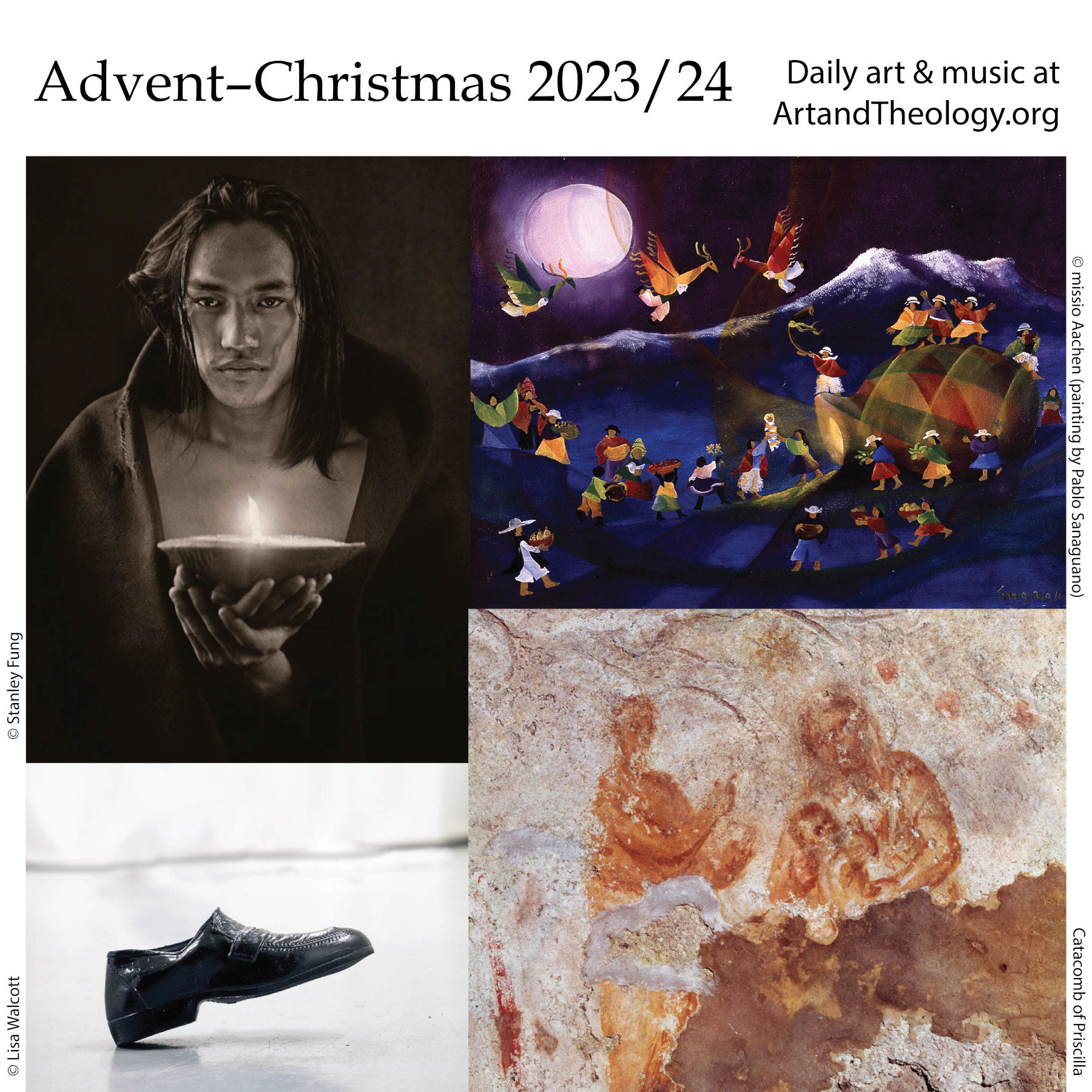
This year I’m continuing my Advent and Christmas tradition of daily art-music pairings on the blog, from December 2 (a prologue before the official start of Advent on December 3) through January 6, Epiphany. If you know of anyone who might be interested to follow along, they can subscribe here.
An ancient catacomb painting, a contemporary light installation, an Urdu anthem, a French West Indian carol, an Ethiopian tapestry, an impearled chasuble, a kinetic sculpture, a jazz rhapsody, a Byzantine-inspired piano quintet, an isicathamiya-style song, a Puerto Rican bulto, a Netherlandish altarpiece, and settings of Herbert, Blake, Wilbur, and Augustine—these are some of the gifts from artists on offer this season, inviting us to deepen our desire for and celebration of Christ Emmanuel, God with us.
+++
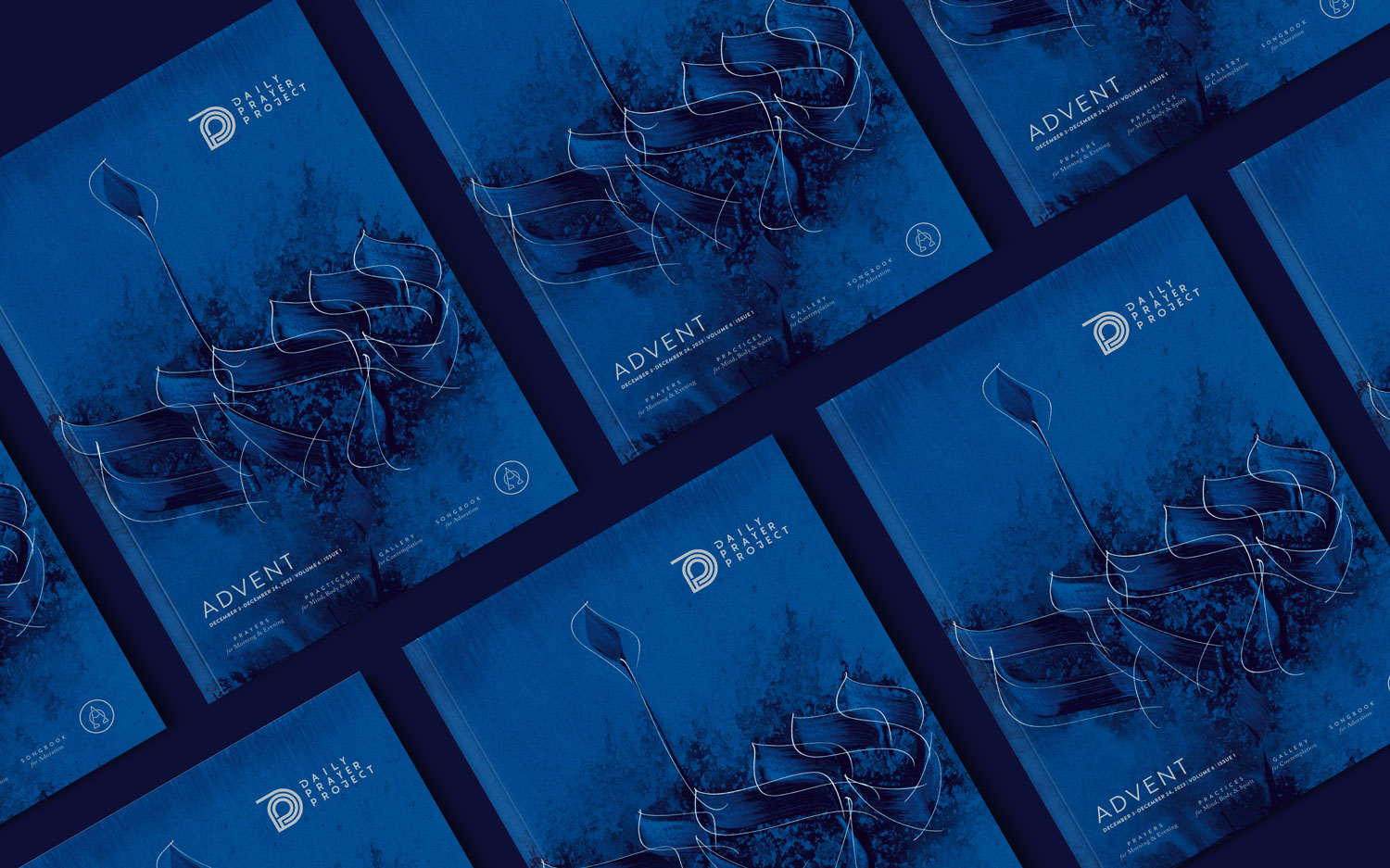
THE DAILY PRAYER PROJECT:Advent 2023: With Advent comes the start of a new liturgical year—which means a new volume of the Daily Prayer Project’s Living Prayer Periodical! Published in six editions a year, this periodical aims to “connect and unify Christians by resourcing them with daily prayers, practices, and music from the global-historical church, and visual art of spiritual and artistic value.” I curate the art. The cover image for Advent 2023—which, providentially, was finalized before the Hamas attack on Israel on October 7 and the ensuing retaliations—is a calligraphic rendering of the Hebrew word shalom by Michel D’anastasio, a French Catholic artist with Jewish ancestry. The lamed is like a candle held hopefully aloft against a dark-blue midnight.
Rev. Joel Littlepage, who is the pastor of worship and formation at Grace Mosaic in Washington, DC, curates the prayers. Here’s Friday evening’s, from the church in New Guinea: “Lord, oil the hinges of our hearts’ doors, that they may swing gently and easily to welcome your coming.” Wednesday morning’s prayer is a responsive confession by Jorge Lockward, a Dominican song leader from New York, which begins, “Por tantas injusticias, perdón, Señor. Por tanta indiferencia, perdón, Señor.” (For so much injustice, forgive us, Lord. For so much indifference, forgive us, Lord.)
+++
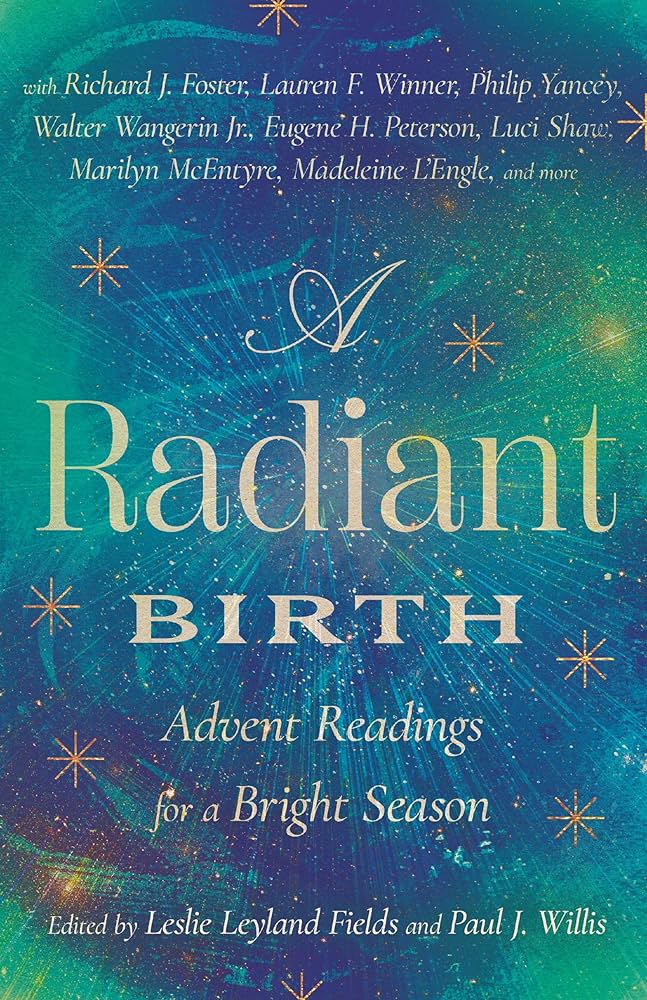
NEW BOOK: A Radiant Birth: Advent Readings for a Bright Season, ed. Leslie Leyland Fields and Paul J. Willis: New this fall from InterVarsity Press, this Advent devotional book is a multiauthor compilation of forty-two readings for Advent through Epiphany, consisting of literary essays, poems, and short stories. Contributors are affiliated with the Chrysostom Society and include Richard Foster, Lauren Winner, Madeleine L’Engle, Philip Yancey, Walter Wangerin Jr., Eugene Peterson, Luci Shaw, and Marilyn McEntyre. About one-third of the content is previously unpublished, including a wonderful little reader’s theater (pages 81–89) by Leslie Leyland Fields that I can imagine working really well as part of a church service (and I received confirmation from Fields that people may use it freely in such settings). I know the market is really thick with Advent books, and I’ve read a lot of them, but this one has to be one of my favorites—the selections are wonderful.
+++
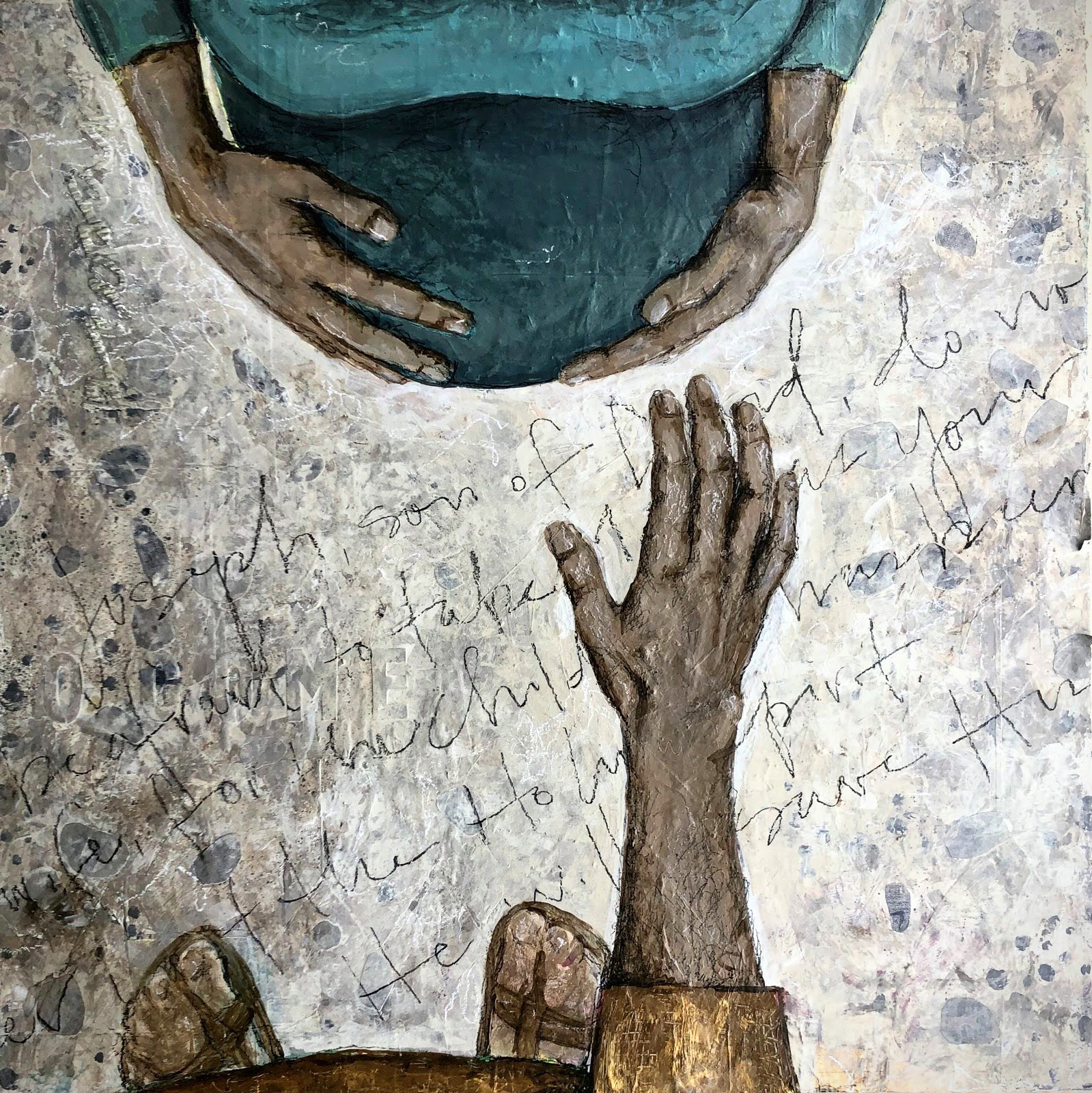
ART SERIES: Advent by Riki Yarbrough: For Advent 2018, artist Riki Yarbrough set herself a challenge: each day, create a 24 × 24-inch mixed media work corresponding to that day’s family devotions, structured around Jesus’s lineage. She didn’t have nearly enough canvases to last the duration of the season, so on day two “I woke up, took the very same canvas I had painted the day before, and worked right on top.” The final product was an artwork twenty-seven layers deep—the various people, prophecies, and foreshadowings adding weight and texture to the progressing story that culminated, in Yarbrough’s devotional program, with the infant Christ in a manger. “To cover the previous day’s work under the beauty of a new focus and set of Scriptures became both an offering and a sacrifice,” she said. “I wasn’t worried about meeting someone’s expectation or coming back to rework it later. I was simply conversing with the Lord over the truth of His Word in those wonderful moments on that particular day.”
Riki Yarbrough (American, 1975–), Joseph, Husband of Mary, 2018. Mixed media on canvas, 24 × 24 in.
Here’s a thirty-second time lapse of the Cain and Abel composition transforming into Noah:
In Advent 2022 Yarbrough reprised the daily challenge, this time executing her images on separate canvases. You can find this series on her Instagram @rikiyarbrough, starting with the candle image—but you can also purchase it in book form, as this month, Yarbrough released Advent in Art and Verse, combining full-color photos of all twenty-seven works from her 2022 Advent series with scripture passages and original poetic reflections. I received my copy, and my first impression was: what a beautiful design!
I like the allusiveness of her paintings: a set of footprints, stalks of grain, a red cord, tongs gripping a hot coal, tree rings, harp strings, a split fig, a cairn—simple objects like these guide us through the narrative of the Old Testament and the opening pages of the New.
+++
SONG MEDLEY: “O Come, O Come, Emmanuel / Come, Thou Long-Expected Jesus” by the Petersens: In this video shot in Weddings at the Homestead in their hometown of Branson, Missouri, family bluegrass band The Petersens perform the two best-known Advent hymns—the one mournful, meditative, and minor key, the other bright and exuberant. They recorded both songs (released as two separate tracks) for their 2020 album Christmas with the Petersens.
+++
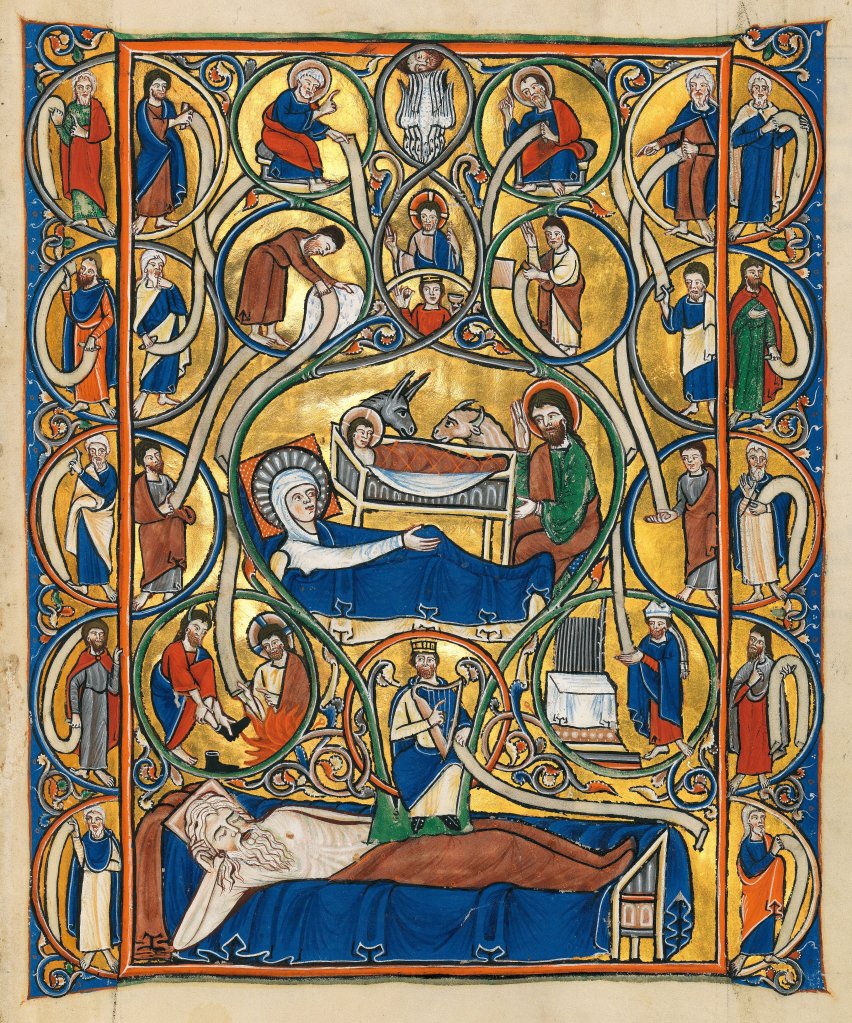
SUBSTACK POST: “O Come, Thou Rod of Jesse” by Grace Hamman, Medievalish 1.12, December 12, 2022: In last December’s installment of her monthly Medievalish newsletter, Grace Hamman considers Jesus’s family tree, visualized in the Middle Ages as what’s called, after Isaiah 11:1, the Tree of Jesse [previously here and here]. What does it mean that Jesus came from a real human family, a “complex web of generation, adoption, relationship, and dependence”? “The Son did not only take on flesh,” Hamman writes, “he took on David’s sometimes troublesome courage and cowlicks, Anne’s devotion and double-jointed pinky fingers. He comes from a line of real and complex people: faithless and faithful, abusers and abused, holy and broken. Baby Jesus is born into our funny human particularities and our burdensome histories, into created time and place.”
Tree of Jesse from an English Psalter in Latin, ca. 1190–1210. Bayerische Staatsbibliothek, Munich, BSB Clm 835, fol. 121r.
+++
PODCAST EPISODE: “The Season of Waiting (and Waiting . . . and Waiting),”Everything Happens with Kate Bowler, November 29, 2022: In this podcast episode from the beginning of last Advent, bestselling author Kate Bowler introduces the season as one of waiting. She explains the history of the Advent wreath, and takes calls from listeners who share Christmas traditions they observe to honor a loved one they’ve lost. Be sure to download Bowler’s 2023 Advent guide, titled Bless the Advent We Actually Have. Here’s an excerpt from Day 1:
Advent is a time marked by waiting. We wait for God to make all things right. For justice to be meted. For democracy to feel stable. For wrongs to be righted. For our communities to be safe spaces for the vulnerable. For our earth to heal. We wait for our lives to get easier—for us to have the financial security we need, for our relationships to be restored, for our bodies to ache less. We wait for our parents to understand us and our families to feel whole. We wait for our kids and grandkids to be healed or come back home. We wait for the grief to end.
But the waiting of Advent is one marked by hope. We wait with expectancy. With anticipation for the inbreaking of God to make all things new. . . .
Advent hope is gritty. It shirks all false optimism. It is hope as protest. Hope in the face of impossibilities. . . .
The excerpt Bowler reads in the podcast is from her 2022 Advent guide, The Season of Waiting (and Waiting . . . and Waiting . . .) (which you can also download for free, along with 2021’s A Good Enough Advent + Christmastide, at https://katebowler.com/advent/).
Many Catholics and Orthodox decry that Protestants really only ever talk about Mary during Christmas. While she does get some extra attention here on the blog in December, I also try to talk about her throughout the year, from the feasts of the Annunciation (March 25) and the Visitation (May 31) to her witness during Holy Week and Pentecost and her being such an important figure in Jesus’s life and exemplary for our own. Here’s a new Marian roundup, plus at the bottom a Christmas gift idea involving a product I helped create. 🙂
VISUAL MEDITATIONS:
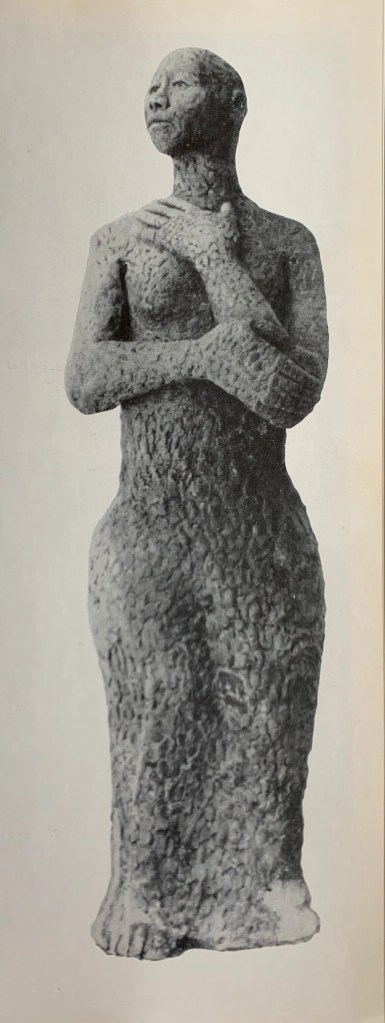
>> “Wondrous” by Paul Simpson Duke, Seeing the Sacred: In 2019, Rev. Drs. Paul and Stacey Simpson Duke, co-pastors of First Baptist Church in Ann Arbor, Michigan, ran an Annunciation art series on their blog, meditating on one artwork on the subject per day for twenty-five days. I commend the whole series, but I was particularly compelled by Day 13, which centers on a terracotta sculpture made by the late Kenyan artist Rosemary Namuli Karuga when she was a student at Makerere College Art School in Uganda. Paul Duke considers especially the mixture of sorrow and awe expressed in the figure’s face.
Rosemary Namuli Karuga (Kenyan, 1928–2021), Mary, ca. 1950. Terracotta. This image is Plate 4 in the book Christian Art in Africa and Asia by Arno Lehmann.
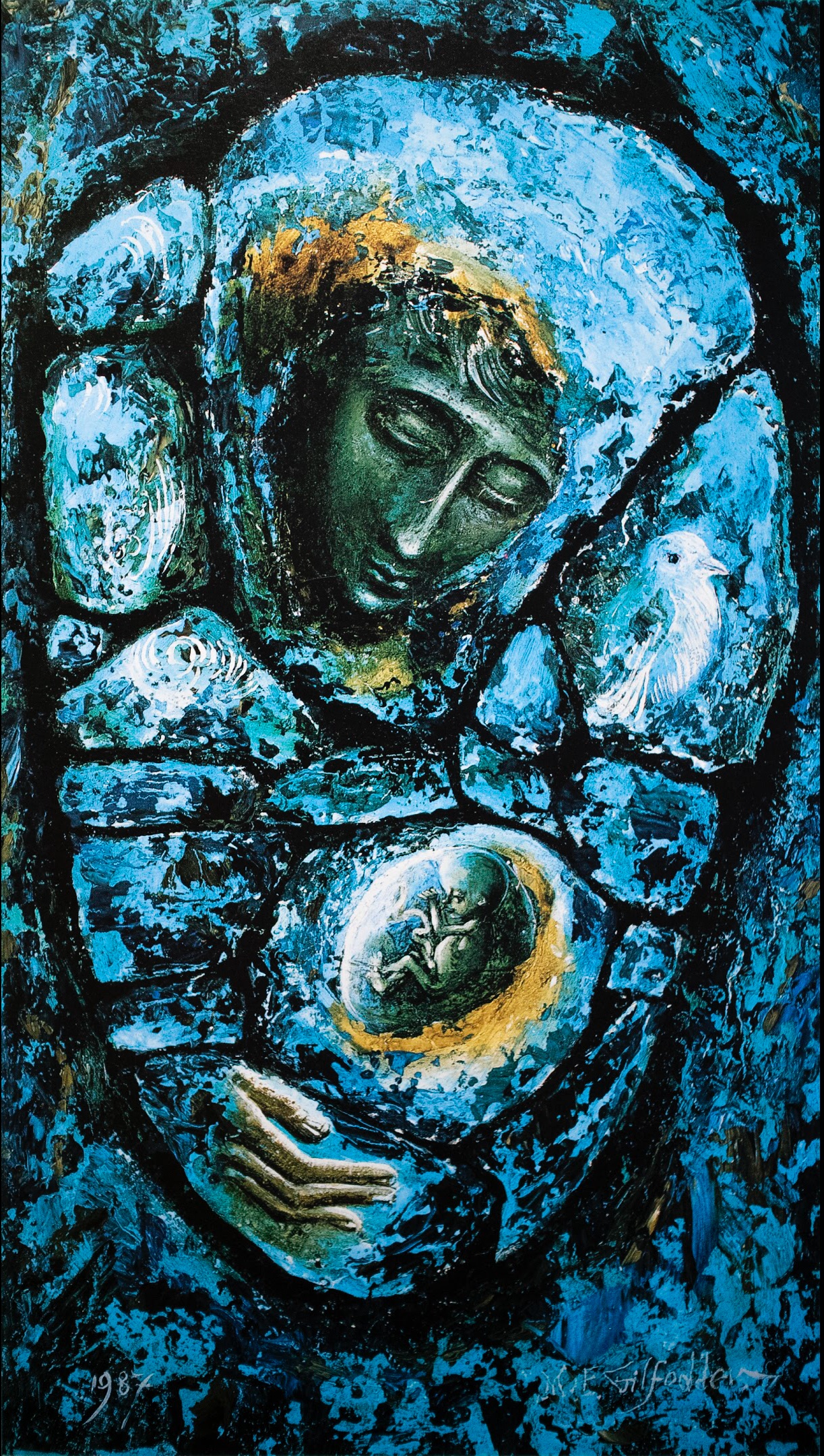
>> “Pregnant with God” by Victoria Emily Jones, ArtWay: For the first Sunday of Advent, I wrote about the painting Blue Madonna by Scottish Catholic artist Michael Felix Gilfedder, which shows the Christ child developing inside Mary’s womb. Pregnancy has always been an image I’ve carried with me during Advent, as it embodies the expectancy characteristic of the season—the growth of new life, a hidden fullness, about to come forth.
Michael Felix Gilfedder (Scottish, 1948–), Blue Madonna (Mary, Mother of God), 1987. Oil and tempera on wood with gesso relief, 25 1/4 × 13 in. (64 × 33 cm). Private collection, London. [prints for sale]
+++
PODCAST EPISODES: Both of the following come from For the Life of the World, the podcast of the Yale Center for Faith and Culture. Released back-to-back last December.
>> “Mary Theotokos: Her Bright Sorrow, Her Suffering Faith, and Her Compassion” with Frederica Mathewes-Green:Frederica Mathewes-Green is an American author and speaker, chiefly on topics related to Eastern Orthodox belief and practice. Here she discusses the Orthodox reverence for Mary; the scriptural account of her life; Mary as the mother of us all; the Protevangelium of James, which provides legendary material about Mary’s upbringing and betrothal; the ancient prayer “Sub tuum praesidium” (“Under Your Compassion”) from 250 CE, the earliest known appearance of the title “Theotokos”; and Mary’s role as intercessor. The latter point is something that Protestants like me are wary of—praying through saints who have passed on is not something I practice—but the way Mathewes-Green explains it is, just as we would ask fellow believers on earth to pray for us, why shouldn’t we also ask our friends in heaven to do the same, if we truly believe that they are alive and that we are in communion with them (as we confess in the Apostles’ Creed)?
Besides explicating several Marian doctrines, Mathewes-Green also speaks of Mary as an ordinary human being with an extraordinary call. With tenderness, she considers Mary’s experiences and emotions at different life stages: first as a perplexed young woman who is taken aback by Gabriel’s announcement but ultimately responds with humility and magnanimity, then as a parent who raises a child and later witnesses his violent death.
>> “A Womb More Spacious Than Stars: How Mary’s Beauty and Presence Upends the Patriarchy and Stabilizes Christian Spirituality” with Matthew J. Milliner: Matthew Milliner, an art history professor at Wheaton College and the author of Mother of the Lamb: The Story of a Global Icon, is a Protestant who wants to see other Protestants embrace a more robust doctrine of Mary as Theotokos, “Mother of God,” and develop a keener sense of her ecclesial presence. In this hour-long conversation he discusses Mary as person and as symbol; the need for “hermeneutical adventurousness anchored in the revelation of God in Christ”; how icons work, and particularly how Marian icons are spiritually formative; how to read a Nativity icon; the feminist objection to Mary; how Mary upends the ancient pagan goddess culture; and how we all must be Marian if we are to be orthodox Christians.
VIDEO: “Magnificat” by SALT Project: This short film features a reading of the Magnificat in Spanish, its words fleshed out in contemporary images. For the same video but in English, see here.
+++
ARTICLE: “The Political Is Personal: Mary as a Parent and Prophet of Righteousness” by Erin Dufault-Hunter, Fuller Magazine: What does the New Testament mean by “righteousness” (dikē)? Is it personal piety, or social justice? This article by Christian ethics professor Erin Dufault-Hunter examines how Mary upholds both connotations of the word. “Perhaps more than anyone else, Mary displays for us how saying yes to the kingdom, and its unlikely king, necessarily involves the personal but also reorients our social and political allegiances,” Dufault-Hunter writes. “Intimacy with God necessarily entails a political orientation, bringing or solidifying a way of seeing power and position.” Debunking the claim that Jesus’s coming was not political, Dufault-Hunter considers Mary’s Magnificat as well as other elements of the Christmas story—like the title “Son of God,” the word “gospel,” and the angels’ potentially treasonous news to the shepherds—showing how the good news of Christ is both personal and political.
+++
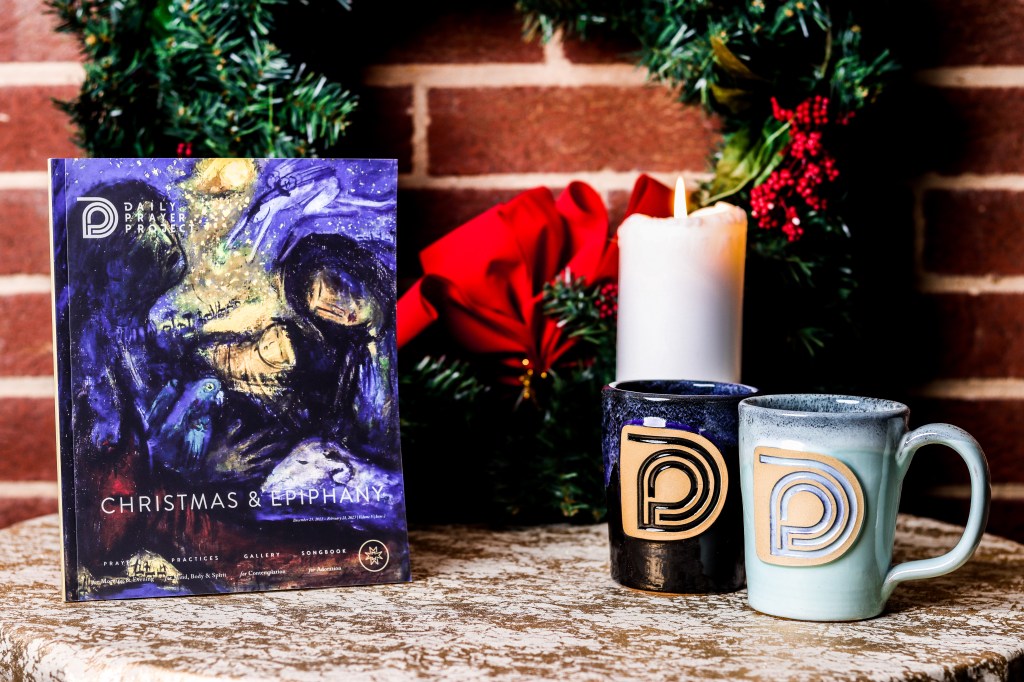
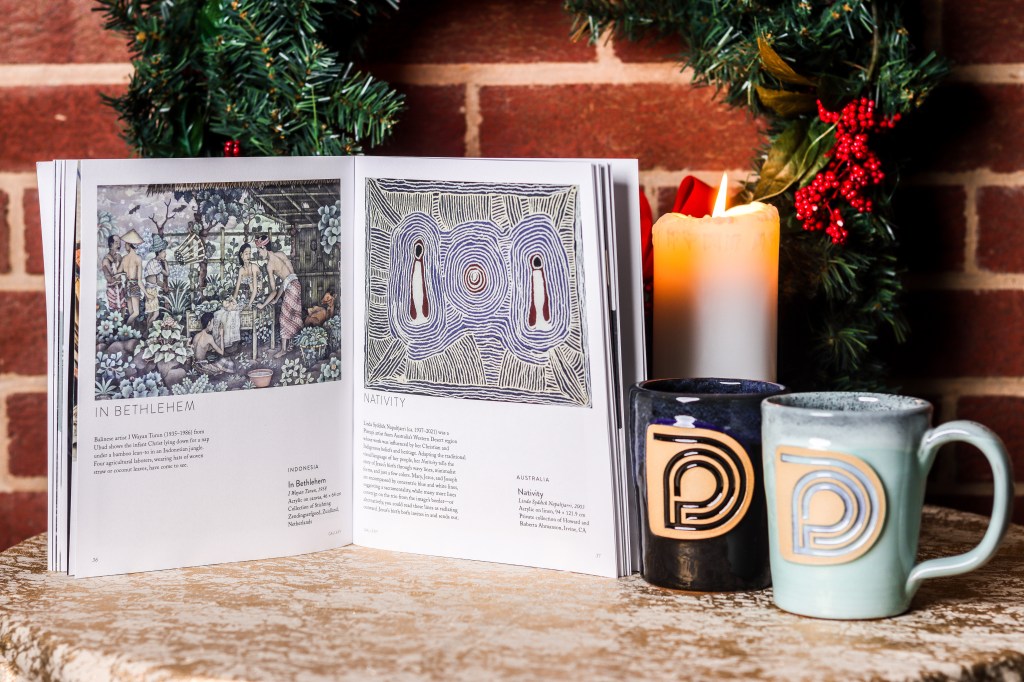
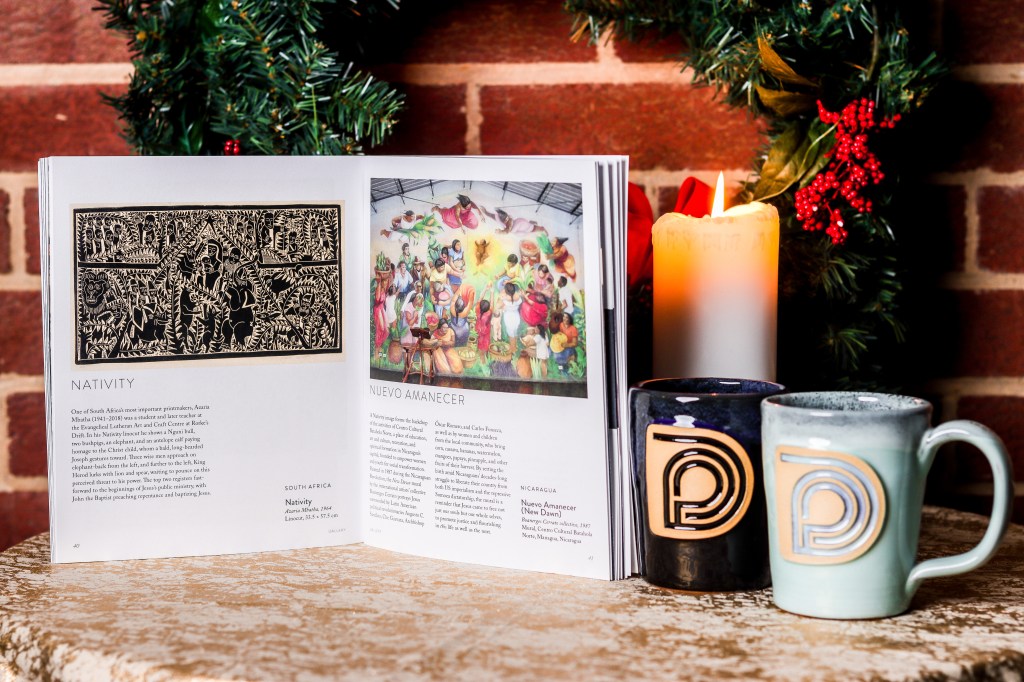
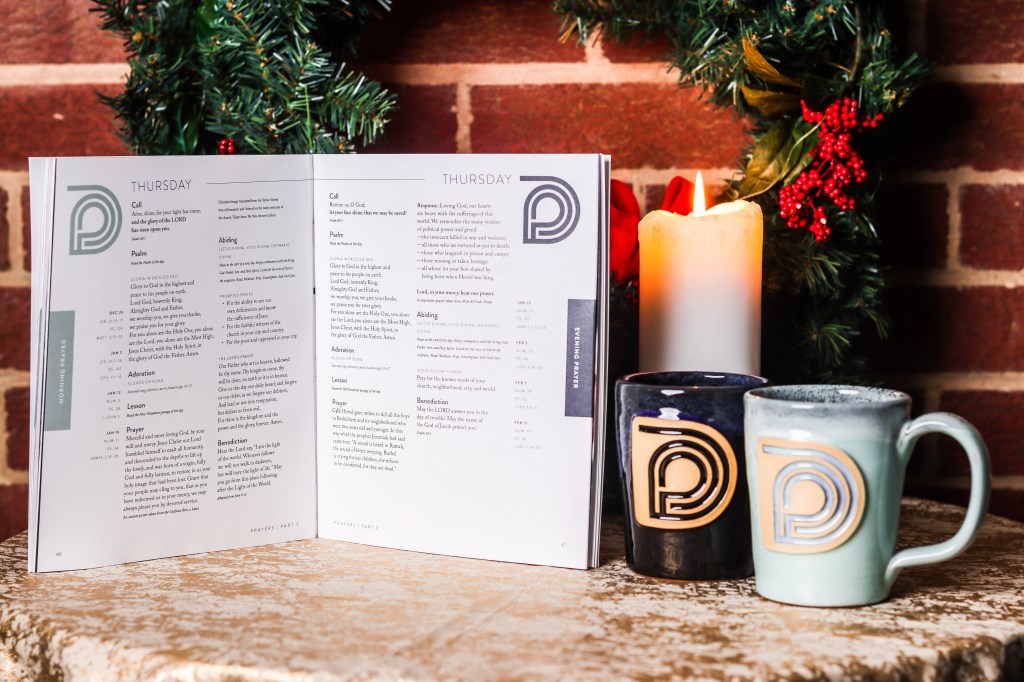
The Daily Prayer Project is running a special Christmas gift offer that, for $50, includes a physical and digital copy of our hot-off-the-press Christmas–Epiphany prayer periodical (covering December 25 through February 21) and two hand-thrown, dishwasher-safe mugs with a raised medallion of our labyrinth-inspired logo and glazes that map onto our morning and evening prayer colors. Packages ship early next week, so get your order in soon! There are also yearly subscription options, individual or communal, on the website.
In addition to working as a copyeditor and proofreader for the DPP, I also curate the art for the Gallery section, which is expanded in this edition to eight pieces—in this case, Nativities from around the world, each accompanied by a short reflection. The cover image is Morning Star by the Japanese Christian artist Hiroshi Tabata (1929–2014).
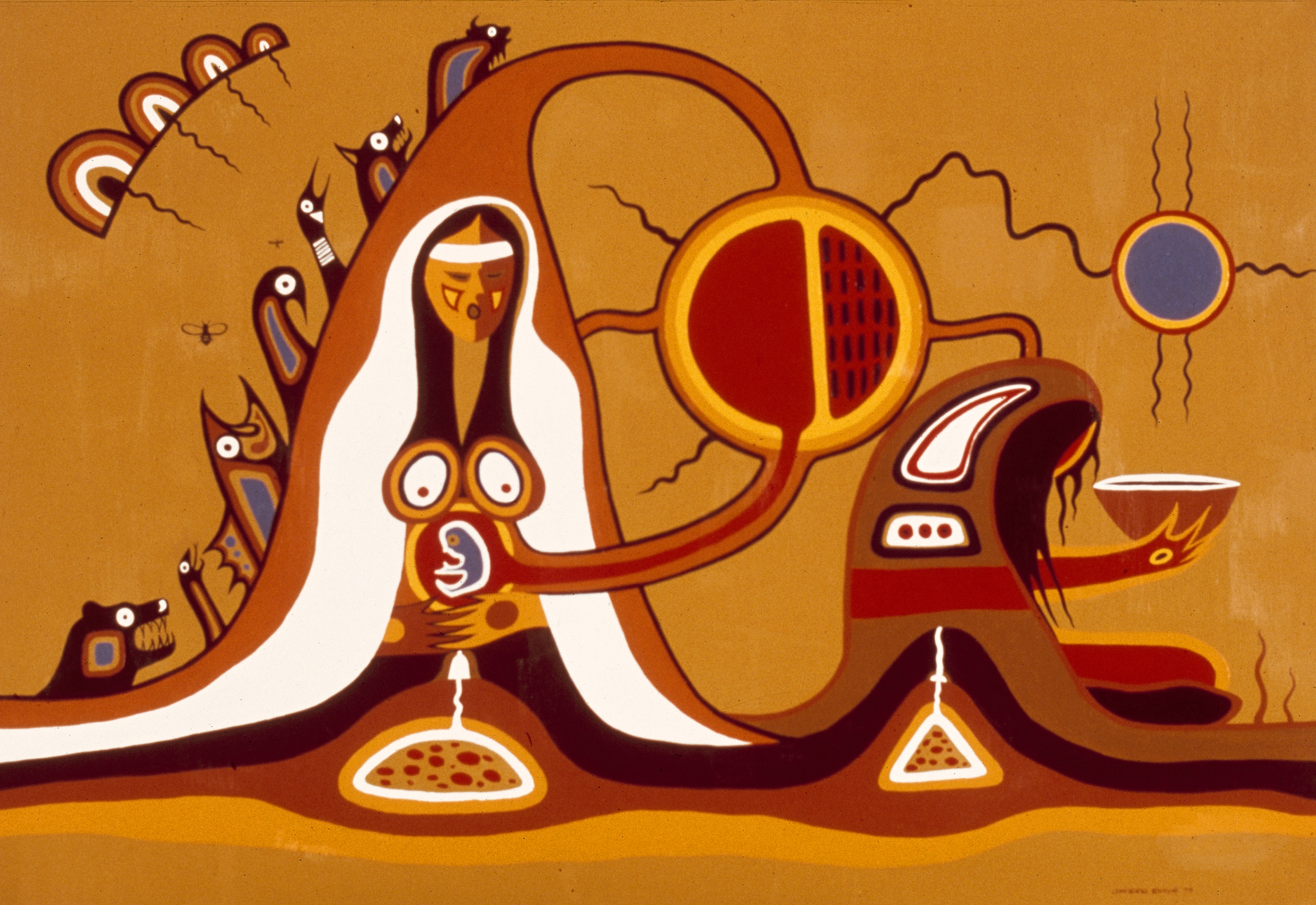
Jackson Beardy (1944–1984) was an Anishinaabe artist born on the Garden Hill Reserve in Manitoba. He belonged to the Woodland school of art [previously], adopting its distinctive style of Indigenous expression characterized by thick black outlines and vivid, compartmentalized color. His paintings draw on Ojibwe and Cree oral traditions and often express cosmological and spiritual concepts.
Beardy is one of twenty Canadian artists commissioned by the Canadian Conference of Catholic Bishops in 1975 to convey the Christian message using whatever idiom they wished. Beardy chose to portray the Virgin Mary pregnant with the Word, the sun’s fire pouring into her and yet she is not consumed. He provided the following artist’s statement:
It is my personal belief that a messenger from the Great Spirit came to earth in the form of His image after Him through a virgin birth in unrecorded history. Through this man, knowledge was passed on to man from the Great Spirit. Many of the teachings of this man have been kept by word of mouth through the ages by the elders of all tribes.
We see the virgin mother-to-be holding on to an embryo connected to the sun symbol (the Great Spirit) [center] who has deemed it necessary to send his messenger to his people. The mother is also connected to Mother Earth, who is nursing her [see the breast shape below]. She too is connected by a lifeline to the sun symbol. Around her are all the orders of creatures who come to see the messenger. He is born to explain their existence, [to restore] harmony between humanity and the elements, physically, mentally, and spiritually.
On the other side of the sun symbol we see an elder in prayer, ritually offering a bowl filled with sacred things. You can see the sun symbol is resting on his hunched frame, bearing him down with doubts, fear, depression, and all the ills of his time, his back to the very miracle he is praying for. It will take time for all to fully comprehend this phenomenon which has come to pass.
The four semicircles represent the elements of the air: snow, rain, tornadoes, heat. The moon [the blue circle] is painted above the elder. We regard the moon as our Grandmother who keeps vigil over all creatures during the night.
Though titled The Nativity, the painting is actually a prebirth scene, as Jesus is still in utero. Beardy shows the Christ child taking root in Mary’s womb (having been conceived by the power of the Great Spirit) and growing to full term as people and animals alike long for his arrival. They groan, they watch, they wrestle and seek. Creator Sets Free—as the First Nations Version of the New Testament translates the name Jesus—is almost here.
(Note: There’s a flipped version of this image floating around online. I confirmed with the CCCB that the file posted here, which I licensed directly from them, represents the correct orientation.)
Leaning into that Advent yearning, here is a performance of “O Come, O Come, Emmanuel” in Ojibwe—“Ondaas, Ondaas, Emaanooyen”—performed by E Halverson:
Now, I have a crowdsourcing request: I am searching for Advent or Christmas songs originally written in Indigenous Canadian or Native American languages, preferably by an Indigenous person. If you know of any, please let me know in the comments below, or in an email. Thanks!




 Art & Theology