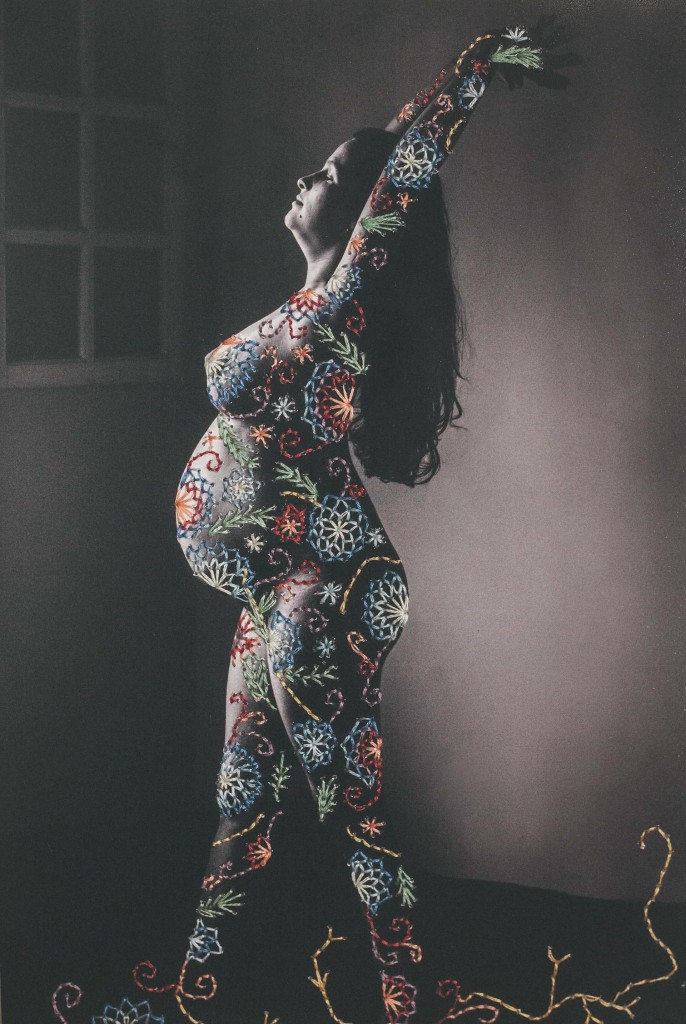
Magnificat roundup: Visio divina with Mary Gardner, “For Ages Women Hoped and Prayed,” and more

QUOTES:

Mary’s response to this announcement [of Jesus’s forthcoming birth]—her Magnificat—is even more overtly revolutionary. Her song in Luke’s Gospel is not a lullaby; it is a manifesto. She declares that the mighty will be cast down from their thrones, the lowly lifted, the hungry filled with good things, and the rich sent away empty. This is the language of redistribution, the language of a world reordered by justice rather than domination. It is no surprise that tyrants have feared this text; throughout modern history, the Magnificat has been prohibited and/or discouraged in public worship in places like Guatemala, Argentina, and India because oppressed communities used it as a rallying cry for liberation. Mary’s theology is insurgent.

—Kat Armas, “The Politics of Birthing God,” Some Things Abuelita (Substack), December 2, 2025

What I love about Hannah and Mary is they step into God’s eternal streams of justice and of righteousness and of what it means to live as a faithful follower of Yahweh. They step into this expansive world of what God is going to do and has promised to do in the world, instead of the smaller space of their own need—which again, is OK and understandable. But they take us to places where, if we’re honest, most of our prayers don’t regularly go.

—Rev. Dr. Tracey Bianchi, “Waiting with Women (Advent Series Part 2): Hannah’s Story and the Gift of Peace (Shalom),” The Alabaster Jar (podcast), December 8, 2025

+++

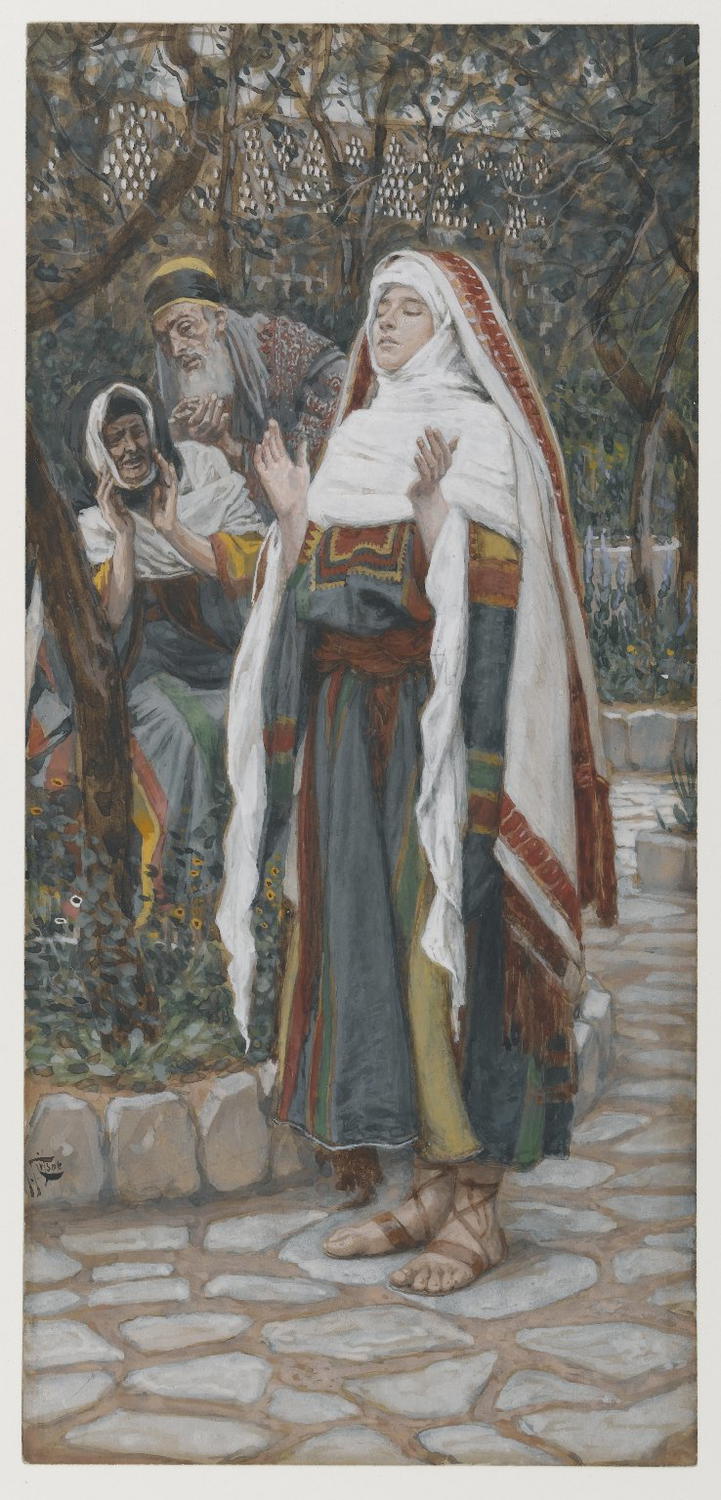
VIDEO DEVOTION: “Beholding the Magnificat with Mary Gardner”: In this “Space for God” video devotion from Coracle, Rev. Mary Amendolia Gardner, an Anglican priest with a bachelor’s degree in art history and a master’s in Christian spirituality, guides us in lectio divina (sacred reading) with Luke 1:46–55 and visio divina (sacred seeing) with James Tissot’s Magnificat.
Tissot, James_The Magnificat
James Tissot (French, 1836–1902), The Magnificat, 1886–94. Opaque watercolor over graphite on gray wove paper, 9 15/16 × 4 5/8 in. (25.2 × 11.7 cm). Brooklyn Museum, New York.

I typically don’t care for Tissot’s biblical watercolors, because of their illustrative quality—they remind me of pictures from the Sunday school curriculum I followed as a child. But I do like this one, which shows Mary in a position of wisdom and authority, absorbed in prayer, preparing to preach and prophesy. Elizabeth and Zechariah stand in attentive awe on the sidelines, their eyes directed toward the divine child she carries in her body while they await her words. The priest’s tongue had been tied, but Mary’s has been loosed. The Cuban American theologian Kat Armas, in the post quoted above, calls Mary “the first theologian of the Gospel,” as she boldly proclaims the messianic deliverance God has set in motion.

+++

SONGS:

>> “For Ages Women Hoped and Prayed” by Jane Parker Huber: “We join the song that Mary sings, an earthly, heavenly theme.” Performed at Wheaton Bible Church in Illinois.

>> “Mary, Did You Know” with alternative lyrics by Jennifer Henry: The original lyrics of this Gaither Vocal Band song were written by Mark Lowry in 1985, and they were set to music by Buddy Greene in 1991; the song became a popular hit. However, some Christians take issue with the rhetorical device that implies Mary did not know her son was God, that he would deliver Israel, and that he would reign forever, when that’s precisely what Gabriel told her from the beginning and what she alludes to in her Magnificat. (Defenders say these questions are most likely voiced by people in Mary’s life who didn’t know all that God had conveyed to her; or that it’s legitimate to wonder whether Mary knew the specifics that would unfold, and to suppose that even if she knew theoretically who Jesus was, she may have struggled to grasp the full scope and significance of his messiahship.)

In 2017, the Canadian theologian and activist Jennifer Henry rewrote the lyrics to center on the Magnificat and its mobilizing influence on justice movements across the globe. That song is sung here by Eric Lige, who is accompanied by Vahagn Stepanyan on piano.

>> “Magnificat” by Simon de Voil, feat. Alexa Sunshine Rose: This adaptation of the Magnificat is by Simon de Voil, a sacred musician, “interspiritual minister,” and retreat leader originally from Scotland now living in Vermont. The imagery in the video is not what I would have expected: It’s footage of bears in the woods. Perhaps it alludes to how all of creation will be redeemed in “the world that is to come”? The bears here, though, seem at peace, so maybe it’s a picture of blessedness, or of creation’s praise alongside Mary’s.

+++

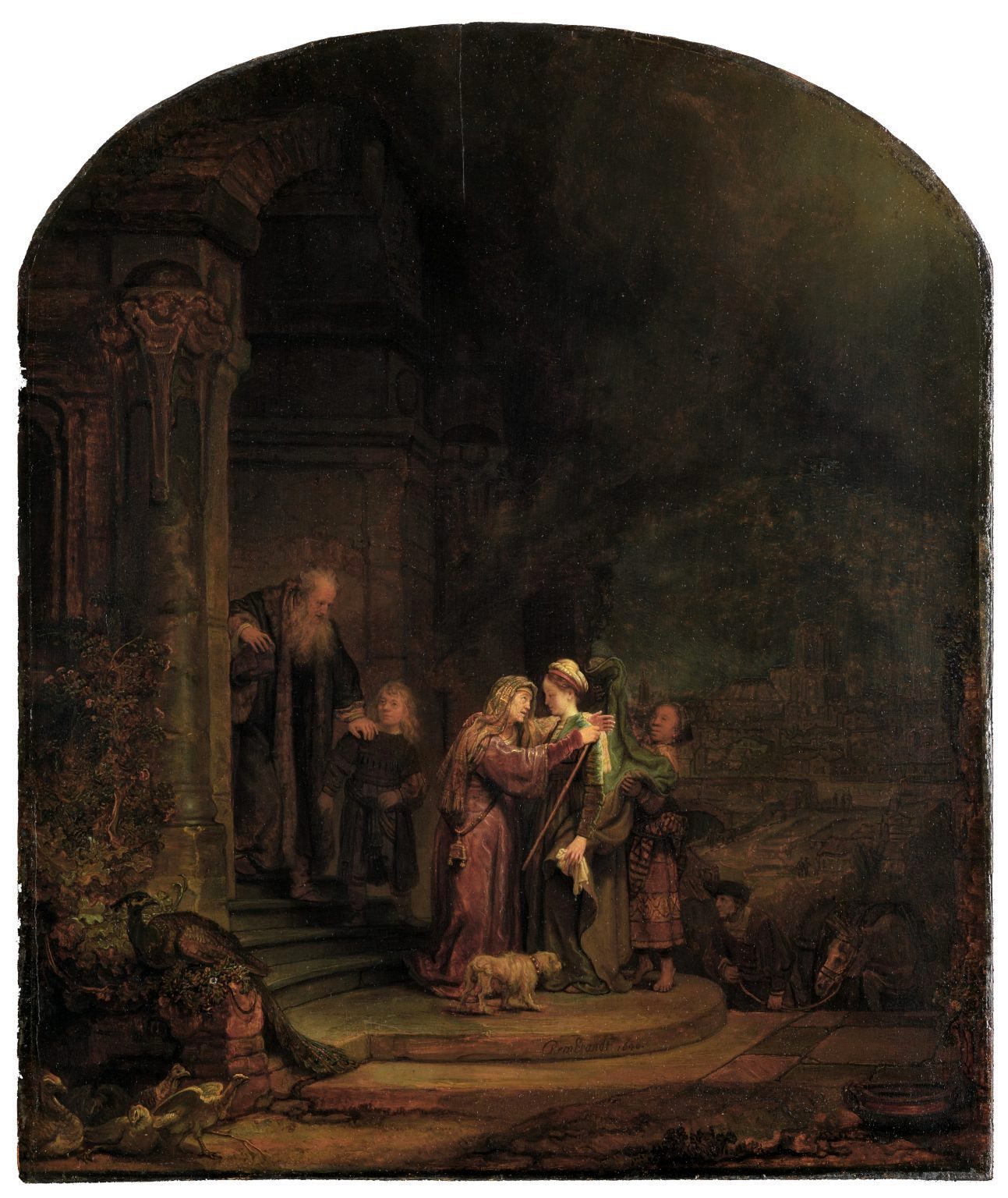
SERMON: Liberated to See by the God Who Sees” by Wes Vander Lugt, Trinity Forest Church, Concord, North Carolina, December 7, 2025: I’m always pleased when preachers, as part of their biblical exegesis, skillfully integrate art into their sermons—not as mere illustration or decoration but as itself interpreting scripture and/or doing theological work. In the sermon he gave for the Second Sunday of Advent this year, Rev. Dr. Wes Vander Lugt [previously], an ordained Presbyterian minister and director of the Leighton Ford Initiative in Theology, the Arts, and Gospel Witness at Gordon-Conwell Theological Seminary, preached on Luke 1:5–25, 39–45, about how God sees us and liberates us to see him and others. He discusses Rembrandt’s Visitation painting, especially the artist’s use of light and shadow—Mary and Elizabeth step out of the shadows, out of a place of feeling unseen, into the light of God’s grace, says Vander Lugt, where they are known and knowing.
Rembrandt_Visitation
Rembrandt Harmensz van Rijn (Dutch, 1606–1669), The Visitation, 1640. Oil on cedar panel, 22 1/4 × 18 7/8 in. (56.5 × 47.9 cm). Detroit Institute of Arts, Michigan. [object record]

He also touches on, very briefly, James B. Janknegt’s 2008 Visitation, which shows how John the Baptist has been liberated to see Jesus, even as the two are still in utero. See 17:49–20:05.

+++

FROM THE ARCHIVE: The Magnificat is a topic I’ve covered on the blog several times over the past ten years. Here are some examples:

“Christmas Bonus: Magnificat” by Stewart Henderson (poem)

In the Home of an Italian Rag-Picker
Jacob Riis (Danish American, 1849–1914), In the Home of an Italian Rag-Picker, Jersey Street, ca. 1890. Photograph, 7 15/16 × 9 3/4 in. (20.2 × 24.7 cm).

My soul magnifies the poor
the sore
the raw
and my spirit rejoices in God
my downcast
my outcast
my twig-bone wrong caste
for He regards the low estate
the no-go estate
the empty plate
and squats there with those generations.

For at Whose Name the cosmos shakes
and canyons quake
sought sanctuary within a womb
a young girl’s chaste, unopened room
a sparse, unblemished catacomb
and holy is He amongst the lame.

His mercy is on those who fear Him
hear Him
those near Him
in desert flapping bivouac or dehydrated barrio.

The night sky rolled out by His arm,
the preening proud ignore His balm
and slink towards the warlock charm
of their small ambitions;
and those on thrones end up alone
replaced by fly-pecked innocents.

He only eats with the hungry,
and if they don’t, He too refrains;
and as for the rich –
a table cannot be found for them.

My soul magnifies the poor
the sore
the raw
and my spirit rejoices in God
my outcast.

From the collection Homeland by Stewart Henderson. Copyright © 1993. Published by Hodder & Stoughton. Used with the author’s permission.

Stewart Henderson is a poet, song lyricist, and broadcaster. His children’s poems, taken from his three best-selling children’s collections (Poetry Emotion, All Things Weird and Wonderful, and Who Left Grandad at the Chip Shop?), are included in the UK’s national education curriculum. As a song lyricist, the music magazines Q and Mojo place his lyrics alongside those of Randy Newman and Radiohead. And as an award-winning presenter and producer of many documentaries for BBC network radio, he continues in the grand tradition, established by the likes of Dylan Thomas, Louis MacNeice, Cecil Day-Lewis, and others, of leading poets being commissioned to make primetime programs for Britain’s national broadcaster. Liverpool-born but long since residing on the southwest fringes of London, Henderson has been a regular participant, since its inception in 1974, in the Greenbelt Festival, an annual summer event in England dedicated to the arts, faith, and justice, for which Henderson served as a board director for twelve years.

Advent, Day 15: Among Us

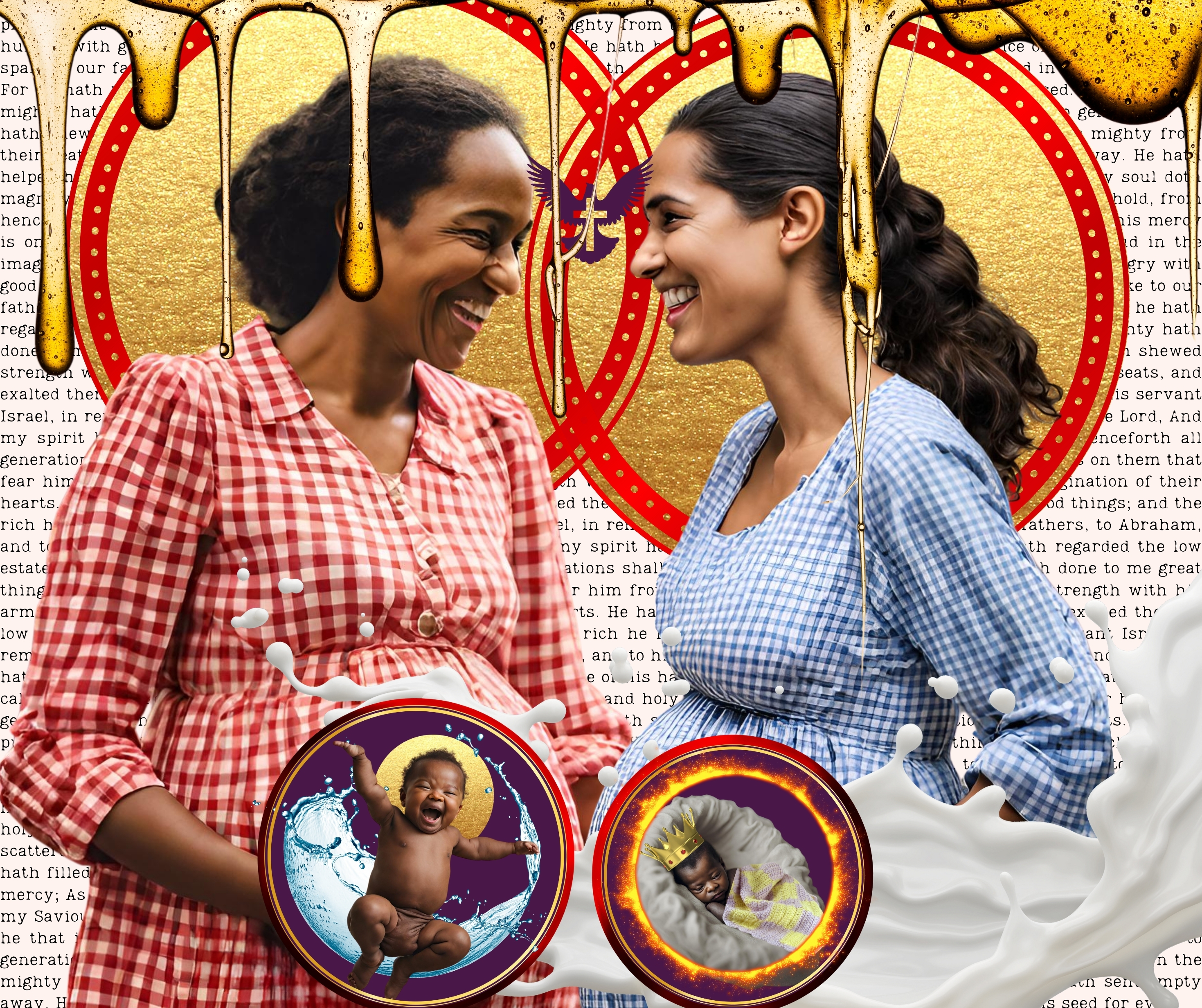
LOOK: Visitation by Beth Felker Jones

Jones, Beth Felker_Visitation
Beth Felker Jones (American, 1976–), Visitation, 2024. Digital collage with AI-generated elements.

Dr. Beth Felker Jones is a theologian who teaches at Northern Seminary near Chicago. This past year she has been making digital collages of biblical figures, especially women, with the assistance of AI technology. She shares them on her Substack, Church Blogmatics, and offers them for free with watermark or just $10 for a high-resolution, watermark-free download.

Her Visitation, she says, “imagines Mary’s visit to Elizabeth in Luke 1, flowing with milk and honey,” symbols of abundance and nourishment. (The promised land is often referred to in scripture using this poetic expression; see Exod. 3:8, Num. 14:8, Deut. 31:20, and Ezek. 20:15.) With the coming of a Savior, a great spiritual bounty awaits God’s people.

Luke the Evangelist describes Elizabeth as “filled with the Holy Spirit” (1:41). The Spirit is present in the center of this collage, silhouetted in purple, the color of Advent. His wings touch the women’s foreheads as if to bless or to join them together in celebration.

Luke also says that John the Baptist “leaped for joy” inside Elizabeth upon hearing Mary’s greeting (1:44), already recognizing that the one she bore was the Messiah. Jones shows this exultation of the in utero prophet. He splashes in the waters of his mama’s womb, as he will one day in the river Jordan, baptizing the repentant. Meanwhile, the great I AM, enfleshed as a preborn baby, sleeps inside a fiery ring in Mama Mary, crowned as king.

The words of Mary’s Magnificat form the backdrop of the scene.

LISTEN: “Among Us” by Nick Chambers, on Advent Songs by Incarnation Music (2023)

My soul will magnify
The Lord who looked on my
Lowliness with grace
My soul will magnify
My neighbor’s precious life
I see Christ in their face

Refrain:
God is among us
In human disguise
Born as one of us
To open our eyes

My soul will magnify
The Lord who took on my
Lowliness in flesh
My soul will magnify
My neighbor’s desperate cry
For in Christ they are blessed [Refrain]

Based on the Magnificat (Luke 1:46–55), “Among Us” by singer-songwriter Nick Chambers highlights how God’s becoming flesh helps us see the imago Dei (image of God) in our fellow humans. There’s an old Orthodox hymn that says, “Christ was born to raise the image that fell of old. Christ came to restore the beautiful image of God within humankind,” the image that had become obscured through sin.

With Mary, Elizabeth, and baby John, let us celebrate the Lord who brings salvation, raising up the lowly, restoring the broken, and reminding us of the dignity and belovedness of our embodied selves.

This is one of eighteen Visitation-themed songs on the Art & Theology Advent Playlist.

Ten Songs of Joy for Gaudete Sunday

The third Sunday of Advent is known as Gaudete Sunday, gaudete (pronounced GOW-deh-tay) (Latin for “rejoice”) being the first word of the introit of the day’s Mass, taken from Philippians 4:4–6 and Psalm 85:1:

Gaudete in Domino semper íterum díco, gaudéte: modéstia véstra nóta sit ómnibus homínibus: Dóminus prope est. Nihil sollíciti sítis: sed in ómni oratióne petitiónes véstrae innotéscant apud Déum. Benedixísti, Dómine, térram túam: avertísti captivitátem Jácob.

Rejoice in the Lord always; again I say, rejoice. Let your forbearance be known to all men. The Lord is at hand. Do not be anxious over anything; but in all manner of prayer, let your requests be made known unto God. Lord, you have blessed your land; you have put an end to Jacob’s captivity.

It is customary for priests to swap out their purple vestments for pink today, and for those who use an Advent wreath to light not a purple candle but a pink one. Some churches favor a spare aesthetic in their sanctuaries for the first two weeks of Advent but break out the flowers for this the third. The approximate halfway point of the penitential Advent season, Gaudete Sunday is a special time to rejoice in the nearness of God’s coming as well as God’s presence with us here even now in the waiting, and to receive a foretaste of the bigger celebration to come on Christmas Day.

Here are ten songs for you to enjoy this Gaudete Sunday. If you’d rather listen to them as a YouTube playlist, click here.

Richardson, Jan_Visitation
The Hour of Lauds: Visitation by Jan Richardson [for sale]

1. “Songs of Joy” by Garrison Doles, written late 1990s, on A Songmaker’s Christmas, 2012: “Songs of joy we hopefully sing, expanding our spirits, the season to know . . .” So opens this song by the late singer-songwriter Garrison Doles (d. 2013) [previously]. In 2009 his wife, the artist Jan Richardson, created a video combining the song with five of the seven collages from her Advent Hours cycle (which can be purchased as reproductions). Read the lyrics and songwriter’s statement here.

2. “My Soul Doth Magnify the Lord” by O’Landa Draper and the Associates, on Live…A Celebration of Praise, 1994: A trailblazing gospel choir director, O’Landa Draper was one of the top gospel artists of the nineties. This song of his is based on the Magnificat, the praise song Mary sings in the company of her cousin Elizabeth following the conception of Christ (see Luke 1).

3. “El burrito de Belén” (The Little Donkey of Bethlehem) by Hugo Cesar Blanco, 1972, performed by the band Matute, 2020: This is a Venezuelan carol about a person riding their donkey, with hurried excitement, from the sabanero (savanna) to Bethlehem to see the newborn Christ. Read the lyrics and translation here.

4. “Ecce mundi gaudium” (Behold the Joy of the World), England, 13th century, arranged and performed by the Mediæval Bæbes on Worldes Blysse, 1998: Written in Latin, this thirteenth-century carol is about the Virgin giving birth to the Son, our joy—announced to the shepherds by an angel and to the magi by a star. Despite the upbeat tempo throughout, the last two verses are about Herod’s raging and the Massacre of the Innocents. The soloist is Katharine Blake, the founder and musical director of Mediæval Bæbes. Read the original lyrics here, clicking on individual lines for the English translation.

5. “Kya Din Khushi Ka Aaya” (क्या दिन खुशी का आया) (What a Happy Day), performed by Akshay Mathews, 2021: A Hindi Christmas carol from India. Read the lyrics here.

6. “Repeat the Sounding Joy,” a fragment from “Joy to the World” arranged by Craig Courtney, performed by the Capital University Chapel Choir, 2019: A super-fun, one-minute choral work.

7. “Now Let Us Sing,” traditional, adapt. John L. Bell, 1995, performed by Katarina Ridderstedt, 2015: Katarina Ridderstedt (née Lundberg) is a rhythm teacher, musician, cantor, and choir director from Gotland, Sweden, who records music under the name Musikat. This video of hers introduced me to a charming little quatrain whose origins I don’t know (it’s credited as “Traditional”), but this version comes from Scotland’s Iona Community [previously]: “Now let us sing with joy and mirth, / praising the one who gave us birth. / Let every voice rise and attend / to God whose love shall never end.”

(Update, 1/6/25: “Now let us sing” is of Scottish origin, first appearing during the Protestant Reformation in the congregational song collection The Gude and Godlie Ballatis; the earliest extant edition of this book is from 1567, but it is thought to have been originally published in 1540. The tune was originally a drinking tune. For his rendition, published in Come All You People: Shorter Songs for Worship, John L. Bell essentially rewrote the first stanza, retaining only the first line of the original.)

8. “Brother” by Jorge Ben Jor, on A Tábua de Esmeralda, 1974: Known by the stage name Jorge Ben or (since the 1980s) Jorge Ben Jor, Jorge Duílio Lima Menezes (b. 1939) is a Brazilian singer-songwriter and musician whose characteristic style fuses elements of samba, funk, rock, and bossa nova. In this song he enjoins us to prepare a joyful path for the coming Christ—who is both Lord and friend—with love, flowers, and music.

9. “Alleluia, He Is Coming (I Looked Up)” by Martha E. Butler, 1979: This song is sometimes used in church services for Palm Sunday or Easter, but I think it makes a fitting Advent song as well—especially with the newer last verse that is sometimes used, as in the first video below. “Alleluia, he [Christ] is coming! Alleluia, he is here,” the refrain proclaims. Read about the inspiration behind the song, in the words of the songwriter, here. Allow me to sneak in two different performances. The first is by Donna Rutledge, Becky Buller, and Todd Green of First Baptist Church of Manchester, Tennessee, from 2020; theirs is a lovely rendition with strong vocals and a poignant violin part, but I do prefer a brisker pace (listening to the video at a playback speed of 1.25 is perfect, in my estimation):

The second is by the South African group Worship House, from their 2016 album Project 5 (Live in Johannesburg):

10. “Joy Will Come” by Paul Zach: The refrain of this song by Paul Zach of Virginia is based on Psalm 30:5b: “Weeping may linger for the night, but joy comes with the morning.” I also hear echoes of Psalms 18 and 121 throughout. The song is a reminder that through the dark nights we experience, we have hope; we have a Savior who will not abandon us.

Advent, Day 15: Praise

In those days Mary set out and went with haste to a Judean town in the hill country, where she entered the house of Zechariah and greeted Elizabeth. When Elizabeth heard Mary’s greeting, the child leaped in her womb. And Elizabeth was filled with the Holy Spirit and exclaimed with a loud cry, “Blessed are you among women, and blessed is the fruit of your womb. And why has this happened to me, that the mother of my Lord comes to me? For as soon as I heard the sound of your greeting, the child in my womb leaped for joy. And blessed is she who believed that there would be a fulfillment of what was spoken to her by the Lord.”

—Luke 1:39–45

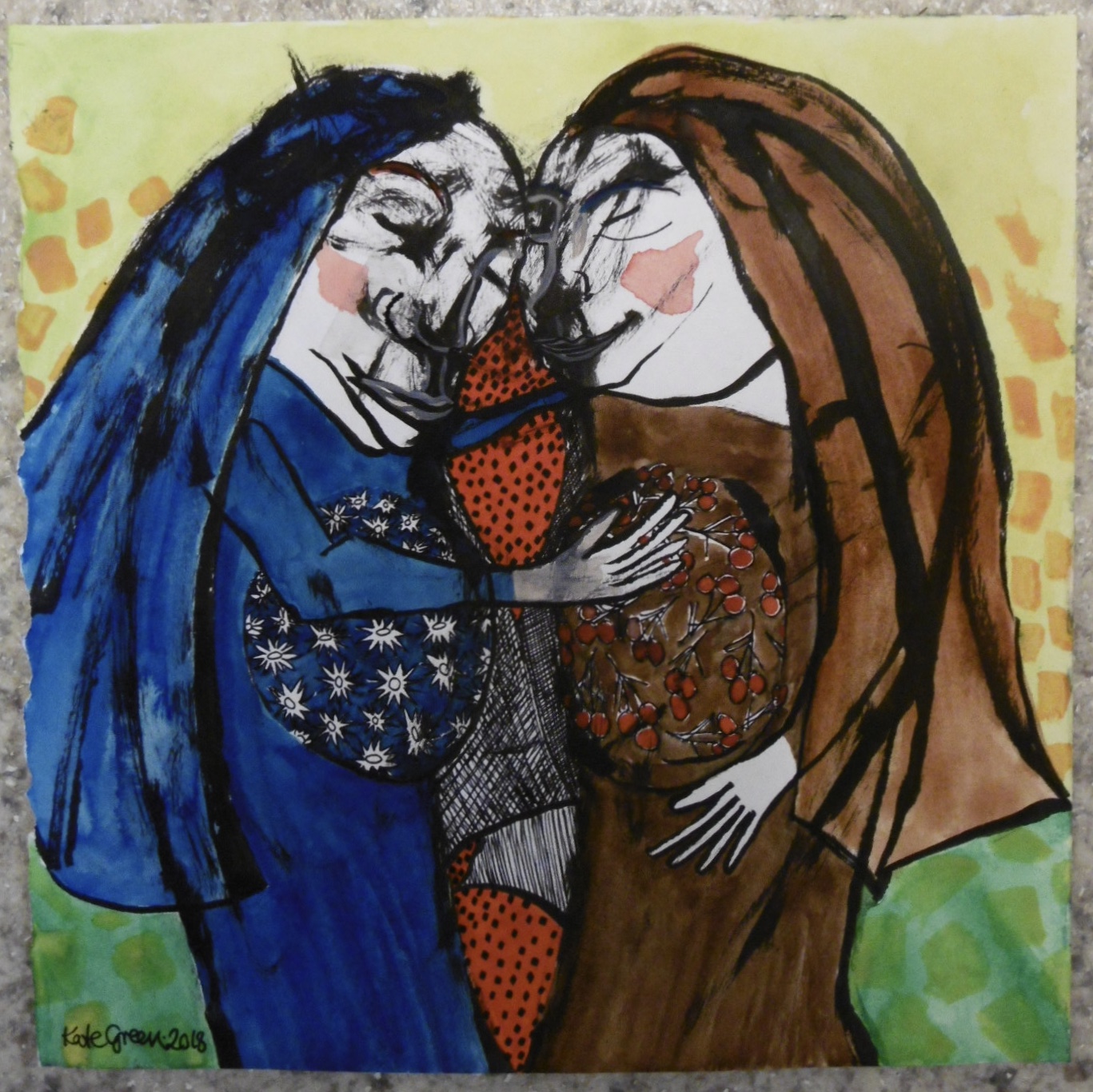
LOOK: Mary and Elizabeth by Kate Green

Green, Kate_Mary and Elizabeth
Kate Green (British, 1965–), Mary and Elizabeth, 2018. Watercolor and ink on paper.

LISTEN: “Praise the Lord” by Phillip A. Peterson, written for and performed by Grace Seattle Experimental Orchestra on Oratorio of Prayers: Supplication, 2007

(The original German words are verse 4 of the 1680 hymn “Lobe den Herren, den mächtigen König der Ehren!” by Joachim Neander.)

Praise to the Lord
Who has visibly blessed your state
Who has rained streams of love from the heavens

Consider
What the Almighty can do
He who meets you with such love


This post is part of a daily Advent series from December 2 to 24, 2023 (with Christmas to follow through January 6, 2024). View all the posts here, and the accompanying Spotify playlist here.

Advent, Day 13: Magnificat

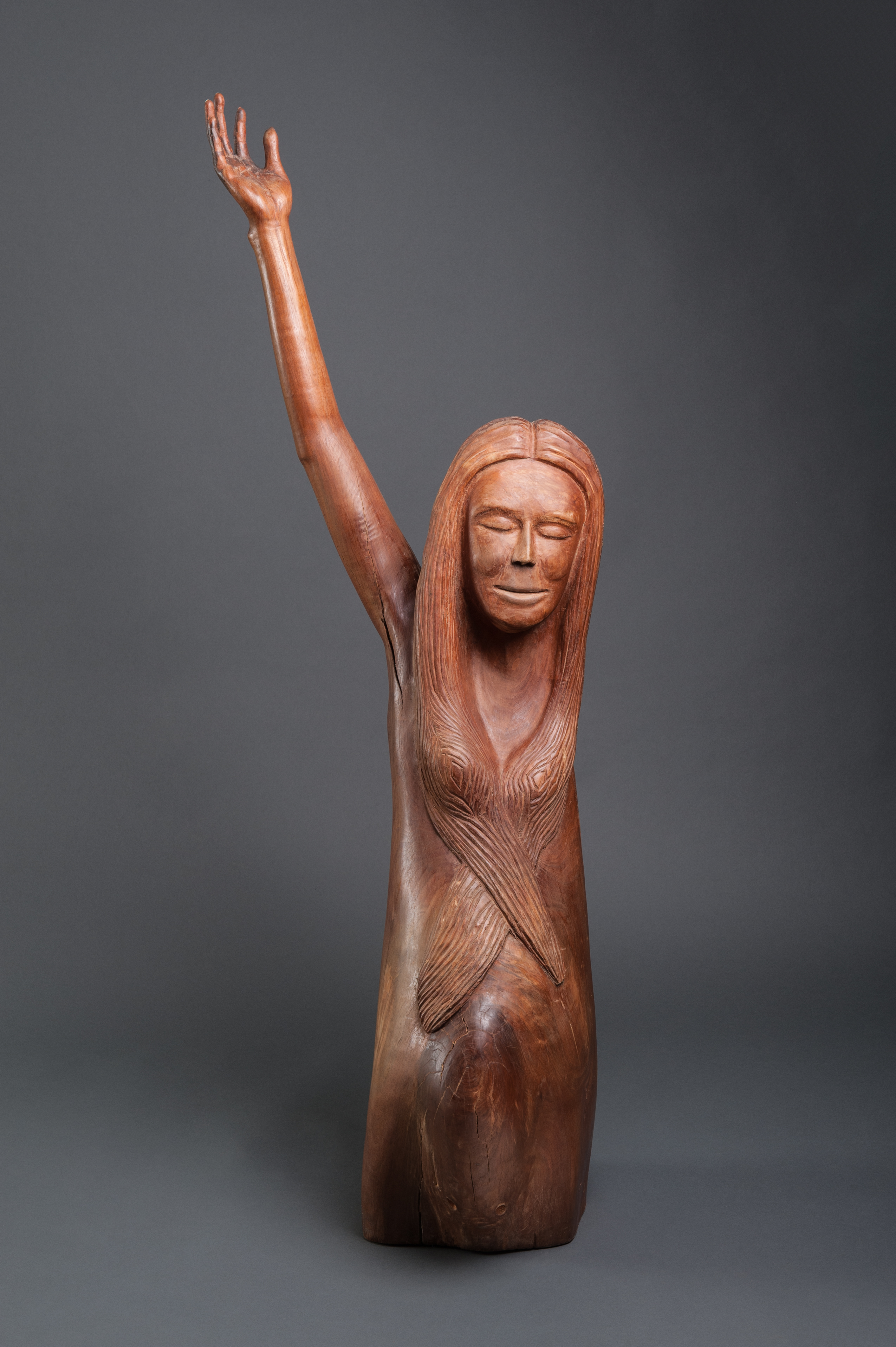
LOOK: Behold My Miracle by Fred Carter

Carter, Fred_Behold My Miracle
Fred J. Carter (American, 1911–1992), Behold My Miracle, 1980. Walnut, 55 × 20 in. Collection of Mary Carter Owens and Vel-Holly Fleming. Photo: Dan Meyers, courtesy of the American Visionary Art Museum.

Born in 1911 in the mountains of southwestern Virginia, Fred Jerome Carter spent the first few decades of his adulthood as a hardware merchant. In 1938 he married Eloise Davis, and in 1950 they adopted their first and only son, Ross.

In his late forties, Carter began to pursue art making, taking a beginner’s painting class, his only formal artistic training. But wood sculpting is the medium for which he became best known. Writer and documentary filmmaker Jack Wright classifies Carter’s art as “Appalachian art brut,” art brut (“raw art”) being a French term coined by modern artist Jean Dubuffet to describe art made outside the academic tradition.

In 1970 Carter was devastated when his son, having returned as a Marine from Vietnam, hanged himself. He and Eloise divorced shortly after, and Carter opened the Ross Carter Gallery, named in his son’s honor, where he started showing his own work. Below the gallery he established the Cumberland Museum to exhibit a large collection of pioneer tools and artifacts (having to do, for example, with farming, mining, spinning, and moonshining) that provided a window into Appalachian culture and history. It’s there that he met Vickie Hill, whom he later married. Vickie gave birth to Carter’s first biological child, Holly, in 1983, when Carter was seventy-two. Their daughter Mary was born two years later.

Carter created Behold My Miracle two years before Vickie’s first pregnancy, but he retroactively identified the figure with her. In a 1980 interview with Wright for Headwaters Television, he describes how the sculpture came about:

I was back, at Easter [1980], in the mountains, and a fellow was sawing up firewood. Now this was part of a walnut log . . . cut down forty or fifty years ago. . . . There was a limb going up through here about ten feet long. I said, “Don’t cut that up for wood. . . . I see something in this that I want to make. . . . I see a pregnant woman.” . . . So I brought it home and began to look at it. . . . The wood began to talk to me and tell me what it is. . . .

So, I will probably call this Behold My Miracle. That’s what the mother is saying and I am trying to get her to say, in the position of her hand and the look on her face, that this is truly the great miracle. . . . As though she is saying, “Behold me, in my greatest moment of the miracle!”

LISTEN: “The Glory of Jah” by Sinéad O’Connor and Ronald Tomlinson, on Theology (2007) – The acoustic version in the video below, which appears on disc 1 of the album, was recorded live at The Sugar Club in Dublin.

There is no Holy One like you
You install kings and take them down
Truly there is no one beside you
You made all of creation with wisdom

Refrain:
May the glory of Jah endure forever
The boughs of the mighty are broken
And the weak are clothed with strength

There is the sea, vast and wide
With all its creatures beyond number
There go the ships, they all look to you
You lift up the poor into a place of honor [Refrain]

Jah makes poor or he makes rich
The pillars of the earth belong to him
And he has set his world upon them
To raise us up from the dunghill [Refrain]

The eighth full-length album by Irish singer-songwriter Sinéad O’Connor, Theology is a collection of mostly original spiritual songs in the Judeo-Christian tradition. It’s saturated with scripture. It contains:

O’Connor grew up Catholic and, until converting to Islam in 2018, identified as such, though she has always been unorthodox. Frustrated by the spiritual vapidness of the pop music industry in which she had found fame, in the early 2000s she studied theology at a college in Dublin, looking to connect more deeply with her religious heritage. Her favorite instructor, the Irish Dominican priest Wilfred Harrington, taught a course on the Prophets, reviving her interest in the biblical material that had so fascinated her as a youth. During this time, she was considering leaving her music career, but Fr. Harrington suggested that she set some scripture texts to music and see what happens. She took his advice, and the result is Theology, which she dedicated to Fr. Harrington. Listen to a ten-minute interview with O’Connor about the album, from the limited-edition Theology DVD released in 2008.

When I first heard “The Glory of Jah,” I thought it was a condensation of Mary’s Magnificat, which she voiced upon visiting her cousin Elizabeth following their mutual unexpected pregnancies—Elizabeth with John the Baptist, and Mary with the Christ:

My soul magnifies the Lord,
    and my spirit rejoices in God my Savior,
for he has looked with favor on the lowly state of his servant.
    Surely from now on all generations will call me blessed,
for the Mighty One has done great things for me,
    and holy is his name;
indeed, his mercy is for those who fear him
    from generation to generation.
He has shown strength with his arm;
    he has scattered the proud in the imagination of their hearts.
He has brought down the powerful from their thrones
    and lifted up the lowly;
he has filled the hungry with good things
    and sent the rich away empty.
He has come to the aid of his child Israel,
    in remembrance of his mercy,
according to the promise he made to our ancestors,
    to Abraham and to his descendants forever. (Luke 1:46–55)

But as I listened more closely and flipped through my Bible to match phrases, I realized that O’Connor’s song is actually a pastiche of Old Testament verses from 1 Samuel, Daniel, and the Psalms, the primary source text being Hannah’s song of thanksgiving:

My heart exults in the LORD;
    my strength is exalted in my God.
My mouth derides my enemies
    because I rejoice in your victory.

There is no Holy One like the Lord,
    no one besides you;
    there is no Rock like our God.
Talk no more so very proudly;
    let not arrogance come from your mouth,
for the LORD is a God of knowledge,
    and by him actions are weighed.
The bows of the mighty are broken,
    but the feeble gird on strength.
Those who were full have hired themselves out for bread,
    but those who were hungry are fat with spoil.
The barren has borne seven,
    but she who has many children is forlorn.
The LORD kills and brings to life;
    he brings down to Sheol and raises up.
The LORD makes poor and makes rich;
    he brings low; he also exalts.
He raises up the poor from the dust;
    he lifts the needy from the ash heap
to make them sit with princes
    and inherit a seat of honor.
For the pillars of the earth are the LORD’s,
    and on them he has set the world.

He will guard the feet of his faithful ones,
    but the wicked will perish in darkness,
    for not by might does one prevail.
The LORD! His adversaries will be shattered;
    the Most High will thunder in heaven.
The LORD will judge the ends of the earth;
    he will give strength to his king
    and exalt the power of his anointed. (1 Sam. 2:1–10)

Hannah, an ancient Jew, prayed these words at the tabernacle at Shiloh upon dedicating her firstborn son, Samuel, to God’s service, as he was conceived after many hard years of infertility and anguished prayer. Mary’s song, which came some ten centuries later, picks up themes from Hannah’s, so it’s no wonder I originally misidentified O’Connor’s source. Mary would have known Hannah’s song from having heard it read in synagogue, and, as Mary’s son would also be set apart for divine service, perhaps she found a special kinship with this ancestral sister. Mary was also spiritually formed by the Psalms, another influence on her Magnificat composition; their words were deep in her bones, naturally coming out in effusions of praise.

Both Hannah and Mary praise God’s kindness, authority, and eternal plan, emphasizing his mercy toward the poor and the humble. Both songs are thematically linked to Psalm 113:5–8:

Who is like the LORD our God,
    who is seated on high,
who looks far down
    on the heavens and the earth?
He raises the poor from the dust
    and lifts the needy from the ash heap,
to make them sit with princes,
    with the princes of his people.

Now returning to O’Connor’s song: Line 2 has a corollary in Daniel 2:21, “he . . . deposes kings and sets up kings.” And the second verse seems inspired by Psalm 104:24–26, 31:

O LORD, how manifold are your works!
    In wisdom you have made them all;
    the earth is full of your creatures.
There is the sea, great and wide;
    creeping things innumerable are there,
    living things both small and great.
There go the ships
    and Leviathan that you formed to sport in it.

. . . . . . . . . . . . . . . . . . . . . . . . . . . . . . . . . . . . . . . . .

May the glory of the LORD endure forever;
    may the LORD rejoice in his works . . .

When referring to God, O’Connor uses the Rastafari name for him, “Jah,” a shortened form of “Jehovah.” She had recorded her previous album, Throw Down Your Arms, in Jamaica, a collection of roots reggae song covers, and her spirituality was impacted by her encounters with the Rastafari there. “They use music to reassure people that God is actually with them and watches them, can be called upon,” she said.

So “The Glory of Jah” is a highly intertextual song, rooted in Hannah’s song but weaving in strands from other biblical books—and the result sounds an awful lot like something Mother Mary would sing!

Roundup: Kenyan Annunciation; Jesus in utero; the politics of the Magnificat; and more

Many Catholics and Orthodox decry that Protestants really only ever talk about Mary during Christmas. While she does get some extra attention here on the blog in December, I also try to talk about her throughout the year, from the feasts of the Annunciation (March 25) and the Visitation (May 31) to her witness during Holy Week and Pentecost and her being such an important figure in Jesus’s life and exemplary for our own. Here’s a new Marian roundup, plus at the bottom a Christmas gift idea involving a product I helped create. 🙂

VISUAL MEDITATIONS:

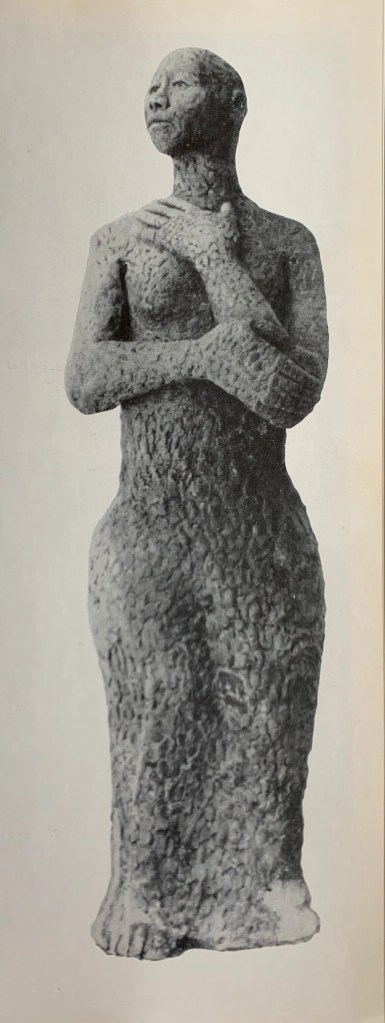
>> “Wondrous” by Paul Simpson Duke, Seeing the Sacred: In 2019, Rev. Drs. Paul and Stacey Simpson Duke, co-pastors of First Baptist Church in Ann Arbor, Michigan, ran an Annunciation art series on their blog, meditating on one artwork on the subject per day for twenty-five days. I commend the whole series, but I was particularly compelled by Day 13, which centers on a terracotta sculpture made by the late Kenyan artist Rosemary Namuli Karuga when she was a student at Makerere College Art School in Uganda. Paul Duke considers especially the mixture of sorrow and awe expressed in the figure’s face.

Karuga, Rosemary Namuli_Mary
Rosemary Namuli Karuga (Kenyan, 1928–2021), Mary, ca. 1950. Terracotta. This image is Plate 4 in the book Christian Art in Africa and Asia by Arno Lehmann.

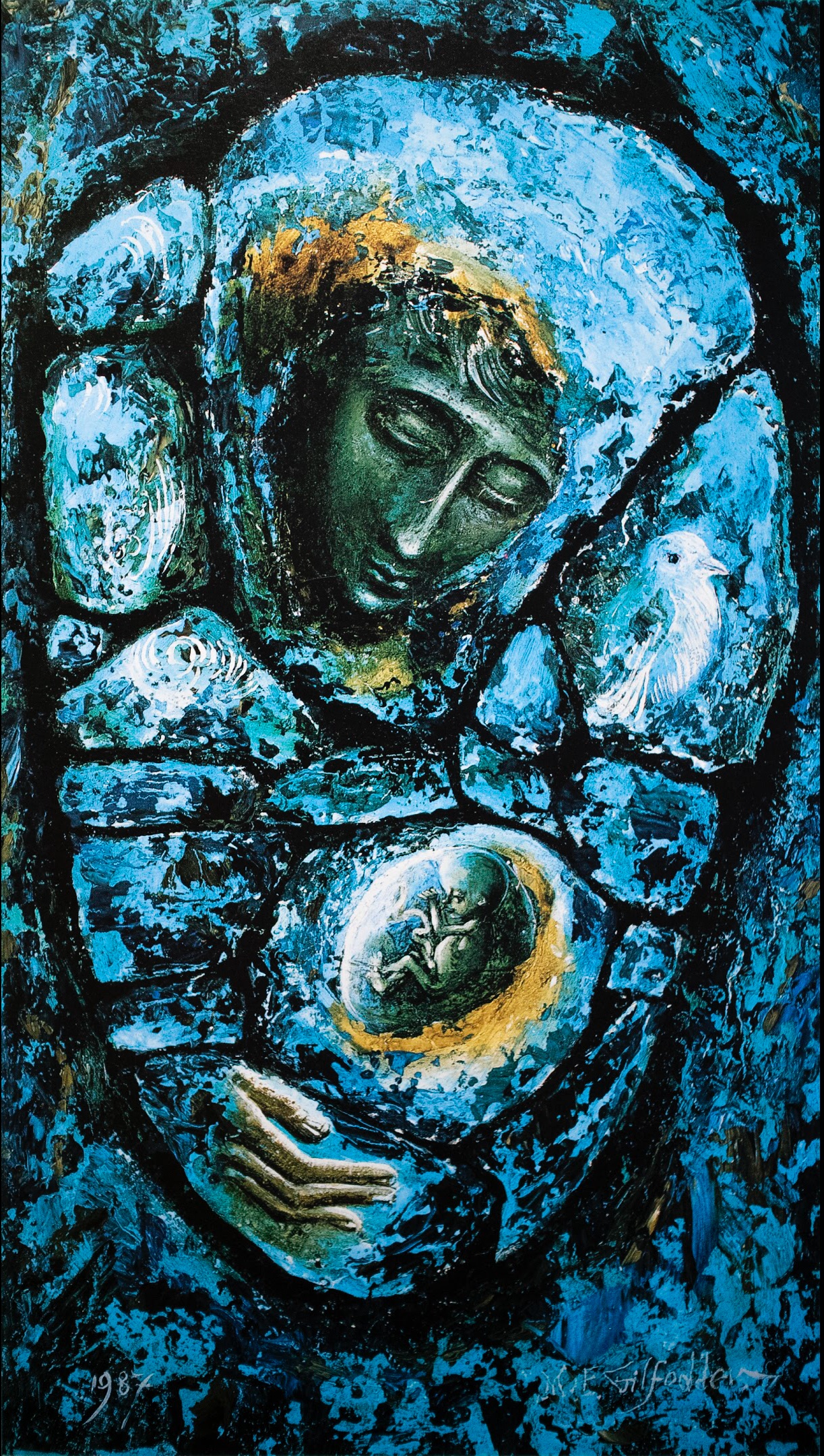
>> “Pregnant with God” by Victoria Emily Jones, ArtWay: For the first Sunday of Advent, I wrote about the painting Blue Madonna by Scottish Catholic artist Michael Felix Gilfedder, which shows the Christ child developing inside Mary’s womb. Pregnancy has always been an image I’ve carried with me during Advent, as it embodies the expectancy characteristic of the season—the growth of new life, a hidden fullness, about to come forth.

Gilfedder, Michael Felix_Blue Madonna
Michael Felix Gilfedder (Scottish, 1948–), Blue Madonna (Mary, Mother of God), 1987. Oil and tempera on wood with gesso relief, 25 1/4 × 13 in. (64 × 33 cm). Private collection, London. [prints for sale]

+++

PODCAST EPISODES: Both of the following come from For the Life of the World, the podcast of the Yale Center for Faith and Culture. Released back-to-back last December.

>> “Mary Theotokos: Her Bright Sorrow, Her Suffering Faith, and Her Compassion” with Frederica Mathewes-Green: Frederica Mathewes-Green is an American author and speaker, chiefly on topics related to Eastern Orthodox belief and practice. Here she discusses the Orthodox reverence for Mary; the scriptural account of her life; Mary as the mother of us all; the Protevangelium of James, which provides legendary material about Mary’s upbringing and betrothal; the ancient prayer “Sub tuum praesidium” (“Under Your Compassion”) from 250 CE, the earliest known appearance of the title “Theotokos”; and Mary’s role as intercessor. The latter point is something that Protestants like me are wary of—praying through saints who have passed on is not something I practice—but the way Mathewes-Green explains it is, just as we would ask fellow believers on earth to pray for us, why shouldn’t we also ask our friends in heaven to do the same, if we truly believe that they are alive and that we are in communion with them (as we confess in the Apostles’ Creed)?

Besides explicating several Marian doctrines, Mathewes-Green also speaks of Mary as an ordinary human being with an extraordinary call. With tenderness, she considers Mary’s experiences and emotions at different life stages: first as a perplexed young woman who is taken aback by Gabriel’s announcement but ultimately responds with humility and magnanimity, then as a parent who raises a child and later witnesses his violent death.

For more from Mathewes-Green on the topic, see her book Mary as the Early Christians Knew Her: The Mother of Jesus in Three Ancient Texts.

>> “A Womb More Spacious Than Stars: How Mary’s Beauty and Presence Upends the Patriarchy and Stabilizes Christian Spirituality” with Matthew J. Milliner: Matthew Milliner, an art history professor at Wheaton College and the author of Mother of the Lamb: The Story of a Global Icon, is a Protestant who wants to see other Protestants embrace a more robust doctrine of Mary as Theotokos, “Mother of God,” and develop a keener sense of her ecclesial presence. In this hour-long conversation he discusses Mary as person and as symbol; the need for “hermeneutical adventurousness anchored in the revelation of God in Christ”; how icons work, and particularly how Marian icons are spiritually formative; how to read a Nativity icon; the feminist objection to Mary; how Mary upends the ancient pagan goddess culture; and how we all must be Marian if we are to be orthodox Christians.

I’ve previously featured two other talks by Milliner on Mary: “The Art of Advent” and “Blessed Art Thou.”

+++

VIDEO: “Magnificat” by SALT Project: This short film features a reading of the Magnificat in Spanish, its words fleshed out in contemporary images. For the same video but in English, see here.

+++

ARTICLE: “The Political Is Personal: Mary as a Parent and Prophet of Righteousness” by Erin Dufault-Hunter, Fuller Magazine: What does the New Testament mean by “righteousness” (dikē)? Is it personal piety, or social justice? This article by Christian ethics professor Erin Dufault-Hunter examines how Mary upholds both connotations of the word. “Perhaps more than anyone else, Mary displays for us how saying yes to the kingdom, and its unlikely king, necessarily involves the personal but also reorients our social and political allegiances,” Dufault-Hunter writes. “Intimacy with God necessarily entails a political orientation, bringing or solidifying a way of seeing power and position.” Debunking the claim that Jesus’s coming was not political, Dufault-Hunter considers Mary’s Magnificat as well as other elements of the Christmas story—like the title “Son of God,” the word “gospel,” and the angels’ potentially treasonous news to the shepherds—showing how the good news of Christ is both personal and political.

+++

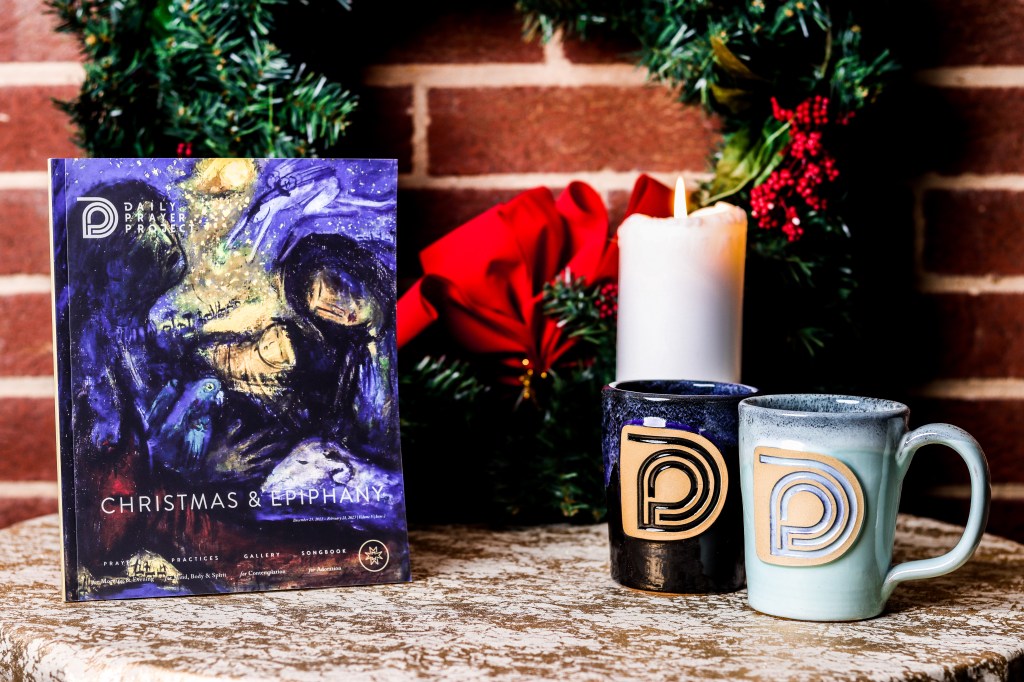
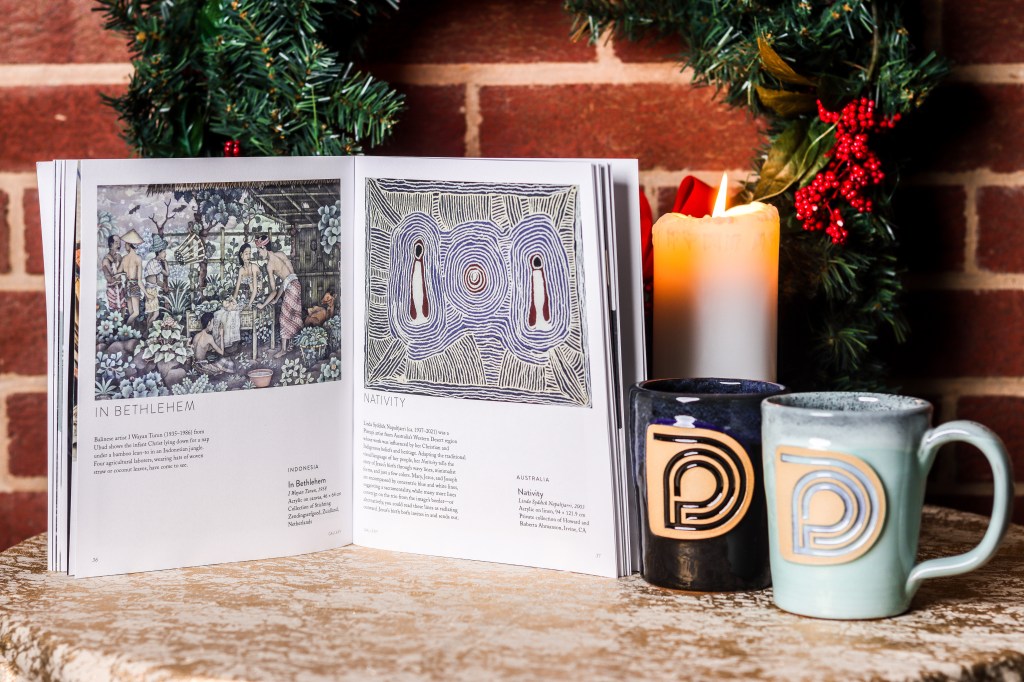
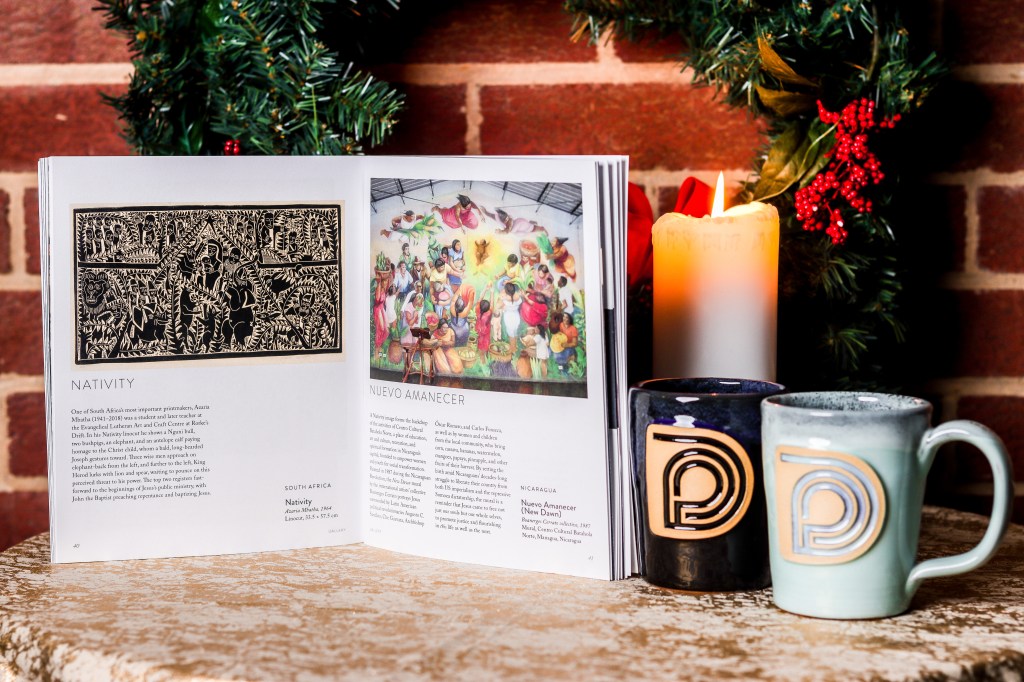
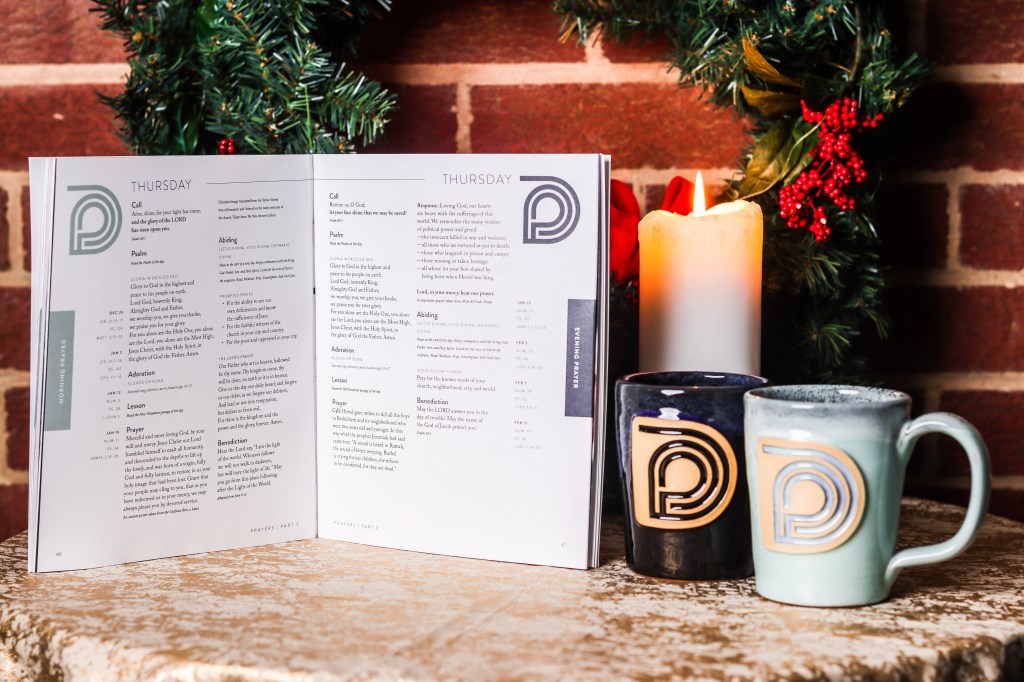
The Daily Prayer Project is running a special Christmas gift offer that, for $50, includes a physical and digital copy of our hot-off-the-press Christmas–Epiphany prayer periodical (covering December 25 through February 21) and two hand-thrown, dishwasher-safe mugs with a raised medallion of our labyrinth-inspired logo and glazes that map onto our morning and evening prayer colors. Packages ship early next week, so get your order in soon! There are also yearly subscription options, individual or communal, on the website.

In addition to working as a copyeditor and proofreader for the DPP, I also curate the art for the Gallery section, which is expanded in this edition to eight pieces—in this case, Nativities from around the world, each accompanied by a short reflection. The cover image is Morning Star by the Japanese Christian artist Hiroshi Tabata (1929–2014).

“My soul is alive with thoughts of God”: An adaptation of Mary’s Magnificat, by Rev. M Barclay

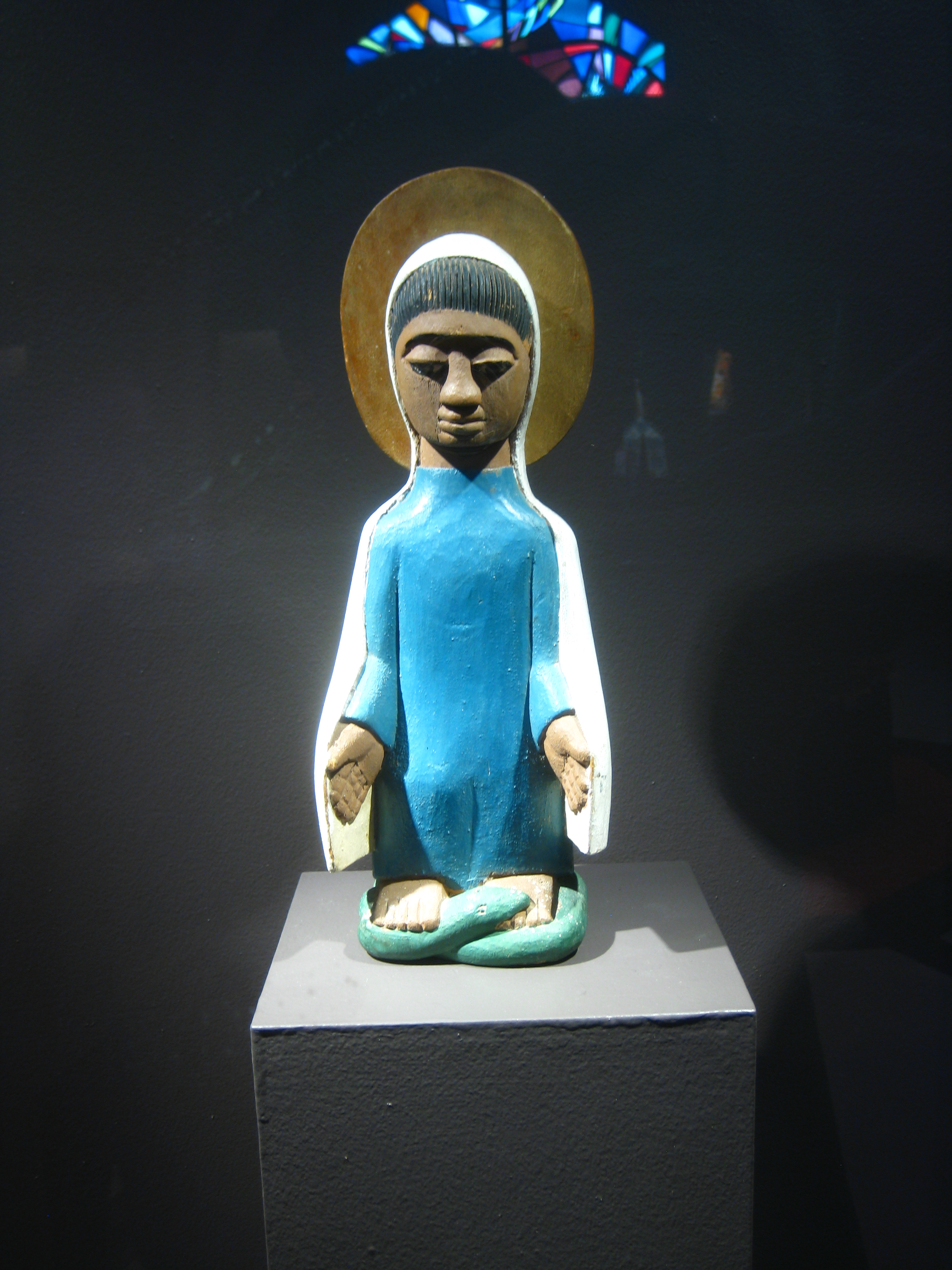
Bandele, George_Virgin Mary
George Bandele (Nigerian, 1910–1995), Virgin Mary, 1960s, wood and pigment. Collection of the SMA African Art Museum, Tenafly, New Jersey. Photo: Victoria Emily Jones.

With the feast of the Visitation coming up on May 31, I’ve been thinking about the song Mary sings in Luke 1:46–55 upon meeting up with her cousin Elizabeth in the hill country of Judea following their miraculous conceptions. It’s bold, exultant, and worshipful, oriented around the liberative power of God. As we continue to reel from the string of mass shootings in the US (Tuesday’s shooting at Robb Elementary School in Uvalde, Texas, was the 212th this year alone), I wonder how Mary’s song might speak to us in this moment—how we, too, might exclaim it with her same fervor and hope, truly believing that God is at work in the world, bringing about justice and healing, even though it is injustice and hurt that so often sound the loudest.

Here is a modern interpretation of the Magnificat by Rev. M Barclay, cofounder and director of enfleshed, an organization that creates prayers, liturgies, art, meditations, teachings, and other spiritual resources for collective liberation. Written in 2019, it captures the verve of Mary’s words while also drawing out shades of sorrow and adding a petitionary element. Barclay uses the gender-neutral pronoun “They” for the Triune God.

My soul is alive with thoughts of God.
What a wonder, Their liberating works.
Though the world has been harsh to me,
God has shown me kindness,
seen my worth,
and called me to courage.
Surely, those who come after me will call me blessed.
Even when my heart weighs heavy with grief,
still, so does hope abide with me.
Holy is the One who makes it so.
From generation to generation,
Love’s Mercy is freely handed out;
none are beyond the borders of
God’s transforming compassion.
The power of God is revealed
among those who labor for justice.
They humble the arrogant.
They turn unjust thrones into dust.
Their Wisdom is revealed in
the lives and truths of those on the margins.
God is a feast for the hungry.
God is the great redistributor of wealth and resources.
God is the ceasing of excessive and destructive production
that all the earth might rest.
Through exiles and enslavement,
famines and wars,
hurricanes and gun violence,
God is a companion in loss,
a deliverer from evil,
a lover whose touch restores.
This is the promise They made
to my ancestors,
to me,
to all the creatures and creations,
now and yet coming,
and in this promise,
I find my strength.
Come, Great Healer,
and be with us.

Roundup: Giotto projections, global Christmas music playlist, Sakhnini Brothers concert, sacred lettering, deep incarnation

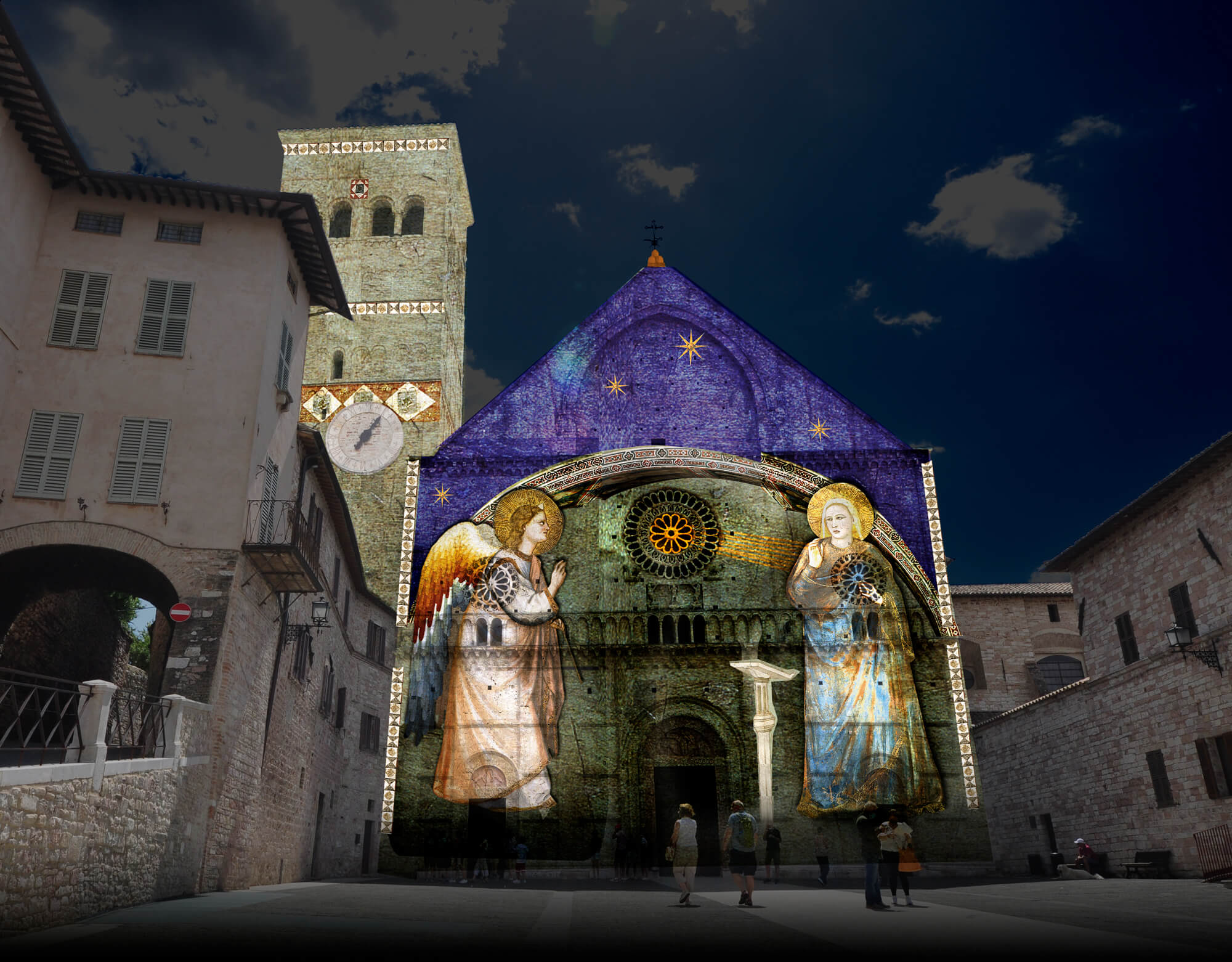
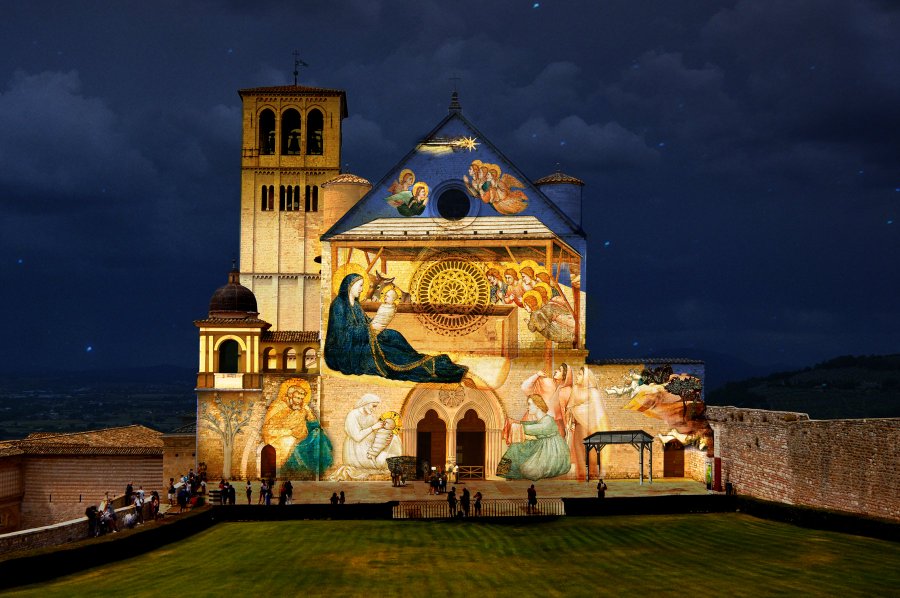
PROJECTION MAPPING INSTALLATION: Il Natale di Francesco (The Christmas of Francis): Last year the Sacro Convento in Assisi, a Franciscan friary, initiated an architectural lighting project called Il Natale di Francesco that featured projections of Christmas-themed frescoes by Giotto from the Lower Basilica of St. Francis onto several of the city’s landmark churches. Architect Mario Cucinella served as artistic director, and the company Enel X realized the installation, which ran throughout Advent and Christmastide, from December 8, 2020, to January 6, 2021 (and I hear it’s been reprised this year!). The pièce de résistance was the projection of Giotto’s Nativity onto the facade of the Upper Basilica of St. Francis. Other projections included the Annunciation on the Cathedral of San Rufino, the Visitation on the Basilica of Saint Clare, and the Adoration of the Magi on the abbey church of San Pietro in Valle—all images adapted using advanced technology to suit the spaces they illuminated.

Annunciation projection

Other components of the installation included frescoed stars from the main basilica’s vaults projected onto the streets; a re-creation of Giotto’s scenes with dozens of sculpted figures, including the addition of a masked nurse at the crèche in honor of all the frontline healthcare workers serving during the COVID-19 crisis; and every thirty minutes a video-mapping show that offered views of the basilica’s interior. I so love the creativity of bringing the sacred art treasures of the church out into the town squares when the pandemic necessitated church closures.

+++

VIRTUAL CONCERT: Christmas with the Sakhnini Brothers: The Sakhnini Brothers are Adeeb, Elia, and Yazeed, three Arabic-speaking brothers from Nazareth who are followers of Jesus. They play about twenty instruments collectively but specialize in piano, oud, and violin, respectively, and love to blend modern Western and ancient Middle Eastern musical styles.

In this half-hour living room concert that premiered December 13, they are joined by vocalist Nareen Farran, pianist Sireen Elias, and percussionist Firas Haddad. They perform an instrumental rendition of “God Rest Ye Merry Gentlemen”; “Amano Morio,” a traditional hymn from the Syriac Maronite liturgy, whose lyrics translate to “The Lord is with us day and night”; “O Come, All Ye Faithful” in Arabic; “Sobhan Al Kalima” (Glory to the Word), another traditional hymn in Syriac (see YouTube video description for full English translation); “Mary, Did You Know”; and “Laylet Eid” (Christmas Eve), a song by Fairuz to the tune of “Jingle Bells.” Their arrangements are fantastic! (You especially have to hear what they do with that closing number; I can’t stop smiling.)

You can support the Sakhnini Brothers on Patreon and follow them on Facebook.

+++

PLAYLIST: Global Christmas Music YouTube Playlist: At the request of Inspiro Arts Alliance, my friend Paul Neeley, an ethnodoxologist blogging at Global Christian Worship, has curated a playlist of twenty-eight Christmas songs from around the world. Languages include French, Yoruba, English, Arabic, Gaelic, Huron, Norwegian, Nepali, German, Hindi, Thai, Italian, Urdu, Spanish, Pangasinan (Philippines), Zulu, Korean, and Swahili. Here are just two videos from the list: “The Greatest Gift,” an original rock song by Sinn Patchai from Thailand, and “Don Oíche Úd i mBeithil” (That Night in Bethlehem), a traditional Irish carol performed by Mairéad Ní Mhaonaigh.

Neeley also put together a listening guide so that you can follow along with the lyrics.

+++

VIRTUAL EXHIBITION: Visual Music: Calligraphy and Sacred Texts, Henry Luce III Center for the Arts & Religion: “‘Form,’ wrote Jewish-American artist Ben Shahn, ‘is the very shape of content.’ Shahn’s statement serves as the guiding principle for this exhibit. Each of these fifteen pieces, all by living artists, is a calligraphic interpretation of a text sacred to Jews, Christians, or both. Each artist has pondered their chosen text, explored it inside and outside, and provided their own rendition of it—their own ‘translation’ into visual form.”

Jonathan Homrighausen, a doctoral student in Hebrew Bible at Duke University who writes and researches at the intersection of Hebrew Bible, calligraphic art, and scribal craft, has curated this wonderful online art exhibition for the Henry Luce III Center for the Arts & Religion at Wesley Theological Seminary in Washington, DC. I spent hours viewing all the rich content on the website, including Homrighausen’s illuminating commentaries (which take us beyond a simplistic “ooh, pretty” response), and following links to learn more. From the exhibition homepage you can click on any of the images for a detailed description, detail photos, embedded videos and music, and suggested articles for further reading.

Also check out the video presentation Homrighausen gave on December 12 for the Jewish Art Salon in New York City in which he discusses five of the Hebrew Bible–based pieces on display, plus two that render rabbinic quotes. The Q&A that follows is moderated by Jewish calligrapher Judith Joseph.

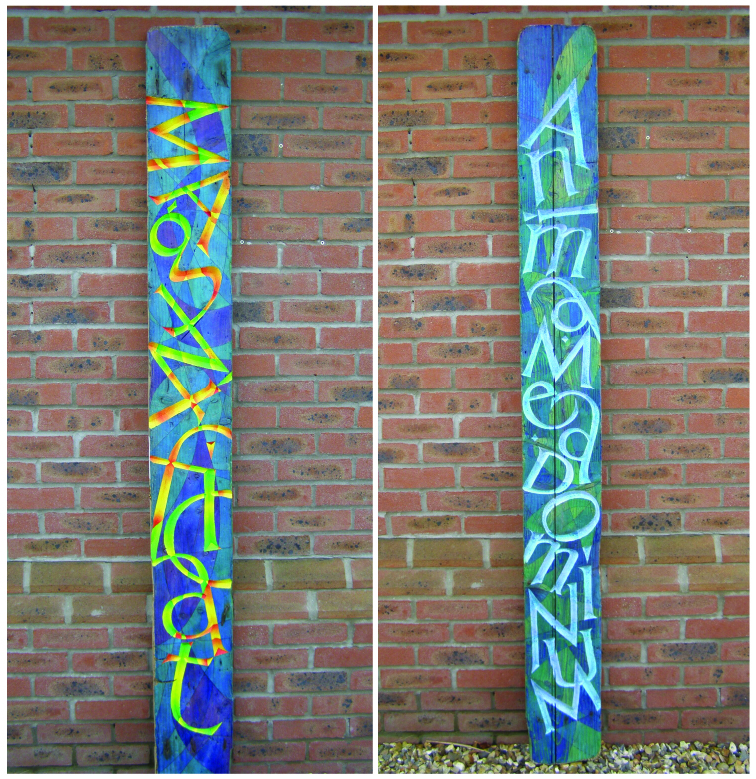
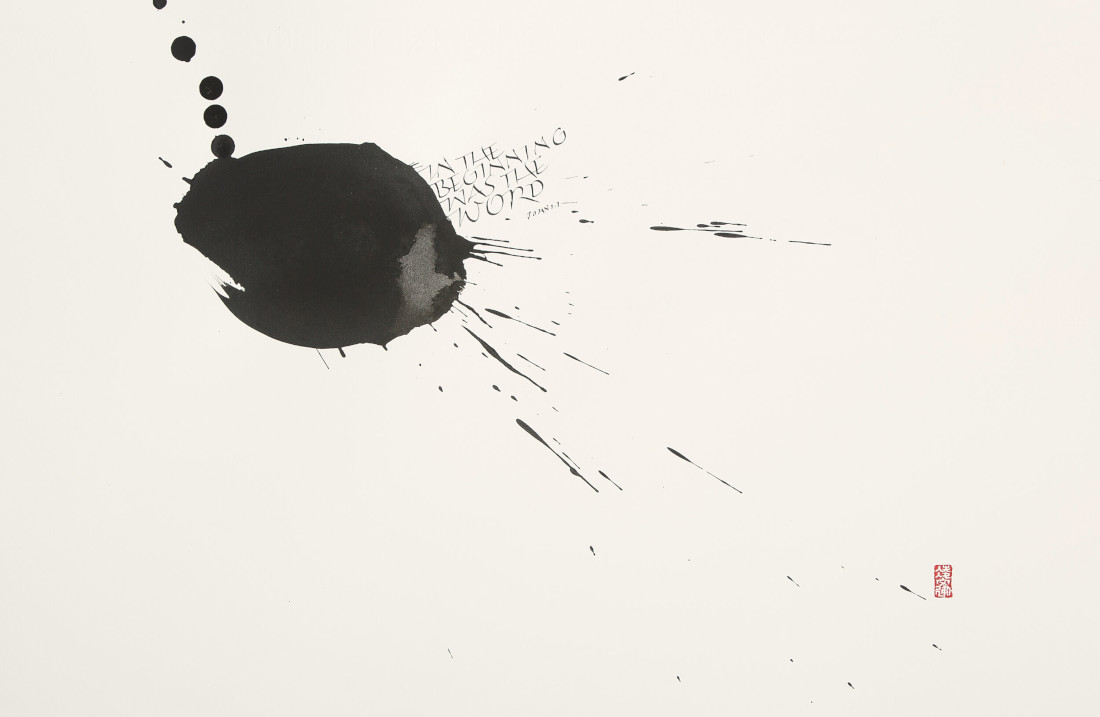
Since many of my blog readers will have just read Mary’s Magnificat from Luke 1 this past Sunday (it’s one of the assigned lections for Advent 4) and we’re just a few days away from the feast of Christmas, let me share these two timely images from the exhibition:

Wenham, Martin_Magnificat (front and back)
Martin Wenham (British, 1941–), Magnificat (front and back), 2008. Paint on found pinewood, 84 × 8 1/2 in.

Ling, Manny_In the beginning was the word
Manny Ling (Chinese, 1966–), ‘In the beginning was the word’ (John 1:1), 2018. Chinese ink on paper, 11 11/16 × 16 1/2 in.

+++

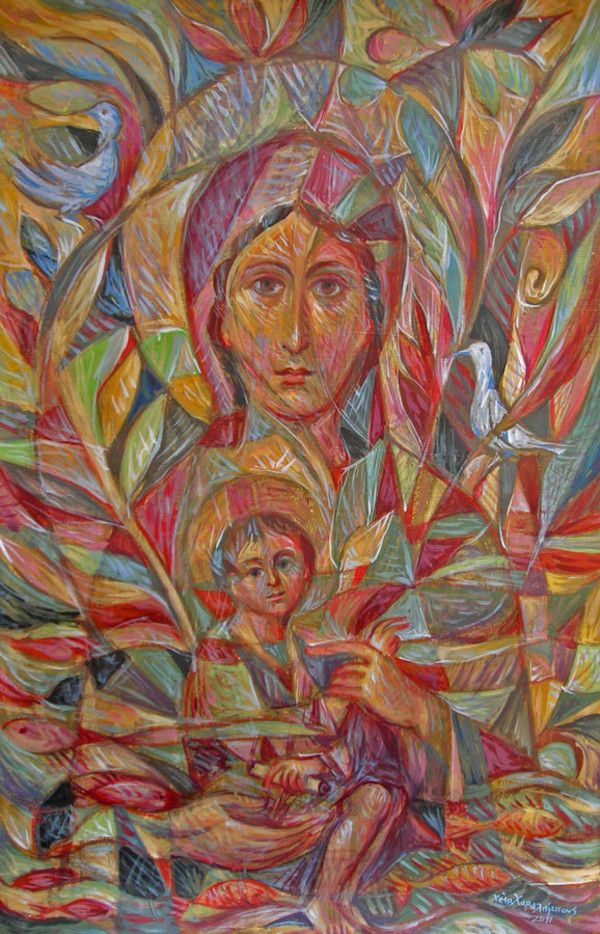
VISUAL MEDITATION: “An Icon of Deep Incarnation” by John A. Kohan: Art collector John A. Kohan reflects on the painting Madonna of the Woods by Cypriot artist Charalambos Epaminonda, a variation on the Virgin Hodegetria type. “God took on human flesh and entered creation not just to bring you and me personal salvation or rescue the human race from sin and death, but to restore and renew the entire earth and all that is therein. Contemporary theologians in our age of ecological awareness call this concept ‘deep incarnation’ . . .”

Epaminonda, Charalambos_Madonna of the Woods
Charalambos Epaminonda (Cypriot, 1962–), Madonna of the Woods, 2011. Acrylic on canvas, 46 × 29 cm. Sacred Art Pilgrim Collection.

“After Annunciation” by Anna Wickham

Art by Aline Brant
Photograph and embroidery by Aline Brant, 2016

Rest, little guest,
Beneath my breast.
Feed, sweet seed,
At your need.
I took Love for my lord
And this is my reward—
My body is good earth,
That you, dear plant, have birth.

Anna Wickham is the pen name of British/Australian modernist poet Edith Alice Mary Harper (1883–1947). After Annunciation was originally published in the January 1917 issue of Poetry magazine and is in the public domain.