
Roundup: Weighed-down sheep, sin and grace, Bermejo’s devil, and more

POEM: “Lost Sheep” by Margaret DeRitter: DeRitter writes about a lost Merino sheep in Australia who, because left unsheared for so long, was carrying over seventy-five pounds of wool on his back. He was found in 2021 and rescued by Edgar’s Mission Farm Sanctuary in Lancefield.

+++

SONGS:

>> “What Have We Become” by the Sweeplings: The Sweeplings are Cami Bradley and Whitney Dean, a singing-songwriting folk pop duo. From their album Rise and Fall (2015), “What Have We Become” laments how sin encroaches on our lives—we may welcome it in at first, but then it takes over, makes of our house a wasteland. This theme is embodied by a shadowy, thorny-veiled dancer in the music video.

>> “It Knows Me” by Avi Kaplan: Living outside Nashville, Tennessee, Avi Kaplan is best known for being the original vocal bass of the a cappella group Pentatonix, from 2011 to 2017. This song of self-probing is from his second solo EP, I’ll Get By (2020). It’s about the freedom that comes from reckoning with one’s inner darkness and accepting grace. The animation in the video is by Mertcan Mertbilek.

Kaplan, who is Jewish, wrote on Facebook,

“It Knows Me” is an extremely personal song to me. I believe that everyone has a darker side of them, and that you can choose to play into that, or you can choose to not. This song is about that battle between those two forces, and having a little grace for yourself when you do falter on your path.

>> “Not the Devil Song” by Marcus & Marketo: Marcus & Marketo (Marcus Clingaman and Marketo Michel) are a worship music duo from South Bend, Indiana, fusing the styles of gospel, classical, country, and soul. “Not the Devil Song,” which they wrote in 2019, is about the power Christians are given to tell Satan to back off! When he dangles temptations in front of you, whispers lies in your ear, sows seeds of doubt or fear or hopelessness, you can confidently retort, “Devil, no, you gotta let go; Jesus died to save my soul.”

+++

WOODCUT SERIES: Das Herz de Menschen (The Heart of Man): “The following illustrations—which, in a wonderful marriage of word and image, plot out the life of the Christian soul—form the central strain in The Heart of Man: Either a Temple of God, or a Habitation of Satan: Represented in Ten Emblematical Figures, Calculated to Awaken and Promote a Christian Disposition (1851), an English edition of a German book published in 1812 in Berlin by the ‘divine’ and philanthropist Johannes Gossner (1773-1858),” which was itself based on an older French text. The illustrations are not credited and are probably copies of ones that originated in France in the late seventeenth or early eighteenth century.
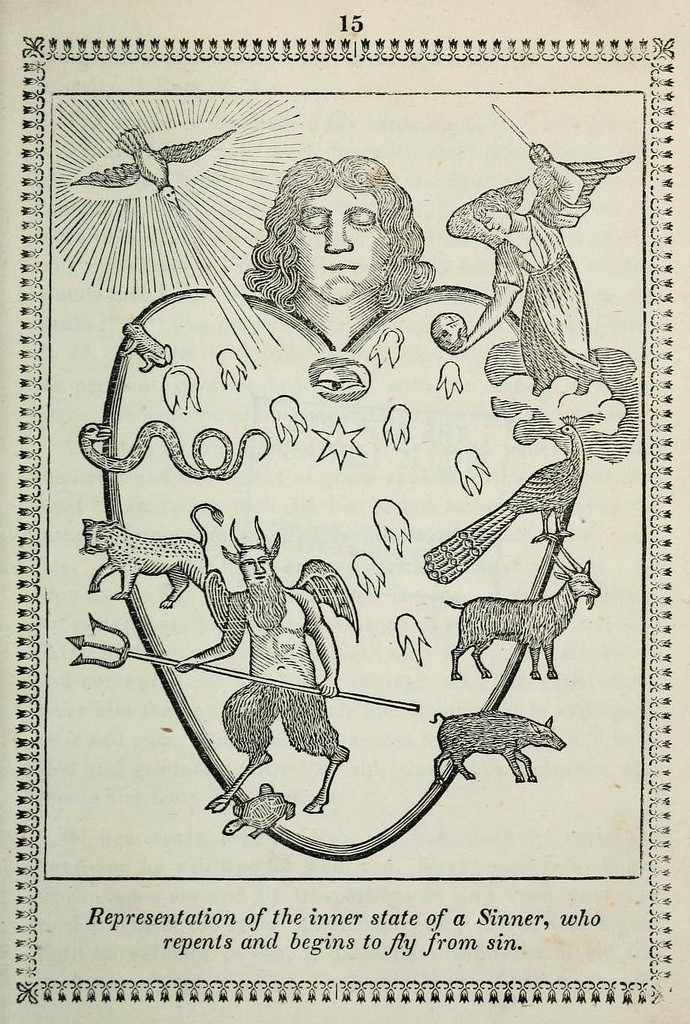
The Heart of Man

In his book The Forge of Vision (2015), visual studies scholar David Morgan contrasts this emblematic series with the related Cor Jesu amanti sacrum by Anton Wierix (which I wrote about here). Whereas the Wierix engravings from Antwerp are marked by sweetness, with the Christ child gently cleaning and setting up house in the human heart, the anonymous illustrations Gossner uses portray more of a psychomachia (battle for the soul), with armed angels seeking to oust Satan and his minions.

+++

VIDEO: “How Bermejo paints good and evil in Saint Michael Triumphs over the Devil: In this nine-minute video, Daniel Sobrino Ralston, associate curator for Spanish paintings at the National Gallery in London, examines a late Gothic painting in the museum’s collection by the Spanish artist Bartolomé Bermejo, showing the archangel Michael slaying Satan. Based on Revelation 12:7–9, this subject gave artists the chance to flex their imaginations in portraying evil incarnate and its vanquishment. Possessing an impressive capacity for fantastical invention, Bermejo gives the devil snakes for arms, eyes for nipples, bird claws, moth-like wings, a spiky tail, and a cactus growing out of its head!
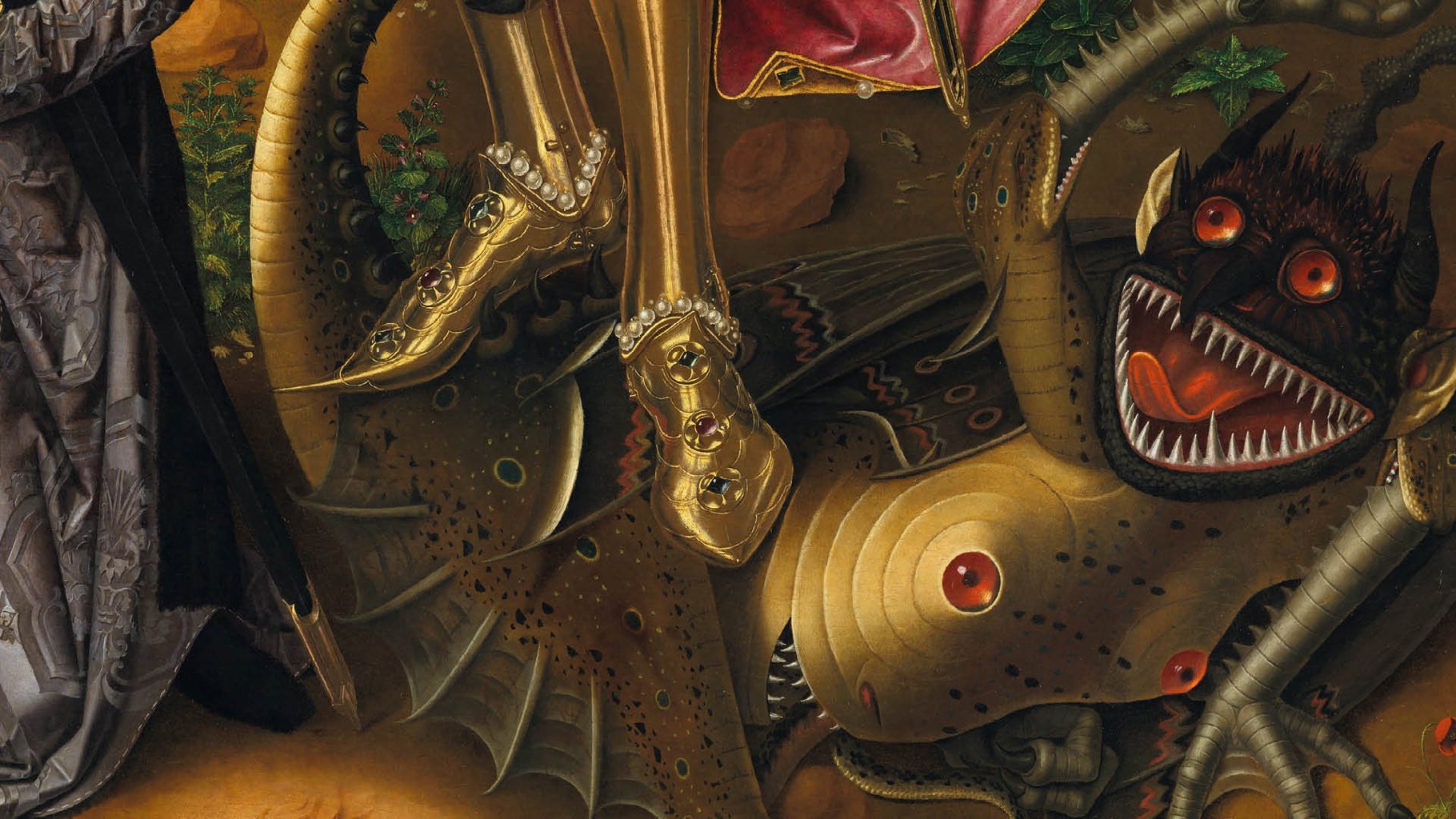
Bermejo, Bartolome_St. Michael (detail)
Bartolomé Bermejo (Spanish, ca. 1440–after 1495), Saint Michael Triumphs over the Devil (detail), 1468. Oil and gold on wood, 179.7 × 81.9 cm. National Gallery, London.

If this visual subject interests you, I recommend the book Angels and Demons in Art by Rosa Giorgi, from the J. Paul Getty Museum’s Guide to Imagery series.

Roundup: West African praise medley, reading poetry and fiction, and more

SPOTIFY PLAYLIST: August 2022 by Victoria Emily Jones: Most months I compile thirty songs and other musical selections into a nonthematic playlist as a way to share good music, mostly from the Christian tradition but otherwise Christian-adjacent. This month’s list includes a traditional Black gospel song performed by Chris Rodrigues and professional spoon player Abby Roach (featured here); a Zulu song from South Africa about holding on to Jesus (bambelela = “hold on”); a song in the voice of Christ Our Mother by Irish singer-songwriter Sinéad O’Connor, from her album Gospel Oak; a portion of Barbados-born Judy Bailey’s Caribbean-style setting of the Anglican liturgy; a brass arrangement of a Golden Gate Quartet classic; Palestrina’s beautiful multivoiced setting of a Latin hymn by Bernard of Clairvaux; a future-looking song of celebration by country artist Naomi Judd, who passed away in April; a condensation of “In Christ Alone” by Texas soul artist Micah Edwards; and more.

The two videos below are from the list: a medley of the Twi praise chorus “Ayeyi Wura” (King of Our Praise) from Ghana and “Most High God” from Nigeria, led by Eric Lige at the 2018 Urbana missions conference, and a new arrangement by Marcus & Marketo of “I’ve Got a River of Life,” a song that I have fond memories of singing in children’s church as a kid (with hand motions!) (you can hear a more standard rendition here). The first line is derived from Jesus’s saying in John 7:38 (“Out of the believer’s heart shall flow rivers of living water”), and the refrain “Spring up, O well!” comes from Numbers 21:17, where the Israelites praise God for providing them water in the desert.

+++

Reading books is a key way that I grow intellectually and spiritually, and books are often where I find content to highlight on the blog, be it poems, visual art, people, or ideas. Because I’m not affiliated with an academic institution, I don’t have easy access to a lot of the books I need for my research, and I rely heavily on my personal library (as well as the Marina interlibrary loan system). If you’d like to support the work of Art & Theology, buying me a book from my wish list is a great way to do that! I’ll consider it a birthday gift, as my birthday is Saturday. 😊

+++

ESSAYS:

>> “Poetry’s Mad Instead” by Abram Van Engen, Reformed Journal: “I believe that poetry has a particular place in the church. I think it responds directly to the call and the invitation of God to ‘sing a new song,’” says Abram Van Engen, chair and professor of English at Washington University in St. Louis and cohost of the podcast Poetry for All. “And in the singing of poetry, the faithful can begin to understand and experience and engage God’s world afresh.” He adds, “Poets often invite us to practice thinking and noticing at a different pace. It is only at a slower speed of processing that we can begin to observe what we have too often missed or ignored.”

In this essay, Van Engen walks readers through the sonnet “Praise in Summer” by Richard Wilbur, which is what he begins with whenever he teaches poetry at church. He teaches you some of the poet’s tools so that you can feel more confident in approaching poems on your own.

>> “In Defense of Fiction: Christian Love for Great Literature” by Leland Ryken: An excellent article, by a professor emeritus of English at Wheaton College and author of The Christian Imagination: The Practice of Faith in Literature and Writing, A Complete Handbook of Literary Forms in the Bible, and more. “With so many valuable nonfiction books available to Christians, many wonder if reading fiction is worth the time. Others view fiction as a form of escapism, a flight from reality and the world of responsibility. But rightly understood, reading fiction clarifies rather than obscures reality. The subject of literature is life, and the best writers offer a portrait of human experience that awakens us to the real world. Fiction tells the truth in ways nonfiction never could, even as it delights our aesthetic sensibilities in the process. Reading fiction may be a form of recreation, but it is the kind that expands the soul and prepares us to reenter reality.”

+++

VISUAL MEDITATION: On Christ and the Samaritan Woman by Jacek Malczewski, by William Collen: William Collen introduced me to this unusual painting on the subject of Christ’s meeting with the woman at the well from John 4—a subject the artist painted several times (e.g., here, here, and here). Whereas Christ is traditionally shown pontificating to the woman with an air of formality, here there is an appealing casualness to their interaction, and the woman dominates the composition.

Malczewski, Jacek_Christ and the Samaritan Woman
Jacek Malczewski (Polish, 1854–1929), Christ and the Samaritan Woman, 1912. Oil on plywood, 92 × 72.5 cm. Borys Voznytskyi Lviv National Art Gallery, Ukraine.

Collen is an art writer and researcher from Omaha, Nebraska, who is a Christian and who blogs at Ruins. I’ve enjoyed following his posts, which include “The proper response to an art of sorrow”; “Dikla Laor’s photographs of the women of the Bible”; how household chores are approached differently by Koons, Picasso, Degas, and Vermeer; “Good art / bad art / non-art”; and “Artists and agency: assumptions and limits.” He writes in a conversational manner that’s really refreshing.