Kolumba and KMSKA: Medieval and contemporary art in conversation (part 2)

This a continuation of yesterday’s article. In part 1 I shared three room highlights from my visit to Kolumba museum in Cologne, Germany, run by the city’s Catholic archdiocese; in this final part I will do the same for KMSKA in Antwerp, Belgium, whose Old Masters galleries received a “contemporary injection” in an exhibition that wrapped this week. All photos are my own.

[Content warning: This article contains female nudity: a controversial Renaissance painting of the Virgin Mary, and three photographs of women who have just given birth.]

KMSKA, Antwerp

The Royal Museum of Fine Arts Antwerp, or KMSKA for short, is a world-famous museum whose collection spans seven centuries, from the Flemish Primitives to the Expressionists.

When I was there last month, the featured exhibition was Collected with Vision: Private Collections in Dialogue with the Old Masters, which ran from April 4 to October 12, 2025. Organized in conjunction with Geukens & De Vil Projects, it interwove postwar and contemporary works by internationally renowned artists from Belgian private collections with the existing museum collection, “expanding the transhistorical approach already in place. The exhibition offers a reflection on the history of art collecting and asks probing questions about social issues such as gender, power and identity. The role of museums and collectors is the focal point. Do the interventions create a harmonious dialogue with 700 years of art history, or do they give rise to challenging contrasts?” Featured artists included Cindy Sherman, Olafur Eliasson, David Claerbout, Francis Alys, Christian Boltanksi, Tracey Emin, Marlene Dumas, Luc Tuymans, and Louise Bourgeois.

The galleries of the exhibition were organized by theme: Holy, Impotence, Horizon, Image, Entertainment, Profusion, Lessons for Life, Fame, The Salon, Heroes, Evil, The Madonna, Suffering, Redemption, Prayer, Heavens, and Power.

I’ll spotlight what I consider the most successful and intriguing pairings.

First, the “Madonna” room, anchored by the famous Madonna Surrounded by Seraphim and Cherubim by the late medieval French court painter Jean Fouquet. It’s the right wing of a diptych that originally hung above an altar at the Collegiate Church of Notre-Dame in Melun.
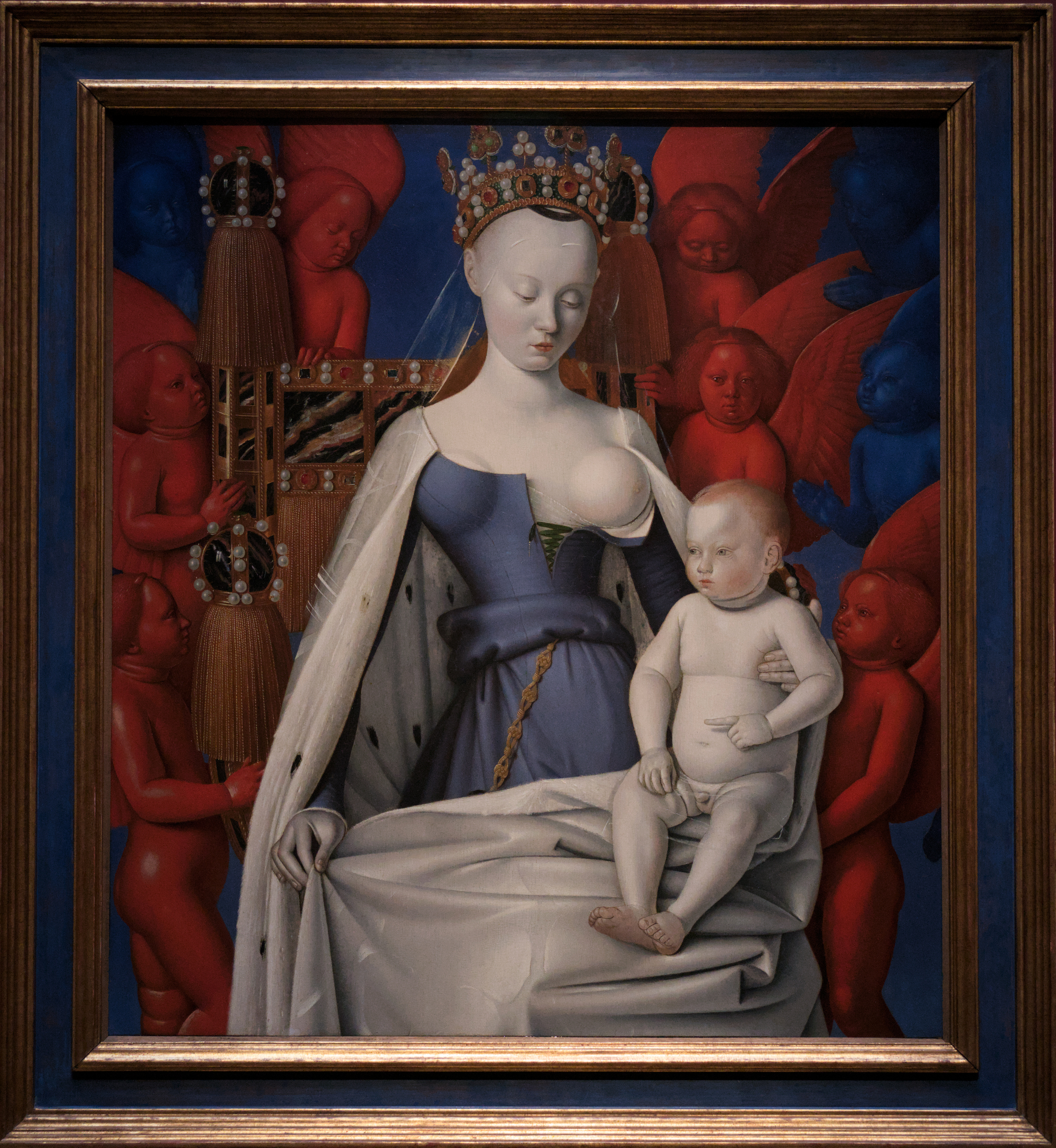
Fouquet, Jean_Madonna Surrounded by Seraphim and Cherubim
Jean Fouquet (French, 1410/30–1477/81), Madonna Surrounded by Seraphim and Cherubim, ca. 1450. Oil on panel, 92 × 83.5 cm. Koninklijk Museum voor Schone Kunsten Antwerpen (KMSKA, Royal Museum of Fine Arts Antwerp).

The painting is historically significant—I first encountered it in a college art history course. Commissioned by Etienne Chevalier, treasurer to King Charles VII of France, it portrays the Virgin Mary as the Queen of Heaven, baring her breast ostensibly to nourish the Christ child with her milk. She was probably modeled after Agnès Sorel, the king’s recently deceased mistress and mother of three of his daughters, considered the ideal of feminine beauty at that time in western Europe: pale-skinned, with a high forehead, and fashionable in her ermine cloak.

Though I can appreciate the technical excellence of this painting and the intense reds and blues of the angels, I don’t really like it. Mary seems cold, not very maternal. There’s also an eroticization of her body—not because her breast is exposed, which was common in Marian art, but because it seems to be on display for the viewer; her son’s not interested in feeding—that’s wholly inappropriate for the subject. Why you’d want to memorialize your boss’s sex partner in such a way is beyond me. I’m no prude, but I much prefer Jan van Eyck’s Madonna at the Fountain, on display in the same room:
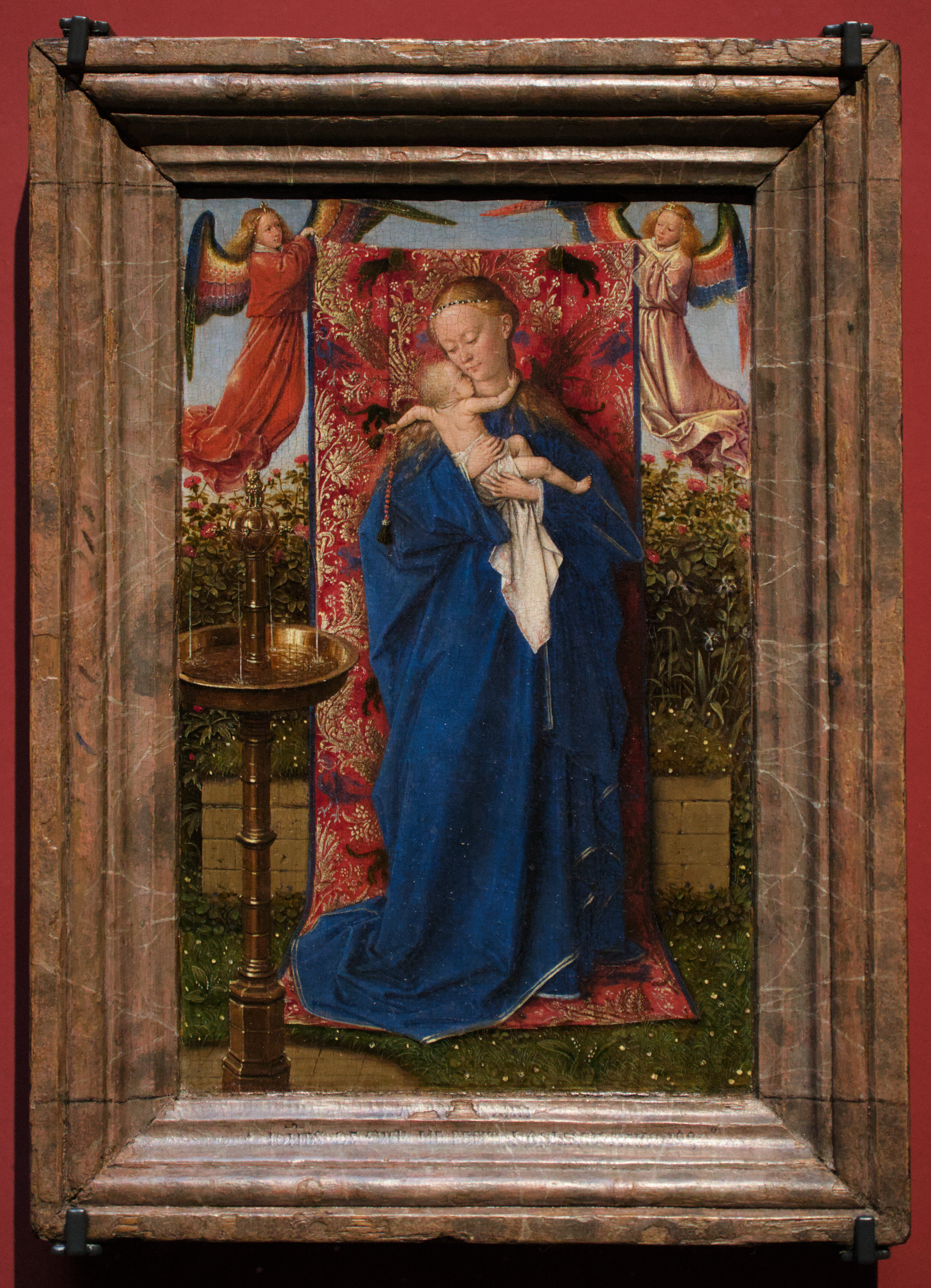
van Eyck, Jan_Madonna at the Fountain
Jan van Eyck (Flemish, 1390/99–1441), Madonna at the Fountain, 1439. Oil on panel, 19 × 12 cm. Koninklijk Museum voor Schone Kunsten Antwerpen (KMSKA, Royal Museum of Fine Arts Antwerp).

This small painting originally hung not in a church but in someone’s house. Though there’s still an air of formality, it has all the tenderness and connection that the other one lacks. Mother and son embrace in a garden of roses, irises, and lilies of the valley, he reaching round her neck and holding a string of prayer beads, she gazing adoringly at him. They stand beside a fountain, recalling Jesus’s discussion in John 4 about the “living water” he gives to those who thirst. The original wood frame bears the artist’s motto: “As well as I can.”

The deeply engrained portrait of motherhood embodied by the Virgin Mary is juxtaposed most potently with a series of three black-and-white portraits of new mothers by the Dutch photographer Rineke Dijkstra.
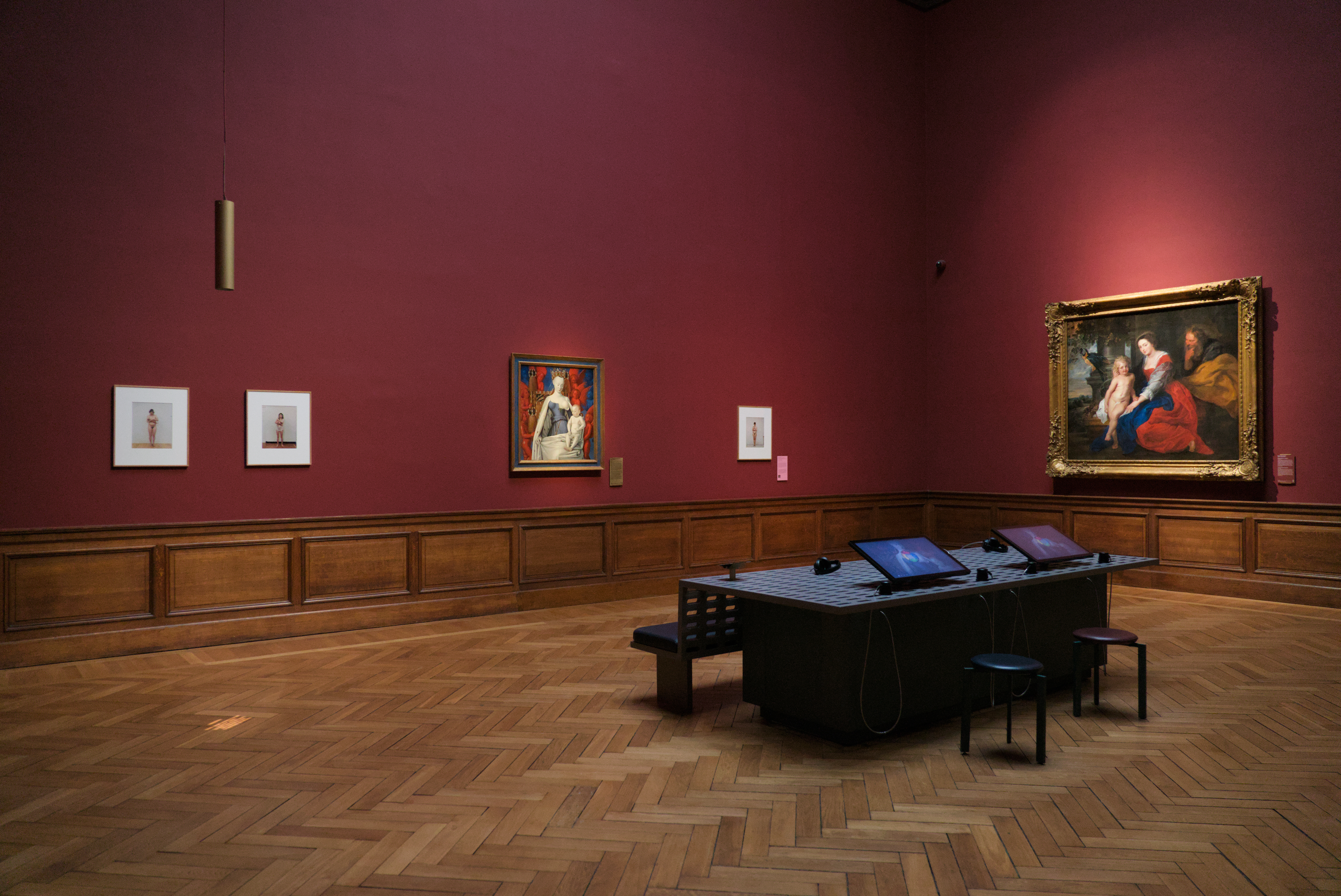
"Madonna" gallery
Gallery 2.17 (“The Madonna”) from the KMSKA exhibition Collected with Vision: Private Collections in Dialogue with the Old Masters

The accompanying text read:

Jean Fouquet portrays motherhood as something sacred. Mary as a symbol of purity and devotion is richly dressed in cool colours. Rineke Dijkstra homes in on the vulnerable reality. Her mothers are scantily clad and marked by childbirth. Both works are innovative: Fouquet may have painted his Mary for the first time from a real person, and in its day the painting was regarded as ‘modern’. Dijkstra shows motherhood in all its rawness, a taboo usually withheld from view.
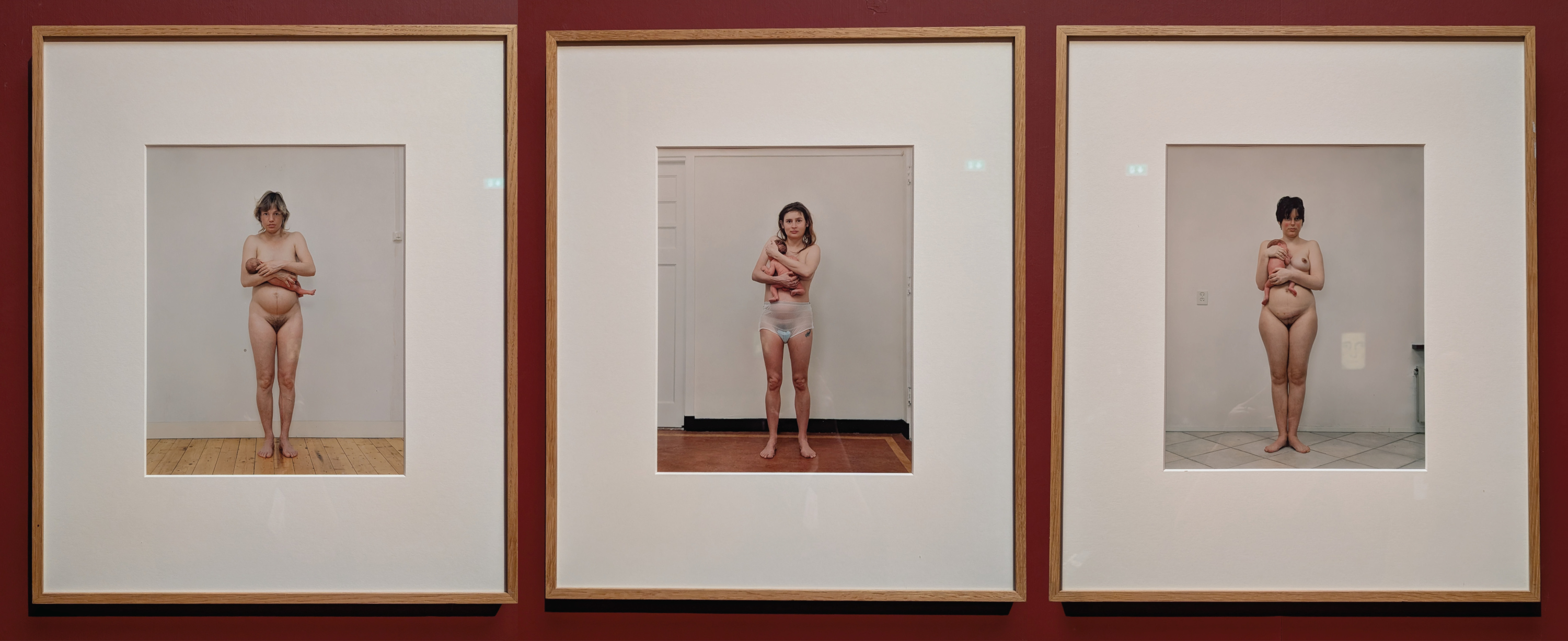
Dijkstra, Rineke_New Mothers
Rineke Dijkstra (Dutch, 1959–), Tecla (Amsterdam, The Netherlands), Julie (Den Haag, The Netherlands), and Saskia (Harderwijk, The Netherlands), 1994. Digital prints. Private collection. [Composite photo by author]

Julie wears hospital pads and mesh underwear, which women often do for several weeks after giving birth to manage postpartum bleeding and urinary incontinence. As for Tecla, blood is running down her leg. And Saskia bears a scar from her cesarean section. A linea nigra (dark line) zips down the abdomen of all three, a temporary pigmentation increase caused by increased hormone levels. I love this triptych that shows motherhood’s glorious, messy, alterative impact on the body—the real physicality of the vocation of bearing children into the world.

I wish there were more imagery of Mary like this, as it would, I think, deepen the wonder of the Incarnation and enhance women’s ability to identify with Mary and thus further enliven her story.

Also in the Madonna gallery was a unique “light poetry” installation by Nick Mattan and Angelo Tijssens—one of seventeen spread throughout the second floor, collectively titled Licht dat naar ons tast (Light that reaches for us). KMSKA had commissioned this couple to bring to life the short verses the museum’s late writer-in-residence Bernard Dewulf had written in response to the galleries’ stated themes.

“Inspired by the museum’s many reading and praying figures, as well as James Ensor’s expressive hand sketches, [Mattan and Tijssens] sought a subtle way to make [Dewulf’s] words tangible,” the museum writes. Their solution was to project them onto the gallery floors from brass cylinders suspended from the ceiling. The words shine like faint specks of light, becoming legible only when a visitor holds their hands, a sweater, or something else up to the light.

Here my husband “holds” a poem written in the voice of Mary:
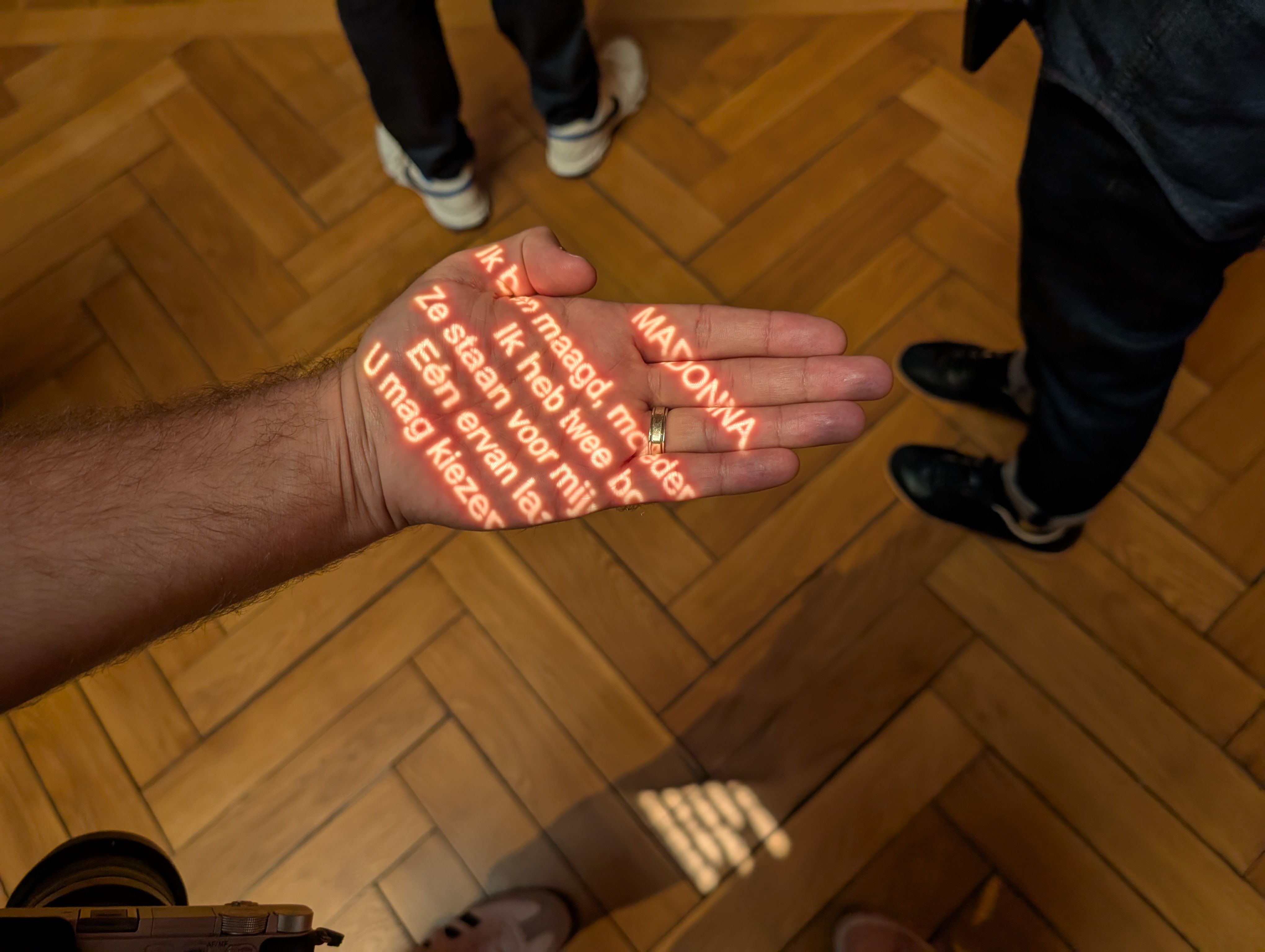
Light that reaches for us
Nick Mattan (Belgian, 1987–) and Angelo Tijssens (Belgian, 1986–), Licht dat naar ons tast (Light that reaches for us), 2023, featuring seventeen poems by Bernard Dewulf. Commissioned by and permanently installed at the Koninklijk Museum voor Schone Kunsten Antwerpen (KMSKA, Royal Museum of Fine Arts Antwerp).

“Madonna” by Bernard Dewulf

Virgin, mother, wife –
I have two breasts
that stand for my three souls.
I show you one of them,
and whose it is is yours to choose.

Translated from the original Dutch by David Colmer

Kind of cheeky! Dewulf speaks of Mary’s three identities and lets us decide if the breast she bares in Fouquet’s painting represents her naked innocence, her nurturing impulse, or her desire to please her husband. (Traditionally in art, it has always stood for the second.)

Though I can’t read Dutch and thus had to consult the KMSKA app for translations of the poems, the thrill of discovery was there in each room. View other visitor engagements with Licht dat naar ons tast on Instagram.

The next gallery I entered was themed “Suffering.”
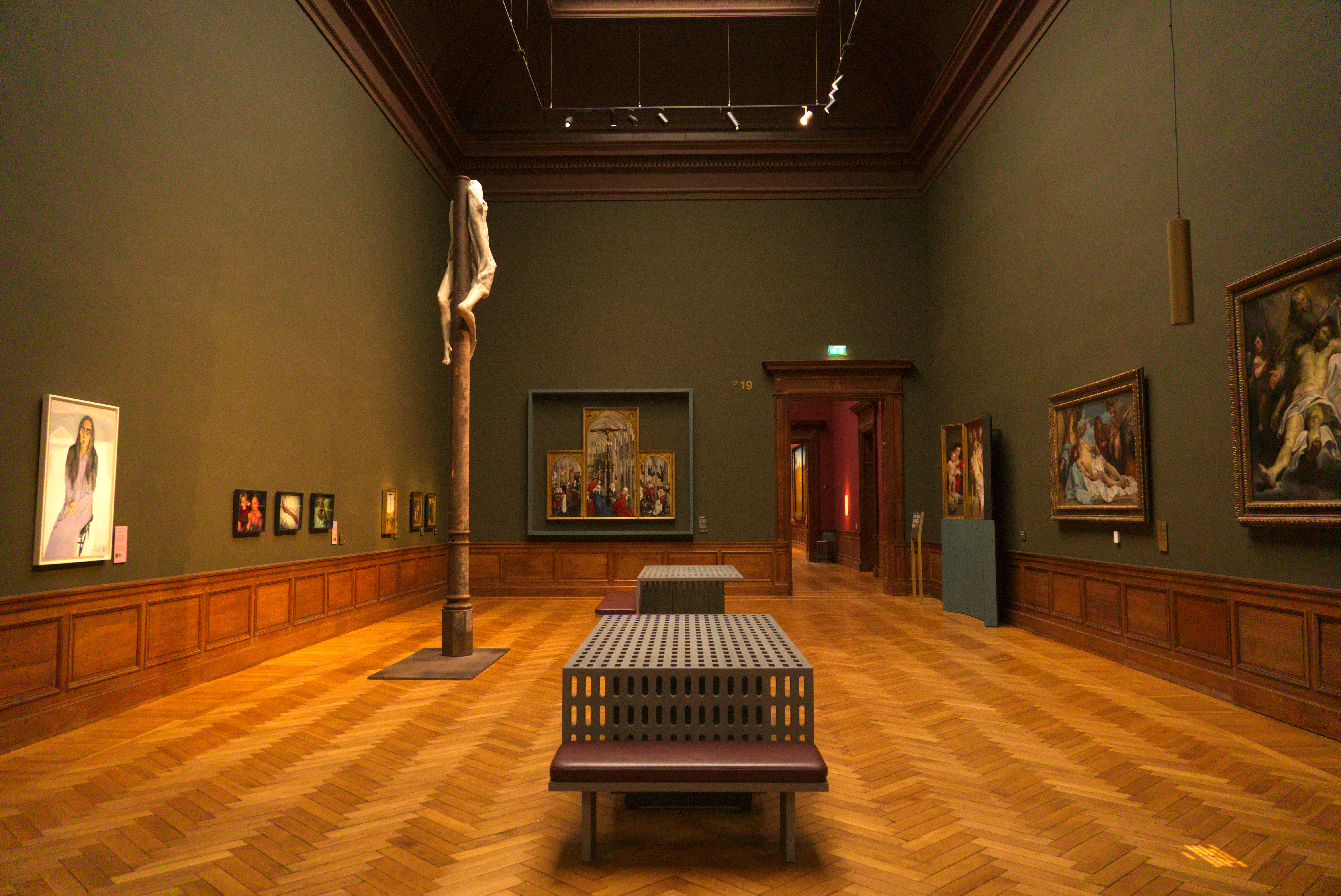
Suffering gallery
Gallery 2.19 (“Suffering”) from the KMSKA exhibition Collected with Vision: Private Collections in Dialogue with the Old Masters

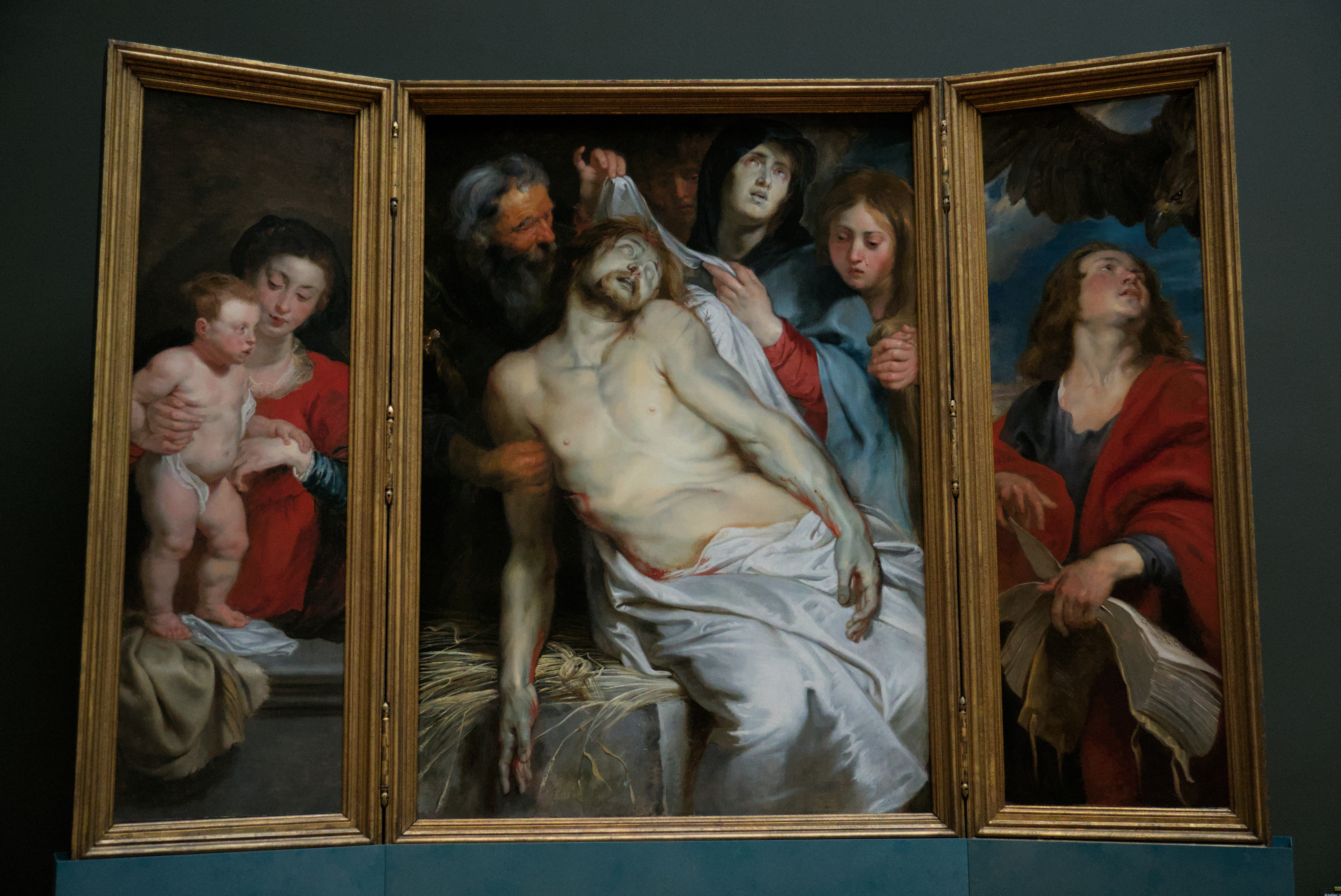
As one would expect, it’s inhabited by several Old Master paintings of Christ’s passion, most notably a triptych by the Flemish Baroque artist Peter Paul Rubens.
Rubens, Peter Paul_Christ on the Straw
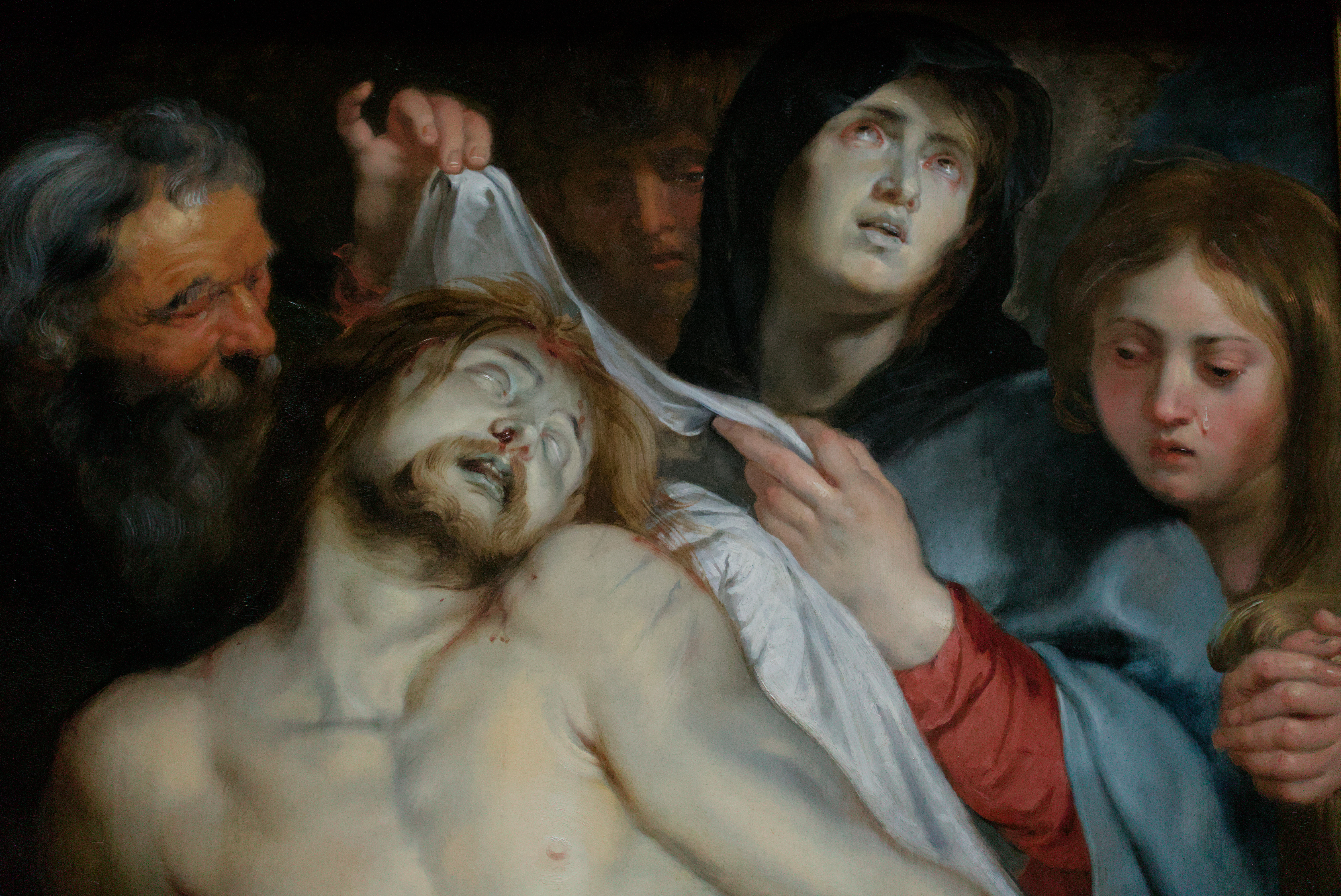
Peter Paul Rubens (Flemish, 1577–1640), Epitaph of Jan Michielsen and His Wife Maria Maes (aka Christ on the Straw, Madonna, and Saint John), 1618. Oil on panel, 138 × 178 cm. Koninklijk Museum voor Schone Kunsten Antwerpen (KMSKA, Royal Museum of Fine Arts Antwerp).

Rubens, Peter Paul_Christ on the straw (detail)

The central panel shows the dead Christ being laid out on a marble slab and wrapped in a shroud by Joseph of Arimathea, while his mother and Mary Magdalene (and the apostle John in the background) mourn him. The left wing shows Mary supporting the pudgy little baby Jesus as he takes some of his first steps, while the right wing shows John, whose symbol is the eagle, writing his Gospel that will place Jesus’s death in the context of the larger story of his life of ministry and his resurrection.

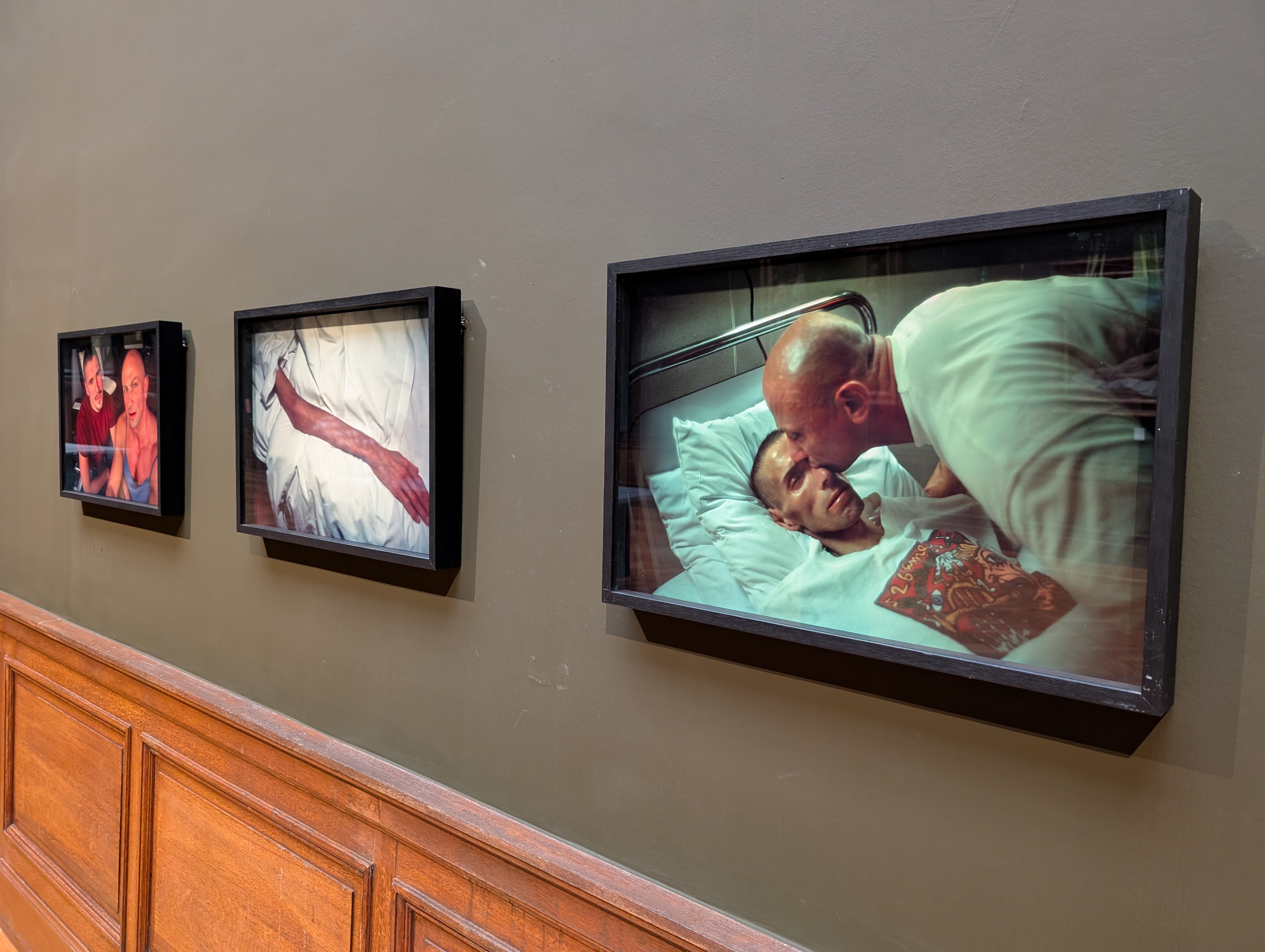
This painting, along with Anthony van Dyck’s Lamentation over the Dead Christ and The Holy Trinity by a follower of Rubens’s (which shows God the Father cradling the dead body of God the Son in an image type sometimes referred to as the Mystic Pietà), are juxtaposed with three photographs by Nan Goldin that show the impact of AIDS on her friend, the Parisian gallery owner Gilles Dusein, and his partner, the artist Gotscho.
Photos by Nan Goldin
Nan Goldin (American, 1953–), Gilles in Hospital, Gilles’ Arm, and Gotscho Kissing Gilles, 1993. C-prints. Private collection.

Dusein’s emaciated arm, resting weakly on a hospital sheet, recalls the limp arm of Christ in paintings of the Deposition and Entombment; and Gotscho’s kiss, the love and grief of Jesus’s mother and friends as they watched their loved one suffer and succumb to death.

By displaying these disparate artworks from vastly different contexts across from each other, we are encouraged to draw connections between the suffering of Christ and that of the LGBTQ+ community. While Christians in Rubens’s day would sit before images of Jesus in pain or sorrow or having died a torturous and untimely death, and deepen their empathy and love, so too might we do well to sit prayerfully, humbly, empathetically, with contemporary images of suffering, seeking to enter the stories they tell.

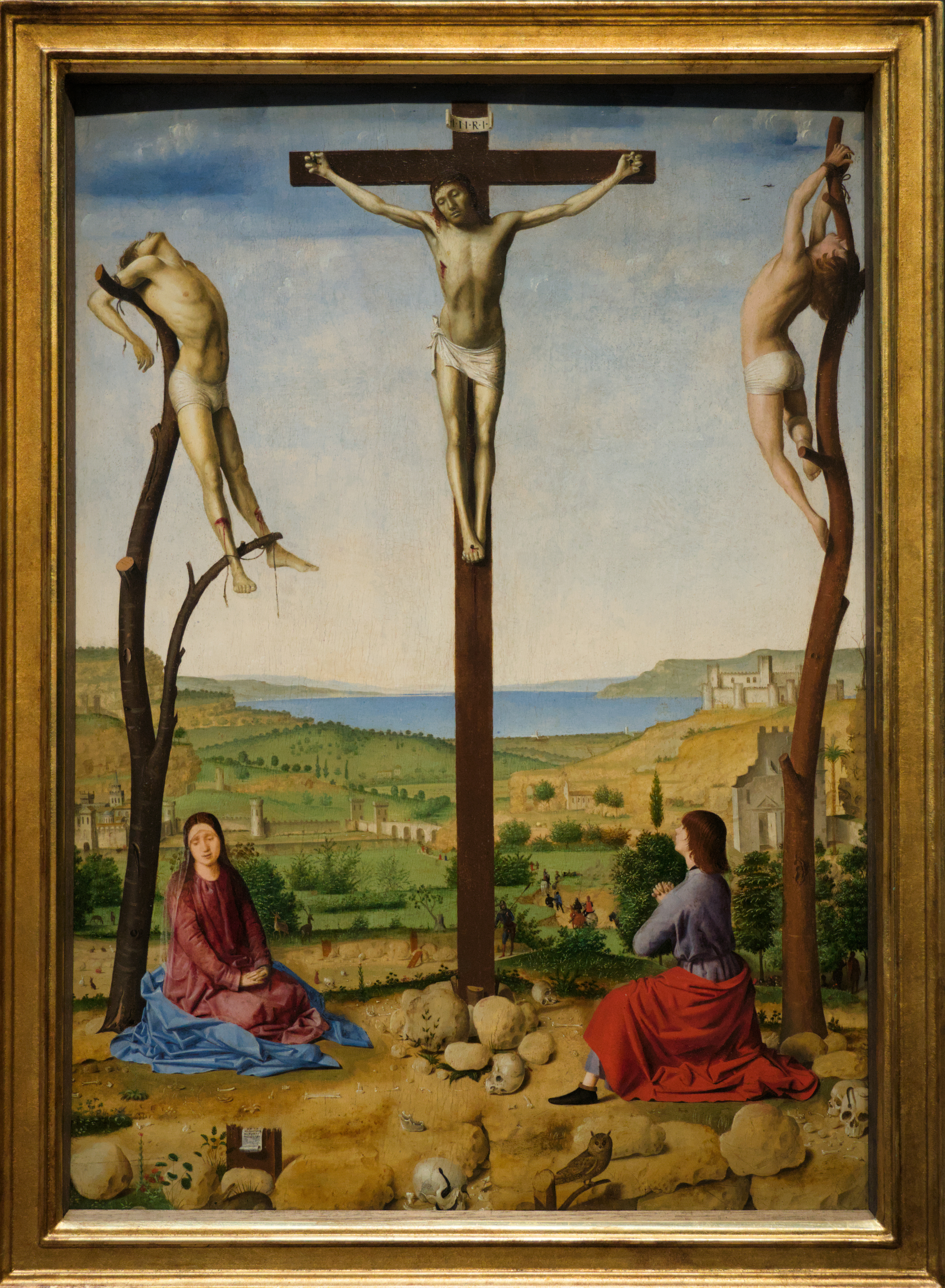
Calvary by Antonello da Messina (another version of which is at the National Gallery in London) also hangs in this gallery. While the crucified Christ seems at peace with his death, the other two on their crosses writhe in pain.
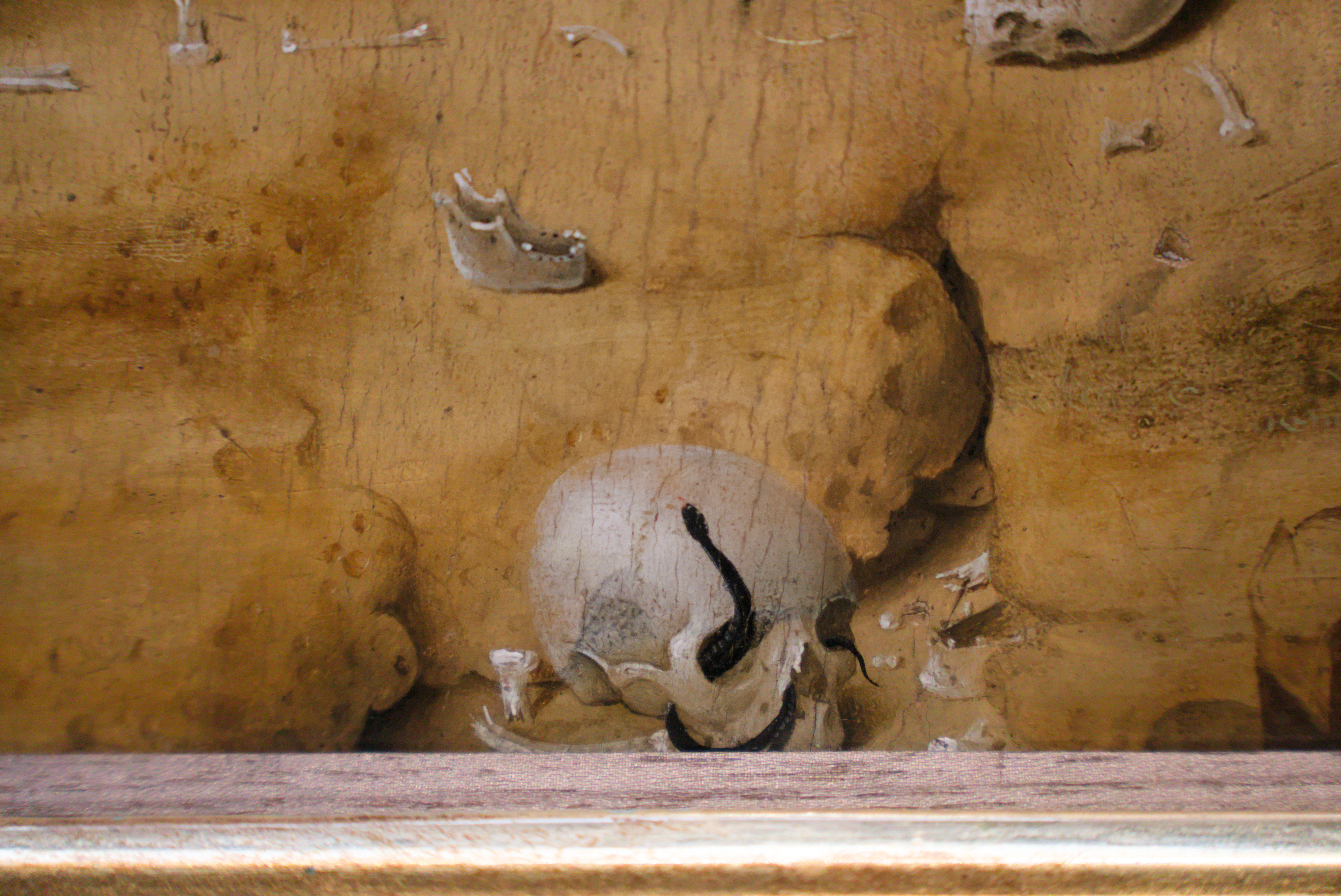
Antonello da Messina_Calvary
Antonello da Messina (Italian, 1430–1479), Calvary, 1475. Oil on panel, 52.5 × 42.5 cm. Koninklijk Museum voor Schone Kunsten Antwerpen (KMSKA, Royal Museum of Fine Arts Antwerp).

Antonello da Messina_Calvary (detail)

Compare these figures to contemporary Belgian artist Berlinde de Bruyckere’s Schmerzensmann (Man of Sorrows), on loan from the collection of David and Indré Roberts (see wide-view photo above). The piece consists of a wax and resin mold of a contorted human form, its skin stretched and broken, its legs wrapped around a tall rusty pole.

“Man of Sorrows” is also the title of an Early Netherlandish painting by Albrecht Bouts and a modern painting by James Ensor, which KMSKA displays side-by-side.
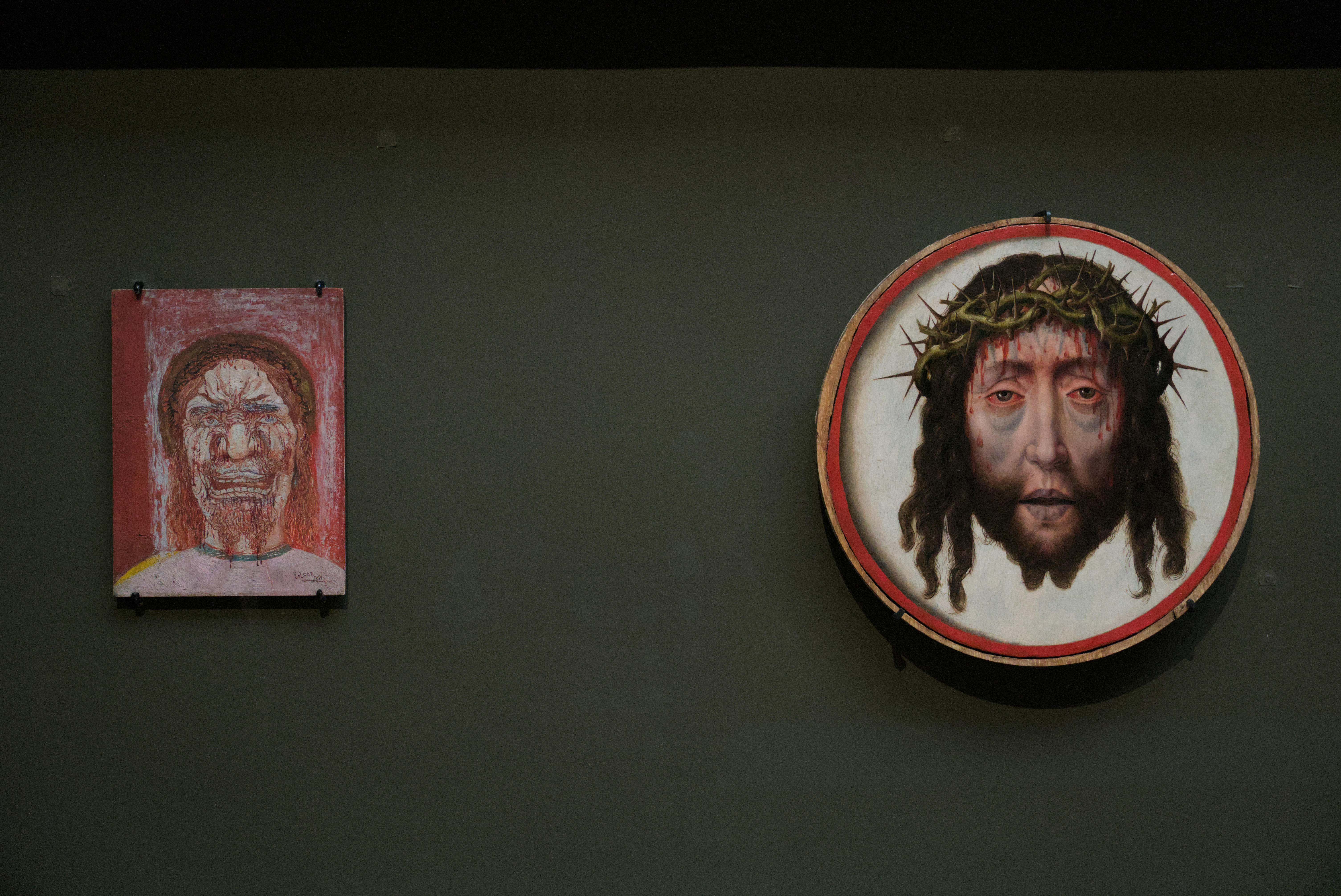
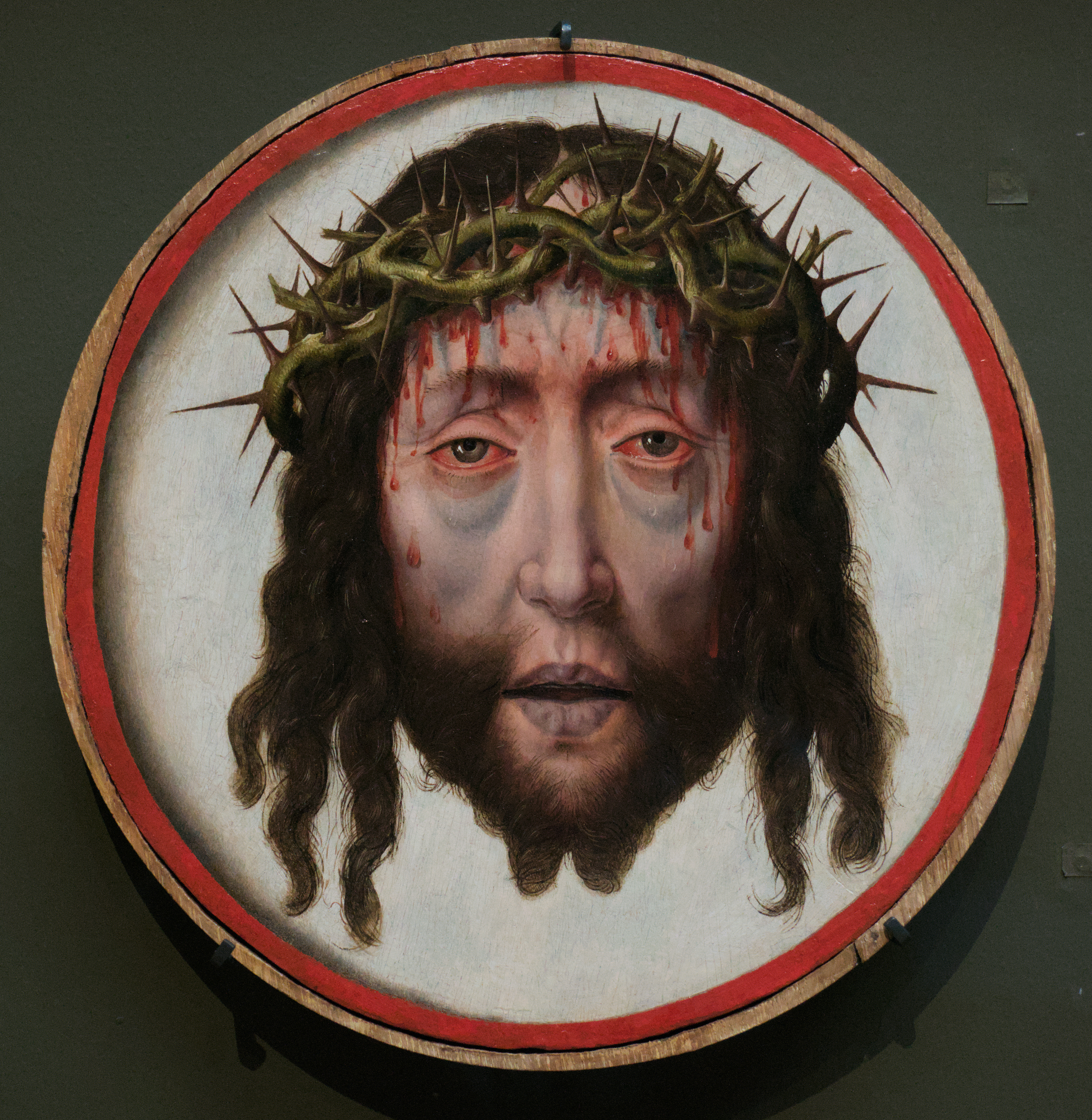
Bouts, Albrecht_Man of Sorrows
Albrecht Bouts (Flemish, 1451/55–1549), Man of Sorrows, 1500–1525. Oil on panel, diameter 29 cm. Koninklijk Museum voor Schone Kunsten Antwerpen (KMSKA, Royal Museum of Fine Arts Antwerp).

The earlier one is an incredibly moving image of pathos. Christ wears a thick, twisted, mock crown whose thorns dig holes into his forehead and draw blood. His eyes are red with tears and sunken in, and his lips are turning blue with the pallor of death. I find it quite beautiful, insofar as an image of suffering can be beautiful. (That’s a topic for another day.)
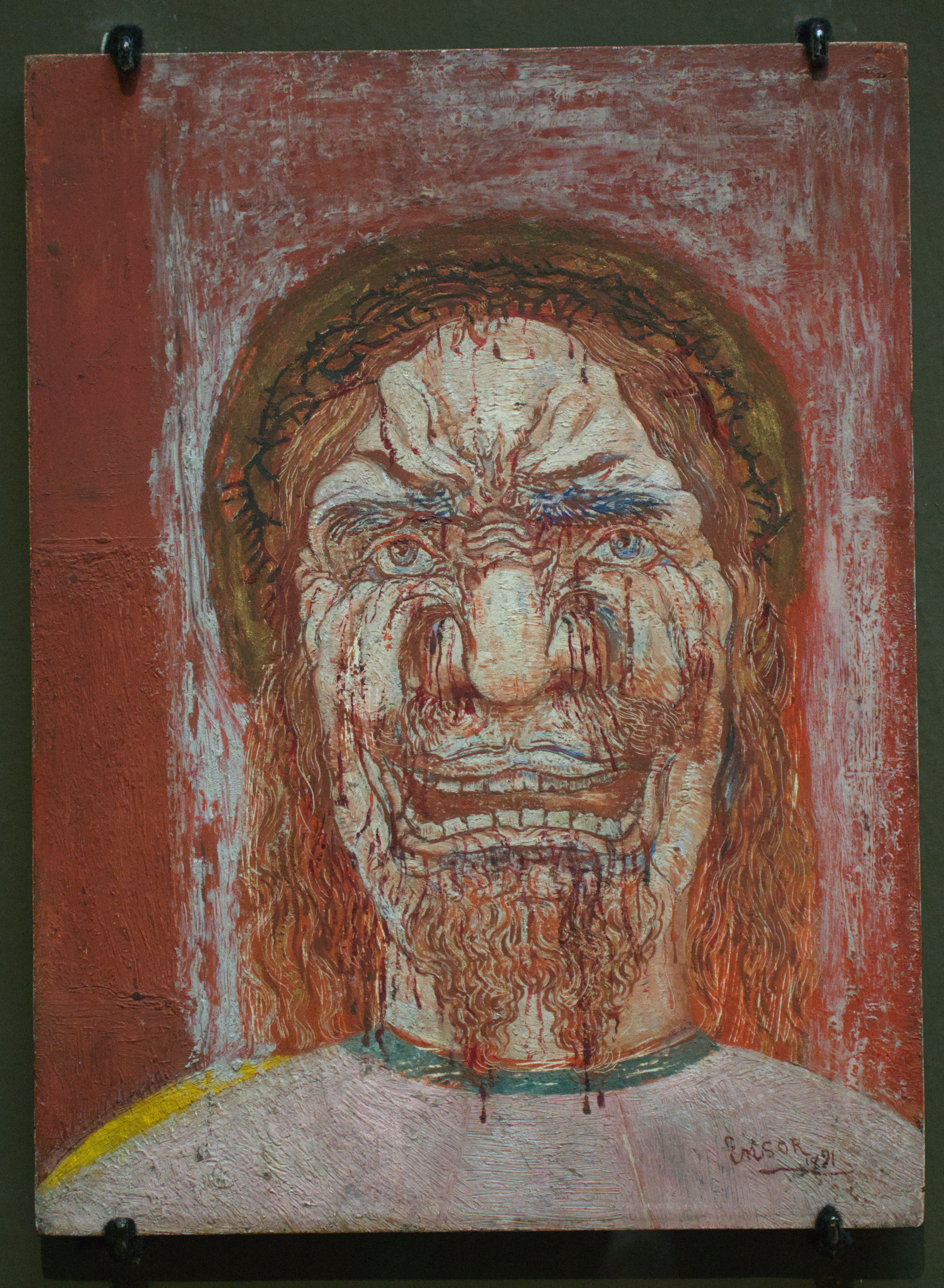
Ensor, James_Man of Sorrows
James Ensor (Belgian, 1860–1949), Man of Sorrows, 1891. Oil on panel, 20 × 15.5 cm. Koninklijk Museum voor Schone Kunsten Antwerpen (KMSKA, Royal Museum of Fine Arts Antwerp).

The Ensor painting, on the other hand, is decidedly not beautiful. In fact, I think it’s the ugliest image of Christ I’ve ever seen, with his crumpled face, scraggly hair, and bared teeth. There’s something very unsettling about his expression, and no wonder, as the curatorial text informs that Ensor drew inspiration from the masks of demon characters in Japanese theater. “His [Ensor’s] Jesus screams with rage about the injustice inflicted on him,” the label says. Is that what that expression is? To me he looks sinister. Like he’s growling at us. And I dislike his dinky crown that he wears like a headband; give me Bouts’s gnarly one instead.

I’m in favor of Christ images that show the rage he must have felt, but I don’t think Ensor is successful if that was his aim. To name a few modern artists who were: Guido Rocha (Tortured Christ, 1975) and David Mach (Die Harder, 2011), both of whom capture Jesus’s cry of dereliction on the cross.

The final themed gallery I’ll call out is “Heavens.”
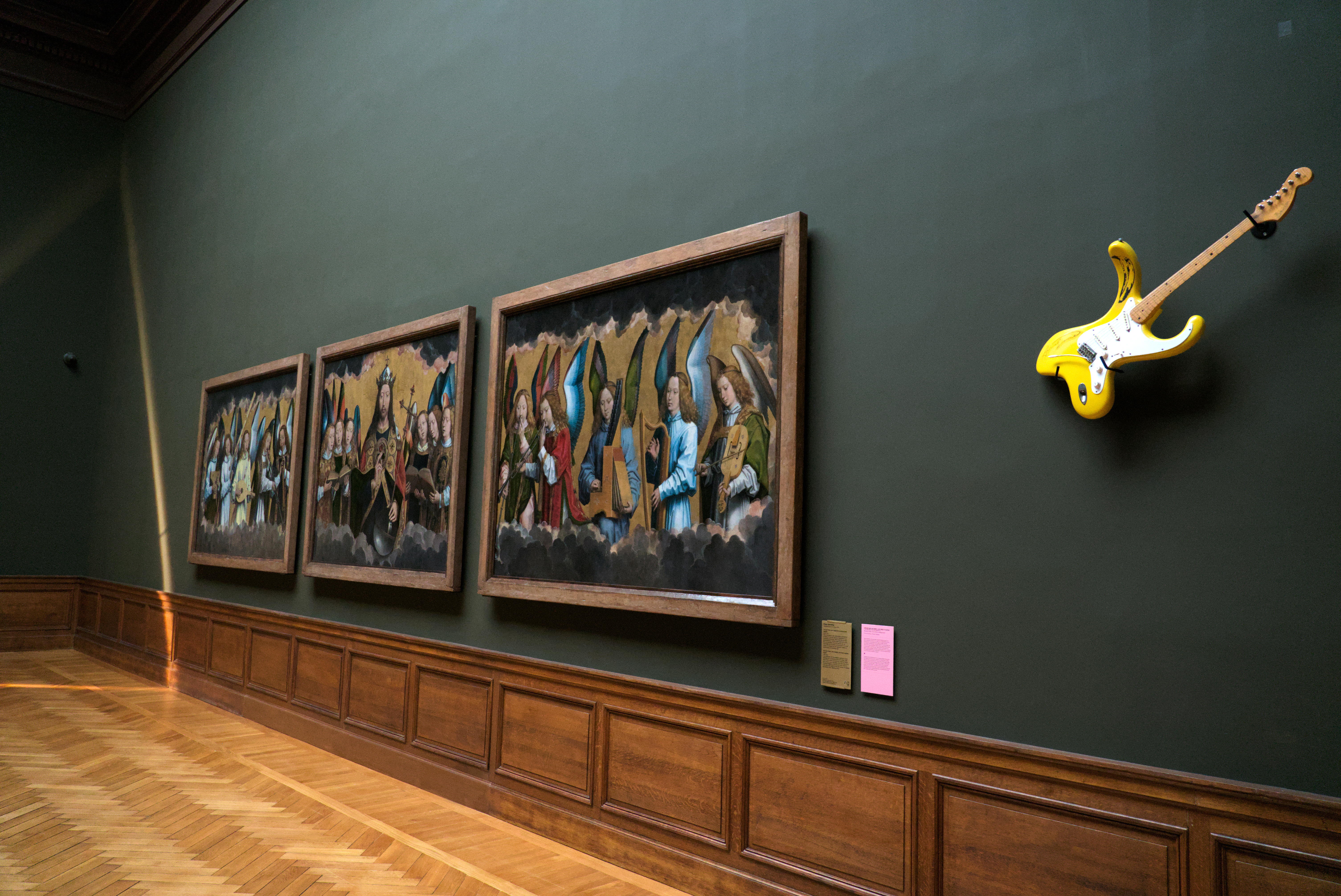
Heavens gallery
Gallery 2.22 (“Heavens”) from the KMSKA exhibition Collected with Vision: Private Collections in Dialogue with the Old Masters

The dominant Old Master work is a set of three panels from the upper tier of a colossal altarpiece that Hans Memling painted for the church at the Benedictine Abbey of Santa Maria la Real in Najera in northern Spain. All the other panels are lost.

The museum titles the central panel God the Father with Singing Angels—but I think the figure is more properly God the Son, Jesus Christ, portrayed as Salvator Mundi (Savior of the World). In his left hand he holds a cross-surmounted crystal globe, signifying his dominion over the earth, and with the other hand he gestures blessing. He wears a tiara and a red cope decorated with gold-thread embroidery, pearls, and precious stones, and his collar bears the words Agyos Otheos (Holy God).
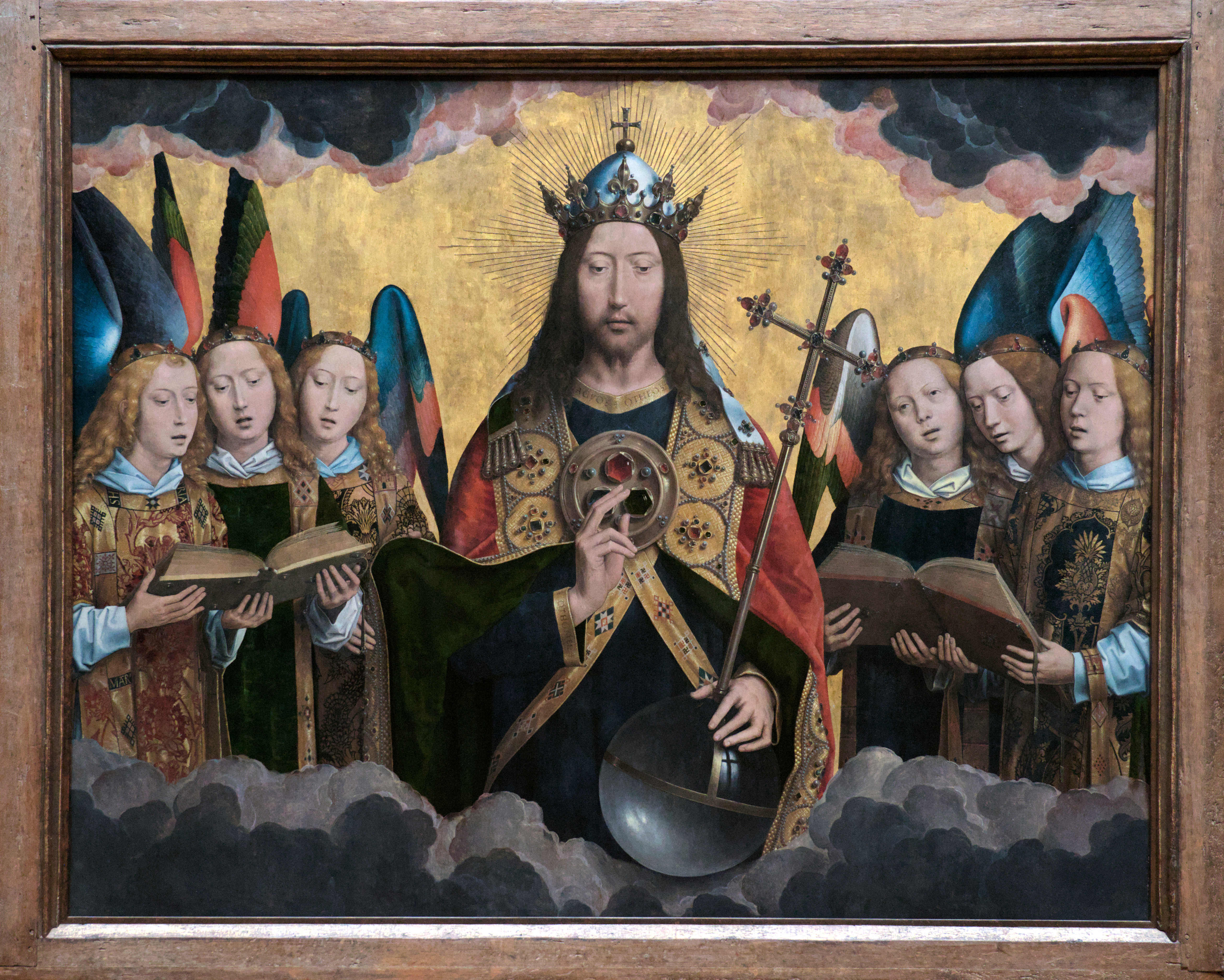
Memling, Hans_God the Father with Singing Angels
Hans Memling (German Flemish, ca. 1430–1494), God the Father with Singing Angels, 1483–94. Oil on panel, 164 × 212 cm. Koninklijk Museum voor Schone Kunsten Antwerpen (KMSKA, Royal Museum of Fine Arts Antwerp).

Surrounding him is a musical band of angels, singing his praises from songbooks and, in the flanking panels, playing a variety of wind and string instruments: (from left to right) a psaltery, a tromba marina, a lute, a trumpet, a shawm, a straight trumpet, a looped trumpet, a portative organ, a harp, and a fiddle.
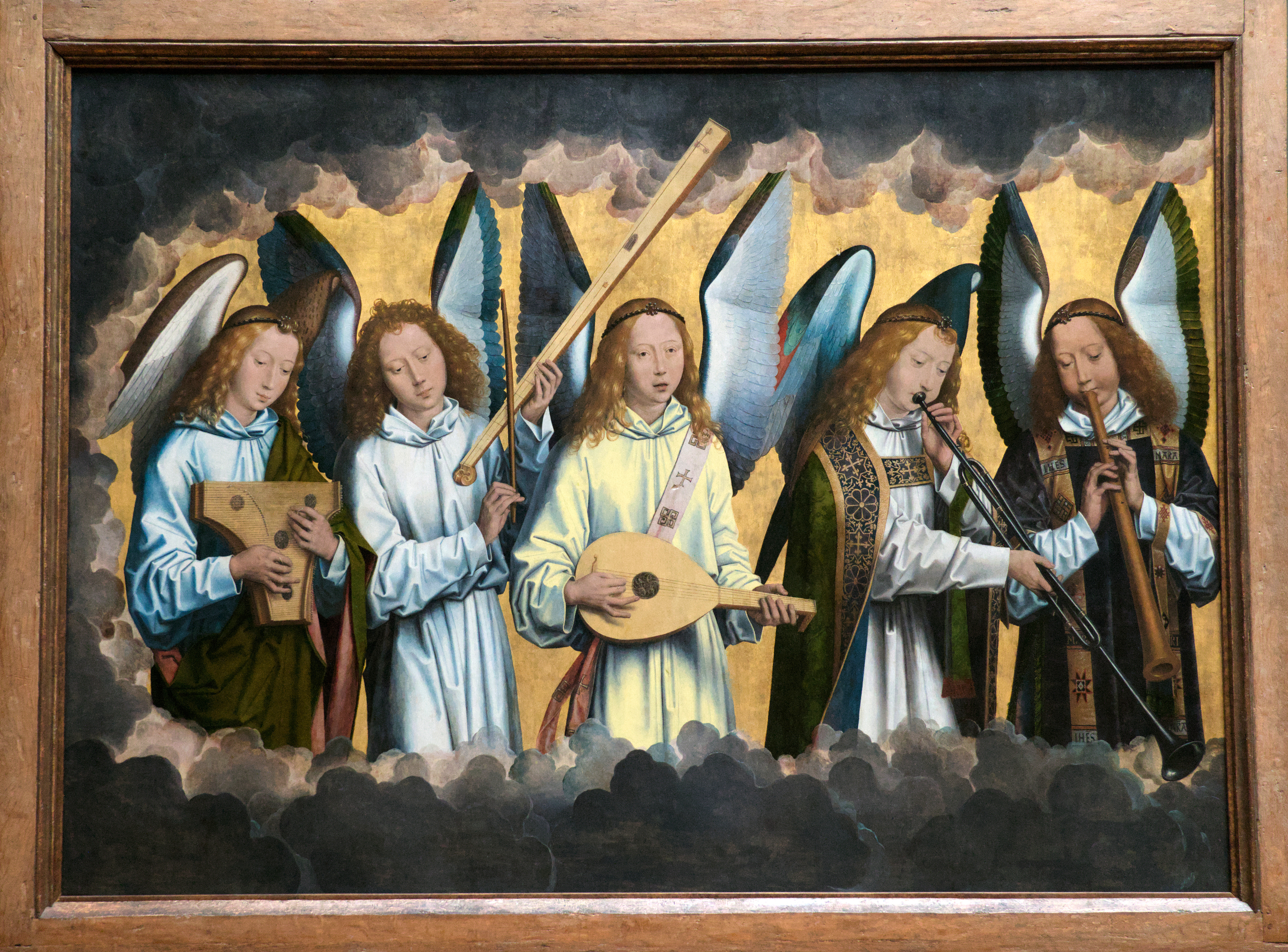
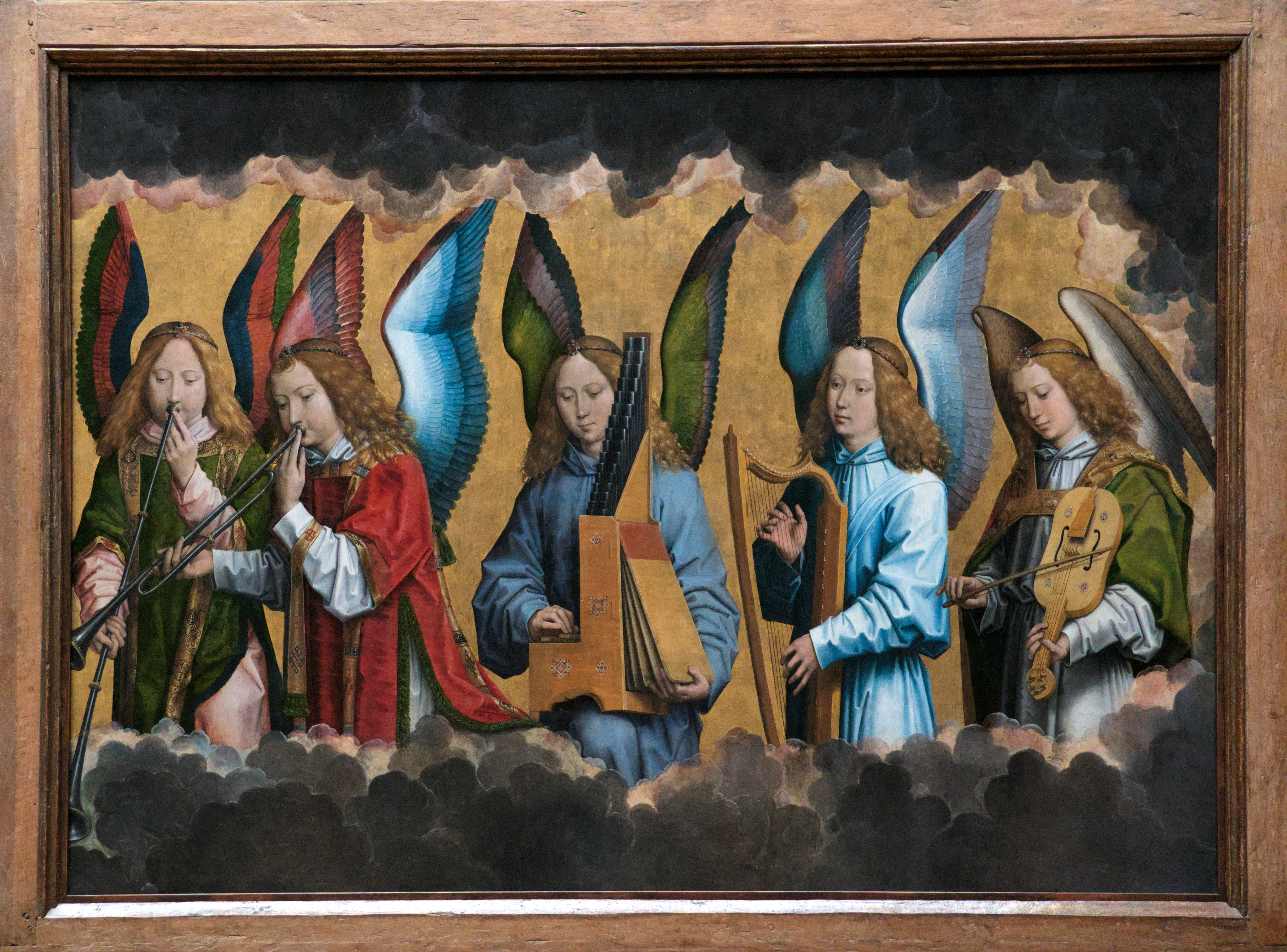
Memling, Hans_Music-Making Angels
Hans Memling (German Flemish, ca. 1430–1494), Music-Making Angels (left), 1483–94. Oil on panel, 165 × 230 cm. Koninklijk Museum voor Schone Kunsten Antwerpen (KMSKA, Royal Museum of Fine Arts Antwerp).

Memling, Hans_Music-Making Angels
Hans Memling (German Flemish, ca. 1430–1494), Music-Making Angels (right), 1483–94. Oil on panel, 165 × 230 cm. Koninklijk Museum voor Schone Kunsten Antwerpen (KMSKA, Royal Museum of Fine Arts Antwerp).

This ensemble probably evokes for you a particular sound—something like Tallis or Palestrina—soaring polyphonic vocals, a gentle yet majestic accompaniment. But instead, a different soundtrack played, audibly, in the room: songs from the 1967 debut album of the American rock band the Velvet Underground, several of which use religious language to describe the experience of doing drugs. “Heroin” opens like this:

I don’t know just where I’m going
But I’m gonna try for the kingdom, if I can
’Cause it makes me feel like I’m a man
When I put a spike into my vein

And I’ll tell you things aren’t quite the same
When I’m rushing on my run
And I feel just like Jesus’ son

This aural element was complemented, on the gallery wall, by the guitar of Lou Reed, the band’s lead singer and songwriter. It’s signed by Andy Warhol, who produced and championed the Velvet Underground & Nico album and made its banana cover art, replicated on the instrument.
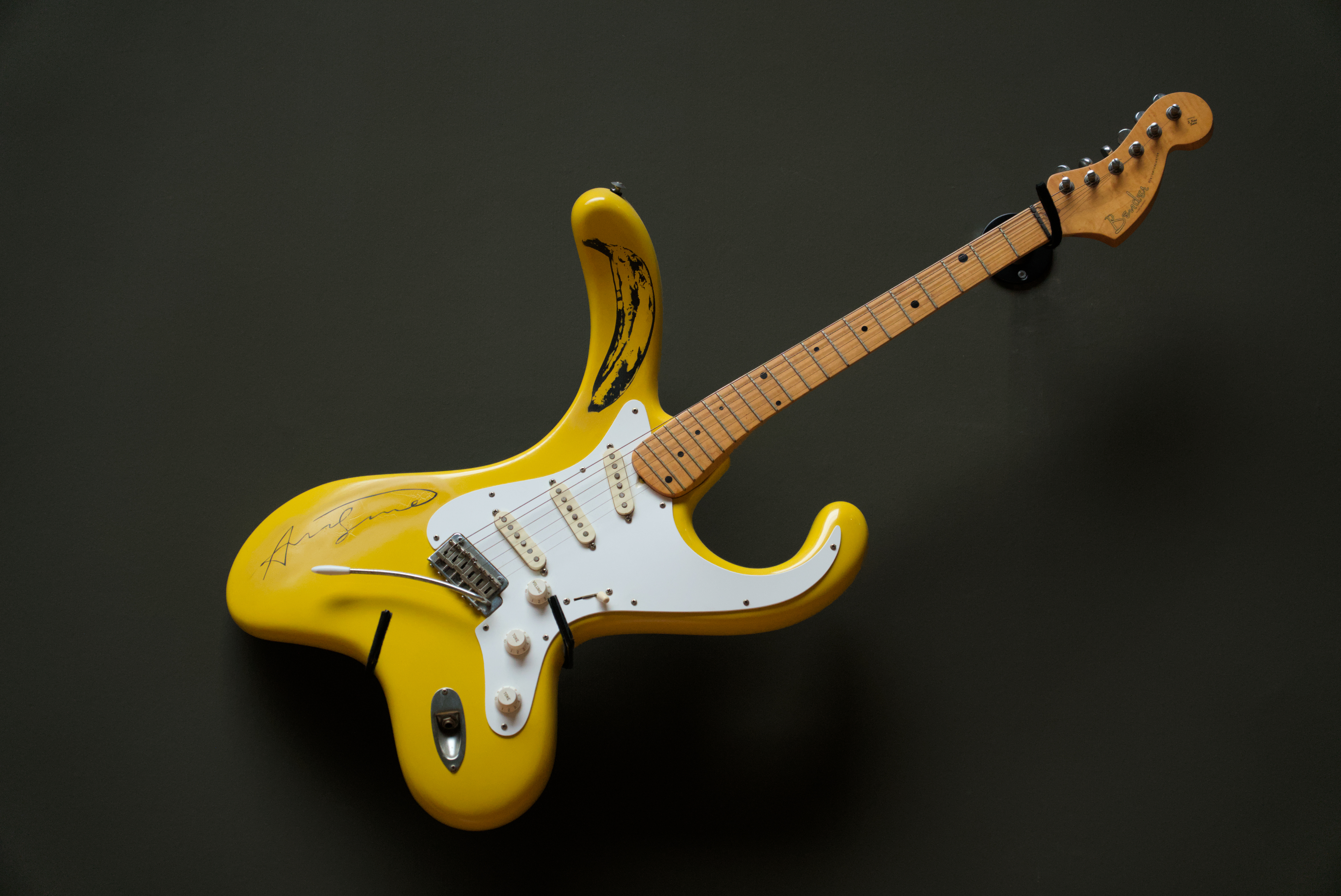
Lou Reed's guitar
Lou Reed’s “Banana Guitar,” from a private collection

Adding to the mix, in the corner of the room was an installation by the Copenhagen-born and -based artist Olafur Eliasson, called Lighthouse Lamp. “Affixed to a tripod, a lamp situated within a Fresnel lens—a compact lens which was developed for lighthouses—emits a band of white light in 360 degrees,” the artist’s website explains. In this space, the beam takes on a triangular shape.
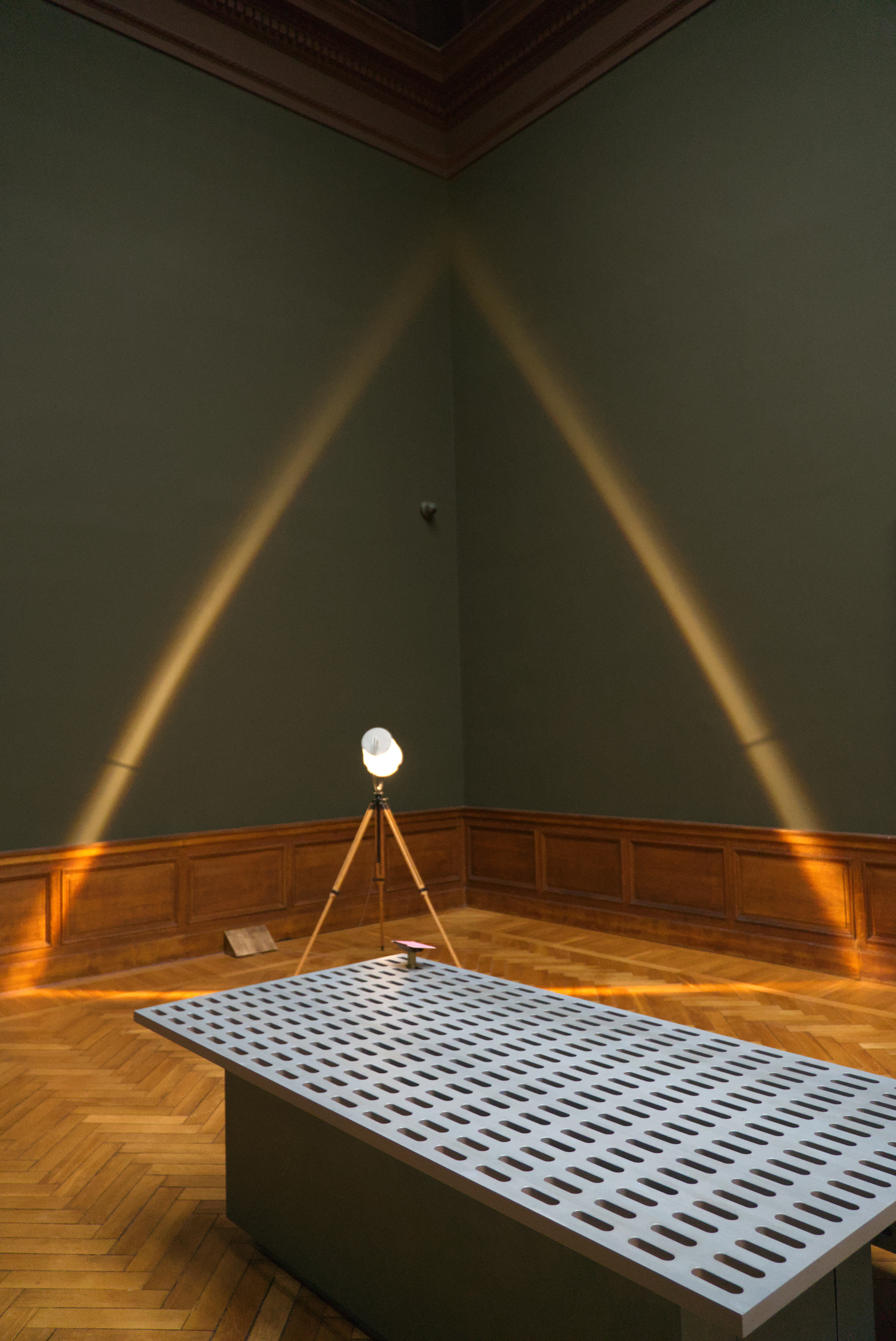
Eliasson, Olafur_Lighthouse Lamp
Olafur Eliasson (Icelandic Danish, 1967–), Lighthouse Lamp, 2004. Mixed media. Collection of Filiep and Mimi Libeert.

There was also an altarpiece of The Last Judgment and the Seven Acts of Mercy by Bernard van Orley, which references Jesus’s teaching in Matthew 25 about one’s entry into heaven being contingent on whether, in this life, you feed the hungry, give shelter to the homeless, visit the prisoner, and so on.

The “Heavens” gallery begs the question: How does one define “heaven”? Is it a physical place? A state of mind? An encounter? I think of related words like bliss, beatitude, communion, the sublime.

The celestial scene painted by Memling—and remember, it’s only partial, as the rest is missing—is beautifully rendered, but it also encapsulates what has become the popular cliché of heaven: angels on clouds, strumming harps, and a regal God swaying his scepter. Music-making, angelic beings, and the reign of God are all certainly a part of how the Bible describes heaven. But it’s also so much more. It’s a garden and a city. It’s healing and restoration. It’s the righting of wrongs. It’s all things made new. It’s jubilee. It’s a wedding—deep and lasting union between God and humanity. It’s an eternal interlocking of God’s space and ours (earth). It’s a global, transhistorical community of faith, gathered together around Christ their head, worshipping him in diverse languages, musical styles, dances, and other cultural expressions. It’s the culmination of the greatest story ever told.

Today, Memling’s vision of heaven probably fails to captivate most people, even Christians. So it’s an interesting experiment to compare it to how others conceive of the concept.

Eliasson’s Lighthouse Lamp wasn’t a commission on or explicit treatment of the theme, but the curator saw fit to place it beside Memling, because heaven is often conceived of as a light-filled space, and light can evoke the divine. For this reason, Memling painted his background gold. What’s more, the three-sidedness of Eliasson’s light beam may, for some, evoke the Trinity, the classical Christian doctrine of Father, Son, and Holy Ghost that Memling alludes to with the three precious stones on the fibula of Christ’s mantle.

Still, other folks experience what could be termed “heavenly” transcendence through the use of mind-altering substances, as did the members of the Velvet Underground, whose drug trips gave birth to their experimental music—which, in turn, has taken others to a transcendent place.


Whether in special exhibitions or displays of their permanent collections, I want to see more of this in museums: bringing old and new artworks into conversation with one another around universal themes, in the same room. (In some museums, the labels sometimes cross-reference works in other galleries, but that’s not the same.) Although there are benefits to the traditional approach of laying out art chronologically to give you discrete pictures of different historical eras and allow you to progress by time period, a thematic approach that compiles works from across time also has its benefits.

I’ve found cross-temporal art displays to be especially vitalizing, because instead of trying to tell history, they more naturally invite personal reflection and tend to be less academic in tone. Such an approach makes the art accessible to a larger number of people, especially those who don’t frequent museums. It helps us see the relevance of the Old Masters (or whatever the museum’s collection focus) for today—how the subjects they depicted often address topics or questions we still ask or wonder about or that reflect aspects of the common human experience, such as joy, suffering, family, death, betrayal, or festivity. Creating relationships between works made centuries apart, highlighting similarities and differences, can give us a broader perspective.

And for this museumgoer (pointing at myself) who is attracted to medieval and early Renaissance art and sometimes bypasses the contemporary galleries, the integrative approach is more engaging. Giving contemporary works a point of connection with the works I’m already inclined to like helps me enter into them more easily and fruitfully, and I’m more likely to spend time with them than if they were segregated.

New and old don’t have to be equally represented—Kolumba skews heavily contemporary, whereas KMSKA lets its strengths shine with the Old Masters, and yet the occasional unexpected intervention from years past or future always caused me to pause and be curious. Over the last several years I’ve been noticing other museums engaging in similar playful exchange—plopping a contemporary work into the medieval section, or vice versa, in a way that provides some kind of illumination.

This was my first and only visit to KMSKA, and as I understand, there’s not the same degree of intermixing of old and new year-round; this was a special exhibition that brought in contemporary works from outside, as the institution itself owns very few. But they did do something similar last year with the exhibition What’s the Story?, and the dangling light poems by Bernard Dewulf are a permanent fixture in the Old Masters galleries.

Have you been to a museum where works from different time periods were displayed side-by-side to create a discourse, and if so, did that choice enhance your engagement, insight, or appreciation? I’d love to hear what other museums are doing this!


This article took me some forty hours to write and to select and edit photos for. If you appreciate learning about my museum experiences and having access to high-resolution, downloadable art images, would you please consider adding to my “tip jar” (PayPal), or sponsoring a book from my Amazon wish list? Thank you!
Open-Access Image Archive of Middle Eastern Art, Architecture, and Archaeology

Based at the Faculty of Classics at the University of Oxford, the Manar al-Athar (“Guide to Archaeology”) digital archive provides high-resolution photographs of archaeological sites, buildings, and art from the Levant, North Africa, the Caucasus, and the Balkans, covering the time of Alexander the Great (ca. 300 BCE) through the Byzantine and early Islamic periods, with special emphasis on late antiquity. All the images are freely downloadable, made available for teaching, research, and academic publication under a Creative Commons Attribution-NonCommercial-ShareAlike 2.0 UK (CC BY-NC-SA 2.0) license.

Manar al-Athar was established in 2012 by Dr. Judith McKenzie (1957–2019) and since 2020 has been directed by Dr. Ine Jacobs. It is in continuous development. The photos are cataloged by geographical region and are labeled in both English and Arabic. They picture a range of historical structures—some intact, others in ruins; both interiors and exteriors, where applicable—including mausoleums, churches, mosques, khanqahs (Sufi lodges), hammams (public bathhouses), palace complexes, madrasas (colleges for Islamic instruction), forums, fountains, cisterns, aqueducts, civic buildings, theaters, markets, fortifications, and hostels.

Of primary interest to me is the Christian art from churches and tombs, from countries such as Egypt, Syria, Turkey, Armenia, Georgia, and Serbia, and Jewish art that pictures stories from the Hebrew Bible.

Unfortunately, the subjects of the artworks aren’t labeled and there’s no commentary or transcription/translation of inscriptions, nor are the buildings or artworks dated. Inevitably, many of the frescoes and mosaics have degraded with age, sometimes making the iconography difficult to read. There’s also no way to filter by religion; Christianity accounts for only a portion of the images, with others coming from Jewish, Islamic, or pagan traditions, and a number are from nonreligious contexts. I’d love to see a more robust tagging system and advanced searchability functions as the archive continues to evolve.

The archive is by no means comprehensive, but I hope it will encourage further scholarship and attract more digital image donations.

Below is a sampling of the hundreds of images you can find on the Manar al-Athar website.


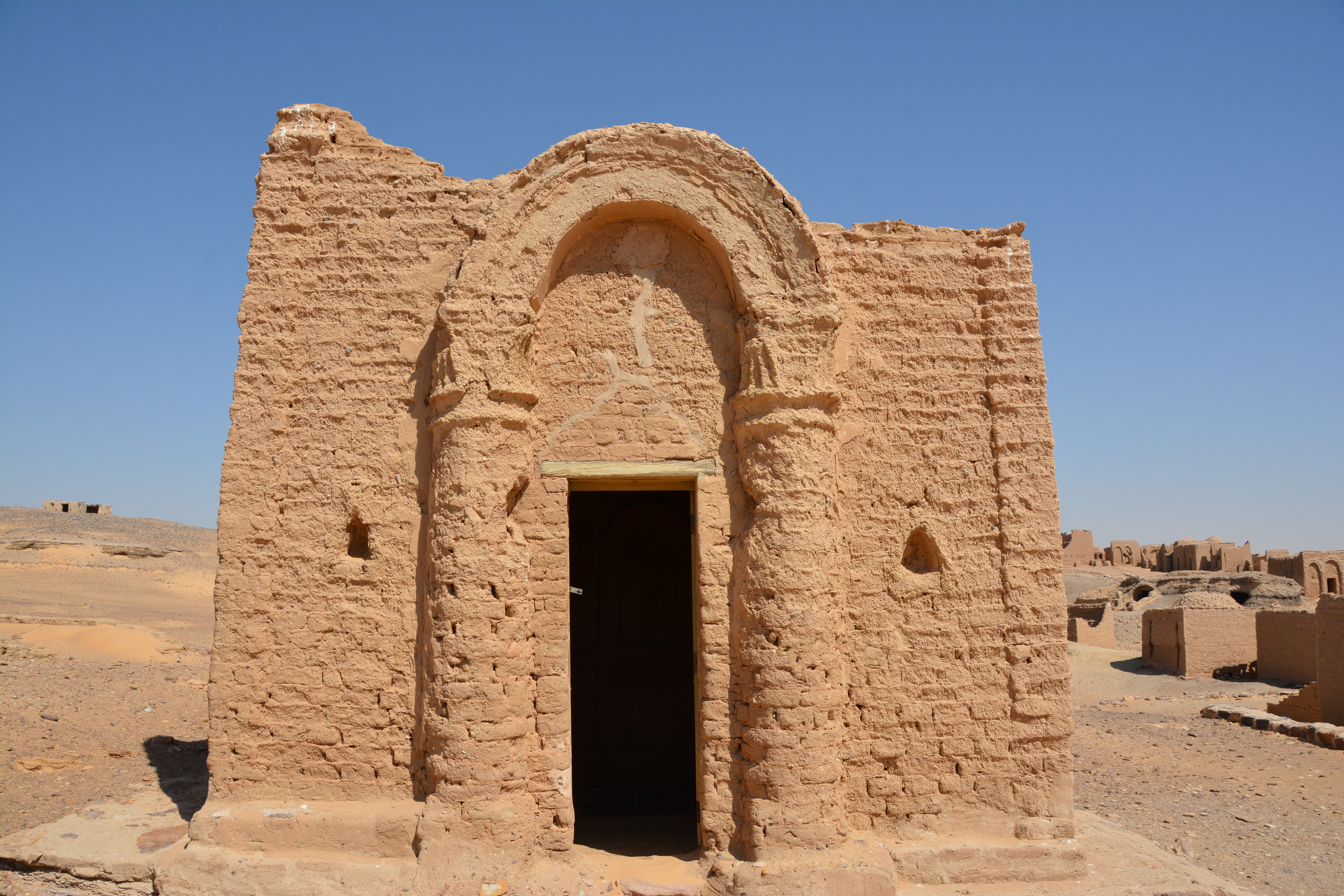
One of the earliest surviving and best-preserved Christian cemeteries in the world, used by Christians from the third to eighth centuries, is Bagawat Necropolis in the Kharga Oasis in Egypt’s Western Desert. The Chapel of Peace is one of 263 mud-brick funerary chapels in the cemetery, celebrated for the painting of biblical, early Christian, and allegorical figures inside its dome.

Chapel of Peace (Bagawat, Egypt)
The Chapel of Peace, a monumental Christian tomb at Bagawat Necropolis, Kharga Oasis, Egypt, built 5th or 6th century. Photo: Mohamed Kenawi / Manar al-Athar.

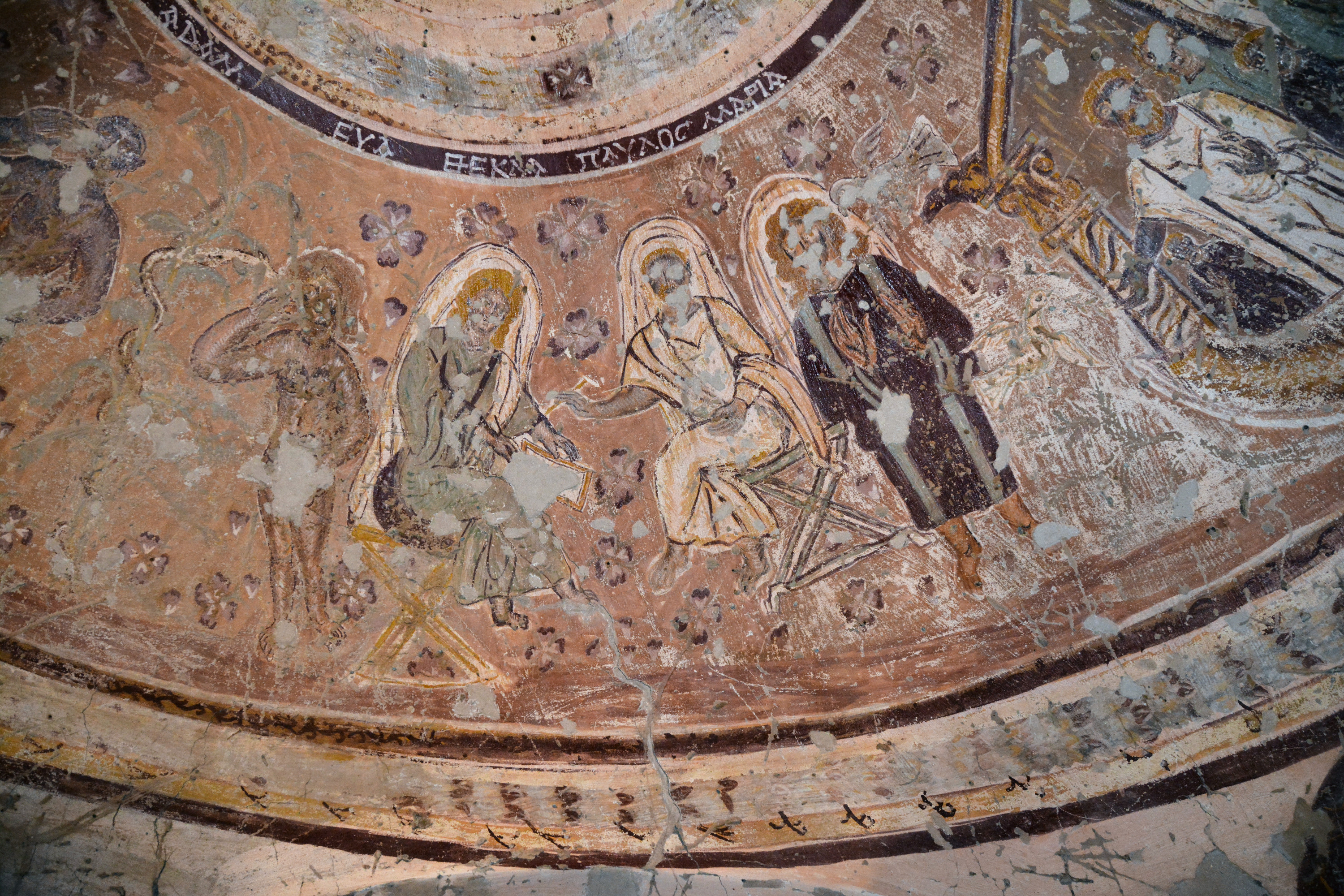
Paul and Thecla (Chapel of Peace)
Dome fresco detail from the Chapel of Peace at Bagawat Necropolis in Kharga Oasis, Egypt, 5th or 6th century. Photo: Mohamed Kenawi / Manar al-Athar.

The detail pictured above shows the female saint Thecla (Θέκλα), a first-century Christian preacher and martyr, learning from the apostle Paul (Παῦλος), as described in the ancient apocryphal Acts of Paul and Thecla. They both sit on stools, Thecla holding open a book on her lap, pen in hand, while Paul points out a particular text.

In addition to Paul and Thecla, the dome fresco also depicts, clockwise from that pair: Adam and Eve; Abraham about to sacrifice his son Isaac, with Sarah stretching out her hand (it’s unclear whether this gesture signifies her surrender to God’s will or an attempt to stop her husband’s act); Peace, holding a scepter and an ankh; Daniel in the Lions’ Den; Justice, holding a cornucopia and balance scales; Prayer; Jacob; Noah’s Ark; and the Virgin Annunciate, the New Eve, who heard the word of God and obeyed it and thus brought forth life, unlike her ancestor, who listened to the lies of the Evil One and brought forth death (the snake and dove at the women’s respective ears emphasize this contrast). View a facsimile of the full dome here.

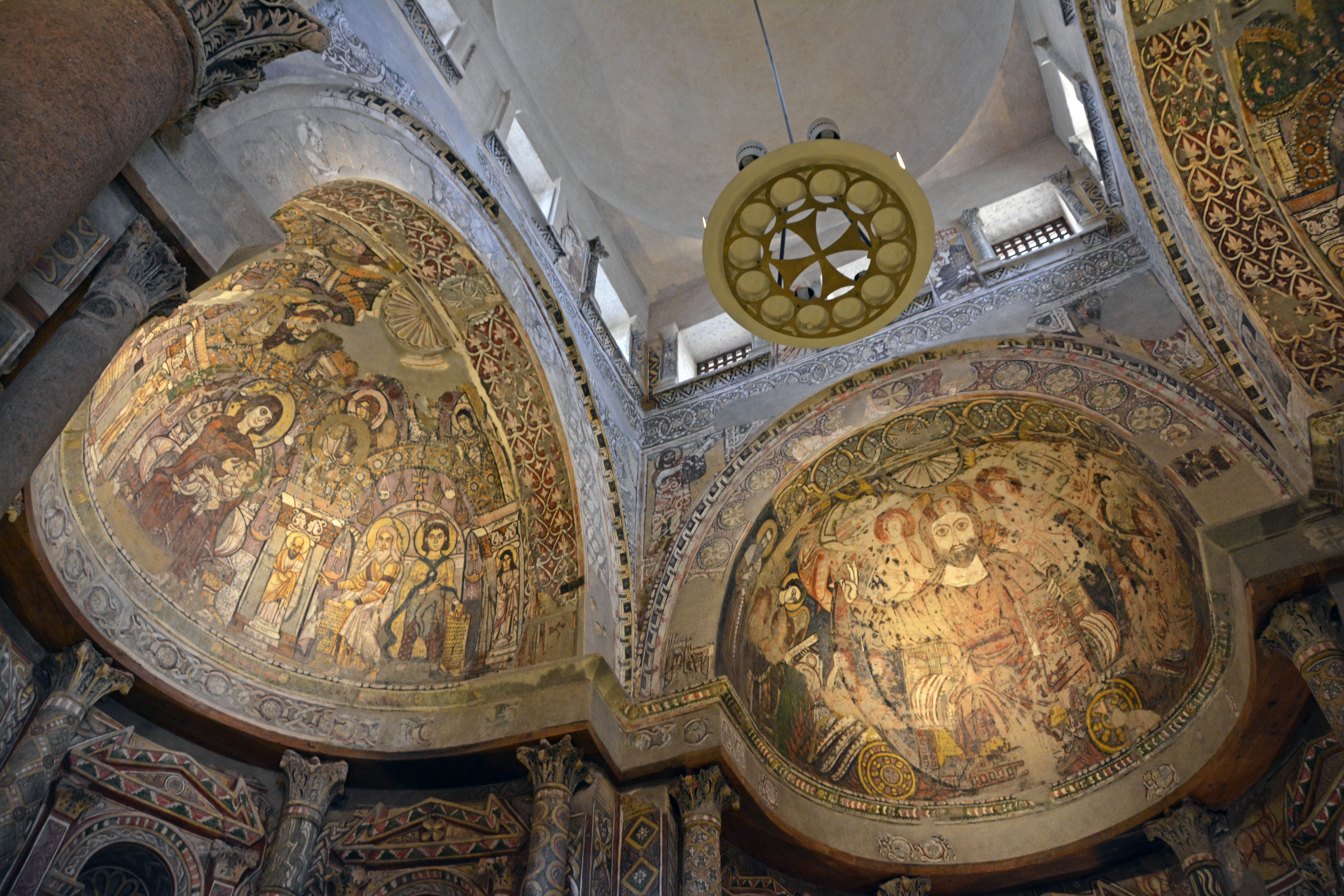
Also in the Egyptian folder are photos of one of Byzantine Egypt’s most glorious encaustic-painted sanctuaries, that of the Red Monastery Church, a triconch (three-apse) basilica that’s part of the (Coptic Orthodox) Monastery of Apa Bishuy near Sohag.

Red Monastery Church
North apse (Virgin Galaktotrophousa, aka the Nursing Madonna) and east apse (Christ Pantocrator), painted 6th–7th or 8th century, Red Monastery Church, near Sohag, Egypt. Photo: Mohamed Kenawi / Manar al-Athar.

Here’s a video that presents a 3D reconstruction and fly-through of the basilica:

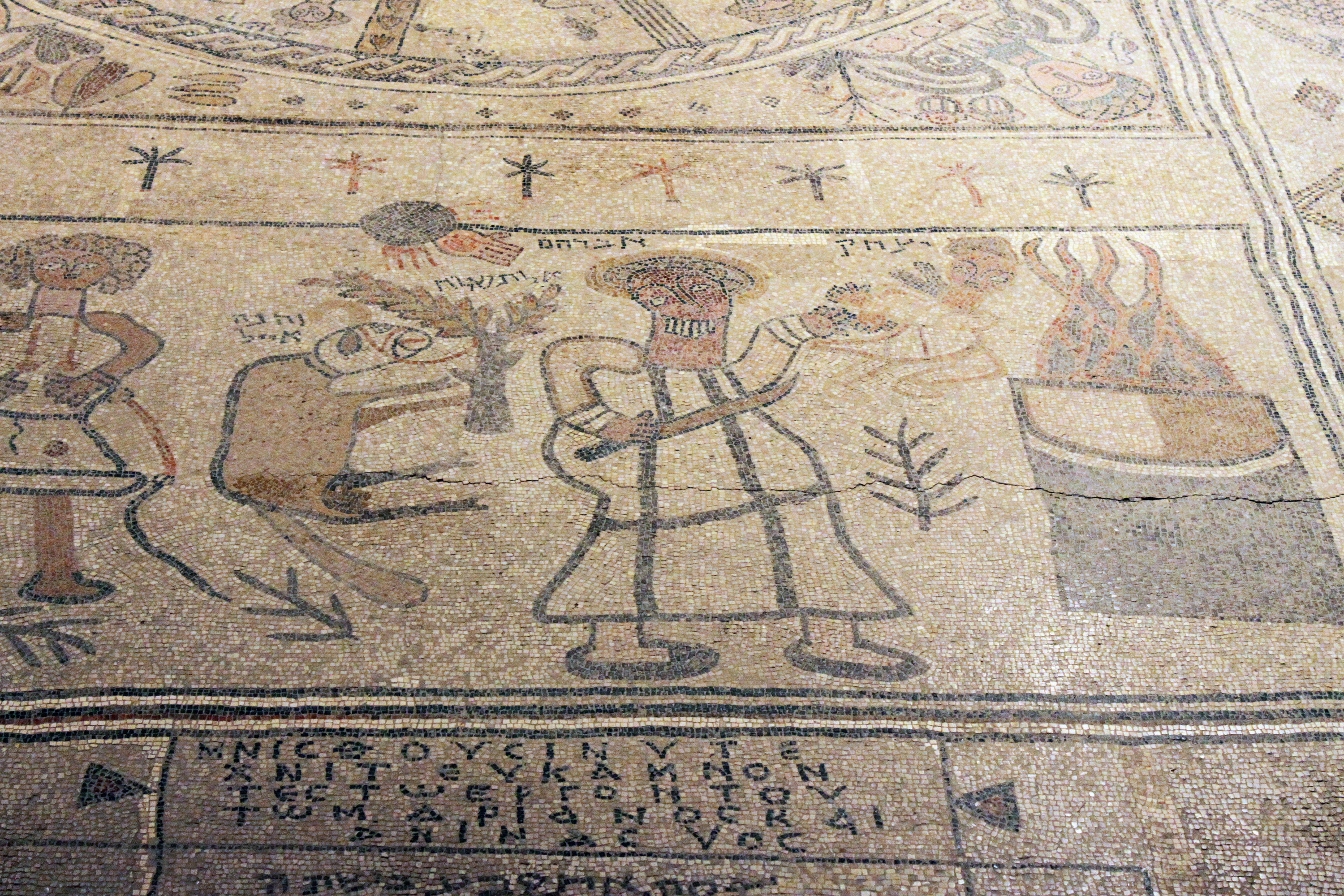
Moving northeast into Israel, we come to the sixth-century Bet Alpha (sometimes rendered as Beit Alfa) Synagogue, located in the Beit She’an Valley. The excavation of Jewish sacred sites like this one reveal that, contrary to what is popularly alleged, Judaism is not a strictly aniconic religion. Many Jewish communities have understood the prohibition against graven images in Exodus 20:3–6 and Leviticus 26:1 as a prohibition against idol worship, not figurative art (art that depicts people and animals) in general. Thus several ancient synagogues, not to mention Jewish manuscripts, portray episodes from the biblical narrative, such as the Akedah (Binding [of Isaac]), told in Genesis 22.

Sacrifice of Isaac (Bet Alpha mosaic)
The Binding of Isaac, early 6th century. Mosaic pavement, Bet Alpha (Beit Alfa) Synagogue, Heftziba, Israel. Photo: Sean Leatherbury / Manar al-Athar.

Rendered in a primitive style, this scene is one of three from the mosaic pavement in the central hall of Bet Alpha. It shows Abraham, sword in hand, about to throw his son Isaac onto a fiery altar, when God, represented by a hand from the sky, intervenes, telling him to stop; it’s then that Abraham notices a ram tangled up in a nearby thicket, which he sacrifices instead. The Hebrew inscriptions read, from right to left, “Yitzhak” (Isaac), “Avraham” (Abraham), “al tishlakh” (Do not lay [your hand on the boy]), and “v’hineh ayil” (Here is a ram). Stylized palm trees line the top of the scene.

Here is video footage of the full floor mosaic in its space, showing wide views as well as details, including of the remarkable zodiac wheel in the center:

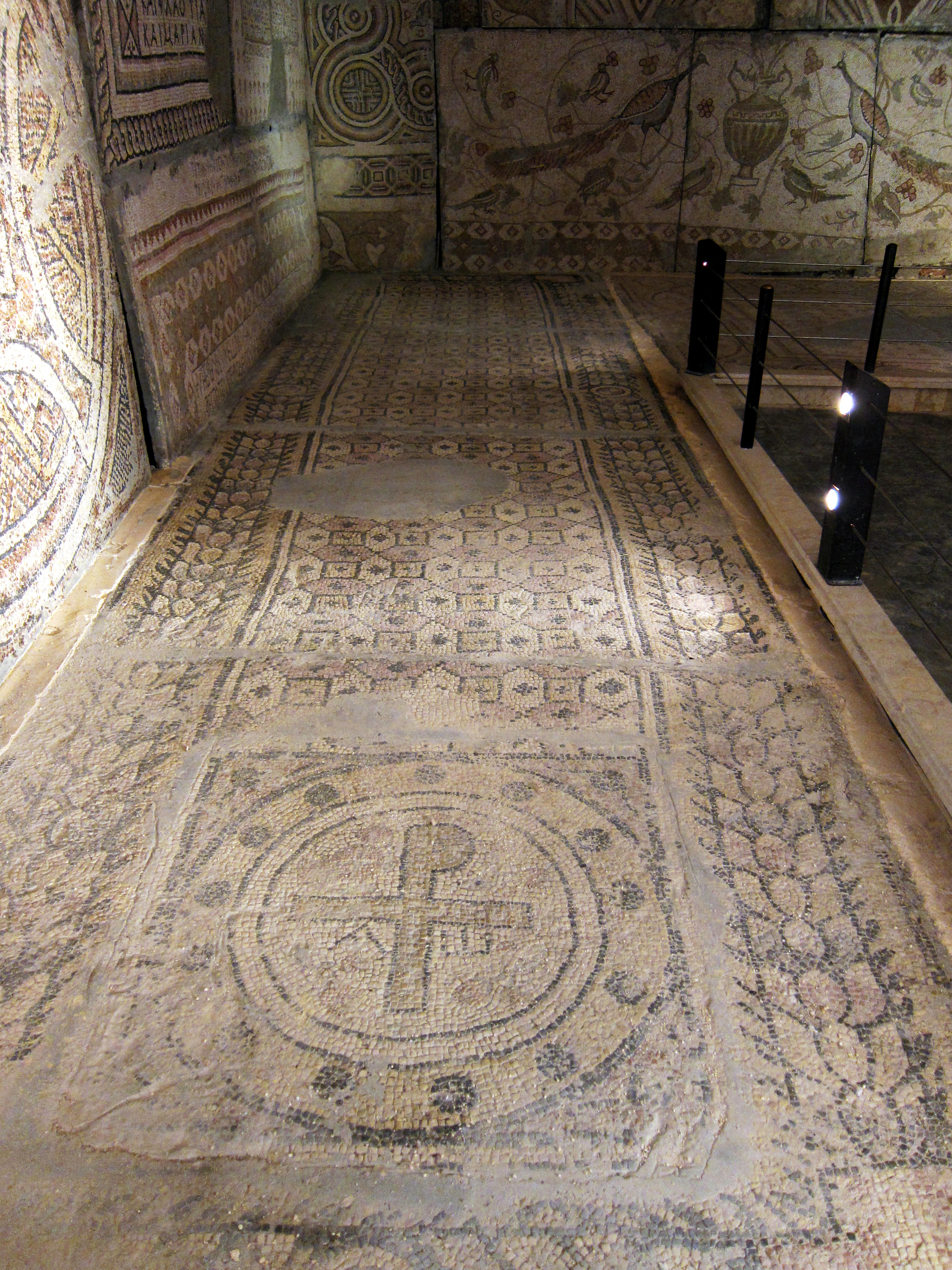
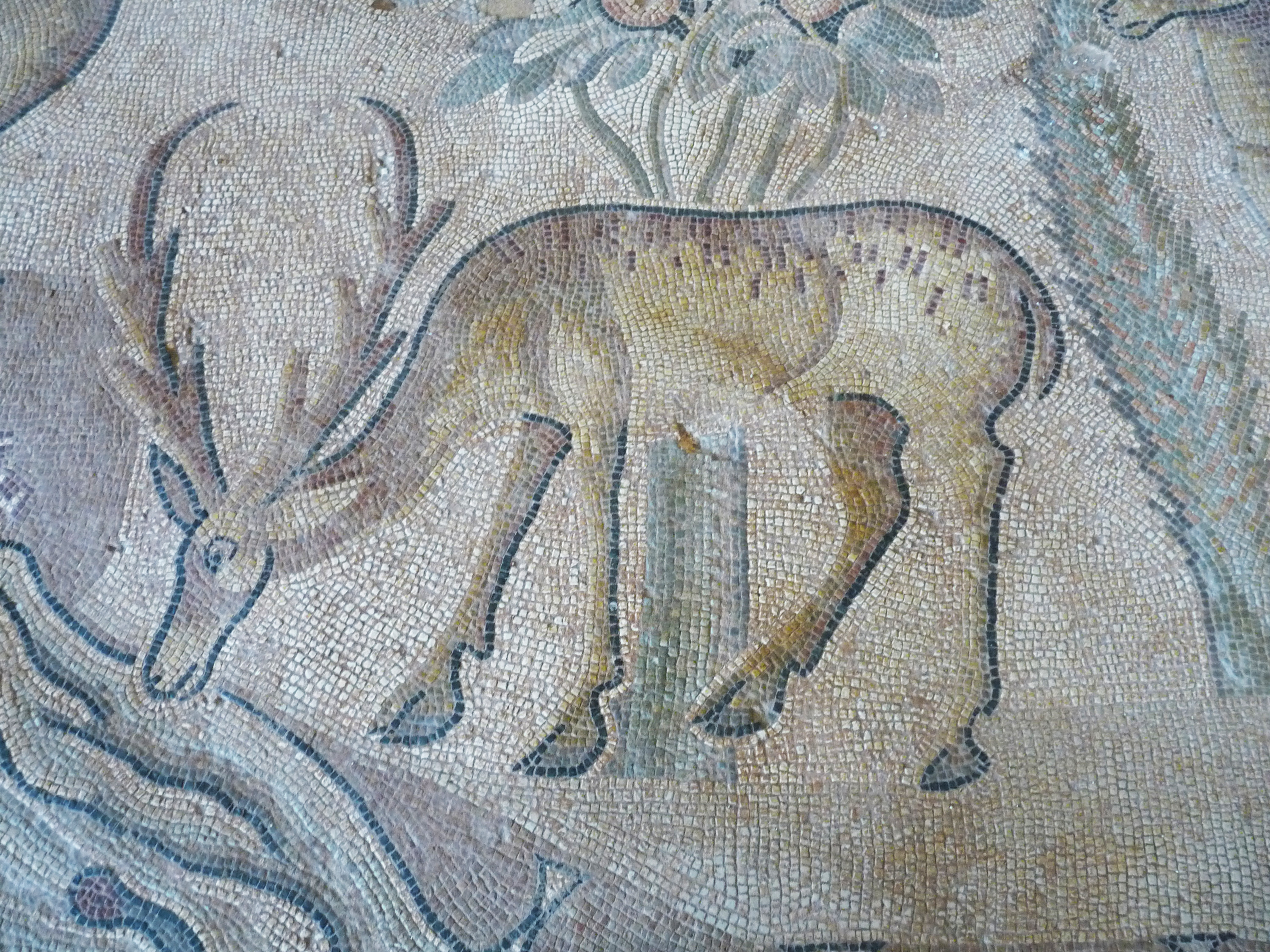
Mosaic was a common form of late antique decoration in places of worship. Here are two examples from Syria:

Tell Aar church mosaics
Mosaics from the ancient Tell Aar church, including a chi-rho monogram with an alpha and omega (foreground) and peacocks flanking an amphora (background), housed in the Maarat al-Numan Museum, Syria. Photo: Sean Leatherbury / Manar al-Athar.

Deer drinking water
Deer drinking from a stream, 5th century. Mosaic, Church of the Martyrs, Taybat al-Imam, Syria. Photo: Jane Chick / Manar al-Athar.

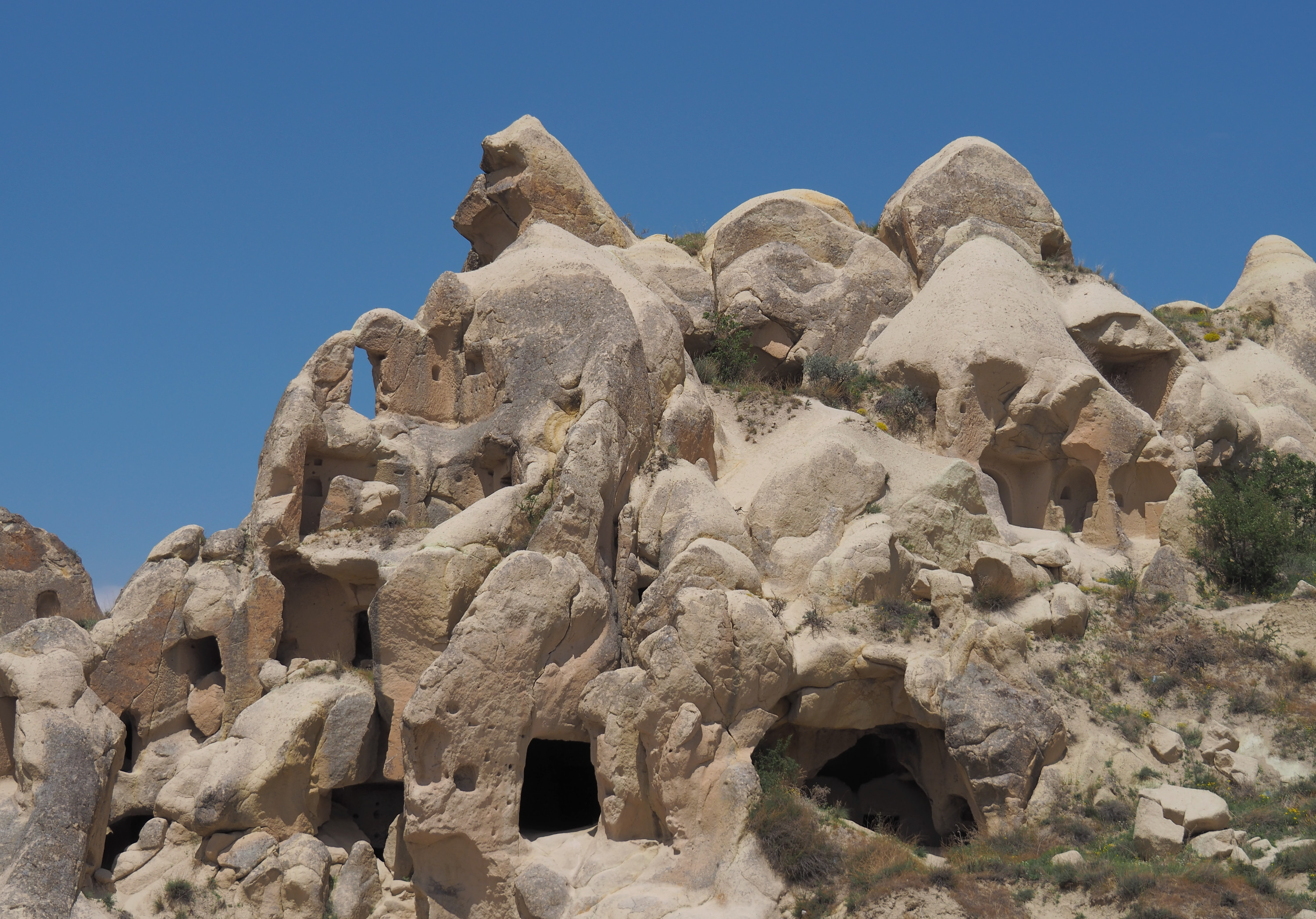
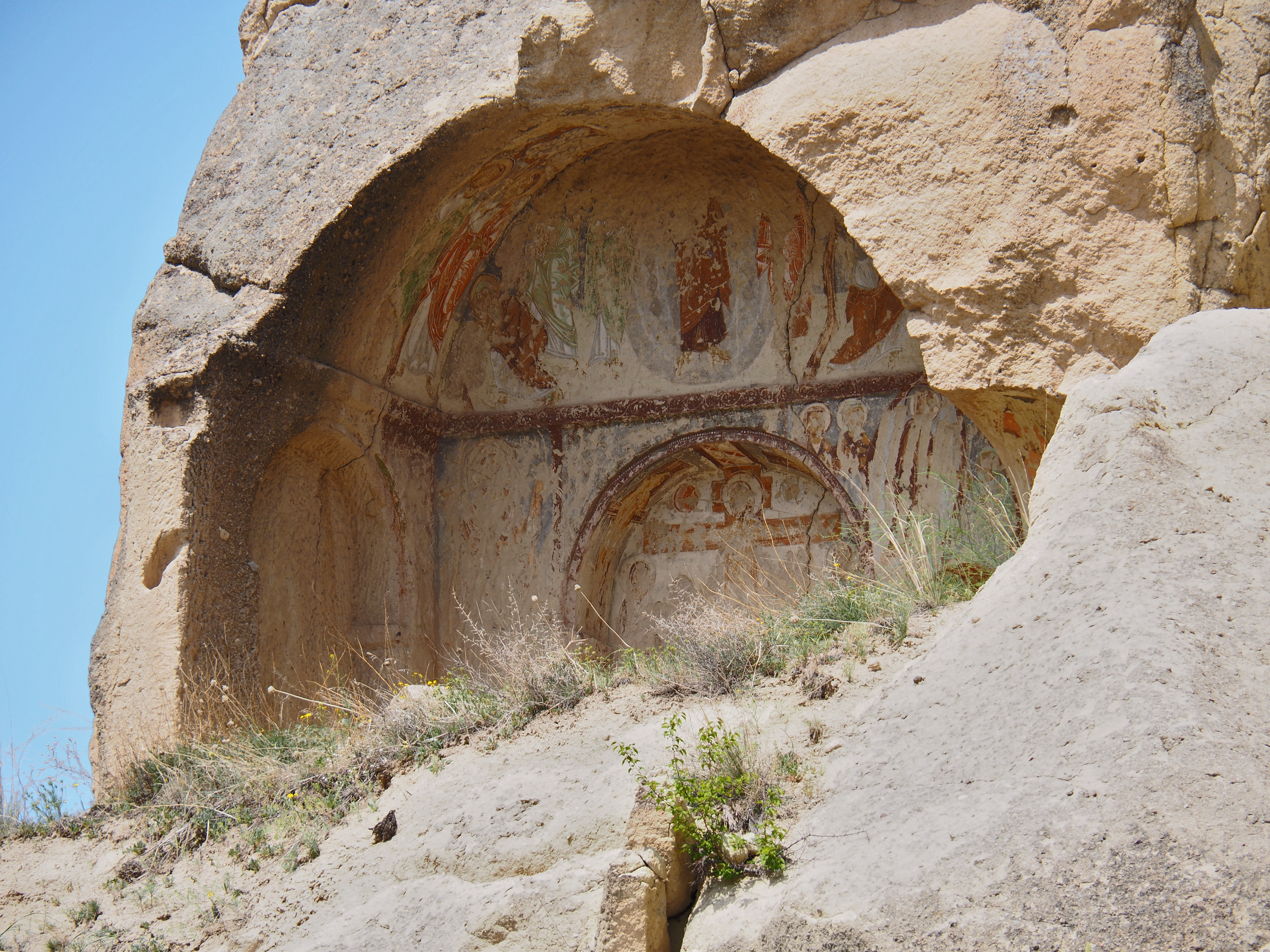
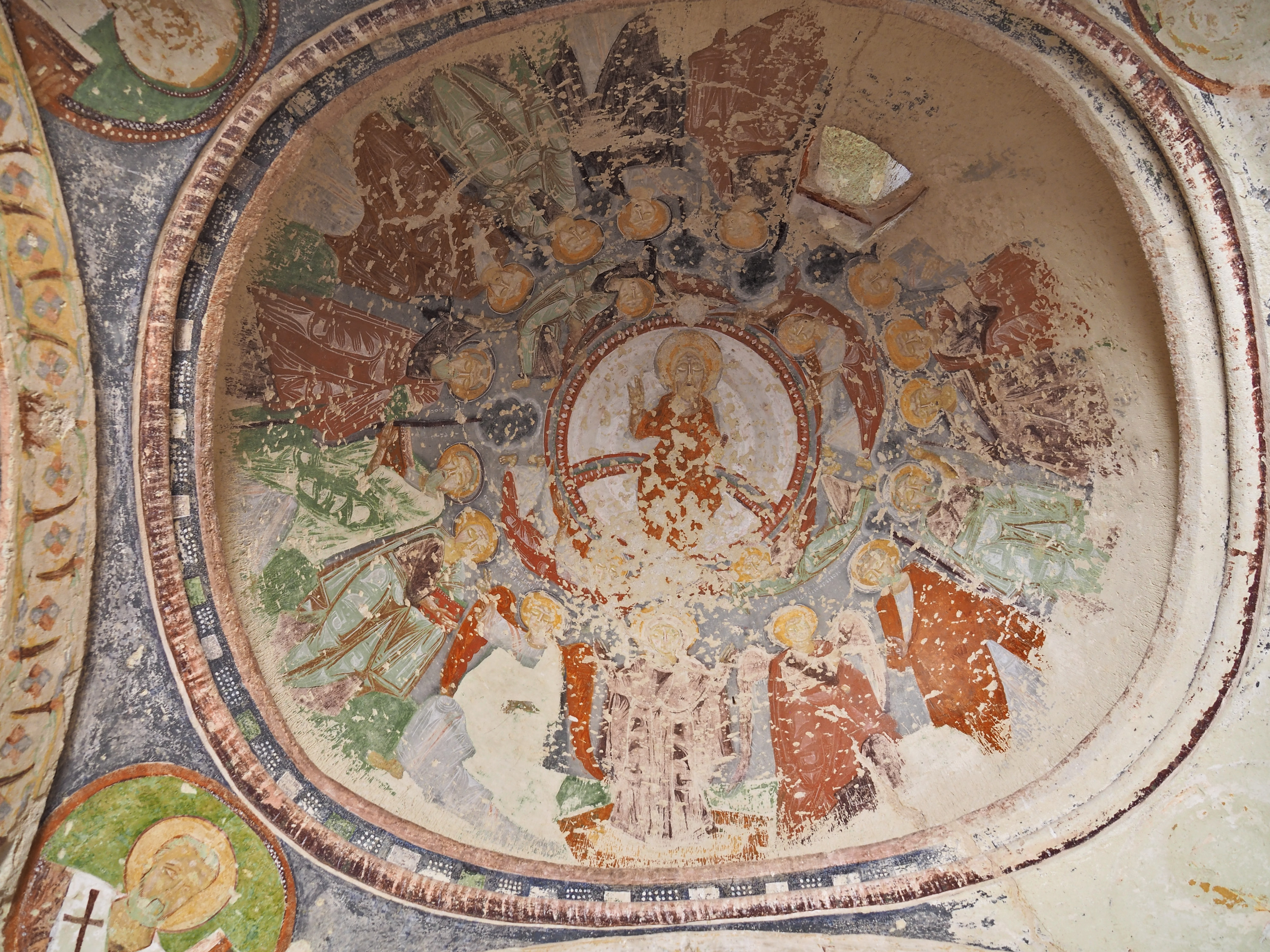
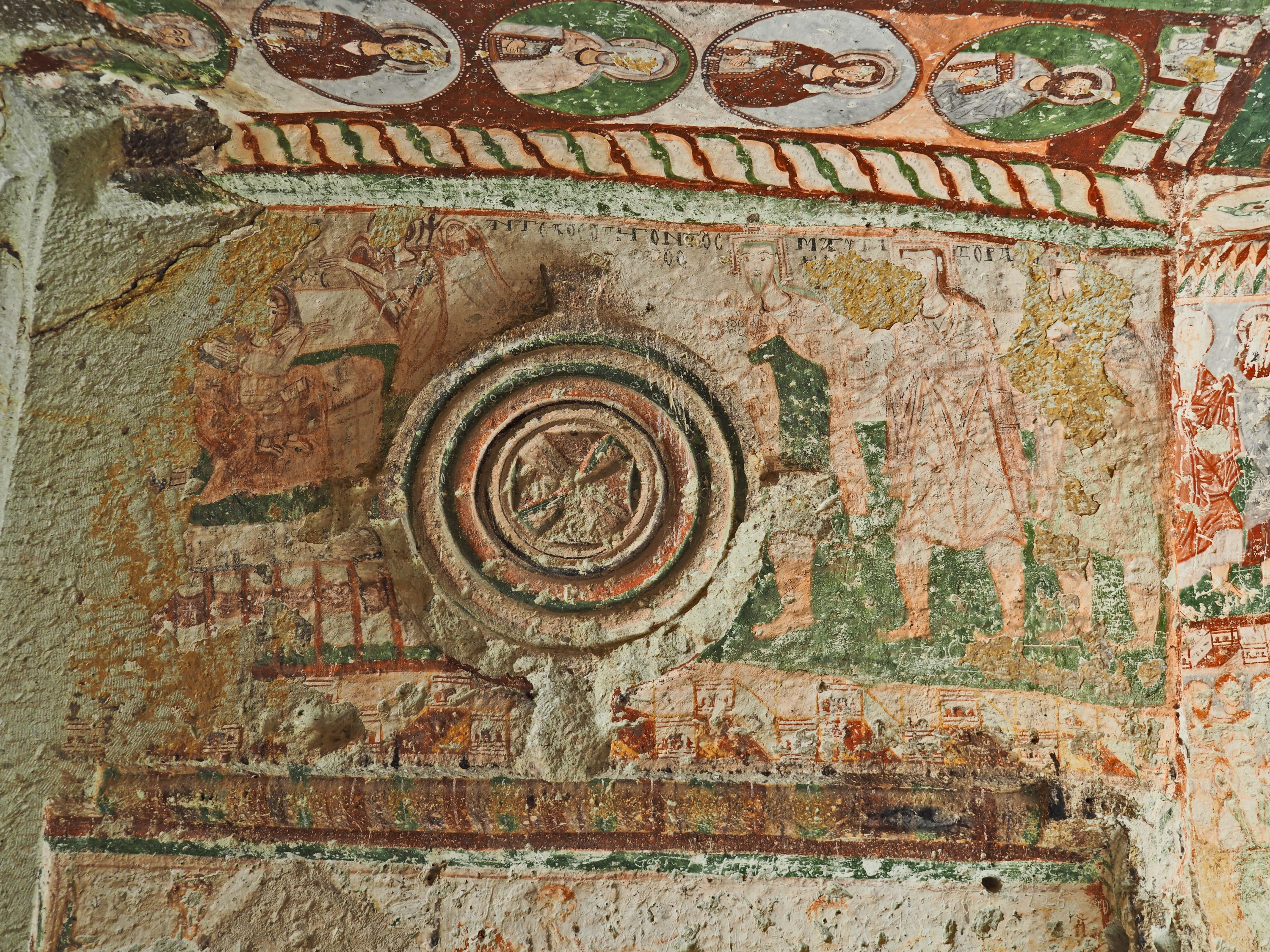
To the north of Syria in Turkey—cataloged by Manar al-Athar under “Anatolia,” the ancient name for the peninsula that comprises the majority of the country—there are the Cappadocian cave churches, hewn out of volcanic tufa. They began to be built in the fifth century, with a boom happening in the ninth through eleventh centuries, which is the period to which almost all the surviving paintings can be dated. There are over a thousand such churches, some very simple inside, and others elaborately painted. The architecture has been described as eccentric and enchanting. I like to imagine the monks, nuns, and other Christians who worshipped there all those centuries ago.

Rock-hewn chapel, Cappadocia
Middle Byzantine cave church, Göreme Open Air Museum, Cappadocia, Turkey. Photo: Marlena Whiting / Manar al-Athar.

Crucifixion and Transfiguration
Frescoes depicting the Crucifixion and the Transfiguration, from a rock-cut chapel at the Göreme Open Air Museum, Cappadocia, Turkey. Photo: Marlena Whiting / Manar al-Athar.

Christ in Glory (Turkey)
The Ascension of Christ, 10th century. Dome fresco, Church of the Evil Eye (El Nazar Kilise), Göreme, Cappadocia, Turkey. Photo: Marlena Whiting / Manar al-Athar.

One of the cave churches in Cappadocia, part of an ancient monastic settlement, is Pancarlik Church, home to an impressive fresco cycle on the Life of Christ that’s painted mainly in rusty red and bean green.

Adoration of the Magi (Turkey)
Adoration of the Magi fresco and Greek cross relief carving, probably early 11th century. Pancarlik Church, Cappadocia, Turkey. Photo: Marlena Whiting / Manar al-Athar.

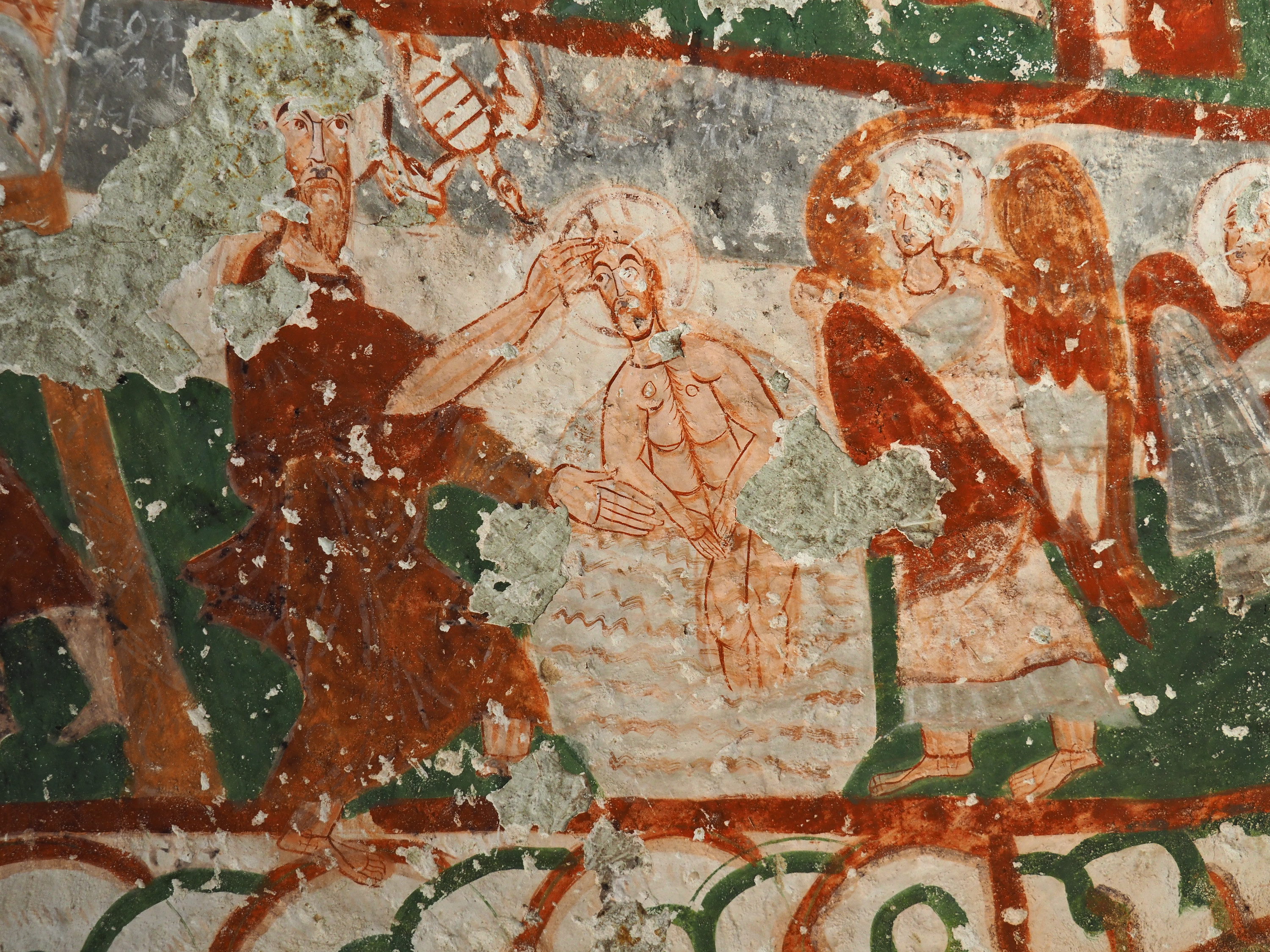
Baptism of Christ (Pancarlik Church, Turkey)
The Baptism of Christ, probably early 11th century. Fresco, Pancarlik Church, Cappadocia, Turkey. Photo: Marlena Whiting / Manar al-Athar.

Beyond Cappadocia but also in Turkey is Hagia Sophia (Holy Wisdom) in Trabzon, not to be confused with the more famous Hagia Sophia in Istanbul, 650 miles away. Originally a Greek Orthodox church, it was converted into a mosque following the conquest of Trabzon (then called Trebizond) by Mehmed II in 1461. During prayer the frescoes in the nave, made by Christians who built and previously occupied the space, are covered by curtains to honor the Islamic prohibition against images—the veils are pulled aside during tourist hours—while the frescoes in the narthex remain uncovered at all times.

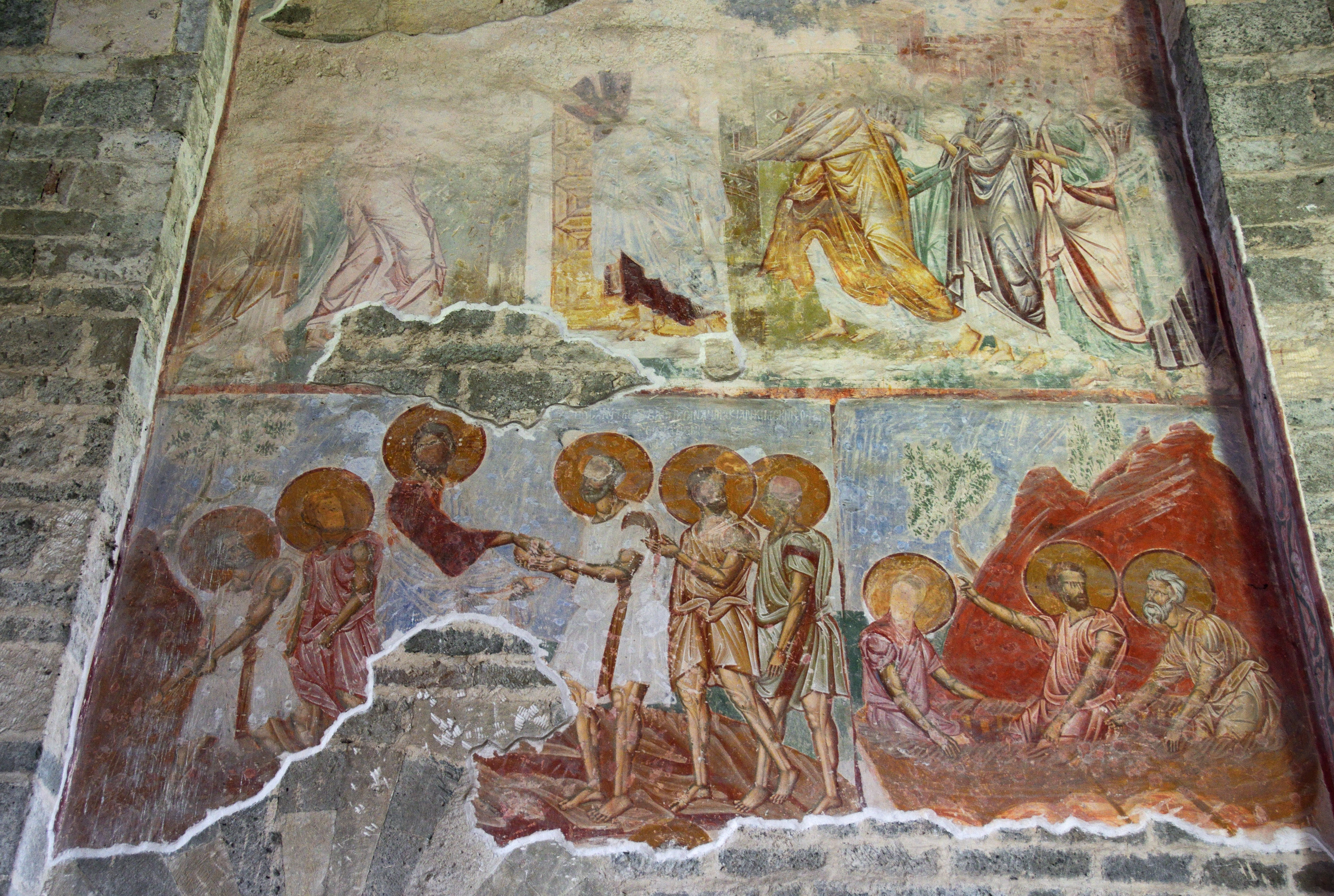
Breakfast on the Shore (Hagia Sophia, Trabzon)
The Incredulity of St. Thomas (top) and The Risen Christ Appears on the Shore (bottom), late 13th century. Frescoes, Hagia Sophia (Aya Sofya Mosque), Trabzon, Turkey. Photo courtesy of Manar al-Athar.

One of the frescoes shows Christ appearing to his disciples after his resurrection on the shore of the Sea of Galilee. He hands a fish and a loaf of bread to Peter, who stands at the front of the group, so that they can all share a joyous breakfast together after the tragic, upending events of the previous week.

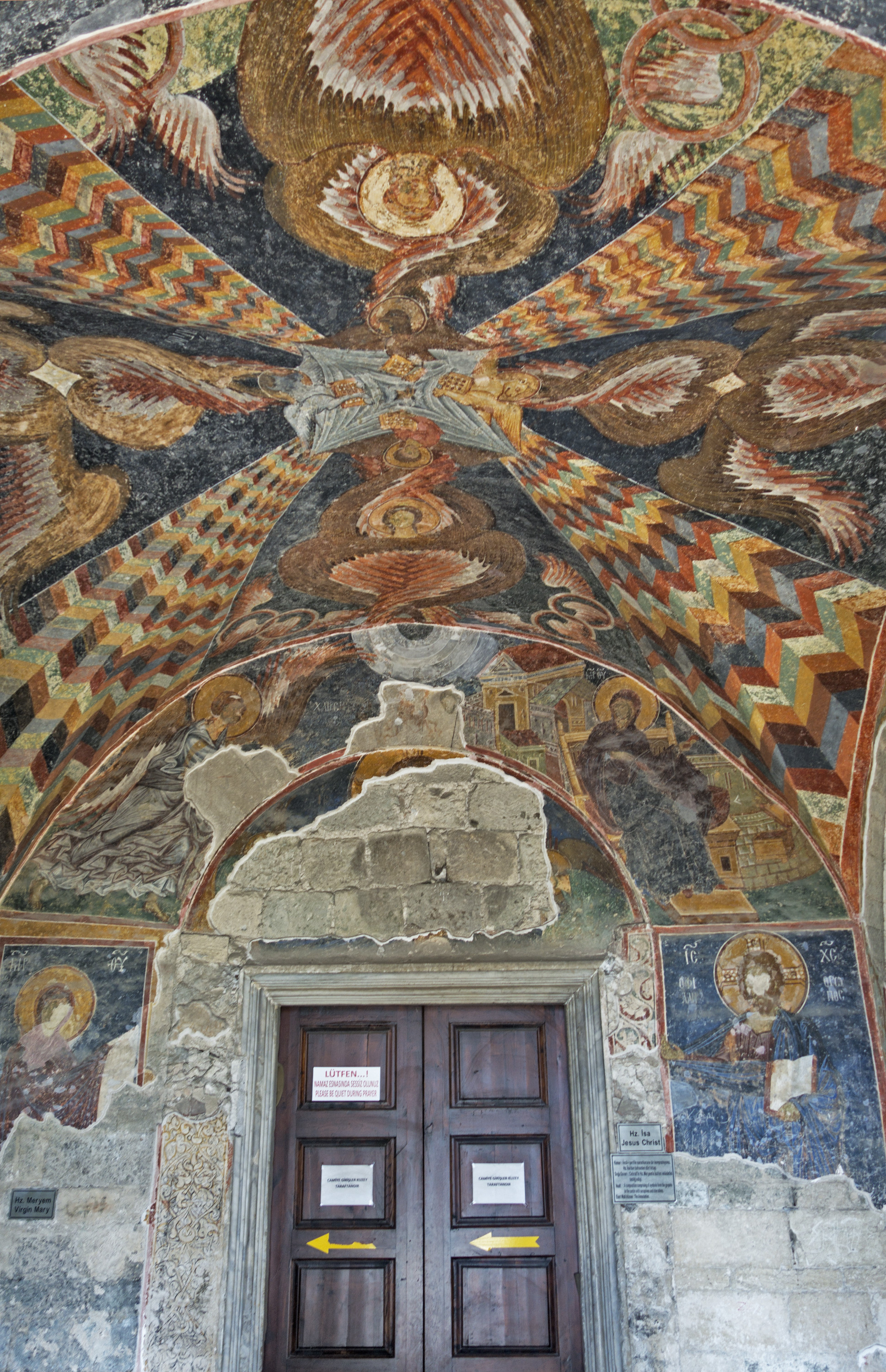
Tetramorph (Hagia Sophia, Trabzon)
Frescoed narthex, late 13th century, Hagia Sophia (Aya Sofya Mosque), Trabzon, Turkey. Photo: Matthew Kinloch / Manar al-Athar.

Another fresco, on the vaulted ceiling of the narthex, shows the four living creatures of Revelation 4—long interpreted by Christian artists as symbols of the Four Evangelists—situated along the four sides of the canopy of the heavens, each holding a golden Gospel-book and surrounded by seraphim and blazes of rainbow light.

In the Caucasus region, Armenia has a long and rich tradition of Christian art, especially relief carving and painting, as the faith took root there early on in the fourth century.

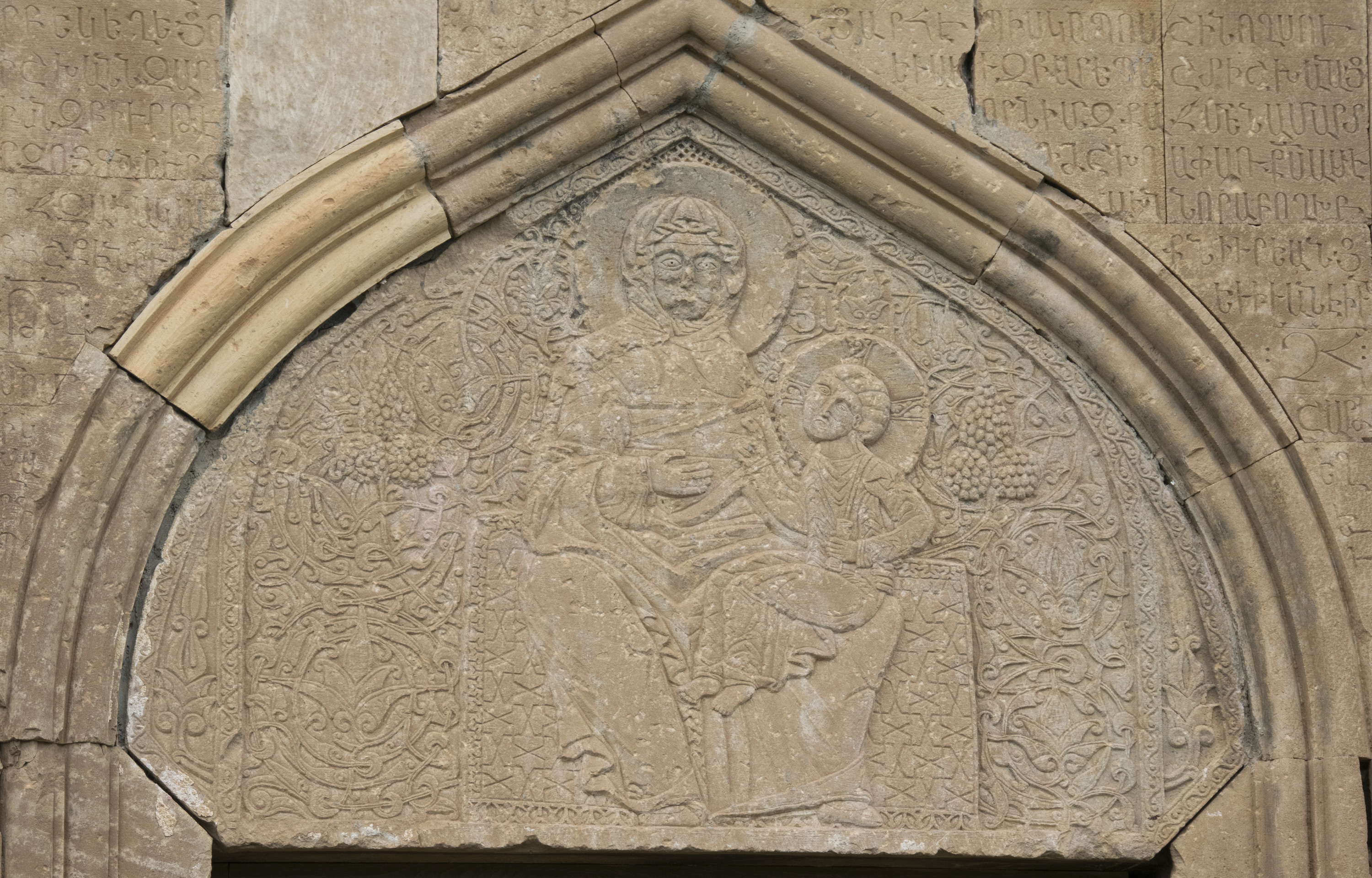
Virgin and Child
Momik Vardpet, Virgin and Child, ca. 1321. Carved tympanum, west portal, Church of St. Astvatsatsin (Holy Mother of God), Areni, Armenia. Photo courtesy of Manar al-Athar.

Overlooking the village of Areni on the eastern bank of the river Arpa is the Church of St. Astvatsatsin, which has a beautiful relief carving in the tympanum above the west portal by the Armenian architect, sculptor, and manuscript illuminator Momik Vardpet (died 1333). It depicts the Christ child seated on the lap of his mother, holding a scroll in one hand and raising the other in blessing. Decorative vines rise up behind and around the pair, suggesting verdancy.

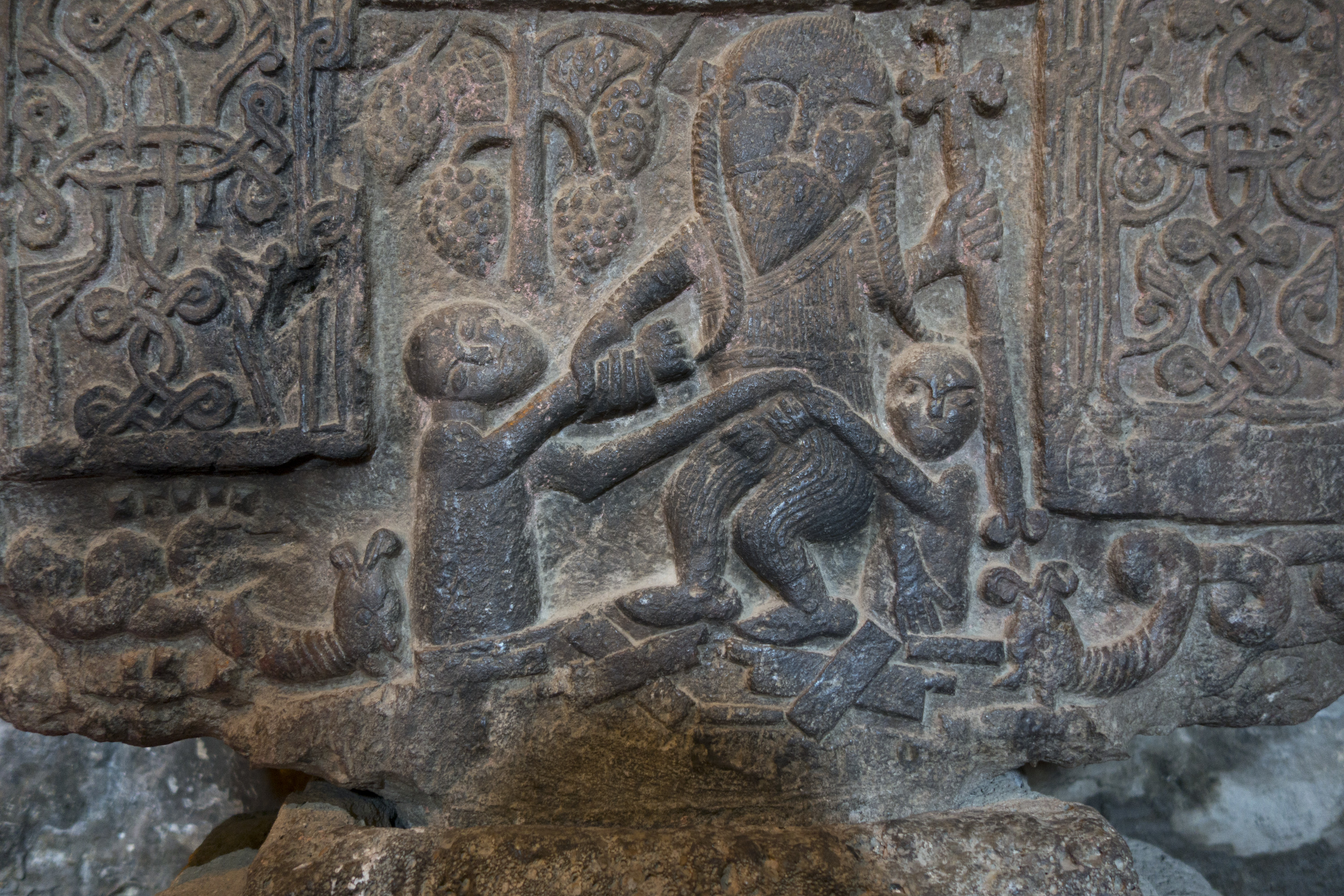
The most distinctive Christian art form in Armenia is the khachkar, a carved memorial stele bearing a cross and often botanical motifs, and only occasionally a Christ figure. In the village of Sevanavank, at a different Church of St. Astvatsatsin, there’s a particularly striking khachkar that portrays the crucified Christ in the center, and below that, a scene of the Harrowing of Hell.

Harrowing of Hell (Armenia)
The Harrowing of Hell, detail of a khachkar from the Church of St. Astvatsatsin (Holy Mother of God) in Sevanavank, Armenia. Photo: Matthew Kinloch / Manar al-Athar. [view full khachkar]

Holding aloft his cross as a scepter, the risen Christ breaks down the gates of death and rescues Adam and Eve, representatives of redeemed humanity, while serpents hiss vainly at his heels. I’m struck by the uniqueness of Christ’s hair, which flows down in two long braided pigtails. Was this a common hairstyle for males in medieval Armenia? I have no idea.

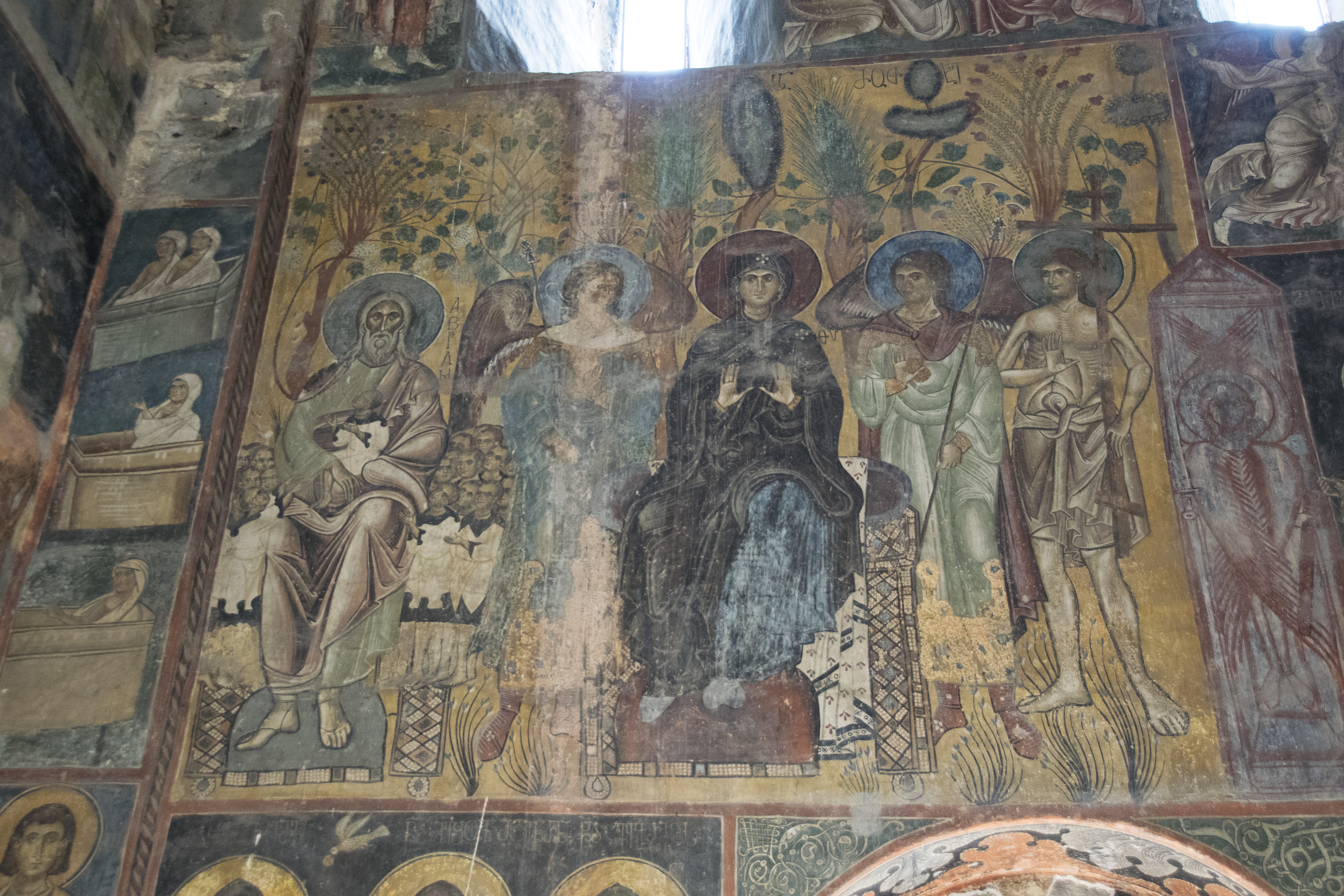
The last artwork from Armenia that I’ll share is an icon of paradise from the Church of St. Astvatsatsin (yes, it’s a popular church name in that country!) at Akhtala Monastery.

Paradise (Armenia)
Paradise, 1205–16. Fresco, west wall, Church of St. Astvatsatsin (Holy Mother of God), Akhtala Monastery, Akhtala, Armenia. Photo courtesy of Manar al-Athar.

In the center is the Mother of God flanked by two angels. On the left is Abraham with a child, representing a blessed soul, sitting on his lap (Luke 10:22 describes how the righteous dead go to “Abraham’s bosom,” a place of repose). On the right is Dismas, the “good thief” who repented on the cross of his execution, and to whom Jesus promised paradise (Luke 23:39–43); he is venerated as a saint in the Catholic and Orthodox churches.

The image is part of a larger Last Judgment scene that covers the entire west wall. A few panels above, at the very top, Christ is enthroned on a rainbow.

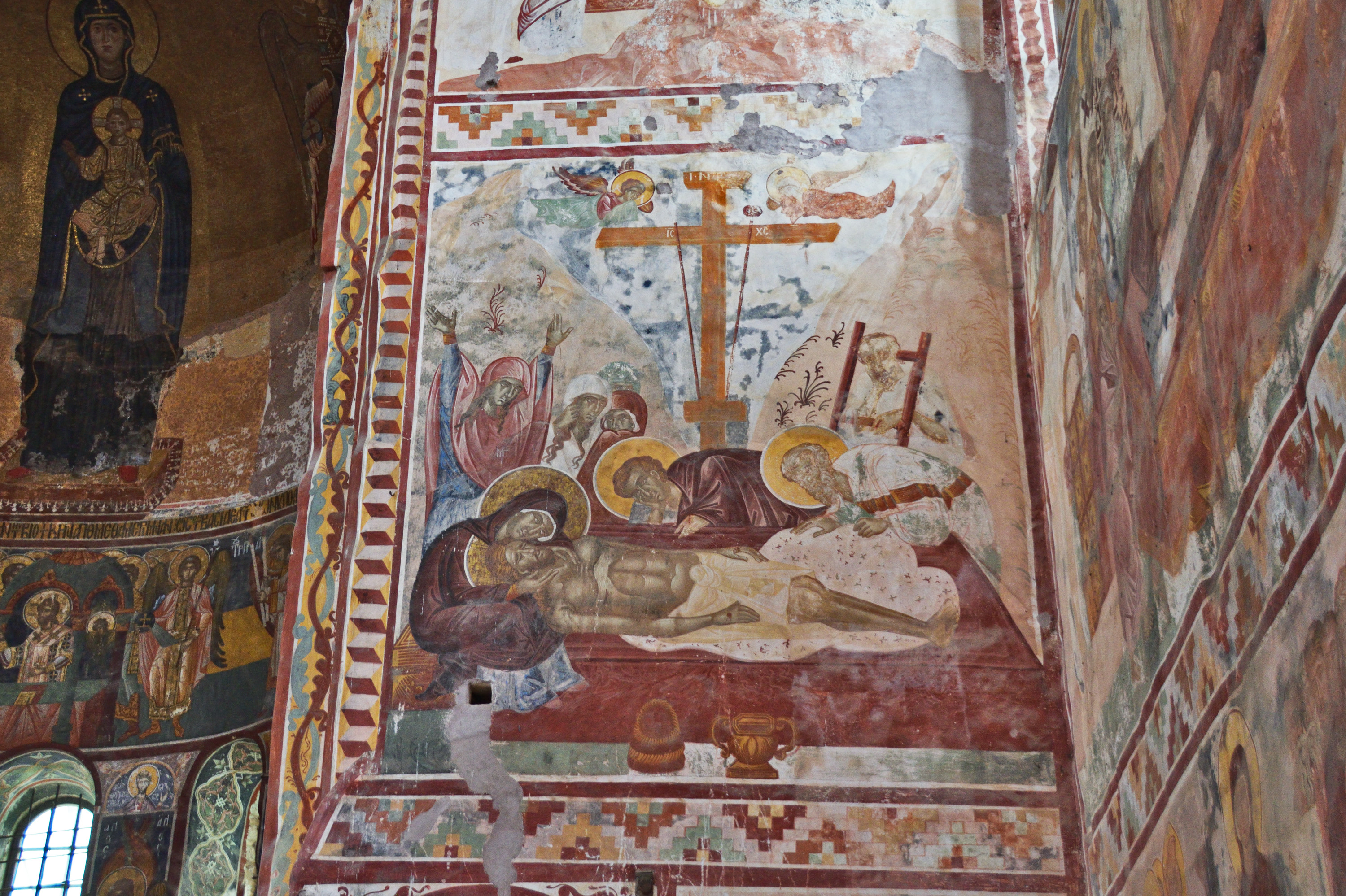
The neighboring country of Georgia has also cultivated a tradition of Christian icon painting. The main church of Gelati Monastery, founded in 1106, is richly decorated with painted murals dating from the twelfth through seventeenth centuries. One of them is the Lamentation over the Dead Christ: The Virgin Mary gently cradles the head of her son and Mary Magdalene throws her arms up in grief while the apostle John leans in close to mourn the loss and Joseph of Arimathea begins to wrap the body in a shroud.

Lamentation (Georgia)
Lamentation over the Dead Christ, fresco, Church of the Blessed Virgin, Gelati Monastery, near Kutaisi, Georgia. Photo courtesy of Manar al-Athar.

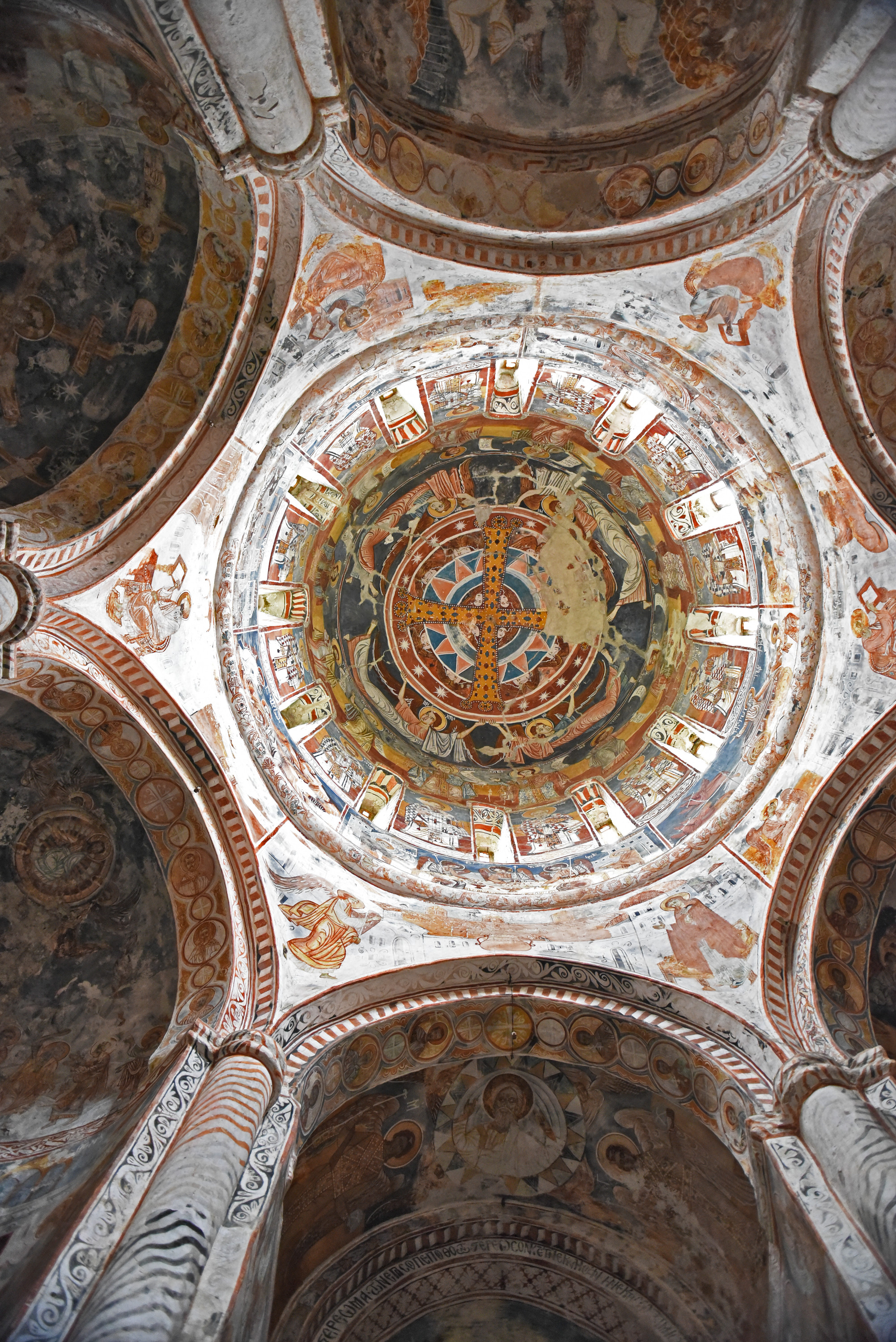
Another Georgian icon painting, from the central dome of the Church of St. Nicholas in Nikortsminda, shows angels bearing aloft a jeweled cross, surrounded by the twelve apostles.

Georgian church dome
Central dome, Church of St. Nicholas, Nikortsminda, Georgia. Photo: Ross Burns / Manar al-Athar.

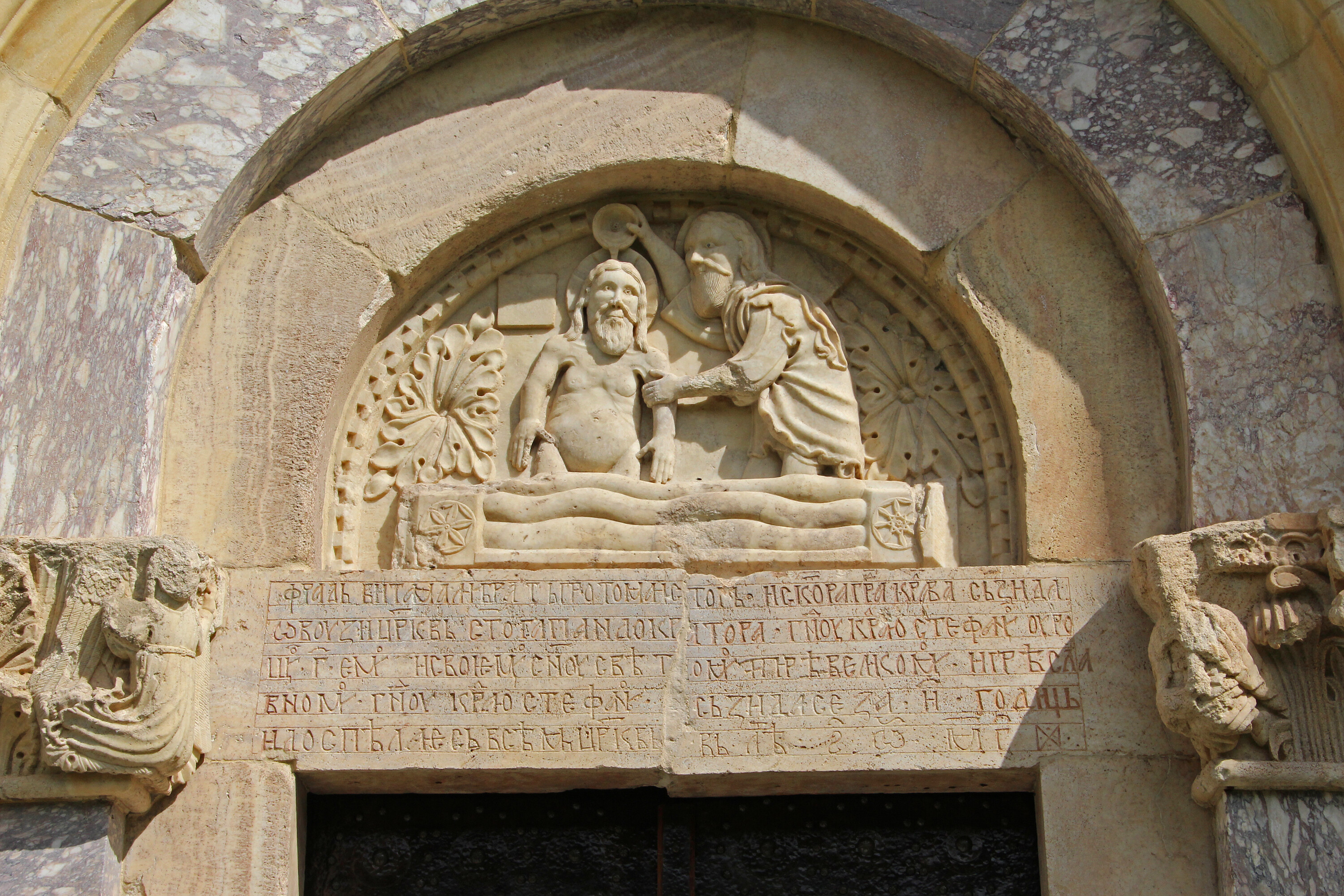
Lastly, from the Balkans, I want to point out Decani Monastery in Kosovo, a Serbian Orthodox monastery built in the fourteenth century in an architectural style that combines Byzantine and Romanesque influences. The tympana of its katholicon (main church) lean into the Romanesque. The one over the south entrance portrays John baptizing Jesus in the river Jordan, and the Serbian inscription below describes the monastery’s founding.

Baptism of Christ tympanum (Decani)
The Baptism of Christ, 1327–35. Carved tympanum, south portal, Christ Pantocrator Church, Decani Monastery, near Deçan, Kosovo. Photo: Mark Whittow / Manar al-Athar.

Decani’s katholicon is the largest and best-preserved medieval church in the Balkans and due to continuing ethnic strife in the region is under international military protection. The Blago Fund website has more and better photos of the extensive frescoes inside, from the fourteenth through seventeenth centuries.

It’s important to note that this is one of a number of churches from the Manar al-Athar archive that are still active sites of Christian worship, where communities of believers are nurtured through word, image, and sacrament.


If you are interested in volunteering with Manar al-Athar—helping with image processing, labeling, fundraising, or web building—or if you have taken any photographs that may be of interest to the curatorial team, email manar@classics.ox.ac.uk.

Website: https://www.manar-al-athar.ox.ac.uk/

Advent, Day 13: A star shall rise out of Jacob

LOOK: Virgin and Child with a Prophet catacomb fresco

Mary breastfeeding (Catacomb of Priscilla)
Virgin and Child with a Prophet, 3rd century. Fresco in the Catacomb of Priscilla on the Via Saleria, Rome. Photo: Scala / Art Resource. [view wider shot]

Deep in the Catacomb of Priscilla in Rome, one of the early Christian underground burial places (named after the donor of the land), is an arched ceiling fresco of a woman breastfeeding her child under an apple tree. Beside her a man points up to a star that’s resting over their heads among the fruit.

Dating to the third century, this image is the earliest known depiction of the Virgin Mary, and one of the oldest of Christ. The identity of the third figure is less sure, but it’s most likely the Gentile prophet Balaam, who, in the power of God’s Spirit, prophesied to King Balak of Moab that “a star shall come out of Jacob, and a scepter shall rise out of Israel” (Num. 24:17).

Although this prophecy had a more immediate fulfillment in King David, it has also been interpreted in a messianic sense since as early as Justin Martyr (ca. 100–165), who wrote, “And that he [Christ] should arise like a star from the seed of Abraham, Moses showed beforehand when he said, ‘A star shall arise from Jacob, and a leader from Israel’” (Dialogue with Trypho, chap. 106).

Irenaeus (ca. 130–200) wrote that the star the magi followed to seek out the newborn Christ was the one prophesied by Balaam (Against Heresies, bk. 3, chap. 9.2), and Origen (ca. 185–254) maintained that Numbers 24:17 was the Hebrew Bible verse the magi found that instigated their journey (Against Celsus, bk. 1, chap. 60).

Priscilla Catacomb arch
Arched ceiling detail from Gallery 3 of the Catacomb of Priscilla, Rome. The central image, in stucco, portrays a shepherd and two sheep, while at the far right, oriented in a different direction, is a fresco of the Virgin and Child. The artworks are damaged by age.

Other suggestions put forward as to the identity of the pointing figure in this catacomb fresco have been a magus; the Hebrew prophet Isaiah, who declared that “a virgin shall conceive” (Isa. 7:14) and enjoined his people to “arise, shine; for thy light is come, and the glory of the Lord is risen upon thee” (Isa. 60:1); and, from Hans-Ruedi Weber, John the Baptist, who “came as a witness to testify to the light, so that all might believe. . . . The true light, which enlightens everyone, was coming into the world” (John 1:6–9).

To explore more of the Catacomb of Priscilla, see the following Smarthistory video by Beth Harris and Steven Zucker. Today’s featured image is introduced at 3:35:

LISTEN: “There Shall a Star from Jacob Come Forth” (original title: “Es wird ein Stern aus Jacob aufgeh’n”), from Christus, Op. 97 | Original German text compiled by Christian Charles Josias von Bunsen, 1846, from Numbers 24:17 and the hymn “Wie schön leuchtet der Morgenstern” by Philipp Nicolai, 1599; English translation of lines 4–10 by Catherine Winkworth, 1863 | Music by Felix Mendelssohn, 1846–47, based on Nicolai’s hymn tune | Performed by the St. Olaf Choir, the St. Olaf Cantorei, the St. Olaf Chapel Choir, the Manitou Singers, Viking Chorus, and the St. Olaf Orchestra, dir. Robert Scholz, on Love Divine, Illumine Our Darkness: Christmas at St. Olaf, 2002

There shall a star from Jacob rise up,
And a sceptre from Israel come forth,
To dash in pieces princes and nations.

How brightly beams the morning star!
With sudden radiance from afar,
With light and comfort glowing!
Thy word, Jesus, inly feeds us,
Rightly leads us,
Life bestowing.
Praise, oh praise such love o’erflowing.

The musical work “Es wird ein Stern aus Jacob aufgeh’n” (There Shall a Star from Jacob Come Forth) is from an unfinished oratorio by Felix Mendelssohn (1809–1847), which the composer’s brother Paul gave the name Christus and published posthumously as Opus 97. The first performance took place in 1852.

The first three lines are taken from Numbers 24:17, while the latter portion is from the Lutheran hymn “Wie schön leuchtet der Morgenstern” (How Brightly Beams the Morning Star) by Philipp Nicolai, written in 1597 and first published in 1599 with the title “Ein geistlich Brautlied der gläubigen Seelen von Jesu Christo ihrem himmlischen Bräutigam, gestellet über den 45. Psalm des Propheten David” (A spiritual wedding song of the faithful soul about Jesus Christ, her heavenly groom, made over the 45th psalm of the Prophet David). The tune it was published with was adapted by Nicolai, it appears, from an older tune found in the Strasbourg Psalter of 1538—which is further adapted here by Mendelssohn.

In Mendelssohn’s piece, the first two lines about an emerging luminary from the lineage of Jacob are lovely and lofty, repeated in different and overlapping voices over the course of a minute-plus. But then the third line cuts in with emphatic force: “To dash in pieces princes and nations.” Its violence is jarring, very far from the peaceful sentiments we’re used to associating with this time of year! Even as it adds drama and interest to the composition, its militant language is unsettling.

But it does honor the larger context of Balaam’s prophecy:

So he [Balaam] uttered his oracle, saying,

“The oracle of Balaam son of Beor,
    the oracle of the man whose eye is clear,
the oracle of one who hears the words of God
    and knows the knowledge of the Most High,
who sees the vision of the Almighty,
    who falls down but with eyes uncovered:
I see him but not now;
    I behold him but not near—
a star shall come out of Jacob,
    and a scepter shall rise out of Israel;
it shall crush the foreheads of Moab
    and the heads of all the Shethites [a Moabite tribe].
Edom will become a possession,
    Seir [an alternative name for Edom] a possession of its enemies,
    while Israel does valiantly.
One out of Jacob shall rule
    and destroy the survivors of Ir [‘City’].”

(Num. 24:15–19)

The mercenary prophet Balaam had been hired by Balak, king of Moab, to curse Israel. See, the Israelites had escaped slavery in Egypt some forty years prior and were looking for land to settle. Having been refused passage through, they had just conquered Amorite country, which used to belong to Moab, and Balak feared Moab would be next.

Despite being a non-Israelite, Balaam heard words from Yahweh, Israel’s God. Balak recognized Balaam as an authority, as did others, and thought he might be persuaded for a fee to issue a prophecy in Moab’s favor. But Balaam told him he would speak only the words of Yahweh.

The passage above is the fourth and final oracle Balaam pronounced on this mission to Moab. In it he says that Moab and Edom would be conquered—a prophecy that came to pass with King David (2 Sam. 8:2–12; cf. Ps. 60:8).

Christians, as we have seen, often extract verses from longer Old Testament passages, prophetic or otherwise, and read into them messianic significance—pointers to Jesus Christ. Even the New Testament authors, and Jesus himself, did this. Did the Old Testament authors intend such meanings? Probably not in most places, not to the extent that premodern Christian interpreters suggested. (That’s not to say Jesus didn’t fulfill biblical prophecies. Quite the contrary!)

But many Christian biblical scholars acknowledge what’s been called the sensus plenior, or “fuller sense,” of scripture—a term popularized by Raymond E. Brown in his book The Sensus Plenior of Sacred Scripture (1955). Sensus plenior, Brown writes, is “that additional, deeper meaning, intended by God but not clearly intended by the human author, which is seen to exist in the words of a biblical text (or group of texts, or even a whole book) when they are studied in the light of further revelation or development in the understanding of revelation.”

Some people consider this kind of reading to be distortive. But others, including myself, consider it creative. Rabbinical literature often does the same thing: finds meaning in and beyond a scripture passage’s strict historical context that the original authors likely did not intend but that open up the text in new ways. Sensus plenior says that studying a book of the Bible only in its historical and immediate textual context and for what it would have meant to its original audience is limiting, incomplete. Of course, the opposite approach, which does run rampant in many Christian communities, is also problematic: divesting scripture passages of their contexts, reflexively backfilling all the Old Testament with “Jesus” at the expense of understanding the texts on their own terms.

I think the application of “To dash in pieces princes and nations” (a paraphrase from Balaam’s prophecy) to Jesus’s birth is confusing, as Jesus was nonviolent, rejecting conquest. Perhaps you could say that Christ’s rule would (rhetorically) dash Herod’s kingdom to pieces, as it challenged the modus operandi of empire. There’s a new caesar in town, a new king on the throne, and his law of love, his gospel of peace, trumps the laws and proclamations of all earthly rulers.

The last six lines of Mendelssohn’s song return to the sweet, gentle tones of the song’s opening, exulting in the radiant glory of Christ, the Morning Star (Rev. 22:16), who shines forth from the pages of God’s word.


This post is part of a daily Advent series from December 2 to 24, 2023 (with Christmas to follow through January 6, 2024). View all the posts here, and the accompanying Spotify playlist here

Hymn 4 on the Nativity of Christ (excerpt) by Ephrem the Syrian

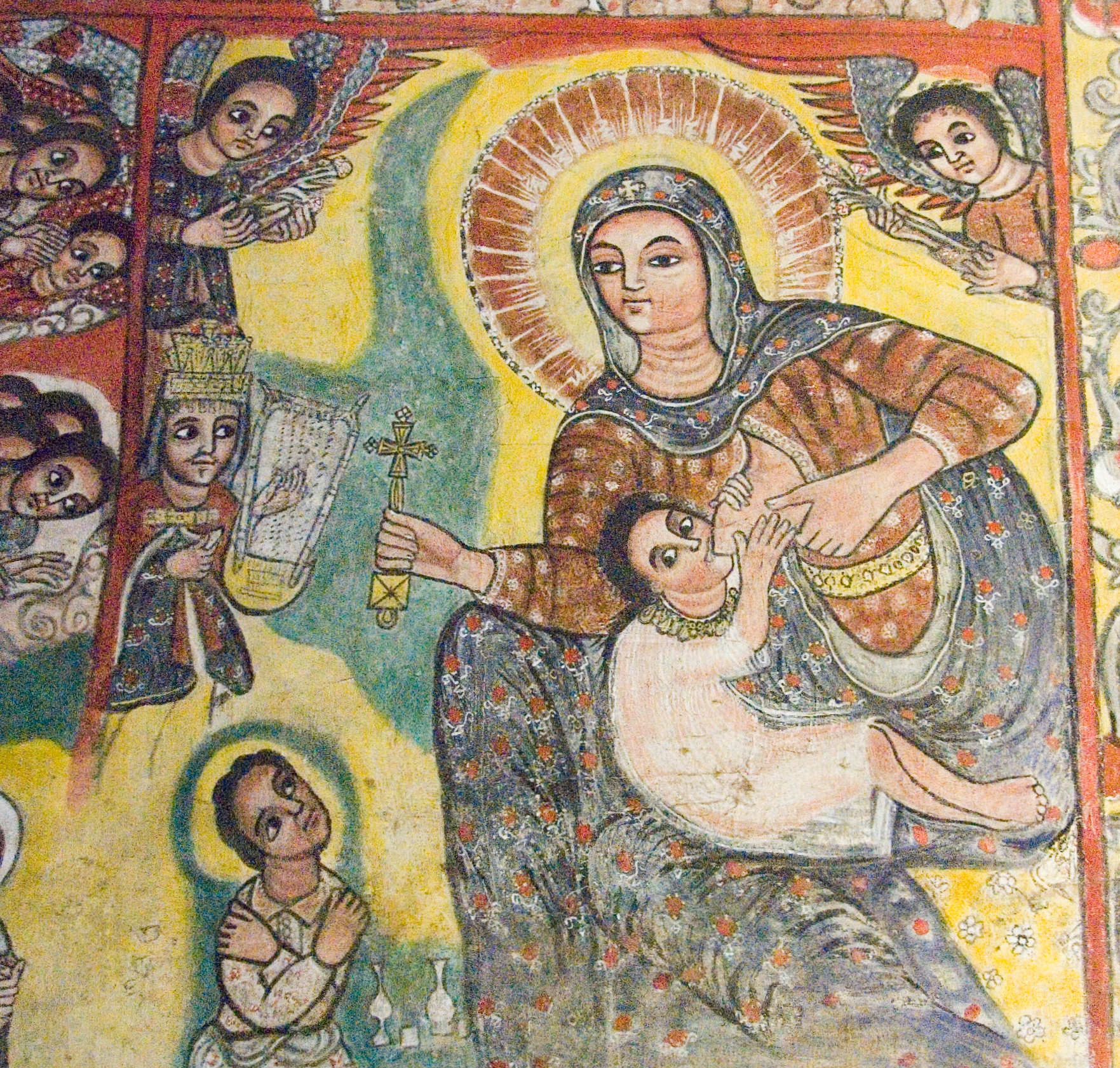
Maria lactans (Ethiopian)
Maria lactans, late 18th century. Fresco, Church of Narga Selassie, Dek Island, Lake Tana, Ethiopia. Photo: Alan Davey.

Glory to that Voice that became a body,
and to the lofty Word that became flesh.
Ears even heard Him, eyes saw Him,
hands even touched Him, the mouth ate Him.
Limbs and senses gave thanks to
the One Who came and revived all that is corporeal.
Mary bore a mute Babe
though in Him were hidden all our tongues.
Joseph carried Him, yet hidden in Him was
a silent nature older than everything.
The Lofty One became like a little child,
yet hidden in Him was a treasure of Wisdom that suffices for all.
He was lofty but he sucked Mary’s milk,
and from His blessings all creation drinks.
He is the Living Breast of living breath;
by His life the dead were suckled, and they revived.
Without the breath of air no one can live;
without the power of the Son no one can rise.
Upon the living breath of the One Who vivifies all
depend the living beings above and below.
As indeed He sucked Mary’s milk,
He has given suck—life to the universe.
As again He dwelt in His mother’s womb,
in His womb dwells all creation.
Mute He was as a babe, yet He gave
to all creation all His commands.
For without the First-born no one is able
to approach Being, for He alone is capable of it.

Translated from the Syriac by Kathleen E. McVey in Ephrem the Syrian: Hymns (Classics of Western Spirituality) (Mahwah, NJ: Paulist Press, 1989), 100–101