Roundup: Songs of thanksgiving, NYC art exhibitions, and more

SPOTIFY PLAYLIST: November 2024 (Art & Theology)

+++

SONGS:

In addition to the new, nonthematic playlist above, I also have a Thanksgiving Playlist that I published in 2021 and have been adding to sporadically. Here are three new songs, among others, that you can hear on it:

>> “I Just Want to Thank You, Lord” by Lynda Randle: Singer-songwriter Lynda Randle has been performing on the Gaither Homecoming videos and tours since 1993. Here she sings one of her original gospel songs with Gayle Mayes and Angela Primm.

>> “Thanks a Lot” by Raffi: Raffi Cavoukian, who goes by his first name only, is an Armenian Canadian children’s singer-songwriter and book author, best known for his song “Baby Beluga.” “Thanks a Lot” expresses gratitude—presumably to God, though God is not named—for the sun, clouds, wind, birds, stars, “the wondering me,” and so on. This live recording is on the 1984 release A Young Children’s Concert with Raffi. I’m guessing he told the kids in the audience to close their eyes, to help cultivate a prayerful state.

>> “Herraa Hyvää Kiittäkää” (Thank the Good Lord) by Herännäisnuorten kuoro: This hymn was originally written in Swedish by Jesper Swedberg in 1694 and was translated into Finnish six years later. It uses an older (1640) tune—nice and hearty! and in a minor key—by the German composer Heinrich Albert. You can follow along with the Finnish lyrics here.

+++

VIDEO: Jazz Vespers Worship Service, Duke Chapel, November 19, 2019: Duke University in Durham, North Carolina, has hosted a Jazz Vespers worship service nearly every March and November since 2014, a collaboration between Duke Chapel and the Duke Jazz Program. In this recorded service from the fall 2019 semester, Rev. Dr. Luke Powery (the chapel dean) leads the liturgy and Rev. Joshua Lawrence Lazard (the chapel’s minister for student engagement) delivers the sermon, which is from 1 Thessalonians 5:16–18: “Rejoice always, pray without ceasing, give thanks in all circumstances, for this is the will of God in Christ Jesus for you.” The music is led by Duke music professor John Brown, a Grammy-nominated jazz bassist and composer, and his Little Big Band. I can’t find the names of the two vocalists.

List of songs:

  • “Every Day Is a Day of Thanksgiving” by Shelby Wills
  • “Glory, Glory (Since I Laid My Burden Down)”
  • “Because of Who You Are” by Vicki Yohe
  • “I Feel Like Praising Him” by Shirley Caesar
  • “Amazing Grace” by John Newton
  • “Perfect Love Song” by Anita Wilson
  • “You Can’t Beat God Giving” by Billy Preston
  • “Thank You, Lord, for All You’ve Done for Me” by Walter Hawkins

Duke’s next Jazz Vespers service is Thursday, November 14, 2024, at 7 p.m. at Duke Chapel.

+++

LITANY: “Celebrating the Gifts of Immigrants” by Rev. Maren C. Tirabassi: “A prayer for the United States which has come to a time of conflict, when the discussion of immigration seems to be limited to a choice of two – fears of burden or pity for the vulnerable – ignoring the third truth – deep gratefulness.”

+++

VIRTUAL WORKSHOP: “Evocations: Advent Responsive Writing” with Marilyn McEntyre, Nov 26, Dec 3, Dec 10, Dec 17, 2024: Each Tuesday over the course of a month, from 7:00 to 8:30 p.m. ET, Marilyn McEntyre will be leading an online gathering of writers in reflecting on and working with words and images gleaned from centuries of song, poetry, and paintings that celebrate Advent, the season of waiting. Participants will engage in lectio divina and visio divina as a foundation for writing personal reflections, memoir, and poetry. Hosted by Image journal. Registration cost: $195.

+++

ART EXHIBITIONS:

I don’t know that I’ll be able to make it up to New York City before these two exhibitions close in January, but I will try! They both look excellent.

>> Siena: The Rise of Painting, 1300–1350, Metropolitan Museum of Art, October 13, 2024–January 26, 2025: Siena: The Rise of Painting, 1300–1350 examines an exceptional moment at the dawn of the Italian Renaissance and the pivotal role of Sienese artists—including Duccio, Pietro and Ambrogio Lorenzetti, and Simone Martini—in defining Western painting. In the decades leading up to the catastrophic onset of the plague around 1350, Siena was the site of phenomenal artistic innovation and activity. While Florence is often positioned as the center of the Renaissance, this presentation offers a fresh perspective on the importance of Siena, from Duccio’s profound influence on a new generation of painters to the development of narrative altarpieces and the dissemination of artistic styles beyond Italy.”

The New York Times published a glowing review of the exhibition, calling it “revelatory . . . the art show of the season.” Here’s a video tour:

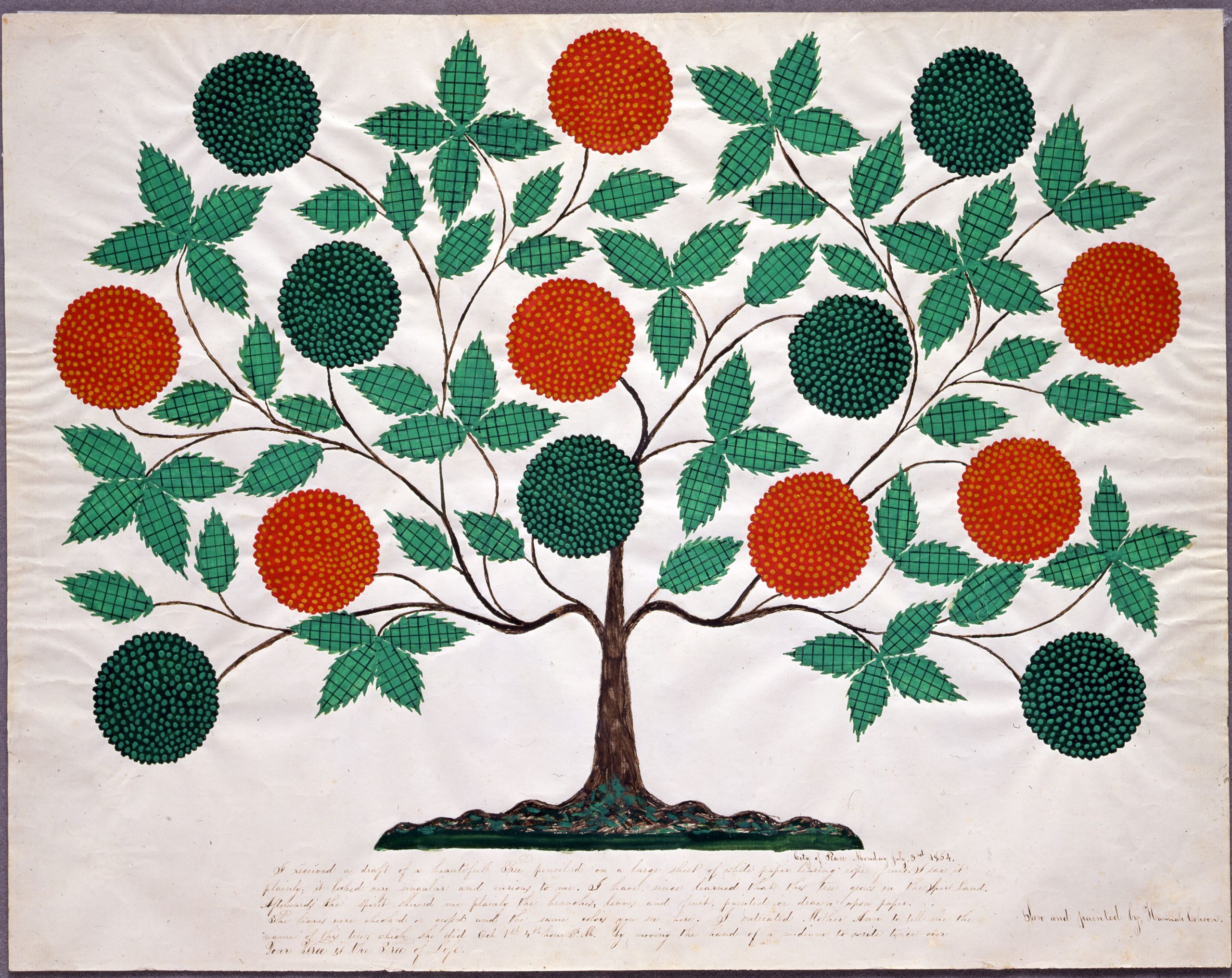
>> Anything but Simple: Gift Drawings and the Shaker Aesthetic, American Folk Art Museum, September 13, 2024–January 26, 2025: “The Shakers, often celebrated for their minimalist approach to design, will be showcased in a new light with the exhibition Anything but Simple: Gift Drawings and the Shaker Aesthetic. Made by women in the mid-19th century and believed to represent divine messages, the ‘gift’ drawings on display represent a departure from the simplicity typically associated with Shaker material culture.

“Opening during the 250th year of Shakerism in the United States, the exhibition features drawings widely considered to be among the finest surviving examples of this rare type. These symbols of love and nature were often given as ‘tokens’ to other Shakers during meetings. Brightly colored and replete with intricate ornamentation, they represent a stunning world of celestial imagery. Compared to examples of Shaker clothing and furniture that will also be included in the exhibition, the vibrancy of the drawings will mark a distinct contrast with the clean lines typically associated with Shaker design.”

Cohoon, Hannah_The Tree of Life
Hannah Cohoon (American, 1788–1864), The Tree of Life, 1854. Ink and watercolor on paper, 18 1/8 × 23 5/16 in. Collection of the Hancock Shaker Village, Pittsfield, Massachusetts.

Online Glen Workshop: July 25–31, 2021

Organized by Image journal every summer, the Glen is equal parts craft workshop, arts festival, and spiritual retreat. It’s framed by the Christian tradition but welcomes spiritual wayfarers of all stripes. This year, due to the pandemic, it’s entirely online, with twelve different classes on offer, taught by renowned artists, writers, and critics. Visit https://imagejournal.org/the-glen-workshop-2021/ for more information.

“The last year has invited many of us into a thicker relationship with place: with the homes where we quarantine, the public spaces we navigate with new caution, the vacation destinations we dream about, and the neighborhood streets we walk to avoid going stir-crazy in the meantime. Even our computers have transformed from objects to places, ushering us into the homes of loved ones, yoga studios, concert halls, museums, and countless other virtual gatherings, including the 2021 Glen Workshop! This year we’ll be exploring the ways in which our surroundings feed our creative vision. And we’ll also consider how art—both making it and sitting with it—sharpens our capacity for attention to the places we live and move and have our being.”

Each class costs $950 and is open to all experience levels. The schedule is such that attendees can choose just one. Registration to any class gives you full access not only to five days (about three hours each) of expert instruction, in-depth conversation, and practice, but also to additional programming that includes faculty presentations, “experiments with poetry and place” with artist in residence Billy Mark, chapel services led by musician Charles Jones and chaplain Marilyn McEntyre, coffee hours, open-mic nights, centering prayer sessions, and yoga sessions. Again, it’s all online.

If you don’t want to register for a class but want access to the other content or just a sneak peek, there are “retreat registration” and “festival pass” options. Click here to view registration options. You can get a 25% off discount if you register in a group of three or more.

What follows is a full list of the workshops (hands-on, craft-based classes) and seminars (immersive, discussion-based classes). I’m considering registering for either the Rosen seminar on contemporary biblical art or the Overstreet seminar on film. The cost is reasonable, but it’s still high, so I have to see if I can make it work.

Workshops

“Poetic Text as Provocation” with Scott Cairns: “We will embrace an approach to poetry that privileges poetic text as a scene of meaning-making, distinct from any approach that would understand the poem as a site of meaning already made. We will begin most days with a reading of a great and provocative poem and discuss the provocations each of us registers in response to that poem. Then, we will share our works-in-progress, and each of us will offer our ideas about what might make each draft a richer, more suggestive, provocative occasion for the reader.”

“The Attention We Owe Each Other” with Shane McCrae: “It is important to almost every poet to find a community of fellow poets with whom they can share their work, and from whom they can expect serious and good-humored attention, and honest and direct critiques. Together, we will make that community. Our poetry workshop will not operate according to any particular idea save the idea that poetry is serious—that it is, in fact, among the most serious things in our lives—and that, consequentially, we owe each other seriousness, and intelligence, and sensitivity when we workshop each other’s poems. We will read and critique each other’s poems closely; we will prioritize whatever particular issues each poem asks us to prioritize while keeping in mind the issues its author has asked us to consider; and we will have fun together, the highest seriousness being joy.”

“Writing the Moveable Feast” with Alissa Wilkinson: “Food is what binds us together as humans. We all eat it. We all make it, or someone makes it for us. We all have opinions about it and preferences for it, which often come from the things that make us, well, us: our families of origin, our nationalities and ethnicities, our individual tastes, our beliefs about God and ethics, and our access to it. Food is the gateway to every aspect of human life; when we eat it, we’re participating in history, culture, and the economy.

“Feasting is one of the most important activities we can do as people. It’s an act of community-building, celebration, and even resistance to the forces that try to tear us apart. Many religious and spiritual traditions are built around feasting; the Bible ends at a wedding feast.

“So in this class, we’re going to talk about food, think about food, make food, and eat food. We’ll talk about how writers have interacted with food and food writing. We will try to understand what it might mean to feast together even when we can’t actually be together. And then we’ll do our own food writing, with the goal of exploring that common experience through our writing (in any genre).”

“Strange Countries: Writing the Inner and Outer Journey” with Fred Bahnson: “In sixth-century Ireland, groups of monks began the practice of peregrinatio, “going forth into strange countries.” The peregrini set off alone or in small groups in tiny coracles made of willow and animal hide, abandoning themselves to the winds and currents of the North Atlantic. A journey into the unknown.

“We moderns find it difficult to grasp the enormity of such an undertaking. Given how frequently we travel, we barely notice the existential threshold crossed upon leaving home. The peregrini remind us that we go on pilgrimage not to consume experience, but to be consumed. To feel again the porous borders between our inner and outer lives. If our rational age has obscured what Seamus Heaney called ‘a marvelous or magical view of the world,’ pilgrimage helps us find it again.

“In this class we will take a very ancient metaphor—the journey—and use it to explore our lives in the age of climate change, pandemics, and fragile democracies. We’ve all gone forth into a strange country, a journey in which we measure distance in time and cortisol levels rather than miles. Setting off in our coracles of narrative—essay, memoir, literary journalism, travel writing, nature writing—we’ll use our peregrinations to map our inner lives against the great stories of our age. We will write our physical journeys (working from memory), and we will write about shelter, intimacy with place, our yearning to be at home. As we traverse the continuum between pilgrimage and place-making, we will discuss various craft topics of literary nonfiction: form, character development (including place-as-character), narrative arc, and, perhaps most important, how to create the fictional ‘I’ that is your nonfiction narrator.”

“The Landscape of the Lyric Essay” with Molly McCully Brown: “The lyric essay combines the density, muscle, and music of the poem with the expansiveness, narrative momentum, and overt desire to engage with information of the essay form. Tied to the original notion of an essay as an effort, a trying, an attempt at making sense, its combined allegiances to the fragment and the whole, the actual and the imaginative, the image and the story, make it the perfect form for exploring and charting the landscapes—both exterior and interior—that make and mark our lives.

“Designed as an opportunity for poets craving a little space to move around, for essayists hungry to drill down to the core of language, or for any writer longing for a chance to experiment, investigate, and attempt, this generative workshop will serve as an introduction to the associative logic of the lyric essay and a chance to try your own hand at the form.

“In class we’ll read and unpack lyric essays from a variety of writers; work together to identify some unique features and possibilities of the form; write in response to prompts designed to help us explore a variety of geographical, sociological, emotional, and intellectual landscapes; and share and discuss our work as it develops. My hope is that you leave the workshop with many attempts and beginnings which might prove fertile ground for later work, and with at least one piece that feels more complete, or further along in its development.”

“Writing Research-Based Narratives for Young Adults” with Marilyn Nelson: “Our curiosity can nourish our reading and our writing, which can nourish the curiosity of our young readers and encourage them to ask questions and follow their own research paths. In this class we will examine some books recently published for middle-grade and young adult readers and based to varying degrees on historical events, asking what questions led to the necessary research, how the research was conducted, and how the material was organized and presented so it is appropriate for younger readers. How do we write for younger readers? How might an author write over their heads? How might an author write down to them? What questions does an author allow to linger? How much information is too much? How does an author find the right voice?”

“Developing Your Authentic Voice” with Charles Jones: “This workshop will focus on teaching artists how to bring their authentic selves to the craft of songwriting and successfully communicate what they want their audiences to hear and feel. We will listen to the music of some of the greatest songwriters of all time and examine what we feel when we listen back. We will explore why we connect deeply with some music, look at the connective tissue these masters created in their songs, and learn how we apply these techniques and tools to our own craft in service of our own unique stories and voices.”

“The Creative and Spiritual Practice of Calligraphy” with David Chang: “From the practical to the ethereal, writing a letter by hand offers a deeper connection to the text and to the viewer. We will cover both aspects of the art form of calligraphy as we learn the basics—including developing your own personal handwriting style—and learn to use handwriting as a creative practice that can also forge a deeper spiritual practice. Through meditational writing we will explore the art of handwriting as a tool for personal expression and as a means to connect with ourselves and also with others.”

“Landscapes and the Art of Seeing” with Suzanne Dittenberg: “In Sargy Mann’s article ‘On Cezanne’ he opposes the popular notion that Paul Cezanne was intentionally distorting the landscape through superimposed affectated abstraction, re-tooling visual information to titillating effect. Instead, Mann makes the case that Cezanne’s painting practice was more straightforward. He describes Cezanne as a relatively unremarkable draftsman who gave himself intensely to the act of looking. ‘As dedicated a realist as you could ever find.’ In Cezanne’s letters, we are given a window into his motivations when painting. He writes, ‘Now the theme to develop is that, whatever our temperaments or power in the presence of nature may be, we must render the image of what we see, forgetting every-thing that existed before us. Which, I believe, must permit the artist to give his entire personality whether great or small.’

“This is a class about seeing. Observational painting serves as a means to explore one’s individual spirit when encountering nature. Each day we will gather together on Zoom and also venture out to work en plein air in our own vicinities. Painting and drawing will serve as a mechanism for finding a new lens with which to view the natural world. A better understanding of nature’s underlying frameworks will result.

“Through daily discussion of drawing and painting techniques, we will cover basic strategies for seeing relative proportions, identifying values structure and understanding color in context. We will also address the use of limited palettes, strategies for achieving harmonious color and methods of paint application. Each afternoon will include time for reflection on the day’s process, experience and results.”

Seminars

“Contemporary Visual Artists Read the Bible” with Aaron Rosen: “The mere mention of a contemporary artist reading the Bible summons competing stereotypes. On one side stands the artist as clamoring missionary, producing pious kitsch. On the other sits the talented but godless iconoclast, scorning the Bible to the applause of intellectuals. It’s high time to get beyond these stereotypes, rooted in the culture wars of the 1980s, yet sadly back in fashion. There are brilliant artists of faith working with the Bible who have the power to challenge even the most ardent atheists, aesthetically and theologically. And there are artists without a spiritual bone in their bodies who engage scripture in ways that can teach devout viewers a thing or two about faith.

“In this seminar, we will see the Bible with fresh eyes, with the help of cutting-edge art across multiple media, from painting to video to virtual reality. Not only will they look at art, they’ll talk to top-notch artists themselves, who will join us by video from their studios around the world, from Los Angeles to London to Lahore. As one of the world’s foremost experts on religion and art, as well as a practicing curator, Dr. Rosen brings together scholarly and practical insights. And as a Jew married to an Episcopal priest, he has a special interest in how art can help us see difference more clearly and creatively at the same time.”

“How Place Becomes Poetry in Cinema” with Jeffrey Overstreet: “For most filmmakers, place is just a backdrop. But great artists of cinema know that place is as influential and as eloquent as any character. Whether he’s in the heat of Texas or the despair of a divided Berlin, director Wim Wenders is listening to what his location has to say. Martin Scorsese and Spike Lee both read New York City closely, but they see very different cities and zones defined by differing forms of prejudice. We’ll consider how one story, told by both Yasujiro Ozu and Claire Denis in different locations, is transformed by the context in which it is told. And we’ll watch the world opened up by the cinematographers of Terrence Malick as well as the animators Tomm Moore and Martin Rosen. A variety of special guests—filmmakers, film critics, and scholars—will join us for these journeys as we watch how human beings are shaped by the ground beneath their feet. The current guest list [subject to change] includes Scott Derrickson (Doctor StrangeSinister), Justin Chang (film critic for the Los Angeles Times), Dr. Yelena Bailey (author of How the Streets Were Made: Housing Segregation and Black Life in America), and Doug Strong (My Angel LarryRiver Road).”

“The Art of Contemplative Reading” with Richard Chess: “In this seminar, we’ll explore reading practices (poetry and prose) that may help us cultivate a contemplative mind. As we practice directing our attentions to different aspects of our experiences as readers—noting our physical experience, quieting our inner voices to enable us to hear more clearly the voice of a text, discerning the difference between noting elements of the text itself and commenting on, reacting to, or interpreting the text—we may also discover ways of engaging with texts (mostly literary) that will help us with our practice as artists and/or our spiritual practices. We’ll also do some writing—reflective writing and generative creative writing—to explore writing itself as a contemplative practice.”

Three poems about Vincent van Gogh

This spring I guest-wrote and narrated an episode of the Makers & Mystics podcast on the life, art, and spirituality of Vincent van Gogh.

Vincent van Gogh artist profile

The son of a Dutch Reformed pastor, Vincent was a lifelong seeker after God who sought through his work to convey the pervasion of the Divine in the everyday. Before he was an artist, he was a missionary to a destitute coal-mining village in Belgium. His ministry was so incarnational—he lived just like those he served—that the sending agency deemed him too undignified to be a minister of the gospel and cut off his support. Hurt by its hypocrisy, Vincent left the institutional church, but he never abandoned his faith. That faith did evolve, however. His so-called evangelical period gave way to a period of artistic discovery, which enabled him to revel even more deeply in the mystery of God and the ethics of Jesus—which he wrote about frequently in letters to his brother Theo.

Despite personal suffering and an acute awareness of the suffering of others, Vincent was very attuned to the beauty of this world and lived a life of wide embrace. He saw the image of God in people and in nature and honored that image through his paintings, of sunflowers, cypresses, olive groves, wheat fields, farmers and mothers and postmen, soldiers, doctors, café owners, and his own self. When he was institutionalized, he continued to paint, so long as his health allowed it, and some of his finest work comes from this period at Saint-Rémy, including The Starry Night. (“When all sounds cease, God’s voice is heard under the stars,” Vincent wrote.) While some interpret the agitated brushstrokes of his later paintings as evidence of internal turmoil and instability, might they not instead express his view of the universe as vibrant, wild, pulsating with life and energy? It is a myth, after all, that Vincent painted in fevered states.

As I was doing research for the podcast episode, I encountered many poets who have responded in verse to specific paintings of Vincent’s, or more generally to Vincent’s oeuvre, vocation, and legacy. I’ve selected three such poems from the latter category, each of which serves as a wonderful introduction to the man and his work—a distillation of his essence, even. I’m struck by how all three poets use religious language to describe Vincent’s paintings: hymns, psalms, prayers.

I’ve compiled the images referred to in the poems, plus a few other representative ones, in the tiled gallery below. To enlarge a photo and to view more info, click on its caption, visible by hovering your cursor over the bottom.

+++

“Dear Lover of Light” by Abigail Carroll

Dear Lover of Light,

There lived a priest
so in love with light
it drove him mad.
Paint was his thing.
When he could no longer
preach, he hopped a train
south, took up a brush,
turned zinc and lead
and chrome
into gaudy, wild-
petaled ambassadors
of the dawn. He slapped
stars as big as brooches
on the sky, danced
crows across bowing fields
of wheat, exalted a bowl
of onions, a bridge, a pipe,
a chair, a bed. Postmen
and prostitutes
were his friends—
so too were irises,
almond trees,
windmills,
clouds. Francis,
if you think of a painting
as a kind of song, he too
canticled the sun.

A Vincent enthusiast

This poem appears in A Gathering of Larks: Letters to Saint Francis from a Modern-Day Pilgrim (Eerdmans, 2017) and is reproduced here by permission of the publisher. All rights reserved.

“Dear Lover of Light” is from a collection of verse-style letters addressed to Saint Francis of Assisi, a thirteenth-century friar who was in love with Christ and with creation—he called animals, the natural elements, and celestial bodies “brothers” and “sisters,” as in his famous “Canticle of the Sun,” and is said to have preached to birds and tamed a wolf.

Abigail Carroll sees Francis as a kindred spirit to Vincent, who, she says, also “canticled the sun.” Vincent’s paintings are like songs of praise. Instead of words he used color—and yellow was his favorite (yellow ocher, cadmium yellow, zinc yellow, chrome yellow), representing for him life, energy, happiness, hope, and friendship.

“When he could no longer / preach” refers to Vincent’s being let go from his village preaching post by a religious board that deemed him too ineloquent and too radical. He moved to The Hague, where he befriended a pregnant sex worker named Sien and her daughter Maria, giving them shelter in his apartment and supporting them as best he could with his own meager funds. From there he went to Nuenen, where his compassion for the working poor manifested in the many earth-toned paintings of this period, including his first major work, The Potato Eaters, showing a family gathered around the dinner table, enjoying the fruit of their labors. After two years in Paris, Vincent needed a respite from the city noise, which led him to Arles in southern France, where he really started finding himself as an artist. He was enraptured by the way sunlight flooded the Provençal landscapes, making them radiant.

Carroll’s poetic descriptions of Vincent’s paintings—dancing crows, jewel-like stars, bowing wheat—capture his sense of all of creation being alive unto God, infused with the sacred. Vincent found great joy in observing what flowered around him, from the irises that grew outside the asylum where he committed himself to the almond tree he painted as a gift for his newborn nephew Vincent, whom his brother named after him. And Vincent saw sacred beauty not only in the natural world but also in everyday articles and objects, be they a pair of well-worn boots in the mudroom or the empty chair of his friend Paul Gauguin.

+++

“What Happened When He Looked” by Marilyn Chandler McEntyre

His miners are made of earth, his sowers so close
to the colors of the fields, only the broad hat, the sack,
the outflung arm keeps them from fading into wheat.

But sometimes, he found, the earth itself turns
to water. Mountains tumble like rapids, waves
curling, blue, roiling and leaping like
the Psalmist’s mountains clapping their hands.

And water turns to air. As life turns to breath.
The sky grows heavy with sun and draws
everything into its fierce embrace, urging
matter upward and homeward to where
the energies of earth begin.

And then there is fire. When they are alive enough
(or we), bushes burn. If you see it, you go
reeling home along a roadway you suddenly know
is temporary and might evaporate or begin
to pinwheel around a star, taking you with it
beyond deeper and deeper blue, into yellow that melts
to a core of thick, transparent white where love
burns day and night to fuel the fallen seed.

This poem appears in The Color of Light: Poems on Van Gogh’s Late Paintings (Eerdmans, 2007) and is reproduced here by permission of the publisher. All rights reserved.

This poem is structured around the four classical elements, understood as the material basis of the physical world: earth, water, air, and fire. Marilyn Chandler McEntyre notes how in Vincent’s paintings, these elements take on characteristics of one another: for example, in Olive Trees in a Mountainous Landscape, the hills surge and flow like water, and in The Sower of 1888, the air burns like fire.

In this latter painting, Vincent said he wished to use the yellow sun as a symbol of Christ’s presence, a sort of halo that covers everything it touches. (See also Letter 673: “I’d like to paint men or women with that je ne sais quoi of the eternal, of which the halo used to be the symbol, and which we try to achieve through the radiance itself, through the vibrancy of our colorations.”) The Sower shows the union between the temporal and eternal, two interpenetrating realms. “The sky . . . draws / everything into its deep embrace, urging / matter upward and homeward,” McEntyre writes.

Vincent saw, in the famous words of Elizabeth Barrett Browning, that “Earth’s crammed with heaven, / And every common bush afire with God.” A reference, of course, to the burning bush in Exodus 3:

Now Moses was keeping the flock of his father-in-law, Jethro, the priest of Midian, and he led his flock to the west side of the wilderness and came to Horeb, the mountain of God. And the angel of the LORD appeared to him in a flame of fire out of the midst of a bush. He looked, and behold, the bush was burning, yet it was not consumed. And Moses said, “I will turn aside to see this great sight, why the bush is not burned.” When the Lord saw that he turned aside to see, God called to him out of the bush, “Moses, Moses!” And he said, “Here I am.” Then he said, “Do not come near; take your sandals off your feet, for the place on which you are standing is holy ground.” (emphasis mine)

McEntyre titled this poem “What Happened When He Looked”—that is, what happened when Vincent, like Moses, looked with intent on the miraculous sights that go unnoticed by so many. What happened is, like Moses, he heard God speak. What happened is he experienced a mystical union with that “something on High—inconceivable, ‘awfully unnameable’— . . . which is higher than Nature.” Vincent’s art making was a reverent act of beholding and of bearing witness to that something.

The final line of McEntyre’s poem refers to Jesus’s parable of the fallen seed, which once it dies, springs forth life—a picture of the promise of resurrection. The sun, or white-hot love of God in Christ, is generative, the energy that raises us out of the dark and fuels our growth and flourishing. Vincent’s paintings radiate that love.

During his time as an assistant preacher under Rev. Thomas Slade-Jones in Isleworth, England, in summer 1876, Vincent wrote to Theo,

I am still far from being what I want to be, but with God’s help I shall succeed. I want to be bound to Christ with unbreakable bonds and to feel these bonds. To be sorrowful yet alway rejoicing. To live in and for Christ, to be one of the poor in His kingdom, steeped in the leaven, filled with His spirit, impelled by His Love, reposing in the Father [. . .]. To become one who finds repose in Him alone, who desires nothing but Him on earth, and who abides in the Love of God and Christ, in whom we are fervently bound to one another.

Though Vincent would later renounce orthodox Christianity, he retained his love for Christ and his sense of awe in the face of the Infinite active in the here and now.

+++

“Van Gogh” by Jeanne Murray Walker

     All right, I love him for the way
                      he painted Vermilion! Orange! jagged as
        shouts, and when no one bought them,
                      no one even heard him,
he shouted louder,
                      Sunflowers! Self-portrait!
     and years later, not one sold,
                      he cut off his own ear.

     Then he had to bring it back on canvas
                      hundreds of times,
        in the brass swelling
                      of the bell
that called him to dinner,
        in the complicated iris
                      at the end of the asylum path.
                            Think how stooping
at a fork in the road
                      he might have seen a stone-shaped ear,
       how the human heart,
                      once it knows what it needs,
will find it everywhere, how
       in the curve of his delicately padded cell
                      one starry night, he must have murmured
                            everything he had ever wanted to say
straight into the ear of God.

This poem appears in A Deed to the Light (University of Illinois Press, 2004) and is reproduced here by permission of the publisher. All rights reserved.

If McEntyre’s poem is about looking and provoking others to look, Jeanne Murray Walker’s is about wanting to be heard, and takes the ear as its central image. Vincent is, of course, notorious for the psychotic episode that culminated in him cutting off his left ear. (His self-portraits show the bandages on his right ear because he painted them while looking in a mirror.) Walker imagines him thereafter seeing ear-shapes everywhere in nature—delicate curves and hollows—manifestations of his longing to be listened to.

Vincent’s paintings are prayers, Walker suggests, that went straight into the ear of the One who hears, who holds all our joys and sadness in love. Others didn’t hear Vincent, but God did.

I will mention that it is a myth that Vincent never sold a painting during his lifetime. True, he sold few—his most significant sale was The Red Vineyard, purchased in January 1890 by Anna Boch while Vincent was convalescing at a psychiatric hospital—“but still,” writes Rainer Metzger in Van Gogh: The Complete Paintings, “the fact should not be overemphasized; after all, Vincent was so willing to give his paintings as presents that many would-be purchasers never needed to part with a penny” (566). And he sometimes made in-kind trades with his paintings.

It’s also false that Vincent died without ever having received recognition for his work. Actually, he was a rising star in the art world. The avant-garde circles in France and Belgium recognized his talent before his death. He was exhibited a few times and received a gushing review in January 1890. Several fellow artists spoke favorably of his work, and his brother Theo, an art dealer, was a tireless champion. It wasn’t easy getting established, and yes, there were many people along the way who didn’t see the value of what he was doing, but Vincent kept at it. He was still in his early career when he died on July 29, 1890, at age thirty-seven. After his death the audience for his work, and thus appreciation for it, grew exponentially, thanks in large part to his sister-in-law, Johanna van Gogh-Bonger, who edited, translated, and published all 652 letters from Vincent that she had in her possession, lent his paintings to various exhibitions, and promoted his work in other ways.

But on a personal level, Vincent was often overlooked, known as something of an eccentric, a crazy person, and was often teased and tormented. In fact, one theory about his death, originating in the 1950s and popularized by the Pulitzer Prize–winning biographers Steven Naifeh and Gregory White Smith in their 2011 book Van Gogh: The Life, is that he was shot by teenage bullies. (The Van Gogh Museum rejects this theory, declaring his death a definitive suicide.)

Vincent battled mental illness: during his lifetime he was diagnosed with a form of epilepsy that causes seizures, hallucinations, and manic depression. While he made friends in each city he lived in, his illness tended to cause rifts, sometimes permanent ones. On occasion he wrote to Theo how lonely he was.

So even when Vincent was starting to attain professional recognition for his art toward the end of his life, he still felt at times unwanted and misunderstood. “A great fire burns within me, but no one stops to warm themselves at it, and passers-by only see a wisp of smoke.” He wrote this line in June 1880, but it’s a sentiment that would resurface in his letters over the next ten years—the idea that people weren’t interested in the gifts he had to offer, whether relational or artistic.

Walker’s poem captures that mixture of confidence and doubt, self-assuredness and vulnerability, hardness and softness, and above all the dogged persistence that characterized Vincent. He “shouted” his soul onto canvas and into a world that in many quarters was plugging its ears. And he “murmured” it to the heavens, where it was received openly, caringly.

+++

To learn more about Vincent van Gogh, here are some recommended resources:

  • The aforementioned “Vincent van Gogh” podcast episode (Makers & Mystics Artist Profile Series no. 28) breaks down Vincent’s art and faith in under twenty minutes.
  • The world’s largest collection of van Gogh’s work is at the Van Gogh Museum in Amsterdam. The museum has an excellent website, which includes high-resolution photos of 200+ paintings and 500+ drawings, plus interactive “Stories” on such topics as “Nature and the Artist,” “Inspiration from Japan,” and “Brotherly Love: Vincent and Theo,” in which you click through bit by bit to view art, archival photos, and quotes connected together with short narration—very engaging! (Kudos to whoever designed the interface.) You can even take a seven-video virtual tour of the museum in 4K, seeing how all the galleries are laid out.
  • The freely accessible website Vincent van Gogh: The Letters contains scans, transcriptions, and translations of all van Gogh’s letters to his brother Theo, his artist friends Paul Gauguin and Émile Bernard, and many others. They are heavily footnoted and include sketches and other enclosures, and the website enables universal searches! I can’t afford the official six-volume, complete illustrated and annotated print edition from Thames & Hudson, but I do own a Penguin Classics edition, The Letters of Vincent van Gogh, a generous selection introduced and editorialized by Ronald de Leeuw and translated by Arnold Pomerans, which is mostly what I quote from in this article. An abridged book like this one might be a good place to start if you’re not able or willing to invest a ton of time poring over the full correspondence, some of which is dull or rambling.
  • Van Gogh’s paintings have been victim to some truly poor-quality reproductions circulating online. The full-color Van Gogh: The Complete Paintings (Taschen, 2012) was indispensable to me as I researched the artist, as it documents his full catalog of paintings (note: not drawings) with high-resolution photos that capture as accurately as possible the works’ colorative and textural richness. These are arranged by period and contextualized with essays.
  • The award-winning HENI Talks produced a seven-minute video titled “Van Gogh’s Olive Trees,” which is gorgeously shot and covers more than just the titular subject.
  • Movies? I really enjoyed the 1956 biopic Lust for Life starring Kirk Douglas—the characterization seems to me spot-on, and overall it does a great job with historical accuracy—and the oil-painted animated feature Loving Vincent from 2017 [previously]. I was not too keen on the recent At Eternity’s Gate starring Willem Dafoe.

Van Gogh books

There are many spiritual biographies of Vincent van Gogh, or books about the religious impulse behind his art:

At Eternity’s Gate, published by Eerdmans in 1998, was the first of its kind and is still probably my favorite; the author has advanced degrees in both religion and art history and does an excellent job arguing that Vincent’s spiritual life was essential to the unfolding of his artistic vision. Carol Berry’s Learning from Henri Nouwen and Vincent van Gogh, though, would probably be my top recommendation to those who just want to dip their toes in and engage Vincent’s story in a less academic, more personal, way, as Berry, an art educator with a background in Christian ministry, interweaves the lives of Vincent and Henri with personal memoir—an excellent gift book.