Roundup: “Word Made Fresh” book on poetry; cantata on Smart’s “Jubilate Agno”; and more

SPOTIFY PLAYLIST: July 2024 (Art & Theology): This month’s “mixtape” includes a worship song by Daniel P. Cariño from Baguio, the Philippines; a 1954 recording from the streets of New Orleans of the itinerant preacher, singer, and guitarist Elder David Ross; a piano-violin arrangement of “Amazing Grace” by Carlos Simon; a nineteenth-century American folk hymn; an excerpt from Mendelssohn’s oratorio Elijah; a Jesus bhajan in Hindi from Toronto; a one-word song by choral-pop composer Michael Engelhardt; a brand-new Porter’s Gate single; and more.

+++

NEW BOOKS:

New books: Diary of an Old Soul; Word Made Fresh

>> Diary of an Old Soul: Annotated Edition by George MacDonald, with introduction and notes by Timothy Larsen: At last, a keepsake edition of George MacDonald’s devotional poetry collection Diary of an Old Soul! Last week InterVarsity Press released a cloth-bound hardcover with ribbon bookmark, an introduction and sparing notes by the modern British religious history scholar Timothy Larsen, and, as MacDonald stipulated in the book’s first printing in 1880, a blank page facing each page of verse for readers to continue the conversation. C. S. Lewis gave a copy of Diary of an Old Soul to his future wife, Joy Davidman, as a Christmas gift in 1952, and it would make a wonderful Christmas gift still. For each day of the year MacDonald offers a seven-line poem that voices his spiritual longings, struggles, or joys; the Victorian tastemaker John Ruskin extolled the collection as proof that worthy religious poetry could still be written in the modern age. I highlighted my favorite selections from the book in a blog post last year, but on reading this new edition, new lines are standing out to me.

>> Word Made Fresh: An Invitation to Poetry for the Church by Abram Van Engen: Several Christians have told me they want to read more poetry and learn to better appreciate it but don’t know where to start. I usually recommend starting with an anthology, to get a taste of a wide range of styles and eras, and see if there are particular kinds they gravitate to. But now I’m thrilled I can recommend Abram Van Engen’s Word Made Fresh: An Invitation to Poetry for the Church, with a foreword by Shane McCrae. (Full disclosure: I was the copyeditor!) Endorsed by such luminaries as Christian Wiman and James K. A. Smith, the book is an excellent introduction to how and why to read poetry. Van Engen discusses sixty-two distinct poems, almost all of them reproduced in full, ranging from John Donne, Ben Jonson, and Frances Ellen Watkins Harper to Gwendolyn Brooks, Richard Wilbur, and Li-Young Lee and including, too, church hymns and biblical psalms, two forms of poetry with which Christian readers are likely already familiar. In part 1 he demonstrates six ways to read poetry: personally, for pleasure, inquisitively, like it’s a friend, considering form, and through erasure. In part 2 he answers the question “Why read poetry?”: to name creation, to tell the truth, to rejoice with those who rejoice, and to weep with those who weep. Van Engen insists that poetry is for everyone, and Word Made Fresh substantiates the claim.

Image journal is hosting an hour-long virtual book launch on Tuesday, July 9, which will feature readings with Van Engen and Image staff (register here), and for a limited time is also offering a free one-year subscription to Image to those who buy the book and provide proof of purchase (new subscribers only). You can read an excerpt from Word Made Fresh at Reformed Journal.

To access all the poems I’ve shared on this blog, see the “Poetry” tab at the top of the website: https://artandtheology.org/poetry/.

+++

PRINT INTERVIEW: “Through the Rent, Eternity Enters: A Conversation with Marilyn Nelson and Christian Wiman,” moderated by Abram Van Engen, Hedgehog Review: In December 2023, The Carver Project at Washington University in St. Louis brought together award-winning poets Marilyn Nelson and Christian Wiman for a discussion of poetry, faith, love, perception, ambition, humility, prayer, and grace, moderated by Abram Van Engen. Poets, I’ve noticed from attending conferences and reading or listening to interviews with them, tend to have an immense storehouse of wise quotes from other poets and thinkers at the ready, as this interview corroborates. There’s so much here to chew on!

+++

ESSAY: “Christianity and Poetry” by Dana Gioia, First Things: “This brief and inadequate historical survey,” writes poet and literary critic Dana Gioia, “is offered to demonstrate the powerful continuity of Christian poetry in English. Our literary canon is suffused with religious consciousness, which has expressed itself in ways beyond the imagination of theology and apologetics. Milton boasted that his Paradise Lost would ‘justify the ways of God to men,’ but his masterpiece was only one of countless poems that engaged, enlarged, and refined the spirituality of the English-speaking world. Christianity went so deeply into the collective soul of the culture that its impact continues even in our secular age.”

He proposes, “All that is necessary to revive Christian poetry is a change in attitude—a conviction that perfunctory and platitudinous language will not suffice, an awareness that the goal of liturgy, homily, and education is not to condescend but to enliven and elevate. We need to recognize the power of language and use it in ways that engage both the sense and the senses of believers.”

+++

CANTATA: Rejoice in the Lamb by Benjamin Britten, performed by VOCES8 and the VOCES8 Foundation Choir & Orchestra, dir. Barnaby Smith:Rejoice in the Lamb (Op. 30) is a cantata for four soloists, SATB choir and organ composed by Benjamin Britten in 1943 and uses text from the poem Jubilate Agno by Christopher Smart (1722–1771). The poem, written while Smart was in an asylum, depicts idiosyncratic praise and worship of God by different things including animals, letters of the alphabet and musical instruments. Britten was introduced to the poem by W. H. Auden whilst visiting the United States, selecting 48 lines of the poem to set to music with the assistance of Edward Sackville-West. The cantata was commissioned by the Reverend Walter Hussey for the celebration of the 50th anniversary of the consecration of St Matthew’s Church, Northampton. Critics praised the work for its uniqueness and creative handling of the text.” (Wikipedia)

I know this poem from its famous passage about Jeoffry the cat, in which Smart celebrates his cat’s relationship with God: “For I will consider my Cat Jeoffry. / For he is the servant of the Living God duly and daily serving him. / For at the first glance of the glory of God in the East he worships in his Way. / For this is done by wreathing his body seven times round with elegant quickness. / For then he leaps up to catch the musk, which is the blessing of God upon his prayer. . . .” See 3:52 of the video.

Britten’s seventeen-minute work is performed here using the orchestration by Imogen Holst (1907–1984), written at Britten’s request. The performance is available on VOCE8’s new album To Sing of Love, available on all streaming platforms. Follow along with the lyrics here. Read the full text of Christopher Smart’s poem here.

+++

SONG: “Wild Strawberries” by Nick Chambers: This song from 2020 expresses yearning to know the God whose beauty is revealed in nature and who is mysterious, “divinely robed in dark and radiant haze.” It’s based on a 1819 Swedish hymn by Johan Olaf Wallin that was quoted by the aging professor Isak Borg in Ingmar Bergman’s multi-award-winning film Wild Strawberries.

“In the gospel narratives,” Chambers writes, “the risen Jesus is always one step ahead, beckoning us further. We follow after tangible touches and traces he leaves behind—folded grave clothes and broken bread. He travels with us but isn’t always recognizable, still teaching his friends how to fish, readying breakfast on the beach. Wherever he appears and withdraws, the background becomes the foreground, inviting us to see and seek him everywhere. Resurrection cannot be confined; all creation is drawn into its trajectory.” Read more from Chambers in the YouTube video description.
Juneteenth roundup: Songs, poems, two painting series, and Step Afrika! performance

Juneteenth is a federal holiday that commemorates the end of slavery in the United States. It is celebrated annually on June 19, the date on which, in 1865, the Union army finally arrived in the nation’s farthest reaches—Texas—to enforce the proclamation Lincoln had signed more than two and a half years earlier. While the holiday is marked predominantly by joy, it also calls on celebrants to reflect on the complicated meaning of freedom—“freedom that came at the end of the bloodiest war on the American soil where more than 700,000 lives were lost, freedom that came at the death of many enslaved people who never lived to see it, and freedom that people still fight for today,” historian Daina Ramey Berry told Life & Letters. In the words of another historian, Mitch Kachun, Juneteenth is a time “to celebrate, to educate, and to agitate.”

Yesterday I published a long-form article on the three twenty-first-century stained glass windows at New Mount Pilgrim Missionary Baptist Church in Chicago, which explore America’s stained past, Black communities’ resilience, present-day gang violence, and “the values of the village.” The article provides ample fodder for possible ways to honor Juneteenth, such as these:

  • Donate to the MAAFA Redemption Project to support the promise and genius of Chicago’s Black and Brown youth. Or choose another Black cause, publication, individual, or business to invest in.
  • Watch the documentary All These Sons to learn about how two Chicago organizations are loving and transforming their neighborhoods, seeking to free residents from cycles of violence and help them reclaim their self-worth.
  • Spend ten minutes looking at and meditating on each of the three rose windows at New Mount Pilgrim. Think of them as visual prayers that you can enter into.
  • “Read” (that is, view, as it’s almost entirely a picture book) The Middle Passage by Tom Feelings, pausing at each illustration to really feel the weight of the atrocities perpetrated during the transatlantic slave trade. Practice lament.
  • Watch the groundbreaking miniseries Roots, based on Alex Haley’s novel, which traces the saga of a Mandinka family for three generations, before, during, and after slavery. It originally aired on ABC over eight consecutive nights in 1977, and later that year on BBC One; it’s streaming for free on Tubi (no account needed) in the form of six ninety-minute episodes.
  • For a firsthand account of slavery written by someone who was himself enslaved, read Olaudah Equiano’s autobiography, or passages from it.
  • Read the poet Lucille Clifton, who writes about Black womanhood, history, family, and religion. A good place to start would be her National Book Award–winning Blessing the Boats.
  • Peruse the Adinkra Symbol Index, put together by web designer Jean MacDonald, to learn more about this West African writing system and some of the concepts and proverbs represented in it.

+++

YOUTUBE PLAYLIST: Juneteenth 2024, compiled by Victoria Emily Jones: As a follow-up to the Juneteenth Playlist I published on YouTube in 2022, I’ve put together a brand-new one of nineteen songs, including a ring shout from South Carolina, a Sam Cooke cover, a virtuosic performance by the Trinidadian pianist Hazel Scott, a song-turned-children’s-book by Rhiannon Giddens, some seventies funk, and more. Here are two selections from the list:

>> “Feelin’ Good”: Written in 1964 by English composers Anthony Newley and Leslie Bricusse for the musical The Roar of the Greasepaint – The Smell of the Crowd, this song became a classic when Nina Simone recorded it the following year for her album I Put a Spell on You. In 2021, Dove, Verve Records, UMe, and the Nina Simone Charitable Trust teamed up to create the first-ever music video for Simone’s version of the song. Directed by Sarah Lacombe and featuring dancer Raianna Brown, the new music video “aims to continue Simone’s important legacy by telling a story of Black female empowerment . . . follow[ing] four generations of Black women living their truths, loving each other, celebrating their hair, and feeling good,” according to the press release.

>> Soul Force by Jessie Montgomery:Soul Force is a one-movement symphonic work which attempts to portray the notion of a voice that struggles to be heard beyond the shackles of oppression,” writes composer Jessie Montgomery. “The music takes on the form of a march which begins with a single voice and gains mass as it rises to a triumphant goal. Drawing on elements of popular African-American musical styles such as big-band jazz, funk, hip-hop and R+B, the piece pays homage to the cultural contributions, the many voices, which have risen against aggressive forces to create an indispensable cultural place.” It’s performed here by the national youth ensembles NYO-USA, NYO2, and NYO Jazz, established by Carnegie Hall.

The title of the work comes from Rev. Dr. Martin Luther King’s “I Have a Dream” speech, in which he states, “We must not allow our creative protest to degenerate into physical violence. Again and again, we must rise to the majestic heights of meeting physical force with soul force.”

Click here to access all nineteen songs on Art & Theology’s YouTube playlist for Juneteenth 2024. (See also my Juneteenth playlist on Spotify.)

+++

WASHINGTON, DC, EVENTS:

I live about an hour north of DC in Central Maryland, so I try to take advantage of some of the many cultural offerings of that city. If you, too, live nearby and don’t already have plans for Juneteenth, here are two ideas of things to do outside the house.

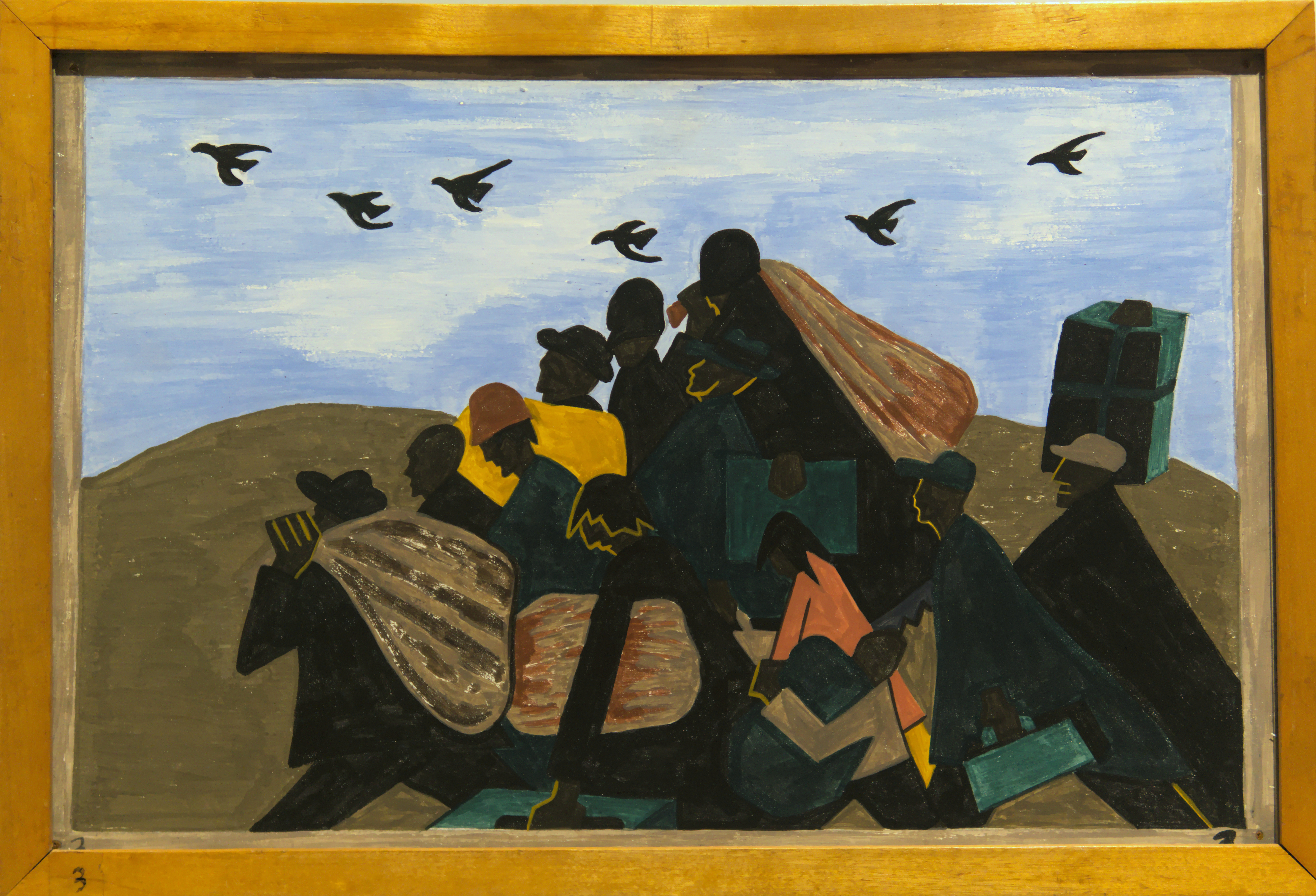
>> STEPPING PERFORMANCE: “Step Afrika! The Migration: Reflections on Jacob Lawrence,” Arena Stage, running through July 14: I’ll be going tomorrow, thanks to an invite from a friend! “Using its hallmark style of percussive dance-theater, Step Afrika!’s The Migration: Reflections on Jacob Lawrence tells the story of one of the largest movements of people in United States history, when millions of African American migrants moved from the rural South to the industrial North in the 1900s to escape Jim Crow, racial oppression, and lynchings. Inspired by Jacob Lawrence’s iconic 60-panel The Migration Series (1940-41), this signature work from the award-winning dance company uses the images, color palette, and motifs in the painting series to tell this astonishing story through pulsating rhythms and visually stunning movement.” The performance fuses body percussion, tap, and contemporary dance with live gospel, jazz, and blues.

Here’s a video promo made by New Victory Theater when the show toured there a few years ago:

Lawrence, Jacob_Migration Series 3
Jacob Lawrence (American, 1914–2000), “From every southern town migrants left by the hundreds to travel north,” panel 3 from The Migration Series, 1940–41. Casein tempera on hardboard, 12 × 18 in. Phillips Collection, Washington, DC. Photo: Victoria Emily Jones. [object record]

Browse all sixty panels from The Migration Series at https://lawrencemigration.phillipscollection.org/. Lawrence pictures different aspects of the northern migration story, such as crowded train stations, rotting crops, lynchings, urban housing, educational opportunity, and church life.

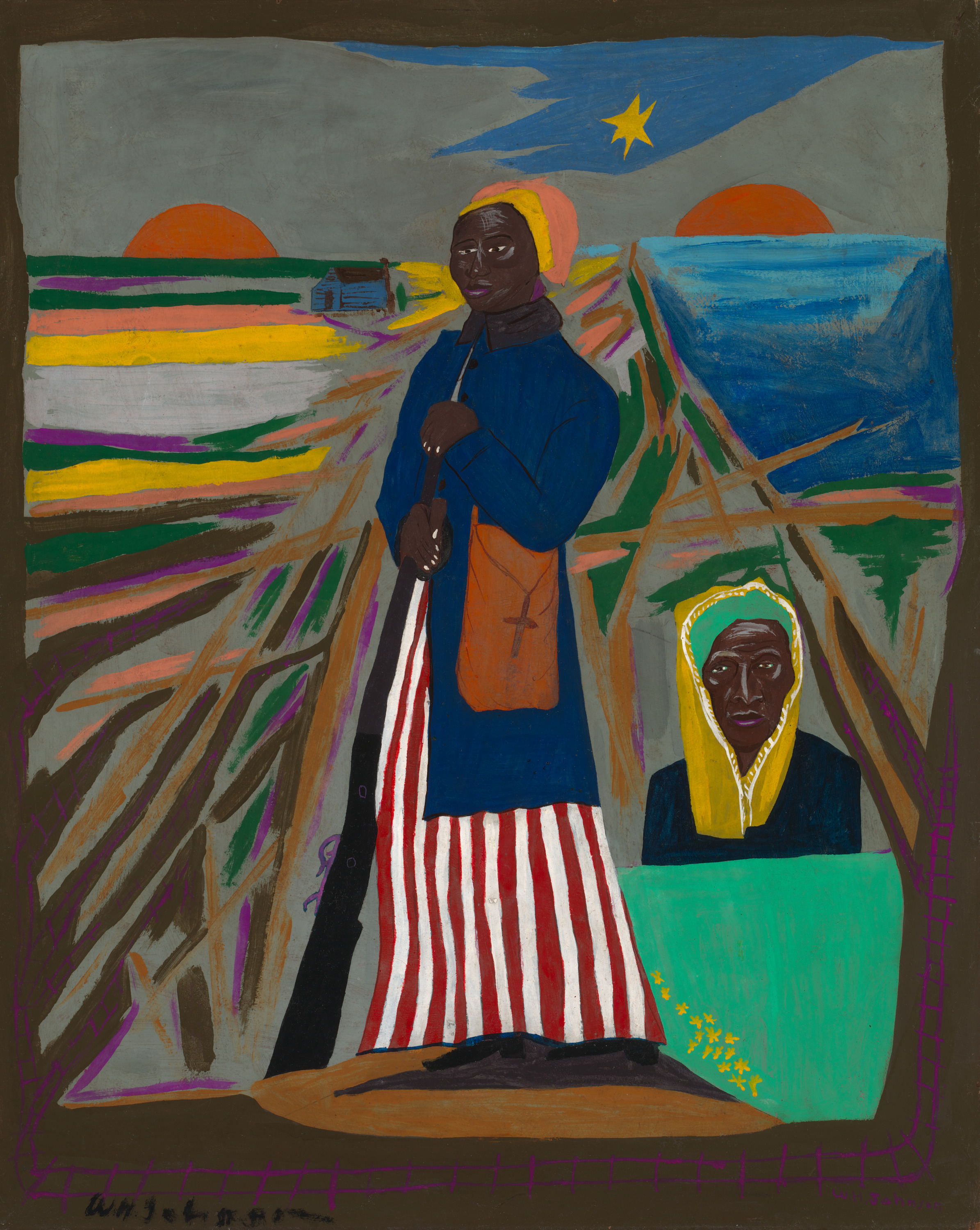
>> ART EXHIBITION: Fighters for Freedom: William H. Johnson Picturing Justice, Smithsonian American Art Museum, March 8–September 10, 2024: Another African American artist who was working around the same time as Jacob Lawrence is William H. Johnson (1901–1970). Last weekend I saw his Fighters for Freedom series of paintings at the SAAM—the first time the works have been shown together since 1946. He painted the series in the mid-1940s as a tribute to African American activists, scientists, teachers, and performers as well as international leaders working to bring peace to the world. Interactive kiosks identify the many historical figures. I learned so much! I can picture this exhibition being a good teaching tool for children as well. Spending time with every painting would be overwhelming for them, but choosing a few select artworks as entry points into talking about the freedom fighters depicted and the larger freedom story they’re a part of should work well.

Johnson, William H._Harriet Tubman
William H. Johnson (American, 1901–1970), Harriet Tubman, ca. 1945. Oil on paperboard, 28 7/8 × 23 3/8 in. (73.5 × 59.3 cm). Smithsonian American Art Museum, Washington, DC.

At the exhibition there are also signs and photos that inform viewers of related artifacts at other Smithsonian museums in the city, including:

(Click on the links for short video features about these objects, made specially for this exhibition.)

+++

POEMS:

>> “Paul Robeson” by Gwendolyn Brooks: Though in popular culture he is best remembered as an international star of stage and screen, the bass-baritone singer and actor Paul Robeson was also a prominent activist who graduated from law school and fought for civil rights. In this poem, Gwendolyn Brooks celebrates that latter legacy of his, his commitment to seeing the Black community in America, as well as other oppressed people groups around the world, flourish. The powerful final lines—“we are each other’s / harvest: / we are each other’s / business: / we are each other’s / magnitude and bond”—communicate the wisdom that we reap the good fruit that grows from seeds sown by others. She references Robeson’s most famous song, “Ol’ Man River,” sung by the character Joe in the musical Show Boat; the song laments the hardships faced by African Americans and expresses envy of the carefree Mississippi River, which just keeps rolling along, free from toil. But Brooks was happy to see Robeson move beyond the despondency embodied by Joe the deck hand, to take a much more empowered stance in public life.

>> “Juneteenth” by Marilyn Nelson: Here Nelson reflects on the childhood of her mother, Johnnie, who grew up in the all-Black pioneer town of Boley, Oklahoma. In Boley, then as now, June 19 is a “second Easter,” a time of food, family, games, and celebration. After several stanzas spent recounting the lighthearted festivities, the last line lands with a thud, a brutal reminder of the terror these community members fled to establish a place of their own. The poem is ultimately about overcoming, but even as the Black residents of Boley have built a new life for themselves and their families, racism is still a wound they bear. “Juneteenth” can be found in the excellent collection The Fields of Praise: New and Selected Poems by Marilyn Nelson (Louisiana State University Press, 1997).

Online Glen Workshop: July 25–31, 2021

Organized by Image journal every summer, the Glen is equal parts craft workshop, arts festival, and spiritual retreat. It’s framed by the Christian tradition but welcomes spiritual wayfarers of all stripes. This year, due to the pandemic, it’s entirely online, with twelve different classes on offer, taught by renowned artists, writers, and critics. Visit https://imagejournal.org/the-glen-workshop-2021/ for more information.

“The last year has invited many of us into a thicker relationship with place: with the homes where we quarantine, the public spaces we navigate with new caution, the vacation destinations we dream about, and the neighborhood streets we walk to avoid going stir-crazy in the meantime. Even our computers have transformed from objects to places, ushering us into the homes of loved ones, yoga studios, concert halls, museums, and countless other virtual gatherings, including the 2021 Glen Workshop! This year we’ll be exploring the ways in which our surroundings feed our creative vision. And we’ll also consider how art—both making it and sitting with it—sharpens our capacity for attention to the places we live and move and have our being.”

Each class costs $950 and is open to all experience levels. The schedule is such that attendees can choose just one. Registration to any class gives you full access not only to five days (about three hours each) of expert instruction, in-depth conversation, and practice, but also to additional programming that includes faculty presentations, “experiments with poetry and place” with artist in residence Billy Mark, chapel services led by musician Charles Jones and chaplain Marilyn McEntyre, coffee hours, open-mic nights, centering prayer sessions, and yoga sessions. Again, it’s all online.

If you don’t want to register for a class but want access to the other content or just a sneak peek, there are “retreat registration” and “festival pass” options. Click here to view registration options. You can get a 25% off discount if you register in a group of three or more.

What follows is a full list of the workshops (hands-on, craft-based classes) and seminars (immersive, discussion-based classes). I’m considering registering for either the Rosen seminar on contemporary biblical art or the Overstreet seminar on film. The cost is reasonable, but it’s still high, so I have to see if I can make it work.

Workshops

“Poetic Text as Provocation” with Scott Cairns: “We will embrace an approach to poetry that privileges poetic text as a scene of meaning-making, distinct from any approach that would understand the poem as a site of meaning already made. We will begin most days with a reading of a great and provocative poem and discuss the provocations each of us registers in response to that poem. Then, we will share our works-in-progress, and each of us will offer our ideas about what might make each draft a richer, more suggestive, provocative occasion for the reader.”

“The Attention We Owe Each Other” with Shane McCrae: “It is important to almost every poet to find a community of fellow poets with whom they can share their work, and from whom they can expect serious and good-humored attention, and honest and direct critiques. Together, we will make that community. Our poetry workshop will not operate according to any particular idea save the idea that poetry is serious—that it is, in fact, among the most serious things in our lives—and that, consequentially, we owe each other seriousness, and intelligence, and sensitivity when we workshop each other’s poems. We will read and critique each other’s poems closely; we will prioritize whatever particular issues each poem asks us to prioritize while keeping in mind the issues its author has asked us to consider; and we will have fun together, the highest seriousness being joy.”

“Writing the Moveable Feast” with Alissa Wilkinson: “Food is what binds us together as humans. We all eat it. We all make it, or someone makes it for us. We all have opinions about it and preferences for it, which often come from the things that make us, well, us: our families of origin, our nationalities and ethnicities, our individual tastes, our beliefs about God and ethics, and our access to it. Food is the gateway to every aspect of human life; when we eat it, we’re participating in history, culture, and the economy.

“Feasting is one of the most important activities we can do as people. It’s an act of community-building, celebration, and even resistance to the forces that try to tear us apart. Many religious and spiritual traditions are built around feasting; the Bible ends at a wedding feast.

“So in this class, we’re going to talk about food, think about food, make food, and eat food. We’ll talk about how writers have interacted with food and food writing. We will try to understand what it might mean to feast together even when we can’t actually be together. And then we’ll do our own food writing, with the goal of exploring that common experience through our writing (in any genre).”

“Strange Countries: Writing the Inner and Outer Journey” with Fred Bahnson: “In sixth-century Ireland, groups of monks began the practice of peregrinatio, “going forth into strange countries.” The peregrini set off alone or in small groups in tiny coracles made of willow and animal hide, abandoning themselves to the winds and currents of the North Atlantic. A journey into the unknown.

“We moderns find it difficult to grasp the enormity of such an undertaking. Given how frequently we travel, we barely notice the existential threshold crossed upon leaving home. The peregrini remind us that we go on pilgrimage not to consume experience, but to be consumed. To feel again the porous borders between our inner and outer lives. If our rational age has obscured what Seamus Heaney called ‘a marvelous or magical view of the world,’ pilgrimage helps us find it again.

“In this class we will take a very ancient metaphor—the journey—and use it to explore our lives in the age of climate change, pandemics, and fragile democracies. We’ve all gone forth into a strange country, a journey in which we measure distance in time and cortisol levels rather than miles. Setting off in our coracles of narrative—essay, memoir, literary journalism, travel writing, nature writing—we’ll use our peregrinations to map our inner lives against the great stories of our age. We will write our physical journeys (working from memory), and we will write about shelter, intimacy with place, our yearning to be at home. As we traverse the continuum between pilgrimage and place-making, we will discuss various craft topics of literary nonfiction: form, character development (including place-as-character), narrative arc, and, perhaps most important, how to create the fictional ‘I’ that is your nonfiction narrator.”

“The Landscape of the Lyric Essay” with Molly McCully Brown: “The lyric essay combines the density, muscle, and music of the poem with the expansiveness, narrative momentum, and overt desire to engage with information of the essay form. Tied to the original notion of an essay as an effort, a trying, an attempt at making sense, its combined allegiances to the fragment and the whole, the actual and the imaginative, the image and the story, make it the perfect form for exploring and charting the landscapes—both exterior and interior—that make and mark our lives.

“Designed as an opportunity for poets craving a little space to move around, for essayists hungry to drill down to the core of language, or for any writer longing for a chance to experiment, investigate, and attempt, this generative workshop will serve as an introduction to the associative logic of the lyric essay and a chance to try your own hand at the form.

“In class we’ll read and unpack lyric essays from a variety of writers; work together to identify some unique features and possibilities of the form; write in response to prompts designed to help us explore a variety of geographical, sociological, emotional, and intellectual landscapes; and share and discuss our work as it develops. My hope is that you leave the workshop with many attempts and beginnings which might prove fertile ground for later work, and with at least one piece that feels more complete, or further along in its development.”

“Writing Research-Based Narratives for Young Adults” with Marilyn Nelson: “Our curiosity can nourish our reading and our writing, which can nourish the curiosity of our young readers and encourage them to ask questions and follow their own research paths. In this class we will examine some books recently published for middle-grade and young adult readers and based to varying degrees on historical events, asking what questions led to the necessary research, how the research was conducted, and how the material was organized and presented so it is appropriate for younger readers. How do we write for younger readers? How might an author write over their heads? How might an author write down to them? What questions does an author allow to linger? How much information is too much? How does an author find the right voice?”

“Developing Your Authentic Voice” with Charles Jones: “This workshop will focus on teaching artists how to bring their authentic selves to the craft of songwriting and successfully communicate what they want their audiences to hear and feel. We will listen to the music of some of the greatest songwriters of all time and examine what we feel when we listen back. We will explore why we connect deeply with some music, look at the connective tissue these masters created in their songs, and learn how we apply these techniques and tools to our own craft in service of our own unique stories and voices.”

“The Creative and Spiritual Practice of Calligraphy” with David Chang: “From the practical to the ethereal, writing a letter by hand offers a deeper connection to the text and to the viewer. We will cover both aspects of the art form of calligraphy as we learn the basics—including developing your own personal handwriting style—and learn to use handwriting as a creative practice that can also forge a deeper spiritual practice. Through meditational writing we will explore the art of handwriting as a tool for personal expression and as a means to connect with ourselves and also with others.”

“Landscapes and the Art of Seeing” with Suzanne Dittenberg: “In Sargy Mann’s article ‘On Cezanne’ he opposes the popular notion that Paul Cezanne was intentionally distorting the landscape through superimposed affectated abstraction, re-tooling visual information to titillating effect. Instead, Mann makes the case that Cezanne’s painting practice was more straightforward. He describes Cezanne as a relatively unremarkable draftsman who gave himself intensely to the act of looking. ‘As dedicated a realist as you could ever find.’ In Cezanne’s letters, we are given a window into his motivations when painting. He writes, ‘Now the theme to develop is that, whatever our temperaments or power in the presence of nature may be, we must render the image of what we see, forgetting every-thing that existed before us. Which, I believe, must permit the artist to give his entire personality whether great or small.’

“This is a class about seeing. Observational painting serves as a means to explore one’s individual spirit when encountering nature. Each day we will gather together on Zoom and also venture out to work en plein air in our own vicinities. Painting and drawing will serve as a mechanism for finding a new lens with which to view the natural world. A better understanding of nature’s underlying frameworks will result.

“Through daily discussion of drawing and painting techniques, we will cover basic strategies for seeing relative proportions, identifying values structure and understanding color in context. We will also address the use of limited palettes, strategies for achieving harmonious color and methods of paint application. Each afternoon will include time for reflection on the day’s process, experience and results.”

Seminars

“Contemporary Visual Artists Read the Bible” with Aaron Rosen: “The mere mention of a contemporary artist reading the Bible summons competing stereotypes. On one side stands the artist as clamoring missionary, producing pious kitsch. On the other sits the talented but godless iconoclast, scorning the Bible to the applause of intellectuals. It’s high time to get beyond these stereotypes, rooted in the culture wars of the 1980s, yet sadly back in fashion. There are brilliant artists of faith working with the Bible who have the power to challenge even the most ardent atheists, aesthetically and theologically. And there are artists without a spiritual bone in their bodies who engage scripture in ways that can teach devout viewers a thing or two about faith.

“In this seminar, we will see the Bible with fresh eyes, with the help of cutting-edge art across multiple media, from painting to video to virtual reality. Not only will they look at art, they’ll talk to top-notch artists themselves, who will join us by video from their studios around the world, from Los Angeles to London to Lahore. As one of the world’s foremost experts on religion and art, as well as a practicing curator, Dr. Rosen brings together scholarly and practical insights. And as a Jew married to an Episcopal priest, he has a special interest in how art can help us see difference more clearly and creatively at the same time.”

“How Place Becomes Poetry in Cinema” with Jeffrey Overstreet: “For most filmmakers, place is just a backdrop. But great artists of cinema know that place is as influential and as eloquent as any character. Whether he’s in the heat of Texas or the despair of a divided Berlin, director Wim Wenders is listening to what his location has to say. Martin Scorsese and Spike Lee both read New York City closely, but they see very different cities and zones defined by differing forms of prejudice. We’ll consider how one story, told by both Yasujiro Ozu and Claire Denis in different locations, is transformed by the context in which it is told. And we’ll watch the world opened up by the cinematographers of Terrence Malick as well as the animators Tomm Moore and Martin Rosen. A variety of special guests—filmmakers, film critics, and scholars—will join us for these journeys as we watch how human beings are shaped by the ground beneath their feet. The current guest list [subject to change] includes Scott Derrickson (Doctor StrangeSinister), Justin Chang (film critic for the Los Angeles Times), Dr. Yelena Bailey (author of How the Streets Were Made: Housing Segregation and Black Life in America), and Doug Strong (My Angel LarryRiver Road).”

“The Art of Contemplative Reading” with Richard Chess: “In this seminar, we’ll explore reading practices (poetry and prose) that may help us cultivate a contemplative mind. As we practice directing our attentions to different aspects of our experiences as readers—noting our physical experience, quieting our inner voices to enable us to hear more clearly the voice of a text, discerning the difference between noting elements of the text itself and commenting on, reacting to, or interpreting the text—we may also discover ways of engaging with texts (mostly literary) that will help us with our practice as artists and/or our spiritual practices. We’ll also do some writing—reflective writing and generative creative writing—to explore writing itself as a contemplative practice.”