
DOCUMENTARY SERIES: Taste and See, dir. Andrew Brumme: “Taste and See is a documentary series exploring the spirituality of food with farmers, chefs, bakers, and winemakers engaging with food as a profound gift from God. Their stories serve as a meditation on the beauty, mystery, and wonder to be found in every meal shared at the table.” The Rabbit Room, who is partnering with them for a virtual cinema event (see below), says, “If, in some blessed alternate universe, Robert Farrar Capon had decided to make a documentary with Terrence Malick, guided by the foundational wisdom of Wendell Berry, then they would have made something like the pilot of Taste and See.”
Some of the people you see in the series trailer are Shamu Sadeh, cofounder of Adamah Farm and Fellowship in Connecticut, which integrates organic farming, Jewish learning, sustainable living, and contemplative spiritual practice (Adamah is the focus of the pilot film); The Soul of Wine: Savoring the Goodness of God author Gisela Kreglinger, who grew up on a winery that has been in her family for generations and who leads wine pilgrimages in Burgundy and Franconia (“a spiritual, cultural, and sensory exploration of wine”); Norman Wirzba, a professor at Duke who teaches and publishes at the intersections of theology, philosophy, ecology, and agrarian and environmental studies (see, e.g., his Food and Faith: A Theology of Eating); Kendall Vanderslice, a North Carolina baker, author, and founder of Edible Theology, which offers “curriculum, community, and communications that connect the Communion table to the kitchen table”; and Joel Salatin, who raises livestock on his Polyface Farm in Swoope, Virginia, in the Shenandoah Valley.
You can buy tickets to a virtual screening of the hour-long pilot, which is happening twice daily from June 3 to June 19 and includes exclusive access to a panel discussion with singer-songwriter Andrew Peterson, theologian Norman Wirzba, and director Andrew Brumme. Revenue from ticket sales will fund the production of future films, some of which are already in the works. “The funding raised will determine how far we can go and which stories we can pursue,” Brumme tells me. “We’re hopeful the virtual event will bring together enough of a supportive base of people who want to see this series made.” There’s also an option on the website to donate.
To hear more from the director, especially about the inspiration behind the series, check out the interview Drew Miller conducted with him.
+++
DISCUSSION PANEL: “Art Between the Sacred and the Secular,” June 6, 2022, Akademie der Künste, Berlin: Moderated by the Rev. Professor Ben Quash, this free public event (reserve tickets here) puts in conversation artist Alicja Kwade; Dr. María López-Fanjul y Díez del Corral, senior curator of the Bode Museum and the Gemäldegalerie; and Dr. Neil MacGregor, former director of the British Museum and the National Gallery, London. The questions they’ll address (see below) sound really intriguing!
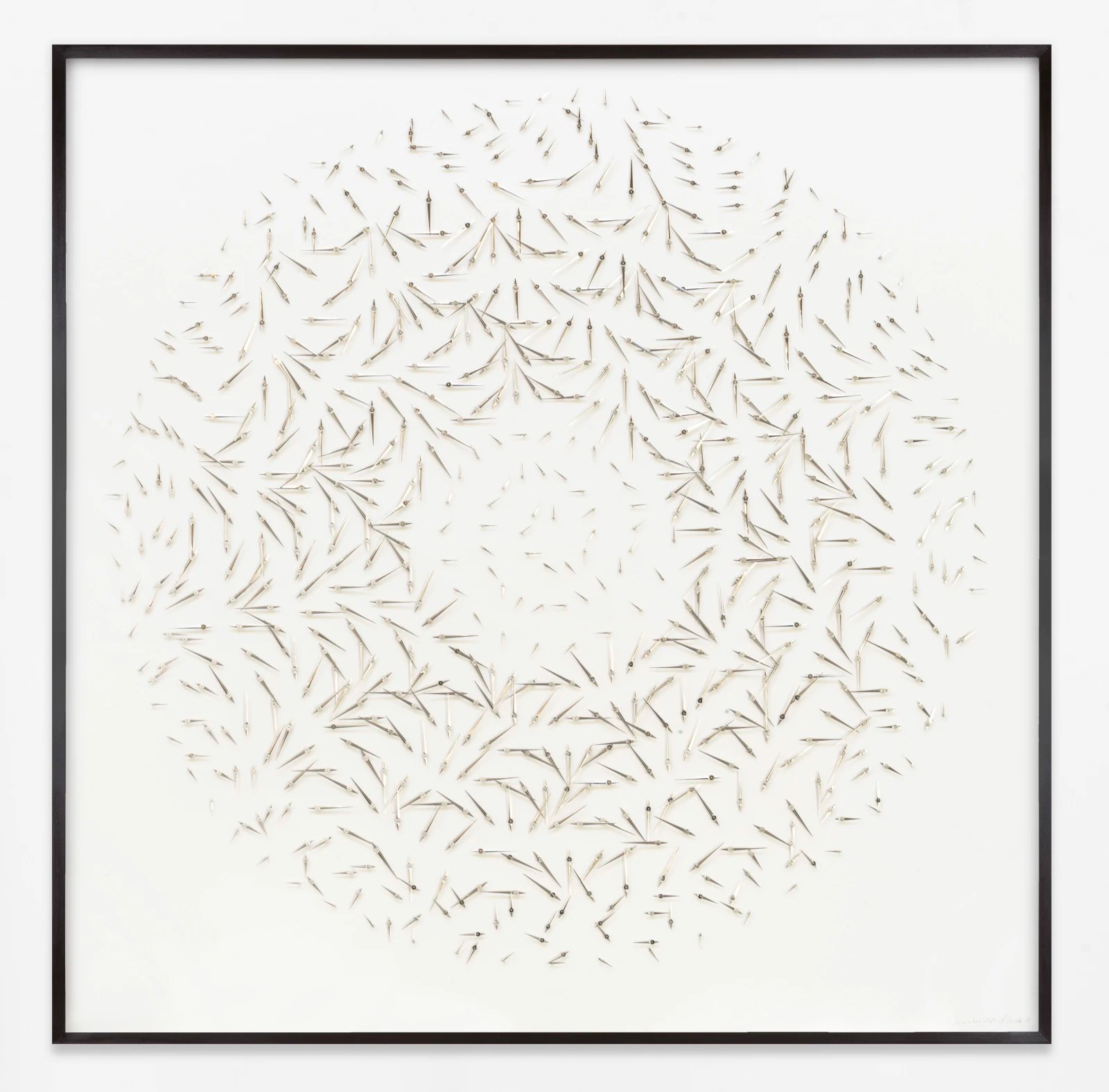
“The abiding power of Christian motifs, ideas and styles in a host of modern and contemporary works that superficially look un- or anti-Christian indicates that visual art and Christian tradition have not become complete strangers. This invites analysis and understanding.
“How have Christian artworks and artistic traditions found new articulations, caused new departures, or provoked new subversions in the last 100 to 150 years? What forms of engagement between theology and modern and contemporary art do such developments in the relationship between art and Christianity invite and reward?
“How do viewers (Christian and non-Christian) interact with historical Christian art today, and how do modern sensibilities affect our viewing of earlier Christian artworks and artistic traditions?
“Is contemporary art an alternative to religion or can it sometimes be an ally? How do contemporary art and religion each respond to human experiences of the absurd or the tragic? What do contemporary art and the spaces in which we encounter it, tell us about the histories of both Western Christianity and Western secularisation?”
+++
FUNDRAISER: New Ordinary Time Album: The indie folk trio Ordinary Time is one of my favorite musical groups—I heard them in concert at a church here in Baltimore a few years ago!—so I’m really excited to see that they’re working on their sixth full-length album, their first since 2016. It will be produced by the esteemed Isaac Wardell, founder of Bifrost Arts and the Porter’s Gate. Per usual, it will comprise a mix of original and classic sacred songs, including the new “I Will Trust,” demoed in the second video below. Help fund their production costs through this Indiegogo campaign, which ends June 15. A donation of just $25 will get you an early download of the album.
+++
SONG: “Oh Give Thanks (Psalm 107)” by Wendell Kimbrough: Wendell Kimbrough is among today’s foremost singer-songwriters engaging with the Psalms. His adaptation of Psalm 107 [previously] is one of his most popular songs, ever since the original studio recording released in 2016. Now he’s recorded a live version with a New Orleans jazz band! It is available on most streaming and purchase platforms.
The music video was shot in February at a bar in Daphne, Alabama, with some eighty of Kimbrough’s friends and supporters, and it premiered May 13. It was his way of saying farewell to his Church of the Apostles community in Fairhope, Alabama, where he served as worship leader and artist-in-residence for eight years. He left this spring to take a new job as uptown artist-in-residence at Church of the Incarnation in Dallas.
“From the time I wrote ‘Oh Give Thanks,’ I always pictured it as a bar tune, specifically set in New Orleans,” Kimbrough says. “The image Psalm 107 conjures for me is a group of friends sitting together swapping stories of God’s deliverance and raising their glasses to celebrate his goodness.” He has noted that some people are uneasy about singing the line “We cried like drunken sailors” in church, but he points out that it’s there in the Old Testament psalm! (Recounting how God rescued a group of men from a storm at sea, the psalmist says that as the waves rose, “they reeled and staggered like drunkards / and were at their wits’ end. Then they cried to the Lord in their trouble, / and he brought them out from their distress,” vv. 27–28).
To learn how to play the song on guitar, see Kimbrough’s video tutorial. You may also want to check out the songs of thanksgiving I compiled on Spotify.
+++
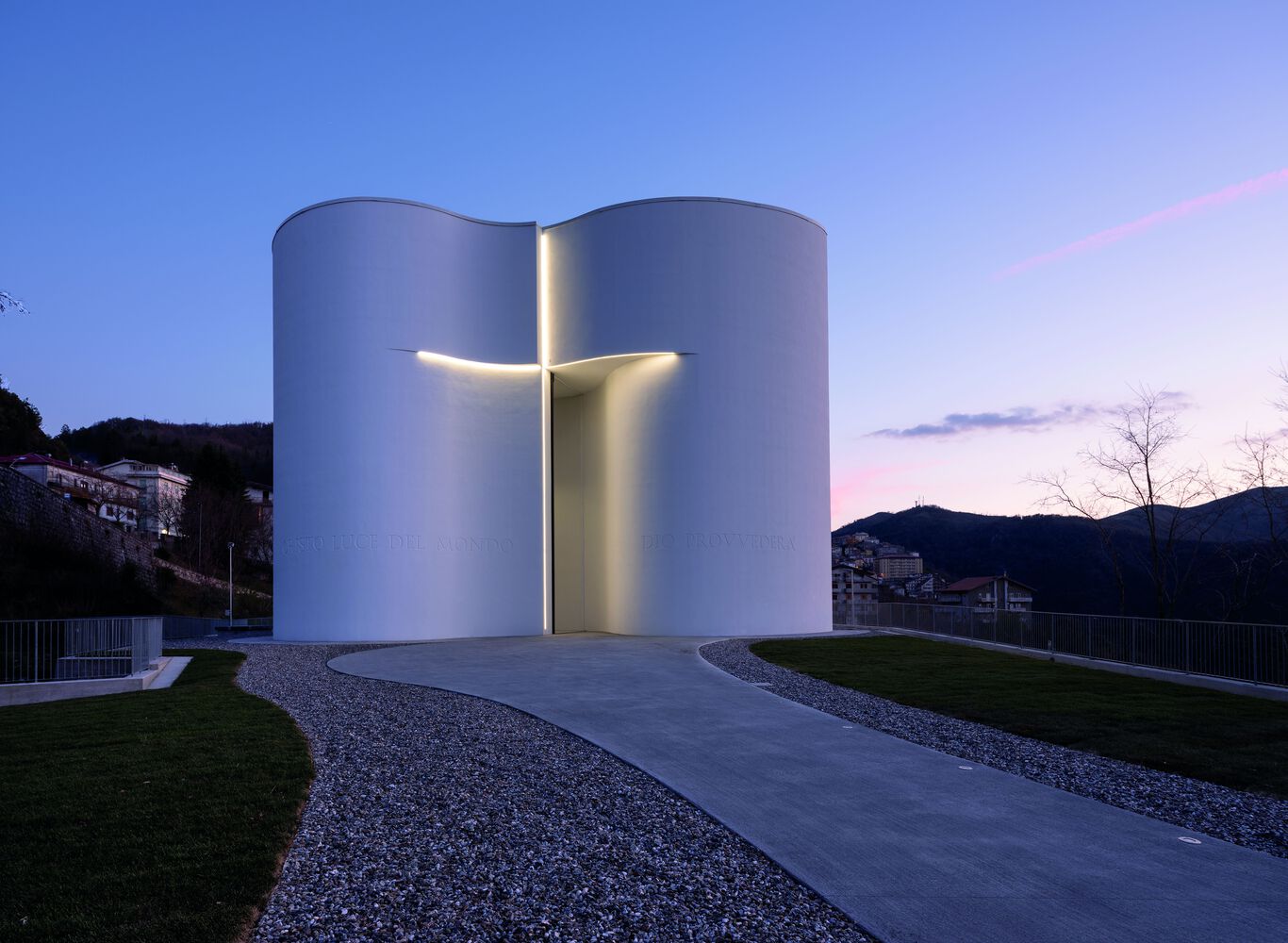
CHURCH ARCHITECTURE: Santa Maria Goretti Church, Mormanno, Italy: In 2013 architect Mario Cucinella won a competition held by Italy’s assembly of Catholic bishops to create the new parish church of Santa Maria Goretti in the hilltop town of Mormanno in Calabria. Because a third of the funds had to be raised locally, the project wasn’t completed until last year. Cucinella says that gave him time to win over its most important constituency: the elderly women who go to Mass every day, and who at first “were suspicious of its modernism.” [HT: My Modern Met]
Cucinella designed an elegantly minimalist concrete building with sinuous surfaces that form the shape of a four-leaf clover, a reinterpretation, Cucinella says, of the shape of Baroque churches. The enclosure has only a few openings. “On its north side, two walls part to create an entrance—while also contributing edges to a cross cut into the curves and lit by LEDs at night. On its south side, a small window is positioned to focus afternoon sunlight on a crucifix on July 6,” Maria Goretti’s birthday.
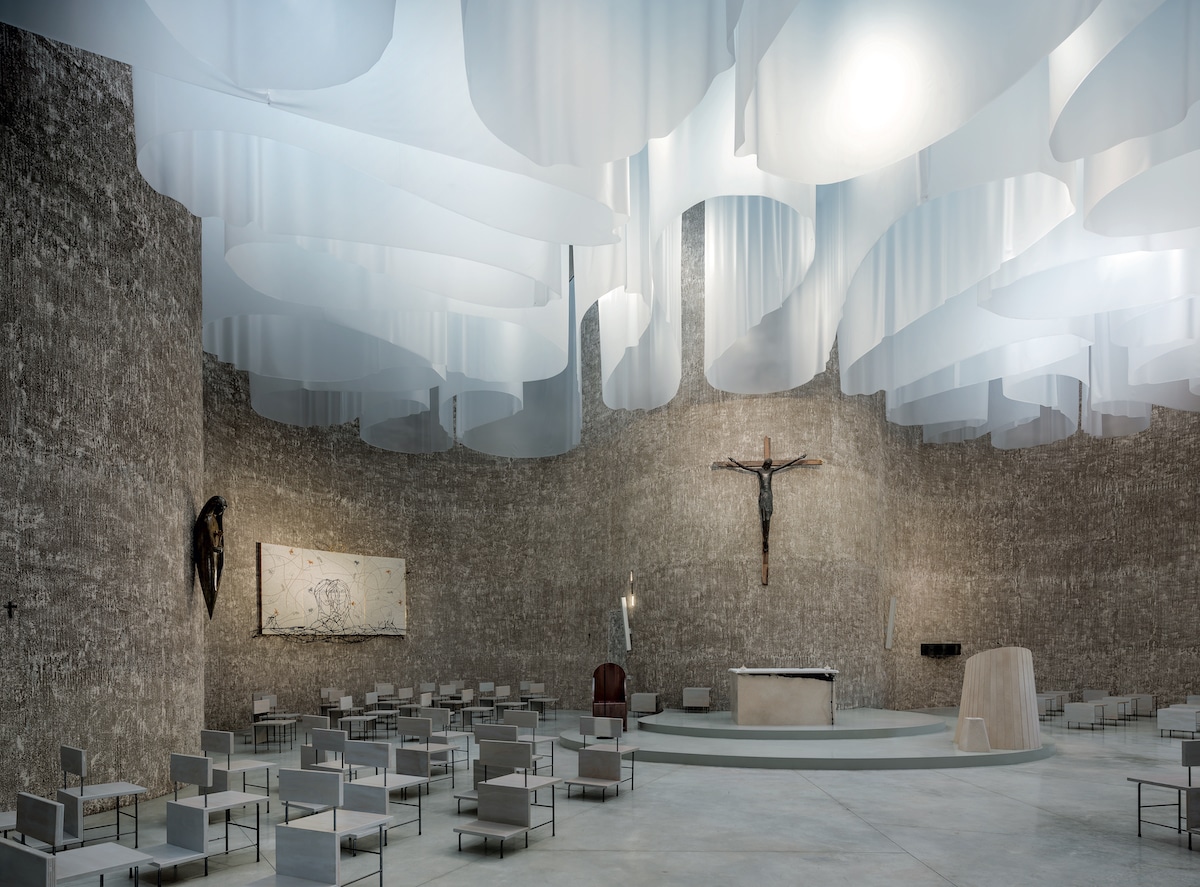
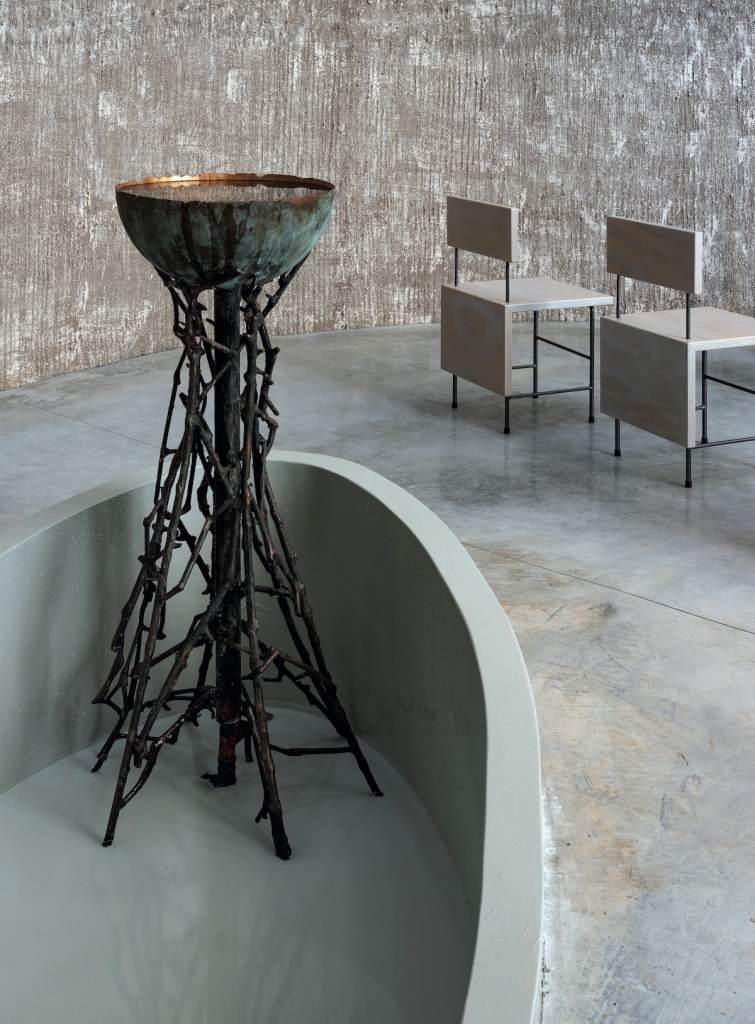
Inside, the walls are hand-finished in plaster mixed with hemp fibers and lime, which give them a mottled, earth-toned look. The most dominant feature of the interior is the twelve-foot-deep scrim that falls from the ceiling in swirls, filtering in sunlight. Artist Giuseppe Maraniello (b. 1945) was commissioned to create the lectern, tabernacle, baptismal font, and figure of the Virgin Mary, while the simple steel and wood seating is by Mario Cucinella Design. Click on any of the three photos above to view more.
The church’s namesake, one of the youngest saints to be canonized, was stabbed to death in 1902 at age eleven while resisting a rape. She is the patron saint of purity, young women, and victims of sexual assault.
 Art & Theology