For the past month I’ve been working on an essay that brings together a selection of over three dozen art-historical images of Adam and Eve at Labor—a subject that appeared as early as the fifth century—and provides theological commentary. I wanted to publish it shortly before Labor Day on September 1. Unfortunately, it won’t be finished in time. Whenever I researched a particular image, it opened up further avenues of research, and I’ve realized that I need to spend much more time reading and reflecting on the topic, including consulting more commentaries on Genesis 3 and medieval theologies of work, before writing.
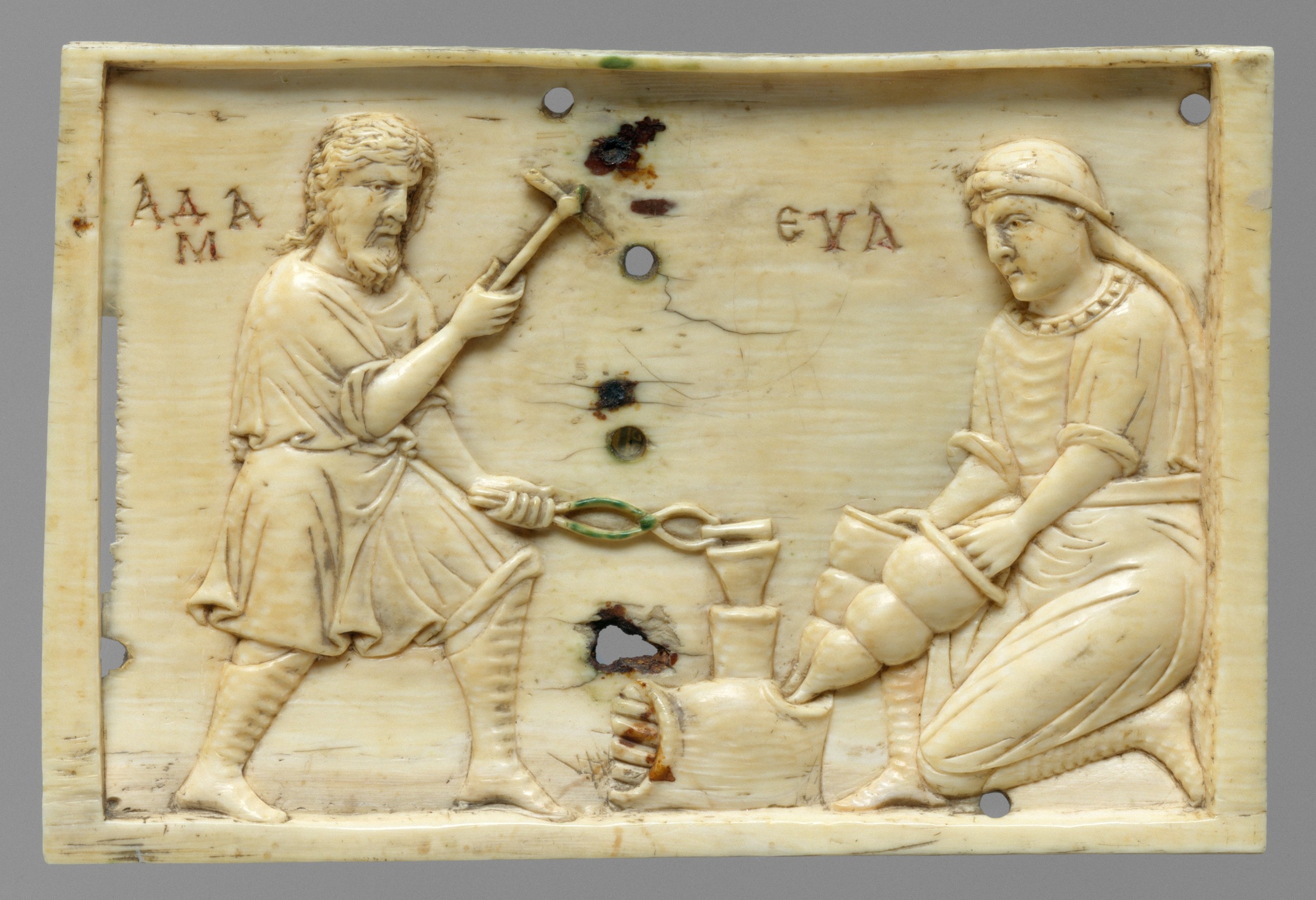
Instead, allow me to simply share a Byzantine ivory panel that amazed me when I encountered it on the website of the Metropolitan Museum of Art a few years ago, which I saw in person on my last visit in January—a small little thing, just a few inches wide, and easy to miss in the large glass case in Gallery 300, except that I was specifically looking for it.
Adam and Eve at the Forge, panel from a small box made in Constantinople, 10th or 11th century. Ivory, gilt, polychromy, 2 9/16 × 3 7/8 × 3/16 in. (6.5 × 9.9 × 0.5 cm). Metropolitan Museum of Art, New York.
It shows Adam hammering iron over an anvil while Eve operates the bellows! Husband and wife co-laboring in a forge—she supplying strong blasts of air to the furnace, he shaping the metal.
This panel struck me because one, I had never seen a medieval image of a female blacksmith before (other than as a personification of Nature, from The Romance of the Rose), and two, the vast majority of images of Adam and Eve at work after the fall show Eve spinning wool or flax and/or breastfeeding while Adam tills the soil, reflecting gendered ideas about the division of labor. Occasionally Eve is shown working the land or harvesting its fruits alongside Adam, as in the Ripoll Bible, a Salerno ivory, a relief carving on the facade of Modena Cathedral, and another ivory panel from this same box—work that men and women in agricultural societies definitely shared then as now. But more often the primordial couple is shown participating in separate spheres of work—the fields versus the home—albeit side by side.
In the Middle Ages, blacksmithing was the domain of men. Sometimes the daughters or wives of male smiths worked alongside them in family-run forges, but they were not permitted to join the guilds.
The Met ivory is a rare egalitarian picture of husband and wife engaged together in a muscular, creative task that contributes to their mutual survival and the betterment of society. Their resourcefulness, ingenuity, hard work, and cooperation are highlighted.
The detached panel is from a luxury box made for an elite Christian client in Constantinople for storing coins, jewelry, or other valuables. A small group of such boxes depicting scenes from the lives of Adam and Eve survives from the tenth and eleventh centuries. It’s possible the box that this smithing panel comes from was a wedding gift, as it espouses the virtue of teamwork in marriage. “Such caskets could have belonged to young couples embarking on a new life together,” writes Ioli Kalavrezou in The Glory of Byzantium: Art and Culture of the Middle Byzantine Era, A.D. 843–1261. “The story of Adam and Eve could have reminded them of the difficulties they would encounter but at the same time spurred them on to an industrious and, it was to be hoped, prosperous existence.”
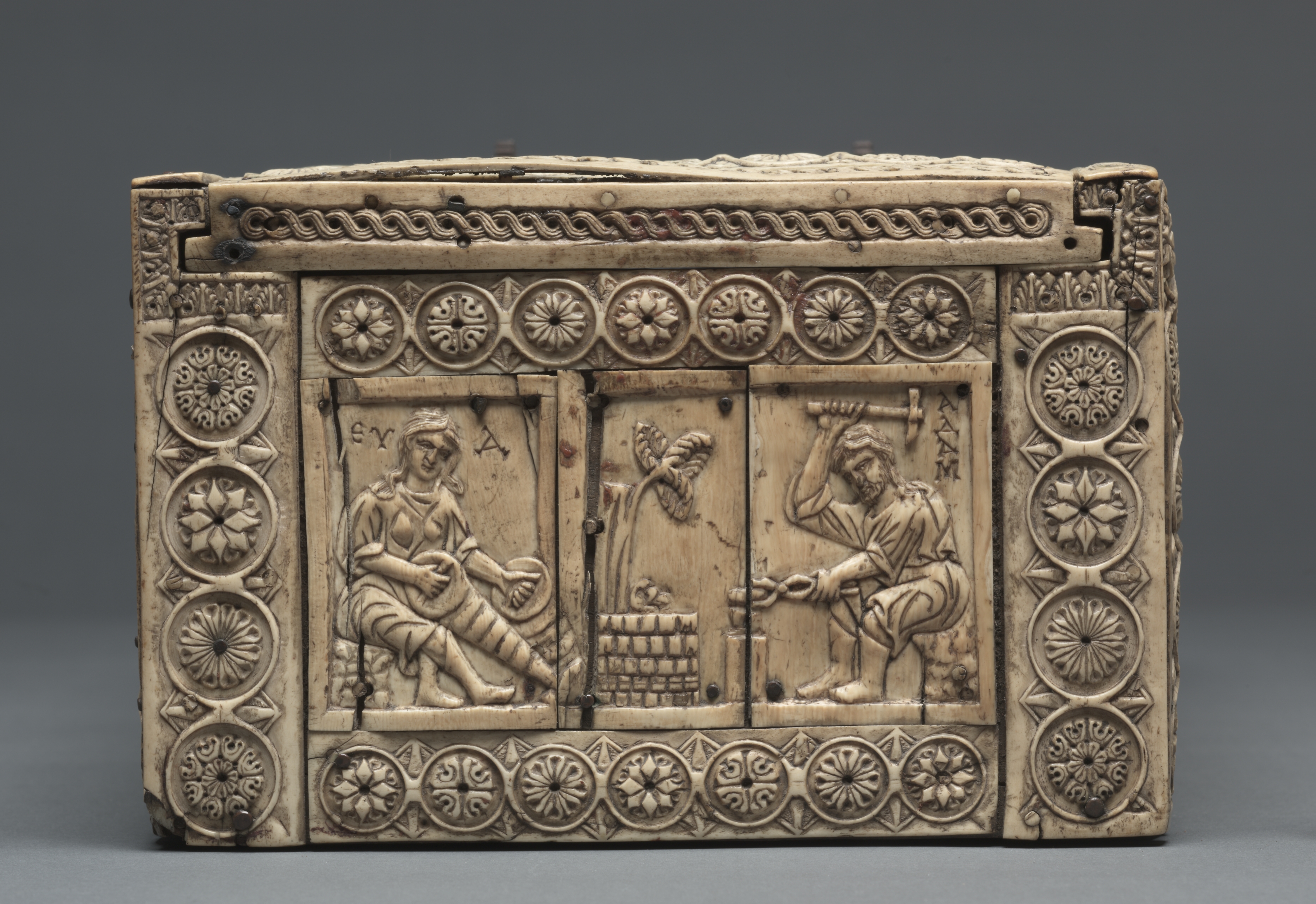
In the essay “The Origin of the Crafts According to Byzantine Rosette Caskets,” historian Justin Wilson examines Byzantine views about the origin of the primordial crafts (technai) of farming and metallurgy, especially by looking at select scenes from three related ivory boxes: from the Cleveland Museum of Art in Ohio in the United States, the State Hermitage Museum in Saint Petersburg, Russia, and the Hessisches Landesmuseum Darmstadt in Germany. All three contain a scene of Adam and Eve at the forge.
Right (short) side of a rosette casket with scenes of Adam and Eve, Constantinople, ca. 975–1025. Ivory, wood, overall 5 5/8 × 18 3/8 × 8 in. (14.3 × 46.7 × 20.3 cm). Cleveland Museum of Art, Ohio.Right (short) side of a rosette casket with scenes of Adam and Eve, Constantinople, ca. 975–1025. Ivory, wood, traces of gilding, overall 5 × 18 5/16 × 7 9/16 in. (12.7 × 46.5 × 19.3 cm). State Hermitage Museum, Saint Petersburg.Right (short) side of a rosette casket with scenes of Adam and Eve, Constantinople, ca. 1000–1025. Wood, ivory, overall 5 × 18 × 7 1/2 in. (12.5 × 46 × 19 cm). Hessisches Landesmuseum Darmstadt, Germany. Photo: Wolfgang Fuhrmannek.
For the anonymous artists of these boxes, Wilson writes, “blacksmithery symbolizes how human labor reshapes the world.”
The scene on the Darmstadt casket features a third figure between the couple: Plutus, the Greek god of wealth and abundance, holding a moneybag. In his 1899 study of the Adam and Eve chests, the classical archaeologist Hans Graeven proposed that Plutus signifies the valuable contents presumably kept inside the chest; art historian Josef Strzygowski agreed, suggesting that the god was meant to be read in relation not to Adam and Eve but to the chest’s lock (now missing), under which he was placed.
Wilson adds that Plutus, traditionally associated with good fortune, signals the prosperity of postlapsarian life—that although we lost Eden and must sweat and toil for our bread, humanity can still thrive. In the words of the late pastor Tim Keller in his book Every Good Endeavor, “Whenever we bring order out of chaos, whenever we draw out creative potential, whenever we elaborate and ‘unfold’ creation beyond where it was when we found it, we are following God’s pattern of creative cultural development,” and there’s blessedness in that.
I’ve seen over seventy films from 2023 (and there are still more I want to see!), and these are my top ten. My top eleven through twenty will be released this weekend in a separate post. Many are international, and what year to classify them as can be hazy; I go by the date on which the film was released in the US, which is when I have access to it.
If the film is streaming for free with a subscription service, I’ve noted that at the bottom of the entry. Otherwise, most are available for digital rental (Google Play is my preferred vendor), and a few are still in theaters. You might also see if your local library has any on DVD, as that’s how I watched several of these.
Please be aware that the following films have either PG-13 or R ratings, for various reasons. I don’t have a personal policy of “no x” or “no y” in the movies I watch, but if you do, please consult the MPAA rating descriptors or a more detailed content advisory before deciding whether to view the film.
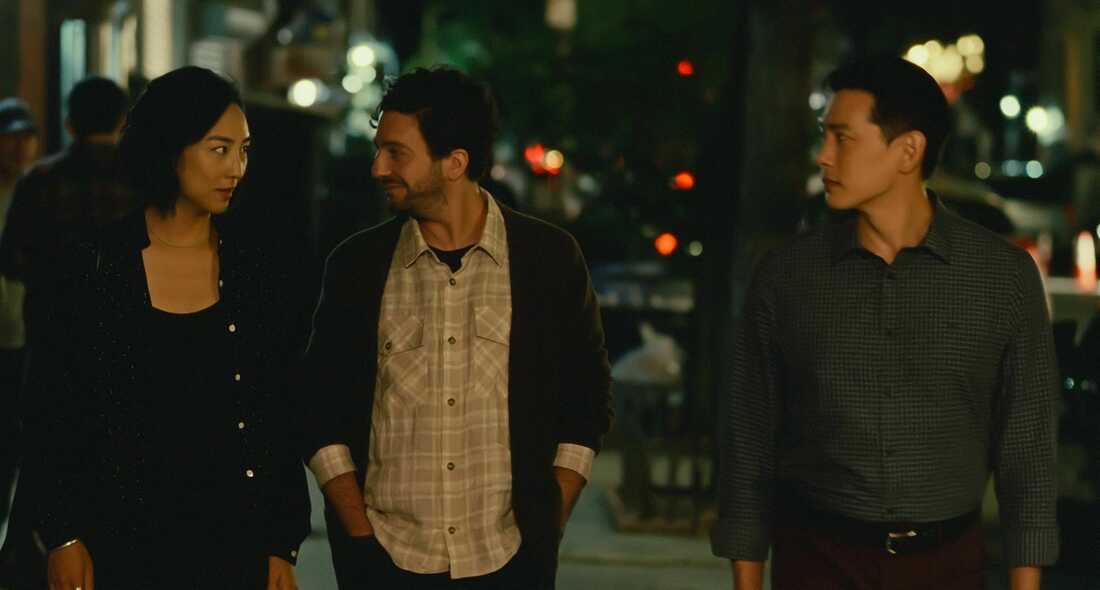
1. Past Lives, dir. Celine Song. Kind, gentle, and empathetic, this semiautobiographical indie drama by debut director Celine Song follows Na Young, or Nora (Greta Lee), over the course of twenty-four years, from her young adolescence in South Korea to her emigration to Canada and then the US. Act 1 introduces us to Nora’s childhood sweetheart, Hae Sung (Teo Yoo), whom she reconnects with virtually twelve years later in act 2, shortly before meeting and befriending a white American man named Arthur (John Magaro) at a writers’ retreat. After another twelve years of not interacting, Nora and Hae Sung find each other again in act 3 at age thirty-six, when the single Hae Sung visits Nora, who’s now married to Arthur, in New York.
What I love about this film is how it subverts all the tropes associated with the romantic triangle. The characters aren’t possessive, conniving, or competitive. There are no heroes or villains here. The film is about bonds of love and culture, and especially about what trust, support, constancy, maturity, and love look like in a marriage. In an interview on the DVD special features, Song says Past Lives is at its core a love story between Nora and Arthur. It’s also a story of navigating a bicultural identity—living between two worlds, mourning the piece of oneself that’s lost with the adoption of a new home country, and integrating elements of one’s “past life” into one’s new life, continuing to be shaped by both.
The opening scene and closing scene are perfect. Song’s skill as a storyteller, honed over her years as a successful playwright, really shines through in her screenplay.
2. The Zone of Interest, dir. Jonathan Glazer. This chilling Holocaust drama centers on a Nazi family living their dream life in the literal backyard of the Auschwitz concentration and death camp. Rudolf Höss (Christian Friedel)—who is an actual historical figure—is the commandant of the camp; having risen through the ranks, he seeks to provide his wife, Hedwig (Sandra Hüller), and their five children a comfortable and idyllic life. It’s a risky choice to tell this story from a German perspective, but Glazer and the two lead actors more than succeed. We never actually set foot inside the camp; most of the scenes happen within the confines of the villa or at the nearby river where the family goes on outings. Nor do we directly see any of the horrors; we see merely hints, like smoke rising from a crematorium chimney in the background. But even more, we hear these intimations: a train pulling into the station, a tussle, a chase, a barking dog, a gunshot, screaming. All of this happens just over the wall, while Hedwig tends to her flower garden or her son plays with toys in his bedroom. (Props to the sound designer, Johnnie Burn.)
What is so disturbing about the film is the banality of evil that it reveals. Rudolf isn’t the type of villain who sneers or snarls or has violent outbursts. He brings his kids kayaking and reads them bedtime stories; he sips coffee with his wife. He could be us. “I wanted to show that these were crimes committed by Mr. and Mrs. Smith at No. 26,” Glazer said. Sanitization is one of the themes explored—lots of scrubbing.
3. Four Daughters, dir. Kaouther Ben Hania. Blending documentary and fiction, this film tells the true story of a Tunisian Muslim mother—Olfa Hamrouni—and her four daughters, the elder two of whom became radicalized by ISIS as teenagers and ran away to Libya to engage in jihad. In 2016 Kaouther Ben Hania saw media segments of Olfa calling out local authorities for their indifference and inaction and knew she wanted to make a film about the disappearance, to understand how a tragedy like this can happen in a family. She originally wanted to do a straight documentary but soon realized it would be more powerful, and more feasible, to have Olfa and her younger daughters, Eya and Tayssir Chikhaoui (born in 2003 and 2005), reenact their memories onscreen. Because daughters Ghofrane and Rahma Chikhaoui are still absent, actors Ichrak Matar and Nour Karoui were hired to portray them, and actor Hind Sabri stepped into the mother role for the scenes that took too high an emotional toll on Olfa.
This method of storytelling better reveals the story’s complex layers, as the three women are both inside and outside the scenes. They’re telling the past, but they’re also questioning it. They’re reflecting on their motivations as they discuss their memories with each other and Ben Hania—many of them traumatic, but others warm or simply ordinary, as when they talk about their first periods! Olfa, the mother, is a particularly complex character, as she is fiercely protective of her daughters but also perpetuates on them some of the patriarchal oppression that she herself suffered. The film is about motherhood, sisterhood, zealotry, rebellion, and violence, and it has left a searing impression on me.
4. Anatomy of a Fall, dir. Justine Triet. In this courtroom drama set in the French Alps, Sandra (Sandra Hüller) is suspected of her husband Samuel’s (Samuel Theis) murder. As the police investigate and the prosecution launches its interrogations, they uncover details about Sandra and Samuel’s conflicted relationship, and the couple’s visually impaired eleven-year-old son, Daniel (Milo Machado Graner), is forced to testify. Hüller’s performance is riveting—she gets my vote for Best Actress of the Year.
5. Saint Omer, dir. Alice Diop. Another French courtroom drama, this one based on the real-life story of Fabienne Kabou. Laurence Coly (Guslagie Malanda), a Senegalese immigrant to France, is on trial in Saint-Omer for the murder of her fifteen-month-old daughter, Lili, an action she blames on sorcery. Intrigued by the case as potential source material for the novel she’s working on, Rama (Kayije Kagame), pregnant, travels from Paris to attend the trial. But when Laurence’s motives prove inscrutable and mental illness is put on the table, Rama begins to worry about her own ability to mother. The testimony dredges up emotions for Rama surrounding her troubled relationship with her mother—also a Senegalese immigrant, who appears, from the flashback sequences, to suffer from depression—and sharpens her sense of cultural alienation. Rama is an analogue for the filmmaker, Alice Diop, who, as a documentarian and expectant mother at the time, attended the Kabou trial, and it forced her to face her own difficult truths.
Streaming on Hulu.
6. Dream Scenario, dir. Kristoffer Borgli. Paul Matthews (Nicolas Cage) is an evolutionary biologist teaching at a small-town college and living a quiet life with his wife and two daughters, when out of nowhere, he starts appearing in the dreams of strangers around the world and becomes instantly famous. An absurd comedy with elements of horror, Dream Scenario satirizes the fickle nature of celebrity in today’s internet age, in which even the most unremarkable people can become an overnight sensation, and the adoration of fans can turn to hatred at the drop of a hat. I was laughing out loud a lot at this one—and cringing too!
7. Fremont, dir. Babak Jalali. Donya (Anaita Wali Zada) is a young Afghan immigrant working at a fortune cookie factory in the Bay Area of California. Formerly a translator for the US Army in Afghanistan, she is ostracized by many of her fellow Afghans as a traitor, and she struggles with loneliness. But the film has an uplifting tone; it’s about survival, hope, and connection. The first full-length feature by the Iranian British filmmaker Babak Jalali, it is in English, Dari, and Cantonese.
Streaming on MUBI.
8. Monster, dir. Kore-eda Hirokazu. When her eleven-year-old son, Minato (Soya Kurokawa), starts behaving strangely and she hears that a teacher hit him, Saori (Sakura Ando) demands answers from the school. The story is told in three parts, each from a different narrative perspective: first the mom’s, then the teacher’s, then the boy’s. The truth gradually emerges with each shift, and a stormy finale brings things to a close.
9. Plan 75, dir. Chie Hayakawa. In a near future, the Japanese government launches a voluntary but coercive program encouraging the nation’s elderly citizens to terminate their lives in order to nobly reduce the burden on society. Having been forced to retire from her job as a hotel maid after one of her coworker peers slips in a hotel shower, Michi (Chieko Baishô) is considering signing up. The film focuses on her but also develops side stories for two Plan 75 employees: a Filipino migrant whose daughter back home needs an operation, and a man whose estranged uncle becomes a client.
10. Killers of the Flower Moon, dir. Martin Scorsese. Based on the best-selling nonfiction book by David Grann about the serial murder of members of Osage Nation in the 1920s, Scorsese’s Killers of the Flower Moon depicts the criminal ugliness of white greed and laments a grave historical injustice. When the Osage discover oil on the reservation they’ve been displaced to in Oklahoma, they become very wealthy, and white men from the outside move in to try to steal that wealth. The white crime boss and master of deception William Hale (Robert De Niro)—the movie uses all the real names—has ingratiated himself with the Osage over decades and has secretly been carrying out a plan to gain control of Osage headrights by killing off inheritors.
The movie focuses on Hale’s nephew Ernest Burkhart (Leonardo DiCaprio), a simpleton whom Hale compels to marry the young Osage woman Mollie Kyle (Lily Gladstone) and further manipulates to manipulate others. The movie suggests that the love been Ernest and Mollie is genuine but complicated, and I didn’t quite grasp what bound them together (was it just physical attraction?) or how much either of them knew about what was going on (was Ernest really that naive? did Mollie never suspect him or his uncle of foul play earlier on?). But I was engrossed for the full three-and-a-half-hour runtime, all the way to the gutsy final scene of the radio play and the beautiful, defiant coda.
I know, I know. My top 20 list of films from 2021 is very late. Several that I wanted to see before compiling the list didn’t come to a theater near me until after the Oscar nominees were announced . . . But better late than never, right?
I’m breaking up the list into two separate posts.
I am counting films as from 2021 if they were released in the US in that year. If the film is available for free through a streaming service to subscribers, I will mention that at the end of the description; most of the others can be rented online for a fee, or you might also try checking your local library for a DVD.
Note: Several of these films are rated R, and for a variety of reasons. If you want to avoid specific types of mature content, I suggest you consult the Parents’ Guide on the IMDB page of whatever movie you’re considering watching.
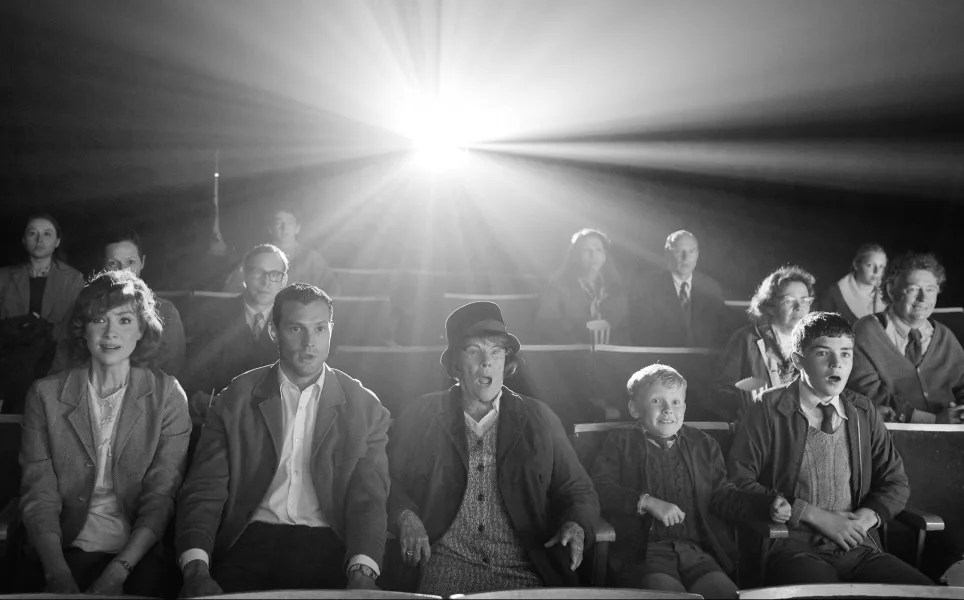
The joy of cinema is one of the themes in Kenneth Branagh’s semiautobiographical film Belfast, as all three generations of Buddy’s family enjoy going to the movies together. In this still, they react to the flying car riding off the cliff in Chitty Chitty Bang Bang.
1. Belfast, dir. Kenneth Branagh. Drawn from writer-director Kenneth Branagh’s own childhood, Belfast takes place in 1969–70 in a working-class neighborhood in the Northern Ireland capital, at the beginning of the thirty-year period of political violence known as the Troubles. This conflict was between (mostly Catholic) nationalists seeking independence from Britain, and (mostly Protestant) loyalists who saw themselves as British and thus sought to preserve Northern Ireland’s union with Britain. The focus of the film, however, is on family, not politics, as all the events of the year are filtered through the perspective of nine-year-old Buddy (Jude Hill). He sees his dad, for example, who refuses to participate in the riots, as a hero in the vein of his favorite western film characters.
Belfast is poignant and nostalgic and not at all the worse for being so. The “Everlasting Love” scene near the end is euphoric—and well earned!—and made me cry. In the wake of a death and amid financial debt, impending displacement from what has been their family’s hometown for generations, and other marital strains, Pa (Jamie Dornan) sings a pop song to Ma (Caitriona Balfe) from a lounge stage and pulls her into a dance, creating a moment of pure celebration, love, and defiant survival. The film’s highlight for me is how it holds together life’s joys and struggles, sorrows and laughter. Branagh, who moved with his parents and brother from Belfast to Reading, England, at age nine to escape the violence, dedicated the film to “those who stayed, those who left, and those who were lost” in Belfast.
2. The Power of the Dog, dir. Jane Campion. An adaptation of a Thomas Savage novel, this film subverts the traditional image of the western cowboy, exploring male virility, vulnerability, and agency. What is required to protect those you love? Is it muscles and bluster and a “gloves off” sort of grit, or a courage rooted someplace else?
Set in Montana in 1925, the film centers on the macho-posturing Phil Burbank (Benedict Cumberbatch), who runs a cattle ranch with his brother George (Jesse Plemons). When George marries the widowed Rose (Kirsten Dunst), she and her impressionable teenage son Peter (Kodi Smit-McPhee) settle at the Burbank estate. Phil is set off by Peter’s “sissiness”—his willowy frame, his slight lisp, his delight in crafting paper flowers for his mother—and he reacts with incessant bullying. He is cruel, mocking, and emotionally abusive not only to Peter but also to Rose, whom he resents for layered reasons.
The ending makes us see one of the characters in a completely different light and therefore prompts us to reread some of the emotional dynamics we have witnessed. The title comes from Psalm 22:20: “Deliver my soul from the sword; my darling from the power of the dog” (KJV).
Streaming on Netflix.
3. The Lost Daughter, dir. Maggie Gyllenhaal. Ambivalence toward motherhood is rarely explored onscreen. We see mother characters overwhelmed and exhausted, even stifled, but the sacrifices they make in those roles are almost always portrayed as ultimately worth it for the profound love and joy they experience as a result of being a mom. Because we’re conditioned, culturally and religiously, to view children as an unmitigated blessing, to express any kind of regret about having children is taboo (we’re only allowed to regret not having children). Women are expected to relish their role as mothers and to find their deepest fulfillment in that role, and if they don’t, they’re branded as “bad” or selfish.
I can already hear the alarm bells going off with my readers right now. “Children are a gift from God! How dare we be anything less than grateful for them! Women are designed to bear and nurture life! What could possibly be more fulfilling than living out that design?” One of the great things about films is that they often help us to enter into other experiences and perspectives, to access the feelings of another and, through that, our own. That doesn’t mean we forsake our beliefs and convictions, but we open ourselves up to a story that could challenge our sometimes overly simplistic thinking. One doesn’t have to reject the Bible to acknowledge that motherhood is messy and that for many women it requires them to confront (or else bury) darker pulls and emotions. Contrary to what we’re often told, motherliness does not come naturally to all women! There’s much more I could say about this, but let’s get to The Lost Daughter:
First-time writer-director Maggie Gyllenhaal, who herself has two daughters, wanted to make a film that explores all the complicated, unresolved emotions surrounding motherhood, which can include terror, anxiety, doubt, annoyance, and despair. An adaptation of Elena Ferrante’s novel of the same title, it follows Leda (Olivia Colman), a middle-age literature professor on holiday in Greece. One day on the beach she encounters a young mother named Nina (Dakota Johnson), who triggers Leda’s memories of her own two daughters, now in their twenties. We see flashbacks to Leda’s life as a struggling twenty-something mom (played by Jessie Buckley). She loves her children but feels plundered by them. And so she does something “aberrant,” as Gyllenhaal put it in an interview, which we find out about halfway through the film.
The film neither punishes nor condones its protagonist’s behavior. To what degree Leda feels guilt, regret, or satisfaction, and about what specifically, is largely left to the viewer to interpret, as she’s a hard one to read. (Colman gives us a very interior performance, which I think is to her and the film’s credit.) She is obviously troubled by past decisions, as her dizzy spells and thievery would suggest. There is also quite a bit of open-ended symbolism at play throughout.
Streaming on Netflix.
4. Drive My Car, dir. Ryûsuke Hamaguchi. The forty-minute prologue of this three-hour film establishes the relationship between theater actor-director Yusuke Kafuku (Hidetoshi Nishijima) and his screenwriter wife, Oto (Reika Kirishima). Within this pocket of time, Oto dies of a cerebral hemorrhage—after Yusuke finds out about her having an affair but before he confronts her about it. Roll opening credits.
Based loosely on a short story by Haruki Murakami, Drive My Car is about grief, intimacy, betrayal, forgiveness, self-knowledge, and communication across barriers. Two years after his wife’s death, Yusuke participates in a residency in Hiroshima, where he has been invited to direct a multilingual stage production of Chekhov’s Uncle Vanya, about a forty-seven-year-old man who is so world-weary that he wants to die. Yusuke’s concept is for the actors to act in their native language—Mandarin, Japanese, Korean, Korean Sign Language—feeding off their dialogue partner’s tones, speech rhythms, body language, and facial expressions, while subtitles are projected on a screen for the play’s audience.
Yusuke’s emotional healing comes through his work on this play (“Chekhov is terrifying because his lines drag the real out of you,” he says) and through the friendship he develops with his assigned driver, Misaki Watari (Toko Miura), a young woman who also carries a private grief. The two help each other come to terms with loss and regret and learn how to live again.
Streaming on HBO Max.
5. Flee, dir. Jonas Poher Rasmussen. This animated documentary chronicles the refugee experience of Amin Nawabi (not his real name), who fled from Afghanistan to Russia with his family in 1992 when he was eleven to escape the Mujahedeen attacks that became more frequent in Kabul after the Soviet withdrawal. He sought asylum in Europe for the next few years as an unaccompanied minor and eventually settled in Denmark, where he attended high school in Copenhagen and became friends with classmate Jonas Poher Rasmussen, now a filmmaker. More than twenty years later, he is telling his story for the first time, and it is Rasmussen he has entrusted it to.
The use of animation, a rare but not unheard-of choice for a documentary, has several advantages. It enables the subject to remain anonymous for his own safety. It allows for the re-creation of scenes from Amin’s childhood that were not, and could not have been, captured on film. And it enhances the expressiveness, tone, and meaning of certain scenes. The animation is supplemented, sparingly, with archival newsreel footage that gives historical veracity to some of Amin’s memories. And an important link to “the real” is forged by the use of Amin’s own voice in the animated interview sessions, conducted over several years, and sometimes in voiceover in the flashbacks. (His younger self is voiced by actors who capture him at two different ages—nine to eleven, and fifteen to eighteen.)
Throughout the film, Amin works to integrate his past and present and to make a home (“someplace safe, somewhere you know you can stay, and you don’t have to move on”) with his fiancé, Kasper, whom he has not yet spoken his traumas to.
Streaming on Hulu.
6. CODA, dir. Sian Heder. Sure, this film follows a predictable narrative arc and hits all the notes you would expect. But it’s so good! Seventeen-year-old Ruby (Emilia Jones) is the only hearing member of her family (CODA = child of deaf adults). Before school each day she works on the family’s fishing boat with her dad (Troy Kotsur) and older brother (Daniel Durant), while her mom (Marlee Matlin) runs the business side of things. But she finds herself increasingly drawn toward singing as a career path, and she starts to consider applying to Berklee College of Music in Boston.
The conflict is a familiar one: follow the plans your parents have laid out for you, or chase your own dreams, your own calling. Ruby needs to find her identity apart from being her family’s interpreter. But how can she honor the talents she’s been gifted with and her family obligations? Ruby’s parents slowly learn to accept and support her ambitions, even though they revolve around an auditory art form that is not accessible to them, and even though it means she’ll have to leave home. A turning point comes when they see her sing a duet at a school concert. In what is the most moving scene in the film, they experience the performance through watching the reactions of others in the audience.
Streaming on Apple TV+.
7. The Killing of Two Lovers, dir. Robert Machoian. A stylish arthouse drama set in rural Utah, this film follows David (Clayne Crawford), who’s desperately trying to keep his family of six together during a separation from his wife, Niki (Sepideh Moafi). He refuses to accept that the marriage is over. Shot in a 4:3 aspect ratio and with lots of long takes, the film is raw, potent, unflinching. And I love where it ends up.
Streaming on Hulu.
8. The Truffle Hunters, dir. Michael Dweck and Gregory Kershaw. This documentary made me smile more than any other film I saw last year. It’s so tender, and so gorgeously shot. And it’s got to be my favorite dog movie!
Truffle hunters are typically a secretive bunch, but the filmmakers got access to several of these elderly men from northern Italy who forage the forests with their trusty dogs, seeking out the edible fungus, a gourmet delicacy, to sell at high-priced auctions or on the black market. There are no interviews, no voiceovers—just a quietly observant camera. Despite the high prices truffles fetch, the hunters live simple lives in their Piedmont villages. And each has his own personality.
There’s a heavy focus on the relationship between the men and their dogs. They share meals with them, take baths with them, sing “Happy Birthday” to them, bring them to church. Aurelio, who is single and has no children, looks for someone to take care of his dog Birba when he dies; his chatter with Birba, and his expressions of love (like baking her a cake for her birthday), is the most endearing part of the film. It was also precious to see Titina, Carlo’s dog, being blessed by a priest—to use her gift of scent to serve others, to bring joy, as her finds will end up being used to make delicious dishes.
9. The Father, dir. Florian Zeller. Because of the COVID-19 extended eligibility period for Oscar submissions last year, this film was technically part of the 2021 Academy Awards, even though it was released in February 2021. Anthony Hopkins, who won Best Actor for this role, plays Anthony, an elderly man with dementia. As he loses his grip on the things and people around him, he becomes easily agitated and resists the care of his daughter Anne (Olivia Colman).
Zeller said he wanted the audience to feel as though, like Anthony, they’re “groping their way through a labyrinth,” so he wove a complex narrative that mixes reality with Anthony’s memories. We are made to feel his confusion, terror, frustration, and disorientation, in part by the use of multiple actors to portray a single character, such that we’re also not sure who’s who and what’s going on. Kudos to editor Yorgos Lamprinos and production designer Peter Francis for their work, as both those skills are key in pulling off this kind of storytelling.
The film is heartbreaking—the biggest downer on my list, for sure, especially with its climactic scene where Anthony breaks down and cries for his mommy. But by inviting us into Anthony’s suffering, The Father develops our empathy for those whose brains stop functioning properly in old age, for whom the world no longer makes any sense—an incredibly fearful thing.
10. C’mon C’mon, dir. Mike Mills. Johnny (Joaquin Phoenix) is a radio journalist who travels the US asking kids big questions about life. When his sister (Gaby Hoffmann) is forced to deal with a mental health crisis her ex-husband is experiencing, Johnny becomes the caretaker of her son (Woody Norman) for an extended period. The uncle-nephew bonding that follows constitutes the core of the film. UnlikeThe Lost Daughter, C’mon C’mon paints a bright and affirmative portrait of parenthood. It acknowledges the challenges of raising children while also celebrating the many small, beautiful moments of connection that are possible between adult and child.



 Art & Theology