Easter, Day 6: “Let us keep the festival”

LOOK: The Antioch “Chalice,” 6th century
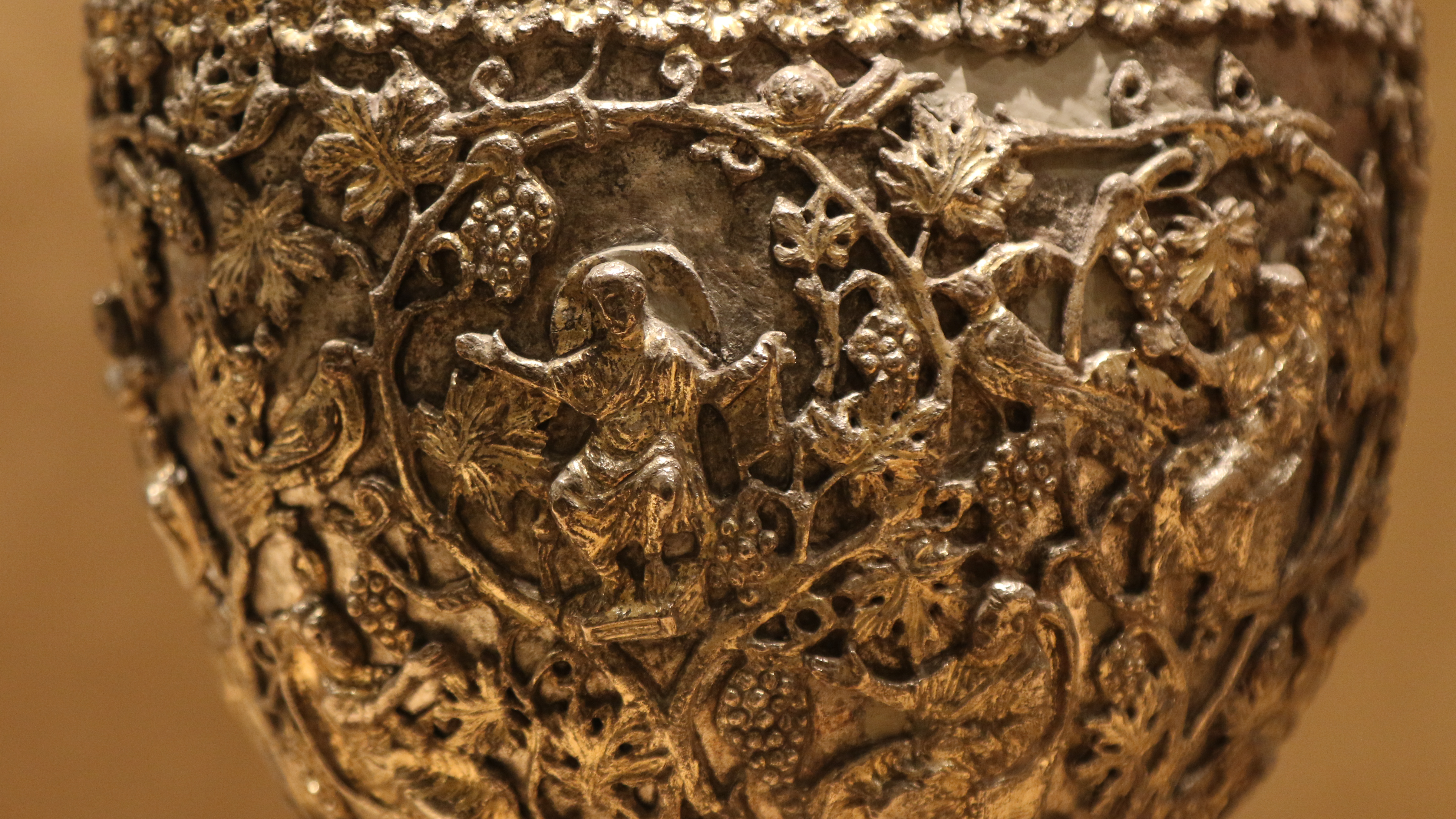
Antioch Chalice (detail)
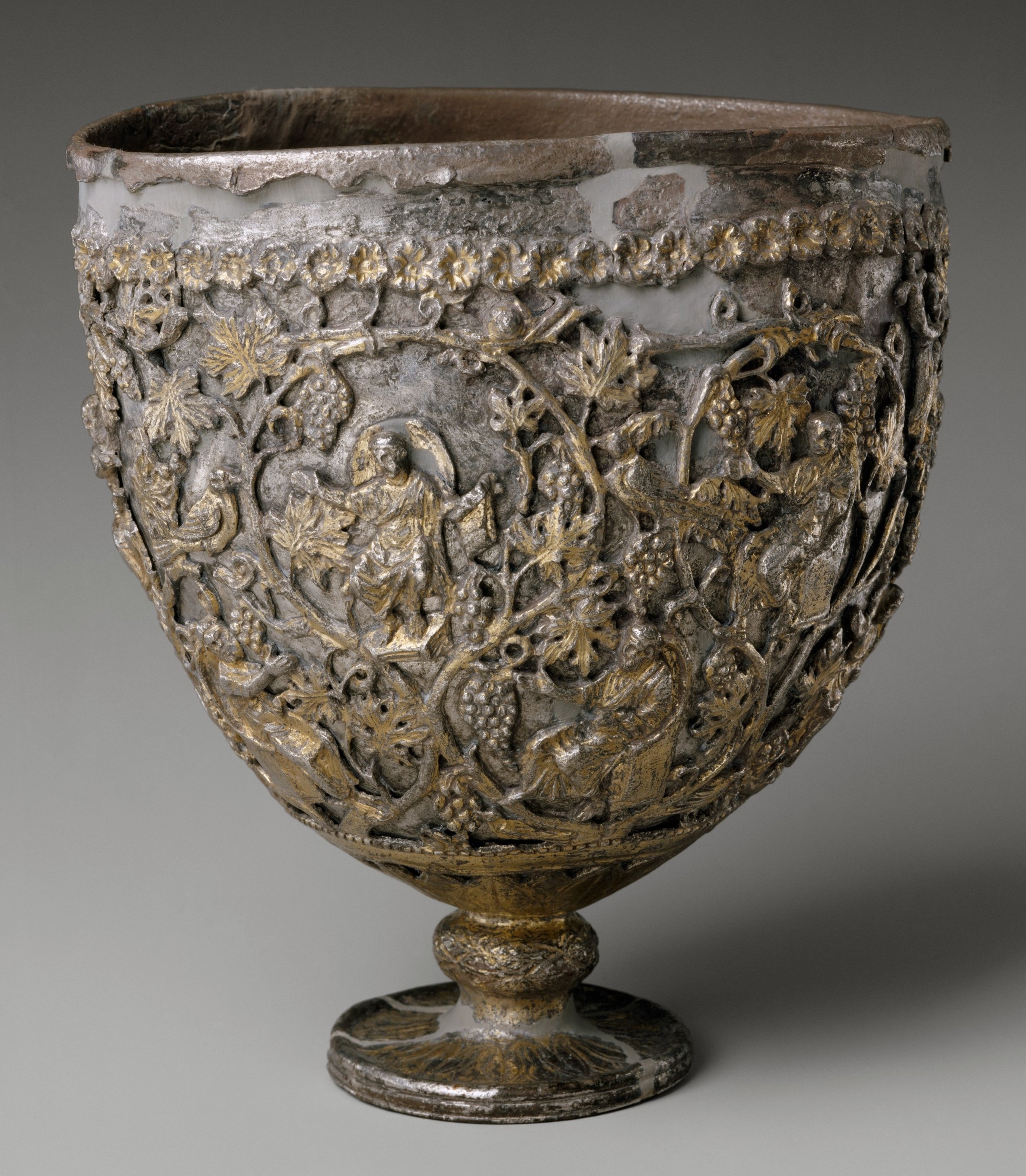
The Antioch “Chalice,” Byzantine (Syria), 500–550. Silver, silver-gilt, overall 7 11/16 × 7 1/16 × 6 in. (19.6 × 18 × 15.2 cm). Metropolitan Museum of Art, New York. Photo: Fr. Lawrence Lew, OP.

This Byzantine liturgical object was discovered in 1908 in Antioch on the Orontes (in modern-day Turkey, near the Syrian border) and is thought to be from the first half of the sixth century. Originally it was identified as a chalice, used in the celebration of the Eucharist, but more recent scholarship suggests that it was probably a standing oil lamp that was used in church.

The elaborate silver shell that encloses the plain silver bowl is covered in emblems of the renewal of life—vines, fruit, doves, a butterfly, a rabbit. There are also snails and a grasshopper! If indeed the object is a lamp, its flame would have reinforced Jesus’s self-identification as the light of the world.

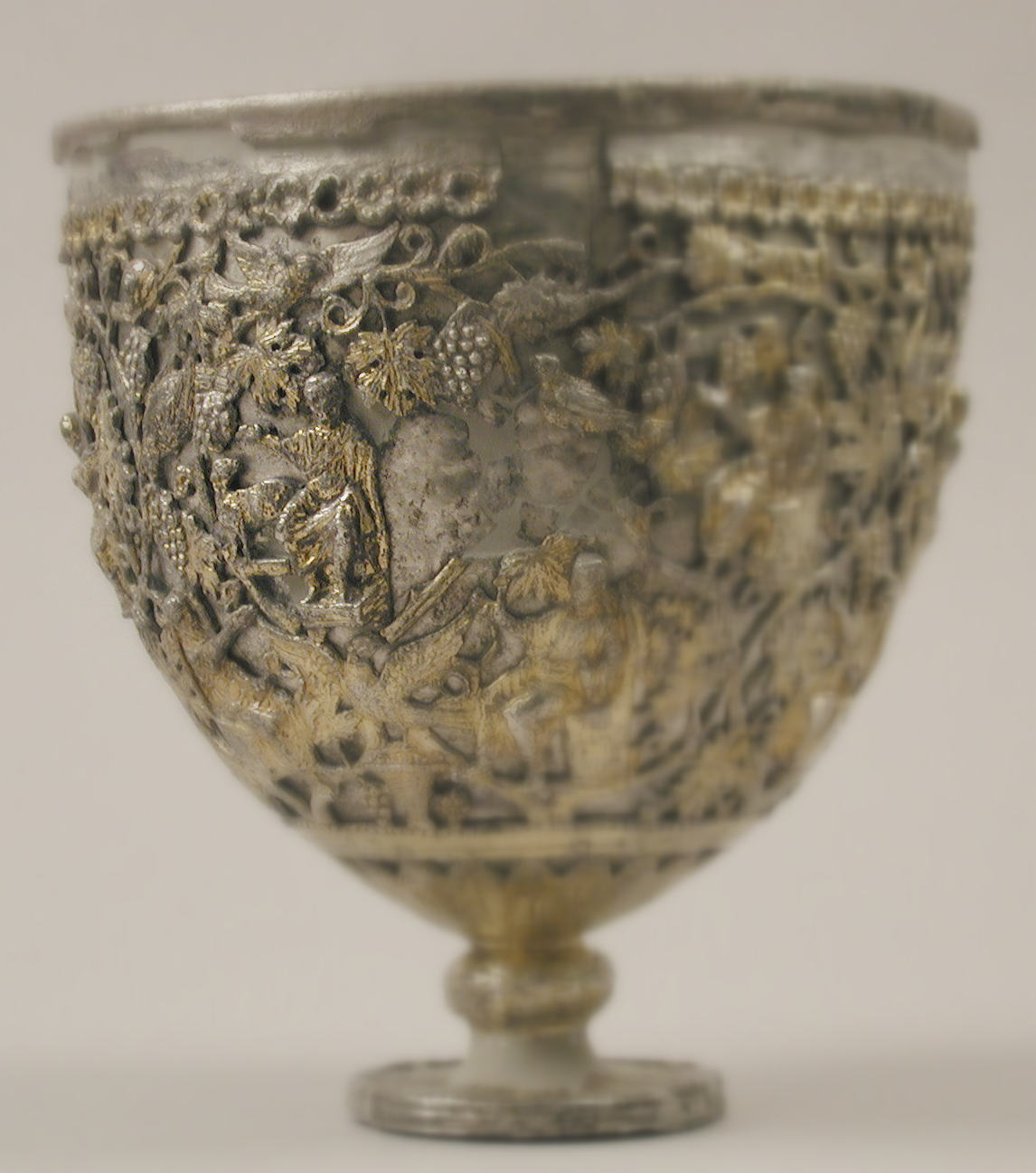
Twelve seated human figures circle the bowl, two of which likely represent Christ, as each is surrounded by five figures in attitudes of directed reverence. One Christ figure (see the first photo below) is shown with a scroll draped over his left arm, representing his teaching. The other Christ, on the opposite side, is depicted as the resurrected Lord and giver of life; a lamb stands under his right arm, and beneath him, an eagle with outspread wings perches on a fruit basket.
Antioch Chalice
View 1, what I’ll call the front

Antioch Chalice
View 2, what I’ll call the back. Photo edited by me to focus on the (second) Christ figure and the lamb. Click on image for original.

The subordinate figures, all holding scrolls, may be apostles, or they may be philosophers of the classical age who, like the Hebrew prophets, had foretold the coming of Christ.

LISTEN: Christ lag in Todesbanden (Christ Lay in the Bonds of Death) (BWV 4) by J. S. Bach, 1707 | Words by Martin Luther, 1524 | Performed by Ensemble Orlando Fribourg at the Church of St. Michael’s College, Fribourg, Switzerland, 2016

Bach wrote this Easter cantata—one of his earliest works—at age twenty-two as part of his application for the post of organist at Divi Blasii church in Mühlhausen, Germany. (He got the job!) Its text and melody are taken from the hymn of the same name by Martin Luther, which was itself derived from the eleventh-century plainsong “Victimae paschali laudes.”

The twenty-two-minute cantata is divided into an opening instrumental movement, called a sinfonia, and seven vocal movements corresponding to the stanzas of Luther’s hymn. These are arranged symmetrically—chorus–duet–solo–chorus–solo–duet–chorus—with the focus on the high drama of the central fourth movement, which describes the battle between Life and Death.

Sinfonia

1. Choral

Christ lag in Todesbanden,
für unsre Sünd gegeben,
der ist wieder erstanden
und hat uns bracht das Leben.
Des wir sollen fröhlich sein,
Gott loben und dankbar sein
und singen Halleluja. Halleluja.

2. Duett (SA)
Den Tod niemand zwingen kunnt
bei allen Menschenkindern;
das macht alles unsre Sünd,
kein Unschuld war zu finden.
Davon kam der Tod so bald
und nahm über uns Gewalt,
hielt uns in seim Reich gefangen.
Halleluja.

3. Aria (T)
Jesus Christus, Gottes Sohn,
an unser Statt ist kommen
und hat die Sünde abgetan,
damit dem Tod genommen
all sein Recht und sein Gewalt;
da bleibt nichts denn Tods Gestalt,
den Stachel hat er verloren. Halleluja.

4. Choral
Es war ein wunderlich Krieg,
da Tod und Leben ’rungen;
das Leben, behielt den Sieg,
es hat den Tod verschlungen.
Die Schrift hat verkündet das,
wie ein Tod den andern fraß,
ein Spott aus dem Tod ist worden. Halleluja.

5. Duett (ST)
Hier ist das rechte Osterlamm,
davon wir sollen leben,
das ist an des Kreuzes Stamm
in heißer Lieb gegeben.
Des Blut zeichnet unsere Tür,
das hält der Glaub dem Tode für,
der Würger kann uns nicht rühren. Halleluja.

6. Aria (B)
So feiern wir das hoh Fest
mit Herzensfreud und Wonne,
das uns der Herre scheinen lässt.
Er ist selber die Sonne,
der durch seiner Gnaden Glanz
erleucht unsre Herzen ganz;
der Sünden Nacht ist vergangen. Halleluja.

7. Choral
Wir essen und leben wohl,
zum süßen Brot geladen;
der alte Sau’rteig nicht soll
sein bei dem Wort der Gnaden.
Christus will die Kost uns sein
und speisen die Seel allein;
der Glaub will keins andern leben. Halleluja.
Sinfonia

1. Chorale
Christ Jesus lay in death’s strong bands
for our offenses given;
but now at God’s right hand he stands
and brings us life from heaven.
Therefore let us joyful be
and sing to God right thankfully
loud songs of alleluia! Alleluia!

2. Duet (SA)
No son of man could conquer death,
such ruin sin had wrought us.
No innocence was found on earth,
and therefore death had brought us
into bondage from of old
and ever grew more strong and bold
and held us as its captive. Alleluia!


3. Aria (T)
Christ Jesus, God’s own Son, came down,
his people to deliver;
destroying sin, he took the crown
from death’s pale brow forever.
Stripped of pow’r, no more it reigns;
an empty form alone remains;
its sting is lost forever. Alleluia!

4. Chorale
It was a strange and dreadful strife
when life and death contended.
The victory remained with life,
the reign of death was ended.
Holy Scripture plainly saith
that death is swallowed up by death;
disgraced, it lies defeated. Alleluia!

5. Duet (ST)
Here the true Paschal Lamb we see,
whom God so freely gave us;
he died on the accursed tree—
so strong his love—to save us.
See, his blood now marks our door;
faith points to it; death passes o’er,
and Satan cannot harm us. Alleluia!

6. Aria (B)
So let us keep the festival
to which the Lord invites us;
Christ is himself the joy of all,
the sun that warms and lights us.
Now his grace to us imparts
eternal sunshine to our hearts;
the night of sin is ended. Alleluia!

7. Chorale
Then let us feast this Easter day
on Christ, the bread of heaven;
the Word of grace has purged away
the old and evil leaven.
Christ alone our souls will feed;
he is our meat and drink indeed;
faith lives upon no other! Alleluia!

Trans. Richard Massie, 1854

Christmas, Day 10: Balulalow

LOOK: The Birth of Christ by Ulyana Tomkevych

Tomkevych, Ulyana_The Birth of Christ
Ulyana Tomkevych (Ukrainian, 1981–), The Birth of Christ, 2016. Egg tempera on gessoed wood, 11 1/2 × 12 in. Sacred Art Pilgrim Collection of John A. Kohan. Photo: Victoria Emily Jones, at East Meets West: Women Icon Makers of Western Ukraine, St. Christopher’s Episcopal Church, Chatham, Massachusetts, 2017.

Frosty yet warm, this icon by Ulyana Tomkevych of Ukraine is one of my favorite Nativity paintings. It shows Mary embracing her swaddled newborn, Jesus, amid a bleak midwinter. She reclines across a red blanket of flowers inspired by Ukrainian embroidery patterns, which hovers mystically above a line of barren trees, suggesting that Christ’s birth has ushered in a new springtime.

The wisps of white against the cool green-grays at the bottom suggest snowdrifts, whereas the faint rose tints at the top imply a suffusing warmth. The silver semicircle at the top, with its emanating beams, represents the mystery and presence of God breaking into the world.

Following Greek Orthodox tradition, Christ’s halo is inscribed with the Greek letters ώ Ό Ν (omega, omicron, nu), spelling “He who is” (see Exod. 3:14). Tomkevych is a member of the Ukrainian Greek Catholic Church, which is in communion with the Holy See but follows the Byzantine Rite.

LISTEN: “Balulalow” | Original German words by Martin Luther, 1535 (title: “Vom Himmel hoch da komm ich her”) | Translated into Scots by James, John, and Robert Wedderburn, 1567 | Music by Peter Warlock, from his Three Carols suite, 1923 | Performed by Sting on If on a Winter’s Night, 2009 [see full credits]

O my deare hert, young Jesu sweit,
Prepare thy creddil in my spreit
And I sall rock thee in my hert,
And never mair from thee depert.

But I sall praise thee evermore
With sangis sweit unto thy gloir.
The knees of my hert sall I bow,
And sing that richt Balulalow.

Literal English translation:

O my dear heart, young Jesus sweet,
Prepare thy cradle in my spirit
And I shall rock thee in my heart,
And nevermore from thee depart.

But I shall praise thee evermore
With songs sweet unto thy glory.
The knees of my heart shall I bow,
And sing that true Balulalow.

English translation, from the German, by Catherine Winkworth:

Ah! dearest Jesus, holy Child,
Make thee a bed, soft, undefiled
Within my heart, that it may be
A quiet chamber kept for Thee.

My heart for very joy doth leap;
My lips no more can silence keep.
I too must sing with joyful tongue
That sweetest ancient cradle song.

These two stanzas in Middle Scots are an extract from the longer “Ane Sang of the Birth of Christ,” also known by its first line, “I come from heuin to tell,” from the Ane Compendious Buik of Godly and Spirituall Sangis (1567). In this part of the hymn, the speaker asks Jesus to be at home in their heart and receive their sweet songs. Mary is the model for this reception, love, and adoration of the Christ child—she who cradled him, praised him, sang to him, and held him close.

The word balulalow is derived from the Scottish word for “lullaby.”

For all fifteen stanzas in Scots, see here, and for Catherine Winkworth’s full English translation, here. The hymn actually originated in German from the pen of Martin Luther, who titled it “Vom Himmel hoch da komm ich her” (From Heaven Above to Earth I Come). It spread to the Netherlands and the British Isles in the 1560s.

In his recording, the cross-genre English musician Sting uses neither the German folk tune that Luther paired with the text upon its first publication, nor the melody Luther composed for it in 1539. Instead Sting uses the 1923 setting written by the English composer Peter Warlock for his Three Carols suite.

In Sting’s rendition, which he arranged in collaboration with Robert Sadin, the female backing vocals evoke a wintry wind and a snare drum creates a forward momentum, while a cello supports Sting’s languid singing. The tone is tender and haunting.


This post is part of a daily Christmas series that goes through January 6. View all the posts here, and the accompanying Spotify playlist here.

Reformation Roundup

FIVE R’S FOR REFORMATION COMMEMORATION

As a guard against Reformed hubris, Churches Together in England has issued a statement urging churches to mark the Reformation’s fifth centenary with sensitivity to other branches of the faith, providing 5 R’s as guidelines. Keep the anniversary, it says, with the spirit of

Rejoicing – because of the joy in the gospel which we share, and because what we have in common is greater than that which divides; and that God is patient with our divisions, that we are coming back together and can learn from each other.

Remembering – because all three streams of the Reformation have their witnesses and one church’s celebration could be another’s painful memory; and yet all believed they acted in the cause of the gospel of Jesus Christ for their time.

Reforming – because the Church needs always to grow closer to Christ, and therefore closer to all who proclaim him Lord, and it is by the mutual witness of faith that we will approach the unity for which Christ prayed for his followers.

Repenting – because the splintering of our unity led us to formulate stereotypes and prejudices about each other’s traditions which have too often diverted our attention from our calling as witnesses together to the mercy of God in proclamation and service to the world.

Reconciling – because the call to oneness in Christ begins from the perspective of unity not division, strengthening what is held in common, even though the differences are more easily seen and experienced.

This is not to say we can’t celebrate the achievements of the Reformation (we certainly should!), but we ought not to do so with denigration toward our Catholic brothers and sisters, nor hold our own branch above reproof. All church history, before and after the major splits, is our history as a body. Read the full CTE statement here. For other initiatives to foster common witness, service, and understanding between Protestants and Catholics, see the documents “Evangelicals and Catholics Together” (1994) and “Joint Declaration on the Doctrine of Justification” (1999).

+++

ECUMENICAL ARTS SYMPOSIUM

The last two weekends in October will cap off the international “Arts and Ecumenism” symposium organized by the Mount Tabor Ecumenical Centre for Art and Spirituality to commemorate the five hundredth anniversary of the Reformation. With events in Paris, Strasbourg, and Florence, the symposium is now coming to the US to continue the discussion on Catholic and Protestant approaches to art.

The penultimate session, “Sacred Arts in North American Contexts,” will take place October 20–21 at Yale University. “Arts in Celebration: The Word in Color, Action, Music, and Form,” the final session, will take place October 27–29 at the Community of Jesus in Orleans, Massachusetts, and will include demonstrations of mosaic, fresco, and Gregorian chant; lectures and panel discussions with Timothy Verdon, William Dyrness, Deborah Sokolove, and others; exhibits of contemporary sacred art by Susan S. Kanaga and Filippo Rossi (view the catalog); liturgies of the Divine Office and Holy Eucharist; an organ recital; and a fully staged presentation of Ralph Vaughan Williams’s opera The Pilgrim’s Progress, performed by the community’s critically acclaimed Gloriae Dei Cantores choir and Elements Theatre Company. Click here for the schedule.

I stayed at the Community of Jesus last week, and trust me, $425 is a great price for two days and nights at this beautiful Cape Cod monastery, with its Benedictine hospitality, and access to a high caliber of visual, musical, and dramatic art and prominent voices in the field of Christianity and the arts. But the best part, I think, will be the opportunity to inhabit the ecumenical vision the community has established, whereby all Christians—Catholic, Protestant, and Orthodox—live together, eat together, and worship together. Some community members have taken vows of celibacy, while others have chosen marriage and live with spouse and children on the compound. Partaking of the Eucharist last Friday with brothers and sisters from other streams of Christianity and multiple generations was an experience I will not soon forget. Be sure to take advantage of the early-bird registration discount, which ends September 1.

(Click here to take a virtual tour of the Community of Jesus’s Church of the Transfiguration.)

Church of the Transfiguration
Church of the Transfiguration, Orleans, Massachusetts. Photo: Victoria Emily Jones

Vento by Filippo Rossi
Vento (detail) by Filippo Rossi, from the exhibition “Spirito Creatore”

+++

PAST LECTURE: “Visual Ecumenism” by Matthew Milliner: Milliner is an evangelical Anglican who teaches art history (his specialization is Byzantine) at a Protestant liberal arts college in Illinois. In this talk given April 7, 2017, at the Wheaton Theology Conference “Come, Let Us Eat Together!,” he discusses how we can “put on” other Christian traditions without losing our own by engaging their artistic output, by opening ourselves up to the material expressions of the gospel present all across the denominational spectrum:

I’m taking a particularly cherished part of my tradition—the law/gospel distinction—and showing that it can be found in other traditions as well. This might seem like I’m colonizing other traditions with my Protestantism, but I’m actually trying to strip my own tradition of its exclusive possession of this message and see it elsewhere, so that evangelicals can be at home in late medieval Catholic devotional manuals or in Russian Orthodox cathedrals. (19:04)

In reverse chronological fashion, he examines Lucas Cranach’s Law and Grace (Protestant), Berthold Furtmeyr’s Tree of Life and Death (Catholic), and the Sinai Pantocrator icon (Orthodox). Michelangelo’s late drawings and tomb for Pope Julius II are discussed in light of his involvement in the Spirituali, a Catholic reform movement in Italy that emphasized intensive personal study of scripture and justification by faith. More personally, Milliner describes how he was able to make it through repeated Hail Marys during a Catholic prayer service he inadvertently stumbled into one time and, on another Marian note, shares the Madonna of Mercy mural created last year by a group of Protestant art students he co-taught in Orvieto, Italy, with Bruce Herman, showing how they honored this subject that originated outside their tradition while also bringing it in line with their theological convictions—which, they discovered, were corroborated by Vatican II. In an earlier essay on visual ecumenism, Milliner wrote,

Just as there is, according to our Bibles, ‘one Lord, one faith, one baptism,’ so perhaps there is also one variegated yet unified Christian aesthetic, to which the different traditions, at their utter best, ascend. Full maturity (which for evangelicals has been a long time coming!) is not to see with Protestant, Orthodox or Catholic eyes—but with the eyes of Christ.

Madonna of Mercy (Gordon in Orvieto)
Madonna of Mercy painting by the 2016 Gordon in Orvieto cohort

Milliner has given similar talks in the past: “Toward a Visual Ecumenism,” at Duke; “Toward 2017: Visualizing Christian Unity,” at George Fox; “Altars on the Jordan and the Rhine,” at the Institute for Ecumenical Research in Strasbourg; “Against Confessional Aesthetics,” at Baylor; and “Hearing Law, Seeing Gospel: A Mockingbird History of Art,” at the 2017 Mockingbird Conference. I hope they turn into a book!

+++

UPCOMING LECTURE: “An Evening with Ken Myers: Luther’s Artistic Legacy,” Saturday, September 9, 7:30 p.m., Wallace Presbyterian Church, College Park, Maryland: To kick off its second season, the Eliot Society has scheduled Mars Hill Audio founder Ken Myers to discuss Martin Luther’s contributions to Christian hymnody. “With the help of some local musicians, Myers will examine the artistic climate Luther helped to create, as well as some of the great composers of sacred music who followed after him. The lecture will argue that the pattern of Luther’s artistic engagement provides a model for contemporary efforts to reconnect faith and the arts.” Click on the link above to reserve your free ticket.

+++

FROM THE ARCHIVES: “An early Protestant painting (commissioned by Luther)”: On my previous blog I wrote a post about an altarpiece Martin Luther commissioned from his friend Lucas Cranach to promote Protestant theology. (It’s the same painting Milliner opens his above talk with.) Luther was more accepting of religious images than many of his fellow reformers, elucidating his position in his Invocavit Sermons (1522) and in the treatise Against the Heavenly Prophets in the Matter of Images and Sacraments (1525). I plan to feature vast swaths of these texts on Art & Theology in the near future.

Law and Grace by Lucas Cranach the Elder
Lucas Cranach the Elder (German, 1472–1553), Law and Grace, 1529. Tempera on linden wood, 82.2 × 118 cm. Castle Museum Schloss Freidenstein, Gotha, Germany.