Easter, Day 4: Weeping Mary

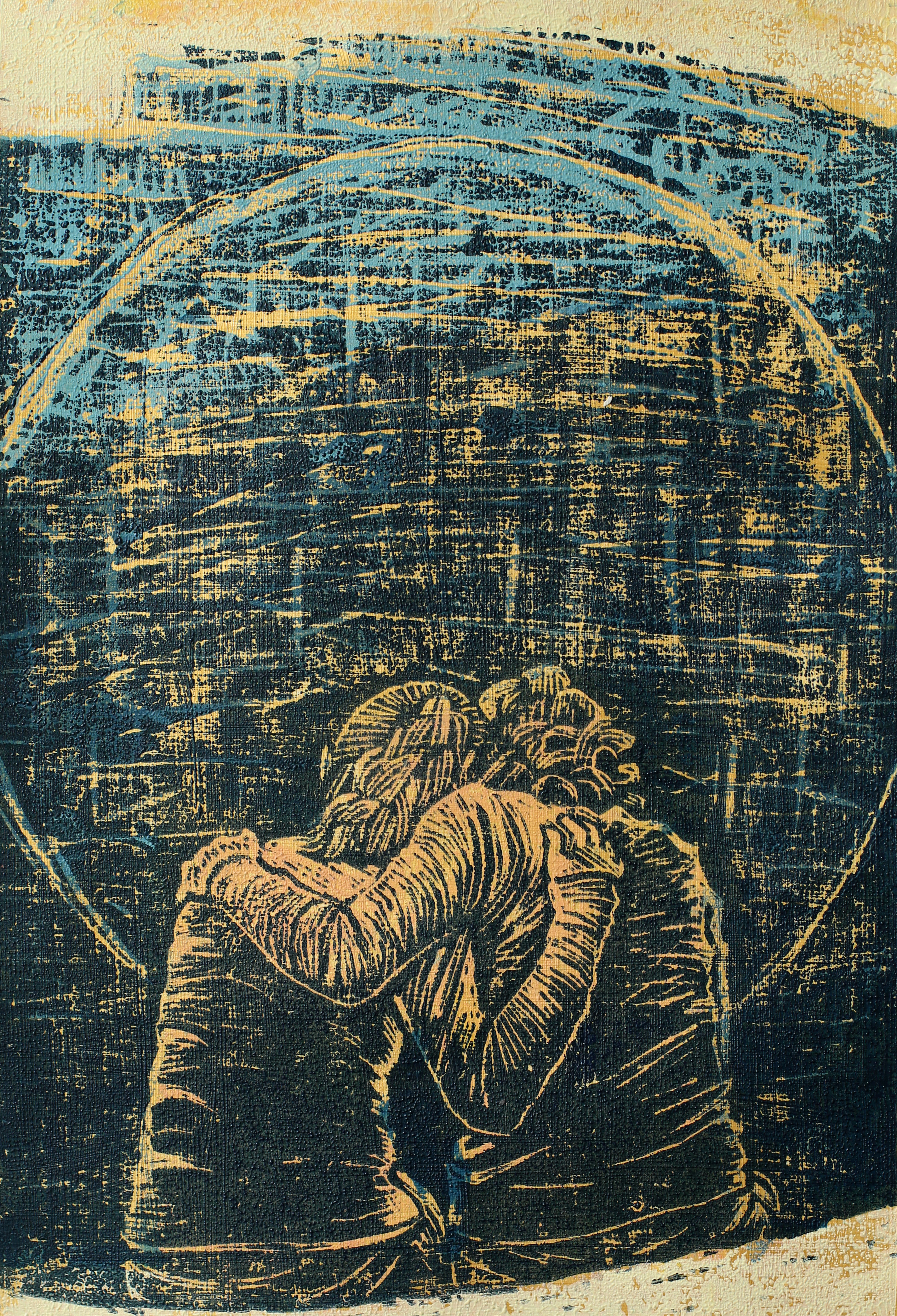
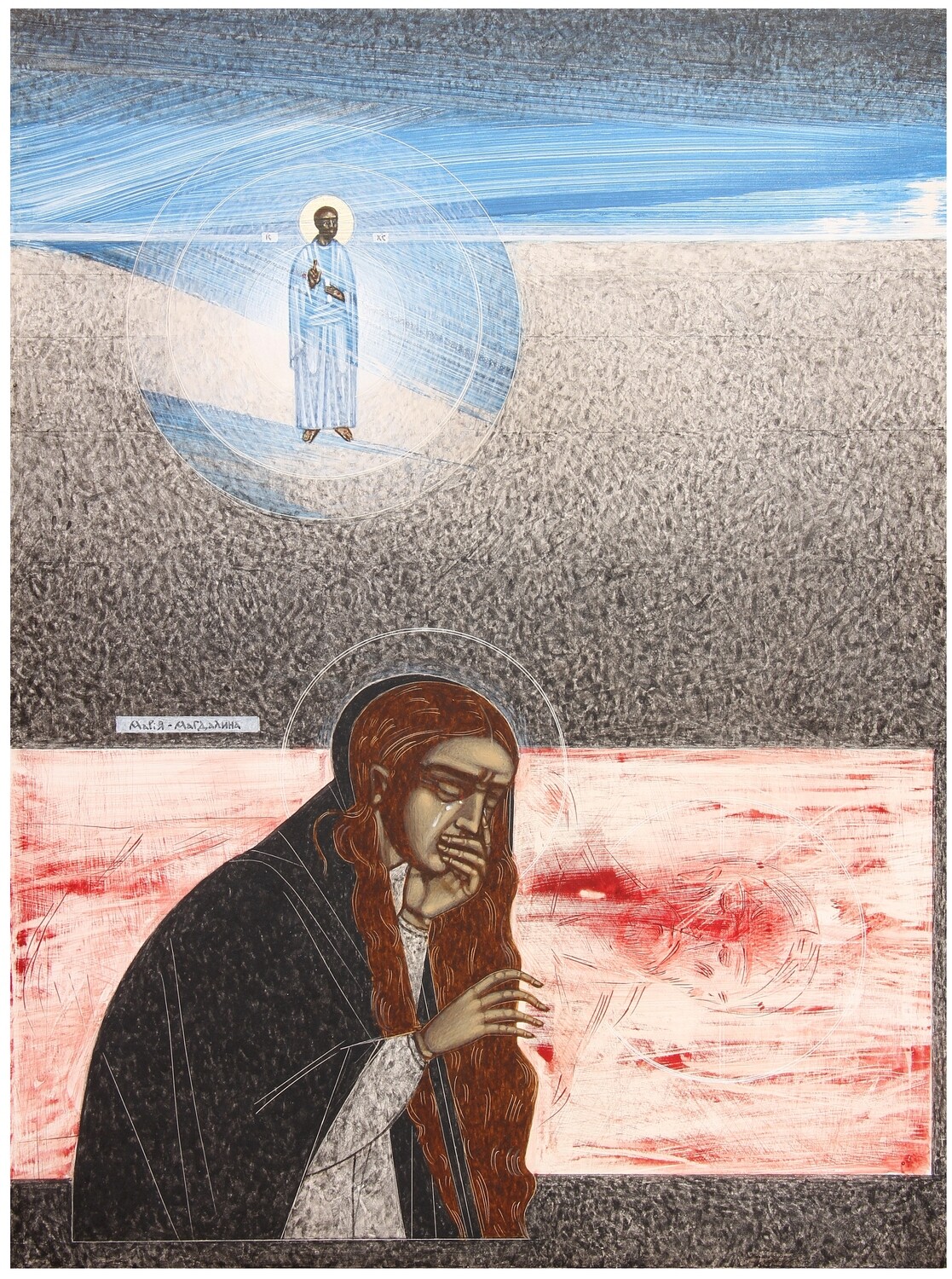
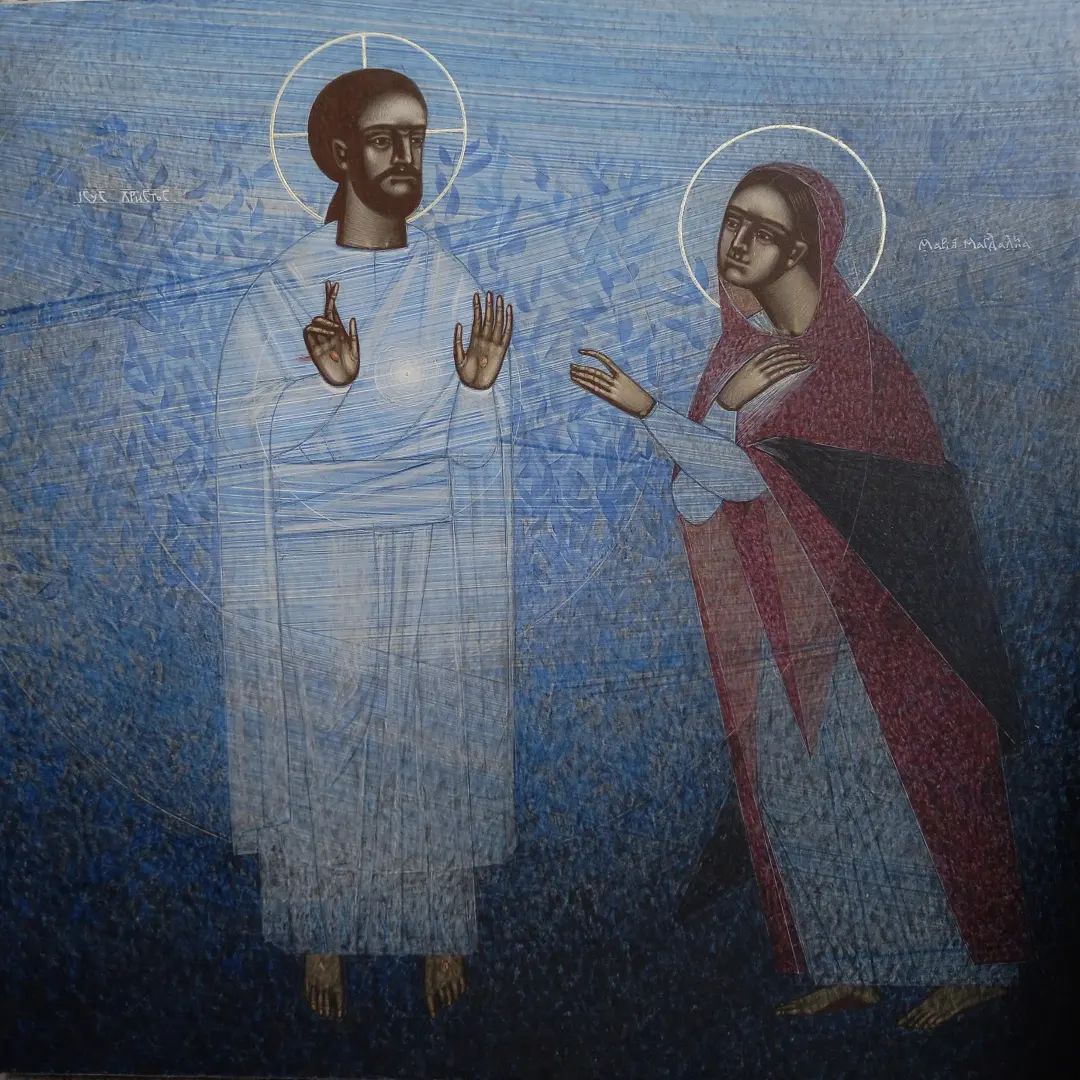
LOOK: Mary Magdalene Stood Crying by Kateryna Kuziv

Kuziv, Kateryna_Mary Magdalene stood crying
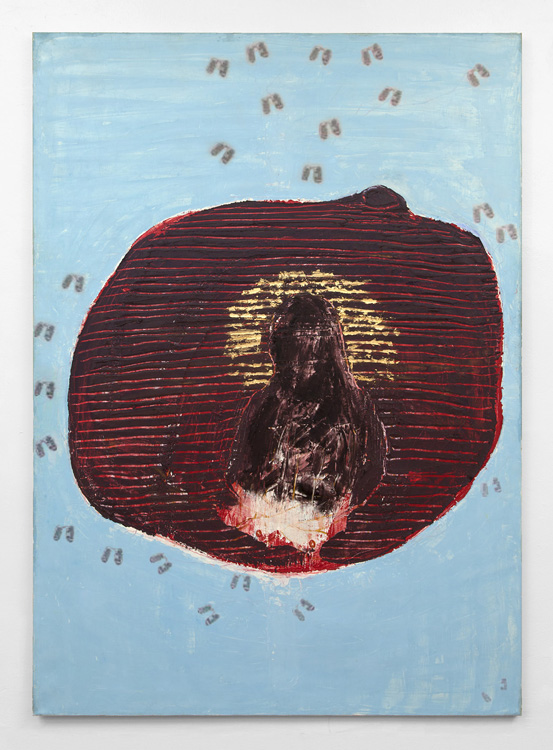
Kateryna Kuziv (Ukrainian, 1993–), Mary Magdalene Stood Crying, 2021. Egg tempera and gilding on gessoed wood, 40 × 30 cm.

LISTEN: “Weeping Mary” | Traditional American, 19th century | Arranged by Dan Damon and performed by the Dan Damon Quartet, feat. Sheilani Alix, on Beautiful Darkness, 2022

Is there anybody here like Mary a-weeping?
Call to my Jesus and he’ll draw nigh.
Is there anybody here like Mary a-weeping?
Call to my Jesus and he’ll draw nigh.

Refrain:
Glory, glory
Glory, glory
Glory be to my God on high
Glory, glory
Glory, glory
Glory be to my God on high

Is there anybody here like Peter a-sinking? . . .

Is there anybody here like jailers a-trembling? . . .

This early American spiritual was transmitted orally before first being recorded in The Social Harp (Philadelphia, 1855), a shape-note hymnal compiled by John Gordon McCurry (1821–1886). McCurry was a farmer, tailor, and singing teacher who lived most of his life in Hart County in northeastern Georgia. The Social Harp credits the music for “Weeping Mary” to him and gives it the year 1852, but I think that indicates not composition but notation and harmonization; in other words, McCurry is the arranger.

In the description of their 1973 facsimile reprinting of The Social Harp, the University of Georgia Press writes, “In the time between the [American] Revolution and the Civil War, the singing of folk spirituals was as common among rural whites as among blacks. This was the music of the Methodist camp meeting and the Baptist revival, and white spirituals in fact are known chiefly because homebred composers sometimes wrote them down, gave them harmonic settings, and published them in songbooks.”

I regard “Weeping Mary” as an Easter song, since the primary verse refers to Mary Magdalene standing outside the empty tomb weeping because she doesn’t know what happened to the body of her Lord (John 20). Then a man she supposes to be the gardener engages her in conversation—and turns out to be the one she’s been seeking, only he’s alive!

The jailer in the third verse refers to the Philippian jailer from Acts 16, tasked with guarding the prisoners Paul and Silas, who were falsely charged with disturbing the peace. One night an earthquake strikes, releasing the chains from the walls and breaking open the cell doors. The jailer raises his sword to kill himself to avoid the shame of having let his wards escape. But Paul alerts him that they’re still there, after which the jailer “fell down trembling” and asked the two what he must do to be saved. “Believe in the Lord Jesus,” they reply. After which he and his whole household convert to the new faith.

“Call to my Jesus and he’ll draw nigh,” the song promises.

Another “Weeping Mary” verse not in The Social Harp but that I’ve heard added in some renditions is “Is there anybody here like Thomas a-doubting?”

More subdued than the typical Easter fare, “Weeping Mary” testifies to the nearness of God in our sorrows, fears, doubts, and weaknesses. It embraces those who are anxious, grieving, or struggling, offering a gentle word.

I first learned this song from a recording by the American folk musician Sam Amidon, which I also really like:

In Brattleboro, Vermont, where he grew up in the 1980s and ’90s, he told NPR, shape-note singing was a social tradition, something that happened once a month, with singers moving to different people’s houses, including his own. His parents are the well-known folk musicians Peter and Mary Alice Amidon.

In his rendition he uses the grammatically incorrect but historically faithful verb that appears in original songbook, “Are there anybody . . .”

For a more vigorous jazz arrangement, which includes scat singing and a trumpet solo, see June April’s 2007 album What Am I?. She uses just the first verse.

And here’s a traditional performance in four-part a cappella by the Dordt College Concert Choir, directed by Benjamin Kornelis:

Roundup: Laura James unveils new painting series, Vessel art trail puts contemporary art in rural churches, and more

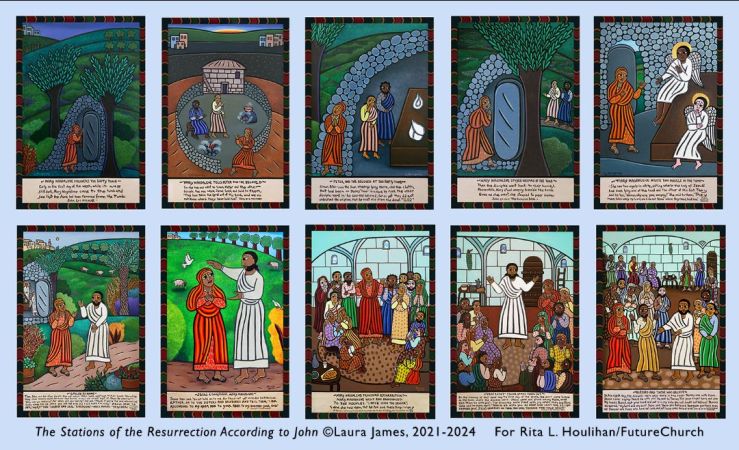
VIRTUAL ARTIST’S TALK: “The Stations of the Resurrection according to John” with Laura James, July 30, 2024, 7:00–8:15 p.m. ET: Next Tuesday, Bronx-based artist Laura James will discuss her latest painting series, The Stations of the Resurrection according to John, in a live online conversation with patron Rita L. Houlihan. Register at the link above.

James, Laura_Stations of the Resurrection

The series began in 2021 with four paintings—Called by Name, Jesus Commissions Mary Magdalene, Mary Magdalene Proclaims Resurrection, and Pentecost: Jesus Sends Them Out, collectively the Mary Magdalene and the Risen Jesus series (which you can purchase as a set of cards)—and then expanded to include the full resurrection narrative from John 20. View details of all ten paintings for the first time, and hear from the artist about the artistic choices she made.

The daughter of immigrants from Antigua in the Caribbean, Laura James is especially celebrated for her vibrant paintings that depict biblical figures, including Jesus, as dark-skinned, influenced in part by the long tradition of Ethiopian Christian art. Rita Houlihan, who commissioned the Stations of the Resurrection series from James, is a founding member of FutureChurch’s Catholic Women Preach and Reclaim Magdalene projects and a longtime advocate for the restoration of historical memory regarding early Christian women leaders, especially Mary Magdalene.

Update, 8/4/24: You can view the series and purchase reproductions of individual pieces from it, or the complete set, at https://shop.laurajamesart.com/the-stations-of-the-resurrection/. And the video recording of the July 30 event is here:

+++

VIRTUAL BOOK LAUNCH: Refractions, 15th anniversary edition, by Makoto Fujimura, August 6, 2024, 3:00 p.m. ET: Artist, speaker, writer, and IAMCultureCare founder Makoto Fujimura is one of the most prominent voices in the “art and faith” conversation in the US. On Tuesday, August 6, he’s hosting a Zoom event to celebrate the release of the fifteenth anniversary edition of his essay collection Refractions: A Journey of Faith, Art, and Culture, which is updated and expanded. He will read new selections from the book and host a time of Q&A and sharing. Register for the event at the above link, and you will receive a 30% discount on copies of the book preordered before the end of July.

+++

ART TRAIL: Vessel, miscellaneous locations along the Welsh-English border, August 8*–October 31, 2024: An exciting new art trail has been curated by Jacquiline Creswell [previously] for the group Art and Christianity. From the press release: “Vessel is a curated art trail in remote rural churches near the Black Mountains between Usk and Hay-on-Wye [in the border country between South Wales and England]. Seven artworks by seven [contemporary] artists will be shown in seven churches, six of which are maintained by the Friends of Friendless Churches who keep them open all year round. The theme of ‘vessel’ references bodies, boats, secretions and receptacles; each of the artworks will be sited in a particular relationship to the church and its material culture.”

*Lou Baker’s installation at Dore Abbey opens August 21.

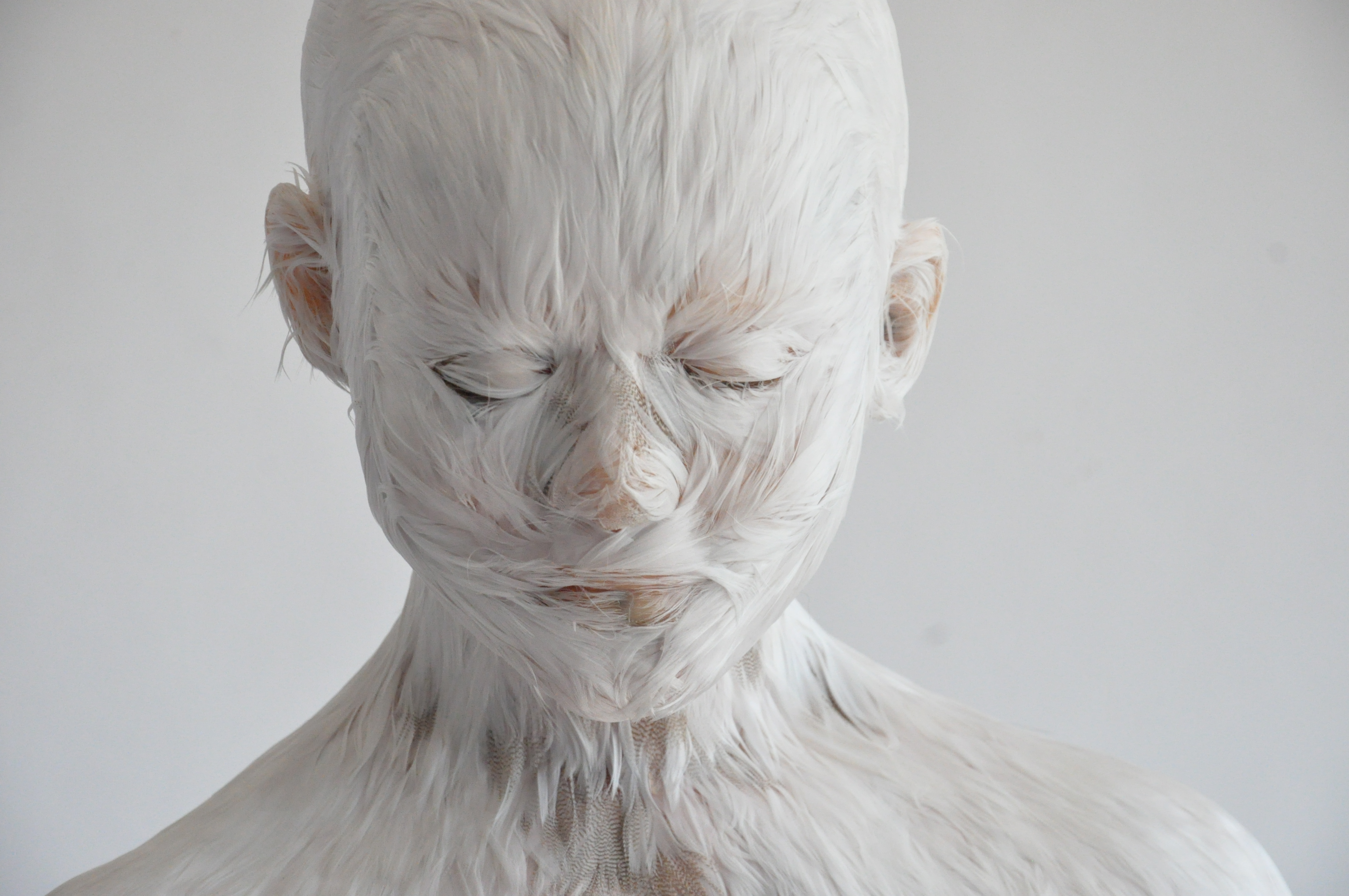
Glendinning, Lucy_White Hart (detail)
Lucy Glendinning (British, 1964–), White Hart (detail), 2018. Wax, Jesmonite, timber, duck feathers, 175 × 73 × 58 cm. Photo courtesy of Art and Christianity. [artist’s website]

Here is the list of venues, artists, and artworks:

  • St Michael and All Angels’, Gwernesney, Monmouthshire, Wales: Grace Vessel by Jane Sheppard
  • St Cadoc, Llangattock Vibon Avel, Monmouthshire, Wales: Wiela by Barbara Beyer
  • St Mary the Virgin, Llanfair Kilgeddin, Monmouthshire, Wales: Centre by Steinunn Thórainsdóttir
  • St Jerome, Llangwm Uchaf, Monmouthshire, Wales: White Hart by Lucy Glendinning
  • St David, Llangeview, Monmouthshire, Wales: Compendium by Andrew Bick
  • Dore Abbey, Herefordshire, England: Life/Blood by Lou Baker
  • Castle Chapel, Urishay, Herefordshire, England: Simmer Down I by Robert George

Art + Christianity is offering a weekend retreat September 13–15, based in Abergavenny, that will include a guided minibus tour (led by the curator) to all seven sites, a lecture by Fr. Jarel Robinson-Brown titled “Living Stones: Buildings, Bodies and Spirit,” a presentation and panel discussion on curating and organizing art in rural churches and chapels, and a performance by Holly Slingsby, Felled, Yet Unfurling, that draws on the iconography of the Tree of Jesse. (St Mary’s Priory in Abergavenny houses an extraordinary fifteenth-century oak carving of the Old Testament figure of Jesse that once formed the base of an elaborate sculpture depicting Jesus’s ancestry; to contextualize this artwork, in 2016 a Jesse Tree Window designed by Helen Whittaker was installed in the church’s Lewis Chapel.) Ticket pricing starts at £35 and does not include accommodations.

+++

VIDEO: “Art and Transcendence: Alfonse Borysewicz”: This month the Templeton Religion Trust released a new video profile on Brooklyn-based artist Alfonse Borysewicz (pronounced Boruh-CHEV-itz), a 2022 recipient of a Templeton Foundation Grant on the topic of “Art and Transcendence,” part of the foundation’s Art Seeking Understanding initiative [previously].

“As religious affiliation declines, can art provide fresh ways of exploring the questions posed by theology?” Borysewicz asks. “Might art—its creation as well as reception—lead to the discovery of new spiritual information? What do faith traditions lose when they overemphasize the written word and neglect the role of images?

“Historically, faith traditions have focused on both the written word and images as sources of knowledge and meaning. Some would claim that words have taken undue precedence as theologies have developed, while images seem to have been left behind. Has this shift in focus left us wanting?”

Borysewicz, Alfonse_Pomegranate
Alfonse Borysewicz (American, 1957–), Pomegranate, 2010–11. Oil and wax on linen, 70 × 50 in. The artist said, “When I see a pomegranate at the market, I see it as a visible sign of the resurrection of Christ; or a hive, the community of Christ.”

+++

SONGS:

>> “Kasih Tuhan” (God’s Love) by Abraham Boas Yarona, performed by Prison Akustik: This video shows, from what I can gather, a group of inmates from Lapas Abepura (Abepura Prison) in Papua, Indonesia, playing and singing an Indonesian Christian song together. It’s one of many lagu rohani (spiritual songs) uploaded to the Prison Akustik YouTube channel (the group is also active on Instagram and TikTok).

>> “Del amor divino, ¿quién me apartará?” (Who Can Separate Me from the Love of God?) by Enrique Turrall and José Daniel Verstraeten, performed by Coro del Seminario Internacional Teológico Bautista: Based on Romans 8:31–39, the lyrics of “Del amor divino” are by Enrique Turrall (1867–1953) of Spain, and the music is by José Daniel Verstraeten (b. 1935). The song was performed in 2018 by a vocal and instrumental ensemble from Seminario Internacional Teológico Bautista (International Baptist Theological Seminary) in Buenos Aires [previously], under the direction of Constanza Bongarrá. The instrumentalists are Jimena Garabaya (guitar), Marcelo Villanueva (charango), and Samy Mielgo (bombo). [HT: Daily Prayer Project]

>> “Caritas abundat in omnia” (Love Aboundeth in All Things) with “O virtus Sapientie” (O Virtue of Wisdom) by Hildegard of Bingen, sung by St. Stanislav Girls’ Choir of the Diocesan Classical Gymnasium, feat. Julija Skobe: Combining two Latin antiphons by the medieval German polymath Hildegard of Bingen [previously], who wrote both the words and music, this song is performed a cappella inside St. Joseph’s Church in Ljubljana, Slovenia, by a student choir with some forty singers between the ages of sixteen and nineteen, directed by Helena Fojkar Zupančič. Mesmerizing! Turn on closed captioning for English subtitles, or see here and here.

Easter, Day 4: “I come to my garden”

LOOK: (She thought he was) The Gardener by Helen Sherriff

Sheriff, Helen_The Gardener
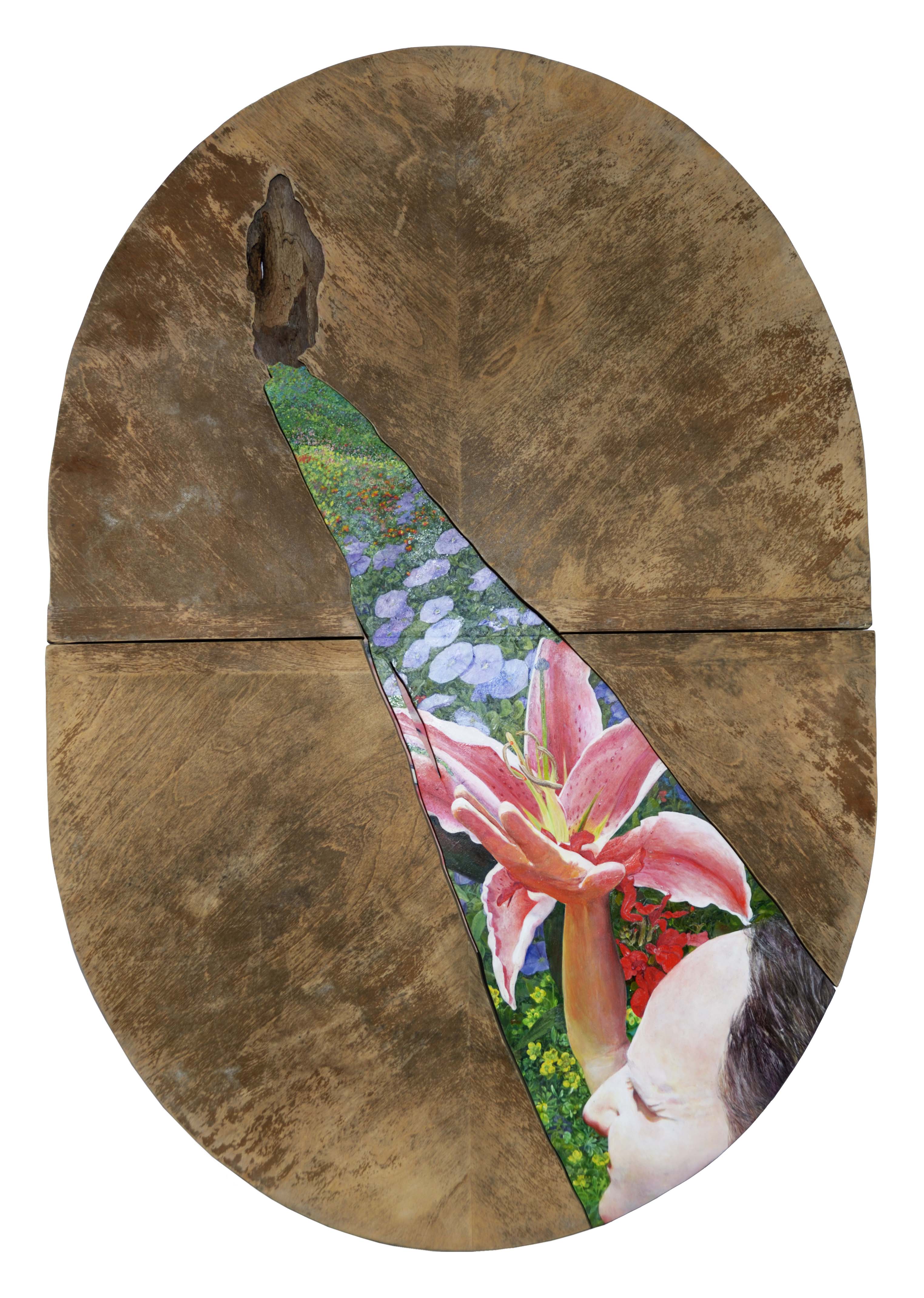
Helen Sherriff (Australian, 1951–), (She thought he was) The Gardener, 2013. Acrylic and oil on found medium-density fiberboard tabletop with parquetry veneer and bark insert, 15 × 10.7 cm.

This painting by Helen Sherriff, which won the Needham Religious Art Prize in 2013, shows Christ appearing to the forlorn Mary Magdalene after his resurrection. Sheriff cut the figure of Christ out of the MDF substrate and “inserted a piece of thick tree bark which had a scar in an appropriate place suggesting a wound,” she writes at ArtWay.eu.

The colorful flowering cast forth from his form is such a unique way to visually interpret the significance of this moment of encounter. “Normally there would be a shadow stretching forward,” Sherriff says, “but this darkness is light.”

Sherriff also notes how the shape of the Stargazer lily is echoed by Mary’s hand held up to shield her face from the brightness.

LISTEN: “J’entre dans mon jardin” (I Come to My Garden) by the Choeur des Moines de l’abbaye de Keur Moussa au Sénégal, on L’heure vient (2007)

This instrumental piece, an air for kora (traditional calabash harp-lute) and recorder, is part of the Liturgy of the Resurrection at Keur Moussa Abbey in Senegal. Its title is taken from Song of Songs 5:1:

I come to my garden, my sister, my bride;
    I gather my myrrh with my spice;
    I eat my honeycomb with my honey;
    I drink my wine with my milk.

Eat, friends, drink,
    and be drunk with love.

The liner notes for this track on the CD sleeve, which are all in French, say, “Christ, in the Christian tradition, is the Bridegroom. He comes, resurrected on Easter morning, to meet Mary Magdalene, seated at the entrance to the tomb. The kora and the flute convey the joy of this Easter reunion with freshness and brightness.”

On Saturday I shared an example of another Christian musician who has linked the Song of Songs to the Easter story.

To learn more about the music making of the Keur Moussa community of brothers, read the 2022 New Yorker profile “The Monks Who Took the Kora to Church” by Julian Lucas, or the blog feature I published in 2017. I also shared their musical setting of the “Vidi aquam” in Wolof last Easter, along with a wood-carved candlestand by Thomas Mpira of Malawi.

Easter, Day 3: Why Are You Weeping?

Early on the first day of the week, while it was still dark, Mary Magdalene came to the tomb and saw that the stone had been removed from the tomb. . . . [She] stood weeping. . . .

As she wept, she bent over to look into the tomb, and she saw two angels in white sitting where the body of Jesus had been lying, one at the head and the other at the feet. They said to her, “Woman, why are you weeping?”

She said to them, “They have taken away my Lord, and I do not know where they have laid him.” When she had said this, she turned around and saw Jesus standing there, but she did not know that it was Jesus.

Jesus said to her, “Woman, why are you weeping? Whom are you looking for?”

Supposing him to be the gardener, she said to him, “Sir, if you have carried him away, tell me where you have laid him, and I will take him away.”

Jesus said to her, “Mary!”

She turned and said to him in Hebrew, “Rabbouni!” (which means Teacher).

Jesus said to her, “. . . Go to my brothers and say to them, ‘I am ascending to my Father and your Father, to my God and your God.’”

Mary Magdalene went and announced to the disciples, “I have seen the Lord,” and she told them that he had said these things to her.

—John 20:1, 11–18

LOOK: ‘Woman, Why Are You Weeping?’ by Rebekah Pryor

Pryor, Rebekah_Woman, Why Are You Weeping
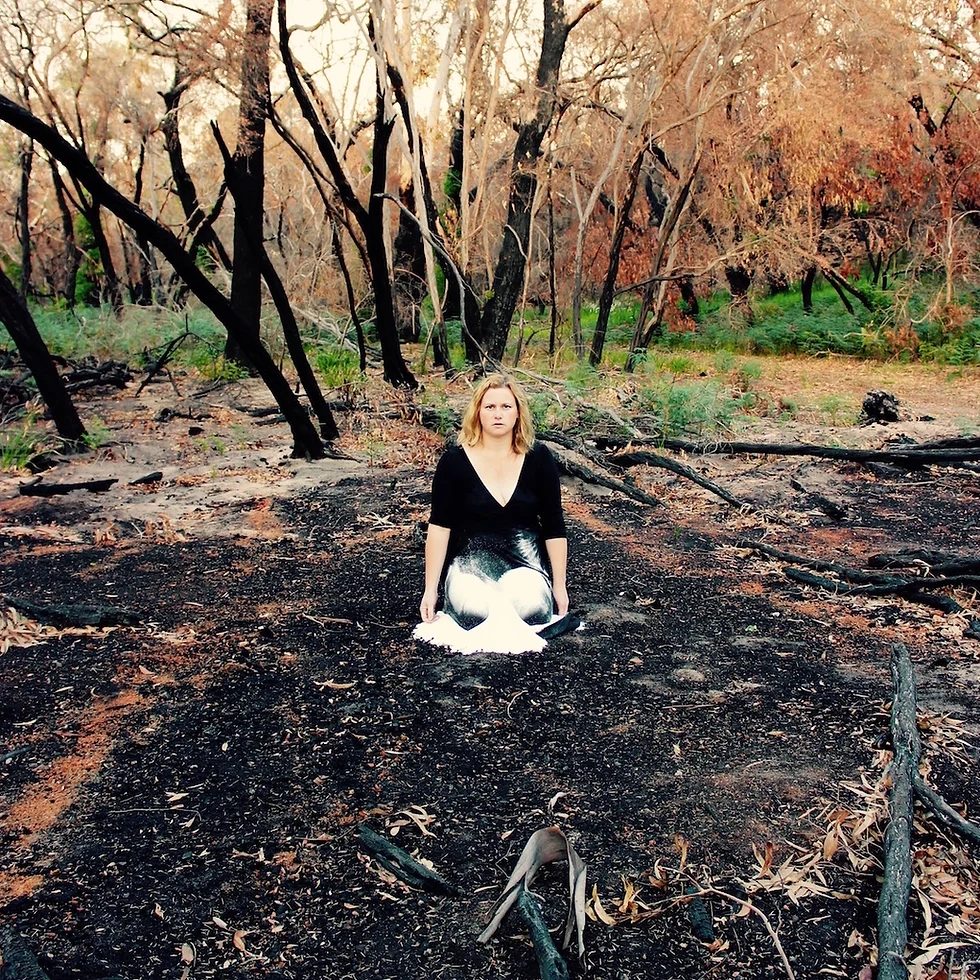
Rebekah Pryor, ‘Woman, Why Are You Weeping?’, 2016. Pigment on archival cotton rag, 60 × 59 cm.

Dr. Rebekah Pryor [previously] is a visual artist, curator, scholar, and member of Australian Collaborators in Feminist Theologies. In this photograph of hers, she poses as Mary Magdalene in the garden of the resurrection at the moment when the risen Christ appears to her. Having wept copious tears, represented by the mounds of salt in front of her, Mary kneels in the soil as she converses with this man whom she at first supposes to be the gardener. Pryor writes that “dawn light and the horizon of regrowth suggest the possibility of ‘a new heaven and a new earth’ in which death, dying, mourning and crying will be no more (Revelation 21:1-5).”

LISTEN: “Still Thy Sorrow, Magdalena!” | Original Latin words (title: “Pone luctum Magdalena”) attributed to Adam of St. Victor, 12th century; English translation by Edward A. Washburn, 1868 | Music by Jon Green, 2023 | Performed on Resurrect, vol. 2, a Cardiphonia Music compilation

Still thy sorrow, Magdalena!
Wipe the teardrops from thine eyes;
Not at Simon’s board thou kneelest,
Pouring thy repentant sighs.
All with thy glad heart rejoices;
All things sing, with happy voices,
Hallelujah! Hallelujah! Hallelujah!

Laugh with rapture, Magdalena!
Be thy drooping forehead bright:
Banished now is every anguish,
Breaks anew thy morning light.
Christ from death the world hath freed;
He is risen, is risen indeed:
Hallelujah! Hallelujah! Hallelujah!

Joy! exult, O Magdalena!
For he hath burst the rocky prison.
Ended are the days of darkness:
Conqueror hath he arisen.
Mourn no more the Christ departed;
Run to welcome him, glad-hearted:
Hallelujah! Hallelujah! Hallelujah!

Lift thine eyes, O Magdalena!
See! thy living Master stands;
See his face, as ever, smiling;
See those wounds upon his hands,
On his feet, his sacred side—
Gems that deck the Glorified:
Hallelujah! Hallelujah! Hallelujah!
Live, now live, O Magdalena!

This medieval Easter hymn was retuned by Jon Green, a Texan living in Edinburgh, Scotland, as part of a Cardiphonia project spearheaded by Bruce Benedict to bring new life to some of the old texts found in Resurgit: A Collection of Hymns and Songs of the Resurrection (Boston, 1879). The lyrics follow a longstanding tradition in the church of conflating the identities of two Marys in the Gospels (Mary of Magdala and Mary of Bethany) and that of the “sinful woman” in Luke 7; all three women become Mary Magdalene, characterized as a penitent who scandalously anoints Christ’s feet with expensive perfume and her own tears during a supper at the house of Simon the Pharisee.

None of the Gospels indicates that this anointer was Mary Magdalene. (Matthew, Mark, and Luke do not name her at all, and John identifies her as the sister of Lazarus and Martha.) But popular tradition ascribes to Mary Magdalene this role—hence the references in the first stanza of the hymn.

What we do know, though, is that Mary Magdalene came early Sunday morning to Jesus’s tomb with the intention of anointing his body, only to find the tomb empty. John 20 is, I think, one of the most glorious chapters in all of scripture. John’s is the only Gospel that recounts Mary’s intimate encounter with the postresurrection Jesus. He tells us that she is distraught over the absence of Jesus’s body, which she presumes someone moved to some unknown location. She had wanted to say her proper goodbyes—he had been taken so suddenly—and, as a gesture of honor, to finish the job of treating his corpse with myrrh and aloes that had been hastily performed by Joseph and Nicodemus on Friday. Now unable to do either, she weeps.

It’s then that Jesus comes to her, alive and in the flesh, revealing himself as her Lord and as conqueror of the grave. He bids her to weep no more.

The gladness of this moment is palpable in the hymn text by Adam of St. Victor. “Laugh with rapture, Magdalena! . . . Joy! exult . . . ! . . . Live, now live.” We are called to do the same.

Roundup: Call for art, Nepali worship song, Magdalene triptych, and more

CALL FOR ART: Light in the Dark, Sojourn Arts: Sojourn Arts, a ministry of Sojourn Midtown church in Louisville, Kentucky, is accepting entries for wall-hung visual artworks on the theme “Light in the Dark” for its juried art show this Advent and Christmas. It is free to enter (see email submission instructions at link), but selected artists will be responsible for shipping costs to the venue. Three cash prizes will be awarded. Deadline: October 8, 2023. Open to continental US artists only.

Light in the Dark
background image by Steven Homestead

+++

SONGS:

>> “O My Hope (A Prayer of Saint Isaac the Syrian)” by Symon Hajjar: Symon Hajjar is a singer-songwriter from Tulsa, Oklahoma. I love, love, love his setting of this passage (lightly adapted from an English translation by Sebastian Brock) from the writings of Isaac the Syrian, a seventh-century theologian from Mesopotamia. Because the song would work well for Epiphany, Hajjar released it as the final track on his album Finally Christmas (2015), although it’s not available on Bandcamp as all the other tracks are.

O my Hope, pour into my heart the inebriation that consists in the hope of you. O Jesus Christ, the resurrection and light of all worlds, place upon my soul’s head the crown of the knowledge of you, and open before me suddenly the door of mercies; cause the rays of your grace to shine out in my heart. . . . I give praise to your holy nature, Lord, for you have made my nature a sanctuary for your hiddenness, a tabernacle for your mystery, a place where you can dwell, a holy temple for yourself.

[see Isaac of Nineveh (Isaac the Syrian): ‘The Second Part’, Chapters IV-XLI, pp. 14–15, 8]

Currently, Hajjar writes and performs kids’ songs under the name Hot Toast Music.

>> “Mahima Mariyeko Thumalaai” (महिमा मारिएको थुमालाई) (Glory to the Lamb Who Was Slain), arranged and performed by Psalms Unplugged: This song is #505 from Nepali Khristiya Bhajan, the definitive Nepali-language hymnal; the words are by Rev. Solon Karthak, and the music is by the late Kiran Kumar Pradhan, the most influential writer of Nepali hymns, who was particularly active in the 1990s. Inspired by Revelation 5:12, its refrain translates to “Glory to the Lamb who was slain / Praise to the Lord of lords / Shouts to the King of kings.” Read the original Nepali lyrics here.

The musicians who form the Nepali worship collective Psalms Unplugged are extraordinary. In this video are Subheksha Rai Koirala (vocals), John Rashin Singh (flute), Ayub Bhandari (keys), Sagar Pakhrin (guitar), and Enosh Thapa Magar (drums). The group’s mission is to see the transformation of lives through the preservation, cultivation, and spread of Nepali Christian music.

+++

LECTURE: “Janet McKenzie’s Women: Mothers, Midwives, and Missionaries” by Sister Barbara E. Reid, OP, September 27, 2015, Catholic Theological Union, Chicago: In this lecture, New Testament scholar Barbara Reid, OP, discusses three painted artworks by Janet McKenzie featuring women of the Bible, all in the collection of Catholic Theological Union: The Succession of Mary Magdalene, a triptych that shows Mary Magdalene deaconing with Susanna and Joanna (Luke 8:1–3), seated with Jesus Christ, her commissioning teacher (John 20:17), and preaching the Resurrection to Peter and John (John 20:2–9, 18); Mary with the Midwives, showing the Mother of God in the early stages of labor; and one of McKenzie’s most reproduced images, Epiphany, which replaces the traditional three wise men with wise women!

Mary Magdalene triptych (Janet McKenzie)
Janet McKenzie, The Succession of Mary Magdalene (triptych), 2008. Left to right: Companion; The One Sent; Apostle of the Apostles. Collection of Catholic Theological Union, Chicago.

Professor Reid’s talk starts at 13:55. Before that, there is an introduction by Barbara Marian from Harvard, Illinois, who commissioned the paintings and donated them to CTU (“The giftedness of women and our call to minister in the church must be made visible, no longer hidden or ignored and devalued,” she says), and by CTU President Mark Francis, CSV. Because the feast day of Mary Magdalene is coming up on July 22, it’s a particularly apt time of the liturgical year to share this!

+++

VIDEO: “12 Ways to Be a Christian” by SALT Project: The nonprofit production company SALT Project creates beautiful short films for churches and other clients. In sixty seconds, this one lists (and visualizes) twelve practical ways of living Christianly. The video is fully customizable to include your church’s name, logo, worship times, and website; click here for prices.

“Resurrection” by W. R. Rodgers (poem)

Kuziv, Kateryna_Mary
Kateryna Kuziv (Ukrainian, 1993–), Mary!, 2022. Egg tempera and gilding on gessoed wood, 40 × 40 cm.

In the end of the Sabbath, as it began to dawn towards the first day of the week, came Mary Magdalene.

The tomb, the tomb, that 
Was her core and care, her one sore.
The light had hardly scarleted the dark
Or the first bird sung when Mary came in sight
With eager feet. Grief, like last night’s frost,
Whitened her face and tightened all her tears.
It was there, then, there at the blinding turn
Of the bare future that she met her past.
She only heard his Angel tell her how
The holding stone broke open and gave birth
To her dear Lord, and how his shadow ran
To meet him like a dog.
And as the sun
Burns through the simmering muslins of the mist,
Slowly his darkened voice, that seemed like doubt,
Morninged into noon; the summering bees
Mounted and boiled over in the bell-flowers.
‘Come out of your jail, Mary,’ he said, ‘the doors are open
And joy has its ear cocked for your coming.
Earth now is no place to mope in. So throw away
Your doubt, cast every clout of care,
Hang all your hallelujahs out
This airy day.’

This is the last of fourteen untitled, epigraphed poems from “Resurrection: An Easter Sequence” by W. R. Rodgers, originally published in Europa and the Bull and Other Poems (Farrar, Straus and Young, 1952) and compiled posthumously in Collected Poems (Oxford University Press, 1971) and later Poems, ed. Michael Longley (The Gallery Press, 1993). Used with permission of The Gallery Press.

William Robert “Bertie” Rodgers (1909–1969) was an Irish poet, essayist, radio broadcaster and scriptwriter, lecturer, and (for eleven years) a pastor. Born, raised, and educated in Belfast, he studied literature as an undergraduate and then entered theological college, becoming ordained as a Presbyterian minister in 1935 and taking a post at Loughgall parish in County Armagh. He began writing poetry three years later, after a friend lent him books by contemporary poets, of whom Auden made the biggest impact. In 1946 he left pastoral ministry to work for the BBC in London and later to freelance, creating radio portraits of Irish writers using a pioneering sound mosaic technique that is now a staple of radio documentaries. He joined a community of writer friends that included Dylan Thomas and Louis MacNeice. During his lifetime he published two books of original verse, with themes including the landscape of Northern Ireland, war, myth, erotic love, and the life of Christ.

Easter, Day 2: When the Sabbath was past…

LOOK: The Three Marys by Henry Ossawa Tanner

Tanner, Henry Ossawa_The Three Marys
Henry Ossawa Tanner (American, 1859–1937), The Three Marys, 1910. Oil on canvas, 42 × 50 in. Fisk University Art Galleries, Nashville, Tennessee.

Based on Mark 16:1–4, this painting shows Mary Magdalene (leading the way), Mary the mother of James, and Salome approaching the tomb of their rabbi, Jesus, the Sunday after his crucifixion. They came bearing spices to anoint his body. They expected it to be a mournful day.

Imagine their response when they found the stone rolled away and the tomb empty! That’s the moment the artist Henry Ossawa Tanner shows us here. Not the Resurrection itself, but the emotional reaction to it, or rather to the evidence of it.

What do you read on the faces of these women? Surprise? Confusion? Fear? Curiosity? Caution? Wonder? Love? Some mix thereof?

They are illumined by the light of an angel who is out of frame and who will speak the news to them presently. Mary Magdalene lifts her hand to her face in a gesture of self-reassurance, while her companion raises her tensed arms at the elbow in a defensive posture, as I read it. Compelled but still somewhat guarded, they progress toward the mystery.

Born and raised the son of a minister in the AME Church in Pennsylvania, Henry Ossawa Tanner (1859–1937) was an African American expat to Paris whose biblical paintings, inspired in part by his two trips to the Holy Land, garnered him international acclaim. In Beholding Christ and Christianity in African American Art, art historian James Romaine identifies Tanner as “the most artistically gifted and theologically astute American painter of biblical subjects.” A master of conveying nuanced mystery, “Tanner paints personal experiences rather than public spectacles,” Romaine writes, communicating more through suggestion than depiction and urging the viewer to undergo, like the figures in his paintings, their own experience of spiritual sight.

LISTEN: “Dum transisset Sabbatum” (When the Sabbath was past) | Text: Mark 16:1–2 | Music by John Taverner, 1520s | Performed by Alamire, 2010

Dum transisset Sabbatum, Maria Magdalene et Maria Jacobi et Salome emerunt aromata ut venientes ungerent Jesum. Alleluia.

Et valde mane una sabbatorum veniunt ad monumentum orto iam sole.

Gloria Patri et Filio et Spiritui Sancto.

English translation:

And when the sabbath was past, Mary Magdalene, and Mary the mother of James, and Salome, had bought sweet spices, that they might come and anoint him. Alleluia.

And very early in the morning the first day of the week, they came unto the sepulcher at the rising of the sun.

Glory be to the Father, and to the Son, and to the Holy Ghost.

The third responsory at Matins on Easter Sunday, this text has been set to music by many composers. The motet by English Renaissance composer John Taverner is the most famous. The video above is just an excerpt. The full piece lasts about eight minutes and alternates between plainchant and polyphony.

This song is on the Art & Theology Eastertide Playlist.

Holy Monday: Anointing at Bethany

LOOK: Intimacy of the Heart by Laura Makabresku

Makabresku, Laura_Intimacy of the Heart (7)
Laura Makabresku (Polish, 1987–), Intimacy of the Heart (7), 2020

Makabresku, Laura_Intimacy of the Heart (8)
Laura Makabresku (Polish, 1987–), Intimacy of the Heart (8), 2020

LISTEN: “Mary” by the Brothers of Abriem Harp, on Last Days (2015) [reviewed here]

Mary, my dear, come over here
Tell me, is it true what they say?
Mary, my dear, let go of your fear
And bring your gift to me, I pray
Let your heart rest with mine
I don’t have much time
So break your fragrance free, my dear

Let your tears fall on me
Brush your hair on my feet
Let your alabaster tears fall on me
Fall on me

Overflow, overflow
And go where you go
Let this fragrance fill the air with love divine
Love divine

Fill the air, fill the air
Let your heart beat with mine
Let this fragrance fill the air with love divine
Love divine

Mary, my dear, bring yourself near
Let your heart beat with mine, my dear

Makabresku, Laura_Intimacy of the Heart (10)
Laura Makabresku (Polish, 1987–), Intimacy of the Heart (10), 2020

Roundup: Feast of Mary Magdalene; holiness of people and place; black squares

Richardson, Jan_The Hours of Mary Magdalene
The Hours of Mary Magdalene by Jan L. Richardson

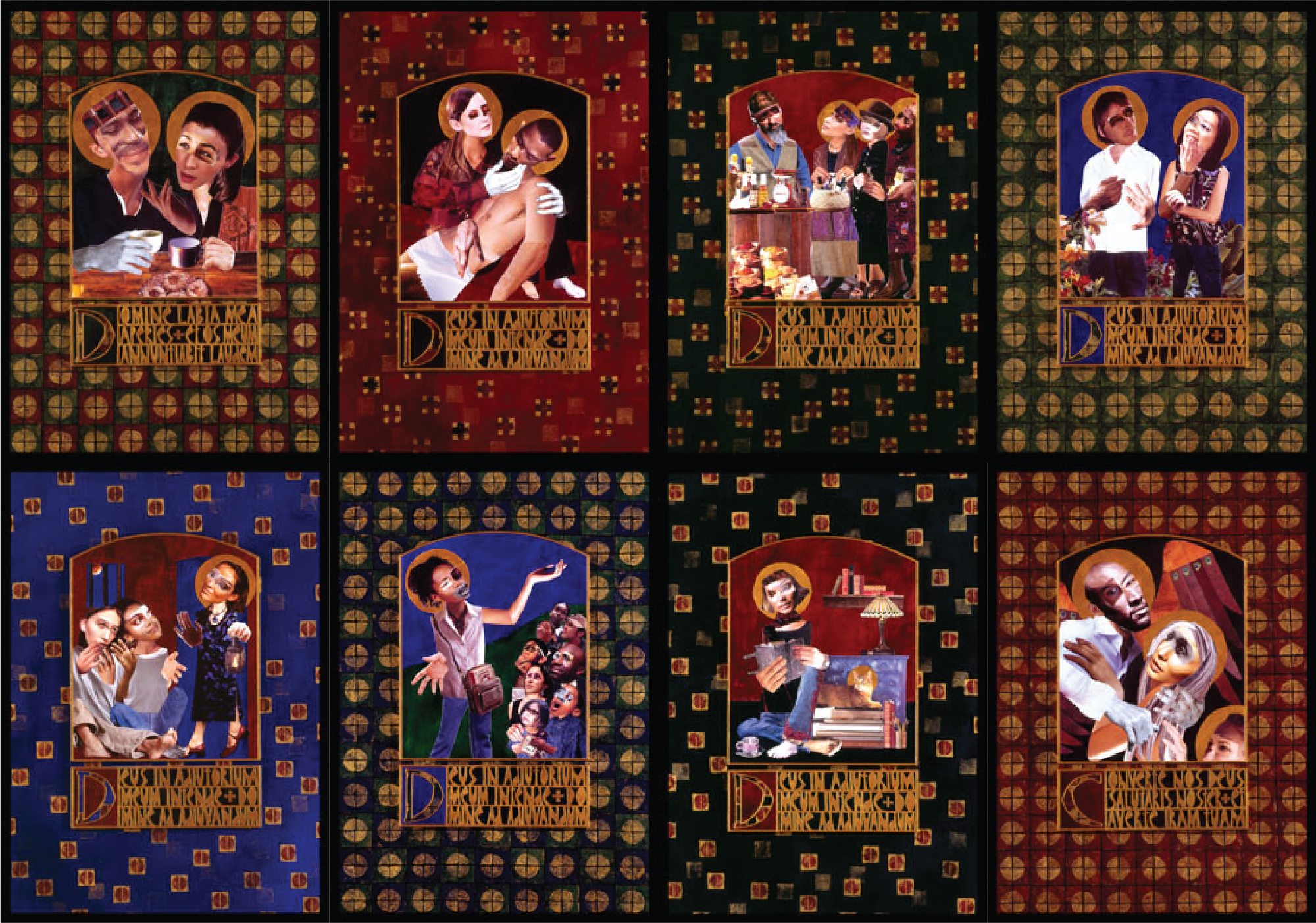
ART CYCLE: The Hours of Mary Magdalene by Jan L. Richardson: July 22 is the feast day of Mary Magdalene, one of Jesus’s closest disciples and the first witness and preacher of the Resurrection. American artist, writer, and minister Jan L. Richardson created a sequence of collages picturing events from her life, drawing on both the biblical narratives and medieval legends. The structure and presentation (decorative borders, Latin script) were inspired by medieval books of hours, used for the praying of the Divine Office. The text below each image reads, Deus, in adiutorium meum intende; Domine, ad adiuvandum me festina (“O God, come to my assistance; O Lord, make haste to help me”), the first verse of Psalm 70, which is prayed at the start of each of the canonical hours.

According to legend, after Jesus’s ascension Mary Magdalene moved to southern France, where she preached the gospel and performed miracles. The last thirty years of her life she lived as a hermit in a cave. Each time she prayed the hours, she was lifted up to heaven by angels, then brought back down at the end of her devotions.

Richardson put together a delightful little video showcasing the art cycle as well as the song “Mary Magdalena” by her late husband, Garrison Doles.

You can purchase these images as digital downloads from Richardson’s website:

  1. Matins: The Blessing Cups: Mary Magdalene and Jesus at Tea
  2. Lauds: After the Cross: The Magdalene’s Farewell
  3. Prime: Shopping for Spices: The Three Marys on Holy Saturday
  4. Terce: Touch Me Not: Resurrection Morning
  5. Sext: Release: Mary Magdalene Freeing Prisoners
  6. None: L’Evangeliste: Mary Magdalene Preaching in France
  7. Vespers: At Her Prayers: Mary Magdalene with a Book of Hours
  8. Compline: Magdalene Ascending: The Divine Hours

+++

DANCE: “Holy, Holy, Holy”: Choreographed by Betsey Beckman to a song by Karen Drucker, this dance number affirms the sacredness of every human being. It was filmed inside St. Gregory of Nyssa Episcopal Church in San Francisco, a church that “invites people to see God’s image in all humankind, to sing and dance to Jesus’ lead, and to become God’s friends.” Beckman dances with Dawon Davis and Corey Action throughout the worship space, which comprises a rectangular room where the Liturgy of the Word is celebrated and an octagonal rotunda for the Liturgy of the Table. The Dancing Saints icon that covers the walls is by Mark Doox. [HT: Global Christian Worship]

+++

MUSIC:

>> “Locus iste” by Anton Bruckner, performed by VOCES8: The British vocal ensemble VOCES8 performs Anton Bruckner’s sacred motet “Locus iste” (This Place) at Les Dominicains de Haute-Alsace in Guebwiller, France. Bruckner composed it in 1869 for the dedication of the Votivkapelle (votive chapel) at the New Cathedral in Linz, Austria, where he had been a cathedral organist. The text—a Latin gradual for church dedications and their anniversaries—is informed by Jacob’s saying, after his dream of the ladder uniting heaven and earth, that “surely the Lord is in this place; and I knew it not” (Gen. 28:16), and by the story of the burning bush where Moses is told to “put off thy shoes from off thy feet, for the place whereon thou standest is holy ground” (Exod. 3:5).

Locus iste a Deo factus est,
inaestimabile sacramentum;
irreprehensibilis est.

This place is made by God,
a priceless sacrament;
it is without reproach.

(Or, alternatively:)
This dwelling is God’s handiwork;
a mystery beyond all price,
that cannot be spoken against.

>> “Tabernacle” by Josh Rodriguez, performed by Mary Vanhoozer: A modernist piano composition inspired by Psalm 19, dedicated to the composer’s father-in-law, the theologian Kevin Vanhoozer.

Tabernacle is a musical triptych shaped by the drama of Psalm 19. While this word, tabernacle, is loaded with religious affection within both Jewish and Christian traditions, some modern readers may not be familiar with its implications. Merriam-Webster offers three related definitions: “a house of worship, a receptacle for the consecrated elements of the Eucharist, or a tent sanctuary used by the Israelites during the Exodus.” By extension, it has come to represent a “dwelling place” or a “temporary shelter.” In short, this is no ordinary space, rather it is a place that is set apart, made holy for a terrifying transformative encounter with the Divine.

Fragments of a prayerful hymn-like melody appear underneath this canopy of sounds. Shifting metric changes, polyrhythms, and percussive primal-sounding harmonies climax in a loud, noisy quote from the 16th-century Genevan Psalter.

More extensive program notes can be found in the YouTube video description.

+++

ESSAY: “Precedents of the Unprecedented: Black Squares Before Malevich” by Andrew Spira, Public Domain Review: Considered one of the seminal works of modern art, Kazimir Malevich’s Black Square (1915) has been cast as a total break from all that came before it. Yet searching across more than five hundred years of images related to cosmology, religious devotion, mourning, humor, politics, and philosophy, art historian Andrew Spira uncovers a slew of unlikely foreshadows to Malevich’s radical abstraction.

Et sic in infinitum
Robert Fludd’s black square representing the nothingness that was prior to the universe, from his Utriusque Cosmi (1617). On each side of the square is written “Et sic in infinitum…” (“And so on to infinity…”).

Blood of Christ
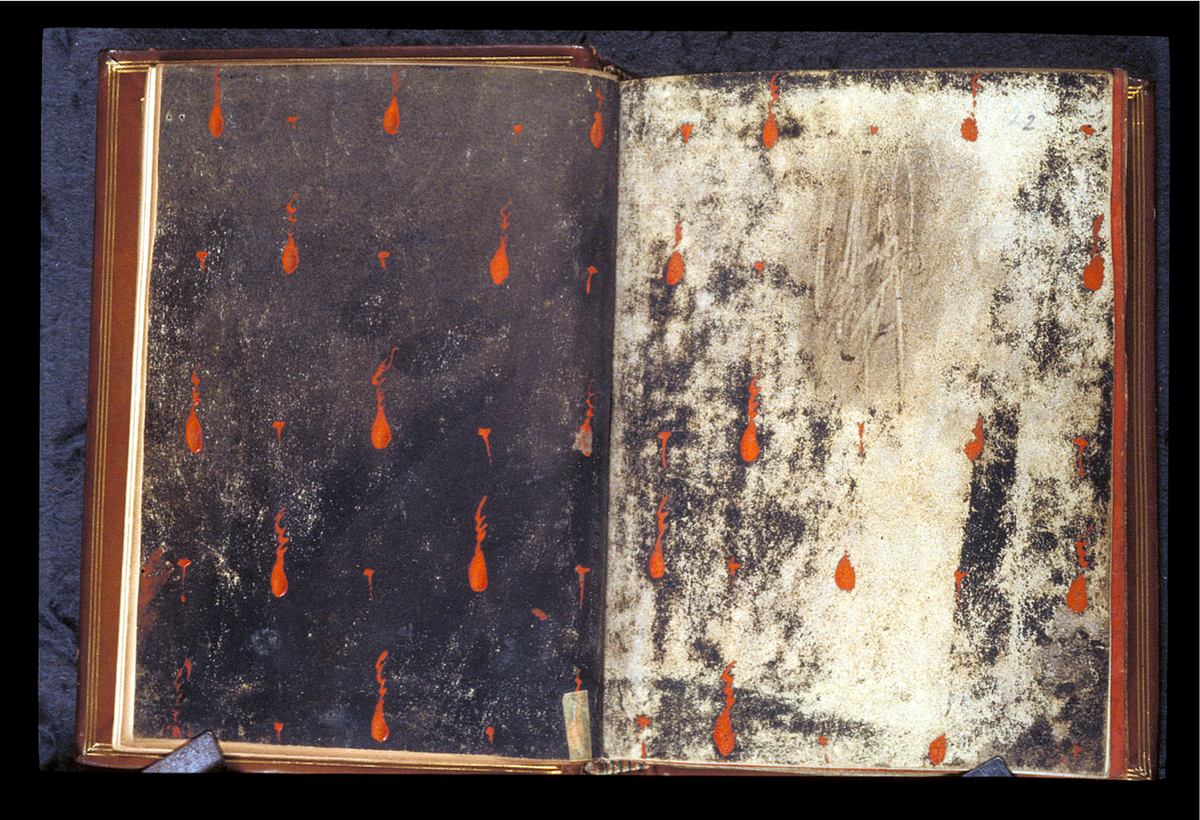
Black pages with red drops of blood, signifying the wounds of Christ, from a psalter and rosary of the Virgin, ca. 1500. The recto is worn from devotional engagement, damaged through kissing and rubbing, perhaps.

For a much more extensive treatment of the topic, see Spira’s Foreshadowed: Malevich’s “Black Square” and Its Precursors, published this month. And for a faith-positive (non-nihilistic) reading of Malevich’s Black Square that honors the artist’s own views, see pages 209–25 of Jonathan A. Anderson and William A. Dyrness’s Modern Art and the Life of a Culture, where they discuss the work in relation to the Russian icons tradition and “apophatic or ‘negative’ theology—a mode of theology that meditates on the absolute Fullness and Otherness of God by way of negating the verbal, visual and conceptual forms used to signify (and to ‘grasp’) God” (220).

Easter, Day 6

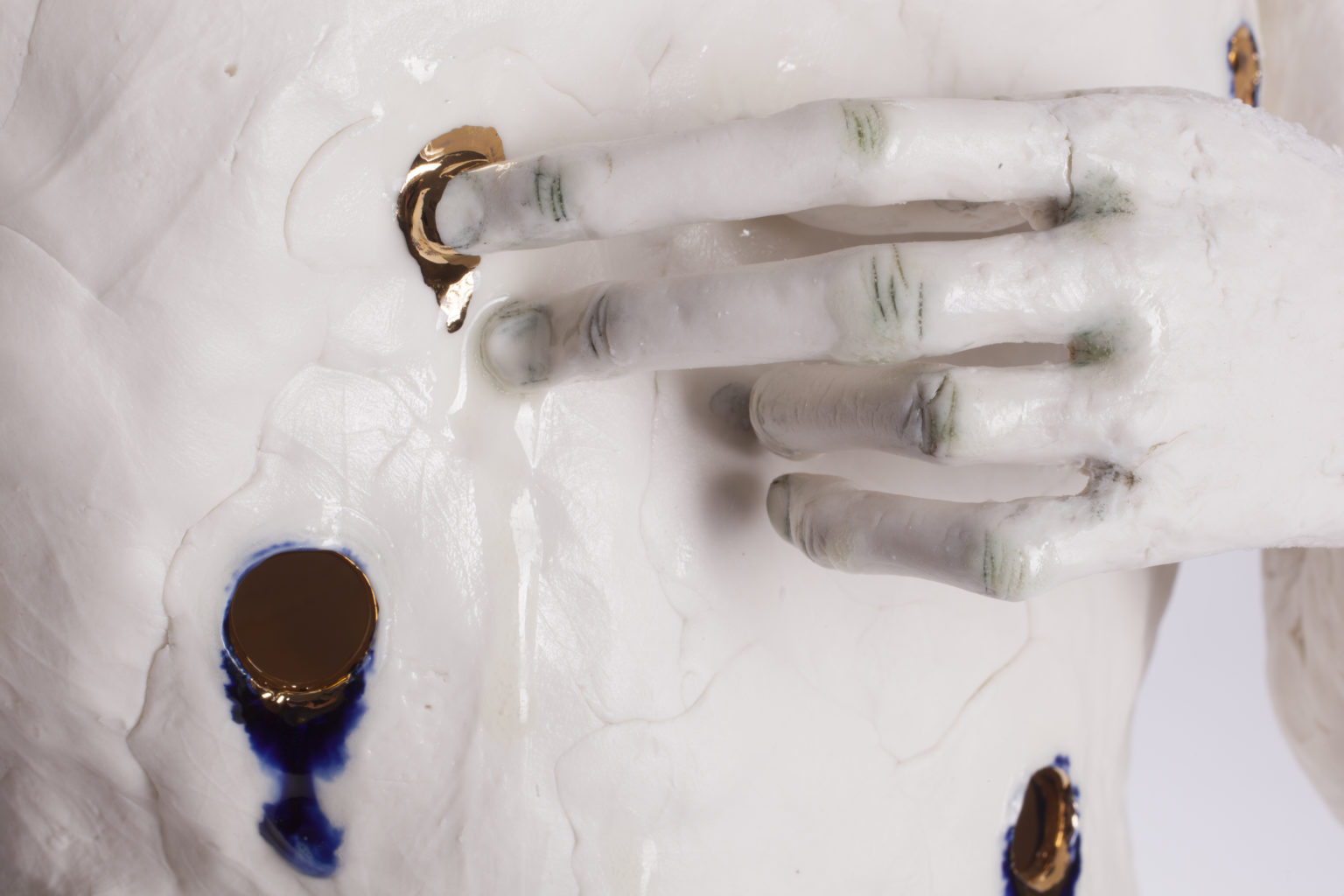
LOOK: Empty Tomb (detail) by Claire Curneen

Curneen, Claire_Empty Tomb (detail)
Claire Curneen (Irish, 1968–), Empty Tomb (detail), 2018. Porcelain, h. 31 inches.

I encountered this striking image on the cover of Image no. 97 (Summer 2018). I’ve not been able to find a photograph of the full piece, but Curneen created a variation on it last year.

In the article “Beauty in Brokenness: The Sculpture of Claire Curneen,” Richard Davey writes that in Curneen’s body of work,

indications of internal states of transformation or transfiguration are not confined to gold. . . . Recently Curneen has begun to use a deep blue to create a similar effect. Like ultramarine, which was reserved for only the most significant parts of medieval paintings, this blue glaze is used only sparingly, painted onto faces, hands, and other areas where it will have the maximum impact. The effect is dramatic, with faces dissolving into an incorporeal void. For unlike gold, which reflects light, this deep blue holds light, absorbing our gaze into its pellucid depths. Curneen exploited this difference in one of her most recent works, Empty Tomb (2018), where blue and gold ooze from a series of gaping wounds, like the unmingled blood and water that flowed from the side of the dead Christ. With the tip of one finger, this elegiac figure gently points out one of these openings, echoing Saint Thomas, who needed to touch Jesus’s wounded side before he could believe. This gesture is the only moment of animation in a work that is otherwise still, but it is not the focus. That is to be found in the wounds themselves, which stand out starkly against the limpid porcelain. These are the empty tomb of the title, apertures exuding blue and gold, dark and light. They draw us in so that we find our attention focused entirely on these small rings. For a moment, as we teeter on this visual precipice, with solidity melting around us and the figure dissolving into the background, time stands still.

LISTEN: “Empty” by The Sowing Season, on The Fox & the Sparrow (2017)

Oh Mary, why have you come?
Come drop your oils and run
You’ll find no one
Find no one

Oh Thomas, can’t you see?
Where bone and sinew meet
You’ll find a hole
Find a whole

Oh Saul, look down at your hands
All red and dripping in the sand
It’s the wrong blood
The wrong blood

Come find the blood of the Son

Jesus meets people where they’re at: Mary Magdalene in her grief (John 20:11–18), Thomas in his doubt (John 20:24–29), Saul in his murderous zealotry (Acts 9:1–19). And he transforms them. After their encounters with the risen Christ, Mary’s tears give way to joy; Thomas’s doubt transposes into belief; and Saul goes from persecutor of Christians to key apostle, with a ministry of preaching the gospel, planting churches, and writing letters of teaching and encouragement that have become sacred scripture.

The song “Empty” by The Sowing Season reflects Christ’s gentle invitation to behold his transfigured wounds and to move, with him, from death into life.

This song is on the Art & Theology Eastertide Playlist.