Today’s format is a little bit different, in that the visual art and music are part of a singular video piece which also prominently features dance—so, multiple media all wrapped up into one.
Every year in the church calendar, December 28 commemorates the Massacre of the Innocents—the boys of Bethlehem slain by agents of the state, deployed by Herod, who feared the perceived threat they posed. The story is told in Matthew 2:16–18 and quotes the prophet Jeremiah:
A voice was heard in Ramah, wailing and loud lamentation, Rachel weeping for her children; she refused to be consoled, because they are no more.
While the remembrance marks this ancient event specifically, the church also takes the occasion to pray for present-day innocents who have been victimized by the powerful. For example, the collect (succinct prayer) for this day from the Book of Common Prayer reads:
We remember today, O God, the slaughter of the holy innocents of Bethlehem by King Herod. Receive, we pray, into the arms of your mercy all innocent victims; and by your great might frustrate the designs of evil tyrants and establish your rule of justice, love, and peace; through Jesus Christ our Lord, who lives and reigns with you, in the unity of the Holy Spirit, one God, for ever and ever. Amen.
The artists of today’s piece, made in 2019, confront the unjustified killing of Black men in America by police. They do not make the explicit connection to Herod’s massacre, but I do, as I hear, in the many Black mothers who have lost their children to state violence, Rachel weeping and refusing to be comforted. And I see Herod-like rulers who want to silence those wails and reverse the progress made in awareness and reform.
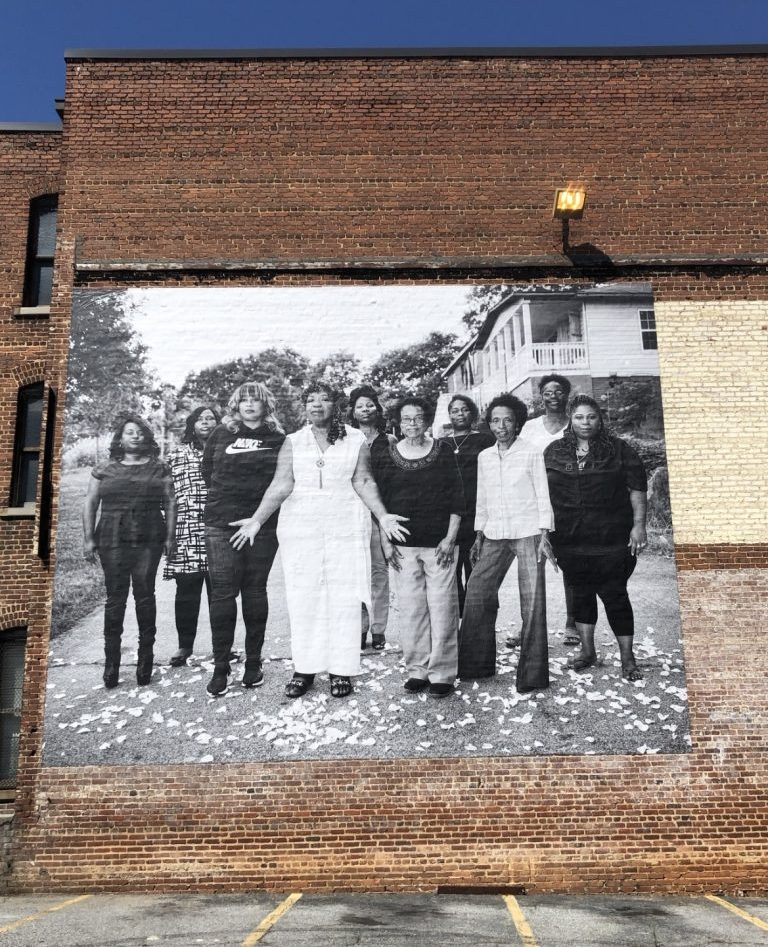
LOOK & LISTEN: The Ritual of Being, a site-specific dance performance by T. Lang in front of the Mothers March On mural by Sheila Pree Bright, 2019
The 2010s was a decade of racial reckoning in America. In response to neighborhood watchman George Zimmerman’s killing of the unarmed Black teen Trayvon Martin and subsequent acquittal, the Black Lives Matter movement was founded in 2013, demanding policing and criminal justice reform and the safety of marginalized Black communities. BLM activism and the continual miscarriages of racial justice that prompt it received ample media coverage all the way through the movement’s peak in 2020 with the murder of George Floyd. That coverage has lessened in the last few years, but the movement is still active, and mothers still bear the wound of their slain children.
In 2019, the lens-based artist Sheila Pree Bright, author of #1960Now: Photographs of Civil Rights Activists and Black Lives Matter Protests, brought together nine mothers who are fighting for justice for their boys whose lives were taken from them by police. She wanted to give them a safe space to talk, and to photograph them. The portrait Mothers March On depicts, from left to right, Tynesha Tilson (mother of Shali Tilson), Wanda Johnson (mother of Oscar Grant), Felicia Thomas (mother of Nicholas Thomas), Gwen Carr (mother of Eric Garner), Monteria Robinson (mother of Jamarion Robinson), Dr. Roslyn Pope (author of An Appeal for Human Rights), Dalphine Robinson (mother of Jabril Robinson), Patricia Scott (mother of Raemawn Scott), Montye Benjamin (mother of Jayvis Benjamin), and Samaria Rice (mother of Tamir Rice).
Sheila Pree Bright (American, 1967–), Mothers March On, 2019. Vinyl-print photo mural installed at 190 Pryor Street, Atlanta, Georgia, 30 × 60 ft. (9.1 × 18.3 m).
Carr, whose son died in the chokehold of an NYPD officer who ignored his cries of “I can’t breathe,” is the focal point of the image, with her arms outstretched and fingers spread. This body language connotes an offering of self to the cause of justice and a readiness to receive it. That her hands are open rather than clenched in a fist indicates unguardedness, while her planted feet indicate firmness.
The woman in glasses beside Carr is Roslyn Pope, who died in 2023. A mother to two daughters, she had not herself lost a child to police violence, but she was part of Mothers March On on account of her seminal civil rights work in Atlanta. In 1960, while serving as president of the student government at Spelman College, she drafted the manifesto An Appeal for Human Rights, announcing the formation of the Atlanta Student Movement, whose campaign of civil disobedience would contribute to the dissolution of racist Jim Crow laws across the region. In a 2020 interview for the sixtieth anniversary of the manifesto’s publication, Pope expressed concern that some of the students’ hard-fought gains were being eroded, telling the Associated Press, “We have to be careful. It’s not as if we can rest and think that all is well.”
The Mothers March On photographic project is about Black women who have witnessed the tragic loss of their children who have fallen to police brutality. . . . This project pays homage to the sacrifices, wisdom, and guidance of Black mothers as nurturers and protectors who are passing on a legacy of determination and love, showing how they are fierce and tender, protective and vulnerable, and strong and soft. I’m honoring the struggles of Black mothers, celebrating the beauty of their strength and resilience. These mothers continue to march on for Human rights for their children to bring attention to the urgent need for police reform and the systemic racism that continues to fuel police brutality against Black bodies since slavery.
Bright’s depiction . . . stresses Black mothers’ memory, determination, love, and corporeality. Through the repetition of standing figures, the portrait insists on the integrity of Black bodily form. The women speak back to lynching culture. With rose petals at their feet, like fallen bodies of their murdered sons, these mothers, on the front-lines of state violence, refuse to relent. They know who and what has been taken from them; they will never forget. . . .
Bright printed the portrait in large scale and pasted it on the side of a brick retail building at 190 Pryor Street in Atlanta, Georgia, near the Georgia State Capitol. Then, for ProtectYoHeART Day in Atlanta, she and the performance artist T. Lang collaborated on a video piece at that site, where T. Lang dances before the mural to the aching instrumental jazz piece “Alabama” by the saxophonist John Coltrane. (Coltrane wrote the music as a memorial for the four girls who were murdered by Ku Klux Klansmen at Sixteenth Street Baptist Church in Birmingham in 1963; learn more here.) Clothed in a fringe dress, T. Lang spins, jerks, reaches, heaves, throws herself against the wall, crouches, withers, bursts, climbs, pulls, and walks forward, movements of grief and struggle capped by resolve.
A temporary installation, the Mothers March On mural is no longer on Pryor Street.
I first learned about Sheila Pree Bright’s photography from a compelling series of hers that I saw at the Wadsworth Atheneum in Hartford, Connecticut, titled Young Americans. In it she invited people across the US between the ages of eighteen and twenty-five to pose with the American flag in whatever way they felt most comfortable. “My practice moves between documentary and conceptual work, from portraiture to constructed realities—always grounded in truth, history, and lived experience,” Bright says.
Mark Cazalet (b. 1964) is a contemporary artist based in London whose work centers on color and balances empiricism and lyricism. He works across media—painting, drawing, printmaking, and (in collaboration with fabricators) stained glass, etched and engraved glass, printed enamel on glass, tapestries, and mosaics. A major part of his career has been fulfilling ecclesiastical commissions and making sacred art. But all of his work, regardless of subject matter, is shot through with a sacramental impulse.
Last year Cazalet made a series of twelve “Advent Stations” that move circuitously through the story of Jesus’s first coming, marked as it was by mystery, vulnerability, risk, and glory. These include modernized versions of scenes you’d find in traditional Infancy of Christ cycles, such as the Annunciation to Mary, the Annunciation to the Shepherds, the Dream of the Magi, and the Flight to Egypt, but also new ones, drawing us into the grand sweep—sometimes rushing, sometimes quiet—of gospel hope. “The overarching theme,” he told me, “is pregnancy, birth, nurturing, waiting, escape, migration, and finally, in the mistle thrush’s morning song, the greeting of the new day’s limitless potential.”
The artist’s choice of substrate is unique: He painted his stations in oil on domestic wooden objects, such as bread boards, meat and cheese boards, children’s lunch trays, washboards, chapati rolling boards, and a baker’s peel. By using these ordinary boards mainly from home kitchens, Cazalet further situates the biblical Advent story in the everyday. That many of the boards are used for preparing or serving bread underscores Jesus’s self-declaration as “the living bread that came down from heaven,” whose flesh Christians eat ritually as a means of interabiding (John 6).
Cazalet’s Advent Stations debuted last December at his home church, St Martin’s in Kensal Rise, London, where they were installed one per week from Advent through Candlemas. The project was a collaboration with fellow parishioners Richard Leaf, who wrote a poem for each station, and Pansy Cambell, who calligraphed the poems.
That exhibition spawned interest from Chelmsford Cathedral in Essex, where all the artworks and poems are on display from December 1, 2025, through February 2, 2026. The cathedral is already home to two commissioned works of Cazalet’s: the monumental multipanel painting The Tree of Life and an engraved and etched glass window depicting St. Cedd.
The word “station” in the title of Cazalet’s recent series refers to a stopping place along a route. In the Middle Ages, the Roman Catholic Church developed a devotional practice known as the Stations of the Cross, which breaks down the passion of Christ into fourteen distinct episodes fit for contemplation. The idea was that those who could not travel physically to Jerusalem for Lent to walk the Via Dolorosa (the processional route Jesus took to Golgotha) could at least walk the path in spirit, using a series of images as prompts to pause, pray, and reflect.
Used by Christians in various denominations, this practice has been adapted for other seasons of the church year. While there are no official Advent Stations or Stations of the Nativity, Cazalet has come up with twelve.
All photos in this article are by the artist and are used with his permission.
Advent Station 1: The Breath of God
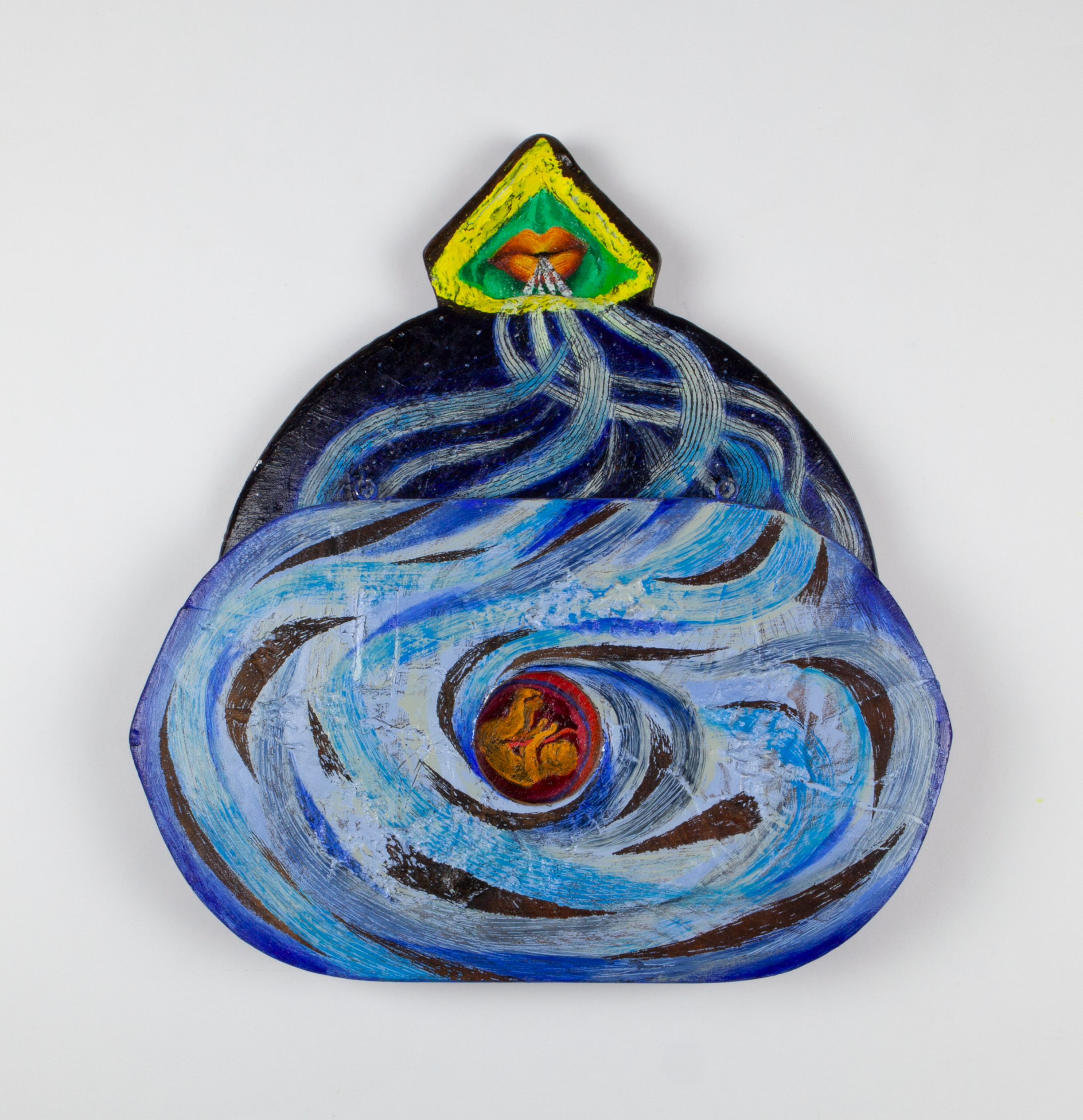
Mark Cazalet, Advent Station 1: The Breath of God (closed), 2024
A mystical visualization of the Word becoming flesh, the first station has two configurations. In its closed form, it shows the mouth of God blowing through space, the divine breath coalescing around a woman’s uterus to form an embryo, the child who will be called Jesus. Wisps of blue swirl dynamically around this firstborn of new creation.
The triangular shape evokes the Trinity, as the Incarnation was an act involving Father (initiator), Son (enfleshed one), and Holy Spirit (overshadower / inseminating agent).
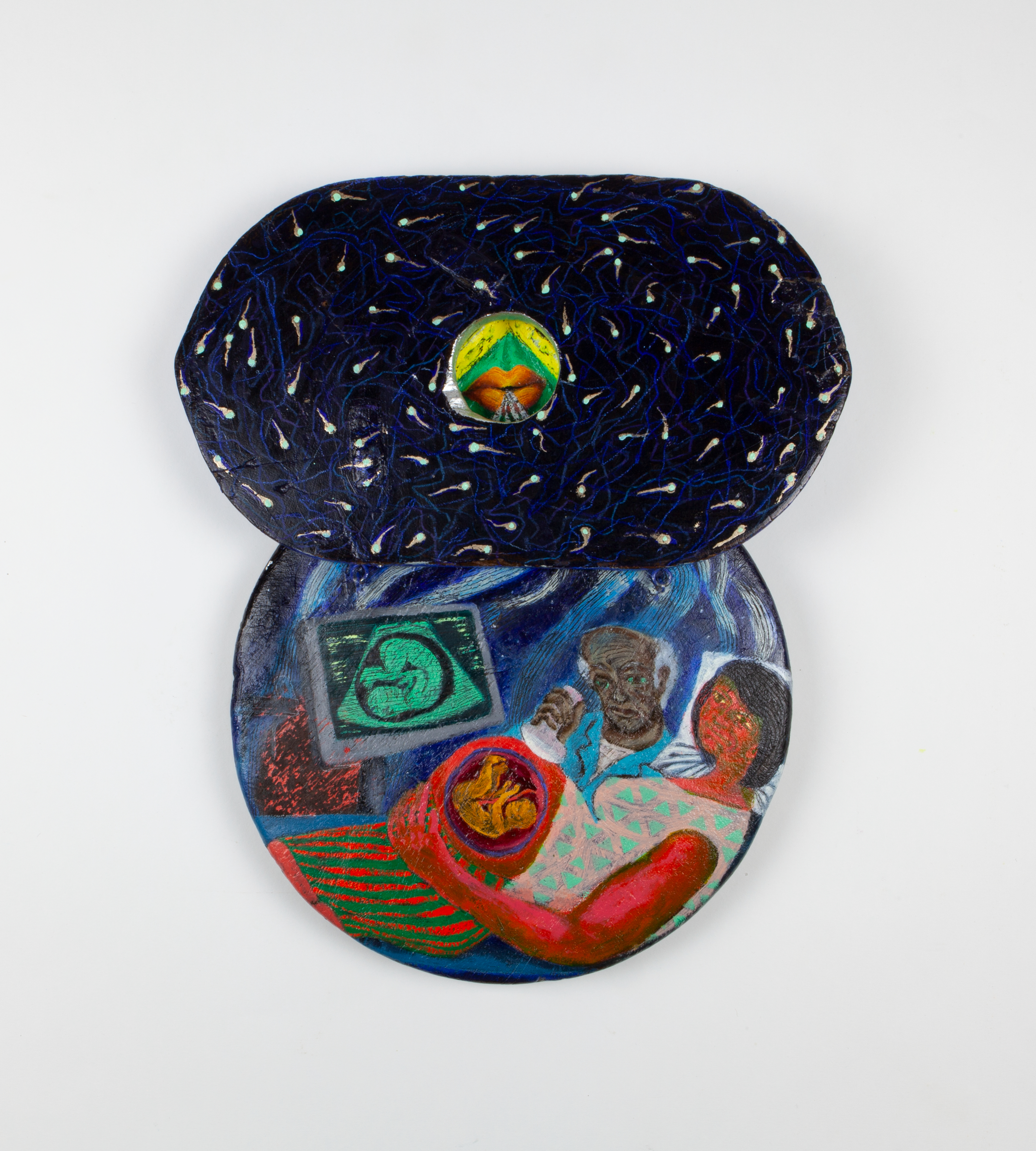
Mark Cazalet, Advent Station 1: The Breath of God (open), 2024
In the exhibition, an attached ribbon instructs viewers, “Lift me.” When you do, the bottom board flips up to reveal a pool of swimming sperm cells, as God created the male gamete needed to make a male child and supernaturally (nonsexually) deposited it into Mary, where it fertilized one of her eggs.
The virginal conception of Christ is a mystery beyond knowing; no amount of scientific head-scratching will bring us closer to understanding the mechanics, nor do we need to. But I like the reminder from this unusual artistic interpretation that all the necessary human genetic material was present—Mary supplying hers, and God supplying the rest. Jesus was not some kind of alien transplanted into a human womb, but rather was made up of all the human stuff we are, and grew by stages inside his mother over a period of nine months. And yet, while fully human, he’s also—marvel of marvels—fully God.
On the round board below, we see that the isolated uterus from the first view belongs to Mary, who lies in bed while Joseph serves as ultrasound technician, shining a light that discloses the still-developing Christ child on a video monitor.
Advent Station 2: John the Baptist on the Beach
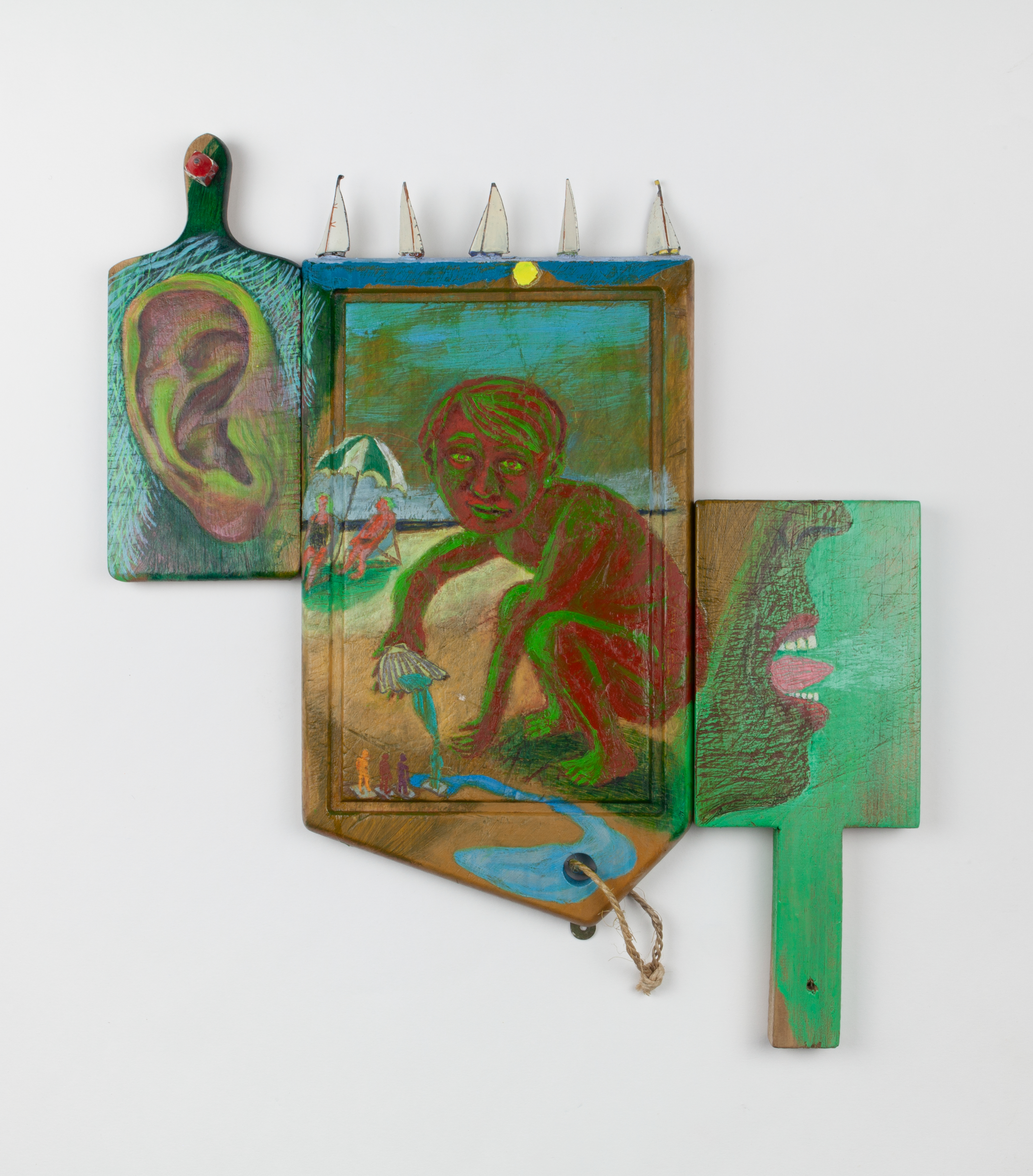
Mark Cazalet, Advent Station 2: John the Baptist on the Beach, 2024
The breath/wind motif is subtly carried over into this second Advent station, with sailboats lining the top of the center board.
This scene shows a young John the Baptist playing on the beach, with his parents, Zechariah and Elizabeth, lounging in swimsuits under a nearby umbrella. John crouches in the sand, pouring water from a seashell (the implement he uses to baptize Jesus in many traditional paintings, most famously Piero della Francesca’s) onto toy figurines who have queued up for the affusion. The water cuts a mini river through the sand, alluding to the Jordan.
The two side panels, which show a close-up of an open ear and an open mouth, likely refer to, in his prophetic ministry as an adult, John’s hearing the word of God and proclaiming it. His is “the voice of one crying out in the wilderness: ‘Prepare the way of the Lord; make his paths straight’” (Mark 1:3). John is regarded as an Advent figure because, by preaching repentance from sin, he prepared the people for the coming of the Messiah.
Advent Station 3: The Annunciation
Mark Cazalet, Advent Station 3: The Annunciation, 2024
The Annunciation, portraying the angel Gabriel’s message to Mary that she has been chosen to bear God’s Son, is one of the most frequently depicted biblical scenes of all time. How could any artist possibly make it new?
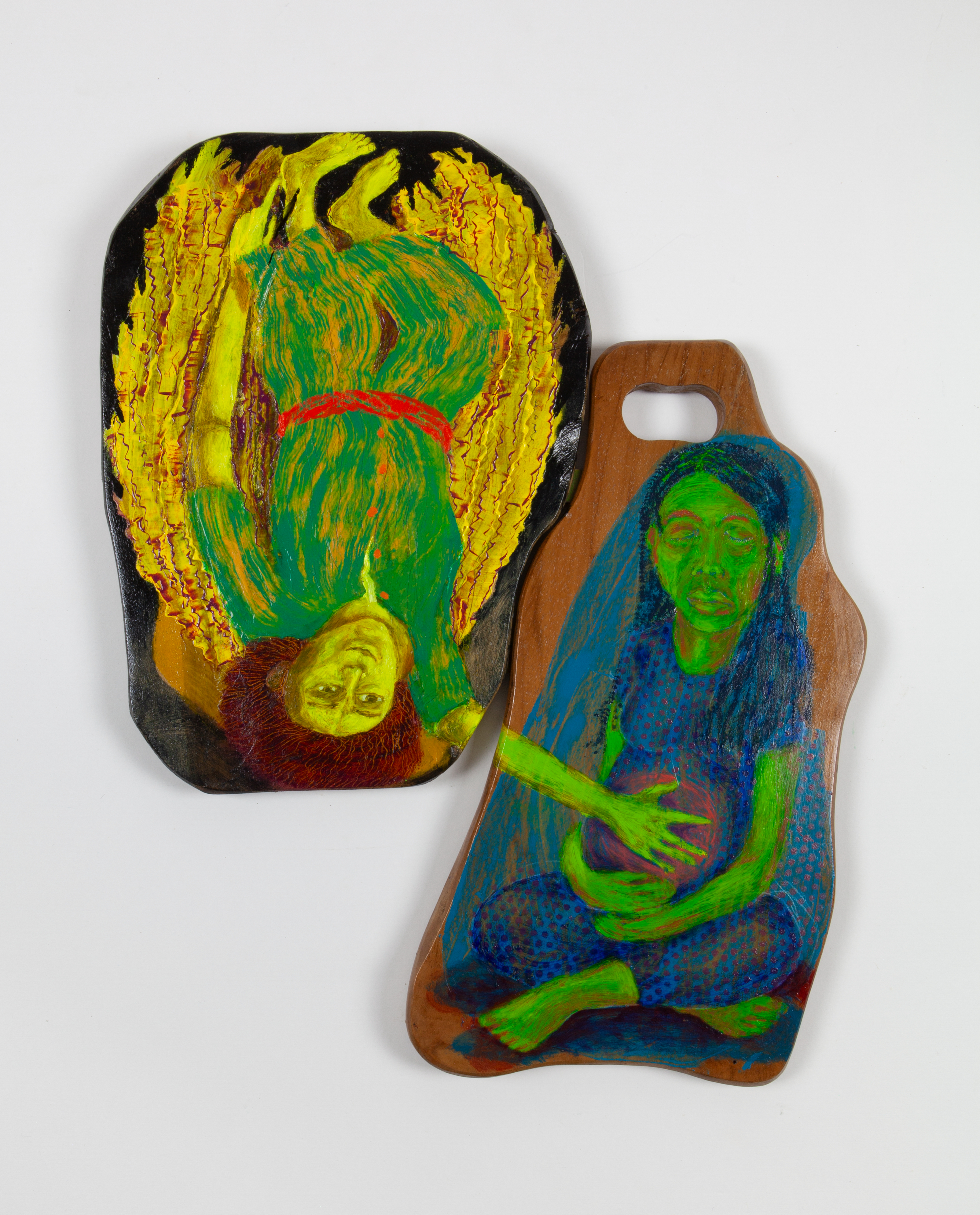
Cazalet refreshes the encounter by showing Gabriel dipping down headfirst from the heavens, the unconventional orientation perhaps a playful allusion to the topsy-turvy nature of Christ’s kingdom. He reaches across the gap to touch the belly of Mary, a young Black woman in a polka-dot dress who is seated on the floor with her eyes closed, rapt in prayer. This consensual touch is what effects the Incarnation.
Mary wears blue and even exudes a blue aura, blue being her traditional color, associated with heaven (the sky realm) and hope. Gabriel’s skin has a golden sheen—the color of divinity, purity, holiness. The coming together of blue and yellow creates green, symbolizing life, growth, and renewal.
Advent Station 4: Bethlehem Motel
Mark Cazalet, Advent Station 4: Bethlehem Motel, 2024
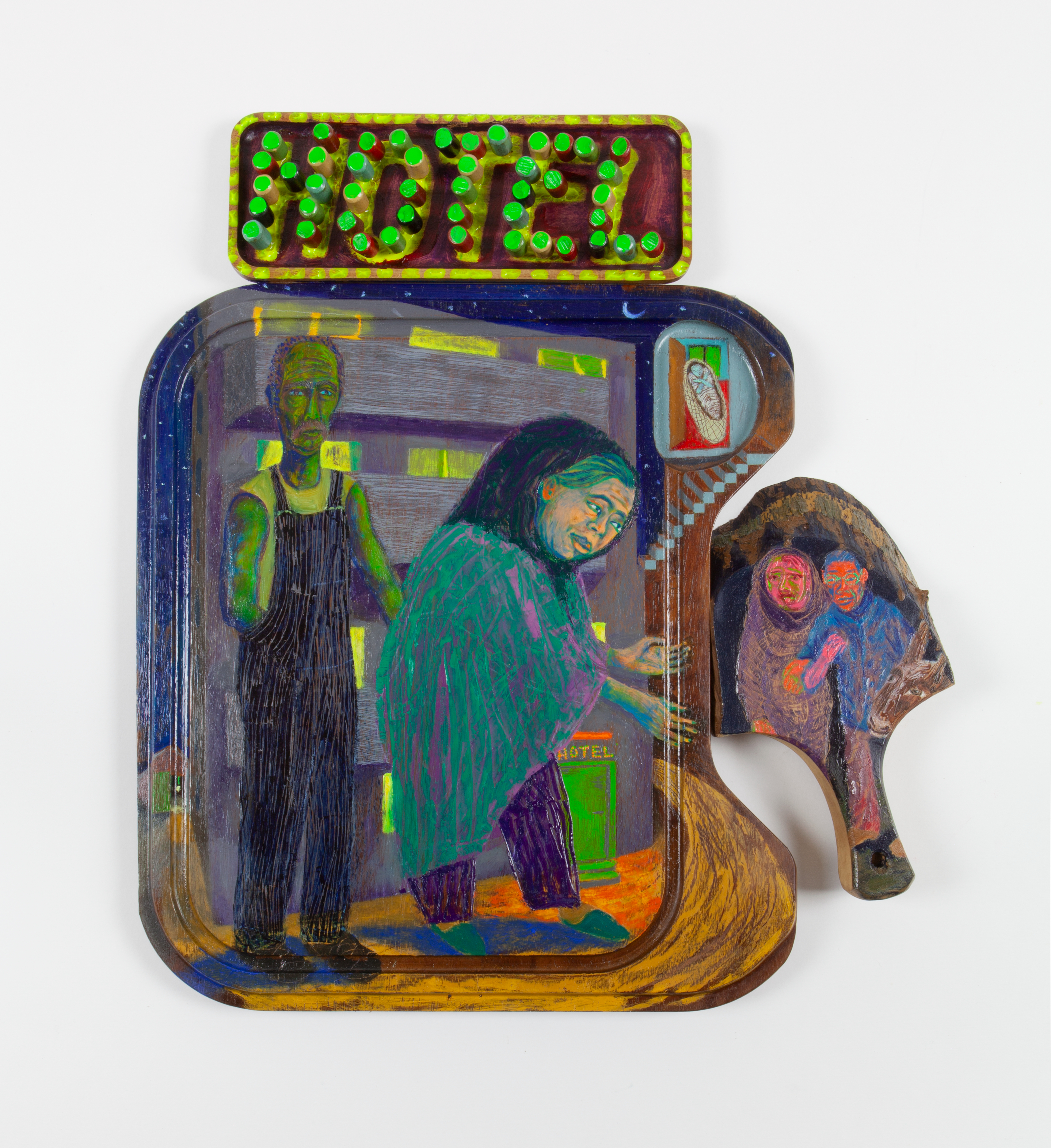
The innkeeper couple in Bethlehem are a cultural invention, biblical scholars tell us, spawned by a misleading English translation of Luke 2:7, which says “there was no room for them [Mary and Joseph] in the inn” (KJV). The Greek word translated “inn,” kataluma, more properly means “guest room”: Because the census had brought many out-of-towners to the area, the guest rooms of Joseph’s relatives were full, but they made space for the pregnant couple in the lower room of the house where animals were kept for the night.
Despite the lack of an innkeeper character in scripture, it has become a popular element in storytelling about the Nativity in art, song, and sermons, as it prompts us to consider whether we are making room for Christ in our busy, overcrowded lives. And not just Christ, but anyone in need—of shelter or other forms of care.
Cazalet shows Mary and Joseph approaching a motel door as the female owner, sympathetic, comes out to greet them. A niche above their heads, hovering like a thought bubble, shows what the couple desires: a place to give birth and to lay their son.
Advent Station 5: The Incarnation (A Blessing Conferred)
Mark Cazalet, Advent Station 5: The Incarnation (A Blessing Conferred), 2024
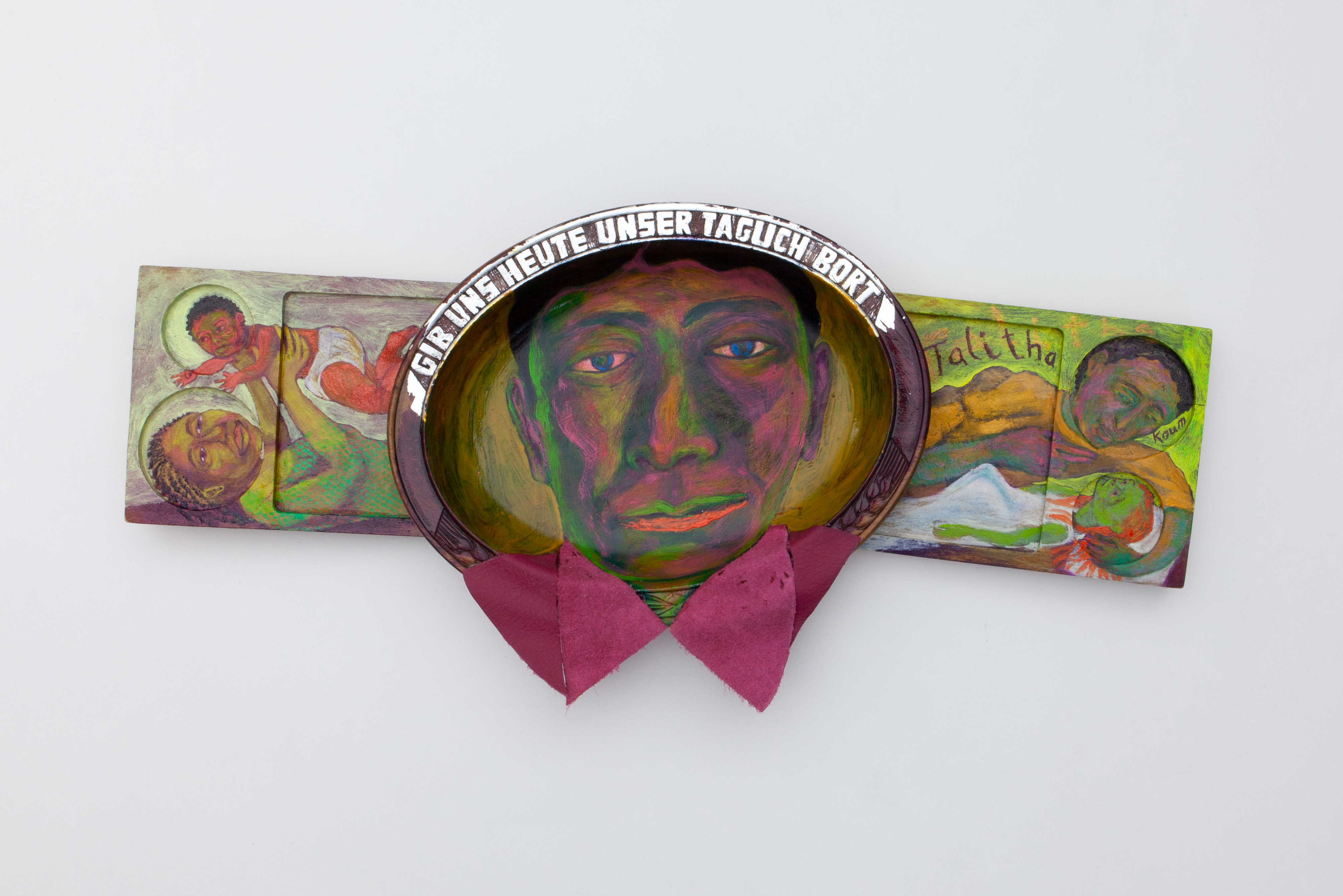
The fifth station features an unconventional combination of images. The left board shows Mary lying on her back, holding the wiggly infant Christ above her. She beams with maternal love.
On the right board, an adult Christ, similarly positioned, leans over the dead daughter of the synagogue leader Jairus. “Talitha koum,” Jesus gently instructs, cradling the girl’s head—Aramaic for “Little girl, get up” (Mark 5:41). With his words, she rises back to life.
The central image, a Head of Christ, is painted on a wooden bread plate from Germany—these plates were sometimes also used as church collection plates—whose rim reads, “Gib uns heute unser täglich brot” (Give us this day our daily bread). Carved sheaves of wheat poke out from under Jesus’s pink cloth collar.
“My intention is that Mary’s love for her son as she raised him taught him the care and compassion to want to help a child in extremis,” Cazalet told me. “The man is formed by the mother’s love, and our childhoods set the pattern of our response to others.”
Notice how, from behind the Christ head, the two adjoining boards emerge like wings, suggesting freedom.
Advent Station 6: The Shepherds See the Star
Mark Cazalet, Advent Station 6: The Shepherds See the Star, 2024
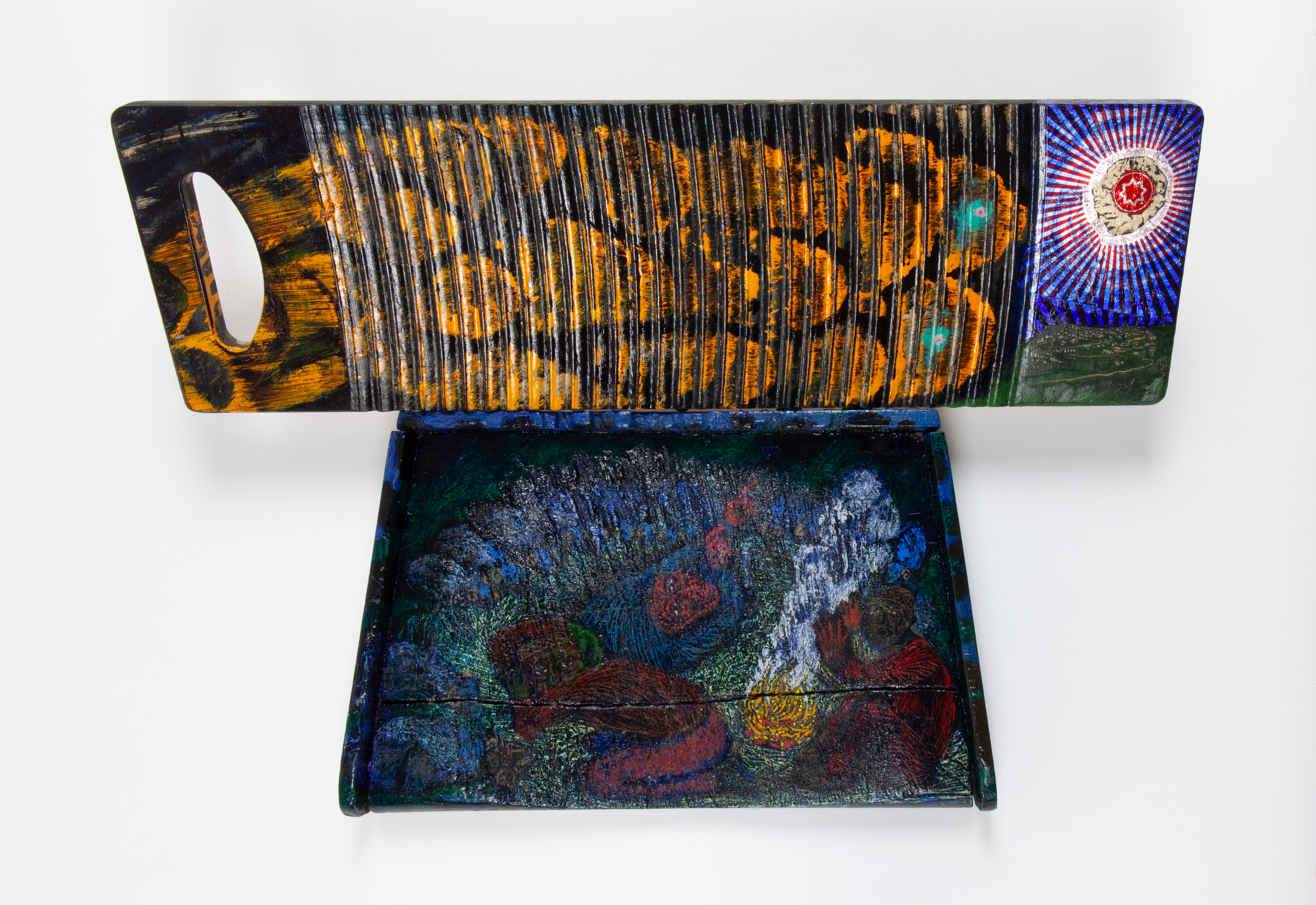
The sixth station portrays the glory of the Lord rippling across the night sky above three shepherds tending their flocks. Content and unassuming, they are gathered round a warm fire when suddenly, an angel appears to announce to them the birth of Christ. One of the shepherds cowers in fear while another gesticulates toward a brightly beaming star in the near distance—rendered with a Tunnock’s milk chocolate tea cake wrapper.
Advent Station 7: The Magi Dreaming
Mark Cazalet, Advent Station 7: The Magi Dreaming, 2024
Having followed a star to Jerusalem from their home back east, the magi enter the court of Herod to inquire where they can find the newborn king of the Jews whom the star heralds, to pay him homage. Herod hadn’t heard of such a king, but immediately he feels threatened—“king of the Jews” is his title—and, unbeknown to the visiting dignitaries, decides to crush this young rival. After consulting with Jewish scholars, he discerns Bethlehem as the birthplace. He divulges this information to the magi and asks them to report back once they’ve found the child so that he, too, can honor him. He hides his true motive under a lie.
The magi have a transformative encounter with Jesus in Bethlehem. Falling asleep after that momentous day, they receive a warning from God not to return to Herod. So they avoid him on their way back home.
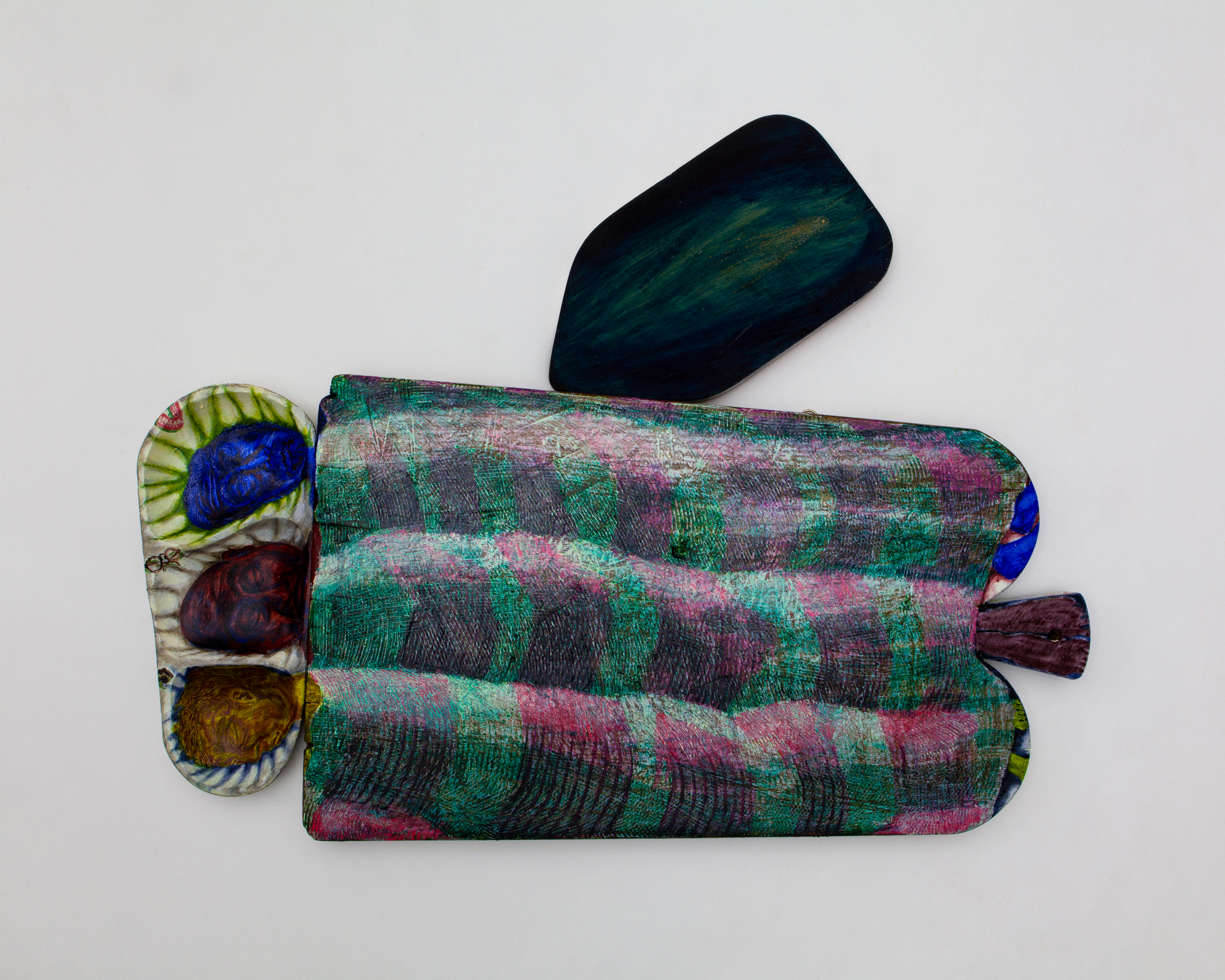
As in medieval visual treatments of the Dream of the Magi, Cazalet has the magi sharing a bed. (There’s nothing salacious about it—it’s just a compositional practicality, to show the three men in one space, having the same dream at the same time.) Their toes peep out from under the covers. That surface, by the way, is flat—Cazalet skillfully creates the illusion of convexity through painting, suggesting bodies underneath.
Beside the magi’s heads are three small personal objects: earbuds, glasses, and dentures, which allude to the proverbial principle “See no evil, hear no evil, speak no evil.” “I was musing if this trinity of pilgrim searchers were perhaps aspects of the one true pilgrim, parts of a single whole disciple,” the artist told me.
Advent Station 8: Herod Syndrome
Mark Cazalet, Advent Station 8: Herod Syndrome, 2024
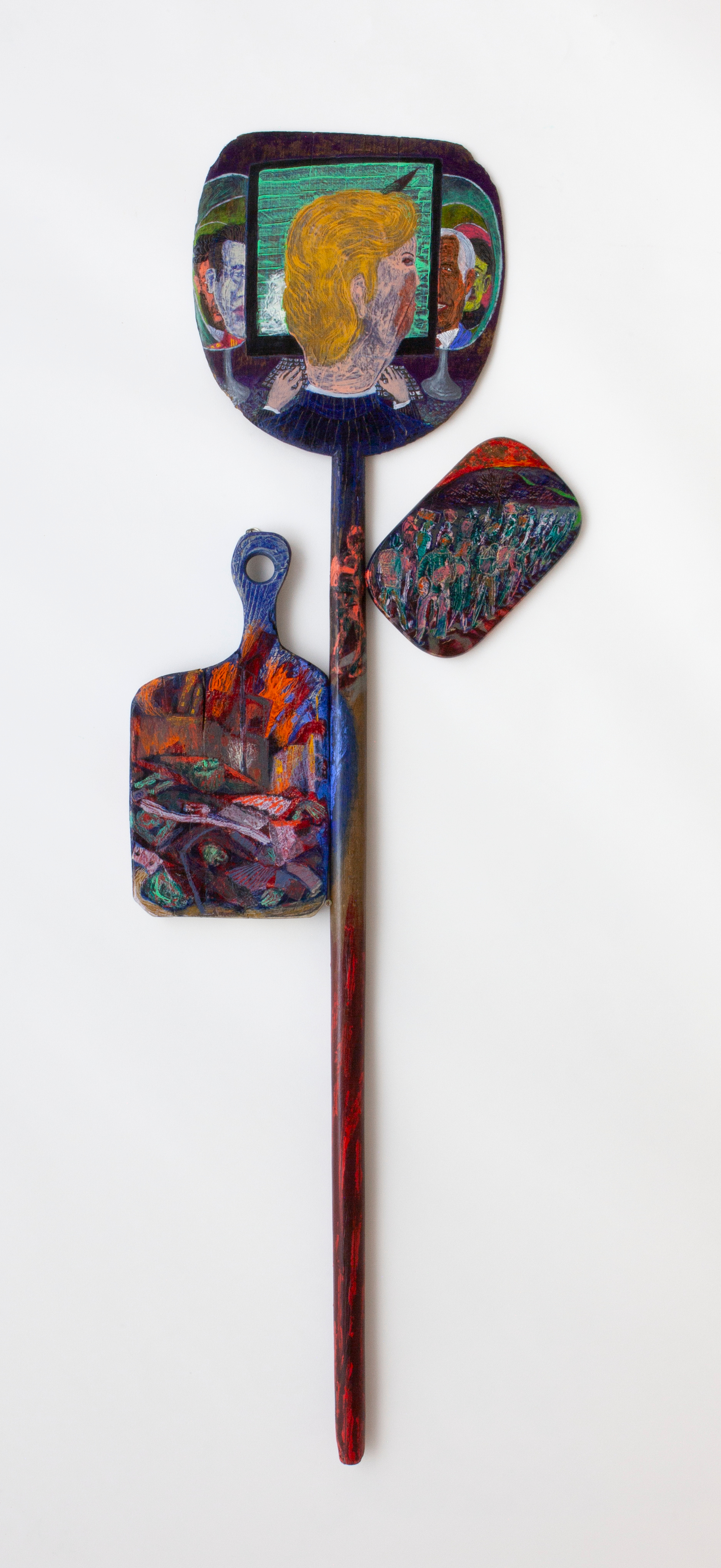
Thwarted by the magi, Herod fumes with rage. He will not be dethroned by this so-called messiah. So he orders his soldiers to kill all the boys in Bethlehem aged two and under, thinking that Jesus will be among them. In his self-obsession, he cares nothing for the good of the people; he cares only for the consolidation of his own power.
Station 8 is Cazalet’s modern take on the Massacre of the Innocents. At the helm of a computer keyboard is a presidential figure launching a missile on whomever he has deemed the enemy, while other likeminded autocrats—I believe that’s Saddam Hussein, Kim Jong Un, Vladimir Putin, and Adolf Hitler—look over his shoulder approvingly, their faces reflected endlessly in mirrors using a technique called mis en abyme (“put in the abyss”). This panel, the transferring surface of a baker’s peel, sits at a height to emphasize the pompousness of rulers like Herod, who see themselves as above others and above the law.
Such an attitude can have dire consequences. “Below we see the devastation of a civilian population, defenceless against the technological onslaught,” Cazalet describes, “and the perpetual streams of migrants fleeing who knows where to be vilified as more foreign mouths to feed.”
The power mania that gripped Herod, that led to his lashing out in violence, is still alive and well today in national and global politics.
Advent Station 9: The Flight to Egypt (Forced Migration)
Mark Cazalet, Advent Station 9: The Flight to Egypt (Forced Migration), 2024
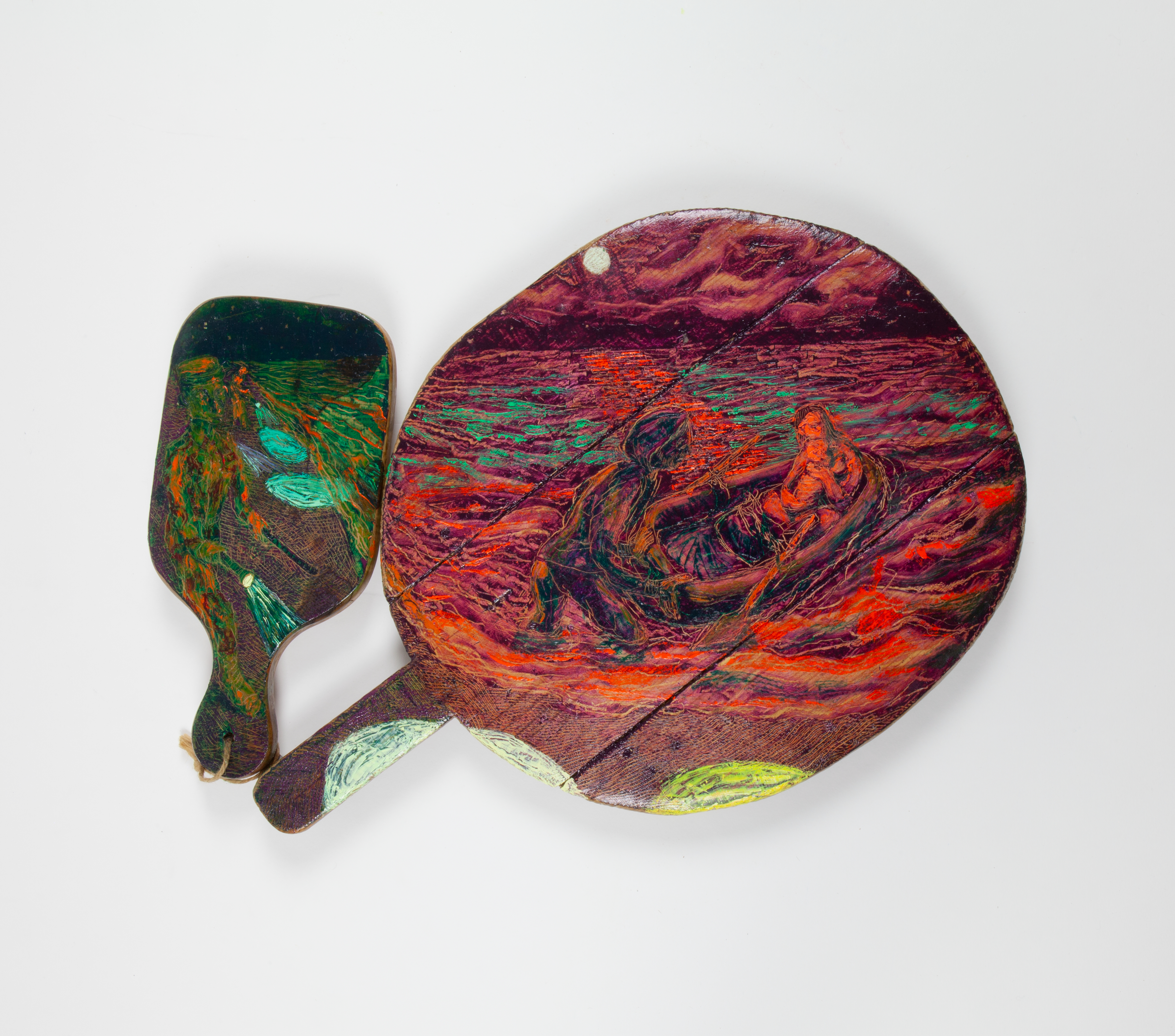
To protect their son from Herod’s murder decree, Mary and Joseph flee with him across the border to Egypt. Cazalet reimagines their flight through the lens of today’s refugee crisis. In station 9, the Holy Family boards an inflatable raft, braving choppy seawaters in search of asylum. They’re bathed in a menacing red.
On the adjoining panel, border patrol officers, with flashlights and batons, stand on the shore, seeking to bar the entry of strangers into their land.
Advent Station 10: The Exiles Return
Mark Cazalet, Advent Station 10: The Exiles Return, 2024
Egypt grants refuge to the Holy Family, and they settle there for an undisclosed period of time—until Joseph receives word from an angel that it’s safe to return to their homeland.
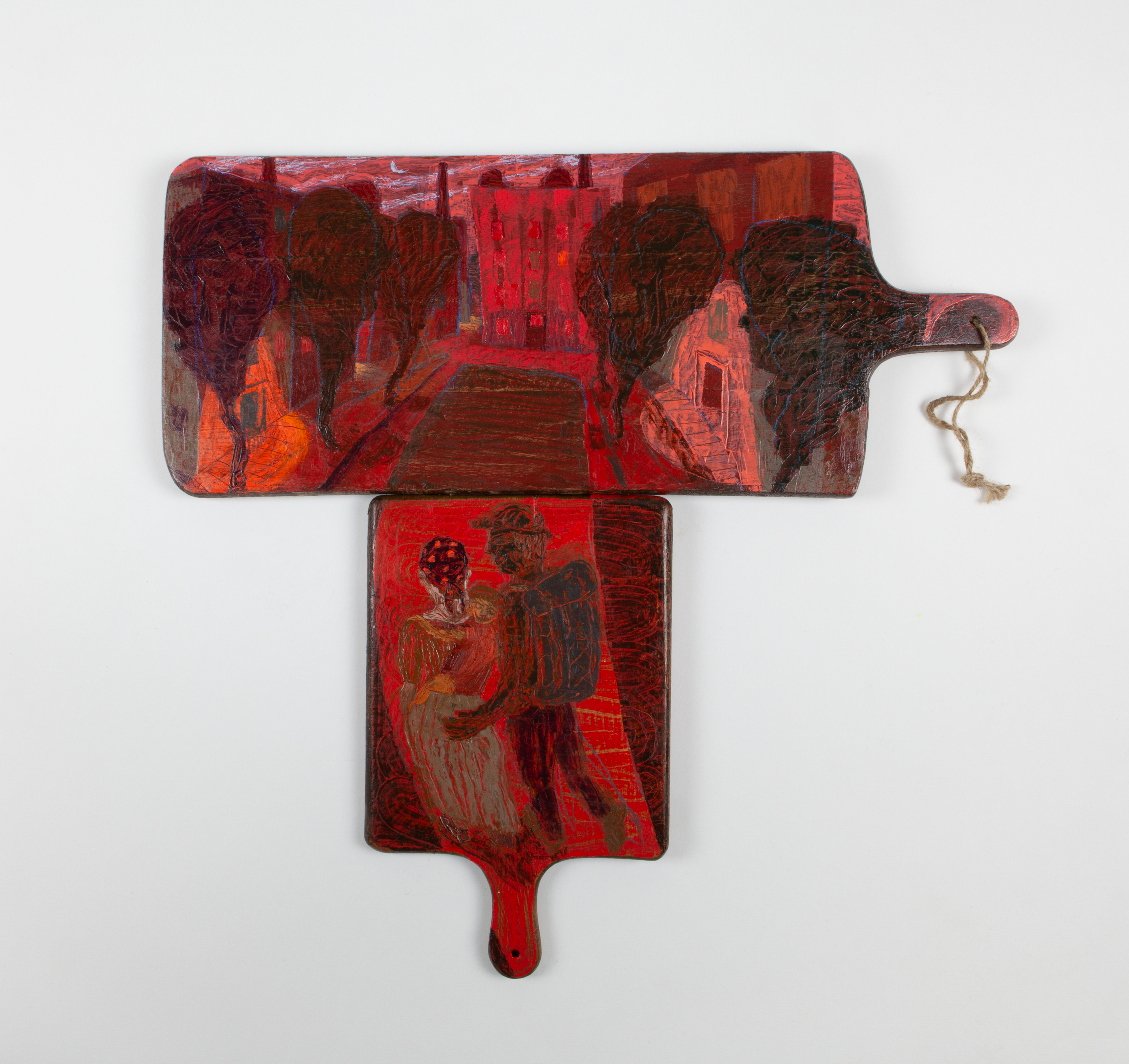
Station 10 shows the family arriving at sunset in their beloved Nazareth, all their belongings reduced to what could fit in a single backpack. As they approach a tree-lined boulevard, Jesus clings to his mother’s back, looking behind at where they’ve come from. He has not yet known this town but will come to love it. He will call it home until his ministry beckons him beyond it more than two decades later.
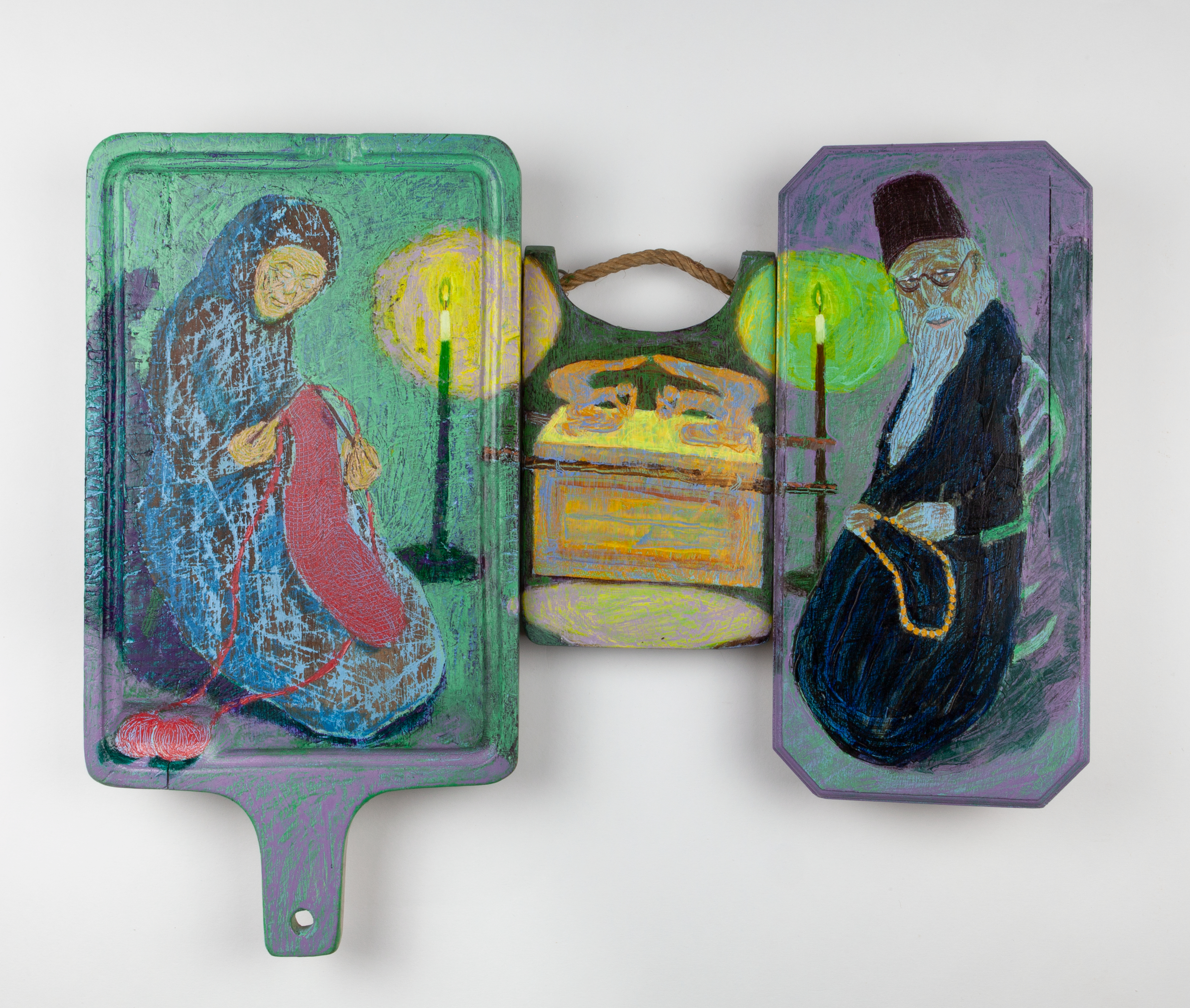
Advent Station 11: Faithful Waiting and Watching (Anna and Simeon)
Mark Cazalet, Advent Station 11: Faithful Waiting and Watching (Anna and Simeon), 2024
This is my favorite of all the stations. While the Presentation of Christ in the Temple is standard fare in Christian art—showing Mary handing Jesus to Simeon, a devout Jew interpreted by most artists as a priest, forty days after Jesus’s birth, with Joseph and the prophet Anna standing off to the side—Cazalet isolates the elderly Anna and Simeon, zeroing in on their faithful act of waiting for the Messiah.
Illuminated by candlelight, Anna knits a scarf, communing with God in the solitude, while Simeon fingers a string of prayer beads. Their eyes are weary and downcast, and yet they possess a steadfast hope that their Savior is on his way.
Linking their two spaces is the ark of the covenant, a sacred wooden storage chest plated in gold and topped by two hammered-gold cherubim. Containing the tablets of the law, Aaron’s rod, and a pot of manna, the ark was kept in the holy of holies, the innermost sanctum of the temple, where it signified God’s presence.
Waiting can often feel useless—like nothing’s happening or will ever happen. But Anna and Simeon continued to wait on the Lord, to count on his promise. And finally, before they died, they were granted the grace to see and to hold the One they had so fervently longed for: the Christ, Emmanuel, “God with us.”
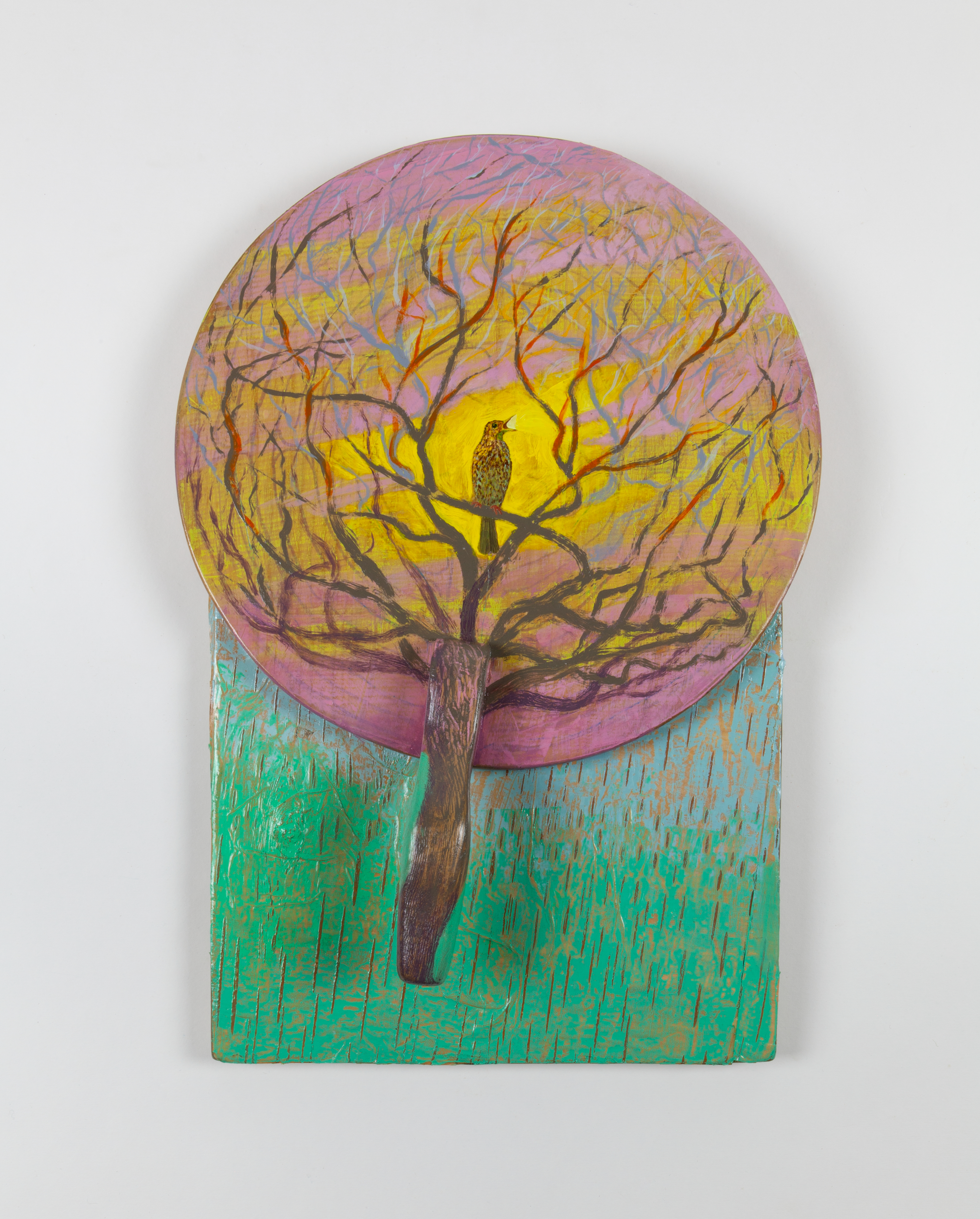
Advent Station 12: The Mistle Thrush Greets the New Day
Mark Cazalet, Advent Station 12: The Mistle Thrush Greets the New Day, 2024
The Advent path we’ve just walked has included an unplanned pregnancy, persecution, and displacement but also miracles, play, and surprise.
Cazalet’s Advent Stations end with a bird in a tree, singing its heart out as a pink and yellow dawn spreads across the sky. The twisted branches become streamers, blowing as if in celebration. (There’s that breath of God again!) Out of the bird’s beak shoots light.
The board that forms the grassy ground is incised with knife marks, perhaps suggesting woundedness—although maybe it’s a turning over of the soil to promote new growth.
The flame-like hues in and around the tree evoke the burning bush of Exodus 3, from which God spoke his name: I AM THAT I AM.
This Advent tree, bare yet lively, calls us to embrace each new day as a gift from the One who is and was and is to come, remembering how Christ came to show us who God is and to feel and heal our brokenness, and he will come again to make all things new.
The Advent Stations by Mark Cazalet, with accompanying poems by Richard Leaf rendered in calligraphy by Pansy Cambell, are on display at Chelmsford Cathedral in eastern England through February 2, 2026. They are available for sale, but until they’re purchased, Cazalet wants to show them in other churches and cathedrals. They’re tentatively scheduled for exhibition in Southwark Cathedral in London during Advent 2026.
We remember today, O God, the slaughter of the holy innocents of Bethlehem by King Herod. Receive, we pray, into the arms of your mercy all innocent victims; and by your great might frustrate the designs of evil tyrants and establish your rule of justice, love, and peace; through Jesus Christ our Lord, who lives and reigns with you, in the unity of the Holy Spirit, one God, for ever and ever. Amen.
—Collect from the Book of Common Prayer
Western church calendars mark December 28 as the Feast of the Holy Innocents, or Childermas, a day set aside to remember the slaughter of male Bethlehemites aged two and under by Herod the Great, king of Judea, as recounted in Matthew 2:16–18. Historians estimate there were probably ten to twenty children of that age in Bethlehem at the time.
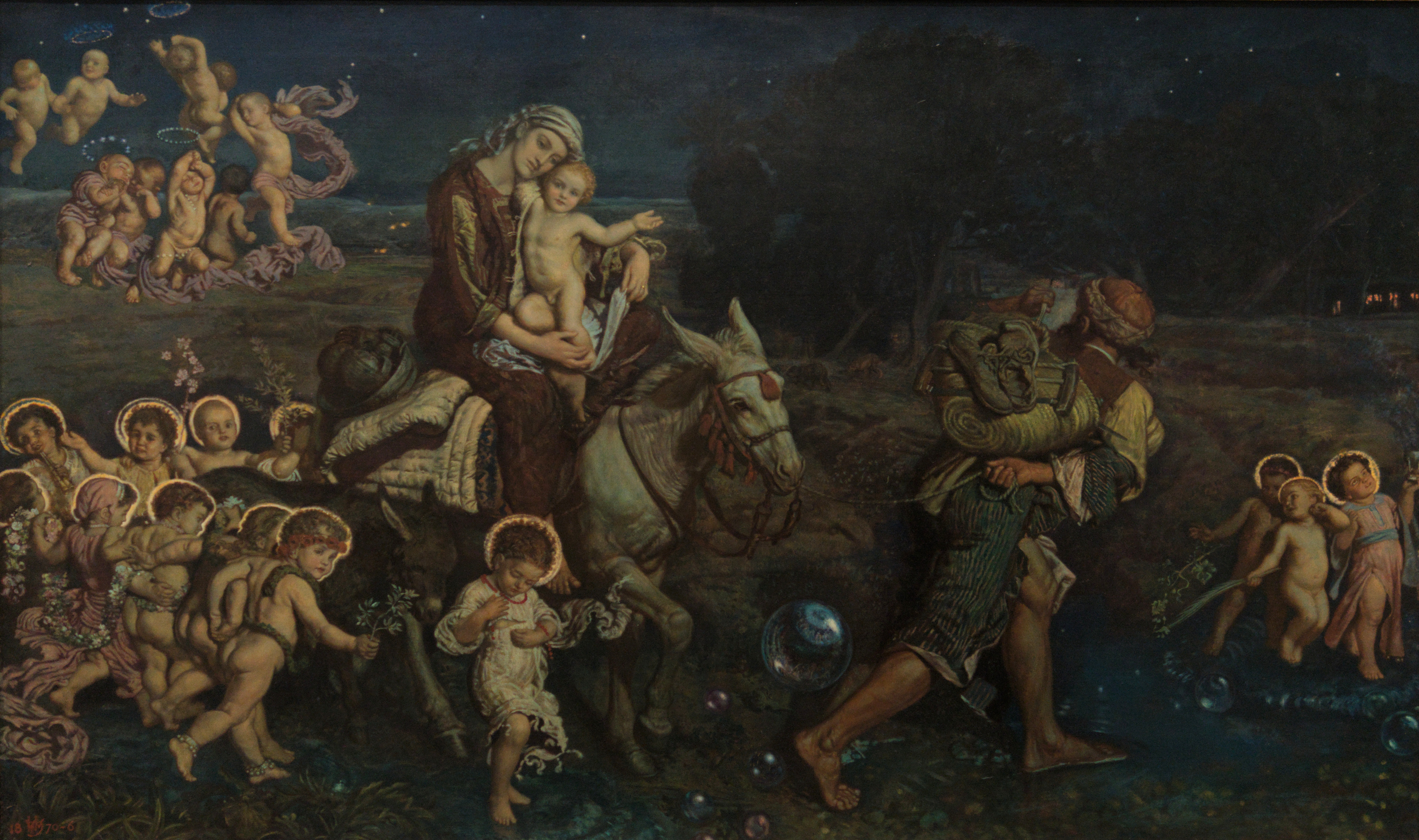
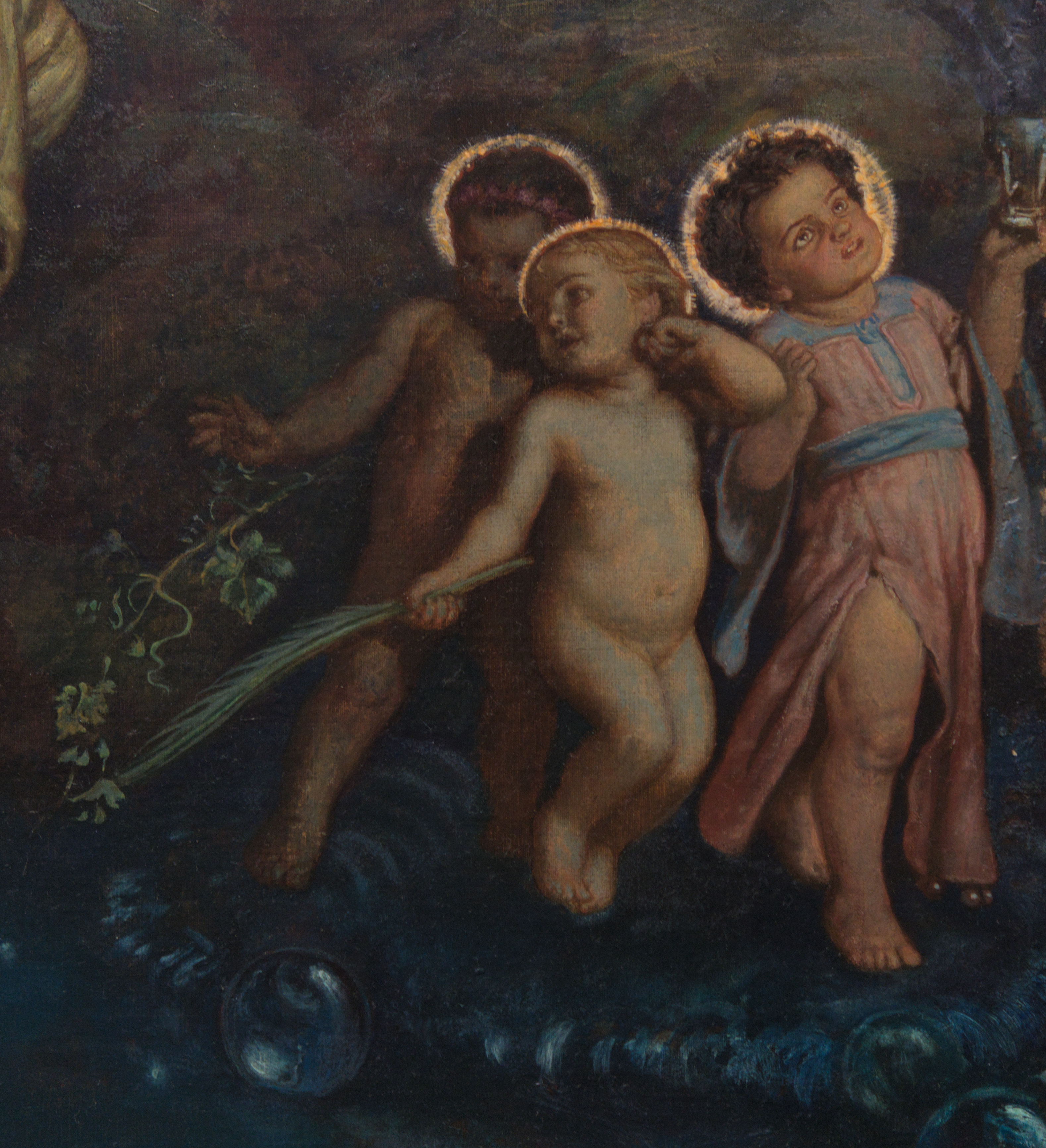
LOOK: The Triumph of the Innocents by William Holman Hunt
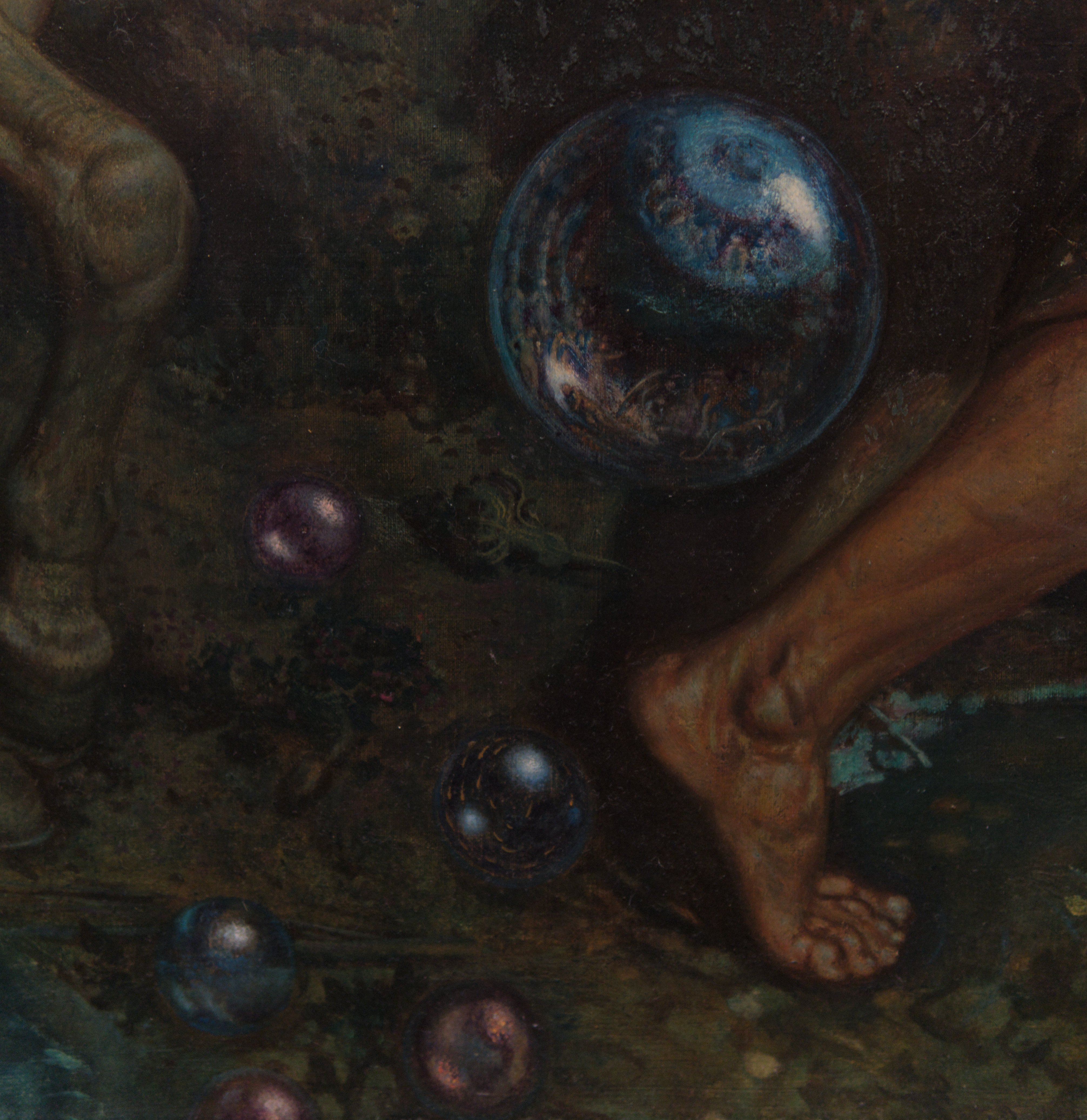
William Holman Hunt (British, 1827–1910), The Triumph of the Innocents, 1870–1903. Oil on canvas, 75.3 × 126 cm. Harvard Art Museums, Cambridge, Massachusetts. Photo: Victoria Emily Jones. [object record]
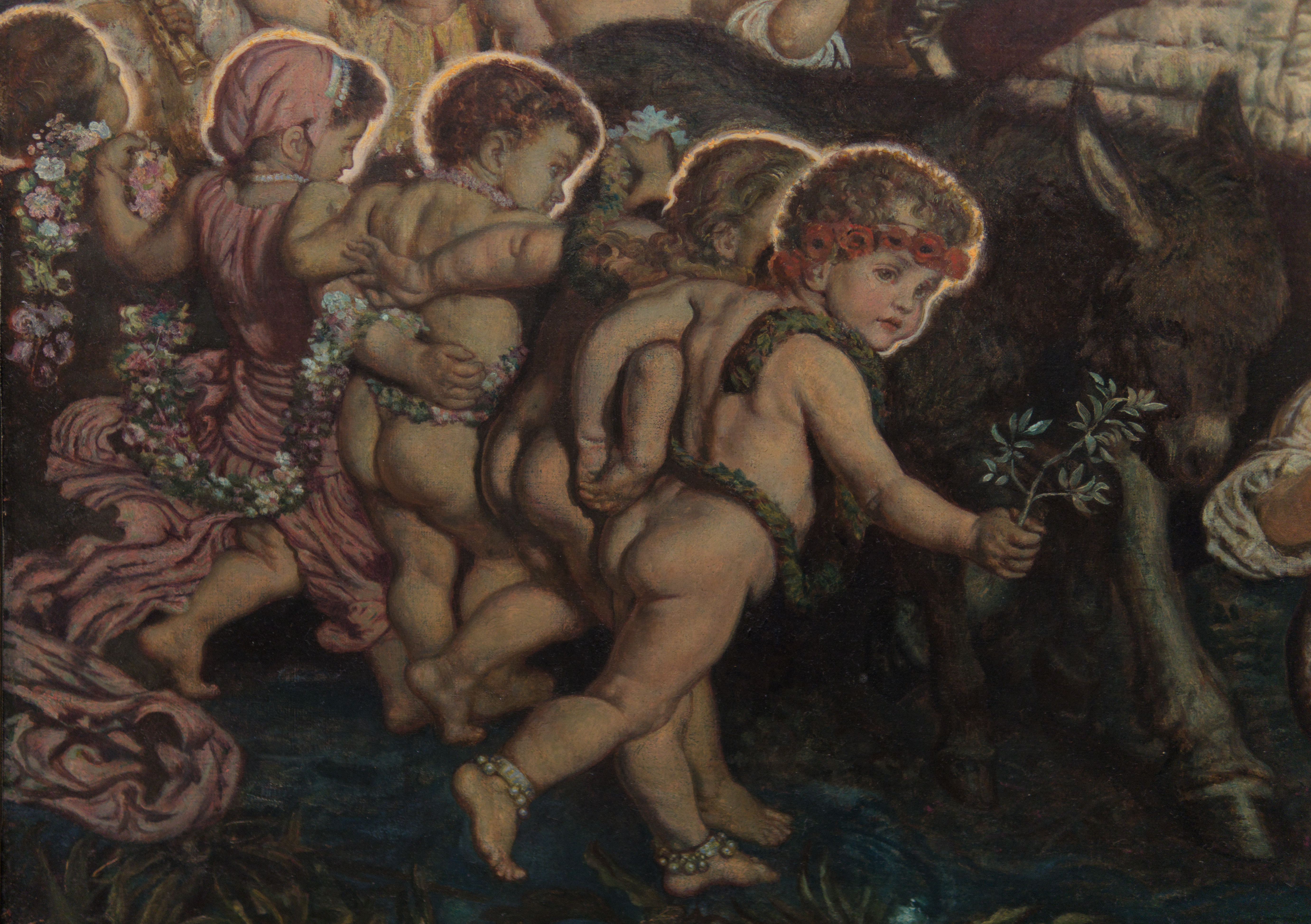
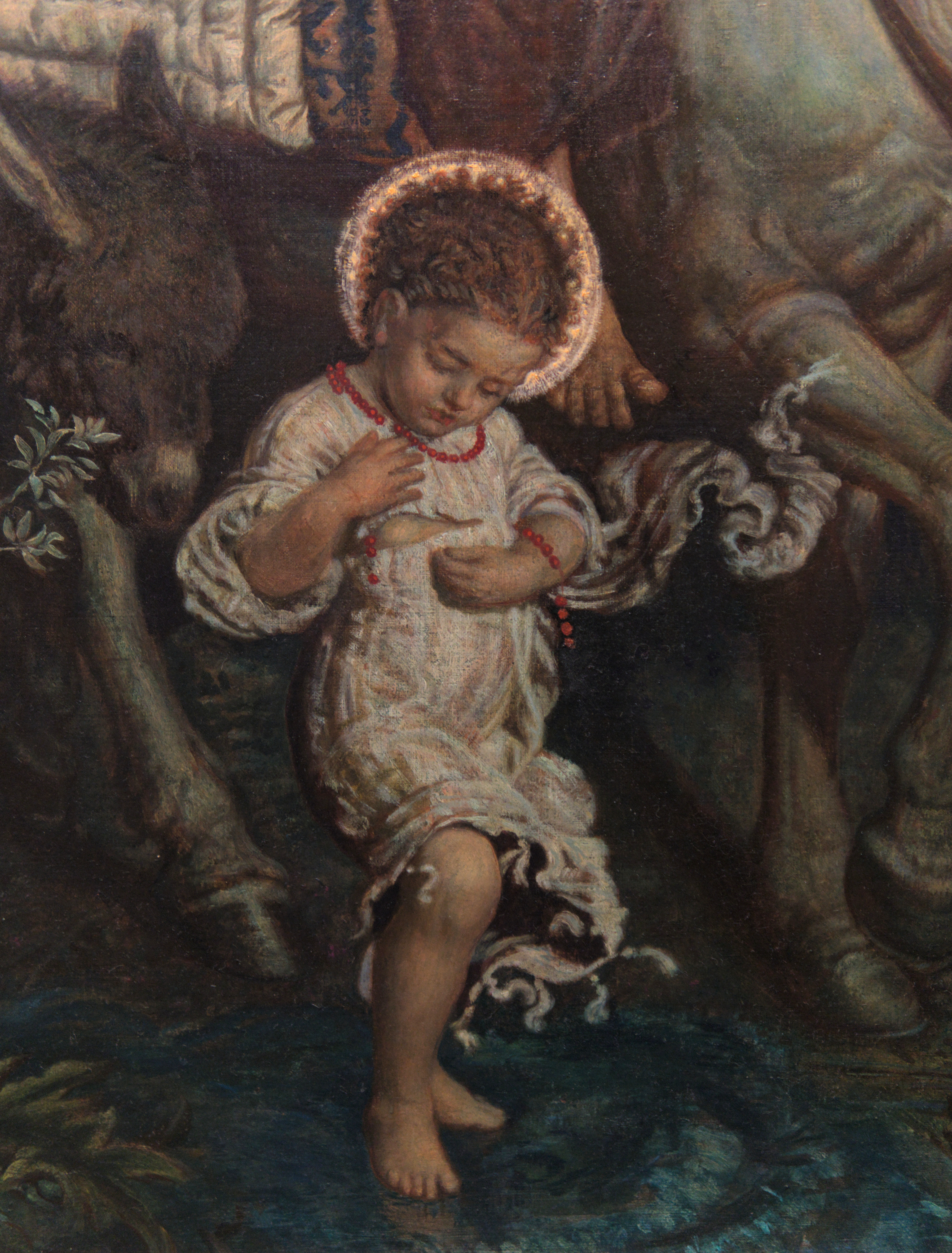
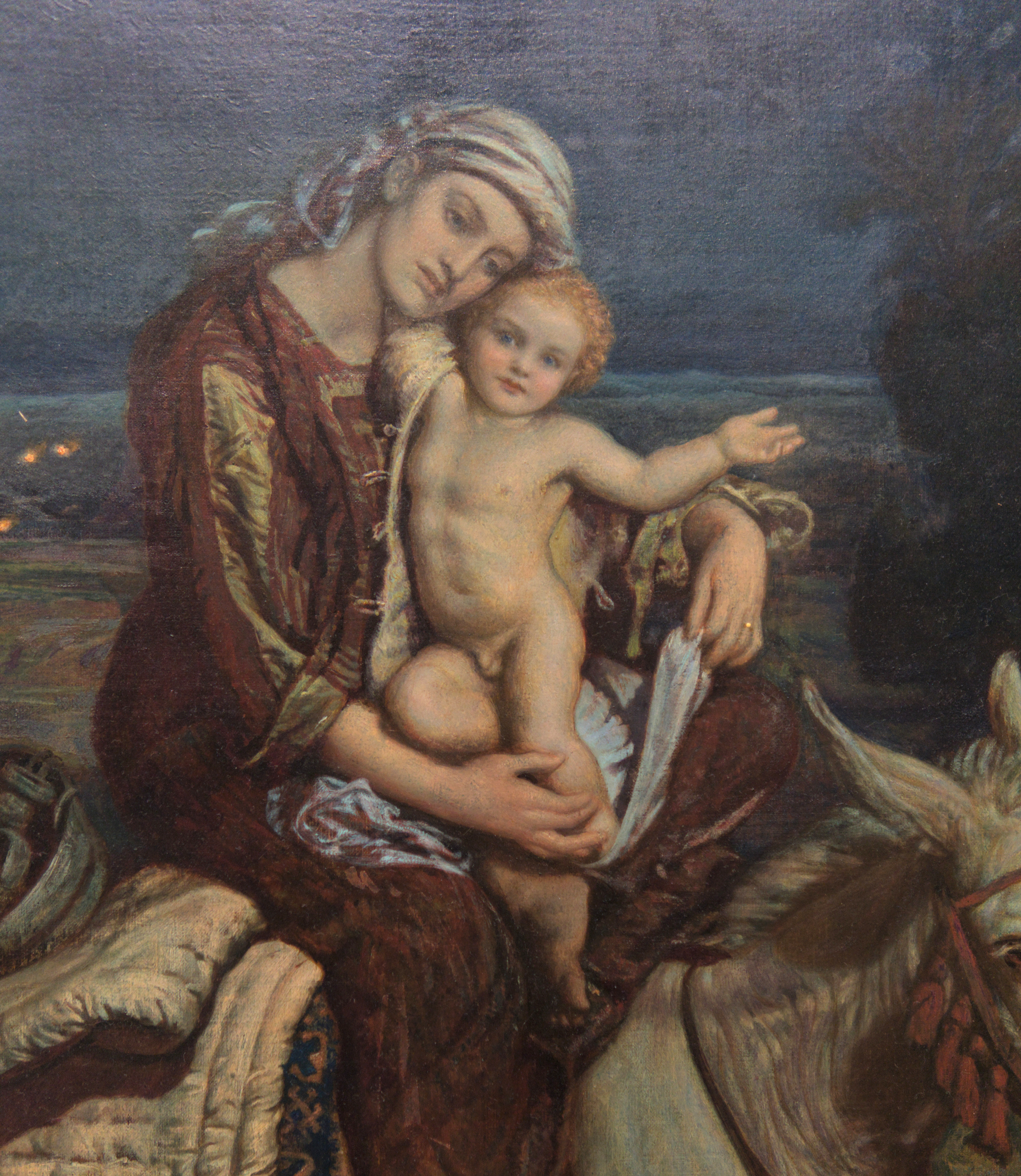
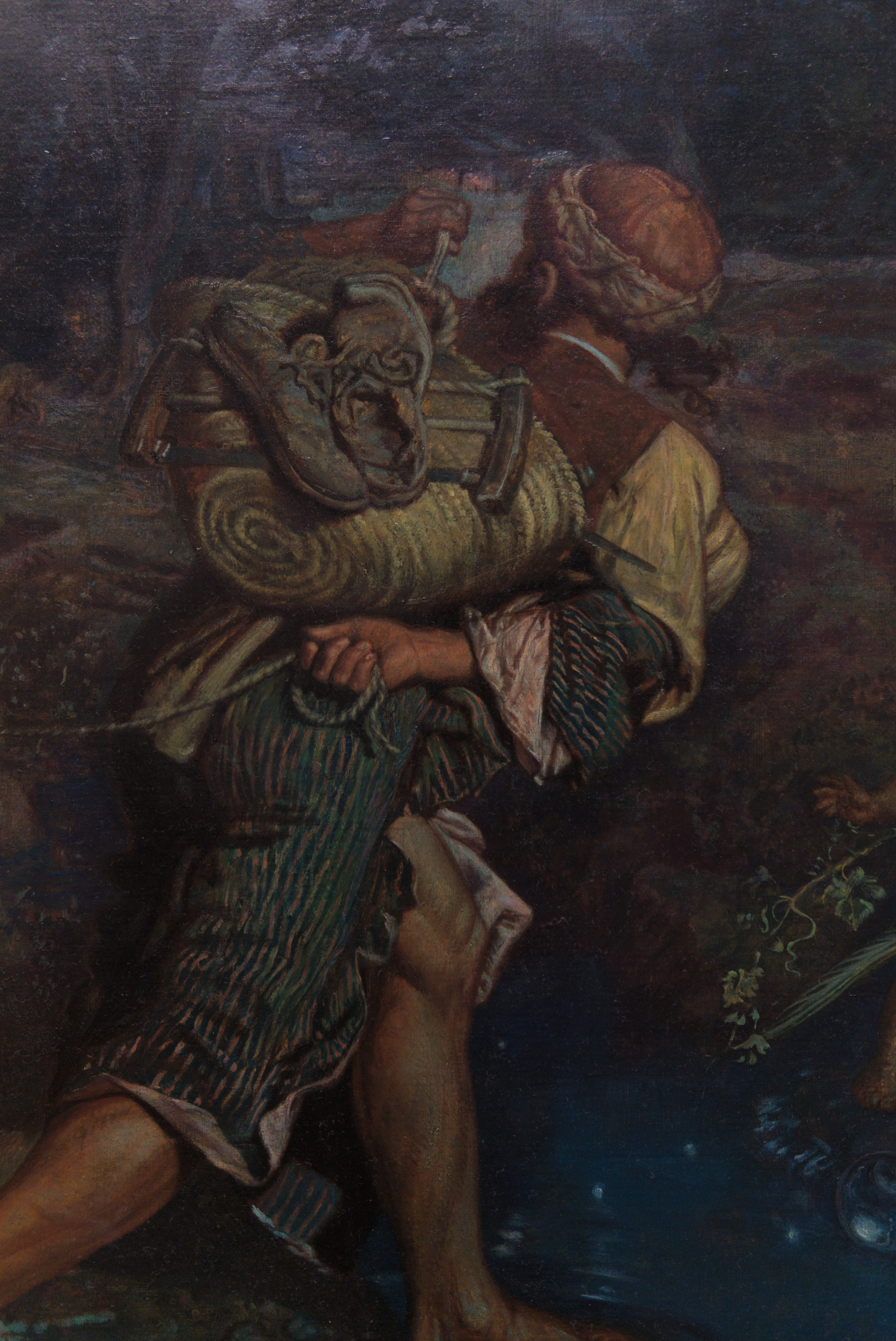
This visionary realist painting by the Pre-Raphaelite artist William Holman Hunt is a unique interpretation of the Flight to Egypt. It shows, surrounding the Holy Family on the run, the embodied spirits of all the little boys in Bethlehem—the “innocents”—who were slain at Herod’s behest. It’s the first of three versions Hunt painted of the subject, mostly completed by 1876, but with some of the background left unfinished until 1903. The other two versions are in the Tate Britain in London and the Walker Art Gallery in Liverpool.
The early church understood these boys as the first Christian martyrs. Though they were not conscious witnesses for Christ, they were killed because of him, casualties of a persecuting tyrant’s brooking no rival. Their death prefigures that of future Christian martyrs, starting with Stephen, as well as Christ’s own death.
Despite the solemnity of this episode, Hunt casts it in a triumphant light. Instead of showing the infants dismembered or impaled in a bloodbath with their mothers wailing in helpless grief, as artists have historically done, Hunt shows them in the light of glory, carrying palms and other branches and wearing floral crowns and garlands. They are, in the words of John Powell Lenox, the “first of that glorious company whose shining ranks are nearest the throne of the Slain One.”
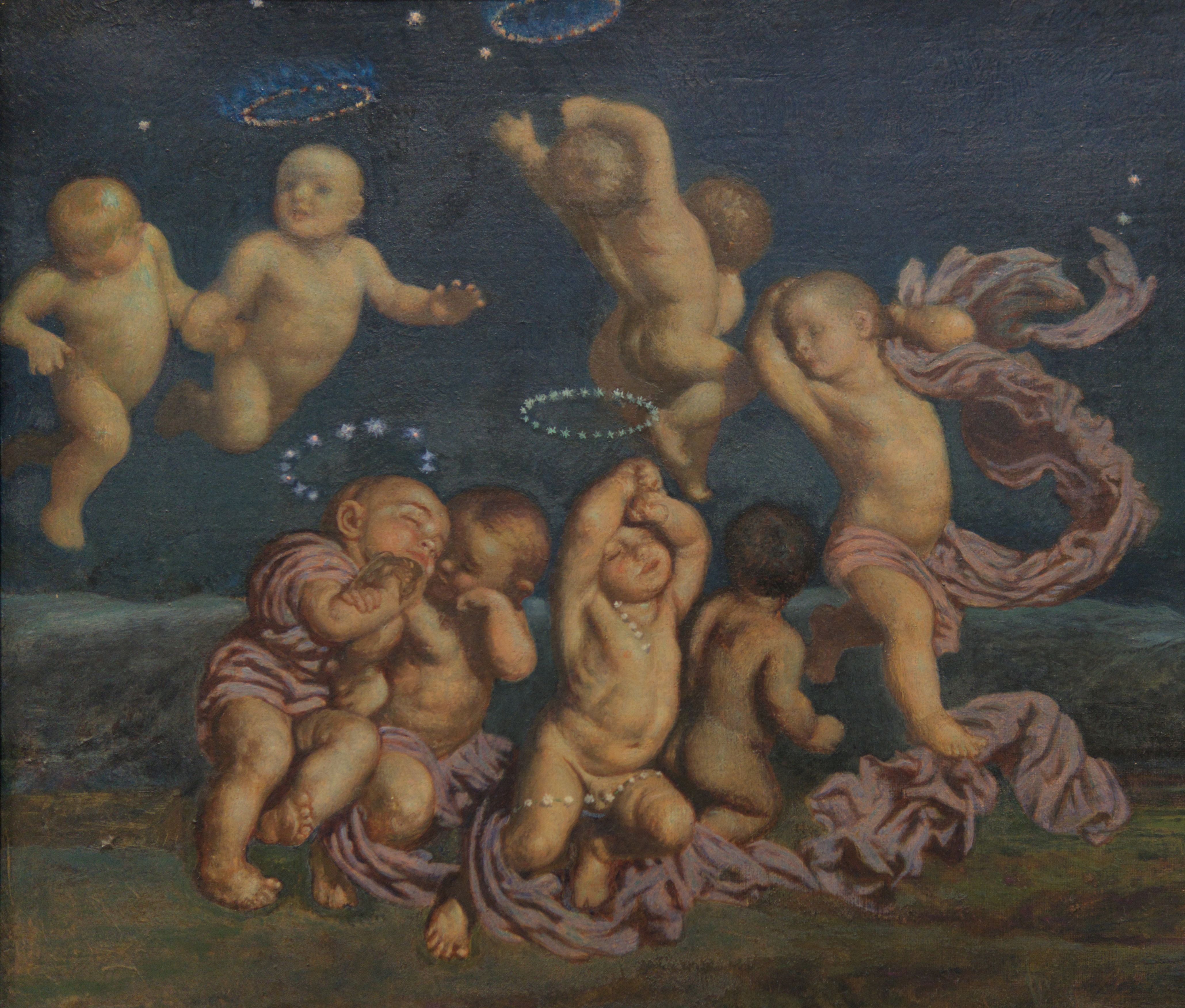
Floating in air, those at the upper left are just waking up to their new spiritual life—they open their eyes and stretch.
Those on the ground lock arms in solidarity and play, surrounding a little foal. One curly-locked lad wears a red necklace, the beads spilling from the chain reminiscent of blood drops. But the fatal chest wound that one of Herod’s soldiers had inflicted by sword is no more, as he looks down with wonder to discover through a tear in his tunic. Healed flesh!
In the center Mary rides a mule, holding Jesus, who greets his playmates with a wave and a smile. He’s the only one who’s aware of them, these mystic brothers accompanying him into exile. Joseph leads the way forward, staying alert to potential threats. His tool basket is slung over his shoulder, which he’ll use to make a living for his family in Egypt.
At the far right one of the child-martyrs, “in priestly office” and holding a censer, leads the celestial band, while his two companions “cast down their tokens of martyrdom in the path of their recognised Lord,” as Hunt wrote in the catalog for the 1885 exhibition of the Tate version by the Fine Art Society in London.
The children tread through “the living fountains of water, the streams of eternal life . . . ever rolling onward and breaking—where it might if real water be dissipated in vapour—into magnified globes which image the thoughts rife in that age in the minds of pious Jews . . . of the millennium which was to be the mature outcome of the advent of the Messiah.” The large bubble above Joseph’s right calf reveals Jacob’s dream at Bethel, which “first clearly speaks of the union of Earth and Heaven” that Christ will one day make total and permanent.
LISTEN: “Salvete Flores Martyrum” (Hail, Martyr Flowers) | Words by Aurelius C. Prudentius, early fifth century | Music by Claudio Dall’Albero, 2022 | Performed by the Choir of Sidney Sussex College, Cambridge, dir. David Skinner, on Vespertina Hymnodia: Sacred Music by Claudio Dall’Albero, 2022
Salvete flores Martyrum
Quo lucis ipso in limine
Christi in secutur sustulit
Ceu turbo nascentes rosas.

Vos prima Christi victima
Grex immolatorum tener
Aram ante ipsam simplices
Palma et coronatis luditis.

Jesu tibi sit Gloria
Qui natus es de Virgine
Cum Patre et almo Spiritu
In sempiterna saecula
All hail, ye little Martyr flowers,
Sweet rosebuds cut in dawning hours!
When Herod sought the Christ to find,
Ye fell as bloom before the wind.

First victims of the Martyr bands,
With crowns and palms in tender hands,
Around the very altar, gay
And innocent, ye seem to play.

All honor, laud, and glory be,
O Jesu, Virgin-born, to Thee;
All glory, as is ever meet,
To Father and to Paraclete.

Trans. Athelstan Riley
“Salvete flores martyrum” is the office hymn for Lauds on the Feast of the Holy Innocents. It is a cento from the 208-line Epiphany poem in the Cathemerinon by the ancient Latin Christian poet Prudentius, first assembled in the 1568 Breviary of Pope Pius V.
This text has been set to music by many composers ever since the Renaissance. My favorite setting is probably by the contemporary Italian composer Claudio Dall’Albero, from his cycle Five Hymns for Vespers, shared above.
Athelstan Riley’s is one of several metrical English translations, but here’s a prose translation provided by John Carden in his compilation A Procession of Prayers:
God keep you, O finest flowers of martyrs, who, at the dawn of life, were crushed by the persecutor of Christ and flung like petals before a furious wind.
You, the first to die for Christ, tender flocks of martyrs, now dance before the altar, now laugh candidly with your palms and gardens.
Käthe Kollwitz (German, 1867–1945), Turm der Mütter (Tower of Mothers), 1937–38. Bronze, 27.9 × 27.4 × 28.8 cm. Art Gallery of Ontario, Toronto. Photo: Craig Boyko / AGO. Kollwitz lost her son in World War I, and much of her work from then on grappled with the horror of that loss or expressed antiwar resistance.
  a sculpture by Käthe Kollwitz

Five Bethlehem women close ranks
to shield sons with hip and hide.
“We will rest in the peace of His hands
before your swords pierce a child.
Spare them or shower us with spears.
Let our blood disarm you, rout you,
haunt you, cowering through nights
that smother your sleep.”
A bosom is no breastplate,
a skirt no fortress wall.
As futile as Babel
the tower falls in,
life upon life.
Death seizes all.
Evelyn Bence (born 1952) is a writer and editor living in Arlington, Virginia. She is the author of Room at My Table; Prayers for Girlfriends and Sisters and Me; Spiritual Moments with the Great Hymns; and the award-winning Mary’s Journal, a novel written in the voice of Jesus’s mother. She has served as religion editor at Doubleday, managing editor for Today’s Christian Woman, and senior editor at Prison Fellowship Ministries. Her personal essays, poems, and devotional reflections have appeared in various publications.
When Herod saw that he had been tricked by the magi, he was infuriated, and he sent and killed all the children in and around Bethlehem who were two years old or under, according to the time that he had learned from the magi. Then what had been spoken through the prophet Jeremiah was fulfilled:
A voice was heard in Ramah, wailing and loud lamentation, Rachel weeping for her children; she refused to be consoled, because they are no more.
—Matthew 2:16–18
Even though we often omit it from our Christmas pageants and sermons, the Massacre of the Innocents recounted in Matthew 2 is part of the Christmas story. December 28 is set apart yearly to commemorate the babies who lost their lives in this slaughter. View posts on this subject from previous years here and here.
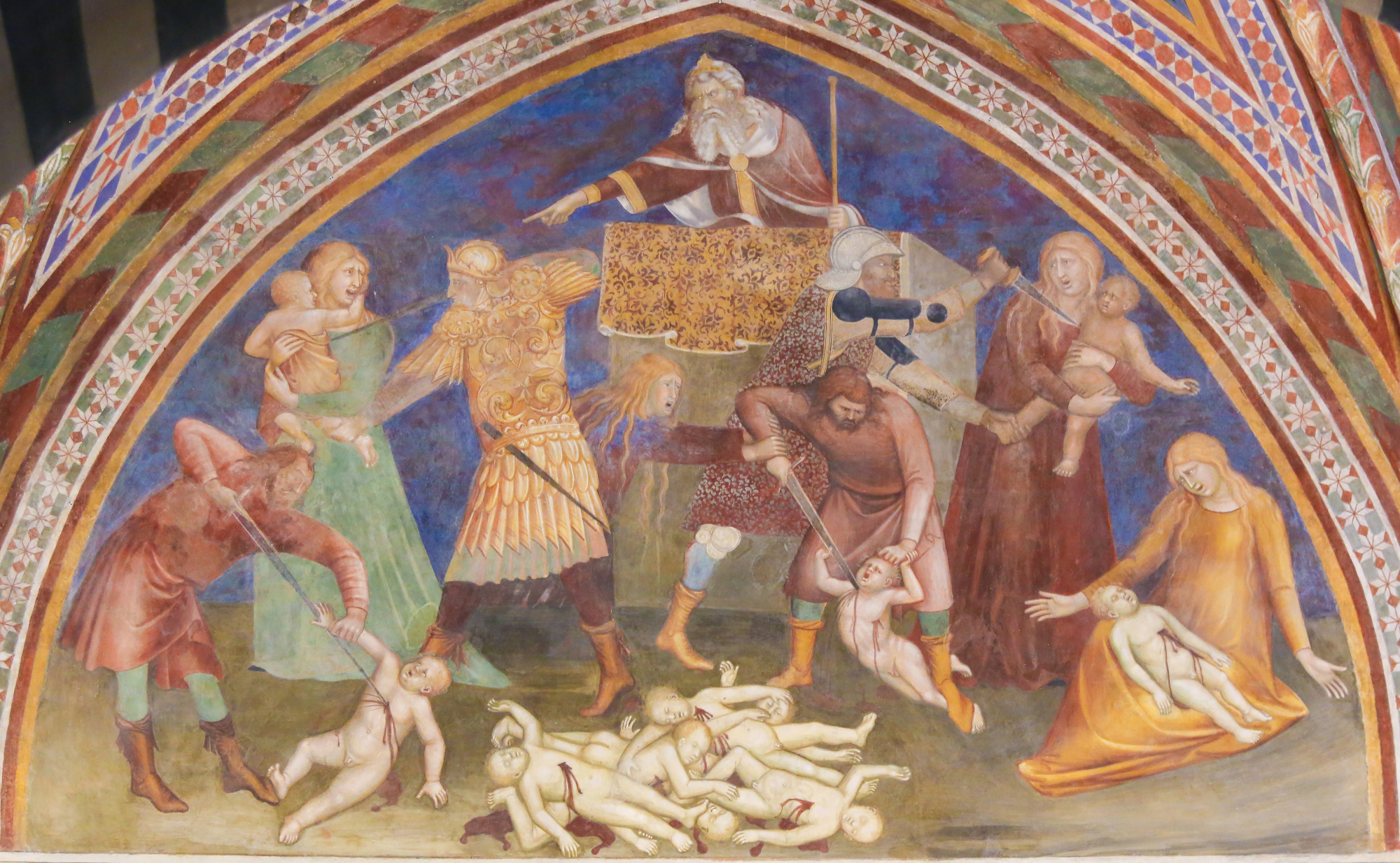
LOOK: Massacre of the Innocents by Lippo Memmi (attrib.)
Attributed to Lippo Memmi (Italian, ca. 1291–1356), Massacre of the Innocents, ca. 1335–45. Fresco, Collegiate Church of San Gimignano, Italy.
In the Collegiate Church of San Gimignano, this scene is part of a narrative cycle on Christ’s infancy in six upper bays, comprising also the Annunciation, the Nativity and Adoration of the Shepherds, the Adoration of the Magi, the Presentation in the Temple, and the Flight to Egypt.
LISTEN: “And Herod Rages On”| Words by Kate Bluett, 2020 | Music by Elise Massa, 2020 | Performed by Elise Massa
The streets ran red in Bethlehem; our little boys were gone when soldiers came on Herod’s whim, but Herod rages on. No newborn king his light should dim; he’d be the only dawn, sent men to tear them limb from limb— and Herod rages on.
Two thousand years, all filled with births and stained as red as dawn by blood that soaks the thirsty earth, still Herod rages on. And what is all this bloodshed worth, our sons and daughters gone, but barren fields and empty hearths, while Herod rages on?
Dear infant Christ in Joseph’s arms, escaped before the dawn, O come and heal how we’ve been harmed, for Herod rages on. The sirens shriek, deep fear alarms; when will you make them gone? Or must we wait ’til hate’s disarmed? For Herod rages on.
The stones that wept in Abel’s gore cry out with every dawn ’til swords are laid down evermore, while Herod rages on. Someday he’ll fall to rise no more; someday he will be gone. Our hearts ’til then are bleeding sore, and Herod rages on.
This song by Kate Bluett and Elise Massa views Herod as representative of any political leader whose policymaking or direct command threatens the lives of innocent children today. Lord, have mercy.
This post is part of a daily Christmas series that goes through January 6. View all the posts here, and the accompanying Spotify playlist here.
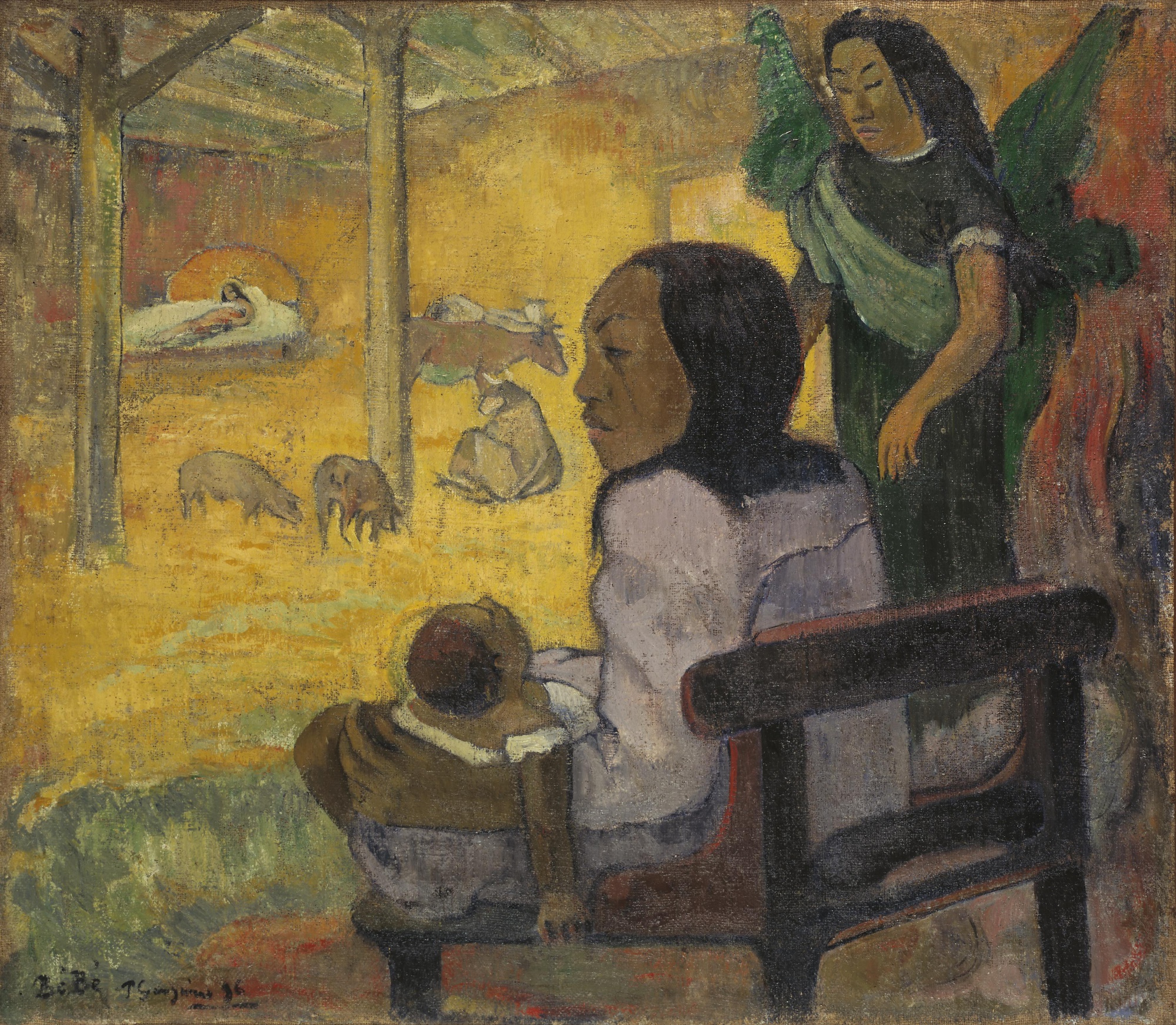
Paul Gauguin (French, 1848–1903), Be Be (The Nativity), 1896. Oil on canvas, 67 × 76.5 cm. State Hermitage Museum, St. Petersburg, Russia. A midwife holds the newborn Christ as his mother rests in the upper left corner.
O child of man,
Wombed in dark waters you retell
Millenniums, image the terrestrial span
From an unwitting cell
To the new soul within her intricate shell,
O child of man.

O child of man,
Whose infant eyes and groping mind
Meet chaos and create the world again,
You for yourself must find
The toils we know, the truths we have divined –
Yes, child of man.

O child of man,
You come to justify and bless
The animal throes wherein your life began,
And gently draw from us
The milk of love, the most of tenderness,
Dear child of man.

So, child of man,
Remind us what we have blindly willed –
A slaughter of all innocents! You can
Yet make this madness yield
And lift the load of our stock-piling guilt,
O child of man.
“Agnus Dei” is the seventh of nine titled sections of the poem “Requiem for the Living” by Cecil Day-Lewis, originally published in The Gate, and Other Poems (J. Cape, 1962) and compiled in The Complete Poems of C. Day Lewis (Stanford University Press, 1992).
Cecil Day-Lewis CBE (1904–1972) was one of the leading British poets of the 1930s, closely associated with W. H. Auden. He was born in Ireland of Anglo-Irish parents, his father a Church of Ireland clergyman, and was educated at Oxford, where he taught poetry from 1951 to 1956. In the 1940s he “turned from poetry of left-wing political statement to an individual lyricism expressed in more traditional forms” (Britannica) and served as poet laureate of England from 1968 until his death in 1972. In addition to writing poetry, he also wrote crime novels under the pseudonym Nicholas Blake, sixteen of which feature detective Nigel Strangeways. One of Day-Lewis’s four children is the actor Daniel Day-Lewis.
The fourth day of Christmas is set apart in Christian calendars to commemorate the massacre of innocents in Bethlehem shortly after the birth of Jesus. Herod, a Roman client king of Judea, felt threatened by the news that the “Anointed One” of God had been born and would rule the people. In an attempt to secure his political power, Herod ordered that all the male babies in Bethlehem be killed, thinking that surely the Messiah would be among them.
Applying the prophet Jeremiah’s words about the grief of exile (Jer. 31:15) to the present bloodshed, Matthew tells us in his Gospel that the night of the Bethlehem massacre,
A voice was heard in Ramah, wailing and loud lamentation, Rachel weeping for her children; she refused to be consoled, because they are no more. (Matt. 2:18)
Rachel, a matriarch of Israel, was buried near Bethlehem, so the implication is that she was crying out from her grave in grief over her murdered descendants, joining the chorus of wailing Jewish mothers whose loss is unfathomable.
LOOK: Antiquarum Lacrimae (The Tears of Ancient Women) by Joan Snyder
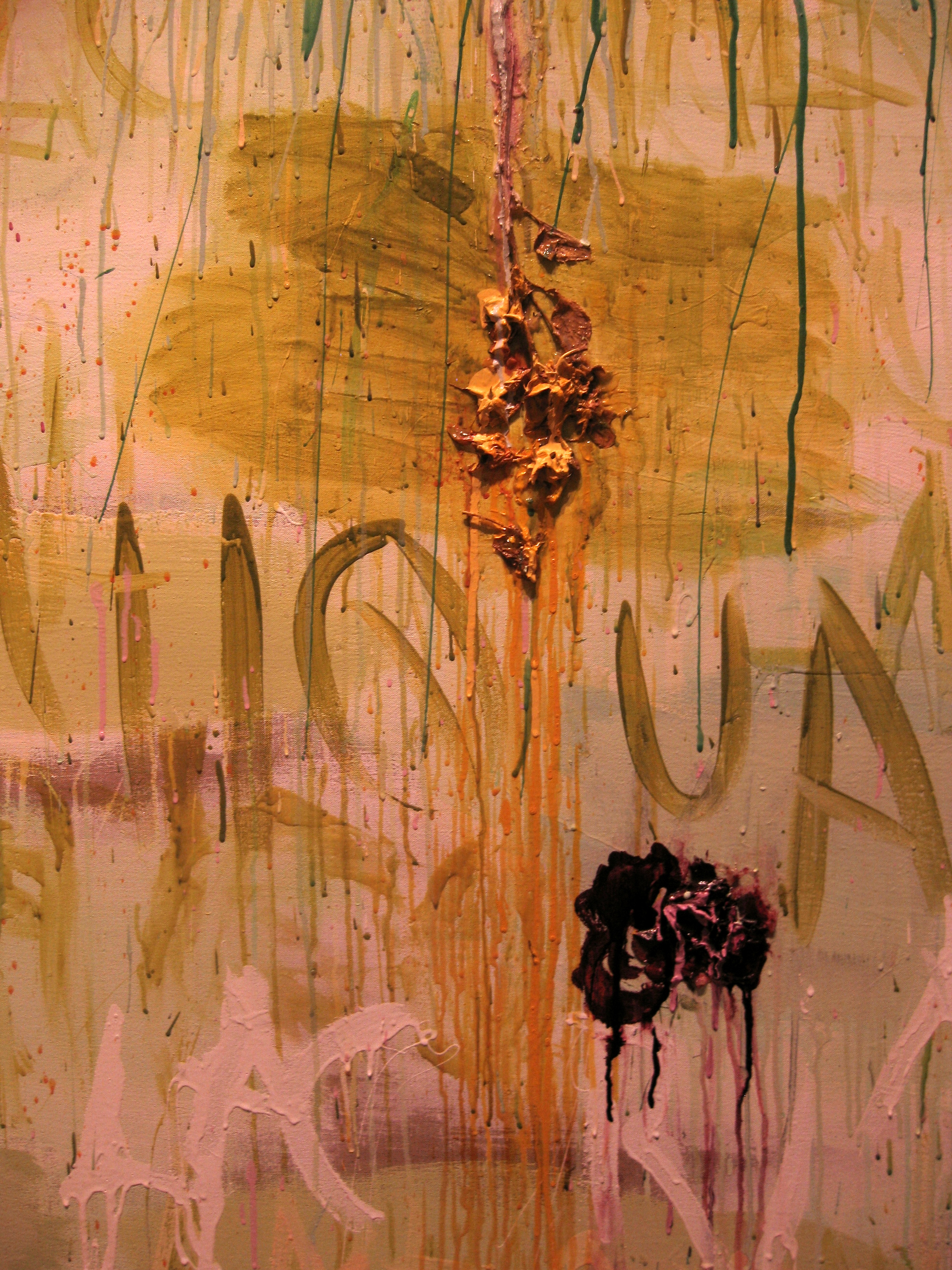
Joan Snyder (American, 1940–), Antiquarum Lacrimae (The Tears of Ancient Women), 2004. Acrylic and dried flowers on linen, 78 × 120 in. Grand Rapids Art Museum, Grand Rapids, Michigan. Photo courtesy of the artist.
Painted in the wake of the September 11, 2001, attack on the New York World Trade Center and the subsequent US invasion of Afghanistan and Iraq, the elegiac Antiquarum Lacrimae by Joan Snyder evokes the suffering of women in times of war and violence. Broad, lateral strokes of green in varying shades form a backdrop for the scrawled repetition of the Latin words of the title, which translate to “The Tears of Ancient Women”—women who weep in personal anguish, lamenting their own losses, but also more broadly for the state of the world. Dried flowers, pressed upside down onto the canvas, suggest a ravaged field, or gravesides, and the thick, round, deep red splotches of dripping paint suggest open wounds.
LISTEN: “Neharót Neharót” by Betty Olivero, 2006–8 | Performed by violist Kim Kashkashian on Neharót, 2009, and live on October 20, 2019 (see video below)
A chamber piece for solo viola, accordion, percussion, two string ensembles, and tape, “Neharót Neharót” is by contemporary Israeli composer Betty Olivero. Its Hebrew title translates to “Rivers Rivers,” referring to the rivers of tears shed by women—though Olivero also points out the word’s resemblance to nehara, meaning “ray of light,” thus identifying a faint hope that shines through floods of suffering. The composition is a textured lament led by viola, which plays lyrically over the top of an ensemble accompaniment and engages with recordings of women’s singing voices.
In 2006 Olivero was working on a commission from 92NY, a Jewish community center in Manhattan, when war broke out at the Israel-Lebanon border between the Israeli military and the militias of Hezbollah, an Islamist group. “Deeply touched and marked by the shocking television images of victims, corpses and mourning people on both sides of the border, [Olivero] chose elegies by mothers, widows and sisters who had lost their loved ones as a point of reference for her composition.”
Olivero taped women in mourning, as well as elegies and love songs of Kurdish and North African origin or derivation performed by professional Israeli singers Lea Avraham and Ilana Elia. One such song is “Fermana” (Destruction), which laments Saddam Hussein’s slaughter of the Kurds. Excerpts from these recordings are played back as part of the fabric of the live performance of “Neharót Neharót.” The piece also quotes Orpheus’s lament from Monteverdi’s L’Orfeo.
“‘Neharót Neharót’ is a dedication to all those women and children living in areas of war,” Olivero says. Though it was catalyzed by and references particular conflicts, it is intended as a universal cry of sorrow on behalf of women everywhere who carry the wounds of war—especially the unremitting grief of having lost children to violence.
Joan Snyder, Antiquarum Lacrimae (detail). Photo: Victoria Emily Jones.
December 28 is Childermas, or Holy Innocents’ Day, when the church commemorates the slaughter of young male children in Bethlehem by the order of Herod the Great, attempting to quash the threat of a rival king. This, too, is part of the Christmas story. The Gospel account of the “massacre of the innocents” quotes Jeremiah: “A voice was heard in Ramah, weeping and loud lamentation, / Rachel weeping for her children; / she refused to be comforted, because they are no more” (Matt. 2:18).
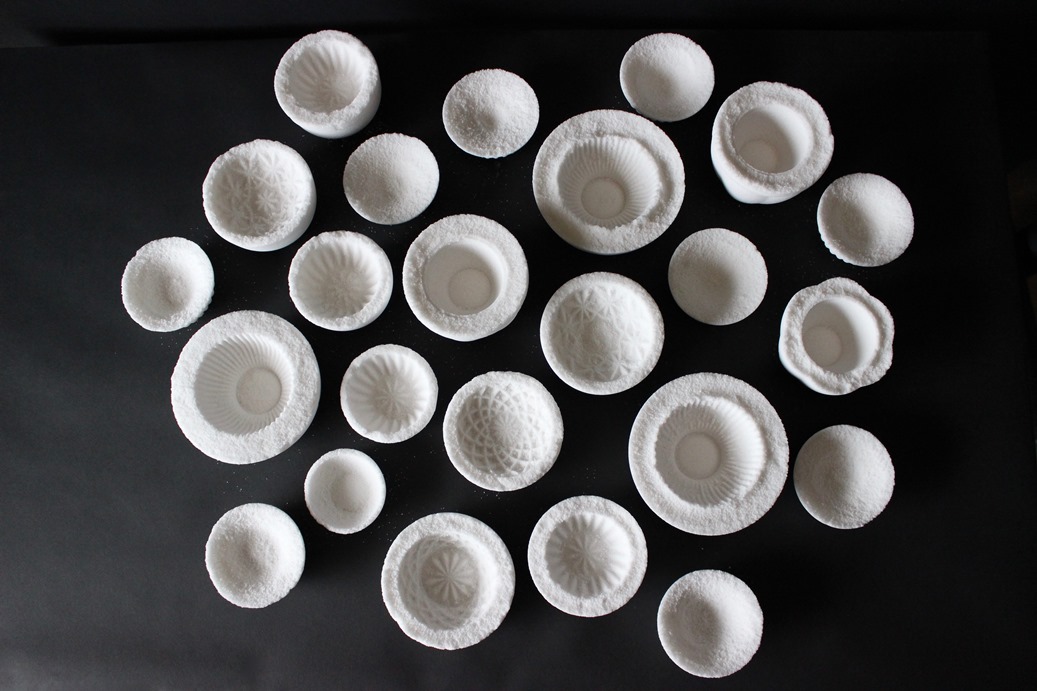
This ensemble of delicate containers made entirely of salt “is a motif of maternal lament,” says Australian artist Rebekah Pryor. “My Saltcellars functions to preserve and offer a taste of both the bitterness of maternal lament and the wisdom of love that enables the mother to survive it.”
LISTEN: “Mothers and Shepherds” by Brittney Spencer, Emil Sydhage, Gilbert Nanlohy, and Connor Wheaton, 2018 | Released as a single by Common Hymnal (feat. Brittney Spencer), 2019 | CCLI #7141753
Come now and hear the sound Of mothers gathered round Tears are streaming down in Bethlehem Grieving life that didn’t have to end Asking God to justify the pain Never knowing He would feel the same The powerful oppress the prophecy But shepherds passing through have found a King
Rumor has it that a child is born And it’s said that we will call him Lord Heaven’s angels came to let us know That our freedom rests upon His throne So we’ve traveled from across this land Seeking out the new and precious Lamb The One who came and made time stand still When heaven opened up at God’s own will
Hallelujah Glory in the highest King Messiah Savior of the world
Now forever we will sing the song Of the One who was and is to come All creation joins in harmony In declaring He is perfectly
Holy, holy Merciful and mighty God has sent The Savior of the world
Hallelujah Glory in the highest King Messiah Savior of the world
Ooh-ooh, ooh-ooh Ooh-ooh-ooh-ooh-ooh-ooh Ooh-ooh, ooh Savior of the world Ooh-ooh, ooh-ooh Ooh-ooh-ooh-ooh-ooh-ooh Ooh-ooh, ooh Savior of the world
Songwriter Brittney Spencer describes “Mothers and Shepherds” as “a Christmas song that forces hope, disaster, and pursuit to meet on a painful yet dauntingly beautiful path that exposes how much we’ve always needed a savior.” Find the chords here.
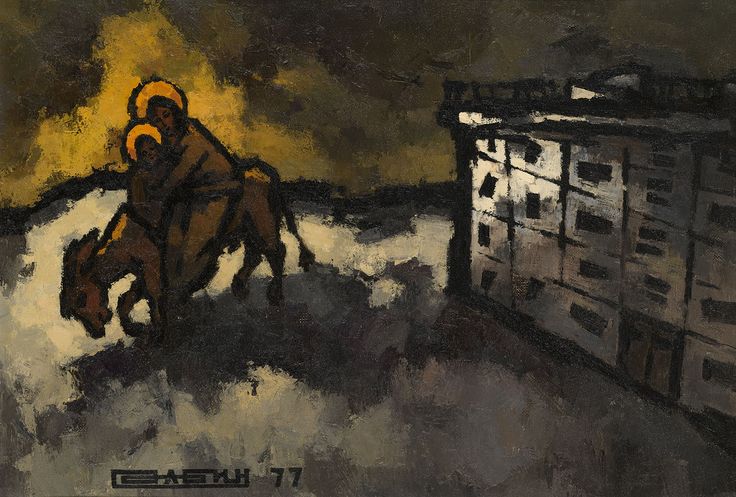
Oscar Rabin (Russian, 1928–2018), Flight into Egypt, 1977. Oil on canvas, 49 × 70 cm.
Now when they had departed, behold, an angel of the Lord appeared to Joseph in a dream and said, “Rise, take the child and his mother, and flee to Egypt, and remain there until I tell you, for Herod is about to search for the child, to destroy him.” And he rose and took the child and his mother by night and departed to Egypt and remained there until the death of Herod. This was to fulfill what the Lord had spoken by the prophet, “Out of Egypt I called my son.”
Then Herod, when he saw that he had been tricked by the wise men, became furious, and he sent and killed all the male children in Bethlehem and in all that region who were two years old or under, according to the time that he had ascertained from the wise men. Then was fulfilled what was spoken by the prophet Jeremiah:
“A voice was heard in Ramah,
weeping and loud lamentation,
Rachel weeping for her children;
she refused to be comforted, because they are no more.”
When was he born? When was he born?
When was he born? On a cold dark night.
The king said, “Kill every baby boy that you can find.
There’s been too much talk about a new king born,
And this throne is mine.”
When was he born? When was he born?
When was he born? On a cold dark night.
He wasn’t born to be a king. He wasn’t born to fight.
He knew this world can get so dark that when you can
You’ve got to turn on the light.
When was he born? When was he born?
When was he born? On a cold dark night.
+++
A Russian painter and activist, Oscar Rabin was one of the founders of the Soviet Nonconformist Art movement. After being stripped of his citizenship in 1978 for political dissidence, he emigrated to Paris, where he lived until his death last year at age ninety. He is the subject of the feature-length documentaries Oscar (2018) and, with his wife and fellow artist Valentina Kropivnitskaya, In Search of a Lost Paradise (2015).
This post belongs to the weekly series Artful Devotion. If you can’t view the music player in your email or RSS reader, try opening the post in your browser.
To view all the Revised Common Lectionary scripture readings for the First Sunday after Christmas Day, cycle A, click here.



 Art & Theology