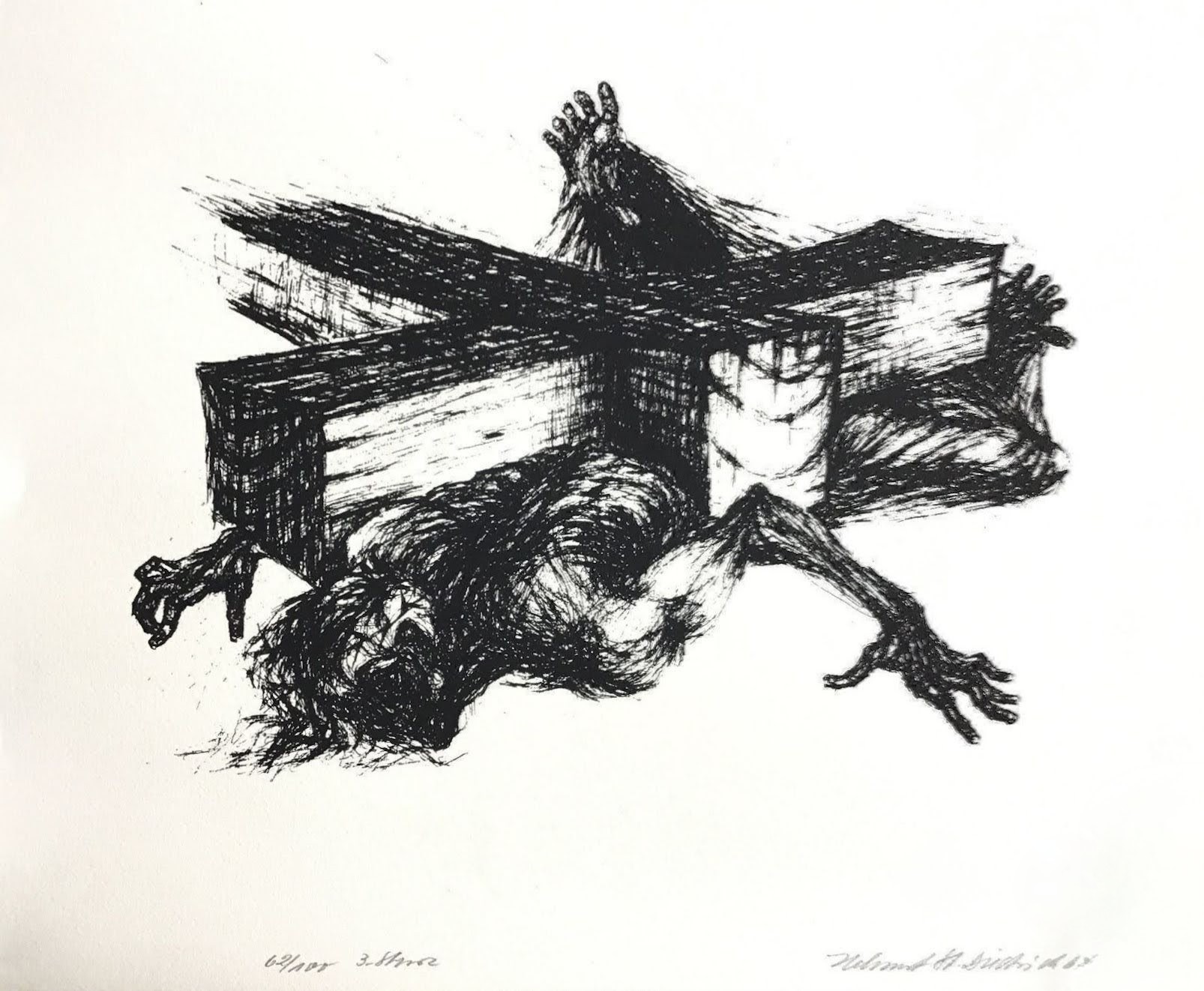
Helmut Stephan Diedrich (German, 1937–), Kreuzfall, 1964. Lithograph, edition 62/100.
You fall, sparrow-bone, God-eyed leaf,
black hair of ox, kernel of wheat,
gold blown from the stalk. You lift wood,
trudge, and lurch, your back pulped. You would
spit up the cup-dregs for relief—

but no, you want not; you believe
your master’s dream. You toss your dreams
like chaff to the breeze. You lift wood.
You fall,

            thin coin,

                          widow’s all,

                                       copper seed
into the mouth of the box. She
brushed you a hundred times, so good
to hold, but better to drop. Wood
weights you, snapped bone, wind-flung leaf.
You fall.
This poem was originally published in Christianity and Literature 59, no. 2 (Winter 2010) and is anthologized in Imago Dei: Poems from Christianity and Literature, ed. Jill Peláez Baumgaertner (Abilene Christian University Press, 2012). Used by permission of the poet.
Originating in the Middle Ages, the Stations of the Cross is a Christian devotional practice in which participants commemorate the journey Jesus took down the Via Dolorosa (Way of Sorrows) to his death—either on location in the Holy Land, physically following a demarcated route, or, more accessibly, in their imaginations, through the aid of images or meditative texts. Traditionally, there are fourteen stations, the third, seventh, and ninth of which are “Jesus falls.” At these stopping places, Christians reflect on the crushing weight of sin and wood, on Jesus’s intensifying exhaustion, and yet, too, on his perseverance to get up each time and, pushing through the debility, to continue his trek to its fatal, foreordained end.
In his poem “Sparrow Lament,” William Woolfitt alludes to Jesus’s three falls on his way to Golgotha: “You fall,” “You fall,” “You fall.” He uses a string of metaphors from the natural world for the falling Christ: He’s a sparrow bone (spat out by a predator?), a floating leaf, a shed bovine hair, a grain of wheat blown loose from its stalk. These are wistful images of solitariness, passage, decease—and yet the descriptor “God-eyed” indicates that the path Christ is on is governed by divine providence.
The sparrow reference, given further weight by its use in the poem’s title, evokes Jesus’s teaching in Matthew 10:28–31: “Do not fear those who kill the body but cannot kill the soul; rather, fear the one who can destroy both soul and body in hell. Are not two sparrows sold for a penny? Yet not one of them will fall to the ground apart from your Father. And even the hairs of your head are all counted. So do not be afraid; you are of more value than many sparrows.”
The Father has willed the Son to drink the bitter cup of suffering and death, which, despite Jesus’s distressed plea less than twenty-four hours prior that the cup be removed, he downs in trust, casting off any dreams he had for living into old age. As he carries out his calling, he stumbles, he falls to the ground—but not apart from the will of his Father.
In the middle of the poem, the lineation—the arrangement of words using lines and line breaks—mimics a downward motion. Like the drop of the storied widow’s coin into the offering box (Mark 12:41–44; Luke 21:1–4). Most biblical interpreters assume that Mary, Jesus’s mother, was a widow by the time Jesus started his ministry, since Joseph is never mentioned in any of the Gospel accounts after the episode of Jesus disappearing in the temple at age twelve. Woolfitt refers to Jesus as “widow’s all”—Mary’s everything, her firstborn son, whom she sacrificially gives to the world, knowing God will bless her gift. She doesn’t hoard this dear treasure of hers. She surrenders him to God’s greater plan.
It wasn’t an easy choice to make. Mothers instinctively want to hold on to their children, and tight. Many intrusively fear dropping them as infants and would do anything to spare them pain. Well, Mary drops her son, on purpose. She relinquishes him, “copper seed,” whose death bears fruit, yields dividends.
William Woolfitt is a writer across the genres of poetry, fiction, and essay. His poetry collections are The Night the Rain Had Nowhere to Go (Belle Point, 2024), Spring Up Everlasting (Mercer, 2020), Charles of the Desert (Paraclete, 2016), and Beauty Strip (Texas Review, 2014). He is an associate professor of creative writing at Lee University in Cleveland, Tennessee, where he lives with his wife and two children. He founded and edits Speaking of Marvels, a blog that features interviews with authors of chapbooks, novellas, and books of assorted lengths.
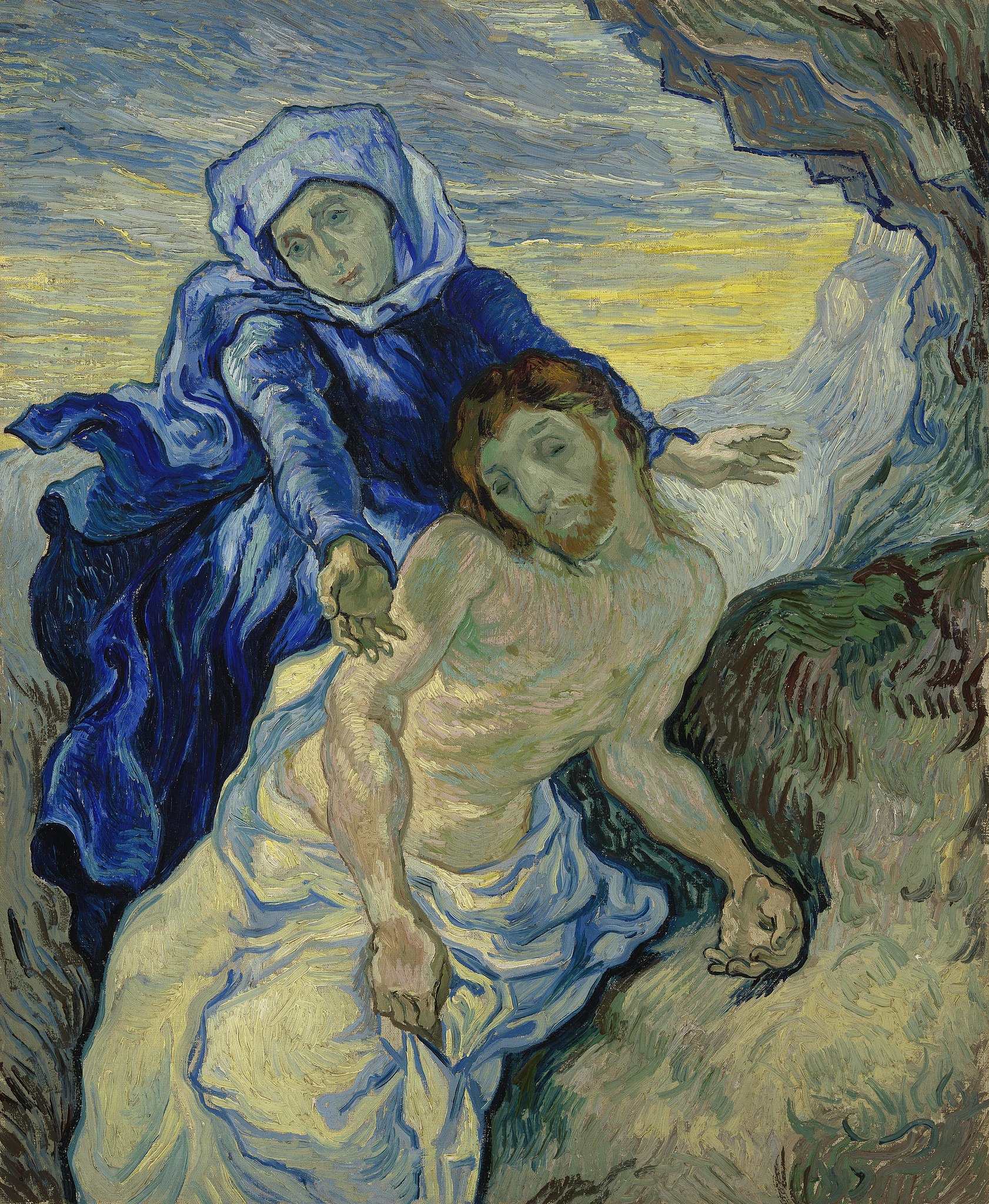
Vincent van Gogh (Dutch, 1853–1890), Pietà (after Delacroix), 1889. Oil on canvas, 73 × 60.5 cm. Van Gogh Museum, Amsterdam.
“Poor fighter, poor sufferer,”
my brother’s words for me.
                                                 Self-pity—
I have to beat it down. But how, exactly?
Never know when the next attack will come.
How to suppress religion?
Down the cloisters of the sick it beckoned—
I abused my God . . . that lithograph of Delacroix’s,
irredeemable sheets I flung in the paint and oil,
his Pietà in ruins.
                               Reconstruct it from memory.
Good technical exercise. Start with the hands,
there were four hands, four arms in the foreground—
mother and son, and the torsions of their bodies
almost impossible, draw them out—
painfully . . . no measurements—
into a great mutual gesture of despair.

Delacroix and I, we both discovered painting
when we no longer had breath or teeth.
Work into his work, strain for health,
the brain clearing, fingers firmer,
brush in the fingers going like a bow,
big bravura work—pure joy! I copy—
no, perform his masterwork of pain.

Genius of iridescent agony, Delacroix,
help me restore your lithograph with color.
I mortify before your model—
how to imitate my Christ? The bronze
of my forelock shadows his, the greatest artist:
stronger than all the others, spurning marble,
clay and paint, he worked in living flesh.

Living and yet immortal, Lord, revive me—
let me inhale the blue of Mary’s cape
billowing hurricanes of hope, clothe me
in your cerements gold with morning—
mother and son, from all your sorrow
all renewal springs, the earth you touch
turns emerald as your hand that burgeons green.
Robert Fagles (1933–2008) (PhD, Yale) was an award-winning American translator, poet, and academic. He is best known for his many translations of ancient Greek and Roman classics, especially the epic poems of Homer. He taught English and comparative literature at Princeton University from 1960 until his retirement in 2002, chairing the department from 1975 onward.
Vincent van Gogh (1853–1890) was raised in the Dutch Reformed Church, the son of a small-town minister—and even worked himself as a lay preacher in the Borinage mining region of southwestern Belgium for two years in his mid-twenties. While there, he gave away all his possessions and lived in poverty like those he served, eating a spare diet, wearing rough garments, and sleeping on the floor. Ironically, his sponsoring evangelical committee deemed such behavior unbecoming of a minister of the gospel, and, due also to his lack of eloquence and theological refinement, they withdrew their support.
This rejection soured Vincent on institutional Christianity. But it didn’t squash his faith. After moving back in with his parents in Nuenen, the Netherlands, he wrote to his brother and close confidante, Theo:
Life [. . .] always turns towards one an infinitely meaningless, discouraging, dispiriting blank side on which there is nothing, any more than on a blank canvas.
But however meaningless and vain, however dead life appears, the man of faith, of energy, of warmth, and who knows something, doesn’t let himself be fobbed off like that. He steps in and does something, and hangs on to that, in short, breaks, ‘violates’ – they say.
Let them talk, those cold theologians. [Letter 464]
Although Vincent left the church and developed conflicted feelings about the Bible, he maintained a reverence for Christ to the end of his days. His time in the Borinage was not for nothing, as it’s there that he discovered, through sketching his parishioners and the surrounding landscapes, his calling to be an artist.
This new vocation was one he ascribed metaphorically to Christ. In a letter to his friend and fellow artist Émile Bernard dated June 26, 1888, Vincent wrote that Jesus’s masterworks are human beings made fully and eternally alive:
Christ – alone – among all the philosophers, magicians, &c. declared eternal life – the endlessness of time, the non-existence of death – to be the principal certainty. The necessity and the raison d’être of serenity and devotion. Lived serenely as an artist greater than all artists–disdaining marble and clay and paint – working in LIVING FLESH. I.e. – this extraordinary artist, hardly conceivable with the obtuse instrument of our nervous and stupefied modern brains, made neither statues nor paintings nor even books . . . he states it loud and clear . . . he made . . . LIVING men, immortals. [Letter 632]
In the same letter, he contended that “the figure of Christ has been painted – as I feel it – only by Delacroix and by Rembrandt…….. And then Millet has painted…. Christ’s doctrine.”
These are the three artists Vincent admired most. He mentions them many times throughout his ample correspondence with family and friends, and he made paintings after all three.
The only painting Vincent ever made of Christ was his Pietà, which he painted in two versions in September 1889, both after the French artist Eugène Delacroix (1798–1863). These are among the many works Vincent painted at a psychiatric hospital in Saint-Rémy-de-Provence in southern France, to which he had voluntarily committed himself after suffering an acute mental breakdown that resulted in his infamous severing of his left ear on December 23, 1888. Theo had rushed to Arles, where Vincent was living in “the Yellow House” at the time, and on December 28 reported on Vincent’s condition in a letter to his wife, Jo van Gogh-Bonger:
I found Vincent in the hospital in Arles. The people around him realized from his agitation that for the past few days he had been showing symptoms of that most dreadful illness, of madness, and an attack of fièvre chaude, when he injured himself with a razor, was the reason he was taken to hospital. Will he remain insane? The doctors think it possible, but daren’t yet say for certain. It should be apparent in a few days’ time when he is rested; then we will see whether he is lucid again. He seemed to be all right for a few minutes when I was with him, but lapsed shortly afterwards into his brooding about philosophy and theology. It was terribly sad being there, because from time to time all his grief would well up inside and he would try to weep, but couldn’t. Poor fighter and poor, poor sufferer. Nothing can be done to relieve his anguish now, but it is deep and hard for him to bear. [Letter 728]
Vincent returned to the Yellow House in January 1889 but over the next few months experienced recurring bouts of mania and depression and was in and out of the hospital. Some of the people of Arles grew increasingly frightened by his erratic behavior, and they essentially ran him out of town. That’s when he made his way twenty miles northeast to the town of Saint-Rémy to check in to Saint-Paul-de-Mausole, a former monastery that then, as now, served as a hospital for the mentally ill.
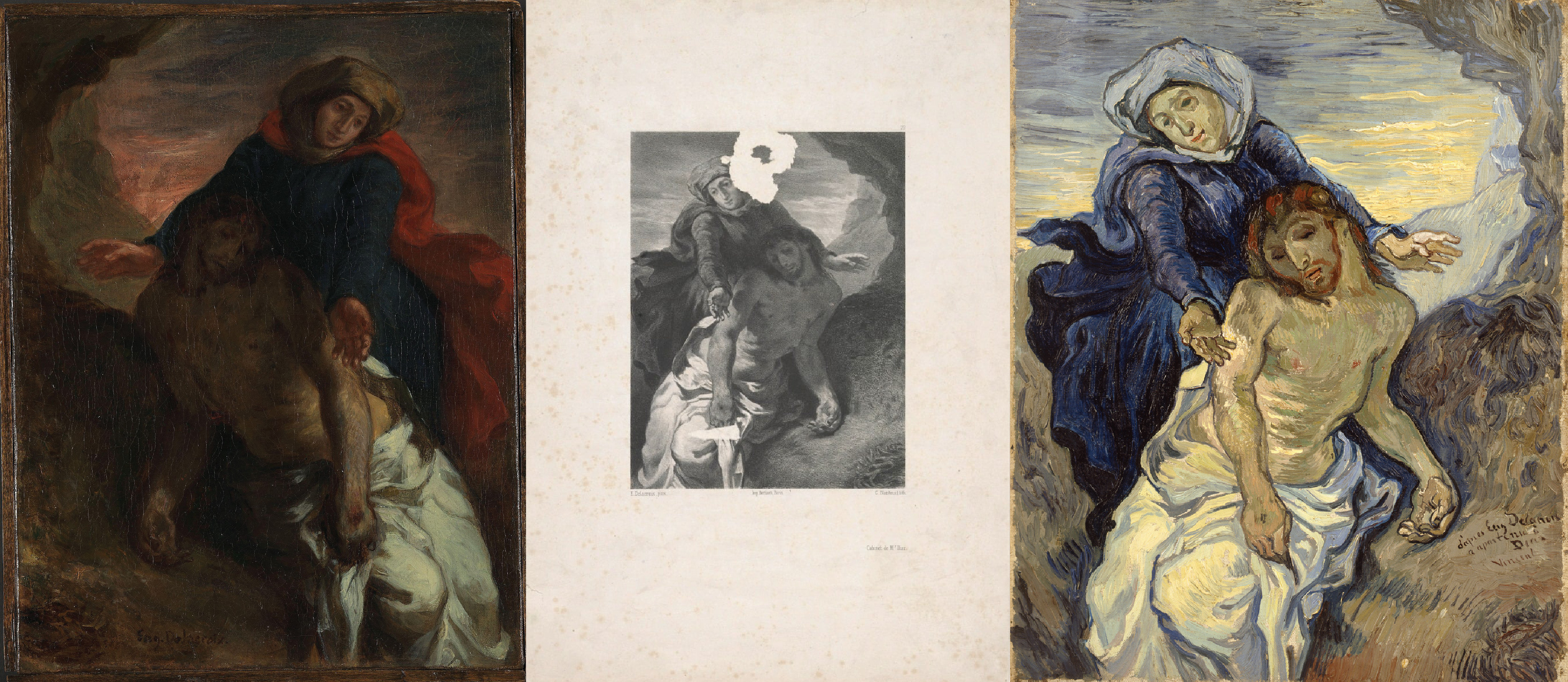
Vincent had two rooms there, one of which he used as a studio, setting up the various print copies he owned of acclaimed paintings. One was a lithograph by Célestin François Nanteuil-Leboeuf after Delacroix’s Pietà, from the portfolio Les artistes anciens et modernes. (Theo had bought and sent him this litho at his request.) Vincent lamented to his brother that he accidentally damaged it with spilled paint—but that impelled him to paint his own copy of Delacroix. On September 10, 1889, he wrote:
Work is going very well, I’m finding things that I’ve sought in vain for years, and feeling that I always think of those words of Delacroix that you know, that he found painting when he had neither breath nor teeth left. Ah well, I myself with the mental illness I have, I think of so many other artists suffering mentally, and I tell myself that this doesn’t prevent one from practising the role of painter as if nothing had gone wrong.
[. . .] In the very suffering, religious thoughts sometimes console me a great deal. Thus this time during my illness a misfortune happened to me – that lithograph of Delacroix, the Pietà, with other sheets had fallen into some oil and paint and got spoiled.
I was sad about it – then in the meantime I occupied myself painting it, and you’ll see it one day, on a no. 5 or 6 canvas I’ve made a copy of it which I think has feeling. [. . .] My fingers [are] so sure that I drew that Delacroix Pietà without taking a single measurement, though there are those four outstretched hands and arms – gestures and bodily postures that aren’t exactly easy or simple. [Letter 801]
LEFT: Eugène Delacroix, Pietà, ca. 1850, oil on canvas, 35.6 × 27 cm, National Museum of Art, Architecture and Design, Oslo. CENTER: Célestin François Nanteuil-Leboeuf, Pietà (after Delacroix), 1853, lithograph, Van Gogh Museum, Amsterdam. RIGHT: Vincent van Gogh, Pietà (after Delacroix), 1889, oil on canvas, 42 × 34 cm, Vatican Museums.
The painted copy he refers to here is the smaller of the two, which he gifted to his sister Willemien and is now in the collection of the Vatican Museums in Vatican City. In another letter, from September 19, he tells Wil “this little copy of course has no value from any point of view,” but “you’ll be able to see in it that Delacroix doesn’t draw the features of a Mater Dolorosa [sorrowing Mother of God] in the manner of Roman statues – and that the pallid aspect, the lost, vague gaze of a person tired of being in anguish and in tears and keeping vigil is present in it.”
The other Pietàthat Vincent painted—which is similar to the first but larger and brighter—he kept for himself, hanging it in his bedroom at Saint-Rémy. He describes the painting to Wil:
The Delacroix is a Pietà, i.e. a dead Christ with the Mater Dolorosa. The exhausted corpse lies bent forward on its left side at the entrance to a cave, its hands outstretched, and the woman stands behind. It’s an evening after the storm, and this desolate, blue-clad figure stands out – its flowing clothes blown about by the wind – against a sky in which violet clouds fringed with gold are floating. In a great gesture of despair she too is stretching out her empty arms, and one can see her hands, a working woman’s good, solid hands. With its flowing clothes this figure is almost as wide in extent as it’s tall. And as the dead man’s face is in shadow, the woman’s pale head stands out brightly against a cloud – an opposition which makes these two heads appear to be a dark flower with a pale flower, arranged expressly to bring them out better. [Letter 804]
Vincent van Gogh (Dutch, 1853–1890), Pietà (after Delacroix), 1889. Oil on canvas, 73 × 60.5 cm. Van Gogh Museum, Amsterdam.
Although Vincent may have at one time seen Delacroix’s Pietàpainting in person, at Saint-Rémy he had only a grayscale image, the lithograph by Nanteuil-Leboeuf, to reference. For his version, he invented his own color scheme—bold blues and yellows.
On September 20, Vincent described to Theo his process of “copying,” or interpreting, the masters:
What I’m seeking in it, and why it seems good to me to copy them, I’m going to try to tell you. We painters are always asked to compose ourselves and to be nothing but composers.
Very well – but in music it isn’t so – and if such a person plays some Beethoven he’ll add his personal interpretation to it – in music, and then above all for singing – a composer’s interpretation is something, and it isn’t a hard and fast rule that only the composer plays his own compositions.
Good – since I’m above all ill at present, I’m trying to do something to console myself, for my own pleasure.
I place the black-and-white by Delacroix or Millet or after them in front of me as a subject. And then I improvise colour on it but, being me, not completely of course, but seeking memories of their paintings – but the memory, the vague consonance of colours that are in the same sentiment, if not right – that’s my own interpretation.
Heaps of people don’t copy. Heaps of others do copy – for me, I set myself to it by chance, and I find that it teaches and above all sometimes consoles.
So then my brush goes between my fingers as if it were a bow on the violin and absolutely for my pleasure. [Letter 805]
Some art historians believe the Christ figure in the painting is a self-portrait—Vincent identifying himself with the suffering Christ, or recognizing Christ’s presence with him in his suffering, and expressing his longing to be cradled in loving arms and for resurrection from the grave of psychosis. In Vincent van Gogh: The Complete Paintings, Ingo F. Walther and Rainer Metzger write,
Nothing could convey more clearly his need to record his own crisis in the features of another than these two copies [of Delacroix’s Pietà]. The face of the crucified Christ in the lap of a grieving Mary quite unambiguously has van Gogh’s own features. In other words, a ginger-haired Christ with a close-trimmed beard was now the perfect symbol of suffering, the (rather crude) encoding of van Gogh’s own Passion. The painter was to attempt this daring stroke once more, in his interpretation of Rembrandt’s The Raising of Lazarus. Here, van Gogh gave his own features to a Biblical figure who, like Christ, passed through Death into new Life. It was as if, in his work as a copyist, van Gogh was pursuing the kind of oblique allegory he disapproved of in Bernard and Gauguin [see Letter 823]. Five weeks of mental darkness demanded artistic expression – and even that incorrigible realist Vincent van Gogh could not be satisfied with landscape immediacy alone. (542)
On May 16, 1890, Vincent left the hospital at Saint-Rémy, bringing his Pietà painting with him. He moved to Auvers-sur-Oise, a suburb of Paris, placing himself under the care of the homeopathic doctor Paul Gachet, who became a friend. Dr. Gachet admired the painting very much and requested his own copy. (As far as we know, Vincent never got around to making one.)
Vincent was incredibly prolific in Auvers, but his mental health continued to decline, and he died a little over two months after relocating there, on July 29, 1890, from a gunshot wound to the lower chest that was likely self-inflicted.
In his poem “Pietà” from an ekphrastic collection based entirely on Vincent’s paintings, Robert Fagles draws on Vincent’s biography and letters in addition to the titular painting to voice the spiritual and emotional yearnings of Vincent’s final year. The last stanza is a prayer that the poetic speaker Vincent addresses to God—for hope, renewal, light:
Living and yet immortal, Lord, revive me— let me inhale the blue of Mary’s cape billowing hurricanes of hope, clothe me in your cerements gold with morning— mother and son, from all your sorrow all renewal springs, the earth you touch turns emerald as your hand that burgeons green.
In Vincent’s Pietà, the dead Christ’s limp hand rests on a grassy boulder or knoll, which Fagles reads as signifying life awakening from death. You can even see the green reflected in Christ’s face and chest, not to mention the golden sun (“after the storm,” as the historical Vincent wrote) glinting on his right arm, abdomen, and shroud, a faint promise of resurrection.
The English Crucifixion lyric “My Fearful Dream” (also known by the beginning of its first line, “To Calvary he bore his cross”) was written anonymously in the fifteenth century. It is preserved, with music by Gilbert Banastir (sometimes spelled Banaster or Banester) (ca. 1445–1487), on folios 77v–82r of the famous Tudor songbook BL Add. MS. 5465, intended for use at the court of King Henry VII. Compiled around the year 1500, this manuscript is commonly referred to as the Fayrfax Manuscript after Robert Fayrfax, the Tudor composer who was organist of St. Albans and a Gentleman of the Chapel Royal—that is, an adult male singer in the monarch’s household choir. It contains twelve sacred songs and thirty-seven secular songs, all in English—with, “beyond question, the finest music written to vernacular words which survives from pre-Reformation England,” writes John Stevens in Early Tudor Songs and Carols (xvi). It is unknown whether the text or the music was written first.
In 1982 “My Fearful Dream” was performed by Pro Cantione Antiqua under the direction of Mark Brown at the Church of St. John-at-Hackney in London. The recording of this performance was originally released in 1985 in vinyl format on A Gentill Jhesu: Music from the Fayrfax Ms. and Henry VIII’s Book (Hyperion A66152) and was later reissued by Regis Records in 2006 on the CD Tears & Lamentations: English Renaissance Polyphony (RRC 1259). Unfortunately, the CD is out of print, the choral group is inactive, and I can find no performances online. I thus provide the recording of “My Fearful Dream” (or “My Fearfull Dreme,” as the track list spells it) directly below for educational purposes. It is a song for three voices: alto, tenor, bass.
Below is the original text as transcribed by Richard Leighton Greene from the Fayrfax Manuscript in The Early English Carols (Oxford: Clarendon Press, 1935), page 124, followed by a version with modernized spellings and updates of a few antiquated words. The text also appears in John Stevens, Music and Poetry in the Early Tudor Court (London: Methuen, 1961), no. 56, and the music in John Stevens, ed., Early Tudor Songs and Carols (Musica Britannica 36) (London: Stainer and Bell, 1975), page 476.
Pro Cantione Antiqua does not sing the third stanza.
Rogier van der Weyden (Netherlandish, 1399/1400–1464), The Crucifixion, with the Virgin and Saint John the Evangelist Mourning, ca. 1460. Oil on panel, overall 71 × 73 in. (180.3 × 185 cm). Philadelphia Museum of Art.
Most people today use the word “carol” as synonymous with a cheerful Christmas song. But up until about 1550, the term was used for lyrics of a certain form rather than a certain subject or spirit. Greene defines the medieval or Renaissance carol as “a song on any subject, composed of uniform stanzas and provided with a burden . . . [that is,] an invariable line or group of lines which is to be sung before the first stanza and after all stanzas” (Early English Carols, xxxii–xxxiii). He distinguishes a burden from a refrain: “The refrain, as defined in this essay, is a repeated element which forms part of a stanza, in the carols usually the last line. The burden, on the other hand, is a repeated element which does not form any part of a stanza, but stands wholly outside the individual stanza-pattern” (clx).
That’s why “My Fearful Dream” can properly be called a carol. The two lines beginning “My fearful dream” open the song and repeat after each stanza.
My Feerfull Dreme
My feerfull dreme nevyr forgete can I:
Methought a maydynys childe causless shulde dye.

To Calvery he bare his cross with doulfull payne,
And theruppon straynyd he was in every vayne;
A crowne of thorne as nedill sharpe shyfft in his brayne;
His modir dere tendirly wept and cowde not refrayne.
          Myn hart can yerne and mylt
          When I sawe hym so spilt,
          Alas, for all my gilt,
Tho I wept and sore did complayne
     To se the sharpe swerde of sorow smert,
     Hough it thirlyd her thoroughoute the hart,
So ripe and endles was her payne.

My feerfull dreme . . .

His grevous deth and her morenyng grevid me sore;
With pale visage tremlyng she strode her child before,
Beholdyng ther his lymmys all to-rent and tore,
That with dispaire for feer and dred I was nere forlore.
          For myne offence, she said,
          Her Son was so betraide,
          With wondis sore araid,
Me unto grace for to restore:
     ‘Yet thou are unkynd, which sleith myn hert,’
     Wherewith she fell downe with paynys so smert;
Unneth on worde cowde she speke more.

My feerfull dreme . . .

Saynt Jhon than said, ‘Feere not, Mary; his paynys all
He willfully doth suffir for love speciall
He hath to man, to make hym fre that now is thrall.’
‘O frend,’ she said, ‘I am sure he is inmortall.’
          ‘Why than so depe morne ye?’
          ‘Of moderly pete
          I must nedis wofull be,
As a woman terrestriall
     Is by nature constraynyd to smert,
     And yet verely I know in myn hart
From deth to lyff he aryse shall.’

My feerfull dreme . . .

Unto the cross, handes and feete, nailid he was;
Full boistusly in the mortess he was downe cast;
His vaynys all and synowis to-raff and brast;
The erth quakyd, the son was dark, whos lyght was past,
          When he lamentable
          Cried, ‘Hely, hely, hely!’
          His moder rufully
Wepyng and wrang her handes fast.
     Uppon her he cast his dedly loke,
     Wherwith soddenly anon I awoke,
And of my dreme was sore agast.

My feerfull dreme . . .
My Fearful Dream (modernized)
My fearful dream never forget can I:
Methought a maiden’s child causeless should die.

To Calvary he bore his cross with doleful pain,
And thereupon strained he was in every vein;
A crown of thorns, sharp as needles, shoved in his brain.
His mother dear tenderly wept and could not refrain.
          My heart did yearn and melt
          When I saw him so spilt,
          Alas, for all my guilt,
And I wept and did sore complain
     To see the sharp sword of sorrow smart,
     How it pierced her straight through the heart,
So ripe and endless was her pain.

My fearful dream never forget can I:
Methought a maiden’s child causeless should die.

His grievous death and her mourning grieved me sore;
With pale visage, trembling, she strode before her child,
Beholding his limbs all rent and torn,
That with despair for fear and dread I was near forlorn.
          For my offense, she said,
          Her Son was so betrayed,
          With wounds sore arrayed,
Me unto grace for to restore:
     “Yet thou art unkind, which slayeth my heart,”
     Wherewith she fell down with pains so smart;
Hardly one word could she speak more.

My fearful dream never forget can I:
Methought a maiden’s child causeless should die.

Saint John then said, “Fear not, Mary; all his pains
He willfully suffers for the special love
He has to man, to make him free that’s now in thrall.”
“O friend,” she said, “I am sure he is immortal.”
          “Why, then, do you mourn so deeply?”
          “Of motherly pity
          I needs must woeful be,
As a terrestrial woman
     Is by nature constrained to smart,
     And yet verily I know in my heart
From death to life he shall arise.”

My fearful dream never forget can I:
Methought a maiden’s child causeless should die.

Unto the cross, hands and feet, he was nailed;
Violently into the mortise he was cast down;
His veins and sinews were all riven apart and burst;
The earth quaked, the sun was dark, whose light was past,
          When he, lamenting,
          Cried, “Eli, Eli, Eli!”
          His mother was ruefully
Weeping and wrung her hands fast.
     Upon her he cast his deathly look,
     Wherewith suddenly anon I awoke,
And of my dream was sore aghast.

My fearful dream never forget can I:
Methought a maiden’s child causeless should die.
The speaker of this carol has a dream—a nightmare—of Calvary, where he beholds the ignominious death of Jesus and the agonizing grief of Jesus’s mother and realizes that such suffering was undertaken for his sake, to save him from sin and its fatal consequences. The accusation that Mary hurls at the speaker in her hour of torment is biting: “You slay my heart!” My son is dead because of you. It’s such a humanizing passage, this expression of a mother’s anger at a death that didn’t have to be.
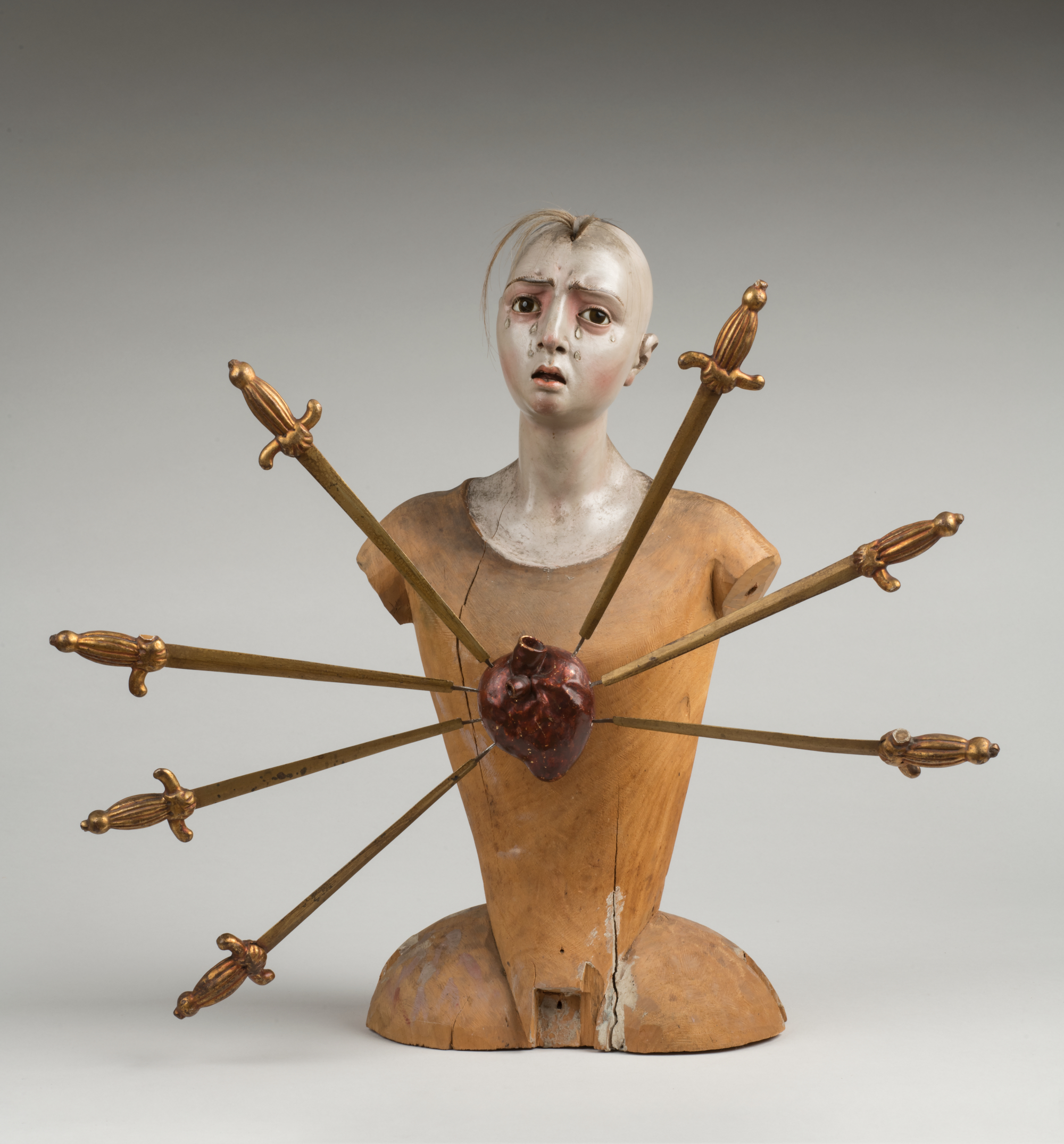
This is the Mater Dolorosa (Latin for “Sorrowful Mother”) of Christian tradition, who is sometimes depicted with a sword (or seven!) in her chest, literalizing Simeon’s prophecy to her as a teen and evoking the piercing sensation of losing a child. In Rogier van der Weyden’s Crucifixion diptych that I’ve reproduced here, created in roughly the same period as “My Fearful Dream” but in the Low Countries, there’s no sword, but Mary’s sorrow is evident in her tear-stained face, the wringing of her hands, and her literally collapsing under the unbearable weight of what she’s been asked to endure.
In the carol, the apostle John, present with Mary at the foot of the cross, catches her in her swoon and offers consolation, reassuring her that Jesus suffers willingly out of love. She responds that she knows it in her heart, and that she knows too that he will ultimately rise from death, but that that doesn’t diminish the sharpness of the pain she feels, deep in her body, watching her son shamed and wounded so.
The final image in the dream is of Jesus looking on his mother with a deathly pallor. With that, the speaker is jolted awake and sits with the horror.
On this side of the resurrection, it can be easy to breeze past Good Friday (“He didn’t stay dead!”) or to meditate on the Crucifixion only in a spiritual or theological sense. But this poem, this carol, sticks us in medias res, before the resurrection, into a physical human drama full of emotional intensity, so that we can feel what it might have been like to be present at the execution of the Son of God. Maybe you feel that the graphic details are gratuitous (the thorns shoved in his brain[!], his sinews riven apart, etc.), that sensory engagement with the scene is an exercise that fails to honor the bigger picture, and that it’s fruitless to generate pity for Christ or his mother, as the event is passed and what’s done is done. But centuries of faithful Christians have found otherwise: that meditating on Christ’s pain and that of his mother can help us better appreciate the real-life as opposed to merely mythic dimensions of the story and can cultivate in us a proper horror of sin and a deeper gratitude for Christ’s sacrifice.
The word “causeless” in the burden of the carol—the speaker sees a woman’s child dying without cause—does not imply that Jesus’s death served no purpose, but rather that he was put to death on wrongful charges. The Jewish tribunal charged him with blasphemy for calling himself the Son of God, and the Roman courts charged him with sedition, with inciting insurrection against the empire. But he was telling the truth about his identity and did so in ultimate reverence for God, not lack of it, and while the path he called his followers to would in some ways challenge the values of Rome and reorient ultimate loyalties, he never took up arms or encouraged his followers to do so (quite the contrary), and he never sought political power or overthrow.
Listen once more to Pro Cantione Antiqua’s performance of this carol as it would have been performed for the first Tudor monarch, Henry VII, presumably in private religious services for him and his family. May the depths to which God went to save God’s beloved world be something you never can forget.
Solomia Kazanivska (Соломія Казанівська) (Ukrainian, 1996–), Mother of God, 2019. Acrylic and soil on wood, 60 × 40 cm.
I.
Here mothers move more than others
into Mary’s mourning, each chorus
a soul full of crosses, weighted
with her child dying
continuously in the contemplation
of our contrition.

II.
That once-upon-a-time angel’s voice
stretching anew her middle-aged womb,
she who once sang Magnify, O Magnify,
when all she screams for now
is mercy in her urgent rebirth
of sorrow.

III.
When he stumbles,
she cannot fix his fall,
cannot cradle the boyhood
scrapes and bruises bleeding
into crowd-sanctioned murder.
No cock crows; she hears his groans
as if the world’s bones
are splintering within her.

IV.
Besides the tree, he carries
the tears of the one who carried him
beneath her Eve ribs, lifted him
into a world he breathed as good,
gone now into this God-crucified-
as-her-son catastrophe
for salvation’s sake.

V.
Simon of Cyrene stands close.
Understanding too well the two sorrows—
mother and son helpless to comfort the other—
he heaves up and shoulders
the burdens of both,
his back the black tablet
of Moses’ commandments fulfilled
to the jot and tittle.

VI.
Veronica—eyes swollen
for the Madonna and Child
wrenched from their rightful honor—
lifts her veil to cool the Savior’s pain,
alleviate, however slightly, a mother’s anguish.

VII.
Thorns gouge the brow she stroked.
The sweat-caked man that came out of her
stumbles again. Already,
the sharp nails gnaw her own palms.

VIII.
Oh, daughters of Jerusalem,
your tears sweep the streets,
wet the weary soles of Mary.
Weep for your own children
forever dashing away from Yahweh.

IX.
Wretched stones that tip her sinless child,
dirt that drives down the innocent son.
His own earth hurts him more each tumble.
Three times he trips,
crashes to the dust we are,
mortal muscles turning their backs
on Man and his Mother.

X.
Threads twisted by her own fingers,
tugged carefully through cloth:
this is the tunic they rip from him,
fabric tattooed with red;
she remembers his baby body
blood-splattered and matted.

XI.
Her soul stabbed by the tree
that slays her son. Her heart nailed.
She swears his life spurts
from her barely breathing body.

XII.
Death is indigo and indelible,
the Roman sky collapsed and re-scribbled
on the shreds of her memories.
She cannot bear to look upon his face
when breath forgets its maker.

XIII.
Ten thousand stillborns better
than this: his torso in her arms,
icon of the inconsolable,
the flesh Pietà with its nails of pain,
pounding, pounding.

XIV.
The hewn tomb seals her grief.
She remembers his first words,
his final prayer. All else rots
within her. They swaddle him,
implant him quickly behind stone.
This poem is from Weeknights at the Cathedral (Cincinnati: WordTech Communications, 2006) and is anthologized in slightly revised form, as here, in Poems of Devotion: An Anthology of Recent Poets, ed. Luke Hankins (Eugene, OR: Wipf & Stock, 2012).Used by permission of the author.
Note: The Stations of the Cross are a form of Catholic devotion organized around the events of Christ’s passion, from his condemnation by Pilate to his crucifixion and burial.
Marjorie Maddox (born 1959) is the author of fourteen poetry collections, including Begin with a Question (Paraclete, 2022); Transplant, Transport, Transubstantiation from the Poiema Poetry Series (Wipf & Stock, 2018); and True, False, None of the Above (Wipf & Stock, 2016). She has also published a short story collection, four children’s and YA books, and 650-plus stories, essays, and poems in journals and anthologies. Living in Central Pennsylvania, she is a professor of English and creative writing at Lock Haven University and is the assistant editor of Presence: A Journal of Catholic Poetry.
ONLINE EXHIBITION: A Global Icon: Mary in Context, created by the National Museum of Women in the Arts: Curated by Virginia Treanor, this digital resource was created as an expansion of the in-person exhibition Picturing Mary: Woman, Mother, Idea (see catalog), which ran from December 5, 2014, to April 12, 2015. Click through the pages to experience art images with descriptions, videos, and other content having to do with representations of Mary from across the world. The first video in the series is posted below, and here’s a playlist of all seven.
INTERVIEW (+ upcoming virtual conversation): “A God Who Wails and Dances: A Conversation with Yvonne Adhiambo Owuor”: This interview by Erika Kloss, which appears in the current issue of Image journal (no. 109), is so. good. Kenyan writer Yvonne Adhiambo Owuor is the author of the novels Dust and The Dragonfly Seaand award-winning short stories such as “The Weight of Whispers,” as well as the executive director of the Zanzibar International Film Festival. Here she talks about fiction, faith, coffee, and calling colonialism to account. To engage further, you can register for the Image-sponsored online event “The Art of Fiction: A God Who Wails and Dances with Yvonne Adhiambo Owuor,”which takes place September 23 at 3 p.m. ET.
Here’s just a snippet from her conversation with Kloss, where she describes what she would say to those who want nothing to do with Christianity because of all the evil that has been done in its name:
Dare to rescue God as Emmanuel from the dense debris of hubris, and from the weight and stench of whited sepulchers. For it is true, an excess of ghouls have appropriated for themselves the meaning and potency of the revolutionary One who dares to pronounce to humanity, “Love your enemies . . . Do good to those who hate you.”
Why should young people let themselves be revulsed by a legion who never fully entered into the depths of the subversive, seductive, paradigm-dissolving, drinking-and-hanging-out-with-sinners, beautiful, and heroic man-God? Why wouldn’t young people set out to experience for themselves the grand and compelling epic of a creator God in love, who loses his children and the earth to a defiant and rebellious once-beloved prince of light, and who struggles long and hard to regain the humanity he had loved and lost? So passionate and desperate is the creator in this endeavor that he will enter into humanity to try to court and secure these cherished children, even at the risk of his own murder—and even that does not stop the love. A love stronger than death? Don’t we all write anthems, in one form or another, yearning for this?
Let the next generation of seekers . . . visit old worlds that contain the spirit of the faith, not just in the Middle East, but also northern Africa, northern Sudan, Egypt, and Ethiopia, all those rubbed-out places (that colonialists presumed to suggest they were ‘civilizing’) from which Christianity entered into and transformed Europe and the world. . . . An historical quest for meaning at sites of origins might inspire young people to look again at the call to adventure and transcendent idealism that is the Way.
+++
VIDEO SERIES: How to Read the Bible by BibleProject: “Reading the Bible wisely requires that we learn about the ancient literary styles used by the biblical authors. . . . While the Bible is one unified story, it cannot all be read in the same way. The How to Read the Bible series walks through each literary style found in the Bible to show how each uniquely contributes to the overall story of Scripture.”
Led by Dr. Tim Mackie and Jon Collins, BibleProject is a crowdfunded animation studio that creates videos, podcasts, and small-group curricula. From 2017 to 2020 they executed a series called How to Read the Bible, which is nineteen episodes total. In it they examine the three major literary styles that comprise the Bible: narrative (chronicles, biographies, parables), poetry (celebratory, reflective, erotic, politically resistant, apocalyptic), and prose discourse (laws, sermons, letters). Each style lives by its own rules and structure, and we get into trouble, for example, when we don’t properly understand how metaphor works, or when we don’t recognize that Paul’s epistles were situated in a particular historical context. Here’s one of the videos in the series, on design patterns in biblical narrative:
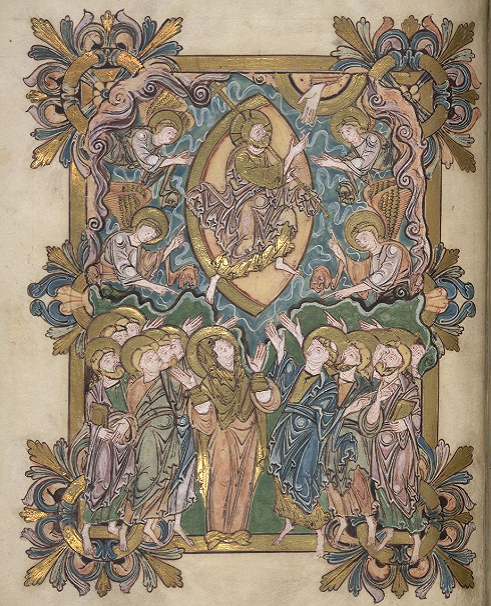
ANGLO-SAXON ASCENSION POEM: Excerpts from “Christ II” by Cynewulf, probably ninth century, translated from Old English by Eleanor Parker: Dr. Eleanor Parker lectures on medieval literature at Oxford University and runs the excellent blog A Clerk at Oxford, where she often shares her translations of Anglo-Saxon poetry, with commentary. The poem she shares here reflects on Christ’s ascension—the disciples’ grief, the angels’ joy. To me the most remarkable section is the one that, indirectly referencing a sermon of Gregory the Great, describes Christ “leaping” up to heaven, taking an active bound toward his homeland, a movement read in light of Song of Solomon 2:8: “Behold, he comes, leaping over the mountains, bounding over the hills.” This leap is one of six he took: from heaven (1) into Mary’s womb, (2) into a manger, (3) onto the cross, (4) into the tomb, (5) into hell, and finally, (6) back into heaven. “Prince’s play”! Parker pairs the poem with an exquisite, near-contemporary manuscript illumination, also from England; there’s also a lot of resonance between the poem and the Ascension image I published Tuesday by Bagong Kussudiardja, which shows a more balletic ascent.
The Ascension, from the Benedictional of St. Æthelwold (BL Additional MS. 49598), f. 64v, England, 963–984 CE. British Library, London.
+++
UNDERWATER DANCE:“AMA,” a short film by Julie Gautier: This wonderfully expressive silent film shows French free diver and underwater artist Julie Gautier dancing in a single breath for several minutes inside the world’s deepest swimming pool, Y-40 Deep Joy in Montegrotto Terme, Padua, Italy, to a minimalist piano piece. The final shot shows Gautier slowly rising to the water’s surface while releasing a giant air bubble, her pose evocative of the crucified Christ (and her upward movement an Ascension of sorts!). Titled “Ama” (Japanese for “sea woman,” the name given to Japan’s pearl divers), the film is “dedicated to all the women of the world,” Gautier says. The choreography is by Ophélie Longuet.
Gautier and her husband, Guillaume Néry, a free-diving champion, own the underwater filmmaking company Les Films Engloutis. Their most well-known project has been a music video featuring Beyoncé, codirected by Gautier and starring Néry.
+++
KICKSTARTER CAMPAIGN:Help Andy Squyres finance his next album: Andy Squyres is a super-talented singer-songwriter whose lyrics don’t stay in the shallows but, rather, dive into the depths of the faith experience. They are also supremely hope-filled. Below is a video of Squyres performing “Labor in Vain” at a house concert; the song is from his last album, Cherry Blossoms, which I reviewed here. Click on the boldface link above to hear Squyres discuss his new album project and to donate toward it.
+++
ICON PAINTING COMPETITION: The Interparliamentary Assembly of Orthodoxy (IAO) is hosting an international icon painting competition on the subject of Christ’s Resurrection. “Our purpose is to explore and bring to the foreground the numerous stylistic trends in existence today, enabling the visualization of a creative dialogue with tradition and, at the same time, the personal artistic expressions of artists who reframe tradition without, however, digressing from the doctrinal framework of Christian icon painting set by the 7th Ecumenical Council.” The submission window is closed—there are sixty-three great entries!—and now it’s time to cast your vote. Five winners will be selected to receive cash prizes, the topmost being €3,000, and other honors. Popular votes will be taken into account by the twelve jury members, among whom are esteemed iconographers George Kordis from Greece and Todor Mitrovic from Serbia.
Dimosthenis Avramidis (Greek, 1965–), Christ’s Descent into Hades, 2017. Egg tempera on wood, 91.5 × 61.5 cm.
+++
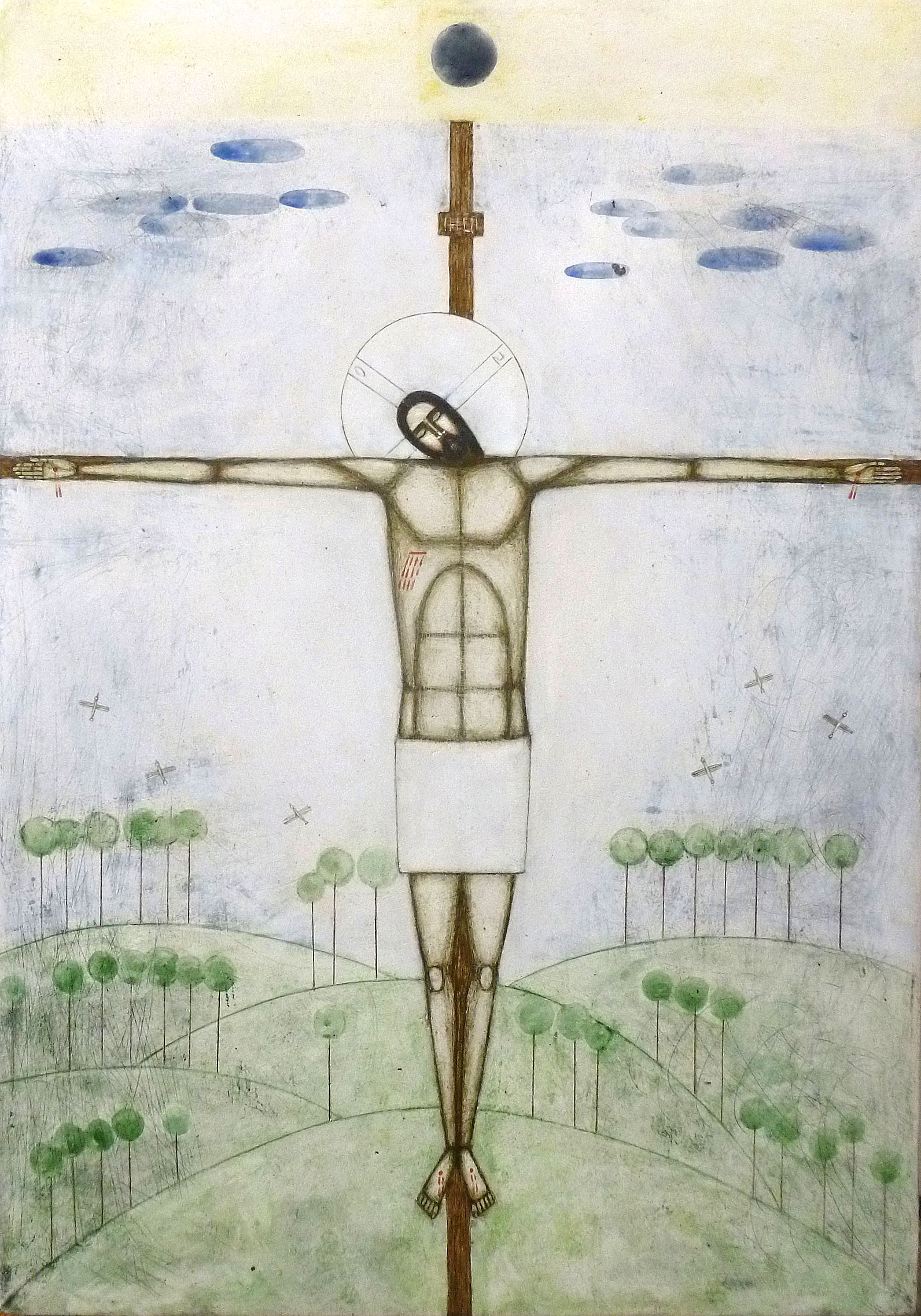
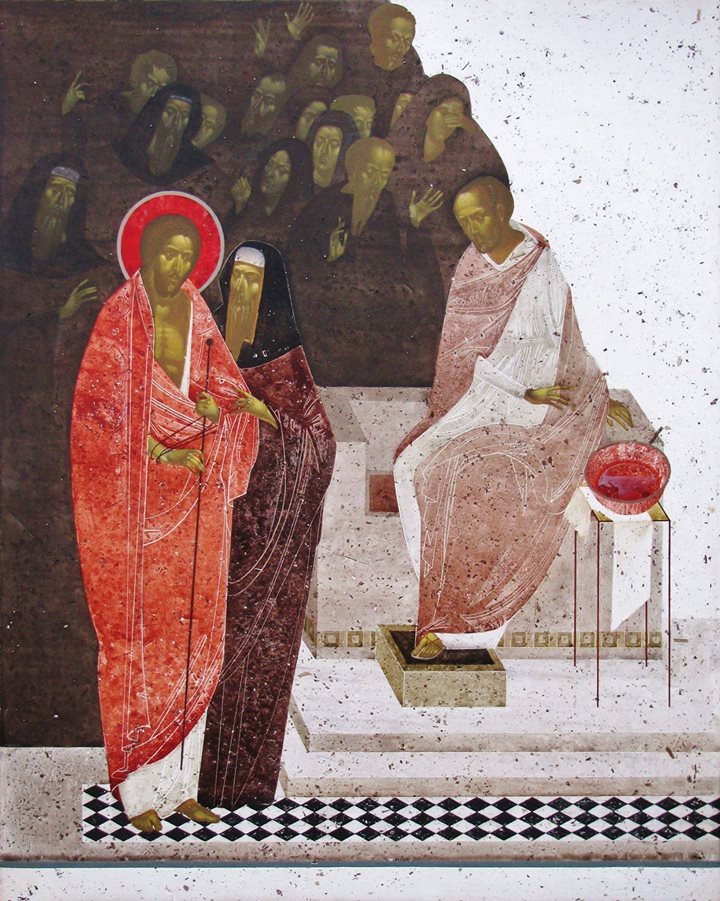
ESSAY: “On the Border of East and West: Searching for Icons in Lviv” by John A. Kohan: The latest issue of Image journal features a wonderful essay on the Lviv school of iconography (represented in entries #4, #10, and #20 of the above contest), a movement by young Ukrainian Greek Catholic artists to contemporize the Byzantine visual tradition. Written by John A. Kohan, an avid religious art collector and former Time bureau chief in Moscow (1988–1996), it discusses the political history of the city; the role of Metropolitan Andrey Sheptytsky (r. 1901–1944) in preserving and supporting art for future generations; the opening of the Iconart gallery in 2010 to nurture and promote the new style; the broad training these icon makers receive at the Lviv National Academy of Arts; and the uneven reception by others in the denomination (especially official church bodies), who tend to prefer their sacred art in the Radruzh School style or as contemporary Catholic kitsch. Kohan writes from his firsthand experiences meeting the artists and visiting their studios, churches, and exhibition spaces. The essay is available to subscribers only; click here to subscribe.
Natalya Rusetska (Ukrainian, 1984–), Crucifixion, 2017. Egg tempera on gessoed wood, 11 3/4 × 8 1/4 in.
Ivanka Demchuk (Ukrainian, 1990–), Christ before Pilate, 2017. Mixed media on gessoed wood, 19 3/4 × 15 3/4 in.
I’m enthralled by the contemporary icons being produced in Lviv—I saw a bunch from Kohan’s collection last summer, and I featured some in a Baptism of Christ roundup earlier this year. The best way to keep abreast of the output from the Lviv school is to follow Iconart on Facebook, and for an even wider breadth of innovative eastern European icons, follow Międzynarodowe Warsztaty Ikonopisów w Nowicy (International Iconography Workshop in Nowica, Poland).
+++
MET GALA + EXHIBITION: “Heavenly Bodies: Fashion and the Catholic Imagination,” May 10–October 8, 2018, Metropolitan Museum of Art, New York City: The largest exhibition ever mounted by the Met’s Costume Institute, “Heavenly Bodies” features both religious vestments from the Vatican and runway fashions by famous designers inspired by Catholicism. AFashionista reviewer who attended a preview reports on the integrated displays:
A reliquary arm of Saint Valentine is displayed alongside a breastplate and crown of thorns from Alexander McQueen’s Givenchy days; sacred music serves as the auditory backdrop for a Rodarte collection that features a dress inspired by Bernini’s famous sculpture Ecstasy of Saint Teresa. Rows of mannequins wearing Dolce & Gabbana, Moschino and Raf Simons show the ways that the silhouettes of the cassock and nun’s habit have been explored on the runway time and again. There are even vestments by the likes of Yves Saint Laurent and Riccardo Tisci that were expressly designed to dress statues of the Virgin Mary in chapels in Italy and France.
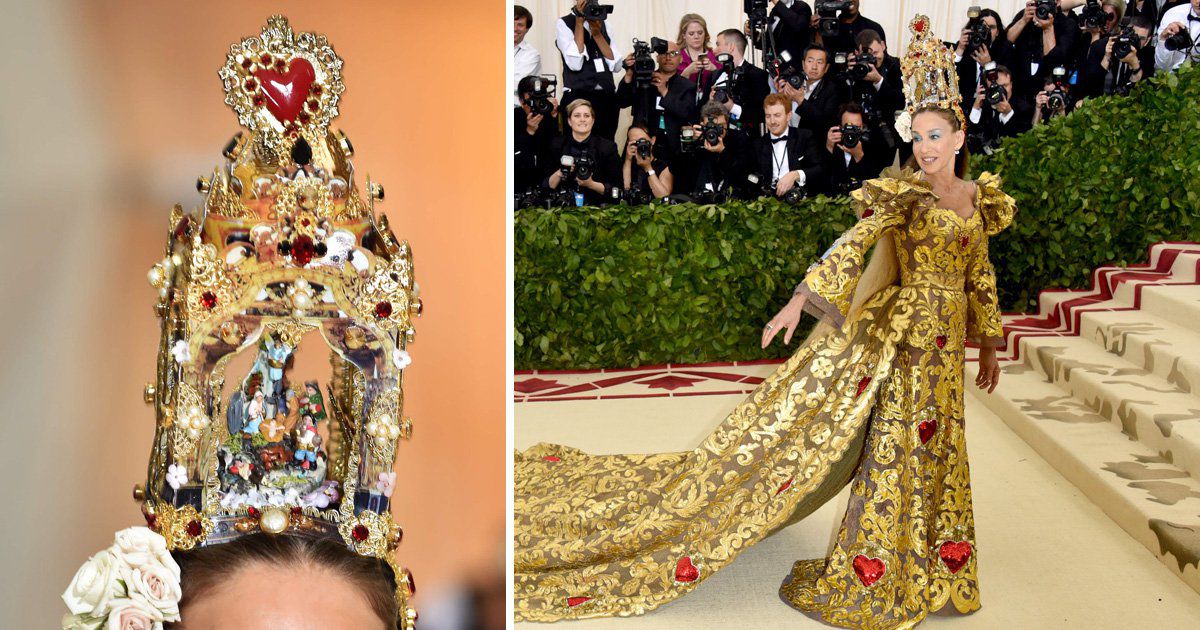
Each year since 1948, the opening of the Costume Institute’s spring exhibition has been celebrated with a huge fundraising gala attended by celebrities who dress to the theme; this year’s took place May 7. There were lots of crosses and haloes, but also some more particularized outfits. Ariana Grande’s gown was inspired by Michelangelo’s Last Judgment; Gigi Hadid’s, by stained glass. Selena Gomez carried a Coach handbag embroidered with Proverbs 31:30b: “A woman who fears the Lord is a woman who shall be praised.” The most brazenly dressed was Rihanna, who wore a gem-encrusted bishop’s miter (not a papal tiara, as has been commonly reported). Another standout headpiece was Sarah Jessica Parker’s, which featured a Neapolitan Nativity scene set inside a mini baldachin. (The making of elaborate presepi, or Christmas crèches, is a longstanding tradition in Naples, reaching its height during the eighteenth century.)
The white Margiela minidress, cape, and headpiece Rihanna wore to Monday’s Met gala were inspired by Catholic pontifical vestments. Photo: John Shearer/Getty.
Sarah Jessica Parker wore a regal gold, long-trained Dolce & Gabbana gown, but the pièce de résistance of her ensemble was the Nativity headpiece.
Lana Del Rey went as Our Lady of Sorrows, wearing an immaculate-heart chest plate pierced through with seven daggers; it was comical to hear religiously illiterate reporters trying to interpret the symbolism, saying things like the daggers are a “reminder to repent your sins or suffer damnation!” (Wrong. The swords symbolize the Virgin’s seven sorrows, beginning with Simeon’s prophecy.)






 Art & Theology