The following exhortation is by Kenneth Tanner, pastor of Holy Redeemer church in Rochester Hills, Michigan, and the author of Vulnerable God: Reviving the Wonder of God-with-Us in Our Humanity, forthcoming from Brazos Press. He originally posted it on Facebook on March 26, 2018, and I reprint it here with his permission.
[In 2004] a film premiered during Lent. The film was about this week we are entering, the week that changes the world.
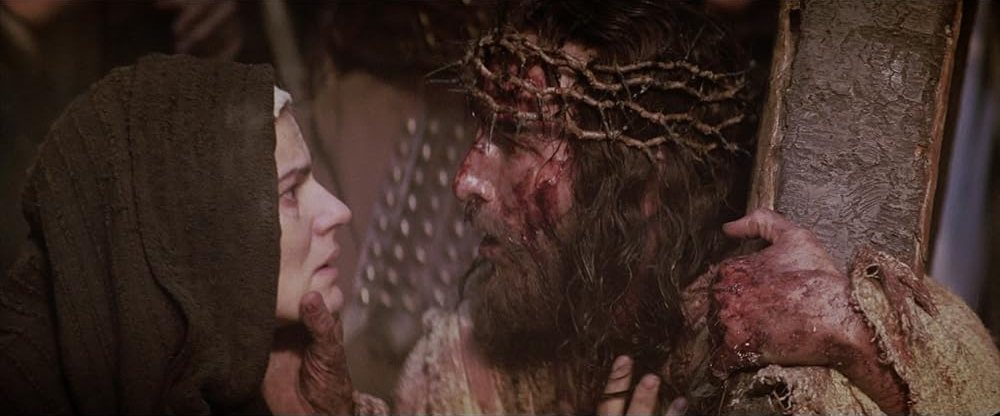
There’s a scene in the film of Jesus falling flat on his face into a dusty road; surrounded by crowds, a crown of thorns on his head, the heavy timber he is carrying comes down hard on his back.
He falls at the intersection of an alleyway where we see his mother Mary huddled in anguish as she waits in horror to glimpse Jesus passing.
When Jesus hits the ground just yards from her, Mary flashes back to a moment when as a child Jesus stumbled and hurt himself. In the memory, Jesus runs to her in pain and she takes him into her arms of comfort.
Startled back from her vision, back to the reality of her son laying prostrate in the dust, Mary springs to life and rushes to the aid of her son. When Jesus sees her, he shoulders his cross, and as he slowly rises back to his feet, he looks at Mary and says, “Behold, mother, I make all things new.”
Film still from The Passion of the Christ (2004), dir. Mel Gibson
Once a year Christians let this story be the priority in their lives. We take children out of music lessons and sporting events. We don’t plan social engagements. We pause. We take a deep breath. We put ordinary busyness on hold. We take a long weekend of sabbaths.
We pray. We sing. We lament. We remember. We find silence and dwell in it. We worship.
We ENTER the story together by the Spirit in gathered liturgies that re-enact the gift of the Last Supper, the command to love as God has loved us, the anxious questions and perspiration of Gethsemane.
We come together again to take a hard look at the cross, at our own violence toward God, at the Love that forgives even as we betray and deny and flee, as we smite and whip and nail and mock.
In the quiet of Holy Saturday we ponder a world without God, where death reigns without the resurrection.
Then we gather once more with great joy to remember that death is not the end of anyone or the end of the world, that the resurrection is the end of all things.
I want to encourage you to disconnect from the grind and walk the way of the cross this week, to stay with Jesus and the women and John in the darkness that has to come before the new dawn.
You will never quite understand our community, ancient practices, or the deeper meanings of this week until you let it take over your life once a year. And with every passing year, as you keep this sacred week sacred, free from other obligations and pursuits, you will see and experience and encounter Jesus Christ anew.
So I invite you to surrender and enter contemplation of the mighty acts whereby God has reconciled the world to himself in Jesus Christ, the things only Jesus can do, for we cannot do them ourselves, where we find genuine rest from our labors in the acts of Love that make the world new.
To assist your contemplations, I’ll be sharing a song and an artwork here on each day of Holy Week, as is my custom. (You can view the archived posts in this annual series, from 2024, 2023, 2022, 2021, and 2020.) Some of the songs can be found on Art & Theology’s Holy Week Playlist:
VISUAL COMMENTARY: “Repentance (Transforming Tears)” by Clemena Antonova: One of the three works that art historian Clemena Antonova curated for the Visual Commentary on Scripture exhibition on Peter’s denial of Christ (Matt. 26:69–75; Mark 14:66–72; Luke 22:54–62; John 18:15–18, 25–27) is the installation Lágrimas de São Pedro (Tears of Saint Peter) by contemporary Brazilian artist Vinícius Silva de Almeida. The artist used hundreds of light bulbs, filled with water and suspended on near-invisible nylon threads, to create an environment in which visitors move between “tears” falling like raindrops from above. In the Christian tradition, Peter is regarded as a paradigm of penitence, as scripture says he “wept bitterly” when he realized his sin, and soon after he was restored to Christ. As Antonova interprets, Tears of Saint Peter invites folks to reflect on the interconnection of sorrow and healing in Peter’s story and in their own.
Vinícius Silva de Almeida (Vinícius S.A.) (Brazilian, 1983–), Lágrimas de São Pedro (Tears of Saint Peter), 2005–21. 6,000 light bulbs filled with water (various numbers in different locations). Photo: Erivan Morais.
>> “Peter” by Montell Fish: Montell Fish (the stage name of Montell Frazier) is a singer-songwriter from Pittsburgh whose music combines elements of lo-fi and classic R&B. In his song “Peter” from the album Camp Lukewarm (2020), he compares himself, in confessional mode, to the titular apostle, who denied Christ three times. “Sometimes I feel like Peter / Denied you and I cannot deny that I did / Can I rest my head on your shoulders again?” In the bridge, Christ answers in the affirmative: Yes, come rest.
>> “O How He Loves You and Me / Your Love Divine”: The first song in this medley was written by CCM (contemporary Christian music) pioneer Kurt Kaiser in 1975; the second, by the legendary gospel artist Richard Smallwood. Recorded live at Jericho City of Praise in Landover, Maryland, it’s performed here by Smallwood (at piano) and his vocal and instrumental ensemble Vision, featuring soloist Vanessa Williams. The recording appears as two separate tracks on Persuaded: Live in D.C. (2001).
Here are the lyrics to the second song, starting at 3:06:
Refrain: Lord, you know the pain, pain we bear And Lord, you know the toils, toils and cares Send your direction Send your protection Send your compassion And your love divine
Verse: Help us love those who would do us wrong Send your cleansing power from above Unite our hearts as one Make us vessels for the flow-through of your love
[Refrain]
Vamp: Your love divine Your love divine
+++
BOOK CHAPTER: “Maundy Thursday—The Mission,” chap. 16 from Films for All Seasons by Abby Olcese:Abby Olcese is a writer on film, faith, and popular culture, living in Kansas City. Last year her book Films for All Seasons: Experiencing the Church Year at the Movies was published by InterVarsity Press, spotlighting twenty-six films as lenses through which to reflect on the great themes of the church calendar. I was preparing to write something on The Mission, the 1986 film directed by Roland Joffé, for Lent this year when I encountered this book, and because Olcese covers the movie so well, I secured permission from IVP to provide a free PDF download of the chapter to Art & Theology readers. Olcese situates The Mission as a film that’s especially appropriate for Maundy Thursday, a day when the church reflects on the call to servant-love and commemorates, among other things, Jesus’s arrest in the garden of Gethsemane, during which he and his disciples “face the forces of human empire, a dramatic moment of conflict ending in what, for the moment, feels like defeat.”
The Mission addresses themes of Christian ministry, the kingdom of God, repentance, forgiveness, love, respect, and the nonviolent ethic of Christ. Based on actual events, it follows an eighteenth-century Spanish Jesuit priest, Father Gabriel (Jeremy Irons), as he establishes a mission among the Guaraní people in the borderlands of present-day Argentina, Paraguay, and Brazil and seeks to protect the Guaraní from the encroachment of Spanish and Portuguese enslavers. He is later joined by the penitent Rodrigo Mendoza (Robert De Niro), a recent convert and former slave dealer and mercenary soldier. But the two clash over how best and most faithfully to protect the people they live among and serve.
ORATORIO: Water Passion After St. Matthew by Tan Dun: Commissioned for the 250th anniversary of Bach’s death in 2000, this eclectic, Asian-influenced Passion oratorio by the Chinese American composer Tan Dun follows Jesus from his baptism to his resurrection. As the title suggests, water plays an important role in the work. When performed, seventeen large transparent water bowls, dramatically lit from below, form a cross on the stage and are used by percussionists throughout the piece’s ninety-minute duration, creating various timbres. (“The three percussionists make water drip, flow, burble, crash and hiss. They lift handfuls of water, then fling it back down. They stir it, strike it with pairs of plastic cups, float soup bowls upside down in it and play them,” Justin Davidson described in his review of the world premiere.) For Tan, water is “a symbol of baptism, renewal, re-creation, and resurrection.”
Composer Tan Dun plays a “water drum” in Hangzhou, Zhejiang Province. Photo courtesy of Visual China Group (VCG).
In addition to the water percussion, the work calls for an SATB chorus that doubles on stones and tingsha (Tibetan finger cymbals); soprano and bass soloists who double on the xun (Chinese ocarina, or globular vessel flute) and who are required to do some Mongolian overtone singing; one violin; one cello; and one sampler player (Yamaha A-3000).
Water Passion premiered in Stuttgart, Germany, on September 8, 2000, conducted by Tan—you can listen to the full live recording on Spotify—and it has since been performed a handful of other times across the globe. I recommend the following hour-long video from Symphony Tacoma in Washington, which features excerpts from their March 30, 2016, performance augmented by interviews with some of the key players:
+++
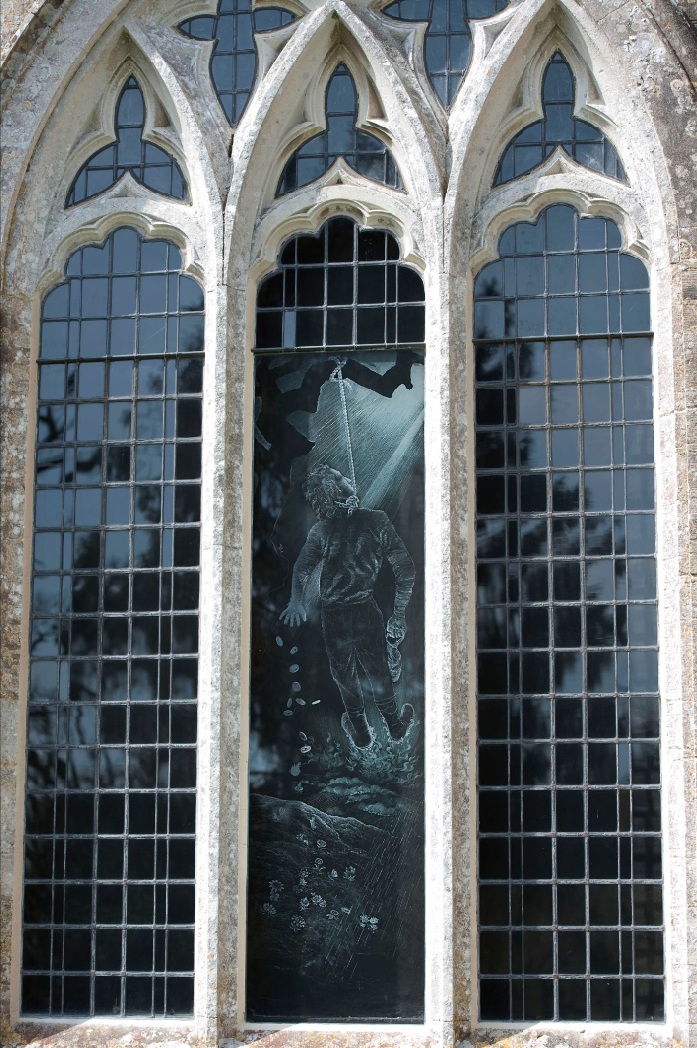
ARTWORK: The Judas Window by Laurence Whistler: In 1940, St Nicholas Moreton in Dorset was hit by a German bomb, destroying much of the church building, including its nineteenth-century stained glass windows. After rebuilding, the church commissioned the renowned glass engraver Laurence Whistler in 1955 to make twelve new windows, replacing the ruined ones, a project he worked on for the next three decades; they depict butterflies, birds, rabbits, wildflowers, candles, stars and planets, and local scenes. (See a few photos at The Dorset Rambler or Chris Belsten’s Flickr album.) In 1987 he offered to donate a thirteenth window on the theme of forgiveness, featuring the death of Judas, which would be visible, by design, from the outside only (the proposed space was blocked on the inside by a memorial tablet). The idea was entertained but, after consultation between the rector, parish council, and local diocese, was ultimately rejected due to its controversial nature—too many felt that it just wasn’t a fitting subject for a church window. Eager to pursue his vision, Whistler made the window anyway and loaned it to the county museum in Dorchester but insisted that if the church ever changed its mind, it should be given to them.
Laurence Whistler (British, 1912–2000), The Death of Judas (aka the Forgiveness Window), made 1993, installed 2013. Engraved glass, St Nicholas’ Church, Moreton, Dorset, England. Photo: Phil Yeomans / Bournemouth News and Picture Service.
In 2012, Rev. Jacqueline Birdseye, the new rector, encouraged the parish to revisit the issue, and this time around, there was unanimous approval to install the window, startling though it is. Again, it’s a blind window—behind it is black wooden boarding—which was the artist’s intent, as he wanted Judas to be a “shadowy” figure (so he couldn’t be front-lit and backlit) and on the outside, near the graveyard. But, unlike traditional portrayals of Judas’s suicide, which are bleak and punishing, Whistler’s portrayal is one of subtle hope, redemption, and new life. The uniting theme of the twelve interior windows is “light,” and here a bright shaft falls from the heavens on Judas’s upturned face. Hanging from his noose, he relinquishes the thirty coins for which he sold his Savior, and when they hit the ground they transform into flowers; the “field of blood” (Acts 1:18–19) becomes a spring meadow.
Scripture tells us that after realizing his enormous error, Judas “repented” (Matt. 27:3 KJV), “was filled with remorse” (NLT), and returned the blood money. Though Christians have historically counted Judas as eternally damned, other Christians have suggested the possibility of forgiveness beyond the grave for the traitorous disciple who was desperately grieved by his sin. “There’s a wideness in God’s mercy.” “A broken and contrite heart, O God, you will not despise” (Ps. 51:17).
If I, your Lord and Teacher, have washed your feet, you also ought to wash one another’s feet. For I have set you an example, that you also should do as I have done to you. . . .
I give you a new commandment, that you love one another. Just as I have loved you, you also should love one another. By this everyone will know that you are my disciples, if you have love for one another.
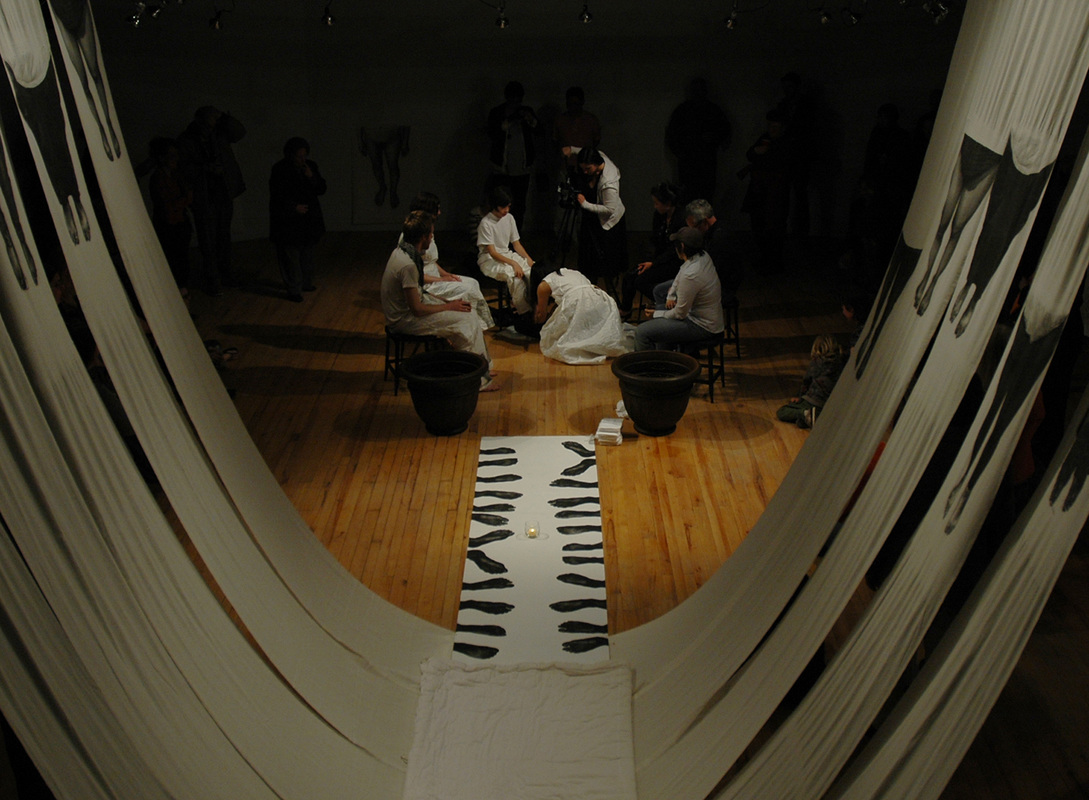
Hyeyoung Shin (Korean American, 1974–), We Are, 2010. Performance, graphite drawings on paper and paper garments, and lithographs on muslin. Big Orbit Gallery, Buffalo, New York.Foot-washing performance by Hyeyoung Shin at the opening of We Are, April 23, 2010, Big Orbit Gallery, Buffalo, New York.
Hyeyoung Shin is a South Korean–born, Kansas City–based artist whose work explores human vulnerability, humility, intimacy, empathy, interpersonal relationships, and belonging.
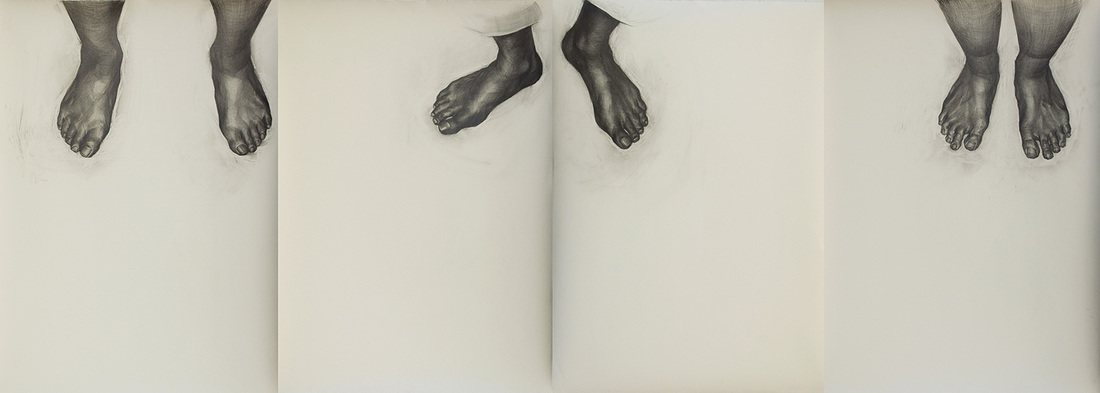
We Are is the name of a solo exhibition of hers from 2010 consisting of life-size drawings and lithographs of human feet and a foot-washing performance. Shin executed thirty-four graphite drawings on paper as well as on paper garments that she custom-made. The structural anchor of the installation was five muslin panels, each ten yards long, suspended from the ceiling and draped like a hammock. On the upper reaches of each were lithographs of two pairs of legs, and in the bed of the hammock lay a mat, a pillow, and a paper dress. Leading up to the hammock was a long sheet of paper with twelve sets of footprints arranged in two rows, evoking Jesus’s twelve disciples.
Graphite drawing on handmade paper garment with hanji, 2009Lithographs on muslin, approx. 288 × 30 in., 2009–10Graphite drawings on paper, 42 × 64 in., 2009
Shin enacted the foot washings herself. She said that “through the experiences, I began to learn again how to practice love akin to holding my mother’s feet” as she lay dying of a terminal illness. The physical proximity and tender touch at that gallery event opened up channels of empathy between the artist and participants.
LISTEN: “Reverie: This is my will,” arr. Anne-Marie O’Farrell, on Easter in Ireland: Music for the Paschal Season (2020)
Rev. Dr. Anne-Marie O’Farrell, a harpist, composer, and Church of Ireland minister from Dublin, wrote this reverie on the Maundy Thursday hymn “This Is My Will” for solo lever harp in 2019. (A reverie is an instrumental piece suggesting a dreamy or musing state.) The Jesuit priest James Quinn (1918–2010) of Scotland wrote the hymn text, reproduced below, in 1969, a paraphrase of John 15:11–17, pairing it with a traditional Irish suantraí (lullaby) melody. It is that melody—which in Ireland has come to be associated with Holy Week, thanks to Quinn—that O’Farrell has arranged here. Purchase sheet music for O’Farrell’s harp reverie, or an arrangement for SATB voices and solo.
This is my will, my one command, that love should dwell among you all. This is my will, that you should love as I have shown that I love you.
No greater love a man can have than that he die to save his friends. You are my friends if you obey all I command that you should do.
I call you now no longer slaves; no slave knows all his master does. I call you friends, for all I hear my Father say you hear from me.
You chose not me, but I chose you, that you should go and bear much fruit. I called you out that you in me should bear much fruit that will abide.
All that you ask my Father dear for my name’s sake you shall receive. This is my will, my one command, that love should dwell in each, in all.
Jesus speaks this discourse after washing his disciples’ feet the day before his death. The name traditionally accorded to Thursday of Holy Week—Maundy Thursday—comes from the Latin word mandatum, “command,” referencing this passage.
Then Jesus went with his disciples to a place called Gethsemane, and he said to them, “Sit here while I go over there and pray.” He took Peter and the two sons of Zebedee along with him, and he began to be sorrowful and troubled. Then he said to them, “My soul is overwhelmed with sorrow to the point of death. Stay here and keep watch with me.”
Going a little farther, he fell with his face to the ground and prayed, “My Father, if it is possible, may this cup be taken from me. Yet not as I will, but as you will.”
Then he returned to his disciples and found them sleeping. “Couldn’t you men keep watch with me for one hour?” he asked Peter. “Watch and pray so that you will not fall into temptation. The spirit is willing, but the flesh is weak.”
He went away a second time and prayed, “My Father, if it is not possible for this cup to be taken away unless I drink it, may your will be done.”
When he came back, he again found them sleeping, because their eyes were heavy. So he left them and went away once more and prayed the third time, saying the same thing.
Then he returned to the disciples and said to them, “Are you still sleeping and resting? Look, the hour has come, and the Son of Man is delivered into the hands of sinners. Rise! Let us go! Here comes my betrayer!”
—Matthew 26:36–46 NIV, emphasis added
LOOK: Agony in the Garden by Fra Angelico [HT: John Skillen]
Fra Angelico (Italian, ca. 1387–1455), Agony in the Garden, ca. 1450. Fresco, 177 × 147 cm. Cell 34, Convent of San Marco, Florence.
This fresco is from one of the forty-four cells in the Dominican convent of San Marco in Florence whose walls Fra Angelico and his assistants painted with religious scenes in the mid-fifteenth century. The friars who lived at San Marco—of which the artist, whose nickname means “Angelic Brother,” was one—used these paintings for private meditation.
Here we see Jesus in the garden of Gethsemane pleading with God the Father to let the cup of suffering, held out by an angel, pass him by. As he prays in agony, his disciples James, John, and Peter nod off just a stone’s throw away. Jesus had asked them to stay awake and pray with him, but their tiredness gets the better of them. In their friend’s hour of deepest need, they fail him.
By contrast—and this is unique!—Mary and Martha, two sisters from Bethany who are also followers of Jesus, are awake and alert under an open loggia, diligently praying and studying God’s word. Perhaps Mary points, in the book in her lap, to the passage of the Suffering Servant in Isaiah 53, recognizing Christ in it, or to the book of Exodus, where the Israelites celebrate their first Passover by smearing the blood of a lamb over their doors. Perhaps Martha prays that the Father would grant Jesus discernment of his will and the strength to follow through with it—that he would sustain him all the way to the cross and beyond.
While the male disciples on the other side of the wall fall asleep, heads in hands, the women watch and wait through the night, exemplars of faithfulness. They trust the prophecies and keep vigil, supporting their Lord in his suffering.
LISTEN: “Stay with Me” by Jacques Berthier, 1984 | Performed by the Taizé Community Choir on Songs of Taizé: O Lord, Hear My Prayer & My Soul Is at Rest, 1999
Stay with me Remain here with me Watch and pray Watch and pray
The words from this Taizé chant come from Jesus’s words in Matthew 26:38, 41 (cf. Mark 14:34, 38). He and his disciples have just finished the Passover Seder, and with full bellies, three of them follow Jesus up to an olive grove, which was perhaps a favorite prayer spot. But they neglect his instruction to stay awake and pray with him.
How can we remain with Christ this Maundy Thursday?
To “keep vigil” this night is to be fully present to Christ’s suffering and spiritually awake to his will and way.
There are hundreds of thousands of musical works, from a range of genres, inspired by Christ’s passion, especially his death on the cross, which, along with the resurrection, is the centerpiece of the Christian faith. I’ve curated just a sampling of these on Spotify, from across time periods and countries, to serve as an aural guide through the final week of Jesus’s life. The drama begins with Christ’s triumphal entry into Jerusalem on a donkey, where he’s hailed with hosannas, and then continues with a last supper shared with his disciples, an agonized prayer in Gethsemane followed by betrayal and arrest, then, all in one day, multiple trials (religious and civil), conviction by mob, a public execution, and burial. Many of the playlist selections are narrative in character, while some have a more theological bent. My hope is that these pieces aid you in observing this most holy of weeks, walking with Christ through the shadows, taking in how “he himself bore our sins in his body on the tree, that we might die to sin and live to righteousness. By his wounds [we] have been healed” (1 Pet. 2:24).
To add the playlist to your account, open the Art & Theology Holy Week Playlist link, then click on the More (…) icon and select “Save to Library.”
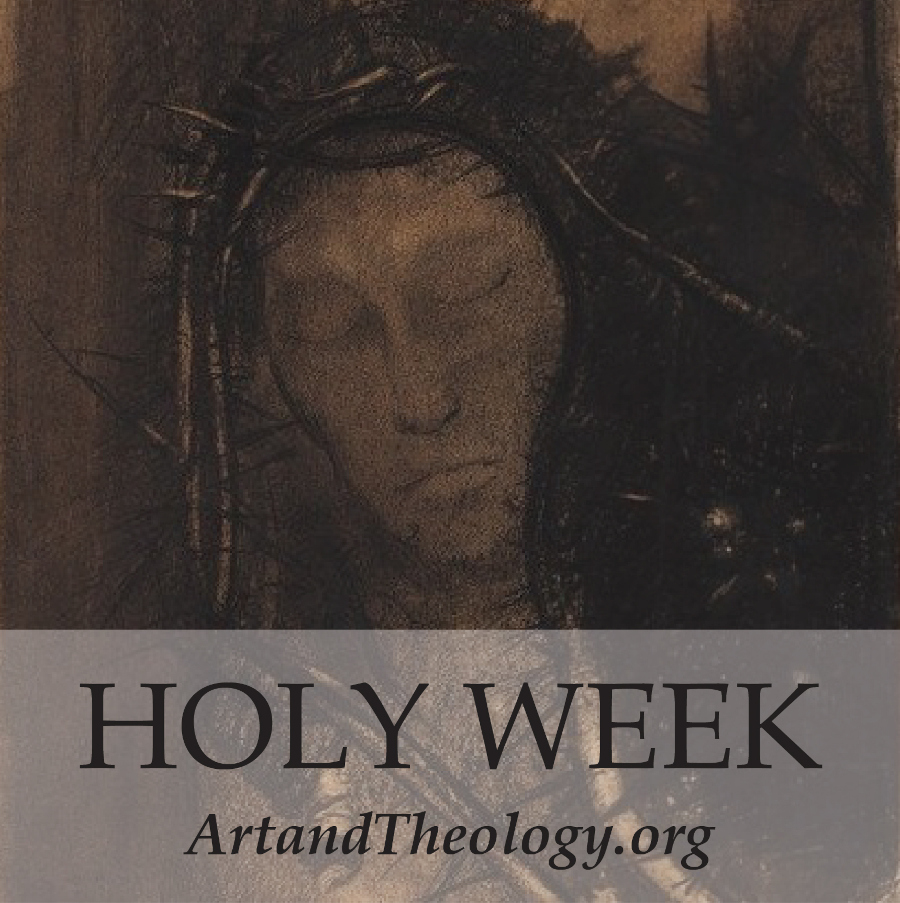
[Playlist cover art: Odilon Redon, Christ, ca. 1895, charcoal, chalk, pastel, and pencil on paper, Museum of Modern Art, New York]
The playlist is a mixture of classical and popular (indie-folk, gospel) music. In this post I want to provide a little context for some of the pieces, by which I mainly mean translations of all the non-English lyrics. Because of what you see here, you might get the wrong impression that the list is almost entirely classical; actually, it’s only about half.
The opening track, “Herr, unser Herrscher” (Lord, Our Ruler), is a unique arrangement of the opening chorus from Johann Sebastian Bach’s St. John Passion, a Good Friday oratorio in German.
Herr, unser Herrscher, dessen Ruhm
In allen Landen herrlich ist!
  Zeig uns durch deine Passion,
  Daß du, der wahre Gottessohn,
  Zu aller Zeit,
  Auch in der größten Niedrigkeit,
  Verherrlicht worden bist!
Lord, our ruler, whose fame
In every land is glorious!
  Show us, through your passion,
  That you, the true Son of God,
  Through all time,
  Even in the greatest humiliation,
  Have become transfigured! [source]
Unique, because the Baroque choir and orchestra are accompanied by an ensemble of Gabonese musicians who contribute their own rhythmic profile, along with solo percussionists Sami Ateba from Cameroon and Naná Vasconcelos from Brazil. The recording, rereleased on the compilation album Babel (2008), is originally from Lambarena: Bach to Africa (1995), a collaboration between French composer and producer Hughes de Courson and Gabonese composer and guitarist Pierre Akendengué, synthesizing two disparate sound worlds. (“Bombé / Ruht wohl, ruht wohl, ihr heiligen Gebeine” is another highlight from the album. For weeks I debated whether to include it on this playlist—adding it, taking it off, adding it back again—ultimately deciding to leave it off, the reason being that it overlays Bach’s choral rondo with music and invocations to the dead from a Bwiti religious ritual. Though sonically compelling and worth listening to, I felt that it might impede some Christians’ ability to engage this list in a devotional way; so I opted for a traditional Western classical recording instead.)
Other selections from Bach’s St. John Passion are:
>> “Christus, der uns selig macht”
Christus, der uns selig macht,
Kein Bös’ hat begangen,
Der ward für uns in der Nacht
Als ein Dieb gefangen,
Geführt für gottlose Leut
Und fälschlich verklaget,
Verlacht, verhöhnt und verspeit,
Wie denn die Schrift saget.
Christ, who makes us blessed,
committed no evil deed,
for us he was taken in the night
like a thief,
led before godless people
and falsely accused,
scorned, shamed, and spat upon,
as the scripture says. [source]
>> “Petrus, der nicht denkt zurück”
Petrus, der nicht denkt zurück,
Seinen Gott verneinet,
Der doch auf ein' ernsten Blick
Bitterlichen weinet.
Jesu, blicke mich auch an,
Wenn ich nicht will büßen;
Wenn ich Böses hab getan,
Rühre mein Gewissen!
Peter, who did not recollect,
denied his God,
who yet after a serious glance
wept bitterly.
Jesus, look upon me also,
when I will not repent;
when I have done evil,
stir my conscience! [source]
>> “O große Lieb”
O große Lieb, O Lieb ohn alle Maße,
Die dich gebracht auf diese Marterstraße!
Ich lebte mit der Welt in Lust und Freuden,
Und du mußt leiden.
O great love, O love beyond measure,
that brought you to this path of martyrdom!
I lived with the world in delight and joy,
and you had to suffer. [source]
>> “Ruht wohl, ihr heiligen Gebeine”
Ruht wohl, ihr heiligen Gebeine,
Die ich nun weiter nicht beweine,
Ruht wohl und bringt auch mich zur Ruh!
Das Grab, so euch bestimmet ist
Und ferner keine Not umschließt,
Macht mir den Himmel auf und schließt die Hölle zu.
Rest well, you blessed limbs;
now I will no longer mourn you.
Rest well and bring me also to peace!
The grave that is allotted to you
and encloses no further suffering
opens heaven for me and closes off hell. [source]
For Bach’s St. Matthew Passion—one of the most celebrated works of classical sacred music ever written, right up there with Handel’s Messiah—I’ve drawn from the abridged English version (rather than the original German), translated by the Rev. Dr. John Troutbeck and performed in 1962 by the New York Philharmonic and Collegiate Chorale under the direction of Leonard Bernstein. I chose just a few pieces from it, not wishing to replicate the whole thing; as you can see, I tend to favor chorales over arias.
Now before the Feast of the Passover, when Jesus knew that his hour had come to depart out of this world to the Father, having loved his own who were in the world, he loved them to the end. During supper, when the devil had already put it into the heart of Judas Iscariot, Simon’s son, to betray him, Jesus, knowing that the Father had given all things into his hands, and that he had come from God and was going back to God, rose from supper. He laid aside his outer garments, and taking a towel, tied it around his waist. Then he poured water into a basin and began to wash the disciples’ feet and to wipe them with the towel that was wrapped around him. He came to Simon Peter, who said to him, “Lord, do you wash my feet?” Jesus answered him, “What I am doing you do not understand now, but afterward you will understand.” Peter said to him, “You shall never wash my feet.” Jesus answered him, “If I do not wash you, you have no share with me.” Simon Peter said to him, “Lord, not my feet only but also my hands and my head!” Jesus said to him, “The one who has bathed does not need to wash, except for his feet, but is completely clean. And you are clean, but not every one of you.” For he knew who was to betray him; that was why he said, “Not all of you are clean.”
When he had washed their feet and put on his outer garments and resumed his place, he said to them, “Do you understand what I have done to you? You call me Teacher and Lord, and you are right, for so I am. If I then, your Lord and Teacher, have washed your feet, you also ought to wash one another’s feet. For I have given you an example, that you also should do just as I have done to you. Truly, truly, I say to you, a servant is not greater than his master, nor is a messenger greater than the one who sent him. If you know these things, blessed are you if you do them.”
. . .
When [Judas] had gone out, Jesus said, “Now is the Son of Man glorified, and God is glorified in him. If God is glorified in him, God will also glorify him in himself, and glorify him at once. Little children, yet a little while I am with you. You will seek me, and just as I said to the Jews, so now I also say to you, ‘Where I am going you cannot come.’ A new commandment I give to you, that you love one another: just as I have loved you, you also are to love one another. By this all people will know that you are my disciples, if you have love for one another.”
—John 13:1–17, 31b–35
The Thursday before Easter is referred to as Maundy Thursday—the Middle English word maundy being a derivation of the Old French mandé, from the Latin mandatum, “commandment.” The name refers to John 13:34, where, after the Last Supper, Jesus commands his disciples to love one another.
+++
SONG: “Ubi caritas” | Words: Traditional | Music by Ola Gjeilo, 1999 | Performed by Voces8, on Lux, 2015
“Ubi caritas” is an ancient (or early medieval—it’s disputed) Latin text that is traditionally used as an antiphon, or sung refrain, for the foot-washing ceremony on Maundy Thursday. The current Roman Catholic Missal reassigns it to the offertory procession of the Maundy Thursday Mass.
Originally the text was set to a Gregorian chant melody, but it has since been set and/or arranged by Maurice Duruflé, Ola Gjeilo, Paul Mealor, Ivo Antognini, Audrey Assad, and many others. I’ve chosen the setting by Ola Gjeilo, a Norwegian composer and pianist born in 1978 and now living in the United States.
Ubi caritas et amor, Deus ibi est. Congregavit nos in unum Christi amor. Exsultemus, et in ipso jucundemur. Timeamus, et amemus Deum vivum. Et ex corde diligamus nos sincero.
Ubi caritas et amor, Deus ibi est. Simul ergo cum in unum congregamur: Ne nos mente dividamur, caveamus. Cessent iurgia maligna, cessent lites. Et in medio nostri sit Christus Deus.
Ubi caritas et amor, Deus ibi est. Simul quoque cum beatis videamus, Glorianter vultum tuum, Christe Deus: Gaudium quod est immensum, atque probum, Saecula per infinita saeculorum. Amen.
English Translation:
Where charity and love are, there God is.
The love of Christ has gathered us into one.
Let us exult, and in Him be joyful.
Let us fear and let us love the living God.
And from a sincere heart let us love each other.
Where charity and love are, there God is.
Therefore, whensoever we are gathered as one:
Lest we in mind be divided, let us beware.
Let cease malicious quarrels, let strife give way.
And in the midst of us be Christ our God.
Where charity and love are, there God is.
Together also with the blessed may we see,
Gloriously, Thy countenance, O Christ our God:
A joy which is immense, and also approved:
Through infinite ages of ages. Amen.
+++
The main panel of contemporary iconographer Solomia Kazanivska’s Washing of the Feet shows Christ, whose halo bears a faint cross-shape, washing the dirt off Peter’s feet, as the other disciples, silhouetted in white, look on. At first Peter was much distraught by the notion of his superior stooping to such a menial act of servitude, and he objected. But when Jesus told Peter that Peter would have no part with him unless Peter received the foot-washing, Peter changed his tune completely: he figured that if this were true, then a full body wash would give him an even bigger part with Jesus, so he exclaimed, “Wash my hands and my head too!” That’s why icons show Peter pointing to his head (not, as might be assumed, to signal his initial discomfort, as in “Oh dear . . .”).
What strikes me most about Kazanivska’s icon is the bottom panel, which seems to show the disciples washing one another’s feet, following their teacher’s example. (It’s possible that this band is meant to show Christ washing different disciples’ feet, as the biblical text says he did, but the different clothing of the kneeling figure in each of the six tableaux inclines me toward the other interpretation.) Kazanivska is not suggesting that that’s how it literally went down that evening—the disciples immediately understanding Christ’s meaning and faithfully imitating him. Rather, I read this an aspirational and metaphoric image, of how Christians are to interact with one another: in love and humility, time after time (hence the repetition). And that’s why I chose it to complement the “Ubi caritas” hymn.
This post belongs to the weekly series Artful Devotion. If you can’t view the music player in your email or RSS reader, try opening the post in your browser.
To view all the Revised Common Lectionary scripture readings for Maundy Thursday, cycle A, click here.









 Art & Theology