Roundup: Nativity art from Asia, the Christ Hymn in Thai, and more

ARTICLES:

>> “How Asian Artists Picture Jesus’ Birth from 1240 to Today” by Victoria Emily Jones, December 18, 2023, Christianity Today: My first CT article was published this week! I was asked to curate and introduce a sampling of Nativity art from across Asia. By representing Jesus as Japanese, Indonesian, or what have you, these artists convey a sense of God’s immanence, his “with-us–ness,” for their own communities—and for everyone else, the universality of Christ’s birth.

Turun, I Wayan_In Bethlehem
I Wayan Turun (Indonesian, 1935–1986), In Bethlehem, 1958. Acrylic on canvas, 46 × 64 cm. Collection of Stichting Zendingserfgoed (Missionary Heritage Foundation), Zuidland, Netherlands.

>> “The Story of Christ in Chinese Art: Scholars at Peking University Make a Christmas Portfolio for LIFE,” Life, December 22, 1941, pp. 40–49: In doing research for my Christianity Today article, I found this old article from Life magazine that features eight Chinese watercolors on silk from the collection of Dr. William Bacon Pettus (1880–1959), an American educator and president of the California College of Chinese Studies in Peking (Beijing) in the 1920s and ’30s, which were being exhibited at New York’s American Bible Society at the time. With the ordination of six Chinese bishops by Pope Pius XI in 1926, the Chinese Catholic Church was transitioning from a mission church to an indigenous local church, and Chinese-style religious art—much of it coming out of the art department of the new Catholic University of Peking (Beiping Furen Daxue)—was part of that localization. Productivity seems to have continued at Furen during the Japanese occupation, as this article attests. Many of the students and faculty were recent converts to Christianity, though the article reports that non-Christians also enrolled and taught in the art program.

Lu Hongnian_Nativity
Lu Hongnian (Lu Hung-nien) ( 陸鴻年) (Chinese, 1914–1989), The Birth of Jesus, ca. 1941. Chinese watercolor on silk.

Here is one of the paintings by Lu Hongnian, who sometime after this article was published, in part through his having engaged the New Testament as inspiration for his paintings, became a Christian and took the name John. It shows the Holy Family in a mountainside cave, Mary gazing adoringly at her newborn son as Joseph brings more straw to cushion him. Beside them, an angel holds up a lantern for light, while two shepherd children approach from the entrance, eager to meet their Savior.

+++

SONGS:

>> “Philippians 2:511” by HARK Music: This song takes a traditional Thai melody, arranged by Tirasip Kraitirangul, and puts it to a Thai translation of the famous Christ Hymn from Philippians 2. It’s performed by the HARK Duriya Tasana Singers (feat. Somchairak Sriket and Damrongsak Monprasit) and Dancers, filmed on location at Chaloem Kanchanaphisek Park in Bangkok. The song is from HARK’s Thai Hymns Album (2014), which can be downloaded for free at https://harkpublications.com/?product=thai-hymns-album-2. The two-stringed bowed instrument you see at 3:21 is a saw u.

The Duriya Tasana (“Curators of the Arts”) ensemble was formed in 2012 under the commission of the Thai-Psalms Project, an endeavor to create Thai traditional and classical music settings for the psalms of the Bible. Many of the members are affiliated with the Bunditpatanasilpa Institute of Fine Arts in Bangkok. Thanks to my friend Janet, whose sister is preparing a move to Thailand, for alerting me to this group!

>> “Jesus You Come” by Tenielle Neda, performed with Jon Guerra: This song by the Australian singer-songwriter Tenielle Neda [previously], which she sings with Jon Guerra, makes a nice complement to the Thai song above. The performance is from “Songs for Hope: A TGC Advent Concert” on December 6, 2020.

+++

MIDDLE ENGLISH LULLABY: “As I lay upon a night”: Medievalist Eleanor Parker introduces a charming Christmas lullaby from fourteenth-century England, a dialogue between Mary and the Christ child, and provides a modern English translation of its thirty-seven stanzas. In the Middle Ages, says Rosemary Woolf, the subject matter of lullabies was often a prophecy of the baby’s future—presumably a romantic promise of great and happy achievements. But here it is the child who relates the future to his mother, thus providing the material for his own lullaby.

+++

ART VIDEO: “Third Sunday of Advent: Ethiopian Art: Gospel Book” by James Romaine: Every December, my friend James Romaine, an art historian who teaches at Lander University, publishes four videos on his Seeing Art History YouTube channel related to the themes of the season, part of his annual Art for Advent series. This year he’s chosen to focus on Ethiopian art, covering illuminations from two different manuscripts, a diptych icon, and a rock-hewn church.

In this video Romaine discusses the formal qualities of two paintings from a sixteenth-century Ethiopian Gospel-book, the identity of the figures, and the liturgical context of the book, including the use of the red veil that’s attached at the top, which, Romaine says, “both protects and sanctifies the icon,” creating a sense of anticipation for the Orthodox believer who, in faith, lifts the veil to see what is revealed.

Roundup: Advent photo essay, carol in a silo, multicultural Christmas, and more

PHOTO ESSAY: “Advent 2020: Comfort My People”: Community development and relief worker Kezia M’Clelland, a child protection in emergencies specialist, works in areas of disaster and conflict. Every December she compiles a set of news photographs published in The Guardian that year, pairing each with an Advent scripture. (I introduced her in a 2017 Advent roundup.) Text and image amplify each other and prompt deeper reflection on the themes of the season as well as an awakening to global crises and/or injustices. The photos in this year’s compilation include a schoolteacher bringing plastic-wrapped hugs to her quarantined students in Rio de Janeiro, flooded roadways in Honduras following Hurricane Eta, a Syrian family from Ariha breaking their Ramadan fast amid the rubble of their home, a Palestinian boy from the Khan Younis refugee camp standing on a pile of scrapped car parts, the aftermath of the Beirut port explosion in August (caused by improperly stored ammonium nitrate), a protester outside Dallas City Hall in the US insisting that all citizens’ presidential election votes be counted, and others.

Comfort, comfort my people
Photo: Pilar Olivares / Reuters [via], set to Isaiah 40:1 by Kezia M’Clelland

The rough ground shall become level
Photo: Aaref Watad / AFP [via], set to Isaiah 40:4 by Kezia M’Clelland

M’Clelland adds one new photo for each day of Advent and then releases them all in video slideshow form on December 24. Here are her photo compilations from 2019 (“Good News of Great Joy”) and 2018 (“Peace on Earth”):

She also made a photo compilation for Holy Week 2020.

+++

SONG: “He Who Made the Starry Skies”: For optimal acoustics, three Bruderhof women from the Fox Hill Community in Walden, New York, trek on over to a silo to sing a fifteenth-century processional carol written by the nuns of St. Mary’s, Chester, in England, a medieval nunnery of which nothing now survives. Both the words and music have been preserved in a ca. 1425 manuscript known as The Chester Mysteries. The original is in Latin (and is titled “Qui creavit coelum”), but singers Alina McPherson, Melinda Goodwin, and Coretta Marchant opt for an English translation. I am providing the sheet music here, courtesy of the Bruderhof Historical Archives. [HT: Tamara Hill Murphy]

He who made the starry skies (Lully, lully, lu)
Sleeping in a manger lies (Lully, lully, lu)
Ruler of all centuries (Lully, lully, lu)

Joseph brings the swaddling clothes (Lully, lully, lu)
Mary wraps the babe so mild (Lully, lully, lu)
In the manger puts the child (Lully, lully, lu)

Humbly clad, the King of kings (Lully, lully, lu)
Joy of heav’n to earth now brings (Lully, lully, lu)
Sweet above all earthly things (Lully, lully, lu)

Mary, ask thy little son (Lully, lully, lu)
That he give us of his joy (Lully, lully, lu)
Now and through eternity (Lully, lully, lu)

The Bruderhof is an Anabaptist Christian movement of more than three thousand people committed to peacemaking, common ownership, and proclamation of the gospel. They have twenty-eight settlements on four continents, made up of families and singles. Perhaps you know them through their publishing house, Plough. Their website reads, “Love your neighbor. Take care of each other. Share everything. Especially in these challenging times, we at the Bruderhof believe that another way of life is possible. We’re not perfect people, but we’re willing to venture everything to build a life where there are no rich or poor. Where everyone is cared for, everyone belongs, and everyone can contribute. We’re pooling all our income, talents, and energy to take care of one another and to reach out to others. We believe that God wants to transform our world, here and now. This takes a life of discipleship, sacrifice and commitment; but when you truly love your neighbor as yourself, peace and justice become a reality. Isn’t that what Jesus came to bring for everyone?”

+++

UPCOMING (ONLINE) CHRISTMAS CONCERTS:

“A Family Holiday Singalong with Dan and Claudia Zanes,” Tuesday, December 15, 6 p.m. EST: Presented by the Lebanon Opera House in New Hampshire, this multicultural concert will feature Christmas, Hanukkah, or New Year’s songs from France, Wales, Germany, America, Puerto Rico, Korea, Tunisia, and Haiti. You can download the set list, which includes lyrics and chords, at the registration link I’ve posted. Dan and Claudia Zanes are a musical couple from Baltimore (my neck of the woods!), and I’ve really enjoyed the daily song videos they’ve been releasing on YouTube since COVID started. Here they are in 2018 with Pauline Jean, singing “Ocho Kandelikas,” a Hanukkah song written by Flory Jagoda in the 1980s in the Judeo-Spanish language known as Ladino. (Update: Concert video available here.)

“Gospel Christmas: O Holy Night,” Friday, December 18, 6 p.m. EST: Presented by Washington National Cathedral, this program will feature gospel, jazz, and blues music interspersed with scripture readings. (Update: Concert video available here.)

“Lowana Wallace Christmas Concert,” Sunday, December 20, 9 p.m. EST: Canadian singer-songwriter Lowana Wallace [previously] incorporates subtle jazz styles into her arrangements of worship songs and her own compositions. Listen to a sampler from her wonderful Hymns & Carols album, and tune in this weekend! (Update: Concert video available here.)

+++

ARTICLE: “Making Space for a Multicultural Christmas” by Michelle Reyes: “How can each of us celebrate Christmas at the intersection of our faith and our culture, while welcoming differing cultural perspectives on Christ’s birth?” asks Dr. Michelle Reyes, VP of the Asian American Christian Collaborative and editorial director of Pax, in this Gospel Coalition article. She briefly discusses four different cultural traditions that highlight unique aspects of Jesus’s birth narrative: posadas in Central America, Kiahk in Egypt, parols (star-shaped lanterns) in the Philippines, and Día de los Reyes [previously] in Puerto Rico, Mexico, and other Hispanic countries.

(Related posts from my old blog: “Nativity Paintings from around the World”; “More Nativity Paintings from around the World”)

+++

PODCAST EPISODE: “God’s Global Family,” BibleProject: BibleProject, a nonprofit ed-tech organization and animation studio, produces one of my favorite podcasts, hosted by biblical scholar Tim Mackie and Jon Collins. (I found episodes 6–11 of their recently wrapped “Character of God” series, on the wrath of God, particularly illuminating.) “Family of God” is the name of the series they’re in now. In this first episode they discuss how Christianity is the most multiethnic religious movement in history, and how our humanity cannot be fully realized without understanding, appreciating, and being connected to the identity of every other culture. I link to it here because it dovetails nicely with the Reyes article and because I want to introduce you to the podcast, if you’re not already familiar with it, but also because Mackie spends time talking about the Basilica of the Annunciation in Nazareth, with its many culturally specific portrayals of Mary and Jesus from around the world.

Widayanto, Fransiskus_Mother Mary
Fransiskus Widayanto (Indonesian, 1953–), Bunda Maria (Mother Mary), 2006. Ceramic mosaic and relief sculpture. Basilica of the Annunciation, Nazareth, Israel. Photo © BibleWalks.com. Mary is depicted in a traditional Javanese kebaya.

Madonna and Child mosaic (Thailand)
Thai Madonna and Child, mosaic, Basilica of the Annunciation, Nazareth, Israel. Photo © BibleWalks.com.

Mveng, Engelbert_Our Lady of Africa
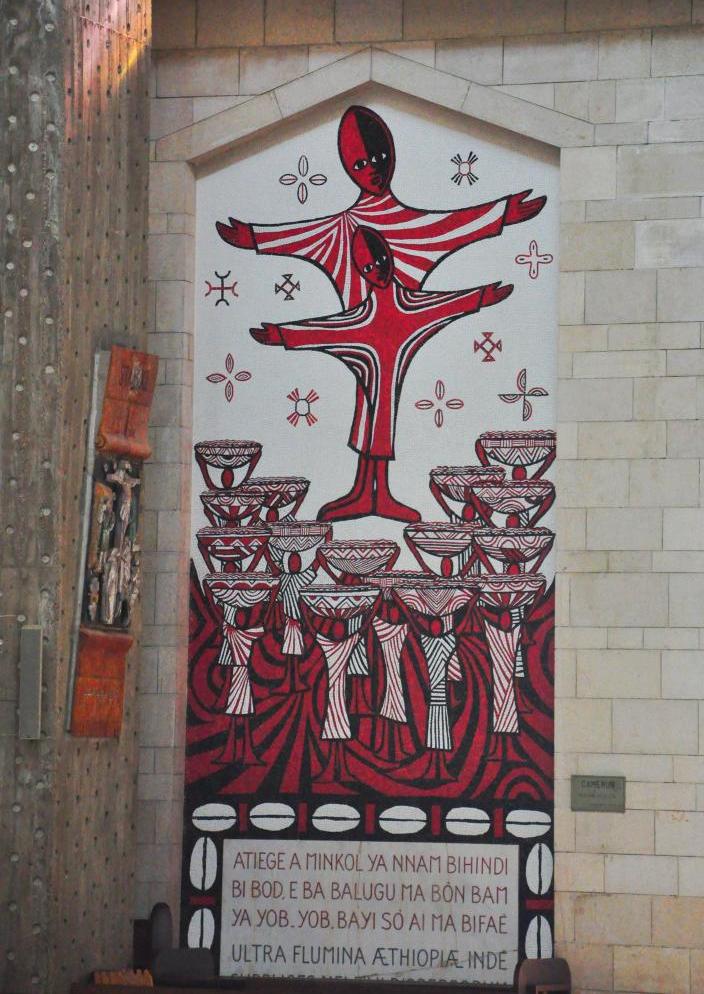
Fr. Engelbert Mveng, SJ (Cameroonian, 1930–1995), Our Lady of Africa, mosaic, Basilica of the Annunciation, Nazareth, Israel. Photo © BibleWalks.com. The inscription is from Zephaniah 3:10: “From beyond the rivers of Cush / my worshipers, the daughter of my dispersed ones, / shall bring my offering.”

As you know, diversity in biblical imagery, especially images of Jesus, is important to me, so I was delighted to hear this popular podcast tip their hat to this pilgrimage site in Israel that features a range of visual interpretations of the incarnation. You can view a compilation of the church’s national mosaics at BibleWalks.com. Most of them are not of high artistic quality, but I appreciate the initiative of inviting the nations to contribute their own localized representations. Above, I posted three that I particularly like.