As an English major in college, I was required to take a course on medieval literature. I had not been looking forward to it—Romantic and Victorian lit were more my thing. I worried that working through Old English and Middle English texts would be a slog. But boy were my expectations upended! I was enthralled by all the imaginative theology I encountered in verse, drama, and sermons, from the Dream of the Rood on down. I went to a public university, but the saturation in Christian thought is unavoidable for students of the history of English literature. After overcoming some hang-ups I had acquired from my fundamentalist Baptist upbringing, I found my faith opened up, strengthened, and inspired by my study of medieval writers. The same has held true in my studies of medieval art.
If you missed the opportunity to study the creative outputs of the Middle Ages in school but want to wade into those waters, you must follow the work of Dr. Grace Hamman, a medieval scholar from Denver who writes and teaches on the great works of that era through her newsletter, podcast, and more recently her first book, Jesus through Medieval Eyes: Beholding Christ with the Artists, Mystics, and Theologians of the Middle Ages (Zondervan, 2023). The book explores seven identities of Jesus—Judge, Lover, Knight, Word, Mother, Good Medieval Christian, and Wounded God—engaging art and literature that develop these tropes, some more familiar to us as moderns than others. Mechthild of Magdeburg, Julian of Norwich, Margery Kempe, Gregory the Great, Fra Angelico, Petrus Christus, Thomas Aquinas, Anselm of Canterbury, and Richard Rolle are among the folks we meet.
The church’s writings and images from the past, Hamman says, are a gift to us in the present that can help us see beyond our time- and culture-bound limitations. “In reading these exploring, adoring, faithful witnesses from the past, we can come to know Jesus—and ourselves—better,” she writes. “What we find strange or beautiful in these medieval witnesses can reveal our concerns, hidden biases, and even new truths. They also teach us new and profound ways to love him” (6).
She continues,
I began reading medieval texts because, to my joyful surprise, I learned that medieval Christians loved Jesus. They wrote about Jesus incessantly, compulsively, athirst with love, devotion, and creativity. They possessed vast Christian imaginations, often more expansive and interesting than many of the Christians who preceded or followed them. I discovered that writers of this period were far more comfortable than we today in thinking about Jesus metaphorically, highlighting particular and peculiar attributes, and crafting new stories about him. Their narrative freedom, delight in allegory and metaphor as paths to truth, and cultural difference offer us the gift of strange new insights—the gift of surprise. (10)
To receive that gift of surprise, Hamman advises, we must approach the texts with a spirit of openness—a willingness to sit with them quietly, attentively, and humbly before making judgments, acknowledging that our own views are not necessarily superior. Then we can welcome in the discernment process, weighing the validity of the picture at hand, determining whether we want to graft it into our understanding of Christ and his work.
I appreciate how Hamman regards the medieval era with neither nostalgia nor negativity. She’s not suggesting we simply embrace medieval theology wholesale, as if it represents some kind of golden age we ought to return to. No, we can and should be critical of certain aspects—but we should first come to these works with a genuine readiness to receive and to learn, not instantly writing them off because they come from a time or tradition we’re not a part of.
Some of the pictures of Jesus that Hamman addresses are
a barefoot knight who jousts with the devil and storms the gates of hell, wearing human nature as his armor
a mother who gestates, gives birth, and breastfeeds
a lover who “forms us in blooming beauty through his tender desire” (53)
In chapter 3, “The Lover,” Hamman includes a woodcut illustration of one of the couplets from the late medieval verse dialogue Christus und die minnende Seele (Christ and the Loving Soul), showing the soul making herself naked before Christ her bridegroom so that they can join in spiritual union. Each gives themselves to the other in vulnerability.
“Christus beraubt die Seele ihrer Kleider, so daß sie nackt ist” (Christ strips the soul of its garments so that it is naked), Germany, ca. 1460. Woodcut illustration from a broadsheet of Christus und die minnende Seele (Christ and the Loving Soul). Albertina Museum, Vienna, Inv. DG1930/197/3.
She also walks us through the anonymous fifteenth-century poem “Quia Amore Langueo,” which brings together the language of romance with imagery of the crucifixion; its Latin refrain, taken from Song of Songs 2:5, translates to “Because I swoon with love.”
It’s important to pay attention to the places in these ancient texts and images that cause discomfort or confusion, as they are often places that helpfully challenge our assumptions today of who God is or what Christianity should look like.
—Grace Hamman, Jesus through Medieval Eyes, pp. 53–54
Jesus through Medieval Eyes introduces the reader to several important medieval texts, including the Old English poem Christ III, concerned with the second coming of Christ; Piers Plowman by William Langland, an allegorical poem in which the narrator, Will, is on a quest for the true Christian life; and the enormously influential Meditationes Vitae Christi (Meditations on the Life of Christ) and its derivative The Mirror of the Blessed Life of JesusChrist by Nicholas Love, who encourages us to exercise our “devout imagination” by envisioning the events of the Gospels. The latter includes charming, homey little narrative details, like Mary using her kerchief as a swaddle for the newborn Jesus, and after his forty-day fast in the desert, Jesus craving his mama’s home cooking.
I admire how Hamman takes art seriously as a theological medium, recognizing how historically, the church has expounded its theology not only through the written word but also through painting and other visual expressions. And so she integrates art images throughout the book, weaving them into her discussion. There are sixteen total, reproduced in black-and-white near the text that refers to them, for convenience, as well as in a color insert, where they can be enjoyed more fully. I wish more theologians and church historians would follow Hamman’s example of drawing on art as a resource for understanding the development of, and for inquiring into and articulating, religious ideas.
But what really sets Hamman apart from other medievalists, in my opinion, is the balance in tone she manages to achieve between academic, devotional, and personal. (It’s something I struggle to achieve as a writer.) She writes with authority but also with an intimacy that is inviting and refreshing. She lets us into her own background and experiences and feelings and is transparent about her enthusiasms and distastes. I feel like she’s a wise old friend conversing with me over a cup of tea. Whether it’s an audio commentary she’s published on her podcast, a Substack missive, or this book, I always come away from her content having learned something, been given something to reflect on or explore further, and been drawn closer to God. She’s a wonderful teacher!
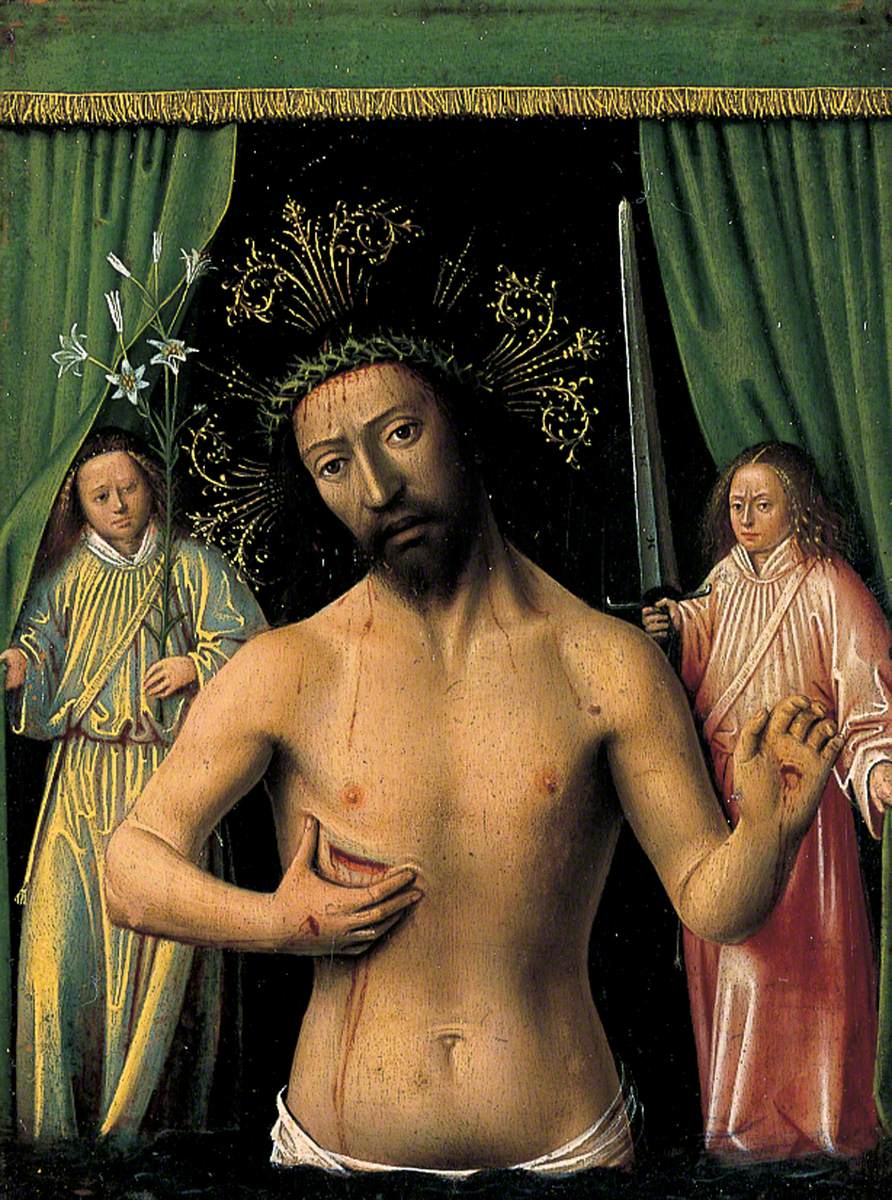
Petrus Christus (Netherlandish, ca. 1410–ca. 1475), Christ as the Man of Sorrows, ca. 1450. Oil on panel, 11.2 × 8.5 cm. Birmingham Museum and Art Gallery, Birmingham, England.
In Jesus through Medieval Eyes, each chapter ends with a scripture, reflection questions, one or two suggested exercises, and a prayer—some sourced from medieval authors, others original.
Each chapter opens with a whimsical line drawing based on medieval manuscript marginalia, which often feature humorous scenarios, like a knight fighting a snail or a rabbit hunting a human! (Role reversals were a favorite form of play for medieval artists.) This design element further immerses the reader in that world. The cover too, its art taken from a French book of hours illuminated by Jean Colombe, gives a sense of the shine of medieval manuscripts with its gilt lettering and halos of the saints.
Hamman has revitalized my interest in medieval literature, in all its wild beauty and strangeness. You may have noticed her influence on my blog over the past few years I’ve been following her. I encourage you to follow her on Twitter @GraceHammanPhD and Instagram @oldbookswithgrace, subscribe to her Medievalish newsletter, and BUY HER BOOK! It would be great material for a Christian book club, and would also make a great gift.
You may also want to check out the recent interview Hamman sat for on The Habit Podcast, part of the Rabbit Room Podcast Network. It’s a terrific introduction to her work:
In the thirteenth century, a new subject emerged in painted Passion cycles in both East and West: Christ resolutely climbing a ladder to the cross. He ascends willingly, even enthusiastically, demonstrating a heroic acceptance of death. In taking those steps up onto the instrument of his martyrdom, he exercises agency. As he tells a gathered crowd in John 10:18, “No one takes [my life] from me, but I lay it down of my own accord. I have power to lay it down . . .” Out of love for the world, he gives himself as a sacrifice, bringing about reconciliation between God and humanity.
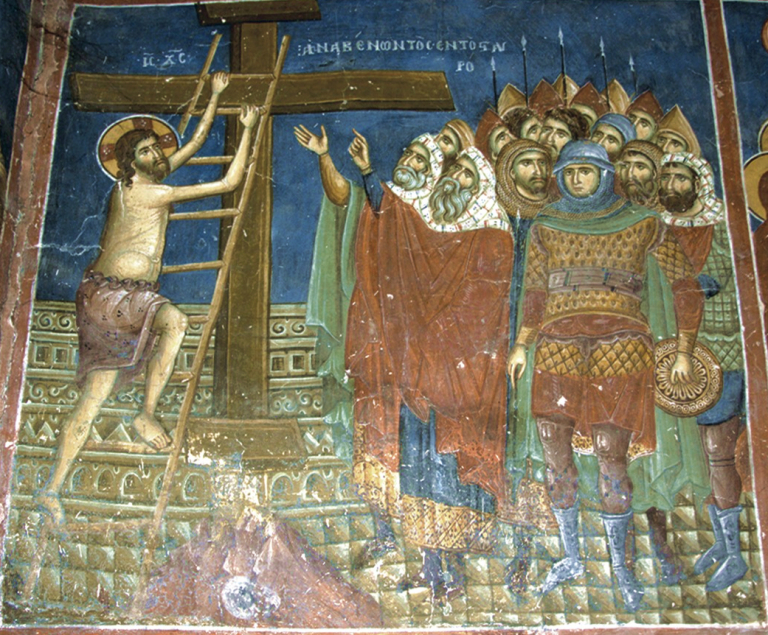
The iconography of the Ascent of the Cross (alternatively referred to as “Christ Mounts the Cross”) is of Byzantine origin and can be found in Macedonian and Serbian church frescoes.
Michael Astrapas and Eutychios, Ascent of the Cross (at right), 1295. Fresco, Church of the Holy Mother of God Peribleptos (aka Church of Saint Clement), Ohrid, North Macedonia. Photo: Vera Zavaritskaya.Ascent of the Cross, 1298. Fresco, Church of St. Nicholas, Prilep, North Macedonia. Photo: P. S. Pavlinov.Ascent of the Cross, 1317. Fresco, Church of St. George, Staro Nagoričane, North Macedonia.Ascent of the Cross, 1343–45. Fresco, Church of St. George, Pološko, North Macedonia.
In a fresco from the Church of St. George at Staro Nagoričane, a small Roman military detachment has just led Jesus to the site of his execution. A young enslaved Roman fixes the cross into the ground, instructed by an older slave who holds a basket of nails, while a third stands on the suppedaneum and waits to nail Jesus’s hands into place. Caiaphas, the Jewish chief priest, points to the cross, indicating to Christ to ascend it. Christ grabs hold of the rungs and climbs, while at the top left, from behind a rock, the Virgin Mary and John look on in grief.
Byzantine painting greatly influenced the Italian painters of the thirteenth and early fourteenth centuries. Many of them adopted Byzantine models, of which the Ascent of the Cross is one example.
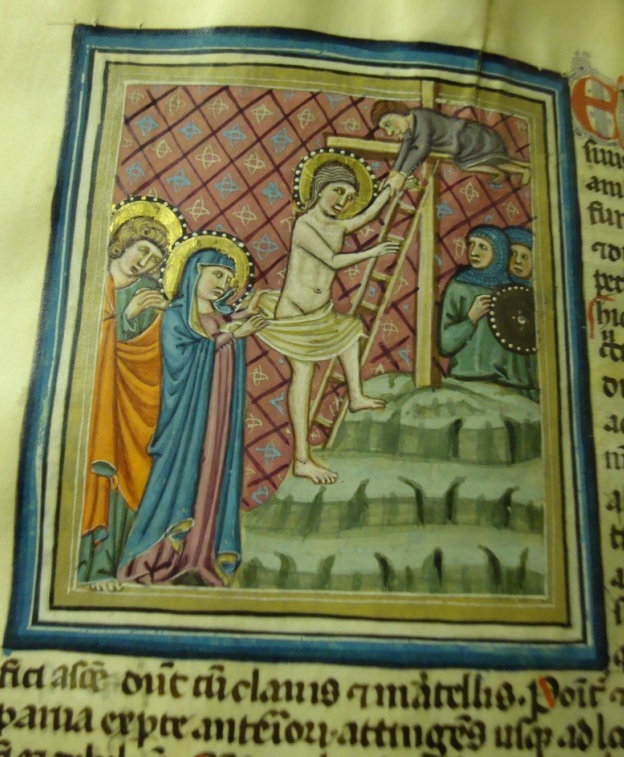
Pacino di Bonaguida (Italian, Florentine, 1280–1340), Ascent of the Cross, from the picture-book Scenes from the Life of Christ and the Life of the Blessed Gerard of Villamagna, ca. 1320. Tempera and gold leaf on parchment, 9 5/8 × 6 7/8 in. (24.5 × 17.6 cm). Pierpont Morgan Library, New York, M. 643, fol. 12r.
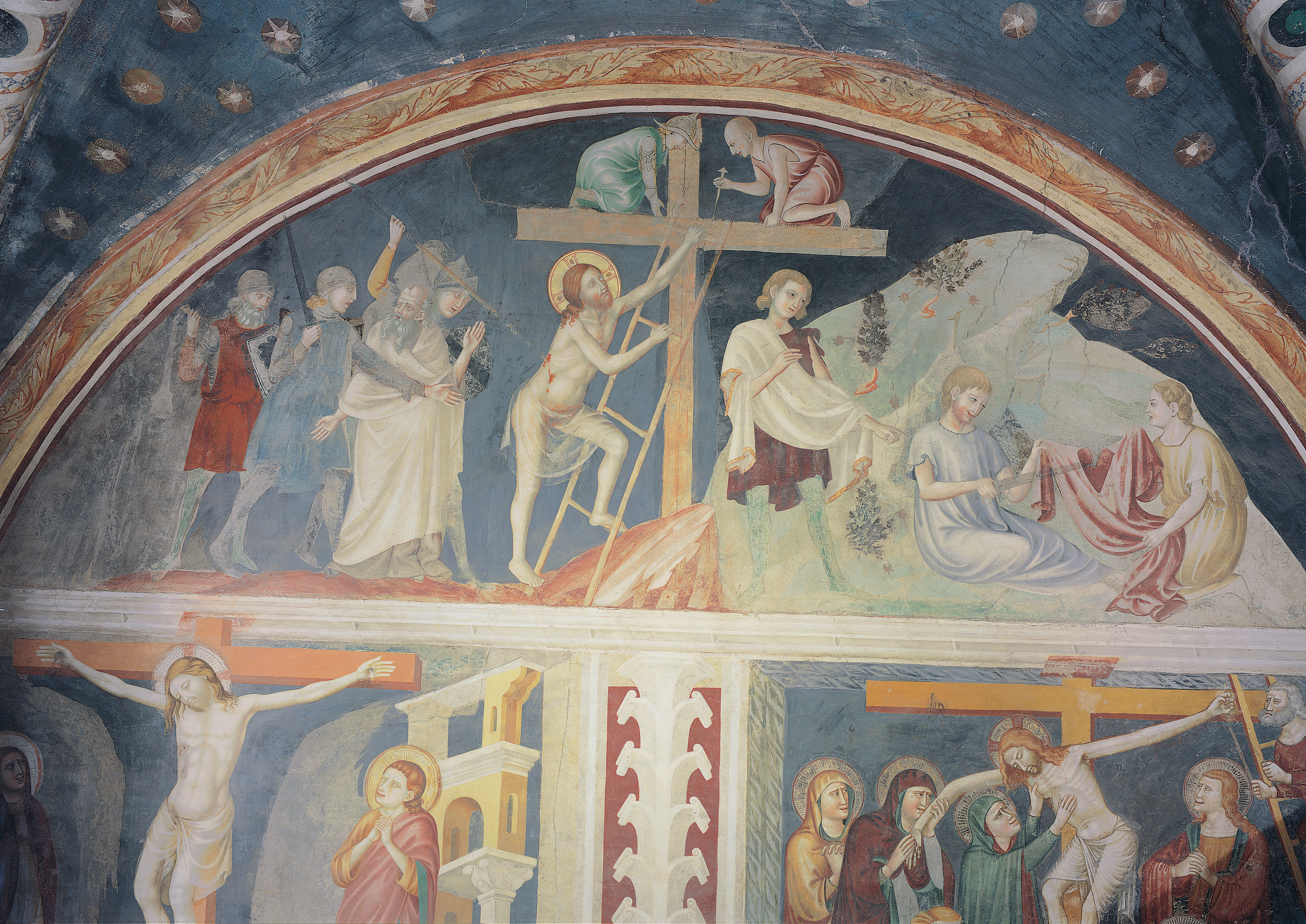
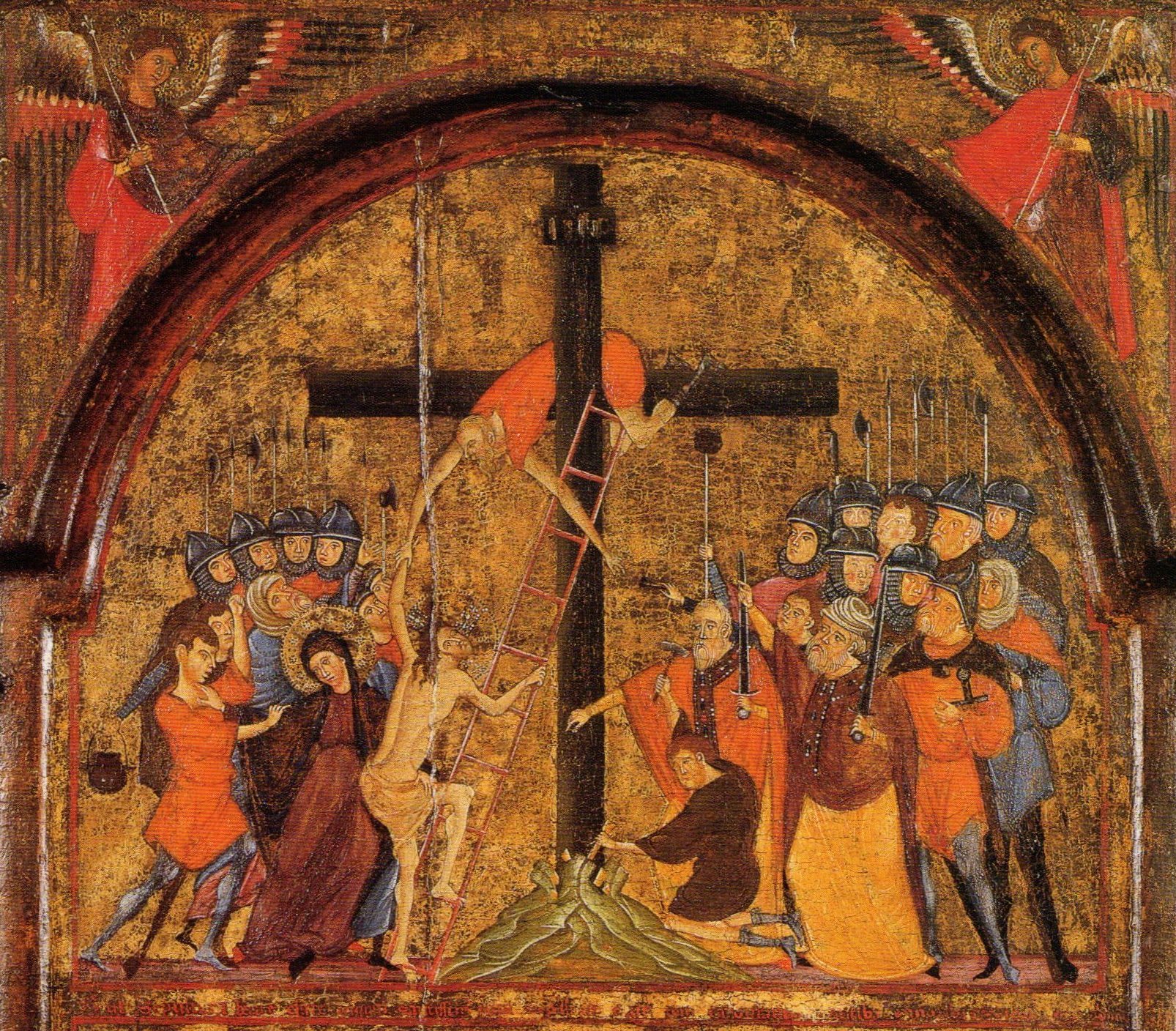
In a Ferrarese church lunette fresco in the Benedictine nuns’ monastic complex of Sant’Antonio in Polesine, two men kneel on the cross’s patibulum as Christ mounts the ladder propped against it. He wears a translucent loincloth, emphasizing his nakedness and humiliation. Knowing Christ’s innocence, an elderly Jewish man tries to intervene to prevent the brutality, but he is restrained by soldiers. On the right, a group of Romans argues over who will get to keep Christ’s cloak, a souvenir from this regional celebrity.
Christ Mounts the Cross on a Ladder, 14th century. Fresco, Monastery of Sant’Antonio in Polesine, Ferrara, Italy.
In some versions of the Ascent of the Cross, Jesus is pushed or pulled into position, or at least aided, by soldiers, with whom he readily cooperates. Such is the case in the earliest identified instance of the subject, from an eleventh-century Armenian Gospel-book. (Armenians were the largest non-Greek ethnicity in the Byzantine Empire.)
Ascent of the Cross, from the Vehapar Gospels, Armenia, early 11th century. Matenadaran, Yerevan, MS 10780, fol. 125v.
Art historian Thomas F. Mathews says that in the Armenian tradition, Golgotha is identified with the place where the Jewish patriarch Jacob had a vision of angels trafficking a ladder connecting heaven and earth. “How awesome is this place! This is none other than the house of God, and this is the gate of heaven,” Jacob exclaimed, dubbing it Bethel, Hebrew for “house of God” (Gen. 28:10–22). In Armenian manuscript illuminations, Mathews argues, the subject of Christ ascending the cross, very often followed by a depiction of Christ’s dead body descending from the cross, was thus interpreted as an extension of Jacob’s vision, as by climbing up and down the ladder of the cross, Christ opened heaven’s gate.[1]
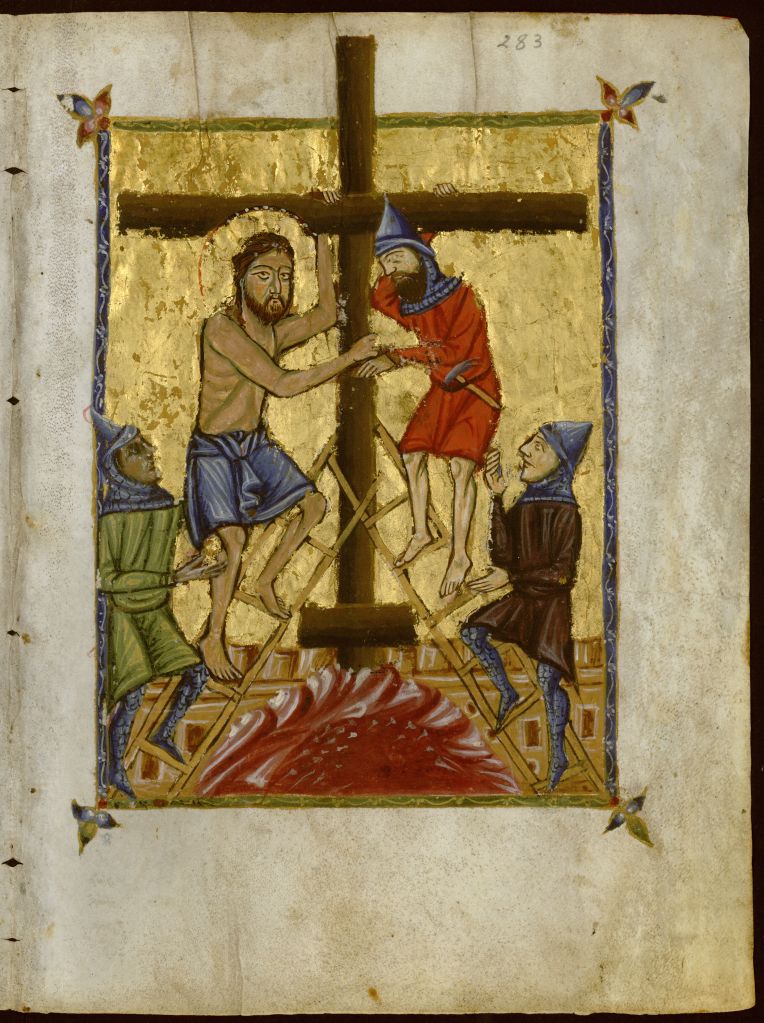
Another Armenian Gospel-book miniature of the subject, from the early fourteenth century, is particularly striking in how it shows Christ turning, mid-climb, toward the viewer, his direct gaze engaging our pity and love.
T‘oros Taronec‘i, Ascent of the Cross, from the Gladzor Gospels, Armenia, 1300–1307. UCLA Library Special Collections, Los Angeles, Armenian MS 1, p. 283.
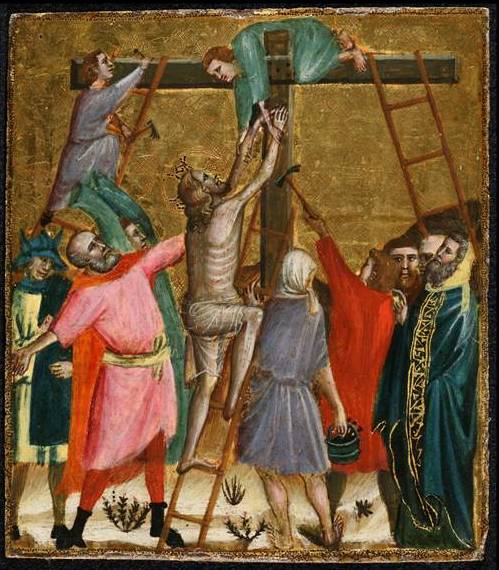
In some versions from Italy, Mary grabs her son around the waist, trying to prevent him from experiencing further torture. Take, for example, the panel painting by Guido da Siena that was originally part of the Madonna del Voto altarpiece in Siena’s cathedral. Her mama-bear instinct kicking in, Mary pushes away one of her son’s tormentors with one arm and with the other protectively encircles her son, unable to let him go.
Guido da Siena (Italian, Sienese, 1230–1290), Ascent of the Cross, ca. 1265–74. Tempera on poplar wood, 34.5 × 46 cm. Museum Catharijneconvent, Utrecht, Netherlands.
Some Christians are wary of suggesting that the Mother of God would seek to deter God’s plan, but let’s remember that, devout as she was, Mary was not superhuman. The death sentence passed against her son and the violence that followed naturally unleashed a flood of emotion in her and an impulse to resist. What mother wouldn’t do everything in her power to save her child from harm? No matter how much she believed in her son’s mission, what mother wouldn’t reach out for one last embrace, if only to delay the inevitable?
That said, Mary’s gesture here may be one of attempting not to impede his ascent but to cover his nakedness. In the widely influential Meditations on the Life of Christ, a text that originated in early fourteenth-century Tuscany and circulated in Latin and all the major European vernaculars,[2] Mary responds in agony to Jesus’s being shamefully stripped for all to see, and she intervenes with a small mercy:
Oh what anguish this was to his mother, to see her most sweet son naked like this, standing like a lamb among these wicked wolves!
Then the mother, full of sorrow, went up close to her most sweet son and took the veil from her head and wrapped it around Lord Jesus Christ with bitter sorrow. And I do not know how she did not fall dead to the earth.[3]
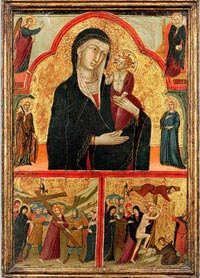
Closely related to the Guido panel is one by an anonymous artist from Umbria or Tuscany that was the central panel of a portable altarpiece with two wings, possibly painted for the Basilica of Santa Chiara in Assisi. It depicts the Ascent of the Cross—again, with the Virgin Mary interceding—above a scene of the Funeral of Saint Clare (d. 1253), a close follower of Saint Francis and the founder of the Poor Clares religious order.
Christ Mounting the Cross and the Funeral of Saint Clare (detail), Umbria or Tuscany, 1290s. Tempera and silver leaf on panel, overall 31 1/4 × 20 3/8 in. (79.4 × 51.8 cm). Davis Museum, Wellesley College, Wellesley, Massachusetts.
For the iconography of the Ascent of the Cross, art historian Anne Derbes identifies a possible literary source as Pseudo-Bede’s De meditatione passionis Christi: “Then, when the cross had been prepared, they [the people] cry: ‘Ascend, Jesus, ascend.’ O how freely He ascends, with what great love for us He bore everything, with what patience, what gentleness!”[4]
Terser references to this episode, Derbes points out, appear in Pseudo-Anselm’s Dialogus, which mentions that Christ “ascends the wood of the cross,”[5] and in Ambrose’s commentary on Luke, in which Ambrose remarks that “it was not his cross that Christ ascended, but ours,” and that Christ ascended the cross “as a victor ascends a triumphal chariot.”[6]
Derbes also notes the possible influence of the adoratio crucis (adoration of the cross) ritual, known in Jerusalem from the fourth century and in the West from the seventh or eighth, which states, “O Lord Jesus Christ, I adore you climbing onto the cross.”[7]
[In the tiled gallery below, click on the image to view the caption and source URL.]
The long Latin version of the Meditations, which, from the mid-fourteenth century, postdates most of the paintings shown here, also mentions the Ascent of the Cross, perhaps itself influenced by trecento visual culture:
Now diligently behold the process of Crucifixion. Two ladders are accustomed to be placed, one on the one side, the other on the other; upon these, wicked men go up, with nails and hammers; while another ladder is placed in front, reaching to that part of the Cross where the feet are to be nailed. Contemplate now each event Our Lord may have been compelled by means of this small ladder to ascend the Cross, for He does whatsoever they bid Him, humbly, without resistance or complaint. Having reached the top of the ladder, He turns Himself round, it may be, opens His arms, and extends His Hands—so royal and beautiful—and yields Himself up to His crucifiers.
. . . Some there are who think that this was not the method of Crucifixion, i.e. by making our Lord ascend a ladder before the nailing of His Body to the Cross; but that they fastened Him to the Cross when it was laid on the ground before it was raised.[8]
Interestingly, the writer, as he does elsewhere in the manuscript, allows for the possibility that the action may have occurred in one of two ways. Actually, probably neither of the two options he describes for how Christ was nailed to the cross is accurate. Ancient historians think it most likely that Jesus was nailed to the horizontal crossbeam while it lay on the ground, which was then lifted up, his body attached, and dropped into a notch in the permanently fixed vertical post.[9]
However, the Ascent of the Cross isn’t so much meant to be a literal portrayal of what happened historically as it is an expression of the theological truth that Christ went to his death voluntarily. He was not forced onto the cross against his will. The Ascent suggests divine initiative and purpose. Even in those images where Christ is being prodded by his executioners, he does not resist. Instead, he bounds onward and upward to his chosen end.
In medieval English literature, the freedom and strength of Christ in his death is often emphasized. In the Old English poem “The Dream of the Rood” from the eighth century, the cross says, “Then I saw mankind’s Lord / hasten with great zeal, as though he wanted to climb on me.”[10] In Middle English religious lyrics, which come down to us mainly through preaching manuscripts, Christ mounts the cross much like a knight does his steed, prepared for battle, but of a spiritual kind.[11]
One anomalous example of the Ascent of the Cross that I found comes from Reformation Germany. A copperplate engraving by Augustin Hirschvogel[12] shows a muscly Christ mounting the cross with three figures slung over his shoulder: a clawed, beaked, horned creature representing the devil; a skeleton representing death; and what looks like a bloated corpse, probably representing sin. The tone is triumphant, as Christ’s death defeats this formidable trio. They are nailed to the cross with him, but unlike him, never to rise.
Augustin Hirschvogel (German, 1503–1553), Christ Ascending the Cross with Sin, Death, and the Devil, 1547. Etching, 11.8 × 14.8 cm (image) / 15.1 × 14.8 cm (sheet). National Gallery of Art, Washington, DC.
Christ Ascending the Cross with Sin, Death, and the Devil is one of a group of over one hundred etchings of biblical scenes commissioned by the Hungarian aristocrat and politician Peter Perényi (1502–1548) for his Concordance of the Old and New Testaments, first published in Vienna by the printer Aegidius Adler in 1550. Perényi selected the scenes and wrote the letterpress captions beneath them. This one reads,
Noch mer Christus am creutz uberwand Desshalben von Gott war selb gesandt Und den teueffel Hell alles band Drumb er unser erlöser ist genannt. Luc. 23e. Corinth.5f.
On the cross, it says, Christ overcame hell and the devil, and that’s why we call him “Redeemer.” The biblical citations are to the Crucifixion account in Luke 23 and to 2 Corinthians 5:14–21, which begins, “For the love of Christ urges us on, because we are convinced that one has died for all; therefore all have died. And he died for all, so that those who live might live no longer for themselves but for the one who for their sake died and was raised” (NRSV).
A follower of Martin Luther and a friend of Philip Melanchthon, Perényi was an influential protector of Protestant preachers in the kingdom of Hungary. But his shifting political allegiances got him into trouble when in 1542 he was imprisoned by Ferdinand I, a Habsburg prince, for disloyalty. It was from a prison in Vienna that he worked on his concordance project.
All these artworks of Christ ascending the cross show his bravery, dignity, and poise in the face of persecution, his heroic self-giving that wins the world’s salvation. Despite his mother’s tearful entreaties, and despite the pain he knows is coming, he remains steadfast, his eyes fixed on the prize that will be attained on Easter morning.
As an independent scholar, I rely on your donations to keep publishing articles like this, as they require a large time investment, and in this case, a photo licensing fee (for the Ferrara fresco). If you appreciate having access to researched, illustrated articles on theological art, would you consider making a donation to support my work, either monetarily (via PayPal or the secure form below) or by buying me a book? Thank you!
1. Thomas F. Mathews and Avedis K. Sanjian, Armenian Gospel Iconography: The Tradition of the Glajor Gospel (Washington, DC: Dumbarton Oaks Research Library and Collection, 1990), 131–32.
2. This text is traditionally attributed to a Franciscan friar known as Pseudo-Bonaventure and believed to have originated in Latin (title: Meditationes de vitae Christi), but Sarah McNamer has persuasively argued that its originator was a woman, a Poor Clare from Pisa, who wrote it in Italian for her fellow nuns sometime between 1300 and 1325. Within the next decade and a half, McNamara proposes, a Franciscan friar expanded and altered it to make it more didactic, creating first another Italian version (the “testo minore”) and then translating this into Latin to “authorize” it and make it more disseminatable. The long Latin text has become canonical but is, McNamara argues, inferior to the base text, compromising its narrative pacing and emotional impact. See Sarah NcNamer, Meditations on the Life of Christ: The Short Italian Text (Notre Dame, IN: University of Notre Dame Press, 2018).
3. Translated by Sarah McNamer from Oxford, Bodeleian Library MS Canonici Italian 174 (the “testo breve”), in Meditations, 141.
4. “Deinde parata cruce dicunt ei, ascende, Jesu, ascende. O quam libenter ascendit, o quanto amore ista omnia pro nobis sustinuit, o quanta patientia, o quanta mansuetudo!”(PL 94:565). Translated by Anne Derbes in Picturing the Passion in Late Medieval Italy: Narrative Painting, Franciscan Ideologies, and the Levant (Cambridge, UK: Cambridge University Press, 1996), 154.
6. “Non enim suam, sed nostram crucem christus ascendit” (PL 15:1923); “currum suum triumphator ascendit” (PL 15:1924). Qtd. Derbes, 242n56.
7. “Domine Ihesu Christi, adoro te in cruce ascendentem,” qtd. Derbes, 242n56, from Karl Young, The Drama of the Medieval Church, vol. 1 (Oxford: Clarendon, 1933), 117–19.
8. S. Bonaventure, The Life of Christ, trans. and ed. Rev. W. H. Hutchings (London: Rivingtons, 1881), 267, xiii–xiv. Sarah McNamer says that while (what she argues is) the original Meditations text describes a crucifixion method known as jacente cruce—Christ nailed to the cross as it lies prone on the ground—the Italian recension and subsequent translations and versions that came soon after privilege the erecta cruce method, in which Christ ascends a ladder to an upright cross and thus is nailed from an elevated position (Meditations, 228n126).
9. Martin Hengel, Crucifixion in the Ancient World and the Folly of the Message of the Cross (Philadelphia: Fortress, 1977), 25; Robin Jensen, The Cross: History, Art, and Controversy (Cambridge, MA: Harvard University Press, 2017), 10.
10. “Geseah ic þā Frēan mancynnes / efstan elne micle, þæt hē mē wolde on gestīgan.”
11. The metaphor of Christ’s cross as a horse that he bravely mounts as if for battle occurs in MS Balliol 149 (cf. MSS Magdalen 93 and Trinity Dublin 277), Nicolas Bozon’s poem “Sa sele fu trop dure, et mout l’ad anguise,” MS Bodley 649, and MS Harley 2316. See Rosemary Woolf, Art and Doctrine: Essays on Medieval Literature (London: The Hambledon Press, 1986), 113–15.
12. Hirschvogel was trained as a stained-glass painter in the workshop of his father, but when his hometown of Nuremberg accepted Luther’s Protestant teachings, the workshop lost its church commissions. Hirschvogel thus pivoted to designing maps and fortification plans and, in his final decade, making landscape etchings as part of the Danube School. Richard Manly Adams Jr., “One Acquisition, Two Great Traditions at Pitts,” Reformation Notes no. 56 (Summer 2021): 5.













 Art & Theology