
. . . you are dust, and to dust you shall return.
—Genesis 3:19 (cf. Ecclesiastes 3:20)
Lord, you have been our dwelling place
in all generations.
Before the mountains were brought forth,
or ever you had formed the earth and the world,
from everlasting to everlasting you are God.You turn us back to dust,
and say, “Turn back, you mortals.”
For a thousand years in your sight
are like yesterday when it is past,
or like a watch in the night.You sweep them away; they are like a dream,
like grass that is renewed in the morning;
in the morning it flourishes and is renewed;
in the evening it fades and withers.For we are consumed by your anger;
by your wrath we are overwhelmed.
You have set our iniquities before you,
our secret sins in the light of your countenance.For all our days pass away under your wrath;
our years come to an end like a sigh.
The days of our life are seventy years,
or perhaps eighty, if we are strong;
even then their span is only toil and trouble;
they are soon gone, and we fly away.Who considers the power of your anger?
Your wrath is as great as the fear that is due you.
So teach us to count our days
that we may gain a wise heart.Turn, O LORD! How long?
Have compassion on your servants!
Satisfy us in the morning with your steadfast love,
so that we may rejoice and be glad all our days.
Make us glad as many days as you have afflicted us,
and as many years as we have seen evil.
Let your work be manifest to your servants,
and your glorious power to their children.
Let the favor of the Lord our God be upon us,
and prosper for us the work of our hands—
O prosper the work of our hands!—Psalm 90
God’s eternity and human frailty. These are the central themes of Psalm 90, commonly read on Ash Wednesday, the first day of Lent. Today many Christians will be receiving the sign of the cross in ash on their foreheads—a symbol of death and repentance. “Remember that you are dust, and to dust you shall return. Repent and believe the gospel,” the pastor pronounces as he or she smears the ash (made from burnt palm fronds from last year’s Palm Sunday) on young and old alike.
For a Protestant defense of Ash Wednesday, see “To Ash or Not to Ash” by Rev. Dr. Timothy R. LeCroy. He explores the biblical symbolism of the ritual, its history, and its importance for Christian formation.
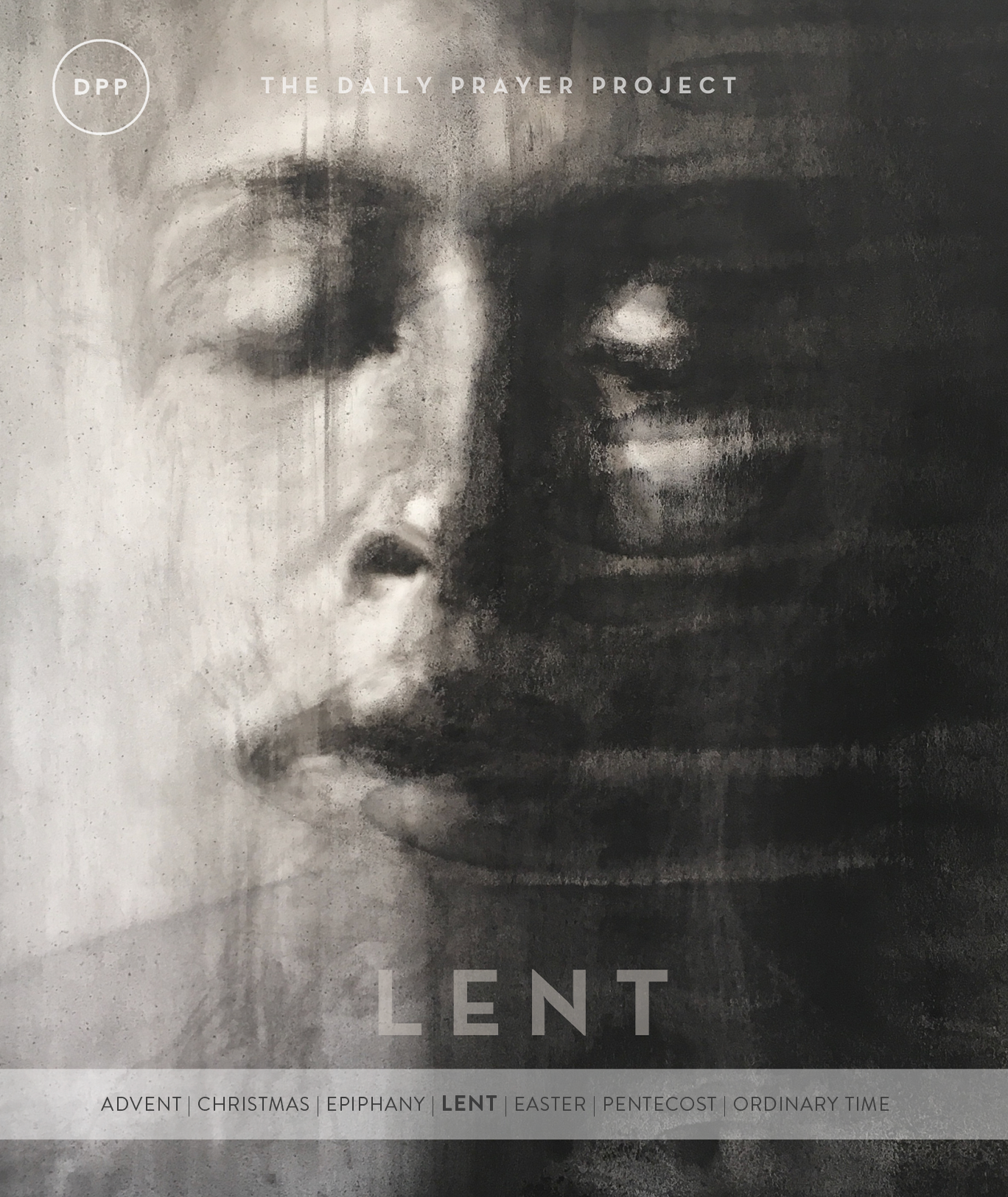
LOOK: We Shake with Joy, We Shake with Grief by Meena Matocha

Austin-based artist Meena Matocha uses charcoal, ashes, soil, and wax to create figurative paintings that explore the tensions between joy and grief, life and death, and the eternal and temporal. The title of this featured painting of hers comes from the poem “We Shake with Joy” by Mary Oliver, reproduced here in full:
We shake with joy, we shake with grief.
What a time they have, these two
housed as they are in the same body. [source]
The exhibition Meena Matocha: Into the Bright Sadness opens this Friday, March 4, at Christ Church of Austin with a reception and gallery talk and will run through April 15. “Bright sadness” is how the Orthodox priest Alexander Schmemann, in his influential book Great Lent: Journey to Pascha (1969), translates the concept of charmolypê that John Climacus develops in his Ladder of Divine Ascent in relation to “holy compunction.” “Bright sadness . . . is the true message and gift of Lent,” Schmemann writes. “The sadness of my exile, of the waste I have made of my life; the brightness of God’s presence and forgiveness, the joy of the recovered desire for God, the peace of the recovered home.” Alternative translations of this compound noun that permeates the Lenten season are “bitter joy,” “joyful mourning,” “joy-making mourning,” or, as Archimandrite Lazarus Moore has it, “blessed joy-grief.”
In their mood and materiality, Matocha’s paintings capture well the themes of Ash Wednesday and the season it inaugurates. Follow her on Instagram @meenamatochaart and on Facebook.
LISTEN: “From the Dust” by Paul Zach and Kate Bluett, 2021 | Released as a single February 25, 2022
Singer-songwriter Paul Zach video-recorded a minimalist demo of this original song last year, and just last Friday he released a fuller version with backing vocals by The Sing Team and a forty-piece orchestral accompaniment. The string arrangement is by Brian Eichelberger. Zach gave me permission to publicly post this Dropbox link, where you can download an audio file of the song, a lead sheet, and the string parts: https://www.dropbox.com/sh/t56w2lyi3hsoerm/AADPnKbPDveZh825uUdBU4JEa?dl=0.
From the dust we came
To the dust we shall return
God everlasting, age unto age the same
We are a moment, then like a breath we fadeFrom the dust we came
To the dust we shall return
God everlasting, we are cut down as grass
Seeds in the morning, and by the night we passO Lord, have mercy
O Lord, have mercy
O Lord, have mercy
Based on Genesis 3:19 and Psalm 90:2–6, “From the Dust” is a sober acknowledgment of the mortality that unites us all, and a plea that God would be merciful to us, forgiving our foolish ways and setting us back on the path of wisdom.
This song appears on the Art & Theology Lent Playlist.
 Art & Theology