Joy, Faith, and Strength in the Mixed-Media Art of Missionary Mary Proctor

All photos in this article are my own.

The American Visionary Art Museum, located right off Baltimore’s Inner Harbor, is midway through its two-year exhibition The Strength to Be Joyful: Messages from Mary Proctor. Exuberant, colorful, and eclectic, the paintings on display, many of them collaged with buttons, cloth, and found objects, are filled with stories from Proctor’s life, lessons taught to her by her grandmother, and prayers and scripture. Her work celebrates faith, love, friendship, creativity, and self-worth.
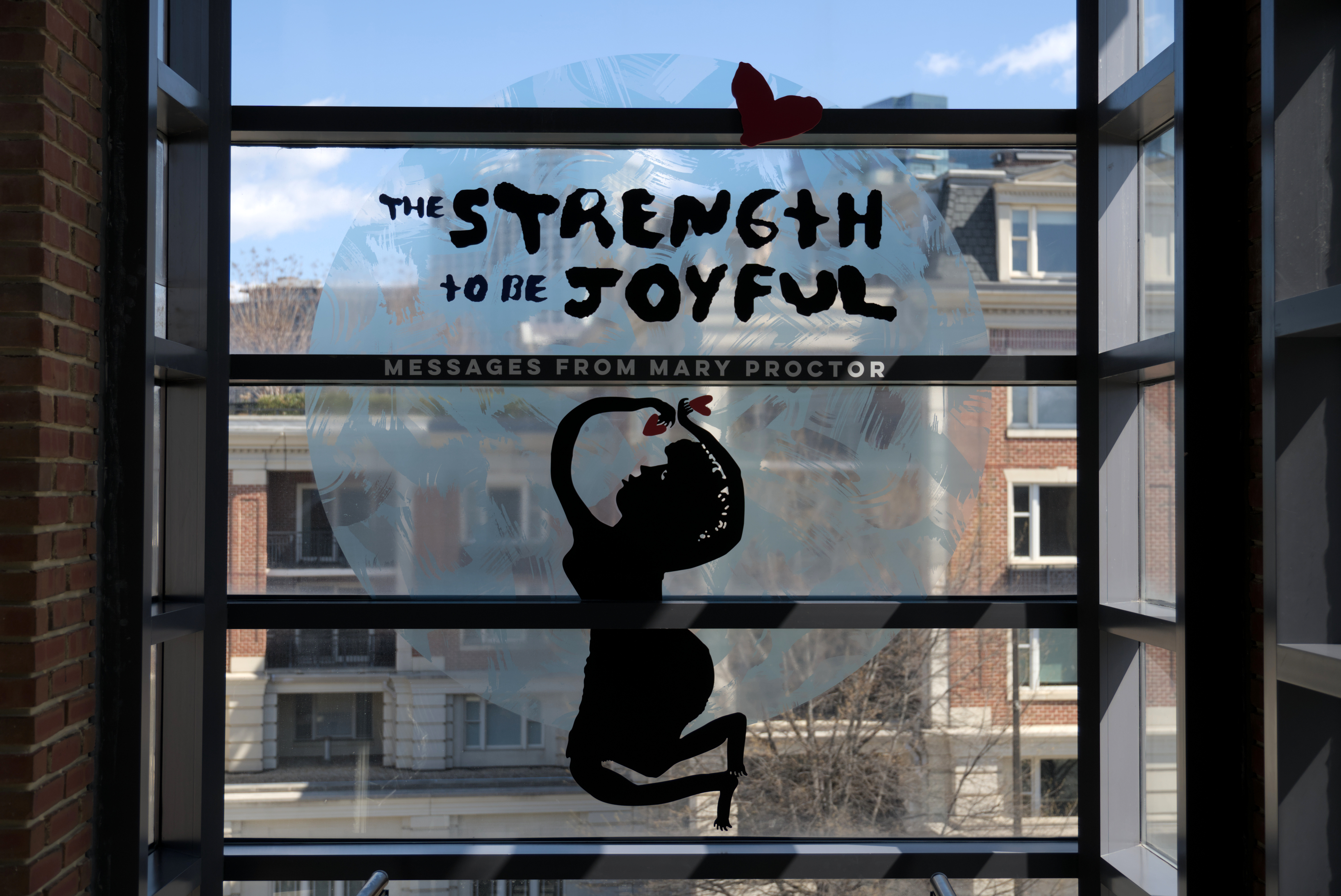
The Strength to Be Joyful
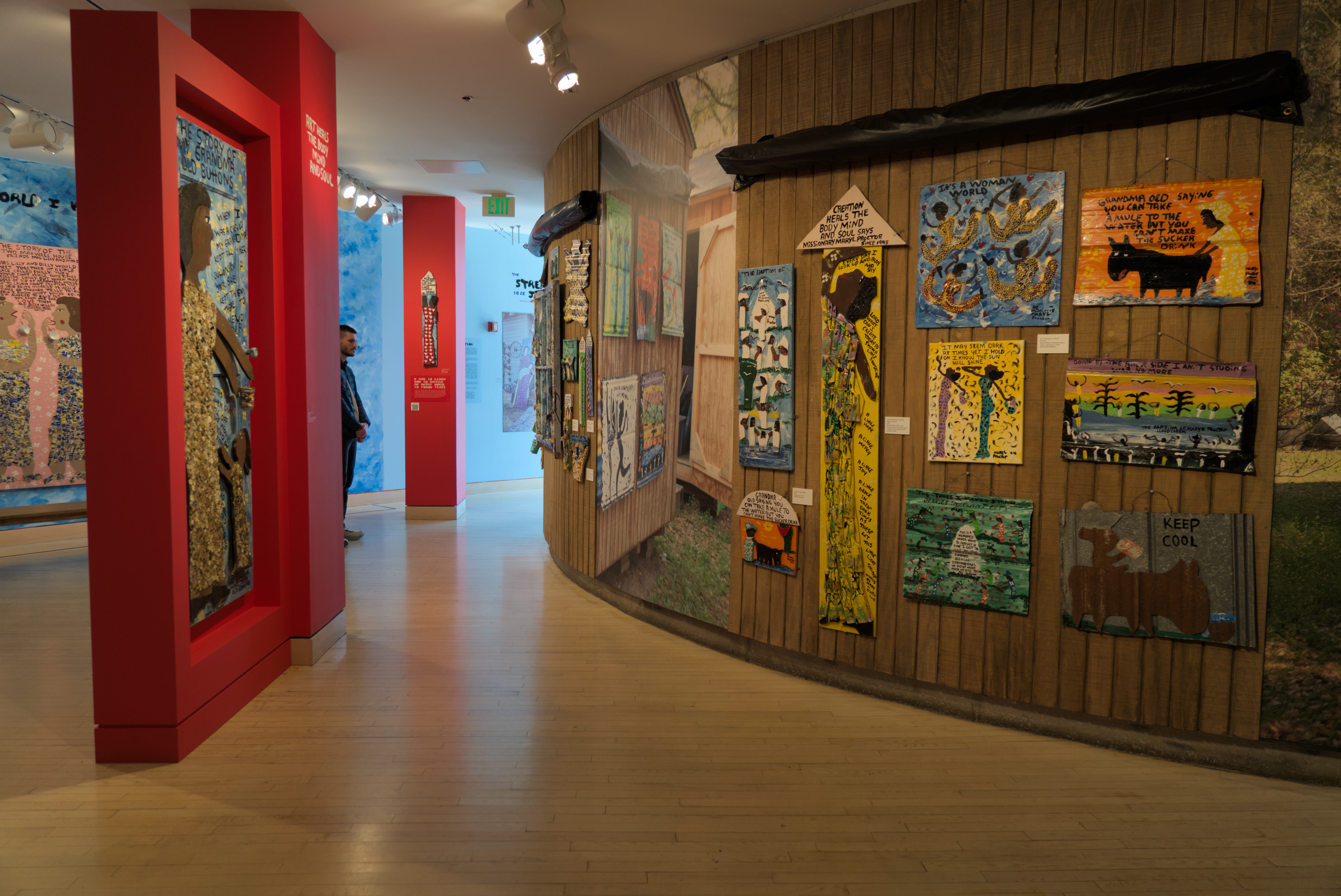
Exhibition view, The Strength to Be Joyful

Mary Louise Proctor (née Cooksey) was born June 11, 1960, in Lloyd, Florida, a small town in Jefferson County, about twenty miles east of Tallahassee. Her mother Paulina gave birth to her at a young age, and she was raised by her maternal grandparents, Frank and Hattie Cooksey. She had an especially close bond with her grandmother, who formed her in the Christian faith and whom she describes as tender, wise, and forgiving.

One particular episode she recalls from her childhood is accidentally breaking a stack of her grandmother’s Blue Willow plates while reaching for a teacake. “I thought she would whip me,” Proctor recounted in paint in 1997. “Instead she held my hands and said, ‘I forgive you cause just yesterday God forgave me.’ And she said one must forgive to be forgiven.” The door painting Story of Grandma’s Old Blue Willow Plates portrays Proctor’s grandma reaching out to her as a child to remove her shame and console her, assuring her of her unconditional love. The clothing of the two figures is rendered in shards of the broken chinoiserie dishware, veined with gold paint, kintsugi-like—a metaphor for repair. Centered at the top of the door, round and gleaming like a sun or a halo, is an intact plate. Below it two angels—one Black, one white—resembling the plate’s turtledoves, swoop in and support the title Proctor has given this sacred memory.
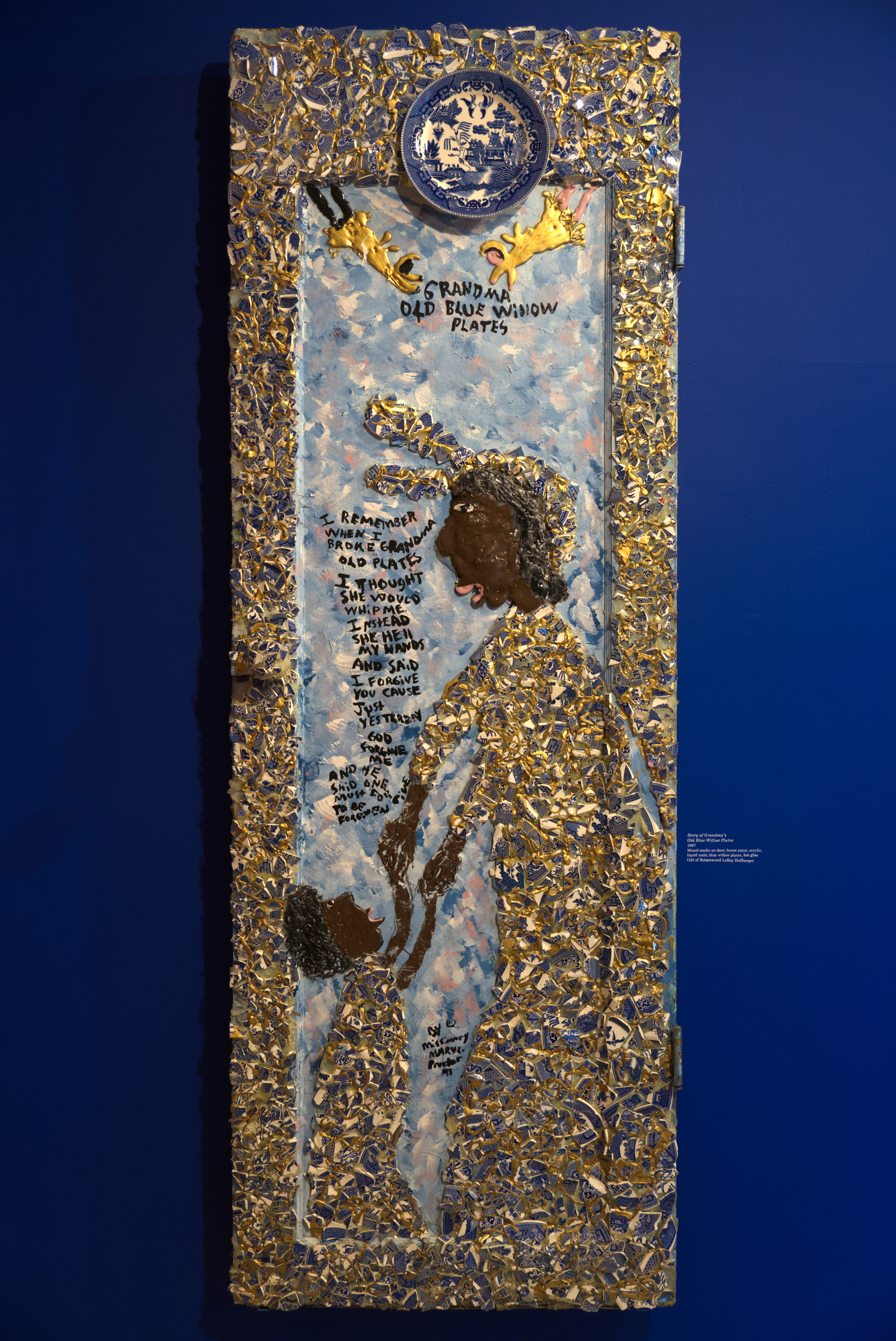
Grandma's Old Blue Willow Plates
Mary L. Proctor (American, 1960–), Story of Grandma’s Old Blue Willow Plates, 1997. House paint, acrylic, liquid nails, Blue Willow plates, and hot glue on door. American Visionary Art Museum, Baltimore.

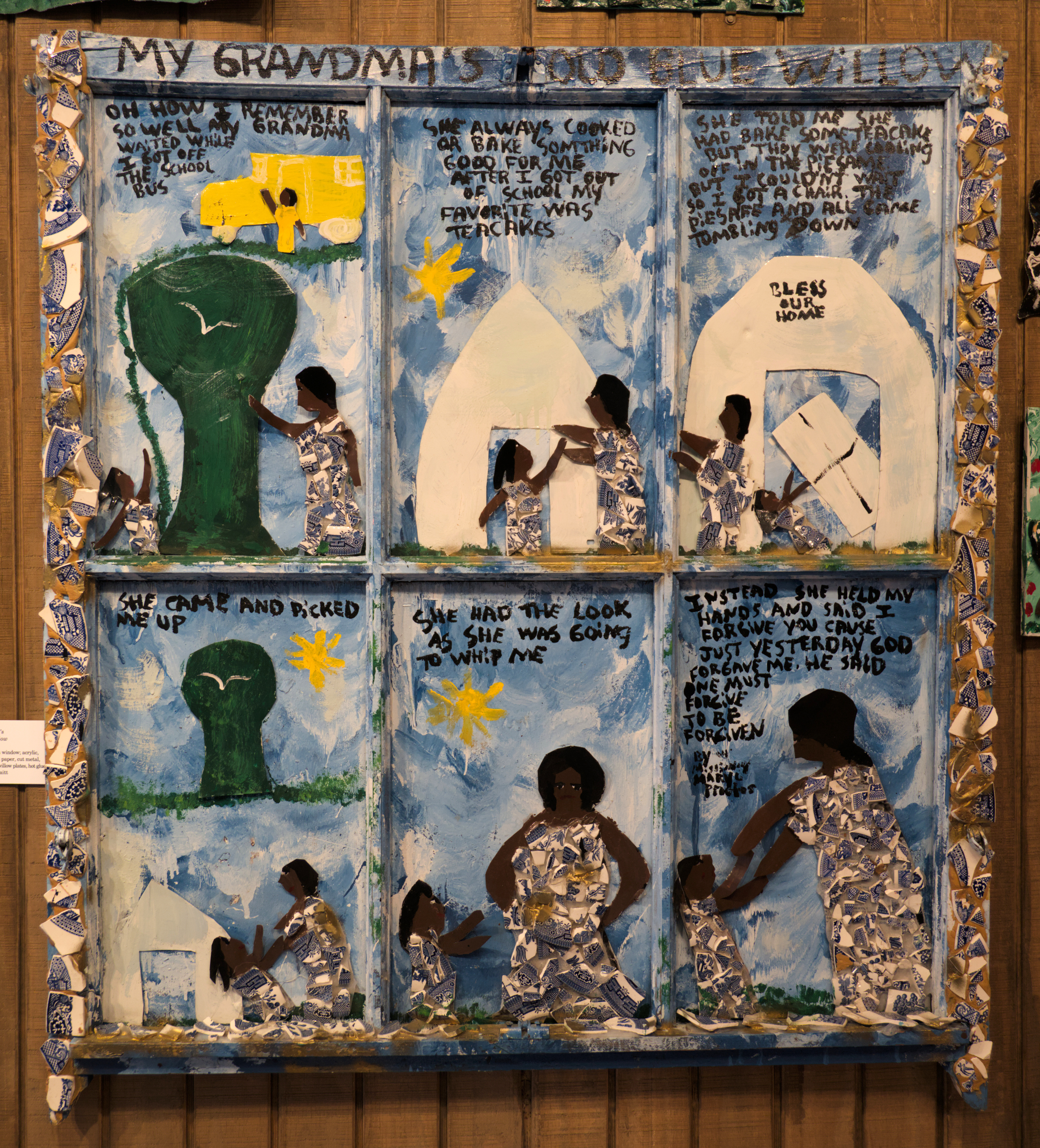
My Grandma's Old Blue Willow
Mary L. Proctor (American, 1960–), My Grandma’s Old Blue Willow, 2004. Acrylic, spray paint, cut paper, cut metal, liquid nails, Blue Willow plates, and hot glue on window. American Visionary Art Museum, Baltimore.

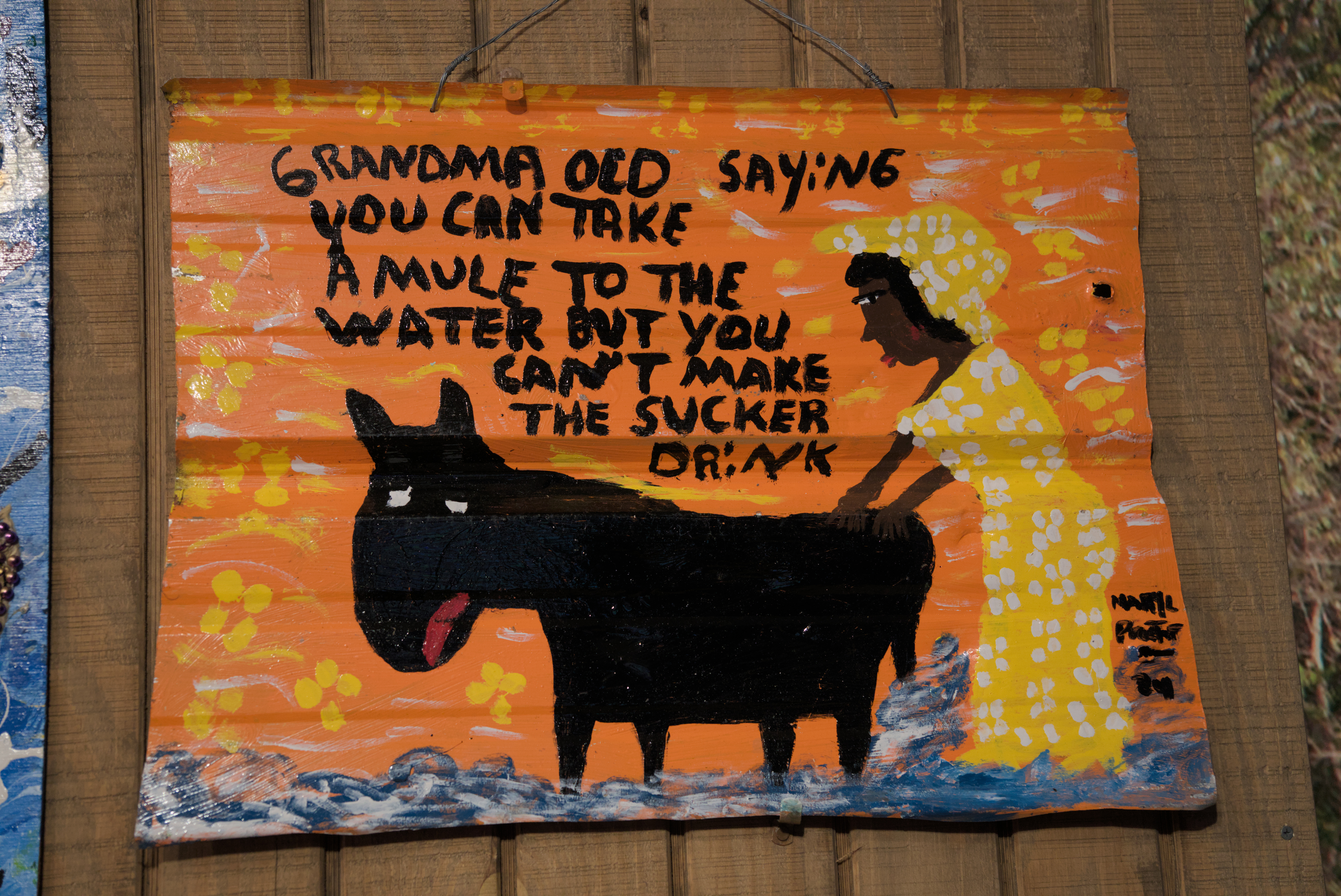
Memories of her grandma, and her grandma’s wisdom sayings, feature in much of Proctor’s work. One painting enumerates eleven “things my old grandmoma told me yesterday [that] holds me today,” such as “Tell you bussiness to God” and “Every body that smile in your face ain’t your friend.” One proverb her grandma would regularly recite is “You can take a mule to the water but you can’t make the sucker drink,” teaching her that we can offer help to other people but ultimately can’t control their choices.
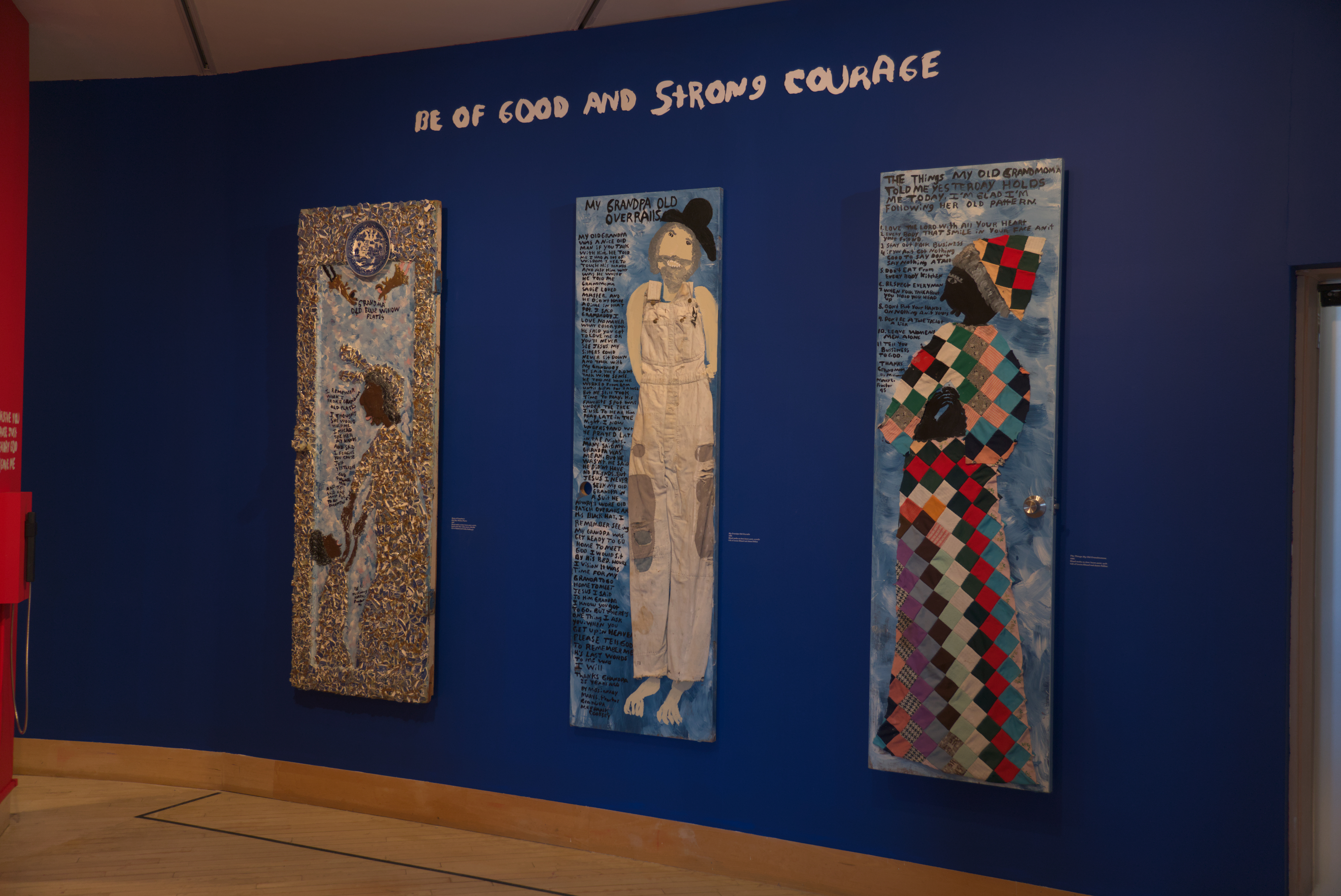
Exhibition view, The Strength to Be Joyful
Left to right: Story of Grandma’s Old Blue Willow Plates, 1997; My Grandpa Old Overalls, 1995; The Things My Old Grandmomma, 1995

Mule painting

Proctor dropped out of school in ninth grade and, after escaping an abusive relationship, married Tyrone Proctor in 1980. She worked as a nurse’s aide until a nerve injury made the job unfeasible, at which point she pivoted to collecting and selling miscellaneous objects for a living.

In January 1994, tragedy struck when Proctor’s grandmother, aunt, and uncle died in a house fire. Proctor was traumatized by seeing the charred bodies removed from the wreckage, and she sunk into a depression. She wrestled with God and even considered suicide.

“The most beautiful personality you ever seen was my grandma. She loved everybody,” Proctor tells. “And I was like, what happened to my grandmother? I mean, why, Lord, why did you allow her to go? That’s my best friend. I was wondering why such a woman had to go like that. Why did it happen?”

While she didn’t receive an answer to that question, she did receive a new direction for her life. In February 1995, while praying and fasting, God spoke to her, telling her to “paint the door.” Not quite sure what he meant, she grabbed three detached doors that she had in her yard and painted the likenesses of her family members on them. This was the beginning of her healing process and her career as a folk artist.

Proctor was already used to salvaging things, from dumpsters and roadsides, that others deemed trash, and making good purchases at flea markets. Now instead of cleaning them up to sell or resell in their current forms, she found uses for them in her art making, and started saving other discarded items as well. Buttons, beads, shells, nails, coins, mirrors, sticks, Spanish moss, coffee cans, toys, shoes, pails, patches of cloth—any of these are worthy art materials for her, along with her go-to house paint. With them, she embellishes doors of all sizes and other types of discarded wood, which she’ll often cut into shapes that suit her.

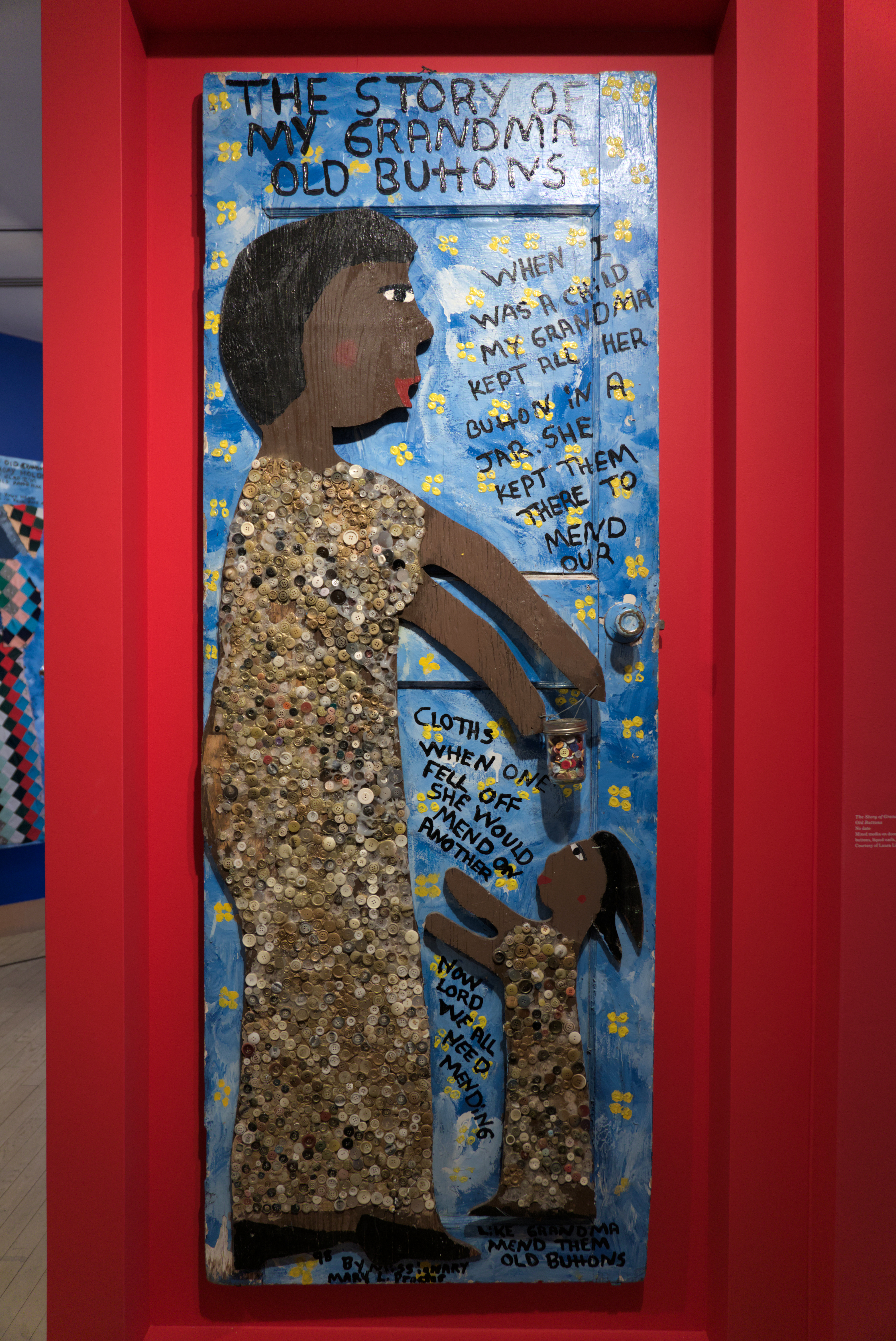
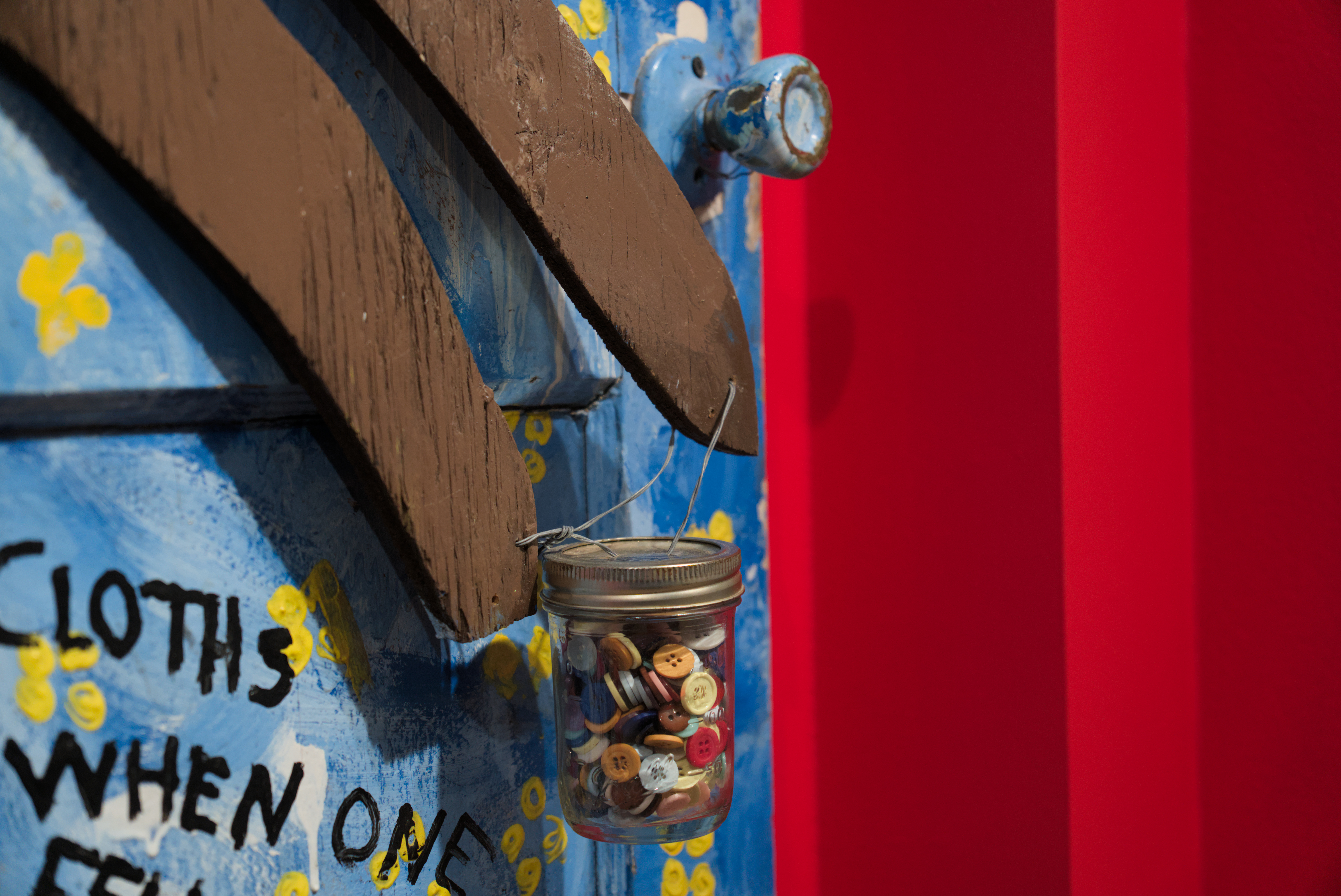
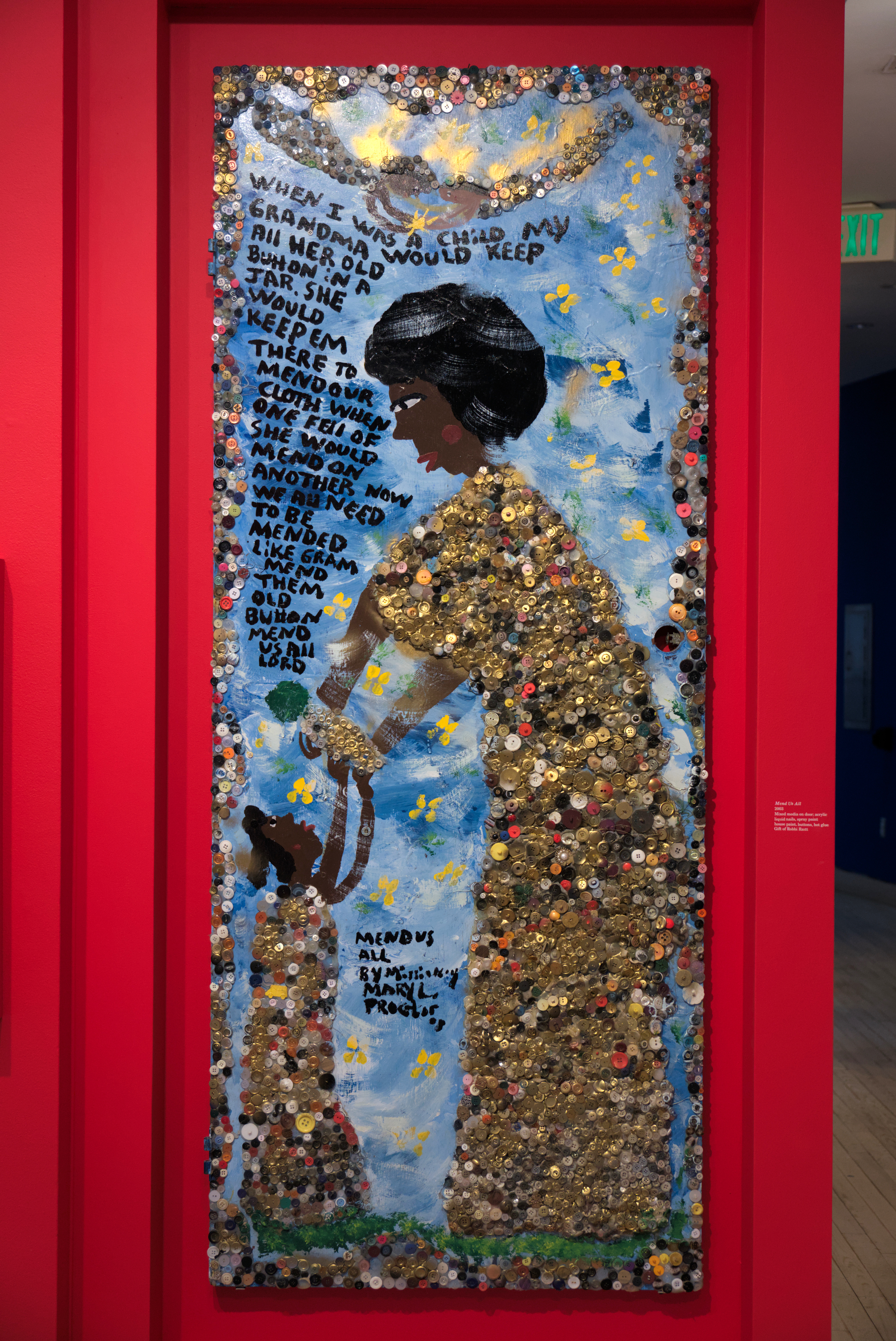
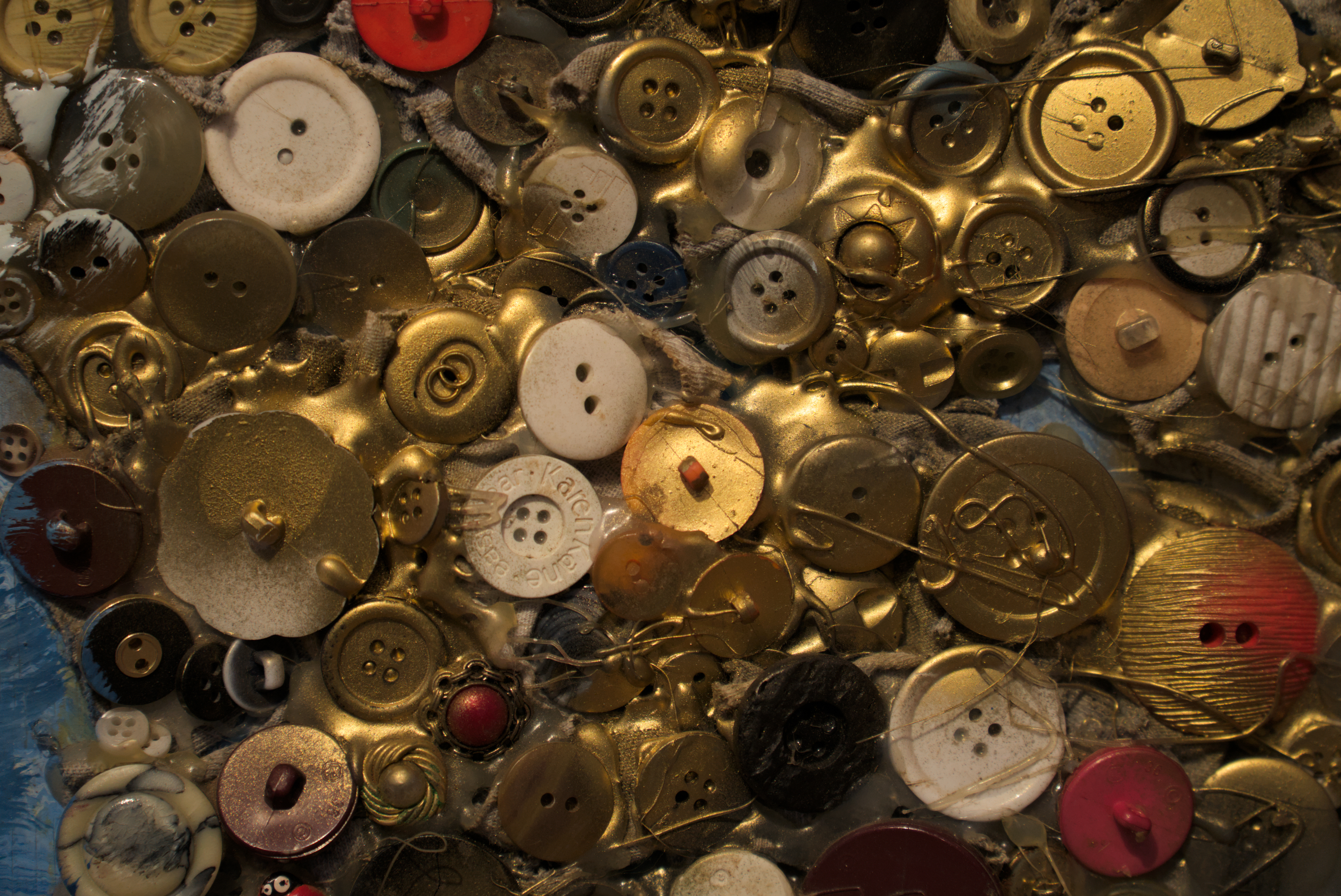
For her, the reclamation of cast-off things reflects God’s redeeming work in our own lives—how he rescues, restores, mends. This work of mending was also modeled by her grandma, who, rather than throwing out old clothes with missing buttons or tears, would lovingly fix them up. “When I was a child,” Proctor reminisces, “my grandma would keep all her old button[s] in a jar. She would keep em there to mend our cloth. When one fell of[f] she would mend on another. Now we all need to be mended like Gram mend them old button[s]. Mend us all, Lord. Mend us all.” Two doors tell this story, showing Gram handing a young Proctor a mended garment or a jar of buttons, the two figures themselves constituted of buttons. In the wispy blue background, angels shower yellow flower petals over the scene, a rain of mercy.
Mend Us All
Mary L. Proctor (American, 1960–), Mend Us All, 2003. Acrylic, liquid nails, spray paint, house paint, buttons, and hot glue on door. American Visionary Art Museum, Baltimore.

Buttons detail
The Story of Grandma Old Buttons
Mary L. Proctor (American, 1960–), The Story of Grandma’s Old Buttons, n.d. House paint, acrylic, buttons, liquid nails, mason jar, and hot glue on door. American Visionary Art Museum, Baltimore.

The Story of Grandma Old Buttons (detail)

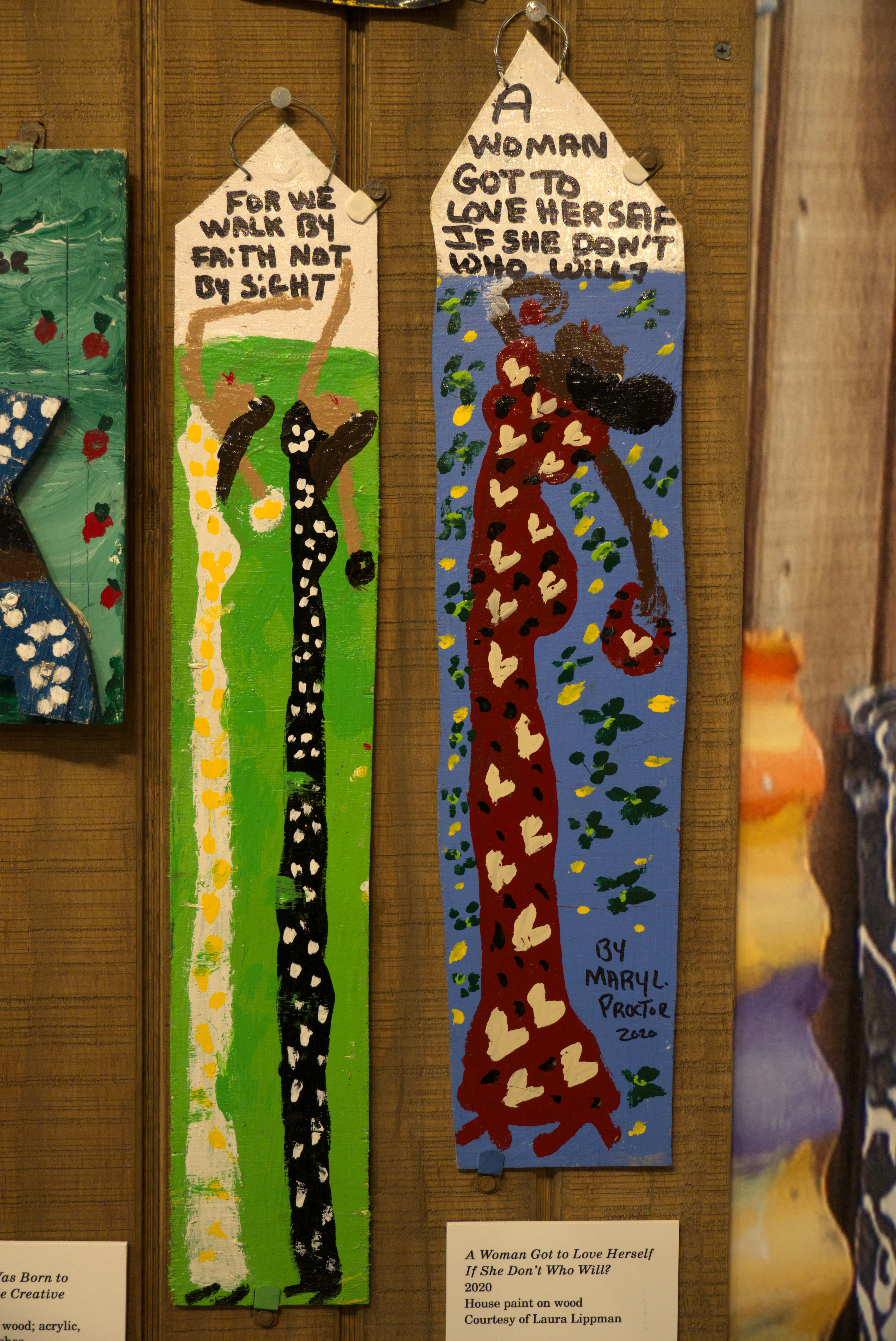
Black women are Proctor’s most frequently depicted subject, whether herself, specific relatives, or more generic women. Her most iconic image type, which exists in many variations, is of a Black woman looking and reaching up, signifying trust in God. For these, she often cuts her substrate into a narrow vertical orientation, emphasizing the seeking of things above, a stretching toward the heavens. Her husband calls her paintings in this format “slims.” Two such slims counsel women to walk by faith, per 2 Corinthians 5:7, and to practice self-love.
Slims

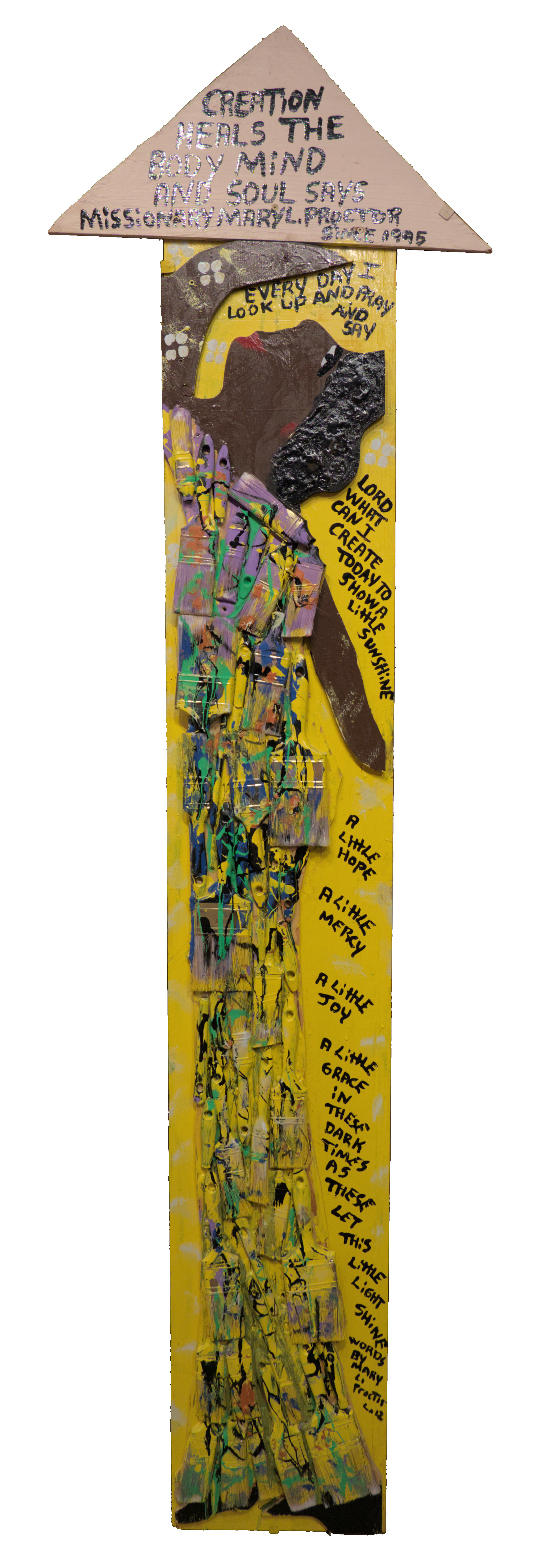
Another, much larger slim, approximately life-size, insists on the salubrious impact of art making. “Creation heals the body, mind, and soul,” it reads. “Every day I look up and pray and say, ‘Lord, what can I create today to show a little sunshine, a little hope, a little mercy, a little joy, a little grace.’ In these dark times as these, let this little light shine”—the latter phrase a reference to Jesus’s Sermon on the Mount (see Matt. 5:14–16). Lit by the Spirit, by whose power she shares the gospel, Proctor prays that her art will benefit not only herself but all those who encounter it.
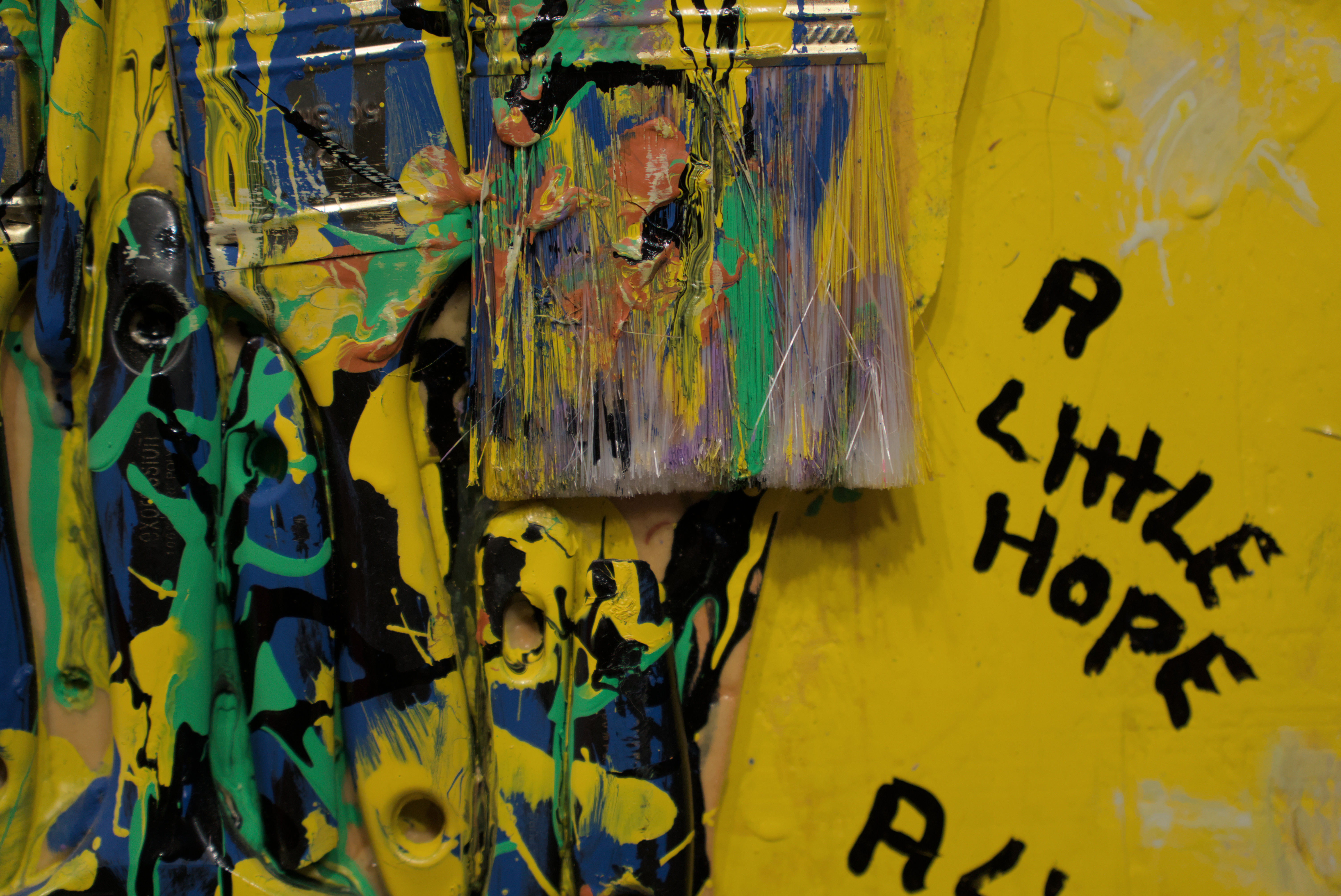
Creation Heals the Body, Mind, and Soul
Mary L. Proctor (American, 1960–), Creation Heals the Body, Mind, and Soul, 2012. Paintbrushes, house paint, and liquid nails on door. Courtesy of Drs. Dahlia Hirsch and Barry Wohl.

Detail

When she makes art, she says, she feels free, like a butterfly.
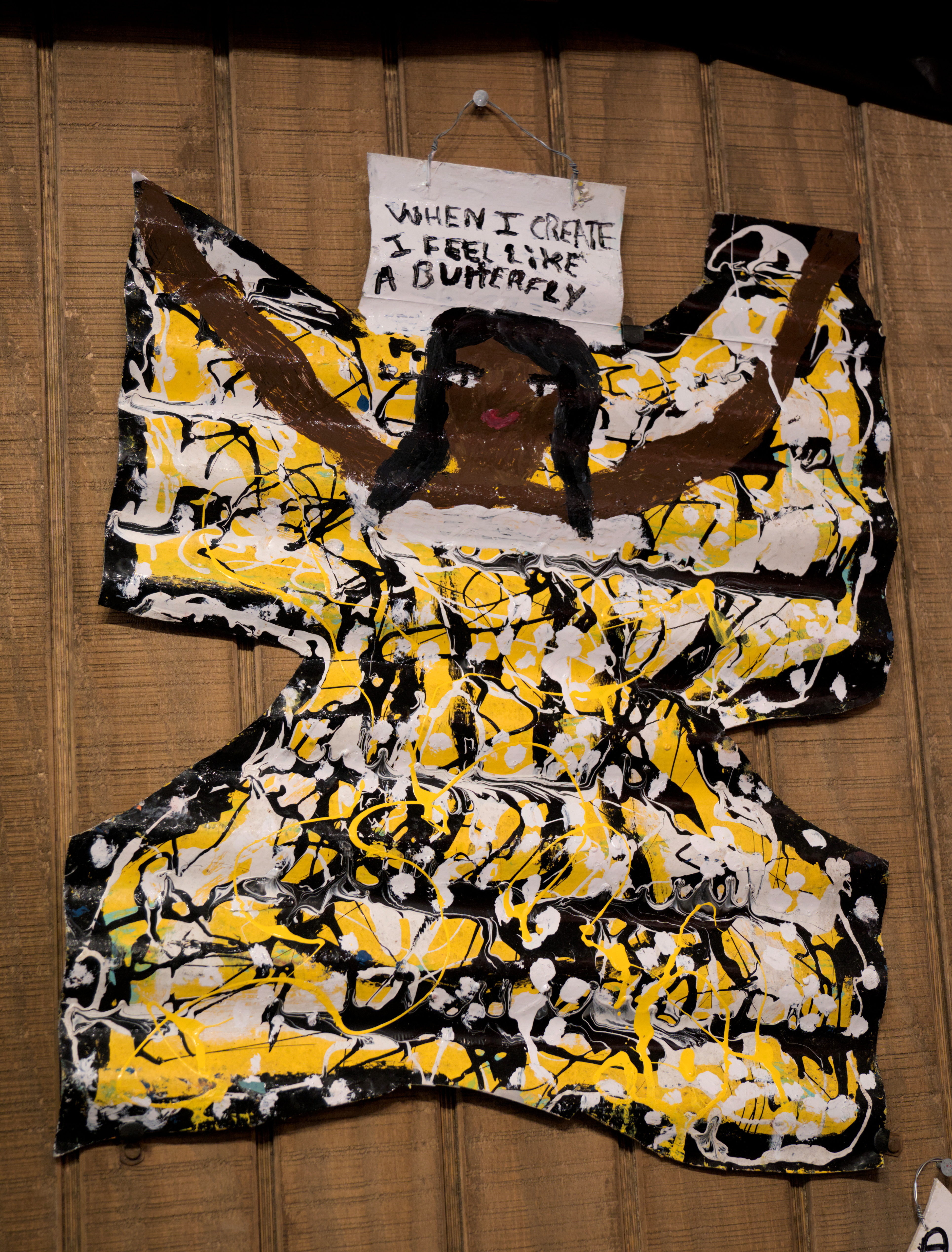
Butterfly

It’s a feeling that’s well captured in It’s a Woman’s World, an unironically titled painting that revels in the abundant life Jesus came to give both sexes (John 10:10), all us descendants of Adam and Eve. The painting shows four Black women in beaded jumpers leaping impossibly wide in the air, their arms outstretched, hearts floating.
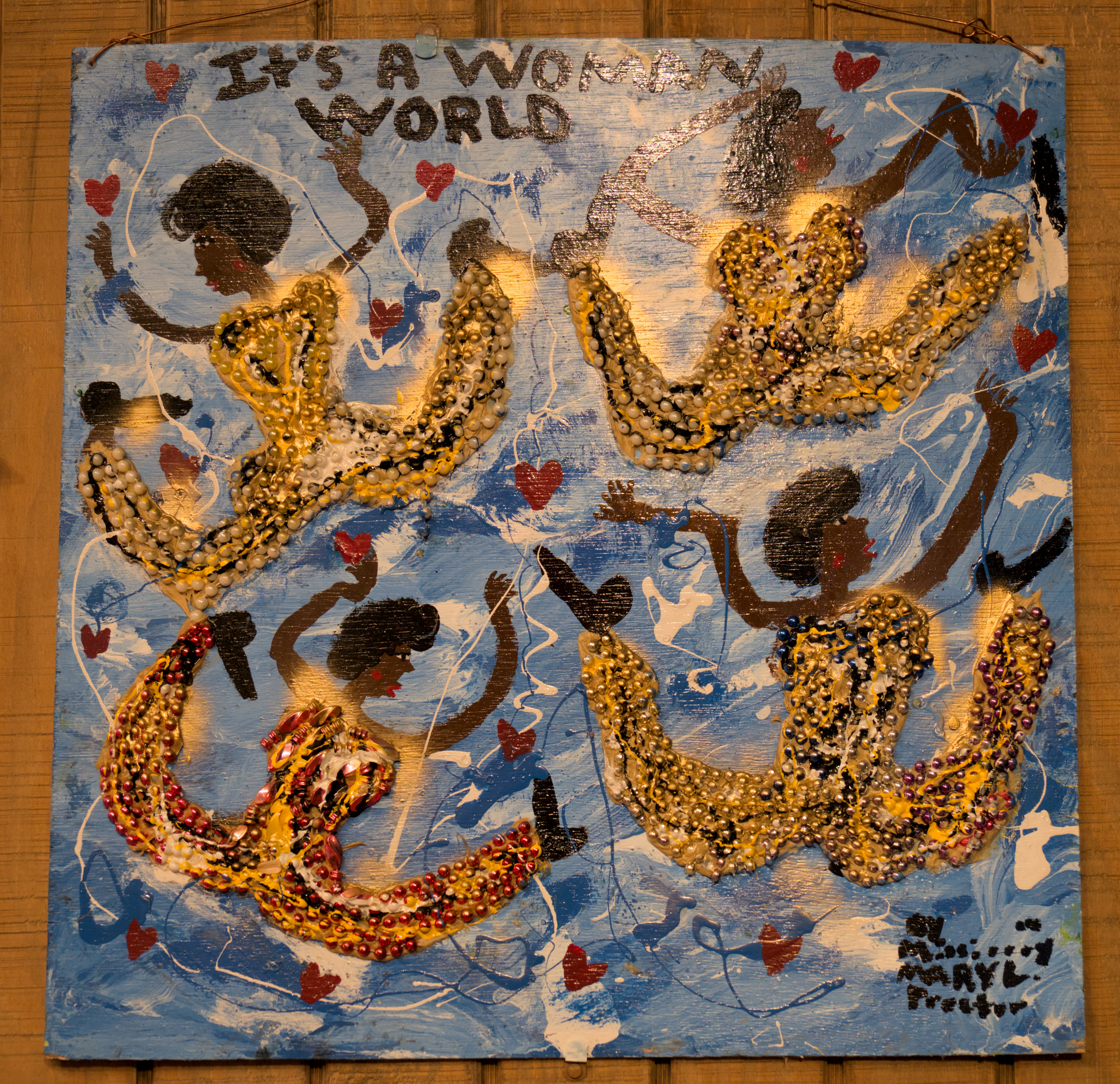
It's a Woman's World
Mary L. Proctor (American, 1960–), It’s a Woman’s World, n.d. Acrylic, spray paint, and beads on Masonite panel. American Visionary Art Museum, Baltimore.

In the article “From Zora Neale to Missionary Mary: Womanist Aesthetics of Faith and Freedom,”Ada C. M. Thomas identifies the womanist (Black feminist) theology expressed in Proctor’s art, which “celebrates Black women as bold, audacious, and determined to embrace their lived experiences”; her figures “embody a prideful yet humbled aesthetic. They are self-possessed and possessed by an intimate, activist faith. The women’s eyes are frequently cast upwards in hopefulness and anticipation.”

Indeed, Proctor considers it part of her mission “to get a message out to broken womens [sic], a message to help and glorify them,” she says. “I’m going to get a message out so men can search their hearts, learn to respect us and treat us the right way.”

She believes everyone is a child of God, and she wants her art to connect people to the hope, peace, joy, and love that’s accessible through him. She calls herself a missionary, often using that title in signatures of her name. “The Lord spoke, and he said, ‘You are on a mission to get a great message out into the houses and hearts,’” she testifies.

(Related post: “The Biblical Imagination of Folk Sculptor Annie Hooper”)

In Look and See the Angel Is You, by using a mirror as the face of the holy figure, Proctor preaches the imago Dei (image of God) in every person, encouraging viewers to recognize their inherent dignity and worth, imbued in them by their Creator.
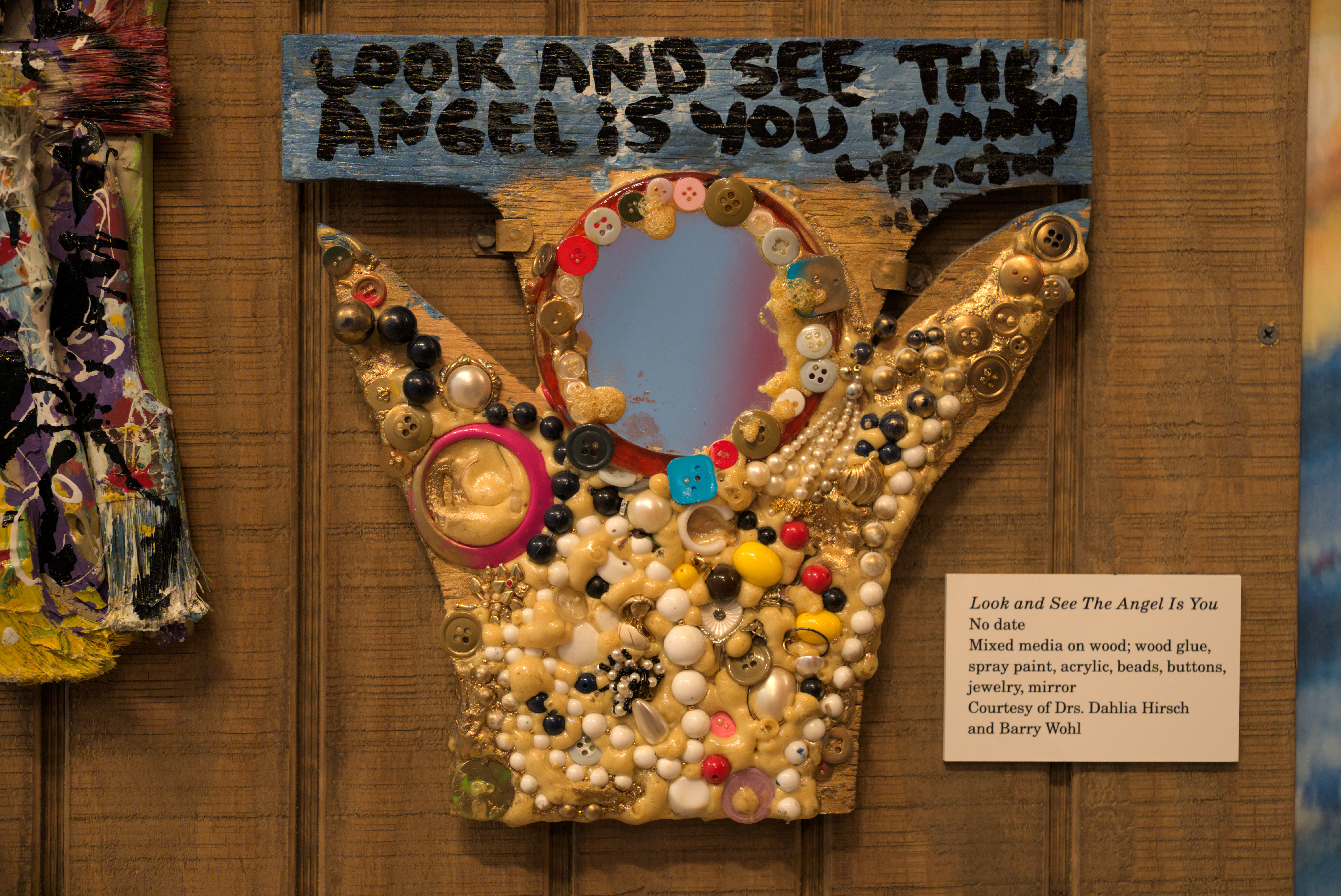
Look and See the Angel Is You
Mary L. Proctor (American, 1960–), Look and See the Angel Is You, n.d. Wood glue, spray paint, acrylic, beads, buttons, jewelry, and mirror on wood. Courtesy of Drs. Dahlia Hirsch and Barry Wohl.

In Every Child Was Born to Rise Up and Be Creative, she echoes the cultural mandate God gave to humans in the garden of Eden: to develop and rearrange the raw materials of creation for the flourishing of all. While not everyone is called to be an artist, we are all called to create.
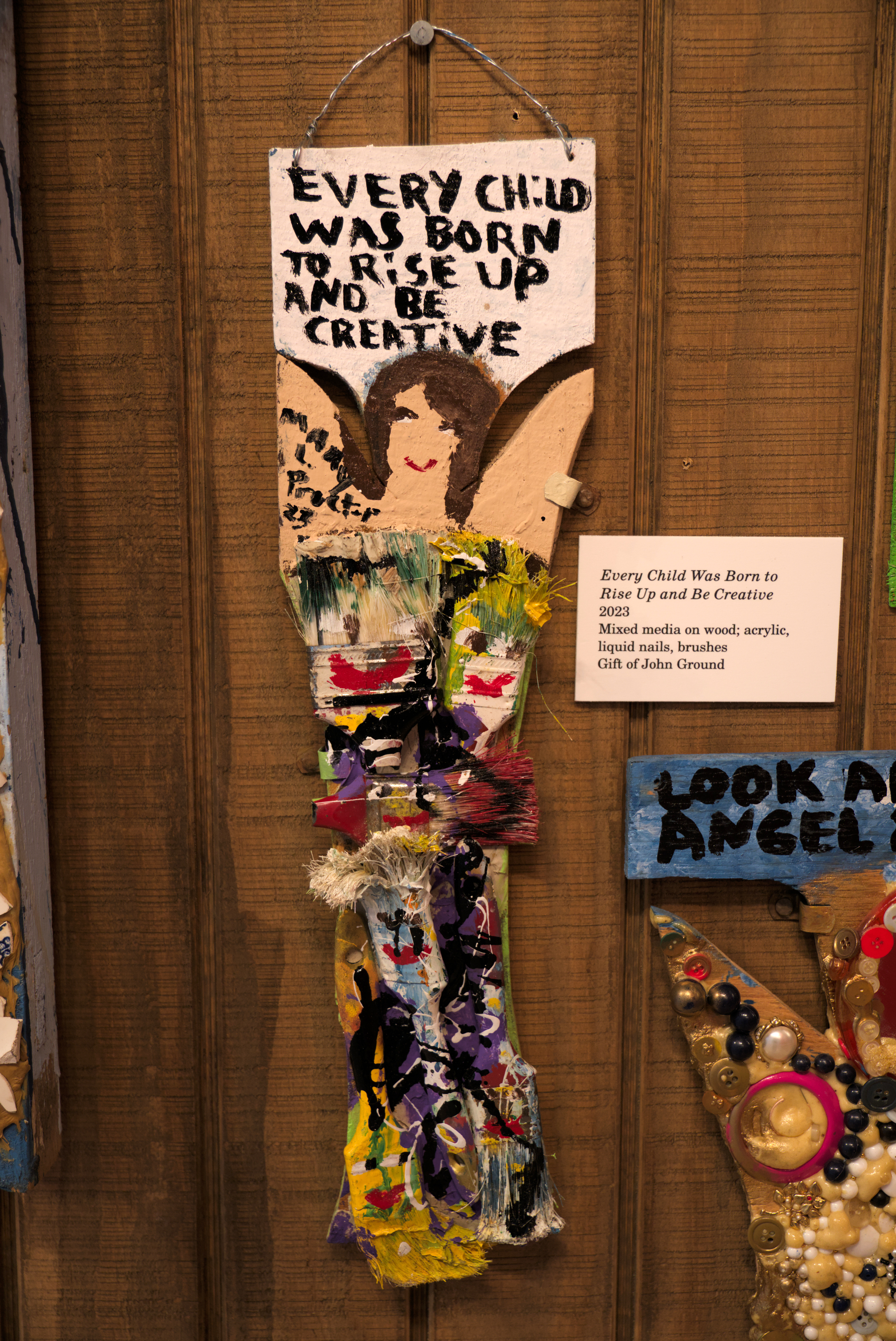
Every Child Was Born to Rise Up and Be Creative
Mary L. Proctor (American, 1960–), Every Child Was Born to Rise Up and Be Creative, 2023. Acrylic, liquid nails, and paintbrushes on wood. American Visionary Art Museum, Baltimore.

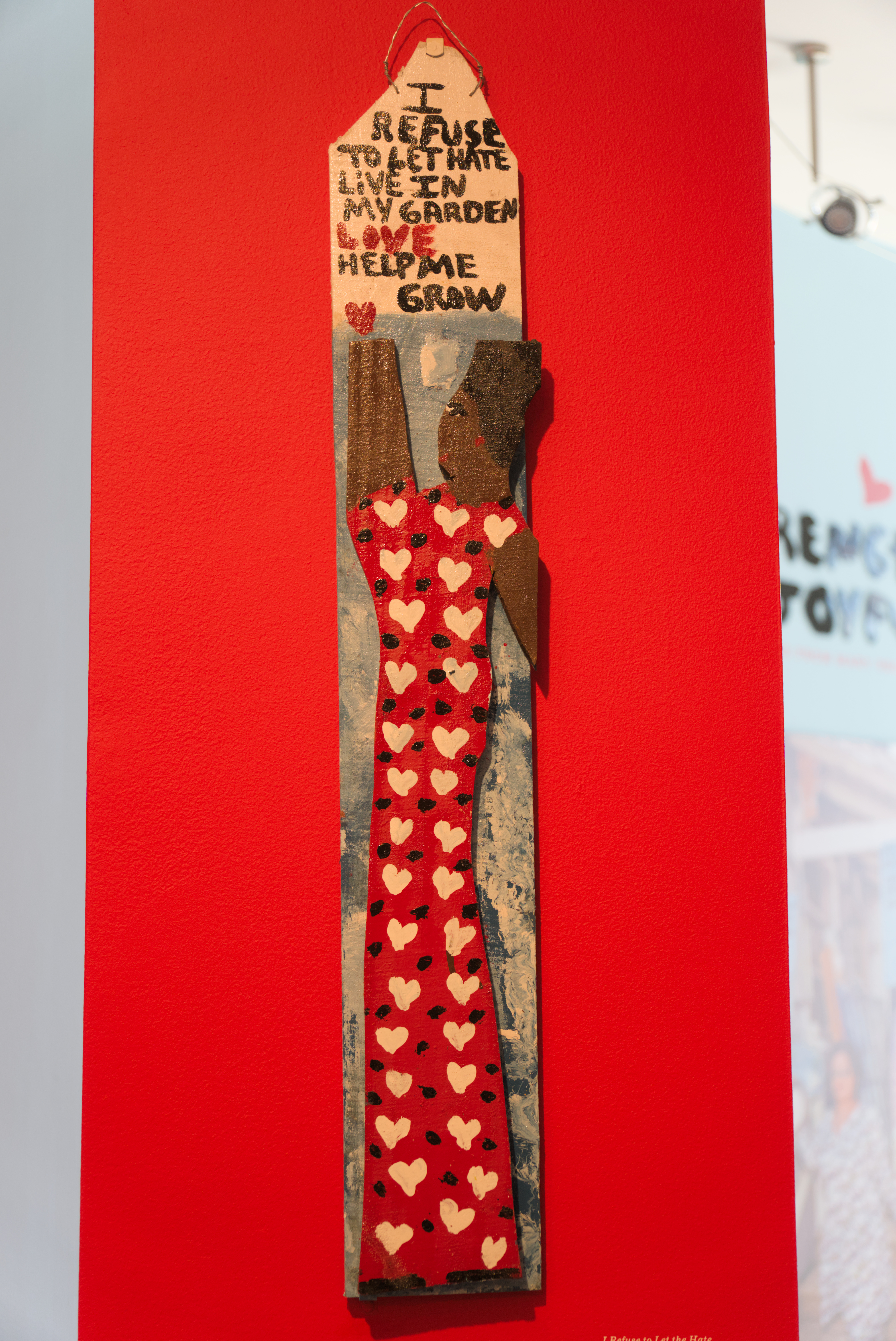
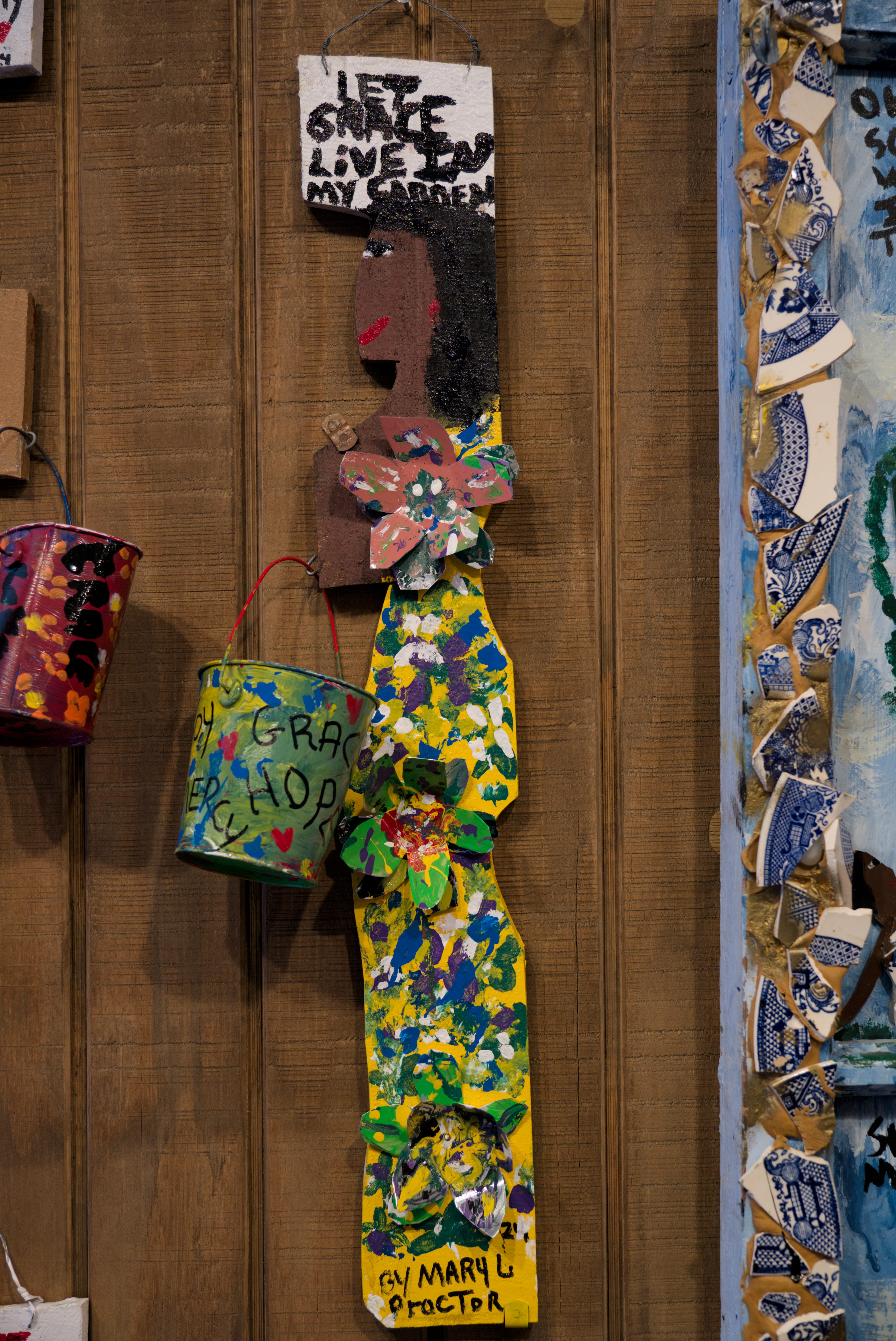
We ought also to cultivate our own selves. Proctor often uses the metaphor—popular in the Middle Ages—of the soul as a garden in which we grow “flowers” of virtue. For example, a series of wood cutouts portrays women holding pails, with signs like “Let love live in my garden” and “Let grace live in my garden.” Another declares and beseeches, “I refuse to let hate live in my garden. Love, help me grow.”
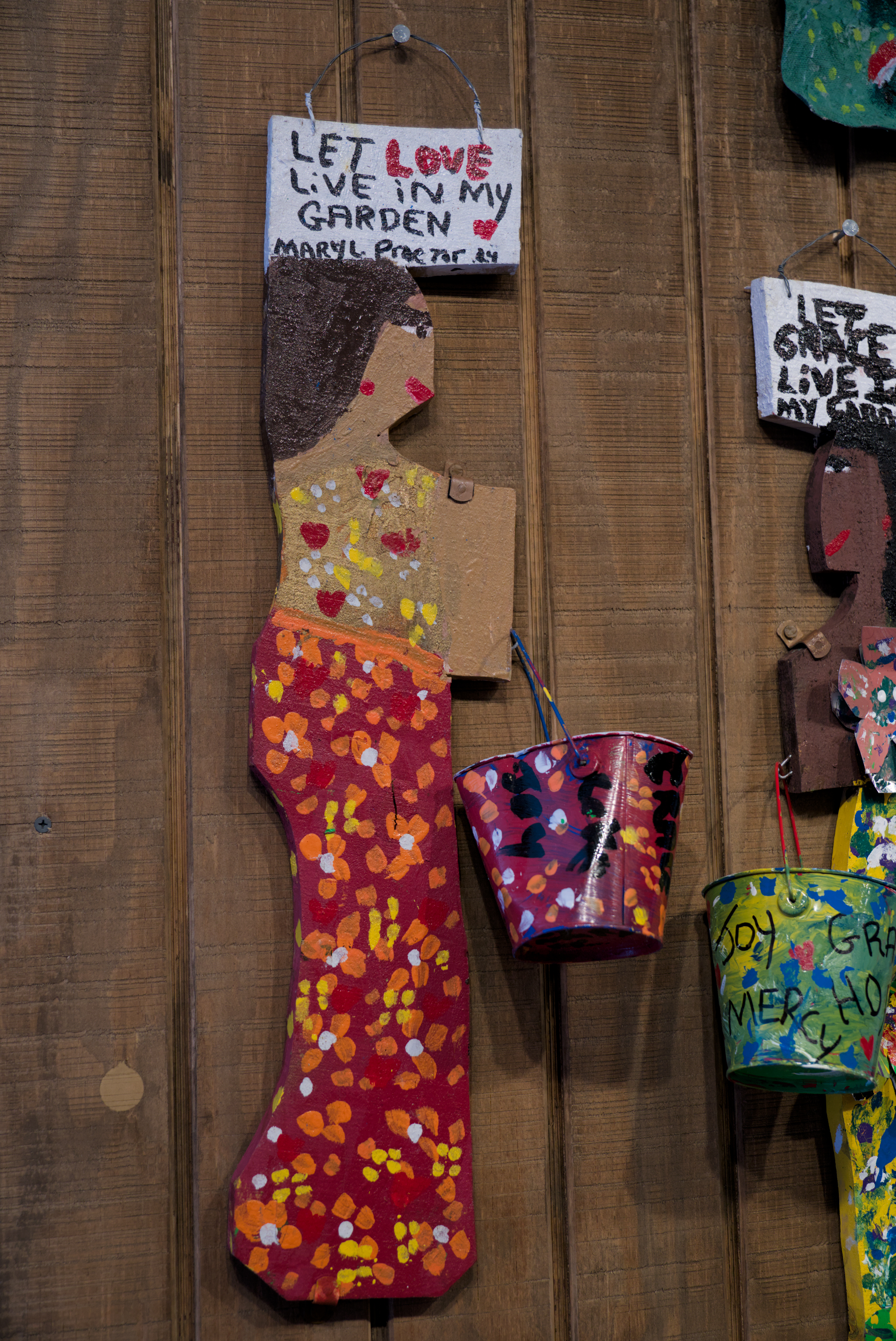
"Let love live in my garden"
"Let grace live in my garden"
I Refuse to Let the Hate Live in My Garden
Mary L. Proctor (American, 1960–), I Refuse to Let the Hate Live in My Garden, 2022. Acrylic on cut wood. American Visionary Art Museum, Baltimore.

Besides vows and petitions, Proctor’s art also contains testimonies. In the Black church, testifying is a sacred tradition of sharing personal stories of survival, deliverance, and praise. Encouragement is a key component. One of Proctor’s painted testimonies reads, “It may seem dark at times, yet I hold on, I know the sun will shine.” She knows God will never forsake her, though he may occasionally seem absent.
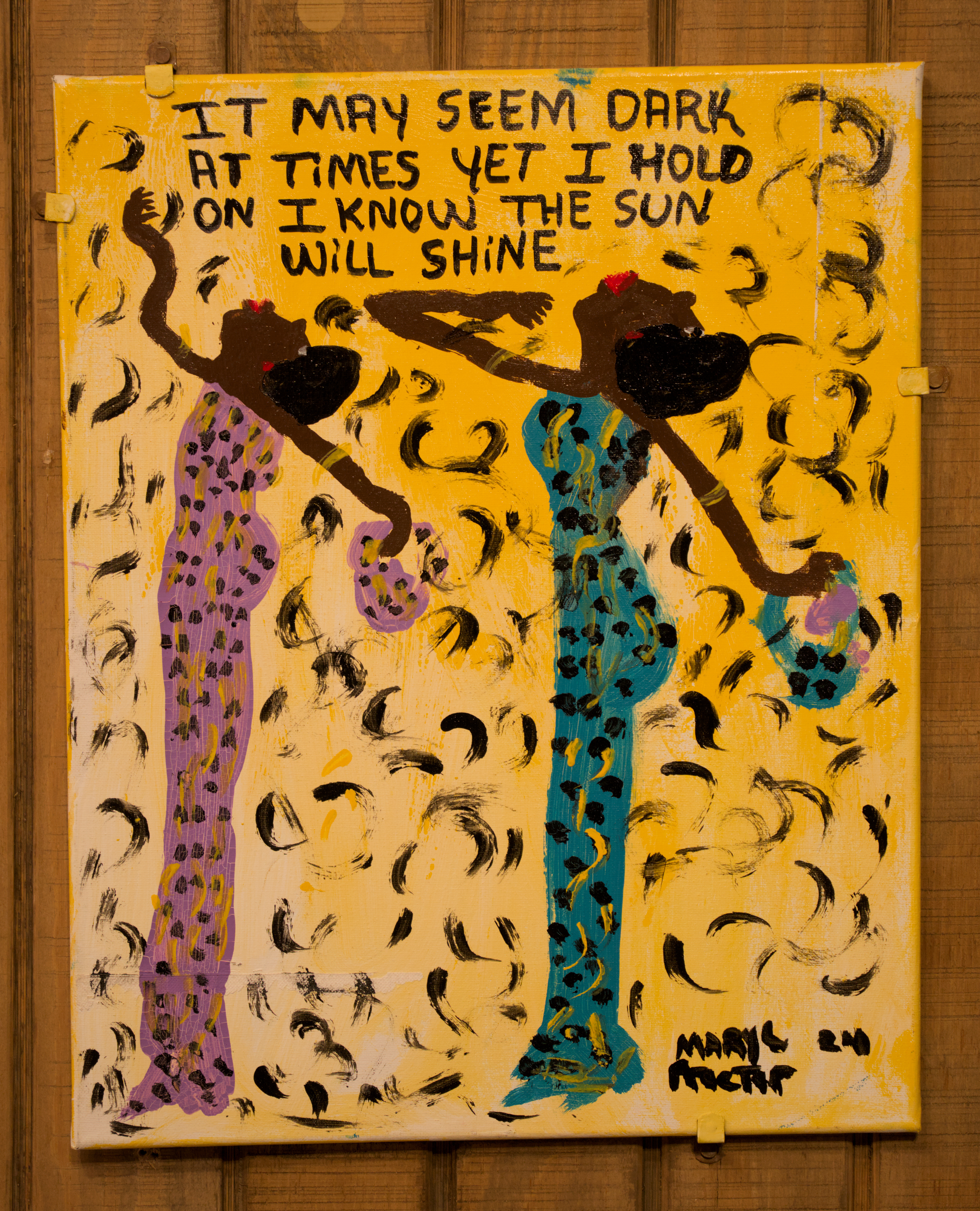
It May Seem Dark at Times

Other paintings by Proctor mark milestones in her spiritual journey, such as her baptism in Lloyd Creek in 1975 at age fifteen. One such painting references the African American spiritual “Down by the Riverside,” its refrain about relinquishing hatred and violence—“Ain’t gonna study war no more”—taken from Isaiah 2:4 and Micah 4:3. Members of her Missionary Baptist church community gather round, dressed in white and golden robes. At the bottom center, two elders raise up Proctor’s arms as she emerges from the baptismal waters, cleansed and reborn.
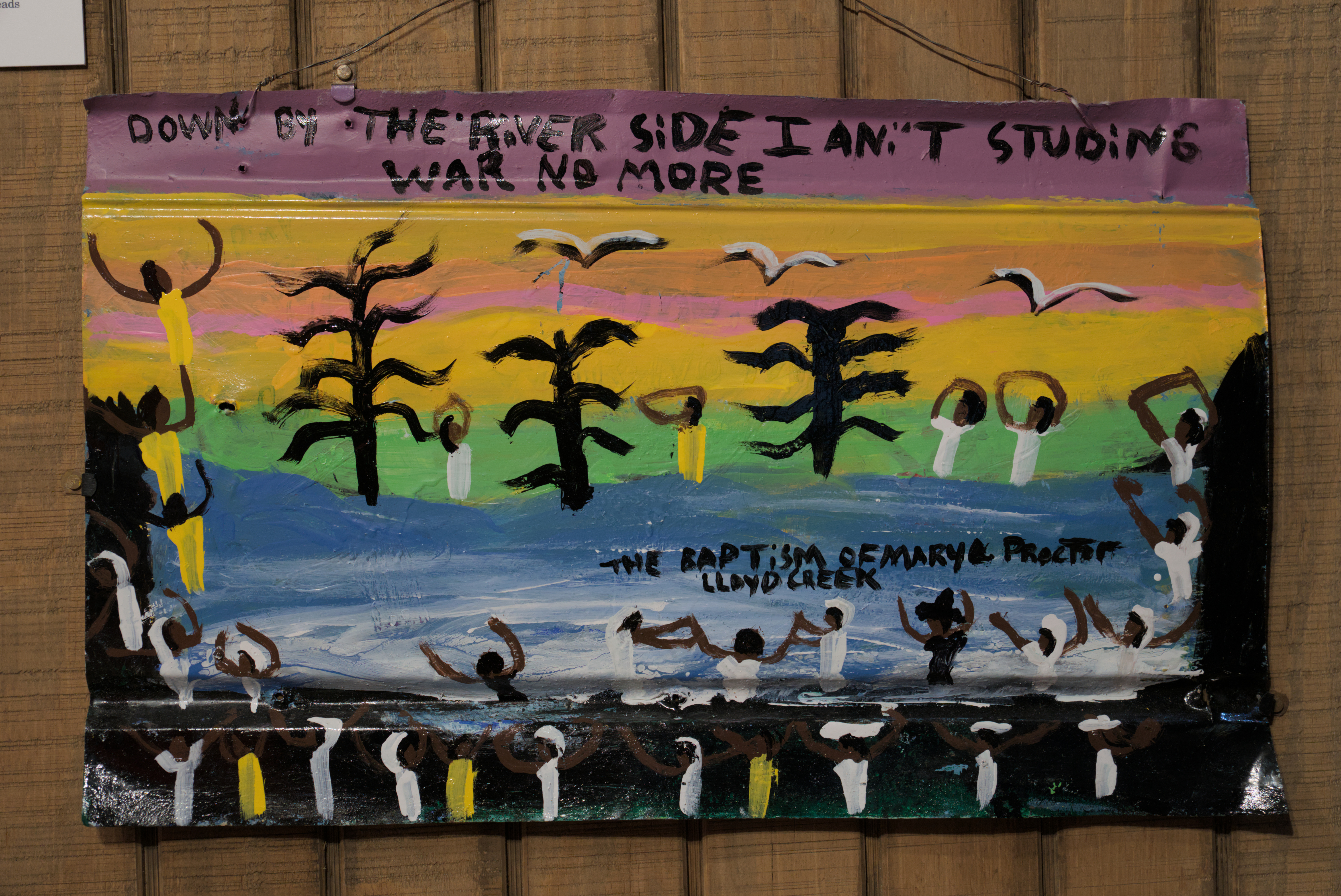
Baptism at Lloyd Creek

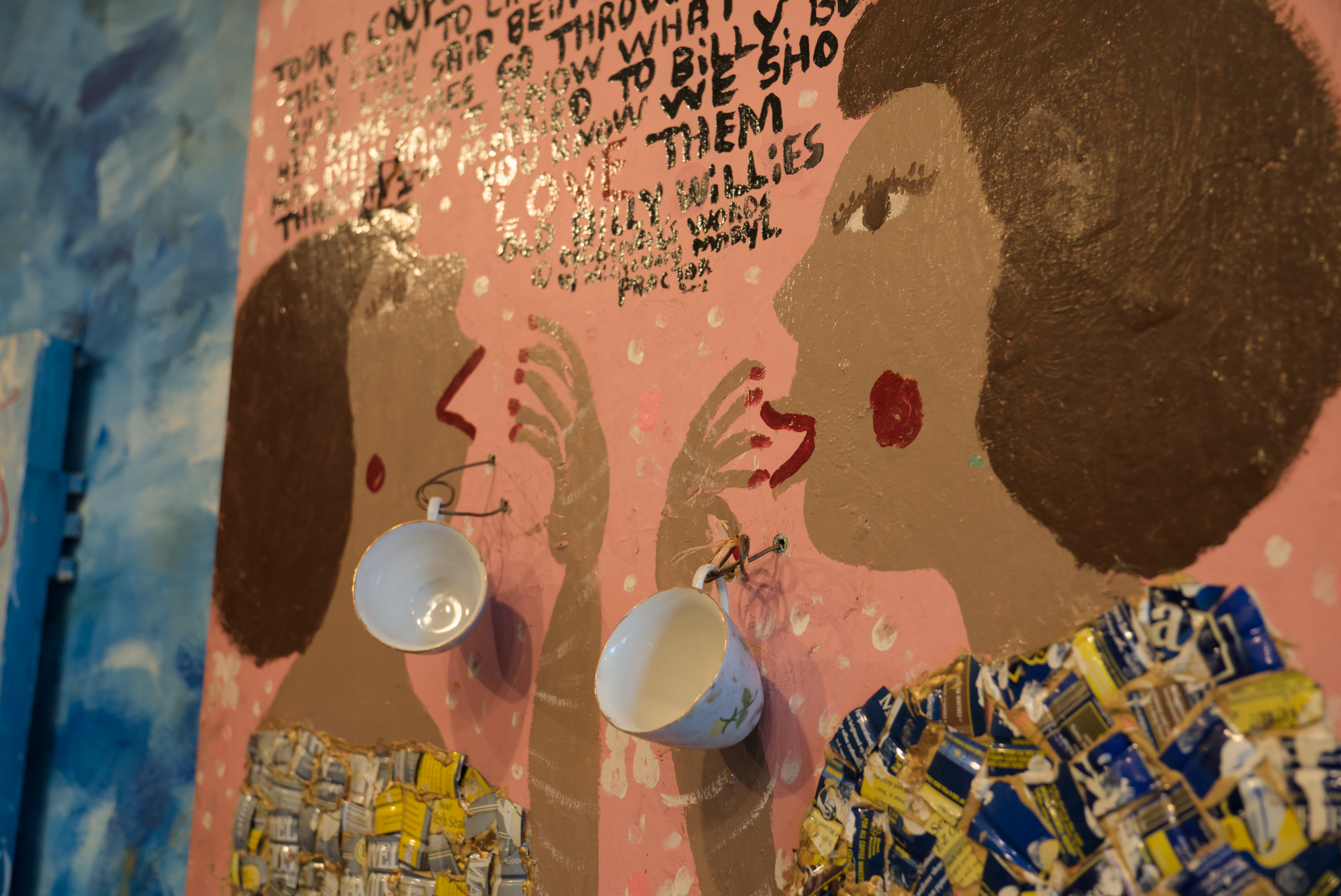
Several pieces highlight Proctor’s whimsical sense of humor. It Ain’t Over Till the Fat Lady Sings God Bless America, a patriotic adaptation of a well-worn idiom, made me laugh. So did the adjacent painting, The Story of the Two Maxwell House Friends Mrs. Lilly and Mrs. Dilly, married to Willie and Billy; the women, Proctor narrates, would meet in Philly, get chilly (and so sip their coffee), and giggle about matters silly. Proctor affixed two teacups to the wood, giving the work three-dimensionality.
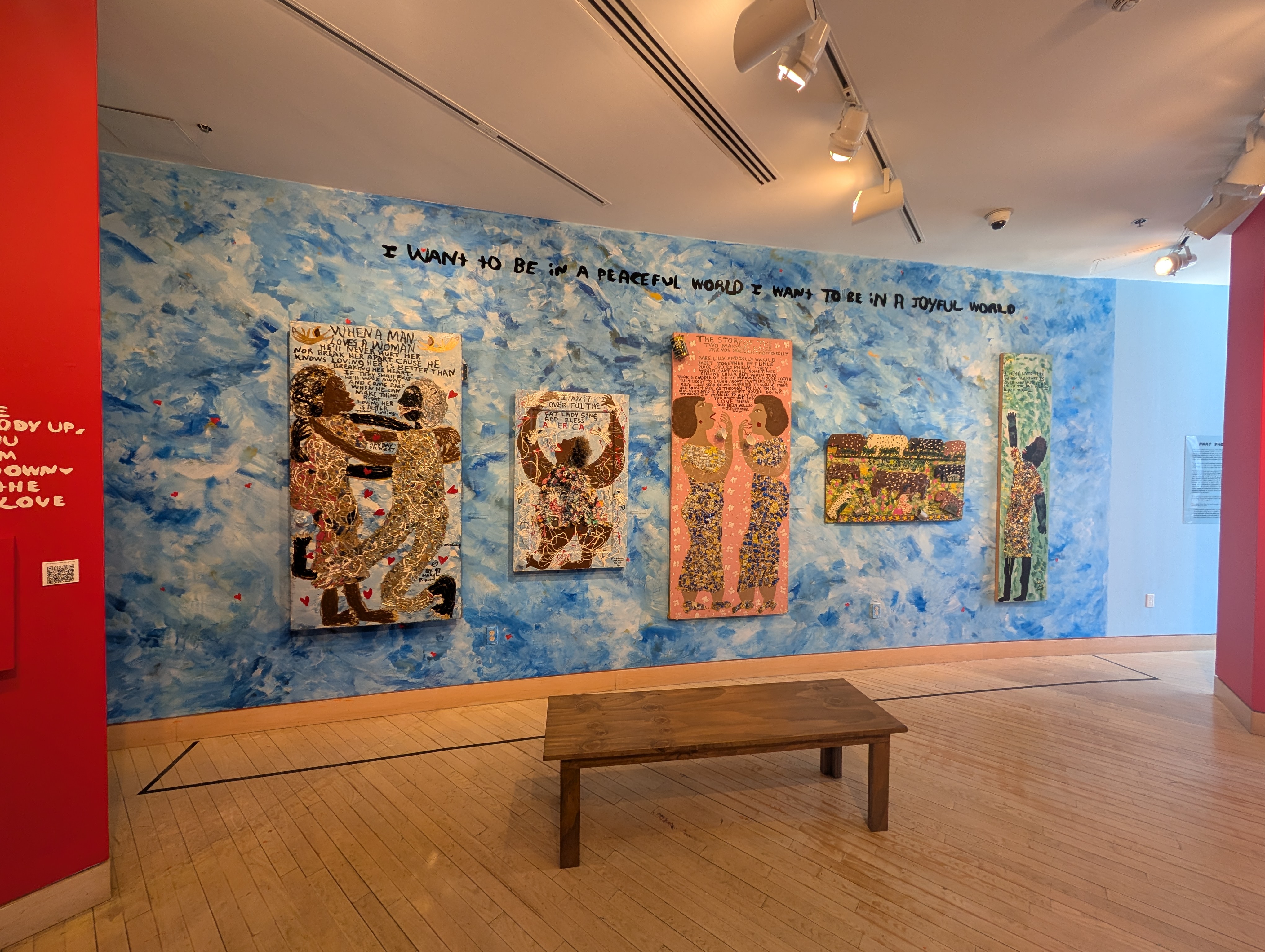
Exhibition view, The Strength to Be Joyful
From left to right: When a Man Loves a Woman, 1997; It Ain’t Over Till the Fat Lady Sings God Bless America, 1996; The Story of Two Maxwell House Friends Mrs. Lilly and Mrs. Dilly, 1996; If the Cows Can Dance in Green Pastures, 2012; I Cry Unto Thee When My Heart Is Overwhelmed, 1995

Mrs. Lilly and Mrs. Dilly (detail)

A sense of delight infuses Proctor’s art. She’s attuned to the beauty of the ordinary, the sacramentality of the everyday. She identifies a spirit of joy and gratitude even in animal life. “Every day I pass the cows,” she writes in one painting. “In the sunshine or rain the cows dance. If the cows can dance in green pastures why can’t we?” Speckled and smiling, her cows bear signs that say “Enjoy life,” “Be content,” “It’s going to be fine.” Cattle are among those named as being part of the cosmic choir of creation in Psalm 148, praising the Lord—Proctor goes even further and imagines them dancing.
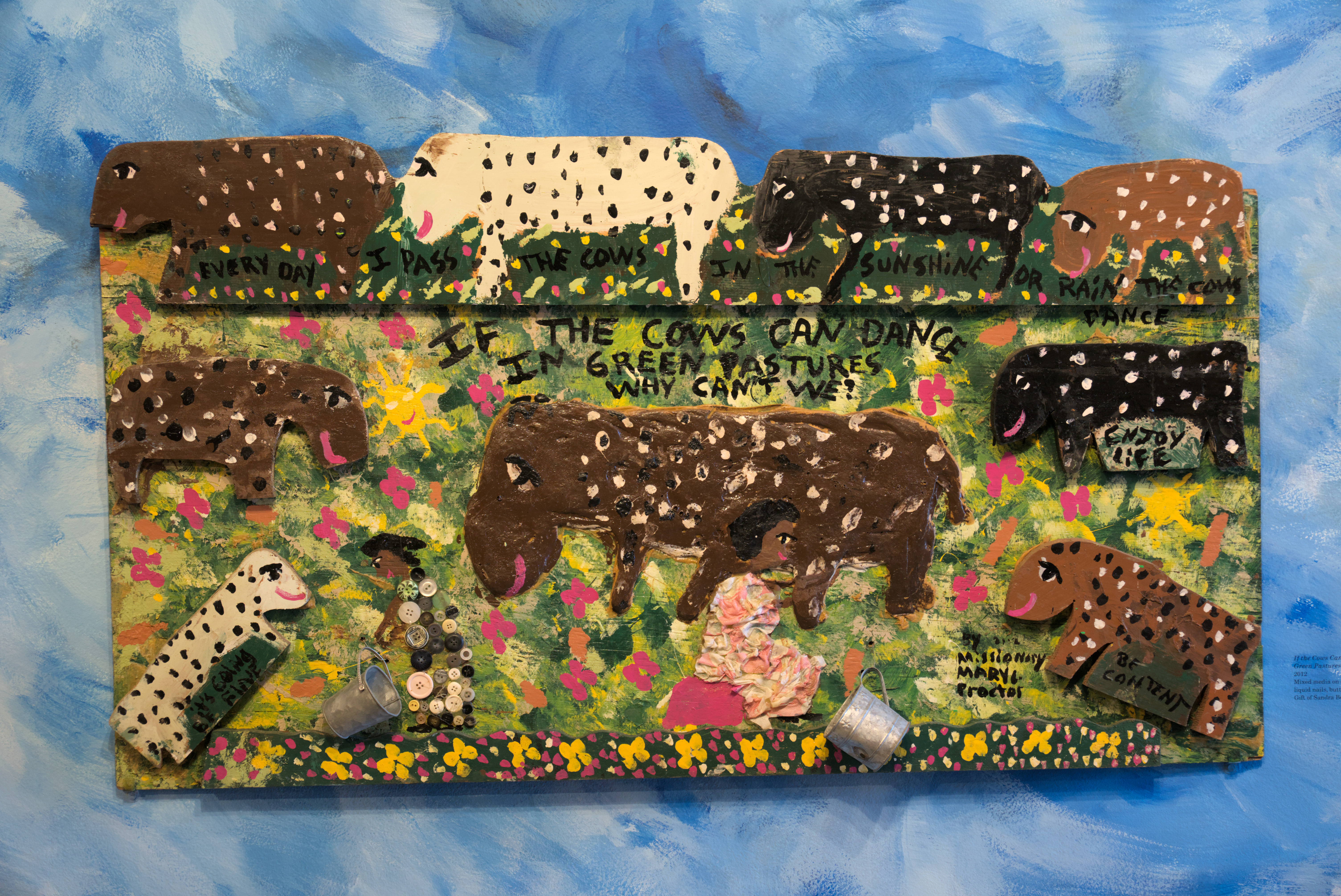
If Cows Can Dance in Green Pastures
Mary L. Proctor (American, 1960–), If the Cows Can Dance in Green Pastures, 2012. Acrylic, house paint, liquid nails, and buttons on door. American Visionary Art Museum, Baltimore.

In the hallway outside the exhibition gallery, it’s a trio of women who dance. The central painting shows Proctor’s signature upward-gazing gal, in a fringed dress, opening her hands to receive divine love, symbolized by the red hearts that angels pass down to earth in one long chain. “It’s the love of God that makes the world go round,” Proctor preaches. “Pass the love from above.”
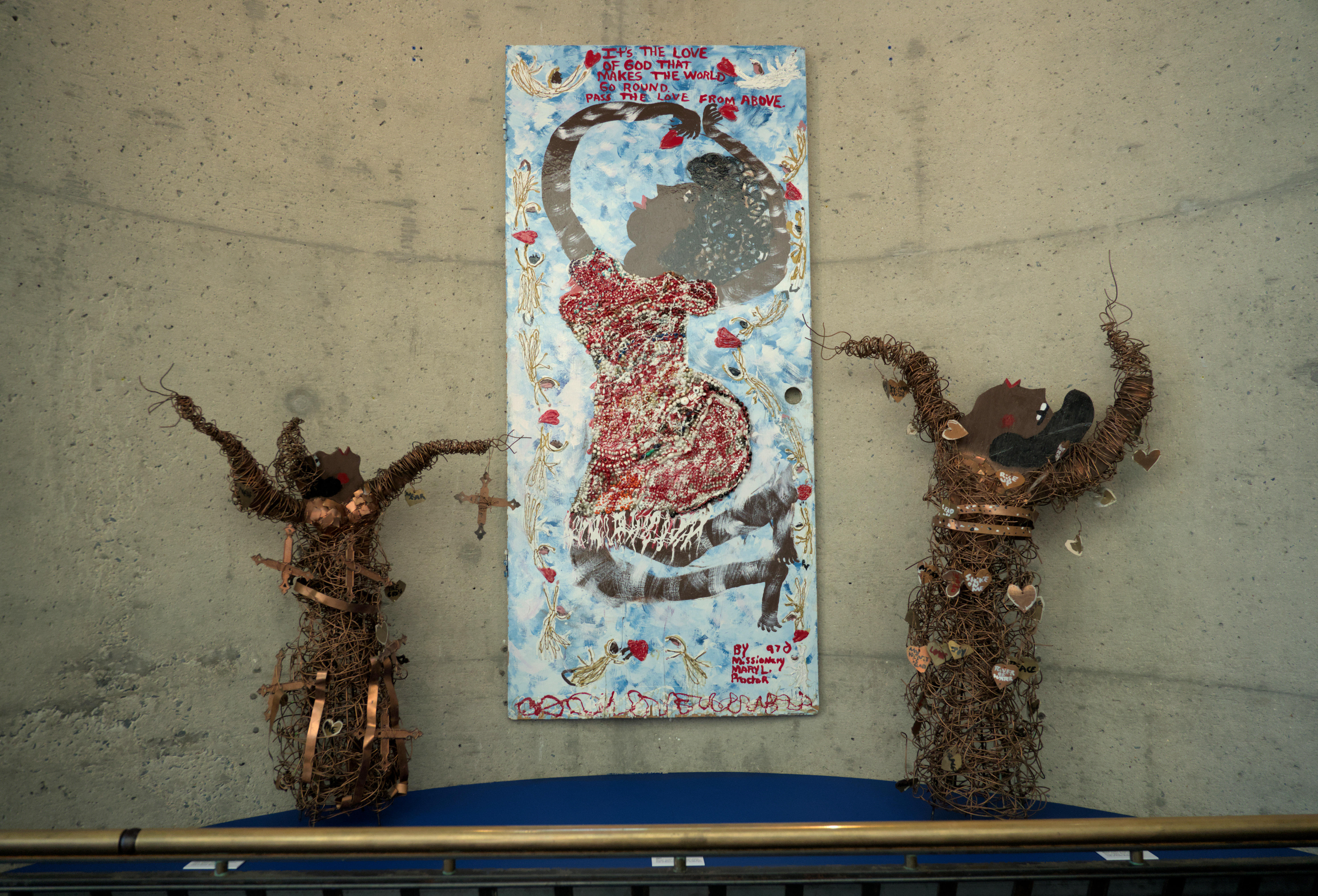
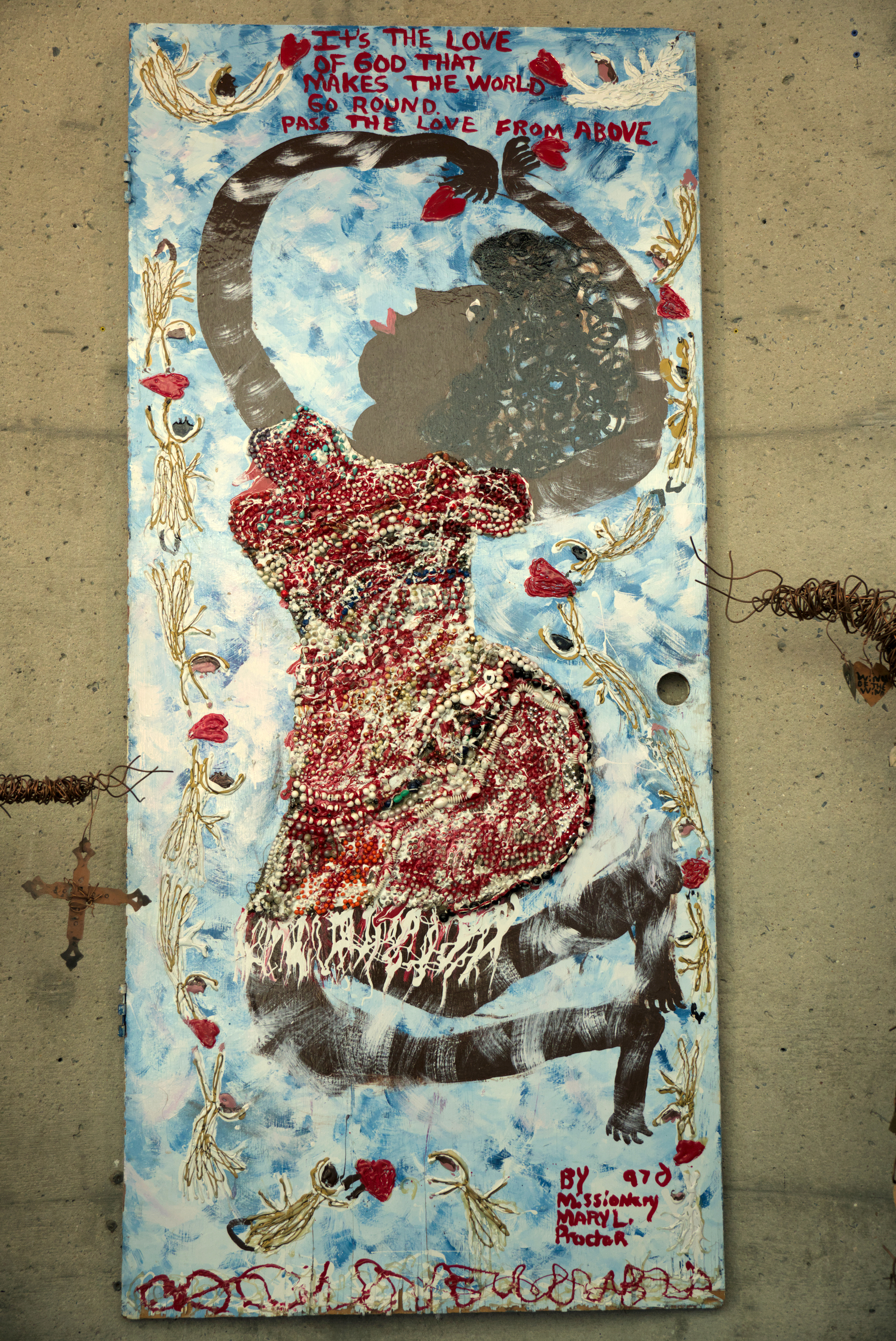
Love Makes the World Go Round
Mary L. Proctor (American, 1960–), Love Makes the World Go Round, 1997. House paint, acrylic, glass, ceramic, beads, and hot glue on wood. American Visionary Art Museum, Baltimore.

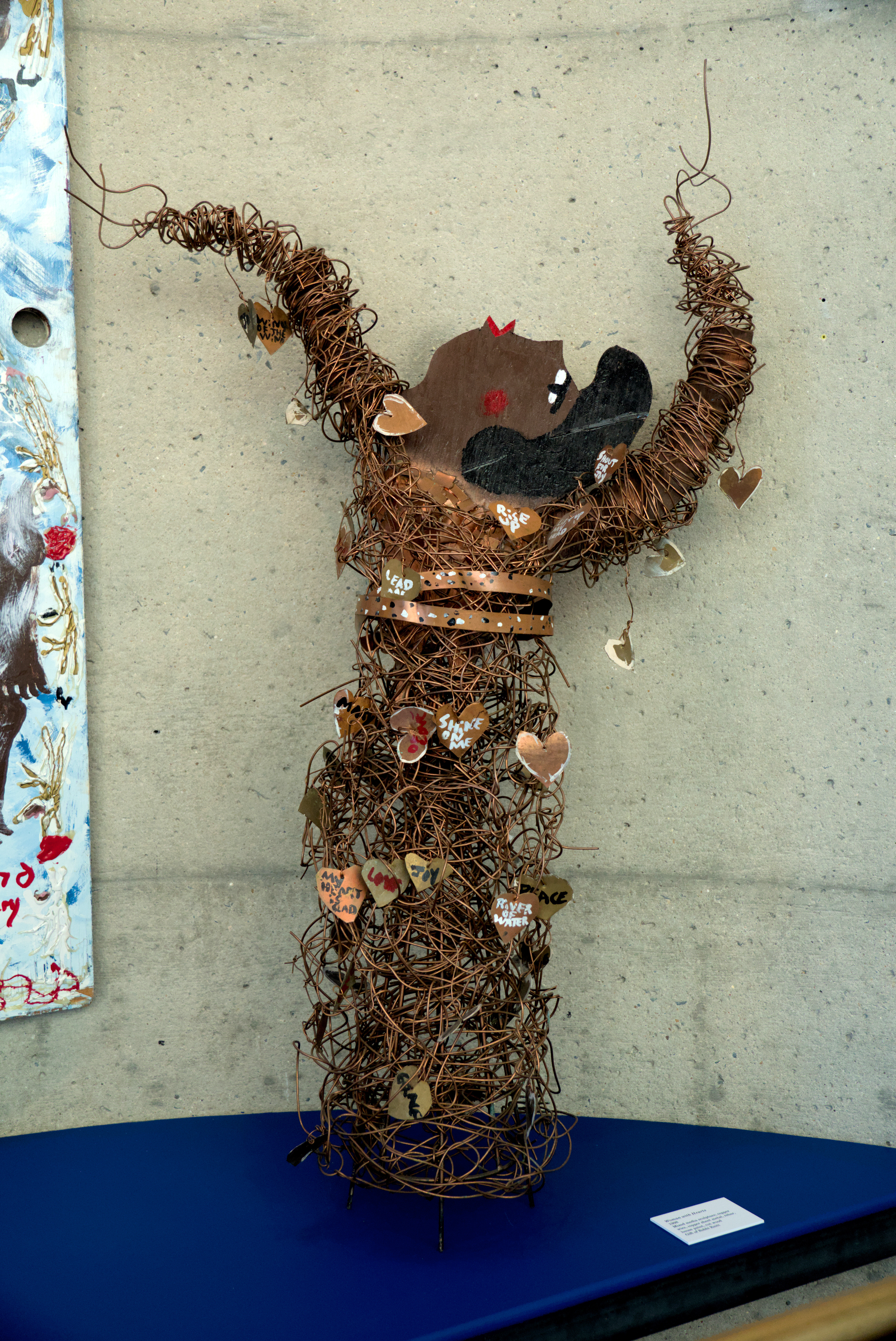
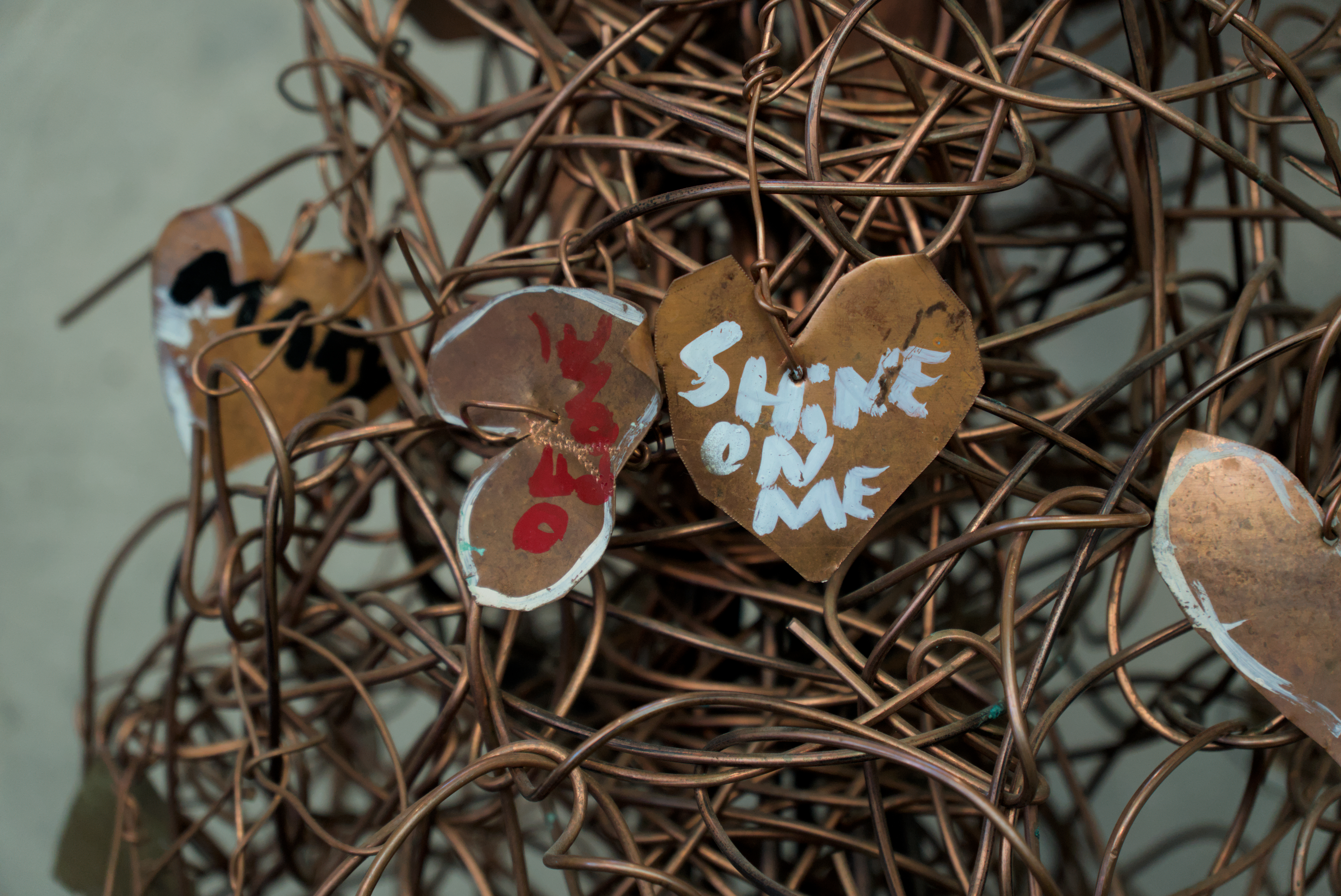
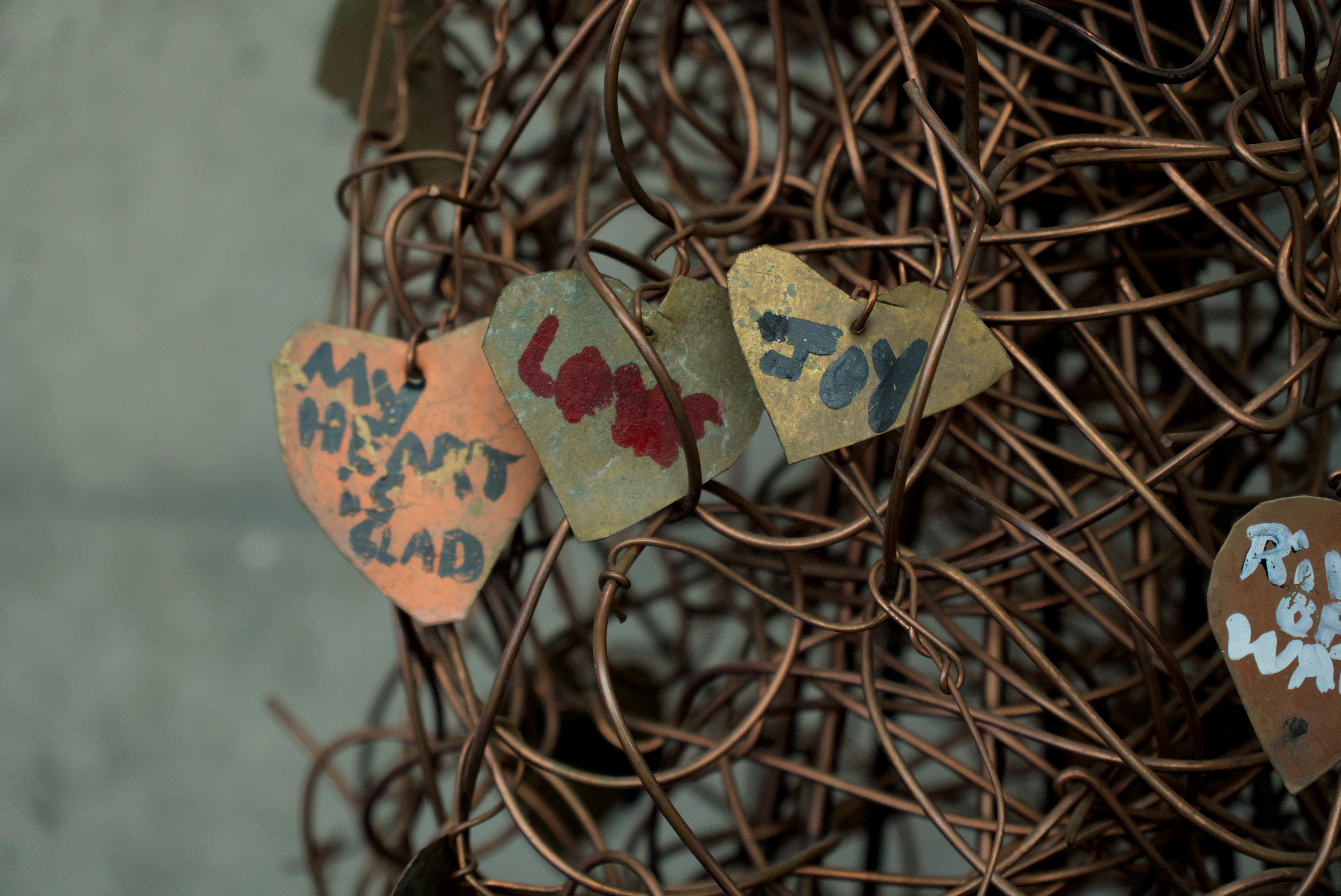
Flanking this painting are two wire sculptures of worshipping women who wear crosses and heart-shaped bangles inscribed with “Near the Cross” (the title of a popular hymn by Fanny Crosby) and psalmic phrases such as “Shout for joy,” “Rise up,” “Lead me,” “Shine on me,” and “My heart is glad.”
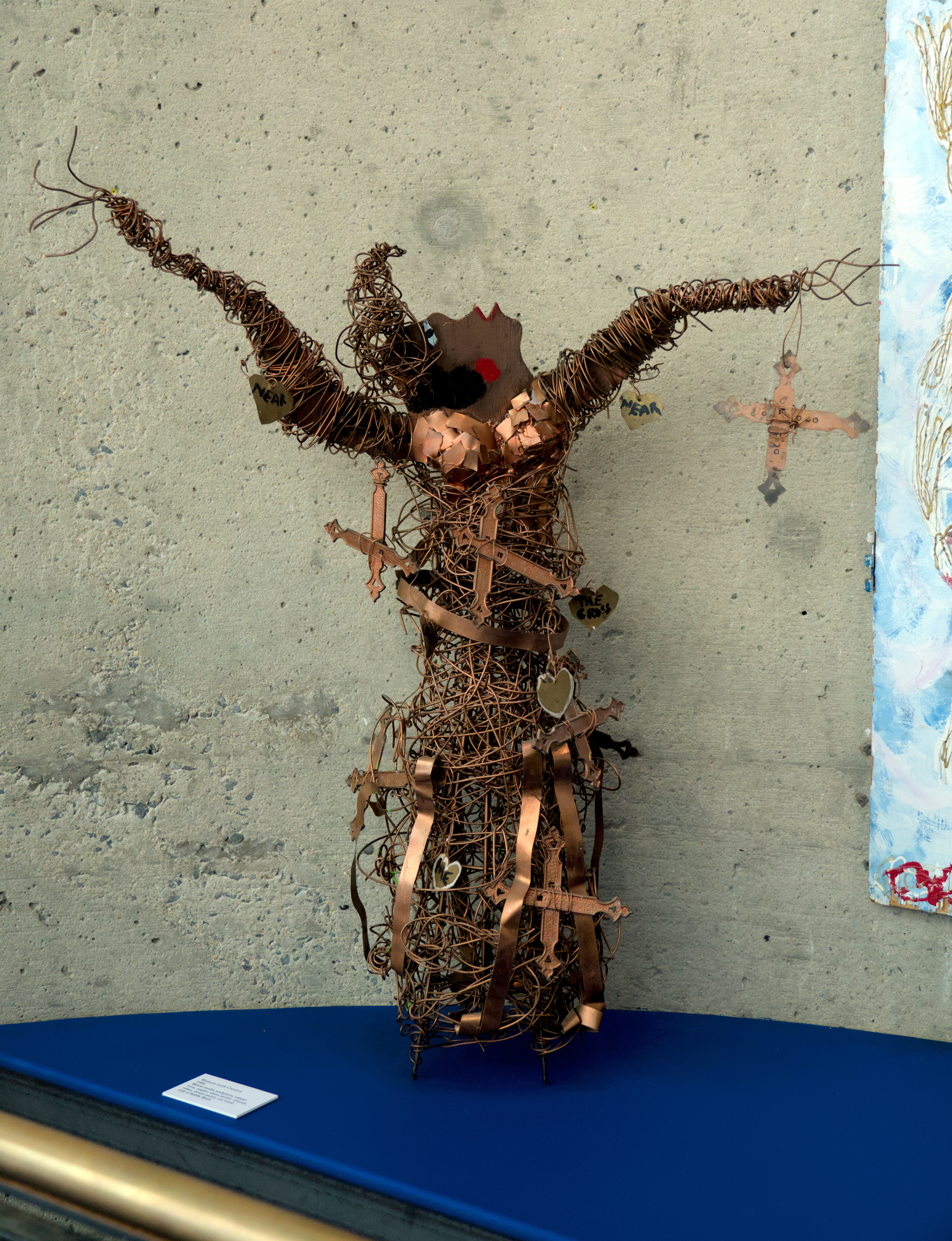
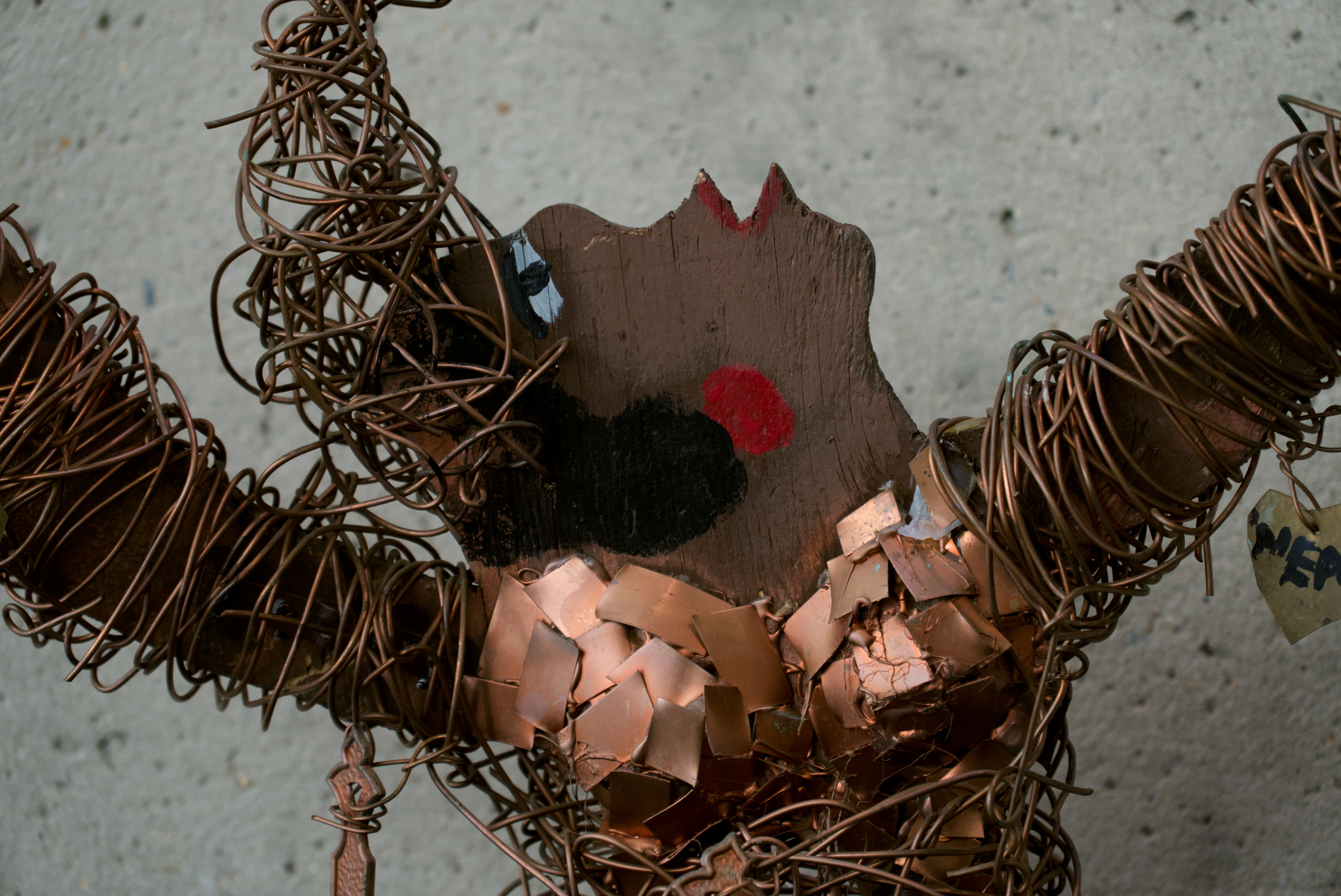
Woman with Crosses
Mary L. Proctor (American, 1960–), Woman with Crosses, 1998. Copper wire, copper sheet metal, crosses, rebar, house paint, and cut wood. American Visionary Art Museum, Baltimore.

Woman with Crosses (detail)
Woman with Hearts
Mary L. Proctor (American, 1960–), Woman with Hearts, 1998. Copper wire, copper sheet metal, rebar, house paint, and cut wood. American Visionary Art Museum, Baltimore.

Woman with Hearts (detail)

Proctor acknowledges that some may look at her art and see only messy pictures or rubbish. But paraphrasing the apostle Paul (1 Cor. 1:26–31), she says God uses foolish things—like scrap wood or twisted wire decorated with cheap paint and baubles—to confound the wise.

Shortly after getting married, Proctor moved to Tallahassee with her husband Tyrone, where they raised three sons and a daughter. They now live back in Lloyd but operate a small gallery in Tallahassee proper, where they sell Proctor’s work. Follow them on Instagram @marysvisions or on Facebook.

The Strength to Be Joyful: Messages from Mary Proctor runs through August 2, 2027, at the American Visionary Art Museum in Baltimore. Admission to the museum is $20.


Don’t miss two more works by Mary Proctor that are on display in the third-floor café, each titled Music Heals the Body, Mind, and Soul. Made of mixed media on wood, they show a man with a guitar and a singing, dancing woman, and scattered across the backgrounds are sheet music fragments from a Christian hymnal.
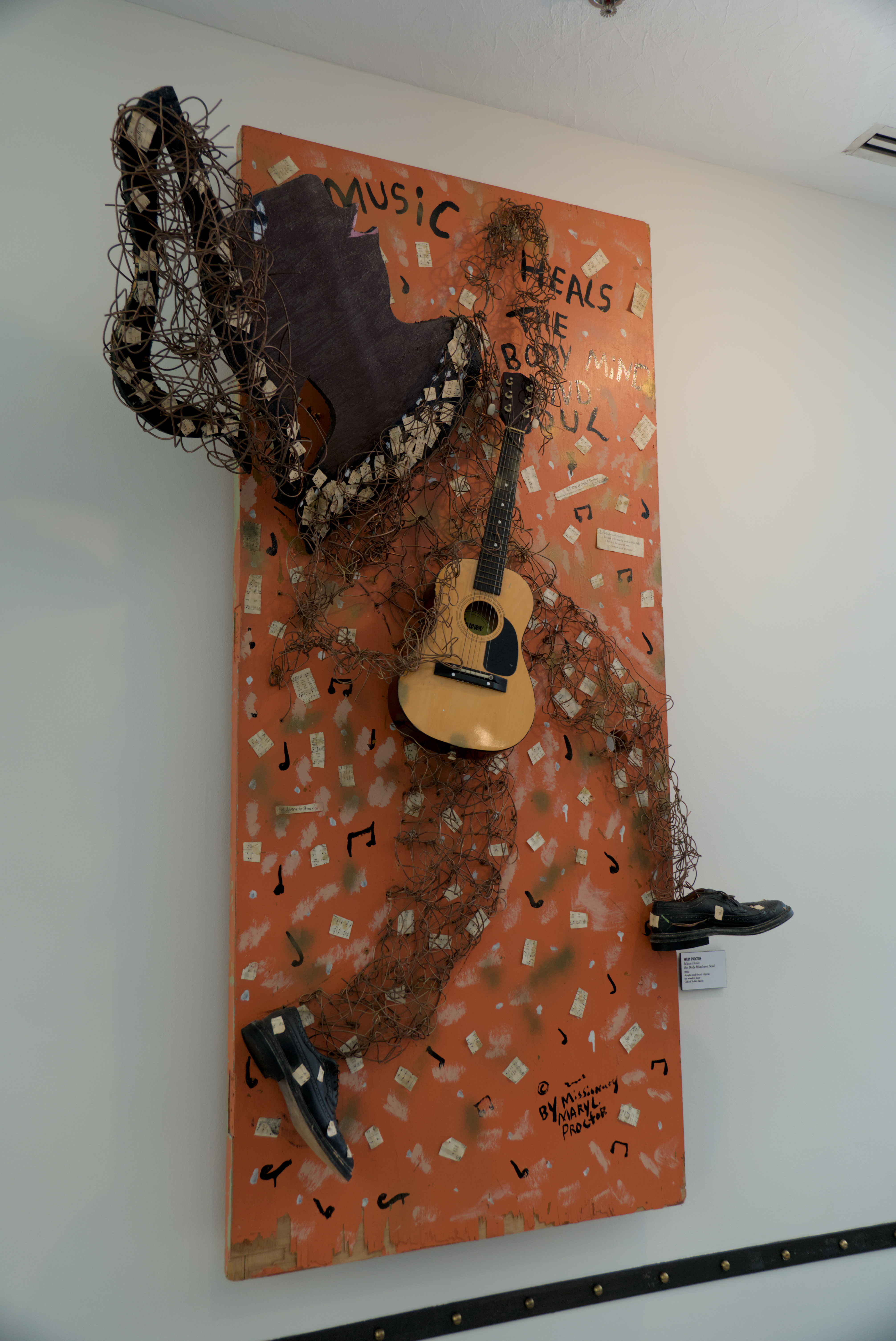
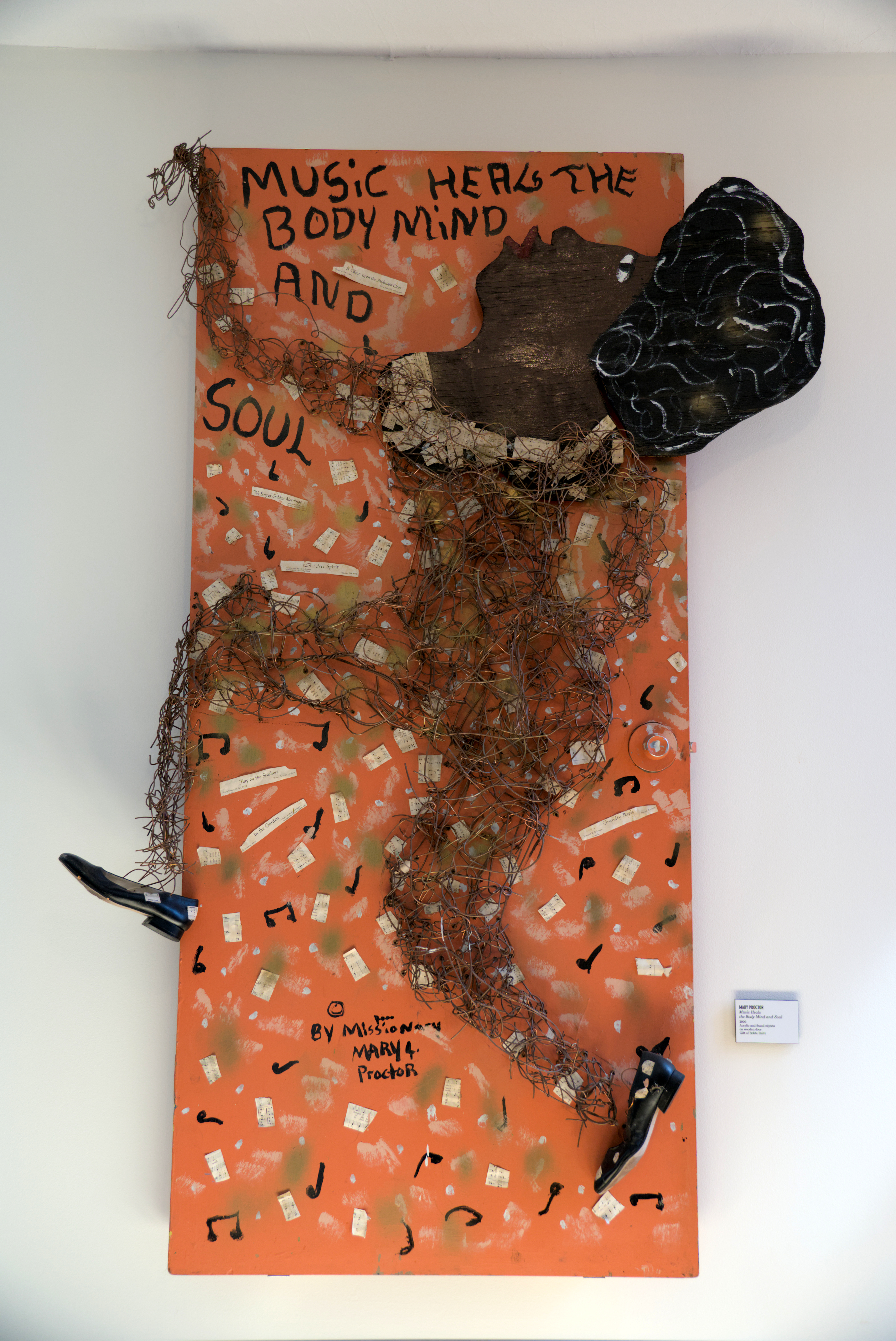
Music Heals the Body, Mind, and Soul
Mary L. Proctor (American, 1960–), Music Heals the Body, Mind, and Soul, 2000. Acrylic and found objects on wooden door. American Visionary Art Museum, Baltimore.

Music Heals the Body, Mind, and Soul
Mary L. Proctor (American, 1960–), Music Heals the Body, Mind, and Soul, 2000. Acrylic and found objects on wooden door. American Visionary Art Museum, Baltimore.


If you download the Bloomberg Connects mobile app and search “AVAM,” then select “The Strength to Be Joyful,” you can access seven audio interviews with artist Mary Proctor (transcripts included), which are tied to different displays in the exhibition. The exhibition also runs a video interview on loop.

But also, here’s a 2003 news segment shot with Proctor in the “art yard” outside her house:

And a more recent interview clip, from 2022, of Proctor talking about her grandmother’s importance in her life:

Roundup: Paula Rego’s Life of the Virgin; corito medleys; more

EXHIBITION: Paula Rego: Secrets of Faith, Victoria Miro Venice, April 23–June 18, 2022: Portuguese-born British artist Paula Rego died last Wednesday, June 8, after a seven-decade career, and in the midst of four solo exhibitions of her work—including this one at Victoria Miro’s gallery in Venice, which explores her small but significant body of religious art. [HT: Jonathan Evens]

In 2002 Jorge Sampaio, then president of Portugal, commissioned Paula Rego to create eight pastel drawings based on episodes from the life of the Virgin Mary, to be installed permanently in the chapel of the presidential palace (Palácio de Belém) in Lisbon. Titled Nossa Senhora (Our Lady), the cycle comprises Annunciation; Nativity; Adoration; Purification at the Temple; Flight into Egypt; Lamentation; Pietà; and Assumption. Rego had such fun with the commission that she produced additional works on the subject, which she decided to keep for herself. It is these, along with her watercolor studies, that are currently on display in Venice. (The original eight pastels are not allowed to leave the chapel for which they were made.)

Rego, Paula_The Flight to Egypt
Paula Rego (Portuguese British, 1935–2022), The Flight to Egypt, 2002. Watercolor and ink on paper, 8 1/4 × 11 3/4 in. (21 × 29 cm).

Rego, Paula_Descent from the Cross
Paula Rego (Portuguese British, 1935–2022), Descent from the Cross, 2002. Pastel on paper mounted on aluminum, 29 1/2 × 28 3/8 in. (75 × 72 cm).

I learned about Rego’s Marian cycle a few years ago and became enthralled by it, though I’ve never seen it in person, and most of these supplemental works are new to me. It’s unique, in part because of Mary’s corporeality. In a 2003 interview with Richard Zimler, Rego said, “If there is anything new about these representations of the Virgin, it is the fact that they were done by a woman, which is very rare. . . . It always used to be men who painted the life of the Virgin, and now it is a woman. It offers a different point of view, because we identify more easily with her.”

While the president praised the cycle and Rego insisted that “these pictures were created with admiration and respect,” an open letter to Sampaio referred to it as an “outrage done to the vast majority of the Portuguese people,” an “outrage against their religious beliefs and an offence to the Virgin Mary.” In brief: “blasphemous and scandalous.” I can see why Rego’s larger oeuvre, with its often menacing and/or transgressive imagery (not least of which is her Abortion Series), would scandalize conservative viewers, but I am a bit confused by the outrage at Nossa Senhora, which to me seems very honoring. The objectors, it sounds like, are those who prefer Mary to be more ethereal and sedate; they don’t want to see her, for example, slouching or wincing or expressing astonishment, or awkwardly struggling to hold the weight of her son’s corpse. There will always be those who resist any kind of updating of religious art. If the scenes are restaged in an unfamiliar way or rendered in an unfamiliar style or introduce a new element or the figures don’t look like how we have always pictured them, then some will oppose them outright—which is a shame, because such art often invites us more deeply into the story, helping us to see it afresh.

Definitely check out the boldface link above to view more pieces from the exhibition, as well as a video that shows Nossa Senhora in situ. For further reading, see “Paula and the Madonna: Who’s That Girl?” by Maria Manuel Lisboa and the transcript from Zimler’s interview with Rego.

+++

PODCAST EPISODE: “Past Hymns for the Present Moment,” Tokens, May 26, 2022: “Hymns are often sentimentalized in the American church, cast aside as merely retired songs with dated language, bearing no real appeal or relevance. But of course it may be that our old hymnals have some crucial things to say to us in our current cultural moment. This is the challenge I [Lee C. Camp] posed to Odessa Settles, Phil Madeira, and Leslie Jordan: find and perform some old hymns which might be both indicting and encouraging to the modern church, and to the world at large. Beautiful conversation and moving performances, taped at Nashville’s Sound Emporium.”

+++

POETRY UNBOUND EPISODES:

In each episode of this podcast from On Being Studio, host Pádraig Ó Tuama unpacks a contemporary poem in fifteen minutes. Here are two from season 5 (which just came to an end) that I particularly liked.

>> “Looking for The Gulf Motel” by Richard Blanco: “What happens when we remember?” Ó Tuama asks. “Why do we remember? Is it sweet or sad? Is it both? If you particularly associate warm memories, romantic memories, nostalgic memories with a place, and then that place is changed, does that mean that all those memories are gone?” In this poem from a collection of the same title (which I checked out from my local library at Ó Tuama’s recommendation, and it’s excellent!), Cuban American poet Richard Blanco, at age thirty-eight, reminisces about a family beach vacation from his childhood. Read the poem here.

If I were writing this poem, it would be called “Looking for The Blockade Runner,” as that’s the name of the Wrightsville Beach hotel in North Carolina that my family and I used to stay at for four days or so each summer. My little brother and I should still be running around on the waterfront lawn as our parents watch us from inside the giant window of the dining room, finishing up their breakfast. My dad should still be riding in a wave on a boogie board, teaching me technique. My mom should still be lounging at the pool in her black one-piece with sunglasses and a Vanity Fair, I feeling so grown up beside her sipping my virgin piña colada. My brother should still be exhilarated by the live hermit crabs at Wings, and I by the dried starfish and sand dollars. We should all still be walking back from the Oceanic, our bellies filled with she-crab soup and hush puppies and catch-of-the-day, down the shore at dusk.

>> “The change room” by Andy Jackson: A poet who’s interested in difference and embodiment, here Andy Jackson, who has severe spinal curvature due to Marfan syndrome, “is looking at the attention that he gets in his body and is refocusing it, extending it wider, looking at the deeper question of, what does it mean for any of us to be in a body, and how do we in bodies relate to others in bodies?” Read the poem here, from the collection Human Looking.

+++

CORITO VIDEOS: A corito (literally “short song”) is a type of Latino Christian worship song. Coritos have “fairly simple tunes, often with repetitive words, that the people sing by heart,” writes Justo L. González in ¡Alabádle!: Hispanic Christian Worship. “Most of them are anonymous, and pass by word of mouth from one congregation to another. For that reason, the tune or the words of a particular corito may vary significantly from one place to another. They are often sung to the accompaniment of clapping hands, tambourines, and other instruments.” To learn more about this genre, see the Calvin Institute of Christian Worship interview with Rosa Cándida Ramírez and Analisse Reyes and the entry in the Encyclopedia of Christianity in the Global South, vol. 2.

>> Joseph Espinoza sings a corito medley consisting of “Cuando el pueblo del Señor” (When the People of the Lord), “No puede estar triste” (The Heart That Worships Christ Cannot Be Sad), “Ven, ven, Espiritu divino” (Come, Come, Holy Spirit), “Cantaré al Señor por siempre” (I Will Sing to the Lord Forever), and “El Poderoso de Israel” (The Mighty One of Israel). Aaron Barbosa is on keyboard, Fabian Chavez is on percussion, and Yosmel Montejo is on bass.

>> The video below was shared March 25, 2020, in the Multicultural Worship Leaders Network Facebook group that I belong to, and it’s pure joy! The performers string together three coritos: “Le canto aleluya” (I Sing Alleluia), “Hay victoria” (There’s Victory), and “Los que esperan en Jesus” (Those Who Wait in Jesus).

Federico Apecena provides the following translation. (The slashes indicate the number of times that line or passage is sung.)

//The heart that worships Jesus cannot be sad
The heart that worships God cannot be sad//

//That’s why I sing, I sing hallelujah
The heart that worships God cannot be sad//

//There’s victory, there’s victory, there’s victory in the blood of Jesus//
The enemy will not be able to defeat our souls
//Because there is victory, because there is victory, because there is victory in the blood of Jesus//

//That’s why I sing, I sing hallelujah
The heart that worships God cannot be sad//

///Those that wait, that wait in Jesus///
//Like eagles, like eagles, their wings will open//

They will walk and will not get tired, they will run and will not stop
//New life they will have, new life they will have, those that wait, that wait in Jesus//

//That’s why I sing, I sing hallelujah
The heart that worships God cannot be sad//