
“Upon the Bleeding Crucifix” by Richard Crashaw (poem)

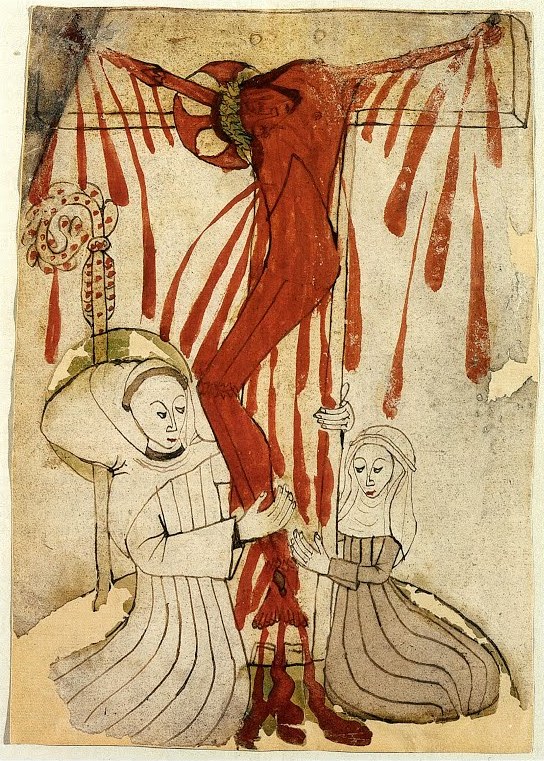
Vision of St. Bernard (Crucifixion)
Vision of Saint Bernard (Blood Crucifix), by a nun from the Lower Rhine, 14th century. Ink and colored washes on paper, 25.5 × 18 cm. Museum Schnütgen, Cologne.

Jesu, no more! It is full tide;
From thy hands and from thy feet,
From thy head, and from thy side,
All the purple rivers meet.

What need thy fair head bear a part
In showers, as if thine eyes had none?
What need they help to drown thy heart,
That strives in torrents of its own?

Water’d by the showers they bring,
The thorns that thy blest brow encloses
(A cruel and a costly spring)
Conceive proud hopes of proving roses.

Thy restless feet now cannot go
For us and our eternal good,
As they were ever wont. What though?
They swim, alas! in their own flood.

Thy hand to give thou canst not lift,
Yet will thy hand still giving be.
It gives, but O, itself’s the gift,
It gives though bound, though bound ’tis free.

But, O thy side, thy deep-digg’d side,
That hath a double Nilus going:
Nor ever was the Pharian tide
Half so fruitful, half so flowing.

No hair so small, but pays his river
To this Red Sea of thy blood;
Their little channels can deliver
Something to the general flood.

But while I speak, whither are run
All the rivers named before?
I counted wrong: there is but one;
But O that one is one all o’er.

Rain-swol’n rivers may rise proud,
Bent all to drown and overflow;
But when indeed all’s overflow’d,
They themselves are drowned too.

This thy blood’s deluge (a dire chance,
Dear Lord, to thee) to us is found
A deluge of deliverance,
A deluge lest we should be drown’d.

Ne’er wast thou in a sense so sadly true,
The well of living waters, Lord, till now.

This poem was published in the second edition of Steps to the Temple: Sacred Poems, with Other Delights of the Muses (London, 1648) under the title “On the Bleeding Body of Our Crucified Lord”; an earlier version appeared in the book’s first edition in 1646 under the title “On the Bleeding Wounds of Our Crucified Lord.” I use the title by which it is most commonly known, “Upon the Bleeding Crucifix,” first assigned to it in Crashaw’s posthumously published collection Carmen Deo Nostro (Paris, 1652). I’ve modernized the spellings.


Richard Crashaw (1612–1649) was one of the major Metaphysical poets of seventeenth-century England, a movement marked by the use of elaborate figurative language, original conceits, paradoxes, and philosophical exploration. He was also a priest. Ordained in the Church of England in 1638, he was installed as curate of the Church of St Mary the Less in Cambridge, embracing the high-church reforms of Archbishop William Laud, for which he was persecuted. In 1643, during the English Civil War, Oliver Cromwell and his Puritan posse forced Crashaw into exile in France, where he converted to Roman Catholicism. Waiting for a papal retainer, he struggled with poverty and ill health. Pope Innocent X finally granted Crashaw a post at a seminary in Rome in 1647, and two years later he was given a cathedral benefice in Loreto, where he died of a fever at age thirty-six. He published two collections of poetry during his lifetime.

For more Crashaw on the blog, see the article “The ‘Nothing’ that won our salvation.”

“The Waterfall” by Henry Vaughan

Senju, Hiroshi_Waterfall
Hiroshi Senju (Japanese, 1958–), Waterfall, 2016. Acrylic and fluorescent pigments on Japanese mulberry paper, 51 × 64 in. Photo courtesy of Sundaram Tagore Gallery.

With what deep murmurs through time’s silent stealth
Doth thy transparent, cool, and wat’ry wealth
                  Here flowing fall,
                  And chide, and call,
As if his liquid, loose retinue stayed
Ling’ring, and were of this steep place afraid,
                  The common pass
                  Where, clear as glass,
                  All must descend
                  Not to an end,
But quick’ned by this deep and rocky grave,
Rise to a longer course more bright and brave.

      Dear stream! dear bank! where often I
      Have sat, and pleased my pensive eye;
      Why, since each drop of thy quick store
      Runs thither, whence it flowed before,
      Should poor souls fear a shade or night,
      Who came, sure, from a sea of light?
      Or, since those drops are all sent back
      So sure to Thee, that none doth lack,
      Why should frail flesh doubt any more
      That what God takes He’ll not restore?

      O useful element and clear!
      My sacred wash and cleanser here;
      My first consigner unto those
      Fountains of life, where the Lamb goes!
      What sublime truths and wholesome themes
      Lodge in thy mystical, deep streams!
      Such as dull man can never find
      Unless that Spirit lead his mind,
      Which first upon thy face did move,
      And hatched all with his quick’ning love.
      As this loud brook’s incessant fall
      In streaming rings restagnates all,
      Which reach by course the bank, and then
      Are no more seen: just so pass men.
      O my invisible estate,
      My glorious liberty, still late!
      Thou art the channel my soul seeks,
      Not this with cataracts and creeks.


In “The Waterfall” by Henry Vaughan (1621–1695), a stream’s sudden surge and plummet over a precipice followed by a calm, continued flow is a picture of the soul’s passage into eternity—the continuation of life after death.

The speaker addresses the stream and its retinue of waters, who “murmur” and “chide”—that is, make incessant noise (in the word’s archaic sense). The waters move with increasing momentum toward the brink and hesitate just before but then take the plunge. Briefly brought under, in their “deep and rocky grave” they are “quickened,” made alive once more, as they rise back up to the surface and course smoothly onward, no longer in a state of agitation. After a momentary crash, serenity.

Vaughan represents this action visually with an alternation of groups of long lines and short lines, which give the impression of water tumbling over ledges of rock. The lines then steady out into a uniform column, signifying the water’s becoming sedate.

“Why,” the speaker wonders, “since each drop of thy quick store / Runs thither, whence it flowed before, / Should poor souls fear a shade or night, / Who came, sure, from a sea of light?” Death is benevolent, merely a drop-off along the route and then reconstitution to the whole. Just as the stream that has fallen returns to the vast ocean from whence (via the cycle of evaporation, condensation, precipitation) it came, so, too, does the soul return to God, its origin.

In the final stanza the speaker muses on water as sacrament—baptism, he says, is our “first consigner unto those / Fountains of life, where the Lamb goes” (see Rev. 7:17; cf. Isa. 49:10). In other words, our baptism gives us over to God, to the New Eden. If baptism is our first consigner, then death is our final consigner, bringing us at last to the One to whom we belong.

The profound mystical truth hidden in something as natural as a waterfall is discerned only by those whom the Spirit reveals it to—that same Spirit who hovered over the waters at Creation (Gen. 1:2) “[a]nd hatched all with his quick’ning love.”

I write this in memory of my husband Eric’s grandfather, who died Sunday. I’m consoled by the image of him as a water droplet whose plunge does not mean a cessation of being but rather a flowing into God, into “glorious liberty.” When water plunges down, it sends ripples toward the bank, Vaughan writes, but then settles into stillness and is imperceptibly carried away to a destination out of view. So Grandpa Jones is now on “a longer course more bright and brave,” flowing toward “a sea of light.”