Art at the United Nations Headquarters in New York

Chagall’s Peace Window is one of the most significant works in the United Nations’ art collection. On my quick visit to New York City last month, where the UN is headquartered, I was hoping to see it, but I emailed ahead of time and found out it’s not currently available for viewing due to construction behind it. (You can “see” it but not really, because it’s not lit, and there’s a tall plastic barrier in front.) I was disappointed, but I decided to visit the UN anyway, to see what other art I might find.

The United Nations was founded in 1945 for the purpose of preventing a third world war. Comprising 193 member states, the organization is committed to maintaining international peace and security, developing friendly relations among nations, and promoting social progress, better living standards, and human rights. Their motto is “Peace, dignity, and equality on a healthy planet.”

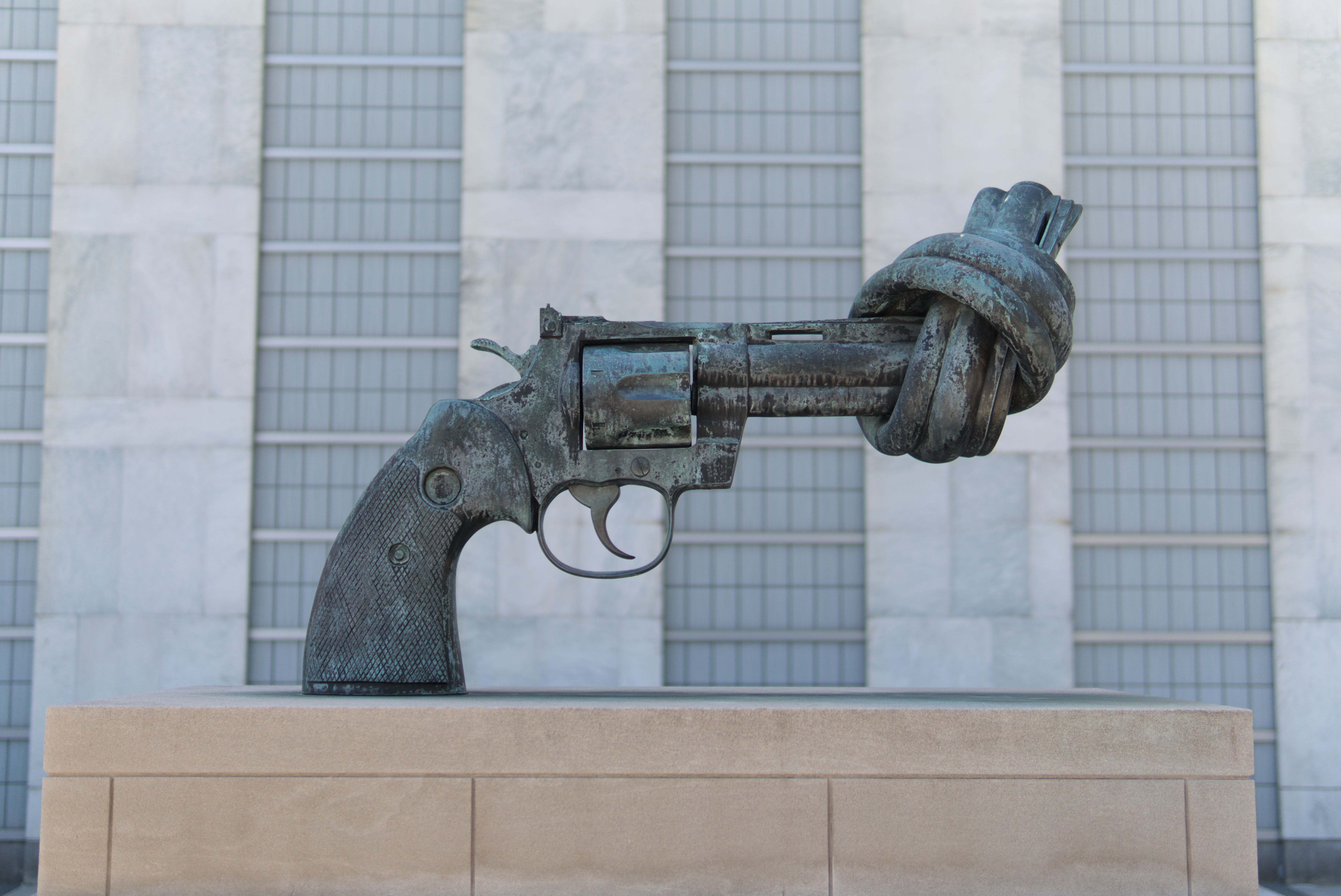
After presenting my ID, getting my photo taken, being stickered, and going through security, I was inside the campus and directed to the General Assembly Building. Outside the entrance to this building is the famous Non-Violence bronze, aka The Knotted Gun, by Carl Fredrik Reuterswärd of Sweden. The artist made the sculpture in 1980 after his friend John Lennon was murdered. He wanted to honor the singer-songwriter’s vision of a peaceful world.
Reuterswärd, Carl Fredrik_Non-Violence
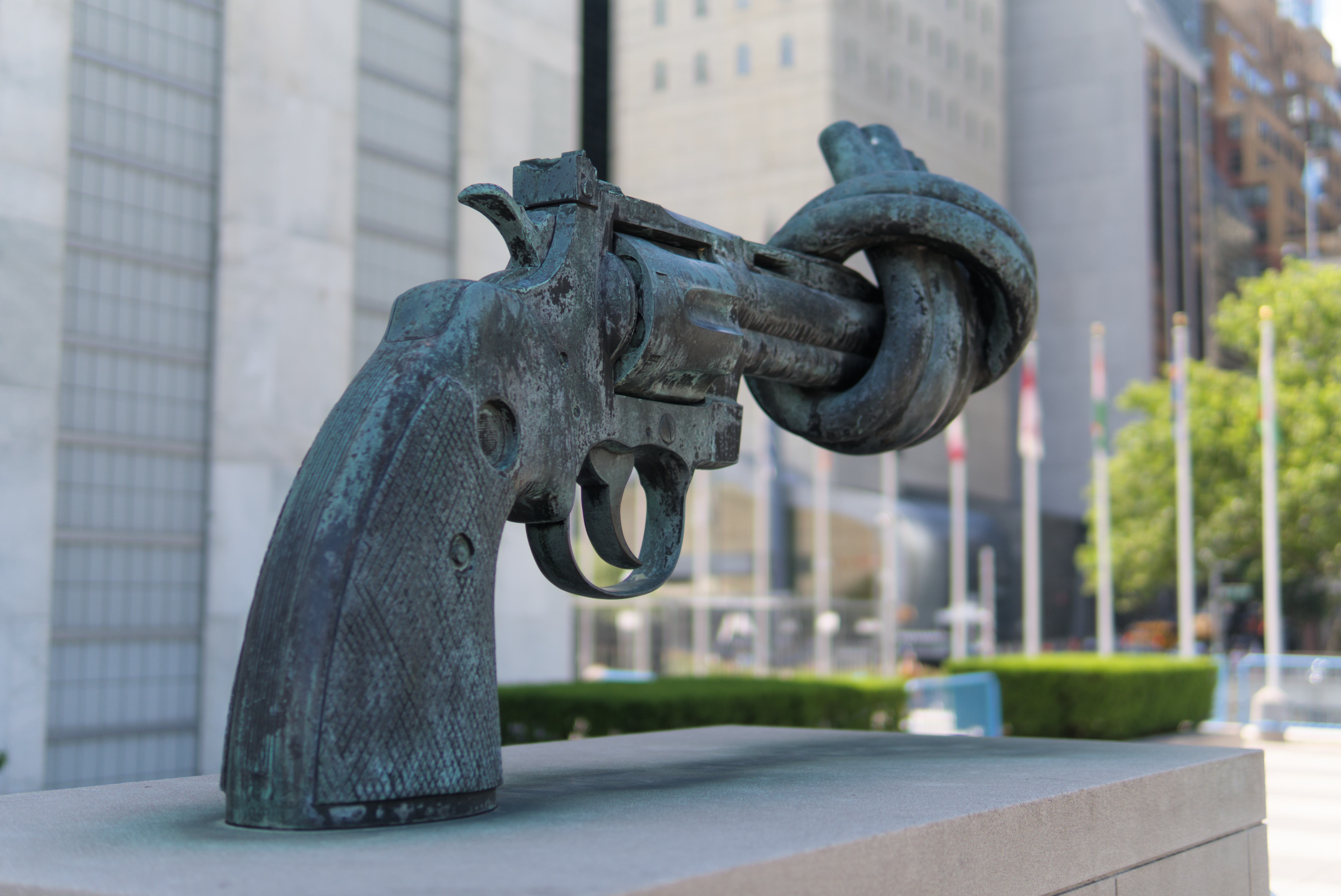
Carl Fredrik Reuterswärd (Swedish, 1934–2016), Non-Violence, 1984. Bronze, 79 × 44 × 50 in. United Nations Headquarters (outside the General Assembly building), New York. Gift from Luxembourg. Photo: Victoria Emily Jones. [object record]

Reuterswärd, Carl Fredrik_Non-Violence

The original cast was first placed at the Strawberry Fields memorial in New York City’s Central Park, across the street from the Dakota apartment building where Lennon and his wife, Yoko Ono, lived, and where he was shot. But Reuterswärd worried it would be stolen there. In 1988, the Government of Luxembourg bought the sculpture and donated it to the United Nations, who installed it inside the gate of their New York headquarters.

Non-Violence is an oversize replica of a Colt Python .357 Magnum revolver with the barrel tied in a knot and the muzzle pointing upward, rendering the weapon useless. In his statement from 1988, Reuterswärd said, “Humor is the finest instrument we have to bring people together. While making my peace-symbol, I thought of the importance of introducing a touch of humor, just to make my ‘weapon’ symbolically ridiculous and completely out of order.”

Reuterswärd ultimately made over thirty additional casts of Non-Violence, which are publicly installed in cities such as Beijing, Beirut, Cape Town, Lausanne, and Mexico City.

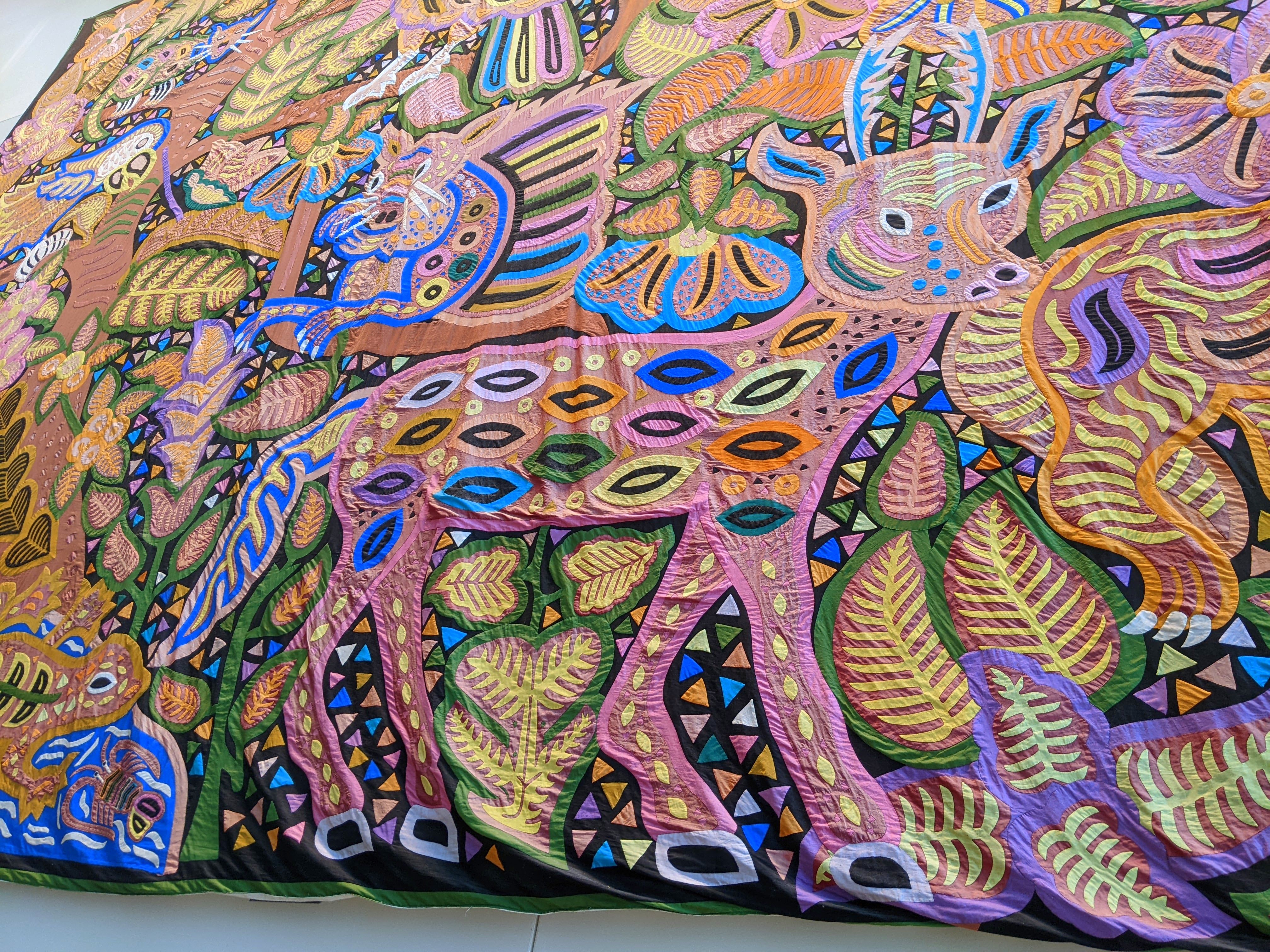
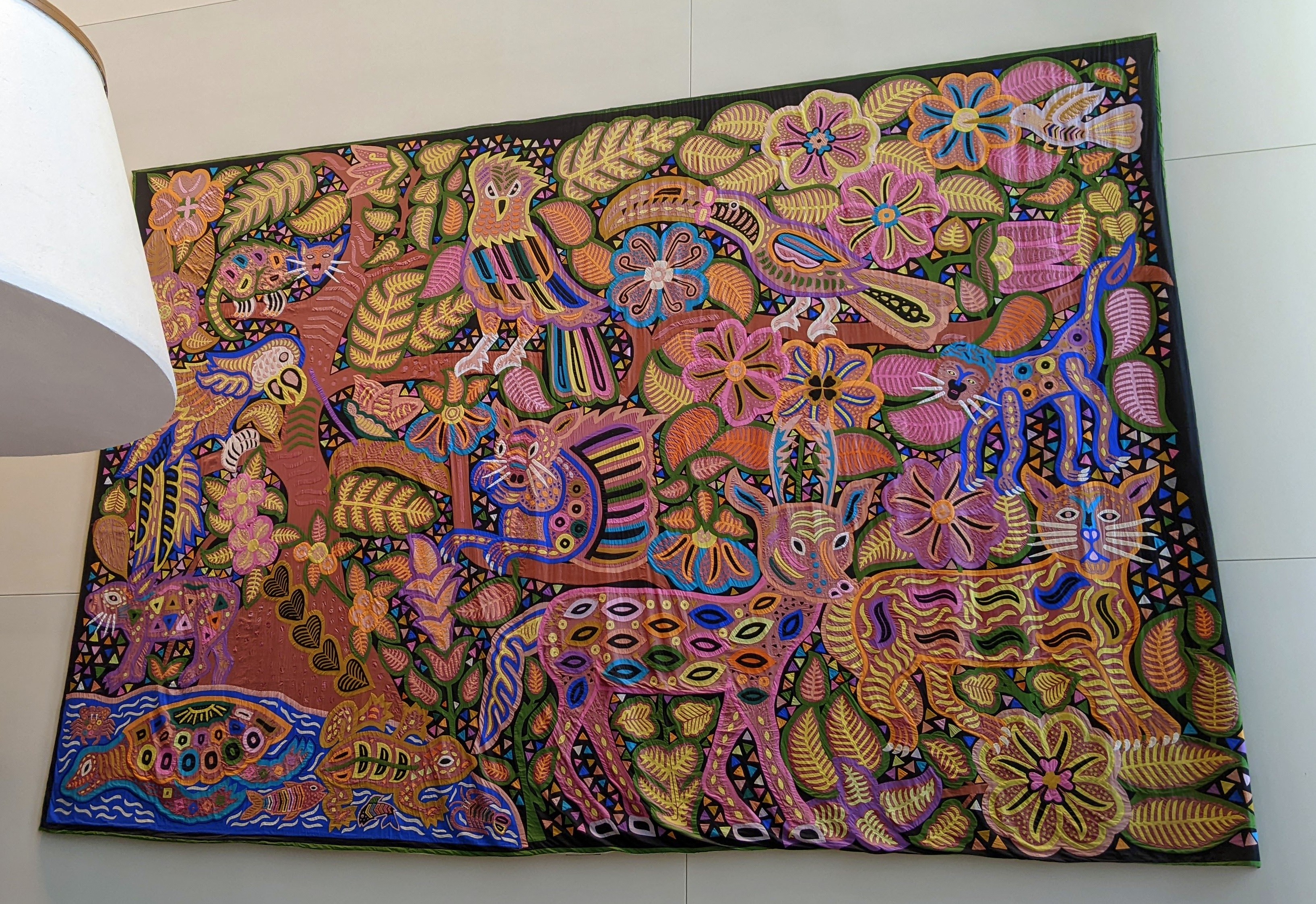
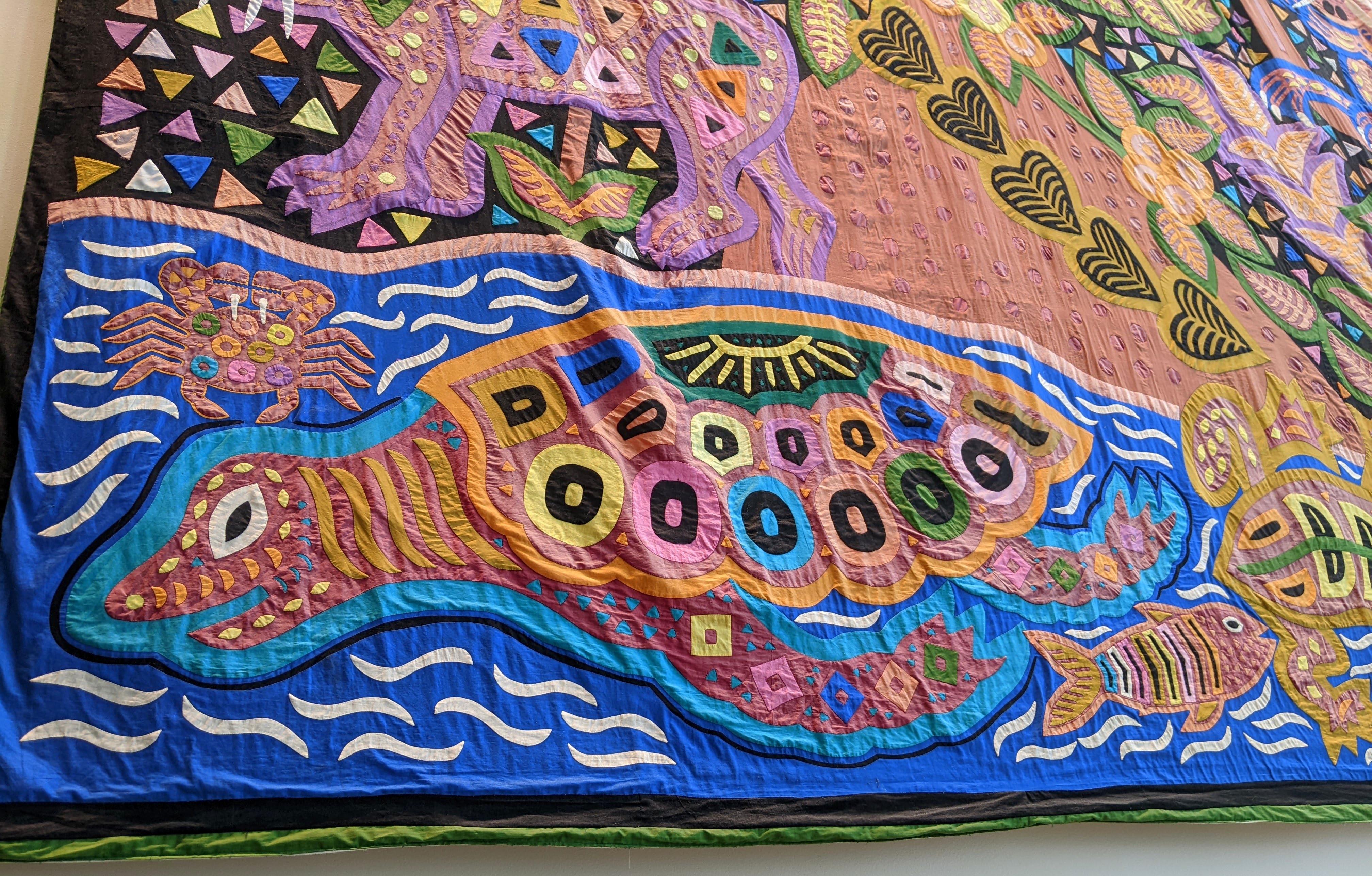
After spending some time with this iconic work, I entered the General Assembly lobby. What first caught my eye, on the right wall, was a monumental Mola Tapestry from Panama, made by unidentified Kuna women. (To learn about the art form, see my previous blog post from Lent 2022.)
Mola Tapestry
Mola Tapestry by the Kuna people, 1993. Reverse appliqué tapestry, 190 × 284 in. General Assembly Building, United Nations Headquarters, New York. Gift from Panama. Photo: Victoria Emily Jones. [object record]

Molas are made using a reverse appliqué technique, in which several layers of multicolored cloth are sewn together and then parts of each layer are cut out to form the design. These textile panels are traditionally made on a smaller scale and sewn onto women’s blouses, but as outside interest in them grew, local artisans started making some to be displayed as wall hangings.

This one shows a colorful array of indigenous flora and fauna, including a toucan, owl, hummingbird, monkey, turtle, frog, squirrel, rabbit, deer, and wildcat.

On the opposite wall is a nearly thirty-foot-long painting titled La Fraternidad (Brotherhood) by Mexican artist Rufino Tamayo [previously], which shows a group of people gathered around a fire with interlaced arms. The fire may represent enlightenment, knowledge and power, or the Divine Presence.

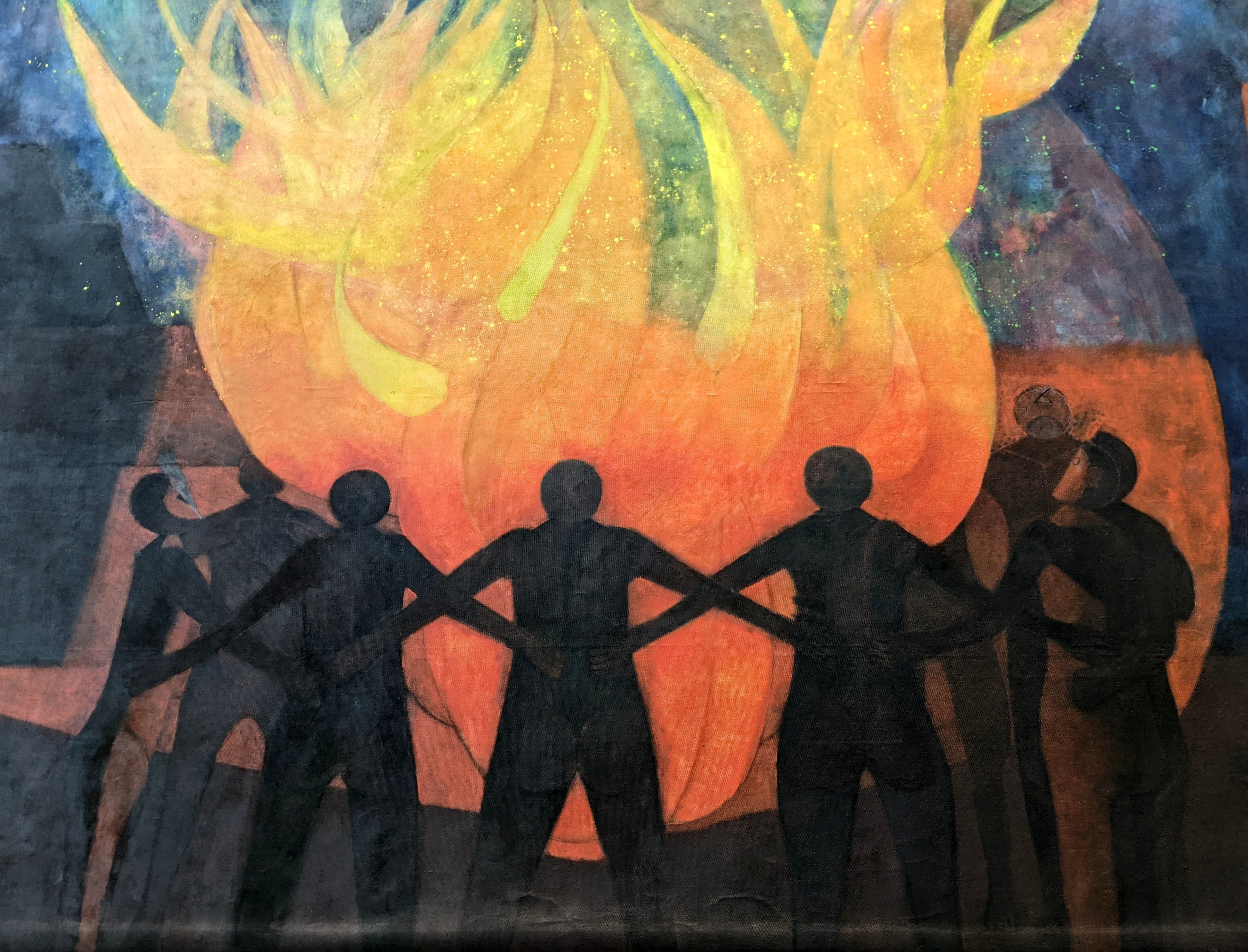
Rufino Tamayo (Mexican, 1899–1991), La Fraternidad (Brotherhood), 1968. Oil on canvas, 160 × 358 in. General Assembly Building, United Nations Headquarters, New York. Gift from Mexico, 1971. Photo: Victoria Emily Jones. [object record]

Tamayo, Rufino_La Fraternidad

At the left is an ancient Aztec or Mayan pyramid, whereas the structure at the right is modern. Tamayo said this shows the span of time, from the ancient era into the present and future.

From 2009 to 2014 the painting was on display at the Mexican state legislature, after which it was restored and returned to the UN.

Situated in front is a replica of an ancient Greek sculpture depicting Poseidon of Artemision, god of the sea, in an active stance. His right hand would have originally wielded a trident, representing his power. At first I thought it an odd choice for the UN to display an apparently militant figure, as Poseidon used his trident as a weapon to fight Trojans, Titans, and others, and indeed here he seems poised to deliver a death blow. But after some rudimentary research, I found that Poseidon also created life-giving springs with the strike of his trident (think Moses striking the rock with his staff), and used it to calm turbulent waters. These ameliorating acts align with the UN’s mission and make the Poseidon sculpture a fitting addition to their collection.  

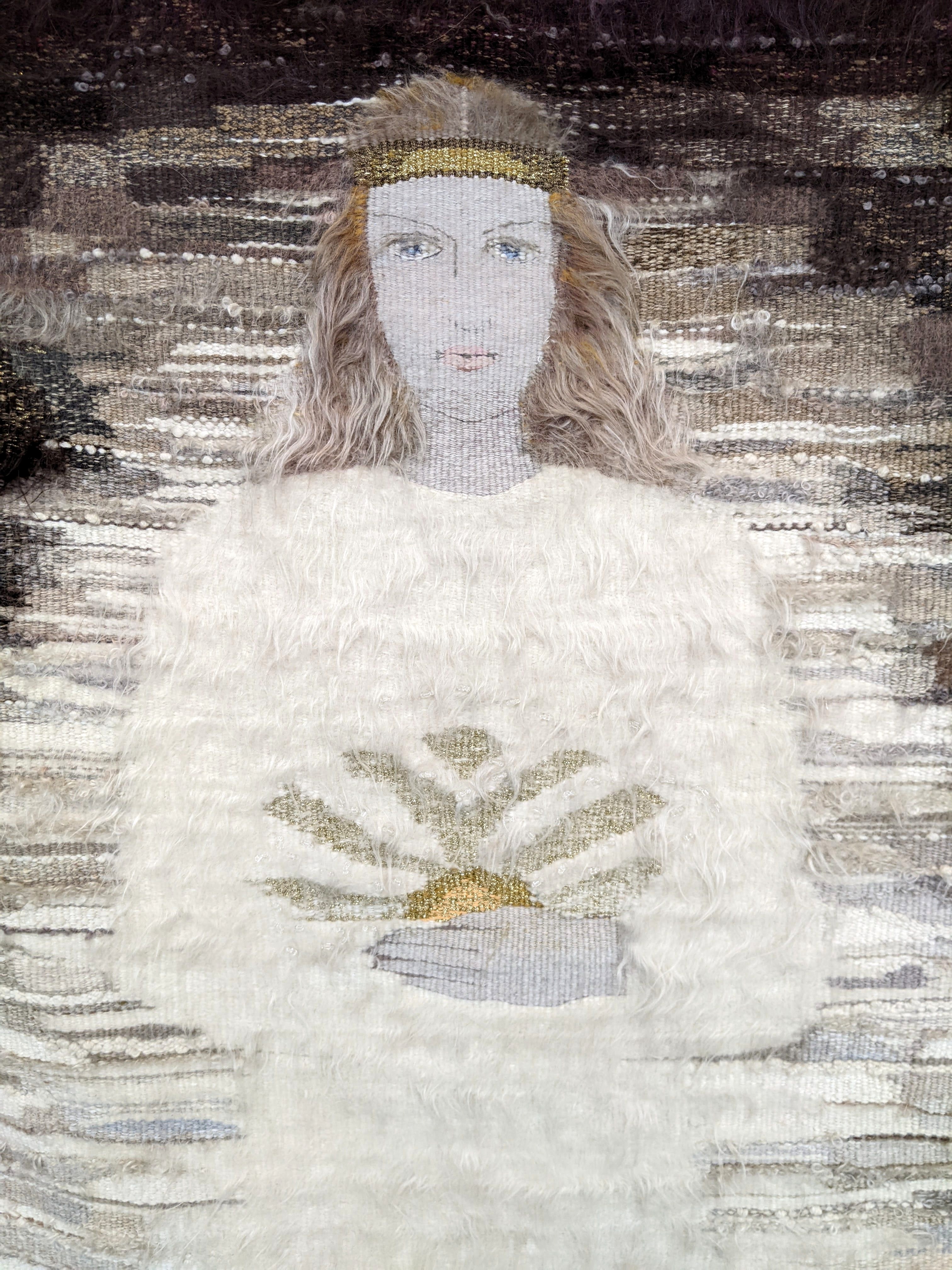
Also in the lobby is a wool tapestry from Latvia. Titled Hope, it’s by the well-known Latvian textile artist Edīte Pauls-Vīgnere.

Pauls-Vīgnere, Edīte_Hope
Edīte Pauls-Vīgnere (Latvian, 1939–), Hope, 1994. Tapestry, 126 × 114 in. General Assembly Building, United Nations Headquarters, New York. Gift from Latvia. Photo: Victoria Emily Jones. [object record]

Pauls-Vīgnere, Edīte__Hope (detail)

The female figure in the foreground is, I’m assuming, a personification of hope, dressed in a white gown and golden headband and holding the sun. She stands in front of the Freedom Monument in Riga, which shows Lady Liberty holding three gilded stars, symbolizing the three constitutional districts of Latvia.


Deeper inside the lobby was a temporary exhibition, Interwoven: Refugee Murals Across Borders, organized jointly by UNHCR (the UN Refugee Agency) and Artolution. It opened on June 20, World Refugee Day, and will continue through July 19. The exhibition presents paintings by refugees and host communities in refugee camps, conflict zones, and crisis-affected communities across the world. These were created through a collaborative process in which the work circulated to different locations, with artists contributing additions at each stop. The end results show interwoven narratives of the diverse peoples forced to flee their homes. Themes include joy, lament, labor, empowerment, identity, and home.

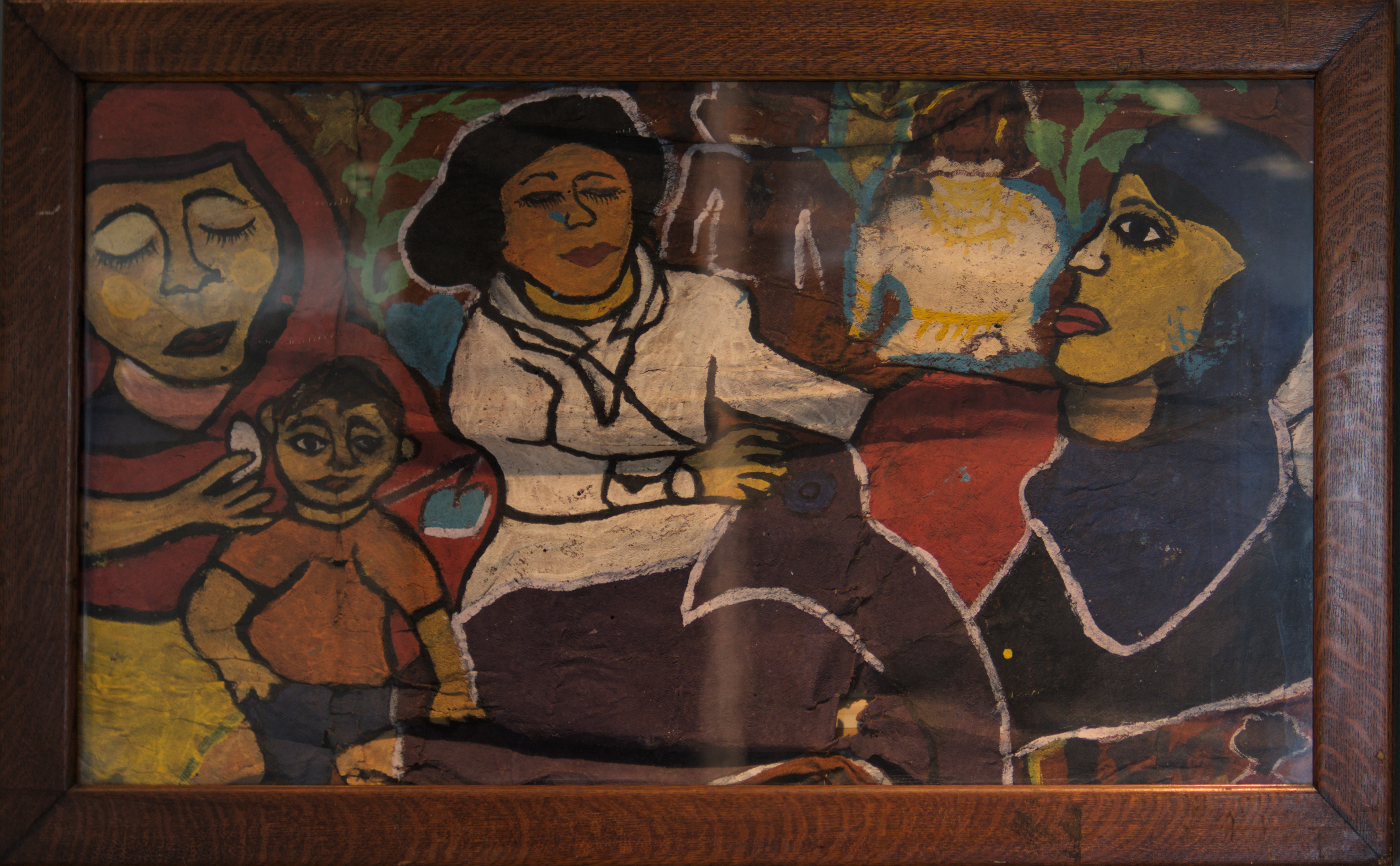
Made by about a dozen refugee girls and women from four countries, Fabric of Women’s Resilience began in Uganda with a small group of South Sudanese, who prepared the traditional bark cloth from the bark of a mutuba tree. This substrate then traveled to Bangladesh, where Rohingya women painted a pregnant woman lying on a bed while a female doctor presses a stethoscope to her belly, and on the left, a mother bathing her child. The artists said they wanted to encourage mothers to seek access to prenatal healthcare and to practice good hygiene with their babies.
Fabric of Women's Resilience
Fabric of Women’s Resilience, a collaborative painting by approx. twelve Rohingya, Syrian, Afghan, and South Sudanese refugee women, 2018. Acrylic on bark cloth, 24 × 60 in. Photo: Victoria Emily Jones.

In Greece, the bark cloth traveled to Samos refugee camp, where one young Afghan woman, with the help of others, painted one of her traumatic childhood experiences: being married off at age twelve to an older man. This scene at the top is a bit crumpled in the frame, so it’s difficult to see, but the child bride is crying, and the man has a white beard.

The painting also went to Azraq refugee camp in Jordan, where Syrian women added a woman carrying a baby on her back while reading a book to show that women can be mothers and pursue an education. (This scene was at the extreme right but must have come off; view the full original painting on the exhibition webpage, fourth image down.) It ended its journey with a return to Uganda, where the South Sudanese women filled in the remaining spaces with plants, fish, and fruits.

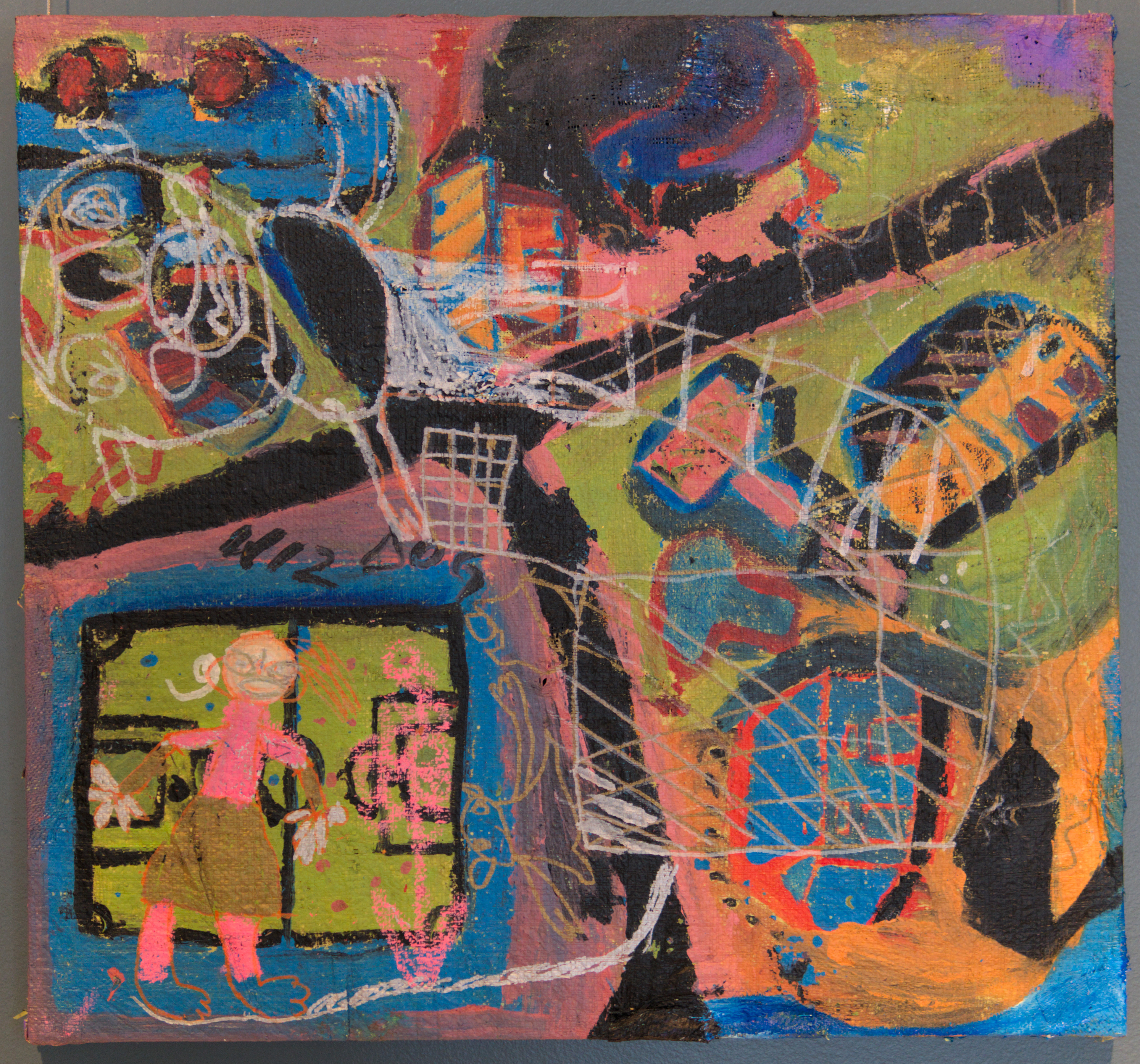
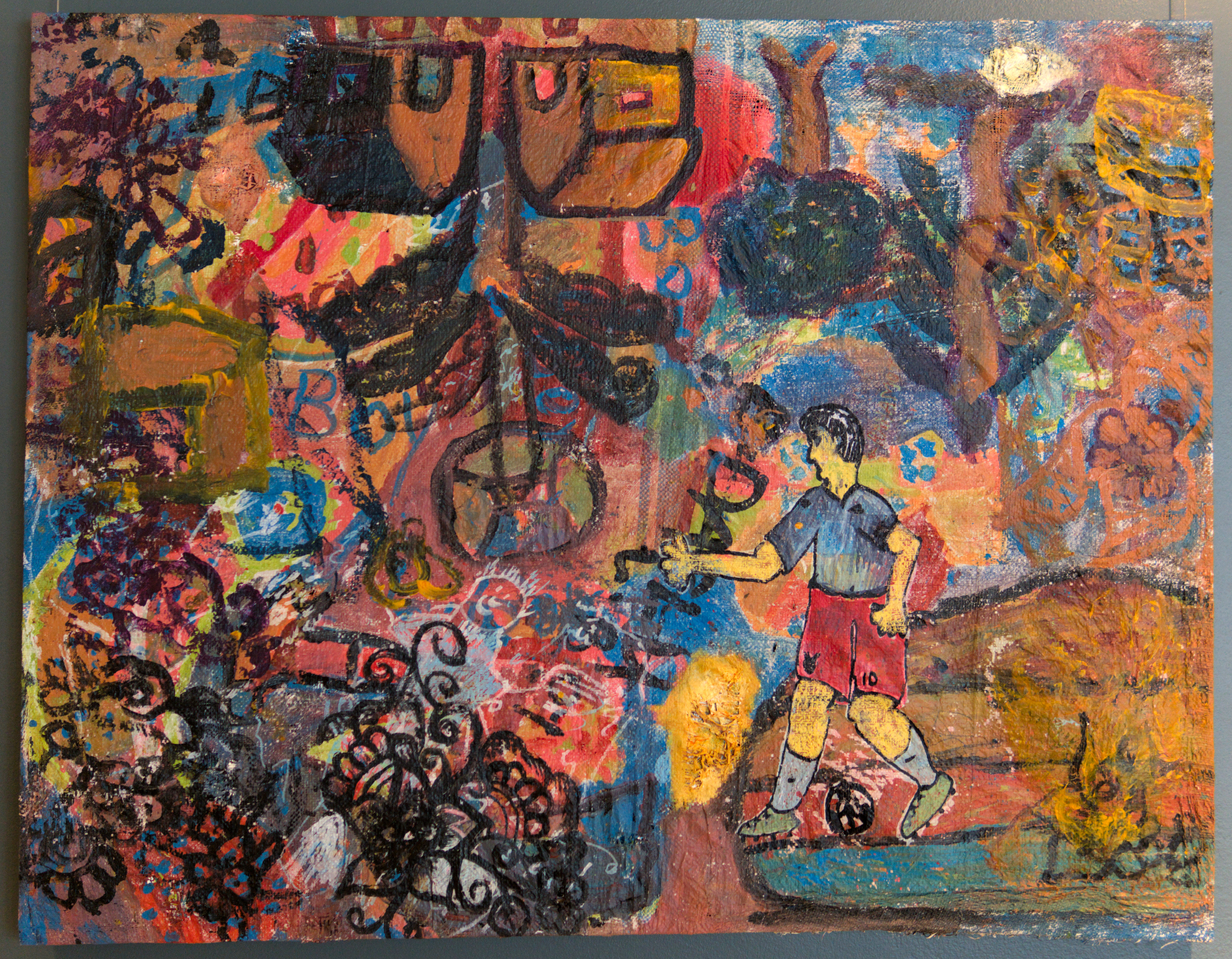
Other artworks include The Creature of Home and Play in the Midst of Chaos, painted on food distribution bags and as a collaboration between South Sudanese and Rohingya refugees, both children and adults.

The Creature of Home, which traveled to BidiBidi Refugee Settlement in Uganda and Balukhali Refugee Camp in Bangladesh, depicts chickens, a soccer field, memories of home, and tools needed to take care of the land.
The Creature of Home
The Creature of Home, a collaborative painting by South Sudanese refugees at BidiBidi Refugee Settlement, Uganda, and Rohingya refugees at Balukhali Refugee Camp, Bangladesh. Photo: Victoria Emily Jones.

Play in the Midst of Chaos, which traveled to BidiBidi Refugee Settlement in Uganda and Bhasan Char Island in Bangladesh, captures a sense of joy with its vivid colors and depiction of sports. It also highlights the importance of planting trees and taking climate action.
Play in the Midst of Chaos
Play in the Midst of Chaos, a collaborative painting by South Sudanese refugees at BidiBidi Refugee Settlement, Uganda, and Rohingya refugees at Bhasan Char Island, Bangladesh. Photo: Victoria Emily Jones.

Seeing the Interwoven exhibition sent me down an internet rabbit trail of learning more about the co-organizer, Artolution, and the work they’re doing, which then impelled me to learn more about the refugee communities in which they’re active. Follow them on Instagram, Facebook, or Twitter. I also commend to you the Founder Spirit podcast interview with Artolution cofounder and public artist, educator, and humanitarian Max Frieder.


All the above artworks can be seen for free without an appointment. (However, note that the temporary exhibitions change throughout the year.) But to access the sculptures in the garden, which is kept locked, your only option is to pay $26 for the guided, forty-five-minute Garden Tour.

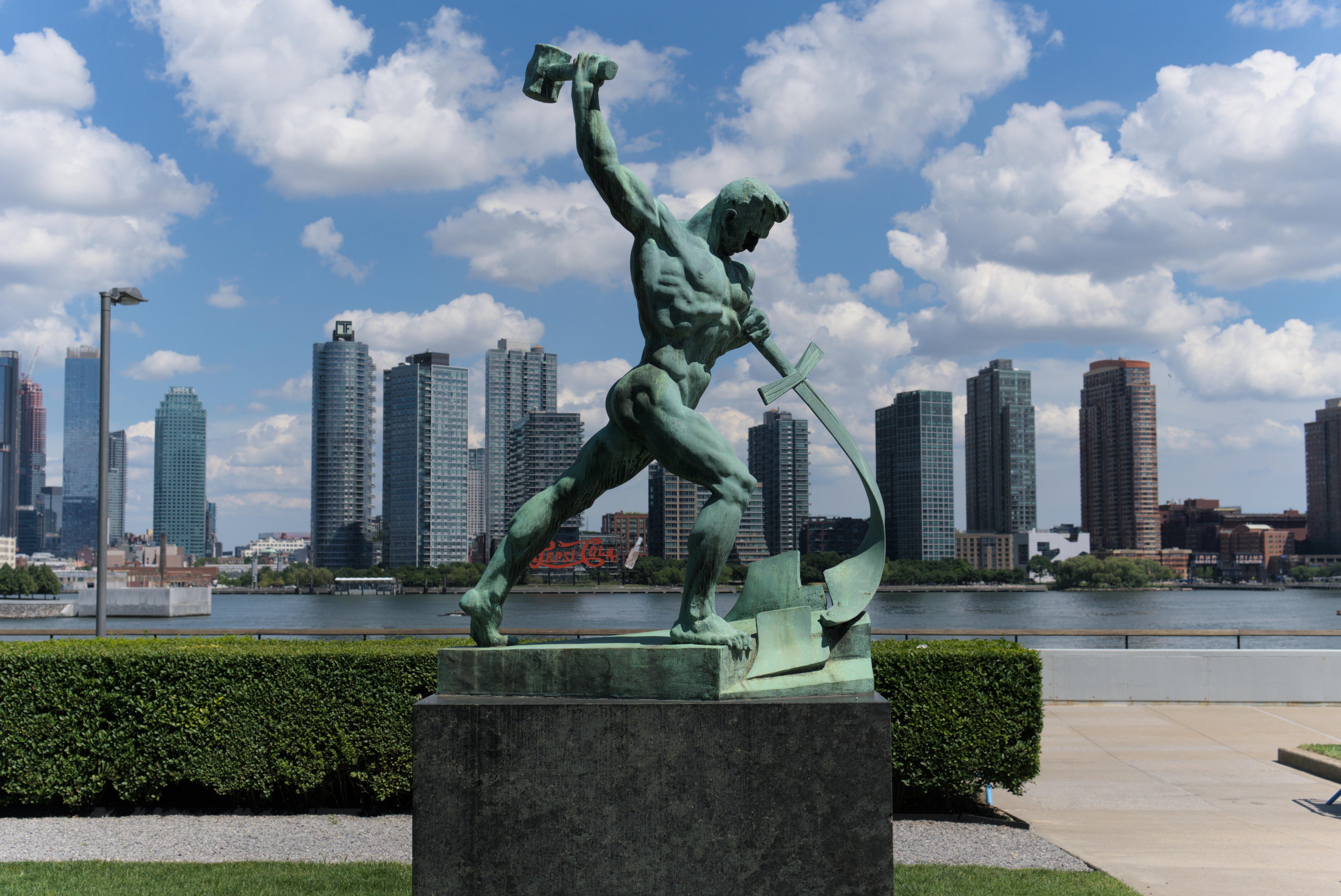
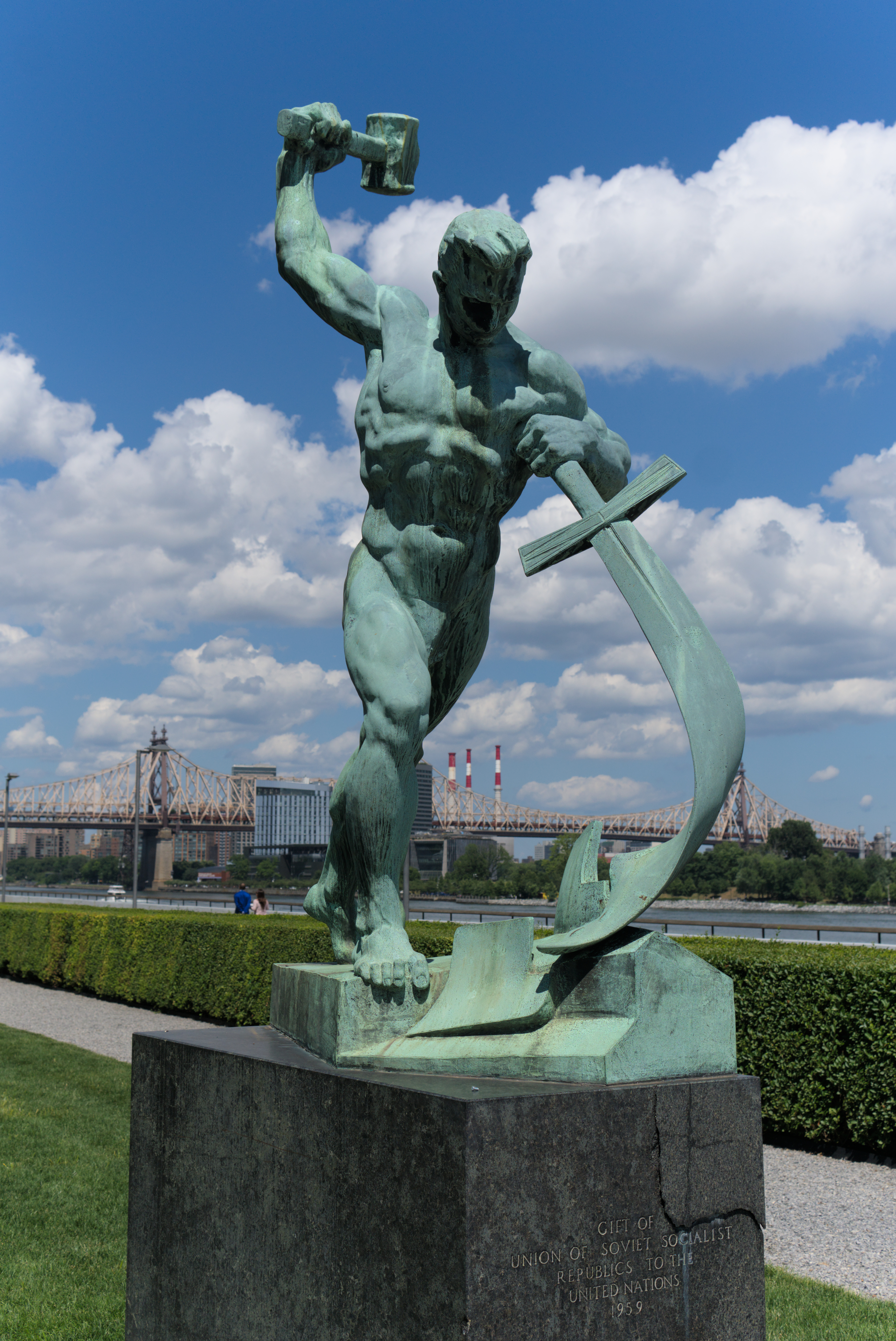
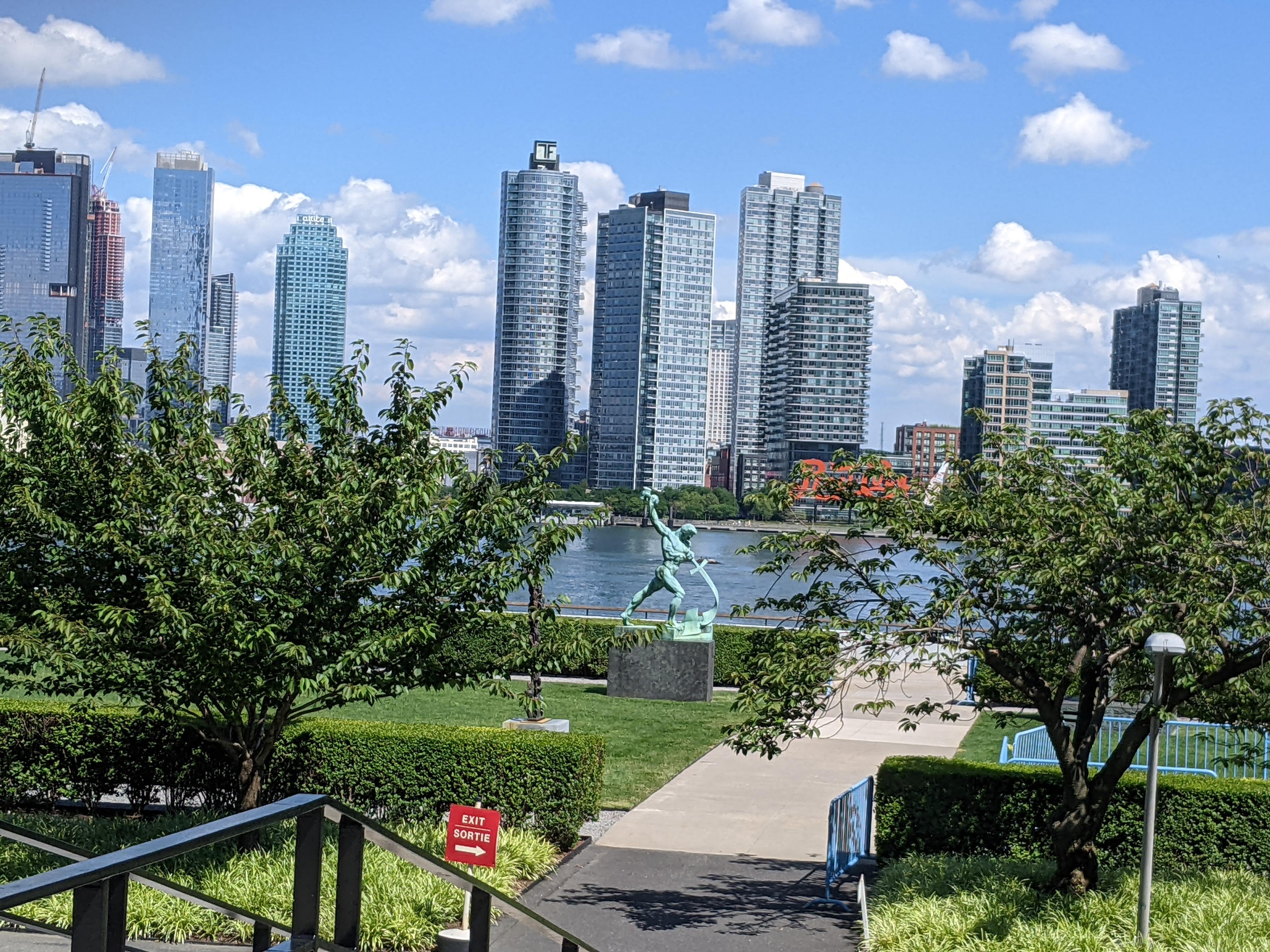
I had seen photos of the biblically inspired Let Us Beat Swords into Ploughshares and wanted to see it in person, so I paid up. It’s vaguely visible from the vantage of the free-access plaza outside the main entrance of the General Assembly Building.
Swords into Plowshares

But let’s move in closer.

Vuchetich, Yevgeny_Let Us Beat Swords into Ploughshares
Yevgeny Vuchetich (Russian, 1908–1974), Let Us Beat Swords into Ploughshares, 1959. Cast bronze and granite pedestal, figure 111 × 76 × 35 in., pedestal 44 × 75 × 34 in. North Lawn, United Nations Headquarters, New York. Gift from the USSR. Photo: Victoria Emily Jones. [object record]

Swords into Plowshares

Gifted to the United Nations by the USSR in 1959, the bronze sculpture is by the Soviet artist Yevgeny (sometimes spelled “Evgeniy”) Vuchetich, who was of Russian, French, and Serbian heritage and lived most of his life in Russia. It shows a muscular man (modeled by Olympic wrestler Boris Gurevich) hammering a sword into a plow blade, used to cut furrows for planting crops. Representing the transformation of tools of death into tools of life, the imagery is taken from Isaiah 2:4 in the Hebrew Bible, in which the prophet proclaims that “in days to come,” people of all nations “shall beat their swords into plowshares and their spears into pruning hooks; nation shall not lift up sword against nation; neither shall they learn war any more.” The vision is that in the kingdom of God, instead of the land being littered with human blood and corpses, it will be cultivated and bring forth good food.

This scripture text is the basis of the African American spiritual “Down by the Riverside” [previously], whose refrain declares, “I ain’t gonna study war no more!” One of the commonly used verses is “I’m gonna beat my sword into a plow.” Here’s Michael Wright’s version:

And, from 1959, the Golden Gate Quartet’s, arranged by Orlandus Wilson:

Reflecting the song lyrics, Vuchetich’s sculpture is itself planted “down by the riverside”—the East River.

(Related posts: “A Blessing for Those Who Hate and Hurt”; “The Christmas Truce of 1914”; Benjamin Rush’s “Plan of a Peace-Office for the United States”)

Vuchetich was one of the major figures of Soviet government–backed monumental sculpture, making his name from depictions of military heroes. So I find it a little odd that he was commissioned to make this peace sculpture that subverts the very militarism his other sculptures celebrate. One of his most famous pieces is The Motherland Calls; located at the top of Mamayev Kurgan hill overlooking the city formerly known as Stalingrad, it shows a female personification of Russia lifting high a sword in one hand and calling the Soviet people to battle with the other.

Look, many artists will take what work they can get, regardless of whether a commission matches their own ideology. I don’t claim to know what Vuchetich’s personal views were about war, violence, and empire.

Regardless of its disjunction with the artist’s larger oeuvre—and the uncomfortable fact that the donor’s successor state and caretaker of the sculpture, the Russian Federation, is persisting in an illegal and immoral war against its neighbor Ukraine—I really appreciate the theological imagination that Let Us Beat Swords into Ploughshares embodies, entreating us to apply our strength to constructive, not destructive, acts.

Nearby in the garden, not pictured in this article, is a literalization of the “swords into plowshares” principle. A recent gift from the Government of Colombia, Kusikawsay (Quechua for “peaceful and happy life”) is made of steel armaments melted and cast into the shape of a canoe, sailing upward. A donor representative said the sculpture for them symbolizes the end of an over-fifty-year armed conflict in their country. The idea is that the grotesque paraphernalia of war is metamorphosed into a benign watercraft that, in how it’s positioned, symbolizes humanity’s traveling into a lofty future.

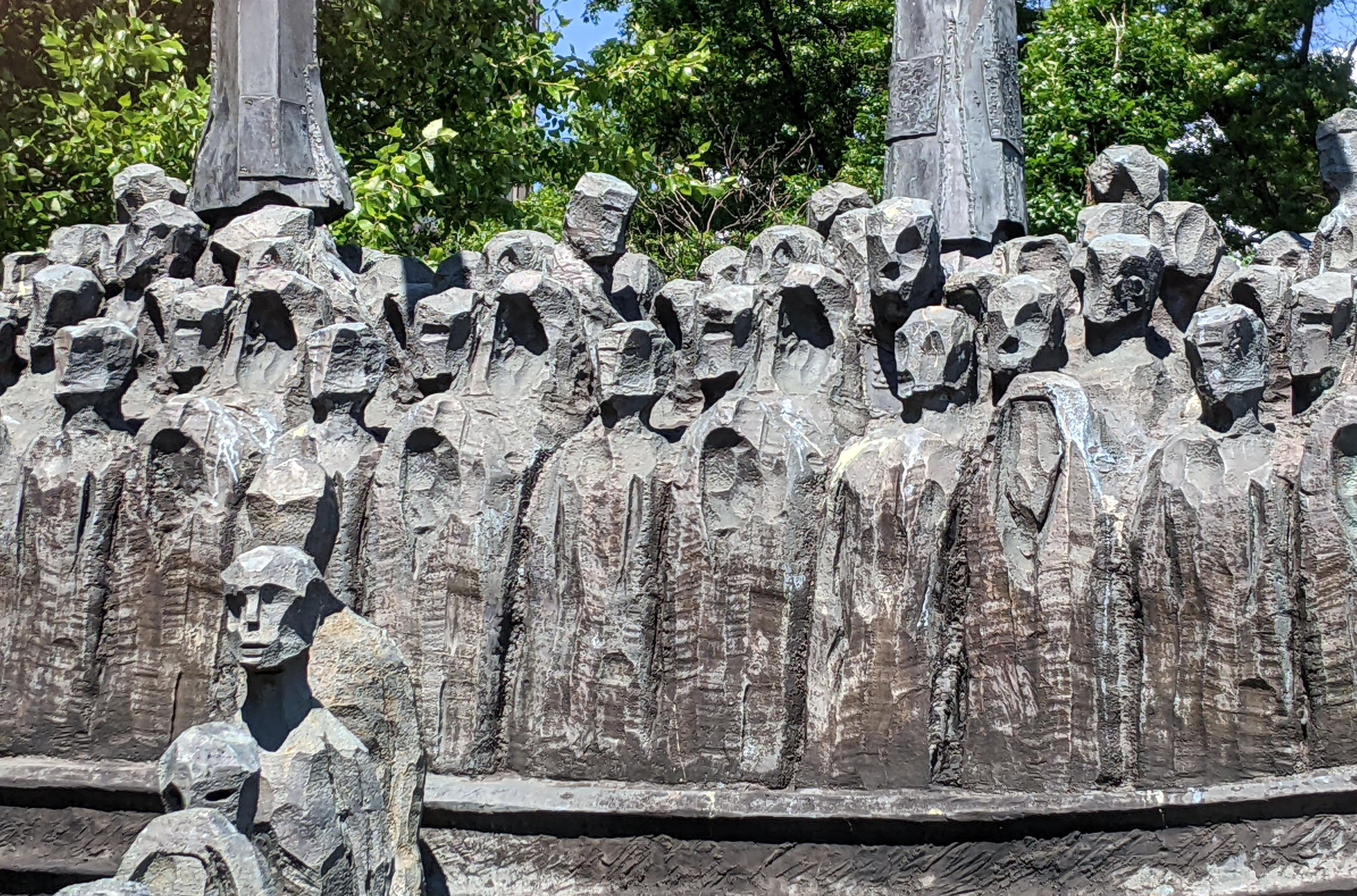
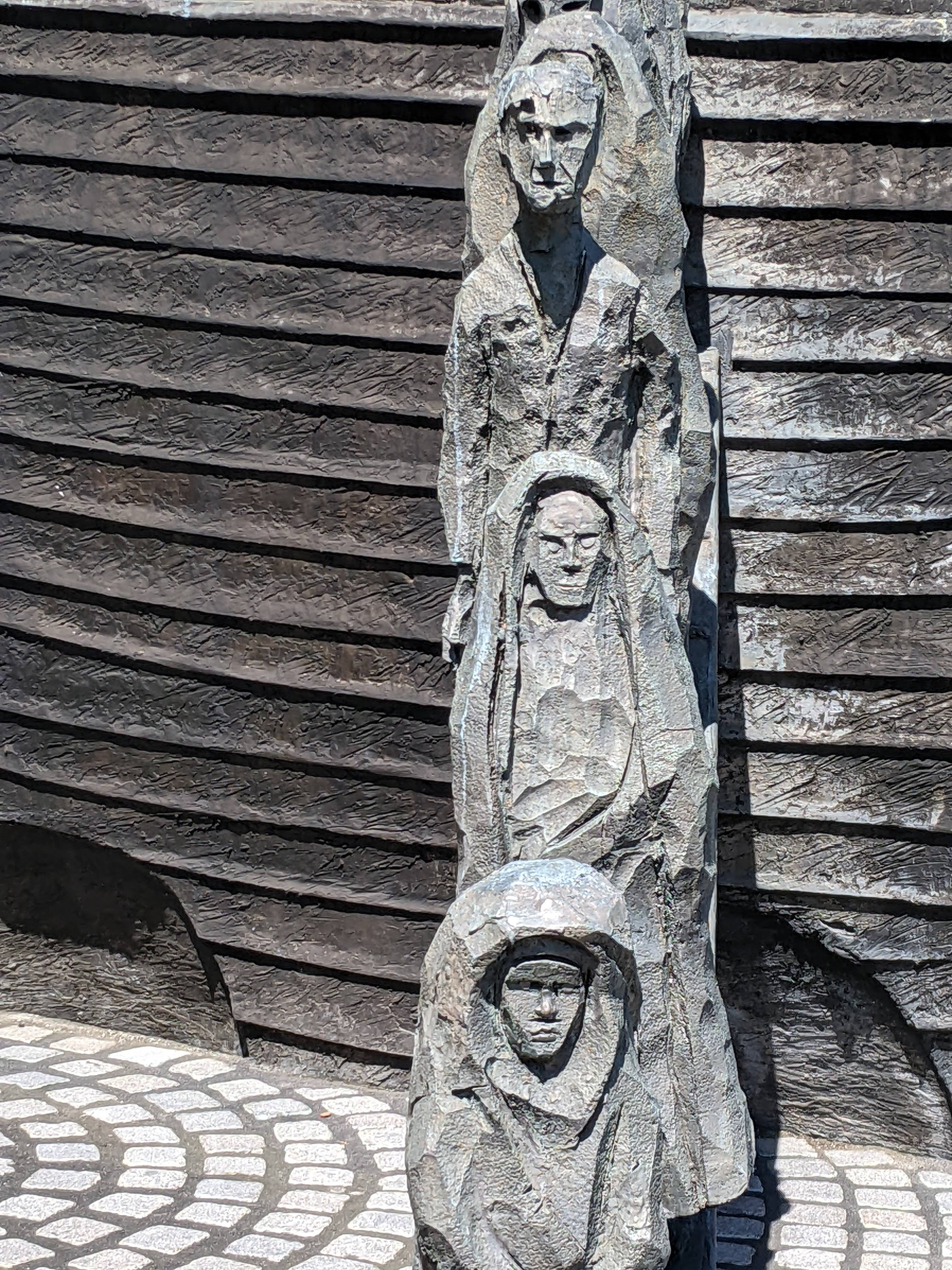
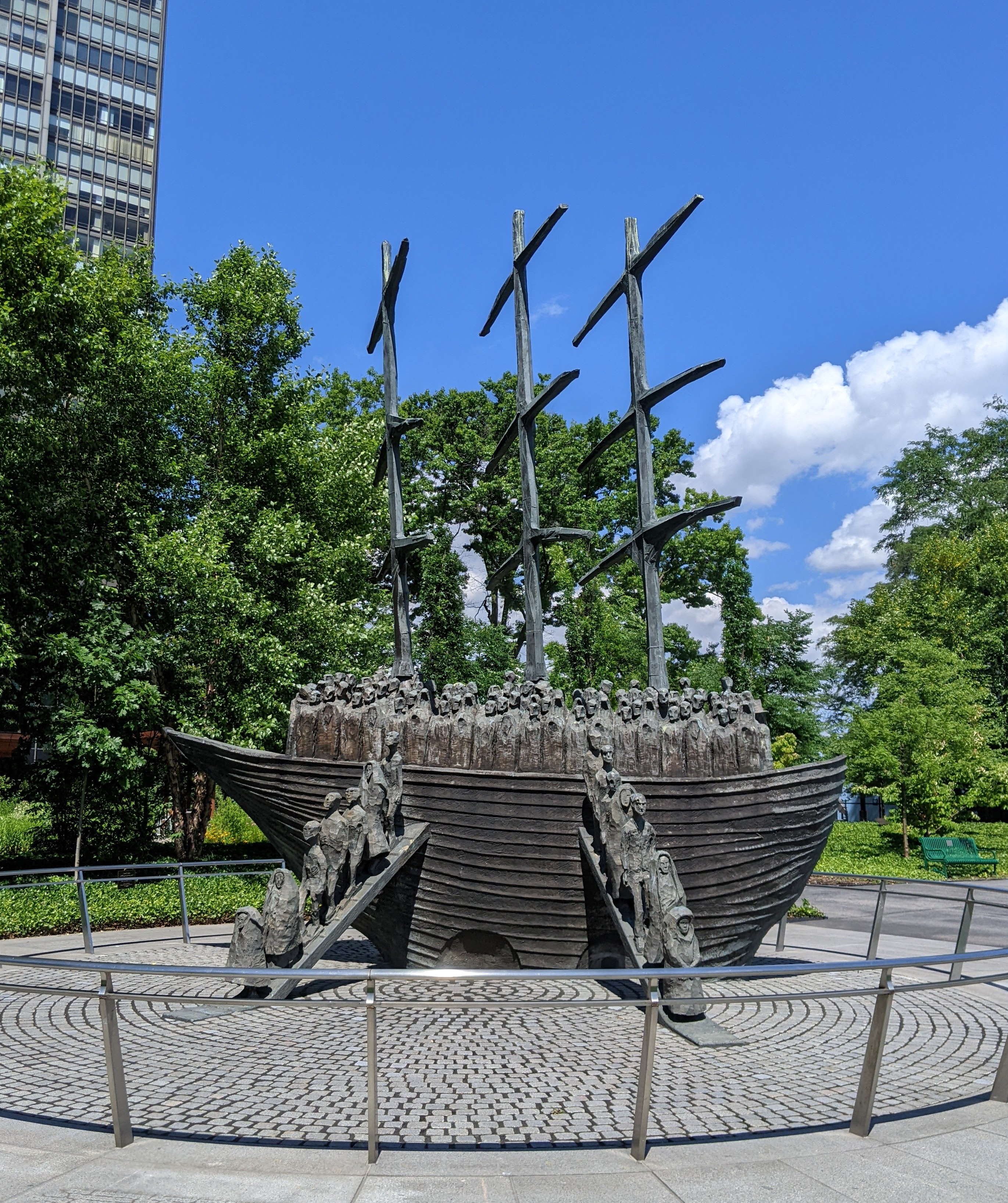
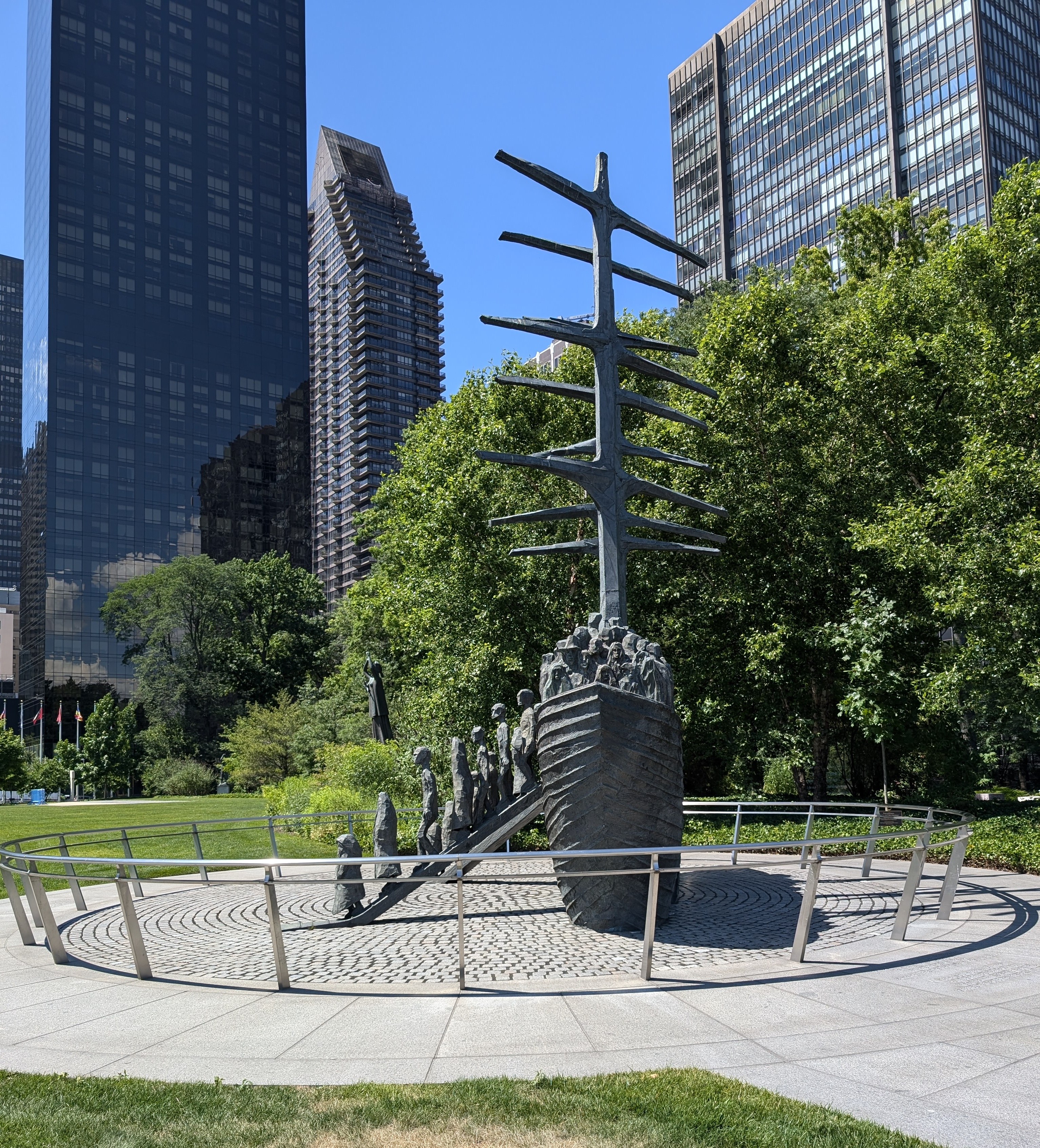
Another boat on the UNHQ’s North Lawn is Arrival by the Irish sculptor John Behan, which shows Irish immigrants disembarking into a new world. The sculpture was intended as a thank-you to the many nations that have received the Irish over the years, including Great Britain, the United States, Canada, Australia, Argentina, Chile, Mexico, New Zealand, and Brazil.
Behan, John_Arrival
John Behan (Irish, 1938–), Arrival, 2000. Bronze, stainless steel on granite pavers, 26 × 23 ft. North Lawn, United Nations Headquarters, New York. Gift from Ireland. Photo: Victoria Emily Jones. [object record]

Behan, John_Arrival

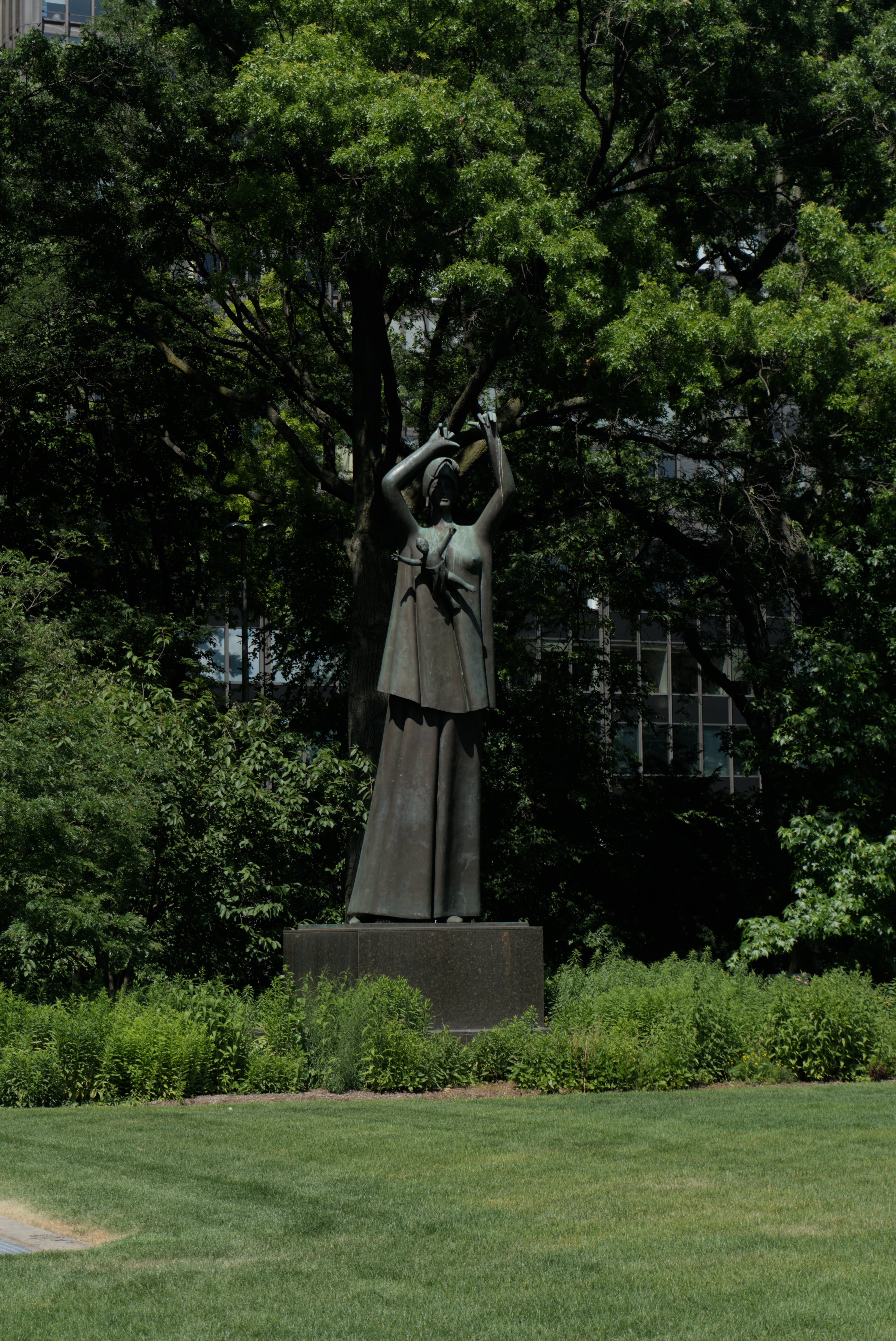
This piece wasn’t covered by the Garden Tour, nor was the colossal Mother and Child by the Italian artist Giacomo Manzù, which I spotted across the lawn and hurriedly snapped a distant photo of while scurrying to keep up with the group.
Manzù, Giacomo_Mother and Child
Giacomo Manzù (Italian, 1908–1991), Mother and Child, 1989. Bronze, 254 × 66 × 52 in. North Lawn, United Nations Headquarters, New York. Gift from Italy. Photo: Victoria Emily Jones. [object record]

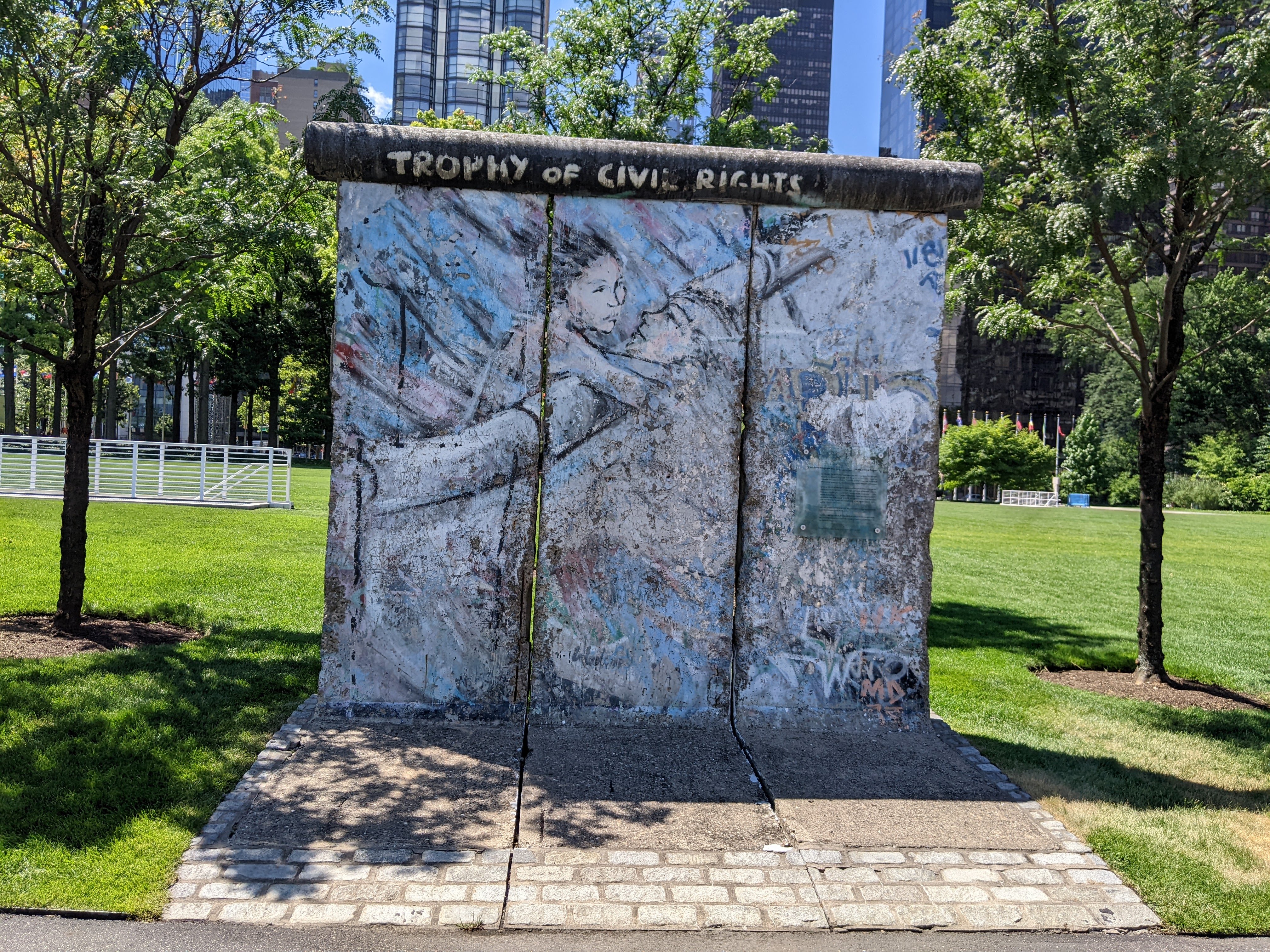
One of the pieces our guide did stop for and spend a good amount of time on was a fragment of the Berlin Wall gifted by Germany in 2002, after the wall came down in 1989. The ninety-six-mile-long barrier was erected in 1961 to divide the country into East (Communist) and West (Federal Republic), but a peaceful revolution in East Germany resulted in its fall and the country’s reunification as a federal republic, marking the end of the Cold War in Europe.
Alavi, Kani_Trophy of Civil Rights
Kani Alavi (Iranian German, 1955–), Trophy of Civil Rights (Berlin Wall Fragment), ca. 1998. Precast reinforced concrete wall sections with paint, overall 84 × 114 in. North Lawn, United Nations Headquarters, New York. Gift from Germany. Photo: Victoria Emily Jones. [object record]

The front of this three-slab wall fragment (that is, the side visible from the paved path) bears a mural by Kani Alavi, an Iranian artist who moved to West Berlin in 1980, living in an apartment overlooking the formidable “Checkpoint Charlie.” Throughout the 1980s, artists painted images on the west side of the wall as a form of political commentary and resistance. The east side, however, was unpainted during the Cold War because it was so heavily guarded; attempted art interventionists probably would have been shot.

After the border opened on November 9, 1989, and demolition of the wall began, Alavi was a key organizer of what’s known as the East Side Gallery, inviting artists from Germany and around the world to paint murals on the east side of the wall, across a segment that would be deliberately left standing as a memorial. “Alavi helped transform the most visible symbol of the Iron Curtain into an enduring monument to the power of freedom,” Ryan Prior wrote for CNN. This open-air gallery is one of Berlin’s most visited attractions, featuring the work of at least 118 artists from twenty-one countries.

Berlin Wall (detail)

Alavi painted Trophy of Civil Rights (I’m not sure whether that inscription was his or just a remnant from another artist, but it’s become the mural’s de facto title) on a section of remaining wall sometime around 1998. “It is a representation of two people hugging over the wall, a dramatic situation of people trying to get close to each other,” he told NPR through a translator. “It shows how the people were separated. It shows how a culture was divided by a wall. That’s what happened, and that’s what I showed.”

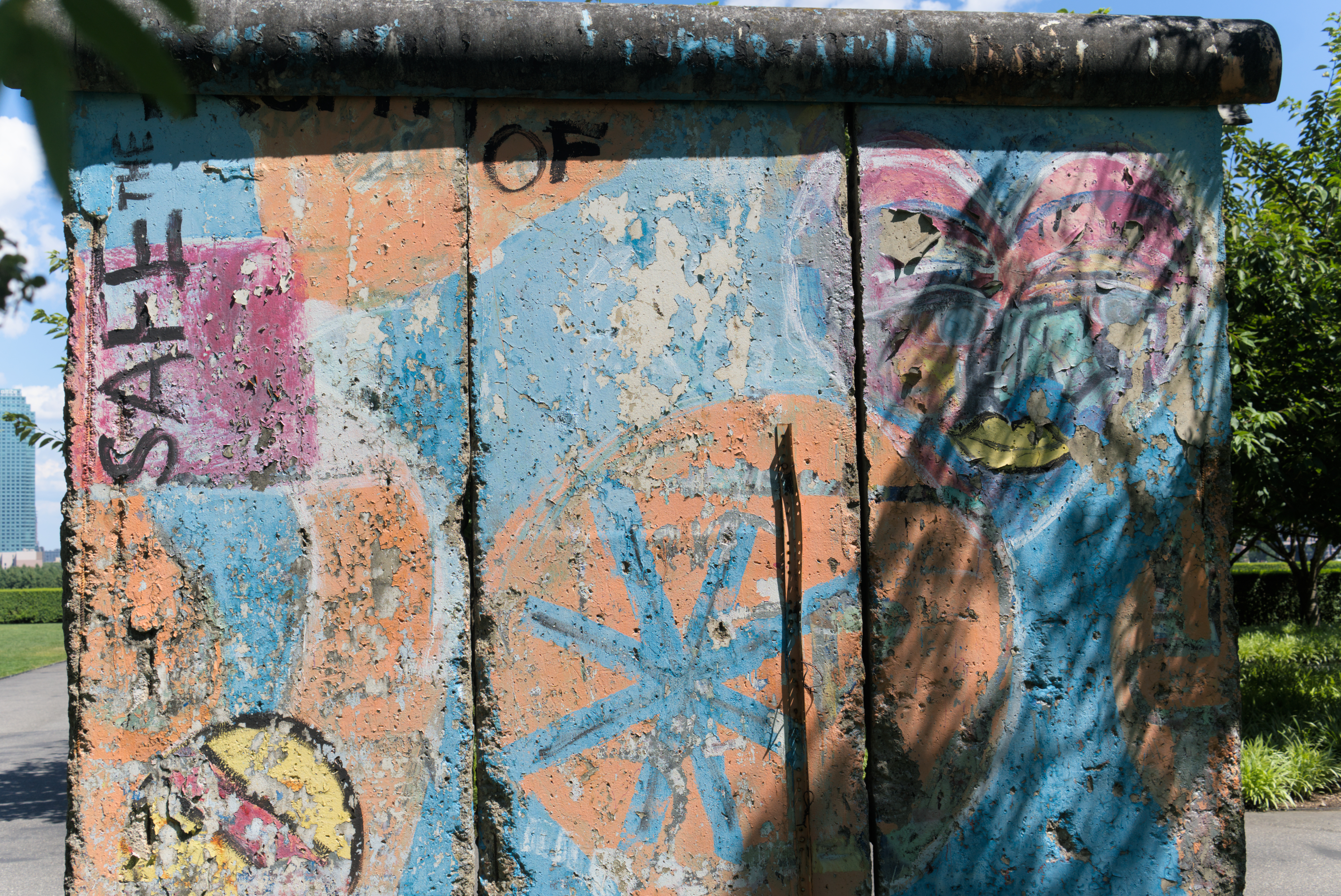
The other side of the wall is painted with miscellaneous graffiti by anonymous artists.
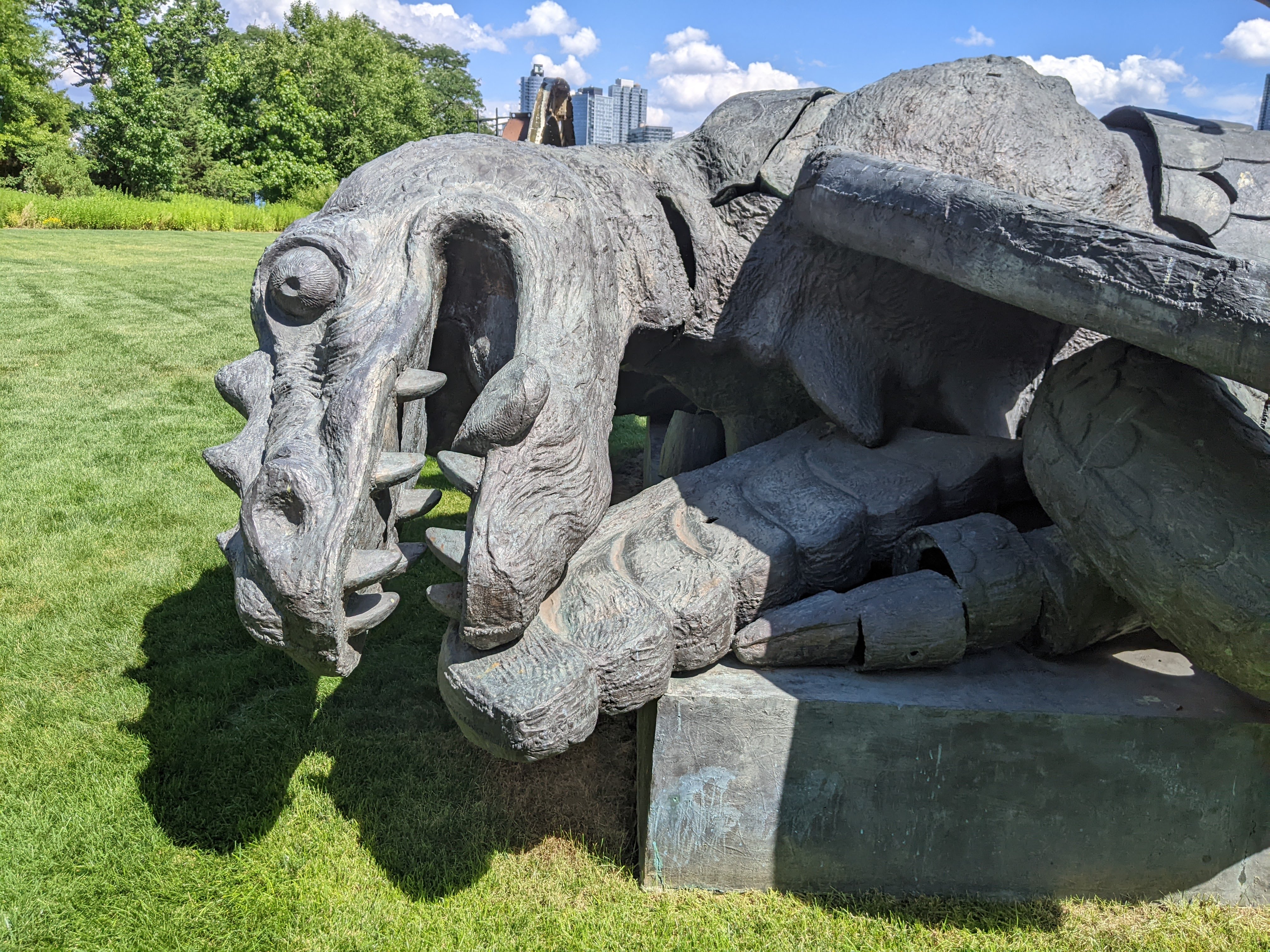
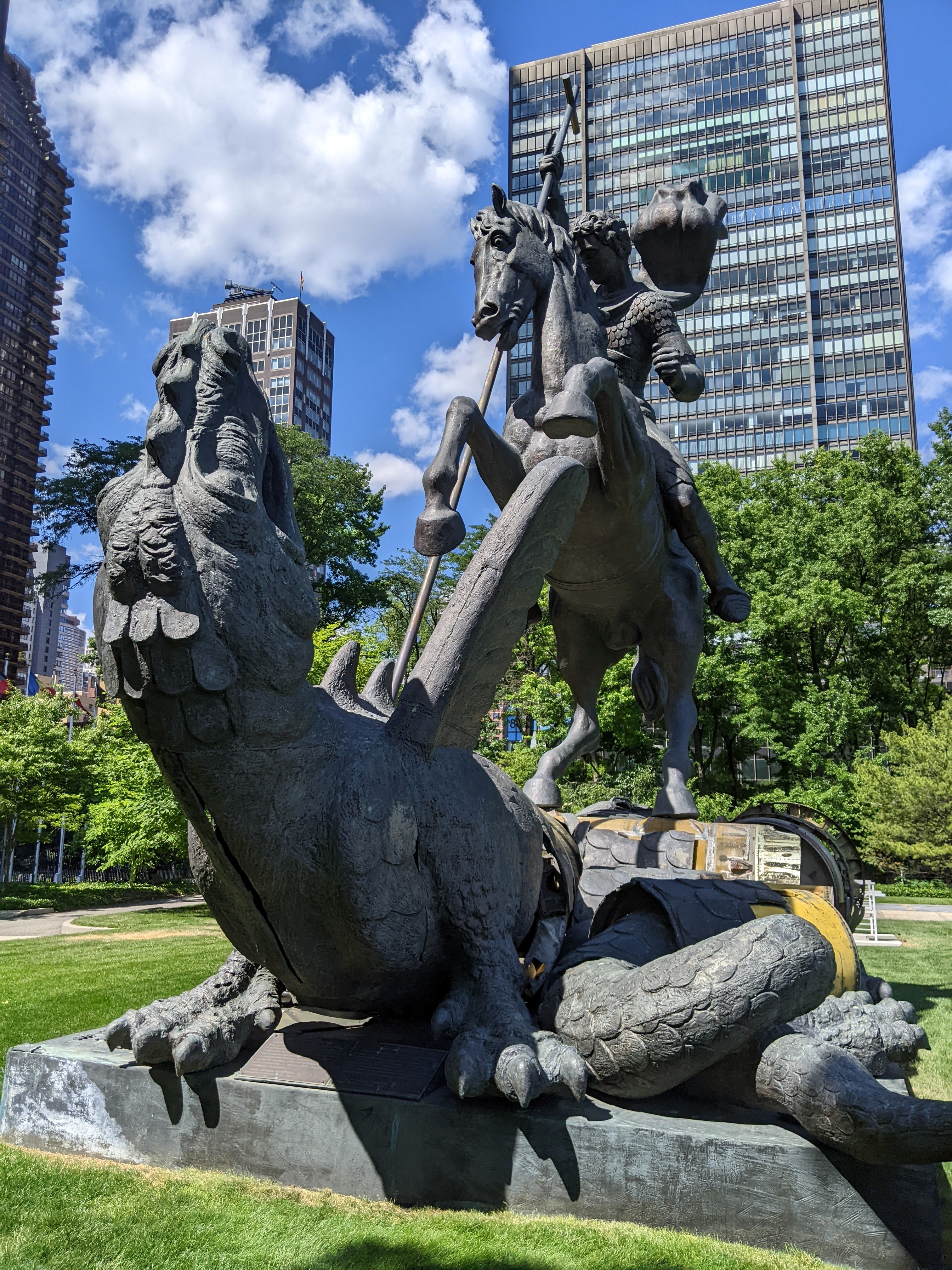
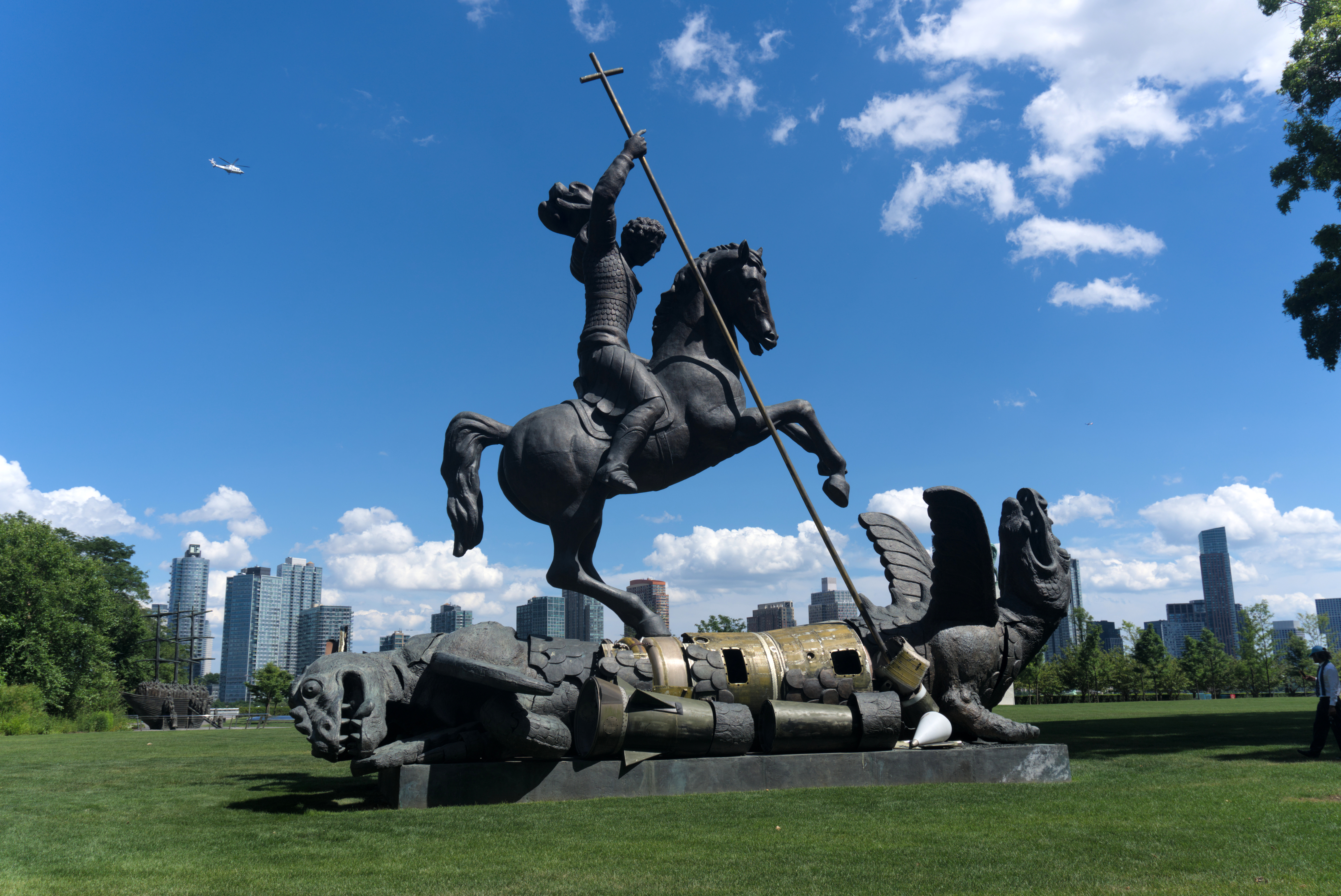
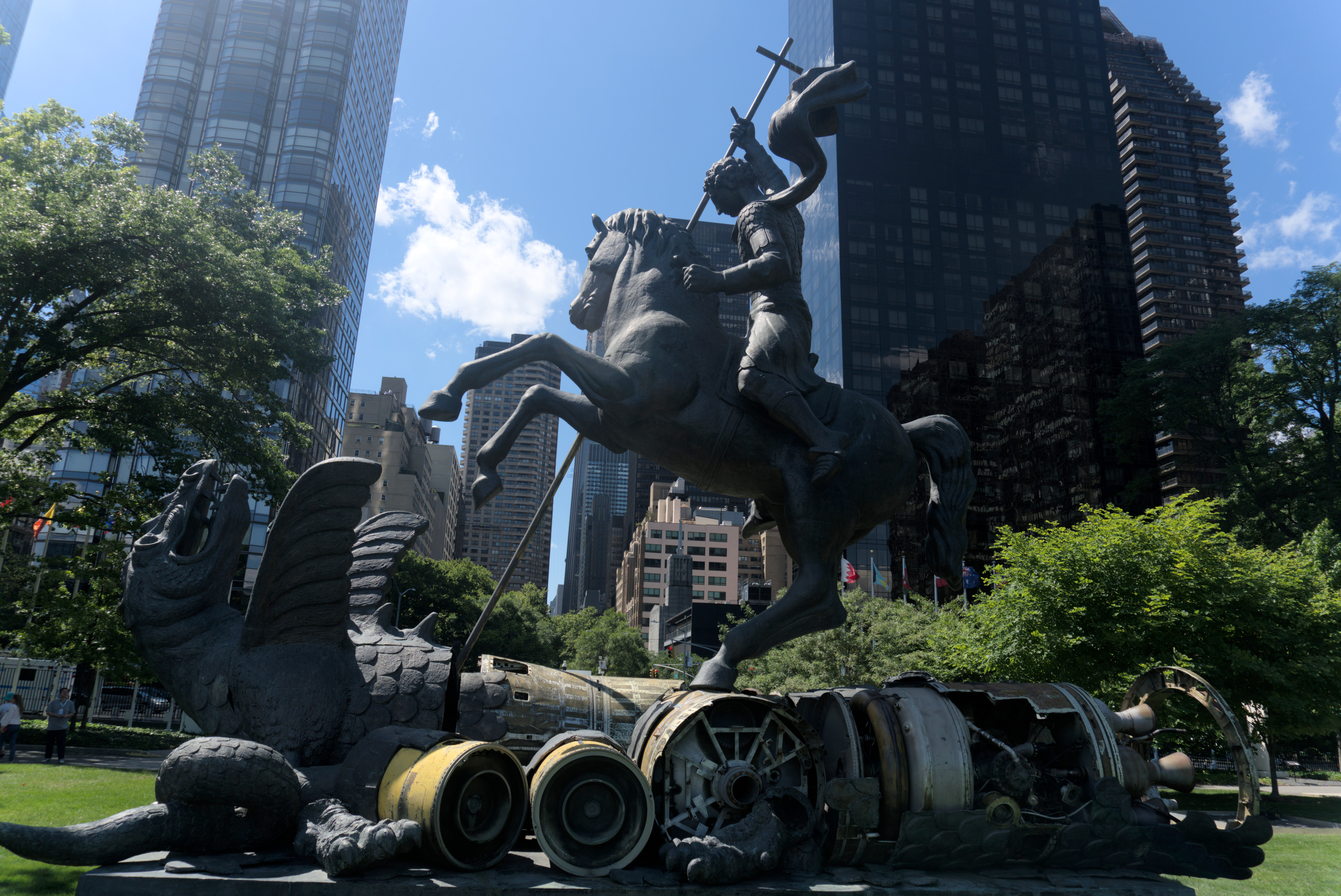
The largest sculpture on the North Lawn, standing at thirty-one feet tall and weighing forty tons, is Good Defeats Evil by the Georgian Russian sculptor Zurab Tsereteli. It depicts the Early Christian martyr-saint George, who was tortured and executed in 303 under the Diocletian persecution. Legends about him started developing in the sixth century and by the thirteenth century were widely circulated and embellished to include a tale of him slaying a dragon to save a Libyan princess whom the terrorized villagers had planned to sacrifice to it for appeasement.
Tsereteli, Zurab_Good Defeats Evil
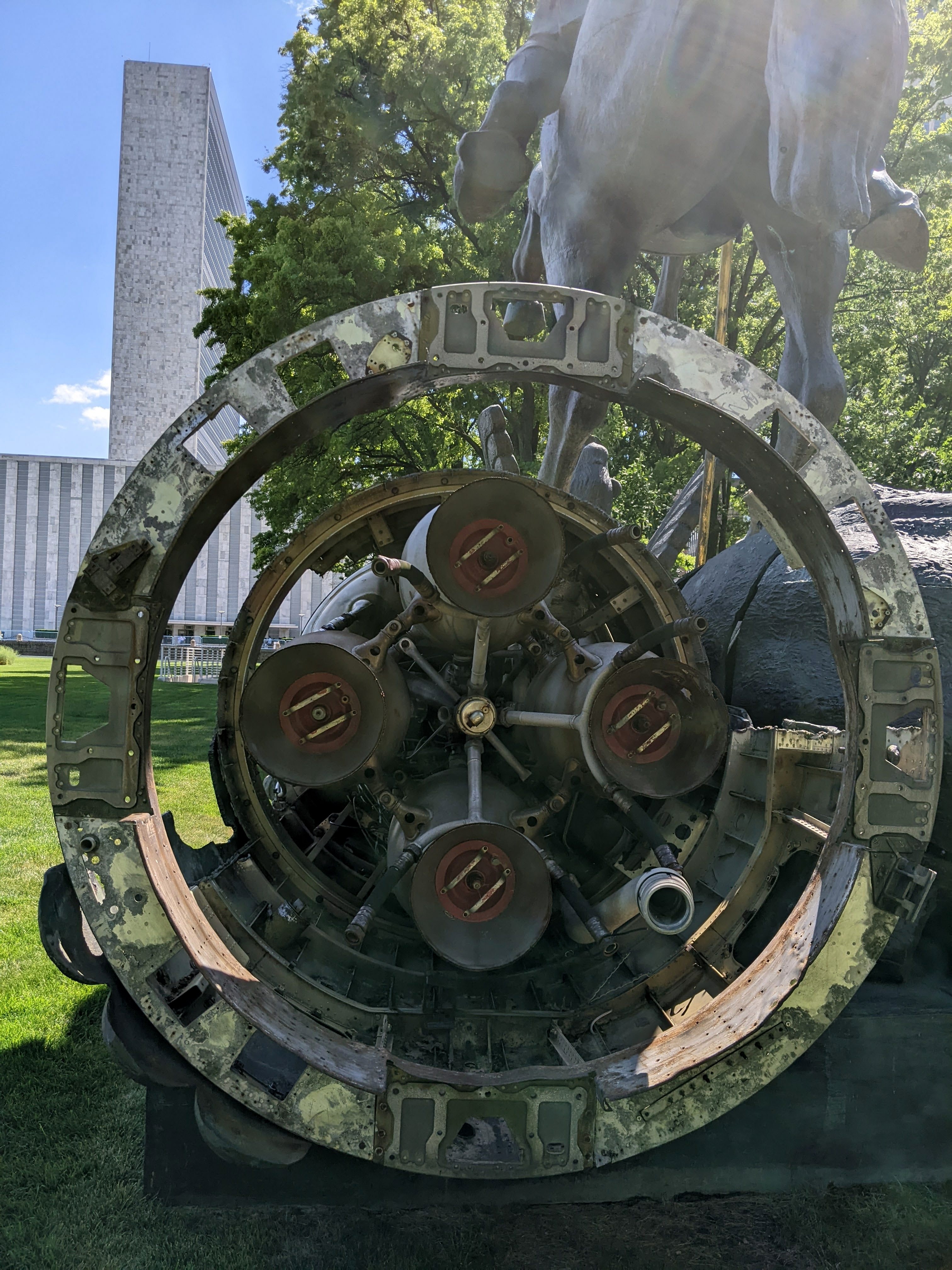
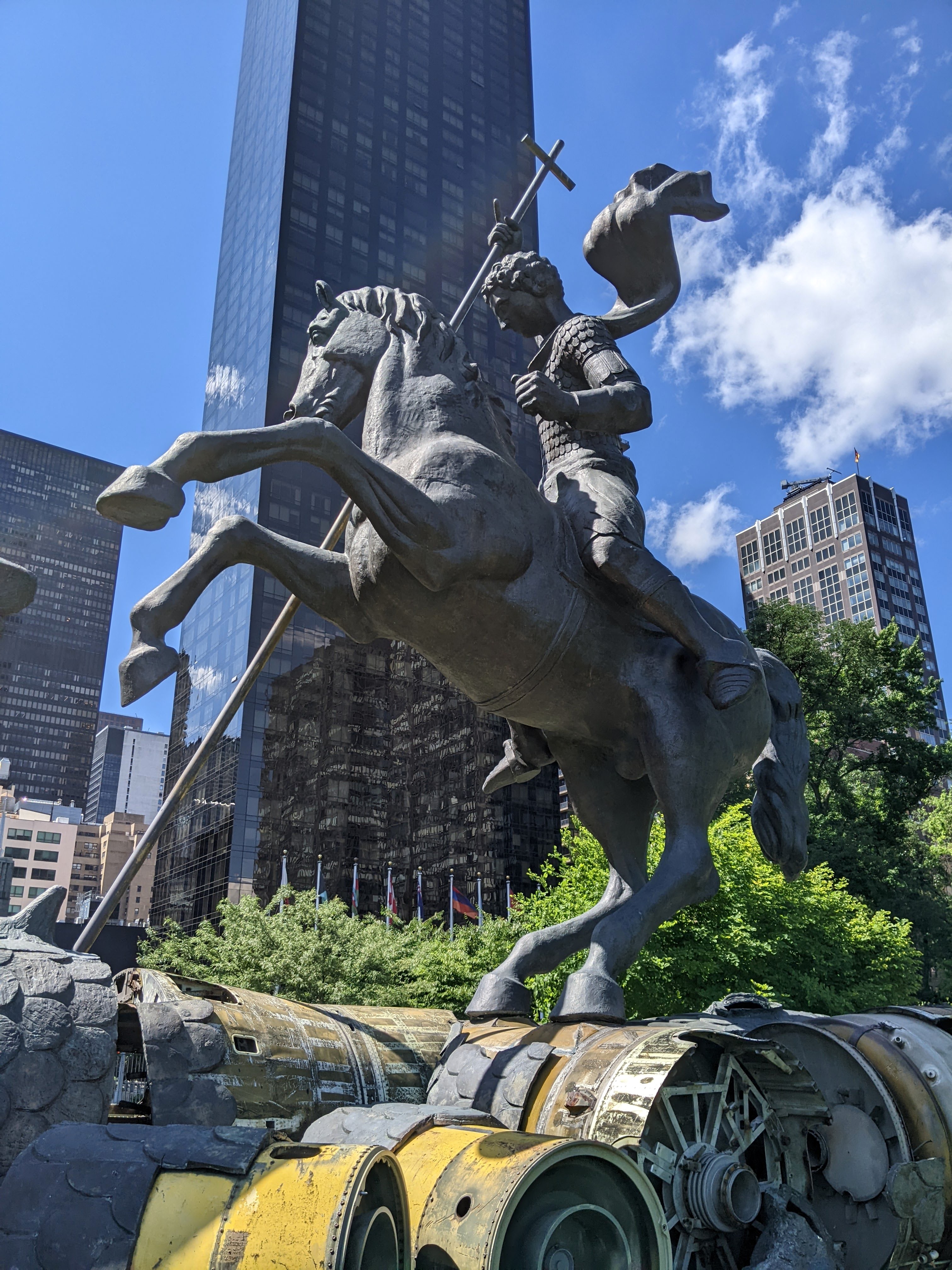
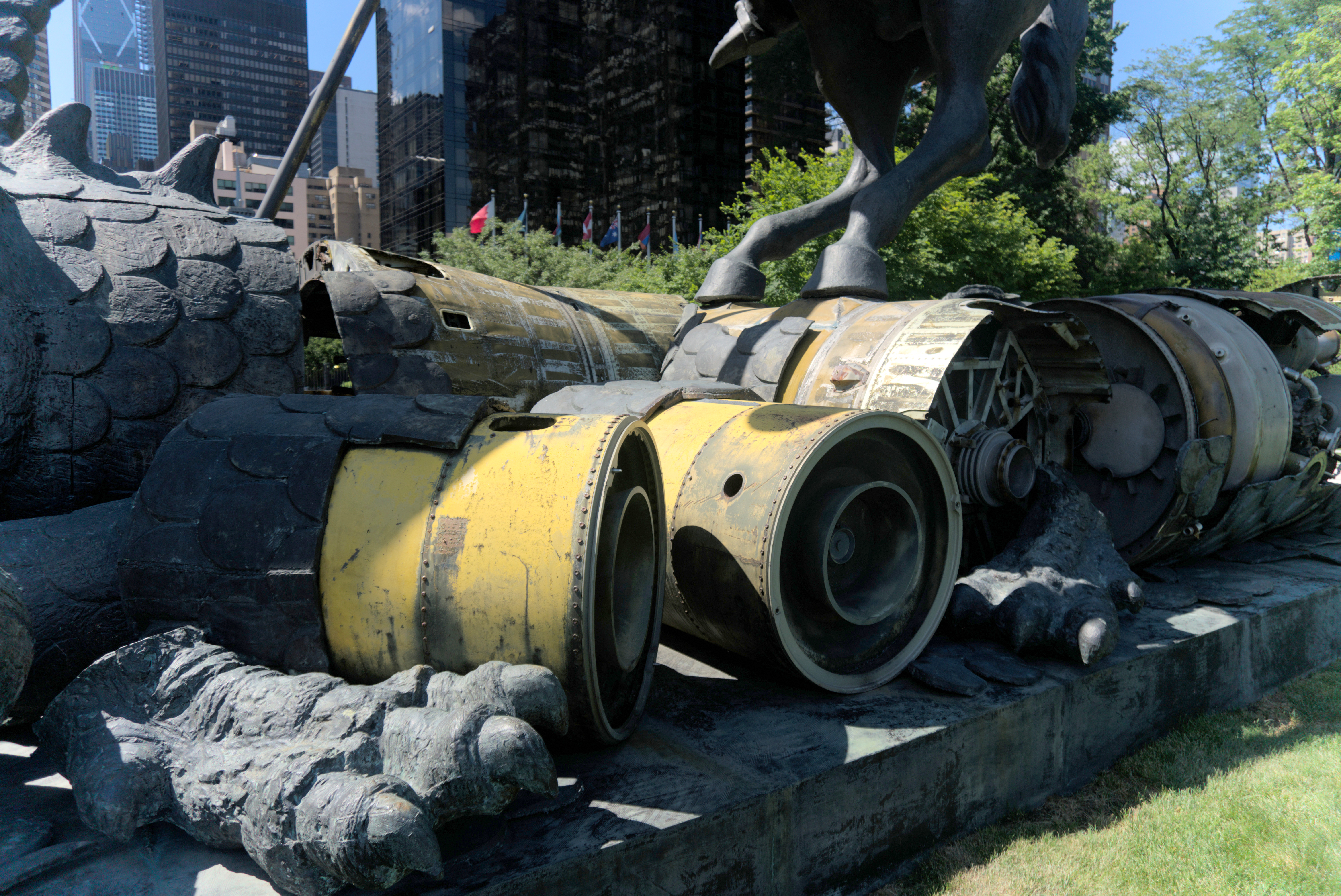
Zurab Tsereteli (Georgian Russian, 1934–), Good Defeats Evil, 1990. Cast bronze figure with dragon formed from sections of two destroyed nuclear missiles, 31 × 18 × 10 ft. North Lawn, United Nations Headquarters, New York. Gift from the USSR. Photo: Victoria Emily Jones. [object record]

Tsereteli, Zurab_Good Defeats Evil (back)
Tsereteli, Zurab_Good Defeats Evil (detail)

(Side note: Saint George is not to be confused with Saint Michael the Archangel from the book of Revelation, who in Christian iconography is usually shown on foot [but occasionally on horseback], also slaying a dragon. The easiest way to tell the two saints apart is that Michael has wings, whereas George does not.)

The most intriguing aspect of this sculpture is that the two-headed dragon is made up of sections of two destroyed nuclear missiles, making the piece a symbol of disarmament. According to the UN website, here

the dragon is not the mythological beast of early Christian tradition, but rather represents the vanquishing of nuclear war through the historic treaty between the Soviet Union and the United States [the Treaty on the Elimination of Intermediate-Range and Short-Range Nuclear Missiles, signed in 1987]. Created as a monument to peace, the sculpture is composed of parts of actual United States and Soviet missiles. Accordingly, the dragon is shown lying amid actual fragments of these weapons, the broken pieces of Soviet SS-20 and U.S. Pershing missiles.
Tsereteli, Zurab_Good Defeats Evil (detail)

The dragon’s two heads thus represent the world’s two largest nuclear arsenals during the Cold War: those of the Soviet Union and the United States.

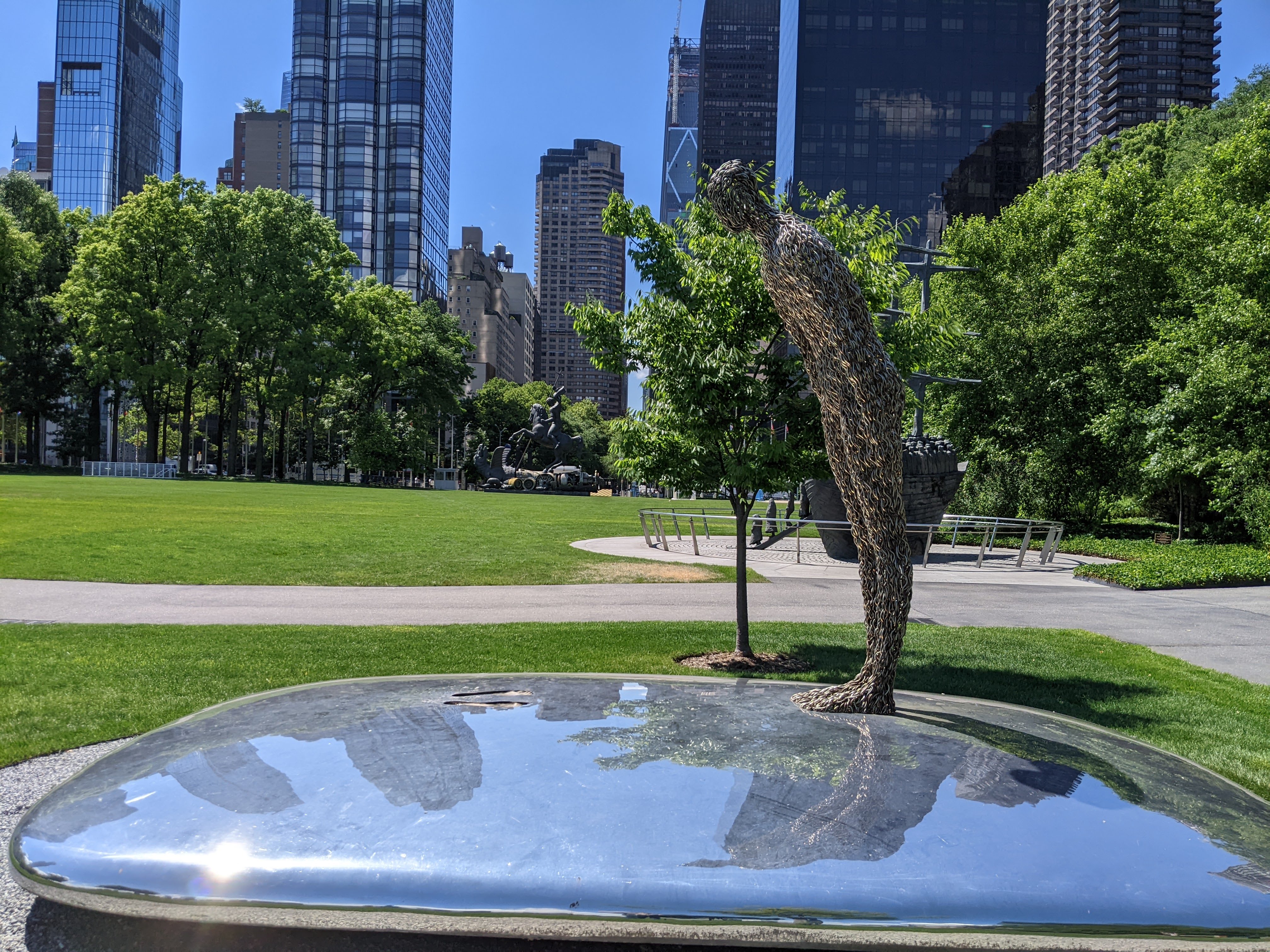
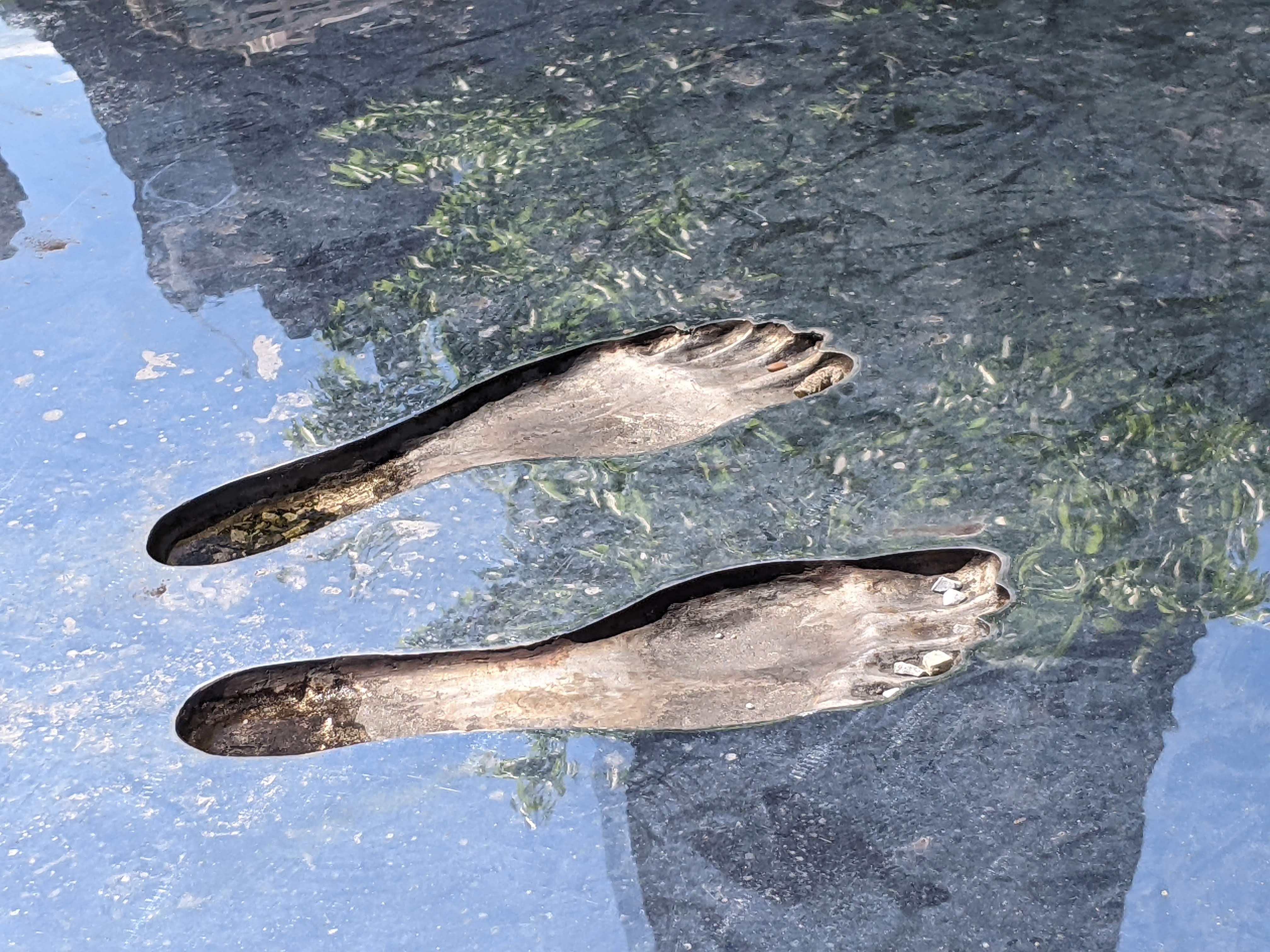
The last sculpture I’ll mention is Consciousness by the Mongolian artist Ochirbold Ayurzana. It consists of a rounded, high-luster steel alloy floor plate on which stands a human figure, made of twisted metal strings, examining the footprints they’ve left on the planet. What mark will we make, for good or ill? The sculpture is dedicated to the historic adoption of two global developmental milestone documents: the UN 2030 Agenda for Sustainable Development and the Paris Agreement on Climate Change.
Ayurzana, Ochirbold_Consciousness
Ochirbold Ayurzana (Mongolian, 1976–), Consciousness, 2017. Steel, metal on pedestal, 110 × 196 × 125 in. North Lawn, United Nations Headquarters, New York. Gift from Mongolia. Photo: Victoria Emily Jones. [object record]


This is just a selection of the many artworks on view at the United Nations Headquarters in Manhattan. To view a full catalog, click here.

Garden Tours are offered every Wednesday at 2 p.m. from May through August, and Art Tours are offered every other Thursday at 1:15 p.m. year-round—or either one upon request. I’m grateful for their having accommodated me and my husband while we were in town!

I really wish the UN would allow visitors to move through the garden at their own speed, though, as the tour was so fast-paced that I hardly had time to take in a sculpture before we were made to move on to the next one. Approximately one to three minutes was apportioned for each work, which is hardly enough time to sit with the weight and history of some of these pieces. And I didn’t have time to change camera lenses for different types of shots. Because you have to be accompanied by a staff person, you are not allowed to linger behind when the group advances. Some leeway was given to me, but overall I felt rushed. Perhaps the pacing was anomalous because it was such a hot day—in the nineties—and the few shaded areas were prioritized.

Despite the swiftness, I really enjoyed the tour and experiencing and learning about the variety of sculptures and other art pieces from a variety of UN member countries, which celebrate peace, joy, and global unity and project a hopeful future.
Roundup: “Incarnation and Imagination” lecture, Planet Drum, and more

PODCAST EPISODE: “Incarnation and Imagination (with Malcolm Guite),” Imagination Redeemed: On March 28, 2015, the Anglican poet-priest Malcolm Guite from Cambridge, England, gave a talk in Colorado Springs for the Anselm Society, an ecumenical Christian organization whose mission is a renaissance of the Christian imagination. They have just released it on their podcast.

Guite discusses how the job of the arts is to link earth and heaven, heaven and earth; where a poem or other work of art stays on only one of those planes, it typically fails. He unpacks Theseus’s monologue from Act 5, scene 1 of Shakespeare’s A Midsummer Night’s Dream, focusing on these six lines: “The poet’s eye, in fine frenzy rolling, / Doth glance from heaven to earth, from earth to heaven. / And as imagination bodies forth / The forms of things unknown, the poet’s pen / Turns them to shapes and gives to airy nothing / A local habitation and a name.”

Shakespeare, Guite says, is riffing on the prologue to John’s Gospel.

The Logos . . . is bodied forth perfectly and beautifully in the living, walking poem of Jesus Christ, in whom everything eternal is made particular, and who invites everybody to come towards him . . . because he is a habitation with open doors. So of course in John’s Gospel he says, ‘I am the door’! . . . Open up, walk in! (48:51)

And one more quote from Guite!

The church . . . is founded by one who is himself artistically embodied meaning—meaning made visible, meaning made beautiful, meaning made habitable and hospitable and welcoming in the touch of the body and in the physical event, which is then transfigured, because it is also a meaningful event, because earth and heaven meet. (55:34)

It’s a brilliant and inspiring talk, and it integrates other poetic verse besides Shakespeare’s.

+++

MUSIC:

>> “More Love, More Power” by Paul Livingstone and Benny Prasad: This sitar-guitar duet is performed by Paul Livingstone (a multi-instrumentalist and composer of “ragajazz chamber music” who was one of the few American disciples of the late Ravi Shankar) and gospel musician Benny Prasad [previously]. The performance took place June 11 at Chai 3:16, a four-hundred-seat café and community space that Prasad founded in Bengaluru to reach out to college students. (Chai is Hebrew for “life,” and “3:16” refers to the famous verse in the Gospel of John about God’s love.) [HT: Global Christian Worship]

>> “King Clave” by Planet Drum: In 1991 Mickey Hart (best known as a drummer of the Grateful Dead) and Zakir Hussain (a classical tabla virtuoso from Mumbai) formed the Grammy-winning global percussion ensemble Planet Drum, bringing together the world’s greatest rhythm masters into a one-of-a-kind improvisational supergroup. Prompted by ongoing international strife, Planet Drum reconvened over the past two years to record their third album, In the Groove, which released August 5. It features six unique compositions led by Hart, Hussain, Sikiru Adepoju of Nigeria, and Giovanni Hidalgo of Puerto Rico.  

The centerpiece of the album is “King Clave” (the clave is a rhythmic pattern), created in partnership with Playing for Change and with funding from the United Nations Population Fund. The four core musicians mentioned above are joined by other percussionists and dancers from around the world. The music video uses the “Alternate Version” of the performance, released separately as a single.

Learn more about the Planet Drum project in this six-minute video:

+++

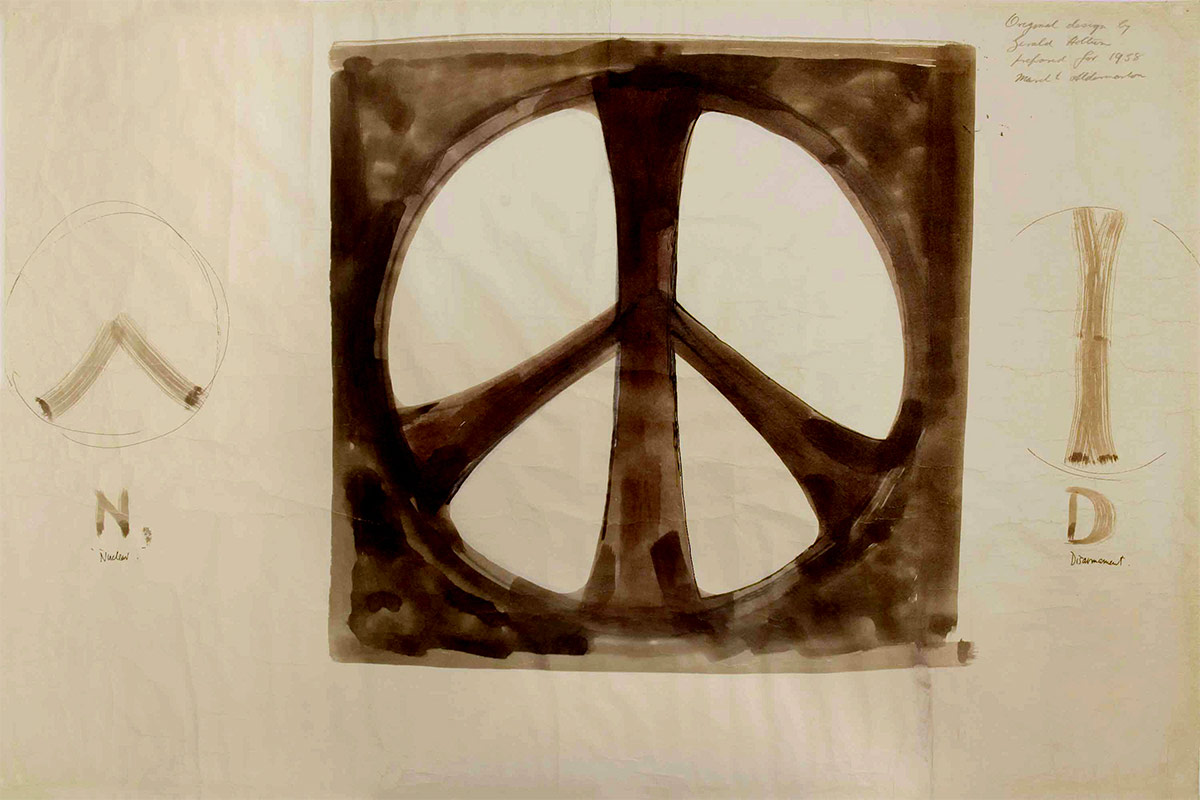
STILL LIFE EDITION: “The History of the Peace Symbol” by Michael Wright: Did you know that the peace symbol that spread worldwide during the 1960s was designed by a Christian from the UK? (Christian pacifism was one of the underappreciated drivers of the nuclear disarmament and antiwar movements.) Learn more about the symbol’s history and art historical and nautical influences in the August 15, 2022, edition of Michael Wright’s weekly letter on art and spirit, Still Life. Also included is the poem “Wildpeace” by Yehuda Amichai, and four weblinks of interest, such as an article on how the patristic tradition agrees with cognitive neuroscience, and a video of FKA Twigs performing in a church!

Holtam, Gerald_Peace
Sketch of nuclear disarmament symbol by Gerald Holtom, created for the first Aldermaston March in 1958. © Commonweal Collection, University of Bradford, England.

+++

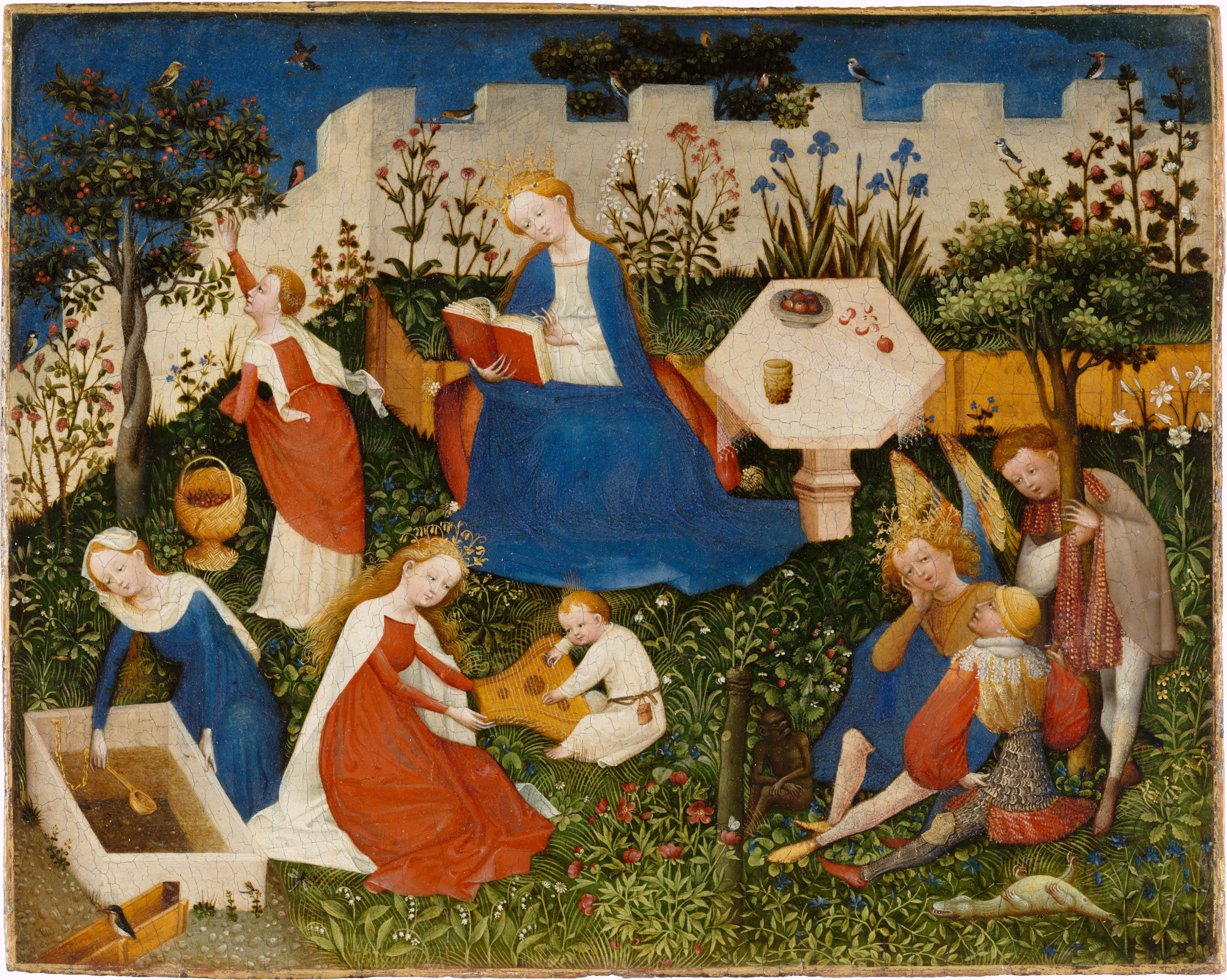
VIDEO LECTURE: “Symbolism and Sacramentality in Art: Medieval and Postmodern Representations of the Little Garden of Paradise” (Religion and Art Talks) by Tina Beattie: Dr. Tina Beattie is a professor emerita of Catholic Studies at the University of Roehampton whose research is at the intersections of art, gender, and theology. In this talk she explores the sacramental imagination of the medieval world through a Late Gothic painting from the Rhineland known as The Little Garden of Paradise. (You can zoom in in tremendous detail on the Städel Museum’s website.) It shows Mary reading in an enclosed garden in the company of saints, her little boy Jesus playing a psaltery at her feet. “Christ retunes the cosmos,” Beattie says. “The harmonies of creation were disrupted by sin. But all of creation is brought back into harmony through the Incarnation.”

Symbolism and allegory abound in medieval religious paintings, encoding profound meanings that can be discerned if we would but take the time to look and to meditate and to understand the world from which these images arose. “The visual image can say things that the theological text can’t,” Beattie asserts. “It can play with the doctrinal truth in ways that allow other meanings to emerge discreetly.”

Though many interpretations of hortus conclusus imagery focus on Mary’s virginity, and indeed that was a primary aspect motivating the creatives who developed such imagery, Beattie draws out themes of new creation and discusses the garden as the human soul.

The Little Garden of Paradise
The Little Garden of Paradise, Upper Rhine, ca. 1410–20. Mixed media on oak, 26.3 × 33.4 cm. Städel Museum, Frankfurt am Main, Germany.

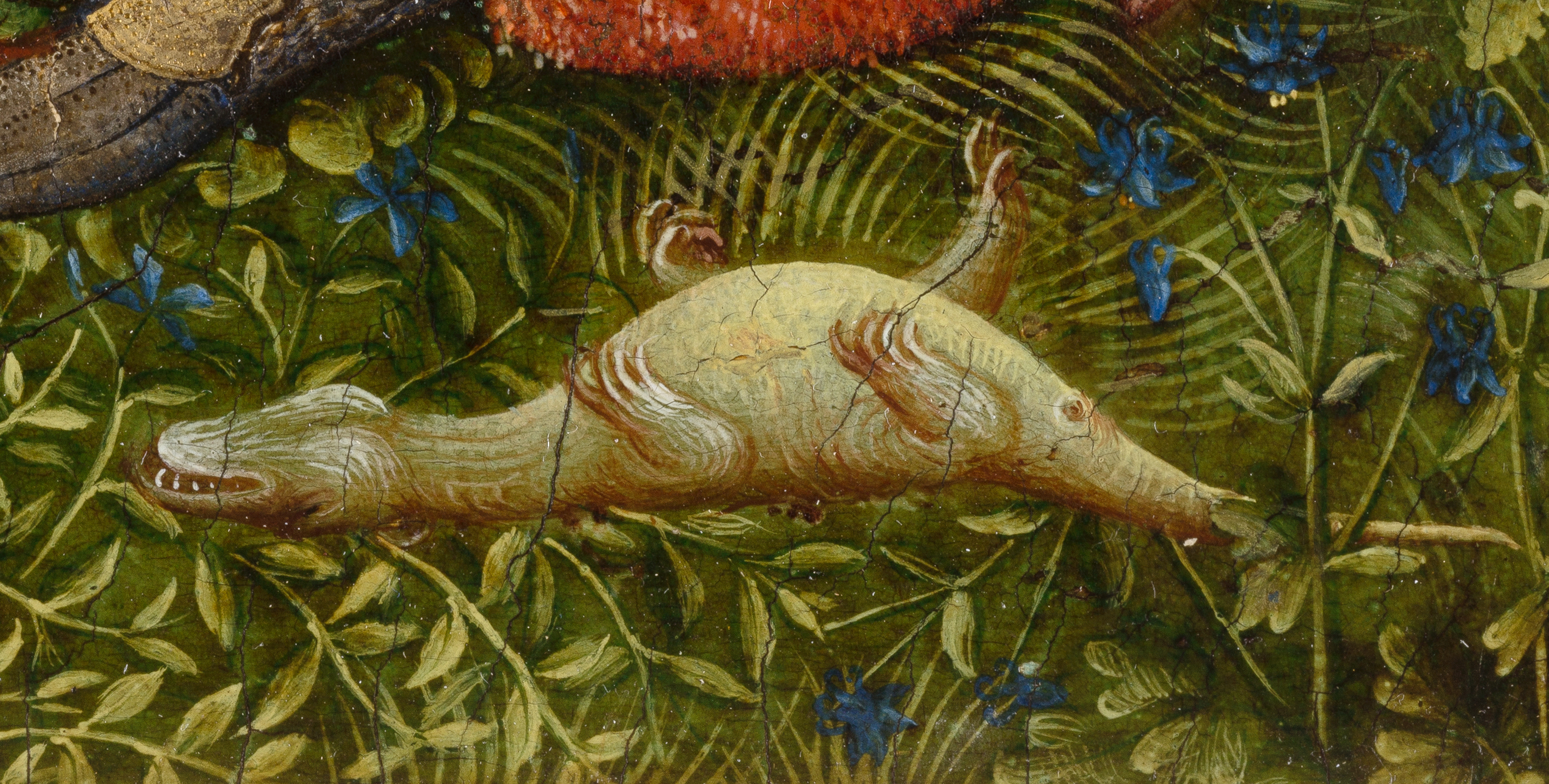
The Little Garden of Paradise (detail, dragon)
A small, slain dragon lies belly-up beside a man in greaves and chain mail, probably Saint George.

The other artworks she glosses are:

The last half hour of the video features audience engagement.

Roundup: Guite-Bell live event, Sister Corita Kent, and more

FREE LIVE EVENT: “Faith and the Imagination: Poetry, Song, and Inspiration with Steve Bell and Malcolm Guite,” June 4–7, 2022, Greater Seattle area: Join hundreds of Seattle artists and ministry leaders for four days of poetry, vocal performances, and conversation about the gift of the human imagination for the flourishing of our world, hosted by Cambridge’s distinguished poet Malcolm Guite and award-winning Canadian musician Steve Bell.

Sessions are free and open to the public and will not be livestreamed (and the conversations require advance registration):

  • June 4, 7–9pm: Live Concert (Seattle, WA)
  • June 5, 9:45–11am: Worship Service (Normandy Park, WA)
  • June 5, 7–9:30pm: A Conversation on: Faith and the Arts (Seattle, WA)
  • June 6, 6:30–8:30pm: A Conversation on: Faith and Technology (Bellevue, WA)
  • June 7, 7–9pm: A Conversation on: Faith and Work (Seattle, WA)

Guite and Bell have been collaborating for years. Below are two snippets of them performing together. In the first video Guite comedically performs (to rhythmic accompaniment!) a villanelle he wrote in response to something a woman who worked at the venue of one of his poetry talks exasperatedly said to him when his hurried photocopying caused a paper jam. The second video showcases a sonnet by Guite on the baptism of Christ, from his collection Sounding the Seasons: Seventy Sonnets for the Christian Year, and the song that Bell adapted it into, released on Keening for the Dawn.

+++

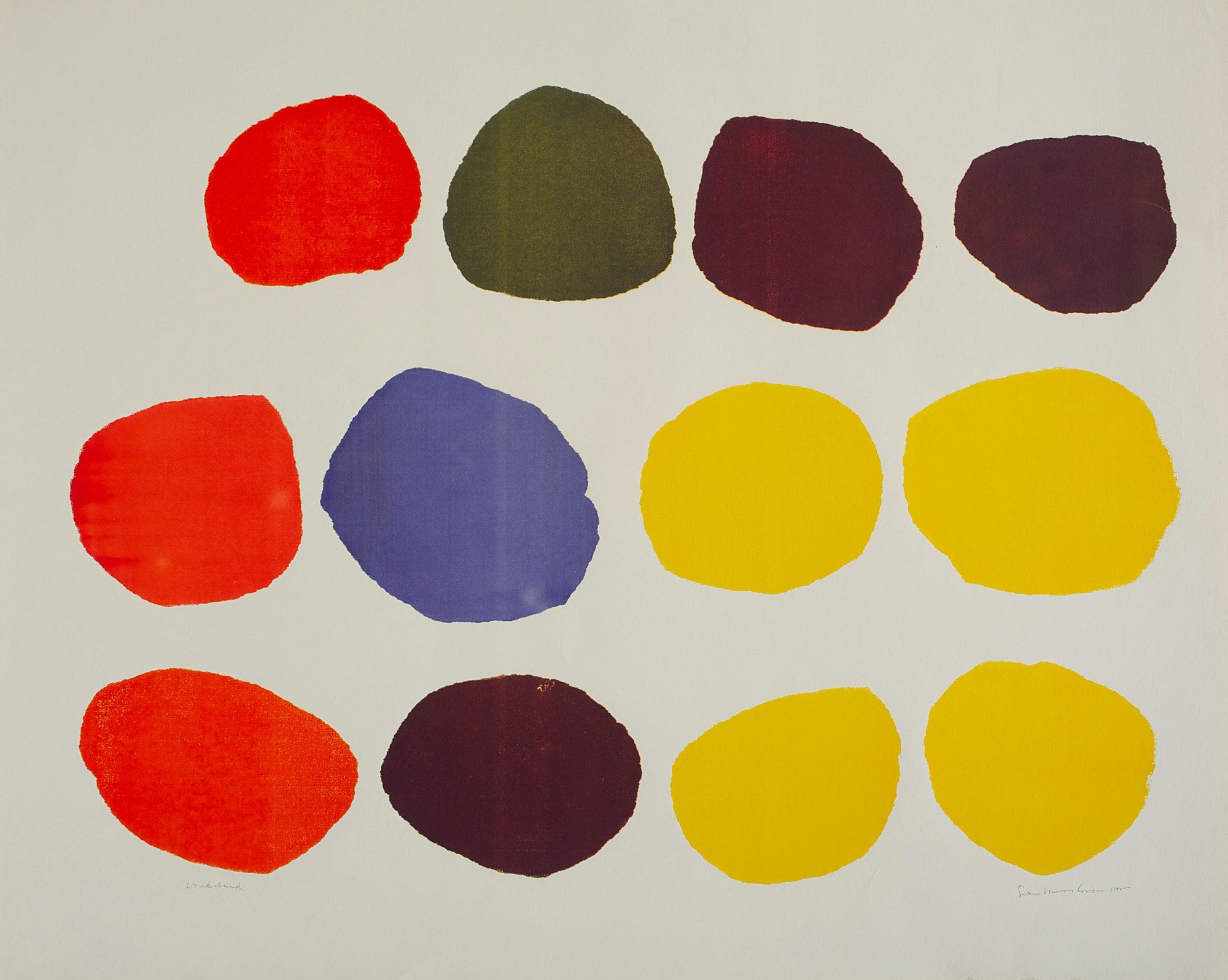
ESSAY: “The Listening Heart: Corita Kent’s Reforming Vision” by Michael Wright: Corita Kent (1918–1986) [previously] was an American pop artist who was also, for over three decades, a nun. Michael Wright writes about how “she became interested not just in depicting scenes from the Bible but answering this: what might happen if a Christian imagination engaged the world around us through the arts? That art might look less like an illustration from a children’s Bible and more like exploring seeing the stuff of life—even a bread bag—as dialogue partners with mysteries of faith.” wonderbread is one of four works he discusses—“a playful meditation on sacred time, wonder, and communion.”

Kent, Corita_wonderbread
Corita Kent (American, 1918–1986), wonderbread, 1962. Serigraph, 25 1/2 × 30 1/2 in.

While I do think even Kent’s biblical artworks push the genre of religious art forward, I appreciate how Wright challenges Christians to give a chance to her works that are less straightforwardly religious, as these are often the most imaginative and profound. And they, too, are “deeply Christian work.” Let’s not think so narrowly about what “Christian art” must look like!

+++

LIVING PRAYER PERIODICAL: Pentecost 2022: One of the organizations I work for is the Daily Prayer Project [previously], which publishes seven ecumenical Christian prayer periodicals a year, structured around the liturgical calendar. I do the curation for the Gallery section, which comprises three art images with written reflections, and the editing. Our latest edition covers June 5 (the feast of Pentecost) through August 6, and it includes prayers from India, Japan, Korea, Algeria, Italy, the Choctow Nation, and more. I’m excited to feature on the cover Corita Kent’s word picture: gift of tongues! As many of her screenprints do, it integrates image and text—in this case Acts 2:1–2a, which sprawls out through the sky and onto a billowing banner, like a sail, over a crowd of people aflame with the fire of the newly descended Spirit of God.

Pentecost LPP 2022

On the website there are options for one-time purchase or group subscription, and for digital only or print and digital.

+++

PRAYER: “The Lord’s Prayer, Extended Dance Mix” by Nadia Bolz-Weber: In March, actor Jennifer Garner asked Lutheran pastor and author Nadia Bolz-Weber if she could offer a prayer and a benediction on her InstaLive. Bolz-Weber vamped on the traditional words of the Lord’s Prayer, the text of which you can read at the boldface link.

Such a beautiful prayer.

One of the things I appreciate about Bolz-Weber’s spiritual teaching is her avoidance of clichés. She gives fresh language to the experiences of faith and life in general and to theology, which often reawakens me to the beauty of God and of Christ’s gospel. Describing why she regularly turns to prayer, she says in the Instagram video:

When I don’t have enough—like if I don’t have enough patience, if I don’t have enough compassion for myself or other people, when I don’t have enough resources—prayer is this way in which I can remind myself that there is enough. That I have a connection to my own divine source. I have a connection to God. And in the heart of God there’s enough forgiveness when I don’t have enough. In the heart of God there’s enough compassion when I don’t have enough. And so for me, it’s about reminding myself of that connection.

+++

SONG: “Dry Bones” by Gregory Porter: From Gregory Porter’s 2021 album Still Rising, this song was inspired by Ezekiel 37. The official music video features dancing skeletons in yellow cowboy boots(!), animated by L’Incroyable Studio. The song’s bridge quotes the African American spiritual “Dem Bones.”

The first verse goes,

I won’t die, won’t bury, won’t sink
’Cause love is the spirit I drink
I’ll be free in the morning light
’Cause your touch is the medicine of life
There’s a dance to this beat, let’s shake
Every move—feel my body awake
There’s a sound—you and me are one
And your hope is the rhythm I drum

Roundup: Formational films, Mary Magdalene exhibition, and more

WEBINAR: “Formational Films Round-Up: Movies That Matter,” hosted by Renovaré: Recorded August 24, this is an excellent eighty-minute conversation with film critic and professor Jeffrey Overstreet [previously], minister Catherine Barsotti, and theologian Chris Hall, led by Carolyn Arends [previously]. Each of the three guests identifies and discusses five films that have been spiritually formative to them—and what great selections! (Though there are four I have not yet seen.) Barsotti’s number one is one of my all-time favorites.

Because the movie ratings issue (that is, content like violence, sex, and/or profanity) is almost always raised by Christian audiences, Arends asks, “Are there some films that are bad for you to watch, and if so, why?” The question is wisely addressed from 34:52 to 49:40.

+++

INTERVIEW: “We must become poetry,” Still Life: For the September 13, 2021, edition of his weekly Still Life letter, Michael Wright [previously] interviewed Christian author Paul J. Pastor, having been intrigued by a recent tweet of his, which asks, “Where are the bardic preachers, wild at the eye, speaking not just to mind or heart, but to gut?” Pastor talks about the connection between the seen and the unseen; the relationality of poetry and finding shelter in the words, images, and emotions of another; holistic knowing; the disservice of reducing the Bible’s poetry to moral lessons with tidy applications; the nearness of Walt Whitman’s poetic vision to the Christian vision of sanctification; and more.

“My passion is for Christians to reclaim our way’s remarkable resources for living virtuously, beautifully, and well,” he says. Mine too!

To subscribe to Still Life, distributed for free every Monday over email, click here.

+++

Lecture by David Brinker for the 8th Catholic Arts Biennial, Verostko Center for the Arts at Saint Vincent College, Latrobe, PA, September 12, 2021: I mentioned the call for entries for this exhibition back in June. Of the 396 entries from artists from around the country, MOCRA director and guest juror David Brinker has selected 52. In this talk given the weekend after the exhibition’s opening (which starts at 14:47), he discusses the following three questions, pulling in artworks from the current exhibition and from his twenty-five-plus years as an art curator at a Catholic institution.

  • What identifies contemporary art as “Catholic”?
  • What contributions can Catholic art and artists offer to the broader contemporary art world?
  • What can Catholic art and artists receive from the broader art world?
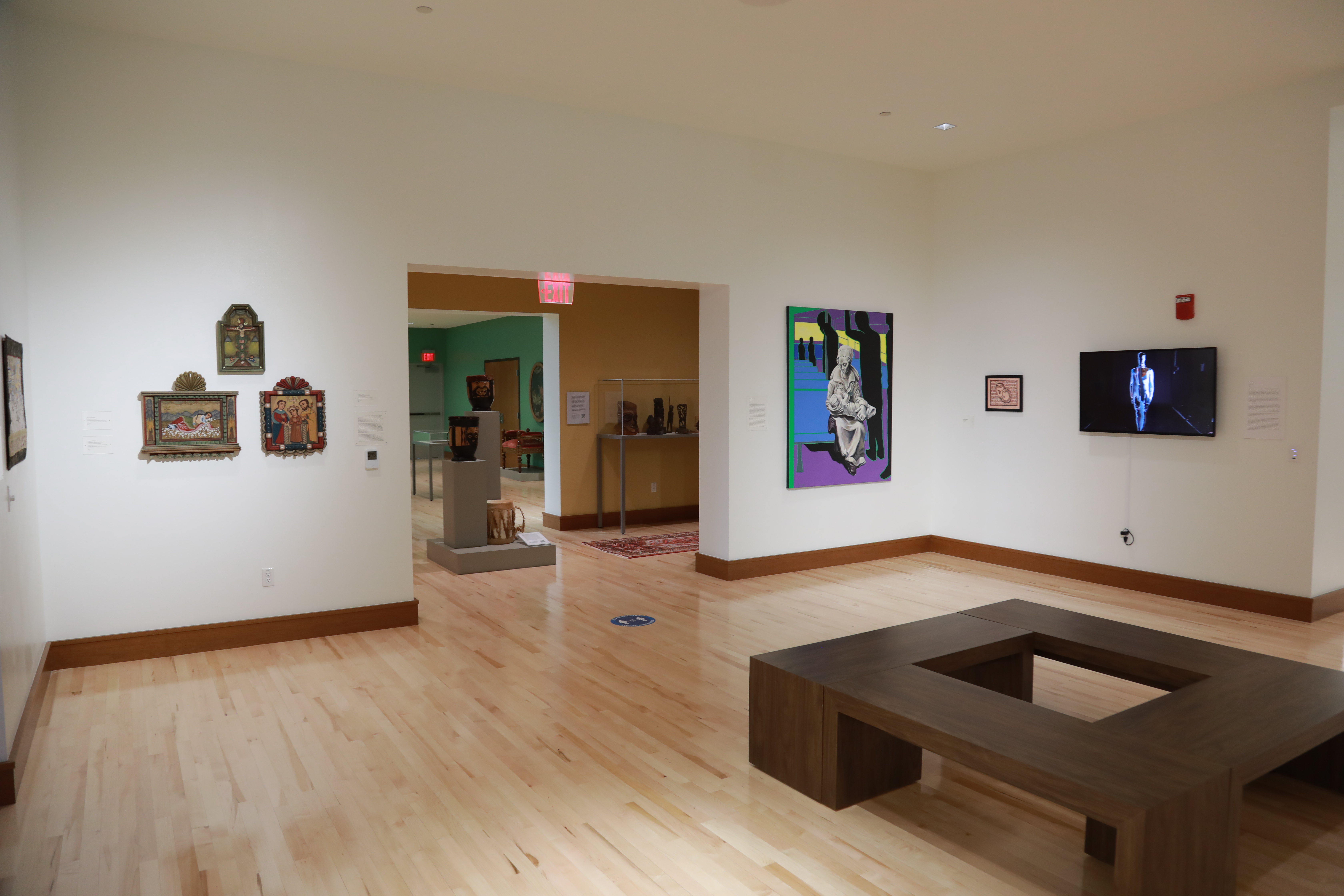
8th Catholic Arts Biennial
Exhibition view, 8th Catholic Arts Biennial. From left to right are three retablos by Vicente Telles, Maternidad by Piki Mendizabal, Iesu in Utero by Rebecca Spilecki, and The Living Temple by Jesse Klassen.

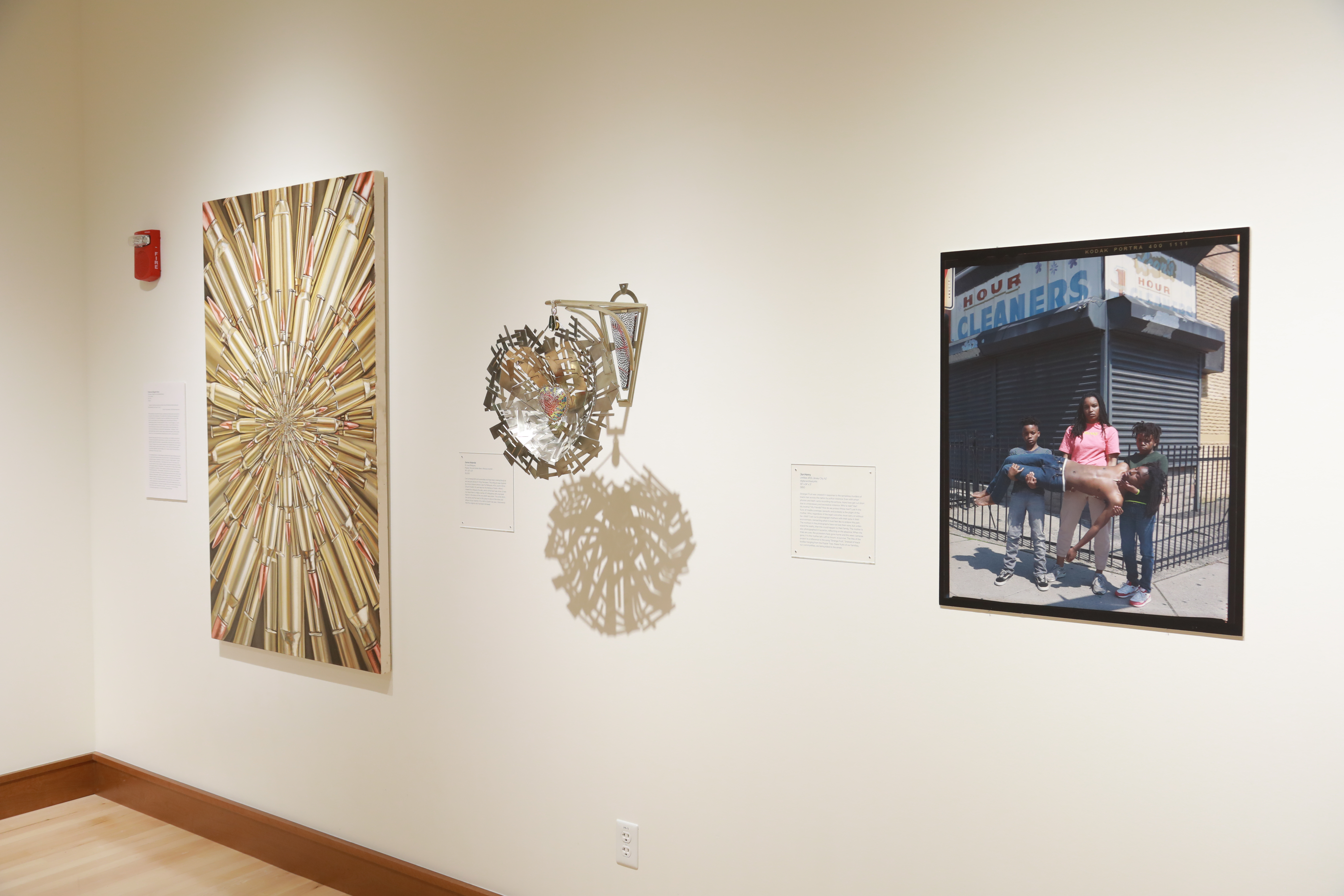
8th Catholic Arts Biennial
The Heart of Man by Kristen van Diggelen Sloan; St. Laud Reliquary by James Malenda; Untitled, #33, Jersey City, NJ by Jon Henry

8th Catholic Arts Biennial
Foreground: Saintly Selfies by Annie Dixon

(The three photos above are provided courtesy of the Verostko Center for the Arts.)

Saint Vincent’s 8th Catholic Arts Biennial exhibition is on view through October 29, 2021; off-campus visitors are asked to make an appointment by emailing verostkocenter@stvincent.edu. While you’re in the area, you might also want to visit the Fred Rogers Center at Saint Vincent College, which houses artifacts from Mister Rogers’ Neighborhood as part of a larger permanent exhibition on his life, work, and influence. (Latrobe was Fred Rogers’s hometown.) And Pittsburgh is just an hour away!

+++

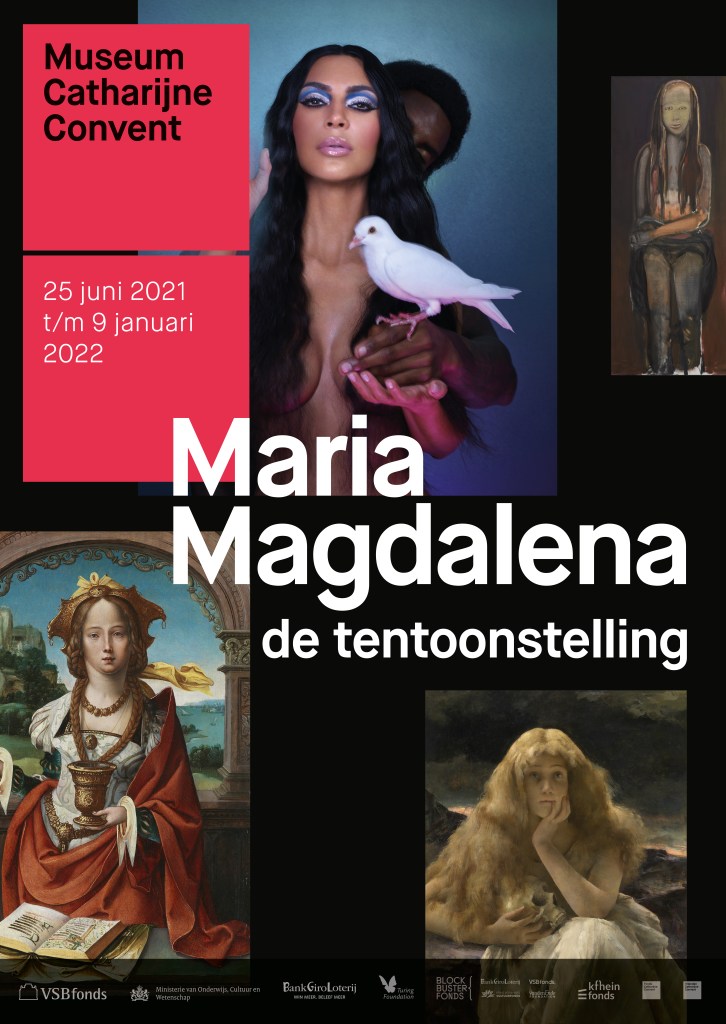
EXHIBITION: Maria Magdalena (Mary Magdalene), Museum Catharijneconvent, Utrecht, Netherlands, June 25, 2021–January 9, 2022: Curated by Lieke Wijnia. “Mary Magdalene is one of the most enigmatic women from the New Testament. Through a trans-historical display of artistic representations from the eleventh century to the present day, this exhibition explores the enduring fascination for this mysterious saint.” The catalog, Mary Magdalene: Chief Witness, Sinner, Feminist, is available in Dutch or English from the publisher Waanders. In addition to the exhibition page on the museum’s website, which hosts select images and a series of videos, resources in Dutch include an audio tour (with images), a podcast episode and accompanying article, and a video preview with commentary by Karin Haanappel.

Maria Magdalena art exhibition

I’m fascinated by Mary Magdalene, and while I won’t get to see this exhibition, it appears that it does an excellent job of exploring the many facets of her life and identity (including both before meeting Jesus and after his ascension), as told through canonical and apocryphal texts, and her complicated reception history. It addresses her role as the first witness to Jesus’s resurrection; the so-called Gnostic Gospel of Mary, which has Peter saying, “Sister, we know that the Savior loved you more than the rest of the women. Tell us the words of the Savior which you remember—which you know (but) we do not, nor have we heard them”; the legacy of Pope Gregory the Great’s infamous Easter sermon of 591 CE, which, in its (many would say erroneous) conflation of the Magdalen with other New Testament women, identified her as a converted prostitute; the development of legends about her later life in southern France, as an evangelist, a miracle-worker, and a penitent, cave-dwelling ascetic; modern films and literature that cast her as a romantic lover, or even the wife, of Jesus; and Pope Francis’s elevation of her liturgical commemoration from an obligatory memorial to a feast day in 2016, in which she is to be celebrated not as a fallen woman doing penance but as the “apostle to the apostles,” a title of hers dating back to the High Middle Ages.

The poster above features Mary Magdalene Receives the Holy Spirit by American photographer David LaChapelle, Magdalena by contemporary South African artist Marlene Dumas, The Magdalen from a sixteenth-century Flemish workshop, and Mary Magdalene by nineteenth-century Belgian artist Alfred Stevens.

+++

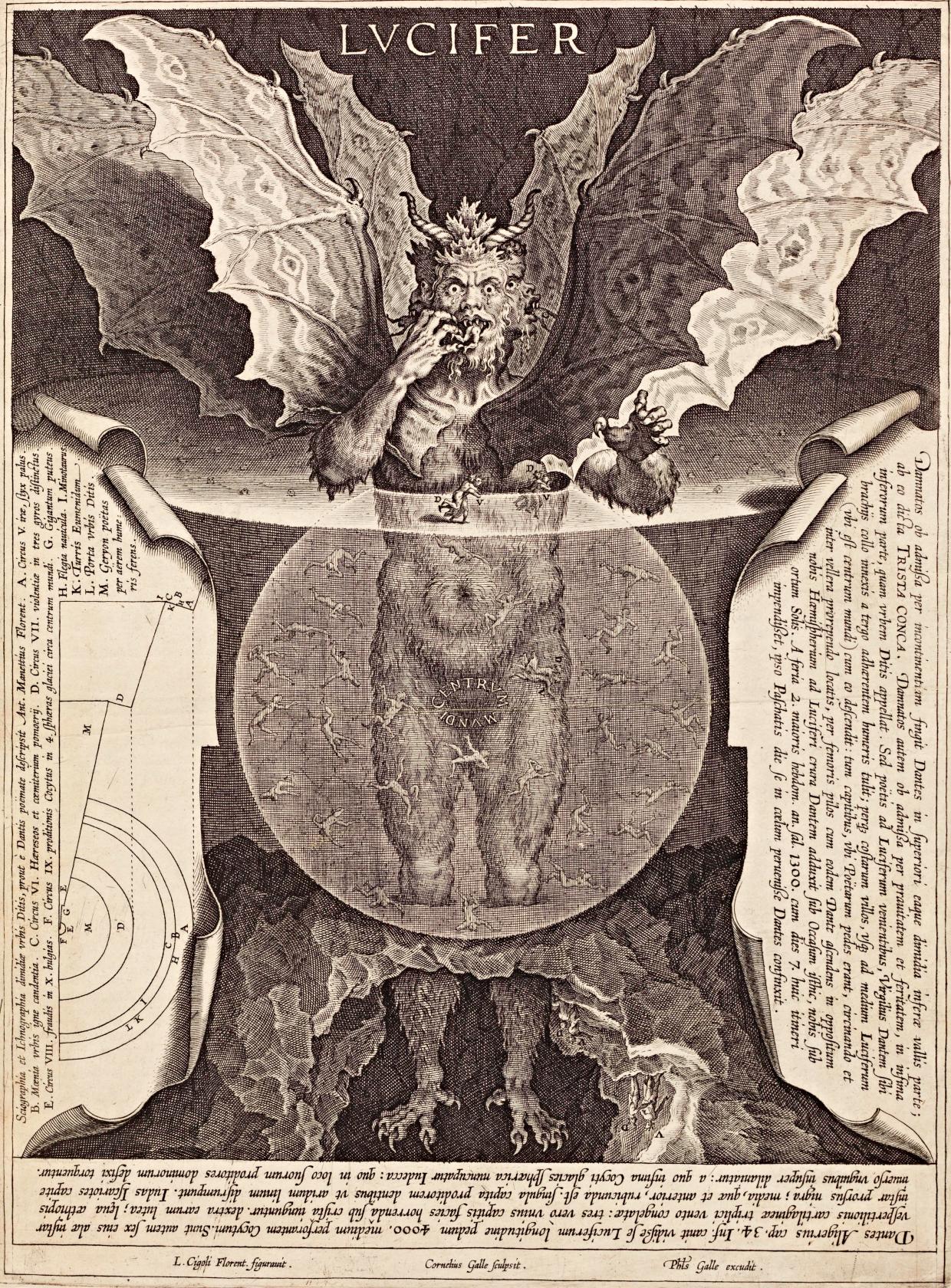
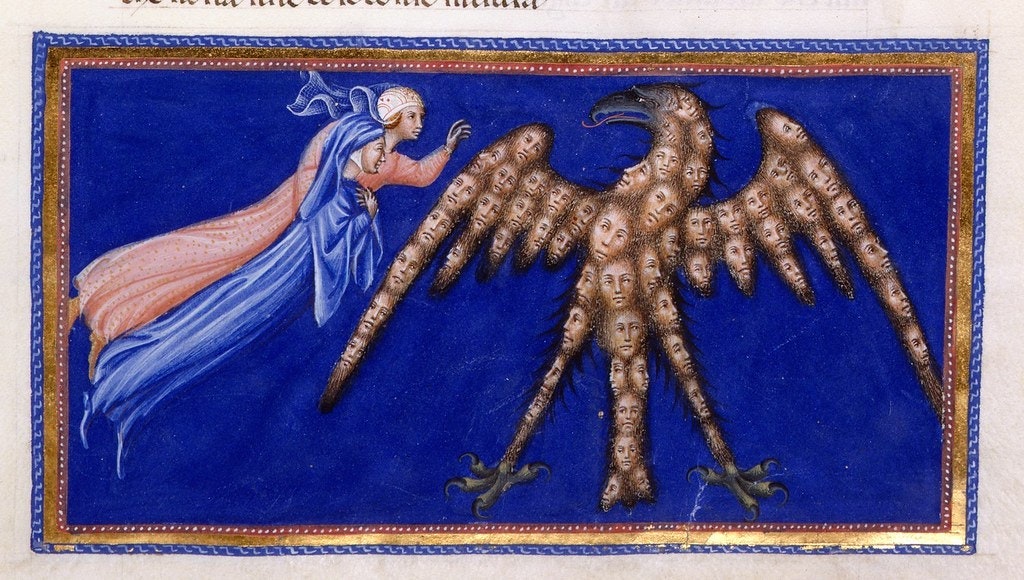
ARTICLE: “700 Years of Dante’s Divine Comedy in Art”: In honor of the seven hundredth anniversary of the Italian poet Dante Alighieri’s death on September 14, the Public Domain Review has collected art directly inspired by his Commedia from over the last seven centuries—on the nine circles of hell, the beatific vision, and much more. Under the tutelage of literature professor Stefano Gidari, I read and studied Dante’s groundbreaking afterlife-adventure trilogy—in Italian!—in 2009 while living in Florence, where it was written, which was such an invaluable experience.

Galle I, Cornelis_Lucifer
Cornelis Galle I (Flemish, 1576–1650), Lucifer, after Stradanus, ca. 1595. Engraving, 27.5 × 20 cm.

Eagle of Justice
Giovanni di Paolo (Italian, ca. 1403–1482), Dante and Beatrice before the Eagle of Justice, ca. 1450. From Yates Thompson 36, fol. 162, British Library, London.

Michael Wright on Keith Haring’s “Jesus freak” connection

Michael Wright is the creator of Still Life, a free weekly letter on art and spirit that I look forward to receiving in my inbox every Monday. On March 8 he wrote about Keith Haring (1958–1990), an artist whose work I first encountered as a child on the cover of the compilation album A Very Special Christmas, which we pulled out from the CD shelf in the family room every December. As an adult I came across Haring’s Life of Christ triptych inside Saint John the Divine in Manhattan (I instantly recognized the style), and one of his anti-apartheid paintings at the Stedelijk Museum Amsterdam. Wright discusses Haring’s connection to the Jesus People movement, which I, too, was unaware of! I share this excerpt from the latest edition of Still Life with Wright’s permission. Subscribe here.

+++

Haring, Keith_Untitled (1981)
Keith Haring (American, 1958–1990), Untitled, 1981. Acrylic on vinyl, 96 × 96 in. (244 × 244 cm). © Estate of Keith Haring

Friends,

This week I discovered that the famous street artist Keith Haring was part of the Jesus People before moving to New York City. He grew up in a Christian home in Kutztown, PA, went to church every Sunday and church camp every summer, and read the Bible voraciously. He even carefully read and rated each of the 150 Psalms. In his youth he found his way to the Jesus People movement, most likely through communes local in the area, and his early journals are filled with Christian symbols and apocalyptic ideas: “We must repent now and devote our lives to Jesus Christ! The time is now, time is running out, It can happen at any time! Be prepared for God!” Whew. I had no idea.

The Jesus People movement was a counter-cultural Christian movement of people who were anti-establishment (including church), highly critical of materialism, and committed to living with and supporting the poor. They shared their convictions through the Hollywood Free Paper, a free mailing that featured cartoons lampooning politicians, new age hucksters, and lukewarm Christians. While Haring no longer officially participated as an adult, American Art writer Natalie Phillips says there’s a “direct iconographic connection” between his style and the imagery of the paper. The Jesus People left an indelible mark on his “visual memory,” and once you know it, it’s hard to miss.

In his early subway drawings, Haring often drew the Radiant Child, a small crawling baby surrounded by beams of light. In one of the earliest versions, the baby is the central figure of a nativity scene: the Christ Child. Here’s his own description: “lines radiate from the baby indicating spiritual light glowing from within, as though the baby were a holy figure from a religious painting, only the glow is rendered in the visual vocabulary of a cartoon.” Another common image Haring used was the figure with a chest-sized hole. Sometimes filled with dollar signs, other times broken open by packs of wolves, the imagery evokes unfilled (or wrongly filled) longings and desire. And do you know what was common throughout the Hollywood Free Paper? Chest-sized holes in cartoon after cartoon, an image of spiritual voids filled by Christ himself.

On top of this, some of his late works were explicitly religious. He created a monumental series of the Ten Commandments, he created a mural for a convent in Pisa, and, most poignantly, his final work was an altarpiece of the Last Judgment, on view at both New York’s Cathedral of St John the Divine and San Francisco’s Grace Cathedral. That’s not to say “Gotcha! He’s a Christian artist!” As a gay man dying of AIDS, Haring was vocally critical of the institutional church and kept his distance during his adult life. Nor should we say this is his “religious art” and everything else is the popular stuff. His compassion for the weak and vulnerable, his critical eye to unjust systems, his celebration of the body and human dignity—this was all part of Haring’s sensibility, and it’s deeply Christ-like too, even if it’s harder to trace in work without obvious religious subject matter.

I guess I’m bringing all this up because I want you to be surprised with me. When I say “Jesus Freak,” the first thing that comes to mind is dcTalk—not a sex-positive, ambiguously spiritual, gay street artist. And yet as a teen, that’s what he called himself. Keith Haring wrote about it in his journals, and he talked openly about the influence of his Christian background. Uncovering this history doesn’t burden the artwork or the artist—it gives me renewed interest in his work. Granted, I write about these topics in Still Life all the time, but I don’t think we have to be afraid of letting religion be one of the many interpretive lenses we use to enjoy the arts. At their best, art and religion can be exactly what Haring hoped for in his own creative work: “It should be something that liberates the soul, provokes the imagination and encourages people to go further. It should celebrate humanity instead of manipulating it.”

Take care, 
Michael

P.S. Many of the quotes above come from Natalie E. Phillips’ “The Radiant (Christ) Child: Keith Haring and the Jesus Movement,” published in American Art.

Roundup: Jewish mosaics; New Psalm Contest; revising hymns; tree-inspired chapel; and more

I will be going on vacation soon and will be mostly unplugged, so you will notice less frequent blog posts for a few weeks. I’ll cue up some Artful Devotions to be published automatically each Tuesday I’m gone but won’t be posting the links to the blog’s Twitter and Facebook pages as I usually do—so be sure to check the site instead! (Or subscribe by email by clicking the “Follow” link, located in the sidebar if viewing from your computer or at the bottom if viewing from your phone.) My regular publishing schedule will resume in September.

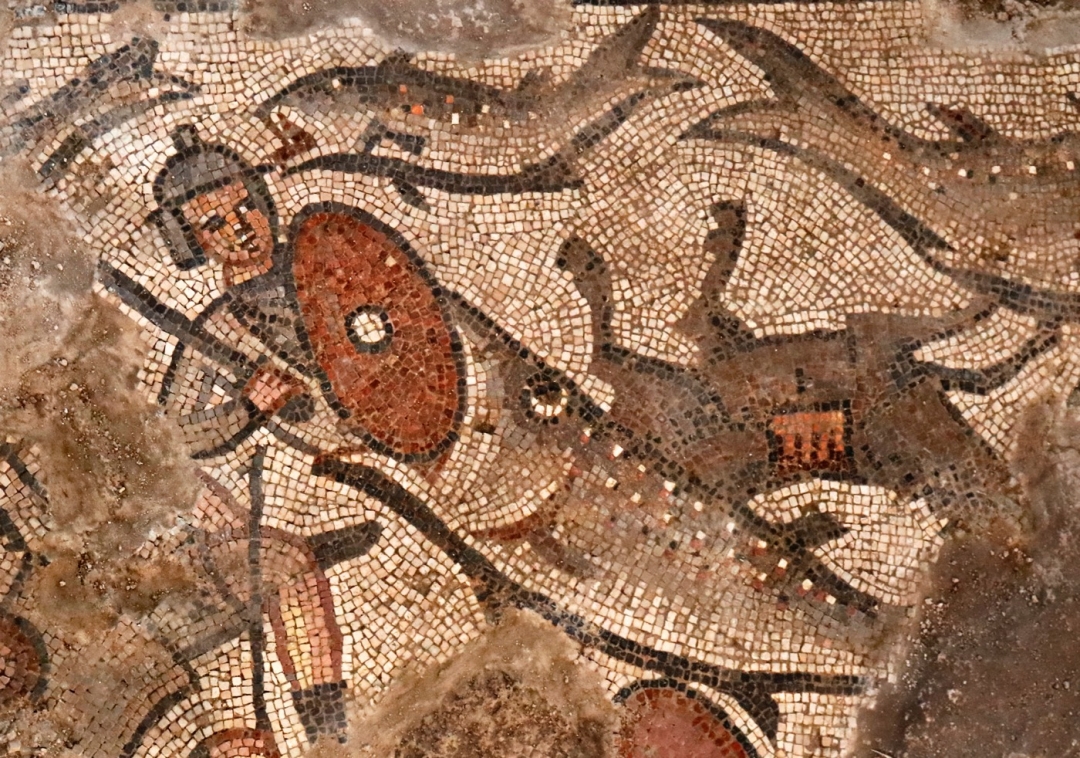
ARCHAEOLOGICAL FIND: “Discovery of Jewish Mosaics in Israel Bring Color to Biblical Accounts” by Sarah E. Bond: “At the ancient site of Huqoq, near the Sea of Galilee in modern Israel, a number of stunning mosaics depicting biblical, astrological, and historical narratives have been uncovered in a Jewish village that flourished during the late Roman empire. The colorful and large number of mosaics found in a synagogue challenge traditional views about Jewish art of the period as symbolic rather than representational of biblical texts, bland, and in decline during the period.”

Fish swallowing Pharoah's soldier
A giant Red Sea fish swallows one of Pharaoh’s soldiers in this mosaic detail from the late Roman (ca. 5th century) synagogue at Huqoq, Israel. Photo: Jim Haberman, via UNC-Chapel Hill.

+++

SONGWRITING CONTEST: “In an effort to encourage Psalm-singing, Church of the Servant [in Grand Rapids, Michigan] invites congregational songwriters to submit a Psalm-based song to its 2018 COS New Psalm Contest. The winner will receive a $500 award. There is no entry fee and the contest is open to all. Submissions must be emailed or postmarked by October 1, 2018. The song will be premiered in worship on January 27, 2019. Church of the Servant is a Christian Reformed Church with a rich history of encouraging the arts in worship. Its worship is Reformed, liturgical, participatory, eclectic, and open to creative new worship expressions.”   Continue reading “Roundup: Jewish mosaics; New Psalm Contest; revising hymns; tree-inspired chapel; and more”