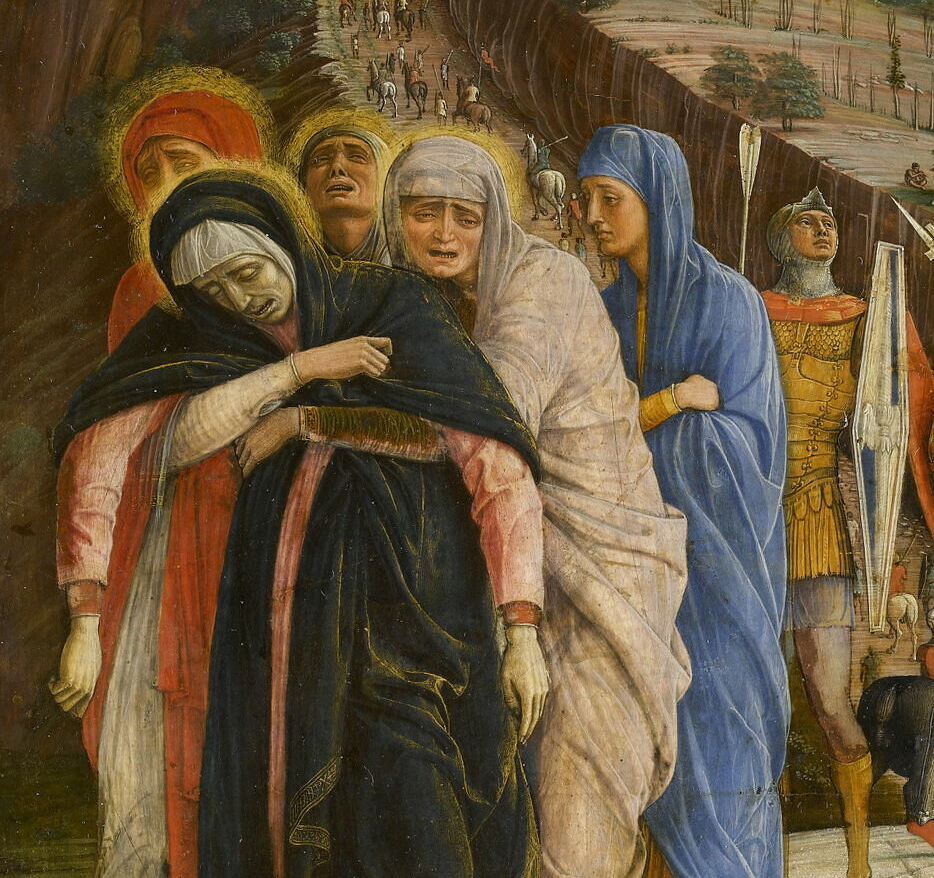
Andrea Mantegna (Italian, ca. 1431–1506), The Crucifixion, 1457–59. Tempera on panel, 75 × 96 cm. Musée du Louvre, Paris. [object record]
There’s much to look at in this painting. I want to focus on Jesus’s grieving mother under the cross to our left.
In Renaissance art of the Crucifixion, Mother Mary is often shown swooning, supported by John or by one of her female companions. Here she’s with a group of four women—the other Marys—two of whom wrap an arm around her to bolster her up when her legs give out. Her son has just died, and she can’t bear to look.
This work was painted by Andrea Mantegna between 1457 and 1459 as the central element of the predella (base) of the high altarpiece at San Zeno in Verona, Italy, a monumental work of art. In 1797, French Napoleonic forces plundered the altarpiece and brought it to Paris; the country returned the three main panels to Verona in 1815 when Napoleon lost power, but they kept the three predella panels, which are on display in museums: The Crucifixion at the Louvre, and The Agony in the Garden and The Resurrection at the Musée des Beaux-Arts in Tours.
LISTEN: “Swete Sone” | Words: Anon., 14th century (before 1372) | Music by Katharine Blake, 1998 | Performed by Mediæval Bæbes on Worldes Blysse, 1998
This song is in Middle English. If you’re reading along with the lyrics, you’ll want to know that the letter thorn, þ, says th; and u makes a w or v sound. I’ve bracketed the two words that the Mediæval Bæbes leave out.
Suete sone, reu on me, & brest out of þi bondis; For [nou] me þinket þat i se, þoru boþen þin hondes, Nailes dreuen in-to þe tre, so reufuliche þu honges. Nu is betre þat i fle & lete alle þese londis.
Suete sone, þi faire face droppet al on blode, & þi bodi dounward is bounden to þe rode; Hou may þi modris herte þolen so suete fode, Þat blissed was of alle born & best of alle gode!
Suete sone, reu on me & bring me out of þis liue, For me þinket þat i se þi detȝ, it neyhit suiþe; Þi feet ben nailed to þe tre—nou may i no more þriue, For [al] þis werld with-outen þe ne sal me maken bliþe.
Sweet son, have pity on me, and break out of your bonds; For I think I see through both your hands Nails have been driven into the tree, so painfully you hang there. It would be better if I fled now and abandoned all these lands.
Sweet son, your beautiful face is dripping with blood, And your body beneath is bound to the cross; How will your mother’s heart endure [the suffering of] such a sweet child, Who was born most blessed of all and was the most goodly of all!
Sweet son, have pity on me and deliver me from this life, For I think I see your death approaches quickly; Your feet have been nailed to the tree—now I may never prosper, For without you, all this world can never make me happy.
These three monorhyming quatrains are from John of Grimestone’s commonplace book, where he jotted down material for sermons; it’s unknown whether they’re original to him or compiled from some other source. (For other lyrics I’ve featured from this notebook, see “Undo Thy Door, My Spouse Dear” and “Love Me Brought.”)
In the poem, written in Mother Mary’s voice, Mary reveals a premonition she’s had of her son being nailed on a tree to die. (At least that’s how I read it, mainly because of the “I think I sees.”) She agonizes over this nightmare and asks Jesus that if it be true, to deliver her from this life, as she won’t be able to endure the sorrow of losing him.
Verses like these really humanize Mary, a woman who, faithful though she was to God’s unfolding plan, nevertheless felt the intense parental pangs that inevitably accompany witnessing one’s child being brutalized and killed.
The poem has been set to medieval-style music by Katharine Blake, the founder of Mediæval Bæbes, a classical chart–topping British music ensemble celebrating its thirtieth anniversary this year.
The song opens with an unaccompanied solo voice singing in free time. In the second half of the first stanza, additional voices enter, as well as a strummed instrument. Then with “& þi bodi dounward is bounden to þe rode,” the tempo quickens; a 2/4 meter takes shape and regularizes, with percussion keeping the beat; and the volume amplifies with twelve women now singing. With the final stanza, there’s once again a softening as the song returns to a single vocalist and the instrumentation drops out. This movement from weary pain, Mary barely able to speak it aloud, to foot-stomping anger, which her friends join in solidarity, and back to solitary desolation captures different shades of grief.
For a wholly a cappella solo rendition, see this performance by Ariana Ellis:
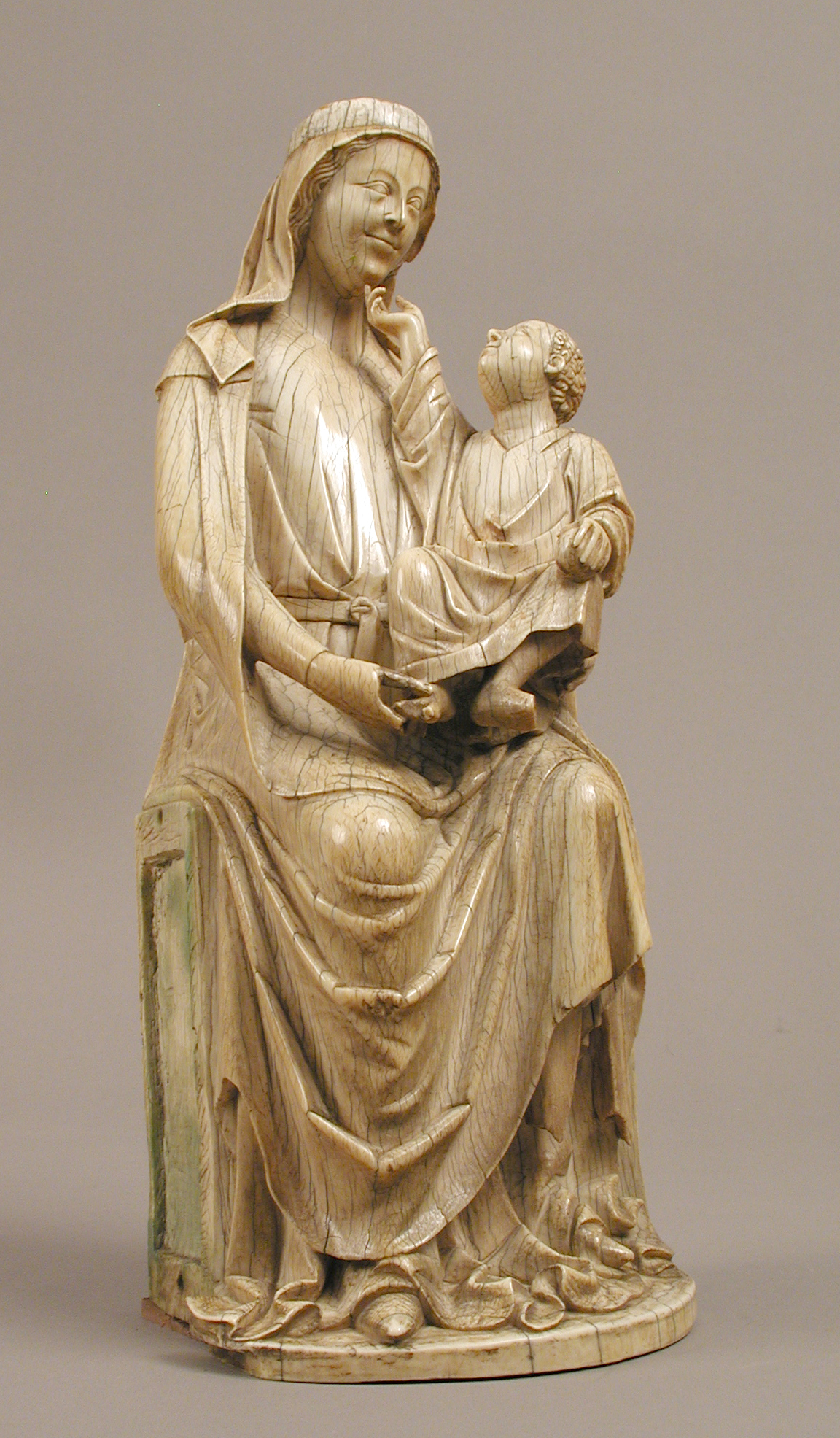
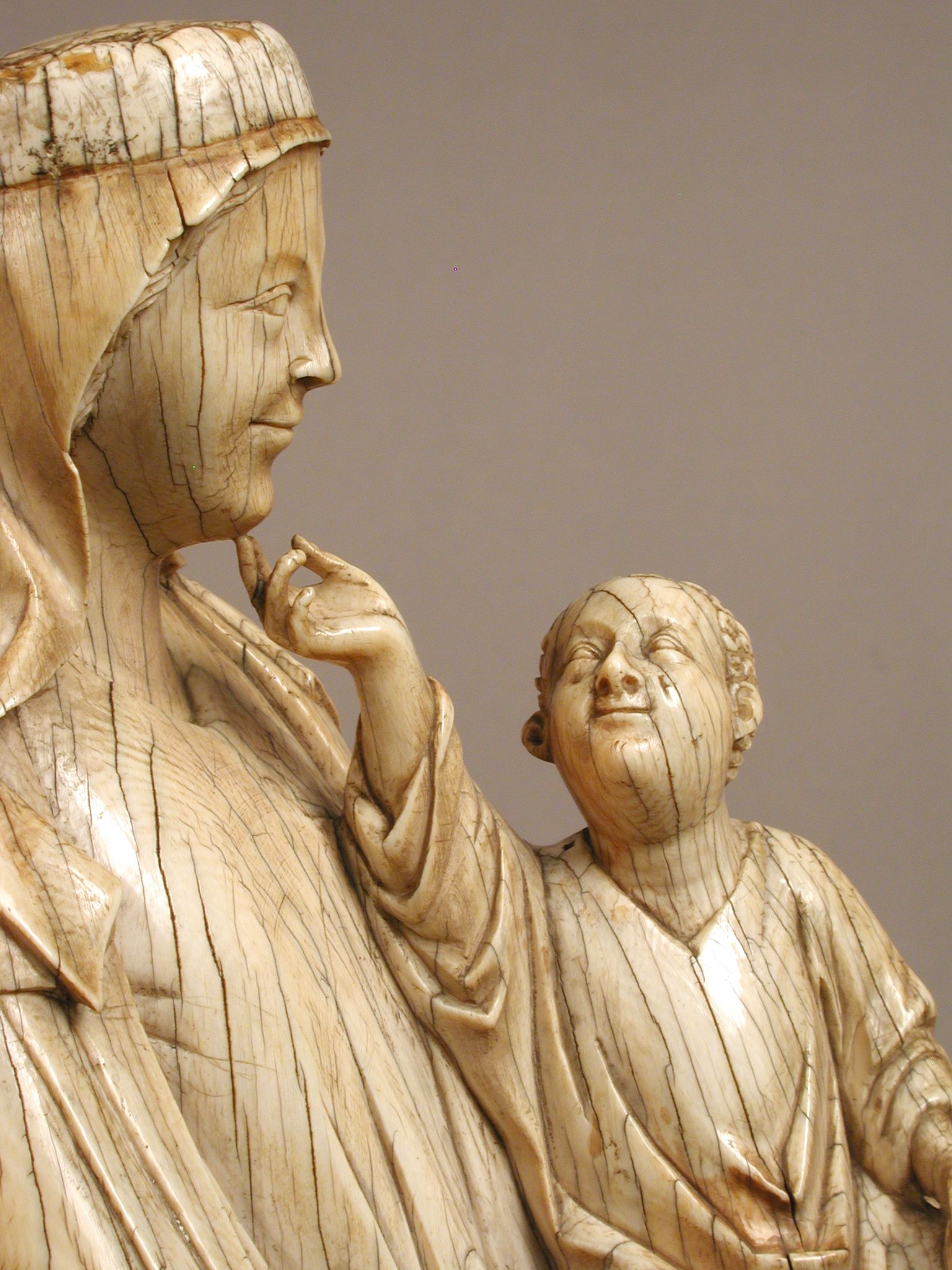
Virgin and Child, northern France, ca. 1250. Ivory, 11 5/8 × 4 3/4 × 4 1/16 in. (29.5 × 12.1 × 10.3 cm). Metropolitan Museum of Art, New York.
I love the affection between mother and child in this thirteenth-century ivory statuette from northern France. A variation of the Virgin Eleousa (Virgin of Tenderness) icon type, it shows Jesus seated in Mary’s lap, sweetly touching her chin, while she reciprocates with a squeeze of his foot.
LISTEN: “Quid petis, o fili?” (What Do You Seek, O Son?) | Words: Anonymous | Music by Richard Pygott, ca. 1510 | Performed by The Sixteen, dir. Harry Christophers, on Christus Natus Est: An Early English Christmas, 1996
ORIGINAL MIDDLE ENGLISH:
Quid petis, o fily? Mater dulcissima ba ba. O pater, O fili? Michi plausus oscula da da!
The moder full manerly and mekly as a mayd, Lokyng on her lytill son, so laughyng in lap layd, So pretyly, so pertly, so passingly well apayd, Full softly and full soberly unto her swet son she saide:
Quid petis, o fily? . . .
I mene this by Mary, our Maker’s moder of myght, Full lovely lookyng on our Lord, the lanterne of lyght, Thus saying to our Saviour; this saw I in my syght; This reson that I rede you now, I rede it full ryght:
Quid petis, o fily? . . .
Musyng on her manners, so ny mard was my mayne, Save it plesyd me so passyngly that past was my payn; Yet softly to her swete sonne methought I hard her sayn: Now, gracious God and goode swete babe, yet ons this game agayne.
Quid petis, o fily? . . .
Source: London, British Library, Add. MS 31922, fols. 112v–116r; transcribed in John Stevens, Music and Poetry in the Early Tudor Court (Cambridge University Press, 1979), p. 421, cat. H105
MODERNIZED SPELLINGS:
Quid petis, O fili? Mater dulcissima, ba ba. O pater, O fili? Mihi plausus oscula, da da.
[Translation: “What do you seek, O son?” “Sweetest mother, kiss, kiss.” “O father, O son?” “Clapping hands, give me kisses!” – or – “Applaud me with kisses!” – or – “Kisses on me, give, give!”]
The mother, full mannerly and meekly as a maid, Looking on her little son, so laughing in lap laid, So prettily, so pertly, so passingly well apayed, [pertly = beautifully; apayed = contented] Full softly and full soberly, unto her sweet son she said:
Quid petis, O fili? . . .
I mean this by Mary, our Maker’s mother of might, [I mean this by = I refer to] Full lovely looking on our Lord, the lantern of light. Thus saying to our Savior, this saw I in my sight; This reason that I read you now, I read it full right: [reason = statement]
Quid petis, O fili? . . .
Musing on her manners, so nigh marred was my main, [sapped was my strength] Save it pleased me so passingly that passed was my pain; Yet softly to her sweet son, methought I heard her sayn: “Now, gracious God and good sweet babe, yet once this game again”:
Quid petis, O fili? . . .
This carol for four voices is from the so-called Henry VIII Manuscript, an anthology of polyphonic songs and instrumental music from the Tudor court. Of the 108 compositions in the collection, “Quid petis, O fili” is one of the few religious ones. The author of the text is unknown, but the composer is Richard Pygott (ca. 1485–1552).
The four-line Latin burden* is a dialogue between Mary and the Christ child. Presumably he’s wiggling or making noise, because she asks him what he wants. “Kisses!” he replies. She calls him, oddly, both son and “father,” which reflects her unusual relationship with the God-boy she bore into the world: He’s both her child and her God.
There are three stanzas in the carol—all in English—voiced by a first-person narrator who has witnessed the playful mother-son exchange. It so endeared him that he wants to share it with others.
* Scholars of medieval carols differentiate between a refrain and what’s called a burden. “The refrain . . . is a repeated element which forms part of a stanza, in the carols usually the last line. The burden, on the other hand, is a repeated element which does not form any part of a stanza, but stands wholly outside the individual stanza-pattern.” Richard Leighton Greene, ed., The Early English Carols, 2nd ed., revised and enlarged (Clarendon Press, 1977; 1st ed. 1935), clx.
(This post is optimized for viewing in a web browser on a computer screen.)
Pelican in Her Piety, 1880–81. Mosaic, Palatine Chapel, Aachen, Germany.
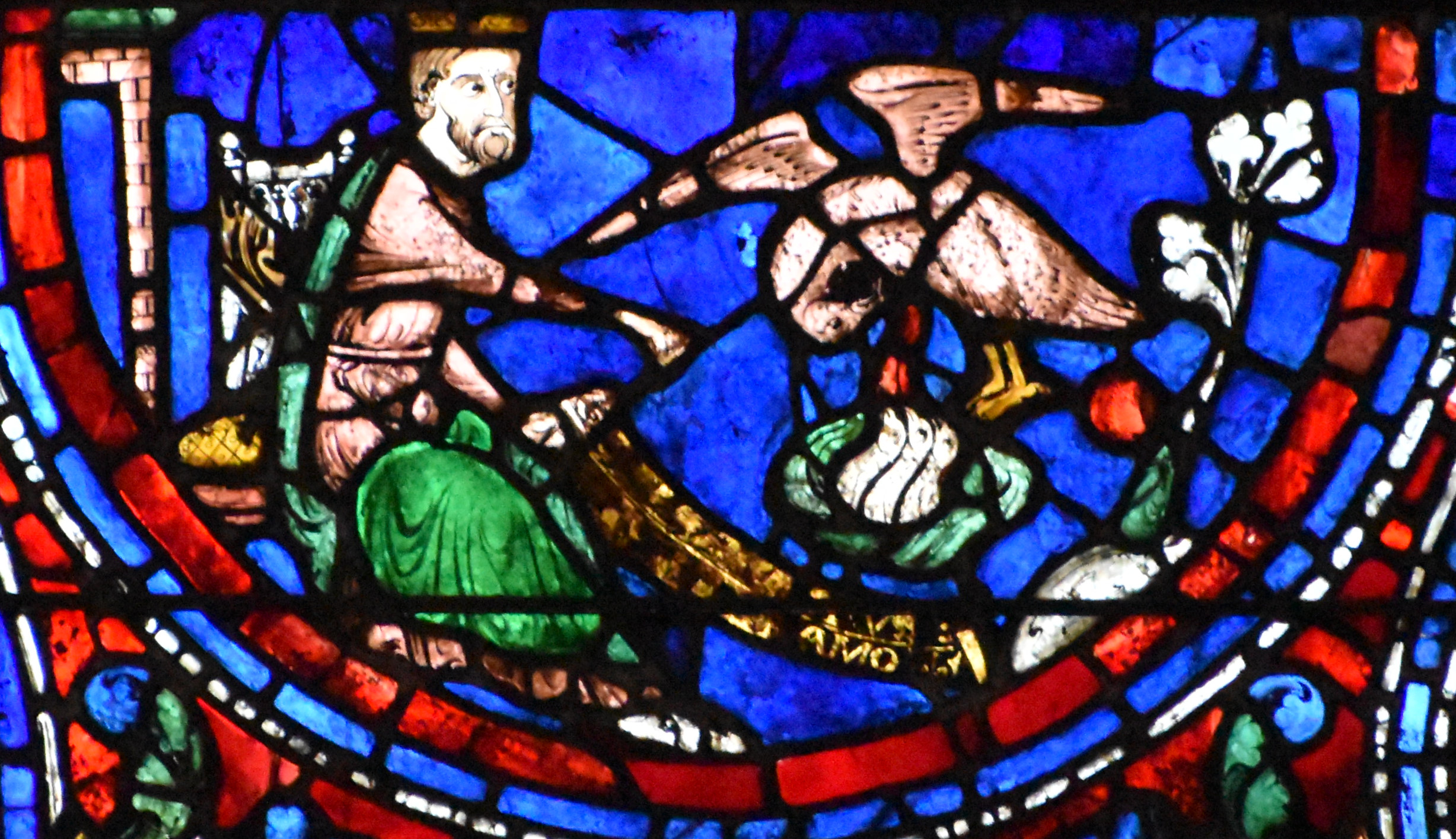
The pelican was one of the most popular animal symbols for Christ in the Middle Ages, appearing widely in art and literature. The association was first made in the Physiologus, a Late Antique Greek compilation of moralized animal lore written (probably around the year 200) in Alexandria and intended for Christian edification. Its anonymous author says the mother pelican is such “an exceeding lover of its young” that, to revive them from death, she pierces her breast with her beak and spills her blood over them.
The church sometimes refers to this allegorical bird as the vulning pelican (from the Latin vulnerō, “to wound”), or the Pelican in Her Piety.
The Christological parallel is obvious: Jesus submitted to being pierced with nails and spear on the cross, his heart’s blood spilt, in order to give life to his children. But the Physiologus cites a more obscure biblical passage: “ὡμοιώθην πελεκᾶνι ἐρημικῷ” (Ps. 101:7a LXX). In the Latin Vulgate, that’s “Similis factus sum pelicano solitudinis,” and in English, “I am like a pelican of the wilderness” (Ps. 102:6a KJV). The Physiologus author puts these words of the psalmist, which express a sense of isolation, into the mouth of Christ, lonely in his messianic ministry and in his passion.
Detail from the 13th-century Redemption Window at Chartres Cathedral in France, showing a pelican (a figure of Christ) feeding her young with her own blood as King David looks on, holding a scroll with the inscription “Similis factus sum pellicamo,” from Psalm 102:6. Photo: Adrian Barlow. There are similar glass panels at Rouen and Le Mans.
Not all parts of the pelican legend recounted in the Physiologus map easily onto Christ’s love for his church. The chicks are dead because they kept striking their parents in the face, and their parents, striking back, killed them. The parents feel bad, and it’s after three days of mourning that mama bird breaks herself open to bring back her little ones.
In his commentary on Psalm 102, Augustine writes, “Let us not pass over what is said, or even read, of this bird, that is, the pelican.” Standing over her dead chicks, “the mother wounds herself deeply, and pours forth her blood over her young, bathed in which they recover life. This may be true, it may be false: yet if it be true, see how it agrees with him, who gave us life by his blood. It agrees with him in that the mother’s flesh recalls to life her young with her blood; it agrees well. For he calls himself a hen brooding over her young. If, then, it be so truly, this bird does closely resemble the flesh of Christ, by whose blood we have been called to life.”
Augustine then goes on to explain how the mother’s killing her young relates to God metaphorically killing our old self so that he can then raise us up to new life in Christ; he likens conversion to death and rebirth. Medieval theologians loved to stretch allegories to the extreme!
A more streamlined version of the pelican legend that got passed down omits the filicide, focusing simply on the bird’s animating sacrifice—on how her shed blood raises the dead to life. And after the Feast of Corpus Christi was established in 1311, a variant emerged that said the pelican feeds her young with her blood when no other food would satisfy, a picture that resonated with the increased attention on the Eucharist in the Latin West.
The Physiologus, which contains the earliest known appearance of the pelican legend, was translated from Greek into Latin sometime between the fourth and early sixth centuries, and from there into Ethiopic, Armenian, Syriac, and a multitude of European and Middle Eastern vernaculars. By the end of the twelfth century its legends were absorbed into the bestiary, a genre of popular nature-book in keeping with the encyclopedic taste of the High Middle Ages.
In Art
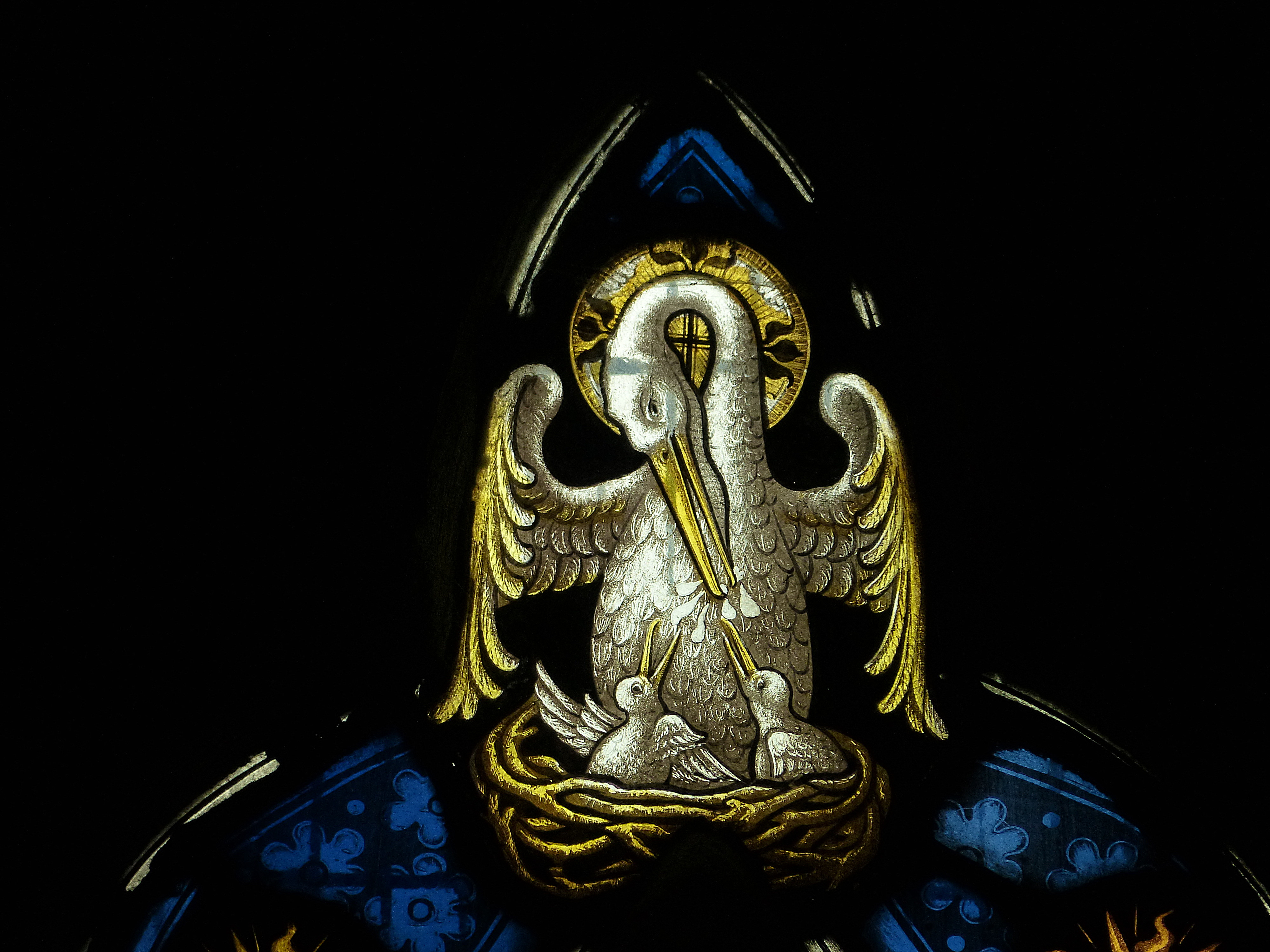
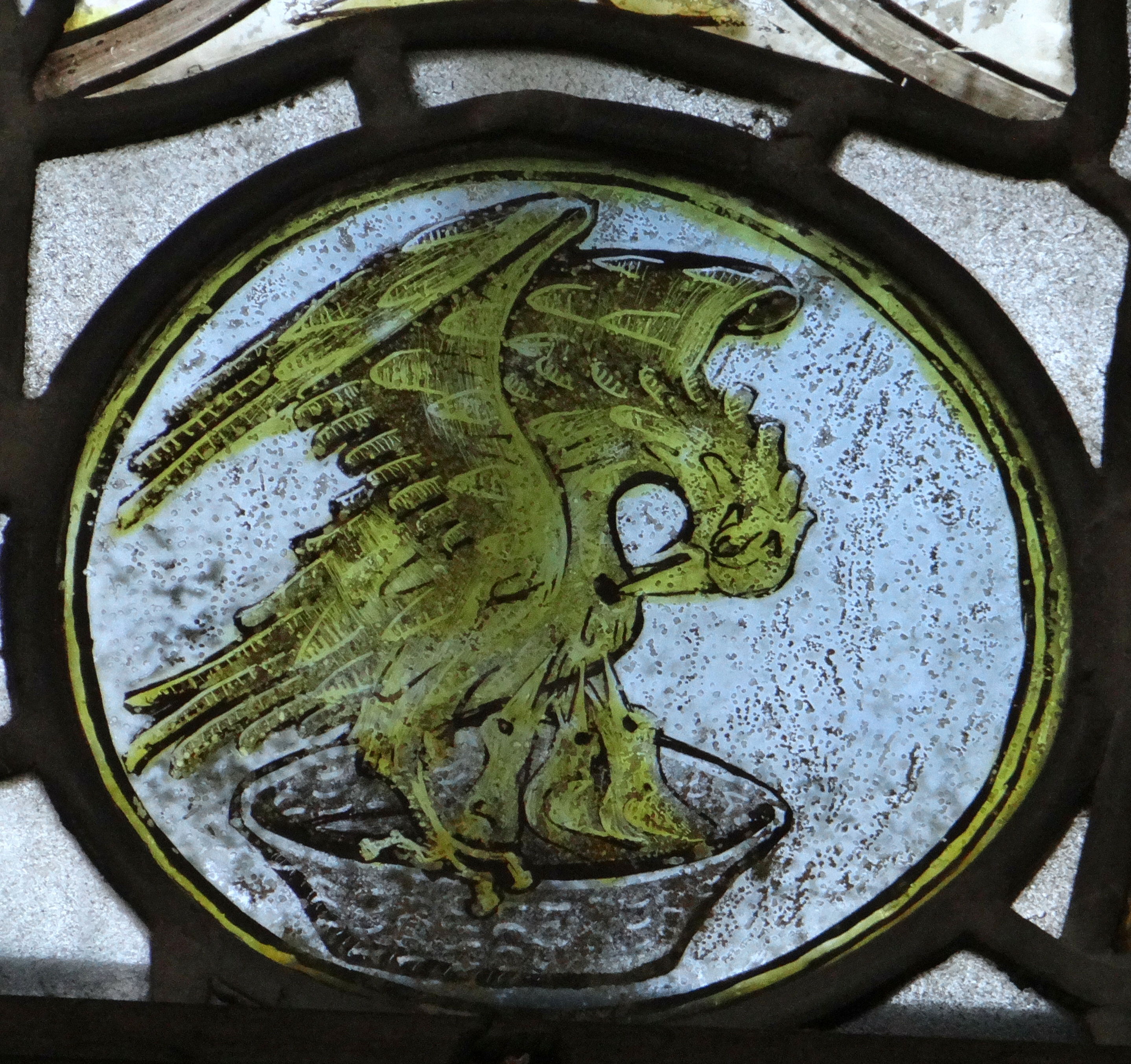
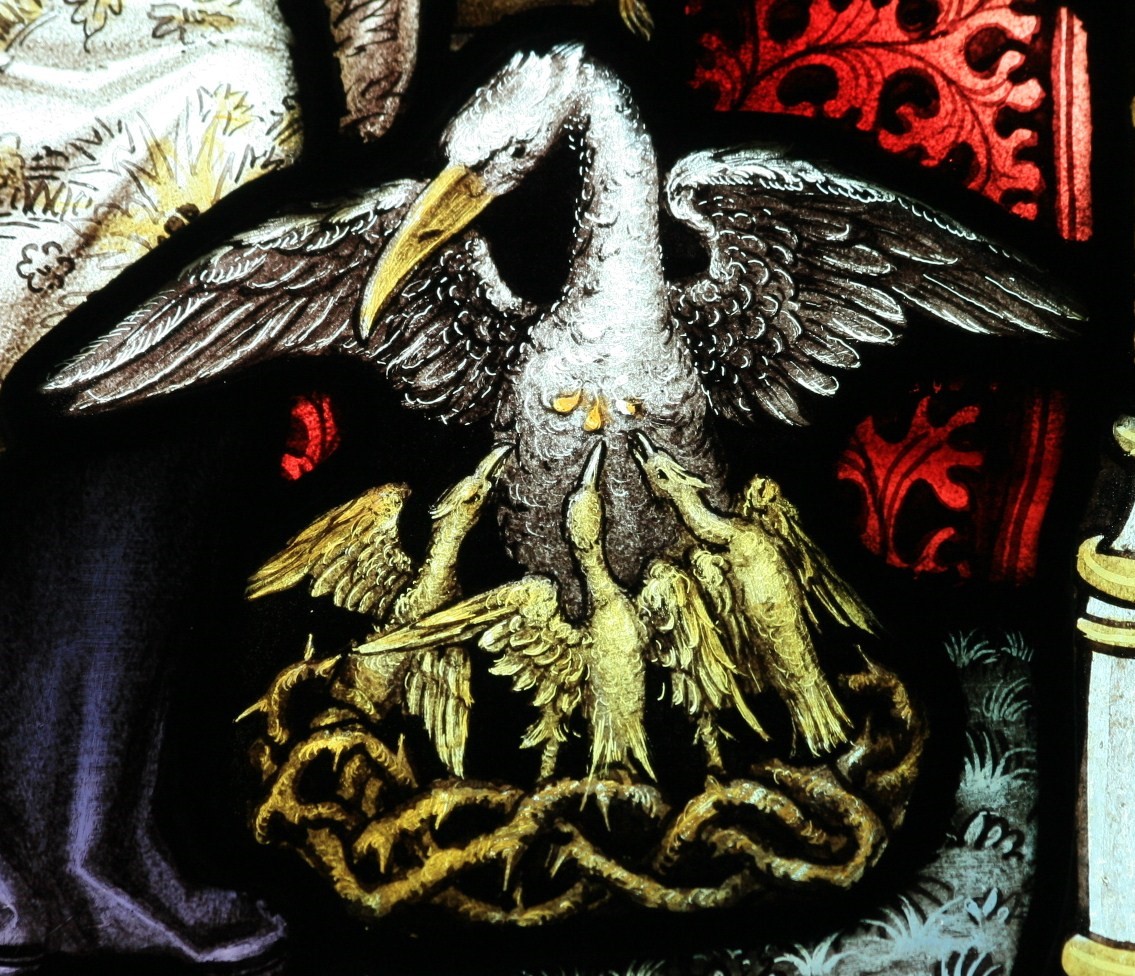
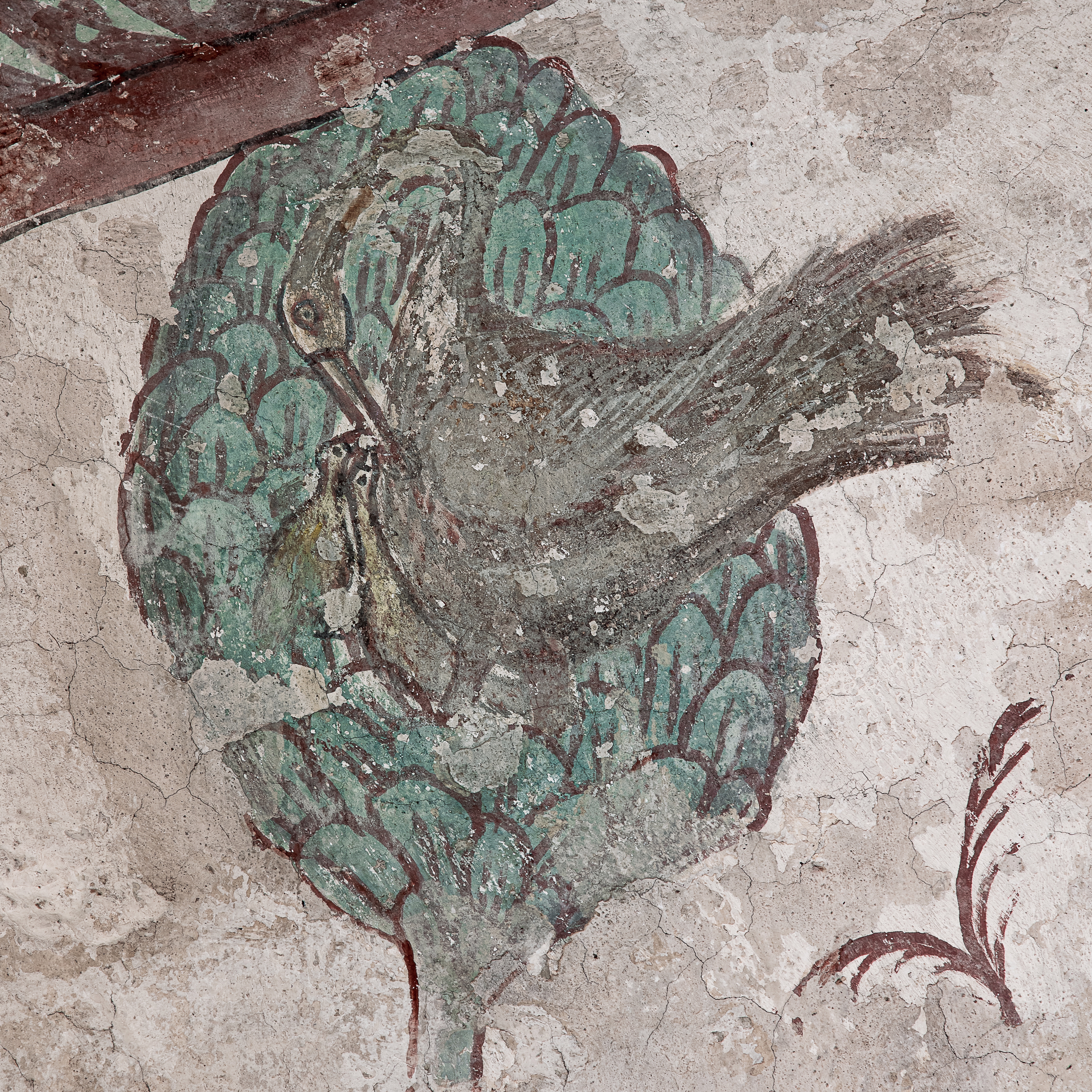
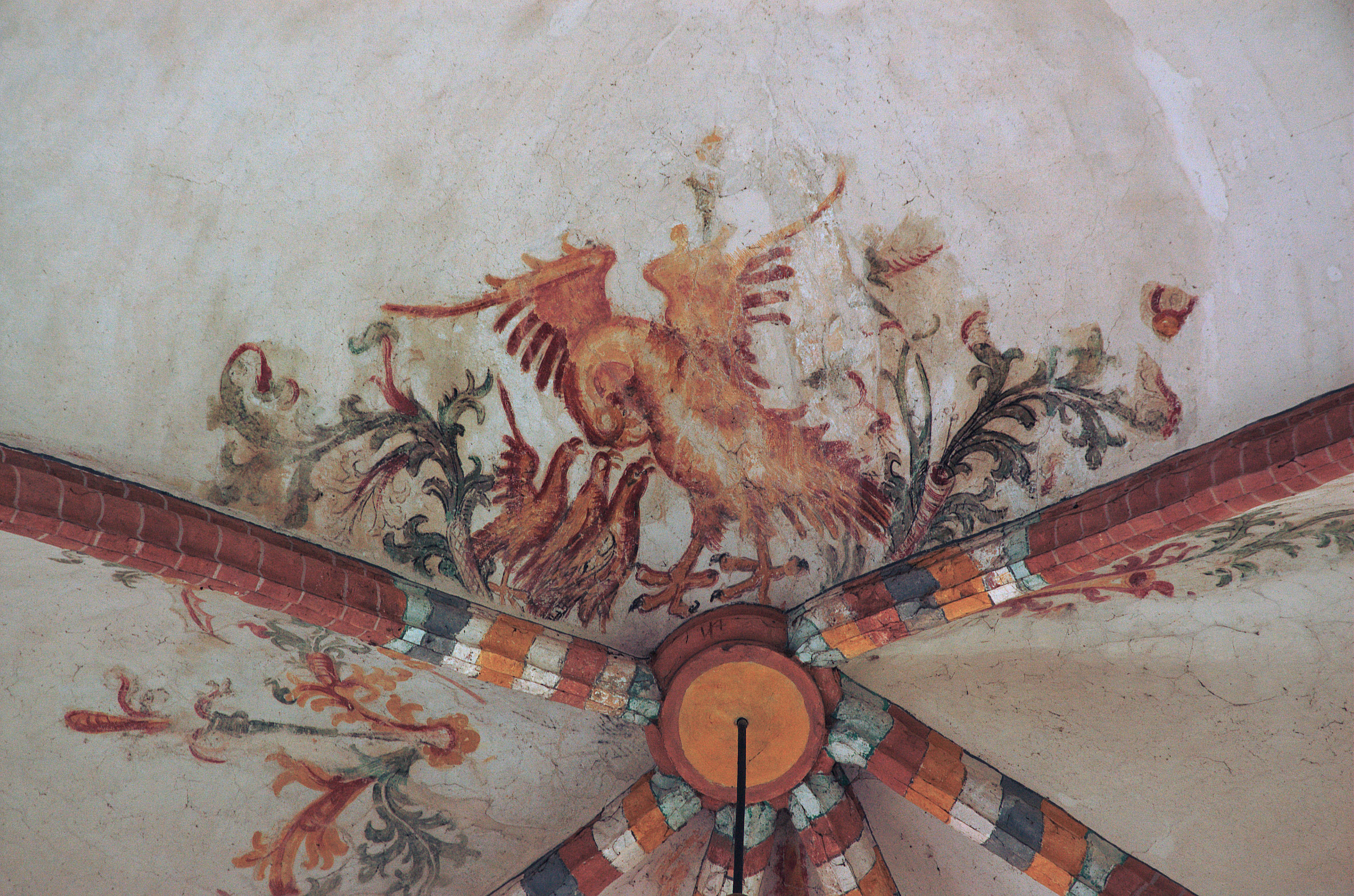
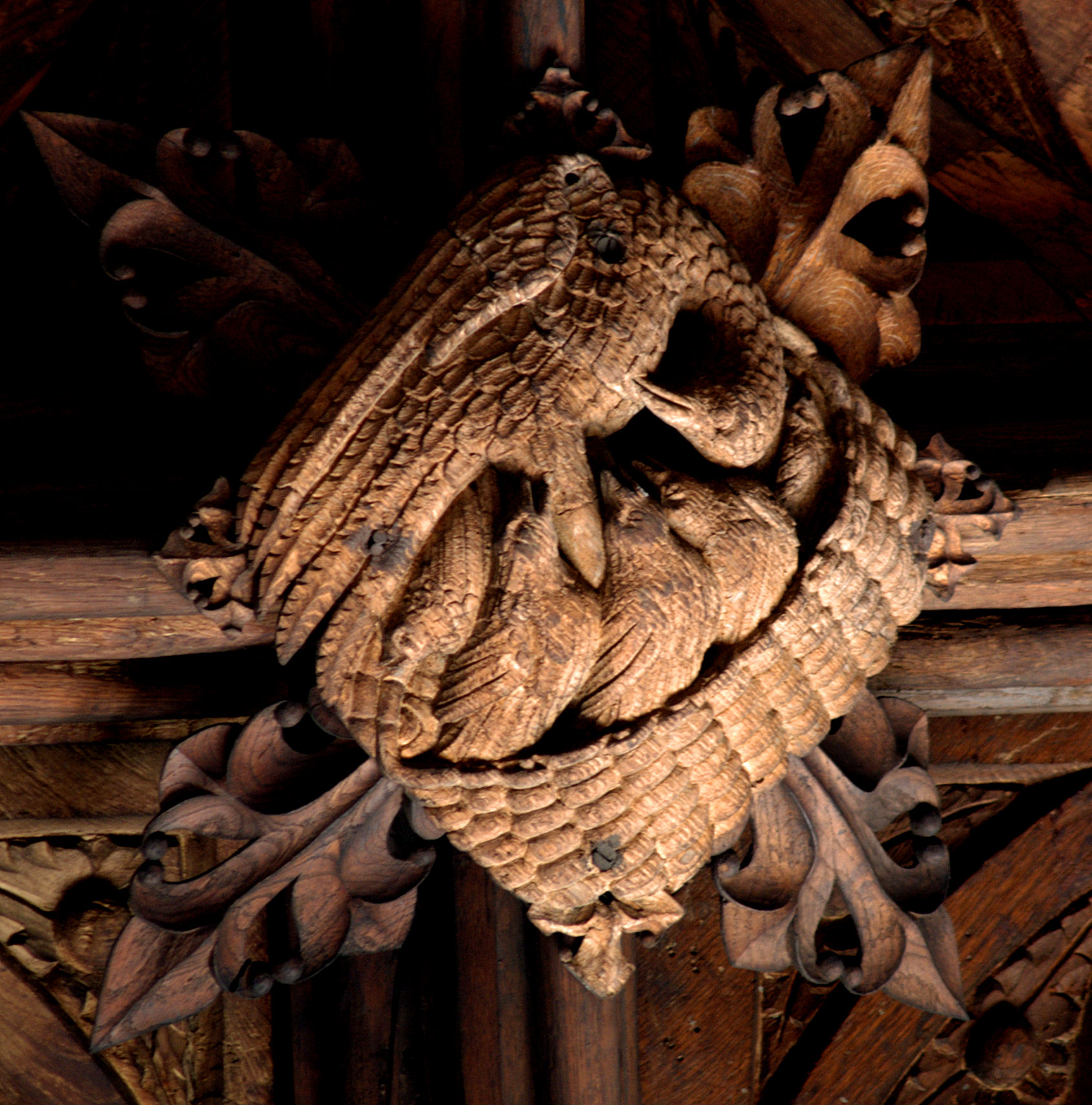
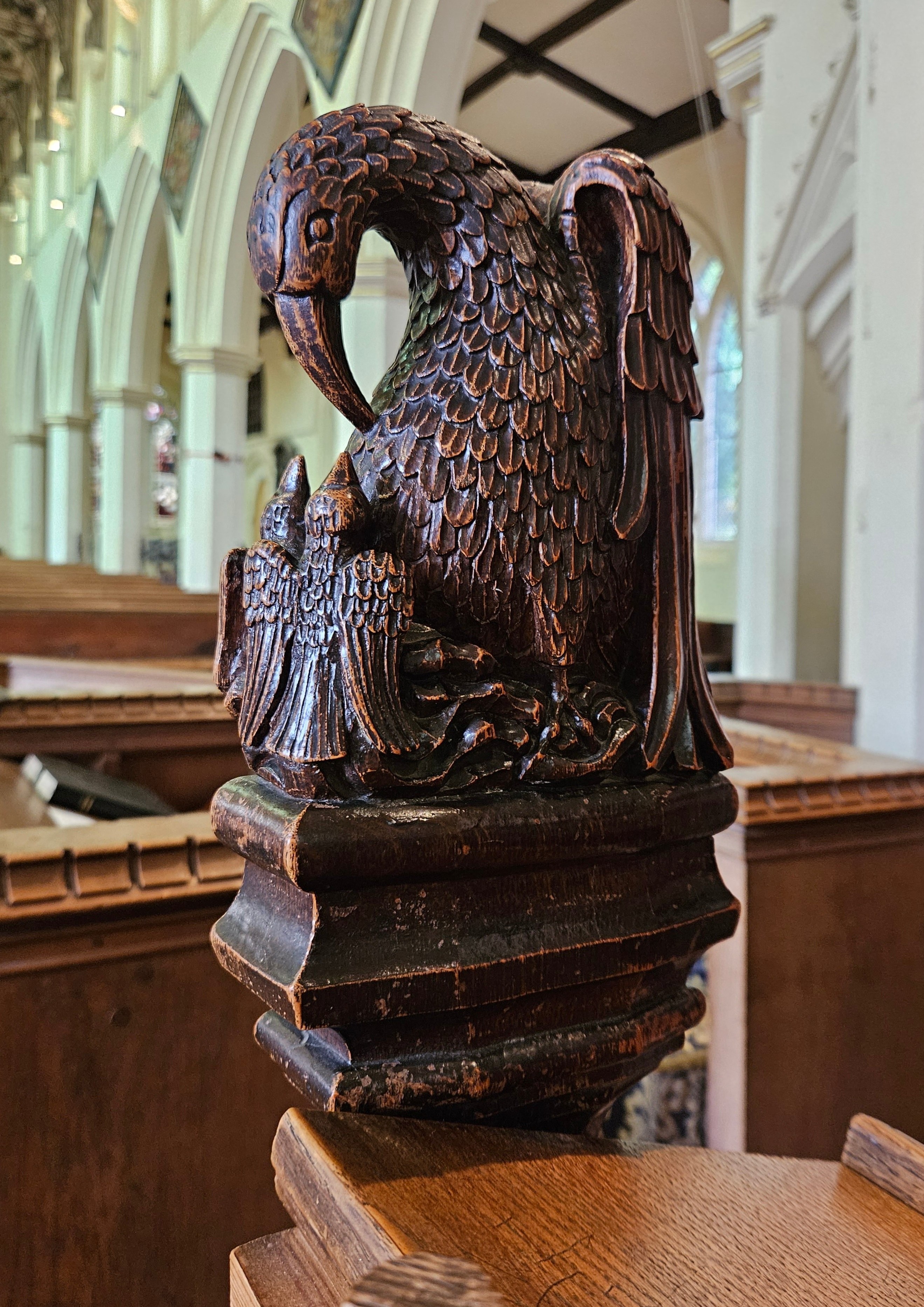
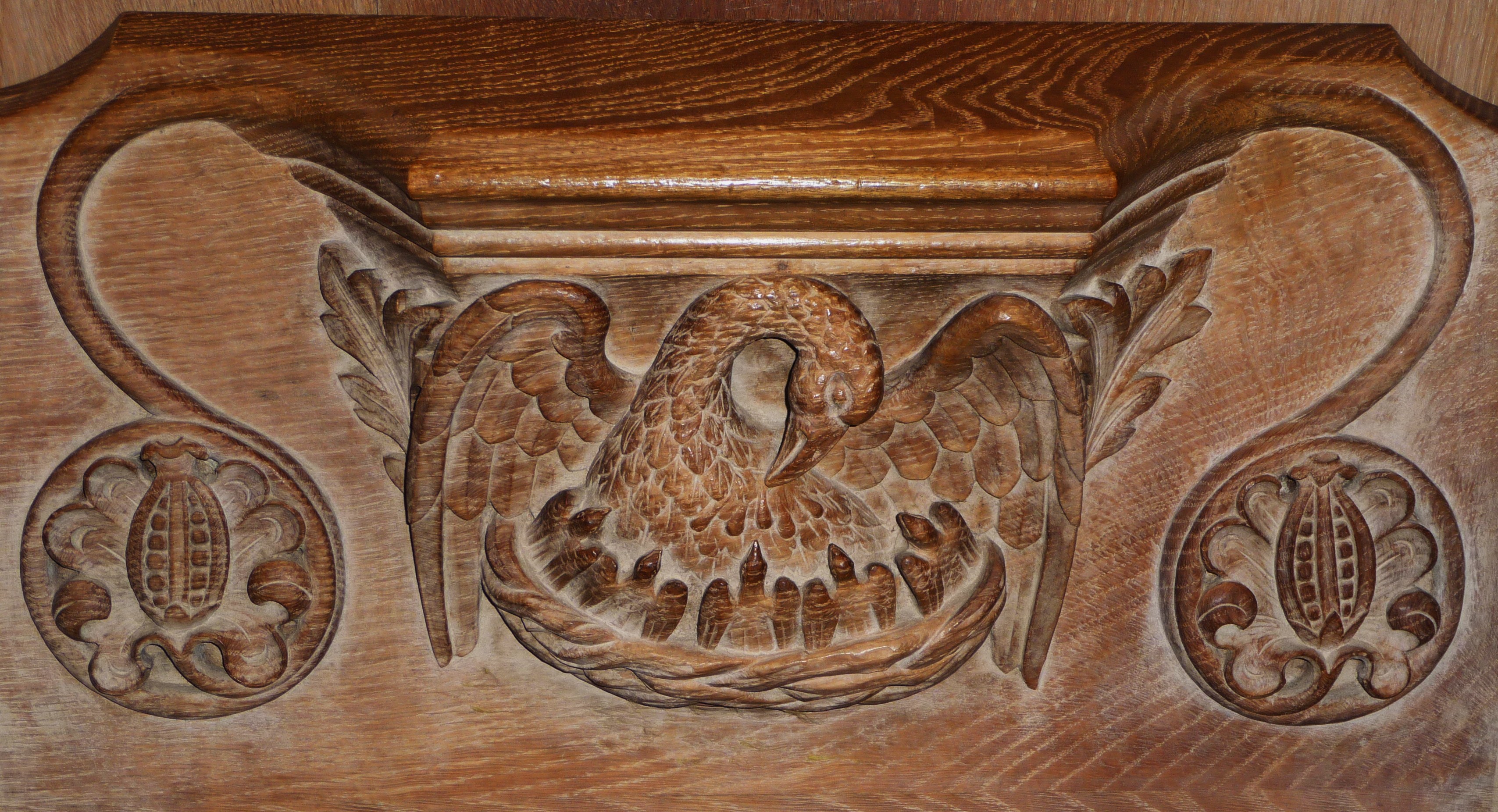
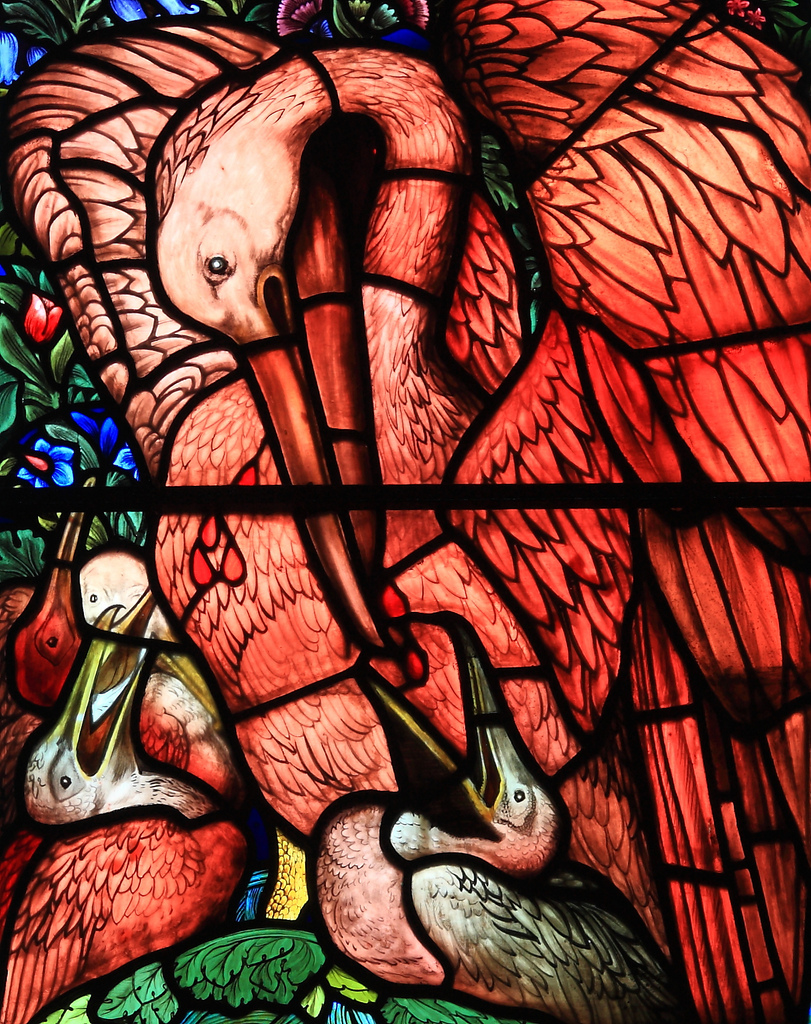
The vulning pelican has appeared in all kinds of visual media from late antiquity through the medieval and premodern eras and on into the twentieth and twenty-first centuries, including illuminated prayerbooks, missals, bestiaries (as in the tiled gallery below; hover to view captions, or click to enter carousel); panel paintings, frescoes; mosaics; stained glass windows; tapestries; lecterns, roof bosses, bench ends, misericords, corbels; and a range of liturgical objects and vestments.
From a miscellany containing an illustrated copy of Hugh of Fouilloy’s De avibus, Italy, late 13th or early 14th century. Biblioteca Statale di Cremona, MS 199, fol. 11v. https://bestiary.ca/beasts/beastgallery244.htm
From an illuminated copy of Der Naturen Bloeme (The Flower of Nature) by Jacob van Maerlant, Flanders, ca. 1350. The Hague, Koninklijke Bibliotheek, KA 16, fol. 96vb. https://manuscripts.kb.nl/show/images/KA+16/page/26
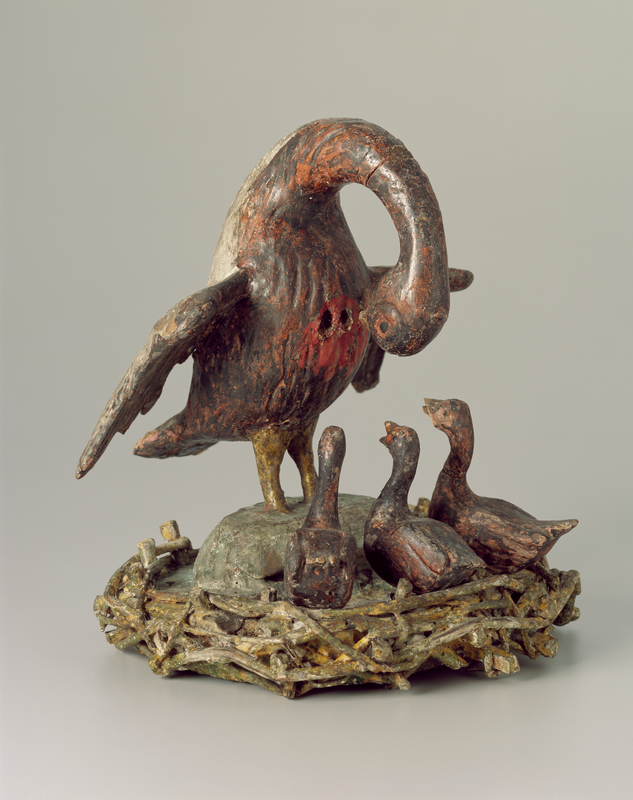
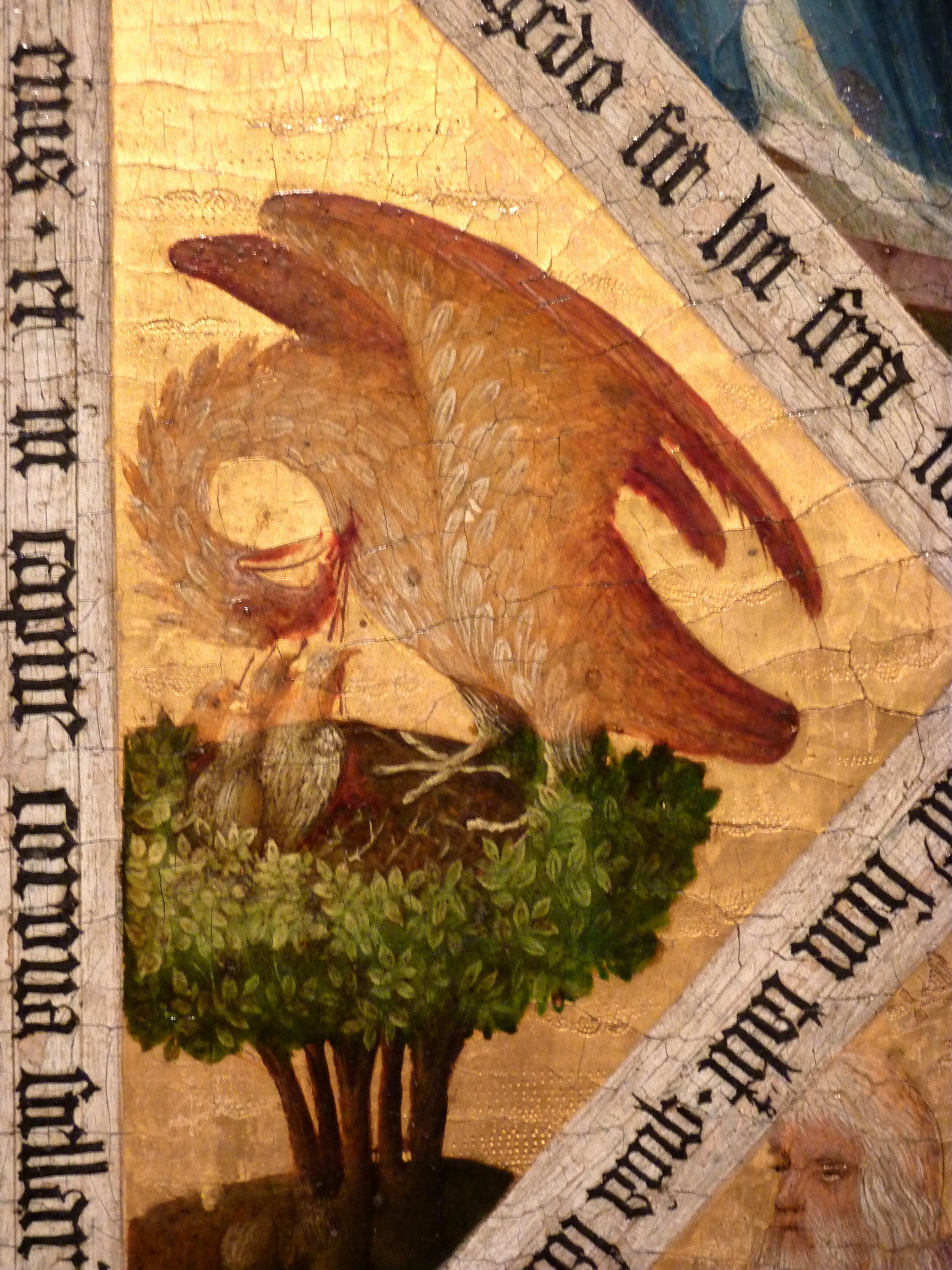
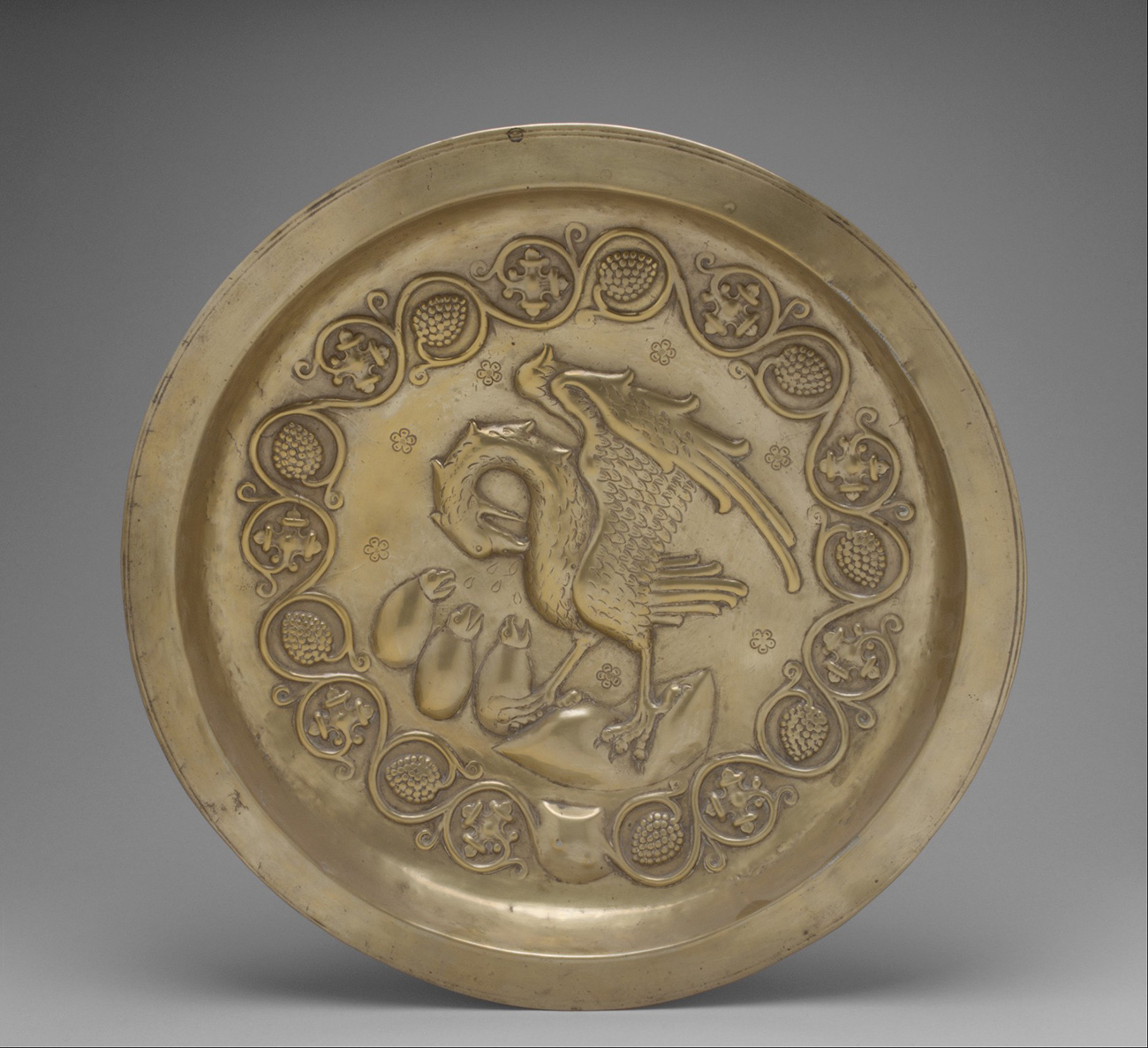
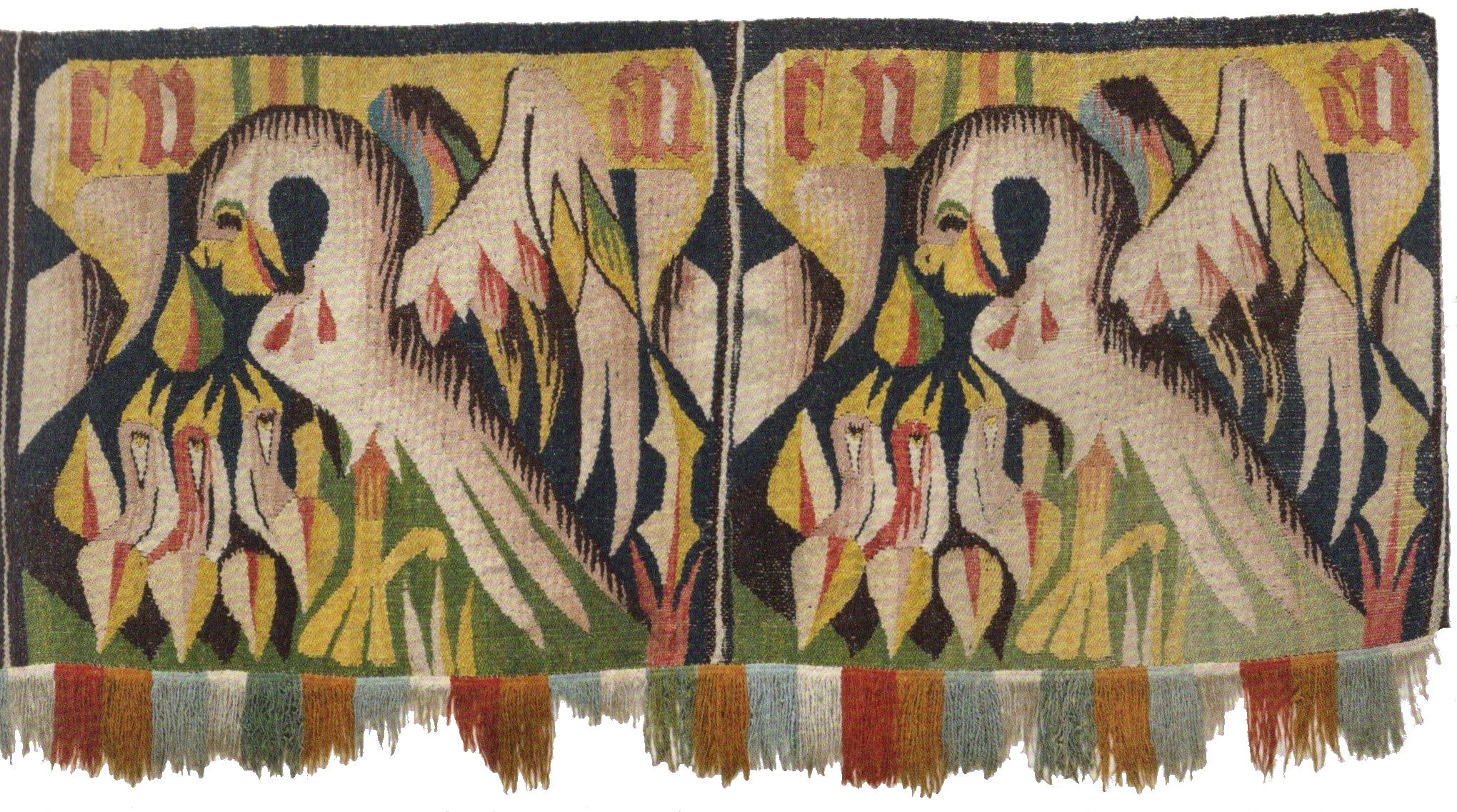
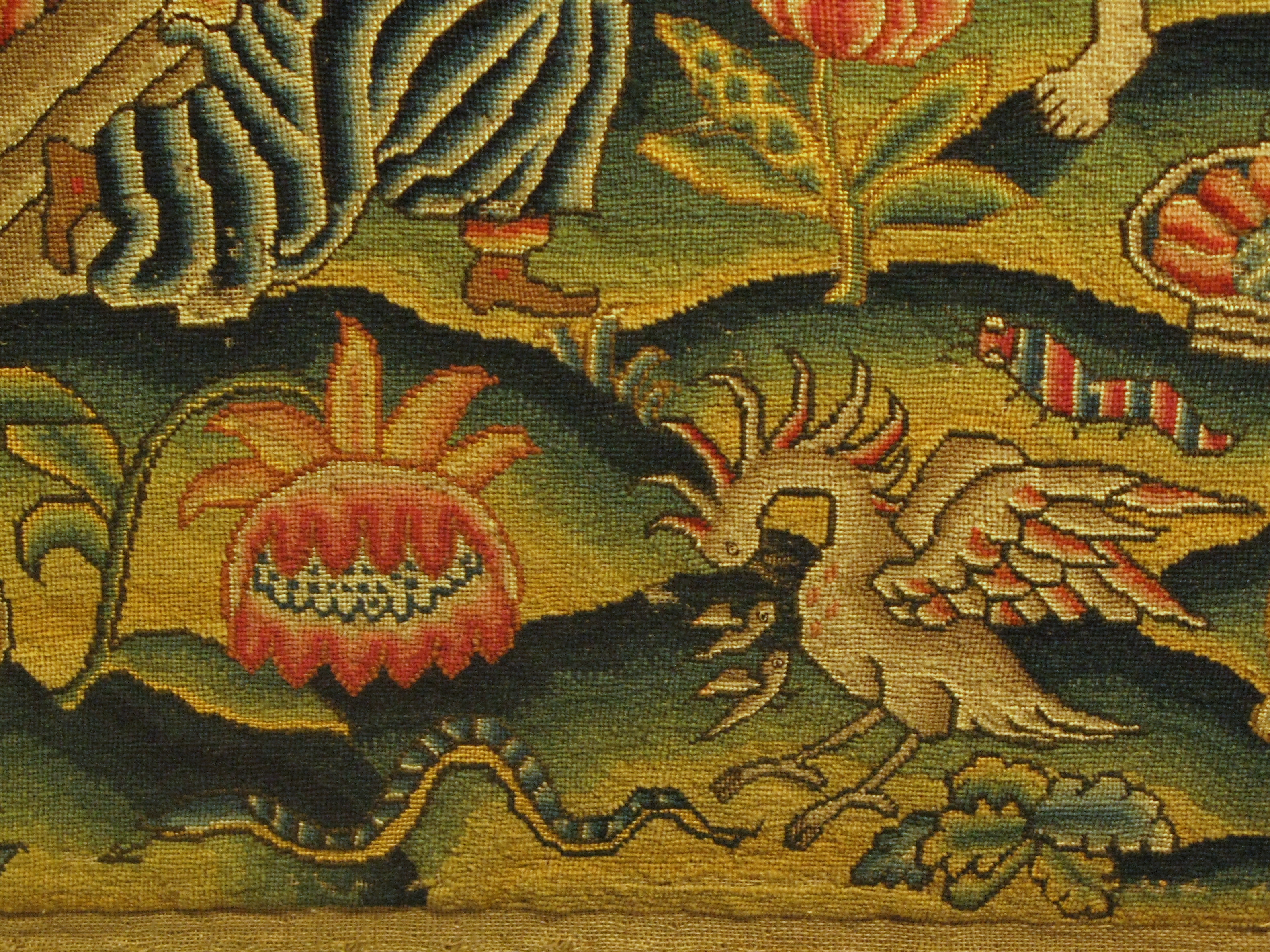
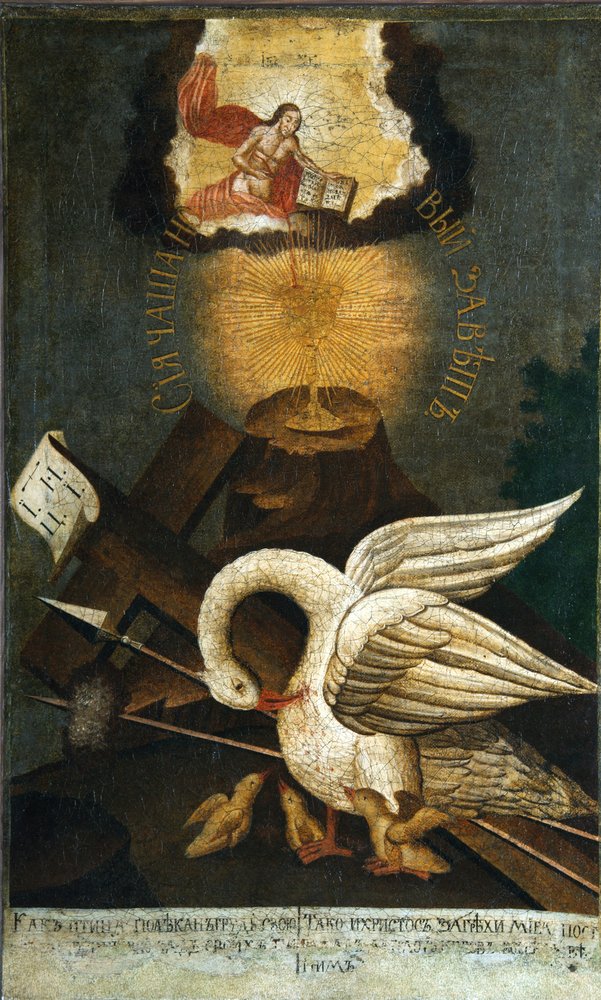
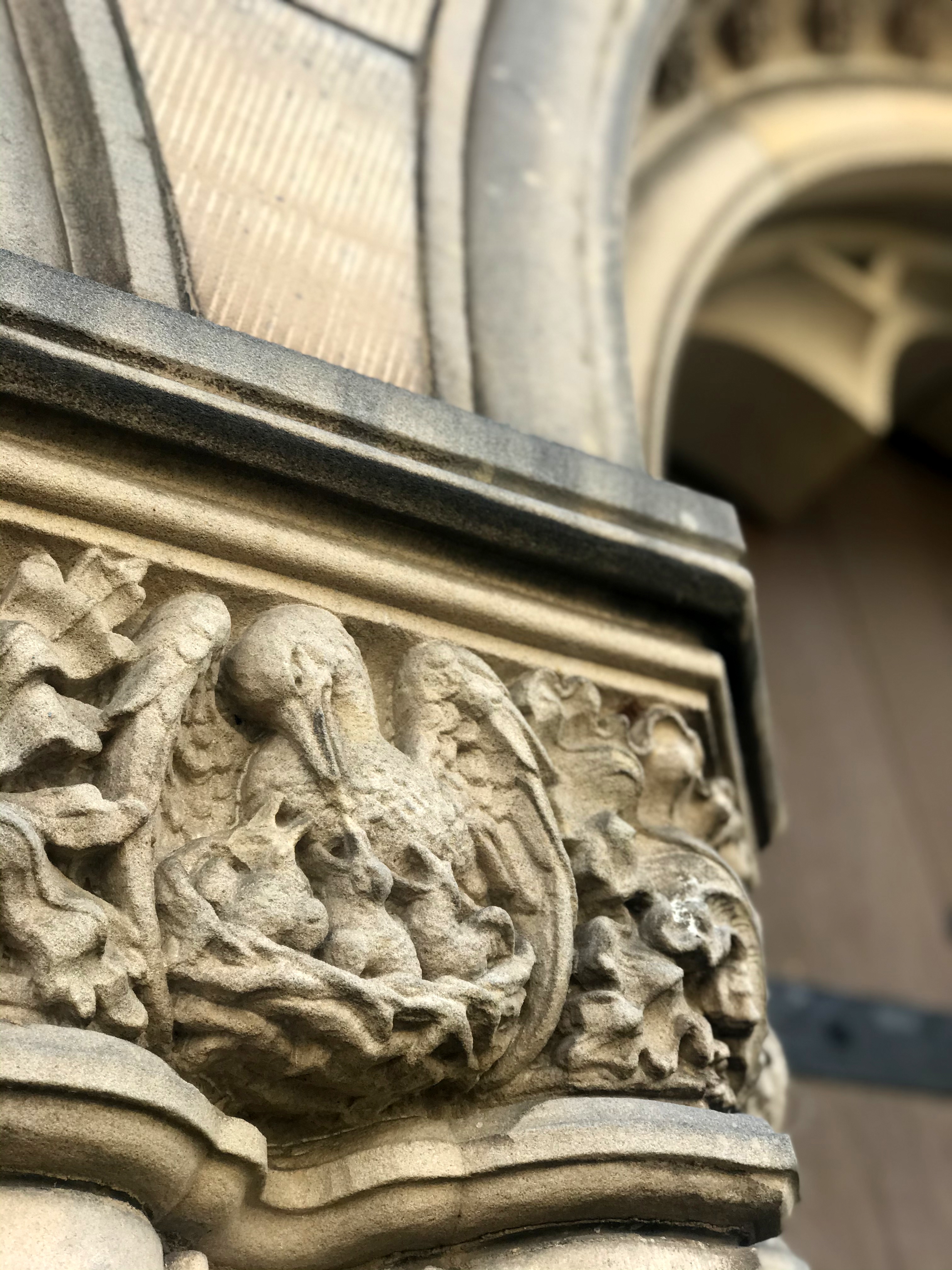
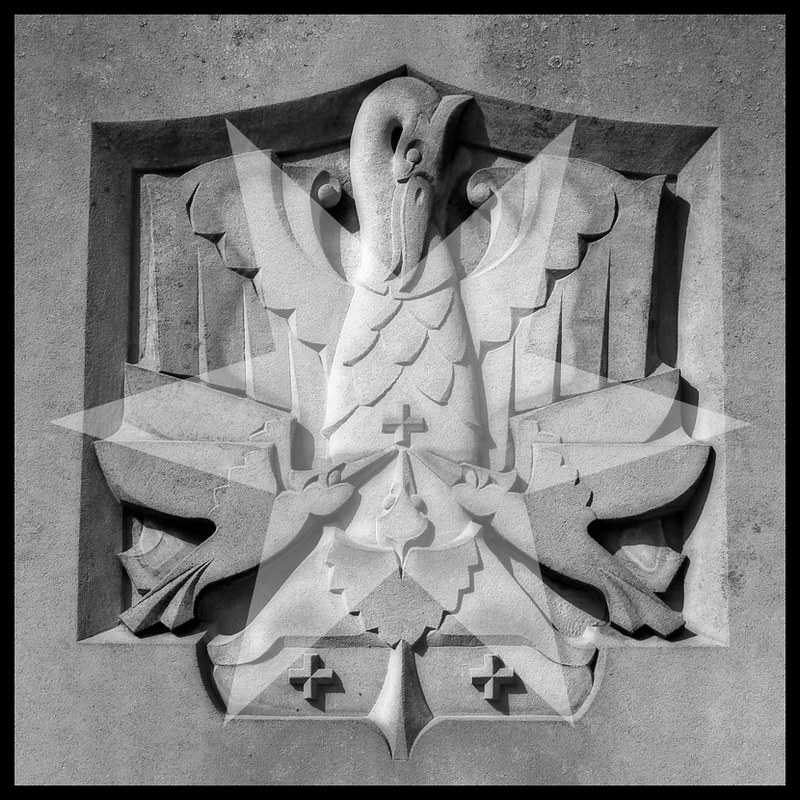
Pelican in Her Piety, 1331–32. Stained glass, Lady Chapel, St Michael and All Angels, Felton, Northumberland, England. Photo: Ann Chapman.Pelicanin Her Piety, 15th century. Stained glass, All Saints Church, Oaksey, England. Photo: Rex Harris.Pelican in Her Piety, All Saints Church, Bishop Burton, East Riding of Yorkshire, EnglandPelican in Her Piety, 1476. Fresco, Bollerup Church, Sweden. Photo: Stig Alenas.Painted choir vault, 15th century, Mariakerk (St. Mary’s Church), ‘t Zandt, Groningen, Netherlands. Photo: Ana Sudani.Oak wood roof boss, ca. 1470–80, St Mary the Virgin, Shrewsbury, Shropshire, England. Photo: Ana Sudani.Bench end by Henry Ringham, 19th century, St Margaret, Ipswich, Suffolk, England. Photo: Simon Knott.Carved oak misericord from Sheffield Cathedral, England, 1920Sculpture with Pelicans, Switzerland, 16th century. Painted linden and willow wood, 29.5 × 27 × 26 cm. Landesmuseum (Swiss National Museum), Zurich, LM-3972.Triptych with the Virgin and Child (detail), Cologne or Lower Rhine, ca. 1425–30. Tempera and gold leaf on oak wood. LVR-LandesMuseum Bonn, Germany. [view full triptych]Plate with the Pelican in Her Piety, Dinant or Malines, Netherlands, 15th century. Brass, diameter 19 7/8 in. Metropolitan Museum of Art, New York. It’s unknown whether this plate was used domestically or liturgically (i.e., for the Eucharist).Tapestry with a Pelican Feeding Her Young (detail), Germany (Lüne Abbey), ca. 1500. Linen and wool, 65 × 233 cm. Kloster Lüne Museum für sakrale Textilkunst, Lüneburg, Germany, Inv. LUEKO Ha 010.05. Source: Book of Beasts: The Bestiary in the Medieval World, cat. 41bCushion cover (detail), England, ca. 1640–70. Wool and silk embroidery on linen, 55.9 × 107.5 cm. Victoria and Albert Museum, London. The primary scenes are the Hospitality of Abraham and the Sacrifice of Isaac. [view full cushion]Pelican in Her Piety, Russia, early 19th centuryPelican in Her Piety, 1907–9. Relief carving from the exterior of Holy Trinity Church, St Andrews, Scotland. Photo: Joy Marie Clarkson.Pelican of Mercy, 1956. Stone relief carving, exterior of Blessed Sacrament Catholic Church, Sioux City, Iowa.
The bird doesn’t always look like an actual pelican, though. It could be that some of the artists had never seen one, although the Dalmatian pelican, which has the long bill and the expandable throat pouch that we most associate with the genus, had been widespread across Europe since ancient times. More likely, the imaginative rendering of the pelican in Christian art derives from the account of the bird in book 12 (“De animalibus”) of the widely influential compendium Etymologies by the Spanish archbishop Isidore of Seville, written around 623, which repeats the popular legend and adds that the pelican lives in Egypt. An exotic bird therefore required exotic treatment.
Neither does the behavior the Physiologus ascribes to pelicans have any basis in natural fact. It’s possible the legend arose from the observation that the pelican sometimes bends its beak into its chest, which may look like it’s piercing it, and that some pelicans have a reddish tinge on their breast plumage and/or a red tip on their beak. However, zoological accuracy was not the point; the point was to convey theological truth.
In The Bestiary of Christ, Louis Charbonneau-Lassay says the pelican first started appearing as a Christian symbol on clay oil lamps in ancient Carthage (present-day Tunisia), citing “L. Delattre, Carthage,Symboles eucharistiques, p. 91”—the French archaeologist Alfred Louis Delattre (1850–1932). But I’ve not been able to track down the cited text or find any such examples. If you can point me to photographs, please do!
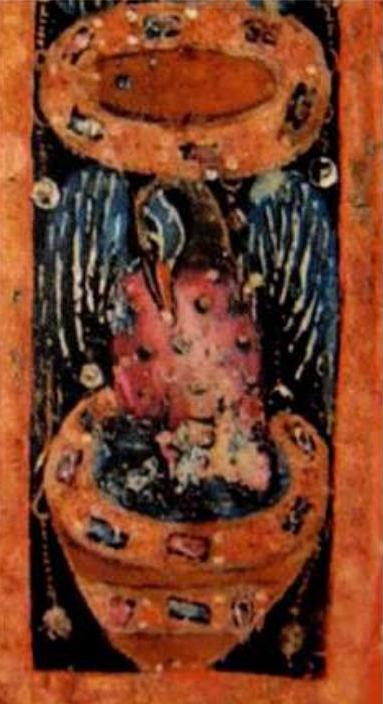
In the “Ējmiacin [Etchmiadzin] Codex” entry in The Eerdmans Encyclopedia of Early Christian Art and Archaeology, Paul Corbey Finney identifies the border illustrations in that Armenian Gospel book’s Baptism of Christ miniature from ca. 600 as depicting a pink-bodied pelican spreading its blue wings and pecking its breast while standing in a bejeweled chalice. The figure is repeated ten times.
Pelican detail from The Baptism of Christ in the Codex Etchmiadzin, an Armenian Gospel book. Yerevan, Mesrop Mashtots Institute of Ancient Manuscripts (Matenadaran), Cod. 2374, fol. 229v. The image is dated to ca. 600, but it was added to a 10th-century manuscript.
Finney mentions that a vulning pelican also appears in the Rabbula Gospels from sixth-century Syria. I think he’s referring to the bird at the top of the canon tables on folio 5a, which also shows the prophets Joel and Hosea and the Wedding at Cana. The iconography is far less obvious here.
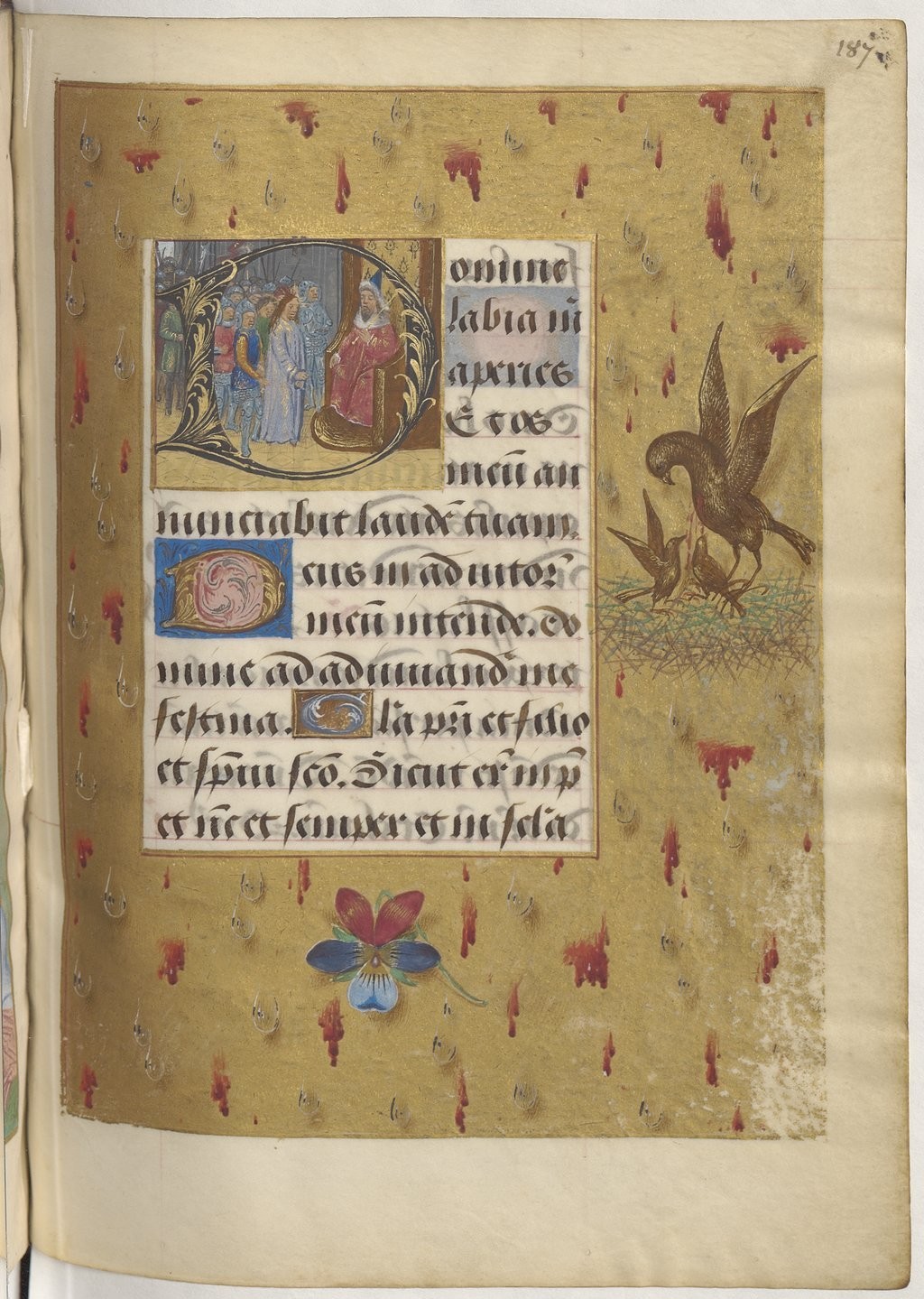
One illuminated manuscript page I love that makes use of the pelican symbol comes from the late Flemish Boussu Hours, a prayerbook made for Isabelle de Lalaing, probably after the death of her husband Pierre de Hennin, lord of Boussu.
Master of Antoine Rolin (Flemish, active 1490–1520), Le pélican, symbole du Christ (Pelican, symbol of Christ), from the Boussu Hours, Cambrai, France, ca. 1490–95. Paris, Bibliothèque de l’Arsenal, Ms 1185 réserve, fol. 187r.
Appearing opposite a full-page miniature of Christ in Gethsemane, folio 187r opens the Hours of the Passion prayer cycle:
V: Domine labia mea aperies. R: Et os meum annunciabit laudem tuam. V: Deus in adiutorium meum intende. R: Domine ad adiuvandum me festina. Gloria Patri, et Filio: et Spiritui sancto. Sicut erat in principio, et nunc, et semper: et in saecula saeculorum.
English translation:
V: O Lord, open my lips, R: And my mouth shall declare thy praise. V: Incline unto my aid, O God. R: O Lord, make haste to help me. Glory be to the Father, and to the Son, and to the Holy Ghost, as it was in the beginning, is now, and ever shall be: world without end.
The historiated initial “D” shows Christ before Pilate, and in the margin a pelican exudes her lifeblood into the mouths of her two chicks, a scene set against a gold background likewise dripping with blood—as well as sweat and tears. It’s “almost as if the gold margin were an expanded microcosm of the bird’s broken breast,” writes Katharine Davidson Bekker in her essay “Those Who Weep: Tears, Eyes, and Blood in the Boussu Hours.” Bekker further notes that “the pansy flower in the margin, the name of which references the French penser (‘to think’), . . . encourages the reader to think deeply about the images on the page.”
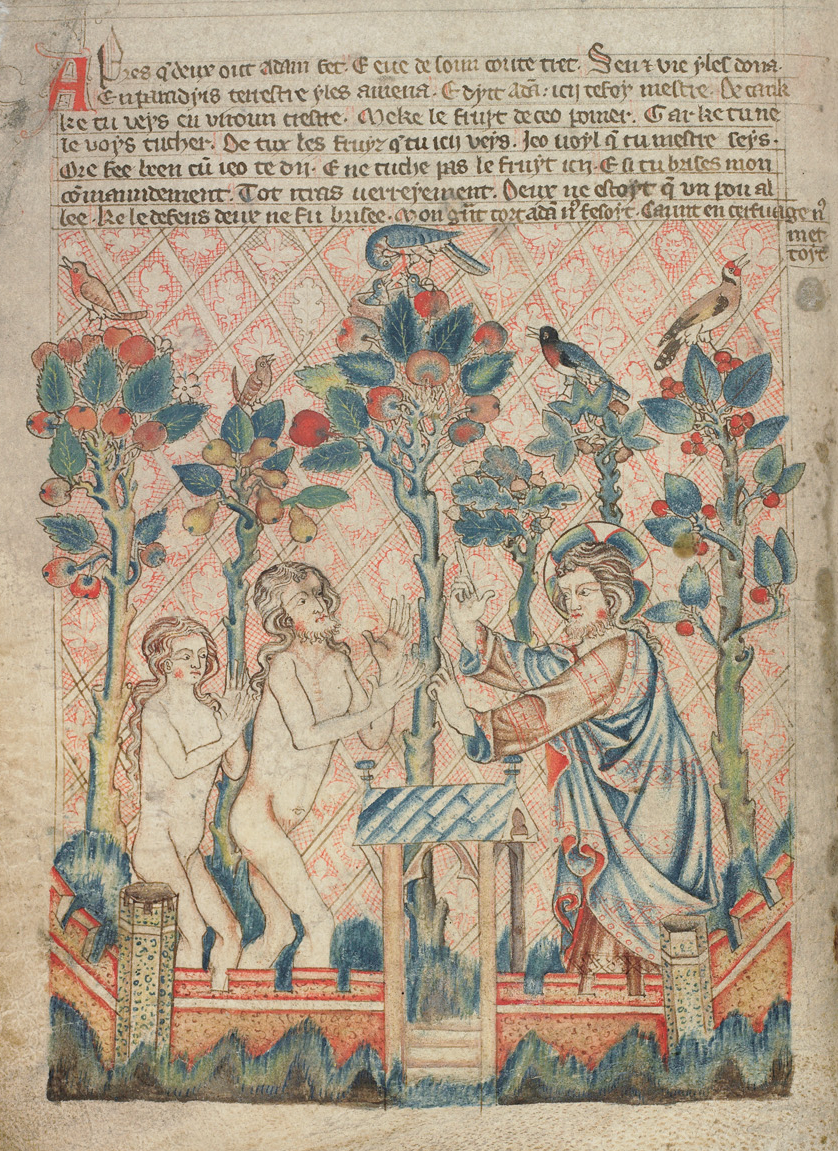
Another remarkable appearance of the pelican in medieval manuscript illumination is in the Holkham Bible Picture Book from fourteenth-century England—remarkable because it appears not in a passion cycle, as was typical, but in a creation cycle!
The Tree of Knowledge, from the Holkham Bible Picture Book, southeastern England, ca. 1327–35. British Library, Add MS 47682, fol. 3v.
In the garden of Eden, God the Creator, portrayed here as Christ, instructs Adam and Eve that they may freely eat of any tree except the tree of the knowledge of good and evil, which he points to with one hand and with the other wags his finger in a forbidding manner. Various birds perch atop the adjacent trees, but at the apex of this fateful one at the center is the vulning pelican, foreshadowing the sacrifice of Christ that will be required for humanity to reenter Paradise after the fall.
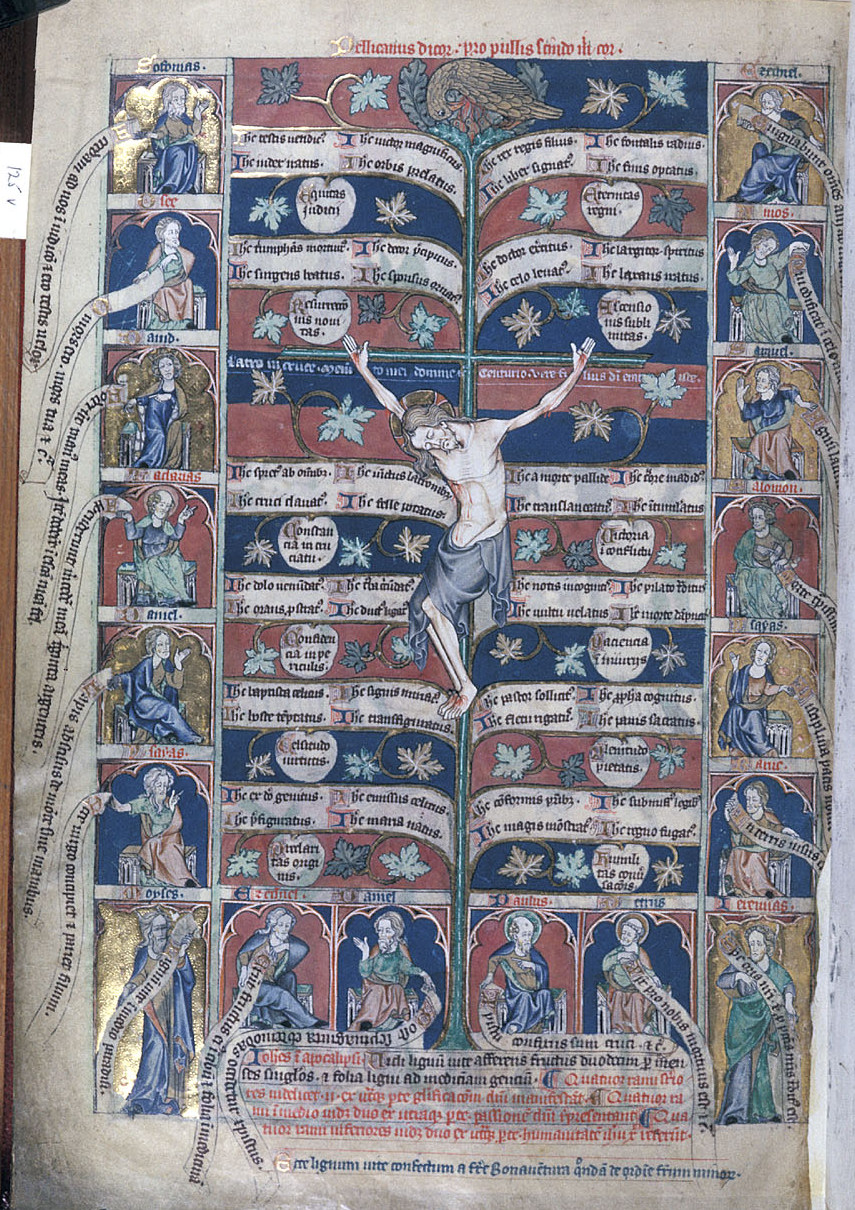
Compare this image to the diagrammatic one on folio 125v of the De Lisle Psalter, which was inspired by Bonaventure’s meditational treatise the Lignum vitae. It shows a pelican nesting atop the tree of life on which Christ is crucified, wounding herself to feed her offspring with her blood:
Tree of Life, from the De Lisle Psalter, England, 1310–39. London, British Library, Arundel MS 83, fol. 125v.
The Latin inscription above it in red reads, Pellicanus dicor, pro pullis scindo mihi cor (“I am called a pelican, because I tear open my heart for my chicks”). The twelve branches contain texts relating to Christ’s humanity, passion, and glorification, while the surrounding panels contain Old Testament witnesses.
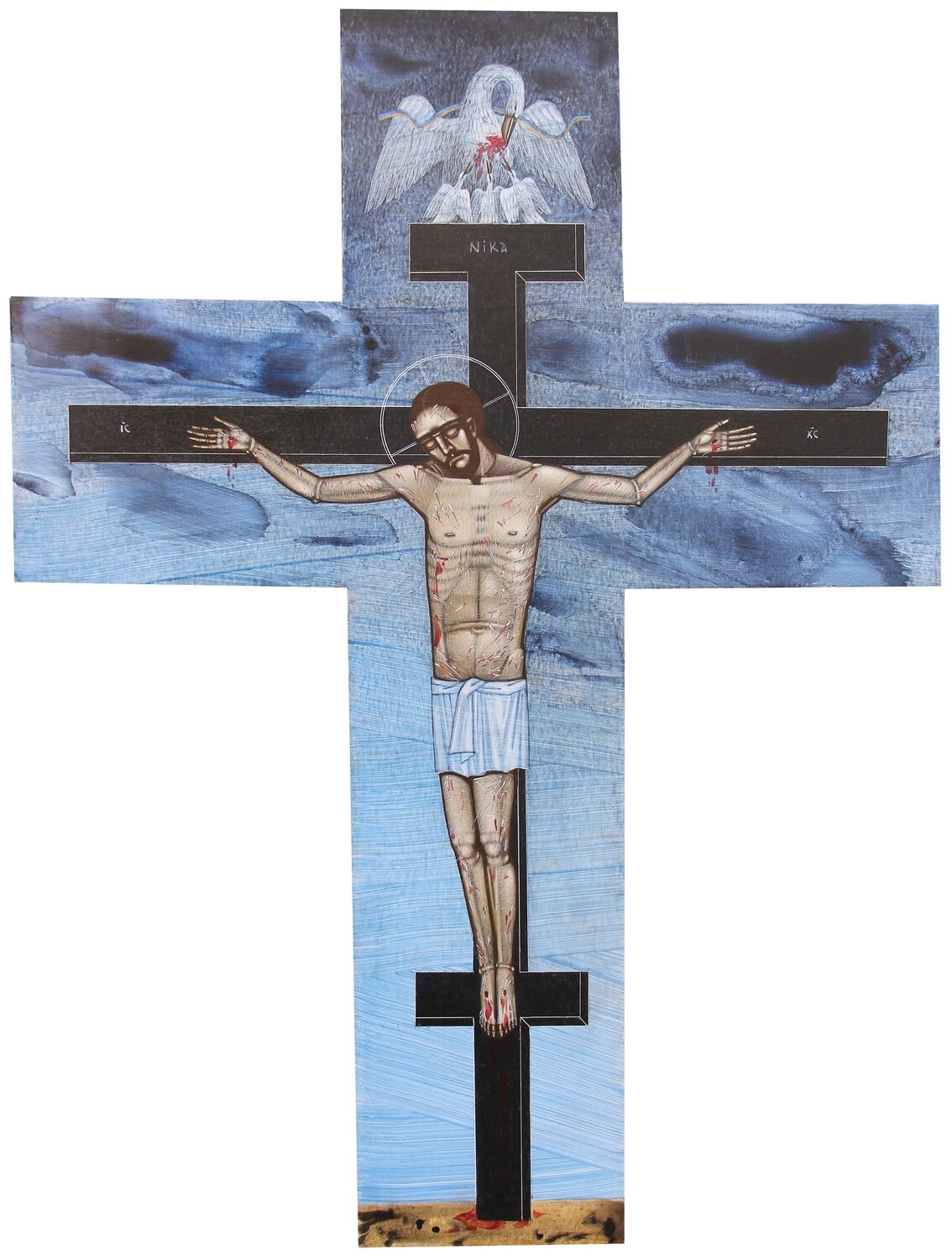
The Crucifixion is the narrative context in which the vulning pelican most often appears in art, reinforcing the notion of Christ’s self-emptying sacrifice. It was especially popular in proto- and early Renaissance panel paintings from Italy—which the gallery below reflects, in addition to featuring a few other examples from France, Greece, and Armenia.
Fra Angelico, Christ on the Cross, the Virgin, Saint John the Evangelist, and Cardinal Torquemada (detail), ca. 1453–54. Harvard Art Museums / Fogg Museum, Cambridge, Massachusetts. Photo: Victoria Emily Jones [view full painting]
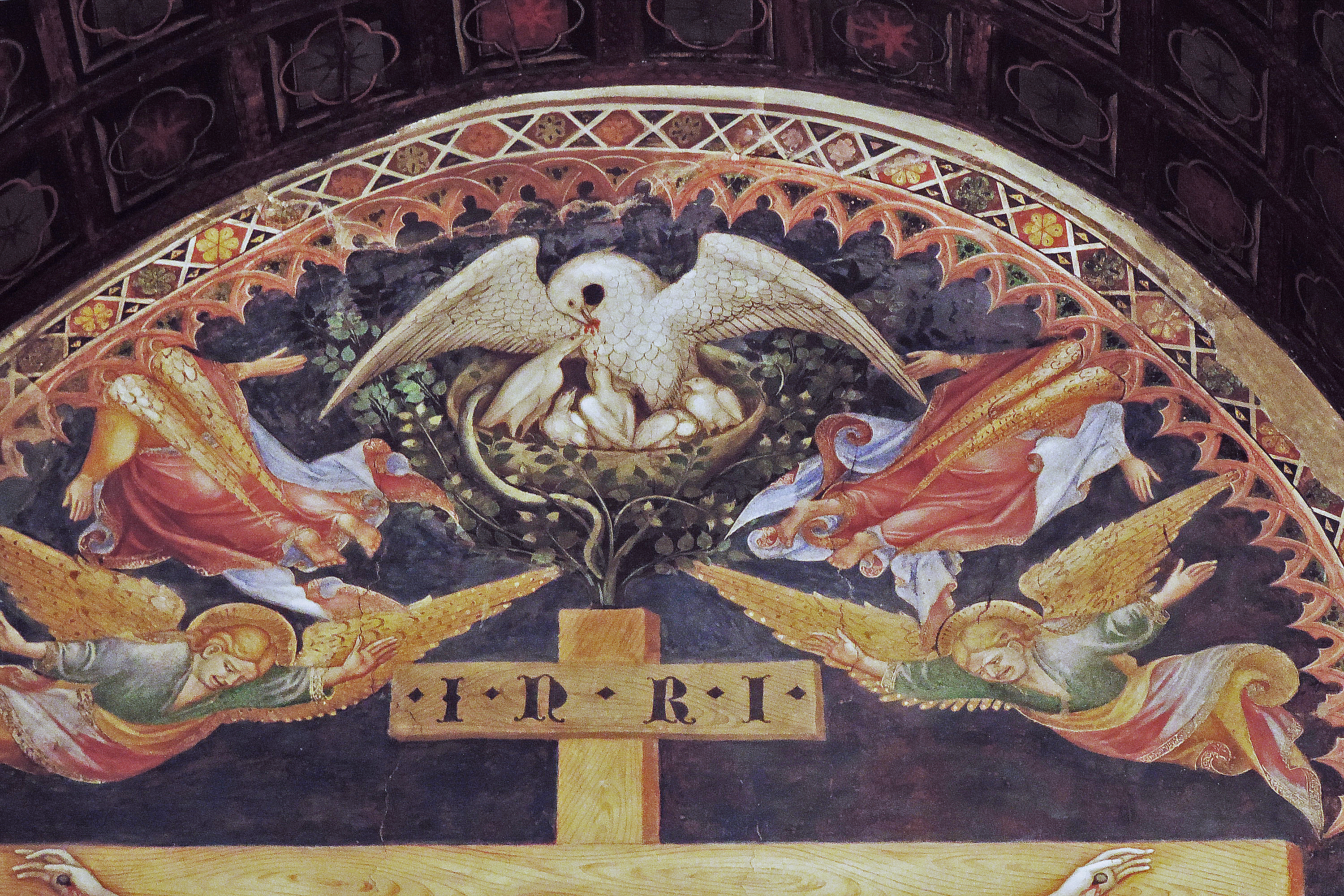
In the Simone di Filippo Benvenuti example above (third row, left), notice the little winged dragon fleeing the pelicans’ nest as the mother pelican undoes the harm he has inflicted. A similar detail can be found in the Crucifixion fresco from the altar wall of the Oratory of St. John the Baptist in Urbino, which shows a snake slithering away from the perishing chicks, who are brought back to life by their intervening mother:
Lorenzo Salimbeni (Italian, 1374–ca. 1418) and Jacopo Salimbeni (Italian, ca. 1370/80–after 1426), Crucifixion (detail), ca. 1416. Fresco, Oratorio di San Giovanni Battista (Oratory of St. John the Baptist), Urbino, Italy.
The snake motif references a version of the pelican legend found in De natura rerum (On the Nature of Things) by the Flemish Dominican friar Thomas of Cantimpré (ca. 1200–1272) and the slightly later De animalibus (On Animals) by the German Dominican friar Albertus Magnus (ca. 1200–1280). According to these two works, when the mother pelican leaves her nest to find food for her fledglings, she returns to find them dead from the bite of an ambushing snake. She then tears her own flesh to revive them with her blood, which is full of healing properties.
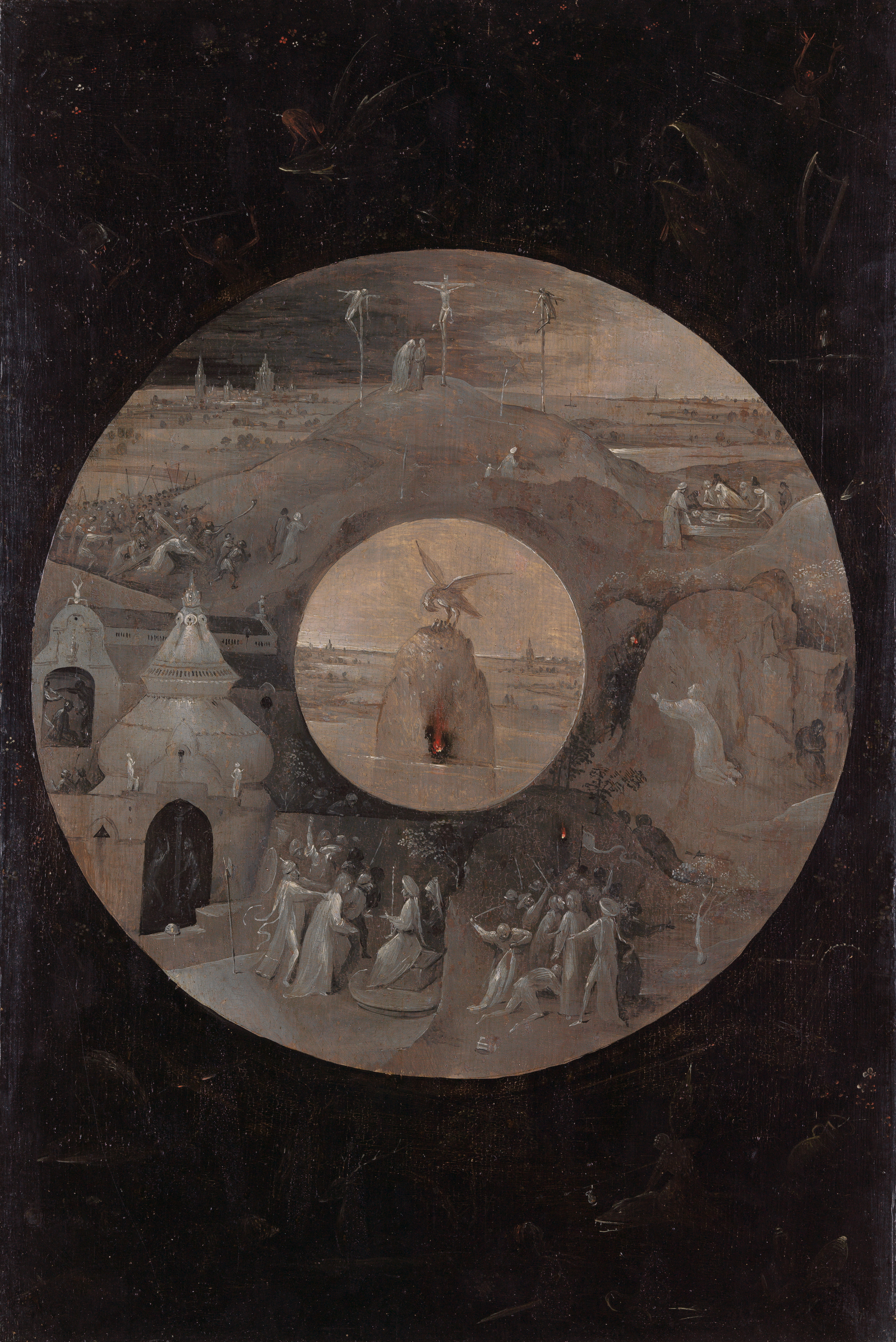
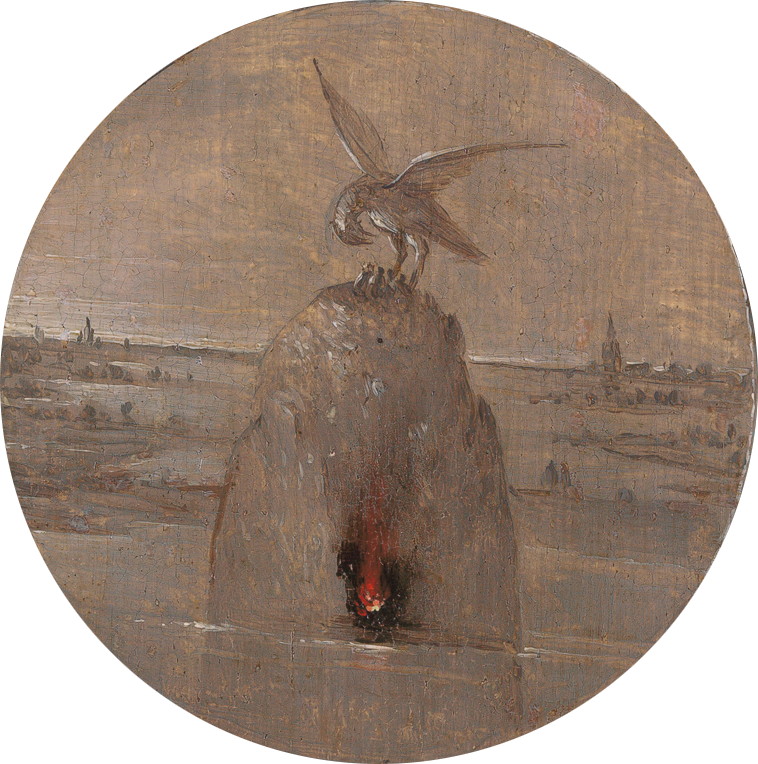
One of the most unique visual treatments of the vulning pelican that I found is a painting by the Dutch Renaissance artist Hieronymus Bosch. Rendered in grisaille (gray monochrome), his pelican appears in the center of a ring depicting scenes from the passion of Christ. It’s painted on the reverse of a panel that shows John the Evangelist in exile on Patmos, penning the book of Revelation.
Hieronymus Bosch (Netherlandish, ca. 1450–1516), Scenes from the Passion of Christ (reverse of John on Patmos), ca. 1500. Oil on panel in grisaille, 62.8 × 43.2 cm. Staatliche Museen zu Berlin, Gemäldegalerie.
Staged around mountain crags, the passion cycle begins on the right with Jesus praying in Gethsemane and continues clockwise with the Arrest of Christ, Christ before Pilate, the Flagellation, the Crowning with Thorns, the Carrying of the Cross, the Crucifixion, and the Entombment.
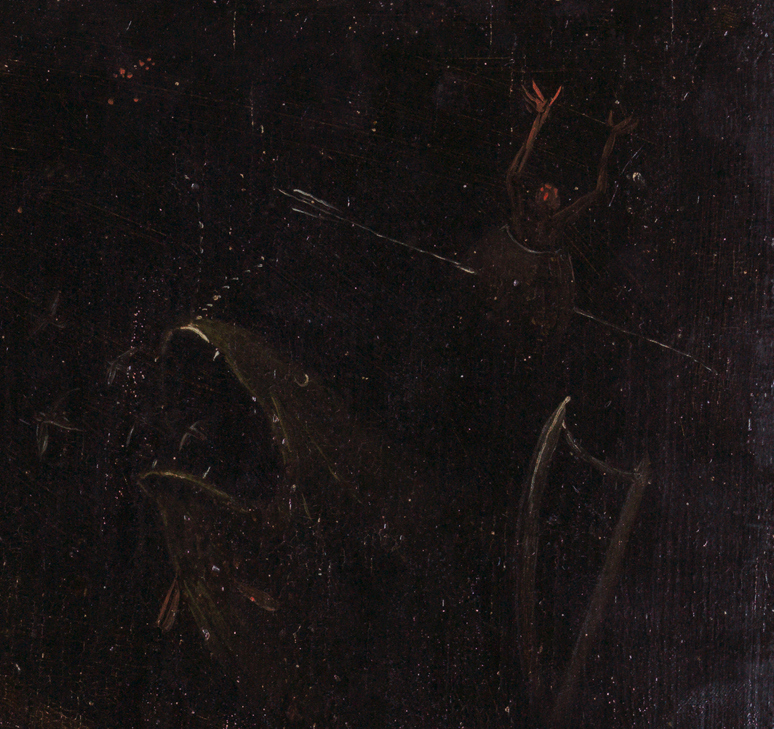
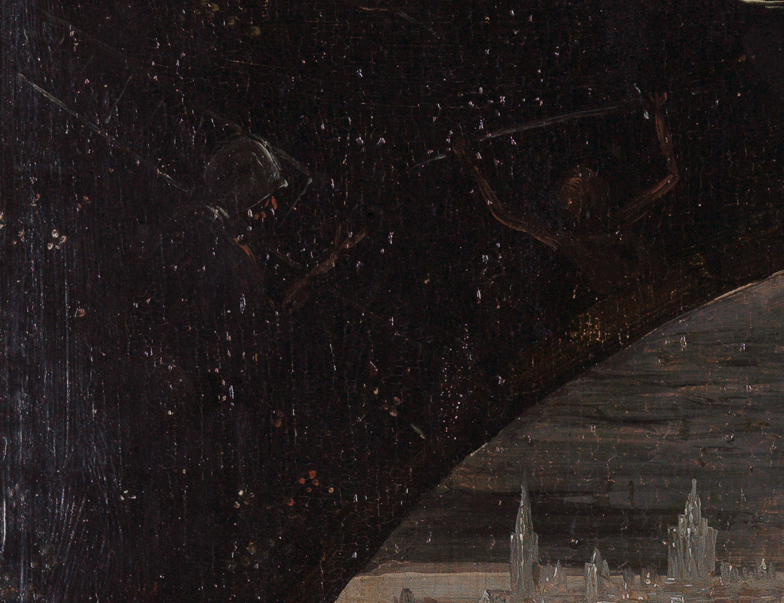
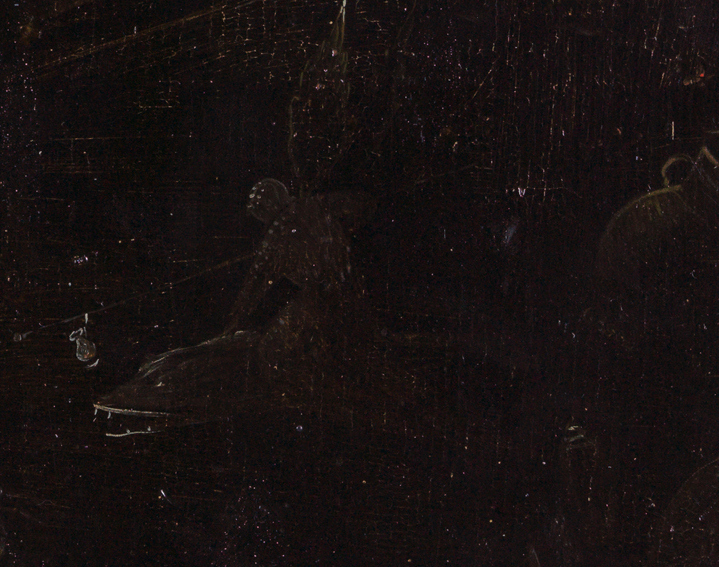
Outside this ring of scenes is a darkness populated by shadowy demons:
But the inner disc, the focal point of the composition, contains the promise of redemption. Emerging from the still waters of a vast postdiluvian landscape is a hillock with a hollow that houses a burning fire. On the summit, a large mother bird spreads her protective wings over her brood, inclining her head toward her chest—an iconography we recognize as the vulning pelican, symbolic of the deep, saving love God embodied on the cross.
As we view this painting, we progress from the outer darkness with its infernal powers, to the growing light actualized by the events of Maundy Thursday and Good Friday, and finally to the brilliant center with its red flame—which, other than two dim, flickering torches in Gethsemane, contains the sole bit of color in the whole painting. Images of the Sacred Heart of Jesus, which would gain prominence in the seventeenth century, feature a flame, representing Christ’s ardent love burning bright. And that’s what we have here.
Red is also the color of blood. I’m reminded of Robert Southwell’s poem “Christ’s Bloody Sweat,” which combines imagery of the pelican and the self-immolating but ultimately indestructible phoenix, marveling at “how bleedeth burning love.” (I’ll explore a few more poems about the pelican in the next section.)
As John writes in the wonderful prologue to his Gospel, “The light shines in the darkness, and the darkness did not overtake it” (John 1:5).
In Bosch’s painting, the Christbrand bursts, like the pelican’s split side. The flame of redemption is lit, like a lighthouse, calling us home into the love of God.
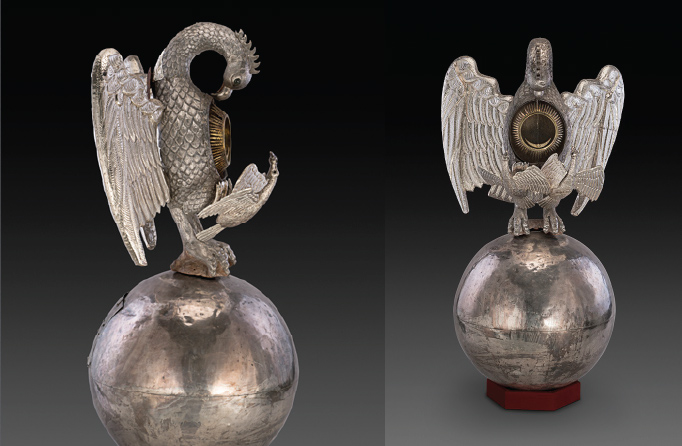
Another especially compelling art object that draws on the pelican legend is a silver-plated tabernacle monstrance from Portuguese Goa in southwestern India.
Tabernacle monstrance made in Goa, India, 17th century. Silver on wood, glass, 142 × 72 cm, globe 66 cm. Museum of Christian Art, Convent of Santa Monica, Old Goa, India.
In the Roman Catholic Church, a tabernacle is a container in which the consecrated hosts (small unleavened wafers of bread) of the Eucharist are stored as part of the “reserved sacrament” rite, and a monstrance is a vessel that displays the consecrated host on the altar and in procession. This object combines both into one—the spherical base serving as the tabernacle, with access gained through an opening at the back, and the bird’s breast bearing a transparent aperture surrounded by a golden sunburst halo, through which the host can be viewed. The body of Christ, broken for you.
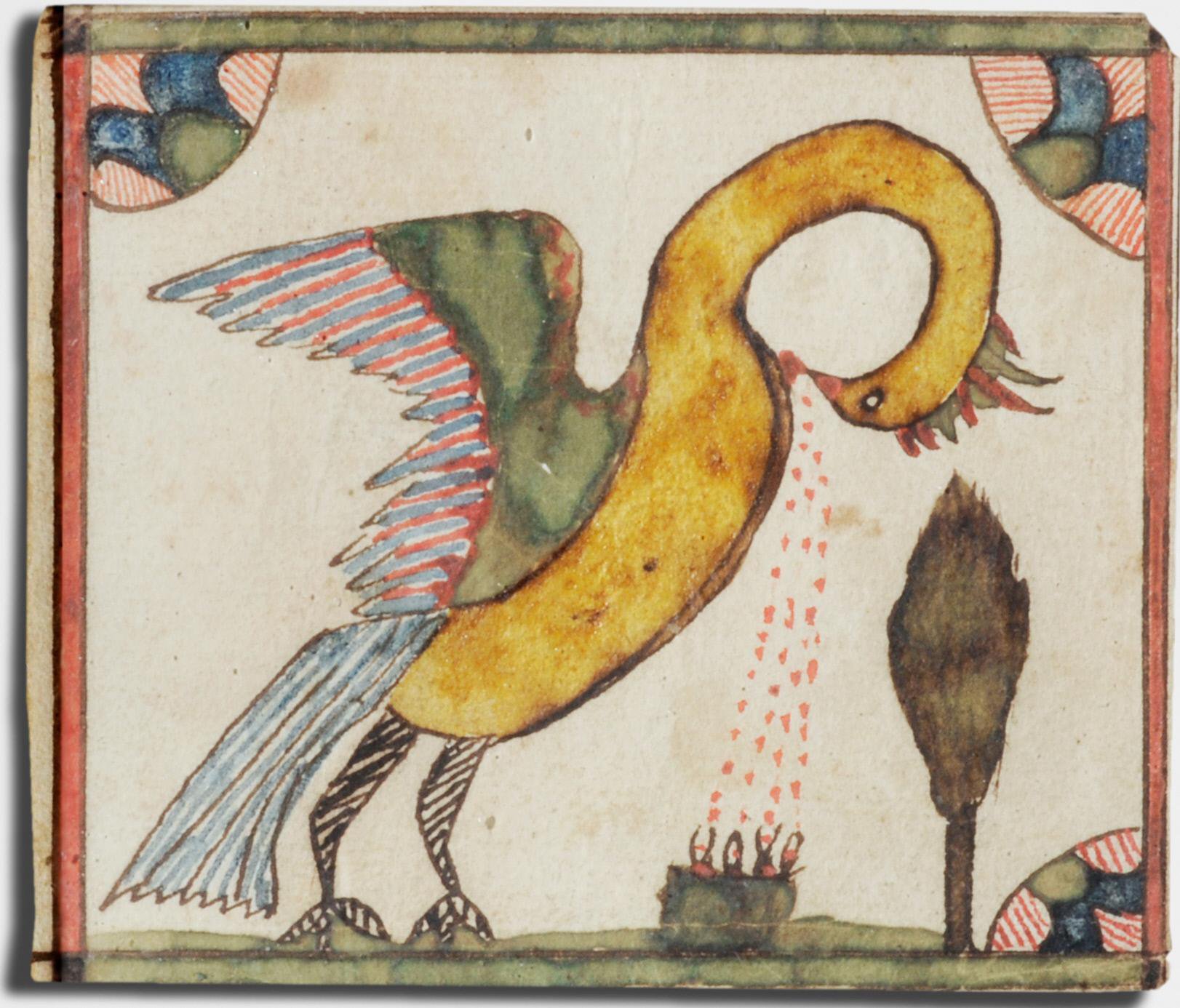
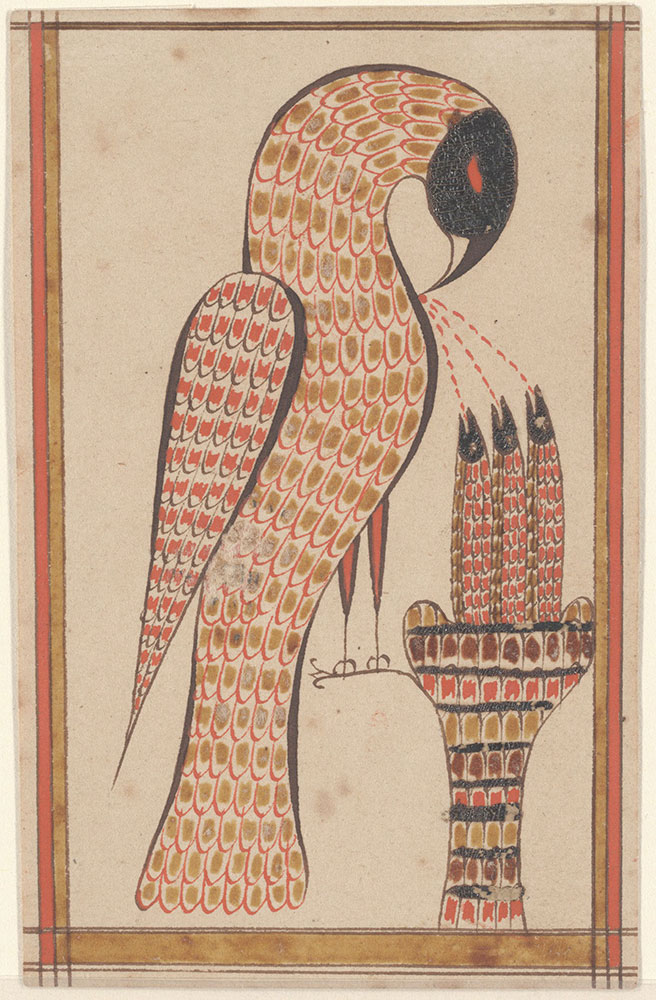
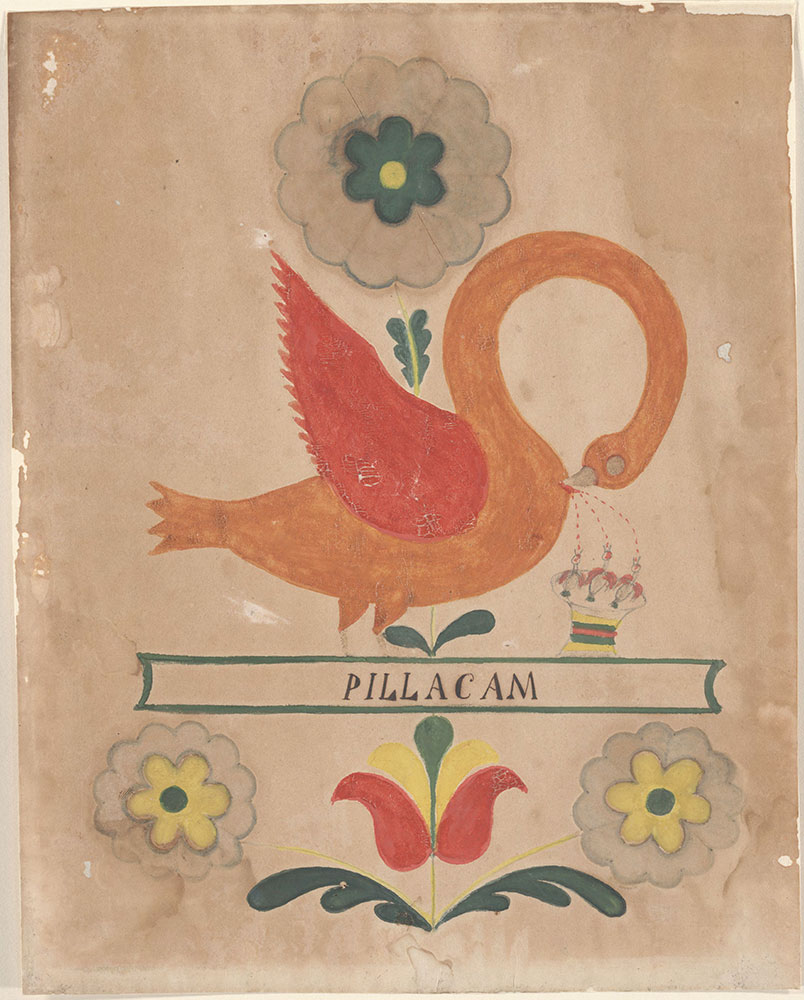
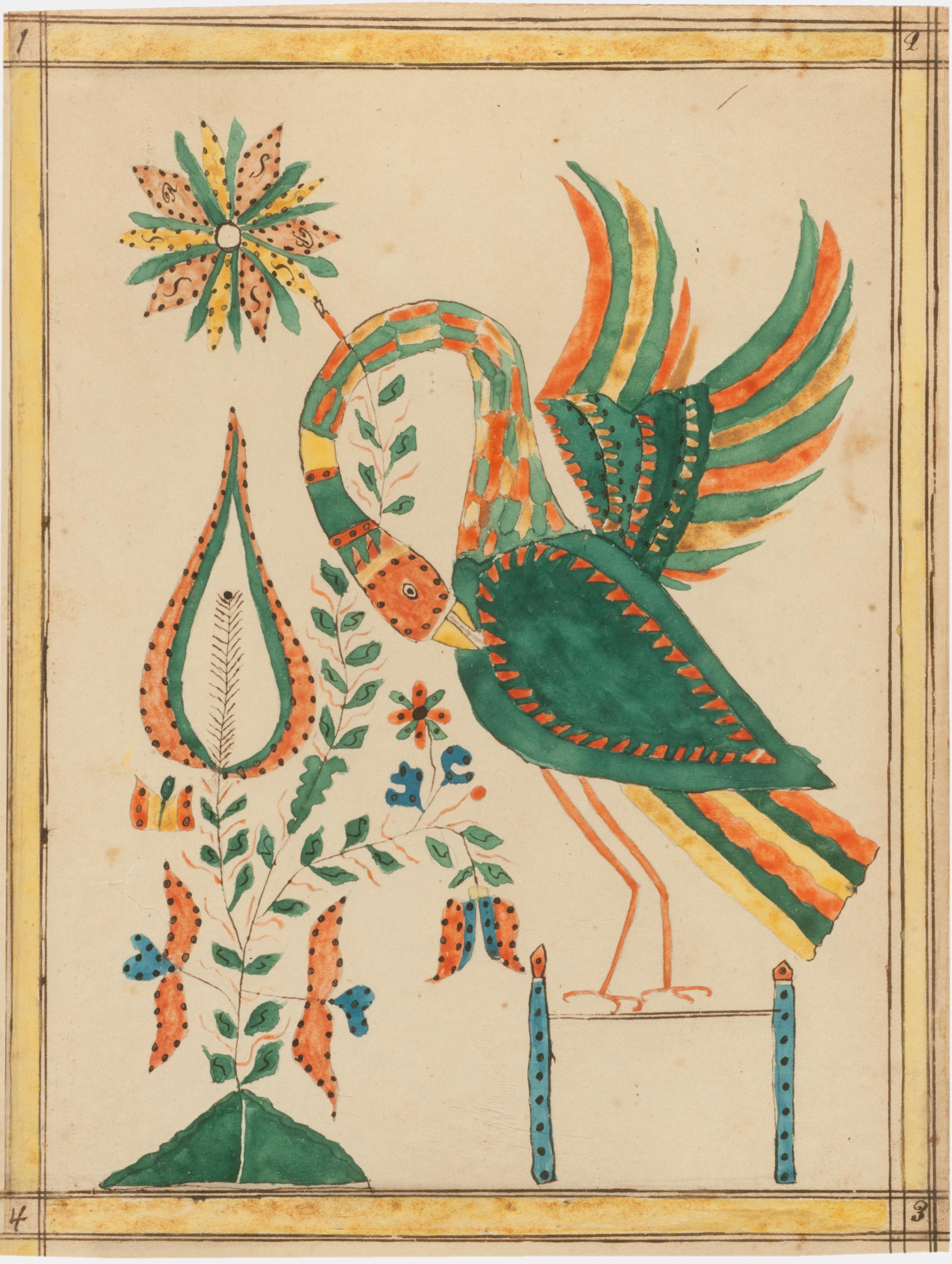
In researching this essay, I found that the pelican is a subject that recurs (so charmingly!) in the folk art of eighteenth- and nineteenth-century Pennsylvania Germans:
A Pelican in Its Piety, Bucks County or Montgomery County, Pennsylvania, ca. 1800. Watercolor and ink on laid paper, 8.9 × 8.3 cm. Promised gift of Joan and Victor Johnson to the Philadelphia Museum of Art.David Kulp (American, 1777–1834), Pelican in Its Piety, Bucks County, Pennsylvania, ca. 1810. Watercolor and ink on wove paper, 18.6 × 12.2 cm. Free Library of Philadelphia.Pelican, Pennsylvania, ca. 1850. Watercolor and ink on wove paper, 31.6 × 25.4 cm. Free Library of Philadelphia.A Pelican in Its Piety, Pennsylvania, ca. 1825. Watercolor and ink on wove paper, 24.1 × 19.1 cm. Promised gift of Joan and Victor Johnson to the Philadelphia Museum of Art.
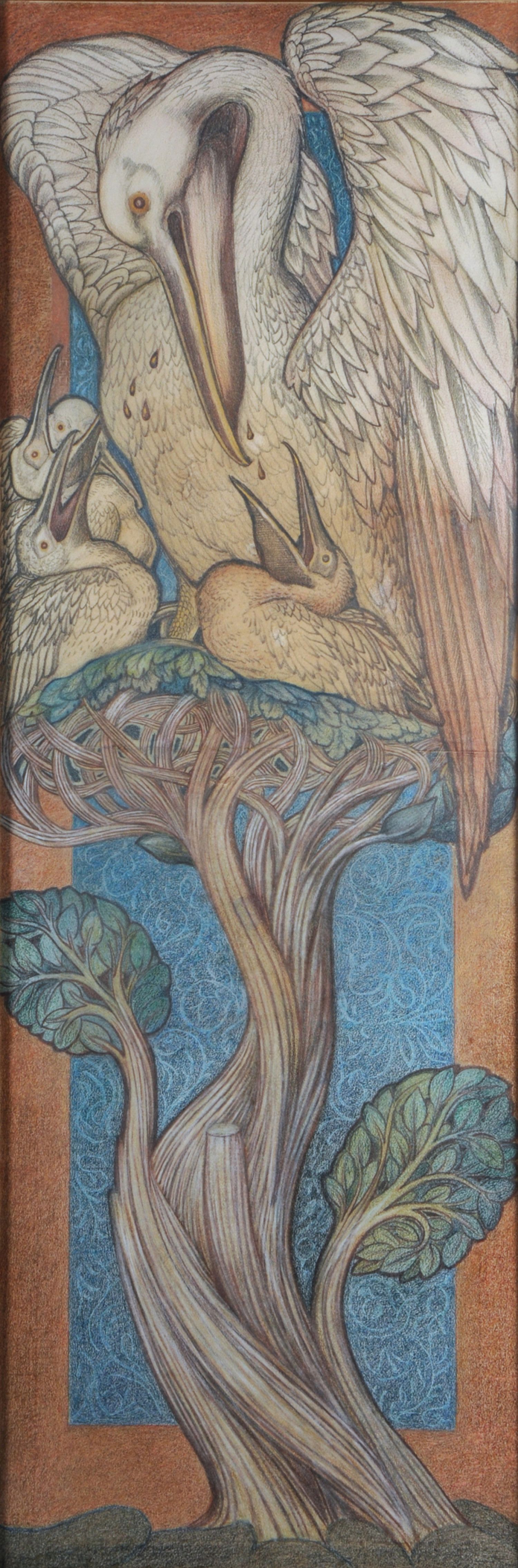
From the Victorian era, I’m especially fond of the stained glass pelican design by the Pre-Raphaelite artist Edward Burne-Jones, fabricated by Morris & Co. to serve as part of the East Window of St Martin’s Church, Brampton, in Cumbria. Burne-Jones drew his design in 1880, and after the window was completed the following year, he returned to the drawing out of personal fondness, embellishing it with colored chalks, and gold for the blood drops, thus developing it into a more substantial work.
Edward Burne-Jones (British, 1833–1898) and Morris & Co., Pelican on Nest (detail), 1880. East Window, St Martin, Brampton, Cumbria, England. Photo: Dave Webster. [view full window]Edward Burne-Jones (British, 1833–1898), Pelican in Her Piety, 1880–81. Pencil, colored chalk, and gold on paper, 172.7 × 57.3 cm. William Morris Gallery, London.
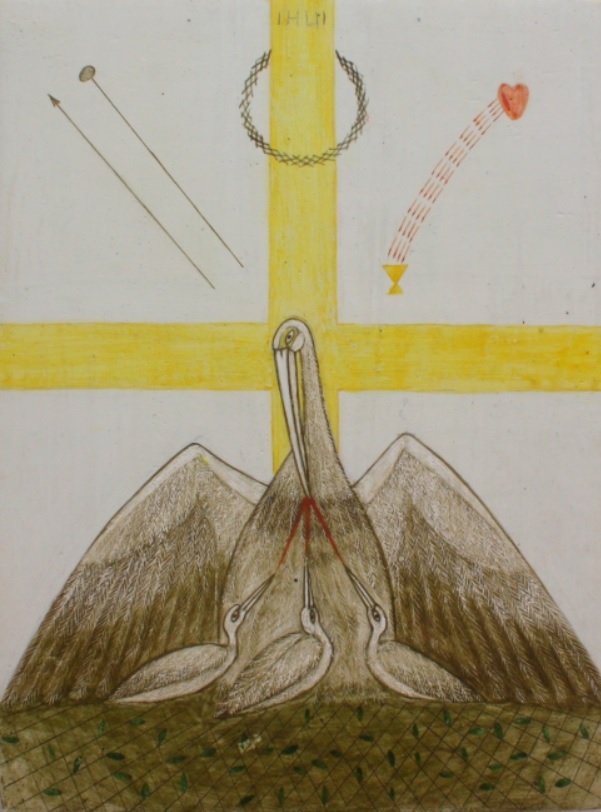
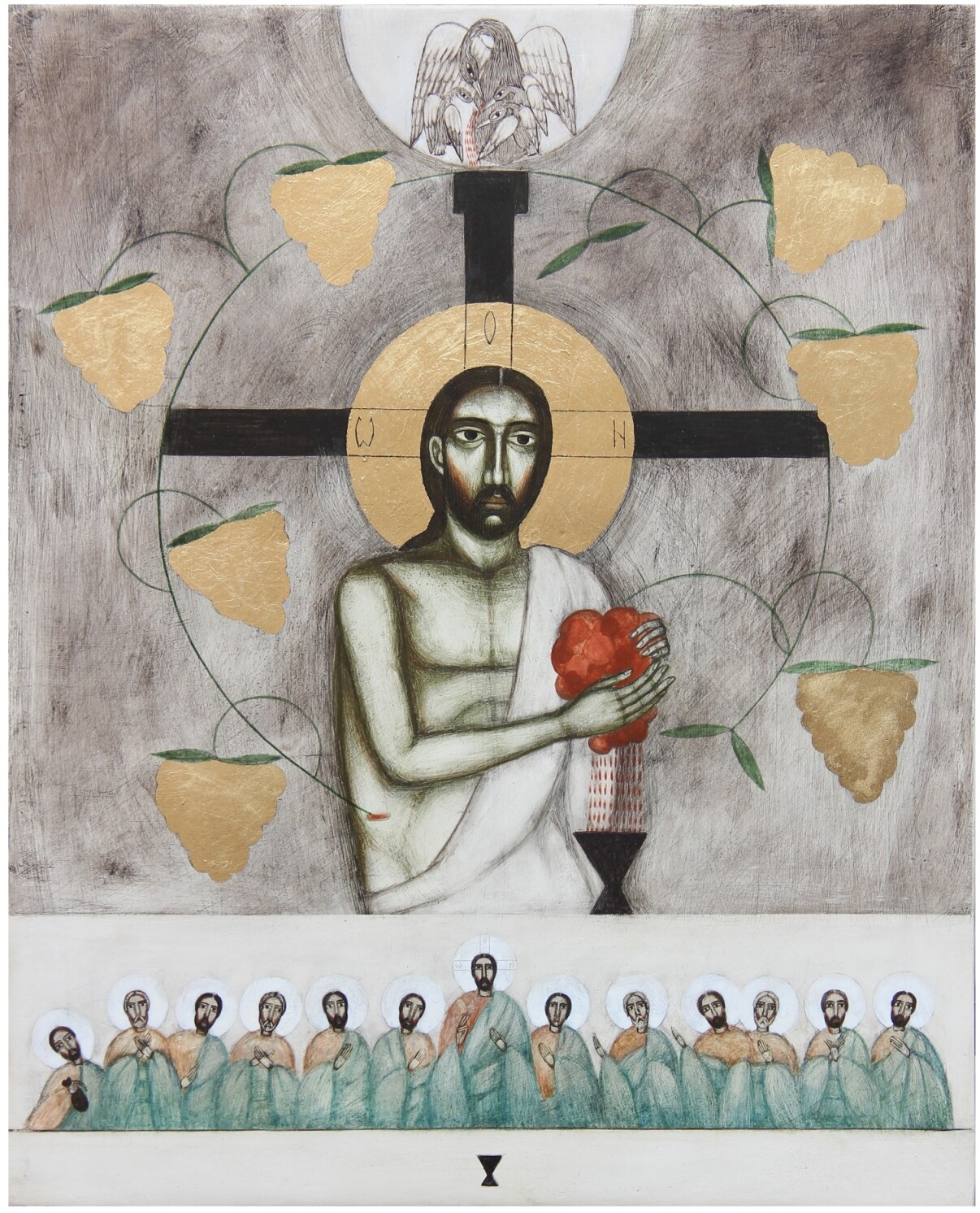
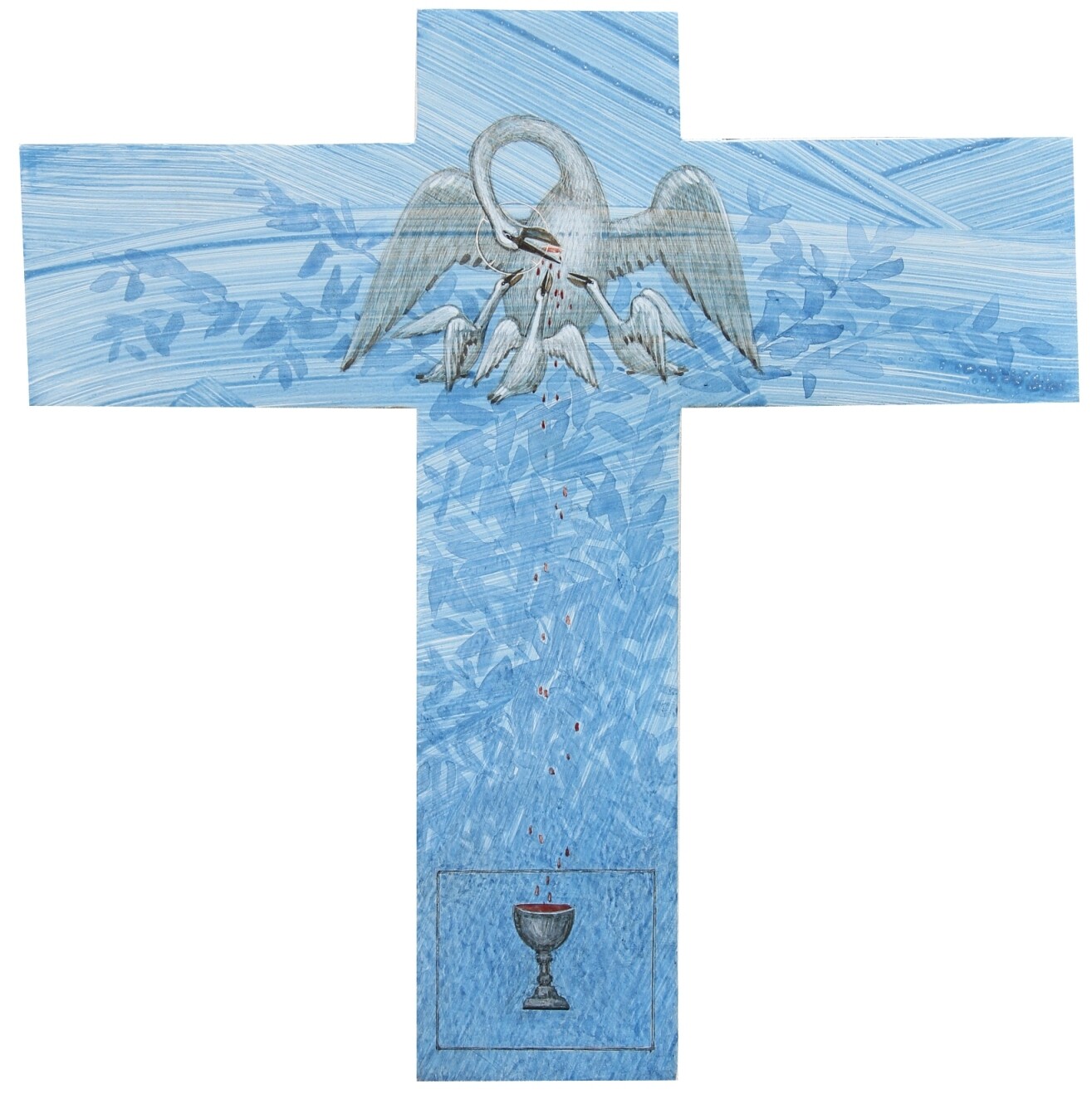
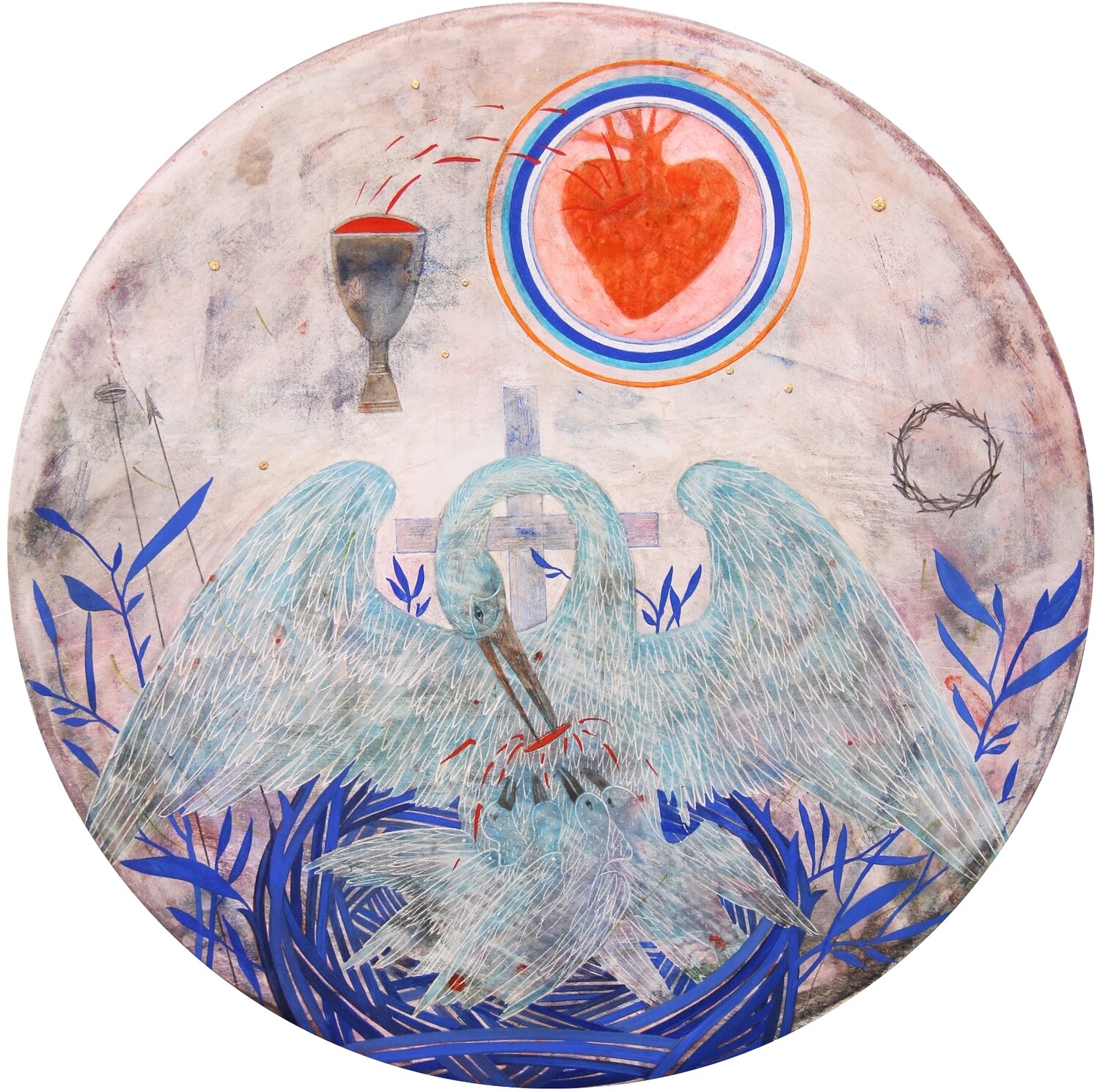
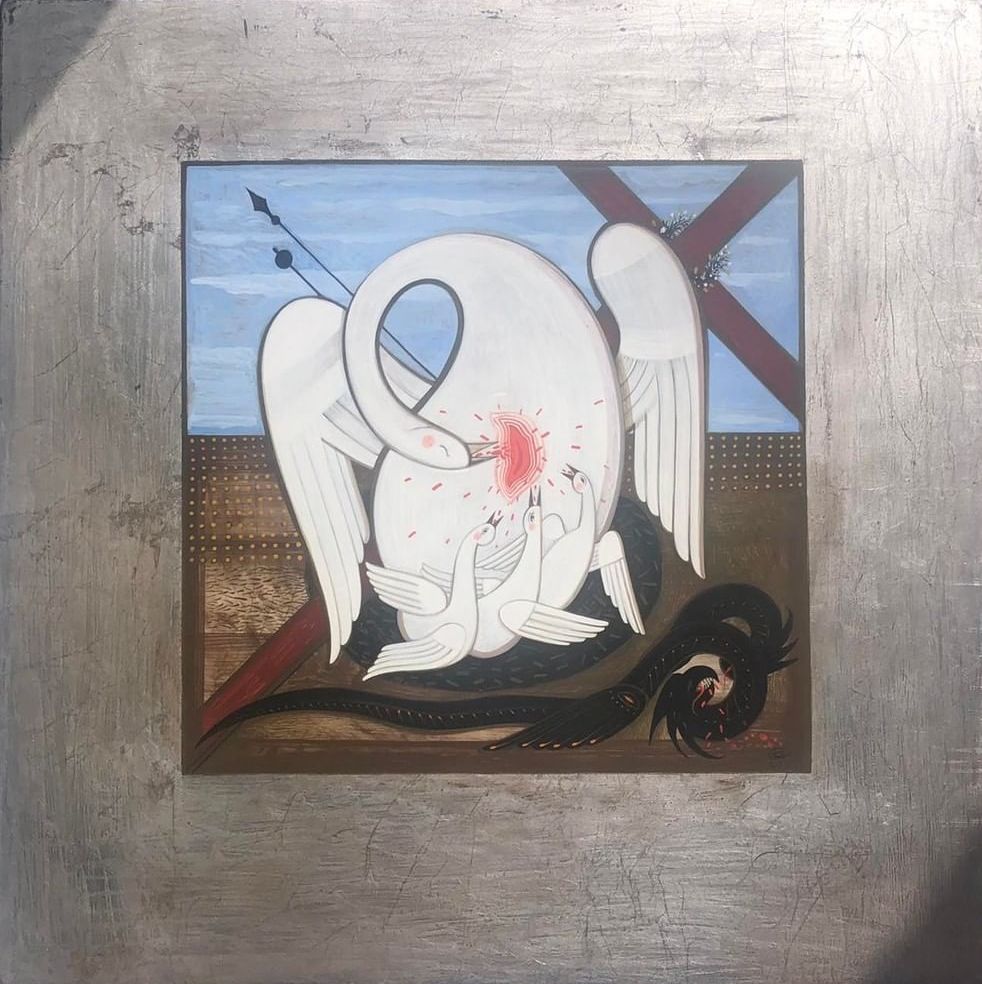
Contemporary artists have also turned to the subject of the vulning pelican, especially the Ukrainian Catholic women iconographers of Lviv:
Natalya Rusetska (Ukrainian, 1984–), Pelican, 2017. Egg tempera on gessoed wood, 19 × 15 cm.Natalya Rusetska (Ukrainian, 1984–), Jesus the Grapevine and the Last Supper, 2021. Egg tempera on gessoed wood, 30 × 24 cm.Kateryna Kuziv (Ukrainian, 1993–), Pelican, 2021. Egg tempera on gessoed wood, 30 × 30 cm.Kateryna Kuziv (Ukrainian, 1993–), Crucifixion, 2022. Egg tempera on gessoed wood, 65 × 49 cm.Ulyana Tomkevych (Ukrainian, 1981–), Pelican, 2021. Egg tempera on gessoed wood, diameter 30 cm.Olya Kravchenko (Ukrainian, 1985–), Sacrifice and Victory, 2022. Tempera and silver leaf on gessoed wood, 40 × 40 cm.
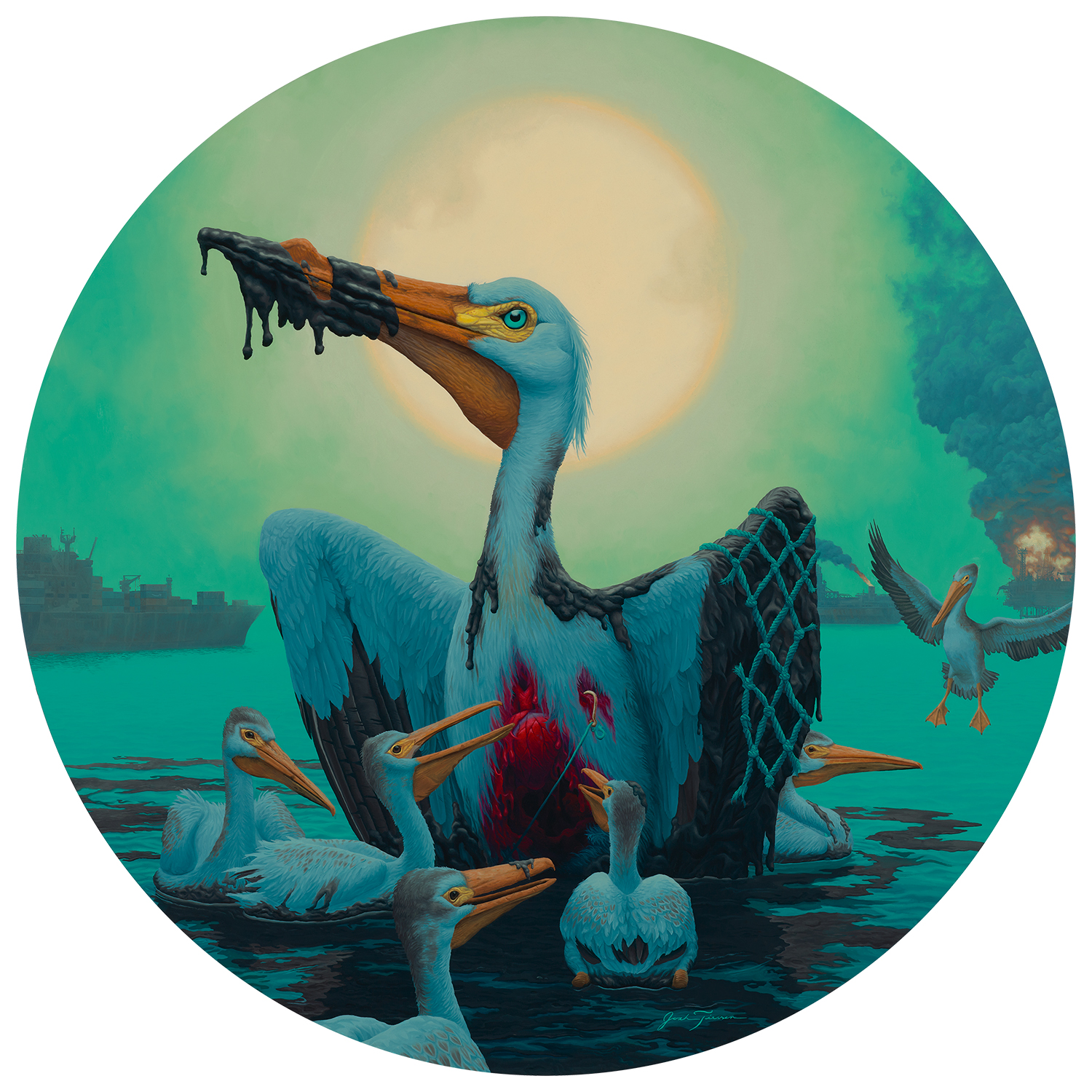
Addendum, 4/8/25: Shortly after publishing this, a reader reminded me of Josh Tiessen’s painting All Creatures Lament from his Vanitas and Viriditas series, which shows an American white pelican protecting her chicks in the face of another oil spill and the accumulation of fishing-related plastic waste. Tiessen, an artist of faith, directs the symbolism of the pelican toward a call for wildlife conservation. (I previously featured Tiessen’s work here.)
Josh Tiessen (Canadian, 1995–), All Creatures Lament, 2023. Oil on braced Baltic birch, diameter 26 inches.
In Poetry and Song
Probably the most universally famous poetic treatment of the pelican as an emblem of Christ is the eucharistic hymn “Adoro te devote” (Hidden God, Devoutly I Adore Thee). Written around 1260 by Thomas Aquinas, it is one of the most beautiful medieval poems in Latin. Aquinas did not originally write it for the liturgy, but it was added to the Roman Missal in 1570 and since then has been used in the Catholic Mass. The penultimate stanza reads:
Pie pelicane, Jesu Domine,
Me immundum munda tuo sanguine,
Cujus una stilla salvum facere
Totum mundum quit ab omni scelere.
Like what tender tales tell of the Pelican,
Bathe me, Jesus Lord, in what thy bosom ran—
Blood that but one drop of has the pow’r to win
All the world forgiveness of its world of sin.

Trans. Gerard Manley Hopkins
Here’s a great video of the hymn put out by the Fundación Canto Católico, set to a Benedictine plainsong melody from the thirteenth century, as has become standard. Our pelican passage appears at the 4:10 mark. The subtitles are in Spanish, but you can turn on CC for English.
(If, like me, you’re wondering what in the world the video’s images are from, an explanatory note in the YouTube comments section explains: they are from the Cuasimodo festival in Chile, celebrated the second Sunday of Easter. The festival has nothing to do with Victor Hugo’s famous hunchback but rather is about bringing Communion to the sick and elderly who were unable to leave their residences to participate in the sacrament during Holy Week. [The Spanish Cuasimodo comes from the Latin Quasimodo, from the incipit of the day’s introit based on 1 Peter 2:2: “Quasi modo géniti infántes . . . ,” or “As newborn babes . . .”] Traditionally for this task, priests were escorted by horsemen, who showed them the route and protected them from assaults.)
The vulning pelican also appears in the liturgy of the Eastern Orthodox Church, whose members sing at Matins on Good Friday evening, “Like a pelican wounding her breast, Thou, O Word, hast made Thy mortal children to live, for Thou hast shed upon them life-giving streams.”
Dante Alighieri, the great medieval Italian writer, calls Christ “nostro Pelicano” (our Pelican) in canto 25 of his Paradiso, the third book in his Divine Comedy trilogy of extended narrative poems.
The Christ-pelican appears, too, in English poetry from the late Middle Ages onward. One Middle English poem found in a prayerbook from ca. 1460 reads:
The pellicane his bloode dothe blede
Therwith his birdis for to fede.
It figureth that God with his bloode
Us fede hanging on the rode,
Whane he us brought oute of hell
In joy and blis with him to dwel,
And be oure fader and oure fode,
And we his childerne meke and good.

[Bodleian Library MS Douce 1, fol. 57r]
The pelican his blood doth bleed,
Therewith his birdies for to feed.
It figures God, who, with his blood,
Fed us hanging on the rood,
By which he brought us out of hell,
In joy and bliss with him to dwell,
To be our father and our food,
And we his children meek and good.
Our Pelican, by bleeding thus, Fulfill’d the law, and cured us.
Look here, and mark (her sickly birds to feed) How freely this kind Pelican doth bleed. See how (when other salves could not be found) To cure their sorrows, she herself doth wound; And when this holy emblem thou shalt see, Lift up thy soul to him, who died for thee.
For this our hieroglyphic would express That Pelican which, in the wilderness Of this vast world, was left (as all alone) Our miserable nature to bemoan; And in whose eyes the tears of pity stood, When he beheld his own unthankful brood His favors and his mercies then condemn, When with his wings he would have brooded them, And sought their endless peace to have confirm’d, Though to procure his ruin, they were arm’d.
To be their food, himself he freely gave; His heart was pierc’d, that he their souls might save, Because they disobey’d the sacred will, He did the law of righteousness fulfill; And to that end (though guiltless he had been) Was offered for our universal sin.
Let me, oh God! forever fix mine eyes Upon the merit of that sacrifice: Let me retain a due commemoration Of those dear mercies, and that bloody passion, Which here is meant; and by true faith, still feed Upon the drops this Pelican did bleed; Yea, let me firm unto thy law abide, And ever love that flock for which he died.
I already mentioned, in relation to Bosch’s pelican painting above, “Christ’s Bloody Sweat” by the English Catholic martyr Robert Southwell.
More recently, the Anglican priest Matt Simpkins, who performs music under the name Rev Simpkins, wrote a song titled “Pelican,” which he released on his album Big Sea (2020). Gritty and impassioned, here’s a live performance at Colchester Arts Centre:
Pelican feeds the hungry and needy I kneel before her My throat like an open grave
Food cannot fill me Water dilutes me Nothing contents me Pelican, pity me
She tears her breast, her children to refresh By her I am blessed, led to life from living death
Though death entreats me Her life flows sweetly Given so freely Given in flesh and blood
She tears her breast, her children to refresh By her I am blessed, led to life from living death
Pelican feeds me Loves me completely Though I’m unworthy She gives so graciously
She tears her breast, her children to refresh By her I am blessed, led to life from living death
She crowns the whole earth, the heavens and seas The Pelican tears her breast for me
She’s queen of what was and what is to be The Pelican tears her breast for me
She gives of herself in infinity The Pelican tears her breast for me
She’s compassion and love, she’s strength and glory The Pelican tears her breast for me
I love it when contemporary artists engage with historical Christological symbols, whether from the animal world or elsewhere, tapping into a creative wisdom the saints of ages past have bequeathed to us but that is too often dismissed in favor of literalism or wordy, intellectual articulations of doctrine.
I wholeheartedly support the endeavor of academic theology, but it must be remembered that for centuries, the church has developed her theology not just through discursive prose but also through liturgy, verse, and visual art. While many modern Christians may discount medieval allegories of Christ as naive, backward, too fanciful, or too obscure, I want to suggest that there’s value in learning (at least some of) them and even incorporating them into new material, to explore how they might come alive in new contexts.
By studying the pelican of ancient lore, for example, as it has been adapted in Christian art and literature, I’ve grown in my appreciation for the mother-love of God, who, to restore me to life and to nourish me—his child, his dependent—allowed his sacred flesh to be torn, so that I might know the power in the blood.
This essay took many hours to research and write and came to fruition only after several years spent collecting enough Pelican images to reach a critical mass. If you have the inclination and means to support more essays like this, I’d really appreciate a donation!
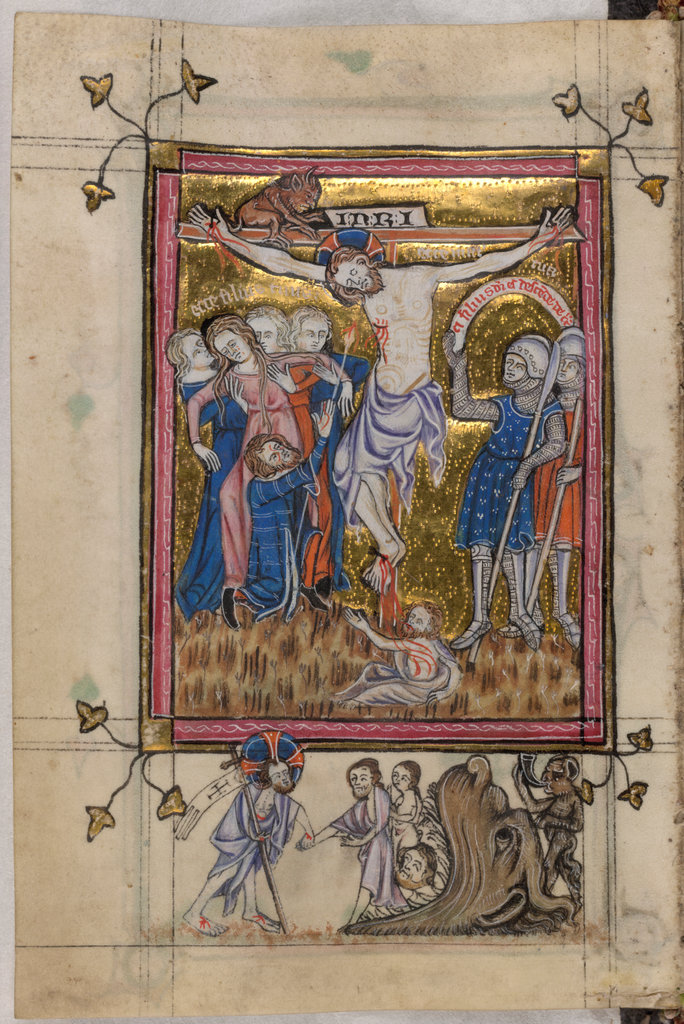
Crucifixion with bas-de-page scene of Christ leading figures from the mouth of Hell, from the Taymouth Hours, England, second quarter of 14th century. British Library, Yates Thompson 13, fol. 122v.
ORIGINAL MIDDLE ENGLISH:

Loue me brouthte,
& loue me wrouthte,
Man, to be þi fere.
Loue me fedde,
& loue me ledde,
& loue me lettet here.

Loue me slou,
& loue me drou,
& loue me leyde on bere.
Loue is my pes,
For loue i ches,
Man to byƷen dere.

Ne dred þe nouth,
I haue þe south,
Boþen day & nith,
To hauen þe,
Wel is me,
I haue þe wonnen in fith.
MODERN ENGLISH TRANSLATION:

Love me brought,
And love me wrought,
Man, to be thy fere. [companion]
Love me fed,
And love me led,
And love me fastens here.

Love me slew,
And love me drew,
And love me laid on bier.
Love’s my peace;
For love I chose
To buy back man so dear.

Now fear thee not;
I have thee sought
All the day and night.
To have thee
Is joy to me;
I won thee in the fight.

Trans. Victoria Emily Jones
This medieval passion lyric is from the Commonplace Book of John of Grimestone, compiled in Norfolk, England, in 1372 and owned by the National Library of Scotland in Edinburgh. It was transcribed by Carleton Brown in Religious Lyrics of the Fourteenth Century(Oxford: Clarendon Press, 1924), page 84.
Adv.MS.18.7.21, fol. 121r, with “Love Me Brought” poem highlighted. In this manuscript, the Franciscan friar John of Grimestone jotted down miscellaneous verses and quotes to use in his preaching.
In the poem, Christ addresses humankind from the cross, professing his great love for her. He was begotten in love by the Father, and it’s love that brought him to earth. Love nourished and guided him, and for love he stayed the difficult course, all the way to the end. Satan had stolen Christ’s beloved, and to win her back, Christ went into battle, to redeem her who was rightfully his. His decisive move: spreading out his arms across a wooden beam, so as to embrace the world, and submitting to being nailed there.
He died for love of his lady. Love is what drew him to and secured him to that cross, what kept him there when the physical and emotional agony begged he desist. And because of his persistence in seeking us, his courageous endurance as the enemy assailed, he attained ultimate victory. “Well is me!” (Blessed am I), he exclaims, “for you are mine and I am yours.” Let nothing stand between.
Katharine Blake, the founder and musical director of Mediæval Bæbes, wrote a setting of “Love Me Broughte,” in medieval style, for the group’s 1998 album Worldes Blysse. Sweet and vigorous, it features, besides voices, a zither, pipe, recorder, tambourine, and drums.
Did you enjoy this poem? For more like it, come on out on November 23 to “Christ Our Lover: Medieval Art and Poetry of Jesus the Bridegroom,” a lecture by Dr. Grace Hamman that I’ve organized for the Eliot Society in Annapolis. Learn some of the ways Christian preachers, poets, theologians, mystics, and artists in the late Middle Ages, both male and female, conceptualized Christ’s passionate love, drawing from the Song of Songs, courtly love poetry, and more—often in quite imaginative ways!
Following the popularity of last year’s “25 Poems for Christmas,” I’ve decided to publish a brand-new installment, and will perhaps make this a yearly tradition! All the selections can be read online—just follow the links.
Despite the pithy title of this post, not all the poems are “Christmas” poems, strictly speaking, but rather they encompass the season of Advent too, as well as Epiphany. Advent is a four-week season leading up to Christmas that is characterized by a mood of longing and expectation; it is oriented not only toward Jesus’s first coming but also toward his second. Christmas, of course, celebrates the birth of Jesus, the Word of God made flesh. And Epiphany, on January 6, commemorates the visit of the magi to the crib, representing God’s self-revelation to the wider world.
Each poem is accompanied by a micro-commentary or short descriptive blurb, which I suggest you read after reading the poem itself. There’s a benefit to first entering a poem without having any context—then after registering your initial impressions and questions, to consider another person’s framing or analysis or highlights, and reread. And then a third time! Each reading can potentially reveal new meaning.
Stone Nativity by Juan Manuel Cisneros, Ventura, California, December 2016 [learn more]
1.“Haiku for an Advent Calendar” by Richard Bauckham: Church services during Advent tend to focus on messianic prophecies from the Hebrew Bible, rumblings of a coming savior. In this sequence of twenty-four haiku, Richard Bauckham pulls a detail from each book of the Jewish scriptures, finding anticipations of Christ. For example, Isaiah: “In the wilderness / a voice cries for centuries / seeking an echo.” Or Job: “God answered Job but / not his question. Maybe he / will do that again.”
2. “How Christ Shall Come” (anonymous): The cosmological Christ blew in from the four cardinal directions, coming as lover, knight, merchant, and pilgrim. So says this fourteenth-century Middle English lyric, rich in metaphor, compiled in a book of preaching aids and sermons by John Sheppey (d. 1360), bishop of Rochester. (It is unclear whether he is the author of the poem.) The great medieval literature scholar Carleton Brown gave it the title “How Christ Shall Come” in his landmark Religious Lyrics of the XIVth Century (1924), and Grace Hamman brought it to my attention recently in her wonderful monthly Substack, Medievalish, providing a modern English translation and commentary.
3.“Hawk Lies Down with Rabbit” by Seth Wieck: What would it look like for death to no longer have dominion in the animal world? Grappling with Isaiah’s end-time vision of a peaceable kingdom void of predation, this poem describes in graphic terms a bird of prey making its kill, feeding on flesh, and wonders how a hawk could still be itself with rewired impulses. Hear the author read and provide context for the poem on the Reformed Journal Podcast.
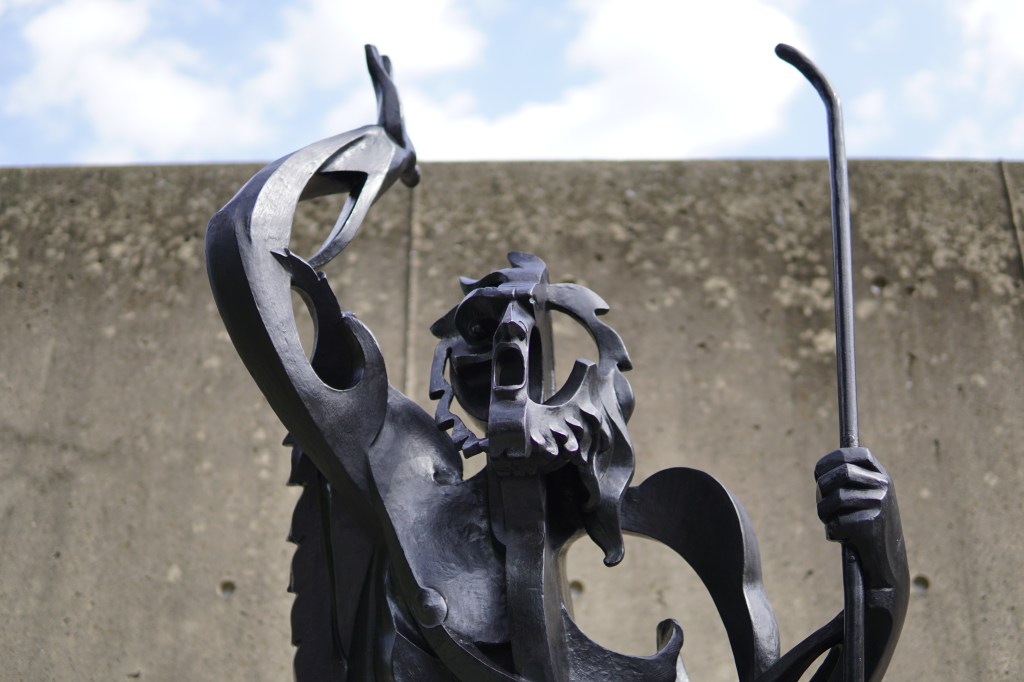
4.“john” by Lucille Clifton: Written in the voice of John the Baptist, this poem is part of an extraordinary sixteen-poem sequence titled “some jesus,” which features a range of biblical characters. In her retelling of his ministry as forerunner to the Messiah, Lucille Clifton casts John as a Black Baptist preacher, preparing his listeners to receive the one who “com[es] in blackness / like a star.” Clifton’s larger body of work would suggest that “blackness” here is multivalent, describing what Jesus comes into and as: the word suggests the darkness of the world that Christ entered, on the one hand, but also functions as a positive racial identifier. In Clifton’s revisioning, Christ comes as a Black man, wearing “a great bush / on his head”—which, again, could be read as an Afro, and/or as a mystical reference to the site at which God revealed himself to Moses in the Sinai desert. Luminous with truth, Christ comes, “calling the people brother.”
Pablo Gargallo (Spanish, 1881–1934), The Prophet (St. John the Baptist) (detail), 1933. Bronze, 91 3/4 × 29 1/2 × 19 in. Wurtzburger Sculpture Garden, Baltimore Museum of Art. Photo: Victoria Emily Jones.
5. “Christmas Mail” by Ted Kooser: Every December the story of an ancient birth comes alive again in couriers’ mailbags, in tin boxes at the ends of driveways, on mantels and fridges. This poem honors those postal workers who deliver good tidings in the form of Christmas cards, the magic spilling out the envelopes to make even the most tiresome routes sparkle a bit.
6. “December 25” by George MacDonald: Through the mid-nineteenth century, denominations influenced by the Reformed tradition, including the Church of Scotland in which George MacDonald was raised, typically did not observe Christmas, the rationale being that no one day should be thought of as holier than any other. But in his book-length dramatic poem Within and Without, MacDonald refers to December 25 as “this one day that blesses all the year”—and in this seven-liner from his Diary of an Old Soul, he describes Christmas as a gleaming blue sapphire, a structural center around which all the other jewels of the church calendar are oriented.
7. “On a Cardinal Climbing Down a Manhole to Restore Power to 400 Homeless People” by Michael Stalcup: On May 11, 2019, Cardinal Konrad Krajewski, the papal almoner (Pope Francis’s special appointee to distribute charity), crawled into a manhole and broke a police seal to personally restore power to a homeless shelter in Rome whose electricity had been shut off due to its failure to pay its bills. The shelter was occupied by some 450 people at the time, 100 of them children, who had been without electric light, hot water, and refrigeration for nearly a week. In this poem, which can be read Christologically, Michael Stalcup celebrates this defiant humanitarian act that brought light to a people living in darkness.
8. “Incarnation” by Amit Majmudar: “Inheart yourself, immensity. Immarrow, / Embone, enrib yourself.” So begins the five-poem sequence “Seventeens.” Musical and witty, this first poem is a plea to the great I AM to take on a body and “be all we are, and all we aren’t.”
9.“The Lord Is with Thee” by Micha Boyett: Written in 2010 as the third in a five-poem sequence commissioned by John Knox Presbyterian Church in Seattle, this poem centers on the Visitation episode described in Luke 1:39–58. It’s about Mary finding belonging in God’s story, especially through the companionship of her elder cousin Elizabeth, who has nurtured Mary’s faith since infancy and continues to do so in this her moment of crisis. “How easily she spoke of God, / as if he were a neighbor, a fish vendor on the street,” Mary admires. Elizabeth supports Mary physically, emotionally, and spiritually, holding her hair back as she vomits, protecting her from vicious rumors, affirming the work of God in her life, and accompanying her at the start of this wild path God has set them both on.
Odilon Redon (French, 1840–1916), Mystical Conversation, ca. 1896. Oil on canvas, 65 × 46 cm. Museum of Fine Arts, Gifu, Japan.
10.“Our Lady” by Mary Elizabeth Coleridge: The great-grandniece of the Romantic poet Samuel Taylor Coleridge, Mary Elizabeth Coleridge (1861–1907) grew up in a home visited by family friends Alfred Lord Tennyson, Anthony Trollope, John Ruskin, and Robert Browning, among others. In this poem she marvels at how God chose the common-born Mary for such a task as mothering the Christ, singing along with Mary’s Magnificat about how God raises up the lowly.
Source: Fancy’s Following (privately published, 1896). Public Domain.
11. “Traveling Man”by Marjorie Maddox: With his pregnant wife alongside, Joseph plods down south to Bethlehem, “convinced of the predestined / roll of dice chrismated with Miracle.” An epigraph from a Leonard Cohen song sets the tone.
12.“Sonnet in the Shape of a Potted Christmas Tree” by George Starbuck: This charming shape poem contrasts the extravagance of our popular celebrations of Christmas with the poverty of the first-century event it marks. The first half describes the furious wind of decorative activity that uproots evergreens from their natural habitats to bring them indoors and deck them with baubles and ribbon. I don’t know how to interpret “no scapegrace of a sect,” but “Daughter-in-Law Elect” refers to a duet from the Gilbert and Sullivan opera The Mikado. The turn comes with “a son born / now / now,” the latter two lines styled as the visible trunk of the tree; here the scene shifts to the simple stable of old, where Mary lies “spent” next to her newborn along with a cow and donkey, a sole “firework” guiding the magi and us all to the spot.
13.“Christmas (I and II)” by George Herbert: George Herbert (1593–1633) is one of the most celebrated poets of the English language. In part 1, a sonnet, of this two-part poem, he imagines himself a weary traveler who chances upon a humble inn where he unexpectedly finds his Lord, the infant Christ. It’s the inn of Bethlehem. Having then received rest from Christ his host, in the closing couplet he expresses his desire to reciprocate—to offer his own soul, lowly though it is, as a residence for Christ, praying that God first adorn it to make it hospitable. In the second part of the poem, Herbert uses a metaphysical conceit (extended metaphor) comparing his soul to a shepherd whose flock of thoughts, words, and deeds pastures on God’s word and who, like the shepherds of Bethlehem, sings glory to God. His shepherd-soul seeks eternal daylight, which he finds in the Son/sun, whose beams so intertwine with his song that the beams sing and his song shines.
14. “Descending Theology: The Nativity” by Mary Karr: The physicality of childbirth, from the contractions (which pierce the Virgin like a star, Karr writes) to the bodily fluids, is heavily featured in this poem. Jesus emerges from his mother “a sticky grub” with a “lolling head” and “sloppy mouth” that seeks out her breast for food. And as she feeds him physically, he feeds her spiritually. Then he falls asleep. His first nap, Karr writes, is a foretaste of the sleep of death he will eventually come to taste. But for now, he wakes up crying—as all babies do.
Scott Erickson (American, 1977–), With Us, Face to Face, 2016. Digital art. [available for purchase]
15.“from spiralling ecstatically this”by E. E. Cummings: What a fantastic opening line! The heavenly spheres whirling, twirling, down into the “proud nowhere”—Bethlehem—“of earth’s most prodigious night.” Heretofore living in mundanity, the domestic animals, hungry for miracle, for newness, are vouchsafed to be witnesses of this supernatural event, before which they kneel “humbly in their imagined bodies.” Overhead floats the “perhapsless mystery of paradise,” a phrase suggesting that heaven is beyond human understanding but not without certainty; it’s a declarative reality, not subjunctive, even if it can’t quite be put into words. Mary herself has no words—she silently, knowingly smiles, while the created world erupts in song around her. The “mind without soul” is a reference to Herod, who seeks to snuff out this new life, but to no avail.
The omission of spaces after punctuation marks (e.g., “a newborn babe:around him,eyes”) is not a mistake; that’s how E. E. Cummings liked it. Scholars say it’s to create a faster rhythm, but in this poem I don’t think that choice is as effective, as pauses and slow savoring seem more appropriate to its contemplative mood.
16.“How the Natal Star Was Born”by Violet Nesdoly: Narrated by the angel Gabriel, this poem imaginatively describes heaven’s nervously awaiting the birth of Jesus during the nine months following Gabriel’s dispatch to Mary, and then busting out in celebration when at last they hear his infant-cry. When his Son is born, instead of cigars, the Father passes out trumpets to his company of friends, who sound them all the way to Bethlehem’s fields, and pops open a bottle of champagne whose bubbles spray far and wide.
17. Sections 9–10 of “The Child” by Rabindranath Tagore: Hinduism was the religion of Rabindranath Tagore’s birth and upbringing, but he also held deep respect for Jesus Christ. (For more on the influence of Christianity on Tagore’s thought and writing, see chapter 4 of Rabindranath Tagore and Interfaith Dialogue by Manas Kumar Ghosh [DMin thesis, Charles Sturt University, 2010].) “The Child” is a free-verse poem that Tagore wrote in English in 1930 after seeing a passion play in Germany and then translated into Bengali in 1932 with the title “Sishutirtha” (Pilgrimage to Childhood). In it a “Man of faith” gathers people from all walks of life to join him on a “pilgrimage of fulfilment,” to “struggle [through the dark] into the Kingdom of living light.” Initially met with enthusiasm, the Man later becomes a target of the people’s anger and distrust, and they kill him. Disorientation ensues. But a man in the crowd is able to rally the others to repent and resume their quest, following the spirit of “the Victim.”
The final two sections, 9 and 10, are the selection I’ve chosen. (Scroll right to read the last.) At “the first flush of dawn,” when the time is ripe, the pilgrims arrive at a thatched hut in a palm grove, where they finally meet the eternal Light they’ve been seeking: “the mother . . . seated on a straw bed with the babe on her lap, / . . . the morning star.” Here is the Child of the title, humanity’s redeemer.
Source: The Child (London: George Allen and Unwin, 1931)
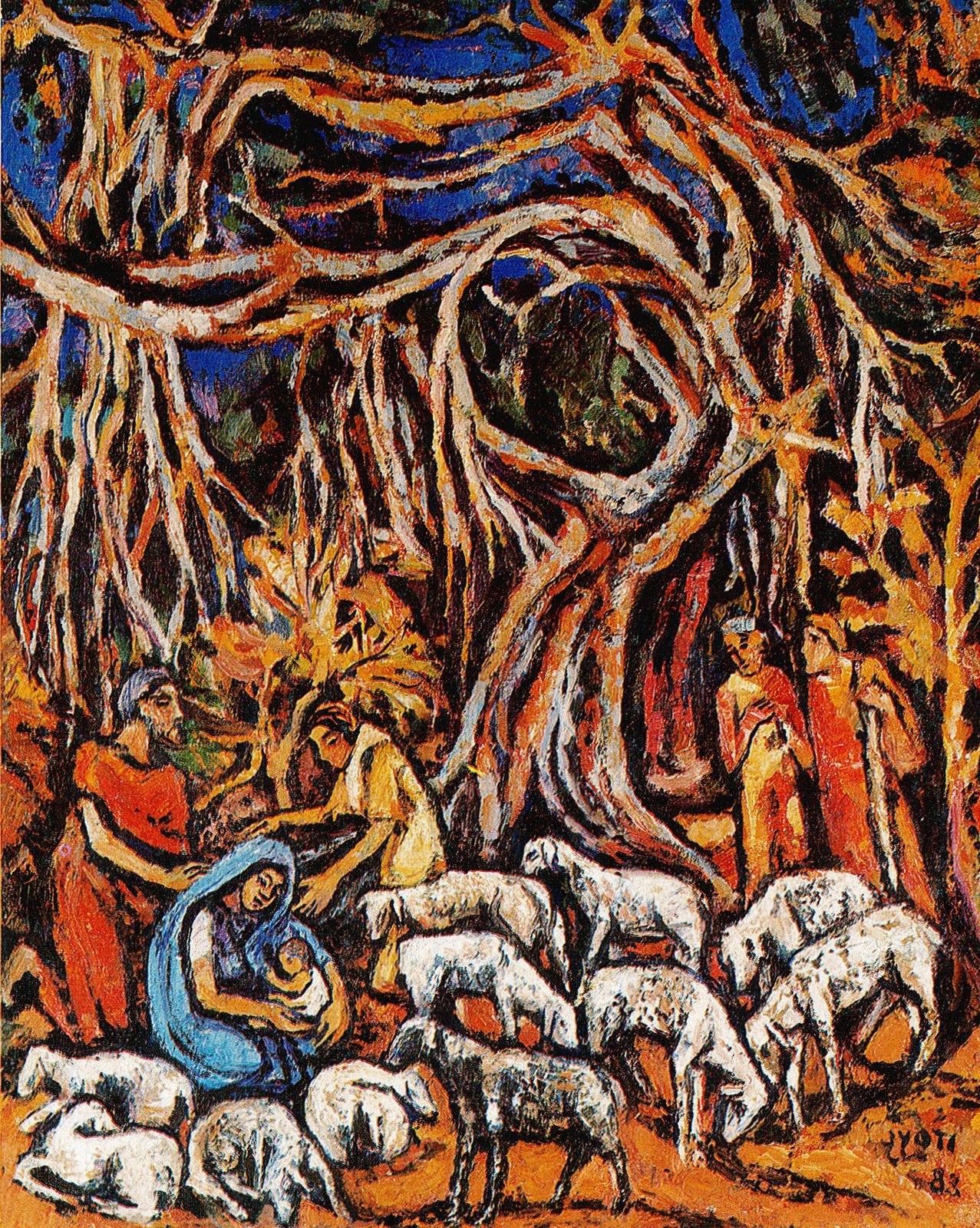
Jyoti Sahi (Indian, 1944–), Adoration of the Shepherds, 1983. Oil and acrylic on canvas.
18. “Love’s Bitten Tongue (11)”by Vassar Miller: This poem, “You, my God, lonesome man, Love’s bitten tongue,” is from a crown of twenty-two sonnets, a type of sequence in which the last line of each sonnet is repeated as the first line of the next, but each time with a new twist of syntax and sense. The crown as a whole expresses the poet-speaker’s struggle against her ego, and her desire for Christ (whom she gives such an evocative name in the title!). In this particular sonnet she describes waiting at the edge of her bed every Christmas Eve as a child in anticipation of both Santa’s arrival with gifts and the holy mystery of Christ’s birth, an admixture of sacred and profane longings that fill her still as an adult.
19. “Gloria in Profundis” by G. K. Chesterton: G. K. Chesterton’s poems are of variable quality, but this one is brilliant, emphasizing God’s descent from the rich heights of heaven into an obscure cave in a simple town. “Glory to God in the lowest!” it exclaims, a clever inversion of the angels’ song to the shepherds in Luke 2:14. The poem was originally published in a 1927 Christmas pamphlet with wood engravings by Eric Gill. The Latin title translates to “Glory in the Depths.”
Source: Gloria in Profundis by G. K. Chesterton (Ariel series pamphlet) (London: Faber and Gwyer, 1927); compiled in The Spirit of Christmas (New York: Dodd, Mead, 1985)
20.“Silent Night” by Bonnie Bowman Thurston: Rev. Dr. Bonnie Thurston invokes a tradition that says the night of Christ’s birth, there was a whole hour in which time stood still and all was silent. What a fascinating legend! Thurston told me its origin is northern European, said she remembers reading it in some scholarly Celtic studies; I wasn’t able to locate any such mentions, but the second-century Protoevangelium of James, chapter 18, probably written in Egypt or Syria, does describe everything momentarily freezing in place around Joseph as he steps out to find a midwife for Mary. Anyway, the poem ends with a striking metaphor! Word, flesh: fire. (Reminds me of this digital artwork by Scott Erickson.)
21. “After Luke 2:19” by Michelle Ortega: When the shepherds recounted to Mary what the angels had told them in the fields about Jesus being the promised Messiah, “Mary treasured all these words and pondered them in her heart,” Luke narrates in his Gospel. Poet Michelle Ortega expounds on this verse, emphasizing the relationship of Mary’s body to her son’s from conception to birth and now postpartum—an intimacy known well by mothers across the centuries. As wondrous as it was to be part of a cosmic story writ large in the skies, Ortega suggests that Mary treasured just as much as the grand pronouncements those small moments of being just an ordinary mama.
22. “Christmas: 1924”by Thomas Hardy: “We the civilized world have given Christianity a fair trial for nearly 2000 years, & it has not yet taught countries the rudimentary virtue of keeping peace,” lamented the British novelist and poet Thomas Hardy (1840–1928) in a letter to Florence Henniker dated February 25, 1900, during the Boer War. World War I only increased his cynicism, which is on display in this sour little epigram that opens with an ironic quotation of the angels’ proclamation to the shepherds the night of Jesus’s birth.
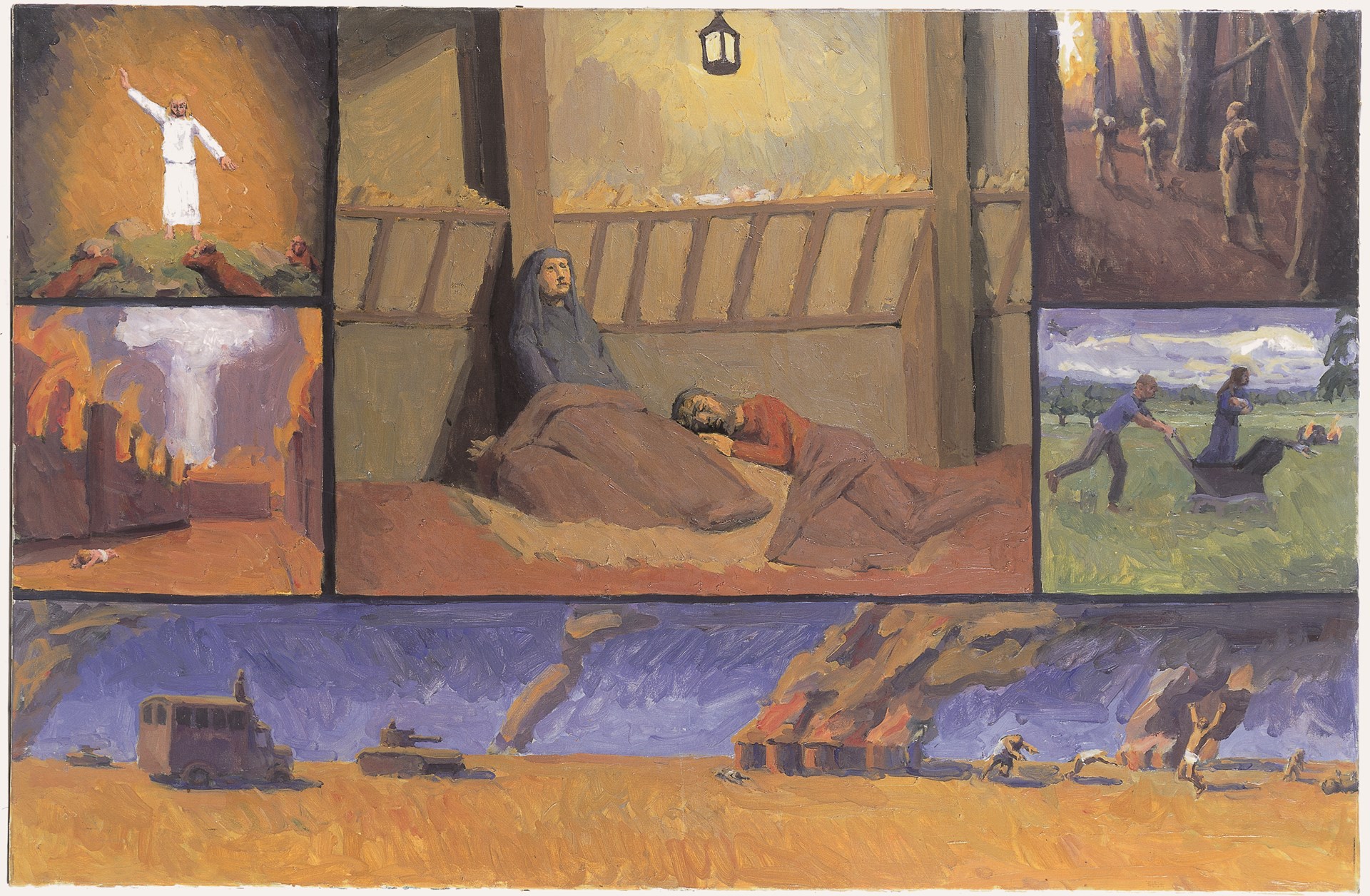
Francis Hoyland (British, 1930–), Nativity, 1961. Oil on canvas, 90 × 120 cm. Methodist Modern Art Collection, HOY/1963/1.
23. “Eating Baklava on New Year’s Eve” by Anya Krugovoy Silver: Poet Anya Silver (1968–2018) reads a spiritual benediction in her piece of baklava, layered and sweet and consumed on the eve of a new year.
Source: Second Bloom (Eugene, OR: Cascade Books, 2017)
24. “A Ballad of Wise Men”by George M. P. Baird: Jesus so often confounds the wisdom of the wise, starting with his birth. With gentle humor and in iambic rhythm and rhyme, this poem celebrates the simple access we all have to Christ.
Source: Rune and Rann (Pittsburgh: Aldine Press, 1916). Public Domain.
25. “Excrucielsis”by Hannah Main-van der Kamp: Originally published at ArtWay.eu as a response to the contemporary Romanian sculpture The Spring by Liviu Mocan, this poem alternates between the weary journeying toward truth of one of the biblical magi and that of a modern-day seeker similarly “longing for / the something more.” It can be a trudge, finding the Light—it involves risk, a willingness to follow the signs, and the tenacity to hold on to your “vision burden,” “clutch[ing] the weight” of it all the way over rough and varied terrain. But the epiphanic moment awaits, to sound like a trumpet blast. The title of the poem is a neologism combining the words “excruciating” and “excelsis” (Latin for “the heights”); “every excelsis contains something excruciating, that’s how we get to genuine excelsis,” the poet told me in an email. Read a related prose reflection by Main-van der Kamp here.
Source: The Slough at Albion (Victoria, BC: Ekstasis Editions, forthcoming)
Disclosure: This post contains Amazon affiliate links, meaning I earn a small commission from qualifying Amazon purchases originating from clicks on this site.
Aelbert Bouts (Netherlandish, ca. 1451/54–1549), Man of Sorrows, mid-1490s. Oil on oak wood, 14 15/16 × 10 7/16 in. (37.9 × 26.5 cm). Harvard Art Museums / Fogg Museum, Cambridge, Massachusetts.
ORIGINAL MIDDLE ENGLISH:

Vndo þi dore, my spuse dere,
Allas! wy stond i loken out here?
     fre am i þi make.
Loke mi lokkes & ek myn heued
& al my bodi with blod be-weued
     For þi sake.

Allas! allas! heuel haue i sped,
For senne iesu is fro me fled,
     Mi trewe fere.
With-outen my gate he stant alone,
Sorfuliche he maket his mone
     On his manere.

Lord, for senne i sike sore,
Forʒef & i ne wil no more,
With al my mith senne i forsake,
& opne myn herte þe inne to take.
For þin herte is clouen oure loue to kecchen,
Þi loue is chosen vs alle to fecchen;
Mine herte it þerlede ʒef i wer kende,
Þi suete loue to hauen in mende.
Perce myn herte with þi louengge,
Þat in þe i haue my duellingge.
Amen.
MODERN ENGLISH TRANSLATION:

“Undo thy door, my spouse dear,
Alas! why stand I locked out here?
     For I am thy mate.
Look, my locks and also my head
And all my body with blood bedewed,
     For thy sake.”

“Alas! alas! evil have I sped,
For sin Jesus is from me fled,
     My true companion.
Without my gate he standeth alone,
Sorrowfully he maketh his moan
     In his manner.”

Lord, for sin I sigh sore,
Forgive, and I’ll do so no more,
With all my might I forsake my sin,
And open my heart to take thee in.
For thy heart is cleft our love to catch,
Thy love has chosen us all to fetch;
My heart it pierced if I were kind,
Thy sweet love to have in mind.
Pierce my heart with thy loving,
That in thee I may have my dwelling.
Amen.
This poem appears in the 1372 “commonplace book” of the Franciscan friar John of Grimestone, who lived in Norfolk, England. Commonplace books were notebooks used to gather quotations and literary excerpts, with entries typically organized under subject headings. Preachers often kept them for homiletic purposes, gathering potential material for sermons. Grimestone’s is remarkable because it includes, in addition to much Latin material, 239 poems in Middle English. (English friars at the time regularly used vernacular religious verse in their sermons.) It is unknown whether Grimestone composed these verses himself or merely compiled them; likely, it is some combination. The first two stanzas of this particular poem are found, transposed, in another manuscript from almost a century earlier. Grimestone revised them slightly and added the third stanza.
Belonging to the Christ-as-lover tradition, “Undo thy door” is based primarily on Song of Solomon 5:2, cited in Grimestone’s manuscript: “I sleep, but my heart waketh: it is the voice of my beloved that knocketh, saying, Open to me, my sister, my love, my dove, my undefiled: for my head is filled with dew, and my locks with the drops of the night.” In a clever interpretation of the Old Testament source, the poet imagines the dewdrops on the Beloved’s brow as blood, thus identifying him with the thorn-crowned Christ. His bride is the human soul. Revelation 3:20 is provided as a further gloss by Grimestone: Jesus says, “Behold, I stand at the door, and knock: if any man hear my voice, and open the door, I will come in to him, and will sup with him, and he with me.”
So in the poem, the speaker is keeping company with sin and has locked out her true lover, Christ. Christ stands at the gate of her heart and implores her with great ardor to let him in and to send sin packing. Wet with the wounds of sacrifice, tokens of his love, he is persistent in his longing for her.
Christ’s entreaties provide the impetus for the speaker’s repentance, expressed in the final stanza, which changes awkwardly in form and meter. His love has pierced her to the core, undoing her resistance. She resolves to break the sin-lock—to turn away from wrongful deeds—and answer Christ’s call so that they can enjoy sweet union together, dwelling in one another’s love. It was his heart that opened first—it was cleft by the centurion’s spear as he hung on the cross—and she is compelled to respond with similar openness, receiving what he has given, requiting his desire.
SOURCES:
This poem is #6108 in the Digital Index of Middle English Verse. It is preserved in Edinburgh, National Library of Scotland, Adv.MS.18.7.21, fol. 121v. A shorter, earlier version, from the late thirteenth century, appears in London, Lambeth Palace Library 557, fol. 185v.
Modern English translation: David C. Fowler, The Bible in Middle English Literature (Seattle: University of Washington Press, 1984), 85–86
For further reading, see chapters 4–5 of Siegfried Wenzel, Preachers, Poets, and the Early English Lyric (Princeton, NJ: Princeton University Press, 1986), especially pages 140–41; and chapter 7, “The Theme of Christ the Lover-Knight in Medieval English Literature,” in Rosemary Woolf, Art and Doctrine: Essays on Medieval English Literature (London: The Hambledon Press, 1986), especially pages 109–10.

#/media/File:Mantegna,_Andrea_-_crucifixion_-_Louvre_from_Predella_San_Zeno_Altarpiece_Verona.jpg)











 Art & Theology