Watercolor illustration by Lisbeth Zwerger, from Stories from the Bible (NorthSouth Books, 2016)
Hush my mother’s infant lusty
hush my fear-born brother nigh
rock you still in paper’s cradle
cry you not, or you will die

Rushes taller than your manhood
hide you now from club and sword
neighbours’ howls forget, and slumber
on the swaying water-sward

Rose a king who knew not Joseph
feared our numbers, feared our poise
feared our strength within his nation
spoke the killing of our boys

Cunning she who bore you quietly
cunning midwife I must be
cunning now to rock you, rock you
on the river tenderly

Hush, and hear not my heart beating
for the story that’s to come
mist-enfolded seeps toward me
in a howl that must be dumb

Silent children, silent women
silent men and silent bones
silent shoes in piles unnumbered
silent dust among the stones –

Here’s the woman with her women
with her barren sorrow bowed
jewels, gold and slaves unnumbered
cannot soothe her field unploughed

Cunning I, my mother’s daughter
cannot hush you, but can save
but can lift you from the water
king’s son make from son of slave

Running now to fetch my mother
running now to lose the sight
of the silent dust unslumbered
mist-encroaching through my flight

Mother, Mother, run and feed him –
of his origins be dumb –
close your ears against the howling
of the mothers still to come
This poem, inspired by Exodus 1–2, is published in The Poetic Bible, ed. Colin Duriez (Hendrickson, 2001).
Alison Leonard (born 1944) is a writer from the UK whose works include children’s and adult fiction, stage and (BBC) radio plays, poetry, and spiritual nonfiction. She is a Quaker and is deeply committed to interfaith dialogue and learning.
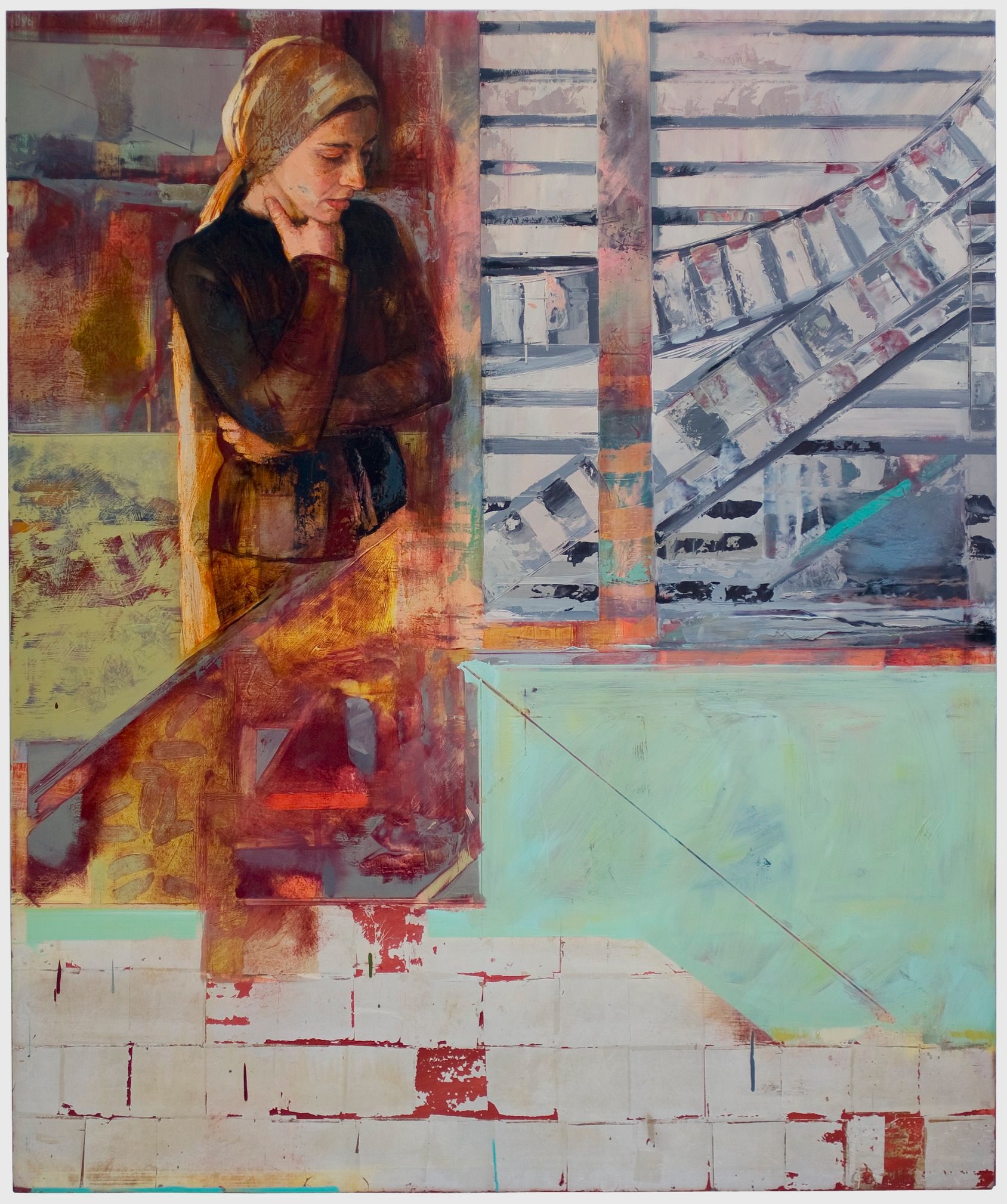
Bruce Herman (American, 1953–), Called, from the Woman series, 2007. Oil, alkyd resin, and 23k gold and silver leaf on wood, 58 3/4 × 48 3/4 in. Collection of Bjorn and Barbara Iwarsson, Lakeville, Minnesota.
My parents named me
    for the daughter of Amram
        and the Levite woman Yocheved:

prophetess with a timbrel
    who cast her baby brother
        on the mercies of the Nile.

Our name means Bitter Waters
    like the salt-encrusted sea
        into which the Jordan flows.

Or perhaps Sea of Myrrh—
    that sticky precious resin
        scenting the anointing oil

which Moshe once used
    to consecrate the Mishkan,
        the place where Presence dwelled.

My namesake had a well
    which followed the Israelites
        in all their wandering,*

a sweet spring in the desert
    bringing clarity to the heart
        of anyone who cupped their hands

and drank. Will I too
    be a wellspring of Torah,
        a source of living waters,

or will I stagnate here
    in this backwater town
        never hearing the voice of God?
* According to the Mishnah (Talmud, Taanit 9a), a well of fresh water miraculously followed Miriam, Moses’s sister, as she wandered with her people through the desert, providing a steady source of drink for all.
Rabbi Rachel Barenblat is a longtime blogger at The Velveteen Rabbi and a cofounder of Bayit, a collective of clergy, liturgists, artists, and educators that develops and distributes online Judaism resources. She holds dual ordination as a rabbi and mashpi’ah (spiritual director) and since 2011 has served as spiritual leader of Congregation Beth Israel in North Adams, Massachusetts. She has an MFA in writing and literature from the Bennington Writing Seminars and is the author of six volumes of poetry, including 70 faces: Torah poems (Phoenicia Publishing, 2011)and Texts to the Holy (Ben Yehuda, 2018). Her work has appeared in Reform Judaism,The Wisdom Daily, The Forward, and anthologies such as The Bloomsbury Anthology of Contemporary Jewish American Poetry and The Women’s Seder Sourcebook. She has taught at Beyond Walls, a writing program for clergy of many faiths at the Kenyon Institute, and is currently serving as a visiting faculty at the Academy for Spiritual Formation.
VISUAL MEDITATION: “At the Whipping Post” by Victoria Emily Jones: Last year the Museu de Arte de São Paulo (MASP) ran a major retrospective on Djanira da Motta e Silva, “a central artist in Brazilian mid-century modernism” (Rodrigo Moura). ArtWay’s editor asked me to choose a painting of hers to write about—I chose the one she submitted to the 1955 “Christ of Color” contest, showing Jesus as an enslaved African being scourged in the historic center of Salvador de Bahia, the first colonial capital of Brazil.
Djanira da Motta e Silva (Brazilian, 1914–1979), Largo do Pelourinho, Salvador, or Cristo na coluna (Christ at the Column), 1955. Oil on canvas, 81 × 115 cm. Private collection, Rio de Janeiro, Brazil. Photo: Jaime Acioli.
+++
LECTURE: “Is Christianity a White Man’s Religion?” by Dr. Vince L. Bantu: I first encountered Vince Bantu in a Conversing (Fuller Studio) podcast episode on African American identity and the church. (He joined the Fuller faculty last year as assistant professor of church history and Black church studies.) In this video from January 2018, he returns to his alma mater, Wheaton College, to discuss the history of Christianity in Africa—which some people are surprised to learn predates colonialism. “To study ancient African history is to study Christianity. They go together,” he says. “If you want to study Ethiopian literature, . . . you’re going to be reading a whole bunch of Christian literature. Same thing in Nubian. Same thing in Coptic.” While the Anglo-Saxons were still worshipping Odin and Thor, Bantu says, Black Africans were building churches, establishing seminaries, and writing Christian theological treatises!
The talk starts at 11:34 and really kicks into gear at around 24:00. Q&A starts at 52:40 and includes discussion of a three-point spectrum of approaches to culture, mission as “cultural sanctification,” and internalized theological racism. Take note of Bantu’s response, at 1:09:35, to the question “What do we do with this information?”
“Christianity is and always has been a global religion,” Bantu reminds us. Unfortunately, people tend to associate it most with western Europe. That’s because Rome, the dominant culture for some time, essentially said, “Christianity belongs to us,” instituting a theological hegemony. The West proclaimed itself the guardian of the Christian faith, declaring heretical churches in other regions that didn’t express theology the same way they did, with no regard for differences in language and philosophical frameworks.
I appreciate how Bantu teaches Christian history in part through art and architecture, which are material witnesses to the faith and sometimes even modes of theology. He shows photos of churches and monasteries and their interior decoration. Most fascinating to me is a tenth-century wall painting he photographed at the Great Monastery of Saint Anthony in Old Dongola (present-day Sudan), a Nativity scene that shows Africans wearing animal crest masks and worshipping Christ with traditional instruments. (You can view some photos here. See also The Wall Paintings from the Monastery on Kom H in Dongolaby Malgorzata Martens-Czarnecka, or the freely accessible essay by the same author, “The Christian Nubia and the Arabs.”)
Great is your name, Lord Jesus Christ Praise to your name, Lord Jesus Christ Power to your name, Lord Jesus Christ Praise to your name, exalted Jesus Christ
Hallelujah, hallelujah Hallelujah, hallelujah Hallelujah, hallelujah Praise to your name, exalted Jesus
“I Am Thine (Plague Hymn)”: Made especially timely by the current COVID-19 pandemic, this hymn text was written in 1519 by Swiss Reformer Ulrich Zwingli while convalescing from the bubonic plague, having caught it ministering to others. This year Zac Hicks wrote a new melody for it, and it’s sung here by Leif Bondarenko. Released by Advent Birmingham.
+++
BIBLICAL ART DATABASE: Visual Midrash: “Visual Midrash is an online bilingual (Hebrew and English) collection of Bible art and commentary, sponsored by the TALI Education Fund in Israel. At present, the site contains more than 1100 art images relating to 33 different subjects from all three divisions of the Hebrew Bible – including such figures as Abraham, Jacob, Moses, David, the women of the Book of Judges, the scrolls of Ruth and Esther and much more. Among the images are objects from the Ancient Near East; frescoes from the ancient synagogue of Dura Europos; medieval illuminated manuscripts; paintings, sculptures, lithographs, and nearly 100 other art media from Michelangelo to Rembrandt to Chagall to contemporary artists.” I’ve had fun browsing! Below is just a small sampling of images from the site.
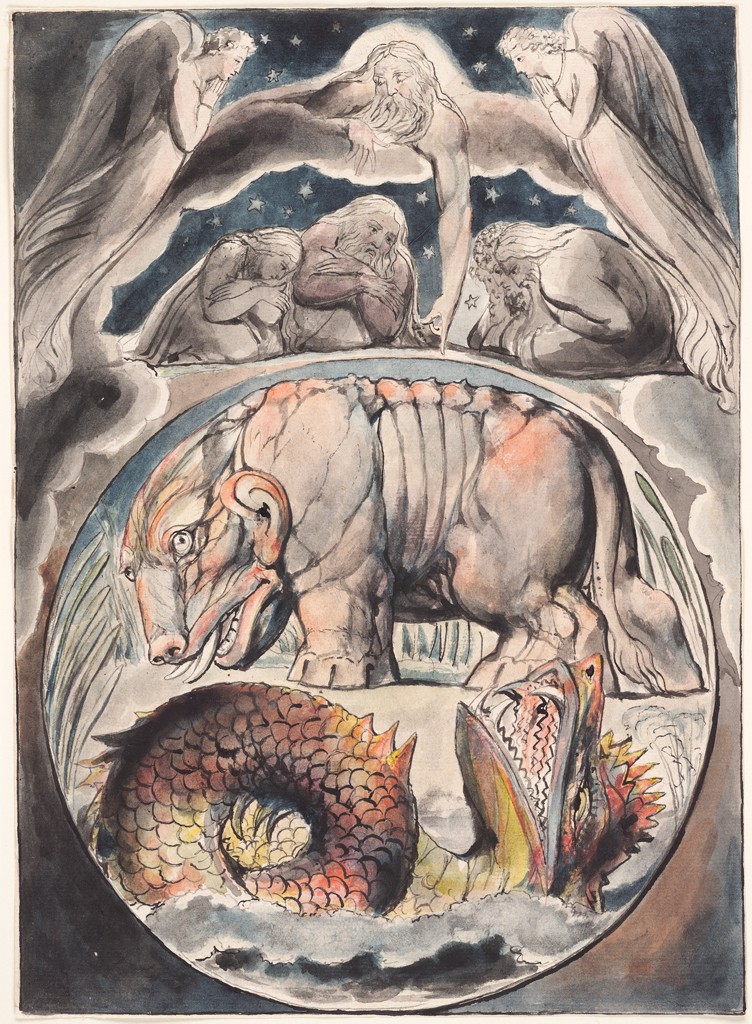
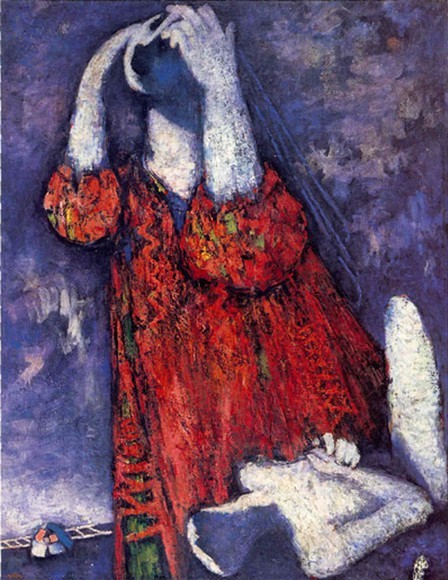
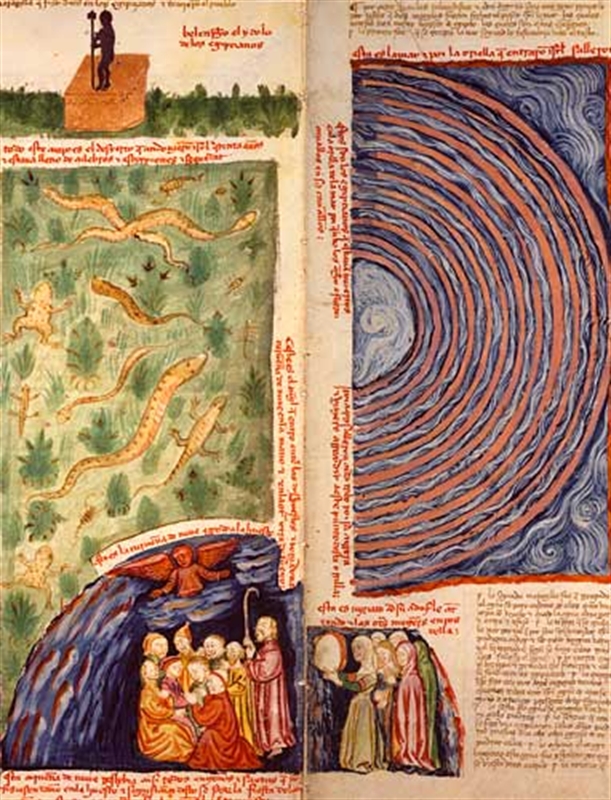
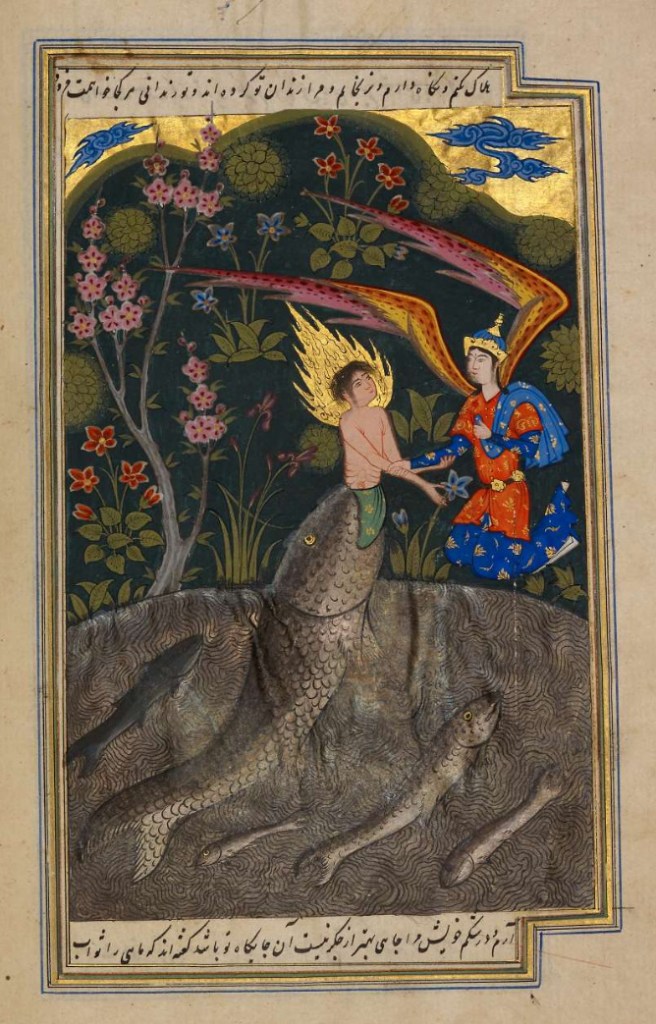
William Blake (British, 1757–1827), Behold Now Behemoth, Which I Made With Thee (The Book of Job) (Linnell set), 1821. Watercolor, black ink, and graphite on off-white antique laid paper, 27.5 × 20 cm. Harvard Art Museums/Fogg Museum, Cambridge, Massachusetts. [HT]Mordecai Ardon (Israeli, 1896–1992), Sarah, 1947. Oil on canvas, 138 × 108 cm. Jewish National and University Library, Jerusalem.“The Finding of Moses,” wall painting made in 244 CE, from Dura-Europos Synagogue in Syria. Preserved at the National Museum of Syria, Damascus. [HT]“Crossing of the Red Sea,” Spain, 1430. Illumination from the Alba Bible (fol. 68v–69r), Liria Palace, Madrid.“Jonah,” Iran, 1577. Illumination from the Qisas al Anbiya (Diez A Fol. 3, fol. 142v), Staatsbibliothek, Berlin. [HT]




 Art & Theology