
Roundup: Peter’s tears, “The Mission” film, Tan Dun’s “Water Passion,” and more

VISUAL COMMENTARY: “Repentance (Transforming Tears)” by Clemena Antonova: One of the three works that art historian Clemena Antonova curated for the Visual Commentary on Scripture exhibition on Peter’s denial of Christ (Matt. 26:69–75; Mark 14:66–72; Luke 22:54–62; John 18:15–18, 25–27) is the installation Lágrimas de São Pedro (Tears of Saint Peter) by contemporary Brazilian artist Vinícius Silva de Almeida. The artist used hundreds of light bulbs, filled with water and suspended on near-invisible nylon threads, to create an environment in which visitors move between “tears” falling like raindrops from above. In the Christian tradition, Peter is regarded as a paradigm of penitence, as scripture says he “wept bitterly” when he realized his sin, and soon after he was restored to Christ. As Antonova interprets, Tears of Saint Peter invites folks to reflect on the interconnection of sorrow and healing in Peter’s story and in their own.

Silva de Almeida, Vinicius_Tears of Saint Peter
Vinícius Silva de Almeida (Vinícius S.A.) (Brazilian, 1983–), Lágrimas de São Pedro (Tears of Saint Peter), 2005–21. 6,000 light bulbs filled with water (various numbers in different locations). Photo: Erivan Morais.

View additional photos here.

+++

SONGS:

>> “Peter” by Montell Fish: Montell Fish (the stage name of Montell Frazier) is a singer-songwriter from Pittsburgh whose music combines elements of lo-fi and classic R&B. In his song “Peter” from the album Camp Lukewarm (2020), he compares himself, in confessional mode, to the titular apostle, who denied Christ three times. “Sometimes I feel like Peter / Denied you and I cannot deny that I did / Can I rest my head on your shoulders again?” In the bridge, Christ answers in the affirmative: Yes, come rest.

>> “O How He Loves You and Me / Your Love Divine”: The first song in this medley was written by CCM (contemporary Christian music) pioneer Kurt Kaiser in 1975; the second by the legendary gospel artist Richard Smallwood. Recorded live at Jericho City of Praise in Landover, Maryland, it’s performed here by Smallwood (at piano) and his vocal and instrumental ensemble Vision, featuring soloist Vanessa Williams. The recording appears as two separate tracks on Persuaded: Live in D.C. (2001).

Here are the lyrics to the second song, starting at 3:06:

Refrain:
Lord, you know the pain, pain we bear
And Lord, you know the toils, toils and cares
Send your direction
Send your protection
Send your compassion
And your love divine

Verse:
Help us love those who would do us wrong
Send your cleansing power from above
Unite our hearts as one
Make us vessels for the flow-through of your love

[Refrain]

Vamp:
Your love divine
Your love divine

+++

BOOK CHAPTER: “Maundy Thursday—The Mission,” chap. 16 from Films for All Seasons by Abby Olcese: Abby Olcese is a writer on film, faith, and popular culture, living in Kansas City. Last year her book Films for All Seasons: Experiencing the Church Year at the Movies was published by InterVarsity Press, spotlighting twenty-six films as lenses through which to reflect on the great themes of the church calendar. I was preparing to write something on The Mission, the 1986 film directed by Roland Joffé, for Lent this year when I encountered this book, and because Olcese covers the movie so well, I secured permission from IVP to provide a free PDF download of the chapter to Art & Theology readers. Olcese situates The Mission as a film that’s especially appropriate for Maundy Thursday, a day when the church reflects on the call to servant-love and commemorates, among other things, Jesus’s arrest in the garden of Gethsemane, during which he and his disciples “face the forces of human empire, a dramatic moment of conflict ending in what, for the moment, feels like defeat.”

The Mission addresses themes of Christian ministry, the kingdom of God, repentance, forgiveness, love, respect, and the nonviolent ethic of Christ. Based on actual events, it follows an eighteenth-century Spanish Jesuit priest, Father Gabriel (Jeremy Irons), as he establishes a mission among the Guaraní people in the borderlands of present-day Argentina, Paraguay, and Brazil and seeks to protect the Guaraní from the encroachment of Spanish and Portuguese enslavers. He is later joined by the penitent Rodrigo Mendoza (Robert De Niro), a recent convert and former slave dealer and mercenary soldier. But the two clash over how best and most faithfully to protect the people they live among and serve.

PDF excerpt from Films for All Seasons by Abby Olcese. Copyright © 2024 by Abigail Olcese. Used by permission of InterVarsity Press. www.ivpress.com

+++

ORATORIO: Water Passion After St. Matthew by Tan Dun: Commissioned for the 250th anniversary of Bach’s death in 2000, this eclectic, Asian-influenced Passion oratorio by the Chinese American composer Tan Dun follows Jesus from his baptism to his resurrection. As the title suggests, water plays an important role in the work. When performed, seventeen large transparent water bowls, dramatically lit from below, form a cross on the stage and are used by percussionists throughout the piece’s ninety-minute duration, creating various timbres. (“The three percussionists make water drip, flow, burble, crash and hiss. They lift handfuls of water, then fling it back down. They stir it, strike it with pairs of plastic cups, float soup bowls upside down in it and play them,” Justin Davidson described in his review of the world premiere.) For Tan, water is “a symbol of baptism, renewal, re-creation, and resurrection.”

Tan Dun
Composer Tan Dun plays a “water drum” in Hangzhou, Zhejiang Province. Photo courtesy of Visual China Group (VCG).

In addition to the water percussion, the work calls for an SATB chorus that doubles on stones and tingsha (Tibetan finger cymbals); soprano and bass soloists who double on the xun (Chinese ocarina, or globular vessel flute) and who are required to do some Mongolian overtone singing; one violin; one cello; and one sampler player (Yamaha A-3000).

Water Passion premiered in Stuttgart, Germany, on September 8, 2000, conducted by Tan—you can listen to the full live recording on Spotify—and it has since been performed a handful of other times across the globe. I recommend the following hour-long video from Symphony Tacoma in Washington, which features excerpts from their March 30, 2016, performance augmented by interviews with some of the key players:

+++

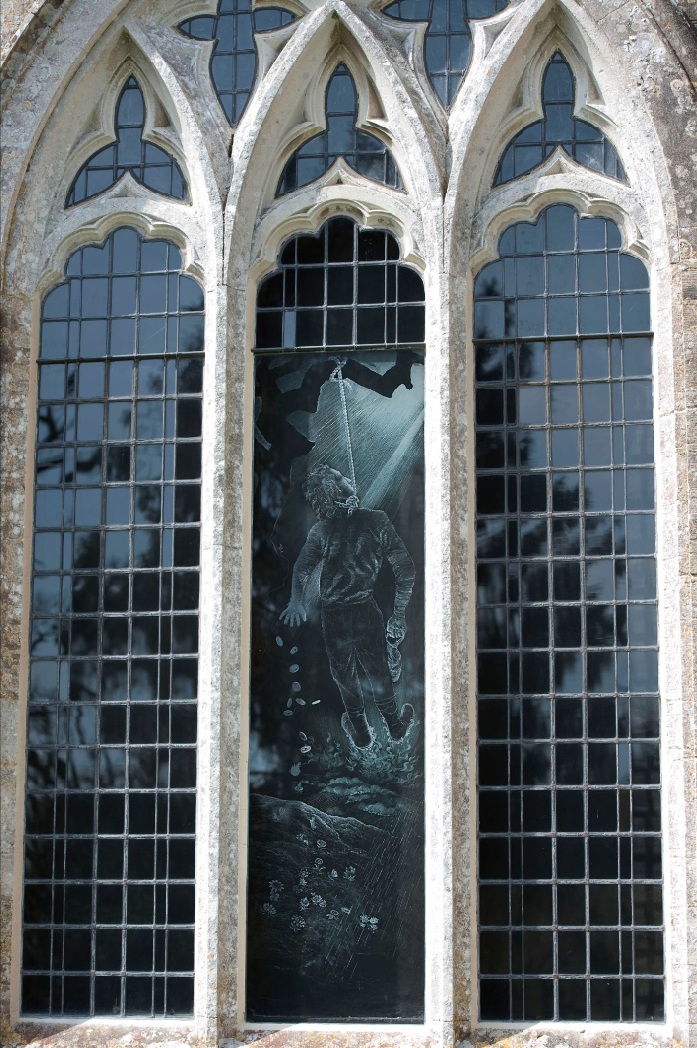
ARTWORK: The Judas Window by Laurence Whistler: In 1940, St Nicholas Moreton in Dorset was hit by a German bomb, destroying much of the church building, including its nineteenth-century stained glass windows. After rebuilding, the church commissioned the renowned glass engraver Laurence Whistler in 1955 to make twelve new windows, replacing the ruined ones, a project he worked on for the next three decades; they depict butterflies, birds, rabbits, wildflowers, candles, stars and planets, and local scenes. (See a few photos at The Dorset Rambler or Chris Belsten’s Flickr album.) In 1987 he offered to donate a thirteenth window on the theme of forgiveness, featuring the death of Judas, which would be visible, by design, from the outside only (the proposed space was blocked on the inside by a memorial tablet). The idea was entertained but, after consultation between the rector, parish council, and local diocese, was ultimately rejected due to its controversial nature—too many felt that it just wasn’t a fitting subject for a church window. Eager to pursue his vision, Whistler made the window anyway and loaned it to the county museum in Dorchester but insisted that if the church ever changed its mind, it should be given to them.
Whistler, Laurence_The Death of Judas
Laurence Whistler (British, 1912–2000), The Death of Judas (aka the Forgiveness Window), made 1993, installed 2013. Engraved glass, St Nicholas’ Church, Moreton, Dorset, England. Photo: Phil Yeomans / Bournemouth News and Picture Service.

In 2012, Rev. Jacqueline Birdseye, the new rector, encouraged the parish to revisit the issue, and this time around, there was unanimous approval to install the window, startling though it is. Again, it’s a blind window—behind it is black wooden boarding—which was the artist’s intent, as he wanted Judas to be a “shadowy” figure (so he couldn’t be front-lit and backlit) and on the outside, near the graveyard. But, unlike traditional portrayals of Judas’s suicide, which are bleak and punishing, Whistler’s portrayal is one of subtle hope, redemption, and new life. The uniting theme of the twelve interior windows is “light,” and here a bright shaft falls from the heavens on Judas’s upturned face. Hanging from his noose, he relinquishes the thirty coins for which he sold his Savior, and when they hit the ground they transform into flowers; the “field of blood” (Acts 1:18–19) becomes a spring meadow.

Scripture tells us that after realizing his enormous error, Judas “repented” (Matt. 27:3 KJV), “was filled with remorse” (NLT), and returned the blood money. Though Christians have historically counted Judas as eternally damned, other Christians have suggested the possibility of forgiveness beyond the grave for the traitorous disciple who was desperately grieved by his sin. “There’s a wideness in God’s mercy.” “A broken and contrite heart, O God, you will not despise” (Ps. 51:17).

Favorite Films of 2023, Part 2

Read part 1 here.

11. Oppenheimer, dir. Christopher Nolan. Based on the biography American Prometheus by Karl Bird and Martin J. Sherwin, Oppenheimer chronicles the role of nuclear physicist J. Robert Oppenheimer (Cillian Murphy) in developing the world’s first atomic bomb. Recruited by the US Army in 1942, Oppenheimer heads up the new Manhattan Project lab in Los Alamos, New Mexico, assembling a team of leading scientists. While some decline the invitation or, over the next few years, drop off the project for ethical reasons, Oppenheimer persists with the self-justification that if the US didn’t make the bomb, Germany would. The film grapples with moral responsibility and guilt when it comes to applying advanced scientific knowledge toward destructive ends.

12. The Holdovers, dir. Alexander Payne. It’s December 1970, and Angus Tully (Dominic Sessa) is looking forward to getting away from his New England boarding school for Christmas break, especially from his ornery classical studies teacher Paul Hunham (Paul Giamatti). But when his mom calls to say she and her new husband need some alone time, Angus is left under the begrudging care of Mr. Hunham for the holidays. Mary Lamb (Da’Vine Joy Randolph), the school cook whose son died earlier that year in Vietnam, also stays on campus to make meals. We learn about these three unlikely companions as they learn about one another and confront their griefs, anger, and disappointment. The Holdovers is a warm and charming film that’s destined to become a new Christmas classic.

Streaming on Peacock.

13. Godland, dir. Hlynur Pálmason. In this slow-burning mood piece set in the late nineteenth century, a young Lutheran priest named Lucas (Elliott Crosset Hove) is dispatched from his home country of Denmark to a remote part of Iceland to establish a church. Led by the gruff but spiritually curious local guide Ragnar (Ingvar Sigurðsson), Lucas treks through the country’s rugged wilderness. But the deeper he travels, the more his sense of purpose and morality falters. The film explores the physical and mental challenges of international mission work, opposing approaches to nature (as something to be dominated versus something to work with in humility), and the interlocking histories of two nations, one under the political control of the other.

A title card at the beginning of the film says Godland was inspired by seven wet-plate photographs found in a wooden box, the sole documentation of a Danish priest’s odyssey to the southeast coast. What an intriguing concept!, I thought: to invent a narrative out of this anonymous set of historical photos (a girl playfully posing on a horse, a nascent church congregation seated outside its new building, etc.), which are re-created throughout the film. It turns out there were no photos; the writer-director made that up. But the strength of the concept still stands. In addition to serving a religious vocation, Lucas is a photographer, and his journey is made all the more rigorous by his having to lug his heavy camera equipment over the terrain. He photographs what he values—and refuses to photograph what he doesn’t, which leads to a climactic altercation. The frames of the film have a 4:3 aspect ratio and rounded corners to further evoke vintage photography.  

I found it hard to get a handle on Lucas’s character, as he seems so ill suited to pastoral ministry. He’s generally closed off, uncharitable (even spiteful), and easily annoyed, and he has a sense of superiority over Icelanders, refusing to learn their language and to recognize the glory of their land and culture. I think he starts off more optimistic and open, but when he suffers a loss and his feelings of isolation and frustration increase, he becomes a reluctant prophet, like Jonah. I read the muddy scene near the end as him finally acknowledging his guilt (Ragnar’s barking dog piercing his conscience), but others have interpreted it differently. If you watch it, I’m curious to know what you think.

Streaming on Kanopy.

14. The Eight Mountains, dir. Felix van Groeningen and Charlotte Vandermeersch: Adapted from the best-selling 2016 novel by Paolo Cognetti, The Eight Mountains is a tale of friendship and making peace with the past. Eleven-year-old Pietro meets Bruno one summer while vacationing in the Italian Alps with his family. Pietro’s dad, Giovanni (Filippo Timi), becomes a father figure for Bruno, whose own father neglects him. As a teen Pietro becomes estranged from his family while Bruno maintains a relationship with them. Pietro doesn’t return to Bruno’s village until some twenty years later, when he learns that his father has died. Pietro and Bruno (played by Luca Marinelli and Alessandro Borghi as adults) reconnect over restoring a dilapidated cabin that the father had always dreamed of living in. Over the next decade, the two support each other in their griefs and letting go: Pietro over the years he lost not knowing his father, and Bruno over the loss of the dairy farm that has been in his family for generations but that is no longer viable, and with it the loss of a simple, rural way of life in the mountains he loves.

It’s rare to see a film about male friendship that doesn’t involve war, crime, or drunken shenanigans or turn into a romance. The Eight Mountains shows us two men who are a caring presence in each other’s lives, whose getting together simply involves conversation, comfortable silences, and scenic hikes. It’s a quiet film with gorgeous cinematography.

15. Return to Seoul, dir. Davy Chou. Frédérique “Freddie” Benoît (Park Ji-Min), a twenty-five-year-old French woman who was adopted as a baby from South Korea, returns for the first time to her birth country and hesitantly decides to track down her biological parents. The film follows her over the course of eight years as she tries to find who she is and where she belongs.

Streaming on Amazon Prime.

16. A Thousand and One, dir. A. V. Rockwell. After getting released from prison, the devoted and determined Inez (Teyana Taylor) kidnaps her son, Terry (played at different ages by Aaron Kingsley Adetola, Aven Courtney, and Josiah Cross), from the foster care system and sets out to build a life for him in a Harlem that is rapidly changing through gentrification. Spanning 1994 to 2005, the film is about love that we choose and that chooses us. Taylor is phenomenal in the lead role.

Streaming on Amazon Prime.

17. R.M.N., dir. Cristian Mungiu. When three Sri Lankan migrant workers are hired by a bread factory in a Transylvanian town, paranoia and violence erupt. The locals boycott the bread and demand the “outsiders” leave—and this despite the town’s already multiethnic population, consisting of Romanians, Hungarians, Germans, and Roma. Writer-director Cristian Mungiu based the film on an actual incident of xenophobia in Ditrău, Romania, in January 2020, in which ethnic resentments led to a petition that pushed the Sri Lankans out. The Christmastime setting underscores the irony of the town’s hostile response to its new residents, as the Christmas story involves strangers seeking lodging and welcome to bring the Christ child into the world.

Streaming on AMC+.

18. American Fiction, dir. Cord Jefferson. Thelonious “Monk” Ellison (Jeffrey Wright) is shopping his novel to different publishers, but they’re not interested; they say it’s “not Black enough.” Frustrated by the industry’s platforming and profiting from stereotypes of Blackness, he decides to write a new novel so outrageous in its use of tired and offensive Black tropes that the gatekeepers will be forced to confront their ridiculousness. Turns out, My Pafology becomes a smash success. This film addresses through comedy our culture’s narrow expectations of what Black art and entertainment should be—what stories Black people should tell and in what kind of voice, or what issues Black writers and filmmakers should address in their work.

19. One Fine Morning, dir. Mia Hansen-Løve. Sandra (Léa Seydoux) is a young widowed woman caring for her eight-year-old daughter (Camille Leban Martins), her aging father (Pascal Greggory), and herself, while holding down a job as a translator in Paris. Too often in film, moms are flat characters, but I love how multidimensional Sandra is—how we see her balancing motherhood, daughterhood, and her professional and romantic lives. Neither perfect nor unforgivably flawed, she is just a normal mom dealing with normal stuff, and wow, is Seydoux endearing in the role. The scene in which she’s having to size down her dad’s personal library after moving him into a long-term care facility where his neurodegenerative disease can be monitored made me cry.

Streaming on Amazon Prime.

20. Flora and Son, dir. John Carney. From the director who brought us Once and Sing Street comes another well-made feel-good movie about the power of music. Flora (Eve Hewson), a single mom, is constantly at war with her delinquent fourteen-year-old, Max (Orén Kinlan). (I’m genuinely shocked by how they talk to each other!) To keep him out of trouble, she tries to find him a hobby, and when he rejects the guitar she salvaged from a dumpster, she decides to take up the instrument herself. When she learns that Max is into making electronica and rap, she helps him turn one of his songs into a music video, and he helps her write a song for the online class she’s taking. It’s a sweet movie about a mother and son finding a way to connect with each other through music.

Streaming on Apple TV+.

HONORABLE MENTIONS: American Symphony (Netflix); Barbie (HBO); Rye Lane (Hulu); Spider-Man: Across the Spider-Verse (Netflix); Close (Showtime); Earth Mama (Kanopy)