
Holy Tuesday: The Bridegroom’s Coming

And at midnight there was a cry made, Behold, the bridegroom cometh; go ye out to meet him.

—Matthew 25:6 KJV

In the Orthodox Church, observances of Holy Monday, Tuesday, and Wednesday (which in that tradition take place next week) focus on the end times, “remind[ing] us of the eschatological meaning of Pascha,” says Alexander Schmemann.

The Gospel reading for the Liturgy of the Presanctified Gifts on Holy Tuesday is Matthew 24:36–26:2, which covers the need for watchfulness, the parable of the ten bridesmaids, the parable of the talents, and the Last Judgment. These passages constitute the latter half of Jesus’s Olivet Discourse, or Little Apocalypse, which, according to the chronology of Mark’s Gospel, Jesus preached the Tuesday before his death.

So, informed by the Matthew 25:1–13 reading, today I’ve selected a papercut by Chinese artist Fan Pu and a Black gospel song from the southern US that both engage with Jesus’s call to keep our metaphoric oil lamps burning in expectation of the return of the Bridegroom, who died and rose for love of us, and who has gone to build us a home.

LOOK: Ten Bridesmaids by Fan Pu
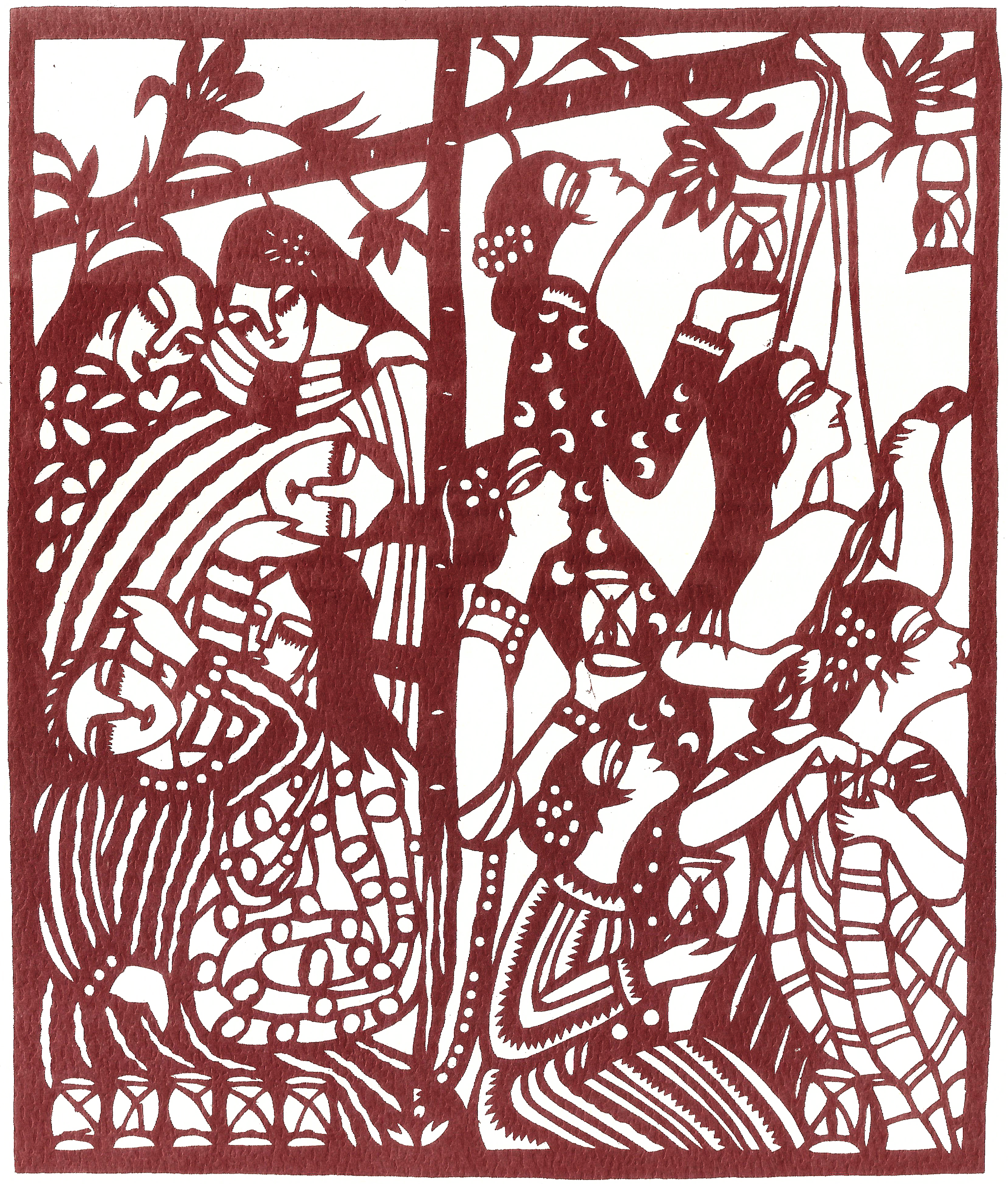
Fan Pu_Ten Bridesmaids
Fan Pu (Chinese, 1948–), Ten Bridesmaids, 2001. Papercut. Collection of the Asian Christian Art Association.

(Note: This artwork has changed since the original publication of this post. I learned that the previous artist did not want her work featured or her name mentioned on the website.)

LISTEN: “The Bridegroom’s Coming,” traditional gospel song | Recorded August 6, 1940, by Mitchell’s Christian Singers, on Mitchell’s Christian Singers, vol. 3 (1938–1940) (released 1996)

I couldn’t find lyrics for this song online, so I transcribed them myself the best I could. I’m not positive about the second line in the refrain, and I couldn’t make out the second half of the last line of verse 2.

Refrain:
And behold (and behold), lo, the Bridegroom’s coming
Lift up (lift up), I heard the voices cryin’ out loud
And be ready (and be ready) when the Bridegroom’s coming
To meet him in the air

Ever seen such a man as this?
Jesus was sent, he came down to die
Came to save my soul from the burning fire [Refrain ×2]

Ever seen such a man as this?
Jesus was sent, he came down to die
I want to meet . . . (?) [Refrain ×2]

Mitchell’s Christian Singers [previously] were an influential early gospel group from Kinston, North Carolina.

The Kentucky Jubilee Four recorded an earlier version of this song for OKeh in St. Louis, Missouri, in 1927.

Blessed Are (Artful Devotion)

Come ye blessed by Nathaniel Mokgosi
Nathaniel Mokgosi (South African, 1946–2016), “Come, ye blessed . . . ,” 1980. This linocut is one of ten in a series on the Beatitudes. Source: Christliche Kunst in Afrika, p. 274

Blessed are you who are poor, for yours is the kingdom of God.

Blessed are you who are hungry now, for you shall be satisfied.

Blessed are you who weep now, for you shall laugh.

Blessed are you when people hate you and when they exclude you and revile you and spurn your name as evil, on account of the Son of Man! Rejoice in that day, and leap for joy, for behold, your reward is great in heaven; for so their fathers did to the prophets.

—Luke 6:20b–23

+++

SONG: “Blessed Are the Poor in Spirit” | Traditional, performed by Mitchell’s Christian Singers, on Mitchell’s Christian Singers, vol. 2 (1936–1938)

The Great Depression had a devastating effect on America’s recording industry, but a gradual recovery started in 1934, and that’s when the gospel quartet climbed to ascendancy within the broader genre of African American religious music. One of the most celebrated groups of this period was Mitchell’s Christian Singers from Kinston, North Carolina, originally called the New Four but then renamed for manager Willie Mitchell.

Each of the members had a different day job—tobacco warehouse laborer, truck driver, stonemason, coal salesman—but they formed a habit of singing together in the evenings and were discovered by a local talent scout. They went on to record more than eighty sides from 1934 to 1940, and in 1938 they even appeared onstage at Carnegie Hall alongside other greats, including Sister Rosetta Tharpe and Count Basie, for a landmark program titled “From Spirituals to Swing.” (One review of the concert noted how Mitchell’s Christian Singers sang “with touching solemnity . . . intensity and abandon . . .”) But despite their extensive output and relative popularity, none of the members opted for full-time professional musicianship. They traveled out of state to make records from time to time but generally stayed close to home, performing at churches and community functions.

The recording above, from an August 11, 1937, studio session, features Louis “Panella” Davis, Julius Davis, William Brown, and Sam Bryant. It was reissued in 1996 by Document as part of a four-volume CD set of the group’s complete works.


This post belongs to the weekly series Artful Devotion. If you can’t view the music player in your email or RSS reader, try opening the post in your browser.

To view all the Revised Common Lectionary scripture readings for the Sixth Sunday after Epiphany, cycle C, click here.