
Christmas, Day 5: Poor Little Jesus

LOOK: Our Lady of Humility by Allan Rohan Crite
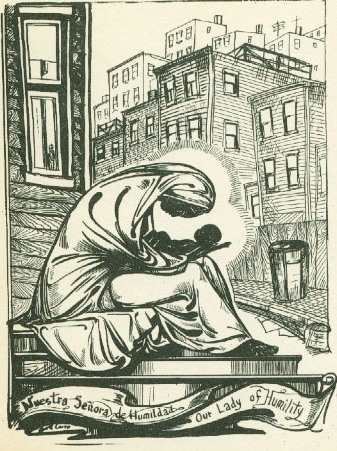
Crite, Allan Rohan_Our Lady of Humility
Nuestra Señora de Humildad / Our Lady of Humility by Allan Rohan Crite

Allan Rohan Crite (1910–2007) was a Boston-based African American artist best known for his religious paintings and drawings, many of which place holy personages among everyday people in Boston’s South End. He was Episcopalian.

On using Black figures to narrate biblical stories, Crite said:

I used the black figure in a telling of the story of the Lord, the story of the suffering of the Cross and the whole story of the Redemption of Man by the Lord, but . . . my use of the black figure was not in a limited racial sense, even though I am black, but rather I was telling the story of all mankind through this black figure. (quoted in Julie Levin Caro, Allan Rohan Crite: Artist-Reporter of the African American Community, p. 20)

The image above, which I found years ago at the now defunct brushesandpigments.com with very little captioning info, sets the Nativity in an urban neighborhood. Sitting on a stoop, Mary bends her head down to look lovingly at her son Jesus, cradled in her lap. The banderole at the bottom reads, “Nuestra Señora de Humildad / Our Lady of Humility.”

As indicated by the inscription, this pen and ink drawing belongs to a type of iconography especially popular in the fifteenth century, showing Mary sitting on the ground or on a low cushion, usually holding the Christ child in her lap. The word “humility” derives from the Latin humus, meaning “earth” or “ground.”

I’m not sure why Crite uses Spanish here—whether he spoke it as a second language, or had Spanish-speaking neighbors, or was working on commission—but I do know he visited Mexico and Puerto Rico. 

LISTEN: “Poor Little Jesus” (aka “Oh, Po’ Little Jesus”), African American spiritual

Oh, Po’ Little Jesus.
Dis world gonna break your heart.
Dere’ll be no place to lay your head, my Lord.
Oh, Po’ Little Jesus. (Hum)

Oh, Mary, she de mother.
Oh, Mary, she bow down an’ cry.
For dere’s no place to lay his head, my Lord.
Oh, Po’ Little Jesus.

Come down, all you holy angels,
Sing round him wid your golden harps,
For someday he will die to save dis worl’.
Oh, Po’ Little Jesus. (Hum)

>> Sung by the Morehouse College Glee Club, arr. Leonard de Paur, on New Born King (1999):

>> Sung by Maddy Prior and the Carnival Band, arr. Andrew Watts, on Carols and Capers (1992) (the video below is a live performance from 2004):

>> Arranged and sung by Rev Simpkins (Matt Simpkins), with Martha Simpkins, on Poor Child for Thee: 4 Songs for Christmastide (2020):

I find this spiritual so moving. The five-part harmonies—or even just the two parts in Rev Simpkins’s version—are lush and carry such pathos.

From his humble beginnings in a Bethlehem stable to his ignominious death on a Roman cross, Jesus was no stranger to want and sorrow. He wasn’t impoverished, but he wasn’t wealthy; he had a simple upbringing in the small town of Nazareth. His mother probably longed to give him more than she could. She understood in part the hardship of his calling, knew the rejection he would face—and so she sings, “This world’s gonna break your heart.”

Jesus spent three determinative years of his adult life as an itinerant preacher, traveling from place to place and reliant on the support of others; as he told a scribe who aspired to follow him: “Foxes have holes, and birds of the air have nests, but the Son of Man has nowhere to lay his head” (Matt. 8:19). That ministry culminated in false charges, abandonment, and a public execution.

The Incarnation required vulnerability on the part of God. God chose to make himself susceptible to hurt by entering fully into the life of human struggle. But out of the hurt and struggle that Christ endured came salvation.

“Poor Little Jesus” seeks to stir up pity for Jesus’s plight. Underlying that pity is a thank-you: thank you, Jesus, for taking on our flesh and dealing with our sin, so that we might be free.

The spiritual is not to be confused with another spiritual of the same name (recorded, for example, by Odetta) that goes, “It was poor little Jesus . . . didn’t have no cradle . . . wasn’t that a pity and a shame?”


This post is part of a daily Christmas series that goes through January 6. View all the posts here, and the accompanying Spotify playlist here.

Yoruba Christmas carol and art (Nigeria)

A popular song in choir repertoires, “Betelehemu” is a Yoruba Christmas carol by the Grammy-nominated drummer Babatunde Olatunji, arranged for men’s choir by Wendell P. Whalum. It came into being while Olatunji was a student on scholarship at Morehouse College in the 1950s: he shared it with Whalum, director of the school’s glee club, and that spawned a collaboration.

There have been numerous recordings of “Betelehemu” over the years, and each one has its own distinct flavor, especially in the percussion sections. I really like the one by The Young People’s Choir of New York City from the 2003 album It Is Possible. But here’s a version from Brazil, arranged for SATB by Jonathan Crutchfield:

You might also be interested in performances by the Morehouse College Glee Club (from their one hundredth anniversary concert in 2012) and the African Children’s Choir.

Here are the Yoruba lyrics and English translation to follow along with, provided courtesy of my friends Ezekiel Olagoke and Temidayo Akinsanya. For a pronunciation guide, click here.

Betelehemu
Awa yio ri Baba gbojule
Awa yio ri Baba fehinti
Nibo labi Jesu
Nibo labe bi i
Betelehemu, ilu ara
Nibe labi Baba o daju
Iyin, iyin, iyin nifun o
Adupe fun o, adupe fun o, adupe fun ojo oni
Baba oloreo
Iyin, iyin, iyin fun o Baba anu
Baba toda wasi
Betelehemu

Bethlehem
We shall see that we have a Father to trust
We shall see that we have a Father to rely on
Where was Jesus born?
Where was he born?
Bethlehem, the city of wonder
That is where the Father was born for sure
Praise, praise, praise be to Him
We thank You, we thank You, we thank You for this day
Blessed Father
Praise, praise, praise be to You, merciful Father
Father who delivered us
Bethlehem

The lyrics are simple, rejoicing in the Father’s glory and grace in giving his Son over to be born in Bethlehem. I asked my Yoruba friends about the line “That is where the Father was born for sure,” which seems problematic from a Trinitarian perspective, because it was the Son, Jesus—not the Father—who was born in Bethlehem. The Yoruba word Baba has more nuance than the English “Father”; it is used to signify a biological relationship but also as an honorific for wise men or elders. But still I wondered whether it is theologically appropriate.

Ezekiel told me that Yoruba Christians understand the distinctions between the three persons of the Trinity and that Baba is not commonly used to refer to Jesus, but in defense of it, he pointed me to scripture passages like Daniel 7:9–14 (cf. the book of Revelation), which describes Jesus as “the Ancient of Days”; John 8:58, in which Jesus tells his disciples, “Before Abraham was, I am,” ascribing to himself a status greater than that of the greatest Jewish patriarch; and Colossians 1:15–17: “He [Jesus] is the image of the invisible God, the firstborn of all creation. For by him all things were created, in heaven and on earth, visible and invisible, whether thrones or dominions or rulers or authorities—all things were created through him and for him. And he is before all things, and in him all things hold together.” In Yoruba culture and other African cultures as well, says Ezekiel, Jesus is sometimes called “Chief” or “Ancestor,” a similar notion that emphasizes his being before all things, the eternal Source in whom all things consist.

Temi said that to avoid confusion, he would probably recommend a revision from Nibe labi Baba o daju to Nibe labi Jesu o daju (or else he’d drop the name so that the indefinite pronoun “he” is implied instead).

Both friends felt that the phrase Awa yio ri (“We shall see”) in the second and third lines is awkward in this context. All the other lyric translations I’ve found translate the phrase as “We are glad,” but that would be Awa ni, Ezekiel said—and that doesn’t quite fit the musical meter. It’s possible that the song is merging Advent with Christmas: it starts with looking forward to the birth, then it acknowledges the birth as having happened, eliciting appellations of praise.

Yoruba nativity by George Bandele
Wooden door detail by George Bandele, 1962, showing the Adoration of the Magi. Collection of the SMA Fathers, Cadier en Keer, Netherlands. Source: Christliche Kunst in Afrika, p. 144

It seems that “Betelehemu” is more popular outside Nigeria than in. Ezekiel and Temi and one other Yoruba friend (from different generations) said that despite growing up in Christian homes in Nigeria, they’ve never heard it before, but they’ve heard ones similar to it. So while some sources credit “Betelehemu” as a “Yoruba folk text” and “Yoruba folk tune,” leaving Olatunji out entirely, I think it’s more likely that Olatunji drew on the song traditions of his people to create a new composition. At the very least, Olatunji introduced the song to the United States—and our Christmas concerts are all the richer for it!   Continue reading “Yoruba Christmas carol and art (Nigeria)”