
Advent, Day 5: Tired

Not only are humans tired and stressed and in need of deliverance; so is the environment. Today’s two featured works function as a call to care for the earth—the one a performative enactment of said care, tender and consoling, and the other an urgent lament by choir.

The gospel is for more than just humanity; it’s for all the earth—animals and insects, plants and soil, skies and oceans. All creation groans for redemption, Paul says in his letter to the early church in Rome. And in the final book of the Bible, John the Revelator’s vision is of the whole world renewed.

LOOK: Earth Rite by Holly Slingsby
Slingsby, Holly_Earth Rite
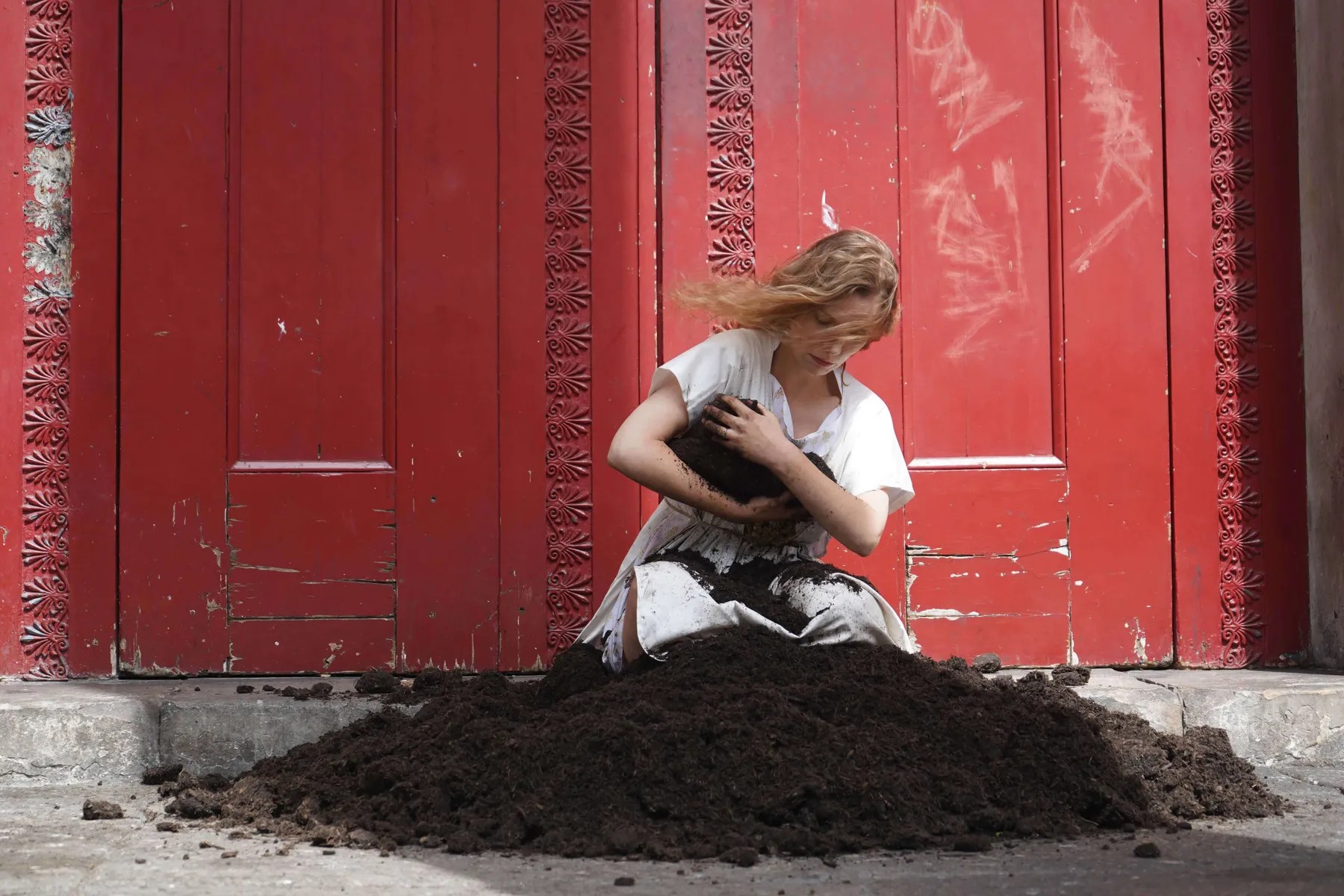
Holly Slingsby (British, 1983–), Earth Rite, performance at St Pancras Church, London, July 6, 2024. Duration: 1 hour. Photo: Adam Papaphilippopoulos.

Artist Holly Slingsby’s Earth Rite premiered at the Ritual/Bodies live performance event that took place at St Pancras Church in London on July 6, 2024, organized by Dr. Kate Pickering. It was one of eight performance works by eight different artists (one work was by two performers; two works were by one) that collectively spanned some three hours, followed by a ninety-minute panel discussion.

In Earth Rite, “a solo performer sits atop a mound of earth, cradling it in her arms. The earth slips away only to be regathered, in a continuous act of generating, losing, and regenerating.” Charles Pickstone, an Anglican priest, reviewed the work in the Autumn 2024 issue of Art + Christianity journal, writing:

Holly Slingsby, in a loose white dress, sat on the church steps on a mound of rich soil, arms folded in embrace. Where one might have expected a baby, the artist was embracing armfuls of soil, constantly replenishing her burden as the soil slipped away from her. Part earth mother, part mourner, on the edge of the busy and noisy Euston Road, the artist made what could have been rather a moralistic revisiting of a well-known theme (compare William-Adolphe Bouguereau’s Charity, perhaps an influence on this work) into a courageous and compelling glimpse of the earth’s abused and vulnerable soil.

Slingsby reprised the performance on September 27, 2025, at the International Forum of Performance Art in Drama, Greece.

LISTEN: “Kasar mie la Gaji” (The Earth Is Tired) by Alberto Grau, 1987 | Performed by Stellenbosch University Choir, dir. André van der Merwe, 2024

“Kasar mie la gaji” is a Hausa saying from the Sahel region of Africa that means roughly “The earth is tired.” In 1987 leading contemporary Venezuelan composer Alberto Grau (b. 1937) set it to music, creating a magnetic choral composition for, in his words, “an international mobilization to save THE EARTH.”

In their performance notes, the Stellenbosch University Choir from South Africa writes: “The composition is designed on hypnotic repetition, with a steady reiteration of the text. Plaintive glissandos and layered ostinato patterns create a compelling chant, begging for justice and rebirth.”

Kathy Romey, the director of choral activities at the University of Minnesota, offers further description:

The work is broken into three distinct sections, of which the first and third incorporate short melodic motives combined with rhythms from traditional South American dance music intensified by clapping and stomping. The middle section is a slow lament and utilizes various special effects for a cappella chorus, including glissandi, whispering, talking, and hissing.

Why is the earth tired? Because we are depleting her resources. We are disrupting her ecosystems. The carbon emissions from our burning of fossil fuels for energy and transportation are trapping heat in her atmosphere and causing extreme weather.

Lord, have mercy. Please help us restore our planet to health and treat her with respect, recognizing that she, as part of your creation, is precious to you.
Lent, Day 1 (Ash Wednesday)

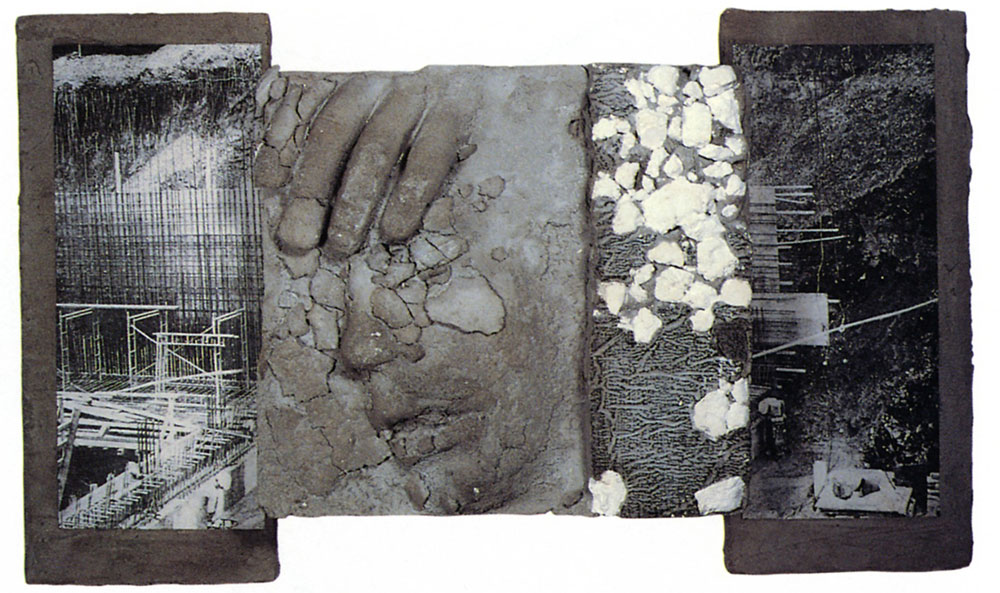
LOOK: Bradford Johnson, Untitled, 1987. Mixed media, 12 × 28 × 3 in. This image is featured in the essay “Wreckage and Rescue: The Art of Bradford Johnson” by Joel Sheesley in Image no. 25 (Spring 2000).

LISTEN: “Child of Dust” by Thrice (words by Dustin Kensrue, music by Dustin Kensrue, Edward Carrington Breckenridge, James Riley Breckenridge, and Teppei Teranishi), on The Alchemy Index, vols. 3–4: Air and Earth (2008)

“Child of Dust” is the final song of a four-EP cycle structured on the four basic elements: Fire, Water, Air, and Earth. It’s written as a sonnet in the voice of Earth.

Dear prodigal, you are my son and I
Supplied you not your spirit but your shape,
All Eden’s wealth arrayed before your eyes.
I fathomed not you wanted to escape.

And though I only ever gave you love,
Like every child you’ve chosen to rebel,
Uprooted flowers and filled the holes with blood.
Ask not for whom they toll, the solemn bells.

O child of dust, to Mother now return,
For every seed must die before it grows.
And though above the world may toil and turn,
No prying spades will find you here below.

Now safe beneath their wisdom and their feet,
Here I will teach you truly how to sleep.

The earth personified laments how humanity has not reciprocated the care she gives. We’re made of her (Gen. 2:7) and are invited to enjoy her beauty, and yet we abuse and destroy her and each other.

The second stanza alludes to Cain’s murdering Abel. “The voice of your brother’s blood is crying to me from the ground,” God tells Cain in Genesis 3:10. Line 8 is a reference to John Donne’s “Meditation 17” from Devotions upon Emergent Occasions, which uses a metaphor of land erosion to express humanity’s interconnectedness:

No man is an island, entire of itself; every man is a piece of the continent, a part of the main. If a clod be washed away by the sea, Europe is the less, as well as if a promontory were, as well as if a manor of thy friend’s or of thine own were. Any man’s death diminishes me, because I am involved in mankind; and therefore never send to know for whom the bell tolls; it tolls for thee.

In other words, when one person dies, a part of the whole of humanity is severed, and in that sense any time a funeral bell rings, we ought all to mourn the loss of a piece of ourselves.

Line 10, in the third stanza, references Jesus’s parable of the grain of wheat: “Truly, truly, I say to you, unless a grain of wheat falls into the earth and dies, it remains alone; but if it dies, it bears much fruit” (John 12:24). Jesus was talking about his own literal death and resurrection, but the principle applies to our dying to sinful desires, an act that enables new life to spring up in us (see, e.g., Rom. 6; Gal. 2:20, 5:24; Col. 3:2–5; 1 Pet. 2:24).

Kensrue’s lyrics have Mother Earth asking her prodigal children to return to her. As they sing the final couplet, the band puts the microphone in a wooden box (a “coffin”) and shovels dirt on top of it, creating a muffled sound effect. The last sixty seconds of the track are near silence, just the faint clinking of shovels into dirt and rocks. It’s as if we, the listener, are being buried.

Lent is a time when, beneath the world’s incessant noise and toil, we sow ourselves; we reground ourselves in God. The song can be interpreted in several ways, but I see it as calling us to die to self so that we might truly live. Dying and rising is a lesson that Earth, with her seasons and agricultural cycles, can teach us. The seed must be buried before it can experience growth.

(This song is featured on the Art & Theology Lent Playlist on Spotify.)