Kolumba and KMSKA: Medieval and contemporary art in conversation (part 2)

This a continuation of yesterday’s article. In part 1 I shared three room highlights from my visit to Kolumba museum in Cologne, Germany, run by the city’s Catholic archdiocese; in this final part I will do the same for KMSKA in Antwerp, Belgium, whose Old Masters galleries received a “contemporary injection” in an exhibition that wrapped this week. All photos are my own.

[Content warning: This article contains female nudity: a controversial Renaissance painting of the Virgin Mary, and three photographs of women who have just given birth.]

KMSKA, Antwerp

The Royal Museum of Fine Arts Antwerp, or KMSKA for short, is a world-famous museum whose collection spans seven centuries, from the Flemish Primitives to the Expressionists.

When I was there last month, the featured exhibition was Collected with Vision: Private Collections in Dialogue with the Old Masters, which ran from April 4 to October 12, 2025. Organized in conjunction with Geukens & De Vil Projects, it interwove postwar and contemporary works by internationally renowned artists from Belgian private collections with the existing museum collection, “expanding the transhistorical approach already in place. The exhibition offers a reflection on the history of art collecting and asks probing questions about social issues such as gender, power and identity. The role of museums and collectors is the focal point. Do the interventions create a harmonious dialogue with 700 years of art history, or do they give rise to challenging contrasts?” Featured artists included Cindy Sherman, Olafur Eliasson, David Claerbout, Francis Alys, Christian Boltanksi, Tracey Emin, Marlene Dumas, Luc Tuymans, and Louise Bourgeois.

The galleries of the exhibition were organized by theme: Holy, Impotence, Horizon, Image, Entertainment, Profusion, Lessons for Life, Fame, The Salon, Heroes, Evil, The Madonna, Suffering, Redemption, Prayer, Heavens, and Power.

I’ll spotlight what I consider the most successful and intriguing pairings.

First, the “Madonna” room, anchored by the famous Madonna Surrounded by Seraphim and Cherubim by the late medieval French court painter Jean Fouquet. It’s the right wing of a diptych that originally hung above an altar at the Collegiate Church of Notre-Dame in Melun.
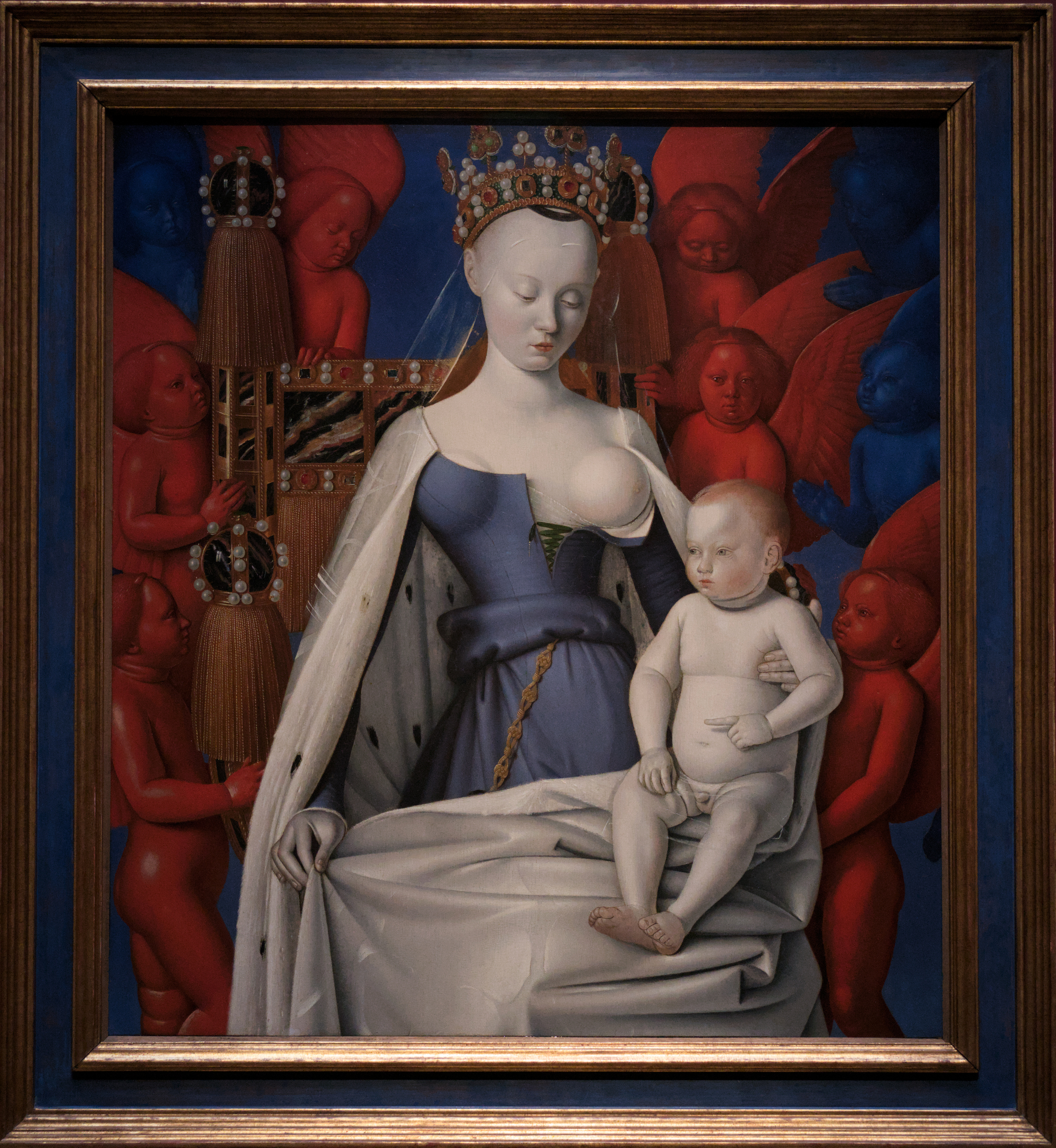
Fouquet, Jean_Madonna Surrounded by Seraphim and Cherubim
Jean Fouquet (French, 1410/30–1477/81), Madonna Surrounded by Seraphim and Cherubim, ca. 1450. Oil on panel, 92 × 83.5 cm. Koninklijk Museum voor Schone Kunsten Antwerpen (KMSKA, Royal Museum of Fine Arts Antwerp).

The painting is historically significant—I first encountered it in a college art history course. Commissioned by Etienne Chevalier, treasurer to King Charles VII of France, it portrays the Virgin Mary as the Queen of Heaven, baring her breast ostensibly to nourish the Christ child with her milk. She was probably modeled after Agnès Sorel, the king’s recently deceased mistress and mother of three of his daughters, considered the ideal of feminine beauty at that time in western Europe: pale-skinned, with a high forehead, and fashionable in her ermine cloak.

Though I can appreciate the technical excellence of this painting and the intense reds and blues of the angels, I don’t really like it. Mary seems cold, not very maternal. There’s also an eroticization of her body—not because her breast is exposed, which was common in Marian art, but because it seems to be on display for the viewer; her son’s not interested in feeding—that’s wholly inappropriate for the subject. Why you’d want to memorialize your boss’s sex partner in such a way is beyond me. I’m no prude, but I much prefer Jan van Eyck’s Madonna at the Fountain, on display in the same room:
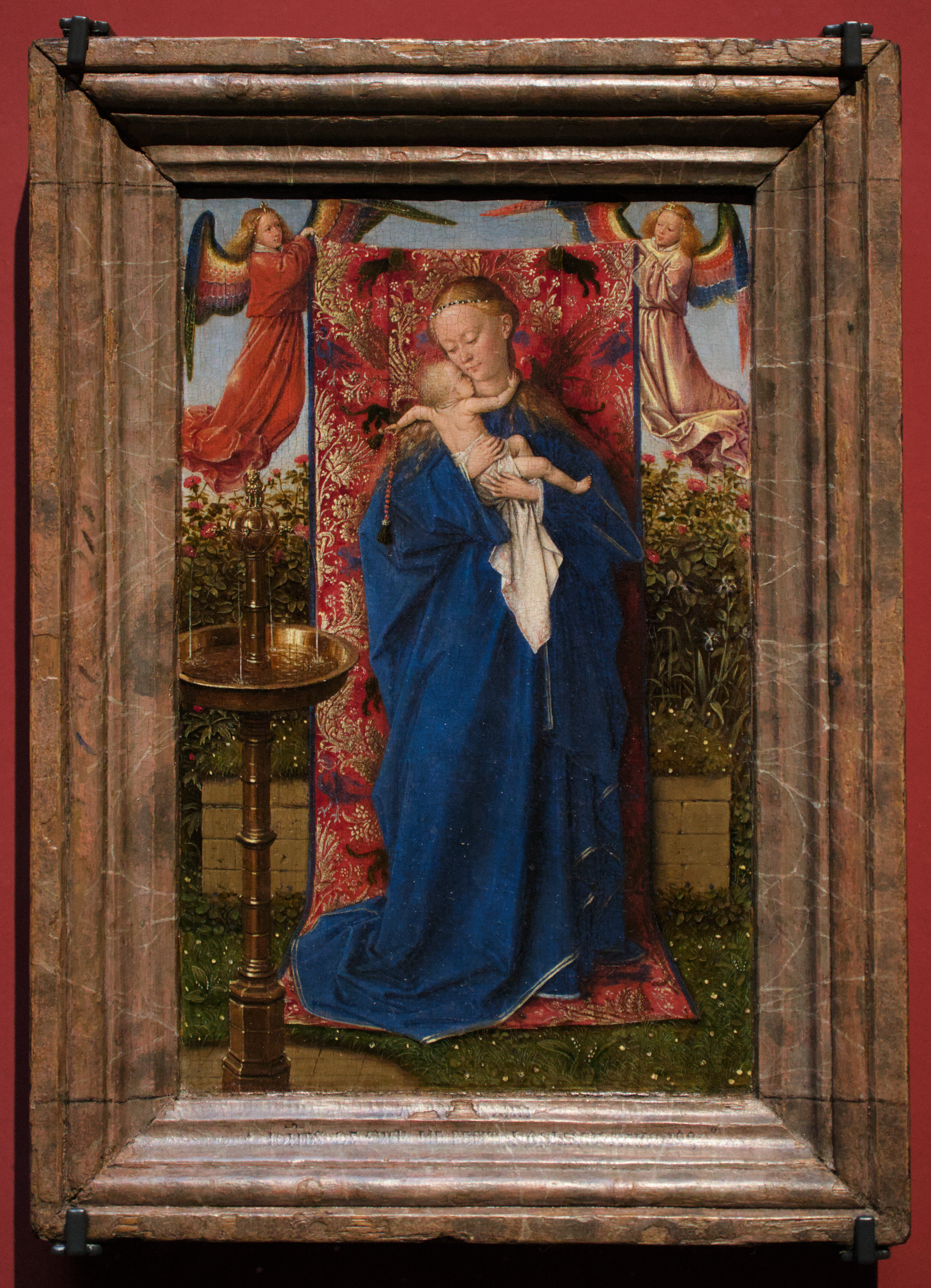
van Eyck, Jan_Madonna at the Fountain
Jan van Eyck (Flemish, 1390/99–1441), Madonna at the Fountain, 1439. Oil on panel, 19 × 12 cm. Koninklijk Museum voor Schone Kunsten Antwerpen (KMSKA, Royal Museum of Fine Arts Antwerp).

This small painting originally hung not in a church but in someone’s house. Though there’s still an air of formality, it has all the tenderness and connection that the other one lacks. Mother and son embrace in a garden of roses, irises, and lilies of the valley, he reaching round her neck and holding a string of prayer beads, she gazing adoringly at him. They stand beside a fountain, recalling Jesus’s discussion in John 4 about the “living water” he gives to those who thirst. The original wood frame bears the artist’s motto: “As well as I can.”

The deeply engrained portrait of motherhood embodied by the Virgin Mary is juxtaposed most potently with a series of three black-and-white portraits of new mothers by the Dutch photographer Rineke Dijkstra.
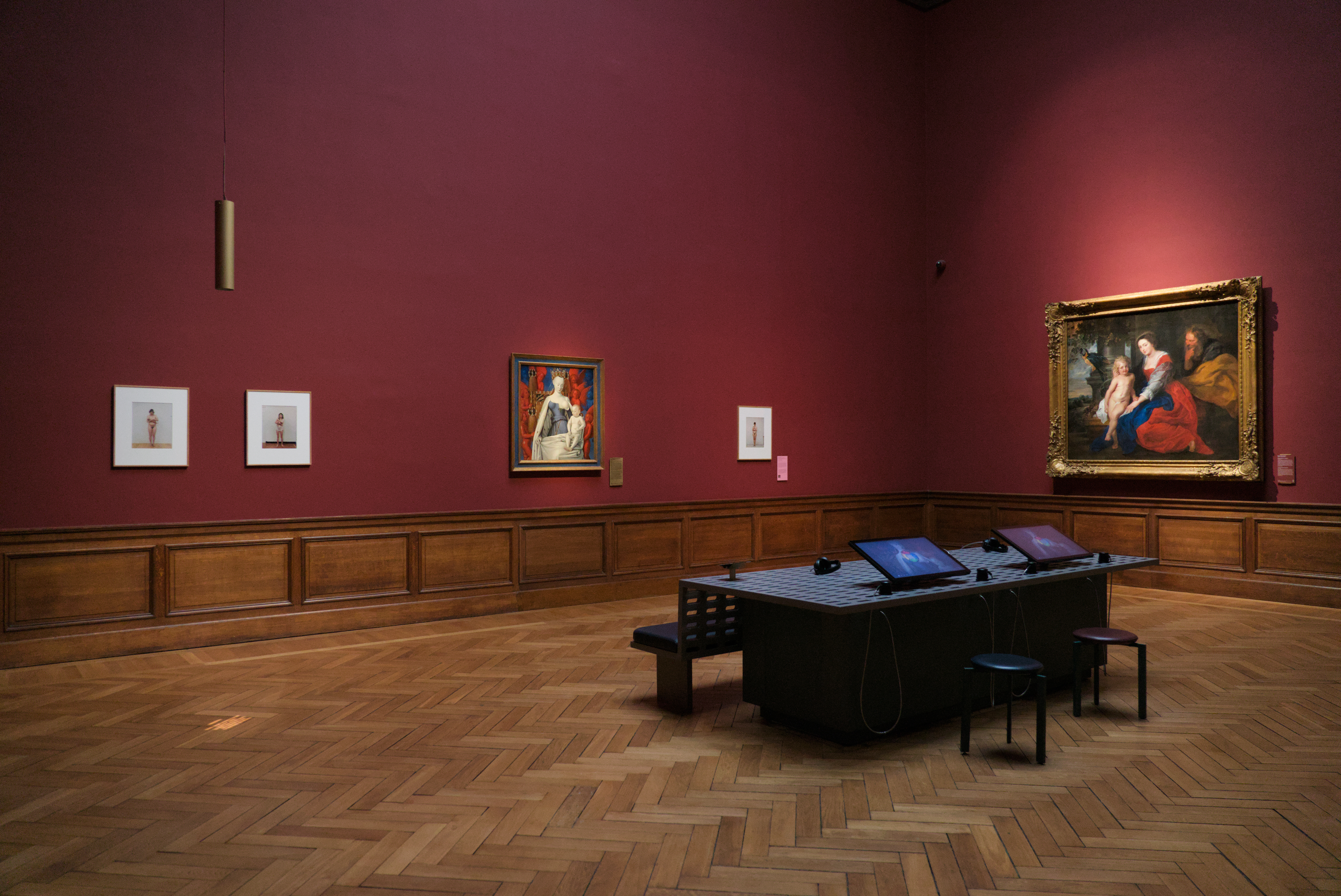
"Madonna" gallery
Gallery 2.17 (“The Madonna”) from the KMSKA exhibition Collected with Vision: Private Collections in Dialogue with the Old Masters

The accompanying text read:

Jean Fouquet portrays motherhood as something sacred. Mary as a symbol of purity and devotion is richly dressed in cool colours. Rineke Dijkstra homes in on the vulnerable reality. Her mothers are scantily clad and marked by childbirth. Both works are innovative: Fouquet may have painted his Mary for the first time from a real person, and in its day the painting was regarded as ‘modern’. Dijkstra shows motherhood in all its rawness, a taboo usually withheld from view.
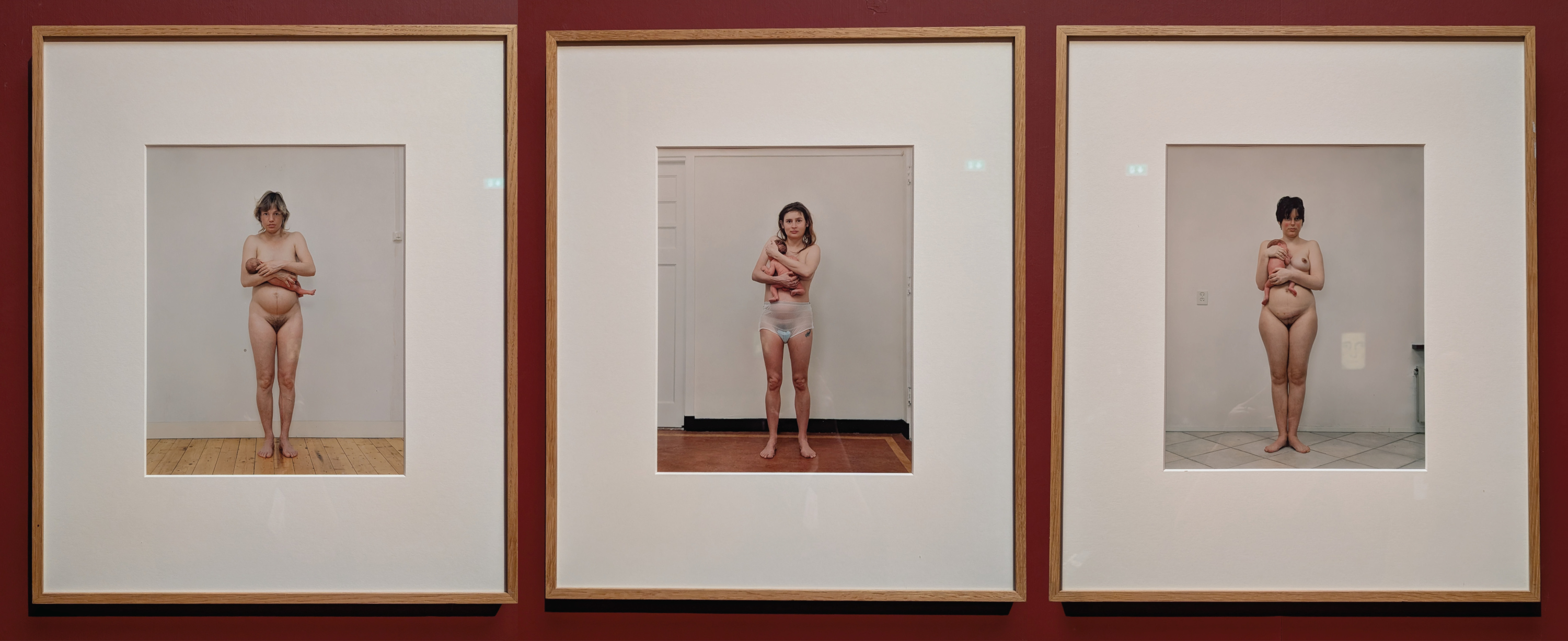
Dijkstra, Rineke_New Mothers
Rineke Dijkstra (Dutch, 1959–), Tecla (Amsterdam, The Netherlands), Julie (Den Haag, The Netherlands), and Saskia (Harderwijk, The Netherlands), 1994. Digital prints. Private collection. [Composite photo by author]

Julie wears hospital pads and mesh underwear, which women often do for several weeks after giving birth to manage postpartum bleeding and urinary incontinence. As for Tecla, blood is running down her leg. And Saskia bears a scar from her cesarean section. A linea nigra (dark line) zips down the abdomen of all three, a temporary pigmentation increase caused by increased hormone levels. I love this triptych that shows motherhood’s glorious, messy, alterative impact on the body—the real physicality of the vocation of bearing children into the world.

I wish there were more imagery of Mary like this, as it would, I think, deepen the wonder of the Incarnation and enhance women’s ability to identify with Mary and thus further enliven her story.

Also in the Madonna gallery was a unique “light poetry” installation by Nick Mattan and Angelo Tijssens—one of seventeen spread throughout the second floor, collectively titled Licht dat naar ons tast (Light that reaches for us). KMSKA had commissioned this couple to bring to life the short verses the museum’s late writer-in-residence Bernard Dewulf had written in response to the galleries’ stated themes.

“Inspired by the museum’s many reading and praying figures, as well as James Ensor’s expressive hand sketches, [Mattan and Tijssens] sought a subtle way to make [Dewulf’s] words tangible,” the museum writes. Their solution was to project them onto the gallery floors from brass cylinders suspended from the ceiling. The words shine like faint specks of light, becoming legible only when a visitor holds their hands, a sweater, or something else up to the light.

Here my husband “holds” a poem written in the voice of Mary:
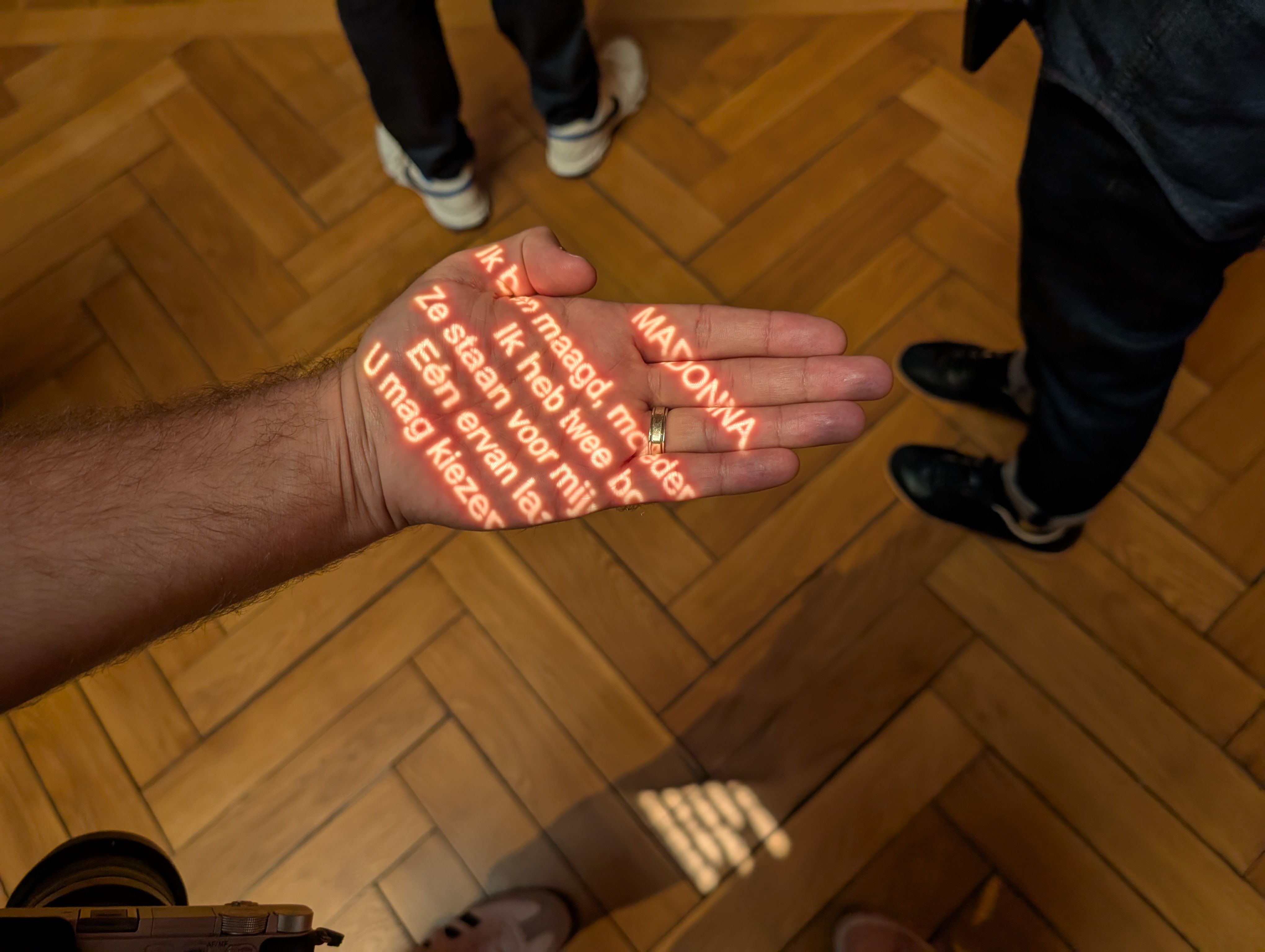
Light that reaches for us
Nick Mattan (Belgian, 1987–) and Angelo Tijssens (Belgian, 1986–), Licht dat naar ons tast (Light that reaches for us), 2023, featuring seventeen poems by Bernard Dewulf. Commissioned by and permanently installed at the Koninklijk Museum voor Schone Kunsten Antwerpen (KMSKA, Royal Museum of Fine Arts Antwerp).

“Madonna” by Bernard Dewulf

Virgin, mother, wife –
I have two breasts
that stand for my three souls.
I show you one of them,
and whose it is is yours to choose.

Translated from the original Dutch by David Colmer

Kind of cheeky! Dewulf speaks of Mary’s three identities and lets us decide if the breast she bares in Fouquet’s painting represents her naked innocence, her nurturing impulse, or her desire to please her husband. (Traditionally in art, it has always stood for the second.)

Though I can’t read Dutch and thus had to consult the KMSKA app for translations of the poems, the thrill of discovery was there in each room. View other visitor engagements with Licht dat naar ons tast on Instagram.

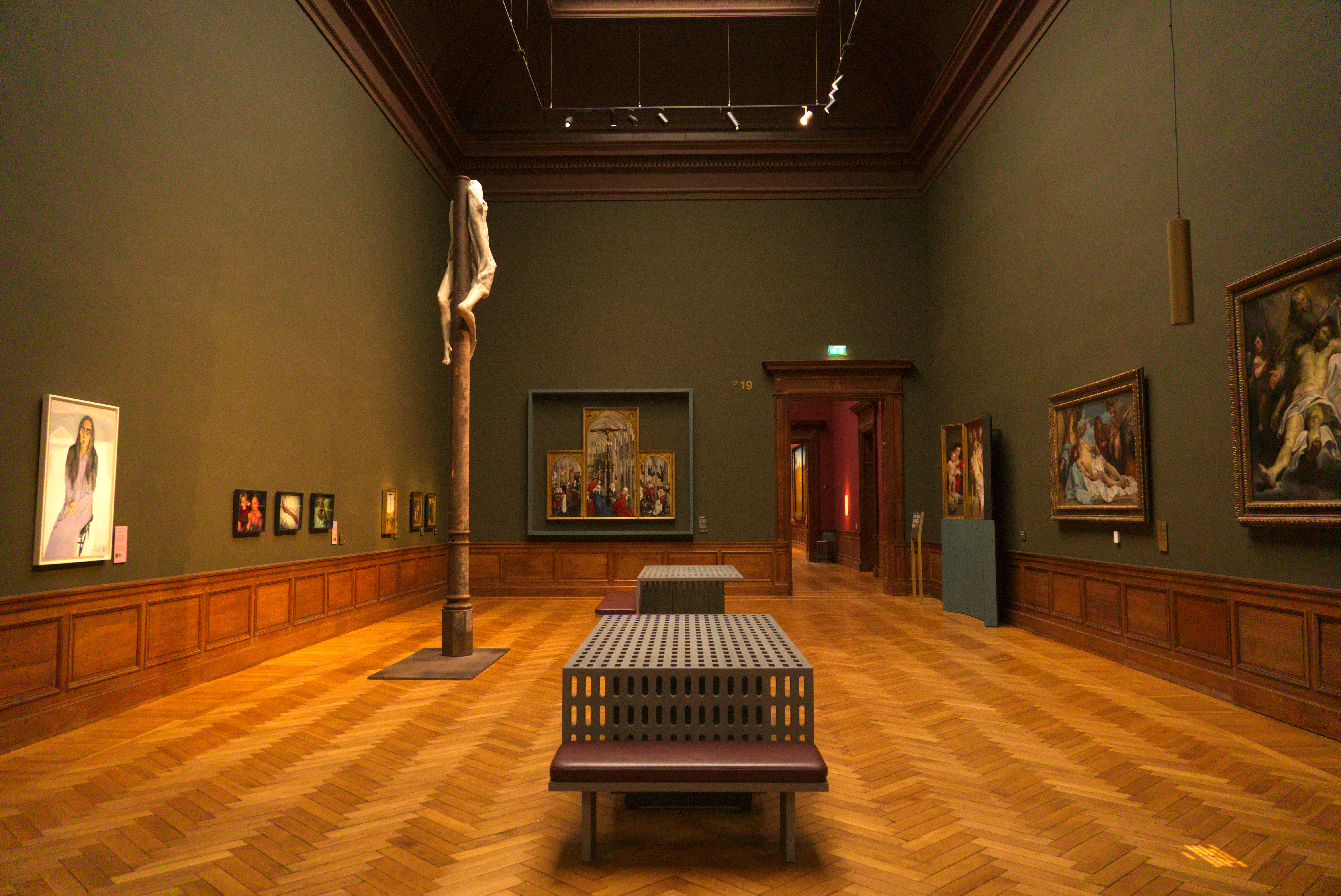
The next gallery I entered was themed “Suffering.”
Suffering gallery
Gallery 2.19 (“Suffering”) from the KMSKA exhibition Collected with Vision: Private Collections in Dialogue with the Old Masters

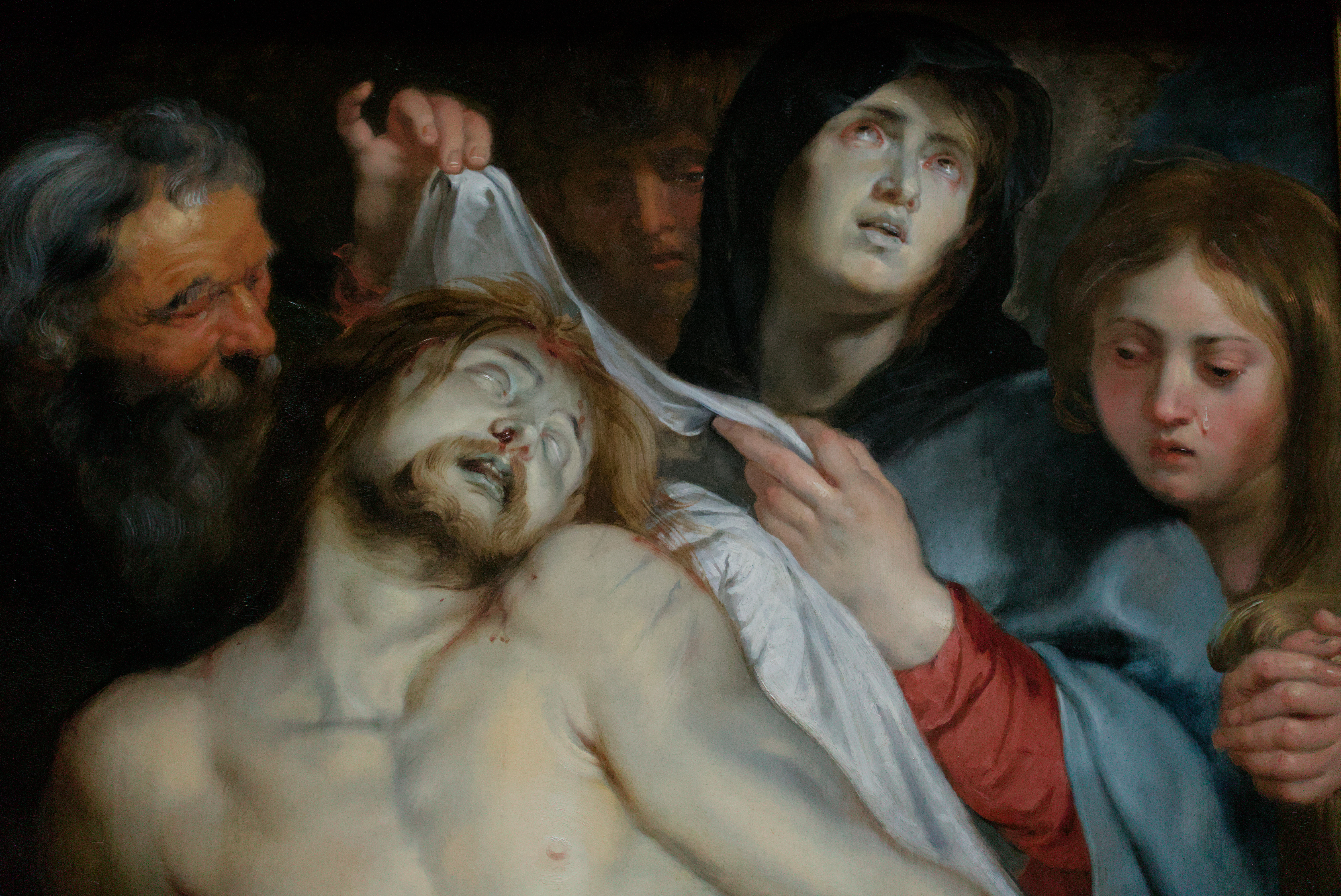
As one would expect, it’s inhabited by several Old Master paintings of Christ’s passion, most notably a triptych by the Flemish Baroque artist Peter Paul Rubens.
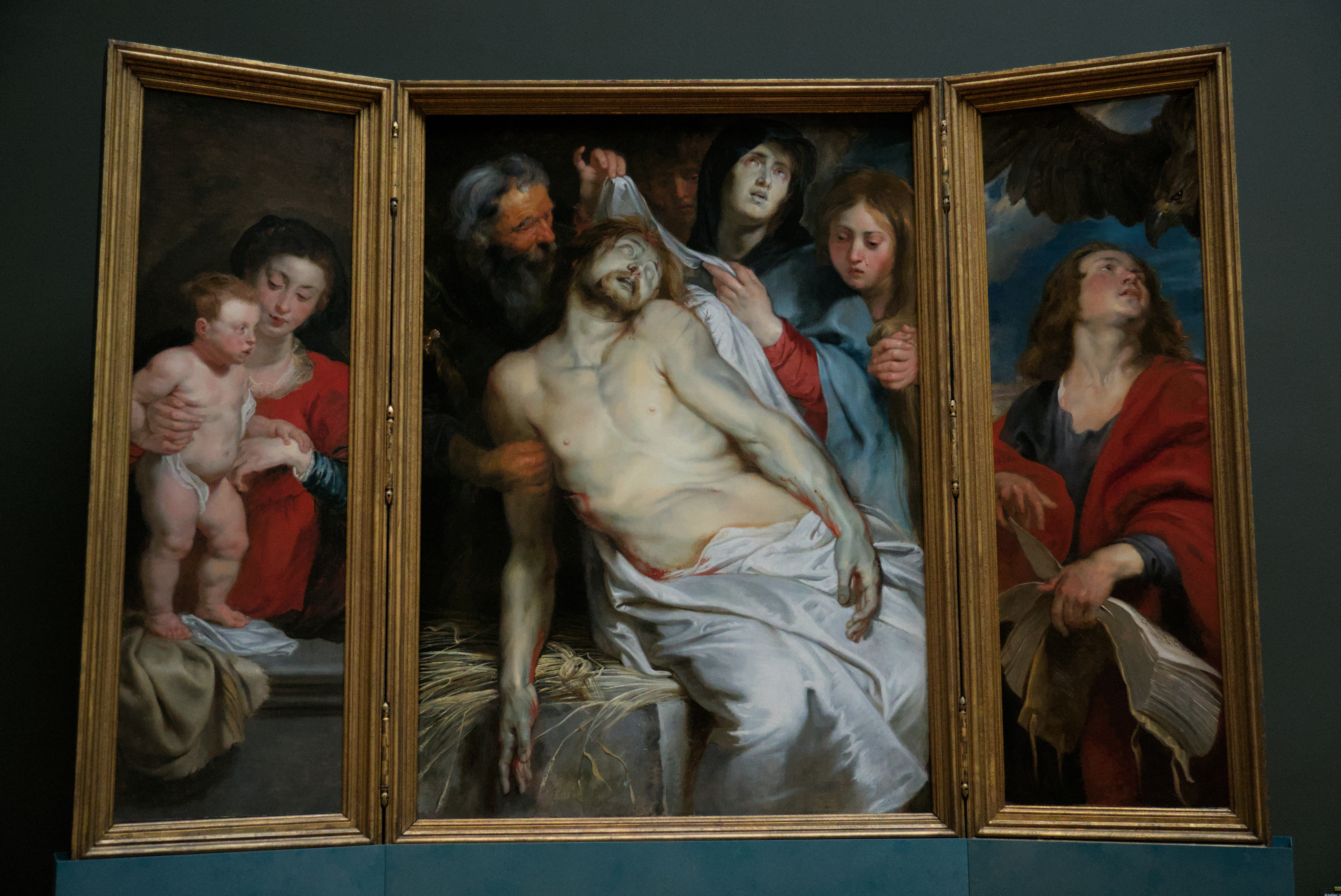
Rubens, Peter Paul_Christ on the Straw
Peter Paul Rubens (Flemish, 1577–1640), Epitaph of Jan Michielsen and His Wife Maria Maes (aka Christ on the Straw, Madonna, and Saint John), 1618. Oil on panel, 138 × 178 cm. Koninklijk Museum voor Schone Kunsten Antwerpen (KMSKA, Royal Museum of Fine Arts Antwerp).

Rubens, Peter Paul_Christ on the straw (detail)

The central panel shows the dead Christ being laid out on a marble slab and wrapped in a shroud by Joseph of Arimathea, while his mother and Mary Magdalene (and the apostle John in the background) mourn him. The left wing shows Mary supporting the pudgy little baby Jesus as he takes some of his first steps, while the right wing shows John, whose symbol is the eagle, writing his Gospel that will place Jesus’s death in the context of the larger story of his life of ministry and his resurrection.

This painting, along with Anthony van Dyck’s Lamentation over the Dead Christ and The Holy Trinity by a follower of Rubens’s (which shows God the Father cradling the dead body of God the Son in an image type sometimes referred to as the Mystic Pietà), are juxtaposed with three photographs by Nan Goldin that show the impact of AIDS on her friend, the Parisian gallery owner Gilles Dusein, and his partner, the artist Gotscho.
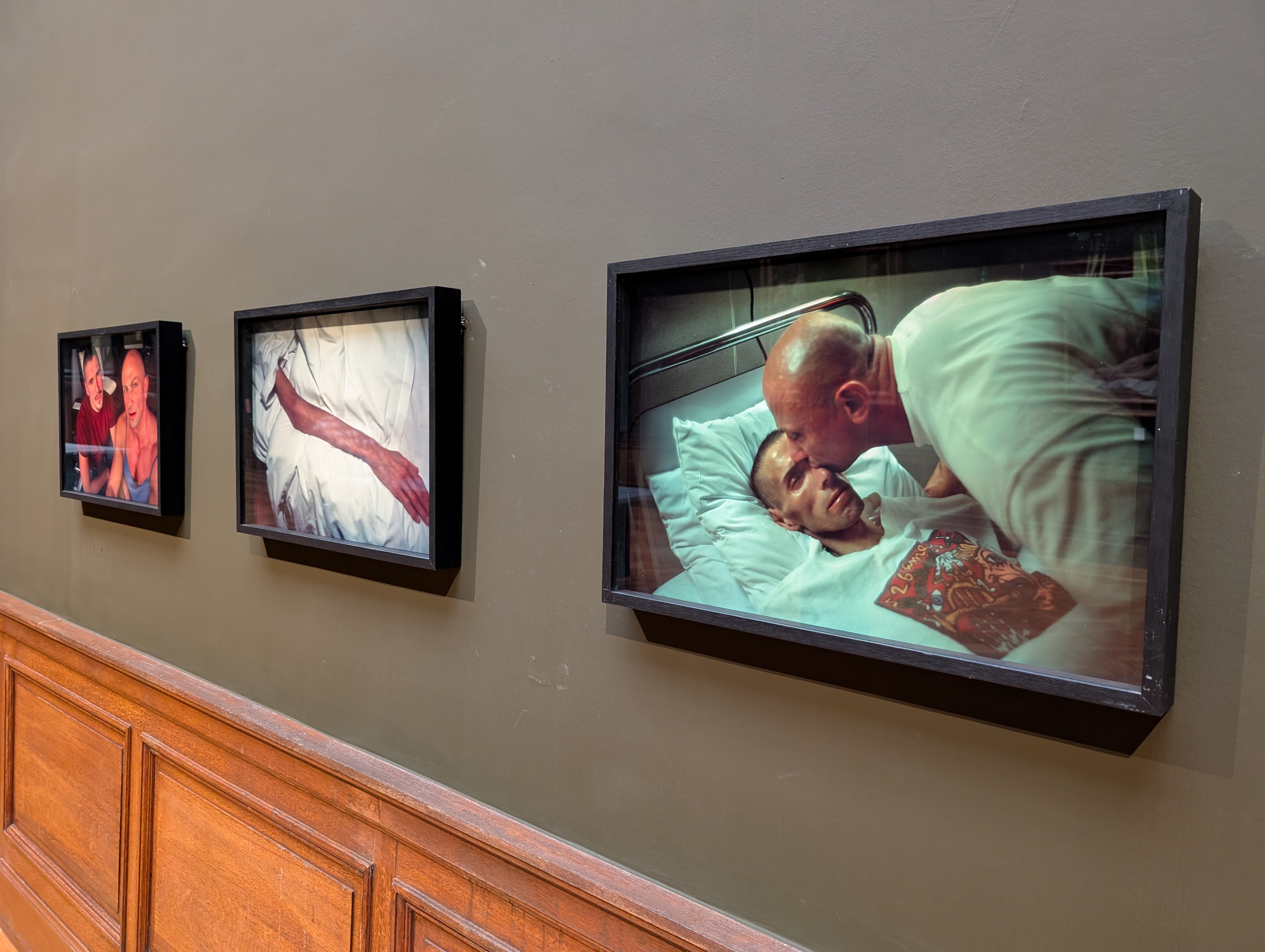
Photos by Nan Goldin
Nan Goldin (American, 1953–), Gilles in Hospital, Gilles’ Arm, and Gotscho Kissing Gilles, 1993. C-prints. Private collection.

Dusein’s emaciated arm, resting weakly on a hospital sheet, recalls the limp arm of Christ in paintings of the Deposition and Entombment; and Gotscho’s kiss, the love and grief of Jesus’s mother and friends as they watched their loved one suffer and succumb to death.

By displaying these disparate artworks from vastly different contexts across from each other, we are encouraged to draw connections between the suffering of Christ and that of the LGBTQ+ community. While Christians in Rubens’s day would sit before images of Jesus in pain or sorrow or having died a torturous and untimely death, and deepen their empathy and love, so too might we do well to sit prayerfully, humbly, empathetically, with contemporary images of suffering, seeking to enter the stories they tell.

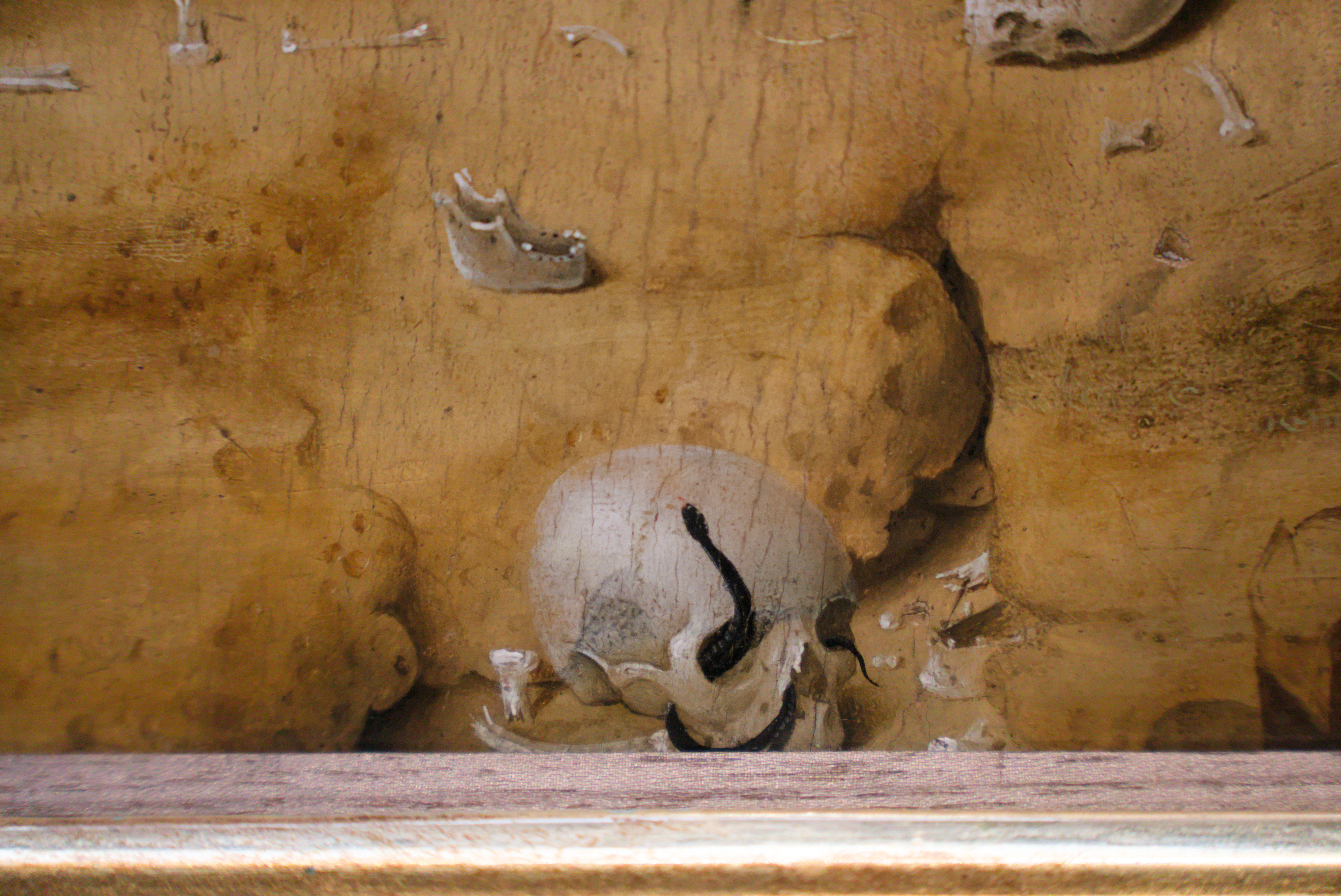
Calvary by Antonello da Messina (another version of which is at the National Gallery in London) also hangs in this gallery. While the crucified Christ seems at peace with his death, the other two on their crosses writhe in pain.
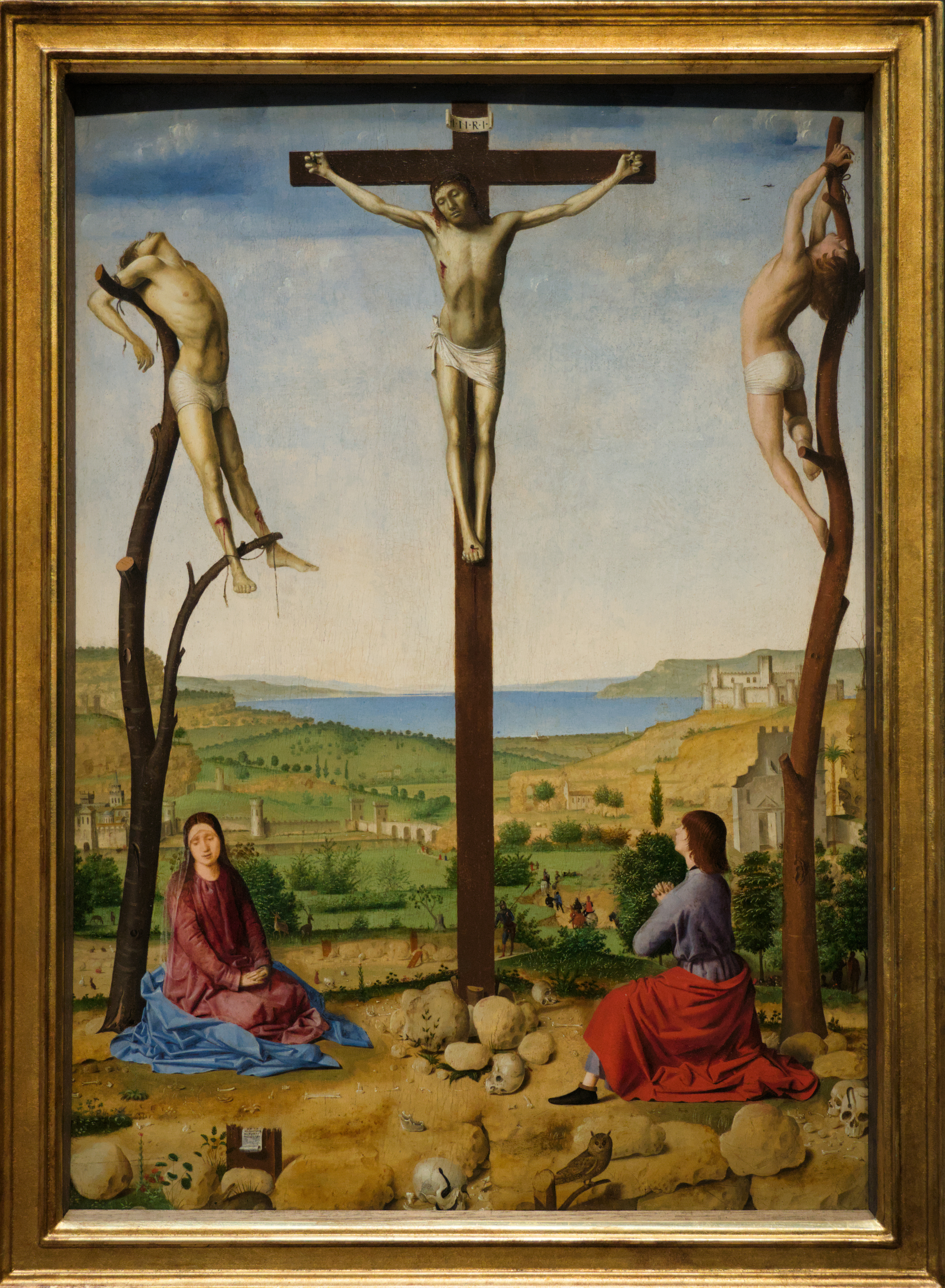
Antonello da Messina_Calvary
Antonello da Messina (Italian, 1430–1479), Calvary, 1475. Oil on panel, 52.5 × 42.5 cm. Koninklijk Museum voor Schone Kunsten Antwerpen (KMSKA, Royal Museum of Fine Arts Antwerp).

Antonello da Messina_Calvary (detail)

Compare these figures to contemporary Belgian artist Berlinde de Bruyckere’s Schmerzensmann (Man of Sorrows), on loan from the collection of David and Indré Roberts (see wide-view photo above). The piece consists of a wax and resin mold of a contorted human form, its skin stretched and broken, its legs wrapped around a tall rusty pole.

“Man of Sorrows” is also the title of an Early Netherlandish painting by Albrecht Bouts and a modern painting by James Ensor, which KMSKA displays side-by-side.
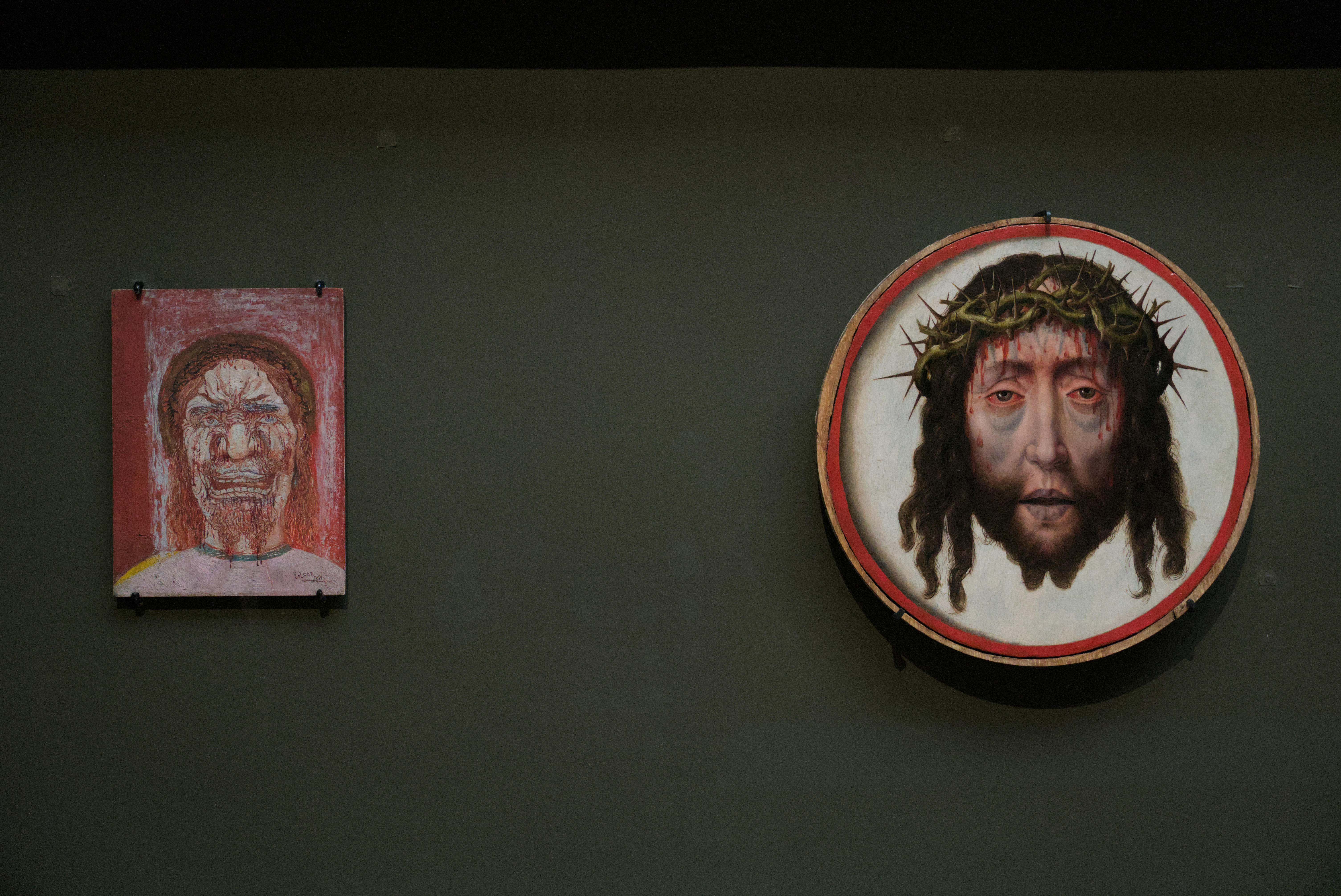
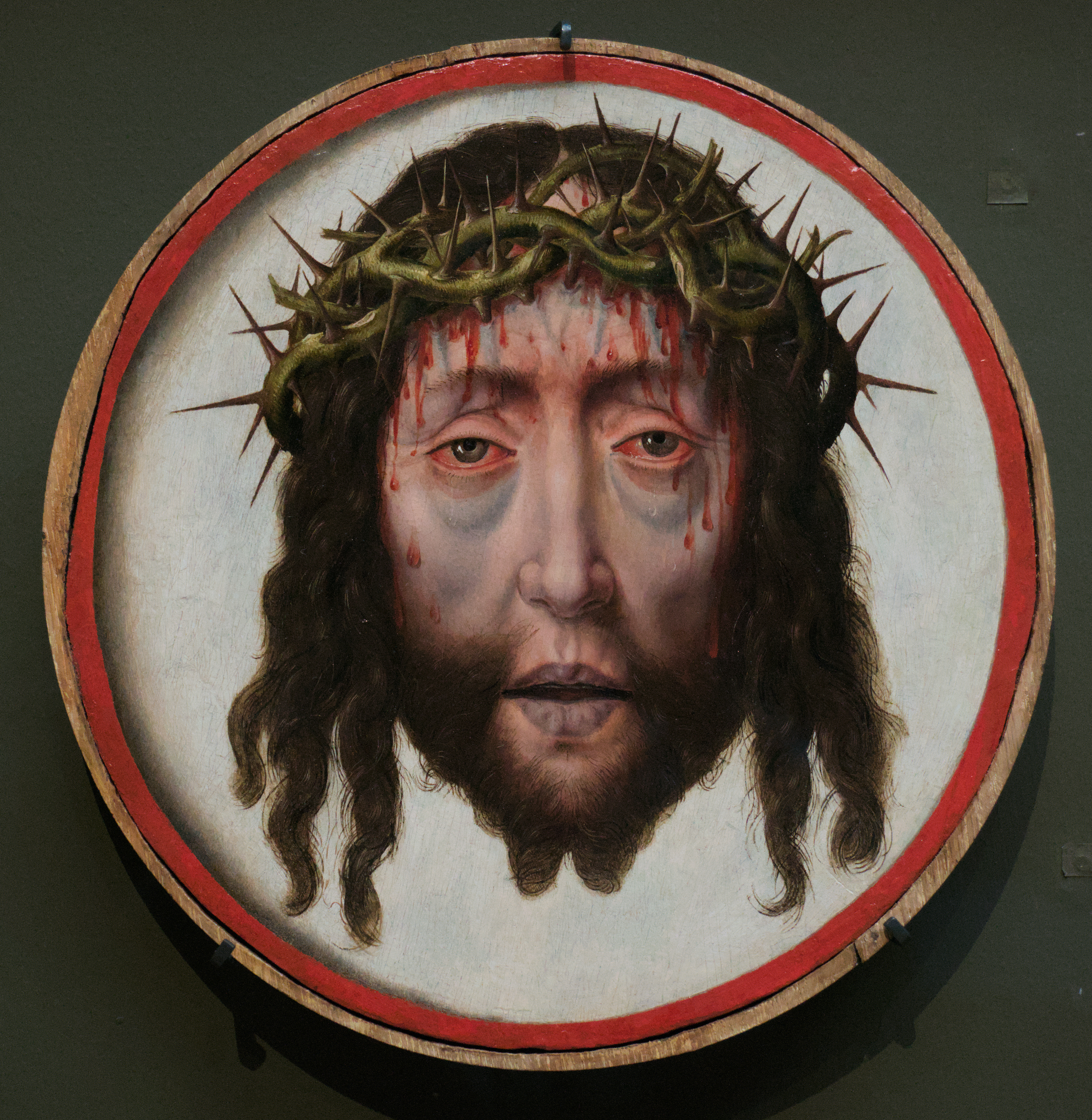
Bouts, Albrecht_Man of Sorrows
Albrecht Bouts (Flemish, 1451/55–1549), Man of Sorrows, 1500–1525. Oil on panel, diameter 29 cm. Koninklijk Museum voor Schone Kunsten Antwerpen (KMSKA, Royal Museum of Fine Arts Antwerp).

The earlier one is an incredibly moving image of pathos. Christ wears a thick, twisted, mock crown whose thorns dig holes into his forehead and draw blood. His eyes are red with tears and sunken in, and his lips are turning blue with the pallor of death. I find it quite beautiful, insofar as an image of suffering can be beautiful. (That’s a topic for another day.)
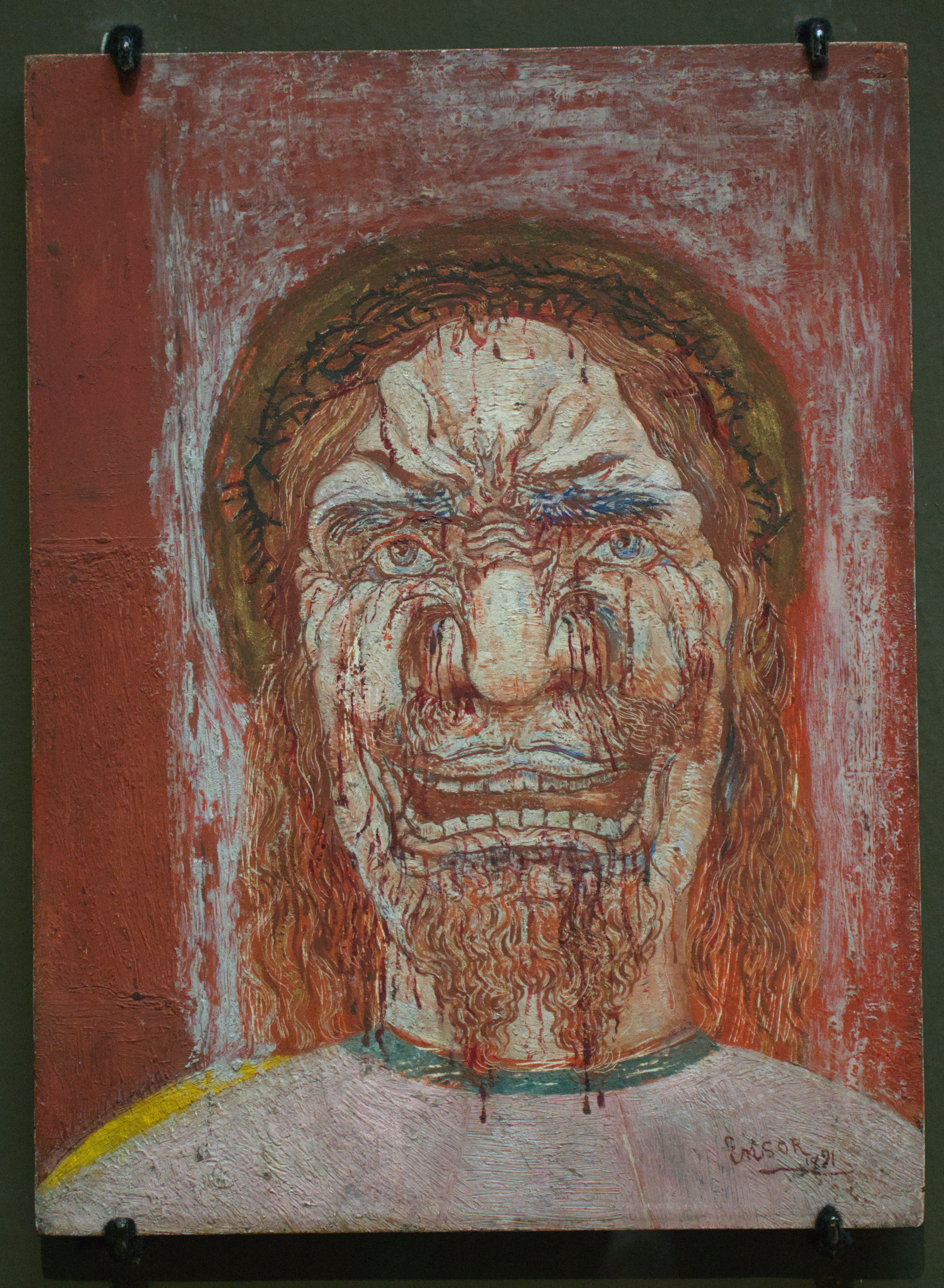
Ensor, James_Man of Sorrows
James Ensor (Belgian, 1860–1949), Man of Sorrows, 1891. Oil on panel, 20 × 15.5 cm. Koninklijk Museum voor Schone Kunsten Antwerpen (KMSKA, Royal Museum of Fine Arts Antwerp).

The Ensor painting, on the other hand, is decidedly not beautiful. In fact, I think it’s the ugliest image of Christ I’ve ever seen, with his crumpled face, scraggly hair, and bared teeth. There’s something very unsettling about his expression, and no wonder, as the curatorial text informs that Ensor drew inspiration from the masks of demon characters in Japanese theater. “His [Ensor’s] Jesus screams with rage about the injustice inflicted on him,” the label says. Is that what that expression is? To me he looks sinister. Like he’s growling at us. And I dislike his dinky crown that he wears like a headband; give me Bouts’s gnarly one instead.

I’m in favor of Christ images that show the rage he must have felt, but I don’t think Ensor is successful if that was his aim. To name a few modern artists who were: Guido Rocha (Tortured Christ, 1975) and David Mach (Die Harder, 2011), both of whom capture Jesus’s cry of dereliction on the cross.

The final themed gallery I’ll call out is “Heavens.”
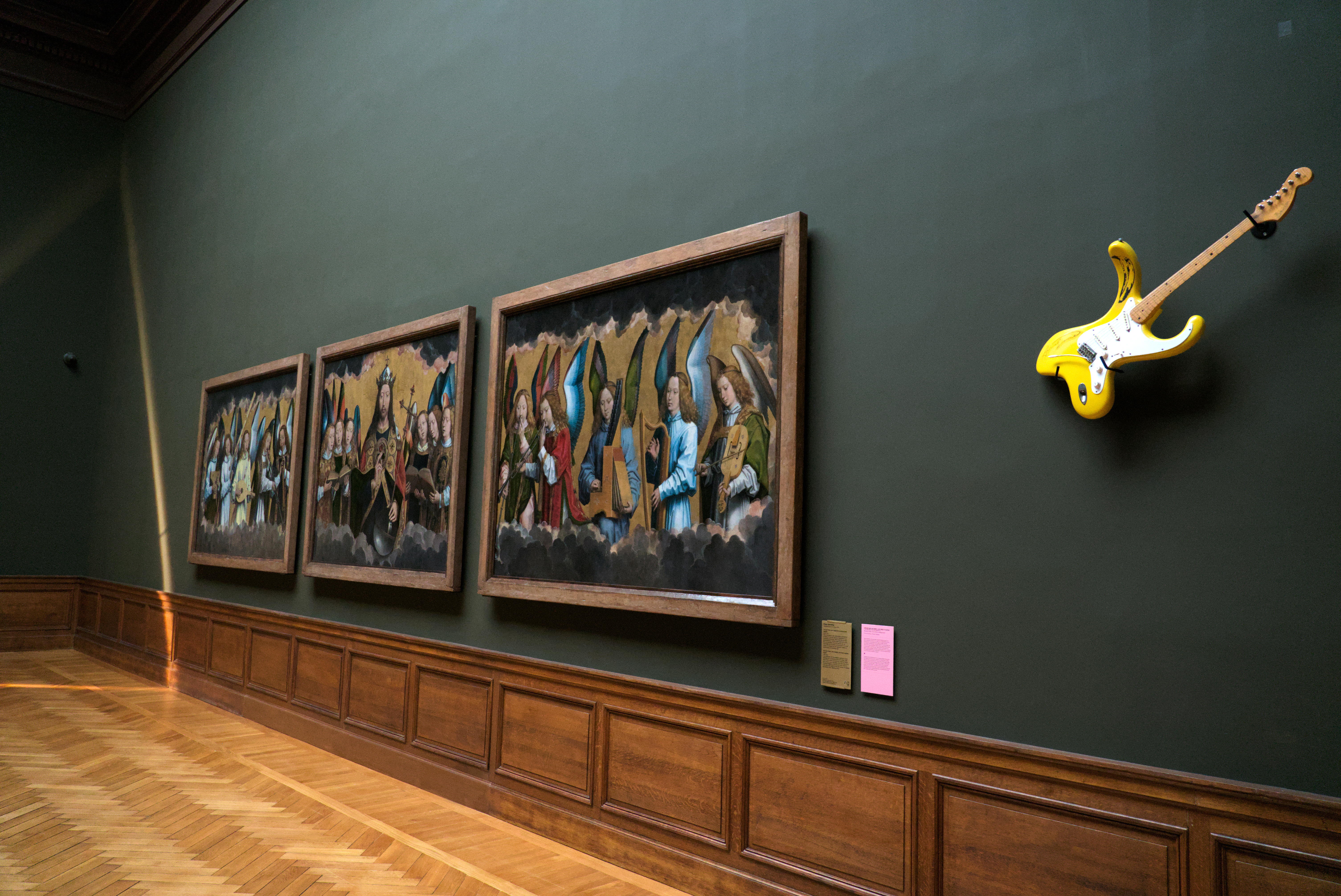
Heavens gallery
Gallery 2.22 (“Heavens”) from the KMSKA exhibition Collected with Vision: Private Collections in Dialogue with the Old Masters

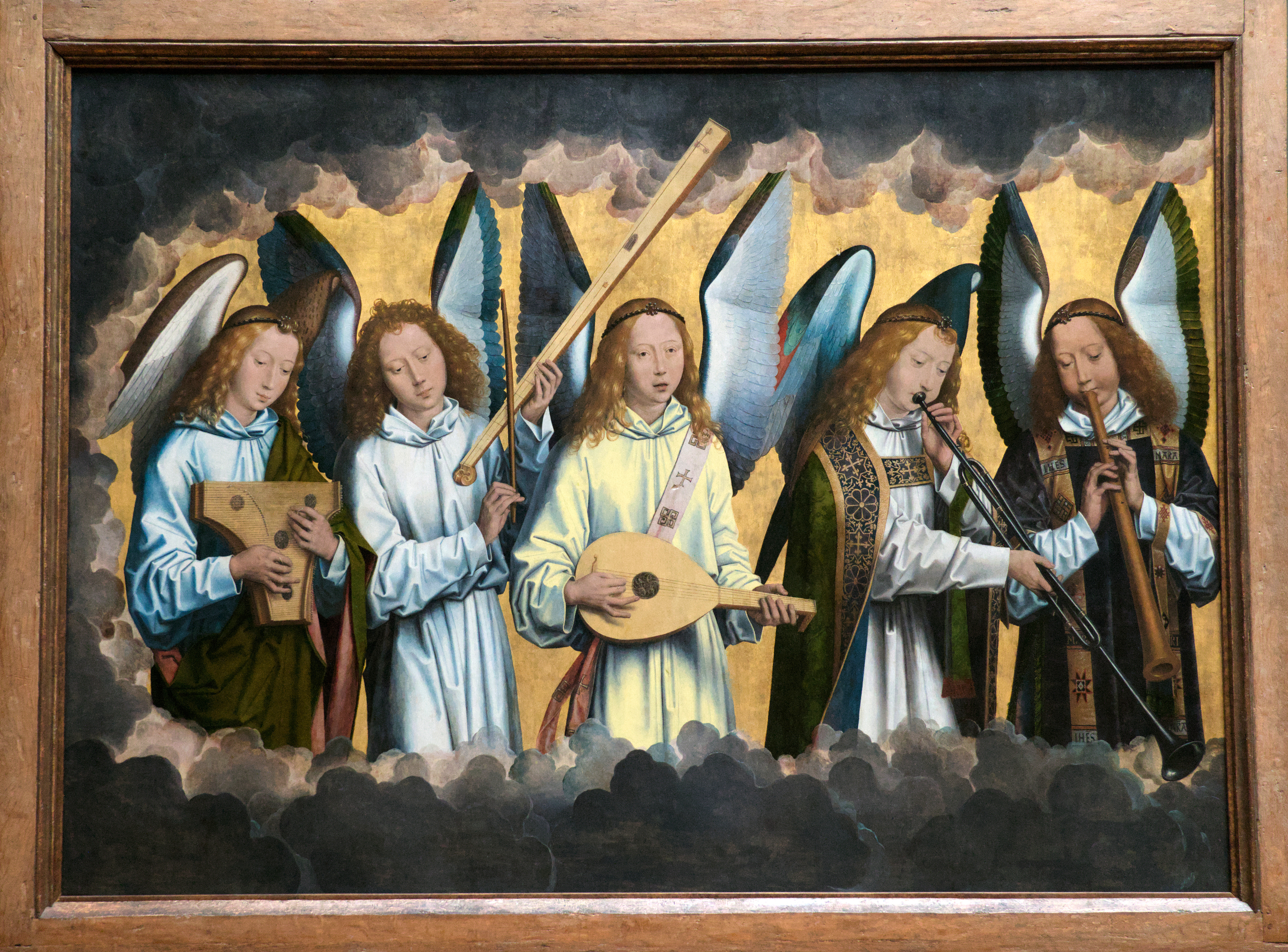
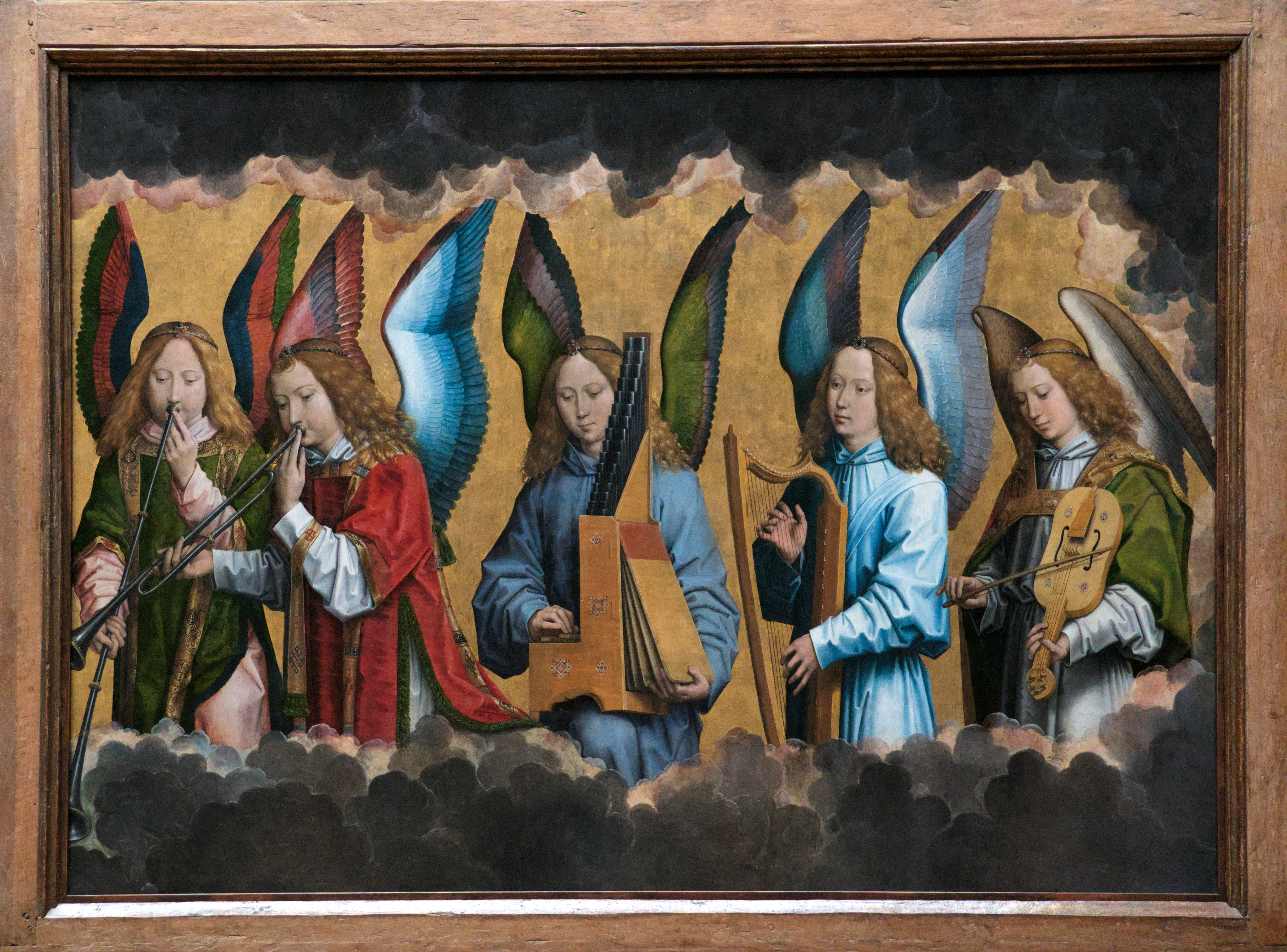
The dominant Old Master work is a set of three panels from the upper tier of a colossal altarpiece that Hans Memling painted for the church at the Benedictine Abbey of Santa Maria la Real in Najera in northern Spain. All the other panels are lost.

The museum titles the central panel God the Father with Singing Angels—but I think the figure is more properly God the Son, Jesus Christ, portrayed as Salvator Mundi (Savior of the World). In his left hand he holds a cross-surmounted crystal globe, signifying his dominion over the earth, and with the other hand he gestures blessing. He wears a tiara and a red cope decorated with gold-thread embroidery, pearls, and precious stones, and his collar bears the words Agyos Otheos (Holy God).
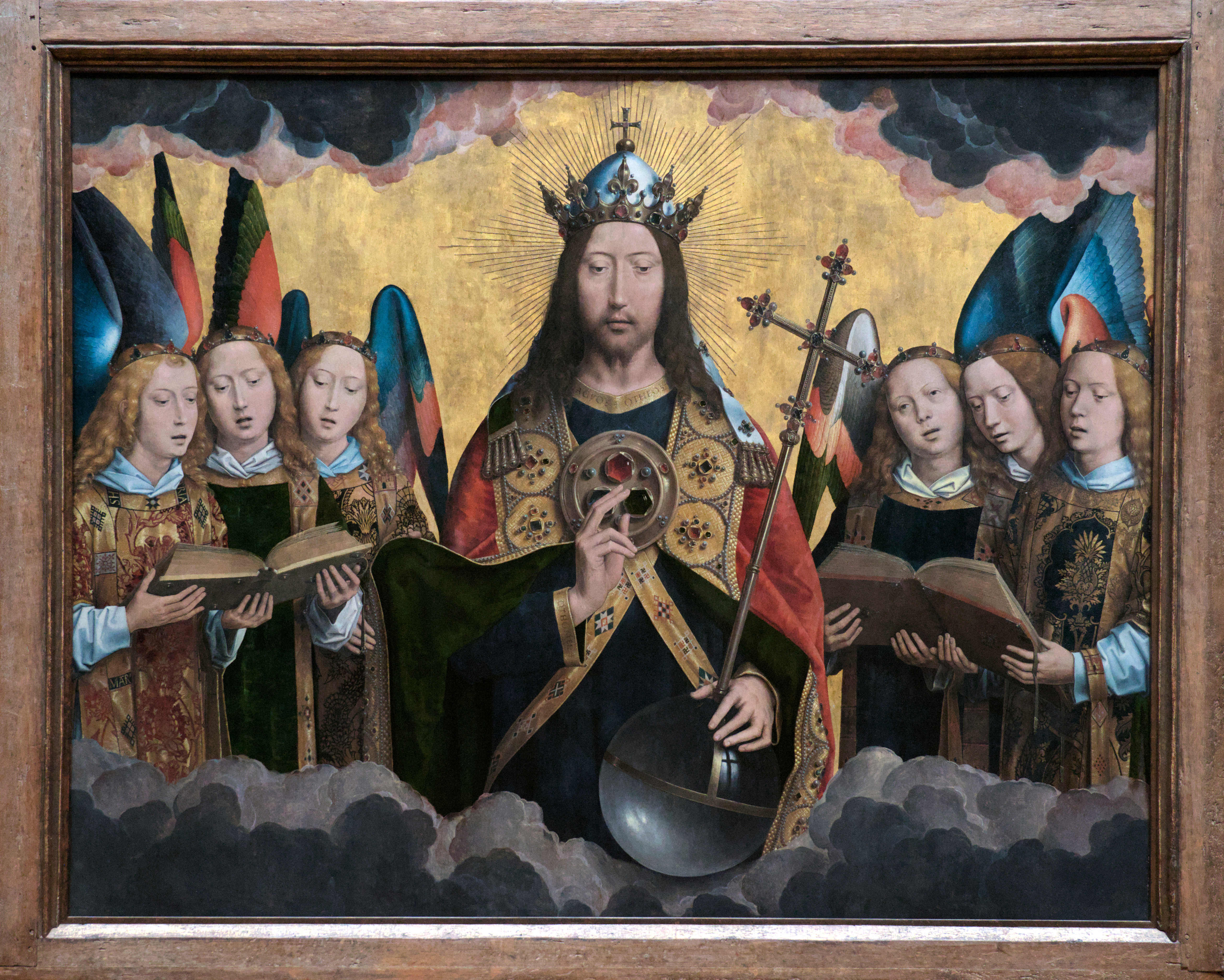
Memling, Hans_God the Father with Singing Angels
Hans Memling (German Flemish, ca. 1430–1494), God the Father with Singing Angels, 1483–94. Oil on panel, 164 × 212 cm. Koninklijk Museum voor Schone Kunsten Antwerpen (KMSKA, Royal Museum of Fine Arts Antwerp).

Surrounding him is a musical band of angels, singing his praises from songbooks and, in the flanking panels, playing a variety of wind and string instruments: (from left to right) a psaltery, a tromba marina, a lute, a trumpet, a shawm, a straight trumpet, a looped trumpet, a portative organ, a harp, and a fiddle.
Memling, Hans_Music-Making Angels
Hans Memling (German Flemish, ca. 1430–1494), Music-Making Angels (left), 1483–94. Oil on panel, 165 × 230 cm. Koninklijk Museum voor Schone Kunsten Antwerpen (KMSKA, Royal Museum of Fine Arts Antwerp).

Memling, Hans_Music-Making Angels
Hans Memling (German Flemish, ca. 1430–1494), Music-Making Angels (right), 1483–94. Oil on panel, 165 × 230 cm. Koninklijk Museum voor Schone Kunsten Antwerpen (KMSKA, Royal Museum of Fine Arts Antwerp).

This ensemble probably evokes for you a particular sound—something like Tallis or Palestrina—soaring polyphonic vocals, a gentle yet majestic accompaniment. But instead, a different soundtrack played, audibly, in the room: songs from the 1967 debut album of the American rock band the Velvet Underground, several of which use religious language to describe the experience of doing drugs. “Heroin” opens like this:

I don’t know just where I’m going
But I’m gonna try for the kingdom, if I can
’Cause it makes me feel like I’m a man
When I put a spike into my vein

And I’ll tell you things aren’t quite the same
When I’m rushing on my run
And I feel just like Jesus’ son

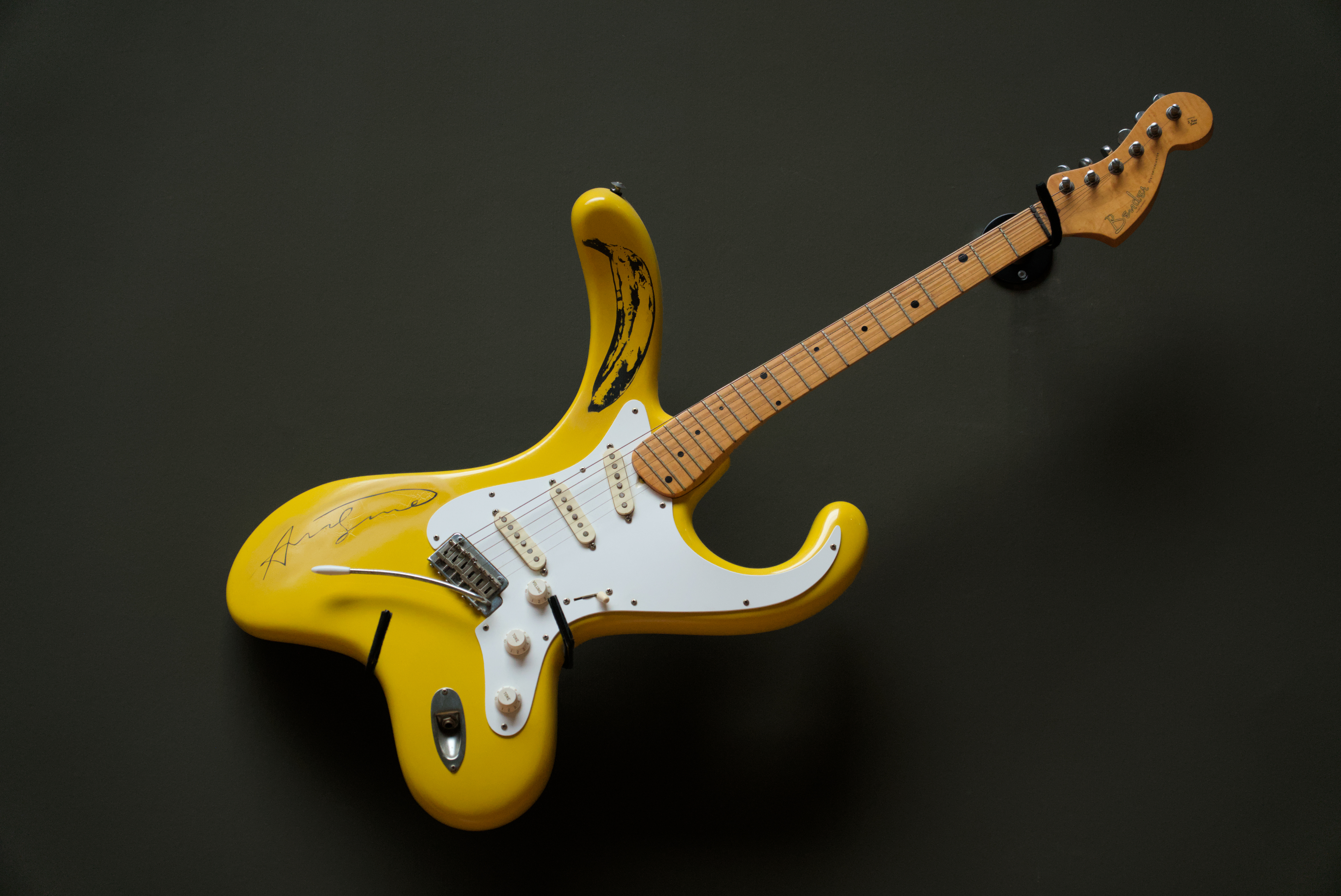
This aural element was complemented, on the gallery wall, by the guitar of Lou Reed, the band’s lead singer and songwriter. It’s signed by Andy Warhol, who produced and championed the Velvet Underground & Nico album and made its banana cover art, replicated on the instrument.
Lou Reed's guitar
Lou Reed’s “Banana Guitar,” from a private collection

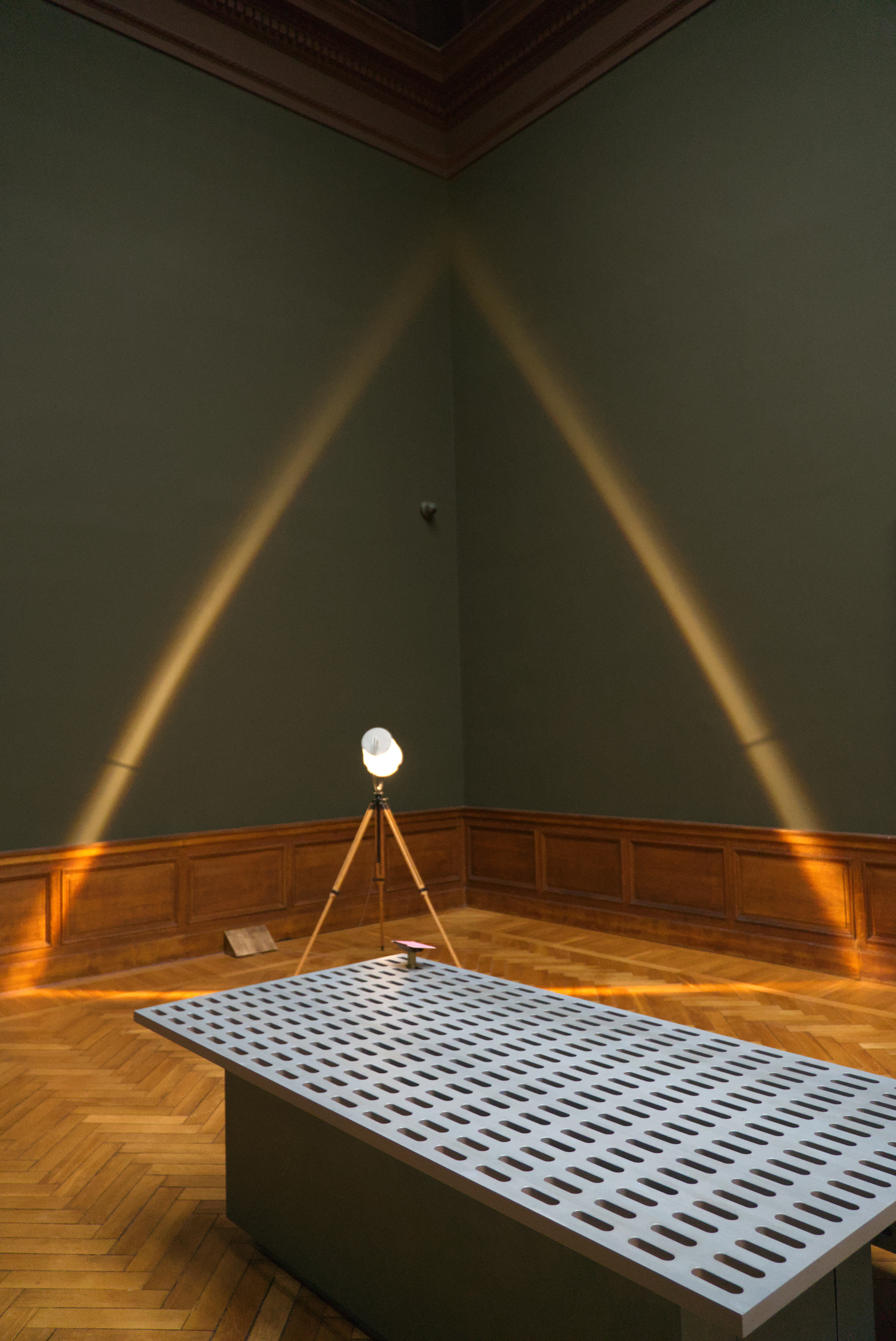
Adding to the mix, in the corner of the room was an installation by the Copenhagen-born and -based artist Olafur Eliasson, called Lighthouse Lamp. “Affixed to a tripod, a lamp situated within a Fresnel lens—a compact lens which was developed for lighthouses—emits a band of white light in 360 degrees,” the artist’s website explains. In this space, the beam takes on a triangular shape.
Eliasson, Olafur_Lighthouse Lamp
Olafur Eliasson (Icelandic Danish, 1967–), Lighthouse Lamp, 2004. Mixed media. Collection of Filiep and Mimi Libeert.

There was also an altarpiece of The Last Judgment and the Seven Acts of Mercy by Bernard van Orley, which references Jesus’s teaching in Matthew 25 about one’s entry into heaven being contingent on whether, in this life, you feed the hungry, give shelter to the homeless, visit the prisoner, and so on.

The “Heavens” gallery begs the question: How does one define “heaven”? Is it a physical place? A state of mind? An encounter? I think of related words like bliss, beatitude, communion, the sublime.

The celestial scene painted by Memling—and remember, it’s only partial, as the rest is missing—is beautifully rendered, but it also encapsulates what has become the popular cliché of heaven: angels on clouds, strumming harps, and a regal God swaying his scepter. Music-making, angelic beings, and the reign of God are all certainly a part of how the Bible describes heaven. But it’s also so much more. It’s a garden and a city. It’s healing and restoration. It’s the righting of wrongs. It’s all things made new. It’s jubilee. It’s a wedding—deep and lasting union between God and humanity. It’s an eternal interlocking of God’s space and ours (earth). It’s a global, transhistorical community of faith, gathered together around Christ their head, worshipping him in diverse languages, musical styles, dances, and other cultural expressions. It’s the culmination of the greatest story ever told.

Today, Memling’s vision of heaven probably fails to captivate most people, even Christians. So it’s an interesting experiment to compare it to how others conceive of the concept.

Eliasson’s Lighthouse Lamp wasn’t a commission on or explicit treatment of the theme, but the curator saw fit to place it beside Memling, because heaven is often conceived of as a light-filled space, and light can evoke the divine. For this reason, Memling painted his background gold. What’s more, the three-sidedness of Eliasson’s light beam may, for some, evoke the Trinity, the classical Christian doctrine of Father, Son, and Holy Ghost that Memling alludes to with the three precious stones on the fibula of Christ’s mantle.

Still, other folks experience what could be termed “heavenly” transcendence through the use of mind-altering substances, as did the members of the Velvet Underground, whose drug trips gave birth to their experimental music—which, in turn, has taken others to a transcendent place.


Whether in special exhibitions or displays of their permanent collections, I want to see more of this in museums: bringing old and new artworks into conversation with one another around universal themes, in the same room. (In some museums, the labels sometimes cross-reference works in other galleries, but that’s not the same.) Although there are benefits to the traditional approach of laying out art chronologically to give you discrete pictures of different historical eras and allow you to progress by time period, a thematic approach that compiles works from across time also has its benefits.

I’ve found cross-temporal art displays to be especially vitalizing, because instead of trying to tell history, they more naturally invite personal reflection and tend to be less academic in tone. Such an approach makes the art accessible to a larger number of people, especially those who don’t frequent museums. It helps us see the relevance of the Old Masters (or whatever the museum’s collection focus) for today—how the subjects they depicted often address topics or questions we still ask or wonder about or that reflect aspects of the common human experience, such as joy, suffering, family, death, betrayal, or festivity. Creating relationships between works made centuries apart, highlighting similarities and differences, can give us a broader perspective.

And for this museumgoer (pointing at myself) who is attracted to medieval and early Renaissance art and sometimes bypasses the contemporary galleries, the integrative approach is more engaging. Giving contemporary works a point of connection with the works I’m already inclined to like helps me enter into them more easily and fruitfully, and I’m more likely to spend time with them than if they were segregated.

New and old don’t have to be equally represented—Kolumba skews heavily contemporary, whereas KMSKA lets its strengths shine with the Old Masters, and yet the occasional unexpected intervention from years past or future always caused me to pause and be curious. Over the last several years I’ve been noticing other museums engaging in similar playful exchange—plopping a contemporary work into the medieval section, or vice versa, in a way that provides some kind of illumination.

This was my first and only visit to KMSKA, and as I understand, there’s not the same degree of intermixing of old and new year-round; this was a special exhibition that brought in contemporary works from outside, as the institution itself owns very few. But they did do something similar last year with the exhibition What’s the Story?, and the dangling light poems by Bernard Dewulf are a permanent fixture in the Old Masters galleries.

Have you been to a museum where works from different time periods were displayed side-by-side to create a discourse, and if so, did that choice enhance your engagement, insight, or appreciation? I’d love to hear what other museums are doing this!


This article took me some forty hours to write and to select and edit photos for. If you appreciate learning about my museum experiences and having access to high-resolution, downloadable art images, would you please consider adding to my “tip jar” (PayPal), or sponsoring a book from my Amazon wish list? Thank you!
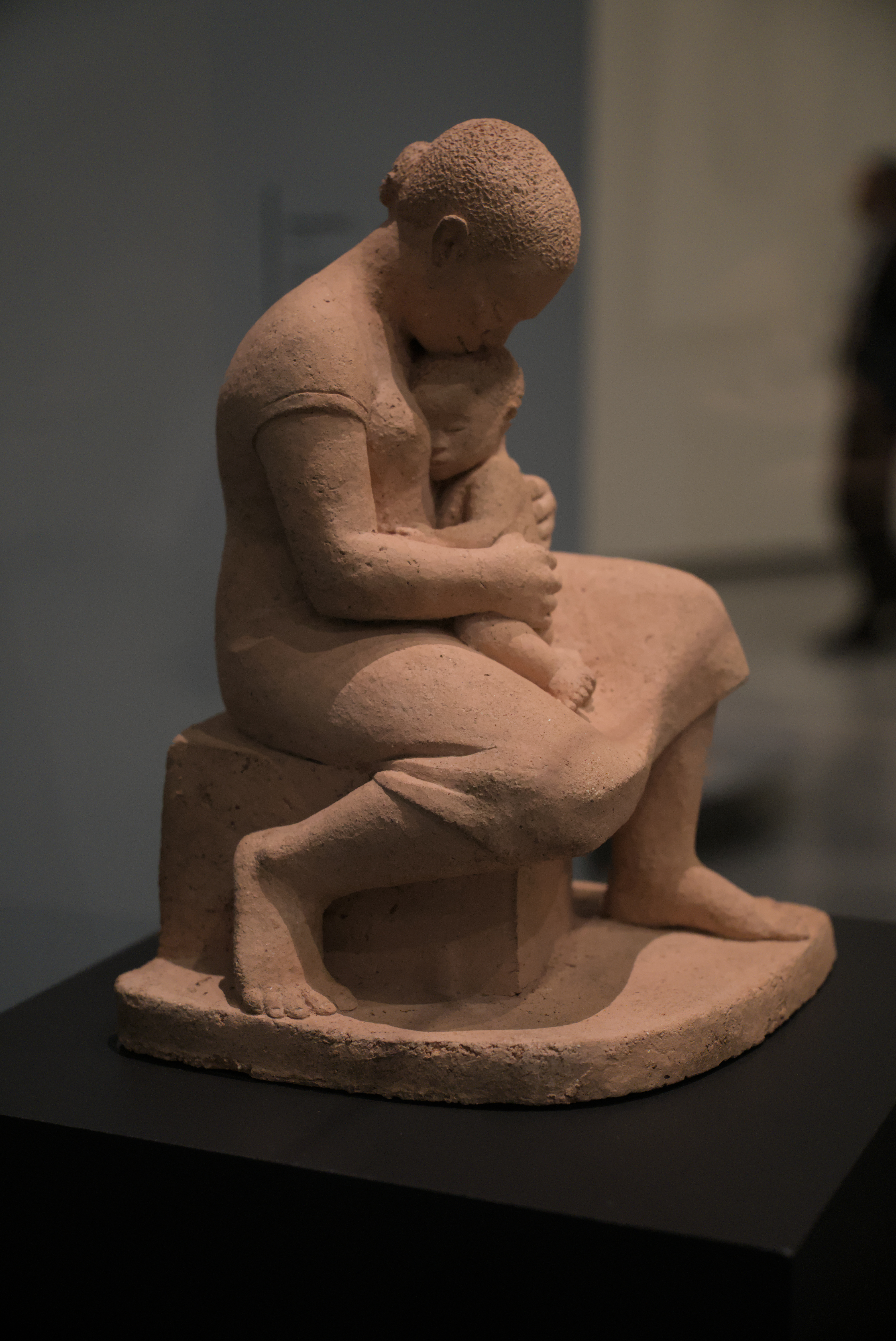
Mother-child artworks by Elizabeth Catlett

Last month I saw the exhibition Elizabeth Catlett: A Black Revolutionary Artist at the National Gallery of Art in Washington, DC, an impactful display of over two hundred prints and sculptures from throughout Catlett’s illustrious seven-decade career. Organized in partnership with the Brooklyn Museum of Art, where it first opened last year, the show focuses on Catlett’s advocacy, through her art and her on-the-ground activism, against poverty, racism, war, and gender oppression—her promotion of human dignity and freedom for all. Her work especially celebrates the beauty and strength of African American working-class women.

The exhibition title comes from a speech Catlett delivered in May 1970 by phone from Mexico to attendees at the Conference on the Functional Aspects of Black Art at Northwestern University outside Chicago, which she could not attend in person because the United States refused her entry to the country on the grounds of her allegedly dangerous politics: “I have been, and am currently, and always hope to be a Black revolutionary artist, and all that it implies,” Catlett stated.

Born in 1915 in Washington, DC, and raised there, Catlett witnessed class inequality, racial discrimination, and US imperialism firsthand, which formed her consciousness and influenced the direction her art would go. After graduating from Howard University, she spent time teaching in Durham (North Carolina), New Orleans, and Harlem and studying art in Iowa and Chicago before permanently settling in Mexico in 1946, becoming a Mexican citizen in 1962. She married the Mexican printmaker and muralist Francisco Mora in 1947, and they had three children together, all sons.

Black motherhood is a recurring subject in Catlett’s work, starting with her MFA thesis project in 1941 at the University of Iowa, a limestone sculpture of a mother and child that won first prize at the America Negro Exposition in Chicago that year but that is now lost. “Black women have been cast in the role of carrying on the survival of Black people through their position as mothers and wives, protecting and educating and stimulating children and Black men,” Catlett said. “We can learn from Black women. They have had to struggle for centuries.”

The social justice framework of the current retrospective exhibition leaves plenty of room for Catlett’s depictions of mothers with their children. What follows are photos I took of some such works.

Catlett, Elizabeth_Mother and Child
Elizabeth Catlett (American, active in Mexico, 1915–2012), Mother and Child, 1956. Terracotta, 28.6 × 17.8 × 17.8 cm (11 1/4 × 7 × 7 in.). Museum of Modern Art, New York.

My favorite is a terracotta sculpture made just a year after the lynching of fourteen-year-old Emmett Till, whose mother Mamie Till’s response was an important catalyst of the civil rights movement. It brings two bodies—that of mother and infant son—into one volume. Art historian Leah Dickerman remarks on

the uncanny way that it seems both intimate and monumental at once. Intimacy lies in the way the weight of the child’s face presses against the mother’s breast, the mother’s right leg pushed back to stabilize her balance and her head nestled against the child’s scalp, breathing in that smell. Tenderness, both affectionate and shielding, is conveyed so keenly it almost aches. . . . Catlett seems to capture, somehow, the idea of remembering something fleeting, the sculpture a tiny memorial to loving protection that cannot be maintained.

Catlett, Elizabeth_Mother and Child (detail)

Platformed across from this sculpture is another, in mahogany, this one modernist, abstracted:

Catlett, Elizabeth_Mother and Child
Elizabeth Catlett (American, active in Mexico, 1915–2012), Mother and Child, 1970. Mahogany, 49.5 × 33 × 21 cm (19 1/2 × 13 × 8 1/4 in.). Currier Museum of Art, Manchester, New Hampshire.

It shows a mother holding her baby in a swaddle, his or her head gleefully poking out from the folds. While the baby seems happy, the mother seems stressed, as she turns her head away and grabs her head with her hand, which I interpret as her taking a deep breath to compose herself for several more hours of caregiving before bedtime.

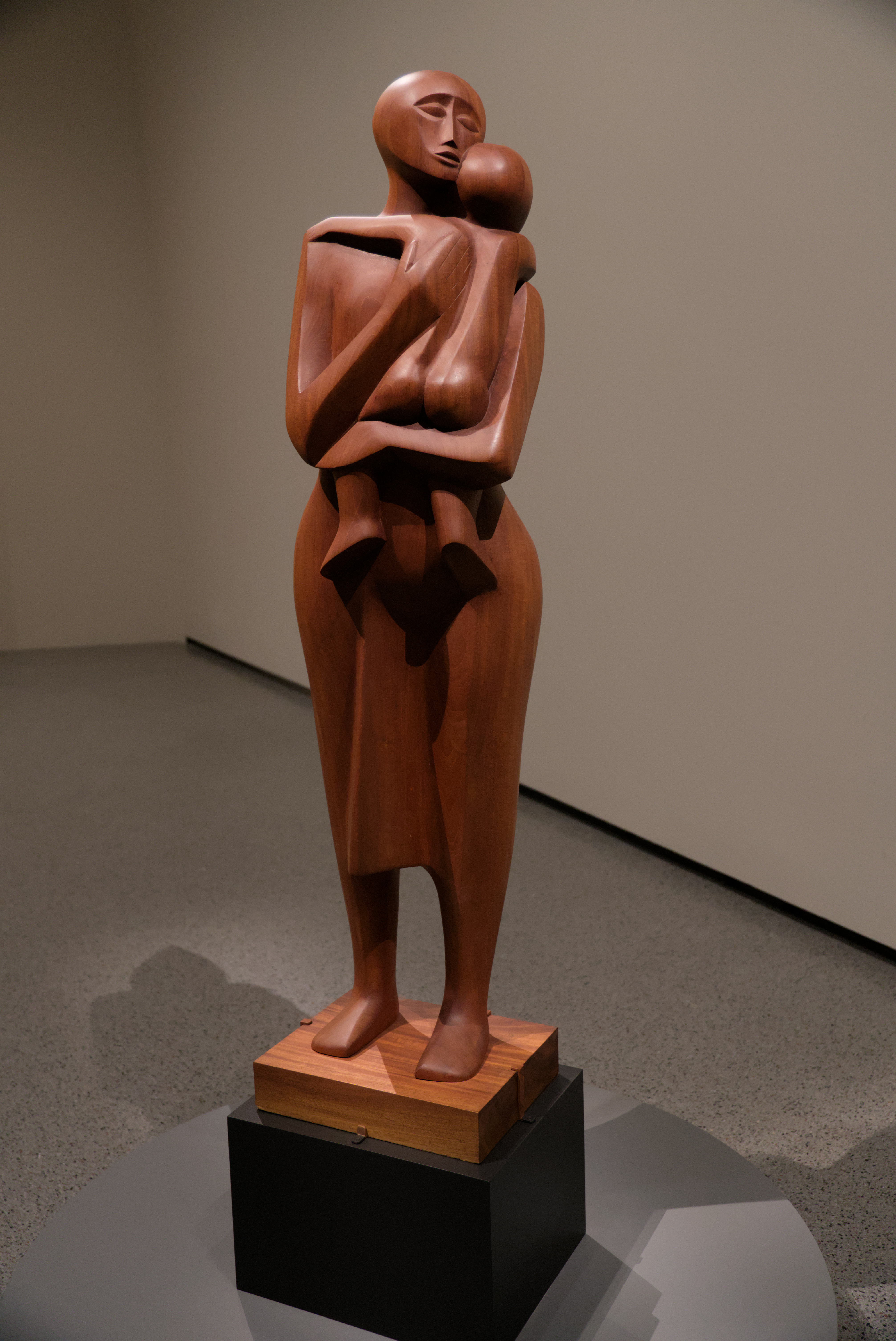
Another mahogany sculpture is borrowed from the New Orleans Museum of Art:

Catlett, Elizabeth_Mother and Child
Elizabeth Catlett (American, active in Mexico, 1915–2012), Mother and Child, 1983. Mahogany, 134.6 × 33 × 33 cm (53 × 13 × 13 in.). New Orleans Museum of Art, Louisiana.

The adjacent wall text quotes art historian Melanie Anne Herzog, author of Elizabeth Catlett: An American Artist in Mexico:

Becoming a mother, Catlett told me, was her most creative endeavor. She returned to the theme of maternity throughout her career in sculptures that illuminate the intimate physical bond between mother and child, a child’s comfort in its mother’s embrace, and the anguish of mothers who know they cannot protect their children from future harm. Catlett’s boldly corporeal rendering of maternity centers Black and Brown women in her depiction of this universal theme. I feel the fierce tenderness of this stately standing figure cradling her child, its body melded with hers. Her pensive expression and resolute stance call us to reflect on what she has endured and what her child, too, will encounter in the world that awaits.

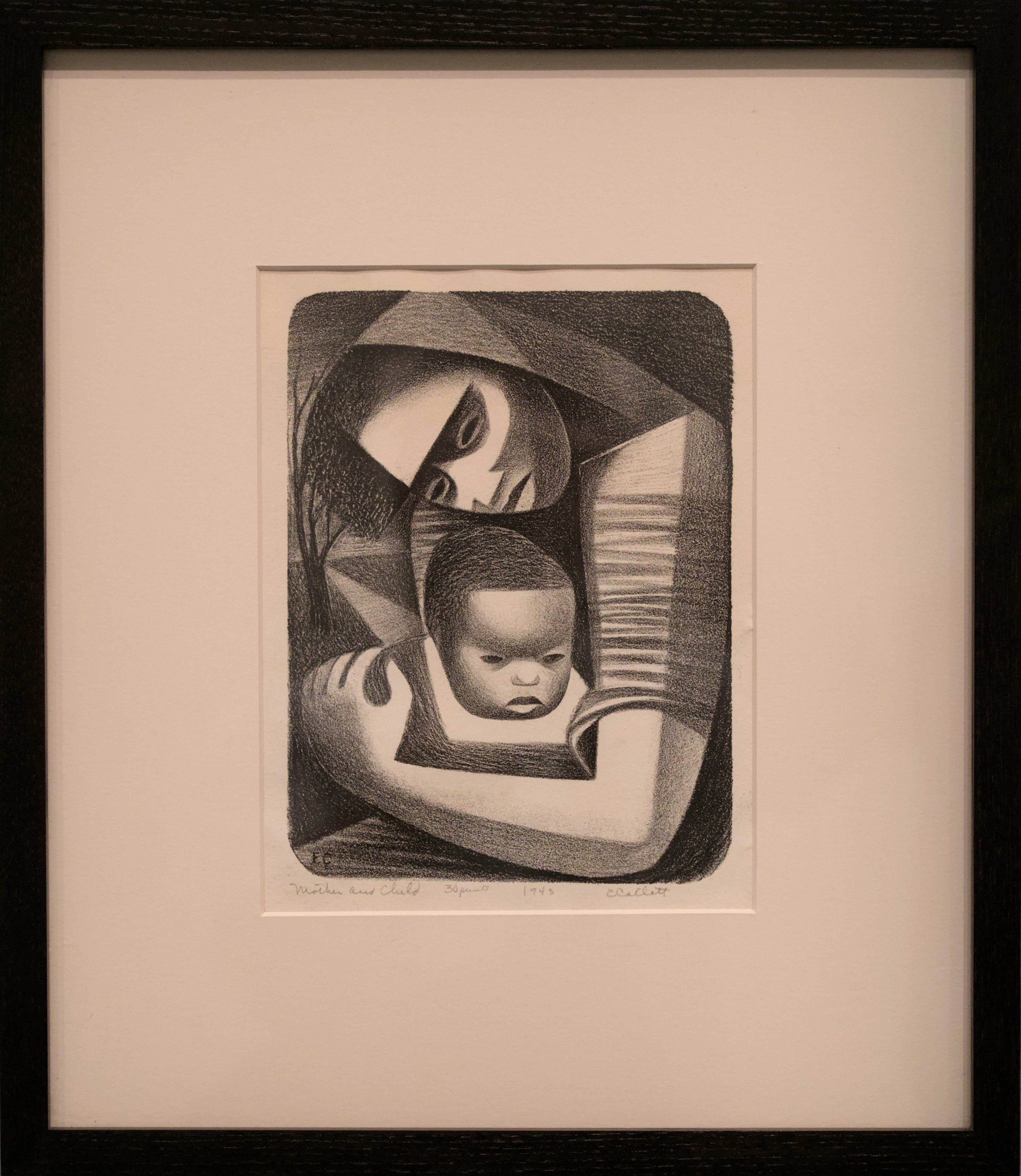
One of Catlett’s earliest prints of the mother-child subject is a lithograph from 1944:

Catlett, Elizabeth_Mother and Child
Elizabeth Catlett (American, active in Mexico, 1915–2012), Mother and Child, 1944, printed 1945. Lithograph, image: 19.7 × 14.3 cm (7 3/4 × 5 5/8 in.); sheet: 31.4 × 23.8 cm (12 3/8 × 9 3/8 in.). Canton Museum of Art, Canton, Ohio.

The label notes how it “recasts Christian Madonna and Child iconography in the context of a racially segregated United States. A leafless tree in the background and the mother’s protective clutch hint at the brutal history of lynching and violence against Black people.”

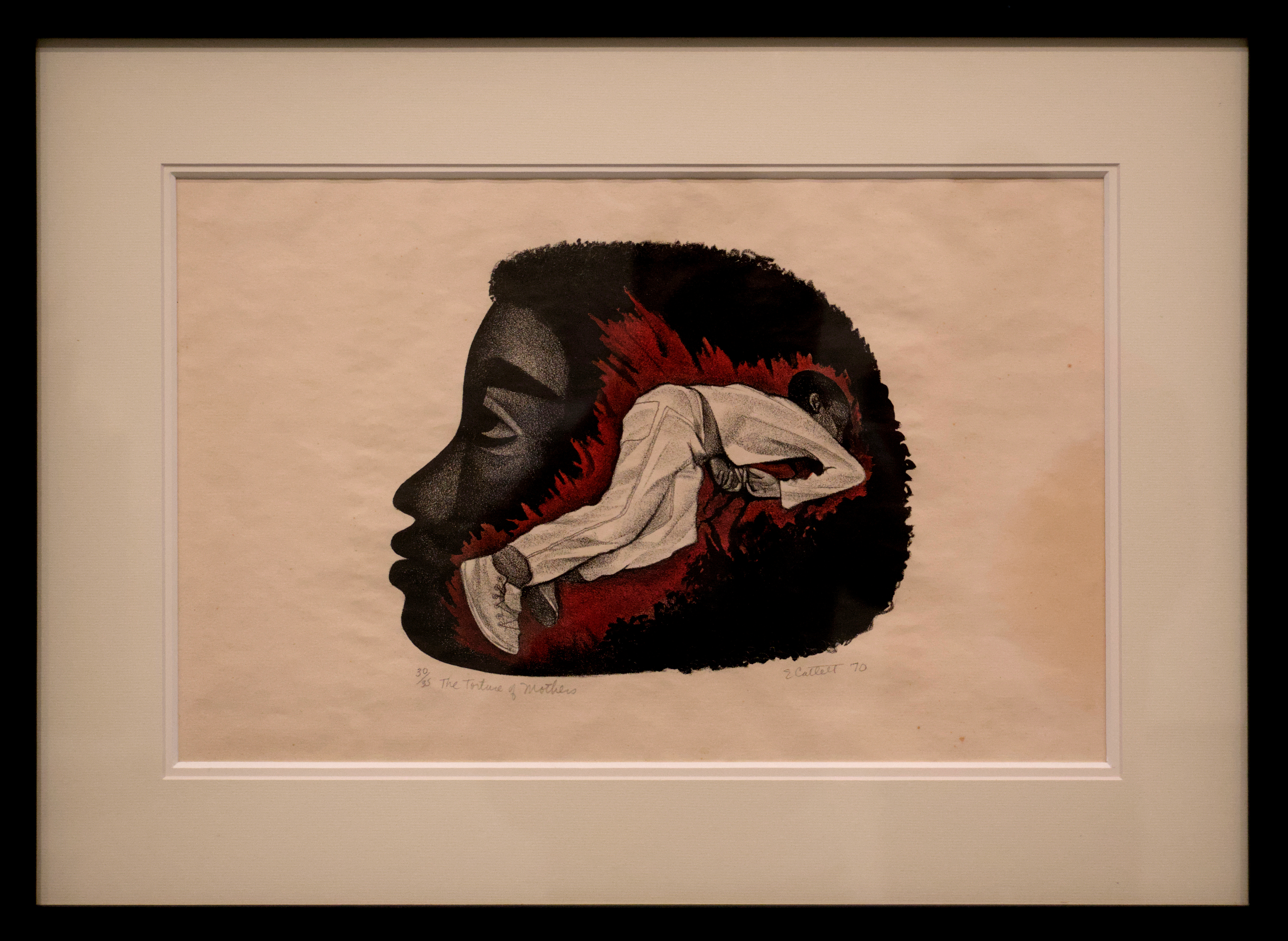
Even after her move to Mexico, Catlett remained connected to the Black liberation struggle in the US. Her Torture of Mothers from 1970 is based on the photograph by Bud Lee published on the cover of Life magazine’s July 28, 1967, issue, showing a twelve-year-old Black boy lying in a pool of his own blood in the middle of a street in Newark, New Jersey, having been shot by two stray police bullets. The police were trying to suppress the riots that had erupted in protest of the beating of a Black cab driver in Newark by two white police officers, and while Joe Bass Jr. was outside playing with his friends, he got caught in the crossfire.

Catlett, Elizabeth_Torture of Mothers
Elizabeth Catlett (American, active in Mexico, 1915–2012), Torture of Mothers, 1970. Hand-colored lithograph, sheet: 38.1 × 56.5 cm (15 × 22 1/4 in.); framed: 48.3 × 66 cm (19 × 26 in.). Collection of Juanita and Melvin Hardy.

“Catlett’s composition visualizes the emotional toll such events have on Black mothers and women of color more broadly,” the gallery label reads—mothers whose minds are continually haunted by the racial violence, sometimes even state-authorized, that threatens the safety of their boys. “While Catlett was tracking police brutality in the US, she was also aware of similar state violence against Mexican youth, including the mass shooting of student protestors in 1968 by police at the Universidad Nacional Autónoma de México where Catlett taught.”

Several of the mothers in Catlett’s art are posed in a protective embrace that seeks to shield their children from harm. The arms of her 1982 Madonna, for example, wrap around a son and a daughter, though her averted eyes look worried:

Catlett, Elizabeth_Madonna
Elizabeth Catlett (American, active in Mexico, 1915–2012), Madonna, 1982. Lithograph, sheet: 76.2 × 56.5 cm (30 × 22 1/4 in.). Stanley Museum of Art, University of Iowa, Iowa City.

In African American families, children are often raised by their grandmothers. Reflecting adaptability and support, such kinship care is memorialized in These Two Generations, which shows in profile a young boy and the primary maternal figure and caregiver in his life: his grandma.

Catlett, Elizabeth_These Two Generations
Elizabeth Catlett (American, active in Mexico, 1915–2012), These Two Generations, 1979, printed 1987. Lithograph, image: 48.3 x 55.7 cm (19 x 21 15/16 in.); sheet: 56.7 x 76.2 cm (22 5/16 x 30 in.); framed: 69.9 x 80 cm (27 1/2 x 31 1/2 in.). Collection of Otis and Harryette Robertson.

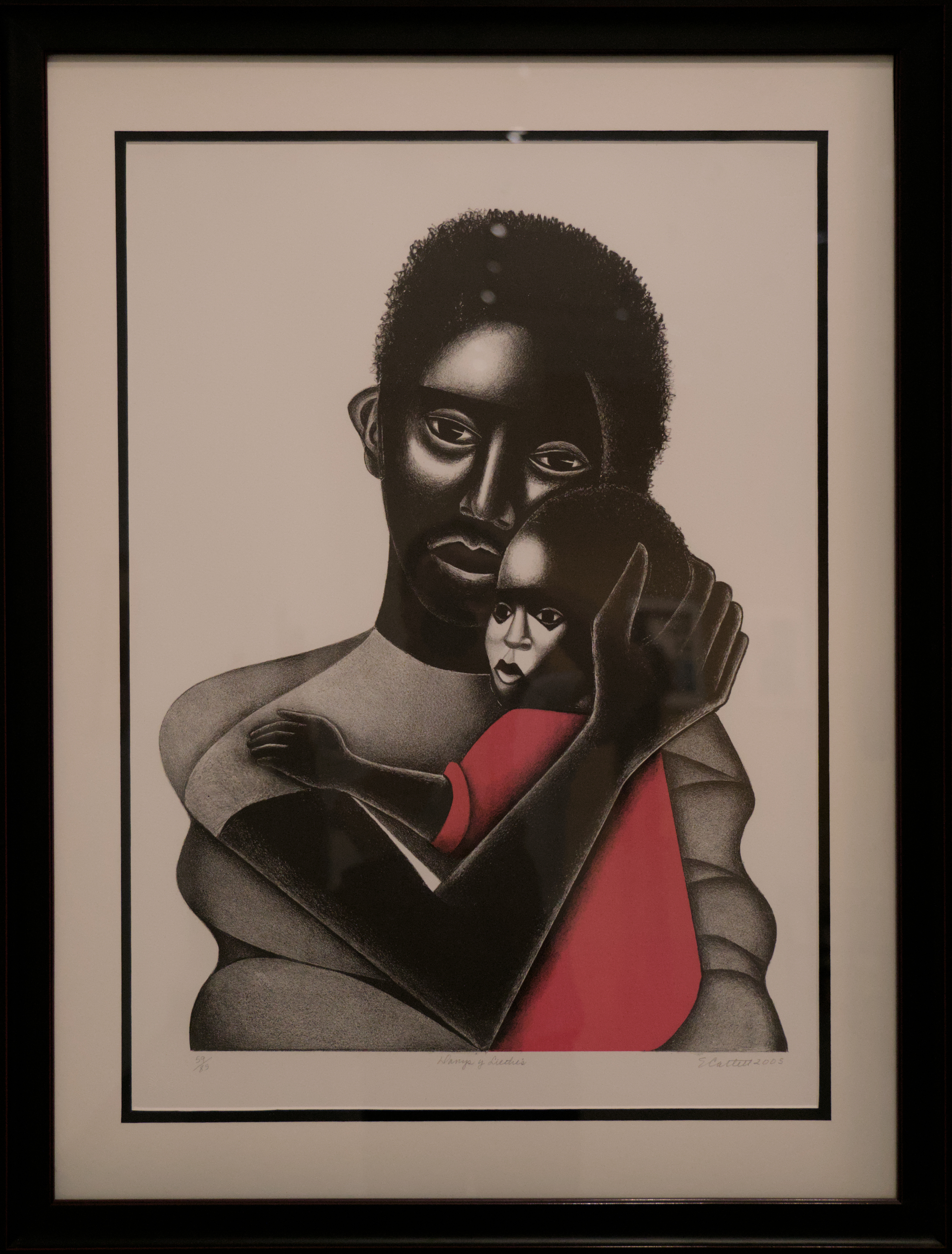
Skipping ahead to this millennium, the exhibition includes Danys y Liethis, a portrait of the artist’s niece and great-niece:

Catlett, Elizabeth_Danys y Liethis
Elizabeth Catlett (American, active in Mexico, 1915–2012), Danys y Liethis, 2005. Offset lithograph, sheet: 71 × 50.8 cm (27 15/16 × 20 in.); framed: 91.4 × 71.1 cm (36 × 28 in.). Collection of Barbara J. Luke.

Lastly, suspended from the ceiling at the exhibition’s entrance/exit, is Catlett’s most unique mother-child sculpture, Floating Family:

Catlett, Elizabeth_Floating Family
Elizabeth Catlett (American, active in Mexico, 1915–2012), Floating Family, 1995. Mexican primavera wood, overall length: 304.8 cm (120 in.). Collection of the Chicago Public Library.

It’s striking! Art historian Elissa Yukiko Weichbrodt writes beautifully about it on her Substack, whose words I’ll close with:

In many of her depictions of motherhood, Catlett unifies the mother and child into a single form, emphasizing their intimacy. But I’ve been thinking about her large-scale sculpture Floating Family, which usually hangs above the circulation desk at the Legler Branch of the Chicago Public Library. Here, mother and daughter are still tethered together, but instead of standing upright they are now perfectly horizontal. Are they maple seed pods, spinning and falling to the earth to plant something new? Or a rotor, lifting upwards, leaving gravity behind? Despite the seeming precarity of the moment, the mother’s face is calm and set, and the daughter looks up at her, trusting.

I imagine that it does something different in the context of a library than as the closing object in a museum retrospective. For me in October, after seeing so many sculptures of mothers cuddling their children close, this work evoked the particular terror and thrill of parenting adolescents. Now, it suggests more than that: the labor and love we give not only our children but our communities and the way that hope can sometimes feel like a free fall.


Elizabeth Catlett: A Black Revolutionary Artist will continue through July 6, 2025, at the National Gallery of Art before traveling to the Art Institute of Chicago for its final leg from August 30, 2025, to January 4, 2026. You can purchase the exhibition catalog here and view some of my other photos on Instagram.

Favorite Films of 2023, Part 1

Past Lives

I’ve seen over seventy films from 2023 (and there are still more I want to see!), and these are my top ten. My top eleven through twenty will be released this weekend in a separate post. Many are international, and what year to classify them as can be hazy; I go by the date on which the film was released in the US, which is when I have access to it.

If the film is streaming for free with a subscription service, I’ve noted that at the bottom of the entry. Otherwise, most are available for digital rental (Google Play is my preferred vendor), and a few are still in theaters. You might also see if your local library has any on DVD, as that’s how I watched several of these.

Please be aware that the following films have either PG-13 or R ratings, for various reasons. I don’t have a personal policy of “no x” or “no y” in the movies I watch, but if you do, please consult the MPAA rating descriptors or a more detailed content advisory before deciding whether to view the film.

1. Past Lives, dir. Celine Song. Kind, gentle, and empathetic, this semiautobiographical indie drama by debut director Celine Song follows Na Young, or Nora (Greta Lee), over the course of twenty-four years, from her young adolescence in South Korea to her emigration to Canada and then the US. Act 1 introduces us to Nora’s childhood sweetheart, Hae Sung (Teo Yoo), whom she reconnects with virtually twelve years later in act 2, shortly before meeting and befriending a white American man named Arthur (John Magaro) at a writers’ retreat. After another twelve years of not interacting, Nora and Hae Sung find each other again in act 3 at age thirty-six, when the single Hae Sung visits Nora, who’s now married to Arthur, in New York.

What I love about this film is how it subverts all the tropes associated with the romantic triangle. The characters aren’t possessive, conniving, or competitive. There are no heroes or villains here. The film is about bonds of love and culture, and especially about what trust, support, constancy, maturity, and love look like in a marriage. In an interview on the DVD special features, Song says Past Lives is at its core a love story between Nora and Arthur. It’s also a story of navigating a bicultural identity—living between two worlds, mourning the piece of oneself that’s lost with the adoption of a new home country, and integrating elements of one’s “past life” into one’s new life, continuing to be shaped by both.

The opening scene and closing scene are perfect. Song’s skill as a storyteller, honed over her years as a successful playwright, really shines through in her screenplay.

2. The Zone of Interest, dir. Jonathan Glazer. This chilling Holocaust drama centers on a Nazi family living their dream life in the literal backyard of the Auschwitz concentration and death camp. Rudolf Höss (Christian Friedel)—who is an actual historical figure—is the commandant of the camp; having risen through the ranks, he seeks to provide his wife, Hedwig (Sandra Hüller), and their five children a comfortable and idyllic life. It’s a risky choice to tell this story from a German perspective, but Glazer and the two lead actors more than succeed. We never actually set foot inside the camp; most of the scenes happen within the confines of the villa or at the nearby river where the family goes on outings. Nor do we directly see any of the horrors; we see merely hints, like smoke rising from a crematorium chimney in the background. But even more, we hear these intimations: a train pulling into the station, a tussle, a chase, a barking dog, a gunshot, screaming. All of this happens just over the wall, while Hedwig tends to her flower garden or her son plays with toys in his bedroom. (Props to the sound designer, Johnnie Burn.)

What is so disturbing about the film is the banality of evil that it reveals. Rudolf isn’t the type of villain who sneers or snarls or has violent outbursts. He brings his kids kayaking and reads them bedtime stories; he sips coffee with his wife. He could be us. “I wanted to show that these were crimes committed by Mr. and Mrs. Smith at No. 26,” Glazer said. Sanitization is one of the themes explored—lots of scrubbing.

3. Four Daughters, dir. Kaouther Ben Hania. Blending documentary and fiction, this film tells the true story of a Tunisian Muslim mother—Olfa Hamrouni—and her four daughters, the elder two of whom became radicalized by ISIS as teenagers and ran away to Libya to engage in jihad. In 2016 Kaouther Ben Hania saw media segments of Olfa calling out local authorities for their indifference and inaction and knew she wanted to make a film about the disappearance, to understand how a tragedy like this can happen in a family. She originally wanted to do a straight documentary but soon realized it would be more powerful, and more feasible, to have Olfa and her younger daughters, Eya and Tayssir Chikhaoui (born in 2003 and 2005), reenact their memories onscreen. Because daughters Ghofrane and Rahma Chikhaoui are still absent, actors Ichrak Matar and Nour Karoui were hired to portray them, and actor Hind Sabri stepped into the mother role for the scenes that took too high an emotional toll on Olfa.

This method of storytelling better reveals the story’s complex layers, as the three women are both inside and outside the scenes. They’re telling the past, but they’re also questioning it. They’re reflecting on their motivations as they discuss their memories with each other and Ben Hania—many of them traumatic, but others warm or simply ordinary, as when they talk about their first periods! Olfa, the mother, is a particularly complex character, as she is fiercely protective of her daughters but also perpetuates on them some of the patriarchal oppression that she herself suffered. The film is about motherhood, sisterhood, zealotry, rebellion, and violence, and it has left a searing impression on me.

4. Anatomy of a Fall, dir. Justine Triet. In this courtroom drama set in the French Alps, Sandra (Sandra Hüller) is suspected of her husband Samuel’s (Samuel Theis) murder. As the police investigate and the prosecution launches its interrogations, they uncover details about Sandra and Samuel’s conflicted relationship, and the couple’s visually impaired eleven-year-old son, Daniel (Milo Machado Graner), is forced to testify. Hüller’s performance is riveting—she gets my vote for Best Actress of the Year.

5. Saint Omer, dir. Alice Diop. Another French courtroom drama, this one based on the real-life story of Fabienne Kabou. Laurence Coly (Guslagie Malanda), a Senegalese immigrant to France, is on trial in Saint-Omer for the murder of her fifteen-month-old daughter, Lili, an action she blames on sorcery. Intrigued by the case as potential source material for the novel she’s working on, Rama (Kayije Kagame), pregnant, travels from Paris to attend the trial. But when Laurence’s motives prove inscrutable and mental illness is put on the table, Rama begins to worry about her own ability to mother. The testimony dredges up emotions for Rama surrounding her troubled relationship with her mother—also a Senegalese immigrant, who appears, from the flashback sequences, to suffer from depression—and sharpens her sense of cultural alienation. Rama is an analogue for the filmmaker, Alice Diop, who, as a documentarian and expectant mother at the time, attended the Kabou trial, and it forced her to face her own difficult truths.

Streaming on Hulu.

6. Dream Scenario, dir. Kristoffer Borgli. Paul Matthews (Nicolas Cage) is an evolutionary biologist teaching at a small-town college and living a quiet life with his wife and two daughters, when out of nowhere, he starts appearing in the dreams of strangers around the world and becomes instantly famous. An absurd comedy with elements of horror, Dream Scenario satirizes the fickle nature of celebrity in today’s internet age, in which even the most unremarkable people can become an overnight sensation, and the adoration of fans can turn to hatred at the drop of a hat. I was laughing out loud a lot at this one—and cringing too!

7. Fremont, dir. Babak Jalali. Donya (Anaita Wali Zada) is a young Afghan immigrant working at a fortune cookie factory in the Bay Area of California. Formerly a translator for the US Army in Afghanistan, she is ostracized by many of her fellow Afghans as a traitor, and she struggles with loneliness. But the film has an uplifting tone; it’s about survival, hope, and connection. The first full-length feature by the Iranian British filmmaker Babak Jalali, it is in English, Dari, and Cantonese.

Streaming on MUBI.

8. Monster, dir. Kore-eda Hirokazu. When her eleven-year-old son, Minato (Soya Kurokawa), starts behaving strangely and she hears that a teacher hit him, Saori (Sakura Ando) demands answers from the school. The story is told in three parts, each from a different narrative perspective: first the mom’s, then the teacher’s, then the boy’s. The truth gradually emerges with each shift, and a stormy finale brings things to a close.

9. Plan 75, dir. Chie Hayakawa. In a near future, the Japanese government launches a voluntary but coercive program encouraging the nation’s elderly citizens to terminate their lives in order to nobly reduce the burden on society. Having been forced to retire from her job as a hotel maid after one of her coworker peers slips in a hotel shower, Michi (Chieko Baishô) is considering signing up. The film focuses on her but also develops side stories for two Plan 75 employees: a Filipino migrant whose daughter back home needs an operation, and a man whose estranged uncle becomes a client.

10. Killers of the Flower Moon, dir. Martin Scorsese. Based on the best-selling nonfiction book by David Grann about the serial murder of members of Osage Nation in the 1920s, Scorsese’s Killers of the Flower Moon depicts the criminal ugliness of white greed and laments a grave historical injustice. When the Osage discover oil on the reservation they’ve been displaced to in Oklahoma, they become very wealthy, and white men from the outside move in to try to steal that wealth. The white crime boss and master of deception William Hale (Robert De Niro)—the movie uses all the real names—has ingratiated himself with the Osage over decades and has secretly been carrying out a plan to gain control of Osage headrights by killing off inheritors.

The movie focuses on Hale’s nephew Ernest Burkhart (Leonardo DiCaprio), a simpleton whom Hale compels to marry the young Osage woman Mollie Kyle (Lily Gladstone) and further manipulates to manipulate others. The movie suggests that the love been Ernest and Mollie is genuine but complicated, and I didn’t quite grasp what bound them together (was it just physical attraction?) or how much either of them knew about what was going on (was Ernest really that naive? did Mollie never suspect him or his uncle of foul play earlier on?). But I was engrossed for the full three-and-a-half-hour runtime, all the way to the gutsy final scene of the radio play and the beautiful, defiant coda.

Streaming on Apple TV+.

Read part 2.

“The Tower of Mothers” by Evelyn Bence (poem)

Kollwitz, Kathe_Tower of Mothers
Käthe Kollwitz (German, 1867–1945), Turm der Mütter (Tower of Mothers), 1937–38. Bronze, 27.9 × 27.4 × 28.8 cm. Art Gallery of Ontario, Toronto. Photo: Craig Boyko / AGO. Kollwitz lost her son in World War I, and much of her work from then on grappled with the horror of that loss or expressed antiwar resistance.

  a sculpture by Käthe Kollwitz

Five Bethlehem women close ranks
to shield sons with hip and hide.
“We will rest in the peace of His hands
before your swords pierce a child.
Spare them or shower us with spears.
Let our blood disarm you, rout you,
haunt you, cowering through nights
that smother your sleep.”
A bosom is no breastplate,
a skirt no fortress wall.
As futile as Babel
the tower falls in,
life upon life.
Death seizes all.

This poem was originally published in The Windhover: A Journal of Christian Literature, vol. 3 (Spring 1999). Used by permission of the author.

Evelyn Bence (born 1952) is a writer and editor living in Arlington, Virginia. She is the author of Room at My Table; Prayers for Girlfriends and Sisters and Me; Spiritual Moments with the Great Hymns; and the award-winning Mary’s Journal, a novel written in the voice of Jesus’s mother. She has served as religion editor at Doubleday, managing editor for Today’s Christian Woman, and senior editor at Prison Fellowship Ministries. Her personal essays, poems, and devotional reflections have appeared in various publications.